Tunisians demonstrate outside US embassy, demand envoy expulsion
Al Mayadeen | June 30, 2024
Tunisia saw on Sunday mass popular demonstrations outside the US embassy, in support of Gaza and in rejection of the ongoing Israeli aggression on the Strip, amid demands for the expulsion of the American ambassador and the closure of the embassy.
Since the start of the Israeli war on Gaza, Tunisians have been continuously taking to the streets and staging sit-ins to raise their voices in support of the Resistance and to demand an end to the genocide being committed in Gaza by Israeli occupation forces.
Salaheddine al-Masri, the chairman of the Tunisian League for Tolerance, told Al Mayadeen that the Israeli occupation would destroy itself if it dared to confront the Lebanese Resistance, as evidenced by the United States sending messages to the Israeli entity not to open a front with Lebanon.
Lebanese Prime Minister Says His Country in State of War Due to Threats From Israel
Sputnik – 29.06.2024
Lebanon is in a state of war due to threats and aggression from Israel, Lebanon’s caretaker prime minister, Najib Mikati, said.
“The threats we see are a kind of psychological warfare. The question that is on everyone’s lips ‘Is it a war?’ Yes, we are in a state of war. Due to Israeli aggression, there are a large number of civilian and non-civilian casualties and destroyed villages,” Mikati said in a statement on Saturday.
On June 18, the Israel Defense Forces (IDF) announced that it had approved operational plans for an offensive in Lebanon. Israeli Foreign Minister Israel Katz later said that Israel was “very close” to a decision to “change the rules” against Hezbollah and Lebanon, threatening to destroy the movement “in an all-out war” and to “severely hit” Lebanon.
Hezbollah Secretary General Hassan Nasrallah said that the movement could invade northern Israel if the confrontation intensifies further.
The situation on the Israeli-Lebanese border worsened after the start of Israel’s military operations in the Gaza Strip in October 2023. The IDF and Lebanese Hezbollah fighters fire at each other’s positions in areas along the border on a daily basis. The Lebanese Foreign Ministry said that around 100,000 people had to leave their homes in border areas, while the Israeli Foreign Ministry said that 80,000 Israelis had to do the same.
Saudi Arabia warns of ‘dire consequences’ of Israel’s new settlement plans in West Bank

Press TV – June 29, 2024
Saudi Arabia’s Foreign Ministry has warned of the “dire consequences” of Israel’s plan to expand illegal settlement in the occupied West Bank.
In a statement on Saturday, the ministry slammed the Israeli regime’s decision to legitimize five new outposts in the West Bank.
Saudi Arabia opposes the “ongoing Israeli violations of international law and international legitimacy resolutions,” it added.
“These violations undermine opportunities for peace and contribute to fueling conflicts and destabilizing regional and international security and stability,” the statement read.
On Thursday, Israel’s extremist finance minister Bezalel Smotrich announced that the Security Cabinet authorized one outpost for every country that unilaterally recognized Palestine as a state in the last month.
Last month, Spain, Ireland and Norway formally recognized the Palestinian state, joining over 140 UN member states that have recognized its statehood over the past four decades.
Slovenia and Malta have also indicated they plan to formally recognize the state of Palestine.
The five settlement outposts are Evyatar, Givat Assaf, Sde Efraim, Heletz, and Adorayim.
The Organization of Islamic Cooperation in a statement on Saturday condemned Israel’s new settlement expansion plan in the West Bank.
It said all actions and decisions taken by Israel as the occupying power to perpetuate its colonial regime in the occupied Palestinian territory are null and void under international law and the relevant UN Security Council resolutions, especially UN Security Council Resolution 2334 (2016).
No slow down in US shipments of 2,000lb bombs to Israel
The Cradle | June 29, 2024
The US has sent Israel over 27,000 bombs since the start of its horrific aerial assault on Gaza in October, Reuters reported on 29 June, including 14,000 highly destructive 2,000-lb bombs that US officials have acknowledged as “inappropriate” for Israel to use.
Reuters stated that the US military had transferred at least 14,000 of the MK-84 2,000-lb bombs, 6,500 500-lb bombs, 3,000 Hellfire precision-guided air-to-ground missiles, 1,000 bunker-buster bombs, 2,600 air-dropped small-diameter bombs, and other munitions, according to US officials who were not authorized to speak publicly.
A recent US shipment of bombs to Israel was allegedly delayed due to the inclusion of 2,000-lb bombs within it. Prime Minister Benjamin Netanyahu released a video harshly criticizing the White House for the delay.
A US official told Axios the White House’s “main concern from day one was the Israeli use of the 2,000-lb bombs in Gaza, which the administration thought was inappropriate.”
In October, Israel dropped a 2,000-lb bomb in the center of the crowded Jabaliya refugee camp, killing some 120 people.
However, Reuters notes that the totals suggest “no significant drop-off in U.S. military support for its ally,” despite the recent White House “decision to pause a shipment of powerful bombs.”
Experts told Reuters the size and contents of the shipments are sufficient for Israel to replenish weapons it has used in its eight-month bombing campaign, which has ruined much of Gaza, turning vast swathes into a “moonscape.”
In late April, Euro-Med Human Rights Monitor estimated that Israel had dropped approximately 70,000 tons of bombs on Gaza since the start of the war, an amount far surpassing the US and allied bombing of Dresden, Hamburg, and London combined during World War II.
Israeli leaders say that major combat operations in Gaza are winding down and that they are now shifting troops and resources to fight against the Lebanese resistance movement, Hezbollah, on the northern front.
While the US provides detailed descriptions and quantities of military aid sent to Ukraine to fight Russia, the White House has revealed few details about the full extent of US weapons and munitions sent to Israel, Reuters added.
US Secretary of State Antony Blinken has led the effort to supply bombs to Israel that have slaughtered over 37,000 Palestinians, the majority women and children.
In January, 19 Democratic lawmakers called Blinken’s decision to unilaterally approve two emergency weapons sales to Israel without congressional approval “highly unusual.”
Israel Lobby Cash Dominates and Perverts American Elections
Where is the Foreign Agents Registration Act of 1938 when you really need it?

BY PHILIP GIRALDI • UNZ REVIEW • JUNE 28, 2024
Once upon a time the United States of America was a constitutional republic that was by design constructed with checks and balances to limit corruption and constrain the ability of any branch of government to initiate certain potentially harmful actions, like going to war, which required approval by both Congress and the Executive Branch. Of course, that was 261 years ago and things change over time. Today’s America, what claims to be both a democracy and the issuer plus enforcer of international rules and norms, is arguably one of the most corrupt as well as most disliked countries on earth, with a political system that is exceptionally vulnerable to those who have deep pockets and a willingness to spend freely to obtain favors from the professional politicians and bureaucrats who now proliferate throughout the system.
If one measures the consequences arising from all the corruption, there is no better example than the heavily lopsided relationship with Israel, which has been produced through the infusion of hundreds of billions of dollars coming primarily from Jewish billionaire and corporate sources. Casino magnate Sheldon Adelson famously gifted Donald Trump with $100 million and in return received what he demanded, i.e. a United States decision to move the US Embassy from Tel Aviv to Jerusalem and a recognition that Jerusalem would be recognized as the country’s capital, which was illegal under international law. Additionally, Trump’s team headed by Israeli apologist Ambassador David Friedman, brought about the recognition of the Jewish state’s annexation of the occupied formerly Syrian Golan Heights, also an illegal concession, and the de facto granting of a free hand to Israel for dealing with the Palestinians as it sees fit, which is playing out currently. Trump also was in the business of canceling a nuclear monitoring agreement with Iran, which was very much in the US interest, and the assassination senior Iranian Revolutionary Guard commander Qassim Soleimani, a war crime.
The heavily pro-Israel policies have not developed in the US because of some actual affinity between the two nations but rather because of great dollops of Jewish money liberally applied to politicians and journalists to create a myth of an actual beneficial alliance between the two to produce a narrative that the US public would be inclined to accept. In this massive coordinated effort by what is euphemistically referred to as the Israel Lobby there is no more active entity than the basically illegal American Israel Public Affairs Committee (AIPAC) and its conjoined AIPAC-Political Action Committee, which delivers the cash and also the intimidation of political candidates who do not embrace the Jewish state with enthusiasm. Such dissidents are marked for removal through the surfacing of opposing prospective candidates who are particularly well-funded and sure to receive exceptionally favorable press. In the current round of primaries just concluded, AIPAC-Pac has boasted that it has achieved 100% success as “an AIPAC-endorsed candidate has won in every district (224 races) where an endorsee was on the ballot. All 90 AIPAC-backed Democrats who have had their primary races in 2024 have won. These Democrats are strong pro-Israel voices. 134 AIPAC-backed Republicans have [also]won their elections. Being pro-Israel is good policy and good politics.”
How does it work? As international lawyer John Whitbeck has described the process “the primary reasons why virtually all members of the US Congress prioritize the desires of the Israeli government over the interests of the American people are money and fear — and particularly the fear of all the money that Israel-Firsters will devote to ending your political career, most notably through primary elections, if you manifest anything less than unconditional support and/or abject subservience to Israel.” In the most recent primary in New York state, AIPAC boasts over having devoted a record $15 million, a record amount spent on a primary election, to delivering exemplary punishment to end the political career of Representative Jamaal Bowman, a rare progressive in Congress who has been an outspoken critic of Israeli apartheid and genocide. Among other damnation of Bowman’s record, he was inevitably accused of “antisemitism.” Only a single such example every few years has proven to be enough to keep virtually all members of Congress in line. One might ask former Congressmen like Cynthia McKinney and others in a long line who felt the wrath of AIPAC and its sister organizations. That would include now deceased Senators William Fulbright, Charles Percy and James Abourezk and Congressmen Paul Findley, Pete McCloskey and Jim Traficant.
It has recently been revealed that nearly all congressional candidates are routinely and openly approached by AIPAC representatives who ask in advance their views on Israel. If they are cooperative, sometimes requiring a written statement of intent, they are given a pass and can count on financial support and favorable media. If they are not, they are marked for removal. And one can even sympathize with members of Congress who are self-defined careerists in politics, as, again per Whitbeck, “what is the point, when all around you are groveling flat-out- prone in subservience to Israel, in raising your head on a matter of principle? Your head will simply be cut off, and nothing will change for the better as a result of your sacrifice. There is really no rational choice but to faithfully follow the orders of your ‘AIPAC babysitter.’” The “babysitter” is an AIPAC endorsed staffer placed in nearly every congressional office to monitor and report on Israel issues, a development which has recently been revealed by Congressman Tom Massie while being interviewed by Tucker Carlson.
So how do we limit the ability of Israel to corrupt America’s political system to such an extent that many now believe that Prime Minister Benjamin Netanyahu controls US foreign policy while his domestic lobby creatures at the same time influence as well many other aspects of how the government operates at state and national levels? And why do I refer to the actions of AIPAC and other groups as illegal? Israel is able to act with impunity because of the undeniable powerful influence of its domestic US lobby coupled with its skill at being able to hide what it is up to. The Lobby also has a free hand because the federal government does not enforce its own laws when it comes to the illegally nuclear armed Jewish state. AIPAC, not to mention groups like the Anti-Defamation League (ADL), the American Jewish Committee (AJC), are actually acting as directed agents of the Israeli government and therefore subject to the terms of the Foreign Agents Registration Act (FARA) of 1938 which requires organizations that take foreign direction regarding their activities to open up their books and records to scrutiny. It also requires some transparency vis-à-vis their contacts and relationships with the Israeli Embassy and the country’s Foreign Ministry and intelligence and security agencies.
The Act is usually referred to as FARA and was originally intended to monitor groups acting on behalf of the German and Italian governments prior to World War 2. It has since been used to limit the activity of Russian and other entities that have operated in the US but has never been applied against Israel, in itself yet another indication of the power of the Israel Lobby and its ability to suppress any exposure of its activities. Journalist and lawyer Isaiah Kenen had founded the American Zionist Committee for Public Affairs (AZCPA) as a lobbying division of the American Zionist Council in 1953 but it soon separated from AZC and became AIPAC in 1954. Kenen, an actual lobbyist for the Israeli government, had earlier worked for the Israeli Ministry of Foreign Affairs. AIPAC is today generally considered the most powerful and wealthiest Israeli lobby in the United States. President John F. Kennedy and his brother Attorney General Robert F. Kennedy understood the threat that it represented and sought to compel both AZC and AIPAC to register under FARA but JFK was assassinated shortly thereafter, which have led many to believe that the killing was a Mossad job. Registration under FARA would have inter alia blocked any funding of US political parties and politicians by those groups acting in support of Israeli interests. It would with one stroke take away much of Israel’s ability to corrupt America’s political system in its favor.
In comments to my articles I am often asked what can we ordinary Americans do to bring the Israeli influencers in this country under control. Well, after recognizing that there is a problem, a partial answer is there by enforcing FARA. One needs to put pressure on individual congressmen and the White House through the media to register AIPAC and other pro-Israel groups. Corrupting money is the key to their power and if the spigot of cash is shut off to the politicians and parties their influence will be greatly diminished. And don’t be surprised if there will be many politicians who are privately ashamed at what has been going on who will suddenly become supporters of control over the Jewish groups. The Lobby has been bad for America and not even particularly good for Israel as “sacrosanct” US support for Israel, as Joe Biden puts it, has freed folks like Netanyahu to engage in very dangerous enterprises for his own country as in Gaza and also against its neighbors and for so-called allies like the US. Time to put an end to the status quo.
Philip M. Giraldi, Ph.D., is Executive Director of the Council for the National Interest, a 501(c)3 tax deductible educational foundation (Federal ID Number #52-1739023) that seeks a more interests-based U.S. foreign policy in the Middle East. Website is councilforthenationalinterest.org, address is P.O. Box 2157, Purcellville VA 20134 and its email is inform@cnionline.org.
If the war expands, will western facilities become the new target banks?
The Cradle | June 28, 2024
Israel’s brutal, nine-month military assault on Gaza has full support from several western-allied states, not only in supplying the occupation army’s war machine with a broad range of armaments and ammunition but also through direct military participation. The United States and Britain, for example, have provided vital reconnaissance and intelligence data and have sent their special forces to assist Israel in military operations.
An 8 June New York Times report revealed that US forces assisted the Israelis in retrieving four Israeli captives from Gaza’s Nuseirat refugee camp, killing at least 274 Palestinian civilians and three additional captives and leaving over 698 wounded. According to the paper’s Israeli sources, the US and UK provided intelligence from the air and cyberspace that Israel could not obtain on its own.
On 29 May, the Declassified UK media project reported that London authorized an unprecedented 60 Israel-bound flights using cargo planes that took off from the UK’s RAF Akrotiri air base in Cyprus, a facility covertly used by the US Air Force to move weapons to Israel.
The British government has not revealed the content of the air cargo transported – and maintains that no “lethal aid” is included. London instead claims that RAF flights to the occupation state are used to support its “diplomatic engagement” with Tel Aviv and repatriate British subjects – an odd use of military aircraft when Israel’s Ben Gurion Airport is still operational for regular passenger travel.
London has vigorously invoked its D-Notice since just after the war’s onset, a military and security directive aimed at preventing media outlets from publishing information that could harm national security, specifically relating to British airborne Special Forces (SAS) operations in Gaza. No further information has been revealed since the directive was issued on 28 October 2023.
How western intel penetrates West Asia
But all those concealment efforts were cracked open during Israel’s disproportionate military operation to secure the release of captives during the recent Nuseirat camp fiasco. Trending videos appeared of an Israeli helicopter landing next to the recently-installed $320 million US’ aid pier’ and of ‘aid trucks’ carrying special ops teams that were flanked by armored vehicles during the operation.
Media then reported that dozens of US and UK drones assisted in the Nuseirat camp assault, ostensibly by providing reconnaissance services to the Israeli military.
These incidents highlight not only direct western military participation in the war on Gaza but also the brazen exploitation of diplomatic cover or humanitarian work to prepare and carry out military actions that have led to mass civilian casualties and war crimes, as described by many United Nations institutions.
The question now is whether western facilities and troops will come under target as the war expands, potentially to Lebanon, given the evident collusion of western states in Israel’s aggressions – especially those in flagrant violation of international norms and law.
Although the use of embassies and civilian institutions – in the modern sense – as bases for intelligence gathering and launching special missions is not a new practice and dates back to at least the nineteenth century, current developments in technology and computing have enabled these facilities to act as spying and eavesdropping centers, monitoring and storing information for an entire country.
What was previously impossible has become reality through wireless communication and the Internet. Signal intelligence formerly gained by planting eavesdropping and listening devices can now be accessed via the common smartphone – with data funneled to these centers inside sovereign states.

Aerial view of the US embassy complex, northern Beirut.
‘Second-biggest US Embassy in the world’
Spawling approximately 174 thousand square meters, around 13 kilometers from the Lebanese capital of Beirut, lies the second largest embassy in West Asia – and the world. The new US Embassy in Beirut is surpassed in size only by its counterpart in Baghdad’s “Green Zone.”
Subtracting from the massive size of the embassy and its cost of nearly a billion dollars, there are many questions about the need for such facilities and what they contain.
The computer-generated images published by the embassy show a complex featuring multi-story buildings with tall glass windows, entertainment areas, a swimming pool surrounded by greenery, and views of the Lebanese capital. According to the project website, the complex includes an office, representative housing for employees, community facilities, and associated support facilities.
In May 2023, the Intelligence Online website reported that the massive billion-dollar complex will include a data collection facility, preparing the site as the new regional headquarters for US intelligence. The report says that because of its proximity to Syria, “Lebanon is considered a safe and strategic location for the deployment of intelligence agents already in the region as well as new personnel, who are selected directly from Washington-based agencies.”

Construction of the new US embassy, 13 kilometers north of the Lebanese capital of Beirut.
Although it is not possible to obtain precise information about the design of this embassy, the excavations below surface level, the use of reinforced concrete in the structure, and its fortified location on top of a hill suggest that there is more to its operations, especially since several precedents of the US Beirut diplomatic mission being implicated in the work of intelligence services exist.
The 1983 bombing of the American Embassy revealed a high CIA death toll, with eight killed, including the CIA’s chief West Asia analyst and Near East director, Robert Ames, station chief Kenneth Haass, James Lewis, and most of the CIA’s Beirut employees.
The embassy was not only used as a CIA hub but also as a key regional intelligence base due to Lebanon’s proximity to both the sea and two British NATO bases in southern Cyprus, Dhekelia and Akrotiri, from which reinforcements or helicopter transfers can arrive rapidly onto Lebanese soil. A recent example, in 2020, is Washington’s smuggling of its agent Amer al-Fakhouri from the US embassy using an Osprey helicopter.
British Watchtowers on Lebanon’s borders
On 3 May, Lebanon announced the visit of an official delegation and a senior British intelligence officer the previous month to discuss the construction of new UK-built watchtowers. These are in addition to the more than three dozen watchtowers built by Britain during the Syrian war along the sensitive border between Lebanon and Syria.
According to leaks reported by Lebanon’s Al-Akhbar newspaper, the British delegation had asked the Lebanese army “to approve a plan to establish watchtowers along the border with occupied Palestine, similar to those existing on the eastern and northern borders with Syria.”
Following the low-profile visit, Lebanese caretaker Prime Minister Najib Mikati disclosed: “Establishing the towers and taking measures along the border are Israel’s conditions for stopping the war with Lebanon.”
Last February, the Lebanese Foreign Ministry received an official Syrian protest note classifying the British watchtowers as a threat to Syrian national security on several levels. The main threat is the tower systems’ sensitive intelligence and espionage equipment, which “shines deep into Syrian territory and collects information about the Syrian interior.”
According to Al-Akhbar’s report, “the information output from this equipment reaches the hands of the British, and the Israeli enemy benefits from the output to target Syrian territory and carry out strikes deep inside Syria.” The Syrian memorandum also refers to “the presence of some British officers at the towers.”

A 30-foot British watchtower near the Lebanese-Syrian border
Security cameras monitor the surrounding area at a border point on Lebanon’s border with Syria (Photo by the Lebanese Army Command, Orientation Directorate)
The 38 British watchtowers that claim to assist Lebanese authorities in “combating smuggling” raise many questions instead, among them the reasoning behind the erection of such a large number of these structures. Why, too, do the towers contain thermal monitoring, eavesdropping, signal intelligence, and communications equipment – especially in light of the close relationship between Tel Aviv and London and the periodic presence of British officers in these towers under the pretext of training the Lebanese army?
A commanding officer of the Lebanese Armed Forces (LAF), interviewed at length by The Cradle in August 2021, contradicts London’s public claims about the towers, saying: “The aim of the towers today is to monitor the movements of Hezbollah and the Syrians.”
Dutch special forces in Dahiyeh
In March, Hezbollah captured several Dutch military forces operating covertly in Dahiyeh, the southern suburb of Beirut, which hosts several offices of the Lebanese Resistance. The detainees claimed they were operating under cover of the Dutch Embassy in Lebanon and were found with hundreds of thousands of dollars worth of military equipment and advanced communications devices on their persons and in their vehicles.
During investigations, the Dutchmen claimed they had entered the southern suburb as part of a training exercise for evacuating Dutch citizens and diplomats in the event of a war. However, no Dutch nationals of the embassy resided in that area. It was also found that the servicemen had not communicated about their mission with the Lebanese Ministry of Foreign Affairs, the Lebanese security services, or their country’s embassy.
That same month, a Spanish citizen was arrested for filming inside the same southern suburb of Beirut, only to discover later that he had a diplomatic passport and that his phone contained advanced software that prevented access to its data.
These events and a myriad of other examples show that some western governments continuously use western diplomatic and civilian facilities to gather intelligence or conduct special missions training in sovereign Lebanon.
These actions constitute a clear violation of the Vienna Convention on International Relations and the Vienna Convention on Consular Relations, which prohibit embassy diplomats from carrying out espionage activities. These actions don’t only place civilian populations in danger but also the thousands of professional diplomats in the country, all diplomatic missions, and the civilian facilities used as cover for illicit operations. They also drag otherwise immune diplomatic facilities into the legal framework of “hostilities,” intentionally or accidentally.
This danger is reinforced by Israel’s repeated violations of diplomatic and international norms, which are either ignored or protected by western allied states. Israel’s unprecedented military strikes against Iran’s consulate building in Damascus in April, for instance, did not receive the deserved condemnation from most western capitals, which helped it avoid the requisite UN Security Council censure.
Since the basic value of international norms is the precedent and event on which this law is built, the possibility increases that such western-supported attacks will backfire wildly and lead to the retaliatory targeting of western facilities and embassies – all in the context of new legal precedents and customs created that no longer prohibit strikes on suspect non-military facilities.
It is yet unknown to what extent western governments can expect to maintain their double standards in the application of international law and customs, especially if the Gaza war they are materially supporting expands to Lebanon or other West Asian regions.
The Resistance Axis, which has, in the past nine months, normalized military strikes on Israel, missile attacks on Israel-destined shipping vessels, and weekly strikes on US and UK naval fleets, are but one escalation away – as in, a declared war on Lebanon – to create a new set of target banks that surpass their last ones.
Does that then include the US embassy in Baghdad, the largest in the region – and the world – hosting 10 thousand American employees and troops, or, closer to home, the second largest embassy in West Asia, the US embassy in Beirut?
It is difficult to imagine that such facilities will remain immune if western involvement remains apparent, which we already know to be a constant, daily flow of armaments to fuel Israel’s war machinery and provide Tel Aviv with military intelligence and target banks.
It will be even harder to protect diplomatic missions if they reveal themselves to essentially act as military command centers or intelligence hubs during the conduct of war. Targeting these facilities – which are already in breach of the Vienna Convention – can easily fall within the framework of self-defense and reciprocity as long as western states and Israel continue to normalize these illicit activities.
If the Gaza war established entirely new rules of engagement throughout the region, do Israel’s western allies expect to escape unscathed in an expanded war? How do they think they can arm military aggression against a country and yet remain safely in its capital city?
Over 80 UK war planes deployed from Cyprus to Lebanon since 7 Oct: Report
The Cradle | June 28, 2024
The UK has sent over 80 military transport planes to the Lebanese capital of Beirut since the start of Israel’s war on Gaza nine months ago, Declassified UK reported on 28 June.
All the flights have gone from the UK’s massive Akrotiri airbase on the nearby island of Cyprus, long a staging post for UK bombing missions in West Asia.
Declassified UK notes that the number of UK military flights to Beirut has risen dramatically in recent months. The group tracked 25 flights in April and May and 14 so far in June.
Flights from the UK base take around 45 minutes to reach Beirut, which Israel has increasingly threatened to bomb in a possible full-scale war with the Lebanese resistance movement, Hezbollah.
The Ministry of Defense declined to disclose the number of UK military flights to Lebanon since the start of the war on 7 October or their purpose.
A defense source told Declassified UK that the flights “have been primarily for the purpose of facilitating senior military engagement” with the Lebanese army.
But it is widely assumed the planes are carrying weapons to Beirut to arm anti-Hezbollah militias. The US, UK, and Israel would presumably use these militias to attack Hezbollah from within the country in the case of an Israeli invasion from the south.
Declassified UK notes that nearly every Royal Air Force flight to Lebanon has been the Voyager KC mark 2, which can carry a payload of 45 tons and 291 personnel or provide air-to-air refueling. Another flight involved a vast C-17 cargo plane.
Israeli threats to invade Lebanon have accelerated in tandem with the increase in flights.
Israeli military leaders have increasingly warned of a Lebanon campaign to push Hezbollah away from the border and past the Litani River.
Last week, the Israeli army approved “operational plans for an offensive in Lebanon,” and the US pledged to support Israel with weapons if a full-scale war breaks out.
Hezbollah leader Hassan Nasrallah warned the resistance movement will use its massive rocket and missile arsenal to hit targets across Israel in a “total war” if Tel Aviv decides to launch an invasion.
Nasrallah also threatened Cyprus, noting its role as a US, UK, and Israeli staging ground.
“The Cypriot government must be warned that opening Cypriot airports and bases for the Israeli enemy to target Lebanon means that the Cypriot government has become part of the war and the resistance [Hezbollah] will deal with it as part of the war,” he said.
Nasrallah’s threat appeared to include the Akrotiri base, which lies in territory retained by the UK when Cyprus gained independence in 1960. The territory now hosts vast military and intelligence hubs for Britain and the US, Declassified UK notes.
These are the craziest ‘pro-Israel’ votes on the Hill today
BY BLAISE MALLEY | RESPONSIBLE STATECRAFT | JUNE 27, 2024
In the more than seven months since Israel’s war on Gaza began, the Biden administration has been almost entirely deferential to the war effort, providing Tel Aviv with $6.5 billion worth of weapons, offering rhetorical and diplomatic cover, and holding Hamas wholly responsible for the inability to strike a ceasefire deal.
To some members of Congress — mostly Republicans — this level of support for Israel does not go nearly far enough.
This week, the House of Representatives will be voting on the Department of State, Foreign Operations, and Related Programs appropriations legislation. Among the 75 amendments to the bill that were made in order and will be voted on are a series of anti-Palestinian proposals that seek to eliminate any appearance of balance in the United States’ approach to the war.
Two of the amendments seek to “prohibit funds” appropriated in the bill from being spent on holding Israel accountable for any violations of U.S. law.
One, introduced by Rep. Brian Mast (R-Fla.) “Prohibits funds from enforcing Executive Order 14115,” which Biden announced in February of this year as a way to sanction individuals or groups who the administration deemed “undermining peace, security and stability” in the West Bank. The effort was widely seen as an effort to punish extreme Israeli settlers — as of March, nine Israelis have been sanctioned under the law — but in June the U.S. also sanctioned a Palestinian armed group.
The other, introduced by Reps. Andy Ogles (R-TN) and Eric Burlison (R-Mo.), would block “the use of funds from being used to administer or enforce National Security Memorandum 20.” NSM-20 is the memo issued by Biden in February that required the administration to receive written assurances that recipients of American military aid were complying with international law — in essence, ensuring that no one is using our weapons while committing atrocities, including blocking aid and medicine from getting to civilians.
The first report issued to Congress under this memorandum found that Israel had not violated the law in war conduct or in the distribution of international law. The directive would require the State Department to issue a new report each fiscal year.
Both Executive Order 14115 and NSM-20 call on Israel to do the bare minimum to comply with U.S. law, and critics, including in Congress, have argued that the administration has not gone nearly far enough in administering them.
How exactly Congress could “defund” either of these operations is not exactly clear, but both of these are likely intended as symbolic messages that the United States should not do anything that could in any way constrain Israel as it carries out its war.
Two other proposed amendments are aimed at ensuring that Americans are not aware of the scale of suffering in Gaza nor capable of alleviating it.
A bipartisan group of five representatives, led by Rep. Jared Moskowitz (D-Fla.) introduced an amendment that would prohibit “funds appropriated by this act to be made available for the State Department to cite statistics obtained from the Gaza Health Ministry.”
Given that the Health Ministry — which estimates that more than 37,000 Palestinians have died since October — is the only official source for casualties in the Strip, members seem to think the amendment will preclude the State Department from using the statistics. If so, officially, the U.S. would be ignoring the true scale of destruction in Gaza if this amendment is adopted.
Supporters of Israel have used the fact that Hamas runs the outfit as a way to undermine the death count for public perception, though the figures offered by the ministry have in the past been corroborated by international organizations and the Israeli government.
Meanwhile, the humanitarian pier — the Biden’s administration’s military plan for getting aid into Gaza — has been a failure. Operations have stopped and started intermittently due to the weather, the amount of aid entering Gaza through the pier is wholly inadequate, and even the supplies that have reached the Strip have not made their way to Gazans due to aid workers’ safety concerns. But aside from air drops, absent a ceasefire or the Biden administration putting real pressure on the Israelis, the pier remains the only way that Washington is currently sending assistance.
Nevertheless, Reps. Michael Waltz (R-Fla), Andy Biggs (R-Ariz.), and Zach Nunn (R-Iowa) have put forth an amendment to cut off funding for the project.
Taken together with an earlier ban on funding UNRWA, the largest provider of humanitarian assistance in Gaza, and an amendment to the NDAA that prohibited Washington from funding the reconstruction of the strip, it is clear that some in Congress want to play no role in helping Gazans who have suffered during this brutal war.
Debate over the State and Foreign Operations appropriations bill began on Wednesday evening before being adjourned, with votes on these and a number of other amendments carrying over into Thursday morning.
Dozens of Palestinian homes demolished across occupied West Bank
The Cradle | June 27, 2024
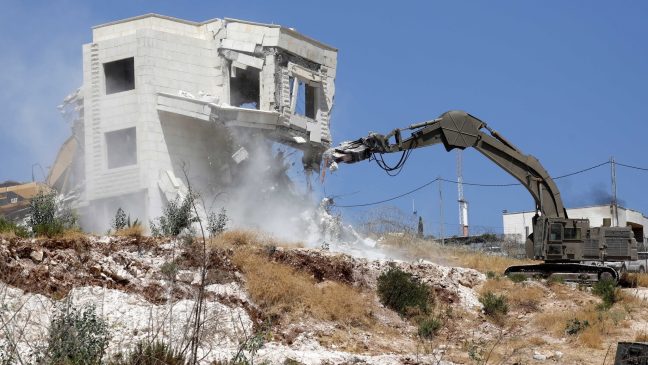
Israeli forces have demolished 17 Palestinian homes across the occupied West Bank on 26 June.
Local sources told WAFA news outlet that the demolitions included four houses east of Jericho, eleven homes in the Umm al-Khair community in Masafer Yatta in Hebron, one home in Beitillu village, and one home in east Jerusalem’s Silwan neighborhood.
In Jericho, the demolitions were carried out on the basis that they were built without Israeli-issued permits.
The eleven houses demolished in Masafer Yatta all belonged to to the Al-Hathalin family, leaving over 50 Palestinians homeless.
Bulldozers tore through the land, uprooting many solar cells, water tanks, and fences, as well as trees.
With international attention on Gaza, Israel has stepped up settler violence to ethnically cleanse and expand its illegal settlement of the occupied West Bank.
Last week, Israeli forces carried out a campaign of raids in various parts of the occupied West Bank, as Israeli Finance Minister Bezalel Smotrich openly confirmed that Israel has plans to annex the West Bank. The Israeli military gave significant legal powers in the occupied West Bank to pro-settler civil servants working for Smotrich to accelerate the annexation of the occupied Palestinian territories.
In March, the Israeli government designated 2,000 acres of Palestinian-owned land in the occupied Jordan Valley as state-owned property for the construction of over 100 settlement housing units and an area for commerce and industry.
Earlier this month, Norway’s largest private pension fund, Kommunal Landspensjonskasse (KLP), dropped its stakes in Caterpillar Inc over concerns of complicity in the destruction of Palestinian homes.
Israeli media expose gap in Israeli vs. UN tally on Gaza destruction
Al Mayadeen | June 27, 2024
Israeli analysis conducted by the Israeli army suggests significantly less damage to Gaza’s infrastructure from the ongoing war compared to international reports, according to a Thursday report from Ynet.
Israeli data claim that approximately 16%, or around 36,000 of Gaza’s permanent structures, have been irreparably damaged during the war. In contrast, UN assessments based on satellite surveys have reported damage to about 50% of structures, with some media outlets suggesting as much as 70% destruction based on similar satellite analyses.
Thousands of buildings destroyed by Israeli Army not linked to Hamas
Ynet reporter Yoav Zitun acknowledged significant discrepancies—sometimes up to 70%—between “Israel’s” claims and data from international bodies regarding the true extent of the damage in the Gaza Strip since October 7.
The correspondent explained that it is “inconceivable” to assume that the data provided by the Israeli army is closer to reality, and it could also be presented to international courts and foreign investigative committees that will investigate the actions of the Israeli army and “Israel” at the end of the war.
He also noted that international investigative bodies from international organizations will be allowed to enter the Gaza Strip when the war is over.
Ynet also noted that thousands of buildings destroyed by the Israeli army are not necessarily affiliated with Hamas but are “located near the border fence.”
The Israeli army justified their destruction by creating a “border buffer zone” and a corridor that splits Gaza into two through the middle, as per the report.
It also noted that hundreds of buildings were leveled in the al-Shujaiya and the al-Tuffah neighborhoods near Nahal Oz and towers in Beit Hanoun.
‘Israel’ destroys 72% of residential buildings in Northern Gaza
Earlier this month, a Palestinian official in Gaza reported that approximately 50,000 housing units had been demolished by Israeli occupation forces during their nearly eight-month-long aggressive campaign in the northern region of the territory.
The chairman of the Emergency Committee for Northern Gaza municipalities emphasized that along with the destruction of homes, vital infrastructure, such as sewage networks and roads, has been extensively damaged across most municipalities in Northern Gaza. Additionally, the official mentioned the destruction of 35 water wells, schools, and UNRWA facilities, highlighting the imminent risk of famine in the northern area of Gaza.
The official also announced that the Jabalia refugee camp and Beit Hanoun, both located in northern Gaza, have been designated as “disaster zones” due to the devastating destruction inflicted by Israeli aggressive war, which the official characterized as genocidal.
Abdallah al-Dardari, the UN assistant secretary general and director of the UN Development Program’s regional office for the Arab states, stated that the Israeli aggression has resulted in the complete or partial destruction of 72 percent of Gaza’s residential buildings.
Analysts across the world agree that “Israel’s” war on Gaza is currently among the bloodiest and most devastating in recent history. The Israeli regime claims to be considerate of civilian lives, but the death toll and the extent of the destruction reveal otherwise.
Back in March, the UNRWA agency revealed that the war on Gaza has resulted in around 23 million tons of rubble and unexploded weapons all over the area and that it will “take years” before Gaza is safe again.
Moreover, a report by the UN Conference on Trade and Development (UNCTAD) in January indicated that rebuilding Gaza and restoring its 0.4% growth per year seen over the past 15 years would factually take 70 years, confirming that enormous amounts of aid would be needed to make Gaza at least habitable.
Yemen shows off hypersonic missile in Arab Sea op
The Cradle | June 27, 2024
Yemen’s Armed Forces released footage on 26 June of the new hypersonic ballistic missile that was used to target an Israeli ship in the Arab Sea a day earlier.
The Hatem-2 hypersonic ballistic missile is equipped with an intelligent control system and has significant maneuverability, according to the Yemeni army’s military media page. The locally-made Yemeni missile runs on solid fuel and boasts several different types with differing ranges.
The video and pictures released by Sanaa’s forces on Wednesday show the missile in use against the Israeli ship, the MSC Sarah.
The Yemeni army announced its attack on the MSC Sarah on 25 June.
“The naval forces of the Yemeni Armed Forces carried out an effective military operation targeting the Israeli ship (MSC SARAH V) in the Arabian Sea. The hit was accurate and direct … We announce that this operation was carried out with a new ballistic missile that entered service after the successful completion of trial operations,” Yemeni army spokesman Yahya Saree said in a statement.
“The missile is distinguished by its ability to hit targets accurately and over long distances, as this operation demonstrated.”
The armed forces of Yemen’s Sanaa government – which is militarily aligned with the Ansarallah resistance movement – are known to locally produce weapons. Sanaa’s Armed Forces are also still in possession of weapons stockpiles from the Soviet era.
Washington and other western nations accuse Iran of smuggling weapons to Ansarallah in Yemen. Yemen has been under a tight Saudi-led blockade for nearly 10 years, making the import of arms into the country extremely difficult.
However, Iranian expertise has played a significant role in the production of Yemen’s anti-ship ballistic missiles, according to a 29 May report from Tasnim news agency.
Tasnim says that the Yemeni Muhit missile – revealed in a military parade in the capital, Sanaa, in September last year – is directly modeled after the Iranian Qadr missile, Tehran’s first locally manufactured anti-ship ballistic missile, which was developed over 10 years ago by late Islamic Revolutionary Guard Corps (IRGC) commander Brigadier General Hassan Tehrani-Moqaddam.
Norwegian fund drops stake in US construction giant over Palestinian home demolitions

(Photo Credit: Kobi Gideon/Flash90)
The Cradle | June 26, 2024
Norway’s largest private pension fund, Kommunal Landspensjonskasse Gjensidig Forsikringsselska (KLP), has dropped its stake in US construction giant Caterpillar Inc, citing “concerns” the company is contributing to the destruction of Palestinian homes in the occupied West Bank.
“Although Caterpillar has shown itself willing to engage in a dialogue with KLP, the company’s responses failed to credibly substantiate its ability to actually reduce the risk of violating the rights of individuals in situations of war or conflict, or of violating international law,” Kiran Aziz, the firm’s head of responsible investments, told Bloomberg.
Aziz highlighted that KLP dropped $69 million worth of Caterpillar shares and bonds earlier this month over the Texas-based company’s equipment being used “to demolish Palestinian homes and infrastructure to clear the way for Israeli settlements.”
She also cited allegations that Caterpillar equipment is being used by the Israeli army in Gaza.
The UN Office of the High Commissioner for Human Rights last week named Caterpillar among several corporations supplying Israel with military equipment and urged investors with stakes in these companies to “take action.”
“These companies, by sending weapons, parts, components, and ammunition to Israeli forces, risk being complicit in serious violations of international human rights and international humanitarian laws,” the UN statement reads.
The UN report also urged western financial institutions and investing firms like Bank of America, BlackRock, Citigroup, JP Morgan Chase, Harris Associates, Morgan Stanley, State Farm Mutual Automobile Insurance, and Wells Fargo & Company – among many others – to “take action” and prevent funding the mass killing of Palestinians in Gaza.
The decision by KLP comes one month after the Norwegian government officially moved to recognize a Palestinian state alongside Spain and Ireland.
“For more than 30 years, Norway has been one of the strongest advocates for a Palestinian state. Today, when Norway officially recognizes Palestine as a state, is a milestone in the relationship between Norway and Palestine,” Foreign Minister Espen Barth Eide said on 28 May.
On Wednesday, Palestinian media reported that the Israeli army demolished nine homes in the occupied West Bank, including Jerusalem, and another in the Palestinian territories occupied since 1948.
According to the Wall and Settlement Resistance Commission, Israel conducted “47 demolitions, affecting 66 facilities, including 35 inhabited homes, five uninhabited, and 15 agricultural and other facilities,” across the West Bank in May.
Featured Video
No Vote, No Representation, No State: Democracy, Israeli Style
or go to
Aletho News Archives – Video-Images
From the Archives
Sanctions, War and the Policy of Dual Containment
By SASAN FAYAZMANESH | March 17, 2008
It is now nearly three decades since the Unites States adopted the policy of dual containment of Iran and Iraq. While much has been written about the containment of Iraq, there has been very little in-depth analysis of this policy when it comes to Iran. In a book that is going to be released on March 31, 2008, entitled The United States and Iran: Sanctions, Wars and the Policy of Dual Containment (Routledge), I attempt to address this shortcoming by investigating when and why the US policy of containment of Iran came about, how it evolved, and where it stands today.[1] To the extent that Israel has been involved in US policy making, the study will also include the role that Israel has played in the containment of Iran. Also, since the fate of Iran has been inextricably linked to that of Iraq, occasionally the investigation will overlap with the containment of Iraq.
The policy of dual containment of Iran and Iraq originated during the Carter Administration, but it was not until the Clinton Administration that the expression “dual containment” became popular. … continue
Blog Roll
 Aletho News
- No Vote, No Representation, No State: Democracy, Israeli Style
- Zionist Bought Senate Blocks Information About American Citizens Killed By Israel
- While Gaza dominates the UN, these are the people keeping it alive
- New Report: “Scholasticide and Genocide in Gaza: Assessment, Testimonies and Legal Analysis”
- ‘THAAD Delusion’: Iran war exposes US missile shield limits – The Atlantic
- Moscow issues warning to NATO over Russian exclave
- Yes, the Iran war has destroyed Trump’s presidency
- The fallacy of US delusions about Iran’s economic collapse
- Hezbollah denies Syria cell link, warns of Israeli plan to sow discord
- The legacy of US sanctions, war, and occupation in Iraq
- If Americans Knew
- Mamdani releases plan to combat antisemitism and hate crimes in New York City
- Iran’s Revolutionary Guards Publish Letter to the American People
- DMFI launches $1 million ad campaign supporting Virginia’s Elaine Luria
- US Senate blocks resolution seeking report on Americans killed by Israel
- Israeli Attacks Kill Ten Palestinians in Gaza
- Massacre at Minab: The School That Became a Grave
- Israeli media: The IDF Shows It Doesn’t Turn a Blind Eye; It Actively Emboldens Settler Havoc
- As settlers ravage West Bank, Israeli forces kill 10 in Gaza – Daily Update
- New Report: “Scholasticide and Genocide in Gaza: Assessment, Testimonies and Legal Analysis”
- Ex-Biden officials are desperate for a Gaza scapegoat
- No Tricks Zone
- Green Energy Debacle: German Expert Professor Fritz Vahrenholt Warns Of Severe Economic And Social Consequences
- Two More Paleo Reconstructions Affirm Meters-Higher Sea Levels Across Ireland, Brazil 7000-6000 Years Ago
- New Study: Earth And Venus Surface Warmth Largely Explained By Convection And Lapse Rate, Not CO2 Or Radiation
- 2025 Nature Paper Claiming Worsening Global Drought Gets RETRACTED …Heavily Flawed
- New Study: ‘Global Drought Shows No Detectable Recent Acceleration Under Climate Warming’
- Economic Masterminds: German Socialists Suggest Taxing Productivity Gains Stemming From Using AI
- The South China Sea Has Not Been Cooperating With The Climate Change Narrative
- Energy Crisis: Germany Enters Heating Season With Historically Low Gas Reserve Fill Levels
- New Study: The Antarctic Ice Sheet Gained Mass From 2020-2024 Due To Staggering Snow And Ice Accumulation
- Study: Ocean Heating Rates From Thousands Of Years Ago ‘Dwarf’ Modern Ocean Heating Rates

