Russia holds Israel responsible for latest offensive against Gaza
MEMO | August 9, 2022
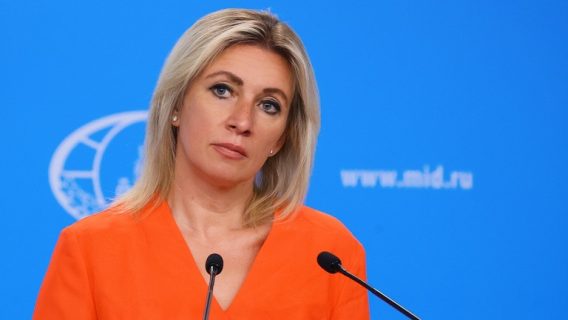
Russia blames Israel for the latest three-day military offensive against the Palestinians in the Gaza Strip, the Foreign Ministry in Moscow has announced.
“The new escalation was caused by the Israeli army firing into the Gaza Strip on 5 August,” said ministry spokesperson Maria Zakharova. She pointed out that the Palestinian factions responded to this escalation by firing rockets indiscriminately towards Israeli territory.
“We are observing with profound worry how events are evolving,” added Zakharova. “The resumption of a full-scale military confrontation [would see the] already deplorable humanitarian situation in Gaza deteriorate further.”
The ministry official reaffirmed Russia’s “principled and consistent position, reflected in the relevant resolutions of the UN General Assembly and the Security Council, in support of a comprehensive and long-term settlement of the Palestinian-Israeli conflict in accordance with the two-state principle.
“It is possible to put an end to cyclical violence only within the framework of the negotiation process, the result of which should be the realisation of the legitimate national rights of the Palestinian people to establish an independent state within the 1967 borders.”
Zakharova’s statements come at a time when relations between Israel and Russia are tense.
Meanwhile, the Ukrainian Ambassador to Israel, Yevgeny Kornichuk, declared his solidarity with the occupation state: “As a Ukrainian whose country is under brutal attack by its neighbour, I feel great sympathy for the Israeli public. An attack against children and women is an abominable thing. Terror and a malicious attack against civilians are the daily reality of Israelis and Ukrainians and this appalling threat must be stopped immediately.”
Kornichuk made his comments before the Egyptian-brokered ceasefire between Gaza and Israel came into effect.
Although the occupation state declared that it was targeting the Palestinian Islamic Jihad movement, the Palestinian Ministry of Health has confirmed that 44 citizens were killed as a result of the Israeli offensive, including 15 children and four women. Another 360 Palestinian civilians were wounded. Moreover, many homes and residential buildings were destroyed.
Leslie Wexner’s Young Global Leaders
By Whitney Webb |
UNLIMITED HANGOUT| August 8, 2022
The following is an adapted excerpt from Whitney Webb’s upcoming book, One Nation Under Blackmail, which examines the network behind Jeffrey Epstein and traces it back to the merging of American organized crime and intelligence beginning in the early 1940s. In this excerpt, Whitney examines the Wexner Foundation’s origins and the ties of Leslie Wexner’s philanthropy and Jeffrey Epstein to Harvard as well as the now infamous Young Global Leaders program of the World Economic Forum. Whitney’s book can be pre-ordered here, here or here.
The Origins of the Wexner Foundation
It is hard to know exactly when the Wexner Foundation was originally created. The official website for the foundation states clearly in one section that the Wexner Foundation was first set up in 1983 alongside the Wexner Heritage Foundation. However, the 2001 obituary of Wexner’s mother, Bella, states that she and her son created the foundation together in 1973. Regardless of the exact year, Wexner’s mother, Bella, became the secretary of the foundation (just as she had with his company The Limited), which Wexner wanted people to refer to as a “joint philanthropy.”
The foundation’s website states that the original purpose of the Wexner Foundation was to assist “emerging professional Jewish leaders in North America and mid-career public officials in Israel.” Per the website, Wexner’s main philanthropic endeavors were created after Wexner “reached the conclusion that what the Jewish people needed most at that moment was stronger leadership.” As a result, Wexner sought to focus his foundation’s attention chiefly on the “development of leaders.” As a consequence of this, Wexner’s programs have molded the minds and opinions of prominent North American, as well as Israeli, Jewish leaders who went on to work at the top levels of finance, government and, even, intelligence.
One of the Wexner Foundation’s original advisors, and perhaps one of the most important, was Robert Hiller, who had previously been executive vice president of the Council of Jewish Federations and Welfare Funds. Robert I. Hiller was described in an article in The Baltimore Sun as a “nonprofit leader who helped develop community fundraising strategies and was active in the Soviet Jewry movement.”
As well as being known as a community development leader, Hiller was also an executive with Community Chest of Metropolitan Detroit in 1948. In that position, Hiller helped bring together corporations such as General Motors to create “social service groups under an umbrella organization, a precursor to collective fundraising efforts today.” In 1950, Hiller became the associate director of the Jewish Community Federation of Cleveland and six years later he also joined the United Jewish Federation of Pittsburgh. He would spend another nine years in that position before his move to Baltimore.
In his autobiography, Hiller wrote about his extensive dealings with various Israeli heads-of-state, saying: “I had pictures of every Israeli Prime Minister from David Ben Gurion to Menachem Begin. I would have many more with Begin because he was the current Prime Minister. My favorite picture, however, (it was to be hung) was taken in Washington, D.C. at a gala party where Marianne and I were with the then Ambassador, Yitzhak Rabin, and his wife, Leah.”
Hiller was extremely proactive when it came to seeding suitable, high ranking candidates for appropriate positions in Jewish community organizations, a task that the Wexner Foundation would later reproduce on a grand scale via its various Fellowship programs and subsequently apply to the worlds of business and government. One example of this matchmaking was the appointment of Larry Moses as assistant to Rabbi Maurice Corson. Corson is credited as having co-founded the Wexner Foundation with Leslie Wexner in 1983, per the foundation’s website, and he served as its first president. After Corson left that post, Moses stepped in to serve as the foundation’s president.

Maurice Corson and Leslie Wexner in an undated photo, Source: The Wexner Foundation
Hiller wrote in his autobiography that he had “personally enticed” Moses to become Rabbi Corson’s assistant and this later resulted in Larry Moses becoming the executive vice president of the Wexner Foundation. When Hiller was 33 years-old, he was presented with an opportunity to become a member of the Big 16, which was classed as an informal grouping of the 16 largest communities in North America headed by prominent Jewish executive members. One of the people who Hiller connected with the Wexner Foundation was originally meant to lead the Big 16 Federation, Fern Katelman. Katelman declined this prestigious leadership role in order to join Larry Moses, where he became his assistant at the Wexner Foundation.
Hiller, when revisiting his life, would state: “One of the most stimulating relationships I had was with the Wexner (Leslie) Foundation of Columbus, Ohio, and New York City. Rabbi Maurice Corson was the foundation president. My relationship with him started in Baltimore where he had been a new rabbi for one of the city’s largest Conservative synagogues. He came from Philadelphia with an interesting background and credentials.”
Hiller goes on to write: “He [Corson], however, seemed bored and uneasy with the routine of being a synagogue rabbi. When he and the congregation decided to part company, I assisted in getting him an executive position with the United Israel Appeal of Canada. He did so well that he was recruited to return to the U.S.A. in an executive position with International B’nai B’rith. Leslie Wexner met him through his work with B’nai B’rith, and when Les began to put together a formal foundation, he engaged Rabbi Corson as the chief executive.” B’nai B’rith is a “Jewish fraternal organization” that was founded in the 19th century and is modeled as a secret society, leading some to compare the group to the freemasons.
Hiller went on to assist Corson in the initial stages of setting up the Wexner Foundation while they put together “a distinguished advisory group” with the group meeting in Columbus, Ohio, and New York City. Hiller describes assisting Corson in creating the foundation, which Hiller called: “an unusual foundation with its own agenda and programming.” After several years of service to the Wexner Foundation, Hiller retired from his consultancy role and was replaced by Philip Bernstein, the former executive of the Council of Jewish Federations and Welfare Funds (CJF).
Now, it makes sense to examine Rabbi Maurice S. Corson himself. Corson was a prominent Jewish educator who, as previously mentioned, already had associations with various Jewish welfare organizations prior to serving as co-founder and then president of the Wexner Foundation. Corson had been ordained as a rabbi in 1960 through the Jewish Theological Seminary, after previously studying at the University of Cincinnati where he graduated in 1955. By 1964, Corson had become the president of the Religious Education Society in Seattle, and he remained in that position until 1966.
Over the following decade, he began working for the Zionist Organization America in Atlantic City and, shortly thereafter, became the Senior Rabbi at the Chizuk Amuna Congregation, a position he held from 1976 until 1979. Around this time, Hiller helped Corson get an executive position with the United Israel Appeal of Canada, where he went on to work for only a year before joining B’nai B’rith.
Once recruited into serving a leadership role within the influential “secret society,” Corson worked as director of development for B’nai B’rith International, based in New York City, between 1980 until 1985. During this very period, the board of overseers of B’nai B’rith included Edmond Safra, a notorious banker with close ties to Robert Maxwell and later Jeffrey Epstein; Edgar Bronfman, scion of the family behind Seagrams whose fortunes have long been tied to organized crime and Max Fisher, a Detroit businessman who re-launched the Jewish Agency, worked as a “private” diplomat on Israel matters and later served as a mentor to Leslie Wexner.
As noted previously, while Corson was at B’nai B’rith, he first met Leslie Wexner, who persuaded him to co-found the Wexner Foundation (per the version of events on the foundation’s website). Although he had been recruited by Wexner and subsequently left the B’nai B’rith organization, Corson became a member of the executive committee of B’nai B’rith Hillel Commission in Washington in 1987.
Another key figure who is important to mention is the co-founder of the Wexner Heritage Foundation, Rabbi Herbert A. Friedman. Depending on which part of the Wexner Foundation site you visit, that Foundation is listed as having been founded in either 1983 or 1985. However, Friedman is clearly listed as the co-founder of the foundation and as having served as its president for a decade.
The Wexner Heritage Foundation, per its website, was created “to strengthen volunteer leaders in the North American Jewish Community.” It spawned the Wexner Heritage program, which “provides young North American Jewish volunteer leaders with a two-year intensive Jewish learning program, deepening their understanding of Jewish history, values, and texts and enriching their leadership skills.”
Friedman was a US Army chaplain during World War II and also served as an “adviser on Jewish affairs to General Lucius D. Clay, the commander of American occupation forces in Germany.” He was later personally recruited by David Ben-Gurion, who went on to serve as Israel’s first Prime Minister, to join the paramilitary group, the Haganah. The Haganah was the pre-cursor to the Israeli military and was armed in large part by organized crime-linked networks. Per the New York Times, “as a member of the Haganah, Rabbi Friedman participated in the Aliyah Bet, the illegal transport of European Jews to Palestine.”
From 1954 to 1971, Friedman was the chief executive of the United Jewish Appeal (UJA) and, in that role “raised more than $3 billion to support the fledgling state of Israel.” During this period, UJA was intimately involved in the relaunching of the Jewish Agency by Wexner’s mentor Max Fisher in 1970. Fisher was also intimately involved with the related United Israel Appeal. Throughout the 1980s, Wexner was “one of the largest individual contributors to the United Jewish Appeal in America” and, after creating the Wexner Heritage Foundation with Friedman, Wexner became UJA’s vice chairman.
While Wexner was serving in these capacities, he was also engaged in closed door meetings with the highest levels of Israeli leadership, not just about “philanthropy,” but also about his business interests. One specific meeting saw him meet with top Israeli government officials about “Chinese and Israeli interests” working with his company, The Limited, to establish factories in the occupied Golan Heights.
Notably, the Wexner Foundation has direct and controversial ties to at least one former Israeli head of state, Ehud Barak, who was intimately involved with Jeffrey Epstein and an alleged participant in his sex trafficking operation. As reported by Israel Today in 2019:
“[Barak’s ties to the Wexner Foundation] became an issue only after right-wing journalist Erel Segal called last October to investigate the $2.3 million ‘research’ grant Barak received from the Wexner Foundation, which has in turn for years been the beneficiary of Epstein’s financial contributions. According to Segal, the grant under question was given to Barak in 2004-2006, when he held no public position. Barak insists he has no authority to disclose details about this grant. Only the Wexner Foundation can, if they so choose (they choose silence).”
Developing Leaders
Set up simultaneously alongside the Wexner Foundation, Wexner’s Heritage Program (WHP) planned to connect American Jews with the ever expanding nation-state of Israel. The program was created so as to “expand the vision of Jewish volunteer leaders, deepen their Jewish knowledge and confidence and inspire them to exercise transformative leadership in the Jewish community.” The foundation defines the program as: “essentially a Jewish learning and leadership development program for volunteer leaders in North America.”
There have been, to date, around 2000 “leaders” who have taken part in the program. The WHP is a vehicle for standardizing a certain perspective on the history of Israel, as well as Judaic texts. The two year program is made up of 36 evening seminars, which occur bi-monthly for four-hour periods, as well as three short-term and out-of-town summer institutes hosted in either the US or Israel. Each of these summer institutes are between 5 and 7 days long and take place throughout the program.
As with other well-founded leadership programs, such as the World Economic Forum’s Young Global Leader program, the Wexner Heritage Program targets a very specific age group, aiming at professionals who are generally between the ages of 30 and 45 years-old. Some of the most important criteria required of program participants include showing a demonstrated commitment to Judaism, the Jewish community and/or Israel and a track record of leadership in Jewish communal life.
The Wexner Foundation website claims that:
“The 2,300 Alumni of the Wexner Heritage Program are top lay leaders at the local, national and international level. In the 35 cities where we have convened WHP cohorts, virtually every Jewish communal organization continues to be supported by our alumni. They become presidents or chairs of synagogues, Federations, JCC’s, Hillels, day schools, camps and more; they often are founders or chairs of allocations or annual campaigns. They serve on the boards of JFNA, 70 Faces Media, the Foundation for Jewish Camp, International Hillel, AIPAC and J Street; The Shalom Hartman Institute, Pardes, Hadar and every US rabbinical seminary; the Jewish Education Project, Prisma, the JDC and so many more.”
It is worth noting that, of those aforementioned groups, the Wexner Foundation (and especially the Wexner Heritage program) enjoys particularly close ties to AIPAC. For instance, Elliot Brandt, AIPAC’s national managing director, is an alumnus of the Wexner Heritage Program and, in a 2018 speech at that year’s AIPAC policy conference, Brandt noted that “most of the [AIPAC] National Board consists of Wexner Heritage Alumni, not to mention its regional chairs and some of its most committed donors as well.”

Elliot Brandt and Alan Dershowitz at the 2017 AIPAC policy conference, Source: Screenshot
Wexner’s close ties to AIPAC take on a different tone when one considers, not only his close association with the Israeli intelligence-connected Jeffrey Epstein, but also the fact that AIPAC itself has long-standing and controversial ties to Israeli intelligence. For instance, AIPAC was at the center of an Israeli espionage scandal in the US in the mid-1980s as well as again in 2004, when a high-ranking Pentagon analyst was caught passing highly classified information over to Israel’s government via top officials at AIPAC.
Despite extensive evidence, particularly in the latter case, AIPAC itself avoided charges. As journalist Grant Smith noted at the time, “the Department of Justice’s chief prosecutor on the [AIPAC] espionage case, Paul McNulty, was suddenly and inexplicably promoted within the DOJ after he backed off on criminally indicting AIPAC as a corporation.” The charges against the specific AIPAC officials involved were also dropped.
In the years after the Wexner Heritage Program was launched, other similar efforts followed. In 1987, the Wexner Foundation announced it would begin channeling “$3-$4 million in grants to the first year of a program dedicated to the enhancement and improvement of professional leadership in the North American Jewish community.”
Per the Jewish Telegraphic Agency, “Wexner said an Advisory Group drawn from among leading Jewish academicians and communal professionals recommended that attention be focused on three critical groups: rabbis, communal professionals and educators.” These efforts would result in the formal creation of the Wexner Graduate Fellowship in 1988. Chairmanship of the Wexner Fellowship Committee was given to Professor Henry Rosovsky.
Henry and Harvard
Henry Rosovsky was an economist at Harvard University. Like Wexner, and like many other of the Wexner Foundation’s associates, Rosovsky was born to Russian Jewish parents. He grew up speaking Russian, German, and French and, in 1940, Rosovsky emigrated to the United States of America with his parents.
During World War II, he served in Counterintelligence Corps of the US Army. He became a naturalized US citizen 9 years later. That same year, he received his B.A. degree from the College of William and Mary public research university in Williamsburg, Virginia, followed by his PhD from Harvard in 1959.
Rosovsky taught overseas as a visiting professor in Japan at Hito Subashi and Tokyo Universities, and subsequently taught Japanese studies, economics and history at the University of California at Berkeley until 1965. He also taught at the Hebrew University of Jerusalem in Israel, again as a visiting professor, as well as working as a consultant with the United States government, the Asian Development Bank, the World Bank, and UNESCO.
Rosovsky settled down into his eventual career at Harvard in 1965 and brought with him the intention of making Jewish life at Harvard flourish. By 1978, Rosovsky had helped to establish the Center for Jewish Studies, which was led by Harry Wolfson, the first chairman of a Judaic studies center at any American college. Rosovsky was the first Jew to serve on the board of the Harvard Corporation. Rosovsky’s wife, Nitza Rosovsky, also had a presence at Harvard, and in 1986, during Harvard’s 350th anniversary celebrations, she wrote a piece entitled “The Jewish Experience at Harvard and Radcliffe,” which traces the Jewish history at the university dating back to the 1720s.
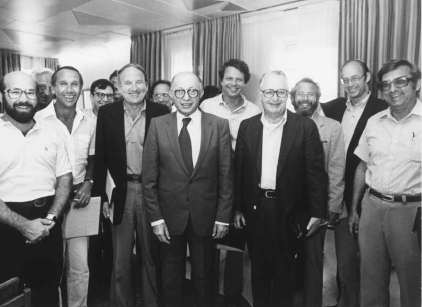
Henry Rosovsky posing with Israeli Prime Minister Menachem Begin, Source: Harvard Hillel
Rosovsky developed a close relationship with some key faculty members at Harvard, including future US Treasury Secretary and Harvard president Larry Summers. In 2017, Summers stated in a video tribute to Rosovsky the following: “Thirty-five years ago, I sat in your office as a young recruit to the Harvard faculty, and I was trembling with the majesty of it all,” he said. “Over time I became less intimidated and came to value your wisdom and your experience.”
Rosovsky became involved with the Wexner Foundation in 1987, when the Wexner Foundation announced the aforementioned initiative to recruit, support, and retain “the highest quality professional leadership” in the American Jewish community through grant-making to individuals and institutions. Those individual grants were awarded as Wexner Foundation fellowships and the Foundation appointed Rosovsky to serve as the chairman of the Wexner Fellowship Committee.
Rosovsky was prominent and well-connected by the time Wexner approached him, with his connections including Israeli politicians and heads of state like Menachem Begin and Yitzhak Rabin. By this point, Rosovsky was also being publicly honored for his many achievements. In 1987, after Wexner had launched several of his philanthropic endeavors, the American Academy of Achievement – a non-profit educational organization that recognizes some of the highest achieving individuals in the country – had awarded Rosovsky its “Golden Plate Award.”
One of Rosovsky’s most important links that were likely of interest to Wexner was his strong connection with Harvard Hillel. What is today referred to as the “Harvard-Radcliffe Hillel,” the Harvard Hillel is commonly described as a service organization that provides Jewish educational, cultural, religious, and social opportunities for students and faculty. Rosovsky had been a key player in paving the way for Hillel’s relocation from a simple home at the outskirts of campus to a location at the heart of Harvard life. Wexner’s subsequent involvement with Harvard Hillel would also mark Epstein’s own entry into what would become his controversial, and intimate, relationship with the prestigious university.
According to a 2003 article in the Harvard Crimson on Epstein’s donations to the University, Rosovsky was not only one of Epstein’s closest associates at Harvard, but was also Epstein’s “oldest friend of the bunch,” having been introduced to Rosovsky by Wexner around 1991. That is notably the same year that Epstein and Ghislaine Maxwell began their sexual blackmail/sex trafficking operation.
1991 was also the year that the New York Times reported that four donors, among them Leslie Wexner and Jeffrey Epstein, had pledged to raise $2 million for the construction of the new student center of Harvard-Radcliffe Hillel. In that article, the Times lists Epstein as the “president of Wexner Investment Company.” The building was completed in 1994 and named Rosovsky Hall in Henry Rosovsky’s honor. Rosovsky Hall is a 19,500-square-foot building, which cost $3 million to complete and includes a garden courtyard, a student lounge, a dining hall, a library, offices, and multi-purpose rooms for worship and meetings.
After Epstein’s 2019 arrest, Hillel executive director Rabbi Jonah Steinberg claimed that Epstein had merely “facilitated” a gift that was actually donated by the Wexners and did not involve Epstein’s personal money. However, a now-absent plaque on the building, cited by the Harvard Crimson in 2003, named both Epstein and Wexner as donors responsible for funding the center’s construction.
Steinberg did note that Epstein did donate $50,000 to Hillel in 1991, the same year that the gift for the construction of Rosovsky Hall was also made. The following year, records from Harvard’s Office of Alumni Affairs and Development reveal that Epstein was courted as a potential donor by the University, with Harvard’s “most senior leaders” first officially meeting with Epstein to “seek his support.” It is unclear exactly what resulted from this meeting, as Epstein’s first official donation to Harvard was recorded in 1998, raising the possibility that support could have been given in other ways that did not necessarily involve direct donations to the University.
Indeed, when Harvard moved to reject donations from Epstein following his 2008 conviction, Epstein continued to donate indirectly to the University by directly sponsoring several professors as well as a student social club at Harvard. Epstein may have contributed in this fashion during this earlier period, especially given that he had already donated to Harvard’s Hillel by the time of the 1992 meeting.

Jeffrey Epstein speaks with Larry Summers at a 2004 dinner he hosted for Harvard’s biggest names. Also pictured is Alan Dershowitz, among others. Source: Sott
It is worth noting that Epstein’s first “official” donation to Harvard in 1998 was the same year he was using his private plane, now best known to the public as the “Lolita Express,” to transport then-Deputy Treasury Secretary Lawrence “Larry” Summers. Summer’s then-boss, Treasury Secretary Richard Rubin, had previously facilitated Epstein’s first official visit to the Clinton White House in early 1993. Summers would become president of Harvard University shortly after the conclusion of the Clinton administration, in July 2001. During Summer’s tenure, Epstein’s access to Harvard’s campus and many of its most notable professors increased exponentially. While president of Harvard, Summers continued to fly on Epstein’s plane.
Developing Young Global Leaders
Though Epstein’s ties to Harvard have been scrutinized, Wexner also dramatically expanded his donations to Harvard during much of the same period. However, the role this may have played in facilitating Epstein’s own connections to the university have been largely glossed over by mainstream media reports on the matter.
Even before Wexner and Epstein donated to Harvard’s Hillel in 1991, Wexner’s philanthropic “development of leaders” had become entangled with Harvard University. In 1989, the year after the Wexner Graduate Fellowship was launched, the Wexner Israel Fellowship program was created to specifically “support up to 10 outstanding Israeli public officials earning their Mid-Career Master of Public Administration (MC/MPA) at Harvard Kennedy School.”
Per the Wexner Foundation’s website: “The goal of the Fellowship is to provide Israel’s next generation of public leaders with advanced leadership and public management training. More than 280 Israeli public officials have participated in the Israel Fellowship, including leaders who have gone on to become Directors General of government ministries, Generals and Commanders in the Israeli military, and top advisers to Prime Ministers.” As part of the program, participants “meet with senior U.S. government officials.” Wexner Israel Fellows also “commit to returning to Israel and remaining in the public sector for at least three years after completing the program.”
Similar claims can be found among Israeli media. For example, Israel 21c stated the following about the program in 2002:
“Several Wexner graduates have gone on to become Director-Generals of government ministries. Others have reached the highest echelons of the military, the health service, and the educational establishment. But ultimately, for Israel, the value of the program is not the titles of its participants, but in the quality of leadership exercised by these individuals at every level.”
That same article also notes that Wexner’s interest in having this program be hosted at Harvard’s Kennedy school “is the quality of the international exposure it permits. It attracts the highest caliber of public sector leadership from around the world and Israeli participants find themselves sitting next to ex-presidents and future prime ministers from every continent. It also creates a rare opportunity for high quality public relations, as future world leaders are exposed to some of the finest and most dedicated individuals Israel has to offer.”
Among the 10 alumni of the first class of Wexner Israel Fellows is Shay Avital, a prominent leadership figure in the Israeli military and who had first served under Benjamin Netanyahu’s brother, Yonatan Netanyahu. Other alumni include Avinoam Armoni, former special adviser to Teddy Kollek, as well as Israeli prime ministers; Moshe Lador, former Israeli state prosecutor; Arik Raz, former governor of Israel’s Misgav region; Uzi Vogelman, current justice on Israel’s Supreme Court; Eduardo Titelman Goren, a Chilean economist who has played a major role in managing Chile’s copper mining industry (the world’s largest); and Yossi Tamir, Director General of the JDC-Israel, “the leading global Jewish humanitarian organization.”
Another interesting alumnus from this first class was Amos Slyper, who was Deputy Director-General of the State Comptroller’s Office in Israel, making him responsible for the auditing of Israeli government ministries and offices. During Slyper’s tenure, the legal adviser to that office was Nurit Israeli, an alumnus of the second class of Wexner Israel Fellows.
As can be seen from just the first class of fellows, the Wexner Israel Fellow programs and its active alumni community have given Wexner considerable clout with prominent Israelis in major positions in government and industry. Years after this program was launched, it has since expanded to include the Wexner Senior Leaders program, which “leverages the training and scholarship of the Harvard Kennedy School to strengthen Israel’s public service leadership and spur innovative, collaborative projects across government departments and agencies.” It specifically seeks applicants from “senior level positions within Israel’s public service sector, including the civil service, local government, government agencies, and security forces.”
Thus, even before the 1991 donation by Wexner and Epstein, Wexner was actively bringing prominent Israelis, many with careers in Israel’s national security apparatus or in the public sector, to study at Harvard’s Kennedy school. In the years that followed, Wexner would become one of the guiding forces behind this particular school and would have even greater influence over the “development of leaders” at the institution.
Shortly before Larry Summers became Harvard’s president, Leslie Wexner, via the Wexner Foundation, funded the creation of the Harvard Kennedy School’s Center for Public Leadership (CPL). The CPL is described as “a premier training ground for emerging public leaders in the United States.”
The long-time director of CPL, who was likely chosen with direct input from Wexner, is David Gergen, an adviser to former presidents Nixon, Ford, Reagan, and Clinton. Gergen has also had a parallel career in journalism and, in the late 1980s, “he was chief editor of U.S. News & World Report, working with publisher Mort Zuckerman.” Zuckerman was a close associate of Epstein and bought the New York Daily News after the death of its previous owner, Robert Maxwell. Gergen is also a long-time member of the Council on Foreign Relations and the Trilateral Commission, where Epstein also had memberships.
Wexner’s contributions to Harvard’s CPL reached $19.6 million by 2006 and totaled more than $42 million by 2012. Notably, during this period, Jeffrey Epstein – one of Wexner’s closest associates until they parted ways between 2007 and 2008 – was also making major connections and gaining unprecedented access to the school.
In 2006, when the Wexner’s announced an additional donation of $6.8 million to the CPL, Gergen was quoted by the Harvard Crimson as saying:
“It has been a great personal privilege to work with Les and Abigail Wexner over the past half-dozen years, at the University and beyond. They are both leaders in their own right – people of vision, imagination, and keen dedication to advancing the quality of public life. They have been wonderful partners.”
In 2014, Gergen participated in the Wexner Foundation’s 30th anniversary gala, hosting a session where he interviewed former Israeli Prime Minister Shimon Peres at length.
Before Epstein’s second arrest, the Wexner-dominated CPL saw Epstein associates like Glenn Dubin and Leon Black creep into its top leadership bodies. For example, Dubin had become a member of CPL’s advisory council, which Leslie and Abigail Wexner co-chaired. Both Wexner and Dubin were pressured to remove themselves from that council after Epstein’s second arrest and subsequent death and departed in February 2020. At the time, the Harvard Crimson noted that the chief of staff to then-Harvard president Lawrence Bacow, Patricia Bellinger, had been added to the board of directors of Wexner’s L Brands (the current corporate name of The Limited).
Also at the time, Dubin had been named in court documents as one of the men Virginia Giuffre was forced to have sex with when she was under Epstein’s control, with another being Harvard Law professor emeritus Alan Dershowitz. In addition, as noted by the Crimson, a “former manager of the Dubin household Rinaldo Rizzo recount[ed] his encounter with a 15-year-old girl allegedly trafficked by Epstein who was brought to the Dubins’ house in 2005.” In 2010, Dubin had donated $5 million to the CPL to create his own fellowship aimed at “developing leaders,” called the Dubin Graduate Fellowships for Emerging Leaders.
In another example, Leon Black, of Apollo Global Management and whose “philanthropic” family foundation was also managed by Epstein for years, was on the CPL’s leadership council. Black, however, did not resign his post after the Epstein scandal became a national concern. However, after Wexner and Dubin had left their positions on the advisory council, Black’s connection to Epstein resulted in considerable media scrutiny as well as an “internal investigation” by Apollo. As of 2022, Black is no longer listed on the CPL’s website as a member of its leadership council.
In 2006, plans were made for the Wexner-funded CPL to team up with the World Economic Forum’s Young Global Leaders (YGL) program. The World Economic Forum, which describes itself as the pre-eminent facilitator of “public-private partnerships” on a global scale, originally created what would become YGL in 1992 under the name the Global Leaders of Tomorrow. It was rebranded as the YGL program in 2004.
In recent years, the Forum and its YGL program have become infamous in some circles, specifically after a clip of the Forum’s chairman Klaus Schwab went viral. In that clip, Schwab states the following of the YGL program:
“I have to say then I mention names like Mrs Merkel, even Vladimir Putin and so on they all have been Young Global Leaders of The World Economic Forum. But what we are really proud of now with the young generation like Prime Minister Trudeau, President of Argentina and so on, is that we penetrate the cabinets… It is true in Argentina and it is true in France now…”
Notably, that clip comes from a 2017 discussion between Klaus Schwab and the CLP’s David Gergen that took place at the Harvard Kennedy school. In the introduction to that discussion, the close ties between the Harvard Kennedy school and the World Economic Forum are highlighted and it is also mentioned that YGL participants are also present and attending the Harvard Kennedy school for an executive session. Gergen, in addition to his many roles and appointments, is also formerly a board member of the Schwab Foundation for Social Entrepreneurship, which Klaus Schwab co-founded with his wife in 1998, and is also an agenda contributor to the World Economic Forum.
The CPL began hosting an Executive Session for Young Global Leader participants in order to allow “the Young Global Leaders a much greater opportunity to form personal connections and bonds that will encourage opportunities for the leaders to working together, across multiple sectors, to solve international issues and problems in the future.”
These executive sessions were “designed and hosted by the Kennedy School of Government” and a significant amount of the funds raised were connected to the Clinton Global Initiative (CGI). In 2007, Epstein’s defense lawyers claimed that Epstein had played a major role in developing the CGI, writing to federal prosecutors that “Mr. Epstein was part of the original group that conceived the Clinton Global Initiative, which is described as a project ‘bringing together a community of global leaders to devise and implement innovative solutions to some of the world’s most pressing challenges’.”
At the time, the executive director of the CPL, working under David Gergen, was Betsy Meyers, a former senior adviser to president Clinton, specifically on women’s issues. Meyers also played a “critical role in Clinton’s re-election effort in 1996.” The corruption surrounding Clinton’s re-election campaign that year and Epstein’s own connections to that corruption are a key focus of my upcoming book.
Klaus Schwab’s now infamous “penetrate the cabinets” quote may offer insight as to Leslie Wexner’s own interest over the decades in “developing leaders” in American Jewish communities, in Israel and beyond. With nearly 40 years focused specifically on training men and women of influence in American Jewish society – as well as in Israel’s government and private sector – ideas and policies that benefit Wexner both personally and professionally have been instilled into generations of leaders and influencers, who then go on to influence many others. In the specific case of the Wexner Israel fellows, Wexner has been able to “penetrate” key posts in Israel’s government, and even its national security/intelligence apparatus, with people he has funded and who have participated in courses that were shaped by, and reflect, Wexner’s views.
Over the past two decades, Wexner’s foray into becoming one of the main donors of the Harvard Kennedy school allows for much the same to occur, but this time for leaders who operate and influence those far outside of the boundaries of the global Jewish community.
Wexner’s exact reasons for establishing and maintaining this legitimate yet massive influence operation, which paralleled Epstein’s own blackmail-based influence operation, have never been made explicit.
Yet, in speculating as to why he would want to mold the powerful and soon-to-be powerful, it is worth considering Wexner’s lesser known connections, including to organized crime and to Jeffrey Epstein.
Whitney Webb has been a professional writer, researcher and journalist since 2016. She has written for several websites and, from 2017 to 2020, was a staff writer and senior investigative reporter for Mint Press News. She currently writes for The Last American Vagabond.
The hidden goal behind Gaza’s assault
By Batool Subeiti | Press TV | August 7, 2022
The Zionist regime’s unprovoked blitz on Gaza since Friday afternoon was, firstly, a direct message to Lebanon, that it is not interested in going into war over the maritime boarders, thereby conceding to line 23 and the Qana fields that Lebanon has demanded full sovereignty over. Secondly, the regime seeks to test the waters through this limited confrontation.
The limited scope of the confrontation between Palestinian Islamic Jihad (PIJ) and the Zionist regime implies the objective is not aimed at weakening the resistance, rather it is to measure the reactions of this confrontation on many levels and to send underlying messages in the process.
The Zionist regime considers the Palestinian resistance to be the easiest target within the resistance axis and has therefore sought calculated confrontation with this entity. Through its assaults on Gaza, the regime is interested in testing the extent of unification of the regional resistance factions in decision making, logistical support, the readiness of factions to get involved if the battle escalates, how willing they are to expand the war in addition to their stock of weapons, their capabilities, and capacities.
This is also happening at a time when the Zionist regime will hold its fifth election in four years this November, thereby seeking to rally the settler population over a point of unity – that is usually attacks on Gaza. The regime seeks to paint the image that it is unafraid to attack in any circumstance to ensure their ‘security’, with Israeli Prime Minister Yair Lapid stating on Friday that, “the country has ‘zero tolerance’ for attacks from Gaza”. However, he also made it clear in the same press conference that there is no interest in a ‘broader battle’.
More importantly, the Zionist regime is approaching a due position and that is drawing the maritime boarders with Lebanon, which if it does not end up playing in the interests of Lebanon, poses an imminent danger, and calls for an imminent war, as made clear by the Secretary General of the Islamic resistance party in Lebanon. The Zionist regime wishes to prevent a war at all costs and that means it has no choice but to compromise, which appears as a point of weakness for the settler population in the context of the elections, as they wish for a candidate that takes a strong stance on such issues. This smaller scale attack was therefore launched in order to avoid a larger war, and for the regime to grant itself some credit as well.
It is also important for the Zionist regime to reinforce the phobia of war within the minds of the settler population, such that the mass general opinion formed is one that aligns with the Zionist government’s decision to compromise on the maritime boarders, in order to prevent a wider scale war where the battle front is opened beyond one Palestinian resistance faction, the PIJ, and in the worst case extends to the Lebanese resistance that has over 100,000 rockets.
The reason that the Zionist regime seeks to compromise on the boarders are because it knows the resistance capabilities are very strong, such as when they sent three unmanned aircraft (UAV) targeting the gas rigs in July. The regime however also seeks to paint the image that they are strong through launching an offensive attack on the resistance, however the reality is that they don’t wish for a war and in fact know that other Palestinian resistance organizations such as Hamas, the Popular Front do not intend to get involved and the operation is of a limited nature. The head of Shin Bet reportedly told cabinet ministers overnight on Saturday that Tel Aviv, “met most of the objectives it set at the outset of the operation in Gaza.”
In this process, the Zionist regime has sought to send a message to the internal resistance in Palestine that the head of PIJ, Ziad Nakhala is in Tehran whilst key commanders of the group are being assassinated, thereby seeking a show of display for their supposed lack of fear and strength. However, the unmasked reality is that since the regime are seeking compromise, they want to grant themselves false credit regarding their strategic strength and seek to gain publicity without it affecting their elections. The reality is that the regime is deceiving its own population through putting forth titles that sound big but are empty, as they know the resistance won’t be dragged into the square they want, and their aim is to appeal to the public opinion of the Zionist settlers through deception.
Batool Subeiti is an Energy Engineer and political analyst based in London, UK.
Why the Gulf states’ SCO membership is a big deal
BY M. K. BHADRAKUMAR | INDIAN PUNCHLINE | AUGUST 7, 2022
Washington has backtracked from the dissimulation by US National Security Advisor Jake Sullivan that Washington had intelligence suggesting Iran was preparing to provide Russia with “several hundred” drones to use in Ukraine, with training sessions set to begin in July.
On July 26, NSC spokesman John Kirby, clarified his boss’ remark by admitting to Al Arabiya, “We’ve seen no indications of any sort of actual delivery and/or purchase of Iranian drones by the Russian Ministry of Defence.”
Interestingly, Al Arabiya buttonholed Kirby at all. For, Sullivan’s fake news (probably based on Israeli disinformation) came at his special briefing on President Biden’s visit to Jeddah. Al Arabiya’s dogged downstream pursuit of the “fake news” suggests that Riyadh knew Sullivan making a crude attempt to to hustle the Crown Prince Mohammad bin Salman in directions that would have made Biden’s trip a roaring success.
Biden had three overlapping objectives: one, to rally Saudi leadership behind his containment strategy against Russia and China; two, to break up the OPEC+ alliance between Saudi Arabia and Russia so that a coordinated counterpoint ceases to be in the world oil market that is beyond American control; and, three, to assemble an anti-Iran military military alliance of Gulf states and Israel to give verve to Abraham Accords which has patently lost its fizz.
Biden drew blank on all three counts: Saudis will pursue their friendly relations with Russia and China and its normalisation with Tehran. Prince Mohammed spoke with President Putin within the week of Biden’s visit where they discussed further expansion of trade and economic cooperation and significantly, also underscored “the importance of further coordination within OPEC+”.
Traditionally, Saudi actions speak far better than words. So, when the OPEC+ held a virtual meeting last Wednesday, it concluded that:
- There is “severely limited availability of excess capacity” among oil producing countries resulting from “chronic underinvestment in the oil sector”;
- It is a matter of “particular concern… (that) insufficient investment into the upstream sector will impact the availability of adequate supply in a timely manner to meet growing demand beyond 2023.”
- The importance of maintaining consensus and the “cohesion” of OPEC and OPEC+ (that is, OPEC plus Russia principally) cannot be overstated.
Plainly put, it rejects the July 3 G7 Foreign Ministers’ Statement on Energy Security, which envisages imposing comprehensive embargo on all services for “transportation of Russian seaborne crude oil and petroleum products globally” unless Moscow sells oil at a price to be agreed in consultation with the West.
Simply, the West is once again contemplating a crackdown on a major oil producing country for geopolitical reasons, which would have profound impact on the world oil market. The paradox here is that, unlike in the case of Iran or Venezuela, the West desperately needs Russian oil’s continued flow into the world oil market but is capping the price at which Moscow can sell so that its income from oil exports cannot sustain the special military operations in Ukraine.
Indeed, the West is acting in the spirit of George Kennan’s famous dictum in the early 1950s that oil “belongs to us” because it lubricated the West’s prosperity. The G7 statement is no doubt precedent-setting. As the pressure on world’s resources becomes more acute, this predatory approach harkens back to the colonial era (when India was frog-marched by Imperial Britain to supply cotton to the textile mills in Britain and buy back textiles at prices determined by the colonial master.)
It can extend to resources other than oil as well. China, for example, produces roughly two-thirds of the world’s lithium-ion batteries, whereas, the US only produces 1% of global lithium supply and 7% of refined lithium chemicals — versus China’s 51% — and is about 70% dependent on imported lithium (which has such critical uses in industries ranging from mobile phones, laptops, digital cameras and electric vehicles to aircraft, high-speed trains and satellites.
To be sure, the G7 move to seize control of Russia’s oil exports rings alarm bells all across the oil-producing countries of the Gulf region. The geopolitical message is: ‘Fall in line, or else.’ Now, this comes at a time when the EU is desperately eyeing access to cheap and reliable supply of oil. (Japan just announced that its “sanctions from hell” against Russia will not apply to the Sakhalin 2 gas and oil project!)
Against such a tumultuous backdrop with the industrial powers inclining toward brandishing their latent colonial instincts of a bygone era, the Gulf states become highly vulnerable. The Gulf states already are shell-shocked about the banditry that the EU and US resorted to against Russia by confiscating its reserves in the Western banking system and appropriating the private assets of wealthy Russians.
There is also an added dimension. Tomorrow, what prevents the “Collective West” from resorting to such pressure tactics to enforce “regime change” in the Gulf region on the pretext of advancing democracy and human rights? After all, it is no secret that the former Crown Prince Muhammad bin Nayef was Washington’s preferred choice to succeed King Salman. Make no mistake, Biden’s fist bump with Prince Mohammed is not the last word on Saudi succession.
Indeed, Prince Mohammed’s suggestion (while Biden was still in Jeddah) that Saudi Arabia and Iran should now step up their contacts to the political level becomes highly significant. Even more so, Saudi Arabia’s interest in SCO membership (so soon after Iran’s admission to the grouping.)
Along with Saudi Arabia, a host of other West Asian countries have approached the SCO for membership. The Russian daily Izvestia reported on Thursday that the SCO plans to sign memoranda on granting dialogue partnership to Egypt, Syria, Qatar, Saudi Arabia and Bahrain at the forthcoming summit in Samarkand. Interestingly, Crown Prince Mohammed bin Salman has been invited to the event.
According to Izvestia, as an exception, the UAE has sought SCO membership on an expeditious basis, although the grouping’s established practice so far has been to start with a “dialogue partner”. Izvestia quoted a source close to the SCO organising committee that the SCO has had consultations internally and “the main understanding that dominates is that the SCO is interesting, the SCO attracts, and therefore the most important thing for us is not to wallow in bureaucracy, but to find solutions that will allow us to respond adequately… And react by adapting the rules to new conditions.”
Clearly, Biden’s offer of a military alliance not only had no takers in the Arab world but they seem petrified. If as the Bible says, there are three brands of deception — vanity, flattery, and blasphemy — and Satan uses all three, Biden’s offer contains elements of all three. And if the SCO offers an antidote to the poisoned chalice, why not?
Israeli airstrike kills 5-year-old Palestinian girl in Gaza
Defense for Children International – Palestine | August 5, 2022
An Israeli airstrike killed a 5-year-old Palestinian girl in Gaza City today as the Israeli military announced a new military offensive on the Gaza Strip.
Alaa Abdullah Riyad Qaddoum, 5, was killed around 4:30 p.m. on August 5 by an Israeli airstrike in the Shuja’iyya neighborhood of Gaza City, according to documentation collected by Defense for Children International – Palestine. The Israeli airstrike hit a group of people gathered outside Abu Samra mosque in the Wadi Al-Arayes area of Shuja’iyya neighborhood. Alaa’s six-year-old brother, Riyad, and father, Abdullah, were injured in the same attack.
“Israeli forces routinely use explosive weapons in densely populated civilian areas with complete disregard for the indiscriminate effects,” said Ayed Abu Eqtaish, accountability program director at DCIP. “There is no safe space in the Gaza Strip for Palestinian children and their families and they increasingly bear the brunt of Israel’s repeated military offensives.”

5-year-old Alaa with her kindergarten diploma. (Photo: Courtesy of the Qaddoum family)
Alaa was killed instantly and sustained injuries to her forehead, chest, and right leg from shrapnel, according to a doctor at Al-Shifa hospital.
At least two other Palestinians were killed in the same attack, including Alaa’s 24-year-old cousin Yousef Salman Mohammad Qaddoum, according to information collected by DCIP.
Alaa is the 19th Palestinian child killed by Israeli forces in 2022, according to documentation collected by DCIP.
The Israeli military launched airstrikes across the Gaza Strip on Friday, killing at least ten people and injuring at least 55, according to the Palestinian Ministry of Health in Gaza. The Israeli military offensive comes days after Israeli forces arrested a senior Islamic Jihad leader in Jenin and killed 16-year-old Dirar Riyad Lufti Al-Haj Saleh, also in Jenin, who was protesting the Israeli military’s incursion into Jenin refugee camp.
International humanitarian law prohibits indiscriminate and disproportionate attacks and requires all parties to an armed conflict to distinguish between military targets, civilians, and civilian objects. Israel as the occupying power in the Occupied Palestinian Territory, including the Gaza Strip, is required to protect the Palestinian civilian population from violence.
Israeli authorities have imposed a closure policy against the Gaza Strip since 2007 by strictly controlling and limiting the entry and exit of individuals; maintaining harsh restrictions on imports including food, construction materials, fuel, and other essential items; as well as prohibiting exports. Israel continues to maintain complete control over the Gaza Strip’s borders, airspace, and territorial waters.
Eight Palestinians killed in Israeli air strikes on Gaza

Palestine Information Center – August 5, 2022
GAZA – At least eight people were killed – including an Islamic Jihad commander and a five-year-old child – and 44 were wounded in a series of Israeli aerial strikes on various areas of the Gaza Strip on Friday evening.
The Palestinian health ministry in Gaza said at least eight people were killed, including the Islamic Jihad commander Taysir al-Jabari and a five-year-old girl.
At least 44 people were wounded and are being treated at hospitals as a result of the Israeli raids, the ministry added.
Jabari, a commander of the Al-Quds Brigades, the armed wing of the Islamic Jihad, was killed in an air strike on an apartment in the Palestine Tower in the center of Gaza City, the Islamic Jihad group said in a statement.
Multiple blasts were heard and seen throughout Gaza, while Israeli reconnaissance drones were heard hovering over the besieged territory.
The Israeli attack follows days of tension after the arrest of a senior Jihad leader in the occupied West Bank.
“The IDF is currently striking in the Gaza Strip. A special situation has been declared on the Israeli home front,” the Israeli military said in a statement. It said further details would follow.
Israel has been imposing tight restrictions on the Gaza Strip for the fourth consecutive day, deepening the humanitarian crisis in the besieged enclave.
Earlier on Wednesday, Israeli prime minister Yair Lapid held a security consultation with Israeli officials to discuss the security situation in the south, Lapid’s office said.
Biden and Allies Continue to Put Iran in the Crosshairs
By Connor Freeman | The Libertarian Institute | August 5, 2022
In addition to escalating brinkmanship with Russia and China, President Joe Biden’s administration is flirting with war against Iran. The clearest evidence of this includes the ever expanding “maximum pressure” sanctions campaign, as well as the development of a U.S.-led, NATO style alliance encircling Iran. There is also ample support for Israel’s incessant drone strikes, assassinations, and ceaseless bombings of allegedly Iranian targets in Syria.
Last month, Biden traveled to the region to publicly genuflect before the rulers of America’s cherished Gulf tyrannies and apartheid Israel. The aforementioned burgeoning alliance topped his agenda.
In May, Tel Aviv’s U.S. taxpayer subsidized military murdered Shireen Abu Akleh, a world renowned Al Jazeera journalist, a Palestinian Christian, and American citizen. During a raid on the occupied West Bank’s Jenin refugee camp, the Israeli Occupation Forces shot her in the face while she was wearing a press vest. They also attacked her funeral procession, attempting to knock her casket to the ground while mourners were carrying it.
But Biden, “Israel’s man in Washington,” got off the plane at Ben Gurion airport and said our bilateral relationship is “bone-deep.” And speaking for the “vast majority” of Americans, he stated emphatically we are “completely devoted to Israel’s security without any ifs, ands, or buts—without any doubts about it.”
He went on to sign a joint declaration with acting Israeli Prime Minister Yair Lapid committing the U.S. to use all of its “national power” to prevent Iran from acquiring a nuclear weapon.
During an interview ahead of his Israel visit, Biden said he would use force, threatening war against Iran “as a last resort.” It is not enough for the Israelis, they demand an “offensive” and “credible” military threat against Iran. Lapid called it “the real thing.”
Biden refuses to lift the necessary sanctions to return to the Joint Comprehensive Plan of Action, the Iran nuclear deal, which means at least the brutal economic war on Iran will persist in perpetuity. This week, Biden levied fresh sanctions on Iran. Biden’s issuance of sanctions has become more frequent in recent months and ever since the other members of the P5+1 began approaching a finalized deal.
As Dave DeCamp, news editor at Antiwar.com, reported,
The U.S. on Monday issued fresh sanctions against Iran meant to target the Islamic Republic’s oil and petrochemical sales to East Asia.
The new sanctions targeted three Chinese firms and one UAE firm accused of doing business with the Persian Gulf Petrochemical Industry Commercial Co. (PGPICC), which the U.S. Treasury Department says is one of Iran’s largest petrochemical brokers.
According to the Treasury Department, PGPICC facilitated the “sale of tens of millions of dollars worth of Iranian petroleum and petrochemical products from Iran to East Asia” through the firms that were hit with sanctions.
The sanctions are the latest sign that the Biden administration is not serious about reviving the Iran nuclear deal, known as the JCPOA. On Monday, Secretary of State Antony Blinken was asked if the U.S. was ready to return to JCPOA, but he sidestepped the questions and put the responsibility on Iran.
Donald Trump and Biden’s “maximum pressure” campaign has led to 40-50% inflation rates and medical shortages. Washington has deliberately suffocated the Iranian people, almost half of whom live below the poverty line.
Last year, former Prime Minister Naftali Bennett told Biden his “strategic vision” for Iran was “death by a thousand cuts,” or myriad military and diplomatic attacks, as well as clandestine attacks, “the gray-area stuff.” Bennett went on to demand U.S. troops remain indefinitely in both Syria and Iraq.
But the decades of lies and unsubstantiated assertions by hawks about Iran’s non-existent nuclear weapons may remain a useable casus belli. Americans aware of Israel’s arsenal, which includes 200 or more nuclear weapons and makes U.S. aid illegal, are considerably outnumbered statistically by those who falsely believe Iran has the bomb. The Iranians have never sought nuclear arms, and they recently reiterated twice that they have the technical capability but, despite their encirclement, Tehran has chosen not to take this course. The development of such weapons is haram under Islamic law, forbidden by the Ayatollah Khamenei’s fatwah.
However, this was never about the phony threat of Iran nuking Israel. The Iranians’ latent threat is unacceptable for Tel Aviv because it may finally restrict the Israelis’ ability to attack their neighbors with impunity, the way they bomb Syria every week.
In the book Enough Already: Time to End the War on Terrorism, Scott Horton, the Libertarian Institute’s Director, explains,
Israeli Prime Minister Benjamin Netanyahu and his then-defense minister, the former prime minister Ehud Barak, admitted in 2010 that even if Iran were hypothetically to gain atomic weapons, the Israelis were not afraid the Ayatollah would attack them in a first strike, as they constantly tell the public. Instead they were merely concerned that it would limit their “freedom of action” against other regional adversaries, such as Hezbollah, and could cause a “brain drain” of talented young Israelis to the United States. Netanyahu’s immediate predecessor, Prime Minister Ehud Olmert told the New York Times that, “Just as Pakistan had the bomb and nothing happened, Israel could also accept and survive Iran having the bomb.” Former Clinton administration State Department official Jamie Rubin also explained in Foreign Policy that the problem was never an Israeli fear of a first strike by Iran, but “Israel’s real fear – losing its nuclear monopoly and therefore the ability to use its conventional forces at will throughout the Middle East – is the unacknowledged factor driving its decision-making toward the Islamic Republic.”
Horton continues quoting Rubin,
[F]or Israeli leaders, the real threat from a nuclear-armed Iran is not the prospect of an insane Iranian leader launching an unprovoked nuclear attack on Israel that would lead to the annihilation of both countries. It’s the fact that Iran doesn’t even need to test a nuclear weapon to undermine Israeli military leverage in Lebanon and Syria.
Earlier this year, the Israelis simulated a massive bombing campaign over Iran, with a series of repeated airstrikes against the Iran’s civilian nuclear energy program. The drills took place over the Mediterranean Sea, spanned over 10,000 kilometers, and saw more than 100 military aircraft and navy submarines participating.
These simulations capped off a month long military exercise called Chariots of Fire which practiced for war with Iran and other contingencies. The U.S. General overseeing Central Command was in attendance. The IDF’s chief of staff has now announced the Israeli military’s primary focus is preparing an attack on Iran. In the Red Sea, the U.S. and Israel are now conducting joint war drills.
The Iran situation is another deadly indication that presidents and administrations may change, but the overall foreign policy agenda does not. Apparently, it only gets worse. The U.S. empire is in decline and the American people feel it. But the neocons and their liberal interventionist partners are holding onto their dream of a “Unipolar Moment.”
As the world adjusts to a multipolar world order, the U.S. foreign policy establishment, left and right, has picked fights with its enemies, not ours.
Americans’ only enemy is our own ruling class who would drag us into wars (proxy wars or otherwise), including with nuclear armed world powers to fulfill their desires to violently dominate the planet, funneling trillions of our dollars into the military-industrial complex. This establishment’s geopolitical and monetary schemes are destroying our nation’s future. As the Ron Paul Institute’s Daniel McAdams recently said, “[American] foreign policy is the FED with nukes.”
We have been stuck with a bill for more than $10 trillion after more than 20 years of war and killing in the Middle East, with millions dead and tens of thousands of soldiers committing suicide. It is long past time Americans put their foot down.
We have a choice. Do we want to continue gambling on the apocalypse, fighting wars with Iran, Russia, and China in memory of the disgraced neocon Charles Krauthammer’s “Unipolar Moment?”
Or should we pursue “peace, commerce, and honest friendship with all nations, entangling alliances with none?”
The answer should be obvious.
Connor Freeman is the assistant editor and a writer at the Libertarian Institute, primarily covering foreign policy. He is a co-host on Conflicts of Interest.
Coincidence or Conspiracy: What Are the Odds?
You do the math
BY KEVIN BARRETT • UNZ REVIEW • AUGUST 4, 2022
A man takes out a lavish, grossly excessive insurance policy on his wife. The next day she keels over dead. Which hypothesis should guide the detective assigned to the case? (A) It’s probably just a coincidence, no need to investigate. (B) There’s a significant probability of foul play, so the husband should be considered a suspect, at least until a thorough investigation definitively clears him.
Intuitively, most of us know that the correct answer is “B.” We don’t need probability theory to tell us that, any more than we need Einstein to tell us that Jeffrey Epstein didn’t kill himself.
But wait! Here comes a mathematically-inclined professional debunker, who explains: “Actually, more than ten million life insurance policies are taken out every year, with the insured person averaging 19.2 years of life expectancy after the initial policy purchase, so 500,000 annually-insured people die each year which means more than 1300 annually-insured people die each day. The insured wife in your example could easily have been one of those 1300 people who just happened to die on that particular day, which just happened to be the day after the husband bought the policy. So it must have been a coincidence. No need to investigate.”
Wikipedia, The New York Times, Snopes, DHS’s Disinformation Governance Board, and assorted fact-checkers all agree. Social media labels people who suspect the husband of murder and insurance fraud “conspiracy theorists” and disables the accounts of those who voice their suspicions.
And then it gets worse. The husband uses part of his gargantuan insurance settlement (with additional help from unknown but very wealthy parties) to sue selected alternative media outlets for libel. He says the alternative media has tormented him by reporting on the people who want him investigated for murder and insurance fraud. He says his feelings have been hurt and he has had to move and change his phone number and seek psychological counseling. He says the “conspiracy theorists” are tormenting him by being so disrespectful of the dead (his wife) and the grieving survivor (himself).
A reasonable judge and/or jury might rule:
“We’re terribly sorry, Mr. Innocent Widower, but even assuming that you really are innocent, it was and remains entirely reasonable for alternative media outlets to voice their suspicions based on the undeniable fact that you bought a grossly excessive insurance policy on your wife the day before she keeled over dead.”
But what if Mr. Innocent Widower could produce an expert witness: a mathematician who swears on a stack of Principia Mathematicas that probability theory proves the odds are over 95% that Mr. Widower is innocent, and the timing of the insurance purchase was just a coincidence? In the absence of expert testimony to the contrary, and with the entire mainstream media supporting poor bullied Mr. Widower, the judge and jury might jettison common sense and say: “Jeepers, that pretty much proves the guy’s innocent! Those conspiracy theorists sure are a stupid, nasty bunch of reality deniers! Why won’t they just ‘trust the science’?”
The above example is, of course, fictitious and hypothetical. But its resemblance to actual events is more than coincidental.
Take Richard Gutjahr—please! Gutjahr has a way of popping up in the strangest places. As I wrote in 2018:
Remember the amazing “terror journalist” Richard Gutjahr? The man with the uncanny ability to show up, pre-positioned, to take iconic footage of “Islamic terror” attacks?
Gutjahr, married to Israeli black ops specialist Einat Wilf, just happened to be on a balcony in Nice, France to film the beginning of the “truck attack.” His footage was essentially the ONLY footage of the event ever seen by the world.
Then one week later, Gutjahr and his daughter both just happened to be at the shopping mall in Munich where the next big “Islamic terror” event burst into the headlines. Once again, the MSM led with Gutjahr’s (and his daughter’s) footage.
It takes chutzpah to pre-position yourself to get the lead footage of two “terror attacks” one week, and 800 km, apart. But it takes even more chutzpah to sue journalists who report your apparent foreknowledge.
Gutjahr, apparently not lacking in chutzpah, sued German journalist Gerhard Wisnewski for reporting the highly suspicious facts. But even in Zionist-owned-and-operated Germany, such chutzpah was too much for the courts to stomach. Below is Wisnewski’s report on his legal victory over the hapless Gutjahr, a more obvious terror suspect than Bin Laden ever was, who obviously needs to be arrested and interrogated. Anybody out there who can rendition him?
I stand by my 2018 statement that Gutjahr is an obvious terror suspect. But he’s just a suspect. He could be innocent. It could be just a coincidence that he happened to be perfectly positioned to film the most-used media footage of two spectacular, ultra-media-hyped “Islamist terror attacks,” in two different nations, in the same week…and that he also just happens to be married to an Israeli intelligence officer. But… what are the odds?!
Now here is where it really gets weird. Gutjahr has just “shown up” at another “suspicious location”: A seemingly well-financed website called Rootclaim that pretends to have developed an app for determining the odds that any given “conspiracy theory” is true:

Rootclaim was developed by one of Gutjahr’s in-laws, a certain Saar Wilf, who is presumably related to Gutjahr’s wife Einat. (These people know how to keep it in the family!) Saar and Einat Wilf not only share a last name, but have co-authored an article on COVID. Of course that might be mere coincidence; they could be completely unrelated. But…what are the odds?
Rootclaim seems reasonably open to non-mainstream perspectives… at least on issues where the Wilf-Gutjahr family doesn’t have skin in the game. It tells us there is an 86% chance that Putin does not have cancer, a 96% chance that the anti-Assad US-NATO backed forces (not Assad) attacked al-Ghouta with chemical weapons, and an 86% chance that COVID-19 “was developed during gain-of-function research and was released by accident.”
That’s all well-and-good. But again: What are the odds that Richard Gutjahr, or any TV host for that matter, would just happen to be the unique person in position to shoot the first and most-used footage of two successive major terror attacks? For some strange reason, Rootclaim hasn’t run those calculations.
When we estimate the odds of such things, we need to consider background information. For example: How relevant is the fact, attested to by Wikipedia, that Richard Gutjahr is married to a former Israeli intelligence officer?
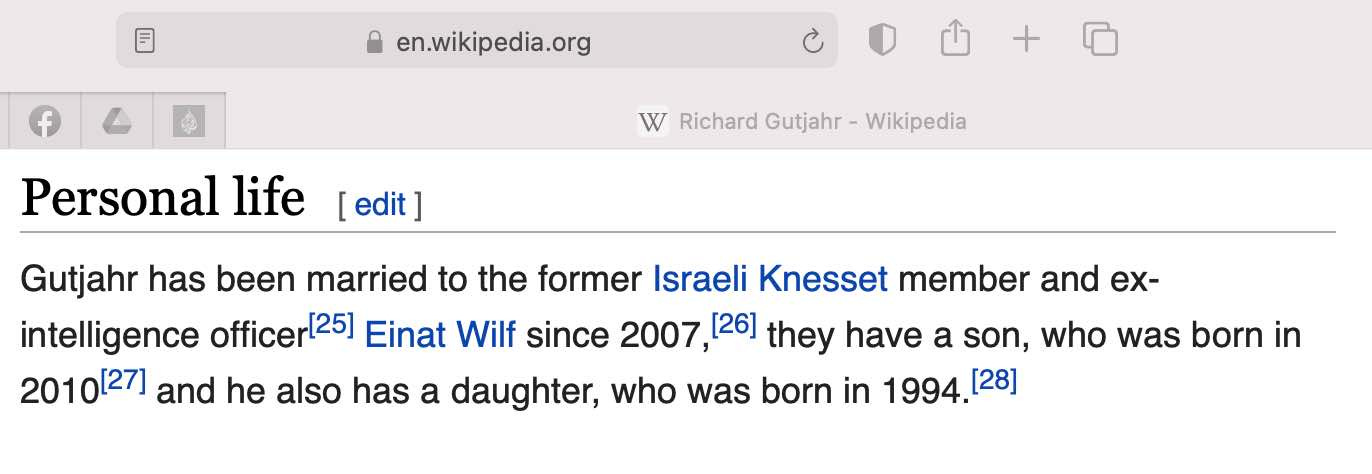
Wikipedia tells us that Gutjahr’s “coincidental presence at events gave rise to conspiracy theories, alleging his presence at both events could not have been a coincidence. Gutjahr has pressed charges against those who make the allegations,[21][22] which he sees mostly motivated by antisemitism against his wife considering the often antisemitic nature of the hostilities.” (Funny how Wikipedia tells us that Gutjahr “pressed charges” against journalists like Gerhard Wisnewski but fails to mention the outcome: Gutjahr suffered a crushing defeat in court.)
And then…bring on the obligatory charges of anti-Semitism! Whoever is editing Wikipedia apparently thinks it is “anti-Semitic” to notice that Israel is the only nation that has benefited from the “war on terror,” an episode of international mass hysteria elicited by a string of alleged “Islamic terror attacks” in which the Israeli government in general, and its intelligence community in particular, is the leading suspect.
Was it just a coincidence that the people who happened to be pre-positioned near the New Jersey waterfront at the perfect spot to film the attack on the Twin Towers, and who filmed and wildly celebrated the attacks before being arrested, were Israeli spies who later confessed they had been sent there “to document the event”?
Was it just a coincidence that the mysterious “Janek” who was pre-positioned on a rooftop to film the iconic footage of “the Charlie Hebdo terrorists’ escape” turned out to be an Israeli agent? As Hicham Hamza wrote:
At the origin of this (iconic Charlie Hebdo) video – filmed, oddly enough, without apparent fear of being hit by a stray bullet – in which one of the Charlie Hebdo attackers (who would soon flee in the direction of a Parisian establishment used by the Israeli army) declaims, with his left index finger pointed towards the sky, that he had “avenged the Prophet” – is a mysterious anonymous Pole, blurred by the television media, who vanishes without a trace – having been employed by a long-standing family enterprise of Laurent Dassault, ultra-Zionist multimillionaire connected to the military and radical wing of the Tel Aviv regime.
There is a mass of evidence, circumstantial and otherwise, that implicates Israel in 9/11, the 7/7/2005 London bombings, the Paris attacks of January and November 2015, and indeed most of the highest-profile GWOT terror incidents attributed to “Islamic extremists.” So Richard Gutjahr’s being married to an Israeli intelligence officer, and then magically showing up to film the beginnings of two successive terror attacks, does seem a tad suspicious. And his presence at a website selling an app that claims to mathematically arbitrate between mainstream and non-mainstream narratives seems not just suspicious, but bizarre… if not downright absurd. If noticing such things makes you “anti-Semitic,” then the alternative to “anti-Semitism” is sheer unmitigated idiocy.
Is mainstream media idiotic… or complicit? What are the odds?
Twitter Censors Pfizer-Injured Israeli COVID Vaccine Director
Boffin suggested that the monkeypox outbreak was connected to mRNA vaccines
Kanekoa’s Newsletter | August 3, 2022
Professor Shmuel Shapira, M.D., MPH, served as the Director General of the Israel Institute for Biological Research (IIBR) between 2013 and 2021, where he led Israel’s effort to develop a coronavirus vaccine.
Prof. Shapira is also the founder and head of the Department of Military Medicine of the Hebrew University Faculty of Medicine and IDF Medical Corps. He is a Senior Research Fellow at the International Institute for Counter-Terrorism (ICT) at Reichman University in Israel.
Shapira previously served as Deputy Director General of the Hadassah Medical Organization and as the Director of the Hebrew University Hadassah School of Public Health. He is a Full Colonel (Res.) in the Israel Defense Forces (IDF) and served as the IDF Head of Trauma Branch.
He has published more than 110 peer-reviewed scientific articles and is the editor of Essentials of Terror Medicine, Best Practice for Medical Management of Terror Incidents, and Medical Response to Terror Threats.
Last week, Twitter censored Prof. Shapira—who was “physically injured” after his third Pfizer vaccine—and forced him to remove a post which said: “Monkey pox cases were rare for years. During the last years a single case was documented in Israel. It is well established the mRNA vaccines affect the natural immune system. A monkey pox outbreak following massive covid vaccination: *Is not a coincidence.”

Prof. Shapira, who started his Twitter account in January 2022, has grown increasingly critical of the mRNA vaccines since he first denounced the Israeli Genesis Award for being delivered to Pfizer CEO Albert Bourla.
On January 18, 2022, Shapira said (translated from Hebrew by Google): “The Israeli Genesis Award was given to the CEO of Pfizer, so wretched. Instead of giving it to an Israeli scientist, and all this for a mediocre, short-acting vaccine that yielded Pfizer a profit of billions, a wretched and exiled one. Bourla will be appointed the King of Israel now. Let me remind you that vaccinated Israel is the fourth-leading in the number of corona patients in the world. There is a championship!”
On February 6, 2022, Shapira asked: “What grade would you give to a vaccine that people are vaccinated with three times and get sick twice (as of today)? Not to mention significant side effects[.]”
On April 9, 2022, Shapira said: “The CEO of the company, millions of whose vaccines were used in Israel for vaccination, stated in an interview with NBC that Israel serves as the world’s laboratory. To the best of my knowledge, this is the first case in history where experimental guinea pigs paid an exorbitant rate for their participation.”
On May 13, 2022, Shapira said: “I received 3 vaccinations, I was physically injured in a very significant way as many others were injured[.] And in addition, my trust in the nature of the decisions and in the processes of making them has been severely eroded. No one asked and checked. I will fight with all my might so that truthful answers regarding all decisions and not just regarding the vaccine are given[.]”
On June 7, 2022, Shapira said: “We are talking about vaccine five in two and a half years. When the vaccine is planned for the sequence from January 2020 (the great-grandfather of the great-grandfather of the current variants). A vaccine that does not prevent infection does not prevent morbidity. And it is allegedly attributed to significant side effects to say the least. Why? What is the logic? Which authority approved? And don’t say that it prevents a serious illness, no one has proven it.”
On June 8, 2022, Shapira said: “I will continue and ask why give an outdated fifth vaccine that does not prevent disease and apparently causes many significant common side effects.”
On July 5, 2022, Shapira discussed the “son of a 36-year-old Australian friend” who developed “severe ventricular arrhythmias and went into heart failure” only “days after the second Pfizer vaccine”.
“The compensation is automatic by the Australian government,” he said. “Despite the behavior of their government they admit to the connection and the phrase ‘no connection’ does not appear in the lexicon.”
On July 15, 2022, Shapira shared a chart of New South Wales COVID rates showing an increased risk of COVID infection with every new dose of the mRNA vaccine on which he commented: “According to official data from Australia the more you are injected the more likely you are to get sick as the fourth injection jumps the chance dramatically. According to this study it is supposedly an anti-vaccine at least according to what I have been taught.”

On July 18, 2022, Shapira said: “I am not anti-vaccine, I am anti-stupidity, anti-fake science, and anti-incompetent management.”
On July 28, 2022, Shapira said: “T warned me to remove the T connecting MP to C. Each day I understand better where we live and in which year.”
In other words, Twitter warned him to remove the tweet connecting monkeypox to the COVID vaccine.
On July 31, 2022, Shapira shared a link to the OpenVaers COVID Vaccine Adverse Event Reports which showed a total of 1,357,937 reports including 170,151 hospitalizations and 29,790 deaths, above which he simply commented: “Safe & Efficient”
Policing the World Is a Full-Time Job
BY PHILIP GIRALDI • UNZ REVIEW • AUGUST 2, 2022
Every leader and top official now in power in the so-called Western World seems to have forgotten that the North Atlantic Treaty Organization (NATO) was founded in 1949 as an alliance that was ostensibly defensive in nature, intended to counter the expansion of Soviet style communism in Europe. That role continued to be the raison d’etre of the organization until communist governments themselves collapsed in both Russia and in the Eastern European states that collectively made up the Warsaw Pact during the 1990s. After that point, NATO no longer had any reason to exist at all as the alleged military threat posed by the Kremlin and its allies vanished virtually overnight.
But clever politicians were quick to put the alliance on life support instead of simply dismantling it. Lacking the threat posed by the Warsaw Pact, NATO was forced to come up with other reasons to maintain military forces at levels that could quickly be enhanced and placed on a wartime footing. Washington and London took the lead in this, citing the now shopworn defense of a “rules based international order” as well as of “democracy” and “freedom.” And fortunately for the national defense industries and the generals, it soon proved possible to find new enemies that provided justification for additional military spending. The first major engagement outside the obligations defined by the original treaty took place in Europe to be sure, but it was in the Balkans where of NATO during the 1995 Operation Deliberate Force. The war ended after the signing of the General Framework Agreement for Peace in Bosnia and Herzegovina in Paris on December 14th 1995. Peace negotiations were finalized a week later but fighting resumed between Kosovo and Serbia in the following year, which led to another NATO intervention that eventually ended with the restoration of Kosovo’s autonomy and the deployment of NATO forces, which bombed the Serbs to compel their compliance with a draft cease fire agreement.
NATO also played a role improbably enough in the US invasion and occupation of Afghanistan, which was justified by claiming that an Afghanistan free to set its own course would become a hotbed of terrorism which would inevitably impact on the United States and Europe. It was a paper-thin argument, but it was the best they could come up with at the time and it also eventually involved soldiers from additional friendly countries like Australia. As we have subsequently seen, however, it was all an argument without merit as Afghanistan became a money pit and a graveyard for thousands of locals and foreign soldiers. It is now again in the hands of the Taliban after a bungled withdrawal of US forces and the collapse of the puppet government in Kabul that Washington had installed.
Turn the clock forward to the present. As everyone but President Joe Biden has recognized, the United States and NATO are currently engaged in a proxy war against Russia in Ukraine, which many observers already believe has some of the attributes of World War III. As Russia neither threatened nor attacked any NATO member state, the argument that the response in arming and training Ukraine was defensive was rendered irrelevant. Nor can it be credibly claimed that Russia is a haven for terrorists, quite the contrary. Nevertheless, Biden has stated that the US will be in the fight on behalf of Ukraine for “as long as it takes.” Does he mean years, and all done without a declaration of war by Congress as required by the US Constitution?
And more appears to be coming. Joe Biden, during last week’s trip to Israel, made clear that the United States is “prepared to use all elements of its national power” to stop Iran from getting a nuclear weapon and has signed a pledge with the Israeli government to commit itself to do so. If Biden presses the argument that Iran is an international threat due to its impending development of nuclear weapons, will he appeal to NATO to support a joint military option to disarm it? I believe he just might do that. And he might just want to consider how the entire set-up and framing of the issue by Israel is somewhat of a trap. Israel considers Iran’s current nuclear program to be intended to create a weapon, which “they continue to develop,” and there are plenty in the US Congress who would agree with that.
So, if Iran is clearly creating a thermonuclear device, the time to strike is now, isn’t it? And bear in mind how the US/Israeli campaign to condemn is multifaceted. Shortly before the meetings held by Biden and his crew with the Israelis, US government sources set the stage for what was to come by going on the offensive regarding reports that Iran may be selling highly capable offensive drones to Russia for use in Ukraine as well as subsequent claims coming out of Washington that the Iranians are seeking to assassinate senior US officials in revenge for the killing of Revolutionary Guards General Qassem Soleimani in January 2020. One wonders why they waited so long and why the White House has chosen to publicize these stories at this point.
And the US and NATO are also getting involved with China’s geopolitical policies, on a path that Beijing is warning is extremely hypocritical and which might lead to armed conflict. The signs that the Chinese might be targeted by NATO, possibly over the Taiwan independence issue, came following a stark warning by US Secretary of State Tony Blinken delivered at the NATO summit in Madrid at the end of June. Blinken accused China of “seeking to undermine the rules-based international order,” the same type of critique recently leveled against Russia and Iran. Blinken’s comment was elaborated on by NATO Secretary General Jens Stoltenberg, who observed how “China is substantially building up its military forces, including nuclear weapons, bullying its neighbors, threatening Taiwan … monitoring and controlling its own citizens through advanced technology, and spreading Russian lies and disinformation.”
Stoltenberg’s indictment of China was followed by a NATO issued “strategic concept” document last that declared for the first time that China poses a “systemic challenge” to the alliance, alongside a primary “threat” coming from Russia. The document copied Blinken’s language, citing “The deepening strategic partnership between the People’s Republic of China and the Russian Federation and their mutually reinforcing attempts to undercut the rules-based international order run counter to our values and interests.”
Finally, the US and British governments collaborated to condemn China as the “biggest long-term threat to our economic and national security.” The declaration came in a July 6th joint news conference in London, where Christopher Wray, director of the FBI, and Ken McCallum, director general of Britain’s MI5, accused China, like Russia, of interfering in US and UK elections. Wray also warned the business leaders in the audience that the Chinese government has been “set on stealing your technology, whatever it is that makes your industry tick, and using it to undercut your business and dominate your market.”
Chinese Foreign Ministry spokesman Zhao Lijian initially responded a few days after the NATO summit, observing that the “so-called rules-based international order is actually a family rule made by a handful of countries to serve the US self-interest,” adding that “[Washington]observes international rules only as it sees fit.” Addressing the issue of the role of NATO specifically, Zhao accused Blinken of using NATO to “hype up competition with China and stoke group confrontation.” He added that “The history of NATO is one about creating conflicts and waging wars… arbitrarily launching wars and killing innocent civilians, even to this day. Facts have proven that it isn’t China that poses a systemic challenge to NATO, and instead it is NATO that brings a looming systemic challenge to world peace and security. Thirty years after the end of the Cold War, [NATO] has not yet abandoned its thinking and practice of creating ‘enemies’ … It is NATO that is creating problems around the world.”
China has a point. What NATO is threatening is war, as it is a military alliance. The Chinese appear to understand that NATO is the world’s largest military bureaucracy which has developed since 1991 an overriding institutional commitment to ensuring its permanent existence, if not expansion, even after it has clearly outlived its own usefulness. So Beijing might justifiably wonder, how does China – on the other side of the globe – fit into NATO’s historic “defensive” mission? How are Chinese troops or missiles now threatening Europe or the US in ways they weren’t before? How are the Americans and Europeans suddenly under military threat coming from China?
The Chinese appear to understand that if there is no threat to “defend” against, then a threat must be manufactured, and that is precisely what we are seeing vis-à-vis Russia, China, Iran and even Venezuela. Washington has become addicted to war and NATO is the chosen tool to give those wars the patina of legitimacy. To launch those conflicts requires either inventing an imaginary threat, or, as in the case of Russia, provoking the very threat the “defensive” bureaucracy was designed to deter or thwart. All indications are that NATO – now embracing 30 countries – is doing both and the results could easily be disastrous for all parties involved. Former congresswoman Tulsi Gabbard particularly abhors the cynical recklessness of the Biden Administration driving the process, explaining how “The reality is, President Biden, members of Congress, leaders in our country, the wealthy, they will have a safe place to be in the event of a nuclear war that they are behind causing while the rest of us in America and Russia, people around the world, will be decimated from this event.”
Prize winning journalist Chris Hedges has also defined the unthinkable that is at stake, and it is past time for Americans and Europeans to take note and stop the madness. Hedges opines that “The massive expansion of NATO, not only in Eastern and Central Europe but the Middle East, Latin America, Africa and Asia, presages endless war and a potential nuclear holocaust.” One might also note that New Yorkers are now being informed about what to do if there is a nuclear attack. Yes, that is precisely the problem – we have an administration in Washington that should be protecting the people living in this country, not setting up scenarios that might lead to their slaughter. Will someone please point that out to Joe Biden?
Philip M. Giraldi, Ph.D., is Executive Director of the Council for the National Interest, a 501(c)3 tax deductible educational foundation (Federal ID Number #52-1739023) that seeks a more interests-based U.S. foreign policy in the Middle East. Website is councilforthenationalinterest.org, address is P.O. Box 2157, Purcellville VA 20134 and its email is inform@cnionline.org.
Israel demands disbanding of UN committee investigating attacks on Gaza
MEMO | August 1, 2022
Israel demanded on Sunday the disbanding of the UN committee investigating crimes committed during the occupation state’s military offensive against Gaza in May last year. It is alleged that remarks made by one member of the committee were “anti-Semitic”.
Israeli Prime Minister Yair Lapid made the demand in a letter to UN Secretary-General Antonio Guterres, in which he referred to the statements by Miloon Kothari, a member of the UN Human Rights Council’s Commission of Inquiry, in a media interview.
“We are very disheartened by the social media that is controlled largely by, whether it is the Jewish lobby or specific NGOs,” Kothari said on a Mondoweiss podcast on 25 July. “A lot of money is being thrown into trying to discredit us.”
Israel boycotted the investigation and prevented the commission’s investigators from entering the apartheid state. It claimed that the commission’s partial findings in June were “the latest in a series of biased reports.”
In his letter to Guterres, Lapid claimed that, “The fight against anti-Semitism cannot be waged with words alone, it requires action. This is the time for action; it is time to disband the Commission. This Commission does not just endorse antisemitism — it fuels it.”
The UN spokesman did not respond immediately to requests for comment, but Mondoweiss published a message from the committee’s chair, Navi Pillay, in which she said that Kothari’s comments were intentionally taken out of context.
The US and other Western countries, including Germany, Britain and Austria, denounced — very predictably — Kothari’s comments as “anti-Semitic”.
The US representative to the UN Human Rights Council, Ambassador Michele Taylor, tweeted, “We are outraged by recent anti-Semitic, anti-Israel comments made by a member of the Israel COI. These unacceptable remarks sadly exacerbate our deep concerns about the open-ended nature & overly broad scope of the COI and the HRC’s disproportionate & biased treatment of Israel.”
Although the commission was set up to investigate the Israeli attack on Gaza, which lasted 11 days in May last year, its mandate includes human rights violations before and after that, in addition to investigating the root causes of the tension.
At least 250 Palestinians as well as 13 people in Israel were killed during the Israeli aggression, which saw severe Israeli attacks and raids that exacerbated the destruction caused by the 2014 military offensive. Palestinian factions in the Gaza Strip fired several thousand rockets in response to Israel’s ongoing brutal military occupation and siege.
Featured Video

Houthis Don’t Have to Conquer Saudi Arabia to Make It Pay
or go to
Aletho News Archives – Video-Images
From the Archives
Newly Released FBI Docs Shed Light on Apparent Mossad Foreknowledge of 9/11 Attacks
By Whitney Webb | MintPress News | May 17, 2019
NEW YORK — For nearly two decades, one of the most overlooked and little known arrests made in the aftermath of the September 11 attacks was that of the so-called “High Fivers,” or the “Dancing Israelis.” However, new information released by the FBI on May 7 has brought fresh scrutiny to the possibility that the “Dancing Israelis,” at least two of whom were known Mossad operatives, had prior knowledge of the attacks on the World Trade Center. … continue
Blog Roll
 Aletho News
- MEP blasts ‘Euro-Gestapo’ for lecturing Russia on democracy
- Syria May Send Troops to Saudi Arabia Amid War with Ansar Allah
- UK whines about losing billions to ‘Putin tax’
- Baghaei to Rubio: Distorted narratives cannot erase US record of broken commitments
- Houthis Don’t Have to Conquer Saudi Arabia to Make It Pay
- MOE: Nearly 22,000 Students and Education Workers Killed
- Guterres in Islamabad: Genocide, cowardice, and the cage of Imran Khan
- Johnson, Marandi say Yemen holds upper hand over Saudi Arabia
- False flags won’t save aggressors, Iran FM spokesman says
- The Makkah Pact Enters Into Force: The End of American Dominance or Its New Form?
- If Americans Knew
- Report claimed Mark Levin used by Israeli government to influence Trump
- Over 2,000 Gazans have died awaiting medical evacuation amid Israel’s continued siege
- How a U.S. Diplomat Suppressed and Altered Reports Critical of Israel
- 5 Palestinians Die from Israeli Strikes in Gaza as Relentless Attacks Continue
- Report: Ceasefire Slows Killing but Leaves Devastation Intact
- Country Music Singer Zach Bryan Breaks Attendance Record at Robert Kraft’s Gillette Stadium While Wearing ‘Free Palestine’ Shirt for Second Night in a Row
- Three years of death and devastation: Israel’s war on Gaza in pictures
- Why Hamas believed the status quo was more dangerous than its 7 October gamble
- Debunking Israel’s latest list of ‘terrorist’ journalists in Gaza
- In Gaza, focus is on survival, “every step is a struggle” – Daily Update
- No Tricks Zone
- New Study: 50 Years Of The Most Aggressive ‘Net Zero’ Policies Can Only Affect The Global Climate By 0.03°C
- US September “Heat” Was No Record…Many Records Set Decades Ago
- Latest European Green Energy Debacle; Portugal’s Largest Flagship Solar Park Insolvent!
- Green Energy Debacle: German Expert Professor Fritz Vahrenholt Warns Of Severe Economic And Social Consequences
- Two More Paleo Reconstructions Affirm Meters-Higher Sea Levels Across Ireland, Brazil 7000-6000 Years Ago
- New Study: Earth And Venus Surface Warmth Largely Explained By Convection And Lapse Rate, Not CO2 Or Radiation
- 2025 Nature Paper Claiming Worsening Global Drought Gets RETRACTED …Heavily Flawed
- New Study: ‘Global Drought Shows No Detectable Recent Acceleration Under Climate Warming’
- Economic Masterminds: German Socialists Suggest Taxing Productivity Gains Stemming From Using AI
- The South China Sea Has Not Been Cooperating With The Climate Change Narrative

