Europe looks to Israel for natural gas
Samizdat | May 16, 2022
Deliveries of Israeli natural gas via Turkey to Europe are being considered as an alternative to Russian energy supply, Turkish newspaper Yeni Şafak reported on Monday.
“Israeli gas is considered as an option, its route is planned via Turkey, through the Eastern Mediterranean,” the paper reported, adding that, in case of such an agreement, “it is expected that the Turkish ship will be on duty during transmission periods.”
The report also highlighted that “focusing on deep-water drilling for the extraction of oil and natural gas from the seas, Turkey has included a fourth drilling vessel in its fleet.”
The new drilling ship, which left South Korea on March 7, is expected to arrive in Turkey on May 19. “A new generation ship that will serve in the Eastern Mediterranean, will begin its first mission in July after two months of preparatory work, it will facilitate deep-sea exploration and dredging in the Mediterranean,” the newspaper said.
The ship can reportedly operate at depths of up to 3,600 meters, and is capable of drilling up to 12,200 meters.
In March, media reported that a Turkey-Israel gas pipeline was being discussed behind the scenes as one of Europe’s alternatives to Russian energy. The idea, first conceived years ago, is to build a subsea pipeline from Turkey to Israel’s largest offshore natural gas field, Leviathan. Gas would flow to Turkey and on to southern Europe looking to diversify away from Russia.
Industry officials, however, have warned of production restraints and geopolitical factors that could leave the plan dead in the water. Lebanon has claimed that the gas field extends into its waters.
UN Urges Israel to Protect Freedom of Assembly After Video Emerges of Journalist Funeral
Samizdat – 13.05.2022
The United Nations is aware of “shocking” video showing violence during the funeral of Al Jazeera journalist Shireen Abu Akleh in Jerusalem and calls on the Israeli government to protect freedom of peaceful assembly, UN spokesperson Farhan Haq said on Friday.
“We have just seen the video coming from this, and this is very shocking to us,” Haq said in a press briefing.
Israeli forces fatally shot reporter Shireen Abu Akleh and injured another employee as the two were covering the government forces’ raids in the West Bank city of Jenin, media reported on Wednesday.
The video showed violence erupting during Akleh’s funeral in Jerusalem when the Israeli police charged the crowd carrying her coffin.
Haq said the United Nations will try to gather more information about the incident.
“Clearly, as in all cases, we want to make sure that the basic rights to freedom of assembly, and of course the right to freedom of peaceful demonstration are protected and upheld,” he said.
No country can attack or kill journalists and those who are responsible for such actions need to be brought to account, Haq added.
Israel shoots dead Al Jazeera journalist during invasion of Jenin

MEMO | May 11, 2022
Israeli occupation forces shot dead Al Jazeera correspondent Shireen Abu Akleh this morning during an invasion of the northern occupied West Bank city of Jenin.
The Palestinian Ministry of Health said Abu Akleh was shot by a live bullet in the head and rushed to hospital where she was declared dead.
Another reporter, Ali Al-Samudi, was also shot by a live bullet in the back, the ministry said. He was reported to be in a stable condition.
Waleed Al-Omari, Al Jazeera‘s bureau chief in Ramallah, said: “It seems that she was shot by an Israeli sniper.” He added that Abu Akleh had been standing in an area away from Palestinians who were protesting against Israel’s deadly raid of Jenin.
Al-Omari’s account negates Israel’s claim that there had been gunfire in the area to which occupation forces responded.
“During the operation in Jenin refugee camp, suspects fired an enormous amount of gunfire at troops and hurled explosive devices. [Israeli] forces fired back. Hits were identified,” the Israeli army said in a statement.
The army also said it was “looking into the possibility that journalists were injured, potentially by Palestinian gunfire.”
A Palestinian paramedic denied the Israeli army’s claims.
In a statement, Al Jazeera said Israeli occupation forces “assassinated in cold blood” its correspondent. This, it added, was “a blatant murder, violating international laws and norms. Al Jazeera Media Network condemns this heinous crime, which intends to only prevent the media from conducting their duty.”
Nasrallah: Those pushing for disarmament of Hezbollah want to sell Lebanon to US

Press TV – May 9, 2022
The secretary general of the Lebanese Hezbollah resistance movement, Sayyed Hassan Nasrallah, speaks in a televised speech broadcast live from the Lebanese capital city of Beirut on May 9, 2022.
The secretary-general of the Lebanese Hezbollah resistance movement has denounced calls by some political parties for the disarmament of the movement in the run-up to next week’s parliamentary elections, saying the demand comes amid those parties’ utter disregard for the worsening economic crisis in the country.
“I want the entire Lebanese nation to know that those who are calling for the disarmament of the resistance are unaware of what the southerners went through since 1948,” Sayyed Hassan Nasrallah said in a televised speech broadcast live from the Lebanese capital city of Beirut on Monday evening.
“Some political forces have unfortunately turned Hezbollah’s disarmament into the main topic of their electoral campaigns,” Nasrallah said, stressing that the parties that are “pushing for the handover of Hezbollah’s weapons want to sell Lebanon to US and make it susceptible in face of Israel.”
“Those who are calling for Hezbollah’s disarmament disregard its achievements as to liberation of the occupied Lebanese territories and freedom of prisoners” from Israeli detention centers, Nasrallah said.
“Does Israel dare bomb any area in Lebanon today?” Nasrallah asked, attributing the deterrence to the presence of Hezbollah forces.
“We respect the army. It has a national creed as well as competent officers and soldiers. The Lebanese army, however, cannot shoulder the responsibility on its own at the moment, and cannot confront the Israeli enemy alone,” the Hezbollah leader said.
Nasrallah went on to emphasize that his movement is ready to discuss a national defense strategy, because it has “reason and evidence.”
He added that those making demands for Hezbollah’s disarmament have not yet offered “an alternative” in the face of Israeli acts of aggression.
“Who will protect southern Lebanon if the resistance abandons its duties? Hezbollah is the strong force protecting Lebanon today,” Nasrallah said.
He went on to lament that some Lebanese politicians “do not view Israel as an enemy” and do not believe that “the regime has ambitious plans for Lebanon’s territorial waters and gas reserves.”
Nasrallah highlighted that the May 15 parliamentary elections will be a “political war” and that Hezbollah “will practice political resistance in the polls.”
“Those who want to defend Lebanon, extract its oil resources and protect its waters must vote for the resistance and its allies,” he pointed out.
“Some people are saying that they won’t vote for the resistance due to the economic crisis. We tell that the resistance will guarantee extraction of natural gas and crude oil from Lebanon’s territorial waters in order to resolve the crisis,” Nasrallah added.
“Hundreds of billions of dollars are present in our waters,” Nasrallah said of Lebanon’s potential oil and gas reserves.
The Ansarullah chief went on to call on the Lebanese government to start investment in the country’s offshore oil reserves.
Nasrallah said the United States wants Lebanon to recognize Israel, and naturalize the Palestinian and Syrian refugees.
He finally made a reference to the Israeli military’s drills near the border with Lebanon, emphasizing that Hezbollah resistance fighters will not hesitate to respond to any aggression against their homeland.
“We are not afraid of your drills and your deployment. We are the ones who coined the expression ‘Israel is weaker than a spider web’ more than 20 years ago,” Nasrallah concluded.
Israel provoking Palestine factions with actions in Al-Aqsa Mosque
MEMO | May 5, 2022
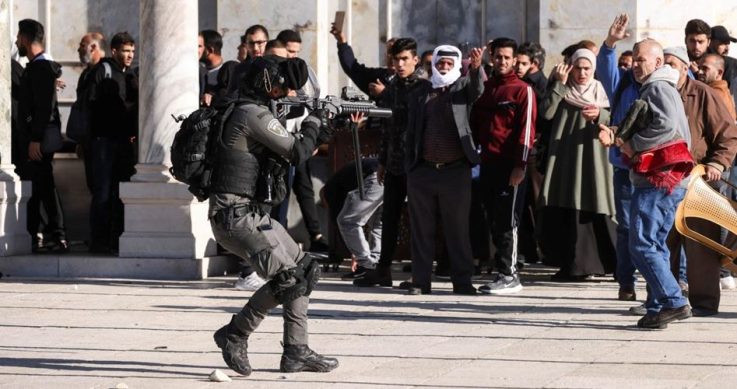
Israeli occupation authorities provoked Palestinian factions after allowing Jewish settlers to storm Al-Aqsa Mosque, statements issued yesterday said.
The Israeli government decided to allow Jewish settlers to storm Al-Aqsa Mosque today.
Hamas said: “Allowing Israeli settlers to storm Al-Aqsa Mosque is playing with fire and this could drag the region into a new escalation.”
“We renew our call for the Palestinian people to travel to Al-Aqsa Mosque and be on high alert in Jerusalem in order to defend their identity, religion and first Qibla.”
According to Hamas, “the Israeli occupation must know that all attempts aimed at dividing Al-Aqsa Mosque or Judaising Muslim holy sites will not pass and will not achieve its malicious goals.”
Meanwhile, spokesman of the Islamic Jihad in the West Bank, Tariq Izzedine, said: “The continuation of Israeli violations against Al-Aqsa Mosque is a violation of Palestinian redlines that needs an urgent movement to stop it.”
Fatah called on Palestinians to gather in Al-Aqsa Mosque today to thwart a “planned provocative Israeli plan to raise the Israeli flag and sing the Israeli anthem at the Palestinian holy site.”
Hamas hails Palestinian worshipers’ heroism
Palestine Information Center – May 5, 2022
 GAZA – Hamas Movement’s spokesman Hazem Qassem hailed the Palestinian worshipers’ heroism in confronting Israeli attacks on al-Aqsa Mosque on Thursday morning.
Israeli authorities are witnessing a state of confusion and panic in face of the Palestinian strong determination, he stressed.
Al-Aqsa Mosque was and will remain a pure Islamic and Arabic shrine, he added.
Earlier Thursday, dozens of Palestinian worshipers were injured after Israeli police forces violently stormed al-Aqsa Mosque in Occupied Jerusalem to clear the area for Jewish settlers’ break-ins that had been paused for the Muslim holidays.
The police forces fired rubber-coated bullets and teargas bombs, injuring dozens of Palestinians. At least 12 live-shot injuries were reported.
Ten worshipers were detained during the attack, including a French Muslim woman.
Three Israelis killed, others injured in stabbing incident
Palestine Information Center – May 5, 2022
OCCUPIED JERUSALEM – Three Israelis were killed while others were wounded in a stabbing incident in Elad area to the east of Tel Aviv on Thursday night.
Hebrew media reported that a number of those injured were in very serious conditions.
Preliminary reports indicated that the attacker used an axe and a knife in his attack before withdrawing from the area.
The Elad municipality asked citizens to remain indoors as the Israeli police forces set up barriers and launched a large-scale manhunt searching for the attacker with the help of choppers.
Moscow Says Israeli Mercenaries Fighting in Ukraine
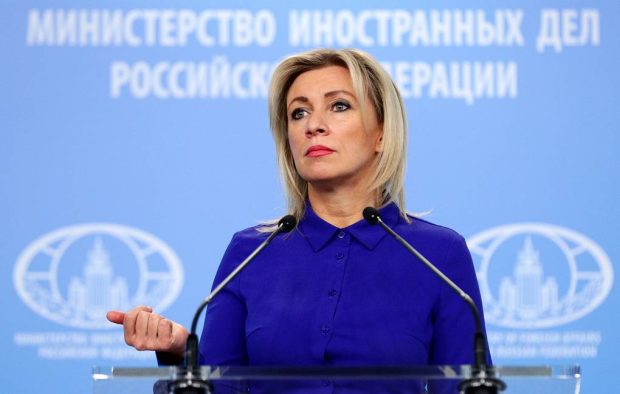
Maria Zakharova, Russian Foreign Ministry spokeswoman, giving press briefing in Moscow (February 2022).
Al-Manar | May 4, 2022
A spokeswoman for Russia’s foreign ministry on Wednesday said Israeli mercenaries were fighting alongside the far-right Azov Regiment in Ukraine, further fueling tensions with Israel after Russia suggested Adolf Hitler had “Jewish blood.”
“Israeli mercenaries are practically shoulder to shoulder with Azov militants in Ukraine,” Maria Zakharova told pro-Kremlin Sputnik radio in an interview.
They have been fighting alongside the Ukrainian army against Russian troops, which on February 24 launched a military campaign in Ukraine to protect Russia’s national security.
By suggesting that Israelis are fighting alongside Azov – viewed by Russia as fascists and Nazis, Moscow is escalating political confrontation that started after Russian Foreign Minister Sergei Lavrov said Sunday that Hitler had “Jewish blood.”
His remarks sparked outrage in ‘Israel’, which called the statement “unforgivable and outrageous” and a “terrible historical error.”
Russia’s foreign ministry on Tuesday accused ‘Israel’ of backing “the neo-Nazi regime in Kiev.” Ukraine’s President Volodymyr Zelenskyy is of Jewish descent.
Israel Extends Detention of World Vision Gaza Director
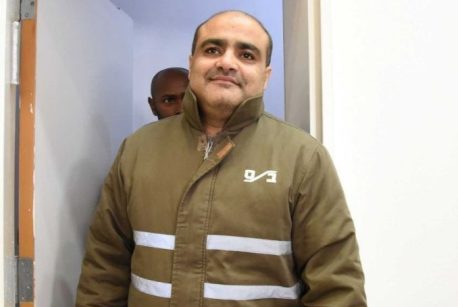
Mohammed Al-Halabi, World Vision’s Operations Manager in the Gaza Strip. (Photo: File)
Palestine Chronicle | May 3, 2022
Israel’s prosecution requested to extend the detention of Palestinian aid worker Mohammed al-Halabi nearly six years after Israel accused him of diverting tens of millions of dollars from an international charity to Hamas, The New Arab reported.
World Vision — a major Christian charity that operates around the world — as well as independent auditors and the Australian government, have found no evidence of any wrongdoing. Al-Halabi’s lawyer says he has rejected multiple plea bargains that would have allowed him to walk free years ago.
The prosecution has requested another hearing on Monday to extend his detention, he has yet to be convicted in an Israeli court and is still being held in detention.
Al-Halabi has consistently denied the accusations throughout his 167 court hearings. Israel hopes that in time and under duress, the father of five will confess under pressure, activists say.
After al-Halabi’s arrest, World Vision suspended its activities in Gaza, where over 2 million Palestinians live under a crippling 15-year Israeli blockade.
Lavrov’s ‘anti-Semitic’ remarks
By Gilbert Doctorow | May 4, 2022
In the past couple of days, there were two major diplomatic scandals at the international level. One concerns the Ukrainian ambassador to Berlin, who grossly insulted the Chancellor. The other concerns Russian Minister of Foreign Affairs Sergei Lavrov’s offhand remarks in an interview regarding anti-Semitism, which immediately riled the political establishment in Israel. Though both incidents have been featured in news bulletins, neither has been approached from the angle of investigative journalism.
When Ambassador Andrij Melnyk accused Olaf Scholz of behaving like “an offended liver sausage” for refusing to visit Kyiv, that caught the attention of not only German media, but global media. The term “offended liver sausage” may have seemed peculiar to English speakers, but it clearly was not meant as a compliment.
The Daily Beast went further than most of the press in identifying the term as a German colloquialism “commonly employed to describe someone as a prima donna.” They connected this insult to the head of government with a tit-for-tat by the Chancellor: in the preceding month, Zelensky had refused to receive German head of state Frank-Walter Steinmeier because of his past close ties to Moscow and this motivated Scholz’s decision not to go.
However, the nominally investigative journalists of The Daily Beast looked no further. Neither this paper nor mainstream has asked and then answered persuasively why Kiev would intentionally offend the most powerful country within the EU, upon whom it greatly depends for military and economic assistance. Some put it down to the ambassador’s personal views. Others are simply confounded. No one has considered that the spat Kiev’s man on the spot has initiated with Scholz might be a calculated intervention in German domestic politics, with a view to pushing the indecisive Scholz out of power. The Chancellor is known to be under threat from other members of his own party and from coalition partners who would gladly replace him with someone more committed to helping the Ukrainian cause with action and not just words.
The case of Lavrov’s remarks about Jews and anti-Semitism has received even less penetrating analysis. He is quoted in the press as having said that Hitler also had Jewish blood and that the worst anti-Semites are found among Jews. These words were instantly denounced by the Israeli government, which called for an apology.
The Western press was equally quick to remark how Lavrov had precipitated what can only be a cooling of relations with Israel. Jerusalem would now surely abandon its claims to be an honest broker and would align itself more closely with Kiev. In Washington and London, editors were gleeful.
However, no one asked the question which begs to be addressed: how, why would Sergei Lavrov, who is surely the most experienced diplomat on the world stage, make remarks that could only do damage to Russian-Israeli relations?
I admit that there is an innocuous explanation. Lavrov intended his words as a counter to Western denial that Kiev is a Nazi-dominated regime on grounds that President Zelensky himself is Jewish. But Lavrov had to be aware how Jerusalem would react to his words, so we should look further.
Let me hazard a guess. Lavrov knew well what he was doing and probably had discussed this subject with his boss, Vladimir Vladimirovich, before he opened his mouth.
The Russians are very dissatisfied with Israel over its past military cooperation with Ukraine, and Lavrov’s statement was only the opening round. If we go back to the very first days of Russia’s ‘special military operation,’ when they took control of the Zaporozhye nuclear power station and seized there documents relating to Ukraine’s efforts to build a ‘dirty nuclear weapon,’ the Russian Ministry of Defense announced that there were foreign enablers active there. Then the next day, unexpectedly and in great haste, Israeli Prime Minister Bennett flew to Moscow for unscheduled talks with Putin. Almost nothing was disclosed about the subject of their talks. But subsequently the foreign enablers were never identified by the Russians.
Though I have been praised by some readers for avoiding ‘speculation,’ I will permit myself just this once to speculate: it is not inconceivable that the Israelis were among the key advisers to Kiev on its program to build nuclear weapons. If that is so, we may expect Russian-Israeli relations to get a lot worse in the coming weeks and months.
©Gilbert Doctorow, 2022
By redefining UNRWA, Washington destroys the foundation for a Just peace in Palestine
By Ramzy Baroud | MEMO | May 3, 2022
Palestinians are justifiably worried that the mandate granted to the United Nations Agency for Palestinian refugees, UNRWA, might be coming to an end. UNRWA’s mission, which has been in effect since 1949, has done more than provide urgent aid and support to millions of refugees. It was also a political platform that protected and preserved the rights of several generations of Palestinians.
Though UNRWA was not established as a political or legal platform per se, the context of its mandate was largely political, since Palestinians became refugees as a result of military and political events – the ethnic cleansing of the Palestinian people by Israel and the latter’s refusal to respect the Right of Return for Palestinians as enshrined in UN resolution 194 (III) of 11 December, 1948.
“UNRWA has a humanitarian and development mandate to provide assistance and protection to Palestine refugees pending a just and lasting solution to their plight,” the UN General Assembly Resolution 302 (IV) of 8 December, 1949 read. Alas, neither a ‘lasting solution’ to the plight of the refugees, nor even a political horizon has been achieved. Instead of using this realization as a way to revisit the international community’s failure to bring justice to Palestine and to hold Israel and its US benefactors accountable, it is UNRWA and, by extension, the refugees that are being punished.
In a stern warning on 24 April, the head of the political committee at the Palestinian National Council (PNC), Saleh Nasser said that UNRWA’s mandate might be coming to an end. Nasser referenced a recent statement by the UN body’s Commissioner-General, Philippe Lazzarini, about the future of the organization.
Lazzarini’s statement, published a day earlier, left room for some interpretation, though it was clear that something fundamental regarding the status, mandate and work of UNRWA is about to change. “We can admit that the current situation is untenable and will inevitably result in the erosion of the quality of the UNRWA services or, worse, to their interruption,” Lazzarini said.
Commenting on the statement, Nasser said that this “is a prelude to donors stopping their funding for UNRWA.”
The subject of UNRWA’s future is now a priority within the Palestinian, but also Arab political discourse. Any attempts at canceling or redefining UNRWA’s mission will pose a serious, if not an unprecedented challenge for Palestinians. UNRWA provides educational, health and other support for 5.6 million Palestinians in Jordan, Lebanon, Syria, the Gaza Strip and the West Bank, including East Jerusalem. With an annual budget of $1.6 billion, this support, and the massive network that has been created by the organization, cannot be easily replaced.
Equally important is the political nature of the organization. The very existence of UNRWA means that there is a political issue that must be addressed regarding the plight and future of Palestinian refugees. In fact, it is not the mere lack of enthusiasm to finance the organisation that has caused the current crisis. It is something bigger, and far more sinister.
In June 2018, Jared Kushner, son-in-law and advisor to former US President Donald Trump, visited Amman, Jordan, where he, according to the US Foreign Policy magazine, tried to persuade Jordan’s King Abdullah to remove the refugee status from 2 million Palestinians currently living in the country.
This and other attempts have failed. In September 2018, Washington, under the Trump administration, decided to cease its financial support of UNRWA. As the organization’s main funder, the American decision was devastating, because about 30 per cent of UNRWA’s money comes from the US alone. Yet, UNRWA hobbled along by increasing its reliance on the private sector and individual donations.
Though the Palestinian leadership celebrated the Biden Administration’s decision to resume UNRWA’s funding on April 7, 2021, a little caveat in Washington’s move was largely kept secret. Washington only agreed to fund UNRWA after the latter agreed to sign a two-year plan, known as Framework for Cooperation. In essence, the plan effectively turned UNRWA into a platform for Israel and American policies in Palestine, whereby the UN body consented to US – thus Israeli – demands to ensure that no aid would reach any Palestinian refugee who has received military training “as a member of the so-called Palestinian Liberation Army”, other organizations or “has engaged in any act of terrorism”. Moreover, the Framework expects UNRWA to monitor “Palestinian curriculum content”.
By entering into an agreement with the US Department of State, “UNRWA has effectively transformed itself from a humanitarian agency that provides assistance and relief to Palestinian refugees, to a security agency furthering the security and political agenda of the US, and ultimately Israel,” BADIL Resource Center for Palestinian Residency and Refugee Rights noted.
Palestinian protests, however, did not change the new reality, which effectively altered the entire mandate granted to UNRWA by the international community nearly 73 years ago. Worse, European countries followed suit when, last September, the European parliament advanced an amendment that would condition EU support of UNRWA on the editing and rewriting of Palestinian school text books that, supposedly, ‘incite violence’ against Israel.
Instead of focusing solely on shutting down UNRWA immediately, the US, Israel and their supporters are working to change the nature of the organization’s mission and to entirely rewrite its original mandate. The agency that was established to protect the rights of the refugees, is now expected to protect Israeli, American and western interests in Palestine.
Though UNRWA was never an ideal organization, it has indeed succeeded in helping millions of Palestinians throughout the years, while preserving the political nature of their plight.
Though the Palestinian Authority, various poltical factions, Arab governments and others have protested the Israeli-American designs against UNRWA, such protestations are unlikely to make much difference, considering that UNRWA itself is surrendering to outside pressures. While Palestinians, Arabs and their allies must continue to fight for UNRWA’s original mission, they must urgently develop alternative plans and platforms that would shield Palestinian refugees and their Right of Return from becoming marginal and, eventually, forgotten.
If Palestinian refugees are removed from the list of political priorities concerning the future of a just peace in Palestine, neither justice nor peace can possibly be attained.
Featured Video

Houthis Don’t Have to Conquer Saudi Arabia to Make It Pay
or go to
Aletho News Archives – Video-Images
From the Archives
Newly Released FBI Docs Shed Light on Apparent Mossad Foreknowledge of 9/11 Attacks
By Whitney Webb | MintPress News | May 17, 2019
NEW YORK — For nearly two decades, one of the most overlooked and little known arrests made in the aftermath of the September 11 attacks was that of the so-called “High Fivers,” or the “Dancing Israelis.” However, new information released by the FBI on May 7 has brought fresh scrutiny to the possibility that the “Dancing Israelis,” at least two of whom were known Mossad operatives, had prior knowledge of the attacks on the World Trade Center. … continue
Blog Roll
 Aletho News
- MEP blasts ‘Euro-Gestapo’ for lecturing Russia on democracy
- Syria May Send Troops to Saudi Arabia Amid War with Ansar Allah
- UK whines about losing billions to ‘Putin tax’
- Baghaei to Rubio: Distorted narratives cannot erase US record of broken commitments
- Houthis Don’t Have to Conquer Saudi Arabia to Make It Pay
- MOE: Nearly 22,000 Students and Education Workers Killed
- Guterres in Islamabad: Genocide, cowardice, and the cage of Imran Khan
- Johnson, Marandi say Yemen holds upper hand over Saudi Arabia
- False flags won’t save aggressors, Iran FM spokesman says
- The Makkah Pact Enters Into Force: The End of American Dominance or Its New Form?
- If Americans Knew
- Report claimed Mark Levin used by Israeli government to influence Trump
- Over 2,000 Gazans have died awaiting medical evacuation amid Israel’s continued siege
- How a U.S. Diplomat Suppressed and Altered Reports Critical of Israel
- 5 Palestinians Die from Israeli Strikes in Gaza as Relentless Attacks Continue
- Report: Ceasefire Slows Killing but Leaves Devastation Intact
- Country Music Singer Zach Bryan Breaks Attendance Record at Robert Kraft’s Gillette Stadium While Wearing ‘Free Palestine’ Shirt for Second Night in a Row
- Three years of death and devastation: Israel’s war on Gaza in pictures
- Why Hamas believed the status quo was more dangerous than its 7 October gamble
- Debunking Israel’s latest list of ‘terrorist’ journalists in Gaza
- In Gaza, focus is on survival, “every step is a struggle” – Daily Update
- No Tricks Zone
- New Study: 50 Years Of The Most Aggressive ‘Net Zero’ Policies Can Only Affect The Global Climate By 0.03°C
- US September “Heat” Was No Record…Many Records Set Decades Ago
- Latest European Green Energy Debacle; Portugal’s Largest Flagship Solar Park Insolvent!
- Green Energy Debacle: German Expert Professor Fritz Vahrenholt Warns Of Severe Economic And Social Consequences
- Two More Paleo Reconstructions Affirm Meters-Higher Sea Levels Across Ireland, Brazil 7000-6000 Years Ago
- New Study: Earth And Venus Surface Warmth Largely Explained By Convection And Lapse Rate, Not CO2 Or Radiation
- 2025 Nature Paper Claiming Worsening Global Drought Gets RETRACTED …Heavily Flawed
- New Study: ‘Global Drought Shows No Detectable Recent Acceleration Under Climate Warming’
- Economic Masterminds: German Socialists Suggest Taxing Productivity Gains Stemming From Using AI
- The South China Sea Has Not Been Cooperating With The Climate Change Narrative

