Israel seizes 30 cryptocurrency wallets allegedly funding Hamas
MEMO | March 1, 2022
Israeli authorities have seized dozens of cryptocurrency wallets from accounts allegedly affiliated with the Palestinian resistance movement, Hamas, in what they claim is a crackdown on funding to the group through digital means.
The seizure of around 30 wallets from 12 accounts was approved by Israeli Defence Minister, Benny Gantz, who said in a statement that “We continue to expand our tools to deal with terrorism, and with companies that supply it with an economic oxygen pipeline.”
The wallets – reportedly owned by an exchange company named Al-Mutahadun in the Gaza Strip and having had an estimated value of tens of thousands of Israeli shekels – were confiscated in a joint operation by the Defence Ministry, police and military.
According to Israeli news outlets, the wallets were the result of Hamas’s efforts to acquire funds from international donors through the use of cryptocurrencies – an experimental project launched by the group around three years ago to help counter its financial troubles and circumvent the traditional banking system.
Al-Mutahadun is reportedly owned by the Shamlah family, prominent amongst the Hamas leadership, who Gantz said “assists the Hamas terror group, and especially its military wing, by transferring funds amounting to tens of millions of dollars a year.”
In 2020, Gantz authorised the seizure of $4 billion in funding allegedly transferred from Iran to Hamas and, last year, Israel claimed that it seized $121,000 sent to the group from members in Turkey.
While the Israeli reports cannot be verified, if true, then Tel Aviv’s seizure of the digital wallets signifies its advancing capability to counter alleged financial aid to Hamas in the form of cryptocurrencies – a commodity that has long been lauded by many as relatively safe from the reach of states and banking institutions. It was in July when the Israeli government launched its campaign to target crypto wallets it says is used by Hamas.
If vaccines work, then why are they bending the curves in the wrong direction?
el gato malo – bad cattitude – february 27, 2022
israel has been a good laboratory for covid intervention assessment. they are a small nation in one climate zone with a small population, good record keeping, a pretty honest set of health agencies, and modern healthcare system. they did lots of testing and they also pursued damn near every mitigation in the book from lockdowns to masking to mandating vaccines and vaccine passports. and unlike many places, they were extremely serious about compliance. they even have an very useful control group in palestine that did almost none of these things.
this provides an interesting opportunity to measure the efficacy of such interventions. at this point, it’s so well established that masking and distancing have no effect that we can more or less drop them from consideration and focus solely on vaccines. (to the extent they worked, they would drive apparent vaccine efficacy in israel anyhow).
and the two states have had remarkably similar overall outcomes and had near identical cumulative deaths per capita through 2021. however, it looks like this might be starting to diverge and this creates a useful comparison.
about three weeks ago, i left THIS POST with some questions:
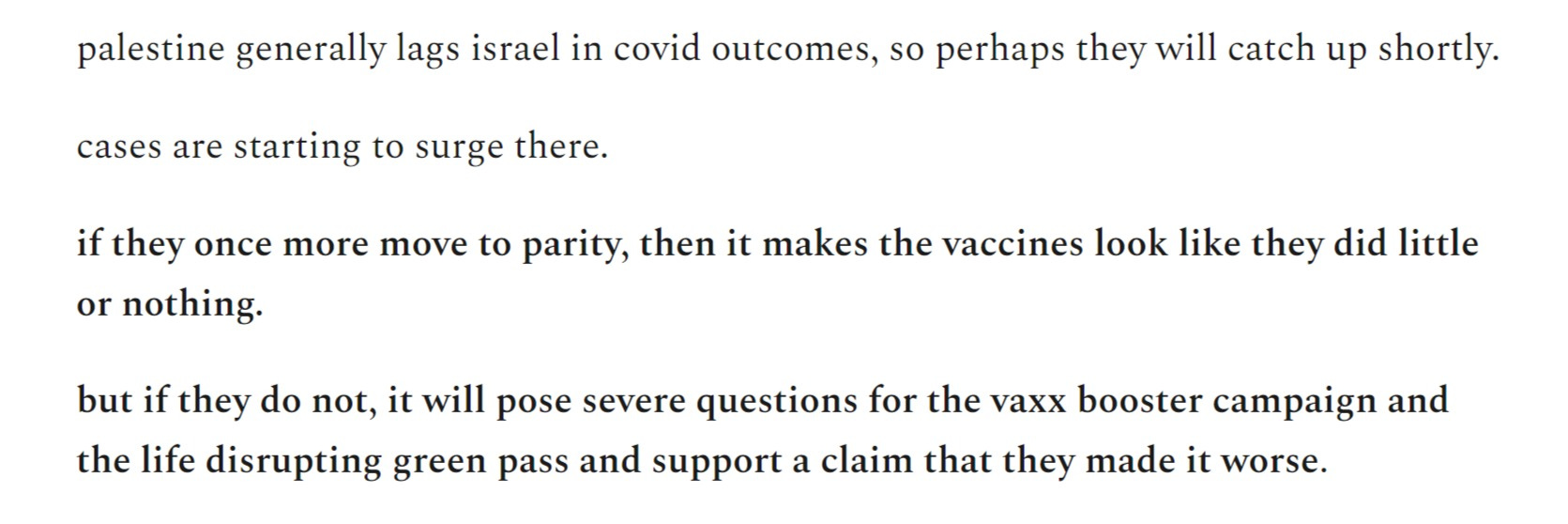
we now have enough data to start to answer this.
the relative vaxx rates are very different and israel is over 50% boosted vs ~0 in palestine. so, if boosters are working, this is about as good a natural experiment setup as you could ask for.
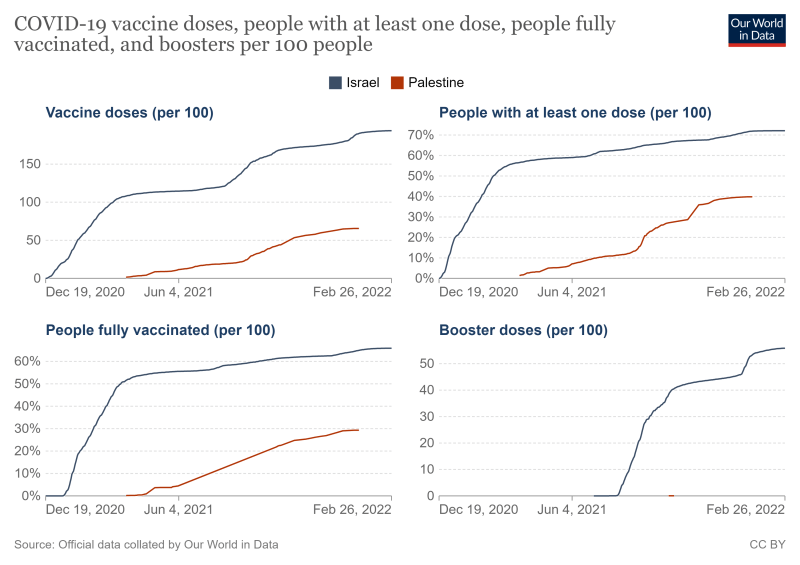
cases are a problematic metric due to variance in testing rates (and we know vaccines do not stop cases) and palestine does not report hospital data. but we can compare deaths, so this is the figure i used.
OWID is the source for all data.
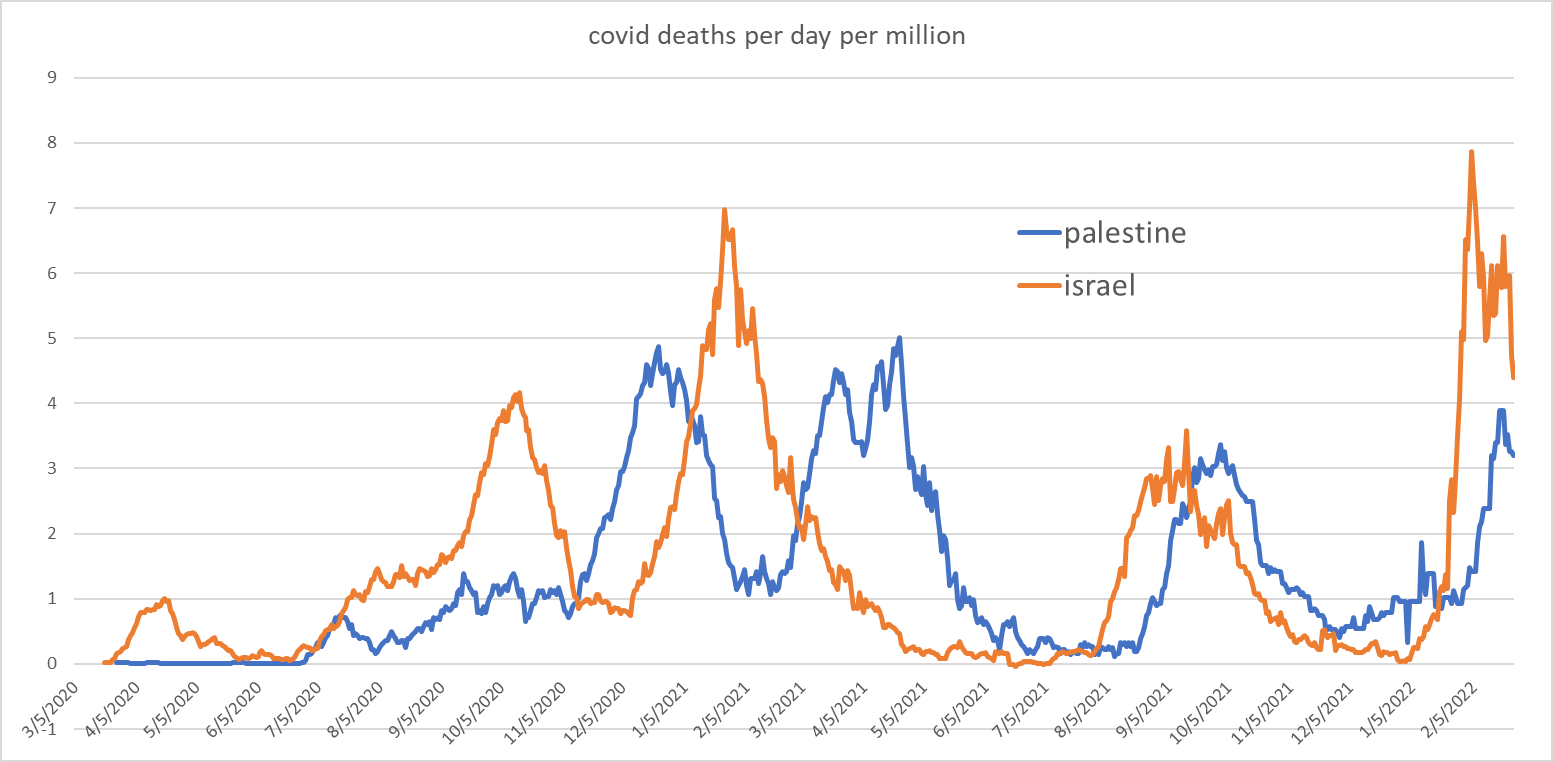
this series is striking. as has commonly been the case, palestine lagged israel by a couple weeks. (i suspect this is reporting lag, this data is day of report, not day of incidence).
assuming this peak holds, the palestine peak was 21% below winter seasonal peak last year. israel was up 13%. that’s a meaningful divergence and the israeli figure is deeply unexpected given a milder variant and 18 months of vulnerable cohort depletion.
this starts to hint at something being quite wrong and also starts to rule out “variant” as the source, because it did not drive that outcome in palestine.
it can be notoriously difficult to eyeball area under curve, so i have plotted cumulative deaths here:
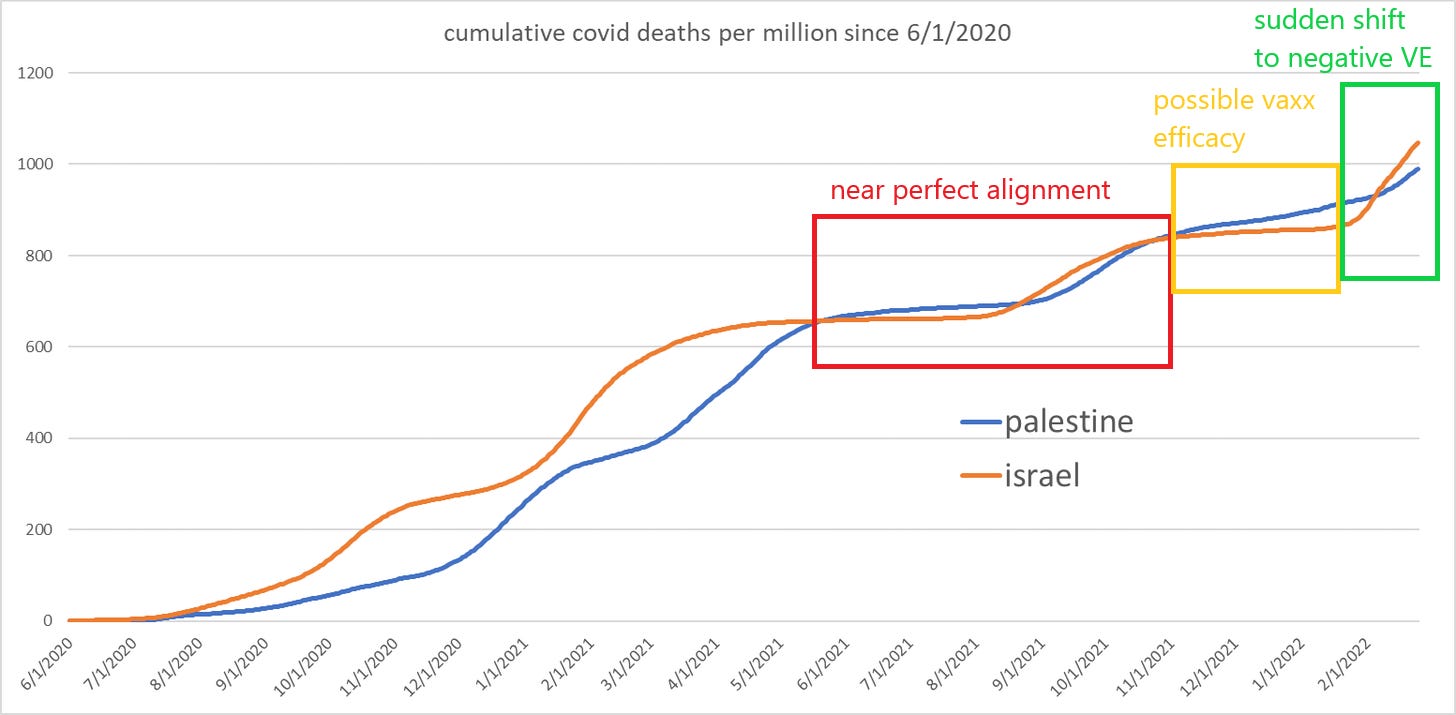
as can be seen, israel had gone pancake flat in november 2021 through jan 2022. then it inflected severely. this is omicron which hit the levant in the second half of december 2021. clinically, you’d expect about a 24 day log to show up in deaths and this tends to jibe with the data i’ve seen all over the world.
it’s possible that boosters were having some effect in bending the curve, but to the extent that they did, it was either fleeting or rapidly inverted in the face of a new variant. (or both)
this becomes extremely easy to see when we zoom into 2022 and start a cumulative count from 1/1/2022.
there is a powerful inflection in israel that does not exist in palestine and israel has seen roughly twice the cumulative per capital death rate of palestine so far this year.
if boosters are effective in preventing deaths from omicron, it sure does not show up here.
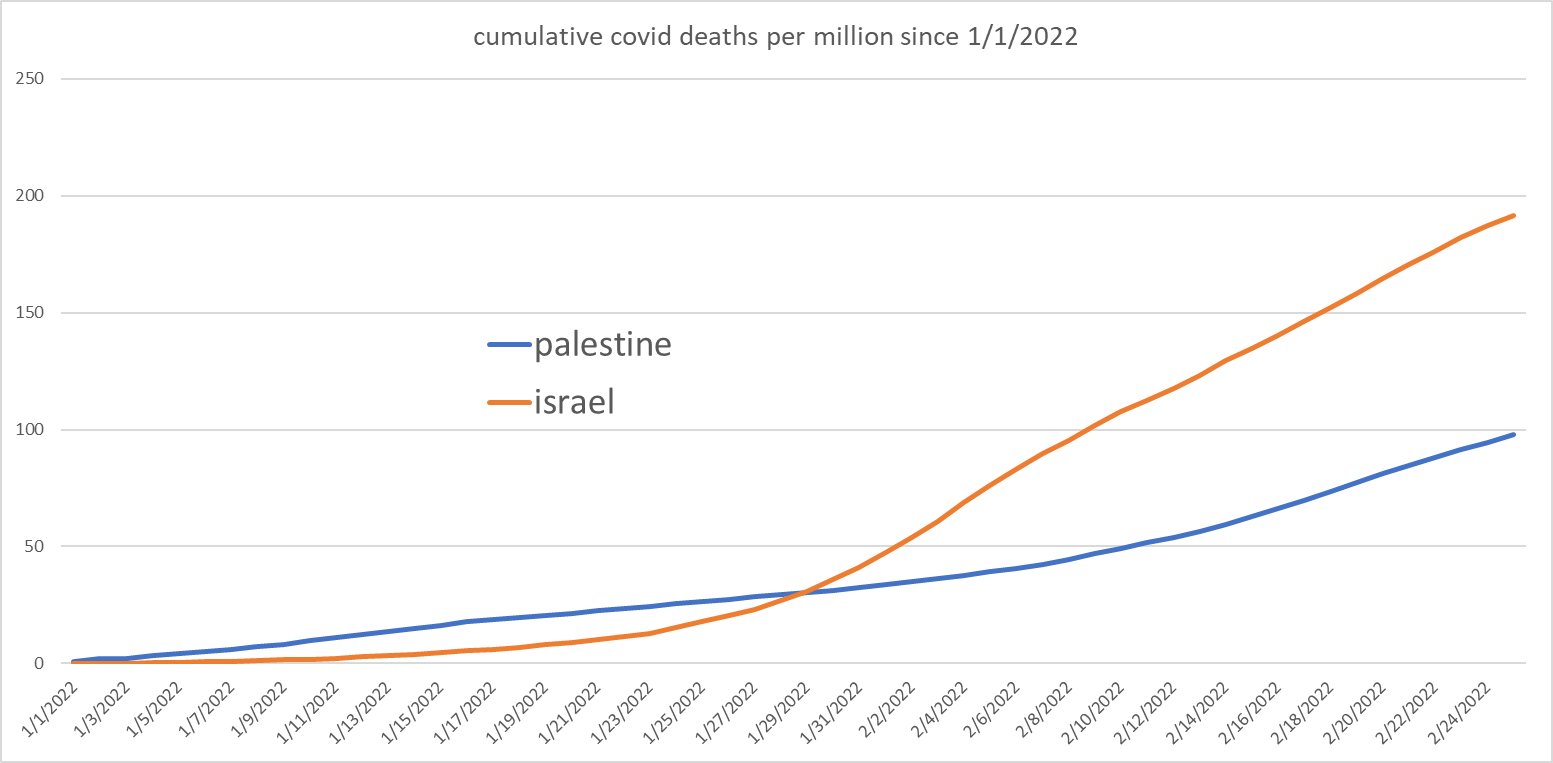
this also lets us rule out “omicron” as a source of greater underlying virulence/fatality. if this were so, it would be manifest in both places. the fact that it is not doing so supports the idea that omicron is an OAS/hoskins effect evolution taking advantage of the narrow antigenic fixation generated by mRNA and adenovirus vaccines. it also seems to show that this advantage is NOT, as many claim, limited to cases. it seems to carry through to deaths as well.
we can also compare israel to itself and see how this highly vaccinated and boosted period compares to the prior year when vaccination was zero. from this data as well, we see strong support for the OAS hypothesis.
israel had been doing better. then omi came and everything changed.
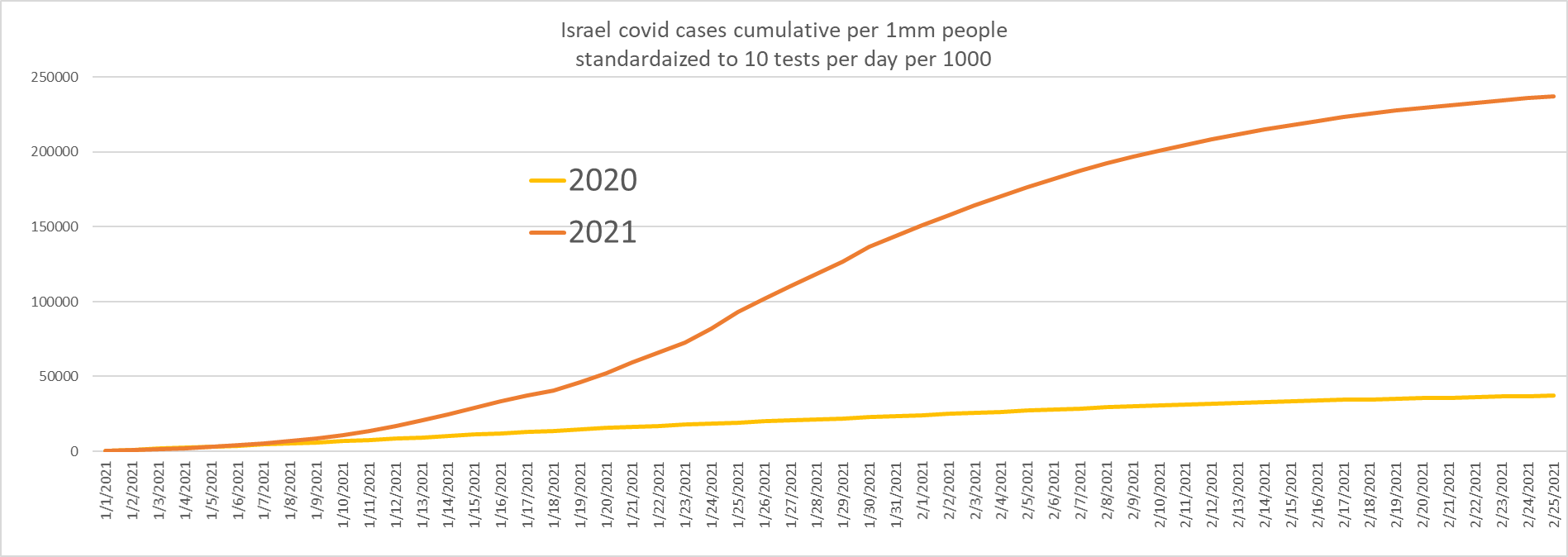
(to remove the skew from widely varying sample rate driven by big shifts in testing levels, i have normalized all cases data to 10 tests per day per 1000 population though given the absurdity of calling a high Ct PCR+ a “case” even lacking symptoms, all case data is troublesome to assess, but we work with what we have, not with what we wish we had)
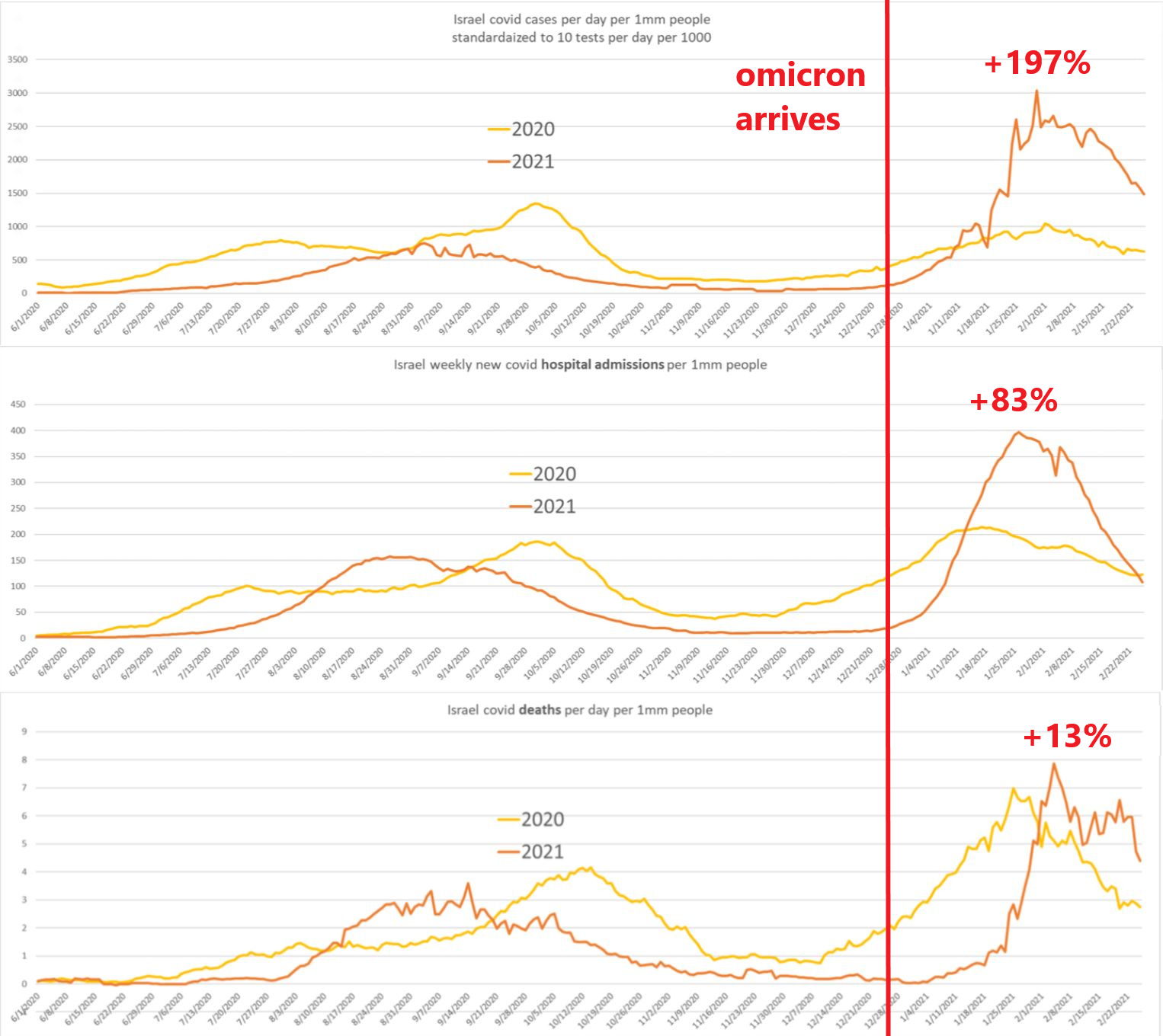
cases nearly tripled and hospitalizations nearly doubled. deaths rose 13%.
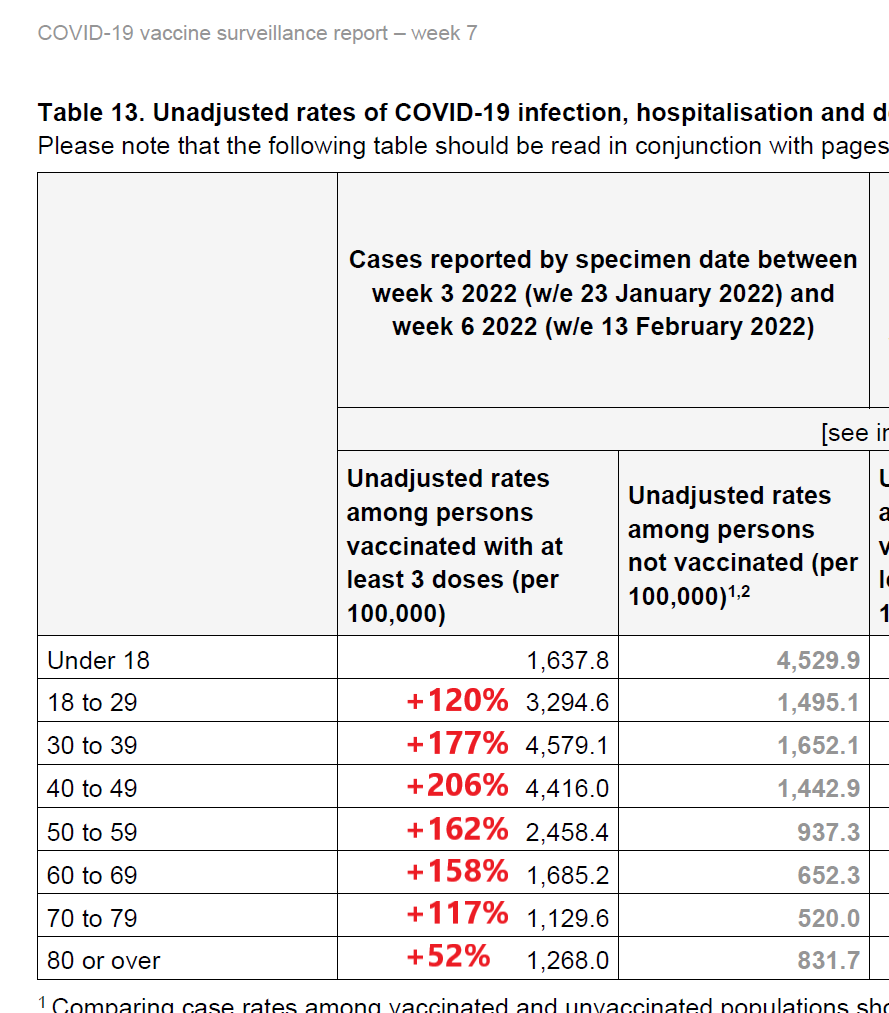
according to israeli authorities and hospitals, this was not driven by “the unvaxxed” but rather by the vaccinated. they seem to make up more than their share of severe outcomes though one must we wary of simpson’s paradoxes. (more HERE)
it might be possible to construct an argument whereby vaccine efficacy is claimed on any given infection (once you are sick, better to be vaxxed) but if that is, in aggregate, swamped by a rise in cases (and we know vaccines lead to more cases, not fewer) then this is still not much of an argument. having vaccines reduce risk of hospitalization per case by 50% but tripling case risk is still a 50% rise in overall hospitalization.
the aggregate data is possibly supportive of this claim outcome, but it’s far from certain either way.
but still, if the overall outcomes are worse post vaxx in the active arm but not in control, from a public health perspective do we really care why?
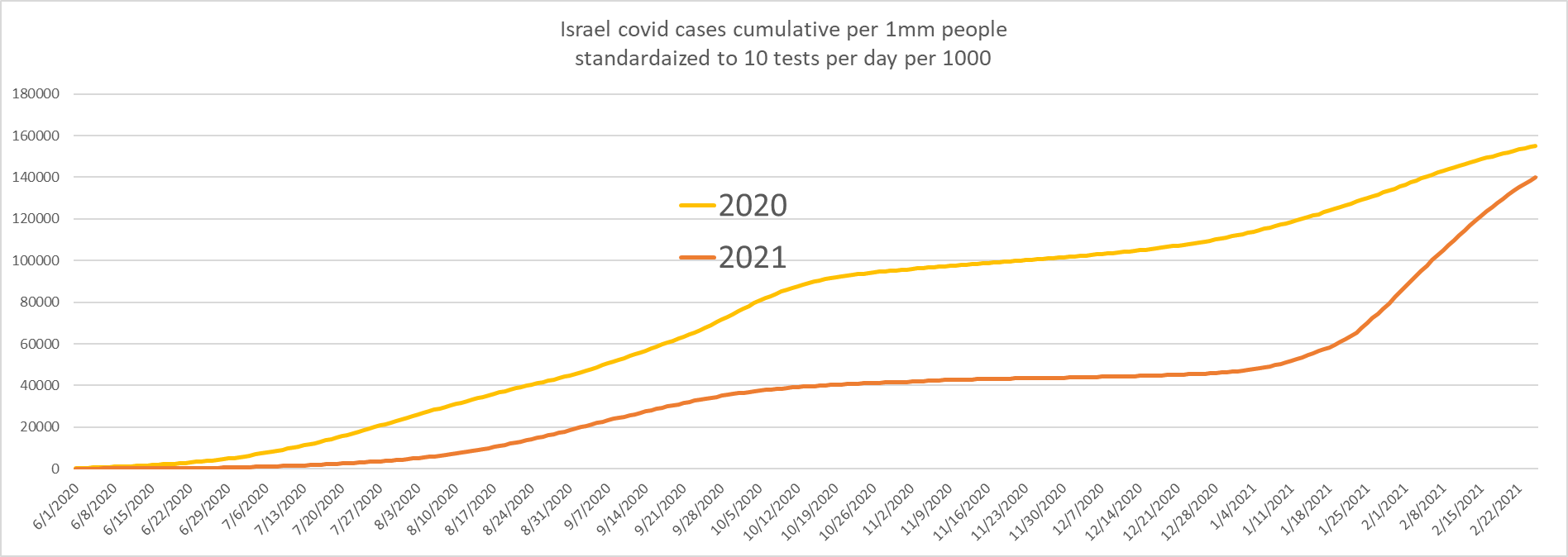
cases were trending MUCH lower. then that changed in a hurry.
zooming in makes it all the more clear.
even adjusted for testing, this is a massive surge in cases.
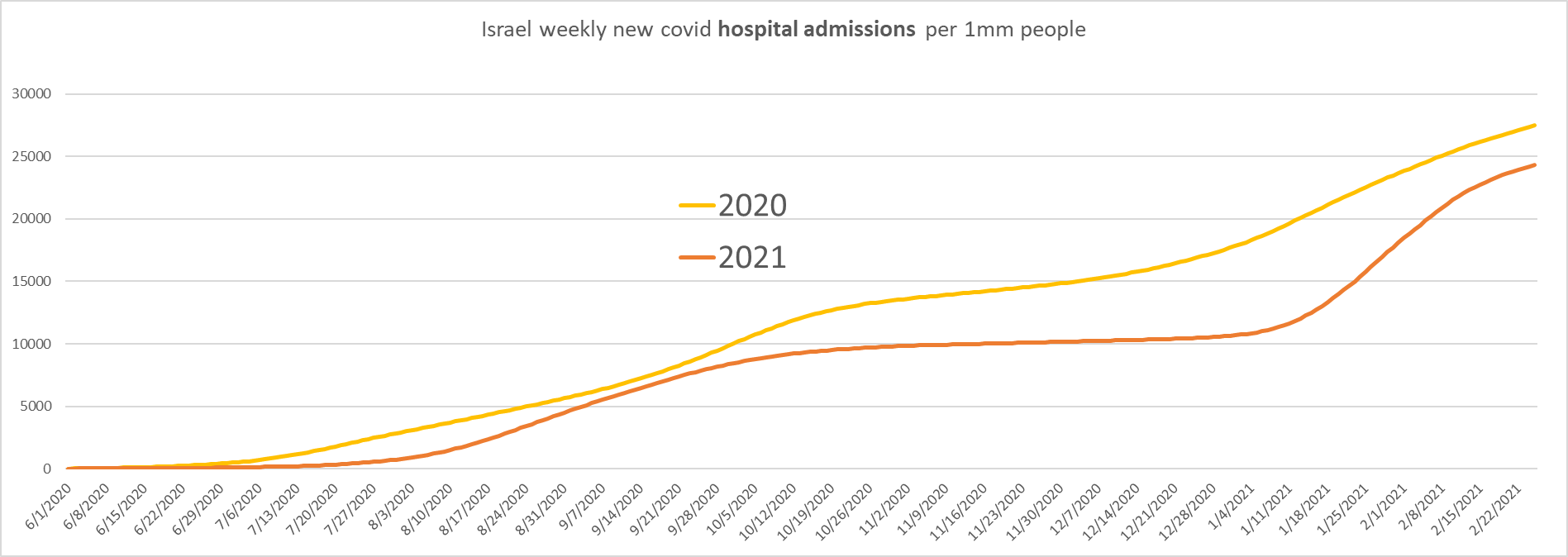
we see the same in hospitalization.
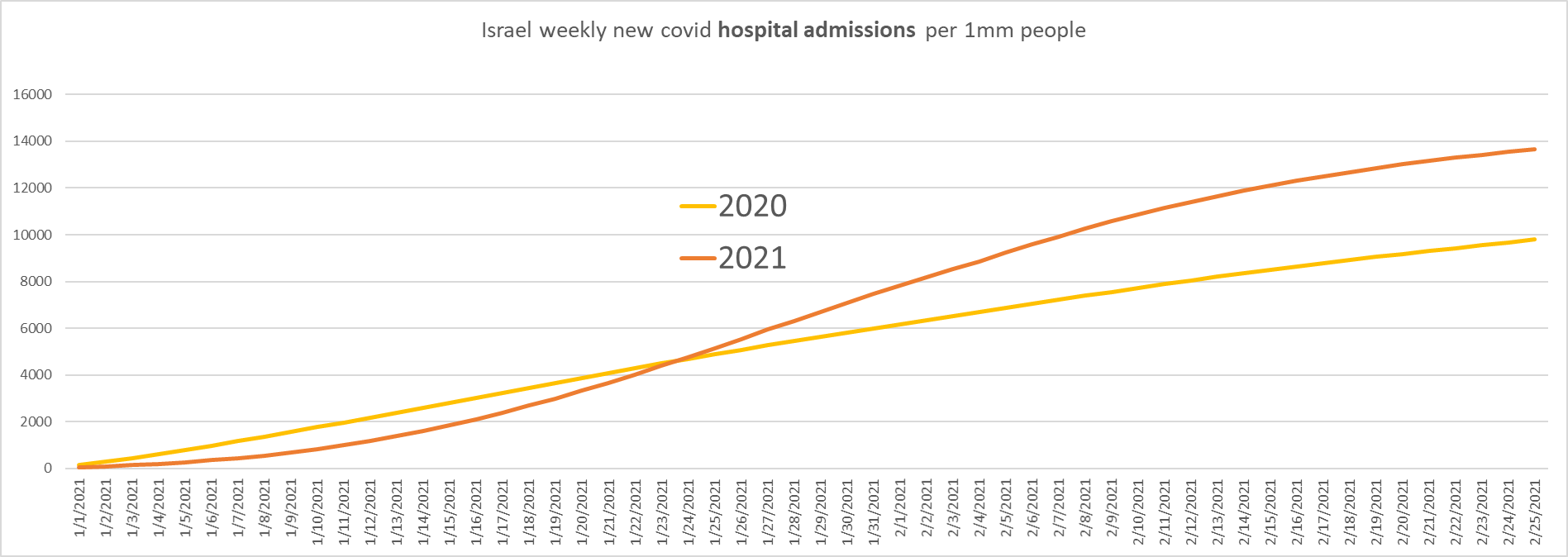
and see the crossover to worse outcomes in 2022 when we zoom in.
overall, they are 39% higher in aggregate YTD vs prior yr.
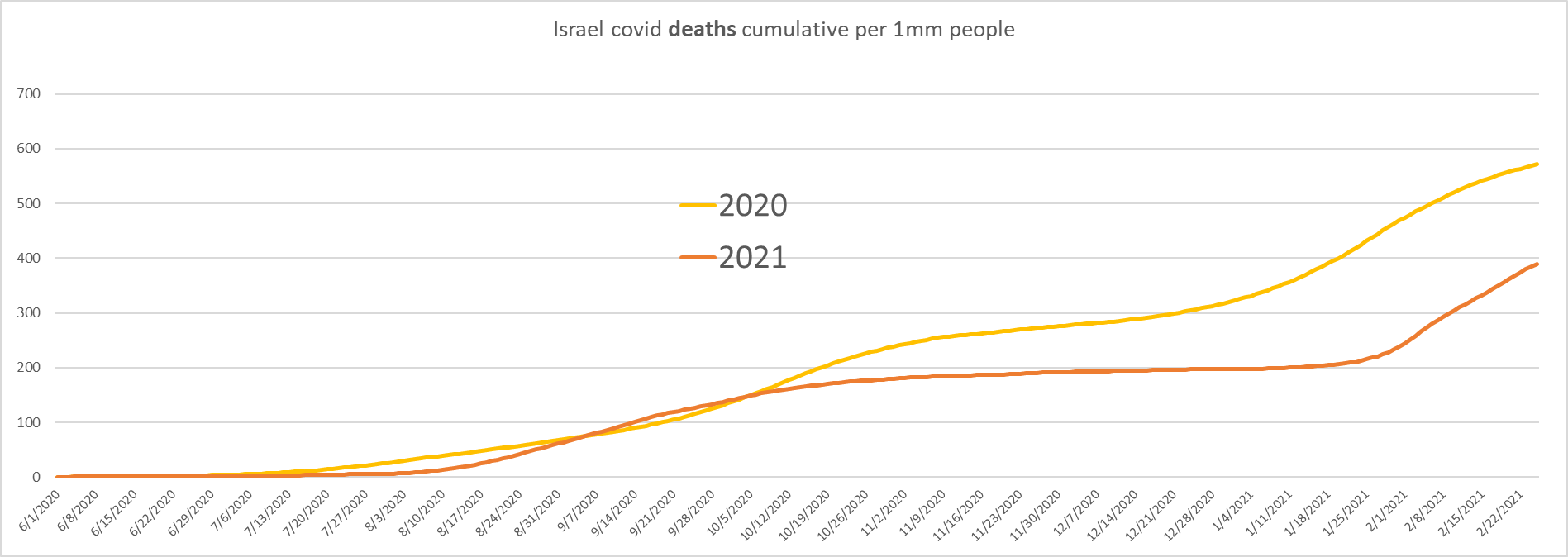
deaths have not yet caught up, but appear likely to do so.
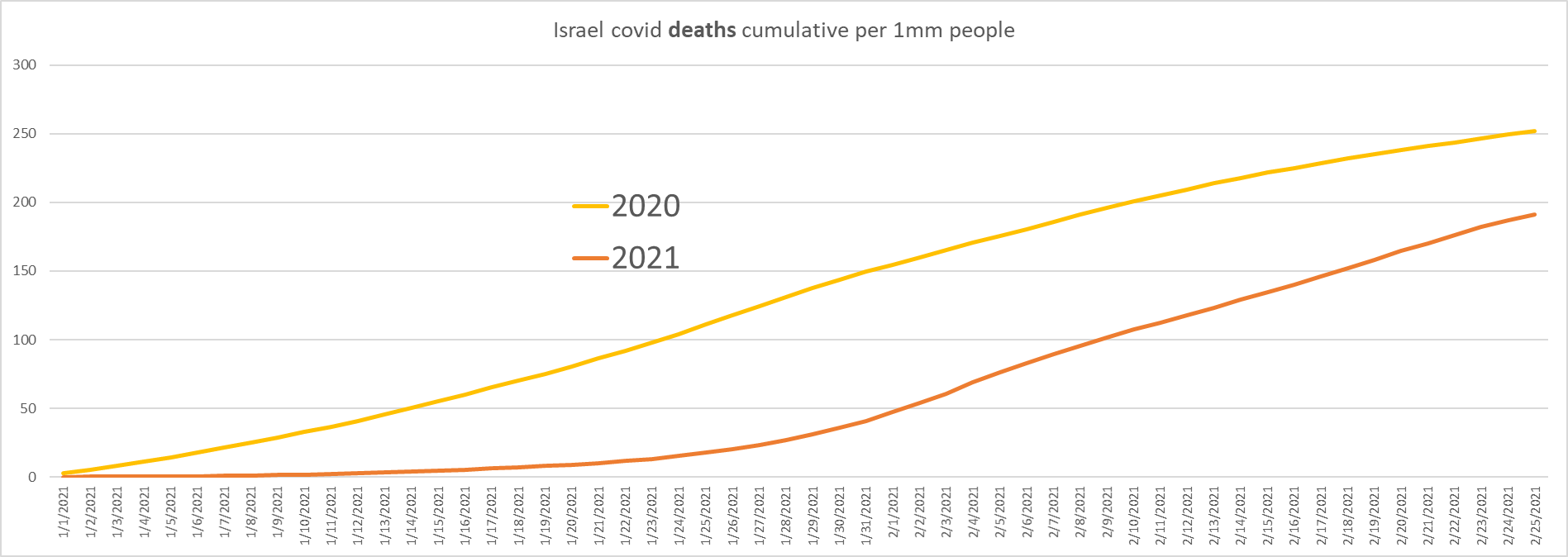
taken as a whole, this is pretty damning of the booster programs.
israel saw a big spike in deaths that was not present in the palestine control group.
it saw a massive jump in cases, a big jump in hospitalizations, and is rapidly converging on deaths (which will lag the others by ~3-4 weeks).
there is just no way to spin this as a win. it looks like an own goal.
this was the known and knowable outcome of widespread inoculation with a leaky vaccine. it is, in fact, WHY we do not use leaky vaccines.
they will rapidly and inevitably select for escape or vaccine enhanced variants. and now it makes you worse and worst of all, locks you into a suboptimal antigenic response pattern that may keep you from EVER generating real sterilizing immunity. the truly nasty part of this may take years to really see.
omicron was not “bad luck” it was invoked consequence of ill conceived intervention. even assuming they ever worked as claimed (dubious) these vaccines were always going to fail because that’s what leaky vaccines do.
this was known and knowable. the drug companies that made them knew it. the regulatory agencies that approved them knew it. and many, many doctors, researchers and public health officials all over the world knew it. they were silenced, threatened, and attacked for it. and this is the bitter fruit of that harvest.
in the US, the data has been manipulated and misused so badly as to render it outright fraud. it becomes obvious when one compares the US data (which calls all “unknown or undetermined” patients “unvaxxed” and used the fact that the EPIC system is awful to create a false sense of VE) with a system that keeps good records as longtime gatopal™ HOLD2, newly on substack, has done here.
like so much of the rest of the covid response, we knew better than to do this, but it was done anyway.
and now, the US is lying about it while others are, at least, coming clean.
but this truth will be too vast to hide much longer, even behind these big lies.
and american health and regulatory agencies are going to have a great deal to answer for.
dr atlas (with whom many at rational ground, including even notorious internet felines, had the pleasure to collaborate) is correct in everything he says here except in his use of the world “almost.”
Leading law firm issues Facebook letter of complaint over ‘anti-Palestinian bias’
MEMO | February 23, 2022
Leading law firm Bindmans LLP has sent a formal letter of complaint to Facebook over its “anti-Palestinian bias.” Instructed by the International Centre of Justice for Palestinians (ICJP), the London based firm demanded explanation for the “systematic” and “far-reaching” censorship of content and accounts related to Palestine.
The complaint was also sent to the United Nations Special Rapporteur on the promotion and protection of freedom of opinion and expression. It requests an urgent review of, and explanation for, the decisions made by Facebook, which was rebranded last October as Meta Inc, to suspend accounts and posts which are affiliated to Palestinian news agencies, commentators and journalists.
Monday’s letter of complaint to Facebook is the second in nine months sent by Bindmans LLP to the social media giant. A previous communication submitted in May 2021 was made on behalf of five journalists and news agencies in Palestine. Facebook is said to have interfered with their accounts and/or posts and was accused of breaching their fundamental right to freedom of expression as well as its own Corporate Human Rights Policy.
In the May 2021 complaint, the main questions posed by Bindmans LLP included whether the censorship decisions were carried out by an algorithm or by a person exercising their discretion, and details regarding Facebook’s policy in justifying their censorship decisions, in addition to steps taken by the company to resolve unfair censorship.
In its response to the letter, a month later, Facebook said that it had investigated the accounts referenced in the letter and, after further review, has restored content and/or accounts where applicable. Notably, no substantial answers were provided to any of the main questions cited in the original communication.
Despite the commitments made by Facebook in their letter sent in June 2021, the censorship remained, said ICJP in its press release detailing the content of the complaint. The centre is an independent organisation of lawyers, academics and politicians that work to promote and support Palestinian rights.
Monitoring group, Sada Social, which has been documenting the suspension of Palestinian content and accounts on Facebook, recorded in 2021 alone, hundreds of instances of inappropriate censorship of social media content in support of the rights of Palestinians. This censorship was exacerbated significantly during the last Israeli offensive on Gaza in May 2021.
The complaint reinstates the request that Meta/Facebook discloses and reviews its decision-making process, and explains why the accounts were closed, suspended or posts taken down, and whether in doing so an algorithm or human discretion was used.
New textbook to be published without ‘undue influence of pro-Israel groups’
MEMO | February 22, 2022
UK Publisher, Pearson, has given assurances that UK lobby groups supporting the State of Israel will no longer play a role in their editorial decision-making process in the soon to be released textbook covering the Middle East.
Pearson, a major international education company, which oversees national exams for 14- to 16-year-olds in the UK, came under the spotlight over two of its GCSE school textbooks, after revelations last year that they had been significantly altered following pressure from pro-Israel groups. GCSEs are the academic qualifications studied for by UK high school students to the age of 16.
Details of the extensive “biased” and “misleading” alterations were exposed by a report, by Professors John Chalcraft and James Dickins, Middle East specialists in History and in Arabic, respectively, and members of the British Committee for the Universities of Palestine (BRICUP).
Their eight-page report uncovered “dangerously misleading” changes to the books published by Pearson, titled “Conflict in the Middle East” and “The Middle East: Conflict, Crisis and Change”, both by author Hilary Brash, which are read by hundreds of thousands of GCSE students annually.
The alterations were made following intervention by the Board of Deputies of British Jews (BoD), working together with UK Lawyers for Israel (UKLFI). Both are amongst the most vocal pro-Israeli groups in the UK.
Pearson finally withdrew the textbooks in June. The publisher confirmed earlier this month that it is partnering with specialist educational charity, Parallel Histories, to develop new educational materials on the topic.
Writing in the Times Higher Education recently, Chalcraft urged academics to keep an eye out for bias in school textbooks. Recounting what he called the “undue influence of pro-Israel groups on a history textbook”, Chalcraft stressed the value of engagement to avoid a similar interference in the future.
Commenting on the report Chalcraft co-authored with Dickins, he said that the modified textbook “read to [me] as though it had been reworked by lawyers acting as if for a client (Israel), rather than by historians acting to educate schoolchildren about a complex history”.
Equally problematic, warned Chalcraft, was the discovery “that the pro-Israeli lobby groups had been invited into the editorial process, and had collaborated with Pearson over many months”. He revealed that no pro-Palestinian groups had been invited to the table and that “something” had gone “dangerously wrong”.
Chalcraft said that he and Dickins had been reassured by Pearson that no lobby groups are involved in the production of new materials on the topic.
Hamas: Australia aligned itself with Israel’s terrorism
Palestine Information Center | February 17, 2022
Senior Hamas official Hisham Qasem has condemned Australia’s intention to designate his Movement as a terror group as “a reflection of blatant bias in favor of the Israeli aggression against the Palestinian people.”
In press remarks to Quds Press, Qasem said that “the Israeli occupation regime sees every opponent as a terrorist party, although it practices organized state terrorism day and night against the Palestinian people at home and abroad.”
“Hamas has never been hostile to any country of the world and only resisted the occupation inside the occupied Palestinian territory, which makes any terror designation by Australia ‘a step against logical reasoning’ and ‘without foundation.’ It is rather complete adoption of the occupation’s aggressive narrative,” the Hamas official underlined.
“The Australian step against the Movement will not change its conviction about upholding its path of resisting the occupation until it achieves its final goal of liberation and return,” he said, stressing that Hamas would never deviate from this path.
Flouting the fact that Hamas is a national liberation movement that resists an occupying power in accordance with international laws and resolutions, the Australian government has declared its intent to add the Hamas Movement to its list of terror groups.
Australia had previously listed the armed wing of Hamas, al-Qassam Brigades, as a terror group in 2003, but the new designation, which will come into effect in April, will blacklist the Movement in its entirety.
US Mulls to bolster Mideast Operations with Israeli-made Vessels

An unmanned Israeli navy vessel test fires missile off Ashkelon
Al-Manar | February 16, 2022
The US Navy is examining the possibility of bolstering its joint operations in the Middle East with Israeli-made unmanned vessels, a US official told the Reuters news agency on Tuesday.
The report did not specify who would be operating the boats, but noted that additional Israeli military involvement in the Gulf region could anger Iran.
The unnamed official said the US military was examining a number of options, including using Israeli unmanned vessels during current Gulf exercises.
The Zionist entity is a participant in a massive US-led naval exercise focusing on unmanned naval systems and the use of artificial intelligence. The International Maritime Exercise, known by its acronym IMX, kicked off last month and is set to end on Thursday.
The Israeli navy has a fleet of unmanned ships that are used to complement its manned patrol boats around the occupied Palestinian coastal waters.
The Reuters report said the US was showing interest in Israeli-made surface drones that can be deployed in tandem with air and underwater UAVs.
“The Israelis are definitely vested in leveraging this technology,” the unnamed official said, adding that a US fleet commander had made a recent trip to Haifa to examine the surface drones.
The comments by the US official were made during a trip by Prime Minister Naftali Bennett to Bahrain, the first official visit by an Israeli premier to the Gulf kingdom, Israeli media reported.
Israel offers Arab state the opportunity to tackle Iran together
RT | February 15, 2022
Since Israel and Bahrain both view Iran as a threat, they could team up and counter Tehran together, Israeli prime minister Naftali Bennett said on his landmark visit to the Gulf monarchy.
“We will fight Iran and its followers in the region night and day. We will aid our friends in strengthening peace, security, and stability, whenever we are asked to do so,” Bennett pledged in an interview with the Bahraini state-linked Al-Ayyam outlet on Tuesday.
The PM blamed Tehran of striving to “destroy moderate states” in the Gulf region in order to replace them with “bloodthirsty terrorist groups.”
When asked about the possibility of creating an alliance to resist Iranian influence, which could include Israel, Bahrain, and some other Arab nations, he gave a positive response: “We all understand that we face the same challenges, so why not work together to tackle them?”
Bennet, who became the first Israeli prime minister ever to visit Bahrain, assured the journalists that “Israel is a strong and reliable country.”
The idea of such a block was first floated by Israeli general Tal Kelman last year. According to Kelman, who heads the IDF’s Strategy and Third Circle Directorate, “the moderate axis” of Israel, Bahrain, the UAE, Jordan, Egypt and others should resist “the radical axis” of Iran and what he called its “proxies” in Lebanon, Syria, Yemen, and Iraq.
Israel and Bahrain normalized relations in late 2020 as part of the so-called Abraham Accords, a US-backed drive to improve ties between the Jewish state and some Arab countries after decades of strife.
Bahrain is a small island nation of around 1.5 million. The majority of its population is Shia Muslims, but the country is being run by a Sunni monarchy. The rulers in Manama have been concerned by Tehran’s activities as Iran, which is located less than 800 kilometers (497 miles) away, often faces accusations from its rivals of supporting Shia groups in other countries.
Threat of War between Syria and Israel is getting More Real
By Vladimir Platov – New Eastern Outlook – 14.02.2022
On February 9, Israel launched yet another series of strikes on targets near Damascus, which resulted in one Syrian killed and five injured, which has aggravated the threat of war between Syria and Israel.
According to the Syrian Arab News Agency (SANA), on February 9, four Israeli F-16s, without crossing the state border of Syria, launched another guided missile attack on facilities near Al-Kiswah, a village south of Damascus. One of the anti-aircraft missiles of the Syrian army exploded over the occupied Golan Heights, after which the IDF fired from the area occupied by Israeli troops in the Syrian Golan Heights ten surface-to-surface missiles at the positions of the Syrian air defense forces. Some missiles were brought down by Syrian air defenses. Nevertheless, the attack still caused significant damage to some buildings in the city of Qudsaya, destroying dozens of houses and cars. To repel the attack, Syrian troops utilized Russian-made air defense systems, which shot down eight missiles.
According to an IDF statement, in response to an intercepted missile fired from Syria into northern Israel, Israel attacked targets in Syria, including the “Syrian radar and anti-aircraft batteries that launched missiles at Israeli Air Force aircraft.” However, it is obvious that the missile chosen by the IDF as the reason for retaliation was the anti-aircraft missile that exploded in the air and was launched by Syrian air defenses as a measure of protection against earlier Israeli missile attacks launched from Lebanon.
In the message the Syrian Foreign Ministry sent to the UN Security Council regarding the aforementioned act of aggression by Tel Aviv, the Syrian government denounces the dangerous consequences the Israeli attacks on the SAR territory may have for stability in the Middle East and the entire world. “Syria reserves the right to use all legal means to respond to the treacherous strikes carried out by Israel on the outskirts of Damascus from Lebanese airspace and from the occupied Golan Heights,” the document says. The Syrian Foreign Ministry drew attention to the fact that “the United States, which patronizes Israel, encourages it to continue attacks and paralyzes possible measures by the UN Security Council to deter the aggressor, which undermines the prestige of the international community.”
Initially, Israel planned to launch two strikes simultaneously on February 9 – one on the outskirts of Damascus, and the other on Latakia. However, after encountering two Su-35s scrambled in response, the IAF fighters flew back without attacking the Syrian port. At the same time, almost all of the missiles allegedly aimed at Iranian facilities in the Rif Dimashq Governorate were shot down by Russian-made Syrian air defense systems. The attack was carried out from Lebanese airspace, which is another gross violation of international law.
Israeli Air Force regularly strikes targets in Syria without entering the airspace of the Arab Republic, and mainly operates from the airspace of Lebanon – in violation of international norms, or from the Mediterranean Sea. Since 2013, the IDF has been carrying out hundreds of airstrikes on the territory of a neighboring country primarily targeting pro-Iranian forces in the SAR. This year, there have already been two such attacks by Israel. The first one was took place on January 31 at targets near Damascus, namely Hezbollah facilities and warehouses in the vicinity of Al-Qutayfah. In 2021, there were 55 attacks:
– 3 missile strikes in December (on December 7, 16 and 28, mainly in the area of the port of Latakia, one Syrian soldier was killed, and significant damage was caused). It is noteworthy that on December 28, not for the first time, two F-16s of the Israeli Air Force launched four guided missiles at facilities on the territory of the port of Latakia without crossing the Syrian border (from the Mediterranean Sea). The Syrian air defense forces did not engage in a battle to repel the IAF raid on the port of Latakia, since a landing Russian Air Force transport plane could be in the affected area;
– 4 missile strikes in November (on November 3, 8, 17 and 28, mainly on targets near the city of Homs, which resulted in four people killed, including two civilians, several people wounded and significant material damage);
– 4 missile strikes in October (on October 8, 13, 25 and 30, strikes were carried out on the outskirts of Damascus, the outskirts of al-Ba’ath and the village of Al-Krum in the Quneitra Governorate in southern Syria, and the city of Abu Kamal, as a result of which more than ten Hezbollah militants and a Syrian soldier were killed, and significant damage was caused);
– 3 missile strikes in September (on September 3, 14 and 27, South from the village of Mayadin in the Deir ez-Zor Governorate in Eastern Syria, near the Iraqi border, with many people being wounded);
– 2 missile strikes in August (on August 17 and 19); 3 missile attacks from May to July (on May 5, June 8 and July 19); 9 missile strikes from January to April, with dozens of people dead and wounded;
– 39 missile attacks and air raids were carried out in 2020.
Israel explains its attacks with the desire to prevent modern weapons from falling into the hands of it enemies. Enemy No. 1 in this regard is the Lebanese Hezbollah movement, which is fighting on the side of Syrian President Bashar al-Assad and is controlled by Tehran. After the first Israeli airstrikes, Moscow invited all interested parties to meet and talk about disentangling their interests in order to avoid armed conflicts and civilian casualties. However, these calls of Russia have not been heeded.
Israel, despite repeated statements by official Syrian authorities to the UN, continues regular airstrikes on Syrian civilian targets, using, among other things, provocative air attacks by its fighters “under the cover” of civilian aircraft. Thus, in addition to the attack of December 28, on the night of October 13, 2021, four IAF F-16s once again entered the Syrian airspace in the area of the US-occupied Al-Tanf zone in the Homs Governorate and, under the cover of civilian aircraft flying at the same time, carried out an airstrike on a phosphate ore processing plant in the Palmyra area. It is noteworthy that this is not the first time such air attacks have been carried out from the area of the US-occupied zone in the Homs Governorate, which clearly indicates the coordinated actions of the IAF with the US military.
Such provocative tactics of the Israeli Air Force can lead to a serious aggravation of the situation, and it will by the IAF’s fault if the Syrian air defenses in their anti-missile actions shoot down a civilian aircraft of any country, under whose cover Tel Aviv carries out its airstrikes. And such an incident has already occurred in 2018 when Israeli planes bombed Syria from the air zone where the Russian reconnaissance plane was located, and the Syrian air defense shot down this plane by mistake. Russian service members were killed and a big scandal broke out, which was extinguished, and an armed conflict with Israel prevented, only thanks to complex diplomatic efforts.
The Syrian leadership has repeatedly demanded that the UN Security Council put pressure on Israel to stop attacks on the territory of the republic, since such actions violate its sovereignty and lead to increasing tensions in the region. The Syrian Foreign Ministry has previously repeatedly stated that the republic can use “all legal means” to respond to Israeli airstrikes on the Syrian territory. Therefore, by continuing such provocative attacks, Israel is openly tempting its fate, which could turn into a serious armed conflict at any time.
UAE ‘directly benefiting’ from illegal Israeli settlement enterprise
MEMO | February 7, 2022
The UAE is directly benefitting from Illegal Israeli settlements and is in violation of international law according to recently signed bilateral trade agreements between Abu Dhabi and the occupation state, Hugh Lovatt, Senior Policy Fellow at the European Council on Foreign Relations, has pointed out in a series of tweets.
Lovatt has worked to advance the concept of EU Differentiation, which includes a variety of measures taken by the European bloc and its member states to exclude settlement-linked entities and activities from bilateral relations with Israel.
The EU has never recognised the legality of Israeli settlements in the occupied territories (including those in East Jerusalem and the Syrian Golan Heights that have been formally annexed by Israel). This means that the EU has an obligation to practically implement its non-recognition policy by fully and effectively implementing its own legislation against Israel’s incorporation of settlement entities and activities into its external relations with the EU.
In 2016, Lovatt worked to have this measure enshrined within UN Security Council Resolution 2334. It passed in a 14–0 vote, with the US notably abstaining. The Resolution states that Israel’s settlement activity constitutes a “flagrant violation” of international law and has “no legal validity”. It demands that Israel stop such activity and fulfil its obligations as an occupying power under the Fourth Geneva Convention.
Lovatt claims that recently released details of bilateral agreements between the UAE and Israel show that that the Gulf State is in violation of Resolution 2334 and the principal of differentiation which all UN member states are expected to abide by.
“Has the UAE respected international law and its obligations to differentiate between Israel and the settlements as per UNSCR 2334?” asked Lovatt in his tweet. “The answer: No.”
Lovatt explained that “to comply with UN Security Council Resolution 2334, every bilateral agreement signed with Israel should contain a ‘differentiation’ clause defining the territorial scope of its application to Israel’s pre-June 1967 borders. This is not the case in this UAE-Israel agreement”. He shared a screen shot of a clause from the bilateral agreement indicating that no such territorial distinction was made.
The definition of territory applied in the agreement includes all the land that is under “Israel’s jurisdiction”, which Lovatt explained include Israeli settlements on occupied Palestinian territory.
Notably Japan’s trade agreement with Israel includes a definition of “Israeli territory” which upholds the differentiation principal and, therefore, does not fall foul of Resolution 2334, Lovatt said. The absence of this distinction in the bilateral agreement between Abu Dhabi and Tel Aviv means that the UAE is “directly” befitting from illegal settlements through its normalisation with Israel.
Lovatt admits that the UAE may have a different interpretation of the agreement than he does, in which case “it would be incumbent on the UAE government to clarify the agreement’s territorial applicability as soon as possible,” he added.
Volunteers’ group targets Facebook for suppressing Palestinian content
MEMO | February 4, 2022
A Palestinian group of volunteers that monitors Facebook has raised an alarm that the social media platform was increasingly blocking and suppressing the content posted by Palestinian journalists, activists and influencers, Anadolu News Agency reports.
In a report, the volunteers’ group, Sada Social, has mentioned that Facebook had limited the reach of the accounts of the Palestinian influencers recently when they were highlighting the issues of Shaikh Jarrah neighbourhood and Gaza Strip.
According to the statistics issued by the group, Facebook had banned the users from reaching the hashtag “Al-Aqsa” in 2021, where many activists were writing about the events happening in Palestine.
“Facebook and Instagram had blocked as many as 1,500 posts in 2021. Almost 44 per cent of posts were posted by journalists and authentic media institutions,” said Iyad Refai, a social media specialist and the Director of Sada Social.
He said that access to the accounts that covered the incidents was restricted through algorithms that identify the digital content, adding that new words were added to expand the restrictive practices.
Facebook catches the words like “to support the Palestine cause” and other words like these, and then blocks the account. In addition, the restrictive practices have been expanded to the names of Palestinian factions, leaders, or martyrs, in addition to any pictures or videos related to this.
“After each violation, we contact Facebook to clarify that we have the right to tell our story. All the discussions with them are about the importance to have a clear and certain adoption of standards of the concepts about violence and hatred since Facebook policies do not follow the UN standards about violence and hatred,” said Refai.
In its annual statement, Sada Social said, in contrast to the efforts of defenders of the right to free expression and a sense of security in digital space, in 2021 there was a growing tendency to impose coercive powers on people’s practices in digital space.
Refai emphasised that, despite repeated calls to Facebook to put an end to the bias shown against the Palestinian content, there has been an increase in attacks on media platforms during the coverage of the recent war and events in Jerusalem. Palestinian news pages like Maydan Al Quds were finally pulled down last year in November.
“It is a US company and US law defines the Palestinian struggle as acts of terrorism,” he added.
According to the annual statistics released by the Sada Social, more than 390 Palestinians were detained by the Israeli forces and exposed to interrogation because of highlighting issues related to Palestine on Facebook.
Featured Video

When Israel Is Mighty
or go to
Aletho News Archives – Video-Images
From the Archives
US murdering 1 million Iraqis is democracy, Iran giving yogurt to Iraq is “domination”
By Ali Salaam | American Herald Tribune | July 31, 2017
The New York Times, owned by the Zionist Jewish supremacist Ochs-Sulzberger family, has no problem with Iraqi suffering as long as Iran is not the one behind it.
The Iraq War was a genocide of the Iraqi people by Zionist supremacists in the Bush administration. Over 1 million innocent people were killed based on a lie. American soldiers died in an Israeli war and now an average of 22 soldiers commit suicide every day because their consciences cannot cope with the fact they committed crimes in an illegal war that served no purpose other than to benefit Israel, not America.
Benjamin Netanyahu, Prime Minister of the Zionist regime, once said “We are benefiting from one thing, and that is the attack on the Twin Towers and Pentagon, and the American struggle in Iraq.”
Paul Wolfowitz had his sights on Iraq since his time in the first Bush administration. Former Israeli official and Bush administration official Richard Perle had his eyes on Iraq since at least his authorship of the Clean Break white paper. The Zionist regime had their eyes on Iraq since the 1980s when strategist Oded Yinon wrote his white paper in support of dividing the Arab-Muslim world along ethnic and sectarian lines. The global Zionist lobby has had their eyes on Iraq since Theodor Herzl stated that Eretz Israel’s true borders go from the Nile River in Egypt to the Euphrates River in Iraq. … continue
Blog Roll
 Aletho News
- MEP blasts ‘Euro-Gestapo’ for lecturing Russia on democracy
- Syria May Send Troops to Saudi Arabia Amid War with Ansar Allah
- UK whines about losing billions to ‘Putin tax’
- Baghaei to Rubio: Distorted narratives cannot erase US record of broken commitments
- Houthis Don’t Have to Conquer Saudi Arabia to Make It Pay
- MOE: Nearly 22,000 Students and Education Workers Killed
- Guterres in Islamabad: Genocide, cowardice, and the cage of Imran Khan
- Johnson, Marandi say Yemen holds upper hand over Saudi Arabia
- False flags won’t save aggressors, Iran FM spokesman says
- The Makkah Pact Enters Into Force: The End of American Dominance or Its New Form?
- If Americans Knew
- Report claimed Mark Levin used by Israeli government to influence Trump
- Over 2,000 Gazans have died awaiting medical evacuation amid Israel’s continued siege
- How a U.S. Diplomat Suppressed and Altered Reports Critical of Israel
- 5 Palestinians Die from Israeli Strikes in Gaza as Relentless Attacks Continue
- Report: Ceasefire Slows Killing but Leaves Devastation Intact
- Country Music Singer Zach Bryan Breaks Attendance Record at Robert Kraft’s Gillette Stadium While Wearing ‘Free Palestine’ Shirt for Second Night in a Row
- Three years of death and devastation: Israel’s war on Gaza in pictures
- Why Hamas believed the status quo was more dangerous than its 7 October gamble
- Debunking Israel’s latest list of ‘terrorist’ journalists in Gaza
- In Gaza, focus is on survival, “every step is a struggle” – Daily Update
- No Tricks Zone
- New Study: 50 Years Of The Most Aggressive ‘Net Zero’ Policies Can Only Affect The Global Climate By 0.03°C
- US September “Heat” Was No Record…Many Records Set Decades Ago
- Latest European Green Energy Debacle; Portugal’s Largest Flagship Solar Park Insolvent!
- Green Energy Debacle: German Expert Professor Fritz Vahrenholt Warns Of Severe Economic And Social Consequences
- Two More Paleo Reconstructions Affirm Meters-Higher Sea Levels Across Ireland, Brazil 7000-6000 Years Ago
- New Study: Earth And Venus Surface Warmth Largely Explained By Convection And Lapse Rate, Not CO2 Or Radiation
- 2025 Nature Paper Claiming Worsening Global Drought Gets RETRACTED …Heavily Flawed
- New Study: ‘Global Drought Shows No Detectable Recent Acceleration Under Climate Warming’
- Economic Masterminds: German Socialists Suggest Taxing Productivity Gains Stemming From Using AI
- The South China Sea Has Not Been Cooperating With The Climate Change Narrative