The Sabra & Shatila Massacre
IMEU | September 17, 2012
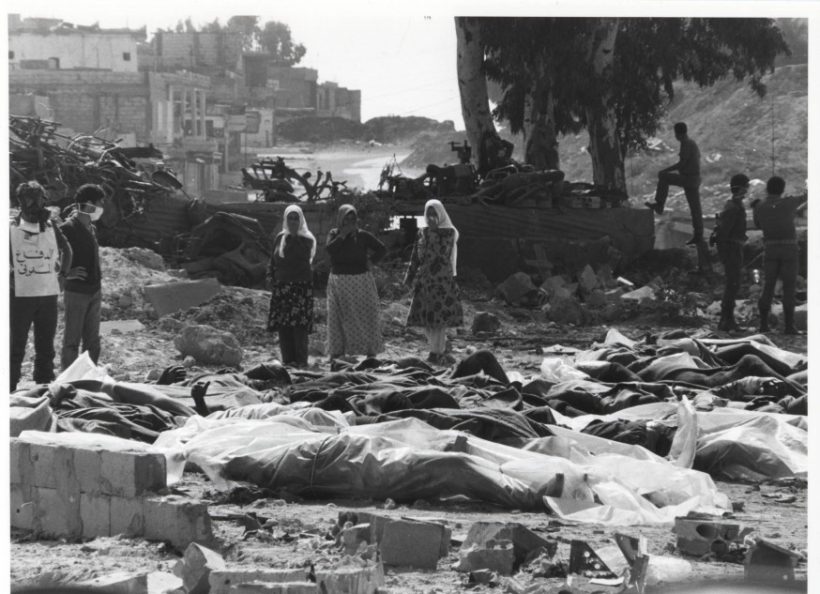
On September 16, 1982, Christian Lebanese militiamen allied to Israel entered the Palestinian refugee camp of Shatila and the adjacent neighborhood of Sabra in Beirut under the watch of the Israeli army and began a slaughter that caused outrage around the world. Over the next day and a half, up to 3500 Palestinian and Lebanese civilians, mostly women, children, and the elderly, were murdered in one of the worst atrocities in modern Middle Eastern history. The New York Times recently published an op-ed containing new details of discussions held between Israeli and American officials before and during the massacre. They reveal how Israeli officials, led by then-Defense Minister Ariel Sharon, misled and bullied American diplomats, rebuffing their concerns about the safety of the inhabitants of Sabra and Shatila.
Lead Up
- On June 6, 1982, Israel launched a massive invasion of Lebanon. It had been long planned by Israeli Defense Minister Ariel Sharon, who wanted to destroy or severely diminish the Palestine Liberation Organization, which was based in Lebanon at the time. Sharon also planned to install a puppet government headed by Israel’s right-wing Lebanese Christian Maronite allies, the Phalangist Party.
- Israeli forces advanced all the way to the capital of Beirut, besieging and bombarding the western part of city, where the PLO was headquartered and the Palestinian refugee camp of Shatila and the adjacent neighborhood of Sabra are located.
- Israel’s bloody weeklong assault on West Beirut in August prompted harsh international criticism, including from the administration of US President Ronald Reagan, who many accused of giving a “green light” to Israel to launch the invasion. Under a US-brokered ceasefire agreement, PLO leaders and more than 14,000 fighters were to be evacuated from the country, with the US providing written assurances for the safety of hundreds of thousands of Palestinian civilians left behind. US Marines were deployed as part of a multinational force to oversee and provide security for the evacuation.
- On August 30, PLO Chairman Yasser Arafat left Beirut along with the remainder of the Palestinian fighters based in the city.
- On September 10, the Marines left Beirut. Four days later, on September 14, the leader of Israel’s Phalangist allies, Bashir Gemayel, was assassinated. Gemayel had just been elected president of Lebanon by the Lebanese parliament, under the supervision of the occupying Israeli army. His death was a severe blow to Israel’s designs for the country. The following day, Israeli forces violated the ceasefire agreement, moving into and occupying West Beirut.
The Massacre
- On Wednesday, September 15, the Israeli army surrounded the Palestinian refugee camp of Shatila and the adjacent neighborhood of Sabra in West Beirut. The next day, September 16, Israeli soldiers allowed about 150 Phalangist militiamen into Sabra and Shatila.
- The Phalange, known for their brutality and a history of atrocities against Palestinian civilians, were bitter enemies of the PLO and its leftist and Muslim Lebanese allies during the preceding years of Lebanon’s civil war. The enraged Phalangist militiamen believed, erroneously, that Phalange leader Gemayel had been assassinated by Palestinians. He was actually killed by a Syrian agent.
- Over the next day and a half, the Phalangists committed unspeakable atrocities, raping, mutilating, and murdering as many as 3500 Palestinian and Lebanese civilians, most of them women, children, and the elderly. Sharon would later claim that he could have had no way of knowing that the Phalange would harm civilians, however when US diplomats demanded to know why Israel had broken the ceasefire and entered West Beirut, Israeli army Chief of Staff Rafael Eitan justified the move saying it was “to prevent a Phalangist frenzy of revenge.” On September 15, the day before the massacre began, Israeli Prime Minister Menachem Begin told US envoy Morris Draper that the Israelis had to occupy West Beirut, “Otherwise, there could be pogroms.”
- Almost immediately after the killing started, Israeli soldiers surrounding Sabra and Shatila became aware that civilians were being murdered, but did nothing to stop it. Instead, Israeli forces fired flares into the night sky to illuminate the darkness for the Phalangists, allowed reinforcements to enter the area on the second day of the massacre, and provided bulldozers that were used to dispose of the bodies of many of the victims.
- On the second day, Friday, September 17, an Israeli journalist in Lebanon called Defense Minister Sharon to inform him of reports that a massacre was taking place in Sabra and Shatila. The journalist, Ron Ben-Yishai, later recalled:
‘I found [Sharon] at home sleeping. He woke up and I told him “Listen, there are stories about killings and massacres in the camps. A lot of our officers know about it and tell me about it, and if they know it, the whole world will know about it. You can still stop it.” I didn’t know that the massacre actually started 24 hours earlier. I thought it started only then and I said to him “Look, we still have time to stop it. Do something about it.” He didn’t react.”‘
- On Friday afternoon, almost 24 hours after the killing began, Eitan met with Phalangist representatives. According to notes taken by an Israeli intelligence officer present: “[Eitan] expressed his positive impression received from the statement by the Phalangist forces and their behavior in the field,” telling them to continue “mopping up the empty camps south of Fakahani until tomorrow at 5:00 a.m., at which time they must stop their action due to American pressure.”
- On Saturday, American Envoy Morris Draper, sent a furious message to Sharon stating:
‘You must stop the massacres. They are obscene. I have an officer in the camp counting the bodies. You ought to be ashamed. The situation is rotten and terrible. They are killing children. You are in absolute control of the area, and therefore responsible for the area.’
- The Phalangists finally left the area at around 8 o’clock Saturday morning, taking many of the surviving men with them for interrogation at a soccer stadium. The interrogations were carried out with Israeli intelligence agents, who handed many of the captives back to the Phalange. Some of the men returned to the Phalange were later found executed.
- About an hour after the Phalangists departed Sabra and Shatila, the first journalists arrived on the scene and the first reports of what transpired began to reach the outside world.
Casualty Figures
- Thirty years later, there is still no accurate total for the number of people killed in the massacre. Many of the victims were buried in mass graves by the Phalange and there has been no political will on the part of Lebanese authorities to investigate.
- An official Israeli investigation, the Kahan Commission, concluded that between 700 and 800 people were killed, based on the assessment of Israeli military intelligence.
- An investigation by Beirut-based British journalist Robert Fisk, who was one of the first people on the scene after the massacre ended, concluded that The Palestinian Red Crescent put the number of dead at more than 2000.
- In his book, Sabra & Shatila: Inquiry into a Massacre, Israeli journalist Amnon Kapeliouk reached a maximum figure of 3000 to 3500.
Aftermath
Israel
- Following international outrage, the Israeli government established a committee of inquiry, the Kahan Commission. Its investigation found that Defense Minister Sharon bore “personal responsibility” for the massacre, and recommended that he be removed from office. Although Prime Minister Begin removed him from his post as defense minister, Sharon remained in cabinet as a minister without portfolio. He would go on to hold numerous other cabinet positions in subsequent Israeli governments, including foreign minister during Prime Minister Benjamin Netanyahu’s first term in office. Nearly 20 years later, in March 2001, Sharon was elected prime minister of Israel.
- In June 2001, lawyers for 23 survivors of the massacre initiated legal proceedings against Sharon in a Belgian court, under a law allowing people to be prosecuted for war crimes committed anywhere in the world.
- In January 2002, Phalangist leader and chief liaison to Israel during the 1982 invasion, Elie Hobeika, was killed by a car bomb in Beirut. Hobeika led the Phalangist militiamen responsible for the massacre, and had announced that he was prepared to testify against Sharon, who was then prime minister of Israel, at a possible war crimes trial in Belgium. Hobeika’s killers were never found.
- In June 2002, a panel of Belgian judges dismissed war crimes charges against Sharon because he wasn’t present in the country to stand trial.
- In January 2006, Sharon suffered a massive stroke. He remains in a coma on life support.
The United States
- For the United States, which had guaranteed the safety of civilians left behind after the PLO departed, the massacre was a deep embarrassment, causing immense damage to its reputation in the region. The fact that US Secretary of State Alexander Haig was believed by many to have given Israel a “green light” to invade Lebanon compounded the damage.
- In the wake of the massacre, President Reagan sent the Marines back to Lebanon. Just over a year later, 241 American servicemen would be killed when two massive truck bombs destroyed their barracks in Beirut, leading Reagan to withdraw US forces for good.
The Palestinians
- For Palestinians, the Sabra and Shatila massacre was and remains a traumatic event, commemorated annually. Many survivors continue to live in Sabra and Shatila, struggling to eke out a living and haunted by their memories of the slaughter. To this day, no one has faced justice for the crimes that took place.
- For Palestinians, the Sabra and Shatila massacre serves as a powerful and tragic reminder of the vulnerable situation of millions of stateless Palestinians, and the dangers that they continue to face across the region, and around the world.
Bahrain civil society groups reject normalisation agreement
MEMO | September 14, 2020
Civil society groups in Bahrain have rejected the government’s normalisation agreement with Israel which is expected to be signed formally in Washington DC on Tuesday. Seventeen organisations have issued a joint statement to this effect, with signatories including the General Federation of Workers’ Trade Unions in Bahrain, the Bahraini Bar Association and the Bahrain Women’s Association.
“We adhere to the constants of the Bahraini people regarding the just Palestinian cause and the provisions of the constitution that criminalise normalisation with the Zionist entity, in accordance with the official and popular Arab and Islamic consensus rejecting normalisation with this criminal entity,” said the groups. “All forms of normalisation with the Zionist entity initiated by some countries have neither produced peace nor restored the usurped rights of the Palestinian people, but have, rather, encouraged the enemy to commit more crimes against Palestine and the holy Arab and Muslim sites, foremost of which is Holy Jerusalem.”
The statement added that “what is known as a peace treaty between Bahrain and the Zionist enemy under the auspices of the US administration has brought about tremendous shock, resentment and widespread popular rejection among the Bahraini people, their political forces, civil society institutions, and all national actors and personalities.”
As a result, the signatories pointed out, nothing arising from the normalisation deal will have any popular legitimacy. “Generations of Bahrainis have believed in the just nature of the Palestinian cause,” they concluded.
Israeli warplanes use US Tanf Zone to bomb Syria again
Al-Masdar News | September 11, 2020
BEIRUT, LEBANON – The U.S. Al-Tanf Zone in southeastern Homs has once again been used by the Israeli Defense Forces (IDF) to bomb an area in Syria, a source in the Syrian Arab Army (SAA) in Damascus told Al-Masdar News.
According to the source, missiles fired from the Al-Tanf area targeted the town of Al-Safira in southern Aleppo, resulting in a number of explosions and at least two deaths.
The source said a number of missiles targeted the Scientific Research Lab, with a few managing to hit the facility.
He would add that the building suffered damage, but it is believed to be minimal at this time.
The U.S.-led Coalition contends that they are using the Al-Tanf Zone to prevent the Islamic State (ISIS/ISIL/IS/Daesh) from returning; however, it is the Syrian Army that has solely faced ISIS in the Homs Governorate.
Thursday night’s attack by the Israeli Defense Forces marks the second time this month and the third time in the last two weeks that they have targeted a site inside of Syria.
The previous attacks targeted the T-4 Airbase in Homs and the Damascus International Airport area.
The attack last night hit the town that has the largest Iranian presence in northern Syria; it has been used by the Islamic Revolutionary Guard Corps (IRGC) to coordinate with its allied forces in Aleppo and the Idlib countrysides.
US ‘Pressing’ Lebanon to Sign Unfavourable Deal With Israel, Analysts Suggest
Sputnik – 11.09.2020
A number of Lebanese politicians expressed concern that the United States is pressuring Lebanon, pushing it to sign a border demarcation agreement that would jeopardise Beirut’s plans to develop gas fields on the Mediterranean shelf.
Sputnik spoke to Lebanese experts to find out whether Israel and the United States are thus trying to take advantage of Lebanon’s current economic and political weakness and force it to agree to all the conditions which are favourable to them, as well as whether Lebanon will be able to resist them.
According to US Assistant Secretary of State for Near Eastern Affairs David Schenker, the maritime border demarcation negotiations between Beirut and Tel Aviv are gradually advancing.
“I hope I will soon come back to Lebanon to sign a framework agreement with Israel,” he said during a telephone press conference with Lebanese journalists.
Schenker refused to talk about the existing obstacles to signing the agreement and the disagreements between the parties.
US Pressure
In turn, Lebanese political scientist Osama Wahby sees direct US pressure on extremely weak Lebanese political elites, which complicates the internal crisis with external issues.
“I’d like to point out that absolutely everyone is pressuring Lebanese politicians for any reason today: government formation, Beirut restoration, receiving money from the IMF and, of course, maritime border demarcation with Israel. While France is pressing Lebanon to solve domestic policy issues, the US is pressing to solve foreign affairs. They are interested in border demarcation and find it interesting for Israel. Undoubtedly, Washington will promise the government financial assistance in exchange for a good deal: they understand very well that Lebanon has no funds to rebuild Beirut after the explosion. There is a danger that Beirut will not receive any international assistance until it concedes to American and Israeli interests,” he said.
“Washington is pressuring individual movements and parties through sanctions. For example, two ministers of the current government have been sanctioned. And this is one of the key indicators of how much the United States expects Lebanon to do what it needs,” he added, speaking about US pressure on Lebanese politicians.
The Streets are Against?
However, Lebanese political scientist Riyad Isa believes that if the government is engaged in such negotiations, the Lebanese public will strongly oppose a framework agreement with Israel, and won’t allow it to be adopted.
“It’s surprising that the United States is speaking of some kind of negotiations between Israel and Lebanon, while Beirut is negotiating border demarcation exclusively with Washington. Such details will face serious consequences in Lebanon. It’s important to understand that the public doesn’t trust the current government and its actions. If they really do sign any kind of agreement with Israel, people will take to the streets. No one will recognise it [the agreement] as valid,” he said.
According to the expert, the US is ready to take advantage of any Lebanese weakness to fulfil its own desires and interests in the region. Nobody will wonder about Lebanon’s interests. If the country were in a better position, it could show some resistance, but not now.
Lebanon rejects Israeli claims to offshore block 9 in the Mediterranean, which is believed to have large hydrocarbon reserves. It is a plot of 856 sq. km, which each party considers a part of its exclusive economic zone. Beirut also shows its discontent with the land border line at 13 points, including the port of Naqoura and Adaisseh, where the Israelis have built a barrier.
Plot meant to smear pro-Palestinian group exposed in Scotland
By Robert Carter | Press TV | September 9, 2020
A major scandal has come to light in Scotland. A fake anti-Semitic plot spearheaded by pro-Israel individuals aiming to smear a prominent pro-Palestine activists group, the “Scottish Palestine Solidarity Campaign.”
The story turned on its head after the Law Society of Scotland fined a pro-Israel lawyer, Matthew Berlow, £500 for playing a key part in faking a graffiti attack on his own home and then placing full blame on the SPSC.
Luckily for the pro-Palestine activists, an investigation found that Berlow knew that an associate of his, pro-Israel former teacher Ed Sutherland, had created a fake Facebook identity under the name “Stevie Harrison” to infiltrate the SPSC in January last year.
And it was the imaginary “Stevie Harrison” who highlighted the vandalism on Berlow’s home in a Facebook post with the comments: A certain “Jewish lawyer” — referring to Barlow — woke up this morning to find ‘Free Palestine’ spray-painted on his home.
Berlow, knowing this to be a false attack, played the victim, claiming it was “typical SPSC behaviour.”
Speaking to members of the pro-Palestine group, they explain how these deceitful tactics are nothing new. These actions don’t sit too well given that allegations of Israeli activists weaponizing anti-Semitism against the Palestinian cause has been expressed many times, including in Britain’s biggest opposition party, the Labour Party, under former pro-Palestine leader Jeremy Corbyn.
Hypocrisy Thy Name Is Zion
Jewish groups support BLM while ignoring Palestinian genocide

By Philip Giraldi • Unz Review • September 8, 2020
There is a tendency on the part of major Jewish groups in the United States and in Europe to discover what they describe as anti-Semitism wherever one turns. Last month, a statue of the well-known and highly respected 18th century French writer and political philosopher Voltaire was removed from outside the Académie Française in Paris. Voltaire was a major figure in the “Enlightenment,” during which what we now call science and applied rationalism challenged the authority of the church and the King.
The statue had recently been vandalized by the French version of Black Lives Matter (BLM) because Voltaire had reportedly invested in the French East India Company, which engaged in the triangular trade between Europe, Africa and the New World. The commodities included Africans who were destined to become slaves in the European colonies. Beyond that Voltaire, a man of his times, believed blacks to have “little or no intelligence” and also considered Jews to be born “with raging fanaticism in their hearts.”
Voltaire was reportedly much admired by Hitler, so perhaps it would not be off base to suggest that in France, where the Jewish community is extremely powerful while Africans are not, it was Voltaire cast as the anti-Semite that consigned his statue to a government warehouse never to be seen again. By that reasoning, one expects that the world will soon have a ban on the music of Richard Wagner and Ludwig van Beethoven as they too were admired by Hitler.
The idea that someone can change history by ignoring aspects of it means that school textbooks are being rewritten at a furious pace to make sure that there is overwhelming coverage of the holocaust and black achievement. Also, the erasing of monuments is being pursued with singular intensity in the United States, where the Founding Fathers and other dead white males are being one by one consigned to the trash heap. Doing so, unfortunately, also destroys the learning experience that can be derived from using the monuments as visual mechanisms for confronting and understanding the mistakes made in the past. A commission set up by the mayor of the District of Columbia has, for example, compiled a hit list of monuments and commemorations that must be either removed, renamed or placed into “context.” It includes the Jefferson Memorial and the Washington Monument. The name “Columbia” is, of course, certain to be changed.
Interestingly, Jewish groups in the United States have been in the forefront in supporting BLM’s apparent mission to upend what used to pass for America’s European-derived culture. Ironically, that culture includes free speech, democracy and mercantilism, all of which have greatly benefited Jews. The narrative is, of course, being wrapped around the common cause of blacks and Jews together fighting against the alleged white nationalists who are being blamed by the media for much of the violence taking place even when videos taken at the scenes of the rioting definitely show nearly all black mobs doing the arson and looting.
And blacks who are skeptical of the Jewish role are quickly put in their place, as was Rodney Muhammad of Philadelphia, who was removed from his executive position with the NAACP after expressing skepticism about all the Jewish friends that blacks suddenly appeared to be acquiring, quoting an observation often attributed to the now disgraced Voltaire on a Facebook entry, “To learn who rules over you, simply find out who you are not allowed to criticize.”
The lead organization in shaping the acceptable narrative is the Anti-Defamation League (ADL), which promotes itself as “Fighting Hate for Good.” In other words, anyone on the other side of the narrative is by definition a “hater.” ADL apparently advertised an online discussion topic for August 28th, shortly after the shooting incident in Kenosha Wisconsin that killed two white men and injured a third. The headline reads “Why all white American middle schoolers must publicly condemn the Anti-Semitic murders by white supremacist Kyle Rittenhouse.”
If the ad is indeed genuine, one notes immediately that the killings are being framed as anti-Semitism without any actual evidence to suggest that anything like that was involved or that the shooter knew the religion of those who were confronting him. All three of the “victims” are described as BLM supporters, which they apparently were, but it ignores the fact that they were also Antifa activists and all three had criminal records involving violence. One of them, Joseph Rosenbaum, is, to be sure Jewish, and also a pedophile, and the other two might also be Jews if ADL is correct, but that does not seem to have been material in what took place. Credible accounts of the shooting suggest that Rittenhouse was attacked by the three, one of whom, Grosskreutz, had a gun, and was being beaten on his head with Huber’s sidewalk surfboard. He responded in self-defense.
And ADL is not alone in its defense of BLM. More than six hundred Jewish groups have signed on to a full page newspaper ad supporting the movement. The ad says “We speak with one voice when we say, unequivocally: Black Lives Matter” and then goes on to assert “There are politicians and political movements in this country who build power by deliberately manufacturing fear to divide us against each other. All too often, anti-Semitism is at the center of these manufactured divisions.”
So, once again, it is all about the perpetual victimhood of Jews. That Jews constitute the wealthiest and best educated demographic in the United States would seem to suggest that they are especially favored, which they are, rather than targeted by raging mobs of hillbillies. More than 90% of discretionary Department of Homeland Security funds goes to protect Jewish facilities and the Department of Education and Congress are always prepared to create new rules protecting Jews from feeling “uncomfortable” in their occasional interactions with critics of Israel.
Jews largely think and vote progressive, which is part of the reason for aligning with blacks even though rioting and looting is likely to affect them more than other demographics as many of them might still have businesses in the cities that are most likely to be hit. But there is also a much bigger reason to do so. Many blacks in BLM as well as progressive white supporters were beginning to suggest that the movement should broaden its agenda and recognize inter alia the suffering of others, to include the Palestinian people. A strong show of support from Jewish groups, backed up by what one might presume to be a flow of contributions to the cause, would presumably be a way of nipping that sentiment in the bud just as Jewish donors to the Democratic Party were able to block any language in the party platform sympathetic to the Palestinians.
It is of course the ultimate irony that Jewish groups are very sensitive to the suffering of blacks in the United State while at the same time largely ignoring the war crimes and other devastation going on in Israel and Palestine at the hands of their co-religionists. The beating and shooting of unarmed and non-resisting Palestinians, to include children, the destruction of the livelihoods of farmers, and the demolition of homes to make way for Jewish settlers is beyond belief and is largely invisible as the Jewish influenced U.S. media does not report it. It is, simply put, genocide. And on top of that, Israel has been bombing defenseless civilians in Gaza nearly daily of late, attacking and destabilizing Lebanon and Syria, and also conniving with American Secretary of State Mike Pompeo to go to war with Iran.
It should not be surprising if black groups would be suspicious of the motives of the Jewish organizations that suddenly seem to want to be friendly. When Rodney Muhammad was removed from his position with the NAACP in Philadelphia, Jonathan Greenblatt, the head of ADL, tweeted “Credit to Executive Committee of Philly NAACP & National NAACP for taking action here. We hope this will enable new opportunities for collaboration as the local Black & Jewish communities can do more to fight against hate & push for dignity of all people.”
Greenblatt has been a leader in the fight to criminalize both criticism of Israel and also the free speech being exercised by supporters of the non-violent Boycott, Divestment and Sanctions movement (BDS). For him, “dignity of all people” clearly does not include Palestinians or even anyone who peacefully supports their cause.
Philip M. Giraldi, Ph.D., is Executive Director of the Council for the National Interest, a 501(c)3 tax deductible educational foundation (Federal ID Number #52-1739023) that seeks a more interests-based U.S. foreign policy in the Middle East. Website is https://councilforthenationalinterest.org, address is P.O. Box 2157, Purcellville VA 20134 and its email is inform@cnionline.org.
Shtayyeh: PA Ready to Talk with Israel Based on International Resolutions
Palestine Chronicle | September 7, 2020
Palestinian Authority Prime Minister Mohammed Shtayyeh said on Sunday that the leadership is ready to return to a political track with Israel based on international resolutions and agreements already signed by the two sides, the Palestinian news agency WAFA reported.
Shtayyeh made his comments during a meeting with the German Minister of State Niels Annen in Ramallah.
The PA official praised Germany’s rejection of Israel’s annexation plans and support for the two-state solution. He stressed that the solid international and Arab position and the will of the Palestinian leadership and people combined to thwart the plans.
Shtayyeh also reiterated the PA’s readiness to return to the political track based on clear terms of reference, including signed agreements with Israel and international law as well as resolutions recognized by the global community.
“If the annexation stops,” he said, “we will not allow the continuation of the status quo, whereby [illegal] settlements and the undermining of the establishment of a Palestinian state continue.” He called on Germany to play a role in ending the status quo through a serious political track.
Palestinian-Israeli talks have been stalled since 2014 after the failure of the then US Secretary of State John Kerry to get the two sides to reach a peace agreement. PA President Mahmoud Abbas announced on May 19 that the PA is canceling all agreements with Israel and the US, as a direct response to Israel’s annexation plans.
Last week, Abbas called for an international peace conference under the UN umbrella and based on new talks with Israel launched from the Arab Peace initiatives.
Israel’s Friends at the RNC: ‘Christian Zionists’ Dictate the Agenda of the Republican Party
By Ramzy Baroud | Palestine Chronicle | September 2, 2020
It is difficult – and futile – to argue which American president has historically been more pro-Israel. While former President Barack Obama, for example, has pledged more money to Israel than any other US administration in history, Donald Trump has provided Israel with a blank check of seemingly endless political concessions.
Certainly, the unconditional backing and love declared for Israel is common among all US administrations. What they may differ on, however, is their overall motive, primarily their target audience during election time.
Both Republicans and Democrats head to the November elections with strong pro-Israel sentiments and outright support, completely ignoring the plight of occupied and oppressed Palestinians.
To win the support of the pro-Israeli constituencies, but especially the favor of the Israel lobby in Washington DC, Democratic presidential nominee, Joe Biden, and his running mate, Kamala Harris, have deviated even further from the low standards set by the Democratic Obama administration. Despite his generous financial support for Israel and full political backing, especially during Israel’s wars on the Gaza Strip, Obama dared, at times, to censure Israel over the expansion of its illegal Jewish settlements.
The Biden-Harris ticket, however, is offering Israel unconditional support.
“Joe Biden has made it clear,” Harris was quoted as saying in a telephone call on August 26, “he will not tie US security assistance to Israel to political decisions Israel makes, and I couldn’t agree more.” The call was made to what the Israeli newspaper, Haaretz, termed as “Jewish supporters.” The Jerusalem Post and the Times of Israel referred to this crucial constituency as “Jewish donors.”
The references above are sufficient to delineate the nature of the Democratic Party establishment’s current support for Israel. Although the view of the party’s rank and file has significantly shifted against Israel in recent years, the Democratic upper echelon still caters to the Israel lobby and their rich backers, even if this means molding US foreign policy in the entire Middle East region to serve Israeli interests.
For Republicans, however, it is a different story. The party’s establishment and the rank and file are united in their love and support for Israel. Though the Israel lobby plays an important role in harnessing and channeling this support, Republicans are not entirely motivated by pleasing the pro-Israel lobbyists in Washington DC.
The speeches made by Republican leaders at the Republican National Convention (RNC), held in Charlotte, North Carolina, between August 24-27 were all aimed at reassuring Christian Evangelicals – often referred to as ‘Christian Zionists’- who represent the most powerful pro-Israel constituency in the United States.
The once relatively marginal impact of Christian Zionists in directly shaping US foreign policy, has morphed over the years – particularly during the Trump presidency – to define the core values of the Republican Party.
“This is apocalyptic foreign policy in a nutshell,” tweeted Israeli commentator, Gershom Gorenberg, on August 24. In Republican thinking, “Israel is not as a real country but a fantasyland, backdrop for Christian myth.”
Gorenberg’s comments were tweeted hours before the controversial speech made by US Secretary of State, Mike Pompeo, America’s top diplomat, who delivered his brief notes from “beautiful Jerusalem, looking out over the old city.” The location, and the reference to it, were clear messages regarding the religious centrality of Israel to US foreign policy, and the unmistakable target audience.
Trump was even more obvious during an August 17 speech in Oshkosh, Wisconsin. “We moved the capital of Israel to Jerusalem,” Trump announced to a cheering crowd, “and so the Evangelicals – you know, it’s amazing with that – the Evangelicals are more excited about that than Jewish people … It’s really, it’s incredible.”
Unsurprisingly, 22 percent of Wisconsin residents identify as “Evangelical Protestants.”
This was not the first time that Trump has derided US Jews for not being as supportive of him as they are of his Democrat rivals. A year ago, Trump called Jewish Democrats “disloyal” to Israel. “I think any Jewish people that vote for a Democrat, I think it shows either a total lack of knowledge or great disloyalty,” he said in August 2019.
This was not a simple case of Trump’s typical political insensitivity but, rather, the cognizance that the real Republican prize in the coming elections is not the Jewish vote but the Christian Zionists.
In his speech before the RNC on August 27, Trump recounted to this same audience his pro-Israeli accomplishments, including the relocation of the US embassy from Tel Aviv to Jerusalem in May 2018. “Unlike many presidents before me, I kept my promise, recognized Israel’s true capital and moved our embassy to Jerusalem,” Trump proclaimed.
The moving of the embassy, always a great opportunity to repeat the word “Jerusalem” before a jubilant crowd, was the buzzword at the RNC, repeated by all top Republicans, including former US Ambassador to the UN, Nikki Haley. “President Trump moved our embassy to Jerusalem — and when the UN tried to condemn us, I was proud to cast the American veto,” Haley announced proudly, which generated an approving cheer.
In all of their references to Israel at the RNC, Republican leaders adhered to specific talking points: Iran, the US embassy move, the recognition of the Occupied Golan Heights as Israeli territories, the fight against anti-Semitism (silencing any criticism of Israel), and so on.
However, the Republican discourse seems to be detached from the traditional US foreign policy view that US support for Israel serves the geopolitical and geostrategic interests of Washington. This view, predominant among Democrats, seems to be almost entirely forsaken by Republicans, whose love for Israel is now dedicated to a purely religious mission.
In June 2015, when he was still a Congressman from Kansas, Secretary Pompeo once declared before a packed megachurch in Wichita, that the “battles” against evil are a “never-ending struggle,” one that will continue “until the Rapture,” a reference to what some Christians believe to be a sign of the end of times.
Addressing the RNC from Jerusalem on August 25, Pompeo must have felt that part of his spiritual mission has already been fulfilled.
Ramzy Baroud is a journalist and the Editor of The Palestine Chronicle. He is the author of five books. His latest is “These Chains Will Be Broken: Palestinian Stories of Struggle and Defiance in Israeli Prisons” (Clarity Press, Atlanta). Dr. Baroud is a Non-resident Senior Research Fellow at the Center for Islam and Global Affairs (CIGA), Istanbul Zaim University (IZU). His website is www.ramzybaroud.net.
Ceasefire Understanding Reached between Hamas, Zionist Entity
Al-Manar – September 1, 2020
Hamas Palestinian Resistance group said it accepted a ceasefire agreement with the Zionist entity on Monday night, ending a nearly month-long round of tensions along the Gaza border.
After talks with Qatari envoy Mohammed El-Emadi, “an understanding was reached to rein in the latest escalation and end [Israeli] aggression against our people”, the office of Hamas leader Yahya Sinwar said on Monday.
The announcement came after three weeks of tensions that saw Israeli strikes on the besieged enclave and the launch of hundreds of explosives-laden and incendiary balloons were launched toward the occupied territories.
According to Hamas, the new understanding includes “a number of projects that serve our people in the Gaza Strip and would help them cope with the outbreak of the coronavirus.”
The Israeli regime, on his part, did not explicitly confirm the existence of a deal, but in a tacit acknowledgment said it would fully reopen the fishing zone off the coast of the Strip and the enclave’s border crossings beginning Tuesday.
“This decision will be tested on the ground: If Hamas, which is responsible for all actions that are taken in the Gaza Strip, will fail to meet its obligations, Israel will act accordingly,” the Zionist entity’s military liaison to the Palestinians said in a statement.
The occupation army has carried out attacks on Gaza almost daily since August 6 in what it says is a response to the airborne incendiary devices and, less frequently, rockets launched into the occupied territories.
Facebook Hires an Israeli Censor
Another attack on free speech by the Jewish State
By Philip Giraldi • Unz Review • September 1, 2020
Israel’s defenders both in the political realm and in the media have long used every weapon available to stifle any criticism of Israeli racism and its oppression of the Palestinians. In particular, the use of “anti-Semitism” as something like a tactical discussion stopper in deliberations about the Middle East has long been a staple of both American and European politics. It is freely employed to end all dispute while also condemning those accused of the crime to being somehow outside the pale, monsters who are consigned forever to derision and obscurity. But the Israelis and, to be sure, many diaspora Jews know exactly how the expression has been weaponized. Former Israeli Minister Shulamit Aloni explained how it is done “Anti-Semitic”…”its a trick, we always use it.”
If one were to read the U.S. mainstream media, reflective as it nearly always is of a certain institutional Jewish viewpoint, one would think that there has been a dramatic increase in anti-Semitism worldwide, but that claim is incorrect. What has been taking place is not hatred of Jews but rather a confluence of two factors. First is the undeniable fact that Israel has been behaving particularly badly, even by its admittedly low standards. Its slaughter of Palestinians in Gaza has been unusually observable in spite of media attempts to avoid mentioning it, plus its support of terrorists in Syria and attacks on that country have also raised questions about the intentions of the kleptocratic regime in Tel Aviv, which is currently pushing hard for an attack on Iran and appears to have the Trump administration fully on board. That all means that the perception of Israel as an exclusively Jewish state, inevitably raises questions about the behavior of the international Jewish community that has done so much to shape the favorable narrative, but it does not necessarily imply hatred of the Jewish ethnicity or religion.
Second, the alleged increase in anti-Semitic incidents is also largely fueled by how those incidents are defined. Israel and its friends have worked hard to broaden the parameters of the discussion, making any criticism of Israel or its activities either a hate crime or ipso facto an anti-Semitic incident. The U.S. State Department’s working definition of anti-Semitism now includes “… the targeting of the state of Israel” and it warns that anti-Semitism is a criminal offense. Recent legislation in Washington and also in Europe has criminalized hitherto legal and non-violent efforts to pressure Israel regarding its inhumanity vis-à-vis the Palestinians. Legitimate criticism of Israel thereby becomes both anti-Semitism and criminal, increasing the count of so-called anti-Semitic incidents. That means that the numbers inevitably go up, providing fodder to validate a repressive response.
One might add that Hollywood, the mainstream media and academia have contributed to the allegations regarding surging anti-Semitism, relentlessly unleashing a torrent of material rooting out alleged anti-Semites and so-called holocaust deniers, while simultaneously heaping praise on Israel and its achievements. All of the media exposure of so-called anti-Semitism has a political objective, whether intended or not, which is to insulate Israel itself from any criticism and to create for all Jews the status of perpetual victimhood which permits many in the diaspora to unflinchingly support a foreign country against the interests of the nations where they were born, raised and made their fortunes.
Two Muslim congresswomen, Rashida Tlaib of Michigan and Ilhan Omar of Minnesota, have dared to overtly challenge the reality that Jewish power is greatly disproportionate in Washington. Tlaib said that the sponsors of legislation intended to benefit Israel by limiting free speech “… forgot what country they represent. This is the U.S. where boycotting is a right and part of our historical fight for freedom and equality. Maybe a refresher on our U.S. Constitution is in order, then get back to opening up our government instead of taking our rights away.”
Indeed, Congressional Israel boosters have long since forgotten that they are supposed to uphold the Constitution of the United States while also promoting the interests of their constituents, not those of a country seven thousand miles away. Glenn Greenwald of the Intercept responded to the Tlaib comment with a tweet “It’s stunning how much time US political leaders spend defending a foreign nation even if it means attacking free speech rights of Americans.” Ilhan Omar then tweeted her own pithy rejoinder to Greenwald: “It’s all about the Benjamins, baby!” which was in reference to the Founder Benjamin Franklin’s portrait on hundred-dollar bills. Her comment was almost immediately interpreted as meaning that she was accusing leading politicians of being bought by the Israel Lobby, which is at least in some cases basically true.
There followed a manufactured outrage, with political leaders from both parties latching on to a media frenzy to score points against each other. Even though it is perfectly legitimate for a Congresswoman on the Foreign Affairs Committee to challenge what the Israel Lobby does and where its money comes from, Speaker of the House Nancy Pelosi complained that Omar’s “use of anti-Semitic tropes and prejudicial accusations about Israel’s supporters” was “deeply offensive.” President Donald Trump, who has admitted that his Mideast policy is intended to serve Israeli rather than U.S. interests, also jumped in, saying “I think she should either resign from congress or she should certainly resign from the House Foreign Affairs Committee.”
Omar’s comments preceded the recent wave of pro-Israel censorship in news stories, on social media and also within information “search” services on the internet. If anything, the effort to broaden the censorship of language and expressions relating to Israel and the activities of the Israel Lobby both in the United States and worldwide has increased. News/information sites like Yahoo have stopped allowing comments on their articles in part because the comments often contradicted their reporting on the Middle East and also on other issues. Google searches are skewed to bury results that are particularly critical of the Jewish state.
As it is an election year and both parties are seeking tens of millions of dollars from Israel-tied Jewish donors like Sheldon Adelson and Haim Saban, the effort to make any criticism of Israel hate speech is intensifying. Two weeks ago “… more than 120 organizations sent a letter to the social media giant [Facebook], urging it to ‘fully adopt’ the International Holocaust Remembrance Alliance (IHRA) working definition of antisemitism as the ‘cornerstone of Facebook’s hate speech policy regarding antisemitism.’ This definition, which was adopted by the IHRA in 2016 and has been promoted to governments worldwide, includes several examples of what it describes as ‘contemporary’ antisemitism—including ‘denying the Jewish people their right to self-determination, e.g., by claiming that the existence of a State of Israel is a racist endeavor” and “applying double standards’ to Israel—that can be interpreted to define much criticism of Israel, Israeli policies, or Zionism as antisemitism.”
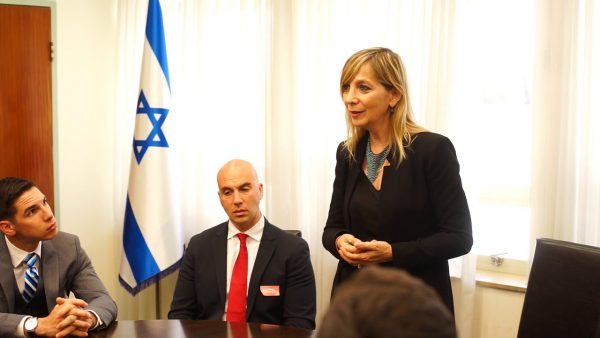
Facebook for its part has hired Emi Palmor, former director-general of Israel’s justice ministry, as a member of its new oversight board which will censor content on the site. The company’s chief operations officer Sheryl Sandberg has also declared that FB is using “… the IHRA definition ‘in informing [its] own approach and definitions,’ that its new policy ‘draws on the spirit—and the text—of the IHRA,’ and that under Facebook’s policy, ‘Jews and Israelis are treated as “protected characteristics.’”
Protected characteristics has meant in practice that criticism of the activities of either Israelis or Jewish groups will not be acceptable on the site. Anecdotal evidence suggests that Facebook is also now censoring any material that might lead to legitimate criticism of the Jewish state and its policies. On August 18th the site removed a picture and article showing a road filled with dead Palestinian-owned sheep that were reportedly killed by an Israeli settler driver. The Israeli deliberately ran over the animals with his car as part of a campaign to destroy the livelihoods of Palestinian farmers on the West Bank.
When the Israel Lobby complains that portraying Israel negatively is thinly veiled anti-Semitism, one might well respond that terrible things are being done in the Middle East in the name of Jews and of Israel. Silencing critics by accusing them of a hate crime is little more than a perversion of justice to serve the demands of a powerful and wealthy minority as well as a denial of constitutional rights for all Americans. When confronted by accusations of “anti-Semitism”, just recall what the Israeli minister admitted: “It’s a trick, we always use it.”
Philip M. Giraldi, Ph.D., is Executive Director of the Council for the National Interest, a 501(c)3 tax deductible educational foundation (Federal ID Number #52-1739023) that seeks a more interests-based U.S. foreign policy in the Middle East. Website is https://councilforthenationalinterest.org, address is P.O. Box 2157, Purcellville VA 20134 and its email is inform@cnionline.org.
Featured Video

The Search for Truth: Charlie Kirk’s Assassination One Year Later
or go to
Aletho News Archives – Video-Images
From the Archives
The 9/11 “Double-Cross” Conspiracy Theory
BY LAURENT GUYÉNOT • UNZ REVIEW • SEPTEMBER 6, 2022
Is it true that “9/11 was an inside job”? Yes, insofar as Israel is “inside” the U.S. But for the 9/11 truthers who have identified Israel as the main perpetrators, “9/11 was an inside job” is at best a half-truth, and at worst an integral part of the Zionist operation, like a secondary flag sewn as a lining under the false flag of Islamism. Victor Thorn (1963-2017) wrote in his book 9/11 made in Israel: The Plot Against America (2011): “In essence, the ‘9-11 truth movement’ was created prior to Sept. 11, 2001 as a means of suppressing news relating to Israeli complicity. . . . The slogan ‘9-11 was an inside job’ was quite possibly the greatest example of Israeli propaganda ever devised.” In milder terms, it is “controlled opposition”.
A genuine truth movement would have pointed to Israel as the prime suspect from the start. From day one, it was obvious who would benefit. … continue
Blog Roll
 Aletho News
- Europe’s mounting social chaos… chickens coming home to roost for proxy war against Russia
- US-Russia Diesel Deal Becomes Massive Defeat for Ukraine
- Hormuz and the Looming Economic Catastrophe
- Dhubab offensive, media blitz and the rapid unraveling of Saudi-backed coalition’s new gambit
- Putin Conveys to Trump Iran’s Vision on Possible Conflict Resolution – Kremlin
- The Search for Truth: Charlie Kirk’s Assassination One Year Later
- ‘Harsh reality’: Iran says France seeks monopoly on power and intimidation, not peace for all
- When Will This White House Madness End?
- Huckabee aide goes to ‘unusual lengths’ to portray ‘Israel’ positively
- Trump Announces Diesel Supply Deal With Putin Following Phone Call
- If Americans Knew
- Israeli forces kill another child in Gaza – Daily Update
- Gaza ceasefire exists in name only, say more than 100 organizations
- Nearly 2 Million in Gaza Need Urgent Shelter Assistance as Winter Looms: IOM Chief Warns
- Suppressing Palestinian resistance: US charity under fire for AI monitoring of Gaza classrooms
- Thousands Are Held in Israeli Torture Camps. This Is What Happens Inside
- Israel puts Gaza’s sick, injured, newborn in peril – Daily Update
- Report claimed Mark Levin used by Israeli government to influence Trump
- Over 2,000 Gazans have died awaiting medical evacuation amid Israel’s continued siege
- How a U.S. Diplomat Suppressed and Altered Reports Critical of Israel
- 5 Palestinians Die from Israeli Strikes in Gaza as Relentless Attacks Continue
- No Tricks Zone
- New Study: 50 Years Of The Most Aggressive ‘Net Zero’ Policies Can Only Affect The Global Climate By 0.03°C
- US September “Heat” Was No Record…Many Records Set Decades Ago
- Latest European Green Energy Debacle; Portugal’s Largest Flagship Solar Park Insolvent!
- Green Energy Debacle: German Expert Professor Fritz Vahrenholt Warns Of Severe Economic And Social Consequences
- Two More Paleo Reconstructions Affirm Meters-Higher Sea Levels Across Ireland, Brazil 7000-6000 Years Ago
- New Study: Earth And Venus Surface Warmth Largely Explained By Convection And Lapse Rate, Not CO2 Or Radiation
- 2025 Nature Paper Claiming Worsening Global Drought Gets RETRACTED …Heavily Flawed
- New Study: ‘Global Drought Shows No Detectable Recent Acceleration Under Climate Warming’
- Economic Masterminds: German Socialists Suggest Taxing Productivity Gains Stemming From Using AI
- The South China Sea Has Not Been Cooperating With The Climate Change Narrative

