Anything Hamas requests will be given, says Iranian FM
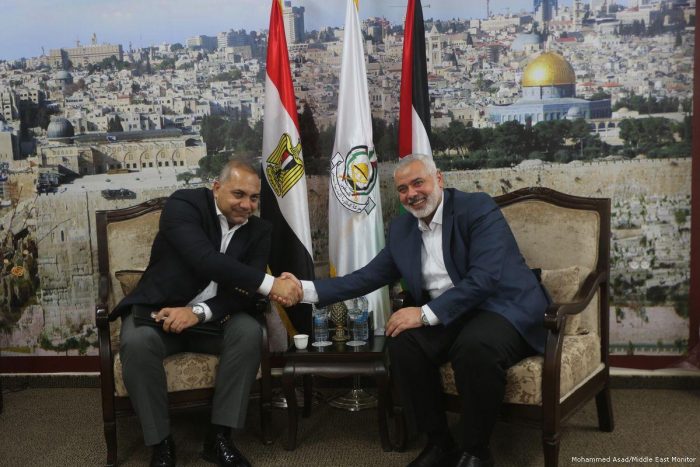
Senior Hamas members prepare for PA delegations to arrive in Gaza on 2 October 2017 [Mohammed Asad/Middle East Monitor]
MEMO | October 25, 2017
The advisor to the Iranian foreign minister, Sheikh Hussein Al-Islam, has said the relationship between the Islamic Republic of Iran and Hamas is excellent and has become stronger and more solid.
“Anything Hamas requests from Iran will be given. This is our duty,” Sheikh Al-Islam said in an exclusive interview with Shehab News Agency.
“All of Iran’s doors are open to Hamas which represents the first line of defence for the Palestinian resistance,” he said.
Commenting on Israel’s demand that Hamas sever ties with Iran as a precondition to accept Palestinian reconciliation, Sheikh Al-Islam said that “Israel wants to destroy Hamas because it is a resistance movement, not because of its relationship with Iran”.
“Hamas’s relationship with Iran is not important, the important thing is that Hamas is a resistance movement, and therefore Israel wants to wipe it out,” he said, adding that the movement makes its own decisions and that Iran does not tell Hamas what to do or not do.
The Iranian official praised the Palestinian national reconciliation, stressing that the agreement serves the Palestinian people’s interests.
Recently a Hamas delegation led by deputy political chief Saleh Al-Arouri visited Iran and met with a number of Iranian officials.
Israel sets up iron gate at entrance of private Palestinian graveyard
Ma’an – October 25, 2017
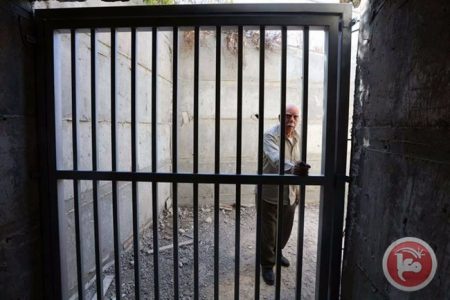
BETHLEHEM – Israeli forces on Wednesday set up an iron gate at the entrance of private Palestinian graveyard in the southern occupied West Bank Bethlehem-area village of al-Walaja.
Locals told Ma’an that the plot of land where the gate was set up around belongs to Ahmad Barghouthi, and holds the graves of several of his family members.
Israeli forces reportedly told Barghouthi that the land is located inside the route for Israel’s separation wall, therefore cutting off his access to the graveyard.
An Israeli army spokesperson told Ma’an they were looking into reports.
Meanwhile, Israeli forces on Tuesday reportedly delivered a demolition notice to an under-construction two-story home in the village, according to official Palestinian Authority (PA)-owned Wafa news agency.
Residents of al-Walaja lost over three-quarters of their lands since the state of Israel was established in 1948, when most of the village’s residents became refugees.
During Israel’s military takeover of East Jerusalem and the West Bank in 1967, 50 percent of al-Walaja’s lands were annexed to the Jerusalem municipality.
Meanwhile, Israel’s separation wall encircles al-Walaja, the hometown of slain Palestinian activist Basel al-Araj, and swathes of land have been reappropriated by the Israeli government for the construction and expansion of the illegal Israeli settlements of Gilo, Har Gilo, and Givat Yael.
The Israeli government has also planned to confiscate hundreds of acres from al-Walaja for the establishment of a national park.
Who wrote the Balfour Declaration and why: The World War I Connection
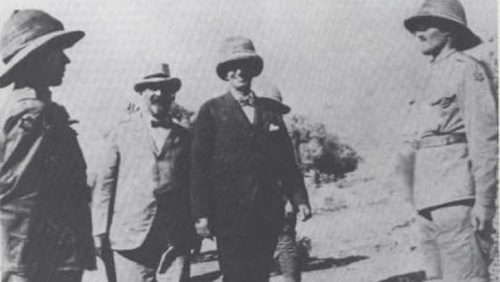
(L-R) Chaim Weizmann, future president of Israel, with Louis Brandeis, US Supreme Court Justice, in Palestine, 1919. The two were instrumental in obtaining the Balfour Declaration, a British document that many feel was a critical step in the establishment of Israel. Zionists’ promise that they would get the U.S. to join Britain in “the Great War” was the enticement.
By Alison Weir, excerpted from Against Our Better Judgment: The Hidden History of How the U.S. Was Used to Create Israel
Most analysts consider WWI a pointless conflict that resulted from diplomatic entanglements rather than some travesty of justice or aggression. Yet, it was catastrophic to a generation of Europeans, killing 14 million people.[i]
The United States joined this unnecessary war a few years into the hostilities, costing many American lives, even though the U.S. was not party to the alliances that had drawn other nations into the fray. This even though Americans had been strongly opposed to entering the war and Woodrow Wilson had won the presidency with the slogan, “He kept us out of war.”[ii]
President Wilson changed course in 1917 and plunged the U.S. into that tragic European conflict. Approximately 320,000 Americans were killed or injured.[iii] Over 1,200 American citizens who opposed the war were rounded up and imprisoned, some for years.[iv]
A number or reasons were publicly given for Wilson‘s change of heart, including Germany‘s submarine warfare, Germany’s sinking of the British passenger ship Lusitania,[v] and a diplomatic debacle known as the Zimmerman Telegram episode.[vi] Historians also add pro-British propaganda and economic reasons to the list of causes, and most suggest that a number of factors were at play.
While Americans today are aware of many of these facts, few know that Zionism appears to have been one of those factors. [Zionism was a political movement to create a Jewish state in Palestine. When this movement began, in the late 1800s, the population of Palestine was 96 percent Muslim and Christian. The large majority of Jews around the world were not Zionists.]
Diverse documentary evidence shows that Zionists pushed for the U.S. to enter the war on Britain’s side as part of a deal to gain British support for their colonization of Palestine.
From the very beginning of their movement, Zionists realized that if they were to succeed in their goal of creating a Jewish state on land that was already inhabited by non-Jews, they needed backing from one of the “great powers.”[vii] They tried the Ottoman Empire, which controlled Palestine at the time, but were turned down (although they were told that Jews could settle throughout other parts of the Ottoman empire and become Turkish citizens).[viii]
They then turned to Britain, which was also initially less than enthusiastic. Famous English Middle East experts such as Gertrude Bell pointed out that Palestine was Arab and that Jerusalem was sacred to all three major monotheistic faiths.[ix]
Future British Foreign Minister Lord George Curzon similarly stated that Palestine was already inhabited by half a million Arabs who would “not be content either to be expropriated for Jewish immigrants or to act merely as hewers of wood and drawers of water for the latter.”[x]
However, once the British were embroiled in World War I, and particularly during 1916, a disastrous year for the Allies in which there were 60,000 British casualties in one day alone,[xi] Zionists were able to play a winning card. While they previously had appealed to religious or idealistic arguments, now Zionist leaders could add a particularly powerful motivator: telling the British government that Zionists in the U.S. would push America to enter the war on the side of the British, if the British promised to support a Jewish home in Palestine afterward.[xii]

British soldiers, Battle of the Somme. British suffered 60,000 casualties in the first day of the battle.
In 1917 British Foreign Minister Lord Balfour issued a letter to Zionist leader Lord Rothschild. Known as the Balfour Declaration, this letter promised that Britain would “view with favour the establishment in Palestine of a national home for the Jewish people” and “use their best endeavours to facilitate the achievement of this object.”
The letter then qualified this somewhat by stating that it should be “clearly understood that nothing shall be done which may prejudice the civil and religious rights of existing non-Jewish communities in Palestine.” The “non-Jewish communities” were 92 percent of Palestine’s population at that time,[xiii] vigorous Zionist immigration efforts having slightly expanded the percentage of Jews living in Palestine by then.
The letter, while officially signed by British Foreign Minister Lord Balfour, had been in process for two years and had gone through a number of edits by British and American Zionists and British officials.[xiv] As Zionist leader Nahum Sokolow later wrote, “[e]very idea born in London was tested by the Zionist Organization in America, and every suggestion in America received the most careful attention in London.”[xv]
Sokolow wrote that British Zionists were helped, “above all, by American Zionists. Between London, New York, and Washington there was constant communication, either by telegraph, or by personal visit, and as a result there was perfect unity among the Zionists of both hemispheres.” Sokolow particularly praised “the beneficent personal influence of the Honourable Louis D. Brandeis, Judge of the Supreme Court.”[xvi]
The final version of the Declaration was actually written by Leopold Amery, a British official who, it came out later, was a secret and fervent Zionist. … continue
Guardian Sells False Image of an Open Jerusalem

By Jonathan Cook | Dissident Voice | October 23, 2017
A Guardian essay on a new Israeli open-rooftops project in Jerusalem, part of a Season of Culture, sadly falls into a standard trap for feelgood articles of this kind. It fails to provide the main context for Jerusalem: that the native Palestinians live under a belligerent Israeli occupation that is ultimately trying to evict them from the city.
Ignoring that context when reporting on life for Jews and Palestinians in Jerusalem is gravely irresponsible journalism.
Does this misrepresentation simply reflect author Hannah Ellis-Petersen’s ignorance? Or is it a consequence of who is footing the bill: the Rockefeller Foundation sponsored the article.
Note these infuriatingly misleading introductory paragraphs:
For its Season of Culture, the ancient capital has thrown open its rooftops to encourage residents to see beyond their blinkered boundaries. But the reality is a city where the divides are growing deeper.
The standfirst sets the mendacious “balanced” tone, as though Palestinians could ever afford the luxury of choosing to be “blinkered” in a city where the Israeli-run, occupation municipality is openly hostile to them, and where their homes can be demolished for the smallest infraction of opaque, Israeli-imposed planning rules.
The city’s divides are not “growing deeper”. They were always deep in a city where the occupying power has sought for five decades to colonise Palestinian East Jerusalem with Jewish settlers. There are now more than 200,000 of these settlers gradually displacing the native Palestinian population.
Living side by side in Jerusalem are communities who exist with no interaction with one another – kept apart by fear, nationalism and religion.
No, that is not what keeps them apart. Just imagine an article on apartheid South Africa stating that whites and blacks had no interaction because they were “kept apart by fear, nationalism and religion”. In reality, the two populations were kept apart by the colour of their skin. For blacks under apartheid, and today for Palestinians under occupation, their inferior status is dictated to them. They have no say in the matter.
Palestinians and Israelis are kept apart by the structural violence of occupation, which confers on them entirely different rights and life choices. Jews in Jerusalem have Israeli citizenship; Palestinians have a residency that Israel can easily revoke. Potentially, Jews can live almost anywhere in the city; Palestinians are confined to ghettoes, where they are being suffocated of space and services to encourage them to leave.
Israel has even built a wall cutting some Palestinian neighbourhoods off from the rest of East Jerusalem and the services they pay for through their municipal taxes. They do not live apart because of fear, nationalism or religion. They have been cut off from family, friends and services by concrete walls and armed checkpoints.
While Israelis typically live in the west and Palestinians in the east of Jerusalem, mixed neighbourhoods do exist. In the winding alleys of the old city and the streets of downtown, the diverse inhabitants peacefully cross paths every day.
“Mixed neighbourhoods”? Is the author referring to Jewish settlers who have forcibly taken over Palestinian properties in areas of occupied East Jerusalem like the Old City, Silwan and Sheikh Jarrah in violation of international law and have then turned their apartment blocs into armed compounds? Is that her idea of “paths crossing peacefully” – that Palestinians must live submissively, in terror of armed Jewish interlopers?
What’s more, the only rooftops of Palestinians that were made accessible are in the old city; there are none in east Jerusalem. … The project traces a line across a divided city via its rooftops. And the stories of the volunteers who have opened their homes to strangers, regardless of ethnicity or creed, speak to a multi-layered Jerusalem, one rarely seen in a conflict-obsessed news cycle: a colourful, fractious and potent city.
Is it really a failure of the news cycle that it wishes to highlight “conflict” rather than accentuate the supposed rough-and-tumble co-existence proposed by this article, and achieved after Israel illegally annexed East Jerusalem?
Israel professes to have created an “eternal, united capital” of Jerusalem, but nothing could be further from the truth. We don’t need from the media less of an obsession with “conflict”. We need greater honesty from them about Israel’s oppression of Palestinians and the harsh reality of a Jewish settler colonial society slowly disappearing the natives.
Only the gullible or dishonest could believe that opening rooftops in the privileged, Jewish side of the city challenges or mitigates the ugliness of what is going on on the other side of Jerusalem, for Palestinians.
Report: 16 Palestinian Children Arrested, Beaten, and Confined to Cage By Israeli Soldiers
By Richard Edmondson | Fig Trees and Vineyards | October 22, 2017
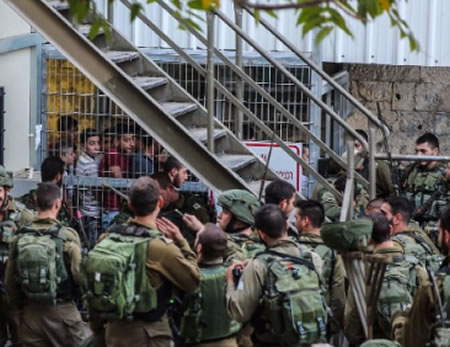
“On October 13th, 2017, 16 children and 2 adults were ambushed and arrested by the Israeli soldiers from the Givati Brigade. The 18 arrested were initially detained in a cage in checkpoint 56, cable-tied, kicked, and hit. 2 were released, whilst the remaining 16 were transferred to an Israeli police station where they were subjected to further physical and psychological violence. All 16 were eventually released without charge, but not before threats were made to their families and the safety of their homes.”
The above is reported by Christian Peacemaker Teams, which maintains a team of international observers in the occupied West Bank…
The seizing of the children took place in the West Bank city of Hebron. The report goes on to describe arrests of minors as “a consistent reality of the occupation and tactic of the Israeli occupation forces,” and it also cites a report from a human rights organization showing that 130 children were arrested in August of 2017 alone.

One of those detained in the October 13 roundup was 12-year-old Abdullah Dwaik. That’s Abdullah in the brown sweater being led away in the photo above. You can also see him in the video below giving an account of what took place after he was taken into custody. Following the initial arrest, he and the others were transported to a military base where they were handcuffed and blindfolded.
I’m not sure exactly where Abdullah’s grandparents live–I’m not familiar with the place name–but Bab Al Zawyeh, the place he calls “home,” is a neighborhood in central Hebron.
I also do not know who the “Ofer the settler” Abdullah refers to (and who he says hit one of the boys) is, though possibly he’s the man profiled in the following video…
In any event, the Christian Peacemakers report goes on to make some additional crucial points:
- Children should never be blindfolded, hooded or painfully restrained;
- Children should never be subjected to violent, threatening or coercive conduct;
- Children must be able to consult with a lawyer prior to interrogation;
- Children should have a parent or guardian present prior to and during their interrogation;
- Children should not be arrested at night;
- Children should be properly informed of their right to silence;
- All interrogations should be audio-visually recorded;
- No child should be transferred out of the West Bank in violation of the Fourth Geneva Convention.
Israel has violated all of these principles.
And this is the country so loved by Dickinson, Texas that its officials deny hurricane relief assistance to people based upon whether or not they support a boycott of it.

Mayor and city council members of Dickinson, Texas
Kirkuk bell also tolls for US strategy in Syria
By M K Bhadrakumar | Indian Punchline | October 22, 2017
The rout of the Kurds in the northern Iraqi city of Kirkuk this week constitutes a major setback for the overall American strategies toward Iraq and Syria. The prospect of an unceremonious US retreat from Syria haunts the Trump administration in immediate terms, and it is all the more galling because Tehran is calibrating it.
Clearly, Iran has pushed the envelope, furious over US President Donald Trump’s provocative threats of sanctions against the Islamic Revolutionary Guards Corps (IRGC). Tehran had warned that US position in the entire Middle East will become increasingly untenable if Trump moved against the IRGC. The capture of Kirkuk by the Baghdad government was a de facto military operation by the Shi’ite militia known as the Hashd al-Shaabi, which was trained and equipped by the IRGC. The western reports suggest that the charismatic commander of the IRGC’s secretive Quds Force, General Qassem Soleimani personally masterminded the military operation – and even prepared the political ground for it.
The US had tried to prevail upon the Iraqi Prime Minister Haider al-Abadi not to move against the Kurds who were its allies. Kirkuk is estimated to hold at least 8000 million barrels of subterranean oil. The oil revenue is critical for the survival of any independent Kurdish state. Evidently, Abadi didn’t listen due to the emergent threat posed by the Kurds’ recent independence referendum. Equally, Iran wanted to finish off the spectre of an independent Kurdistan in the region spearheaded by Massoud Barzani (who enjoys the backing of US and Israel.)
Indeed, the defeat in Kirkuk destroys the Iraqi Kurds’ dream of an independent state and derails the longstanding US-Israeli project to create a base with strategic location. Equally, the liberation of Kirkuk, which is populated by the Kurds, Arabs and Turkmen by the Iran-supported Shi’te militia highlights the strategic convergence between Baghdad, Tehran and Ankara in preventing the creation of an independent Kurdistan in the region.
However, the defeat of Barzani in Kirkuk has far wider ramifications – for Iraq as well as the Syrian conflict, apart from the US’ influence in the Middle East as a whole. At its most obvious level, Iran is thwarting the US plans to balkanize Iraq. Iraq’s unity is no longer under serious threat. Control of the vast oil reserves in Kirkuk will also bolster the Iraqi economy. Baghdad can be expected to reassert its authority over the country. The federal government has taken over the border crossings with Turkey and Syria.
The US attempt in the coming period will be to woo Abadi and encourage him to whittle down Iran’s influence in Iraq. The US Secretary of State Rex Tillerson arrived in Riyadh on Saturday on a hastily arranged trip with the hope of getting Saudi King Salman to take a hand in persuading Abadi to keep Tehran’s influence on Iraq at bay and to mediate between Abadi and Barzani. The US and Saudi Arabia’s best hope lies in creating differences between Baghdad and Tehran by leveraging Abadi. But the chances of such a ploy working seem remote.
The fact that the US watched the defeat of the Kurds in Kirkuk passively tarnishes the overall American image, especially among Syrian Kurds. This casts shadows on the Syrian situation. The US has been routing the military supplies for Syrian Kurds in Raqqa via Erbil, Massoud’s stronghold (in the face of Turkey’s virulent opposition.) This supply route is no longer under Barzani’s control and the disruption will affect the US’ operations in Raqqa. The US-led Syrian Kurdish militia claims to have liberated Raqqa, but a real consolidation needs the decimation of the residual ISIS fighters present in the region and it may take months.
More importantly, a ‘trust deficit’ between Syrian Kurds and Washington at this juncture will be calamitous. Raqqa is Arab territory and the Kurdish militia’s supply lines are already overstretched. The disruption in American supplies means that it may now be a mater of time before Syrian Kurds seek some modus vivendi with the Syrian regime. If American military supplies dry up, Syrian Kurds will also come under pressure from Turkey in the swathe of northern Syria bordering Turkey, which form their traditional homelands. Turkey never liked a Kurdish entity taking shape across their border.
Interestingly, the commander of the Syrian Kurdish militia Sipan Hamo visited Moscow last weekend. The Russians indeed find themselves in an enviable position to drive a hard bargain over the Kurds’ sorrows. Russia is in a unique position to mediate between Syrian Kurds on one side and Ankara and Damascus on the other. But then, what is it that the Kurds can offer Russia in return? Last Thursday, Rosneft signed a big oil deal with Barzani’s government in northern Iraq. To be sure, the old Kurdish saying has some merit – ‘The Kurds have no friends but the mountains.’ (Guardian )
The main impact of last week’s dramatic events is that the US now has no conceivable reason to continue with a military intervention in eastern Syria. The likelihood is that Syrian Kurds will sooner or later hand over Raqqa also to the government forces. Clearly, the Syrian regime’s march to victory is from now onward relentless and irreversible. That is to say, the best-laid plans of the US and its regional allies to balkanize Syria have also gone awry.
Maybe, there will be a federal system in future Iraq and Syria. But last week’s events have ensured that the two countries’ territorial unity and integrity will no longer be under serious threat. Of course, that has also been at the core of the Iranian strategy.
Trump’s new Iran strategy ‘has no support in US’: Ex-congressional staffer
Press TV – October 22, 2017
US President Donald Trump’s new strategy on Iran has “no support inside the United States” other than by pro-war neoconservatives and the Israel lobby, says an American analyst.
“President Trump’s position on canceling the Iran deal, at least on the United States’ side, has no support in the United States either by the public, obviously by the Democratic Party; even it lacks support by members of the Republican Party,” Rodney Martin, radio host and former congressional staffer, said on Saturday.
“It only has support by the rabid pro-war neocons and by the rabid Zionist pro-Israel lobby and of course by Prime Minister [Benjamin] Netanyahu in Tel Aviv,” he added.
Trump announced last week that he would not continue certifying the 2015 nuclear deal with Iran dubbed the Joint Comprehensive Plan of Action (JCPOA).
The US president has come under widespread criticism at home and abroad, with America’s European allies reaffirming their commitment to the nuclear accord.
The majority of Americans also believe Trump should not pull the US out of the international agreement, according to a new poll.
Overall, two in three Americans oppose withdrawing from the JCPOA, a CNN poll has found. Eight in 10 Democrats and two in three Independents have the same opinion. Even in Trump’s own party, Republicans are evenly split, with 48 percent desiring to remain and 47 percent to withdraw.
Martin pointed to the Israeli influence over Trump’s decision regarding the Iran deal.
“We all know that Netanyahu took the atrocious step by coming to the United States and lobbying the US Congress against the deal,” he pointed out.
The analyst said Trump is “throwing Netanyahu a bone” by refusing to certify the JCPOA in order to compensate for his failure to deliver on his promise to move the US embassy to Jerusalem al-Quds.
Trump is “every bit as controlled by the Israeli lobby” as his predecessors, Martin said, adding, “so it doesn’t matter what the public and the experts believe, President Trump is going to do what this very small, dangerous cabal tells him to do.”
The War on Terror: The Plot to Rule the Middle East – A Book Review
Christopher Bollyn, 2017, 146 pages.
Review by David Brooks | American Herald Tribune | October 18, 2017
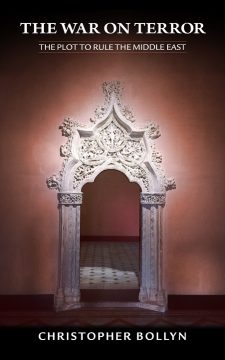 Christopher Bollyn is that rarest of mediaticians, a real-live investigative journalist, formerly of the American Free Press, now altogether free, as befits a researcher-writer of irreducible integrity. For the last decade and a half, Bollyn has made September 11th and its murderous military aftermath his own special beat, going where few 9/11 analysts have dared to venture.
Bollyn’s great contention, expounded in scores of articles and two previous books (Solving 9/11: The Deception that Changed the World ), is that it was not Bin Laden and Al Qaeda who carried out the world’s greatest terror attack, but none other than Ben Netanyahu and El Mossad, so as to foment an endless war against Israel’s perceived enemies in the Middle East.
Even more than David Ray Griffin, the widely acknowledged dean of 9/11 studies, Bollyn deserves a Pulitzer Prize, for not only naming the unnamable, but for substantiating his charge in definitive, documented detail. Mazel tov to anyone who would lightly dismiss his case.
As for those who would single-handedly rebut Bollyn’s thesis with the knee-jerk cry of “anti-Semitism,” let them be forewarned that Bollyn gets serious back-up in a scathing introduction by Dr. Alan Sabrosky, a retired senior administrator at the U.S. Army War College (West Point), who went on record long ago that 9/11 was a Mossad operation. Sabrosky is Jewish himself.
That someone of Sabrosky’s stature and heritage has not yet been invited on network television to deliver his bombshell accusation is just one more proof of the media-wide clampdown on 9/11 truth. While Bollyn may be snubbed by the MSM merely for being a self-published non-entity, the only way for Zionist propagandists to deal with Sabrosky is to pretend that he doesn’t exist. Thus far it has worked.
It’s interesting to note that Sabrosky’s greatest scorn is not for the Israeli terrorist perpetrators, but for homegrown Israeli fifth-columnists, “the mostly Jewish Neo-conservatives, many of whom [are] dual Israeli citizens and all more or less openly professing “dual loyalty” to Israel and the United States – a form of political bigamy that is every bit as dishonest as marital bigamy, and which only thinly disguises the controlling allegiance all hold to Israel, their oaths notwithstanding.”
Bollyn expands on this point for the length of his book, claiming that the War on Terror has been a greater curse on the world than 9/11 itself, costing trillions of American dollars and millions of Muslim lives, with no end in sight. More damning is that all this was foreseen. What has come to pass is indeed the very fulfillment of an objective set out decades ago:
As I explain in my Solving 9/11 books, the false-flag terror of 9/11 was an Israeli idea from the beginning, first articulated by a former head of the Mossad in the 1970’s. At the same time that [Mossad chief] Isser Harel was predicting how Arab terrorists would attack the tallest towers in New York City, Benjamin Netanyahu was holding an international conference of Western leaders in Jerusalem (1979) to promote a global war against terrorism. Both concepts are products of Israeli strategic planners.
What a perp-line Bollyn brings before his readers, digging up well-hidden background information on every possible suspect, Israeli and American, in this criminal cause. A veritable A-list of dual nationals could be compiled just from the officials of recent presidential administrations. Each could be subpoenaed before a real 9/11 commission, rather than evade mention, as was ensured by dual national, Philip Zelikow, in the official whitewash “report.”
Questioning could start with Netanyahu’s long-time friend, Larry Silverstein, who obtained the World Trade Center just weeks beforehand, arranged for dubious, new security, and doubled the insurance. “Lucky Larry” is best known for being the fortuitous owner of WTC 7, which wasn’t hit by a plane, but still managed to collapse neatly in 6.5 seconds later that afternoon. That this staggering fact is still largely unknown sixteen years later speaks more cogently than any of Bollyn’s arguments to a deliberate media and government cover-up.
In some of his research, Bollyn acquits himself like archival historian, tracing certain 9/11 “strategic planners” back to “a small group of veteran Zionist criminals who have employed terrorism as a tool since the 1940s.” Talk about chickens coming home to roost! One of the shadier Zionist operatives is Netanyahu’s own father, Benzion, an American academic who co-hosted that fateful Jerusalem conference with his son, and whose influence upon him may not have stopped with his death at age 102.
Here’s another intriguing item gleaned from Bollyn’s inquiry: For those who remember the film or book, Charlie Wilson’s War, it turns out the celebrated Congressman who enlisted massive funding for anti-Western mujahideen “freedom fighters” in Afghanistan was a Zionist stooge:
Wilson’s Israeli handler was Zvi Rafiah, Mossad station chief in Washington, who had known Wilson since 1973 and who used his congressional office as if it were his own. As George Crile described in his book, Charlie Wilson’s War, “Rafiah had always acted as if he owned Wilson’s office. One of the staffers kept a list of the people he needed to lobby. He would use the phones, give projects to the staff, and call on Charlie to intervene whenever he needed him.”
Imagine gung-ho patriot, Tom Hanks, being played for a schmuck. The unwitting sabotage of more enlightened resistance to the Soviet occupation of Afghanistan led to a more deadly subterfuge—the formation of a perfect patsy for the pre-meditated crime of 9/11:
Thousands of non-Afghan fighters joined [the anti-Western militia] Hezb-i-Islami, including thousands of Arabs, known as Afghan Arabs. Osama bin Laden is the most famous of the Afghan Arabs. Having trained a cadre of 4,000 anti-Western Islamic fighters, Israeli military intelligence and C.I.A. had a database of names to populate the Islamic anti-Western antithesis needed for the War on Terror construct. This database was known as Al Qaeda.
It comes as no surprise to learn in the chapter “9/11 and the War in Syria” that the United States, Saudi Arabia, and Israel conjointly support the most savage of the anti-Western militias there. The only purpose of all these parties is to terrorize and destroy the country. This is not foreign policy, but state-sponsored sociopathy.
In the chapter titled “Who Makes the Terrorist Videos?” we learn that the person releasing most ISIS videos, which have duly invoked air strikes on Syria, happens to be an Israeli intelligence agent named Rita Katz, living in Bethesda, Maryland. How much more transparent can the Zionist psy-op known as the “War on Terror” get?
Most memorable image from Bollyn’s book: “The War on Terror and 9/11 are like two sides of a counterfeit coin. If the American public had a good understanding of the false-flag deception of 9/11, then the fraudulent nature of the wars fought in its name would be equally obvious.” Amen.
A brief review cannot do justice to the depth of research contained in Bollyn’s concise exposé. It is his attention to detail, instanced above, which undergirds every aspect of his overarching thesis of Zionist complicity, and provides substantive evidence to his book-lengthed “J’accuse!”
Attention must be paid—or else. As Bollyn observes, the magnitude of such a fraud as 9/11 can’t stay hidden forever. Too many people know already. Either the truth of 9/11 will prevail, or its perpetrators, who have nothing to lose, may arrange something far worse.
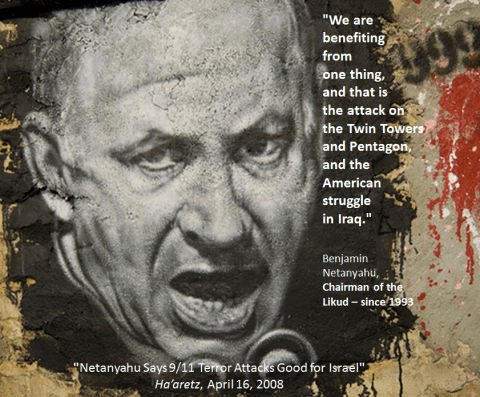 Bollyn is fully apprised of the danger in the combustible combination of the current leaders of Israel and the United States. It could be déjà vu over again: “Ronald Reagan and Menachem Begin led to the Israeli invasion of Lebanon in 1982, and George W. Bush and Ariel Sharon led to 9/11 and the War on Terror in 2001.” Foreboding abounds when President Trump calls Prime Minister Netanyahu a close, personal friend. Will the talented Mr. Netanyahu and the Artful Dealer of America arrange a mutually acceptable war? We may soon have our answer.
While it strains credulity to the breaking point, Bollyn’s most daringly original suggestion is that 9/11 and its propaganda-induced “War on Terror” can be traced in part to a consanguineous conspiracy—a family plot, if you will—conceived and crafted over many years by Netanyahu & Son, and abetted by select American traitors when all the pieces were at last in place. Should their guilt ever become known, the name “Netanyahu” will live in infamy. Move over, Macbeth!
It seems only fitting, then, to let 9/11 mastermind, Benjamin Netanyahu, have the penultimate word in this review. One can almost picture him winking to his future accomplices when he proclaimed decades earlier: “It is perfectly possible to determine who the terrorists are and who stands behind them. If governments have failed to do this, it is more often not for lack of knowledge, but for lack of courage and moral clarity.” (Terrorism: How the West Can Win, 1986)
If Netanyahu soon gets his way—and unleashes yet another false-flagged, media-hyped, Israeli-concocted “war on terror”—it will not be for lack of courage and moral clarity by people such as Christopher Bollyn. May the Lord preserve him and all other truth-tellers.
Netanyahu lobbies world powers to support Iraqi Kurds’ secession bid
Press TV – October 20, 2017
Israeli Prime Minister Benjamin Netanyahu is lobbying world powers to support the independence of the semi-autonomous Kurdistan region from the rest of the Iraqi territory, as Kurdish Peshmerga forces are losing ground to Iraqi army forces in the country’s oil-rich northern province of Kirkuk.
Israeli officials, requesting anonymity, said Netanyahu raised the Kurdish plans for independence with German Chancellor Angela Merkel last week, and with Russian President Vladimir Putin on Wednesday.
The 67-year-old Chairman of the Likud party also made a reference to the issue in his contacts with French authorities.
An Israeli official, who declined to be named, stated that the Tel Aviv regime has security interests in Kurdistan.
“This (territory) is a foothold. It’s a strategic place. It would be best if someone gave them weaponry, and whatever else, which we cannot give, obviously,” the official said without providing further detail.
Israel has maintained military, intelligence and business ties with Iraqi Kurds since 1960s.
“The issue at present is … to prevent an attack on the Kurds, extermination of the Kurds and any harm to them, their autonomy and region, something that Turkey and Iran and … other powers in Iraq and part of the Iraqi government want,” Israeli Intelligence Minister, Israel Katz, alleged in an interview with Tel Aviv radio station 102 FM on Friday.
“The prime minister is certainly engaging the United States, Russia, Germany and France to stop the Kurds from being harmed,” Katz said.
On Friday, Iraqi government forces wrested control of a strategic sub-district of Kirkuk province following clashes with Peshmerga forces.
“Iraqi Federal Police and Counter-Terrorism Service (CTS) forces, along with fighters from Popular Mobilization Units – commonly known by the name Hashd al-Sha’abi, have secured Kirkuk’s northern Altun Kupri sub-district,” the Iraqi Defense Ministry said in a statement.
Iraqi Army Captain Jabbar Hasan said Iraqi federal forces had given Peshmerga forces 24 hours to vacate their strongholds in Altunkopru, and withdraw to areas controlled by the Kurdistan Regional Government (KRG).
Peshmerga forces, however, had rejected the ultimatum, Hasan said.
The referendum on secession of the Kurdistan region was held on September 25 despite strong opposition from the central government in Baghdad, the international community, and Iraq’s neighboring countries, especially Turkey and Iran.
Following the vote, Baghdad imposed a ban on direct international flights to the Kurdish region and called for a halt to its independent crude oil sales.
On October 12, an Iraqi government spokesman said Baghdad had set a series of conditions that the KRG needed to meet before any talks on the resolution of the referendum crisis could start.
“The KRG must first commit to Iraq’s unity. The local authorities in the [Kurdistan] region… must accept the sovereign authority of the federal government on… oil exports, [as well as] security and border protection, including land and air entry points,” the unnamed Iraqi official added.
Iraqi Prime Minister Haider al-Abadi has already demanded the annulment of the referendum.
During a recent press conference in Paris, Abadi said his government did not seek confrontation with Iraqi Kurds, but reiterated Baghdad’s position that the vote was illegal and that problems should be solved within the framework of Iraq’s constitution.
Featured Video
Nima R. Alkhorshid: US military bombs multiple targets on Iran’s Qeshm Island
or go to
Aletho News Archives – Video-Images
From the Archives
British Intel Tried to Make N Irish Gang ‘Shoot Up’ School, Documentary Claims
Sputnik – 23.02.2019
A new documentary, based on an interview with a self-confessed member of the Glennane Gang, gives some insights into allegations that British military intelligence was behind a shocking murder plot to cause the situation in Northern Ireland to “spiral out of control”.
In a documentary, Unquiet Graves: The Story of the Glennane Gang, John Weir, a former officer from the Royal Ulster Constabulary (RUC), alleges that British intelligence tried to persuade paramilitary group Ulster Volunteer Force (UVF) to attack a Catholic primary school at Belleeks in County Armagh.
Weir claimed that the UVF was urged to kill children and teachers in retaliation for the 1976 Kingsmill massacre, in which gunmen stopped a minibus carrying twelve workmen and shot them; only one person survived despite having been shot 18 times.
“The plan that was decided on was to shoot up a school in Belleeks”, he said, adding that the British intelligence plot was to make the situation in Northern Ireland “spiral out of control”. … continue
Blog Roll
 Aletho News
- Nearly 80% of Britons consider Israel a threat to world peace and security: Survey
- Rhode Island Staffer Could Be Reinstated After Firing Over Ceasefire Post
- Will Republicans Learn Their Lesson from the ‘Disastrous’ Midterms?
- Wrong, Newswise, Irresponsible Climate Messaging, Not Climate Change Itself, Is Fueling Student Anxiety
- Zelensky’s Critics Vanish Into Ukrainian Secret Prisons – Source
- Nima R. Alkhorshid: U.S. Military Bombs Multiple Targets on Iran’s Qeshm Island
- Iran-Linked Ships Spotted Hovering over Subsea Cables: Report
- New attack on Iran could devastate ‘Israel’, IOF general warns
- Nuclear deterrence: The US-Israeli military aggression against Iran made the unthinkable legitimate
- U.S. Midterms – a Referendum on Israel and Zionist Power
- If Americans Knew
- The vindication of Marjorie Taylor Greene
- Stephen Miller: What Trump’s new chief of staff means for MENA
- Winter Rains Drown Displacement Tents in Devastated Gaza
- In Jericho, Israeli Settlers Violently Seize and Occupy Palestinian Homes
- Covering Palestine: Historic news clippings reveal US media complicity in Israel’s crimes
- DAILY UPDATE: Latest essential news on Palestine, Israel, & region
- Study says Christians’ share of occupied Jerusalem fell from 25% to 1.56% over century
- Americans voted against Israel-First; Schumer, Jeffries, establishment will try to continue it
- DAILY UPDATE: Latest essential news on Palestine, Israel, & region
- DAILY UPDATE: Latest essential news on Palestine, Israel, & region
- No Tricks Zone
- Zonal Asymmetry of Temperature Change in the Antarctic Circumpolar Current
- New Study: The Net Fossil Fuel Contribution To Rising Atmospheric CO2 Has Been Zero For 500 Years
- Germany’s Green Energy Transition Becoming Increasingly Expensive…Another 6 Trillion Euros!
- Sudden Stratospheric Warming, Powerful El Niño Combination May Lead To Extreme Europe Cold, Energy Crisis!
- Two New Studies Find Thwaites Glacier Melt Cannot Be Driven By Human Activity Or A Warming Ocean
- E-Cars Reduce CO2 Emissions By Only 41% Compared To Internal Combustion Engine Vehicles
- Predictions Made By Renowned Climate Professor Over Past Decades Have Been Proven To Be Poor
- New Study Suggests Large Regions Of The Pacific Ocean Have Been Cooling For The Last 80 Years
- Germany’s Green Energy Debacle: High Energy Costs Force Kahla Porzellan to Close After 182 Years!
- New Study: 50 Years Of The Most Aggressive ‘Net Zero’ Policies Can Only Affect The Global Climate By 0.03°C

