Obama Signs Legislation Inhibiting Boycott of Israel
IMEMC News & Agencies | July 2, 2015
 President Obama has signed legislation which would tackle anti-Israel boycotts all over the world and would raise specific US priorities in roughly 150 trade objectives in its negotiations.
One of the main goals, according to World Bulletin/Al Ray, is to counter willingness to support “Boycott Divestment and Sanctions” movement against Israel within the European Union. The legislation was made by a group of congressmen and the American-Israel Public Affairs Committee (AIPAC).
The new US-Israel Trade and Commercial Enhancement Act is specifically targeted “to discourage politically motivated actions to boycott, divest from, or sanction Israel by states, non-member states of the United Nations, international organisations, or affiliated agencies of international organisations that are politically motivated and are intended to penalise or otherwise limit commercial relations specifically with Israel or persons doing business in Israel or in Israeli- controlled territories.”
The new legislation was signed in spite of numerous warnings from Obama’s advisors and officials, who said that such a law can seriously harm trade relations with the European Union members that favor “Boycott Divestment and Sanctions” movement and prohibit trading with Israeli companies that operate in the occupied territories.
Britain approved £4mn Israel arms sales in the months after Gaza war
RT | July 2, 2015
The UK government approved £4 million worth of arms sales to Israel in the immediate months following the Israeli government’s military bombardment of Gaza last summer, new research reveals.
Detailed analysis published Thursday indicates that the related arms licenses cover military hardware likely to be deployed if violence in the besieged coastal strip resumes.
Among the arms sales Britain presided over were special components for military helicopters and a range of hi-tech parts for guidance and navigation systems used by the Israeli Defense Force (IDF).
The former Conservative-Liberal Democrat coalition government also approved arms licenses for a slew of third-party states that sell weapons to Israel. These particular licenses covered the sale of components for military communications equipment, helicopters used in combat and ground-to-ground missiles.
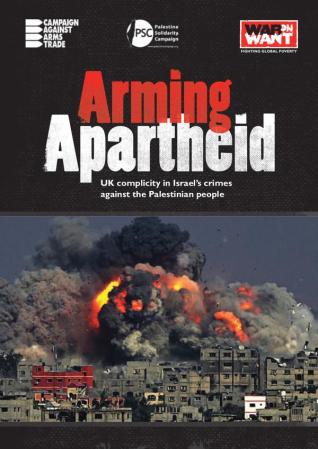 The controversial revelations formed part of a report authored by David Wearing, a researcher at the School of African and Oriental Studies (SOAS). A member of Campaign Against the Arms Trade’s (CAAT) steering committee, Wearing’s work focuses on domestic and international politics.
The research, “Arming Apartheid: UK Complicity in Israel’s Crimes Against the Palestinian People,” analyses how Britain’s arming of Israel renders it complicit in grievous human rights violations.
CAAT’s Andrew Smith said the revelations published in the report showed it was “business as usual” with Israel for the UK government.
“More than 2,000 people died in Israel’s bombardment of Gaza, and yet in the months immediately following the conflict it was business as usual for the UK government and the arms companies they support,” he said.
Smith said that Britain continues to sell arms to Israel, despite the Israeli administration’s continued violation of international law.
“The continuation of arms sales represents a form of political as well as material support from the UK to Israel despite the construction of the ‘apartheid wall’ in the Occupied Palestinian Territories, the expansion of illegal Israeli settlements there and the ongoing blockade of Gaza,” he said.
Palestine Solidarity Campaign director Sarah Colborne said the British state is arming an “apartheid” regime. She argued Palestinians will not be freed from Israeli occupation, discrimination, and bloodshed until sanctions are imposed on Israel.
Ryvka Barnard, a senior campaigner on militarism and security at War on Want, said the Arming Apartheid study highlights Britain’s complicity in “Israel’s oppression of the Palestinian people.”
She argued that the global campaign for boycott, divestment and sanctions (BDS) on Israel has become more vital than ever.
“Only a full two-way arms embargo can ensure the UK will no longer be complicit in Israeli state crimes and abuses,” he said.
Report author Wearing says ministers’ suggestion that British controls on arms exports are tightly controlled “do not stand up to scrutiny.”
“Any real restriction comes from the embarrassment of bad publicity, and then only in the wake of a conflict, too late for the Palestinians affected,” he added.
Britain has a history of unethical arms sales to Israel.
A ministerial statement issued in April 2009 by the then-Labour Foreign Secretary David Miliband confirmed that Israeli military wares used in the 2008-9 Gaza conflict “almost certainly” contained UK-supplied components.
The document was sent to the anti-arms charity after it launched a legal challenge against then-Secretary of State for Business, Innovations and Skills Vince Cable in 2014.
Last summer’s Israel-Palestine conflict culminated in the killing of an estimated 2,000 Palestinians [mostly civilians]. Israel, by contrast, suffered the deaths of 64 soldiers and three civilians during the conflict.
~~~
Take Action
 Act now to Stop Arming Israel. Help increase the pressure on the UK government to end its arms trade with Israel and its complicity in Israel’s occupation and war crimes.
1. Email your MP to demand a two-way arms embargo against Israel.
2. Order campaign materials and book a speaker.
3. Target the companies profiting from Israel’s occupation.
Find the suppliers on your doorstep
More than 100 companies supplying military and security equipment to Israel have bases in the UK. Find out about the suppliers on your doorstep.
Block the factory!
During last summer’s assault on Gaza, activists occupied Israeli arms company Elbit’s factory in Shenstone, causing its operations to grind to a halt and costing Elbit over £100,000. On 6th July, to mark the first anniversary of the assault on Gaza, groups and campaigners from across the UK are going back to Elbit’s factory to demand that the UK stops arming Israel. Join a day of creative action in solidarity with Palestine!
4. Support BDS
Support the Palestinian call for a global movement of Boycott, Divestment and Sanctions against Israel. Visit waronwant.org/BDS
Spin Becomes “Fact” in NY Times Gaza Flotilla Story
Barbara Erickson | TimesWarp |June 30, 2015
Now, with the seizure of a Swedish boat in international waters, The New York Times can no longer ignore Flotilla III, the latest attempt to break Israel’s illegal blockade of Gaza. So we find a story today that ends the paper’s silence on this weeks-long saga that began in Gothenburg last month.
Times readers learned nothing of the Marianne and her three companion vessels as the international organizers of the flotilla announced their plans and gathered crews throughout the spring. Even when one of the boats was sabotaged last week or when a Palestinian member of the Knesset announced that he was joining the group, none of these events appeared in the Times.
Those who checked out The Washington Post, Newsweek, CBS News or Israeli media would have known that Flotilla III was on its way to Gaza, with the Swedish vessel approaching the strip and the others far behind. The Times, however, avoided any mention of the effort until today, when the Israeli navy announced that it had seized the Marianne and was taking her to the port of Ashdod. (The other vessels by then had turned back toward Europe.)
Now the Times has published an article by Diaa Hadid on the seizure, and her piece gives precedence to Israeli spin, allowing official excuses for the brutal siege of Gaza to stand as fact. Thus, she writes that Israel maintains a naval blockade of the strip “because militants have tried to smuggle in weapons and attack Israel by sea.”
Hadid repeats this formula in the subsequent paragraph where she states that Israel allows only “small amounts” of construction materials into Gaza “because Hamas has used building materials to construct tunnels to attack Israel.”
United Nations investigations have provided very different takes on these two issues: A 2010 fact-finding mission, for instance, declared that Israel has imposed the blockade (by land and sea) out of “a desire to punish the people of the Gaza Strip for having elected Hamas. The combination of this motive and the effect of the restrictions on the Gaza Strip leave no doubt that Israel’s actions amount to collective punishment as defined by international law.”
Where Hadid’s piece implies that tunnels have been used for random “terror” attacks on Israel, a recent UN report on the 2014 conflict found that the tunnels had been used only for legitimate means, to engage with Israeli troops during the fighting this past summer. Neither the Times nor any other media outlet has named a single Israeli civilian who was harmed because of these tunnels. (See TimesWarp 6-22-15.)
Unfortunately, Hadid fails to mention either of these findings and repeats Israeli spin as accepted fact. She fails to make even a minimal attempt at attribution, and so we have no “according to” or “Israel claims” here—just the bald, assertive “because.”
Her story ends with a poignant quote that begs for explanation. As fishermen gathered in Gaza to protest the seizure of the Marianne, one of them spoke to a Times representative. “We hope that other activists come to Gaza to help us break the naval siege,” he said, “so that we can sail again without fear.”
The article leaves us with an unanswered question: Why are the fishermen living in fear? Times readers, however, never learn the answer: Israeli naval boats routinely open fire on fishermen as they sail within the 6-mile limit imposed by the blockade. At least one died this year, several have been injured, and several have lost their boats and equipment because of the Israeli attacks.
The Times ignores this ongoing breach of the August 2014 truce, which stated that the fishing limit would expand to 12 miles. (This in itself is still far short of the 20-mile boundary set by the Oslo accords.) The paper also ignores Israel’s military incursions into Gaza, which are further breaches of the ceasefire.
Times editors are counting on a short shelf life for the Flotilla III story. Too much attention to such messy topics as international law, the definition of piracy, assaults on unarmed fishermen and Israeli breaches of the 2014 ceasefire might expose some inconvenient facts about Israel’s pitiless siege of Gaza, and this is not to their taste.
The complementary tactics of Israel and the UNHRC
By Ramona Wadi | MEMO | June 30, 2015
It seems as if Israel is about to regurgitate the script which reads that it is debating whether or not to retain its membership in the United Nations Human Rights Council (UNHRC). Following the publication of the council’s inquiry report on last year’s Operation Protective Edge, which deemed that both Israel and Palestinian resistance factions may have committed war crimes, Israeli Prime Minister Benjamin Netanyahu declared, during a closed meeting held on Monday, that a re-evaluation of Israel’s membership of the UN organisation will take place. “As a result of the report, we will consider whether to remain or to leave the council,” he was quoted by the Times of Israel.
The UNHRC report, which Israel slammed as biased, employed the usual diplomatic jargon that absolved, rather than accused, the settler-colonial state of war-crimes, despite the extensive destruction, targeted killings and massacres committed by the Israeli military in Gaza last summer (and on previous occasions).
In March 2012, former Foreign Minister Avigdor Lieberman announced the decision to cut ties with the UNHRC, citing Palestinian “diplomatic terrorism” when the council announced a probe into Israel’s settlement expansion in the occupied West Bank and East Jerusalem. The move was supported by the US, which was the only country that had voted against the UN proposal to investigate Israel’s illegal colonial expansion. Since then, Israel has utilised the UNHRC as part of its propaganda campaign to enhance its self-victimisation; an extension of what Zionism has accomplished historically to embark upon the colonisation process in Palestine.
Last week, Netanyahu uttered ridiculous words that portray clearly the extent of Israel’s contempt even for those organisations that do everything in their power to exonerate Israel through language that is based upon hypothesis: “The report is biased. Israel is not perpetrating war crimes but rather protecting itself from an organisation that carries out war crimes.”
Israel’s fabricated state is built upon a constant litany of war crimes, necessitating violence to sustain its existence, as well as the presence of international organisations that pretend colonialism has been rendered obsolete. As for bias, one need only take note of how the UNHRC attempted to criminalise Palestinian resistance, aiming to propagate an illusion of near-parity in military power between the world’s 4th best equipped army and civilians with not a tank or aircraft to their name. The obviously asymmetric nature of the conflict resulted in a much higher death toll of Palestinian men, women and children due to Israel’s persistent bombardment of Gaza.
The report’s publication has simply confirmed all that unravelled before our eyes during last year’s colonial massacre, albeit leaving space for manipulation in order to retain Israel’s untouchable status. Israel’s pondering whether or not to remain in the council is nothing new. Rather, it should be viewed as another, integral, part of its colonial project, as well as wilful subjugation on behalf of the international community. With every sliver of condemnation, despite the absence of severe repercussions, Israel embarks upon creating hypothetical conflicts which always result in it reaping rewards for its aggression against the Palestinian people.
Whether Israel remains in the council or not is irrelevant. On the contrary, the focus should be on the failure of the UN and other organisations to act according to international law and hold Israel’s very existence accountable for the horrors it has perpetrated against the indigenous population. However, that would require the UN to unravel its disseminated myths, including its denial of the existence of Zionist colonisation, which would in turn deal a blow to an organisation thriving upon the permanence of violence and murder.
Crunch Time with Iran Let’s push back against Israel’s friends and avoid a war
Philip Giraldi • Unz Review • June 30, 2015
It now appears that the longest drawn out negotiations in history since the Treaty of Westphalia ended the Thirty Years War will again be prorogued. I am, of course, referring to the P5+1 talks in Vienna seeking to come up with a peaceful resolution to the problem of Iran’s nonexistent nuclear weapons program. Today represents the third deadline as the negotiations have already been extended twice, ostensibly to permit further discussion of details of timing for the lifting of sanctions as well as verification and inspection procedures.
I refer to a “nonexistent” program as the frequently cited intelligence suggesting that a weapon was being developed has turned out to be based on forgeries provided by the Israelis. Currently, both the CIA and Mossad agree that no such program exists though both Washington and Tel Aviv persist in suggesting that Iran might change its mind and therefore must not even be able to develop relevant technologies in the future.
In theory an agreement should have been reached long ago as the two basic elements are well understood: Iran wants an end to sanctions and the United States plus its negotiating partners want a verifiable end to existing and potential programs in Iran that could possibly produce a nuclear weapon. The devil would appear to be in the details but that is not necessarily the case as the real problem is political. The talks have in fact been subject to a relentless media campaign by Israel and its friends in the U.S. to derail any possible agreement, to include a number of appearances by none other than Israeli Prime Minister Benjamin Netanyahu before both the United Nations and the U.S. Congress. Netanyahu has been warning that an Iranian weapon is imminent since 1996 and he has even produced a cartoon showing a bomb with a ticking fuse to illustrate his thinking on the issue.
The intensity of the anti-Iran campaign has increased to a boiling point as the end of June deadline has approached, to include full page ads in newspapers and a rash of editorials, op-eds and letters to the editor. If you read an article about the negotiations on an unmoderated site like yahoo you will see numerous comments trashing Iran using the same misspellings and phrases, suggesting that they originate in the banks of paid students organized and directed by the Israeli Foreign Ministry.
In order to avoid constantly rehashing the same material, the well-funded and highly creative exploration of Persian perfidy has meant in practice that the media and punditry are constantly raising new issues that have nothing to do with the nuclear weapons themselves. These have included demanding that a contrite Iran confess that it once sought a weapon, addressing the state of possible missile delivery systems in the discussions, assessing Iran’s intentions as a regional power, critiquing the country’s human rights record and examining Tehran’s support of organizations that critics choose to describe as terroristic. Congress is on record calling for the prevention of Iran’s “capability” to construct a weapon, a threshold that it already has passed. Presidential wannabe Senator Marco Rubio has even demanded that Iran recognize “Israel’s right to exist.” The latest wrinkle is to insist on assurances over what might happen in ten years’ time when any agreement negotiated currently will presumably expire.
Assuming that the neocons’ other pet projects to go to war with Russia and eventually also China do not actually materialize and that we will all still be here in a decade, it has to be recognized that what is occurring in Vienna this week is already a war. On one side are the serious players, including Secretary of State John Kerry acting for the president as well as the Russians, Germans, Chinese, British and French, all of whom understand that no agreement leaves armed conflict as the only remaining option. They realize that a major explosion in the Persian Gulf would be disastrous for all parties and potentially even for the world economy. On the other side are the naysayers from Israel and its formidable amen section, deeply embedded in the media and among politicians at all levels. Many believe that, as Israel firster mega billionaire Sheldon Adelson has recommended, all Iran really needs is an admonitory nuclear strike to show the Mullahs that we are serious about the military option.
As in any war it is important to know what the enemy is doing. That generally requires massive mobilization of resources to collect intelligence, but in this case we are fortunate in that our enemies write for the Washington Post, The Weekly Standard and the Wall Street Journal when they are not, collectively speaking, busy appearing on the Sunday morning talk shows and on Fox.
My favorite Queen of Mean among the pro-Israel shock troops is Jennifer Rubin, who writes a blog appropriately labeled “Right Turn” for the Washington Post. In previous incarnations before she found her niche with editorial page chief Fred Hiatt at the Post Jennifer wrote for neocon house organs Commentary, Human Events and Bill Kristol’s The Weekly Standard. Jenn has ungraciously referred to President Barack Obama as the “most anti-Israel president ever.” Ben Smith at Politico describes her as “caustic and single minded” possessing an “intense and combative interest in foreign affairs and politics in general, and in Israel in particular – the sole bumper sticker on her gray Honda Pilot reads, “JERUSALEM IS NOT A SETTLEMENT. It’s Israel’s Eternal And Undivided Capital.” A recent comment on one of her pieces observed “Science is wrong. The world revolves around Israel. Jennifer knows it to be true. Bibi told her.”
Rubin writes about Iran frequently. Between June 16th and the 26th she penned no less than seven articles attacking the Mullahs – “Obama ignores Iran’s human rights atrocities,” “The Iran missile mistake,” “Democrats, Republicans, neutral experts reject Iran sellout,” “The Iran debacle unfolds,” “Iran appeasement relies on self-delusion,” “Can these forces stop a rotten Iran deal?” and “Iran sanctions back on the table.” All of her writing on Iran beats to death the same theme, i.e. that Iranians are both evil and liars and are out to destroy Israel. Driven by her obsession with Israel, she is constantly at work finding connections and seeing things that the rest of us cannot discern, appreciating as she does that there is always an Israeli angle as well as an evil Muslim narrative hidden somewhere as long as one looks long and hard enough. One of her most recent gems “Can these forces stop a rotten Iran deal?”, which appeared on June 25th, does a good job recounting recent commentary by all her friends in the Israel Lobby who are opposing a nuclear deal, which to her mind represents objective opinion. As is always the case, I searched in vain for any real evidence that Iran in any way threatens the United States but that does not appear to be on her agenda. She does, however, quote a number of Israeli politicians.
And Rubin is far from a lonely voice crying in the wilderness. The New York Times featured a story last Wednesday revealing that “former members of President Obama’s inner circle of Iran advisers” had written a letter advising caution on the possible Iran agreement. The article describes in some detail the objections of Dennis Ross, David Petraeus, Robert Einhorn, Gary Samore, Stephen Hadley and General James E. Cartwright. The signatories, who are accepted at face value in the article, should give one pause. Ross is chairman of the Jewish People Policy Institute (which opposes intermarriage of Jews with non-Jews) and has been described as “Israel’s lawyer” while Hadley, a National Security Adviser for George W. Bush, believes that Iran is intent on dominating much of the Middle East and has a nuclear program that “…is a complex threat to international peace and stability.” Einhorn, who helped “devise and enforce the sanctions against Iran,” and Gary Samore have been persistent critics of the ongoing negotiations. Samore is a fixture at the Harvard Belfer Center, a neocon stronghold, and heads United Against Nuclear Iran. Petraeus is probably the best known of the signatories but I will leave it up to the reader to judge his integrity.
If one were looking for someone who might just entertain the thought that Iran has a legitimate point of view it would not be found in the letter nor in the Times coverage. But the most astonishing thing about the article is what the editors chose not to mention, an omission that would appear to constitute deliberate obfuscation of the letter’s intent. The Times notes towards the end of the article that the letter was commissioned by the Washington Institute for Near East Policy (WINEP), but it does not reveal that WINEP is a spin-off of the American Israel Public Affairs Committee (AIPAC). AIPAC is an organization that is de facto opposed to any agreement with Iran that is not endorsed by Benjamin Netanyahu, which means no deal at all.
Interestingly, Israel is not mentioned even once in the letter nor in the Times coverage of it even though it certainly loomed large in the mind of Ross in particular and likely for all of the other co-authors. One might also note that the arguments against the possible agreement made by the signatories is based on the reader’s acceptance of the view that Iran is some kind of global threat, though they make no attempt to explain how that is so and they also assume that its rulers are not to be trusted without an intrusive inspection regime directed against all military facilities in the country, something that no government anywhere could possibly accept. The five signatories of the letter all claim to support a negotiated settlement with Iran but they are just not happy with what Obama has come up with, which is a characteristic line for many of those who in reality want no agreement at all.
Finally, in a completely bizarre instance of the Israel Lobby’s unwillingness to miss any opportunity in its campaign against Iran, New England Patriots owner Robert Kraft traveled to Israel last week with an entourage of 20 Hall of Fame football players. They met with Prime Minister Netanyahu who lectured the players, attired in their Hall of Fame gold Jackets, all about Iran by using a football metaphor: “Iran is one yard away from the goal line. If they get nukes, the preeminent terrorist regime of our day will be armed with nuclear weapons. That’s dangerous for the United States and for Israel and for the entire world. And our effort today is to make sure that we block them and push them back.” The appreciative players gave Bibi a game jersey, a helmet and a signed football in return.
And so the enormous smear campaign against Iran goes on, though I suppose we can always hope that Obama will show a little intestinal fortitude and go ahead with an agreement. I will most certainly never watch the New England Patriots again, but I made that decision some time ago based on their win at any cost ethos. Indeed, since the Israel Lobby is very much in the game of punishing critics as it is doing with its odious website Canary Mission perhaps it is past time for a little pushback coming from Americans who would like to take their government back. Folks like myself who object to the Lobby’s overweening influence over our foreign policy might initiate personal boycotts of the products and business interests of those billionaires who are the most enthusiastic supporters of Benjamin Netanyahu and who are the enablers of Israel’s crimes against humanity. It would be partial payback for nearly seventy years of systematic abuse of America’s true interests. Don’t attend their sporting activities, don’t buy their products, don’t watch their films and don’t stay in their hotels or play in their casinos. Such a reckoning would certainly include people like Robert Kraft, Las Vegas casino magnate Sheldon Adelson, as well as Hollywood moguls Haim Saban and Arnon Milchan. Milchan notoriously spied against the U.S. for Israel and is still walking around free, which I don’t quite get. I won’t suggest any additional names but other over the top friends of Likudnik Israel are easily identifiable through Google. As the Mikado’s Lord High Executioner once put it, “I’ve got a little list.”
Israel/Jordan negotiate reopening al-Aqsa to non-Muslims
PNN – June 30, 2015
Jerusalem – Hebrew newspaper Haaretz today revealed that Israel and Jordan have been involved in negotiations for a number of months concerning reopening Al-Aqsa Mosque and Dome of the Rock on Temple Mount to non-Muslim visitors.
Haaretz further clarified that there would be procedures put in place in order to prevent visitors being refused entry on the grounds of their religion.
Al-Aqsa Mosque has been closed to non-Muslims since the outbreak of the third Intifada in 2000, before which Jewish and Christian people were also allowed to enter freely.
Although Palestinians hold custodianship of the holy site through Muhammad Ahmad Hussein, head imam and manager of al-Aqsa Mosque, Israel claims sovereignty over all of Temple Mount.
Israeli Occupation Forces (IOF) are permitted to patrol the site despite control of the mosque officially being held by the Islamic Waqf Trust, who are independent of the Israeli government.
Israel considers leaving UN Human Rights Council after Gaza probe – report
RT | June 29, 2015
Israeli Prime Minister Benjamin Netanyahu has reportedly questioned his country’s membership in the United Nation’s Human Rights Council following its recent report on last summer’s Gaza conflict.
The announcement, in which Netanyahu referred to the UNHRC commission as a “hypocritical committee,” was made during a closed-door meeting with top Israeli officials on Monday.
“In light of the [UN Gaza] report, we will consider whether or not to stay in the Human Rights Council,” Netanyahu said, according to Army Radio.
It’s not the first time Israel has been at odds with the Council during the UNHRC’s 9 year-long history. Back in 2012, then-foreign minister Avigdor Lieberman made a decision to quit the council over its probe into Jewish settlements in the West Bank. However, Israel reinstated its membership a year later.
Lieberman, who also was present at Monday’s meeting, reportedly reminded Netanyahu about the precedent. “As foreign minister, I ended Israel’s involvement in the Human Rights Council. Why did you change that decision?” he asked.
On Monday afternoon, about 1,000 people from several European countries, both Jews and Christians, rallied in Geneva to support Israel, as the UN Human Rights Council had another debate on the matter.
“The reason we are here today is to tell the United Nations that it needs to change. It needs to overcome its obsession with Israel. This obsession is destructive and it stands in the way of an effective human rights policy that is so badly needed,” World Jewish Congress (WJC) CEO Robert Singer told demonstrators.
The UN Human Rights Council report on the 2014 Gaza conflict was released last week. It concluded that both Israeli Defense Forces and the Hamas Palestinian group had committed war crimes. The organization also accepted the Palestinian death count, which estimated that 65 percent of those killed in the seige were civilians, or 1,462 out of a total of 2,251 Palestinians killed.
“The report is biased,” Netanyahu said upon the release of the report. “Israel is not perpetrating war crimes but rather protecting itself from an organization that carries out war crimes. We won’t sit back with our arms crossed as our citizens are attacked by thousands of missiles.”
New Iran deal demands are stumbling blocks but won’t kill deal – Soraya Sepahpour-Ulrich
June 29, 2015
The Iranian Foreign Minister Mohammad Javad Zarif has flown from Vienna to Tehran for consultations after holding tough negotiations with his Western counterparts on the Iranian Nuclear program. The negotiations on the final bargaining conditions of Tehran’s nuclear program have ended with no result and it’s become evident that they will pass over the Tuesday deadline. RT is joined by political commentator Soraya Sepahpour-Ulrich.
If Israel was a democracy, Freedom Flotilla would be allowed to Gaza
Richard Sudan | RT | June 29, 2015
Three of the four boats in the Gaza-bound Freedom Flotilla have turned back as the flagship Marianne was intercepted by the Israeli military and rerouted to Ashdod port. If Israel was a democracy it would grant this boat safe passage to Gaza.
These activists are peaceful people sailing in international waters, and are attempting to bring aid, and to donate a fishing boat to the people of Gaza, who are at the mercy of one of the most ruthless and sophisticated armed forces in the world. An attempt to stop them while they are in international waters, itself constitutes a breach of international law. Israel commits war crimes which are acknowledged by the United Nations and many human rights organizations. Let’s consider who the real terrorists in this scenario are. It isn’t the people struggling to have a decent quality of life in the most densely populated piece of land in the world. The idea that Palestinians could present a threat to such a powerful state as Israel is simply ludicrous. Israel holds the political, military, and economic power and controls the information narrative.
We should never forget when thinking about the Freedom Flotilla Coalition, that when Israeli forces stormed the Mavi Marmara in 2010, in an act of piracy, they killed nine people with one person later dying from injuries. The authorities have acted as if no crime was ever committed and as if Israel has nothing to answer for. That is state-sponsored violence with complete impunity.
Our boat is the last to set sail. However, we were told Sunday that our boat for now remains in Athens, and is not moving. At the moment, that’s all I can say.
For this reason, at the time of writing, we are preparing to deviate from the original plan and are making alternate plans to reach our ultimate destination. I would like to be specific at this point but cannot say much more than I already have. What I can say however, is that everyone here is motivated by a drive to highlight what is happening in Gaza through peaceful means.
We are being labeled as trouble makers and as agitators who are trying to make trouble for Israel, which of course is always presented as being guilty of nothing.
Past and present parliamentarians from different nations, aid workers, scholars, and journalists do not paint a picture of terrorists. Actually they have a track record of working against terrorists, many of them working in areas of conflict in the past with people who have had their lives torn apart by war.
They say, as they do when anyone tries to reach Gaza that the act in itself is an act of terrorism because the government in Gaza is run by Hamas. Hamas – who were elected and who represent the people.
Whatever one might think of Hamas is irrelevant, unless of course you happen to live in Palestine. Hamas did not bomb hundreds of innocent people last summer including hundreds of children.
The act of trying to prevent some fishing boats being delivered to people who are trapped and who have no freedom of movement is a monstrous one. These activists are unarmed and are 100 percent not a threat to Israel; they are pretty selfless human beings who simply care. If Israel was a democracy it would grant these activists safe passage. Israel however fulfills none of its obligations to the people of Palestine, and so it’s no surprise that it refuses to acknowledge the humanitarian crisis it has created.
What is wrong with equal rights for everyone under a system which treats everyone the same? If it was good enough for South Africa then surely it’s good enough for the rest of the world.
The FF3 coalition is a peaceful campaign absolutely maintaining a policy of nonviolence. It seems pretty clear though at this stage as if Israel is determined to allow no aid through to Gaza, and will continue to act as judge, jury, and executioner towards anyone that dare question or disagree with the colonial settler state.
I hope the brave souls who are on the vessels already at sea make it and that no harm comes to any of them. They do not deserve to have their names dragged through the dirt by a largely ignorant liberal press, and it’s an utter disgrace that many are happy to highlight a humanitarian crisis elsewhere in the world, while Palestine gets pushed to the side-lines. If FF3 serves to highlight any of this then the campaign will have been worth it.
Richard Sudan, is a London based writer, political activist, and performance poet. Follow him on Twitter.
Jewish group suggests ‘outing’ of American anti-Israel professors, calls for Israel studies programs

Press TV | June 29, 2015
A Jewish institute has proposed “outing” of anti-Israel professors from universities in the United States in order to reduce anti-Israel activity on American college campuses.
The Jewish People Policy Institute said in its 2014-2015 annual assessment that there are over 300 anti-Israel groups at American universities and they are responsible for resolutions passed by the Boycott, Divestment and Sanctions (BDS) movement.
According to the report published on Sunday, severe anti-Israel activity “is limited to around 20 campuses, mainly in California and in some elite eastern schools.”
“We recommend exposing ‘activist’ faculty members who use their academic lecterns to advance an anti-Israel agenda,” said the report.
It suggested enlisting Jewish donors in efforts “to prevent the misuse of academic freedom in promoting a politicized anti-Israel platform.”
Other suggestions are promoting “additional departments for Israeli studies programs on campuses” and increasing “cooperative endeavors with Israeli universities.”
The group gave the report to Israeli Prime Minister Benjamin Netanyahu.
The BDS campaign seeks to increase economic and political pressure on Israel until it ends the occupation and colonization of Palestinian lands and respects the right of return of Palestinian refugees.
The boycott campaign began in 2005 by 171 Palestinian organizations, calling for “various forms of boycott against Israel until it meets its obligations under international law.”
In 2013, two US academic groups — the American Studies Association and the Association for Asian American Studies — supported the boycott.
The refusal of the University of Illinois to hire Professor Steven Salaita last year for his tweets about Israel’s crimes against the Palestinians in the Gaza Strip sparked controversy.
Salaita decided to leave his job at Virginia Tech University after he was offered a professor’s job at the University of Illinois in 2013.
He wrote a number of messages in 2014 to condemn Israel’s war in the Gaza Strip.
In one message, Salaita said, “Only #Israel can murder around 300 children in the span of a few weeks and insist that it is the victim.”
He was told that he would not get the job after writing the messages.
UK activists to block arms factory on Gaza anniversary

MEMO | June 29, 2015
Activists in Britain are planning to block an Israel-linked arms factory to mark one year since Israel’s devastating assault on the Gaza Strip.
In what organisers are billing as “the biggest, most beautiful action” ever seen at a UK arms factory, buses of activists from around the country will descend on Shenstone in the West Midlands on July 6 for “a day of creative action in solidarity with Palestine.”
Last August, during Israel’s attack on Gaza, activists occupied the roof of the UAV Engines Ltd factory in Shenstone, which is owned by the Israeli arms company Elbit Systems. The drone engine factory was shut for two days as a result, which activists claim cost the company more than £180,000.
Elbit-produced drones are used by the Israeli military, and were used to conduct attacks during ‘Operation Protective Edge’.
A year on, and activists plan to ‘Block the factory’ on July 6, “transforming the space around the arms factory… into a fun, creative and child-friendly environment.” The focus is on “an inclusive and family friendly affair”, activists say.
The planned action is “part of the wider Boycott, Divestment and Sanctions campaign (BDS) and the Stop Arming Israel Campaign”, with the latter urging “the UK to end its extensive collaboration with the Israeli weapons industry and to institute a two-way arms embargo.”
Organisers note how “anger and disbelief over last year’s massacre led to widaespread and creative forms of resistance”, including “mass demonstrations, occupations of government buildings and complicit businesses, and growing public pressure on governments and arms companies to stop arming Israel.” The intention is for July 6 to be a continuation of such efforts.
Israel Hijacks Humanitarian Ship to Gaza in International Waters
By Stephen Lendman | June 29, 2015
Gaza has been lawlessly blockaded for nine years – entirely for political, not security reasons. Israel wants its 1.8 million people slowly suffocated.
Flotilla III is the latest humanitarian mission bringing vital aid – symbolic of how much more is needed and a call for world leaders to intervene responsibly for suffering Gazans, victimized by Israeli viciousness.
The latest news from Ship to Gaza Sweden reads as follows:
“Marianne and the #FreedomFlotilla right now
Boarded by Israeli navy in international waters
Distance to Gaza: 97 nautical miles
Last known position: 31.716667 latitude, 32.550000 longitude
Position received at: 29 June 00:57 (CET)
Speed: Unknown”
Hours earlier, Ship to Gaza’s site reported Marianne’s interdiction in international waters, then taken to Israel’s Ashdod seaport. Activists and international politicians on board include:
Dror Feiler, Sweden: musician and composer
Bassel Ghattas, Israel: Palestinian MK
Dr. Moncef Marzuki, Tunisia: former Tunisian president
Ana Miranda, Spain: European Parliament member
Nadya Kevorkova, Russia: RT International correspondent
Kajsa Ekis Ekman, Sweden: journalist and author
Robert Lovelace, Canada: Queen’s University professor
Ammar Al-Hamdan, Norway: Al Jazeera Arabic correspondent
Mohammed El Bakkail, Morocco: Al Jazeera Arabic correspondent
Ohad Herno, Israel: Israeli TV Channel 2 journalist
Ruwani Perera, New Zealand: MaoriTV journalist
Jacob Bryant, New Zealand: Maori TV journalist
Crew members include: Joel Opperdoes (Sweden) Gustave Bergstrom (Sweden), Herman Reksten (Norway), Kevin Neish (Canada), Jonas Karlin (Sweden), Charlie Andreasson (Sweden)
Three other Flotilla III vessels heading for Gaza changed course and returned to their ports of origin – Rachel, Vittorio and Juliano II.
In total, 47 participants from 17 countries are involved. Their mission is “break(ing) the illegal and inhumane blockade of Gaza,” as well as opening the territory to the world. A statement issued said:
“We once again call on the government of Israel to finally lift the blockade on Gaza. Our destination remains the conscience of humanity.”
The Marianne of Gothenburg carried medical equipment and solar panels. Flotilla spokesman Petros Stergiou reported contact with the vessel lost around 2AM local time Monday as three Israeli naval ships approached it.
“What we learned is that the Israeli navy attacked the Marianne about 100 nautical miles from the shore of Gaza,” he said.
Activists on board “said they could see three military boats approaching them that had identified themselves as being military.”
“Once again, the Israeli government and its military acted like state pirates and attacked our boat in international waters,” Stergiou explained. IDF spokesman Peter Lerner called the seizure “uneventful.”
Netanyahu commented as expected, saying “(t)his flotilla is nothing but a demonstration of hypocrisy and lies that is only assisting the Hamas terrorist organization and ignores all of the horrors in our region.”
He congratulated Israeli naval commandos for their high-seas piracy. He lied saying he acted according to international law and support from a “UN Secretary-General committee.”
Defense Secretary Moshe Ya’alon issued a similar statement irresponsibly claiming the mission has “no humanitarian intentions…which instead of caring for Gaza residents, tries to smuggle in weapons (to be) use(d) against Israel and its civilians.”
Fact: Hamas is no “terrorist organization.” It’s Palestine’s democratically elected government.
Fact: Israel and America bear full responsibility for regional “horrors.”
Fact: Palestinians are longstanding victims – along with Iraqis, Libyans, Syrians, Yemenis and others living under monarchal or military dictatorships.
Fact: No flotilla or other humanitarian missions carried weapons for anyone. The whole world knows it. So does Israel.
Its blockade breaches international law. It’s an act of war against 1.8 million largely defenseless Gazans – denied their fundamental human rights.
Poverty and unemployment are extreme. Most Gazans need international aid to survive. The Strip’s most arable land is off limits. Israeli buffer zone diktats prohibit cultivation. Fishing in 85% of Gazan waters is banned.
A nutritional crisis continues along with inaccessibility to clean water for 90% of Gazans. An acute shortage of medicines, medical supplies, building materials and other essentials exists.
Ship to Gaza activists say the international community fails to help a trapped population desperately in need. “As human beings, we cannot stand by silently while witnessing what the blockade is to doing to” people deserving much better. (T)herefore we will act,” they said.
We’ll continue “send(ing) more ships with many more people (in) solidarity with the people of Gaza.”
“New groups are being formed all over the world…(O)ur coalition is growing…Our (mission) is a natural, brotherly action; our objective is humanitarian; our basis lies in international law; and our method is non-violent.”
Israel’s blockade severely restricts movement of people and goods into and from Gaza. It constitutes lawless collective punishment – strictly prohibited under international law.
It deprives Gazans of their livelihoods, security, accessibility to proper nutrition, clean water, medicines, medical care, education, and ability to move freely.
Israeli aggression denies many of their right to life and well-being. Israeli media reported IDF commandos seizing the vessel overnight without incident or injuries to activists on board.
We’ll know more when they’re able to speak for themselves, explain exactly what happened and how they were mistreated.
Israel’s interdiction was high-seas piracy – a lawless bandit act. An IDF statement lied claiming it acted “(i)n accordance with international law.” It blatantly violated it.
Pre-recorded SOS messages called for international help before seizure by Israeli commandos occurred.
Based on how other interdicted activists were treated, Marianne participants can expect short-term detention under harsh conditions, abusive interrogations, confiscation of their possessions, and perhaps denial of food, water and outside contacts, followed by deportations.
Gazans remain trapped and isolated under brutalizing siege. The Al Haq human rights organization reported continued Israeli use of “excessive force” across the West Bank and Gaza – using live fire and other forms of brutality against defenseless civilians, “disregarding Palestinians’ right to life.”
Al Haq director Shawan Jabarin said Palestinian officials delivered documents to the International Criminal Court charging Israel with the crime of apartheid and 22 other criminal offenses, including seven war crimes – pertaining to Operation Protective Edge, illegal settlements, denial of due process and judicial fairness, as well as mistreatment of Palestinian prisoners, mostly held for political reasons.
Throughout nearly half a century of brutalizing military occupation (lawless under international law), punctuated by intermittent acts of aggression, no Israeli government or military official ever was held accountable. Expect justice again denied this time.
Stephen Lendman lives in Chicago. He can be reached at lendmanstephen@sbcglobal.net.
His new book as editor and contributor is titled “Flashpoint in Ukraine: US Drive for Hegemony Risks WW III.”
 Butchered by “Healthcare” is Robert Yoho’s plain-spoken account of how American medicine stopped being a profession and became an industry. 341 pages. Over a thousand references. Thirty-eight chapters.

