Freedom Flotilla III en route to Gaza; military plane spotted overhead

From left to right: Algerian MP Nasser Hamdaduche; Former US Army colonel and retired State Department official Ann Wright; Moroccan MP Abouzaid El Mokrie El Idrissi; and journalist Abdul Latif from Echorouk TV on one of boats of the Freedom Flotilla III, sailing in international waters towards Gaza
By Celine Hagbard | IMEMC News | June 28, 2015
On June 26th 2015, four boats of the 2015 the Freedom Flotilla III set sail toward Gaza to try to break Israel’s nine-year-long economic siege on Gaza. The ships are planning to sail from international waters directly into Palestinian waters, with no Israeli involvement. But just hours after setting sail, the captain of one of the ships took note of a military reconnaissance plane that appeared to be tracking the ships.
The captain of the lead ship, ‘The Marianne’, noticed military vessels and reconnaissance planes near Marianne on Saturday afternoon. The crew could not identify nationality for neither the vessels or the planes. The vessel and plane disappeared around 5pm, and the crew has not seen any sign of them since then.
According to a statement by the group, the Flotilla is due to reach Gaza in just a few days. Participants on board include about 50 human rights activists, journalists, artists, and political figures representing 17 countries. This is the third Freedom Flotilla, in addition to nine single boats that have undertaken to sail to Gaza, beginning in 2008 when several voyages reached Gaza City harbor and returned to Europe after their mission of bringing supplies and solidarity to the people of Gaza.
Israeli forces attacked every subsequent attempt to break the siege on Gaza by sea, seizing the humanitarian goods, medical supplies and water treatment equipment on the ships and arresting the participants. In an attack which garnered international attention, Israeli paratroopers dropped onto a Freedom Flotilla ship called the ‘Mavi Marmara’ and began shooting the passengers, killing nine.
In the current Freedom Flotilla, a converted fishing trawler, dubbed the ‘Marianne of Gothenburg’ left Sweden in May to join the flotilla and has made numerous stops along its journey around Europe. Marianne is carrying solar panels that will help alleviate the serious problem of electricity in Gaza, as well .as medical equipment. Three other sailing vessels (Rachel, Vittorio and Juliano II) are accompanying Marianne in its mission to break the blockade of Gaza, in solidarity with the 1.8 million Palestinians in Gaza. With different strategies and different itineraries, the group says they will continue to sail until the blockade is lifted and Gaza’s port is open.
Dr. Basel Ghattas, a member of the Israeli Knesset, is on board one of the ships, as well as Dr. Moncef Marzouki, former President of Tunisia, the first president after the 2011 popular uprising. Members of parliament from Spain, Jordan, Greece and Algeria are also on board, together with members of European Parliament. Ten of the current participants and crew have been on previous missions. Media outlets on board the flotilla are Al Jazeera, Euronews, Maori TV (New Zealand), Al-Quds TV, Channel 2 TV (Israel) and Russia Today TV, as well as several independent print journalists.
Over 100 European Parliamentarians have signed a letter to the EU’s High Representative, Federica Mogherini, in support of the Freedom Flotilla and calling for an end to the blockade of Gaza.
Minister urges French Jews to move to Israel after factory attack
AFP – June 27, 2015
JERUSALEM – An Israeli minister on Friday urged French Jews to move to Israel after a suspected Islamist attacked a factory near Lyon and pinned a severed head to the gates.
“I call on the Jews of France – come home! Anti-Semitism is rising, terror is increasing,” immigration minister Zeev Elkin, a member of Prime Minister Benjamin Netanyahu’s rightwing Likud party said in a statement.
“This is a national mission of the highest priority.”
A suspected Islamist launched a daylight raid on an industrial gas factory in France Friday, killing a businessman from the suburbs of Lyon.
“The intent was without doubt to cause an explosion. It was a terrorist attack,” said French President Francois Hollande in Brussels, cutting short an EU summit to chair emergency meetings in the French capital.
Netanyahu sparked controversy by encouraging French Jews to move to Israel in the wake of January’s Paris attacks that left 17 dead, including four at a Jewish supermarket, many arguing that the Israeli PM acted on political opportunism.
In response, director of the European Jewish Association Rabbi Menachem Margolin was quoted as saying he regretted that “after every anti-Semitic attack in Europe, the Israeli government issues the same statements about the importance of aliyah [immigration to Israel], rather than employ every diplomatic and informational means at its disposal to strengthen the safety of Jewish life in Europe.
“Every such Israeli campaign severely weakens and damages the Jewish communities that have the right to live securely wherever they are,” Haaertz reported Margolin as saying.
More than three million Jews have immigrated to Israel since its creation in 1948 — including one million from former Soviet states since 1990 — under the Law of Return, which offers citizenship and benefits to Jews from anywhere in the world.
However, millions of Palestinians in exile — those whose descendants were among the 750,000 who fled or were driven from their homes during the war that led to Israel’s creation in 1948 — are barred from returning to their land in what is now Israel.
Ma’an staff contributed to this report.
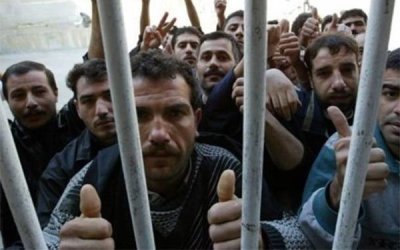
Report: 90% of Palestinian prisoners suffer continuous, systematic torture in Israeli jails
MEMO | June 26, 2015
As many as 90 per cent of Palestinian prisoners have been subjected to various types of torture and abuse in Israeli jails, a report revealed yesterday.
The report by the Palestinian Committee for Prisoners’ and Ex-Prisoners Affairs, which came on the occasion of the International Day in Support of Victims of Torture, highlighted the increasing practice of torture against Palestinian prisoners after the kidnapping of three settlers in June 2014.
According to the report, torture is systematically practiced by the Israeli Security Agency, Shin Bet, under legal cover from the Israeli government, the Israeli Legal Counsel and the Supreme Court who allow investigators to use violence and internationally prohibited means during interrogations under the pretext that the detainees pose a “security risk for the state of Israel”.
The Committee’s report points out that Israel’s use of torture is considered a war crime according to the Geneva Convention and the International Criminal Court, however the Israeli penal code gives immunity for Shin Bet interrogators.
Earlier this week, the Israeli Knesset extended a law which allowed security officials not to record the interrogation of detainees held on security charges, which many believe leaves them open to being tortured and forced to confession under duress.
The report said the Israeli intelligence used brutal and immoral methods of torture during interrogations including: severe beatings, insults and curses, isolation in solitary confinement, no access to lawyers, arrest of family members as a means of pressure, sexual harassment, sleep deprivation, violent shaking, electric shocks and stress amongst others.
According to the report, the percentage of complaints on the use of torture increased after mid-2014 to reach twice the number documented in 2013.
Human rights organisations point out that as many as 850 complaints were filed by Palestinian prisoners against the practice of torture; however the cases were rejected by the Israeli judiciary.
Israel’s Civil Wrongs Law passed on 23 July 2012 prevents Palestinian victims from filing complaints against Israeli officials who committed crimes including torture against them.
Israel deports Turkish journalists and activists after hours-long detention

Turkish ‘Ulke TV’ Editor-in-Chief Hasan Ozturk (L) and Journalist Halime Kokce (R) from Star Newspaper speak to media as they arrived with the group of Turkish citizens who were deported from Israel, at Ataturk International Airport on June 26, 2015
MEMO | June 26, 2015
Israel has deported nine Turkish citizens, including journalists and activists, after holding them for over six hours at Israel’s Ben Gurion International Airport on Thursday.Ulke TV Editor-in-Chief Hasan Ozturk, Ozden Ayvaz and Huseyin Gunay from TRT News, Halime Kokce from Star Newspaper, Memur-sen vice chairman Levent Uslu and four activists – Kemal Ozdal, Durdane Ozdal, Fatih Bolcan and Sumeyra Bolcan – were detained at the airport.
“We are under detention for six hours at the Ben Gurion Airport with a group of journalists and activists. They questioned us individually,” Kokce wrote on Twitter.
She said in another tweet that Israeli officials confiscated the group’s cell-phones and quizzed them on their WhatsApp conversations and contacts.
In a final tweet, Kokce said the group had been informed they were being deported, and had been banned from entering Israel for ten years.
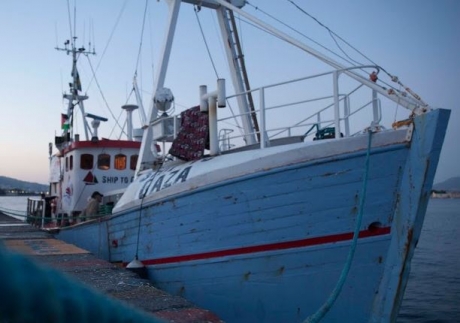
Gaza flotilla ship ‘sabotaged’ days before expected arrival
Ma’an – June 25, 2015
BETHLEHEM – One of the ships taking part in a flotilla headed towards the Gaza Strip was sabotaged south of Crete, an activist aboard one of the ships said Thursday.
Israeli-born Swedish activist Dror Feiler told Nazareth-based al-Shams radio that the ship had been sabotaged by professionals, and would have sunk if sailed at sea.
“Somebody went underneath the ship at night and sabotaged its propellers, just like they sabotaged the same ship in 2011,” Fieler said referring to similar damage that was inflicted upon a ship participating in a previous flotilla.
Feiler, who relinquished his Israeli citizenship after moving to Sweden, boarded the trawler Marianne of Gothenburg in Sweden with 18 other activists six weeks ago. The crew had refrained from stopping at European ports prior to avoid being held by authorities, but their trip was cut short after realizing that they might have drowned had they continued.
Despite the sabotage, the remainder of the flotilla convoy will move as planned with the ships expected arrive in Gaza in succession within three days, Feiler said.
The flotilla is the third of it’s kind to attempt to access the Gaza Strip by sea since 2010, aiming break the nearly nine-year Israeli blockade causing what is termed by rights organizations as a humanitarian crisis for the strip’s 1.8 million residents.
In May 2010, Israeli forces staged a raid on a six-ship flotilla which ended in bloodshed, claiming the lives of 10 Turkish rights activists and sparked a crisis with Ankara.
The participation in this year’s flotilla of Palestinian Knesset member Bassel Ghattas sparked an outcry among right wing members of the Knesset, Israel’s parliament, who called for Ghattas to be stripped of immunity from prosecution for joining.
Similar response was given to Palestinian MK Hanin Zoabi who took part in the 2010 flotilla, when Israeli minister Miri Regev accused Zoabi for “joining terrorists.”
Israeli leaders say that joining efforts to break the Israeli military blockade of Gaza is directly working against the security of Israel.
“It is the gravest thing possible that an Israeli MP would join the flotilla whose aim is to help the Hamas terror organisation,” said Israeli Immigration Minister Zeev Elkin from the ruling right-wing Likud party earlier this week.
Ghattas will be joined by the former Tunisian president, European lawmakers, and activists in what the Freedom Flotilla Coalition described as “a peaceful, nonviolent action to break the illegal and inhumane blockade of the Gaza Strip.”
Foreign investments in Israel cut by half in 2014
Palestine Information Center – June 25, 2015
NAZARETH – Foreign direct investment (FDI) in Israel dropped by nearly 50% in 2014 compared to 2013, a report by the United Nations Conference on Trade and Development (UNCTAD) reveals.
The report tracks a sharp decrease in percentages of foreign investments in Israel. In 2014 $6.4 billion were invested in Israel, whereas in 2013 $11.8 billion were invested – a decline of about 46%.
Moreover, Israeli FDI investments abroad also decreased from $4.67 billion in 2013 to $3.97 billion, a decrease of 15%. These figures are significantly lower than the corresponding figures from 2007 to 2005, before the outbreak of the financial crisis in 2008.
“We believe that what led to the drop in investment in Israel are Operation Protective Edge [in reference to Israel’s military aggression on blockaded Gaza] and the boycotts Israel is facing,” Roni Manos of the College of Management and one of the authors of the report’s summary told Ynet.
According to Manos, there is another reason for the decline.
“In the past there were large transactions such as Waze and ISCAR Metalworking which boosted investment, but over the past year there were not enough such deals.”
According to the UN report, world FDI investments during the past year amounted to only $1.23 trillion, a 16% drop compared to 2013 ($1.47 trillion dollars).
The main reason for this, according to the report’s authors, is weak global economic growth and uncertainty regarding economic and business policy in many countries, which deterred many investors. Among others, the uncertainty due to the rate of quantitative easing in the US and Europe, the Greek debt crisis and its impact on stability in the Eurozone, and the pace of economic growth in China.
Other factors influencing the decline in global FDI were geopolitical risks such as the conflict in Ukraine, which has calmed down in recent months, the worsening of relations between the West and Russia, and revolutions and regime changes in several countries in the Middle East.
US Senate votes to prevent boycotting Israel
Press TV | June 25, 2015
The US Senate has passed a controversial trade bill that contains provisions opposing the growing international boycott movement against Israel.
The Senate passed the measure as part of the Trade Promotion Authority legislation. The legislation was already passed by the House of Representatives and can now be signed into law by President Barack Obama.
The bill was passed under massive pressure from the powerful pro-Israel lobby in the United States.
The provisions require US negotiators to oppose the Boycott, Divestment and Sanctions (BDS) movement against Israel during the ongoing free trade negotiations with the European Union.
The BDS campaign seeks to increase economic and political pressure on Israel until the regime ends the occupation and colonization of Palestinian lands and respect the right of return of Palestinian refugees.
“Today, for the first time in nearly four decades, Congress sent legislation to the president’s desk to combat efforts to isolate and delegitimize the ‘state’ of Israel,” US Representative Peter Roskam wrote in a statement released shortly after the Senate vote.
“After today, discouraging economic warfare against Israel will be central to our free trade negotiations with the European Union,” said Roskam, one of the lawmakers who sponsored the provisions.
This comes as several groups and organizations in the European states have already supported the campaign against Israel.
The boycott campaign against Israel began in July 2005 by 171 Palestinian organizations, calling for “various forms of boycott against Israel until it meets its obligations under international law.”
In 2013, two US academic groups — the American Studies Association and the Association for Asian American Studies — supported the boycott.
Palestine to submit hundreds of documents to ICC for 1st time
Ma’an – June 25, 2015
BETHLEHEM – Palestinian Authority foreign minister Riyad al-Maliki is scheduled to make the State of Palestine’s first submission to the International Criminal Court in the Hague on Thursday in pursuit of war crime charges against Israel.
The PA foreign minister and a high-profile delegation are expected to arrive at the office of the prosecutor of the ICC at 3 p.m. and will deliver hundreds of pages of documents describing in detail Israeli breaches of international law, Palestinian ambassador to the Netherlands Nabil Abu Zneid told Ma’an.
“It will take the ICC a long time to take action, possibly 5-10 years as this is one out of a hundred steps,” Abu Zneid said.
The PLO will continue to collate information and testimonies to later be submitted to the ICC as evidence of Israeli crimes.
The report due to be submitted Thursday was prepared by a 45-member committee appointed by President Mahmoud Abbas in February and chaired by PLO negotiator Saeb Erekat.
The Higher National Committee includes PLO Executive Committee Members, political parties, security forces, unions, ministries and senior Hamas official in Gaza Ghazi Hamid.
A team led by five senior international lawyers commissioned by the PA guided the drafting of the report.
Committee member Mustafa Barghouthi, secretary-general of the Palestinian National Initiative, told Ma’an that Thursday is just the first step in removing Israel’s immunity for violations of international humanitarian law.
The documents will include violations committed by Israel from June 13, 2014 to May 31, 2015 in the occupied West Bank, East Jerusalem and Gaza Strip.
Among the specific cases is the mass Israeli crackdown on the Hebron district in 2014, the war on Gaza last summer, and ongoing settlement activities and crimes against Palestinian prisoners, including administrative detention.
“Our goal is to prove that crimes were committed so as to convince the general prosecutor to start investigations,” Barghouthi said.
“We are also seeking to remove the immunity of Israel and its leaders as we seek to reach justice, protect the Palestinian people and make sure criminals do not avoid punishment.”
Such achievements will strengthen international solidarity with the Palestinian people, including the BDS movement, he added.
On Monday, a UN Commission of Inquiry on the 2014 Gaza conflict announced it had gathered “credible allegations” that both sides had committed war crimes during the conflict, which killed more than 2,140 Palestinians, most of them civilians, and 73 people on the Israeli side, mostly soldiers.
The PLO has been seeking to open criminal proceedings against Israel at the ICC as part of an increased focus on diplomatic maneuvering and appeals to international bodies.
Israel backs bill to allow secret police interrogations to continue
MEMO | June 24, 2015
The Israeli Knesset is to extend a temporary bill that permits police interrogators not to use audio or video recordings to document interrogations of people suspected of security offences, Arab48.com reported yesterday.
The Legal Centre for Arab Minority Rights in Israel (Adalah) condemned the measure and sent a letter to the Israeli Public Prosecutor and the government’s Judicial Advisor demanding they appeal against the bill.
“This amounts to severe violation of basic prisoners’ rights, including the legal right to remain dignified and have just judicial measures,” Adalah said. “Extending this bill clearly undermines any opportunity to monitor the legality of interrogation measures and confessions raised to the court.”
The Israeli Knesset approved a bill in 2002 demanding security services document the questioning of any prisoner who may get more than ten years in prison for his crimes. The bill included an article which made such documentation unnecessary in cases of security-related offences.
According to Adalah, this article was a temporary measure agreed to remain in place for six years. In 2008, the Knesset extended it until 2012 and then it was extended to 2015. Adalah said Palestinian prisoners are affected most by this article.
Israel issues 30 administrative detention orders during June
Palestine Information Center – June 24, 2015
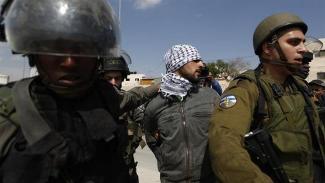 AL-KHALIL – Israeli courts issued, since the beginning of June, 30 administrative detention orders against Palestinian prisoners from al-Khalil, Prisoners Media Center said.
The center stated that 43% of administrative detainees held currently without charge or trial in Israeli jails are from al-Khalil.
As a whole, there are 450 administrative detainees in Israeli jails including four MPs.
The center pointed out that Israeli administrative detention policy mainly targets youth activists, students, MPs, and prisoners’ defenders as an attempt to prevent them from exposing the reported Israeli human rights violations.
Featured Video
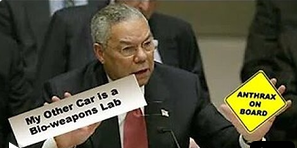
From Anthrax to Iraq
or go to
Aletho News Archives – Video-Images
Book Review
New paperback: Butchered by “Healthcare”
Lies are Unbekoming | October 20, 2026
 Butchered by “Healthcare” is Robert Yoho’s plain-spoken account of how American medicine stopped being a profession and became an industry. 341 pages. Over a thousand references. Thirty-eight chapters.
“Screening Tests Are Useless”, on tests that find diseases that would never have hurt you. “The FDA Protects the Big Drug Companies”, on an agency funded by the companies it regulates. “The Journals’ Sins Are the Editors’ Sins”, on ghostwritten studies and captured peer review. “Opioids and ‘Pain Management’”, on how a generation was prescribed its way into addiction. “Prozac and Relatives” and “Antipsychotics Are Disastrous”, on what psychiatry does to adults and children. “Surgery: Money Before Patients”. “Failed Cancer Treatments”. “Futile CPR and Overprescribing”. “Billing Scams & Specialty Warfare”. “Hospitals Are Sharks”. Each with a Patient Tips section at the end on how to survive it.
If you have ever walked out of a doctor’s office with a prescription you didn’t ask for, or watched a parent put through a treatment that made them worse, this is the book you want on your shelf before the next appointment. … Full review
Butchered by “Healthcare” is available on Lulu now.
Blog Roll
 Aletho News
- Iran: US political targets legitimate if assassinations return
- Iraq shuts key border crossing with Iran under US pressure: Report
- Undersea Internet cables could be targeted in retaliation for attacks on Iran: IRGC deputy chief
- EU sending ‘biased’ observers to interfere in Serbian election – president
- White House envoy declares kinetic action against Yemen ‘fruitless’
- Ukraine deployed thousands of microdrones in Iraqi Kurdistan: Tasnim
- Iran calls for emergency UNSC meeting over Trump’s ‘brazen’ bomb talk, Israeli threats
- Iranian sources reveal details of Russia-China Hormuz proposal
- Plan for more US-Israel integration puts our military tech at risk
- Another Round Against Iran Will Break What Is Left of the Gulf
- If Americans Knew
- Americans at National Conservatism Conference held in Israel this year criticize Israel
- Christiane Amanpour exits CNN with a legacy shaped by the debate over Israel
- Israel’s war on Iran is the final move in a decades-old strategy
- Israel Denies Entry to French Journalist, U.S. Researcher Amid Rise in Entry Denials
- Gaza’s hospitals are running out of life-saving fuel – Daily Update
- Mysterious bot accounts reportedly spread fake ‘man on the street’ videos for Michigan Senate candidate
- Israeli Defense Minister Katz Says Over 60 Lebanon Villages Have Been Destroyed
- Why Is Israel Running TV Ads in Iowa Ahead of the Midterms?
- Hind Rajab’s Alleged Killer Is in the United States. HRF Demands His Arrest.
- US Officials Face Fresh Pressure After Another American ‘Brutalized’ by Israeli Settlers in West Bank
- No Tricks Zone
- E-Cars Reduce CO2 Emissions By Only 41% Compared To Internal Combustion Engine Vehicles
- Predictions Made By Renowned Climate Professor Over Past Decades Have Been Proven To Be Poor
- New Study Suggests Large Regions Of The Pacific Ocean Have Been Cooling For The Last 80 Years
- Germany’s Green Energy Debacle: High Energy Costs Force Kahla Porzellan to Close After 182 Years!
- New Study: 50 Years Of The Most Aggressive ‘Net Zero’ Policies Can Only Affect The Global Climate By 0.03°C
- US September “Heat” Was No Record…Many Records Set Decades Ago
- Latest European Green Energy Debacle; Portugal’s Largest Flagship Solar Park Insolvent!
- Green Energy Debacle: German Expert Professor Fritz Vahrenholt Warns Of Severe Economic And Social Consequences
- Two More Paleo Reconstructions Affirm Meters-Higher Sea Levels Across Ireland, Brazil 7000-6000 Years Ago
- New Study: Earth And Venus Surface Warmth Largely Explained By Convection And Lapse Rate, Not CO2 Or Radiation

