What’s Really at Stake in the Impasse Over Centrifuges
Hillary Mann Leverett on the Iran Nuclear Talks
Earlier this week, Hillary appeared on CCTV’s The Heat to discuss the Iran nuclear talks; click on video above or see here. In her segment, she focused on what really drives the divide between Tehran and the Western members of the P5+1 (the United States, Britain, and France) over Iranian enrichment—namely, the clash between the Islamic Republic’s commitment to strategic independence and Western powers’ determination that Tehran must accept their directives regarding implementation of the Nuclear Non-Proliferation Treaty (NPT) and the dynamics of Middle Eastern power politics. As Hillary notes,
“There has been progress on some significant issues—but this fundamental issue about enrichment is critically important. It gets to not just the number of centrifuges…The issue is really a question of independence.
Iran is fiercely devoted to its independence. That’s what the Islamic Revolution was all about—for Iran to be independent of foreign powers—and it wants this civilian nuclear program as part of its program for independence. So it needs to not dismantle any of its current infrastructure—which includes about 10,000 operating centrifuges—and to increase it, to a have full-fledged civilian nuclear power program.
The United States wants just the opposite. The United States has finally come around, after more than ten years of pounding its fist on the table, to admitting that maybe Iran could have a symbolic program—but that Iran needs to remain dependent on other countries…Not only does this go against the very principles of the revolution in Iran, for independence, but, in fact, Iran tried that. They bought fuel from Argentina, until the United States got angry and forced Argentina to cut it off. And they were part of a project called Eurodif, where Iran bought ten percent of that project, and then they were cut off.
So that’s the fundamental divide—whether to keep Iran dependent on the international community, or to allow them to be independent. That is going to be a very difficult bridge to cross…It’s not a matter of time; it’s a matter of mentality.”
Of course, official Washington’s hegemonic mentality—and its accompanying pretensions—are increasingly at odds with the actual distribution of power in an evolving international order. In part, this reflects the declining utility of America’s military might; to paraphrase a line from that timeless study in the exercise of power (and classic Hollywood blockbuster film), The Godfather, “the United States doesn’t even have that kind of muscle anymore—and can’t really use that much of what it still has.” As Hillary elaborates, that’s an important reason the United States is negotiating, however reluctantly, with Iran:
“It’s interesting that President Obama has refrained…since January of this year, from saying that all options are on the table, for two reasons. One, I think, in terms of allowing the negotiations to go forward, is to take the military option off the table as an offensive rhetorical device against the Iranians.
But part of this is real. This is something that, from all my trips to Iran, I understood. The Supreme Leader there, security and political analysts there, realized a few years ago that after America’s failed interventions in Iraq, Afghanistan, Libya, and Syria, we don’t have the military option on the table, and that gives room for negotiations.
So, even though I’m not optimistic there’s going to be a deal, a comprehensive deal either today or in four months (the new deadline), I do think that there’s enough incentive on both sides to continue negotiations for a very long time. And you may see in September, when the United Nations convenes in New York, you may see not only continued intensive negotiations of high-level officials, but potentially even a President Obama-President Rohani meeting—not to actually seal the deal, but to inject enough momentum to keep things going past the November congressional elections and continue to kick this can down the road.”
Hillary is similarly skeptical about the prospects for a unilateral Israeli attack against Iran:
“Even though a tragically high number of Palestinians have been killed in this current conflict [in Gaza], there is a bit of exposure of the emperor wearing no clothes, that the Israelis are not able to defeat HAMAS in Gaza. And the Iranians certainly see the Israelis having no clothes, that they don’t have the technical capability to bomb Iran’s nuclear facilities. With that, there is, again, more time for negotiations.”
Beyond the purely military dimension of America’s relative decline, the rising influence of non-Western powers—China, Russia, and, in the Middle East itself, Iran—has also helped push the United States into multilateral nuclear talks with the Islamic Republic. As Hillary explains, that’s an important reason the P5+1 is negotiating with Iran:
“The world has changed in the past ten years. Ten years ago, when the United States would say that the U.S., Israel, France, and Britain were ‘the international community,’ nobody really made that much noise. Today, they do. So today, the United States has to take the views of, particularly, Russia and China very squarely into account. They have to be at the table, and they have to buy into what the political and security order is going to look like in the Middle East—not just how many centrifuges Iran is going to have. That’s why we have the negotiations.”
Yet, even though it has been pushed into multilateral nuclear negotiations with Iran, the United States continues to take hegemonically assertive positions in the talks. Take Washington’s positions on the duration of a prospective final agreement, the number of centrifuges Iran should be “allowed” to operate under a final agreement, and limiting Iran’s alleged “breakout” capability. As Hillary describes,
“The United States wants at least a ten-year, and they’re gunning really for a twenty-year deal. That has nothing to do with proliferation. That has to do with their wanting to outwait the Supreme Leader, the Supreme Leader’s life…so that the Islamic Republic has, in their view, a prospect of collapsing into a more pro-American political order.
The Iranians are not buying into that…they’re focused more on what their practical needs are, based on when they have contracts or prospective contracts for nuclear plants, when they need the fuel, and how much fuel they need.
That gets into the number of centrifuges—and, again, this is where the Supreme Leader has spoken about numbers that are much greater than the Americans are willing to consider at this point. But he’s focused on what are the practical needs—the practical needs as told to him by the head of Iran’s atomic energy agency, who (guess what) has his Ph.D. from MIT here in the United States, and who knows what he’s doing.
So [the Iranians] are really talking about a practical needs-based approach, based on a sovereign country pursuing a technical, practical program. The United States is focused on power and influence, and on maintaining a pro-American political and security order in the Middle East…
The so-called ‘breakout issue’ is also a lot of smoke and mirrors. Again, it’s aimed at limiting Iran’s domestic, indigenous, sovereign capacity to pursue this program.
If the United States and its so-called partners were really interested in proliferation, they would accept the Iranian deal, which is to convert all—not some, but all—their enriched uranium into oxide, into powder to make into fuel. All of it. You’d solve the proliferation issue overnight, but the United States isn’t interested in that…We’re interested in constraining capacity, to constrain Iran’s power—its rising power, particularly in the Middle East—at a very volatile time for the United States.”
Hillary goes on to discuss the strategic imperative for the United States to pursue “Nixon-to-China”-style rapprochement with the Islamic Republic—and, in the process, “to change America’s strategy from one of dominance and hegemony in the Middle East to one that is a balance of power, that recognizes and deals with all the critical powers as they are, not as we would like to transform the Middle East.”
–Flynt Leverett and Hillary Mann Leverett
Mystery Surrounds U.S. Justice Department Move to Wrap Anti-Iran Group in Shroud of Secrecy
By Noel Brinkerhoff and Steve Straehley | AllGov | July 30, 2014
The U.S. Department of Justice has drawn attention to itself for helping an organization opposed to Iran maintain secrecy of its records, which are caught up in a defamation lawsuit filed against the group.
United Against Nuclear Iran (UANI) was founded six years ago and is operated by and gets advice from a who’s who list of American and foreign politicos, including former U.S. Senator Joseph Lieberman; Frances Townsend, the former homeland security adviser to President George W. Bush; Dennis Ross, a former Middle East adviser to both Republican and Democratic presidents; plus former intelligence chiefs from Israel, Germany and Britain.
Victor Restis, a Greek shipping magnate accused by UANI of violating sanctions by doing business with Iran, filed a defamation suit against the group. Restis’ lawyers have sought to compel UANI to release information about its donors and other details.
But the Justice Department stepped in and asked a federal judge to block the request, claiming the records contain sensitive information that the government considers important. Federal attorneys insisted “that certain information” would jeopardize law enforcement investigations, expose investigative techniques or identify confidential sources if released, according to The New York Times.
U.S. District Judge Edgardo Ramos in New York City granted the government’s request, while also describing the U.S. government’s involvement as “very curious.” The Justice Department has until July 31 to claim law enforcement privilege and keep the information from being disclosed permanently. In the meantime, each side has hurled charges and countercharges at the other.
“I am particularly concerned,” Ramos said in April, “that the defendants are able to utilize certain information in its public statements, and then not have to answer to their actions on the basis of a privilege.”
The claim of privilege puts the Justice Department in a conundrum. Federal intelligence agencies are not supposed to work with outside agencies to influence U.S. public opinion. But if UANI hasn’t been working with the government, what information could it have that would be so sensitive? We might find out on Thursday.
Gaza Ministry of Health: Israeli attack on crowded market during ceasefire is ‘barbarity personified’
Gaza Ministry of Health | July 30, 2014
Gaza, Occupied Palestine – Ministry of Health Gaza is outraged at the Israeli massacre perpetrated during the so-called humanitarian ceasefire, when F-16s fired missiles into the crowded Shujeiyah market as hundreds took advantage of the lull to buy food and supplies.
At least 17 people have been killed and 200 injured.
“This atrocity is barbarity personified,” said Director General, Ministry of Health Dr Medhat Abbas.
Not satisfied with exterminating entire families in their own homes, not satisfied with killing people praying in mosques, not satisfied with killing patients, staff and visitors in hospitals, not satisfied with killing ambulance drivers as they retrieve the dead and injured, not satisfied with killing women and children sheltering in UNRWA school, the Israeli death machine now blatantly attacks a crowded public market DURING a humanitarian ceasefire, in an unrivaled cruel and cynical exercise of savagery and barbarism.
The Ministry of Health Gaza condemns this latest atrocity in the strongest possible terms, and considers that any further prevarication by the international community can only be seen as complicity in the increasingly barbaric and clearly genocidal war crimes being visited on the citizenry of Gaza.
The Ministry demands immediate international intervention to bring the rogue ‘state’ of Israel under control, and an immediate end to its carnage in Gaza.
Zionism’s Prior Condition: Propaganda
By Nima Shirazi | Wide Asleep in America | July 29, 2014
“Propaganda by its very nature is an enterprise for perverting the significance of events and of insinuating false intentions…The propagandist will not accuse the enemy of just any misdeed; he will accuse him of the very intention that he himself has and of trying to commit the very crime that he himself is about to commit. He who wants to provoke a war not only proclaims his own peaceful intentions but also accuses the other party of provocation.” – Jacques Ellul, Propaganda: The Formation of Men’s Attitudes, 1965
As Israeli war crimes continue unabated – at the time of this writing, nearly 1100 human beings in the besieged Gaza Strip, the vast majority of whom are civilians, have already been slaughtered by their occupiers; over 6,200 have been wounded – Israeli lies too keep piling up.
Despite what Israeli spokespeople and their dutiful, compliant, and prostrate puppets in the media continue to claim, Hamas was not responsible for the abduction and murder of three Israeli teenagers last month. Hamas did not break the 2012 ceasefire, Israel did. Hamas is not forcing Palestinians to act as “human shields.” Israel is not acting in self-defense when it bombs hospitals, schools, ambulances, mosques, homes, refugee camps, parks, or a zoo. The “terror tunnels” which Israel apparently needs to murder hundreds and hundreds of men, women, and children in order to destroy pose essentially no threat whatsoever to Israeli civilians. The list goes on and on.
Israel’s ongoing massacre cannot continue without a steady barrage of hasbara – what Zionists, in their Orwellian glory, refer to as “public diplomacy,” but which is merely propaganda to justify the indefensible, inexcusable, and unspeakable. That is, the promotion of a 19th century, colonial European ideology of ethnic, religious, and racial superiority, imposed upon an indigenous population through military conquest and a campaign of ethnic cleansing, displacement, dispossession, disenfranchisement, and discrimination.
And yet, though mainstream media outlets are suffused with pro-Israel bias and Israel has legions of willing propagandists trolling the internet to spread Netanyahu’s latest talking points, we have heard – especially as the Palestinian death toll keeps rising – that Israel and its advocates are “losing the media war.” Politico, Mashable, New York Magazine, analyst Juan Cole, and Britain’s Channel 4 have all noted this.
Even the Telegraph‘s detestable, neoconservative “Defence Editor” Con Coughlin is worried for Israel’s image, writing that, “with so much focus on the Palestinian victims of this dreadful conflict, it is hard to see how Israel can turn the propaganda war around in its favour.” Coughlin laments, “I fear the answer is that it cannot.”
Similarly, in a conversation via Twitter with a spokesman at the Israeli Embassy, Washington Post White House correspondent Scott Wilson was fretful that the Israeli slaughter in Gaza might not be “good for Israel – strategically.” For Wilson, as for so many others, Israeli war crimes and crimes against humanity are simply image problems, a matter of PR.
Without its propaganda, Israel cannot sustain the support of its benefactors, whether in the war chests of Congress or the war cries of brainwashed and bloodthirsty communities. Without its lies, Israel can’t survive. This fact is known not only to professional hasbarists like Michael Oren, Dore Gold, and Mark Regev, but – more importantly – is a vital feature of Zionism, inseparable from the ideology itself.

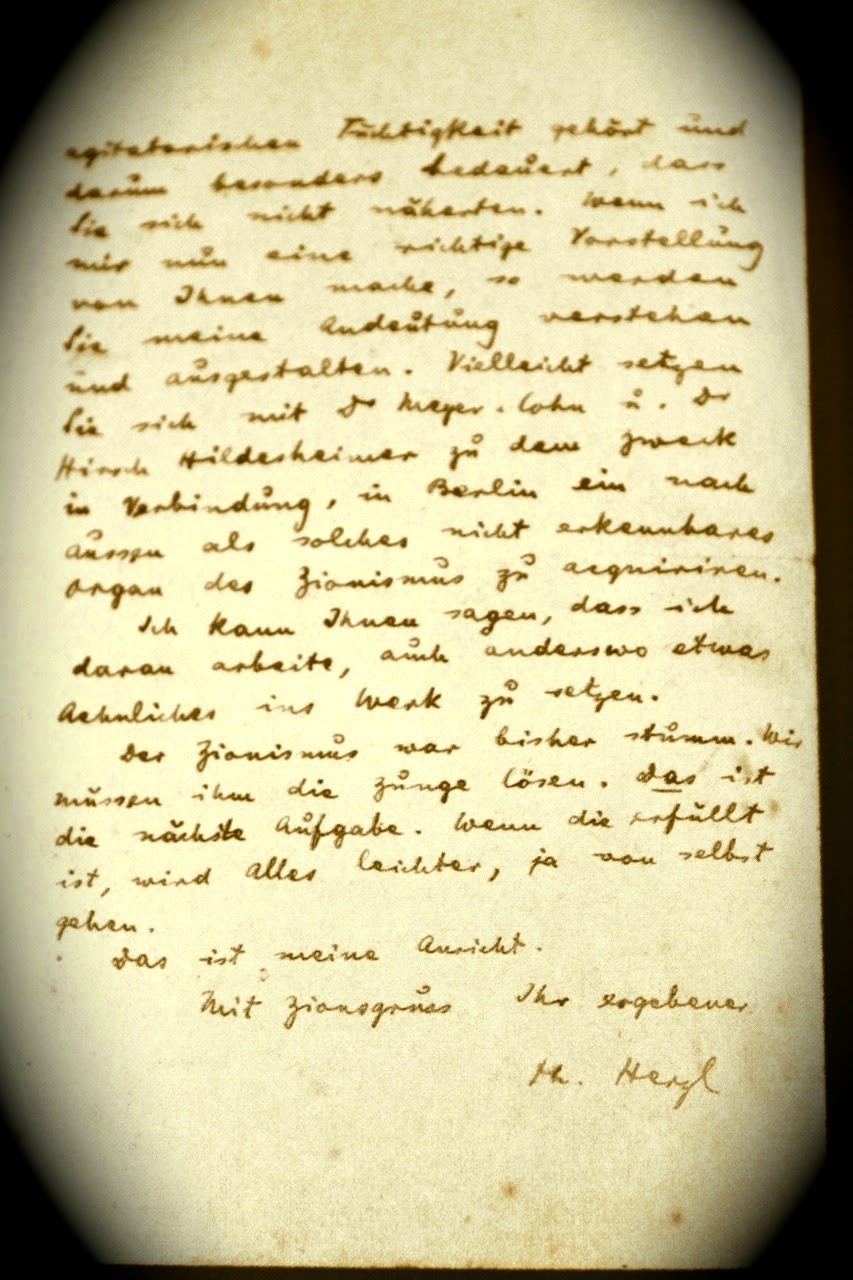
In a little known and rarely-referenced letter written in early 1897, Theodor Herzl, the ostensible founder of political Zionism, made this perfectly clear. During the planning stages of the First Zionist Congress – initially to take place in Munich but eventually held in Basel, Switzerland in late August 1897 – Herzl contacted Willy Bambus, leader of the Berlin Hovevei Zion society (an early Zionist organization committed to Jewish immigration and agricultural settlement in Palestine), for support.
“I want to reach an understanding with the Berlin Zionists,” Herzl wrote from Vienna on January 26, 1897. “[I]n the general Zionist conference that I am planning for next summer, we will grow closer to each other.” The letter is written in German, Herzl’s first language.
Herzl’s dream was big and he knew what he needed to achieve it:
But a project of this sort… has one prior condition: propaganda. First we must have propaganda and afterward establish economic projects… [T]ry to win influence at a Berlin daily newspaper… There is no necessity to immediately give the newspaper a Zionist imprint. On the contrary, because of the cowardly suspicions (to my sorrow, of most of the Jews) of Zionism, it would be wiser to keep things innocent… Perhaps you can… purchase a Zionist paper in Berlin, that will not be outwardly noticed as such.
Friendly media coverage? Feigned innocence and impartiality? Sounds familiar.
“Until now Zionism has been silent,” Herzl wrote Bambus. “We must free its tongue. This is the first order of business.”
Those tongues of Zionism have since wrought over a century of pain and suffering, in name the entitlement and privilege, to the people of Palestine. It is time to drown out the propaganda with truth.
Israeli bombing of Shujaiyya market kills 17 despite ceasefire
Ma’an – 30/07/2014
BETHLEHEM – Despite a four-hour humanitarian ceasefire that began at 3:00 p.m., Israeli forces on Wednesday afternoon shelled a market in Shujaiyya as well as number of homes across the Gaza Strip, killing at least 33.
Gaza Ministry of Health spokesman Ashraf al-Qidra said around 6 p.m. that an Israeli airstrike had hit Shujaiyya market, killing at least 17, including a journalist, and injuring 200, including many seriously.
A Ma’an reporter on the scene said that Israeli artillery had fired several shells at civilians in the market, adding that ambulances and civilian vehicles were still transporting the wounded and the killed to al-Shifa Hospital.
The Ministry of Health in Gaza said that the dead include a journalist and two paramedics, as well as a member of the civil defense crews.
Sources named the journalist as Rami Ryan, a photographer for the Palestinian Network for Journalism and Media.
Bodies were still being pulled from the rubble, with medics estimating that dozens had been killed and injured.
That attack brought the toll since the ceasefire to at least 29, with 12 killed earlier including Muhammad Wissam Dardona, Hussam al-Najjas, Hussam Muhammad al-Najjar, Shaaban Abdulaziz al-Jamal and Alaa Judi Khader.
Four were killed in shelling on a home in al-Qarara in Khan Younis.
Strikes were reported in Juhr al-Dik, al-Bureij, Deir al-Balah, and many other districts across Gaza.
One airstrike hit the al-Basha building in Gaza, which houses a number of press offices.
The Israeli military said, meanwhile, that during the unilaterally-declared ceasefire Hamas had fired 26 rockets into Israel. No damage or injuries were reported.
The violations of the ceasefire brought the day’s total Palestinian deaths to 103, as the total Palestinian death toll in the 23-day offensive hit 1,325 with more than 7,000 injured.
Yoav Mordechai, Israel’s coordinator of government activities in the Palestinian Territories, said earlier that Israeli forces would stop attacks for four hours starting at 3 p.m.
Mordechai said Israeli forces would only target areas where rockets were being fired at Israel.
An Israeli army statement added that the “humanitarian window will not apply to the areas in which (army) soldiers are currently operating.”
“Residents must not return to areas that have previously been asked to evacuate,” the statement said, adding the the army would respond to all fire from Palestinian militants throughout the limited ceasefire.
It was not immediately clear whether Palestinian factions would respect the limited, brief truce.
Hamas spokesman Sami Abu Zuhri said that Israel imposed the ceasefire only for “media consumption.”
Abu Zohri said the truce was “worthless” given that it excluded parts of the Gaza Strip where Israeli forces were operating.
Earlier in the day, Israeli forces killed over 70 Palestinians, bringing the total number of Gazans killed since the beginning of the offensive up past 1,300.
The deadliest Israeli attack on Wednesday was a shelling on a UN-designated shelter in Jabaliya refugee camp which left at least 16 dead.
Chris Gunness, the spokesman for the UN’s Palestinian refugee agency, condemned the attack in a statement made on Twitter.
“UNRWA condemns in the strongest possible terms this serious violation of international law by Israeli forces,” Gunness said.
“Precise location of Jabalia Elementary Girls School #Gaza & that it housed 3,000 displaced was communicated to Israeli army 17 times,” he said in another tweet.
Israeli forces abduct shepherd, goats from southern Lebanon
Al-Akhbar | July 30, 2014
Israeli occupation forces snuck into Lebanon and abducted a shepherd from the southeastern town of Shebaa at dawn Wednesday, one day after they stole a herd of goats from the same area, state media reported.
Ismail Khalil Nabaa was kidnapped in Shebaa and taken to the nearby occupied Shebaa Farms area.
UNIFIL is working to secure his release, Lebanon’s National News Agency (NNA ) said.
The owners of the kidnapped herd, Mohammed Khalil Nabaa and Khodour Hamdan, said they had escaped an Israeli ambush on Lebanese territory on Tuesday.
The report did not speculate over why Israeli forces kidnapped the goats and shepherd.
MP Qassem Hashem called Nabaa’s kidnapping a violation of national sovereignty and international charters, NNA reported.
“The Zionist enemy continues its aggression, abducts Lebanese shepherds and seizes their flocks. The UNIFIL must fully perform its duty,” the NNA quoted him as saying.
Gaza: Black sky turns orange
By Charlie Andreasson | International Solidarity Movement | July 30, 2014
Since July 25th, international volunteers, including activists from the International Solidarity Movement (ISM) and other groups have begun a constant protective presence in various locations at the al-Shifa Hospital. Below is a journal extract from an ISM volunteer during his shift at the hospital on July 28th.
Gaza, Occupied Palestine – There had been shelling during my shift in al-Shifa. My shift began at 7PM, and in the distance I registered the sounds as everybody else does here in Gaza, I heard the drones without trying to see them. I left Joe [another ISM activist] alone in the hospital; I went in a car for an interview and came back again. The shelling from the sea grew closer. But I couldn’t stay awake for 24 hours just to listen to the noise, nobody can, and I tried to sleep for a few hours.

Then the thunder started, and the black sky turned bright orange, the hospital shook a little, and some windows shattered. I send a short text to the media coordinator for the Ship to Gaza-Sweden saying that this is following me, thinking about el-Wafa hospital, Beit Hanoun hospital, and now al-Shifa. But we weren’t hit. Not this time.


The morning came, we were released by the next shift, and I passed some of the nights targets on my way home. I took a few photos and carried on. There’s so much destruction now that I hesitate to take any more pictures of it. In some areas it is now rare to see an undestroyed building. But of course they claim all of this is to create silence and ‘security’ for Israel, seeing the destruction left behind, I don’t think so.


Photos by Charlie Andreasson
UNRWA condemns school shelling in ‘strongest possible terms’
Ma’an – July 30, 2014
GAZA CITY – The UN agency for Palestinian refugees on Wednesday condemned an Israeli attack on one of its schools used to house thousands of internally displaced Gazans earlier the same day.
“Last night, children were killed as they slept next to their parents on the floor of a classroom in a UN designated shelter in Gaza,” UNRWA’s Commissioner-General Pierre Krahenbuhl said in a statement.
“Our initial assessment is that it was Israeli artillery that hit our school, in which 3,300 people had sought refuge. We believe there were at least three impacts,” the statement said.
“The precise location of the Jabalia Elementary Girls School and the fact that it was housing thousands of internally displaced people was communicated to the Israeli army seventeen times … to ensure its protection.”
The statement went on to say that the incident was the sixth time an UNRWA shelter had been struck during Israel’s offensive on Gaza.
“UNRWA condemns in the strongest possible terms this serious violation of international law by Israeli forces,” spokesman Chris Gunness tweeted.
Gaza’s health ministry said earlier that at least 16 people were killed in an Israeli shelling on a UN school in Jabaliya camp. The ministry called on UNRWA to immediately condemn the attack.
An Israeli army spokeswoman told Ma’an later that initial reports suggested Palestinian militants had fired mortar shells at Israeli soldiers from the vicinity of the school.
The Israeli army responded by firing back at the “origins of fire,” the spokeswoman said.
“The incident is still being reviewed,” she added.
Over 70 Palestinians have been killed by Israeli forces so far on the 23rd day of the Israeli offensive, bringing the three-week total above 1,300.
More than 200,000 people, or about one in eight Gazans, have been forced to leave their homes as a result of the assault.
62% of British public says Israel committing war crimes, as polls show sympathy for Palestinians
MEMO | July 30, 2014
Almost two thirds of the British public (62%) believe that the Israeli government is committing war crimes, a new YouGov poll has revealed.
The survey, conducted 27-28 July, comes days after a separate poll carried out on behalf of The Sunday Times showed that 52% of the British public sees Israel’s bombing of the Gaza Strip as “unjustified”. Questioned about their attitude to the conflict more generally, 27% said their sympathies lie more with the Palestinians, while 14% said their sympathies lay more with the Israelis.
Polling data from the U.S. indicates Israel’s growing image problem, even amongst the citizens of its closest ally. A new Pew Research Center poll shows that among 18 to 29-year old Americans, 29% blame Israel more for the current violence, while 21% blame Hamas. Meanwhile, a Gallup poll last week showed that a majority of nonwhite Americans under-50 view Israel’s assault as “unjustified”.
In a CNN poll conducted July 18-20, only 57% of respondents said Israel’s actions in ‘Operation Protective Edge’ are justified.
Meanwhile, a survey of UK Christians commissioned by charity Embrace the Middle East has revealed that 35.4% sympathise more with the Palestinians, while 16.9% sympathise more with Israel. The research was conducted before Israel’s attack on Gaza, which charity head Jeremy Moodey said would likely only increase support for the Palestinians in UK churches.
Israel kills 20 in sixth UNRWA school bombing
Al-Akhbar | July 30, 2014
Updated at 2:41 pm: Israeli bombardments early on Wednesday killed more than 68 Palestinians in Gaza, including at least 20 at a UN school, medics said, on day 23 of the Israeli assault on the besieged enclave.
The deaths brought the Palestinian toll to more than 1,297, according to Gaza’s emergency services spokesman Ashraf al-Qudra’s latest figures. Qudra added that 180 Palestinians were injured on Wednesday, raising the total number of wounded to 7,200.
A shelling shortly after 5:30 am killed some 20 people at the UN school being used as a shelter for those displaced by the war, Qudra said.
An AFP correspondent said that at least one shell had hit the school – the outer wall of the complex was damaged by shellfire. The correspondent said the army had been pounding the area with tank fire for an hour prior to the incident.
Blood splattered floors and mattresses inside classrooms, and some survivors picked through shattered glass and debris for flesh and body parts to bury.
At the edge of the schoolyard, some 20 donkeys lay dead, still tied to a railing.
Displaced Palestinians who had already had to leave their homes quickly gathered belongings and fled the building.
Khalil al-Halabi, director of UNRWA’s northern Gaza operations, said some 3,000 Palestinians were taking refuge in the school, in Jabalia refugee camp, when it came under fire around dawn.
“There were five shells – Israeli tank shells – which struck the people and killed many of them as they slept. Those people came to the school because it is a designated UN shelter,” he said.
Five of the wounded were in critical condition, Halabi said. It was the second time in a week that a UN school sheltering hundreds of homeless Palestinians had been hit.
“I condemn in the strongest possible terms this serious violation of international law by Israeli forces,” said UNRWA commissioner General Pierre Krahenbuhl, saying the school’s location had been communicated to the Israeli army 17 times.
“This is the sixth time that one of our schools has been struck,” he said, indicating some 3,300 people had been sheltering in the school when it was hit.
Abdel-Karim al-Masamha, 27, said he and his family had come to the school after fleeing fighting near their home in the northern Gaza Strip.
“We did not find safety here,” he said. “People were martyred before our eyes. They were dismembered.”
A shelling earlier in the northern Gaza Strip killed an 11-year-old handicapped girl, Qudra said, with a subsequent shelling in the center of the small coastal territory killing a 16-year-old girl.
Five members of the same family in Jabalia were killed in a strike, Gaza officials said.
A strike shortly afterwards in the southern city of Khan Younis killed 10 members of a single family, Qudra said, including one child who could not immediately be identified.
According to Qudra, the victims were all from the Abu Amer family.
A middle-aged man was killed early in the morning in the southern city of Rafah.
Three children were among six people killed in an Israeli tank shelling on Gaza City on Wednesday, medics said.
The attack took place in Tuffah neighborhood in the northeastern part of the city, killing six members of the Al-Khalili family, Qudra said.
Rights groups have expressed alarm at the number of children victims.
The more than 240 Palestinian children who have died represent at least 29 percent of civilian casualties, the United Nations Children’s Fund, UNICEF, said in a statement, adding that another six children in Israel had been wounded from Gaza rocket fire.
“We see children killed, injured, mutilated and burnt, in addition to being terrified to their core. The consequences run much deeper than previous flare-ups” in Gaza, UNICEF’s Gaza field office chief Pernille Ironside said.
UNRWA, the main UN relief agency in Gaza, said it was at “breaking point” with an estimated 240,000 Palestinians having taken shelter in 85 of its schools and buildings following calls by Israel for civilians to evacuate whole neighborhoods before military operations.
On the Israeli side, militant fire, including cross-border rocket fire, has killed 53 Israeli soldiers in addition to two Israeli civilians and a Thai laborer. … Full article
Featured Video

Genocide-linked firm handles Britons’ NHS data
or go to
Aletho News Archives – Video-Images
Book Review
Book review: Boiling Point, How America Brought War to Ukraine
By Tim Kirby | Strategic Culture Foundation | November 14, 2026
Did Vladimir Putin just wake up one day on the wrong side of the bed and decide to invade Ukraine in February of 2022 or is there a lot more to this single decision that has been reshaping the 21st century geopolitical landscape?
Obviously, from the way that I just posed the question you can see that I am on the side that views the causes for the war in Ukraine to be very deep, long-term, historical and consciously nefarious, and most importantly, not from within the halls of the Kremlin. So it was a pleasure to take a look at the book “Boiling Point, How America Brought War to Ukraine” by author Stephen Kinzer, who like myself, also believes that the real reasons behind military conflicts around the world are not what CNN and the BBC have been telling you. The main thesis of this book was stated clearly by its creator; the war “may have been illegal, but it was definitely not unprovoked.” … continue
Blog Roll
 Aletho News
- The 10 Disease Renamings That Rescued the Vaccine
- NATO cancels 2027 leaders’ summit
- IAEA’s politicized use of safeguards undermines its impartiality: Russian envoy
- UK must be ready to strike Russian Arctic – ex-PM
- Fico’s Two Red Lines: Russian Energy and the Next Ukraine Loan
- Thousands rally for banned NATO-skeptic presidential candidate
- Ukraine Settlement and New European Security Architecture Must Go Hand in Hand – Kremlin
- Book review: Boiling Point, How America Brought War to Ukraine
- Israel Revives The ‘Iranian Assassination Threat Against Trump’ Deception In A Desperate Bid To Restart The War
- US rewrites history to dodge blame for illegal war on Iran: Foreign Ministry spokesperson
- If Americans Knew
- An error has occurred; the feed is probably down. Try again later.
- No Tricks Zone
- New Study: Barents Sea Temperatures Were Warmer And Sea Ice Less Extensive In The 1700s Than Today
- German Authorities Start Initiative To Evaluate Public Register For Climate “Disinformation” Spreaders!
- Zonal Asymmetry of Temperature Change in the Antarctic Circumpolar Current
- New Study: The Net Fossil Fuel Contribution To Rising Atmospheric CO2 Has Been Zero For 500 Years
- Germany’s Green Energy Transition Becoming Increasingly Expensive…Another 6 Trillion Euros!
- Sudden Stratospheric Warming, Powerful El Niño Combination May Lead To Extreme Europe Cold, Energy Crisis!
- Two New Studies Find Thwaites Glacier Melt Cannot Be Driven By Human Activity Or A Warming Ocean
- E-Cars Reduce CO2 Emissions By Only 41% Compared To Internal Combustion Engine Vehicles
- Predictions Made By Renowned Climate Professor Over Past Decades Have Been Proven To Be Poor
- New Study Suggests Large Regions Of The Pacific Ocean Have Been Cooling For The Last 80 Years

