Chile, El Salvador, Peru Recall Israel Envoys in Protest of Gaza Offensive
Al-Manar | July 30, 2014
Chile, El Salvador and Peru have announced they are recalling their ambassadors in Tel Aviv in consultation to protest the Israeli assault on the besieged strip of Gaza.
The moves come on the heels of Brazil and Ecuador, who announced last week that they were recalling their envoys.
“Given the escalation of Israeli military operations in Gaza, the Government of Chile, in coordination with others in our region, has decided to call in consultation Santiago Ambassador of Chile in Tel Aviv, Jorge Montero,” the Chilean foreign ministry in Santiago said in a statement.
“Chile notes with great concern and dismay that such military operations, which at this stage of development are subject to a collective punishment against the Palestinian civilian population in Gaza do not respect fundamental rules of international humanitarian law.”
The Chilean foreign ministry emphasized the more than 1,000 Palestinians killed, including women and children during Operation Protective Edge, which continued for a 22nd day on Tuesday. The statement also noted Israel’s attacks “on schools and hospitals.”
“The scale and intensity of Israeli operations in Gaza violate the principle of proportionality in the use of force, an essential requirement to justify self-defense,” the statement added, referring to rocket fire by the resistance movements in the coastal territory.
El Salvador Ambassador in the Zionist entity Susana Edith Gun was also recalled for “urgent consultations” on Tuesday. The Foreign Ministry of the Central American country said that El Salvador President Sanchez Ceren gave these instructions “over serious escalation of violence and Israel’s bombings in the northern part of the Gaza Strip.”
A similar statement was also published by the Peruvian Foreign Ministry, condemning Israel’s operation in Gaza.
Venezuela and Bolivia that cut their ties with Tel Aviv over Israel’s 2009 war on Gaza have also strongly condemned Israel’s actions.
Brazil, Chile, Argentina, Costa Rica, Cuba, Mexico and Venezuela were among the 29 countries that voted in favor of a probe by the UN Human Rights Council into Israel’s war crimes in Gaza.
President of the Canadian Green Party channels Mark Regev
Interventions Watch | July 28, 2014
Paul Estrin is the President of the Green Party of Canada. He recently shared his thoughts on the current fighting in Israel and Gaza.
I thought his comments were worth going over in some detail, if only because they’re so incongruous with what I believe to be some fundamental ‘Green’ principles: namely equality, social justice, human rights and self-determination.
So without further ado . . .
On the Israeli ‘withdrawal’ from Gaza in 2005, Estrin writes:
‘Israel decided to leave, fighting its own citizens, showing once more that it sticks to its word about the settlements not being permanent, but instead something to be removed painfully if peace is achievable to be had’.
But Alvaro De Soto, who was the U.N.’s Peace Envoy to the Middle East at the time, gives quite a different version of events.
In a leaked U.N. report from 2007, he writes that:
‘I don’t think the disengagement marked in any way a conversion by Sharon to the idea of an independent and viable Palestinian state – on the contrary, it was basically a spectacular move that killed and put into ‘formaldehyde’ the Road Map, to quote his key advisor. Sharon used the disengagement to gain vital concessions from the U.S. – including the Bush letter of assurances on retention of settlement blocs and non-return of Palestinian refugees to Israel – while proceeding with the construction of the barrier and the implementation of more settlers in the West Bank’.
http://image.guardian.co.uk/sys-files/Guardian/documents/2007/06/12/DeSotoReport.pdf – p.8
The number of settlers living in the Occupied West Bank and East Jerusalem has increased by over 100’000 since 2005, giving credence to De Soto’s analysis.
The De Soto report also disputes that the Israeli occupation of Gaza ever ended, saying that:
‘Since, as I recall, the test of occupation in international law is effective control of the population, few international lawyers contest the assessment that Gaza remains occupied, with it’s connections to the outside world by land, sea and air in the hands of Israel’.
http://image.guardian.co.uk/sys-files/Guardian/documents/2007/06/12/DeSotoReport.pdf – p.10
That remains as true in 2014 as it was in 2007, and mainstream Human Rights NGOs like Amnesty International and Human Rights Watch concur.
On how Hamas came to be the dominant political force in Gaza, Estrin writes:
‘And then Hamas took power. It has nearly been ten years. Since August 2005, Gazans have been in control of their own destiny’.
It might be worth mentioning here that Hamas actually won parliamentary elections in 2006.
The usual narrative is then to say that Hamas went on to wrest complete control of Gaza in a coup in 2007, driving Fatah out in the process. But that isn’t the full story.
Another facet to the story is that elements in Fatah, working alongside Israel and a George Bush/Condoleezza Rice/Elliot Abrams axis in the U.S., had themselves planned a coup to overthrow Hamas – the democratically elected government of the Occupied Palestinian Territories, remember – and Hamas had simply got wind and pre-empted it.
This is according a lengthy Vanity Fair article based on leaked documents and the testimony of some of those involved.
Either way, to say that Hamas simply ‘took power’ is to remove some important context (and the claim that ‘Gazans have been in control of their own destiny’ since 2005 is just downright false, for reasons already mentioned).
On the state of the economy in Gaza, Estrin writes:
‘instead of showing openness to the world, or managing, or caring . . . Gaza has instead shown that it is not interested in peace, in building a stable economy, in a secure future’.
Notice here that he’s stopped referring to ‘Hamas’, and is openly referring to Gaza as a whole. And Gaza as a whole is not ‘interested in peace, in building a stable economy, in a secure future’, apparently. Is he implying a kind of collective guilt?
But it is no secret that, since 2007, Israel has been deliberately trying to strangle the Gazan economy, as a means of inflicting collective punishment on the population of Gaza. That’s what the so-called blockade is expressly designed to do.
As the International Committee of the Red Cross put it in 2010:
‘The closure imposed on the Gaza Strip is about to enter its fourth year, choking off any real possibility of economic development . . . The whole of Gaza’s civilian population is being punished for acts for which they bear no responsibility. The closure therefore constitutes a collective punishment imposed in clear violation of Israel’s obligations under international humanitarian law’.
http://www.icrc.org/eng/resources/documents/update/palestine-update-140610.htm
Estrin is quite simply engaged in victim blaming here. Lambasting Gazans for not building their economy, while Israel has been deliberately implementing policies to prevent them doing so.
And I just wonder how the U.S., U.K. and Canada would manage their economies if a near total ban on imports and exports was placed on them, and their means of production were destroyed via aerial bombardment every couple of years.
On the Hamas charter, Estrin writes:
‘In Canada and elsewhere, national charters protect the people. In Gaza, the first article calls for the death of Israel and the Jew. (Let me quote just a bit: “Israel will exist and will continue to exist until Islam will obliterate it, just as it obliterated others before it”‘.
Personally, I’m more perturbed by the fact that whole areas of Gaza are being obliterated right now, than I am about what a Charter written in 1988 says.
And there are in fact real questions over just how relevant to Hamas’ political program the 1988 charter is anymore.
In January 2009, Jeremy Greenstock – who is a former U.K. ambassador to the U.N., and who has negotiated with Hamas leaders as part of his work with the Ditchley Foundation – told BBC Radio 4’s Today program that Hamas:
‘ . . . are not intent on the destruction of Israel. That is a rhetorical statement of resistance . . . The charter was drawn up by a Hamas linked Imam some years ago, and has never been adopted, since Hamas was elected as the Palestinian government in January 2006, as part of their political program. This is a grievance based organisation desperate to end the occupation’.
http://news.bbc.co.uk/today/hi/today/newsid_7823000/7823746.stm
Greenstock is Establishment to the bone, and yet even he recognises that the focus on Hamas’ charter is a red herring while Israel continues to build settlements in the Occupied West Bank and East Jerusalem, thus making a just two-state solution a virtual impossibility.
On Gaza Vs Syria, Estrin writes:
‘It looks very bad for Israel. 800+ Gazans dead. 1000s injured. Lots of destruction. Meanwhile, in Syria, how many hundreds of thousands of people, including so many Palestinians, are dead or injured … where are the inflammatory protests …’.
This is basically a claim that Israel is being unfairly singled out as compared to Syria.
First and foremost, it’s worth pointing out that the regime in Israel is heavily supported by the governments of the U.K., U.S.A. and Canada. That support takes the form of military sales, economic aid, general praise and diplomatic protection (e.g. the U.S. using its veto to thwart attempts by the U.N.S.C. to hold Israel accountable for its serial war crimes).
I suspect that protests against Israel in the U.K., U.S.A. and Canada are as much designed to get the respective governments in those countries to stop facilitating Israeli crimes as they are designed to express outrage at Israel itself.
Such support for the Assad regime, however, hasn’t been forthcoming from said same governments, and so there have been no protests designed to stop it.
You could argue that there should still have been more protests against the Assad regime regardless, but that doesn’t change this basic context.
And indeed, in other important ways, Israel is actually being given highly preferential treatment as compared to Syria. There is no talk of formally sanctioning Israel, for example. No talk of ‘no-fly zones’ or ‘humanitarian intervention’, and no talk of equipping Palestinian rebels with high-tech weaponry so they can better defend themselves and their people.
Compare that to Syria now or Libya in February 2011, when some or all of those things were put on the agenda pretty much straight away, and were then carried out to a greater or lesser degree (for reasons that had nothing to do with humanitarianism or human rights, obviously).
Israel is literally getting away with mass murder scot free, for the third time in five years, and so the idea of Israel being singled out is simply untenable.
On the people who have attended protests against Israeli state violence over the last couple of weeks, Estrin writes:
‘if it is anti-Israel it is an easy band-wagon to get on, to get their anti-Israel war-paint on and join their friends between potlucks, veggie smoothies and coffee breaks’.
Seriously, why didn’t he just call them Long Haired Hippy Freaks and have done with it?
On Israel’s military tactics, Estrin writes:
‘Military experts look at Israel’s military strategy: No carpet bombing, no quick actions, but instead pinpoint strikes whilst warning the enemy in advance of what their plans are, and slow movements . . . What other military calls up the enemy on their phone to tell them that their building will be bombed, to kindly leave, yes, you have enough time to leave, just thought it would be the neighbourly thing to do … anyone else in war, and that is what Hamas is calling this time in Gaza, would simply bomb, kill and destroy’.
Once again, research carried out by mainstream human rights organisations belies this claim that the IDF is a profoundly moral army that tries its hardest to avoid inflicting civilian casualties.
On July 16th, Human Rights Watch published a short report documenting how:
‘Israeli air attacks . . . have been targeting apparent civilian structures and killing civilians in violation of the laws of war . . . Recent documented cases in Gaza sadly fit Israel’s long record of unlawful airstrikes with high civilian casualties’.
On July 21st, Amnesty International published a short report documenting how:
‘Israel’s continuing bombardment of civilian homes in several areas of the Gaza Strip, as well as the shelling of a hospital, add to the list of possible war crimes that demand an urgent independent international investigation’.
http://www.amnesty.org.uk/press-releases/israelgaza-attacks-hospitals-are-possible-war-crimes
Also on July 21st, Medicins Sans Frontieres published a short report documenting how:
‘Since the beginning of Operation Protective Edge in the Gaza Strip, the majority of the dead and wounded in Gaza are civilians and medical workers are also coming under fire’.
http://www.msf.org/article/gaza-strip-israel-must-stop-bombing-trapped-civilians
Circa 1,000 Palestinian civilians now lie dead, hundreds of homes have been destroyed, and over 100’00 civilians have been displaced. ‘Hell of a pin-point operation’, as John Kerry said.
I am absolutely certain that when international investigators get into Gaza and research these attacks in more detail, they will conclude that Israel has indeed been wilfully targeting civilian infrastructure, and systemically as well, to the extent that both war crimes and Crimes against Humanity have been committed by them.
On ‘Gaza’s’ respect for human life, Estrin writes:
‘And that is it in a nutshell: Whilst Israel does all that is in its power to protect the lives of all its citizens and the lives of those it is attacking, Gaza does all in its power to have all the more die’.
Once again, Estrin is engaged in shameless victim blaming here, and once again he is referring to ‘Gaza’ as a whole. They are trying to get themselves killed in large numbers, see, to make Israel look bad.
But I wouldn’t be at all surprised if, as on previous occasions, the claim that Hamas uses Palestinians as ‘human shields’ turns out to be without foundation – Israeli propaganda, in other words.
For example, the BBC’s senior middle east correspondent, Jeremy Bowen, recently wrote in an article for the New Statesman :
‘I saw no evidence during my week in Gaza of Israel’s accusation that Hamas uses Palestinians as human shields’.
And as they are doing now, Israeli spokespeople also continually accused Hamas of using ‘human shields’ during Operation Cast Lead in 2008/2009, but the Goldstone Report found:
‘ . . . no evidence . . . to suggest that Palestinian armed groups either directed civilians to areas where attacks were being launched or that they forced civilians to remain within the vicinity of the attacks’.
http://www2.ohchr.org/english/bodies/hrcouncil/docs/12session/A-HRC-12-48.pdf – p.18
They did, however, uncover:
‘ . . . four incidents in which the Israeli armed forces coerced Palestinian civilian men at gunpoint to take part in house searches during the military operations . . . The Mission concludes that this practice amounts to the use of Palestinian civilians as human shields and is therefore prohibited by international humanitarian law’.
http://www2.ohchr.org/english/bodies/hrcouncil/docs/12session/A-HRC-12-48.pdf – p.22/23
So if anything, it is the IDF, and not Hamas, who have form for using Palestinians as ‘human shields’ in this kind of operation.
To conclude:
Only in the bizarro world inhabited by apologists for Israeli state violence is Gaza free from occupation, and Israel keen on ending the settlement enterprise in the Occupied West Bank and East Jerusalem.
Only in the bizarro world inhabited by apologists for Israeli state violence are Gazans responsible for the ruination of their own economy, and desperate to get themselves killed.
And only in the bizarro world inhabited by apologists for Israeli state violence does the IDF make strenuous efforts to avoid civilian casualties.
In the real world inhabited by the rest of us, the complete opposite is true, and demonstrably so.
Estrin has apparently chosen to firmly ensconce himself in that bizarro world, and its to the detriment of the Green Party of Canada.
Journalist, His Family, Killed By Israeli Missile In Rafah
By Saed Bannoura | IMEMC & Agencies | July 29, 2014
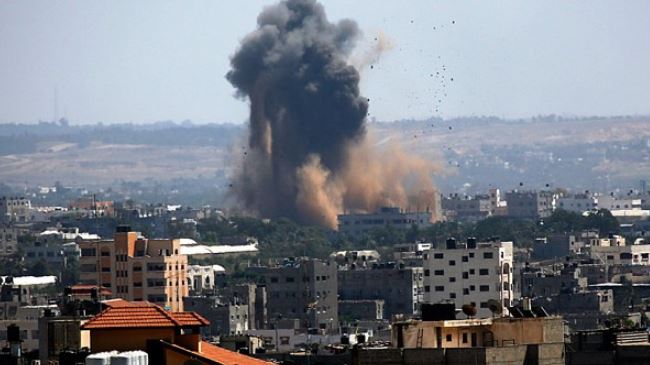
The Israeli army continued its illegitimate bombardment of Palestinian homes, and civilian property, and killed five family members of a Palestinian journalist, including two children in Gaza City.
Media sources said the Israeli strikes also targeted government facilities and ministries, media outlets, mosques and even homes of senior political leaders of Hamas, including the deputy head of the Hamas Political Bureau, Ismael Haniyya.
Medical sources said resident Ezzat Dheir, a 23-year-old journalist, working for a local radio, was killed along with four members of his family, after an Israeli missile striking his home.
The slain Palestinians have been identified as:
1. Ezzat Dheir, 23, Rafah.
2. Turkeyya Dheir, 80, Rafah.
3. Yasmeen Dheir, 25, Rafah.
4. Mary Dheir, 12, Rafah.
5. Tasneem Dheir, 8, Rafah.
The al-Hurriyya (Freedom) Radio issued a statement denouncing the ongoing Israeli crimes against the Palestinian people, including journalists and medics, adding that Dheir was its correspondent in Gaza.
Also on Tuesday, head of the al-Borei Local council, Anis Abu Shammala, was killed after an israeli missile was fired into his home.
On Monday, ten children were killed, and more than 30 were injured, when the army fires missiles into a playground north of the Shaty’ refugee camp, west of Gaza City.
The army also fired missiles into clinics of the Shifa Hospital, one of the biggest hospitals in the Gaza Strip, wounding at least five Palestinians.
Another Palestinian was killed, and three were injured, after the army fired a missile into his home in Beit Lahia, in the northern part of the Gaza Strip.
Three Palestinians, including two brothers, have also been killed by an Israeli missile striking a home, belonging to al-Hashshash family, in Rafah.
Gaza’s main power plant was hit by Israeli tank shells on Tuesday, shutting it down completely. The power plant had already been operating at 20% capacity, after having been hit by Israeli airstrikes last week. Most Palestinians depend on the central Gaza power plant to provide electricity.
This will also severely impact the ability of Palestinians to communicate to the outside world via the Internet — which has been the main source of information getting out of Gaza up until this point. Gaza’s main power plant was also heavily bombarded during the Israeli invasion of 2009, which had a serious impact on hospitals’ ability to provide care.
The Consistency of Official Iranian Commentary, Part III: On Khamenei’s Referendum Rhetoric, Reuters is Wrong
By Nima Shirazi | Wide Asleep in America | July 27, 2014
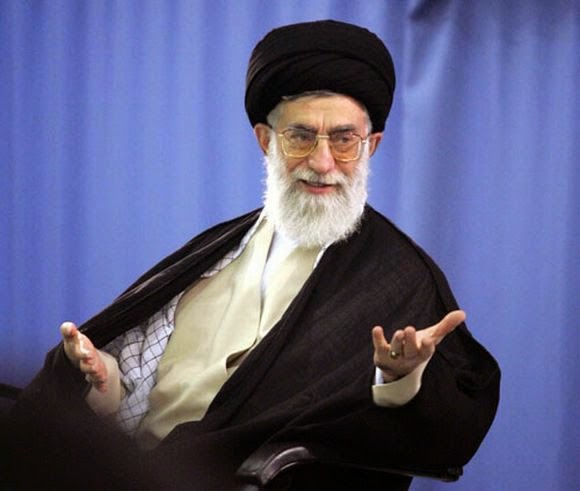 Last week, Iranian leader Ayatollah Ali Khamenei addressed a meeting of Iranian university students and, in his first public comments on the ongoing assault on Gaza, spoke of his belief in the necessity of continued Palestinian resistance to Israel aggression, oppression, and occupation.
“Don’t the Palestinians have the right to defend their lives and security?” he asked rhetorically, and condemned Western nations like the United States and Great Britain for openly supporting Israel’s assault and justifying “crimes that no ordinary person would.”
In the right-wing Daily Caller, notorious neocon darling Reza Kahlili noted that Khamenei reiterated the call by his predecessor, Ayatollah Rouhollah Khomeini, that “Israel must be destroyed,” adding that “until that time with the help of God for this cruel and murderous regime to be destroyed, strong confrontation with steadfast armed resistance is the only solution against this destructive regime.”
Yet the Caller omitted a crucial aspect of Khamenei’s speech – deliberately replaced by an ellipsis linking the the paraphrased Khomeini quote with Khamenei’s endorsement of Palestinian armed struggle – in which the Iranian leader stated that the ideal solution to the current impasse was a democratic vote.
The missing piece, however, was reported by other outlets. “There are logical and practical means to this end, which is for people who live and belong there to pick the government of their choice through a referendum. That would be the end of a usurping fake regime,” Khamenei said, according to a translation by Reuters. Until that time, he continued, “while waiting for an end to this cold-blooded murderous regime, mighty armed resistance is the only way to deal with it.”
Only through a vote by the indigenous population, Khamenei said, will “the usurper and forged regime” of Israel “be practically annihilated.”
Kahlili’s report predictably expunged all mention of a referendum, focusing instead on Iranian military capabilities and nuclear negotiations. More troubling, perhaps, is that “The Young Turks,” a liberal (some might even say, progressive) news and commentary outlet led by host Cenk Uygur, promoted the Daily Caller line in their own round table discussion of the matter. After hearing a portion of the Kahlili article read aloud verbatim, co-host Ana Kasparian described Khamenei’s comments as “extremely violent” and “crazy,” while John Iadarola called such statements “depressing.”
Reuters also quoted Khamenei as saying, “Israel’s annihilation is the only real cure, but that doesn’t mean destroying Jews in this region,” a statement also ignored by the Daily Caller. With this comment, Reuters editorialized, “Khamenei made clear for the first time that he was talking about the dismantling of the state of Israel, not the death of Jews.”
While such clarification is important, the characterization of that distinction as being a new addition to Khamenei’s rhetoric is curious. In fact, this is a distinction made often by Iranian officials when discussing this very topic – and Iran’s official position toward Israel/Palestine. Cursory research into past statements quickly reveals the consistency of such statements and proves the Reuters claim to be, not only sloppy, but ludicrous.
A similar presumption was made last year in the wake of then-newly-inaugurated Iranian President Hassan Rouhani’s insistence that, “when it comes to the settlement and resolution of regional issues,” including the colonization and occupation of Palestine, “we believe that the only path is through the ballot box, through democracy.” International news media declared this to be a breakthrough moment, despite the clear fact that Rouhani’s immediate predecessor, the much-maligned Mahmoud Ahmadinejad, had made identical statements throughout his eight-year tenure as president.
“We are opposed to the idea that the people who live there should be thrown into the sea or be burnt,” Ahmadinejad said in comments reported by the New York Times in September 2008. “We believe that all the people who live there, the Jews, Muslims and Christians, should take part in a free referendum and choose their government.”
More to the point, however, Khamenei himself has remained remarkably consistent on this issue, and Iran’s official prescription, for over two decades. In an extensive analysis of Khamenei’s speeches since 1990, published in the Boston Review in November 2013, well-known Iranian dissident Akbar Ganji – no fan of the Iran’s theocratic leadership – revealed the truth: Khamenei has long called for a new, inclusive Palestinian government to supersede the current Zionist one, thereby dismantling what is currently known as “Israel” politically, not violently.
For instance, Ganji notes, on April 17, 1991, Khamenei discussed “his solution for the Palestinian problem and said, ‘The Islamic Republic’s solution is to disband the usurping Zionist regime, forming a government of the Palestinians, and [guaranteeing] peaceful co-existence of Jews, Christians, and Muslims in all of Palestine.'” Four months later, on August 19, 1991, Ganji adds, Khamenei stated, “Solving the Palestinian problem entails destroying and eliminating the illegitimate government there, so that the true owners [of the land] can form a new government; Muslims, Christians, and Jews can live side by side… Our view regarding the Palestine issue is clear. We believe the solution is destroying the Israeli regime.”
Nearly a decade later, Khamenei’s position had not shifted. In a speech to the Basij militia on October 21, 2000, Ganji tells us that Khamenei again laid out his vision for the indigenous people of Palestine to choose their own political path forward. “The solution is for the millions of the Palestinians to return to Palestine, the several millions that live away from home to return to Palestine. The indigenous people of Palestine—Jews, Christians, and Muslims—should hold a referendum to decide what kind of a regime they want. The vast majority are Muslims. There are also Jews and Christians that belong there, as their parents also lived there. They can decide the political system that they favor,” he opined.
In March 2002, Khamenei again stated, “Holding a referendum in Palestine among the Palestinians, and all those that became refugees—if, of course, they want to return to Palestine—is a rational solution.” In June 2002, he repeated, “The only solution for the Palestine problem is that the true Palestinians, not the usurping and occupying immigrants, those who live in Palestine and those who became refugees, decide the type of government that they want. If asking for the vote of the people of a nation is a solution for those who claim to be democracy advocates, [then] Palestine is also a nation and must decide [its fate].”
The Palestinian problem has only one solution, and that is what we proposed several years ago. Hold a referendum among the indigenous Palestinians, those who live there, or are in refugee camps, or live elsewhere, regardless of whether they are Muslim, Christian, or Jew, and ask them to decide the government that they want. Regardless of whether that government is run by the Muslims, Jews, or Christians, as long as it is the result of people’s direct votes, is acceptable, and will solve the problem. Without it [the referendum] the problem will never be solved.
That Reuters would now claim Khamenei’s recent comments about Gaza mark a stark break from the past is absurd. In his Friday prayer sermon on June 20, 2008, Khamenei declared, “No, we have no problems with Jews. We have no problems with Christians, and with adherents of other religions in the world. The usurper is just the Zionist regime. This is the position of our state, and that of our revolution and our people.”
Similarly, on September 30, 2011, Khamenei spoke at a conference in support of the Palestinian struggle for freedom, justice, and self-determination, and said, “We neither advocate a classic war between Israel and the Islamic countries, nor throwing the Jewish people into the sea, and neither do we accept mediation by the United Nations or any other international organization. We propose a referendum among the Palestinian people. Similar to any other nation, the Palestinians also have the right to decide their fate and pick the type of government they want.”
Addressing the opening assembly of the Non-Aligned Movement on August 30, 2012 in Tehran, Khamenei once again reiterated Iran’s “just and entirely democratic solution” to the conflict:
All the Palestinians – both the current citizens of Palestine and those who have been forced to immigrate to other countries but have preserved their Palestinian identity, including Muslims, Christians and Jews – should take part in a carefully supervised and confidence-building referendum and chose the political system of their country, and all the Palestinians who have suffered from years of exile should return to their country and take part in this referendum and then help draft a Constitution and hold elections. Peace will then be established.
Regardless of whether Khamenei’s proposals are realistic, idealistic, inevitable or impossible, is irrelevant. That he has consistently called for a referendum to alter the exclusivist and discriminatory political system that controls Palestinian lives and has routinely made distinctions between the Zionist government in Israel specifically and Jewish people in general, is indisputable.
Reuters should get their facts straight.
Gaza fighters clash with Israeli forces in Occupied Palestine after strike kills eight children on Eid
Al-Akhbar | July 28, 2014
Updated 8:08 pm: Palestinian gunmen slipped into Occupied Palestine from the Gaza Strip on Monday and penetrated a village near the border before entering clashes with occupation forces, Israeli television said, adding that five militants had been killed.
Hamas said in a statement their fighters had killed 10 Israeli soldiers in the incident before returning home safely. But an Israeli security source told AFP that five Palestinian fighters were shot dead in the gun battle with Israel troops.
Earlier on Monday, an Israeli airstrike hit a public garden in the Beach refugee camp in northern Gaza killing 10 people, eight of them children, according to medics, ending a relative lull in fighting during the Muslim Eid holiday.
The attack brought the death toll in 21 days of attacks to 1,046.
Another explosion shook the grounds of Gaza’s main Shifa hospital, witnesses and an AFP reporter said. It was not immediately clear if there were any casualties.
Pools of blood lay on the ground in the Beach refugee camp garden in the aftermath of the explosion.
“We came out of the mosque when I saw the children playing with their toy guns. Seconds later a missile landed,” said Munther Al-Derbi, a resident of the camp.
“May God punish … Netanyahu,” he said, referring to Israeli Prime Minister Benjamin Netanyahu.
Earlier Monday, Israeli tank fire killed a four-year-old boy in the northern Gaza Strip, in what was the first death since the two sides began observing an unofficial truce, Palestinian medics said.
According to emergency services spokesman Ashraf al-Qudra, the child was killed when a shell hit a house to the east of Jabalia where fighting had recently erupted between Israeli soldiers occupying Gaza and Hamas forces.
The boy, Samih Ijneid, was the first person to be killed in Gaza on Monday although three others also succumbed to their injuries during the night, Qudra said, including a man injured in a July 11 strike.
The latest deaths raise to 1,046 the total number of Palestinians, the overwhelming majority of whom civilians, killed in Israel’s US-backed terror campaign against Gaza which began on July 8.
At least 6,233 Palestinians have also been injured since the beginning of the assault.
Israeli media also reported that four civilians were killed when a rocket launched from Gaza hit the Eshkol Regional Council in the occupied Negev.
Israel had initially eased its assault against the Gaza Strip and Palestinian rocket fire from the besieged enclave declined sharply on Monday, as a fragile Eid al-Fitr truce appeared to be holding up.
But the Associated Press reported that Israeli war jets bombed three targets in central and northern Gaza in the late morning, shattering nearly 12 hours of relative calm.
The occupation forces had said they would halt attacks against Gaza unless rocket fire is renewed.
But Israeli soldiers were still occupying Gaza under the pretext of searching for tunnels.
Hamas said on Sunday it wanted a 24-hour truce to mark the Muslim holiday of Eid al-Fitr marking the end of Ramadan, which started on Monday. In the hours after its announcement, Gaza gradually fell quiet.
Just one rocket was fired out of the battered coastal territory at Ashkelon in the first nine hours of Monday, the occupation army said. Gaza residents reported brief bursts of tank shelling and no casualties.
But just before noon, Israel’s occupation army claimed it bombed a facility for manufacturing rockets, and two rocket launchers in response to the single rocket fired from Gaza.
The UN Security Council called on both sides to implement a humanitarian truce that stretched beyond Eid.
Netanyahu’s security cabinet met into the early hours of Monday to debate ceasefire proposals and also a possible escalation of the Gaza assault.
Israel says 43 of its soldiers have been killed by Palestinian forces, along with seven civilians killed by rocket and mortar fire from Gaza, including four killed Monday.
Kerry calls for Hamas disarmament
Israel and the Palestinians have expressed “serious interest” in a 24-hour truce in the Gaza conflict, but a deal has yet to be reached, UN Secretary-General Ban Ki-moon said on Monday, as he raised concerns about the proportionality of Israel’s military operation.
“The people of Gaza have nowhere to run. They are trapped and besieged on a speck of land. Every area is a civilian area,” Ban told reporters in New York on Monday after returning from a week in the Middle East trying to help broker a ceasefire.
“The casualty and damage figures also raise serious questions about proportionality,” he said.
Under international humanitarian law, proportionality means refraining from launching an attack when it is expected to cause excessive loss of civilian life in relation to the anticipated military advantage.
Ban, who spoke with Netanyahu on Monday, said the temporary pause in fighting during the weekend “revealed how much the massive Israeli assault has devastated the lives of the people of Gaza,” where some 1.8 million people live.
“Some described it as a ‘man-made hurricane’ – whole neighborhoods reduced to debris, rubble; blocks of flattened apartment buildings; scores of bodies still buried under mountains of twisted wreckage,” Ban said.
“It’s a matter of their political will,” Ban told reporters of the obstacle to a ceasefire in Gaza. “They have to show their humanity as leaders, both Israeli and Palestinian.”
He said it was “morally wrong” for the leaders to allow the deadly violence to continue.
Meanwhile, US Secretary of State John Kerry Monday said that international efforts to agree a truce in Gaza must lead to the disarmament of Hamas.
Kerry told reporters he was continuing to work “toward establishing an unconditional humanitarian ceasefire.” But he added: “We also believe that any process to resolved the crisis in Gaza in a lasting and meaningful way must lead to the disarmament of Hamas and all terrorist groups.”
Kerry did not discuss the Israeli blockade of Gaza as a solution to the crisis.
(Reuters, AFP, Al-Akhbar)
Israeli officials Mock Kerry Ceasefire Proposal; Reject any Long-Term Truce
By Chris Carlson | International Middle East Media Center | July 28, 2014
On Friday, a draft of US Secretary of State John Kerry’s ceasefire proposal was shown to Israeli officials. The draft apparently called for the opening of border crossings between Gaza and Israel and included measure to ensure “the economic livelihood” of Palestinians in the Gaza Strip.
According to Haaretz, the document, which was titled “Framework for Humanitarian Ceasefire in Gaza,” also said that a lasting truce would make possible the “transfer of funds to Gaza for the payment of salaries for public employees.”
The proposed ceasefire would also “address all security concerns”, stipulating that Israel would not be allowed to continue destroying tunnels during the initial ceasefire and making no explicit mention of the demilitarizing Palestinian factions in the Gaza Strip.
Israeli officials were apparently shocked after reading the draft, according to Ma’an, saying that it ignored Israel’s security concerns.
“We succeeded in foiling that document and now we are discussing other options,” Haaretz quoted officials as saying.
One of Kerry’s associates is said to have responded:
“There is no paper and no proposal. The draft was based on the Egyptian proposal that Israel wholeheartedly supported. So if they are opposed, they are opposed their own plan.”
Israel refused to work with the ceasefire proposed on Friday, agreeing instead to a 12-hour humanitarian truce which started Saturday at 8am.
Israel resumed its assault on Gaza for the 20th day on Sunday afternoon, killing ten Palestinians in attacks on Sunday.
Hamas leader Khaled Mashal spoke Sunday with PBS interviewer Charlie Rose. In the interview, Mashal stressed that the group was ready to “coexist with the Jews” but would not tolerate “occupiers.”
During a continuation of Saturday’s temporary ceasefire, the Israeli army killed at least ten Palestinians.
Israeli forces have also killed a number of Palestinians in solidarity protests across the West Bank over the past several days, jailing even more.
This afternoon, after the expiration of the previous temporary ceasefire, Hamas announced that all militant groups would be respecting a 24-hour ceasefire, beginning at 2pm.
Israeli airstrikes continued, however, as officials announced their rejection to any permanent ceasefire deal currently on the table and, thus, resistance rocket fire resumed from the Gaza Strip as well.
One Israeli civilian was injured. 43 Israelis have been killed during “Operation Protective Edge”, all of them soldiers apart from three civilians.
Over a thousand Palestinian deaths have been reported in the past 20 days, with many still unidentified , most of which are accounted for by heavy, indiscriminate assaults on civilian neighborhoods, municipal facilities, end even hospitals.
Hamas insists that any lasting ceasefire must begin with lifting the blockade on Gaza, with leader Khaled Mashal warning that Palestinians cannot coexist with their neighbors while their land is occupied.
Gaza has been under a severe economic blockade imposed by Israel since 2006, leading to frequent humanitarian crises. Backed by Egypt, Israel tightened the blockade in 2007, following an election victory by Hamas. Israel does not even respect their own impositions on Gaza’s fishing industry and frequently fires on Palestinian fishermen, often damaging or even confiscating their equipment.
Charlie Rose asked Khaled whether he could foresee [Hamas] living beside Israelis in peace. He responded that only a future Palestinian state could decide upon [Hamas’] recognition Israel.
Khaled said:
“We are not fanatics, we are not fundamentalists. We are not actually fighting the Jews because they are Jews per se. We do not fight any other races. We fight the occupiers…
I’m ready to coexist with the Jews, with the Christians and the Arabs and non-Arabs. However, I do not coexist with the occupiers.
…Palestinian people can have their say when they have their own state without occupation.”
Further pressed on whether Palestinians could recognize the state of Israel as a Jewish state, Mashal reiterated Hamas’ position — the group does not recognize Israel.
“When we have a Palestinian state then the Palestinian state will decide on its policies. You cannot actually ask me about the future. I answered you,” he said.
A full version of the interview is to be broadcast late Monday.
Gaza: Israel puts paramedics in its crosshairs
By Mohammed Suliman | Al-Akhbar | July 28, 2014
Reham is used to not seeing her husband Ayed for several days on end. During war times, she rarely sleeps. Watching over her little children, she sits by her bed horrified as the radio blares out the news of an air-strike that hit somewhere north of Gaza, where she lives. The restless wife would soon try calling her husband, and more often than not, he didn’t pick up. Ayed would be busy evacuating the injured or rescuing the bodies of people who were killed in the aftermath of an Israeli shelling.
Twenty-eight-year-old Ayed al-Buraey was a Palestinian paramedic from northern Gaza. After he finished his shift, Ayed would normally call his wife to assure her that he was safe. This time however, he did not call.
Ayed was killed on July 25 when Israeli forces shelled the ambulance he was in while he and his crew were on their way to evacuate the injured in Beit Hanoun. The shells struck the ambulance and set it on fire. Hatem Shahin, a volunteer paramedic, was with the crew when the ambulance vehicle was shelled. He was injured in the attack but managed to get out of the ambulance and, with the help of few young men, walked to Beit Hanoun Hospital, where he was then taken to al-Awda Hospital in Jabaliya.
“We were heading to al-Masreyyeen Street to evacuate a few injured people stuck there. Once we entered the street, a shell hit our ambulance. I started shouting but couldn’t hear anything. The vehicle was ablaze. I crawled out of it and walked away,” 38-year-old Shahin told Al-Akhbar.
“When I arrived at the hospital, I was told that Jawad Bdeir [the ambulance driver] was also injured and that Ayed was killed. I was shocked,” Hatem said.
Since the start of its most recent onslaught on Gaza on July 8, Israeli forces have on several occasions attacked medical personnel, rescue teams and ambulances. According to the Palestinian Center for Human Rights in Gaza, Israeli forces have killed seven medical personnel and injured 16 others so far. Nearly 20 ambulance vehicles have been completely destroyed during the same period.
Israeli forces have also attacked hospitals and medical staff such as Balsam hospital, Beit Hanoun hospital in Beit Hanoun, the Algerian hospital in Khan Younis and al-Wafa hospital, which finally collapsed after Israeli warplanes bombarded it several times.
”I came home to tell you I’m safe”
As the Palestinian death toll increased day by day, Ayed would rarely come back home to see his wife and two little children. On the few occasions he did manage to come back, he would take his four-month-old baby in his arms and fall asleep.
“I was always worried to death about him,” Reham said tearfully. “It was like I knew something wrong would happen to him. We rarely saw him, he came home only three times since the start of this war.”
“When I asked him about his work, he couldn’t even reply because of how tired he was. He only hugged the children and slept. He used to tell me, ‘I came back to tell you I’m safe, so don’t worry about me.’”
The ambulance vehicle in which Ayed was killed belonged to the Palestinian Red Crescent Society. It was then removed from the street by an Israeli armored bulldozer, which put it on the side of the street. Shortly afterwards, another ambulance arrived at the scene in order to evacuate Ayed’s body. This time, the International Committee of the Red Cross coordinated its access to the area, but as soon as it came into the street, it was fired upon by the Israeli army and another medic was moderately injured.
In another incident, Israeli forces opened fire on medical personnel as they were evacuating a handicapped person from al-Qarara area in Khan Younis. They killed one paramedic. Al-Mezan Center for Human Rights in Gaza reports: “As a result of the attack, a medic, Mohammed Hassan al-Abadla, 32, was injured when he was outside the vehicle. Under the fire, the ambulance driver drove away. Communication with the injured medic was cut and he stayed in the area for half an hour, during which he bled to death. The ICRC had to coordinate again for his fellow medics to reach him. They found him dead.”Jihad Saleem, 43, is an ambulance officer from Gaza. He says although this has been his job for years, every time he receives a call informing him of a body to be picked up or an injured person to be rescued or a group of people to be evacuated, he feels his heart beat as if it was his first time all over again.
“When I see bodies torn to pieces, sometimes disemboweled, I think of them as my own family,” he told Al-Akhbar.
“We’re always stressed because of what we see and what we have to deal with. We always imagine this is our own family we’re going to save,” he explained, adding that it actually happened to one of his colleagues. “He went to save a group of people only to find out it was his brother’s house and four of the dead were his own nephews.”
Another paramedic, Ahmed Musallam, was injured while he was evacuating residents from a building that was going to be bombed. Even though Ahmed was hit by shrapnel in his leg, he refuses to let his injury stop him from doing his job.
“I just couldn’t sit at home despite the pain in my leg. It pains me much more to see these little children dying under the rubble and hear their mothers mourn over them. I had to come back here,” the 30-year-old told Al-Akhbar. “This is where I belong, and my people need me here.”
Israeli attacks on medical personnel, particularly paramedics, as well as the obstruction of medical access to the injured have been condemned by various human rights organizations in Gaza and described as “a serious violation of the International humanitarian law that may amount to war crimes.”
Today Reham is completely distraught over Ayed’s loss. She described him as stubborn, saying he always refused sit at home. “He used to tell me, ‘If we all sat at home and didn’t go to work, who will save all these people?’”
“But now he’s [the one who] died and no one came to save him. My children and I will never see him again,” she said.
Follow Mohammed Suliman on Twitter | @imPalestine
The Shame of David Gregory
By Greg Mitchell | Pressing Issues | July 28, 2014
It’s been a tough week for NBC’s David Gregory.
First were reports that his “Meet the Press” was sinking under even weaker ratings and that he would soon be replaced. Then as we noted here yesterday: Gregory, after a weak interview with Prime Minister Netanyahu, committed one of the worst journalistic ethical lapses of recent vintage. After letting Netanyahu claim, again, that Israel may be blameless in the school massacre, despite all the evidence and logic to the contrary, he brought on UNWRA spokesman Chris Gunness–and blindsided him by showing a 10-second, hazy, tape just released within the hour by Israel allegedly showing a Hamas rocket being fired from the grounds of a UN school. Yet Gregory said NBC had not “verified” that it’s accurate–and admitted that Gunness could not view it and had never seen it before. Yet then asked Gunness to respond! Gunness naturally protested the unfairness–and then the segment quickly ended.
Gregory has now issued this statement: “An end note in a discussion about Gaza we asked a spokesman about this video which Israel claims showed rockets being fired by Hamas from a U.N. school in Gaza,” Gregory said. “This is shot by the Israeli government, and that’s their claim. The U.N. has reviewed it, tells us they have confirmed, in their view, the video does not show rockets being fired from U.N. administrative school in Gaza. So this is a back and forth we are not able to settle at this point.” No apology or recognition of his severe ethical lapse. Shameful. And leaves it at the usual “he said/she said”–rather than NBC attempting to verify tape or prove Israeli propaganda. Which it should have done before airing it.
Meanwhile, the NYT has not updated its report last night, that focused on a different Israeli video, to add the UN statement–which Gregory cited 17 hours ago–debunking the one that allegedly shows rockets fired from the school grounds. Surely it’s worth noting that Israel’s videos may be nothing but propaganda. This is what I wrote about it last night:
Will surprise no one that when the NYT tonight reports on Israel’s claim it killed no one at the school–it’s the same old refusal to take on the absurd IDF claims head-on. You’d never know that Israel lied to them for three days [claiming] that none of their bombs even hit the school. It’s as if the reporters say, “More propaganda, please.” As from the beginning, they ultimately rely on “different versions can’t be reconciled now”–even though all evidence and testimony point to Israel being guilty of this slaughter. It’s a false “balance.”
They give their point of view away by not even referring to Israel completely changing its story after three days. That’s more revealing than the totally unverified 10-second video. Most of those who have gone to the site, such as Peter Beaumont of The Guardian, have all pointed their finger at Israel as no doubt the guilty party. Another one here. Not the Times.
And see the IDF spokesman’s “scenario” (below) that maybe the hundreds of wounded and dead were not hit there but brought to the site from elsewhere. The Times now dutifully uses the phrase that 16 were “reportedly killed” at the site. This is the same Israeli official the NYT reporters give the benefit of the doubt to re: the grainy video with no time stamp. See my earlier report on the shameful NYT coverage on this (as with much else on the conflict).
Israeli forces fire live ammunition injuring 15 protesters in Beit Furik
International Solidarity Movement | July 27, 2014
Beit Furik, Occupied Palestine – At 22:00 in the evening of Friday, July 25th, Israeli forces injured 15 Palestinians during a protest in the village of Beit Furik, which is located fifteen km southeast of Nablus in the northern half of the West Bank.
Approximately 2000 protesters were marching towards the checkpoint near the village. Roughly 40 Israeli soldiers were waiting for them there, and when they came into view, the soldiers began to shoot tear gas canisters in their direction. Shortly after the protest began, the soldiers changed from firing tear gas, to live ammunition.
23-year-old Yousef Mfeed Mletat was struck by a bullet in his left hip. He recounted the scene tearfully in his bed in Rafidia hospital in Nablus. “They were less than four meters away when they shot me. And then they started to beat me. A soldier was standing on my stomach while some of the others were kicking me. This went on for 15 minutes.” He revealed several welts on his arms and shoulders.

Yousef Mfeed Mletat (photo by ISM).
Yahya Hanay, who is 25-years-old, was trying to escape from the scene, when a stun grenade struck his hand, which was covering his face at the time. As he lay on the ground, another stun grenade hit his knee. Yahya has nerve damage in his left thumb, which is said to be serious.

Yahya Hanay (photo by ISM).
19-year-old Yezen Tala Khatatba, was attempting to help an injured protester, when he was shot in the left knee. The bullet exited his left knee and then entered an exited his right one. He was wearing bandages on both knees as he told his story. “The ambulance was taking me to the hospital, when soldiers twice stopped me for half an hour at a checkpoint. When I told them I had a leg injury, they said it would have been better if I’d been hit in the head.” Yezen also mentioned that another injured protestor had been taken from the ambulance at the checkpoint and beaten by soldiers.

Yezen Tala Khatatba (photo by ISM).
Britain’s Shame
By Stuart Littlewood | Dissident Voice | July 26, 2014
Today in London crowds are gathering to vent their anger in a mass demonstration and march to Parliament to “stop the massacre in Gaza” and call for an arms embargo against Israel. This follows last weekend’s huge protest outside the Israeli embassy and campaigns against the BBC’s pro-Israel bias in reporting the assault on Gaza.
There is growing resentment among British people at being endlessly shamed by their government’s complicity in the mega-injustices and non-stop crimes inflicted on the native people of the Holy Land, exemplified by Whitehall’s attempts to whitewash Israel’s latest genocidal offensive.
And on this the 19th day of Israel’s blitzkrieg comes news of a brief humanitarian “pause”, after which the killing spree will continue while Israel attempts to eradicate Gaza’s tunnels. At this point in the orchestrated tragedy the Palestinian death-toll is approaching 900, three-quarters civilians including around 200 children, and more than 5,000 wounded.
These figures are gruesome enough, but Dr David Morrison reminds me that since September 2005 when Israel pulled out its squatters and withdrew its military from Gaza (but not from Gaza’s airspace and coastal waters) only 24 people have been killed in Israel by rocket and mortar fire coming from Gaza. Of those, 13 died during Israel’s three major military offensives against Gaza (including the present one). In the same period, nearly 4,000 Palestinians in Gaza have been killed by Israeli military action.
The unending tragedy is one that Britain created nearly 100 years ago with Balfour’s crackpot Declaration. Balfour, a Zionist convert, wrote: “In Palestine we do not propose even to go through the form of consulting the wishes of the present inhabitants of the country.” He dismissed “the desires and prejudices of the 700,000 Arabs who now occupy that land” in favour of Zionism’s needs and hopes, which were “of far profounder import”.
At the time Lord Sydenham warned: “The harm done by dumping down an alien population upon an Arab country may never be remedied. What we have done, by concessions not to the Jewish people but to a Zionist extreme section, is to start a running sore in the East, and no-one can tell how far that sore will extend.” Well, the harm is massive and still waiting for a remedy. The running sore shows no sign of healing. The trouble will not end until Britain (with help from the international community) takes some very necessary steps. The problem is the British Government’s acute and persistent lack of integrity and foolish pledges of support to the aggressor.
Why is Hamas banished to outer darkness?
In the last few days I have seen two ministerial statements saying that Hamas, democratically elected to power in the 2006, is a proscribed terrorist organisation, proscribed being a posh word for something condemned as so bad as to be banished to outer darkness.
Earlier this month Robert Halfon, the Conservative MP for Harlow and Tel Aviv but not necessarily in that order, said in the House of Commons: “Hamas is Hamas is Hamas: it is a terrorist organisation whether it is part of the so-called unity Government [of Palestine] or not.” He wanted the British Government to “give Israel every possible assistance to take out the Hamas terrorist network so that that country can be sure that her children will be secure in the future”.
Hugh Robertson, Minister of State at the Foreign Offce, replied: “Nobody should be under any illusions about this at all: Hamas is a terrorist organisation and remains a terrorist organisation, and one that is proscribed by the British Government. The key thing about the technocratic [Palestinian] Government was that they signed up to the Quartet principles and renounced violence and no member of Hamas is a member of that Government.”
Earlier he had this to say: “If anybody in that Government were an active member of Hamas, which remains a terrorist organisation, that would absolutely be the end of this Government’s dealing with them and would be a very serious matter indeed. That is not the case at the moment; they are fully signed up to the Quartet principles.”
A few days later Baroness Jenny Tonge, in the House of Lords, asked the Government what action it planned to take to open diplomatic relations with Hamas in order to assess the viability of a long-term truce such as Hamas offered in 2006.
Baroness Warsi, Senior Minister of State for Foreign and Commonwealth Affairs, replied: “Our policy towards Hamas is clear — we have no contact with Hamas, which is a proscribed terrorist organisation. Hamas must renounce violence, recognise Israel and accept previously signed agreements. Hamas must make a credible movement towards these conditions, which remain the benchmark against which their intentions are judged, before we consider a change in our stance.”
Warsi is a Muslim and should know better. How can anyone sensibly recognise Israel when it won’t agree its borders? Has she ever put it to the Israelis that they too must renounce violence, recognise Palestine and accept previously signed agreements — the benchmark against which their intentions will be judged?
And given all this stuff about Hamas being proscribed, what are we to make of a Home Office document dated 20 June 2014 in which, of the 60 international terrorist organisations proscribed by the UK government under the Terrorism Act 2000, only Hamas’s military wing – the Izz al-Din al-Qassem brigades – is listed, not Hamas’s political wing?
Why, then, aren’t we talking to Hamas’s political leaders?
How do organisations qualify for the Terror List anyway? Well, in the UK they have to pass a test and the Home Secretary decides. In the US, under Section 3 of Executive Order 13224 “Blocking Property and prohibiting Transactions with Persons who commit, threaten to commit, or support Terrorism”, the term “terrorism” means an activity that…
(i) involves a violent act or an act dangerous to human life, property, or infrastructure; and
(ii) appears to be intended to intimidate or coerce a civilian population; to influence the policy of a government by intimidation or coercion; or to affect the conduct of a government by mass destruction, assassination, kidnapping, or hostage-taking.
This US order and its definition of terrorism, signed in 2001 by George W Bush, is used to outlaw and crush any organisation, individual or country the US doesn’t like. Funny how it fits the Israeli regime — those “amoral thugs”, as one British MP called them — like a glove. And they have been allowed to practise their terrorism on the Palestinians (and occasionally on the Lebanese and Syrians) without interference for the last 66 years.
The long drawn-out siege and blockade of Gaza, and the numerous military assaults on its people and their legitimate government, are only the latest crimes in a catalogue of torment and terror inflicted on all the Palestinian territories Israel occupies. They are clearly attempts to “intimidate and coerce”, while the mass destruction of Gaza’s infrastructure, the withholding of humanitarian aid, the assassinations, the abductions, the bulldozing of Palestinian homes, and the many violent and dangerous acts including indiscriminate bombing and shelling (and the use of cluster bombs in Lebanon), make Israel’s place on the Terror List a sure thing – or should do.
They talk of addressing “underlying causes” but can they agree what they are?
With Agent Hague gone from the Foreign Secretary post, we are beginning to see what his successor, Philip Hammond, is made of. He started by praising Egypt’s fake ceasefire initiative when Hamas hadn’t even been consulted on the terms and instead of coming through proper diplomatic channels it was released to the media as soon as Israel agreed it. Given the Egyptian regime’s hostility towards Hamas it is hardly an honest broker. Unsurprisingly it contained none of the guarantees that would sustain a ceasefire, such as a permanent end to the 8-year siege (promised but not implemented in the 2012 ceasefire) or the release of prisoners who had been freed then re-arrested by Israel. So what was in it for the illegally occupied Palestinians? Nevertheless Hammond thought it was jolly good and welcomed Israel’s acceptance of this piece of nonsense which hadn’t been shown to the other side.
His other statements have to be seen to be believed. They are on the FCO website. Following the UN Human Rights Council’s decision to launch an inquiry into potential violations of human rights by Israel in its operations in the Gaza Strip, a move Israeli Prime Minister Netanyahu called a “travesty”, Hammond said the UNHRC resolution would not help achieve a lasting ceasefire. “It is fundamentally unbalanced and will complicate the process by introducing unnecessary new mechanisms… The UK could not support this resolution… We will continue to urge Israel to exercise restraint… blah, blah… while recognising its right to defend itself against these attacks.”
And after meeting Israeli and Palestinian leaders (though not Hamas), Hammond said: “With President Abbas… I reiterated the UK’s strong support for his leadership and thanked him for his own efforts to achieve a ceasefire. I stressed that, once a ceasefire is secured, there is an urgent need for a long term plan for Gaza.
“With Prime Minister Netanyahu and Foreign Minister Lieberman, I expressed my deep concern at Hamas’s rocket attacks and reaffirmed Israel’s right to defend itself. I urged that Israeli forces do everything they can to avoid civilian casualties, and stressed the need for a rapid conclusion to their ground operation in Gaza.”
Hammond doesn’t explain how Israelis can claim a right of self-defence against their victims – the people they are brutally occupying and blockading — or how Her Majesty’s Government can possibly “reaffirm” such a crass invention.
He said that for a ceasefire to be durable there must be rapid movement to address “the underlying causes” and find “a wider political solution”. So, Mr Hammond, what “wider political solution” do you have in mind? And, by the way, do you have any idea what those “underlying causes” are? Do you think you could ever get Israel to acknowledge what they are?
Here are some clues from two very knowledgeable sources. In 2010 Archbishop Theodosius Hanna (Orthodox Church of Jerusalem), on a visit to Ireland, told politicians: “The problem in Palestine has nothing to do with religion – it is not a religious issue. It is not a conflict of Christians, Muslims and Jewish people. It is a conflict between those who are the holders of a rightful cause and those who took away that right by military might.”
Fr Manuel Mussallam (formerly of the Catholic church in Gaza), who accompanied the archbishop, told the Irish what things were really like under military occupation. “We have spoken to Israel for more than 18 years and the result has been zero. We have signed agreements here and there at various times and then when there is a change in the government of Israel we have to start again from the beginning. We ask for our life and to be given back our Jerusalem, to be given our state and for enough water to drink. We want to be given more opportunity to reach Jerusalem. I have not seen Jerusalem since 1990.
“We want to see an end to this occupation, and please do not ask us to protect those who are occupying our territory.”
Nearly 4 years on, and what has changed? Can we rely on Hammond to make a difference? Here’s another clue. In a Jerusalem Post report the director of Conservative Friends of Israel remarked that, in his previous job as Defence Secretary, Philip Hammond “presided over a period when the UK-Israel defense relationship has never been better.”
Featured Video

Genocide-linked firm handles Britons’ NHS data
or go to
Aletho News Archives – Video-Images
Book Review
Book review: Boiling Point, How America Brought War to Ukraine
By Tim Kirby | Strategic Culture Foundation | November 14, 2026
Did Vladimir Putin just wake up one day on the wrong side of the bed and decide to invade Ukraine in February of 2022 or is there a lot more to this single decision that has been reshaping the 21st century geopolitical landscape?
Obviously, from the way that I just posed the question you can see that I am on the side that views the causes for the war in Ukraine to be very deep, long-term, historical and consciously nefarious, and most importantly, not from within the halls of the Kremlin. So it was a pleasure to take a look at the book “Boiling Point, How America Brought War to Ukraine” by author Stephen Kinzer, who like myself, also believes that the real reasons behind military conflicts around the world are not what CNN and the BBC have been telling you. The main thesis of this book was stated clearly by its creator; the war “may have been illegal, but it was definitely not unprovoked.” … continue
Blog Roll
 Aletho News
- The 10 Disease Renamings That Rescued the Vaccine
- NATO cancels 2027 leaders’ summit
- IAEA’s politicized use of safeguards undermines its impartiality: Russian envoy
- UK must be ready to strike Russian Arctic – ex-PM
- Fico’s Two Red Lines: Russian Energy and the Next Ukraine Loan
- Thousands rally for banned NATO-skeptic presidential candidate
- Ukraine Settlement and New European Security Architecture Must Go Hand in Hand – Kremlin
- Book review: Boiling Point, How America Brought War to Ukraine
- Israel Revives The ‘Iranian Assassination Threat Against Trump’ Deception In A Desperate Bid To Restart The War
- US rewrites history to dodge blame for illegal war on Iran: Foreign Ministry spokesperson
- If Americans Knew
- An error has occurred; the feed is probably down. Try again later.
- No Tricks Zone
- New Study: Barents Sea Temperatures Were Warmer And Sea Ice Less Extensive In The 1700s Than Today
- German Authorities Start Initiative To Evaluate Public Register For Climate “Disinformation” Spreaders!
- Zonal Asymmetry of Temperature Change in the Antarctic Circumpolar Current
- New Study: The Net Fossil Fuel Contribution To Rising Atmospheric CO2 Has Been Zero For 500 Years
- Germany’s Green Energy Transition Becoming Increasingly Expensive…Another 6 Trillion Euros!
- Sudden Stratospheric Warming, Powerful El Niño Combination May Lead To Extreme Europe Cold, Energy Crisis!
- Two New Studies Find Thwaites Glacier Melt Cannot Be Driven By Human Activity Or A Warming Ocean
- E-Cars Reduce CO2 Emissions By Only 41% Compared To Internal Combustion Engine Vehicles
- Predictions Made By Renowned Climate Professor Over Past Decades Have Been Proven To Be Poor
- New Study Suggests Large Regions Of The Pacific Ocean Have Been Cooling For The Last 80 Years

