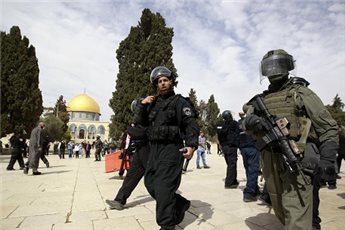
Israel bans guards from entering Aqsa compound
Ma’an – 08/06/2013
JERUSALEM – Israel on Friday banned 25 Al-Aqsa compound guards from the vicinity of the mosque for varying periods of time.
Samer Qweider was banned from entering Al-Aqsa until the end of Ramadan for allegedly verbally abusing rightists who tried to get into the compound.
Qweider told Ma’an that on May 28 he was banned from entering the compound for six days, and accordingly he returned to his job on Monday. After two days of working regularly he was told by Israeli police he was not allowed to enter the compound until Ramadan ends in mid-August.
Another guard, Fadi Bakeer, said that Israel wanted to “silence” the guards, and added that any guard who tried to stop rightists from entering the holy compound would be banned.
A religious department worker said that guards are pressured, arrested, beaten, banned, and fined. He added that his department has pleaded for King Abdullah II of Jordan for help.
Israeli authorities have allowed the Jordanian leadership a degree of control over the holy Muslim site as well as the Church of the Holy Sepulcher due to its historical connections to Jerusalem.
Israel seized the West Bank including East Jerusalem from Jordan in the Six-Day War of 1967.
Related article
- Palestine: The global march to Jerusalem to launch tomorrow in 40 states & demands to flock to Al-Aqsa Mosque (realisticbird.wordpress.com)
Syria – Israel Is Losing the Battle
By Gilad Atzmon | June 7, 2013
In the last week we have been following desperate British and French attempts to push for military intervention in Syria. It is far from being a secret that both governments are dominated by the Jewish Lobby. In Britain it is the ultra Zionist CFI (Conservative Friends of Israel) – apparently 80% of Britain’s conservative MPs are members of the pro-Israeli Lobby. In France the situation is even more devastating, the entire political system is hijacked by the forceful CRIF.
But in case anyone fails to grasp why the Jewish Lobby is pushing for an immediate intervention, Debka, an Israeli news outlet provides the answer. Seemingly, the Syrian army is winning on all fronts. Israel’s military and geo-political calculations have proven to be wrong.
According to Debka, “the battle for Damascus is over”. The Syrian army had virtually “regained control of the city in an epic victory”. The rebels, largely mercenaries, have lost the battle they “can’t do much more than fire sporadically. They can no longer launch raids, or pose threats to the city centre, the airport or the big Syrian air base nearby. The Russian and Iranian transports constantly bringing replenishment for keeping the Syrian army fighting can again land at Damascus airport after months of rebel siege.”
But it isn’t just the capital. Debka reports that “Hezbollah and Syrian units have tightened their siege on the rebels holding out in the northern sector of al Qusayr; other (Syrian army) units have completed their takeover of the countryside around the town of Hama; and a third combined Syrian-Hizballah force has taken up positions around Aleppo.”
Debka maintains that senior IDF officers criticized the Israeli defense minister (Moshe Ya’alon) who “mislead” the Knesset a few days ago estimating that “Bashar Assad controlled only 40% of Syrian territory.” Debka suggests that the Israeli defense Ministry has drawn on a “flawed intelligence assessment and were concerned that the armed forces were acting on the basis of inaccurate intelligence.” Debka stresses, “erroneous assessments… must lead to faulty decision-making.”
Debka is clearly brave enough to admit that Israeli military miscalculations may have led to disastrous consequences. It reports, “the massive Israeli bombardment of Iranian weapons stored near Damascus for Hezbollah, turned out a month later to have done more harm than good. It gave Bashar Assad a boost instead of weakening his resolve.”
Debka is obviously correct. It doesn’t take a genius to predict that an Israeli attack on an Arab land cannot be accepted by the Arab masses, not even by Assad’s bitterest Arab opponents.
Debka maintains that the “intelligence focus on military movements in Syria especially around Damascus to ascertain that advanced missiles and chemical weapons don’t reach Hezbollah laid to a failure in detecting a major movement by Hezbollah militia units towards the Syrian-Israeli border.”
Israel is now facing a new reality. It is facing Hezbollah reinforcements streaming in from Lebanon towards the Golan heights and its border with Syria.
Israel, Debka concludes, will soon find itself “face to face for the first time with Hezbollah units equipped with heavy arms and missiles on the move along the Syrian-Israeli border and manning positions opposite Israel’s Golan outposts and villages.”
Debka is correct to suggest that instead of “growing weaker, Iran’s Lebanese proxy is poised to open another war front and force the IDF to adapt to a new military challenge from the Syrian Golan.”
Rather than The Guardian or Le Monde, it is actually the Israeli Debka that helps us to grasp why Britain and France are so desperate to intervene. Once again, it is a Zionist war which they are so eager to fight.
Sadly enough, it isn’t The Guardian or The New York Times that is there to reveal the latest development in Syria and expose Israeli lethal miscalculations. It is actually a ‘Zionist’ Israeli patriotic outlet that is providing the goods. I actually believe that this form of harsh self-criticism that is embedded in Israeli culture, is the means that sustains Israeli regional hegemony, at least monetarily. This ability to critically examine and disapprove of your own leadership is something I fail to encounter in Western media. Seemingly, the media in Israel is far more tolerant toward criticism than the Zionist dominated Media in the West.
Have You Been Denied Entry?

G4s annual meeting stormed by human rights activists
Press TV – June 7, 2013
Pro-Palestine campaigners have staged a protest at the annual meeting of shareholders of disgraced security firm G4S in London, calling for an end to the firm’s Israeli prison contracts.
G4S meeting on June 6 was twice disrupted by protesters, who voiced their anger against the private company’s provision of expertise and security systems to Israeli prisons, and its complicity in the detention and torture of Palestinian children.
The demonstration was organized by the Innovative Minds (inminds) and Islamic Human Right Commission (IHRC) campaign groups.
“G4S cannot expect to do business as usual whilst it equips Israeli prisons which hold Palestinians in breach of the Geneva Convention,” said Sarah Colborne, director of Palestine Solidarity Campaign.
G4S faces criticism for its cooperation with the Israeli regime, including providing equipment and services to Israeli checkpoints, illegal settlements, the apartheid wall and jails where Palestinian political prisoners are subjected to mistreatment and torture.
Related article
- Pro Palestine Activists Interrupt Ehud Olmert [MUST SEE VIDEO] (intifada-palestine.com)
South African bodies call for Israel to be excluded from diamond processing over ‘war crimes’
RT | June 6, 2013
South African human rights groups, trade unions and major civil society organisations are calling for the Kimberley Process Certification Scheme* to exclude Israel from diamond processing.
The certification scheme is designed to stop ‘conflict diamonds’ from entering the mainstream diamond market and was set up in 2003. The organisation which runs the scheme is currently meeting in South Africa.
The coalition of organisations such as South Africa’s National Union of Mineworkers, the country’s largest trade union federation COSATU; South African Students Congress; the Coalition for a Free Palestine and BDS South Africa say that “billions of dollars’ worth of diamonds exported via Israel are a major source of revenue for the Israeli military, which stands accused of war crimes.”
The coalition is calling for Israel to be excluded from the Kimberley Process Certification Scheme due to its human rights record against Palestinians, and to end all exports of rough diamonds to Israel immediately.
The organizations also wants to ban diamond polishing and cutting in Israel. They claim excluding Israel from the diamond processing would be a great chance for the South African authorities to display “moral vision and political leadership”.
“The Kimberley Process has played an important role over the past decade in resolving conflicts linked to the diamond trade but there is no doubt that it has to be reformed… [by] expanding the definition of conflict to include human rights abuses linked to diamond extraction perpetrated by governments and companies; and expanding downstream monitoring so that the process covers not just the rough diamond trade but also the international movement and polishing of diamonds,” Southern Africa Resource Watch director Claude Kabemba told the Business Day newspaper.
The coalition also pointed to the local benefits of such a move, claiming it could bring more diamond processing jobs back to South Africa. “Consumers will have a clear conscience that their diamonds are not funding, assisting or in any way involved with the illegal Israeli occupation of Palestine, and more jobs will be created locally for our people by bringing this diamond processing back home instead of it being done in Israel,” South African activist Mbuyiseni Ndlozi is quoted by the Middle East Monitor as saying.
The Kimberley Process, established a decade ago to help resolve international diamond trade conflicts and to ensure that the diamond trade is not used as an instrument to fund military rebellions and other violence interfering with human rights. The organization includes 54 participants representing 90 countries while its members account for about 99.8 percent of the global production of rough diamonds, the Middle East Monitor reports.
* The Kimberley Process Certification Scheme (KPCS) is the process to prevent “conflict diamonds” from entering the mainstream rough diamond market. Established by UN GA Resolution 55/56 in 2003, the process is aimed “to ensure that diamond purchases were not financing violence by rebel movements and their allies seeking to undermine legitimate governments.” In order for a country to be a participant, it must ensure that any diamond originating from the country does not finance a rebel group or other entity seeking to overthrow a UN-recognized government, that every diamond export be accompanied by a Kimberley Process certificate and that no diamond is imported from, or exported to, a non-member of the scheme. As of 30 November 2012, there were 54 participants in the KPCS representing 80 countries, with the European Union counting as a single participant.
Farming in Khuza’a, Gaza Strip
Gal.la | June 5, 2013
Gaza, Occupied Palestine – Farmers are working in Gaza buffer zone under threat of Israeli soldiers, tanks, bullets, etc. This video shows the difficulty of daily life for farmers in Khuza’a, south of Gaza Strip.
Corporate Media Drones on about Venezuela’s Defence Program
By Tamara Pearson | Venezuelanalysis | June 4th 2013
Merida – After President Nicolas Maduro attended a military display in Aragua state which included Venezuela’s three unarmed drones, some mainstream media have highlighted Venezuela’s defence program, stressing Venezuela’s relationship with Iran.
Maduro presided over a ceremony to hand over and display National Bolivarian Armed Forces (FANB) equipment last week. There was a demonstration of Venezuela’s Harpy System of Drone Planes.
The unarmed planes are operated by remote, can take photographs and be used for disaster situations, agricultural research and protection of the electrical grid, according to Defence minister Diego Molero.
Molero said that through the Simon Bolivar satellite, the drones can observe any part of Venezuela. He also presented the Gavilan project, for a drone plane which he said has been designed completely with Venezuelan technology.
Venezuela’s Harpy drones are small and can only be used for remote controlled long distance surveillance. They weigh 85kg, have a maximum flight distance of 100km and flight time of 90 minutes, a cargo capacity of 17 kg, and video cameras which can transmit in real time.
Venezuela’s Cavim (Venezuelan Military Industrial Company) manufactured the drones, with the help of Venezuelan military engineers who were trained in Iran. The system consists of three planes, a launcher, and a control unit.
Ciudad CCS reports that the government eventually hopes to have “at least a dozen” Harpies (Arpías in Spanish).
“We’re advancing in the development and management of military science and technology, for preserving peace and security in Venezuela,” Maduro said at the demonstration, adding that Venezuela is “prepared to resist any attack that could be fabricated overseas, against Venezuela”.
Minister for internal affairs at the time, Tareck el Aissami reported in September last year that Venezuela’s drones had detected a plane with a US registration number, allegedly transporting drugs, in Venezuelan territory. The first Harpy (Arpia-001) was manufactured in January 2012.
Media and U.S. response
Last week’s military demonstration led to some corporate media headlines over the following days about Venezuela “launching” its drones system. Media in and outside Venezuela have reported that the drones are for surveillance and to be used to “curb drug trafficking” but has also emphasised that Iran “helped to build them”.
Univision Noticias headlined with, “Venezuela will use drones to protect the country from any threat”. Fox News and AP reported that “Venezuela’s announcement comes as the United States has begun to use unmanned drones to hunt drug traffickers on both the U.S.’s southern border with Mexico and in the open waters of the Caribbean.”
Last year the U.S. said it would watch Venezuela’s drone development closely, with U.S. State Department spokesperson Victoria Nuland saying at the time, “Our concern, obviously, would be with any breaking of international sanctions on Iran. And we will be most vigilant in watching how this goes forward”.
Further, according to an April 2013 article by the InterAmerican Security Watch (IASW), which “monitors threats to regional security” and the Jerusalem Post, “the growing military ties between Iran and Venezuela… have raised concerns in both the US[sic] and Israel”.
The IASW also made the claim that “Iran’s extended reach in Latin America could pose a threat to US national security; Tehran’s strategies in the region could also threaten Jewish and Israeli interests”.
However, while Venezuela’s 3 small drones are unarmed and have not left Venezuelan territory, the U.S. has used armed and unarmed drones in Afghanistan, Pakistan, Iraq, Yemen, and Somalia, while Israel has used them in Lebanon. According to a February 2012 report by the Bureau of Investigative Journalism, U.S. drones had killed at least 2,413 civilians in Pakistan alone, between May 2009 and the date of the report.
London Declaration on Anti-Semitism – a Glimpse Into Jewish Phobia
Introduction by Gilad Atzmon | June 5, 2013
Below you will find the London Declaration on Antisemitism followed by a great analytical deconstruction by Stuart Littlewood.
The declaration doesn’t leave much room for doubt, Israel and its Lobby are in a state of panic. The London Statement is a clear attempt to stop discussion on issues to do with Jewish past, the Holocaust, the Jewish State and its Jewish nature.
Interestingly enough, the declaration provides us with an insight into Zionist projection. Far from being a universal statement, the declaration is primarily concerned with anti-Jewish discrimination. The declaration is a brutal and crude attempt to interfere with freedom of expression that is still regarded by some as a precious human value.
The declaration is full of logical flaws. Here is one example. Though Israel defines itself as the Jewish State, the declaration calls to stop those who “target the State of Israel as a Jewish collectivity” (1). I guess that the meaning of it is simple. Israel is happy to define itself as a Jewish State but it doesn’t like to be defined as such by others.
The declaration calls “national governments, parliaments, international institutions… to affirm democratic and human values, build societies based on respect and citizenship and combat any manifestations of antisemitism and discrimination.” I would expect the Israeli Government to follow this call and to make sure that Israel, once and for all, becomes a ‘state of its citizens’ and succumb to principles of ‘human values’ and true democracy, because at the moment Israel is still a ‘Jewish State’ and its legal system discriminates non-Jews.
The declaration is an attempt to seal Jewish past “Governments must challenge any foreign leader, politician or public figure who denies, denigrates or trivialises the Holocaust” (3). It is obviously clear that some Jews don’t like it when gentiles look into their past. But the question is why? Is there something secretive in Jewish past? The declaration also fails to define exactly what denial, denigration or trivialization may entail.
I guess that the desperate appeal to law and international community is taking place now because Israel and its supporters grasp that the tide has changed. -resentment towards Israel and its lobbies cannot be contained anymore.
I guess that Israel and its Lobby better learn to self-reflect rather than attempting to silence criticism.
http://www.antisem.org/london-declaration/
The London Declaration on Combating Antisemitism, signed by some of the worlds leading parliamentarians, represents a new era in global cooperation in the fight against antisemitism.
Parliamentarians wishing to sign the declaration should click here
The London Declaration on Combating Antisemitism
Preamble
We, Representatives of our respective Parliaments from across the world, convening in London for the founding Conference and Summit of the Inter-parliamentary Coalition for Combating Antisemitism, draw the democratic world’s attention to the resurgence of antisemitism as a potent force in politics, international affairs and society.
We note the dramatic increase in recorded antisemitic hate crimes and attacks targeting Jewish persons and property, and Jewish religious, educational and communal institutions.
We are alarmed at the resurrection of the old language of prejudice and its modern manifestations in rhetoric and political action -against Jews, Jewish belief and practice and the State of Israel.
We are alarmed by Government-backed antisemitism in general, and state-backed genocidal antisemitism, in particular.
We, as Parliamentarians, affirm our commitment to a comprehensive programme of action to meet this challenge.
We call upon national governments, parliaments, international institutions, political and civic leaders, NGOs, and civil society to affirm democratic and human values, build societies based on respect and citizenship and combat any manifestations of antisemitism and discrimination.
We today in London resolve that;
Challenging Antisemitism
1. Parliamentarians shall expose, challenge, and isolate political actors who engage in hate against Jews and target the State of Israel as a Jewish collectivity;
2. Parliamentarians should speak out against antisemitism and discrimination directed against any minority, and guard against equivocation, hesitation and justification in the face of expressions of hatred;
3. Governments must challenge any foreign leader, politician or public figure who denies, denigrates or trivialises the Holocaust and must encourage civil society to be vigilant to this phenomenon and to openly condemn it;
4. Parliamentarians should campaign for their Government to uphold international commitments on combating antisemitism -including the OSCE Berlin Declaration and its eight main principles;
5. The UN should reaffirm its call for every member state to commit itself to the principles laid out in the Holocaust Remembrance initiative including specific and targeted policies to eradicate Holocaust denial and trivialisation;
6. Governments and the UN should resolve that never again will the institutions of the international community and the dialogue of nation states be abused to try to establish any legitimacy for antisemitism, including the singling out of Israel for discriminatory treatment in the international arena, and we will never witness – or be party to -another gathering like the United Nations World Conference against Racism, Racial Discrimination, Xenophobia and other related Intolerances in Durban in 2001;
7. The OSCE should encourage its member states to fulfil their commitments under the 2004 Berlin Declaration and to fully utilise programmes to combat antisemitism including the Law Enforcement programme LEOP;
8. The European Union, inter-state institutions, multilateral fora and religious communities must make a concerted effort to combat antisemitism and lead their members to adopt proven and best practice methods of countering antisemitism;
9. Leaders of all religious faiths should be called upon to use all the means possible to combat antisemitism and all types of discriminatory hostilities among believers and society at large;
- The EU Council of MinistersProhibitions
- Governments
- Parliamentarians should legislate effective Hate Crime legislation recognising “hate aggravated crimes” and, where consistent with local legal standards, “incitement to hatred” offences and empower law enforcement agencies to convict;
- Governments that are signatories to the Hate Speech Protocol of the Council of Europe ‘Convention on Cybercrime’ (and the ‘Additional Protocol to the Convention on cybercrime, concerning the criminalisation of acts of a racist and xenophobic nature committed through computer systems’) should enact domestic enabling legislation; Identifying the threat
- Parliamentarians should return to their legislature, Parliament or Assembly and establish inquiry scrutiny panels that are tasked with determining the existing nature and state of antisemitism in their countries and developing recommendations for government and civil society action;
- Parliamentarians should engage with their governments in order to measure the effectiveness of existing policies and mechanisms in place and to recommend proven and best practice methods of countering antisemitism;
- Governments should ensure they have publicly accessible incident reporting systems, and that statistics collected on antisemitism should be the subject of regular review and action by government and state prosecutors and that an adequate legislative framework is in place to tackle hate crime;
- Governments must expand the use of the EUMC ‘Working Definition of antisemitism’ to inform policy of national and international organisations and as a basis for training material for use by Criminal Justice Agencies;
- Police services should record allegations of hate crimes and incidents -including antisemitism -as routine part of reporting crimes;
- The OSCE
- Education, awareness and training
- Governments
- Governments
- The Council of Europe should act efficiently for the full implementation of its ‘Declaration and Programme for Education for Democratic Citizenship based on the Rights and Responsibilities of the Citizens’, adopted on 7 May 1999 in Budapest;
- Governments should include a comprehensive training programme across the Criminal Justice System using programmes such as the LEOP programme;
- Education Authorities
Community Support
- The Criminal Justice System should publicly notify local communities when antisemitic hate crimes are prosecuted by the courts to build community confidence in reporting and pursuing convictions through the Criminal Justice system;
- Parliamentarians
Media and the Internet
- Governments should acknowledge the challenge and opportunity of the growing new forms of communication;
- Media Regulatory Bodies should utilise the EUMC ‘Working Definition of antisemitism’ to inform media standards;
- Governments should take appropriate and necessary action to prevent the broadcast of antisemitic programmes on satellite television channels, and to apply pressure on the host broadcast nation to take action to prevent the transmission of antisemitic programmes;
- The OSCE should seek ways to coordinate the response of member states to combat the use of the internet to promote incitement to hatred;
- Law enforcement authorities should use domestic “hate crime”, “incitement to hatred” and other legislation as well as other means to mitigate and, where permissible, to prosecute “Hate on the Internet” where racist and antisemitic content is hosted, published and written;
- An international task force
Inter-parliamentary Coalition for Combating Antisemitism
- Participants will endeavour to maintain contact with fellow delegates through the working group framework, communicating successes or requesting further support where required;
- Delegates
Please click the links below for French, German & Spanish translations.
The London Declaration on Combating Antisemitism (FR)
The London Declaration on Combating Antisemitism (GER)
The London Declaration on Combating Antisemitism (SPA)
~
London Declaration on Anti-Semitism: Seeking to Criminalize Criticism of Israel
Criticism of Israel cannot be regarded as anti-Semitic.
By Stuart Littlewood | June 4 2013
Australian federal and state MPs have been indulging in an orgy of anti-anti-Semitism by signing en masse the London Declaration on Combating Anti-Semitism. Over 100 have put their mark on it.
The Israeli newspaper Haaretz reports that even more of the nation’s 226 federal parliamentarians in Canberra are expected to sign up, and all 105 federal Liberal MPs and senators have done so.
About 300 other lawmakers from some 60 countries have also signed, according to a spokesperson from the Inter-parliamentary Coalition for Combating Anti-Semitism. Fifty of these are Canadians, 18 are British, six are Israeli and two are American (what, only two?).
Moreover, last month Australia’s Julia Gillard became the fourth prime minister to sign, after Britain’s Gordon Brown and David Cameron, and Canada’s Stephen Harper, who in 2010 signed the Ottawa Protocol, reaffirming the London Declaration.
The Stooges’ Pledge
So what exactly have they put their names to? The full document can be found here. It seeks to “draw the democratic world’s attention to the resurgence of anti-Semitism as a potent force in politics, international affairs and society”.
The authors of this one-sided treatise (the aforementioned Inter-parliamentary Coalition for Combating Anti-Semitism) want their 34 “commandments” enforced by all the big battalions – national governments, parliaments, international institutions, political and civic leaders, non-governmental organizations and civil society.
In the process, of course, efforts to expose the tightening noose of Zionism on those very same areas of politics, international affairs and society, will be stifled.
Commandment no.1 states that “Parliamentarians shall expose, challenge, and isolate political actors who engage in hate against Jews and target the state of Israel as a Jewish collectivity”.
Oh dear, how confusing. Here I was foolishly thinking the state of Israel was indeed some sort of Jewish collective since its founding document says:
“We, members of the People’s Council, representatives of the Jewish community of Eretz Israel and of the Zionist movement hereby declare the establishment of a Jewish state in Eretz Israel,to be known as the State of Israel. The State of Israel will be open for Jewish immigration and for the Ingathering of the Exiles… We appeal to the Jewish people throughout the diaspora to rally round the Jews of Eretz-Israel in the tasks of immigration and upbuilding…”
Commandment no.6 states that “Governments and the UN should resolve that never again will the institutions of the international community and the dialogue of nation states be abused to try to establish any legitimacy for anti-Semitism, including the singling out of Israel for discriminatory treatment in the international arena…”
In other words, mustn’t pick on, criticize or punish Israel for its horrendous crimes. It’s an old tune.
Commandment no.24 states that “Education authorities should ensure that freedom of speech is upheld within the law and to protect students and staff from illegal anti-Semitic discourse and a hostile environment in whatever form it takes including calls for boycotts”.
But what exactly constitutes “illegal anti-Semitic discourse”? And is this an attempt to make boycotting illegal? Surely, that would be an infringement of personal and civil liberty.
Commandment no.29 states that “Governments should take appropriate and necessary action to prevent the broadcast of antisemitic programmes on satellite television channels, and to apply pressure on the host broadcast nation to take action to prevent the transmission of antisemitic programmes.”
The heavy hand of state censorship rides again.
“A Flawed Document”
There is good, sensible stuff in the declaration but it is laced with neurotic nonsense. The above are just a few examples. Readers will find more to annoy them when they see the full text, including its hectoring tone, and may feel the whole thing trespasses too far on their personal discretion and good sense.
To their credit two Australian Green MPs, John Kaye and David Shoebridge, have publicly refused to sign the declaration, saying that the document,
“wrongly conflates valid criticism of the state of Israel with anti-Semitism” and is “an unacceptable slander on those of us who speak up for the rights of the Palestinians. Criticism of the state of Israel… that is motivated by concern for a people dispossessed of their land, the consequences of a state that is founded on a religion or ethnicity or the actions of a government that ignores UN resolutions, is a valid contribution to public discourse.”
They add: “It is a tragedy that the London Declaration is a flawed document. The fundamental intent – to combat and end irrational hatred against a people – is too important to be subverted by the political objectives of Zionism.”
They further argue:
“When people of goodwill express their opposition to Israeli soldiers routinely humiliating Palestinians at checkpoints, the construction of an apartheid-style segregation wall through the West Bank or the brutal use of Israeli military force against civilians in Gaza, their motivation is not to denigrate the Jewish people but to highlight injustices perpetrated on the Palestinian people.”
Is there a working definition of anti-Semitism? According to the European Forum on anti-Semitism,
“Anti-Semitism is a certain perception of Jews, which may be expressed as hatred toward Jews. Rhetorical and physical manifestations of anti-Semitism are directed toward Jewish or non-Jewish individuals and/or their property, toward Jewish community institutions and religious facilities.”
For example….
Making mendacious, dehumanizing, demonizing or stereotypical allegations about Jews as such or the power of Jews as collective – such as, especially but not exclusively, the myth about a world Jewish conspiracy or of Jews controlling the media, economy, government or other societal institutions.
When did fact become myth? Is Jewish ownership of large sections of the media a myth? Is the subservience of the American Israel Public Affairs Committee (AIPAC) and the US government to Israel a myth? Is repeated interference in church affairs by Jewish groups a myth?
Accusing Jewish citizens of being more loyal to Israel, or to the alleged priorities of Jews worldwide, than to the interests of their own nations.
Legitimate worries over dual loyalty are here to stay.
There’s more to chew on in this part of the document:
Examples of the ways in which anti-Semitism manifests itself with regard to the state of Israel taking into account the overall context could include:
-Denying the Jewish people their right to self-determination, e.g. by claiming that the existence of a state of Israel is a racist endeavour.
-Applying double standards by requiring of it a behaviour not expected or demanded of any other democratic nation.
-Using the symbols and images associated with classic anti-Semitism (e.g. claims of Jews killing Jesus or blood libel) to characterize Israel or Israelis.
-Drawing comparisons of contemporary Israeli policy to that of the Nazis.
-Holding Jews collectively responsible for actions of the state of Israel. However, criticism of Israel similar to that leveled against any other country cannot be regarded as anti-Semitic.
Self-determination? The Israelis have denied the Palestinians their right to self-determination for decades and just recently opposed their moves towards statehood. And let’s get this straight: critics require from Israel only the same standards of behaviour expected of other countries, i.e. conformity with international law, proper respect for humanitarian law and acceptable standards of justice. This is core.
Furthermore, the state of Israel is always welcome to demonstrate to the world that it is not a racist endeavour after all. Wanted: a declaration against irrational hatred of all kinds, not just anti-Semitism
So, are you entirely comfortable with these “commandments”? Would you brandish the blue pencil or eagerly sign up like those fine, thrusting parliamentarians in Australia and Canada – and Brown and Cameron?
What’s the alternative? It seems to me that some Jews would do well to examine their own thoughts and deeds before pleading a special case. Tackling anti-Jewish hatred is a priority but not the only one. Hatred of non-Jews also needs to be curbed, and I’m thinking especially of the Israelis’ Arab neighbours – Christian and Muslim – whose lands, homes and resources they have stolen, whose economy, wellbeing and livelihoods they daily trash, and whose freedom, security and dignity they have long denied. This hatred often spills over into cruelty, murder and other atrocities such as out-and-out military assaults and mass bombing of civilians and infrastructure essential to life.
So here’s a suggestion for the promoters of both documents. Please delete the word “anti-Semitism” from the title and redraft to make it a fair and balanced undertaking against irrational hatred of all kinds.
That, hopefully, would earn universal support. Note the word “earn”. Reasonable, sensible people won’t be pushed and shoved.
It is astonishing how any self-respecting lawmaker could wholeheartedly subscribe to the declaration as it stands.
British attempts to blacklist Lebanese resistance movement end in failure
Press TV – June 5, 2013
The UK government has failed in its desperate attempt at the European Union to blacklist the Lebanese resistance movement Hezbollah as a “terrorist group”, local media reported.
The failure came after Britain was unable to convince its European allies that Hezbollah was behind an attack on Israeli tourists in Bulgaria last year, according to British media outlets.
The bombing happened last July in the Black Sea resort of Burgas, where five Israeli tourists, a Bulgarian driver and the bomber were killed.
This was considered as a crucial part of the UK government’s rationale to convince the EU to blacklist Hezbollah as a terrorist organization.
However, several EU countries voiced doubt over the evidence linking the resistance movement to the bombing.
Hezbollah enjoys a major political and social standing within the Lebanese society and the EU nation also voiced concerns that blacklisting it could create instability in Lebanon.
Meanwhile, after a one-year probe, the Bulgarian government too was unable to submit credible proof that Hezbollah was involved in the attack.
“An attack takes place and immediately all over the world, governments are saying it was Hezbollah,” said Elena Pavlova, a Middle East analyst based in Sofia. “Yet, we have waited a year and still no one has given any proof.”
Along with local journalist Ruslan Yordanov, she found al Qaida-linked martyrdom videos online, claiming responsibility a day after the bombing in Burgas.
They wonder whether evidence pointing towards alternative perpetrators was deliberately ignored to meet the demands of Israeli and Western governments seeking an excuse to ban Hezbollah.
Hezbollah has also dismissed allegations of involvement in the Burgas plot, and the attempt to blacklist the resistance movement has brought heated responses from Lebanon.
“Any listing of the group as a terrorist organisation will be considered as political provocation,” Lebanon’s acting foreign minister Adnan Mansour, who is seen as close to the Syrian government, said last week. “We know there are Israeli pressures practised on more than one international side in order to accuse Hezbollah of terrorism.”
Enough doubts remain to make several EU governments uncomfortable about blacklisting the group, and the support of all 27 members is needed for the motion to pass.
Related articles
- UK bid to blacklist Hezbollah fails to get EU backing (independent.co.uk)
- Why is the UK pushing the EU to designate Hezbollah as a “terrorist” group? (alethonews.wordpress.com)
One Palestinian child has been killed by Israel every 3 days for the past 13 years
MEMO | June 4, 2013
 Official statistics from the Ministry of Information in Ramallah have revealed that 1,518 Palestinian children were killed by Israel’s occupation forces from the outbreak of the second Intifada in September 2000 up to April 2013. That’s the equivalent of one Palestinian child killed by Israel every 3 days for almost 13 years. The ministry added that the number of children injured by the Israelis since the start of the Second Intifada against Israel’s occupation has now reached 6,000.
“The International Day for the Protection of Children is on June 1,” said a spokesman, “but Palestinian children are still subject to attacks by the Israelis and Jewish settlers on an almost daily basis.”
Noting that 2012 saw an unprecedented rise in the number of children arrested by Israeli forces, the report pointed out that 9,000 Palestinians under 18 years old have been arrested since the end of September 2000. Almost half of the Palestinian population is under 18. Almost two hundred and fifty Palestinian minors are being held in prison by Israel; 47 of them are children under 16 years of age.
Related article
- Israel’s occupation forces rounded up 38 Palestinian boys in last two weeks of May (occupiedpalestine.wordpress.com)
Canadian church boycotts companies in Israeli settlements
MEMO | May 31, 2013
Canada’s largest Protestant church, the United Church of Canada, has decided to boycott three Israeli companies as part of its campaign against products manufactured in illegal settlements in the Occupied Palestinian Territories. The “Unsettling Goods: Choose Peace in Palestine and Israel” campaign is set to start on Saturday and will last for a year. It calls for “education and for economic action by United Church members to end the Israeli occupation of Palestinian Territories.”
Last week, the church’s governing General Council approved the proposal to boycott Keter Plastic, SodaStream and Ahava which all operate in illegal settlements. The move builds on last year’s agreement to boycott products manufactured in Israeli settlements in the occupied West Bank and Jerusalem which the Church regards as the principal obstacle to peace in the region.
A statement on the United Church’s website said that in the coming months it “will engage in dialogue” with the three companies and request them to cease production in settlements: “They will be informed that failure to do so will result in economic action against their products.”
Featured Video
Anthony Aguilar: The Point of No Return Has Been Reached
or go to
Aletho News Archives – Video-Images
Villains of Judea
David Wurmser
A shadowy neocon strategist spent 30 years maneuvering Washington toward war with Iran

José Niño Unfiltered | November 17, 2026
As American forces clash with Iran in 2026, a decades-long campaign orchestrated from the shadows of Washington has finally reached its climax. Earlier this year, foreign policy strategist David Wurmser openly called for Washington to let Israel start a war of aggression against Tehran, portraying the conflict as a historic reckoning akin to the Soviet collapse. For avid critics of American foreign policy, the current war represents the ultimate triumph of a shadowy Jewish operative who spent over 30 years advancing Israeli strategic priorities inside the highest echelons of the United States government.
Born in Switzerland, David Wurmser earned three degrees from Johns Hopkins University, including a doctorate. He spent 11 years in Navy Reserve intelligence and reached the rank of lieutenant commander. During that service, the Defense Intelligence Agency mobilized him for its Iraq Intelligence Task Force in 1994, 1996 and 1998.
Yet his defining partnership was personal as much as institutional. His Israeli born wife, Meyrav Wurmser, wrote her doctoral dissertation on Revisionist Zionism. In 1998, she cofounded the Middle East Media Research Institute, known as MEMRI, with Yigal Carmon, a former colonel in the Israeli military. Carmon served in Israel Defense Forces intelligence from 1968 to 1988. He later advised prime ministers Yitzhak Rabin and Yitzhak Shamir on counterterrorism.
During the mid-1990s, Wurmser moved seamlessly between Washington institutions and Jerusalem policy circles. … continue
Blog Roll
 Aletho News
- Lebanon on the Brink: How Washington and Tel Aviv Turned the “Peace Process” into an Instrument of Pressure
- Before Laundering The Iran Dirty Bomb Hoax, Jake Tapper Was Israel’s Chief Propagandist For Genocide.
- Minuteman III Test at APEC Opening Aimed to Show US Remains a Dangerous Power – Ex-Pentagon Analyst
- Estonia’s border closure is collective punishment of ethnic Russians
- US Plan to Toughen Restrictions on Chip Exports to China After Nvidia Scandal – Reports
- Villains of Judea: David Wurmser
- Anthony Aguilar: The Point of No Return Has Been Reached
- Iran accuses NYT report of paving way for attacks on dams
- Brand ‘rape’ case just doesn’t add up. Was he framed?
- How The Jensen Huang Chinese Spy Hoax Is Russiagate 2.0
- If Americans Knew
- An error has occurred; the feed is probably down. Try again later.
- No Tricks Zone
- Argentina’s Perito Moreno Glacier Joins Antarctica and Arctic In Defying Doomsday Melt Claims
- New Study: Barents Sea Temperatures Were Warmer And Sea Ice Less Extensive In The 1700s Than Today
- German Authorities Start Initiative To Evaluate Public Register For Climate “Disinformation” Spreaders!
- Zonal Asymmetry of Temperature Change in the Antarctic Circumpolar Current
- New Study: The Net Fossil Fuel Contribution To Rising Atmospheric CO2 Has Been Zero For 500 Years
- Germany’s Green Energy Transition Becoming Increasingly Expensive…Another 6 Trillion Euros!
- Sudden Stratospheric Warming, Powerful El Niño Combination May Lead To Extreme Europe Cold, Energy Crisis!
- Two New Studies Find Thwaites Glacier Melt Cannot Be Driven By Human Activity Or A Warming Ocean
- E-Cars Reduce CO2 Emissions By Only 41% Compared To Internal Combustion Engine Vehicles
- Predictions Made By Renowned Climate Professor Over Past Decades Have Been Proven To Be Poor

