Let’s talk about the lawsuit against Airbnb
By Kathryn Shihadah | Palestine Home | December 2, 2018
The global tourism company Airbnb decided this week to de-list properties it has offered for rent in Israeli settlements. Amnesty International has been pushing for Airbnb to make this move and praised it as “a stand against discrimination, displacement, and land theft.”
Ha’aretz reports that a group of American Jews now plan to sue Airbnb for religious discrimination.
Since the plaintiffs are Jewish, the lawsuit implies a charge of anti-Semitism – an accusation that has become more and more common lately.
A great deal of controversy has sprung up around the “Israel-centric” definition of anti-Semitism that essentially forbids even legitimate criticism of Israel.
This restrictive definition has even found its way into Congress as the (widely criticized) “Anti-Semitism Awareness Act” and similar bills in a number of states and even countries.
While America awaits Airbnb’s court date in Delaware, the court of public opinion is already in session. If we are going to judge this case, we’d better get familiar with the details. Drawing conclusions without understanding context would be irresponsible.
The charges
According to the lawsuit, Airbnb is in violation of the U.S. Fair Housing Act by discriminating on religious grounds.
Robert Tolchin, a lawyer for the plaintiffs, explained: “Airbnb has made a religion- and nationality-based decision…’We will not list for Jews in the West Bank.’” He elaborated, “It should be equal access for all.”
Some of the plaintiffs, among them Israeli-Americans, claim to own homes in West Bank settlements, and want to rent them out; others say they want to be future clients. All view Airbnb’s policy as “redlining” – targeting only Jewish-owned properties to be de-listed, while allowing Muslims and Christians in the West Bank to continue renting their homes.
They insist that this amounts to Airbnb taking sides in the dispute over the West Bank, where Palestinians hope to establish a state and which Israel captured in 1967, along with East Jerusalem and the Gaza Strip.
The plaintiffs are seeking an injunction against Airbnb to “block future discrimination against Jews and Israelis,” plus damages to cover lost rental income and legal fees.
Let’s talk about the charges.
Discrimination?
Tolchin claims that Airbnb’s decision to de-list settlement rental properties was “religion- and nationality-based,” and that Muslims’ and Christians’ homes are not subject to the policy. Among the West Bank population, only Jews are subject to the policy.
Airbnb insists that those specific properties – Jewish-owned homes in the West Bank – “contribute to human suffering.” Tolchin does not address this point in his statement, but it is an important part of the context.
The West Bank is part of occupied Palestinian Territory, not Israel. The land under question was confiscated from Palestinians and appropriated by Israelis. In violation of international law, Israel transferred some of its citizens into occupied territory to live on Jewish-only settlements.
To be clear, only Israeli Jews – not Israeli Christians or Israeli Muslims – live on these settlements. Airbnb’s “redlining” targeted not a religious group, but a body of people who live illegally on someone else’s land.
All Israeli Jews living on West Bank settlements – not just Airbnb hosts, but all 600,000 – live illegally on someone else’s land.
Hundreds of thousands of Palestinians have lost their homes, businesses, farms, and orchards due to settlements; settlers do indeed “contribute to human suffering.”
Christians and Muslims in the West Bank are not subject to the de-listing policy – not because Airbnb is showing religious preference, but because these groups are casualties of injustice, not perpetrators.
Equal opportunity?
The plaintiffs are either rental home hosts in settlements, or potential customers. Thanks to Airbnb’s new policy, it will not be possible to arrange rentals on their website.
Conversely, thanks to Israel’s policy, Palestinians have not been allowed to live in their homes or farm in their fields for over 50 years. Instead, they live as refugees.
Attorney Tolchin’s plea for “equal access for all” drips with irony, as the whole point of settlements is that they are Palestinian-free zones on Palestinian land. “Equal access” in this context means “all Jews are equally welcome, and non-Jews are equally unwelcome.”
Likewise the “damages” the plaintiffs seek – lost rental income – pale in comparison to the damages Palestinians experienced in the loss of their homes, the decades of lost income, and the casualties of justice, innocence, and hope.
Taking sides?
The other accusation Tolchin mentions is Airbnb’s sin of taking sides.
Airbnb had a moral obligation to take sides when it learned the facts. Airbnb did not choose to pick on Jews, but took action against oppression, knowing that to stay neutral would be to side with the oppressive regime.
The summation
The plaintiffs in the lawsuit against Airbnb are not able to substantiate the accusation of religious discrimination, since Airbnb’s policy is in reality based not on religion, but on international law and human suffering.
The allegation of unequal access is likewise feeble: no one has less access to the properties in question than the Palestinians who actually own the land.
As for the accusation that Airbnb has taken sides, that one is true – it is just not illegal or punishable. In fact, it is a moral imperative.
The verdict
The court of public opinion, having explored context, is now free to deliberate.
How do you find the defendant?
RELATED READING:
Action Alert: tell Booking.com to follow Airbnb in de-listing Israeli settlement properties
The humanitarian impact of Israeli settlements in Hebron city
Israeli settlers, with IDF complicity, have destroyed 800,000 olive trees since 1967
“Let’s Walk to the Haram,” youth initiative to pray at Ibrahimi Mosque
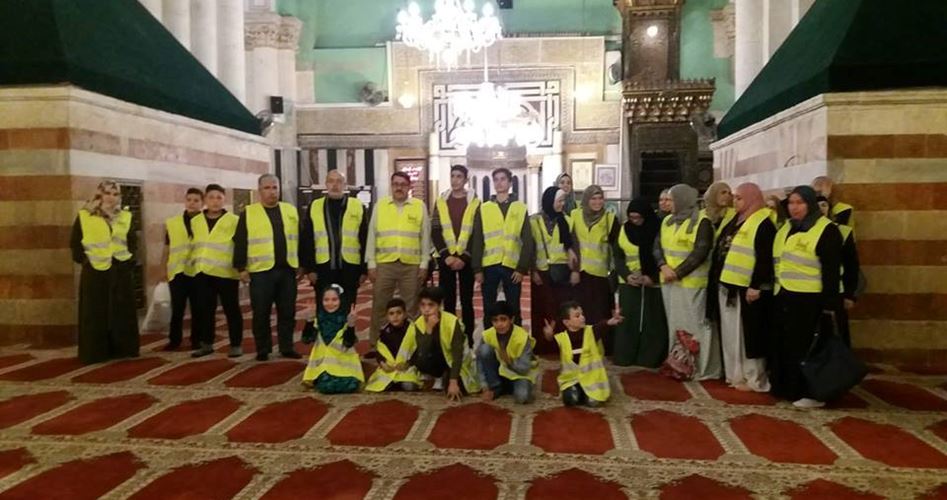
Palestinian youth at Ibrahimi Mosque
Palestine Information Center – November 30, 2018
AL-KHALIL – A Palestinian youth group calling itself “Let’s Walk to the Haram” has launched an initiative in al-Khalil aimed at reviving its Old City and encouraging citizens to pray at the Ibrahimi Mosque.
Young men and women of different ages are participating in this initiative, and they organize tours to the Ibrahimi Mosque, pray collectively inside it and raise public awareness on the importance of visiting the holy site and protecting it against attempts to Judaize it by Jewish groups, settlers and their right-wing government.
The Palestinian group has urged the Palestinian citizens in al-Khalil and the West Bank to participate in the tours it organizes at the Mosque and not to fear any assaults and acts of bullying by Jewish settlers during their presence in the Old City and the Ibrahimi Mosque.
The Ibrahimi Mosque is being exposed to systematic Judaization and attempts by settlers to change its interior appearance in order to make it look like a synagogue and to gradually prevent Muslims from entering it.
Jewish Americans sue Airbnb over West Bank listing ban
MEMO | November 29, 2018
A group of Jewish Americans sued Airbnb Inc on Wednesday in US federal court, accusing the home rental company of religious discrimination over its decision last week to remove listings for about 200 homes in the Israeli-occupied West Bank, Reuters reports.
The 18 plaintiffs, including Israeli-American families and individuals who said they own or wish to rent affected homes, accused Airbnb of “redlining” Jewish-owned properties while letting Muslims and Christians rent their homes.
They said this effectively left Airbnb taking sides in the dispute over the West Bank, where Palestinians hope to establish an independent state and which Israel captured in 1967, along with East Jerusalem.
“We don’t believe this lawsuit will succeed in court, but we know that people will disagree with our decision and appreciate their perspective,” Airbnb said in a statement.
The complaint was filed in federal court in Delaware, where Airbnb is incorporated, and which the plaintiffs said has jurisdiction over the San Francisco-based company’s alleged violation of US laws against housing discrimination.
“Airbnb has made a religion- and nationality-based decision about who can list,” Robert Tolchin, a lawyer for the plaintiffs, said in an interview. “It decided in the United States, ‘We will not list for Jews in the West Bank.’ It should be equal access for all.”
The plaintiffs are seeking injunctive relief and unspecified damages, including for lost rental income.
A separate lawsuit challenging Airbnb’s policy was filed in a Jerusalem court on Nov. 22.
The Delaware case differed by claiming that “Airbnb is violating Americans’ rights, and this can’t be argued in an Israeli court under Israeli law,” Nitsana Darshan-Leitner, another lawyer for the plaintiffs, said in an interview.
Most world powers believe Israel’s settlements on occupied Palestinian land violate international law.
Roughly 500,000 Israelis live in settlements in the West Bank and East Jerusalem.
Airbnb’s delisting was announced on Nov. 19 and applies only in the West Bank, where Palestinians have limited self-rule under Israeli military occupation.
While concluding that “companies should not profit on lands where people have been displaced,” Airbnb said it had “deep respect” for the “many strong views” about what to do with disputed lands.
Palestinians in the West Bank have welcomed Airbnb’s decision.
The case is Silber et al v Airbnb Inc, US District Court, District of Delaware, No. 18-01884.
Airbnb pledges to remove occupied West Bank settlement listings, Israel hits back
RT | November 20, 2018
Global home-rental company Airbnb says it will remove listings of homes located in Israeli settlements in the occupied West Bank. Israeli officials have predictably called the move anti-Semitic and a surrender to terrorism.
Human Rights Watch applauded Airbnb’s move, which came a day before the group’s publication of a (presumably damning) report on the human rights impact of tourist rental listings in settlements. Waleed Assraf, who runs an anti-settlement group for the Palestinian Liberation Organization, was hopeful other companies would follow Airbnb’s example, noting “this will contribute to achieving peace.”
Israeli Tourism Minister Yariv Levin called Airbnb’s move “discriminatory” and ordered his ministry to formulate a retaliatory plan to “limit the company’s activities” in Israel, adding that the country would back settlement listers’ lawsuits in both Israeli and US courts.
Michael Oren, former Israeli ambassador to the US and current deputy minister in PM Netanyahu’s office, called for a revenge boycott, deeming AirBnB’s policy “the very definition of anti-Semitism.” Settler council Yesha agreed that the company’s actions “can only be a result of anti-Semitism or surrendering to terrorism – or both.”
A statement on Airbnb’s website read “We concluded that we should remove listings in Israeli settlements in the occupied West Bank that are at the core of the dispute between Israelis and Palestinians,” explaining that their policy for contested territories like the West Bank, Tibet, and Western Sahara involves “evaluat[ing] whether the existence of listings is contributing to existing human suffering” and “determin[ing] whether the existence of listings in the occupied territory has a direct connection to the larger dispute in the region.” About 200 listings are affected, though they have not yet been taken down.
Palestinian official Saab Erekat wrote to Airbnb’s CEO in January 2016 asking the company to end its relationship with Israeli settlements, and Human Rights Watch called on all businesses to cut ties with companies operating in West Bank settlements in its “Occupation, Inc.,” report shortly thereafter, explaining that the income from such companies relieves the Israeli government of the economic burden of sustaining the illegal settlements. The international Boycott, Divestment and Sanctions movement has also called for travelers to avoid the home-rental service.
The Israeli settlements, constructed on land captured during the 1967 war, are illegal under international law, but Israel has long disputed this. Settlements have been gradually encroaching on Palestinian land ever since the end of the conflict, accompanied by a heavy military presence and the violence that accompanies it.
Israeli Government Targets Educational Institutions, Escalate Settlements Activities

Israeli settler violence – with IDF complicity – is becoming more and more commonplace, even targeting elementary schools. The government has also approved extensive Israeli settlement expansions and Jewish-only roads to be built on Palestinian land, which will result in isolation of Palestinian communities and loss of olive trees.
In addition, Jerusalem has seen an increase in extremist Jewish visits to the Al-Aqsa mosque.
By Madeeha Araj, The National Bureau for Defending Land and Resisting Settlements
Translation by If Americans Knew | November 14, 2018
School attacks and demolitions
In a clear violation of all laws and human rights principles, including the right to education and access to educational institutions, many Palestinian schools in the countryside and Bedouin communities were attacked by Israeli soldiers and settlers.
The Oref and Luban Sharqeia schools south of Nablus were attacked. 7 students were injured during the attack.
There were also shooting attacks by settlers and the Israeli occupation forces in the yard of Al-Tahadi 5 Elementary School in the village of Beit Ta’mir, east of Bethlehem, and the Tahadi 10 School in the Ibzik area in the occupied Northern Valleys. A number of caravans used as classrooms were destroyed.
The Israeli occupation forces handed down notices to demolish the Dabba Elementary school in Mafasser Yatta, south of Hebron, and to expel its teachers and students. They also hindered access to a school on Ramallah’s main Nablus Street.
Within the context, the racist “Rajavim Institution” filed a case in an Israeli court to demolish the Tahadi school in the area of Beit Ta’mir, east of Bethlehem, which has been subjected to demolition since it was demolished on the first day of the scholastic year of 2016-2017. This racist institution is responsible for monitoring Palestinian homes in Area C, and it is always directing the Israeli Civil Administration to demolish houses and stop construction there.
Settlement expansions
At the same time, the Israeli occupation government escalated the open war against the Palestinian people. The Jerusalem District Planning and Building Committee approved the construction of 640 new settlement units in the Ramat Shlomo settlement on Palestinian land in Shufat. It is located between Ramat Shlomo and Beit Hanina in Jerusalem.
Some of these lands were expropriated from the Palestinians under the pretext of using them as public areas.
The construction of those new settlement units will lead to the encirclement of the Palestinian neighborhoods adjacent to the settlement and their isolation from any natural demographic expansion or growth.
The administrative committee of the settlement of Ramat Shlomo said that the decision to establish 1,500 settlement units includes two entrances to the south and east of the settlement, in addition to expanding the northern road with St. 443, and the tendering of 640 settlement units,
The so-called Appeals Committee of the Israeli Planning Council in Jerusalem rejected projects submitted by Palestinian Human Rights organizations aimed at stopping excavations and digging tunnels in Silwan, while approving settlement projects that penetrate Palestinian neighborhoods.
During a closed discussion and without prior announcement, the committee responded to the Silwan “alternative project” As an alternative structural plan for the municipality of the occupation after an objection by the Alad settlement association. Alad oversees the so-called King’s Garden, and rejected the request to reveal the level of excavations under the town of Silwan – Wadi Hilweh and Al-Ain area, and considered that as out of its jurisdiction.
The committee also approved the linking of the settlement of Ramat Shlomo with bypass road 443 Modi’in – Tel Aviv, Jerusalem, on Route 21, which runs through the village of Shu’fat and isolates it from the thousands of dunums between St. 21 and 443 on the Jerusalem – Tel Aviv road.
Land seizure
In the Ramallah Governorate, the Israeli occupation forces seized 155 dunums of land in the western village of Laban to expand the settlement of Beit Aryeh, and open settlement roads to connect the settlements northwest of Ramallah into the settlement of Ariel in the West Bank Occupied West Bank.
There was also a decision to seize 2 dunum from Khallet al-Shamiya, 141 dunums from the village of Al Asfoura and 12 dunums from Masodiya area, with the aim of constructing the aforementioned bypass road to the settlement of Beit Aryeh.
In the Jordan Valley, the Israeli occupation forces seized 356 dunums of land near the village of Makhoul in the northern Jordan Valley, where one of the shepherds found the notification when he had his livestock in the area. Hr poinyrf out that the occupation placed the notification days ago at an electric columns feeding the army camps. The lands are located in four numbered basins 223, 224, 221 and 226.
The Israeli occupation forces have also put a number of notices at the olive farms that stated the uprooting trees within 45 days.
The lands belong to citizens Izat Ahmed Rashaida – 40 trees, Amer Hamil – 45 trees, Hassan Mahmoud Humil – 25 trees, Omar and Mah’d Saleh Sawafta – 150 trees. The trees are between 2-20 years old.
Settlers and Knesset members in Al-Aqsa mosque
Part of the occupation policy is aimed at providing personal security to the religious settler groups, who have been recently roaming the Old City, especially the roads leading to the Al-Aqsa Mosque. Moreover, the Israeli authorities have begun to expand the monitoring network around Al-Aqsa Mosque and the surrounding areas.
The agreement includes the planting of more than 500 smart monitoring cameras in a project called the “Kikra 2000.” Meanwhile the Israeli police allowed a number of Knesset members to visit the Al-Aqsa Mosque. Police in Jerusalem, Major General Yoram Halevy, have quoted as saying: “If the situation continues the same in Al-Aqsa, restrictions on visits by members of the Knesset will be removed”.
In an attempt to legitimize the daily incursions of settlers by the Israeli government’s into the Al-Aqsa Mosque, PM Netanyahu allows Israeli right-wing members to break into the Aqsa once a month instead of one per 3 months. Thus Netanyahu allowed MK Shuli Maallem Raafaili of the far-right Jewish party to storm the Al-Aqsa Mosque, which the Israeli-Yemeni parties call it the Temple Mount.
This decision reflects the adoption of the recommendation of the Jerusalem District Commander, Yoram Halevy, to allow Knesset members to visit the area without any restrictions. For his part, Shuli Maalem, a member of the Israeli Knesset led a provocative incursion into the Al-Aqsa Mosque, and toured it. It is said that a similar storm led by the extremist rabbi, MK, Yehuda Glick of the blessed mosque and carried out tours throughout the mosque.
The National Bureau said that “the continued violation of the sanctity of the Al-Aqsa Mosque requires the intervention of the international community to pressure the occupation authorities to stop such acts and to abide by the provisions of international humanitarian law.”
Hebron is braving a storm of Judaisation

Israeli soldiers detain a Palestinian youth in the West Bank city of Hebron, on 22 September 2017 [Mamoun Wazwaz/Apaimages]
By Nabil Al-Sahli | MEMO | November 9, 2018
The ongoing and intense settlement activity in the occupied West Bank city of Hebron confirms Israel’s deliberate policy to empty it of its Arab inhabitants and Judaise it. The Palestinian city remains the second most targeted area for illegal Jewish settlements after Jerusalem. The first settlement activity in the West Bank was the establishment of the Kfar Etzion kibbutz in the strategic area bordering Hebron.
We can say with certainty that Israel’s plans for the Ibrahimi Mosque in Hebron are no less dangerous than its Judaisation plans for Al-Aqsa Mosque in Jerusalem. Over the years, the Israeli settlers have turned a major section of the mosque into a synagogue. We do not doubt that the settlers intend to take over completely in the months and years ahead.
Perhaps it was precisely for that reason that the Israeli government announced recently a new settlement plan targeting the heart of Hebron in order to link the settlements built across the city by means of new illegal blocs. The government is funding the construction of a settlement on Al-Shuhada Street in the old city, taking advantage of Donald Trump’s Presidency in the US to adopt and “legitimise” its settlement policy in Palestine, even though all Jewish settlements across the occupied Palestinian territories, including Jerusalem, are illegal under international law. This is especially the case in Hebron and Jerusalem, which are both earmarked for even more Judaisation.
The purpose of the latest settlement outpost in Hebron is to create a new military checkpoint to harass and increase the suffering of the Palestinians prior to their eventual expulsion. The site on Al-Shuhada Street belongs to the Hebron municipality. The occupation authorities confiscated it for use as an army base and a location for settlers’ caravans. Defence Minister Avigdor Lieberman made the announcement of the 31 settlement units to be built in the heart of Al-Shuhada Street, approved by the so-called Civil Administration and Israeli government, and funded by the latter.
A few months ago Lieberman ordered the establishment of an authority to manage the municipal affairs of the settlement bloc located in the centre of Hebron. This is a Judaisation measure taken against the city’s Palestinian inhabitants with the purpose of strengthening the powers of the settlers who had previously managed their daily affairs by means of a council, which had no “legal” status.
Israel has portrayed this as being necessary to strengthen the Jewish community in the city and as a very important move in order to continue and develop settlement expansion in the West Bank, despite the existence of Palestinian-Israeli arrangements agreed in 1997 that divided Hebron into two parts. The first was the 80 per cent of the city under the complete jurisdiction of the Palestinian Authority while the remaining 20 per cent was supposed to be under Israeli security control and Palestinian civil control. Since then, the entire city was supposed to have been under the jurisdiction of the Palestinian Hebron municipality (with a population of 260,000 Palestinians and 800 Jewish settlers).
For the purpose of Judaising Hebron and displacing its indigenous Palestinian people, there have been non-stop attacks since the city’s occupation in 1967. There is a consensus among all Israeli parties to establish an administration to manage settler affairs in the city and to promote settlement activity. This explains Prime Minister Benjamin Netanyahu’s practical support for intensifying settlement activity in the West Bank, which is basically an execution of the project to annex Palestinian areas to Israel by means of “legitimate” demarcation and recognition of illegal settlements, along with granting them sovereignty.
It is a well-known fact that the establishment of settlements violates all international principles and customs, as well as the UN Charter, which outlines a long series of restrictions imposed on any occupying forces, including Israel’s. The essence of this bans occupiers from settling their own citizens in areas under occupation. This has been reiterated by UN Resolutions which deny any legal status to the Jewish settlements and ban their annexation by Israel. Indeed, the resolutions call for the dismantling of the settlements, not simply “freezing” settlement activity. The settlements in Jerusalem and Hebron are covered by this requirement.
Israel’s construction of additional settlements, and expansion of existing sites, violate Palestinian rights and international laws and conventions. The decision to build settlement blocs in Hebron and establish a council to manage Jewish settler affairs in the city breaches UN Security Council Resolution 2334. Israel should be condemned for treating international law with such contempt.
This article first appeared in Arabic in the Palestinian Information Centre on 8 November 2018
Read also:
Israel settlers storm Palestinian homes in Hebron
Israel army ‘violently harasses Palestinian family at home’ in Hebron
Hebron: Seven weeks after the murder of Wael Fatah Ja’aberi by Israeli Forces, family still awaits his body for burial.
International Solidarity Movement | October 28, 2018
Hebron, occupied Palestine – On Monday October 22, the family of Wael Fatah Ja’aberi gathered in Ibn Rush square in downtown Hebron to protest the murder of their son and the decision of Israeli forces not to return his body to their family for more than a month. In September, Ja’aberi was killed in a combined settler and soldier ambush. His body has still not been returned to his family, who have erected an information/communication tent in the main square of downtown Hebron in protest.
A week after the Ja’aberi family erected their protest tent downtown, fathers who lost their sons in similar incidents, gathered in the tent and showed their solidarity.

The Ja’aberi family demanded the body of slain Wael, but is waiting in vain for any answer since September 9, 2018 – the day of the brutal incident.
On Monday evening 9/9/2018, Wael Fatah Ja’aberi, a 37 year old father of two children, was shot down close to his home, near the intersection of the Hebron H1/H2 area division, from the entrance of the illegal settlement Givat Ha’avot, by a settler and a soldier.
According to witnesses, Wael and his 9 year old son were walking from their home to a nearby shop, for which they had to pass the road close to a the entrance of the illegal Israeli settlement Givat Ha’avot .
When they approached the location of the entrance, still 20 meters away from it, a settler together with a soldier ambushed and killed the 37 year old father.
His 9 year old son was lucky to escape and could run back home, in shock of the cruelty he went trough. As it seems, the armed settler fired at Wael and his son, after which a soldier, present at the checkpoint, continued the shooting with several live bullets.
Israeli forces left Ja’abari bleeding to death, without giving or allowing him any kind of medical assistance.
No health care was given or allowed. The Israeli ambulance belongs to Ofer, a paramilitary settler of Kyriat Arba – not a medic.
Video recordings of this fatal incident were posted on the internet. (here, here and here)
The Israeli military claimed afterwards, that it was self defense against a stabbing attack, and did not contact the family. This claim is disputed, however, given Israeli forces’ history of planting knives on murdered Palestinians and given the fact that Ja’abari was walking with his 9 year old child. No footage of the many security cameras on that location has ever been released.
Stealing corpses in the aftermath of a unlawful execution, is a standard procedure of the Occupation. Between 2008 and 2018 Israel held back more then 280 corpses.
Palestinian Woman Stoned to Death by Israeli Settlers
IMEMC News – October 13, 2018
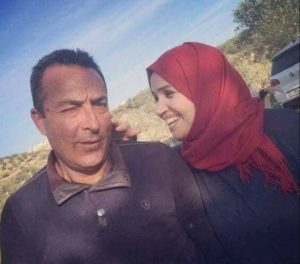 A group of Israeli paramilitary settlers attacked a Palestinian couple south of Nablus, in the northern part of the West Bank, on Friday, killing the woman and severely injuring her husband.
Aisha Mohammed Talal al-Rabi, 47, was riding in a car with her husband near the Za’tara roadblock, south of Nablus, in the northern part of the West Bank, when a group of Israeli settlers came onto the road and began throwing rocks at their car.
The slain woman was from Bidya town, northwest of Salfit.
The Israeli colonial settlers threw a number of large rocks, breaking the windshield of the car. They then continued to throw rocks, according to local sources, hitting the couple multiple times in the head and upper body.
Aisha died of blunt force trauma to the head, caused by a rock that was thrown at her head by the settlers.
Armed Israeli paramilitary settlers have launched a number of attacks on the Palestinian civilian population in the Nablus area, with the number of attacks drastically increasing since two Israeli settlers were killed by a Palestinian in the area on Monday.
Jerusalem: Israel settlers occupy buildings near Al-Aqsa Mosque
MEMO | October 4, 2018
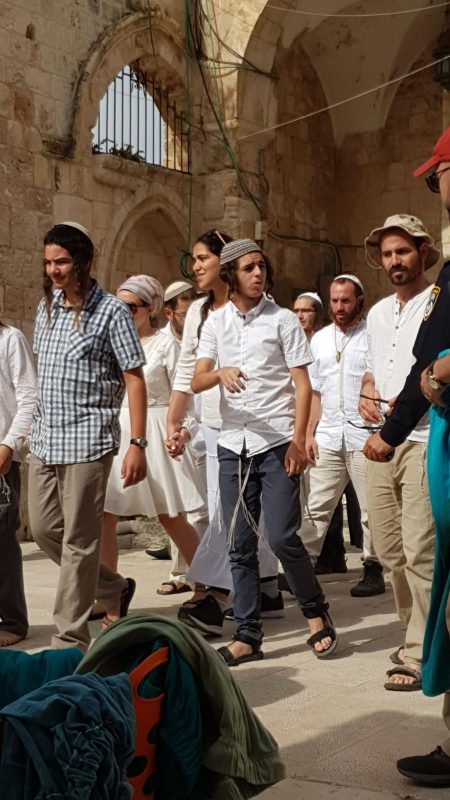 Israeli settlers have occupied two Palestinian buildings near Al-Aqsa Mosque in occupied East Jerusalem.
In the early hours of this morning, Israeli settlers stormed a building in the Muslim Quarter of the Old City. According to Wafa, the “settlers moved into the building owned by the Joudeh family, which was used as a clinic” in the Aqbat Darwish area, near Al-Aqsa Mosque.
This was the second building in Jerusalem to be taken over in the past two days. Yesterday settlers occupied a building in the Wadi Hilweh area of Silwan, situated just outside the walls of the Old City and below Al-Aqsa Mosque.
This is not the first time these areas have been targeted by illegal Israeli settlers, with Silwan in particular repeatedly facing attempts to drive Palestinian inhabitants from their homes. The “City of David” national park – a tourist site and archaeological dig run by right-wing settler group City of David Foundation (also known as Elad) – is situated in Batan Al-Hawa in Silwan and is frequently used as justification for such illegal activity.
In July, the Israeli Knesset advanced a new law that would allow residential construction in the “City of David” national park. According to a report by Haaretz, “the minutes of the [Elad] committee’s previous meeting in January made it clear that Elad and its leader, David Beeri, are behind the bill, which is designed to promote construction at the site.”
In August a “heritage centre” was opened in the park, with the inauguration attended by senior Israeli and US figures. A Palestinian resident of Silwan, Yakoub Al-Rajabi, explained that: “We know that this was a well-orchestrated plan to force us to leave […] And if we stay, it will paralyse us and isolate us in our homes”.
Since 2002, 700 Palestinians have been facing eviction from their land in Batan Al-Hawa. Their land was transferred to the Benvenisti Trust when Israel’s Justice Ministry issued title deeds to the organisation for the land in question. The trust is controlled by Ateret Cohanim, a right-wing organisation that encourages Jewish Israelis to settle illegally in Palestinian neighbourhoods of Jerusalem.
In June, Israel admitted that its decision to evict the Palestinians of Batan Al-Hawa was “flawed” and that it had not properly investigated the nature of the trust, or the Ottoman-era law that applies to the case. Despite the admission, a number of families have already been evicted from Batan Al-Hawa or are embroiled in court battles to save their homes.
Other areas of Jerusalem are also targeted for illegal Israeli settlement. According to statistics from the Jerusalem Institute, as of 2015 there were some 211,000 Jewish Israelis living in occupied East Jerusalem, amounting to 40 per cent of all inhabitants in these neighbourhoods. The statistics also demonstrate that the number of Israelis living in illegal Jerusalem settlements has grown consistently since the city was occupied in 1967.
READ ALSO: Israel settlers flood Khan Al-Ahmar with waste water
Israeli settler runs over Palestinian teen in Hebron City

Ma’an – September 21, 2018
HEBRON – A 16-year-old Palestinian teen was hospitalized after an Israeli settler “deliberately” ran him over, on Friday, in the Tel Rumeida neighborhood in the southern occupied West Bank city of Hebron.
Witnesses told a Ma’an reporter that an Israeli settler deliberately ran over the Palestinian teen with his vehicle in Hebron City.
The teen was identified by locals as Munir Abdullah Gharib, 16.
Mounir suffered injuries from the attack and was immediately transferred to the Alia Governmental Hospital in Hebron for necessary medical treatment; his condition remained unknown.
Incidents involving Israeli settlers hitting Palestinians in the occupied Palestinian territory are a relatively regular occurrence, and are usually treated by Israeli security forces as accidents, even in cases when witnesses claim the car rammings were deliberate.
Some 800 notoriously aggressive Israeli settlers now live under the protection of the Israeli military in the Old City, surrounded by more than 30,000 Palestinians.
Palestinian residents of the Old City of Hebron face a large Israeli military presence on a daily basis, with at least 32 permanent and partial checkpoints set up at the entrances of many streets.
Additionally, Palestinians are not allowed to drive on al-Shuhada street, have had their homes and shops on the street welded shut, and in some areas of the Old City, are not permitted to walk on certain roads.
Meanwhile, Israeli settlers move freely on the street, drive cars and carry machine guns.
A New Capital? Palestinians say Abu Dis is No Substitute for East Jerusalem
By Jonathon Cook | The National | September 11, 2018
From the offputting concrete edifice that confronts a visitor to Abu Dis, the significance of this West Bank town – past and present – is not immediately obvious.
The eight metre-high grey slabs of Israel’s separation wall silently attest to a divided land and a quarter-century of a failed Middle East peace process.
The entrance to Abu Dis could not be more disconcerting, given reports that Donald Trump’s administration intends it to be the capital of a future Palestinian state, in place of Jerusalem.
The wall, and the security cameras lining the top of it, are the legacy of battles for control of Jerusalem’s borders. Sections of concrete remain charred black by fires residents set years ago in the forlorn hope of weakening the structure and bringing it down.
Before the wall was erected more than a decade ago, Abu Dis had a spectacular view across the valley to Jerusalem’s Old City and the iconic golden-topped Dome of the Rock, less than three kilometres away. It was a few minutes’ drive – or an hour’s hike – to Al Aqsa mosque, the third holiest site in Islam, and the Church of the Holy Sepulchre, the reputed location of Jesus’s crucifixion.
Now, for many of the 13,000 inhabitants, Jerusalem might as well as be on another planet. They can no longer reach its holy places, markets, schools or hospitals.
Abu Dis, say its residents, is hemmed in on all sides – by Israel’s oppressive wall; by illegal Jewish settlements encroaching relentlessly on what is left of its lands; and by a large, Israeli-run landfill site that, according to experts, is a threat to human health.
The Palestinian authorities do not even control Abu Dis. The Israeli security cameras watch over it and armoured jeeps full of Israeli soldiers make forays at will into its crowded streets.
Perhaps fittingly, given the Palestinians’ current plight, Abu Dis feels more like it is being gradually turned into one wing of a dystopian open-air prison than a capital-in-waiting.
Abu Dis repackaged
Nonetheless, the town has been thrust into the spotlight. Rumours have intensified that US President Trump’s promised peace plan – what he terms the “deal of the century” – is nearing completion. His son-in-law, Jared Kushner, has been drafting it for more than a year.
Back in January Mahmoud Abbas, the Palestinian leader, confirmed for the first time that the White House was leaning on him to accept Abu Dis as his capital.
The issue has become highly charged for Palestinians since May, when Mr Trump overturned decades of diplomatic consensus by moving the US embassy from Tel Aviv to Jerusalem.
That appeared to overturn a once widely shared assumption that Israel would be required to withdraw from East Jerusalem, which it occupied in 1967, and allow the Palestinians to declare it their capital.
Instead Mr Kushner and his team appear to believe they can repackage Abu Dis, just outside the city limits, as a substitute capital.
How plausible is it that the Palestinians can accept a ghettoised, anonymous community like Abu Dis for such a pivotal role in their nation-building project?
Symbolic power
Ghassan Khatib, a former Palestinian cabinet minister, said Mr Trump would find no takers among the Palestinian leadership.
“A Palestinian state without Jerusalem as its capital simply won’t work. It’s not credible,” he said. “It’s not just Jerusalem’s religious and historic significance. It also has strategic, economic and geographic importance to Palestinians.”
The people of Abu Dis appear to feel the same way, with many pointing to Jerusalem’s enormous symbolic power, as well as the potential role of international tourism in developing the Palestinian economy.
Abu Dis, however, is unlikely ever to attract visitors, even should it get a dramatic makeover.
The approach road, skirting the massive settlement of Maale Adumim, home to 40,000 Jews, is adorned with red signs warning that it is dangerous for Israelis to enter the area.
The section of wall at the entrance to Abu Dis alludes to the residents’ growing anger and frustration – not only with Israel but some of their own leaders.
Artists have spray-painted a giant image of Marwan Barghouti, a Palestinian resistance leader imprisoned by Israel for the past 16 years. It shows him lifting his handcuffed hands to make a V-for-victory sign.
But noticeably, next to him is a much smaller image of Mr Abbas, president of the Palestinian Authority, whose face has been painted out. He has come under mounting domestic criticism for maintaining Palestinian “security cooperation” with Israel’s occupation forces.
Resentment at such cooperation is felt especially keenly in Abu Dis. Large iron gates in the wall give the Israeli army ready access in and out of the town.
An orphaned town
Under the Oslo accords signed in the mid-1990s, all of Abu Dis was placed temporarily under Israeli military control, and most of it under Israel’s civil control also. That temporary status appears to have become permanent, leaving residents at the whim of hostile Israeli authorities who deny building permits and readily issue demolition orders.
The restrictions mean Abu Dis lacks most of the infrastructure one would associate with a city, let alone a capital.
Abdulwahab Sabbah, a local community activist, said: “We are now a small island of territory controlled by the Israeli army.
“Not only have we lost our schools, the hospitals we once used, our holy places, the job opportunities that the city offered. Families have been split apart too, unable to visit their relatives in Jerusalem.
“We have been orphaned. We have lost Jerusalem, our mother.”
A short drive into Abu Dis and the shell of a huge building comes into view, a reminder that the idea of an Abu Dis upgrade is not the Trump administration’s alone.
In fact, noted Mr Khatib, Israel began rebranding Abu Dis as a second “Al Quds” – the Holy City, the Arabic name for Jerusalem – in the late 1990s, after the Oslo agreement allowed Palestinian leaders to return to Gaza and limited parts of the West Bank.
The Palestinian leadership, desperate to get a foothold closer to the densely populated neighbourhoods of East Jerusalem, played along. They expected that Israel would eventually relinquish Abu Dis to full Palestinian control, allowing it to be annexed to East Jerusalem in a future peace deal.
View of al-Aqsa
In 1996 the Palestinians began work building a $4 million parliament on the side of Abu Dis closest to Jerusalem. The location was selected so that the office of the late Palestinian leader Yasser Arafat would have a view of Al Aqsa.
Reports from that time talk of Abu Dis becoming a gateway, or “safe corridor”, for West Bank Palestinians to reach the mosque. One proposal was to build a tunnel between Abu Dis and the Old City.
However, with the outbreak of hostilities in 2000 – a Palestinian intifada – work on the parliament came to a halt. The interior was never finished, and there is now no view of Al Aqsa. The parliament too is sealed off from Jerusalem by the wall.
Since then Israel has barred the Palestinian Authority from having any role in East Jerusalem.
Khalil Erekat, a caretaker, holds the key to the unused parliament. Once visitors could inspect the building, including its glass-domed central chamber. Now, he said, only pigeons and the odd stray dog or snake ventured inside.
“No one comes any more,” he added. “The place has been forgotten.”
And that, it seems, is the way Palestinian officials would prefer it. With the Trump administration mooting the town as a substitute capital, the parliament is now an embarrassing white elephant.
Requests from The National to the Palestinian authorities to visit the building were rejected on the grounds that it was no longer structurally safe.
Eyesore ghetto
Evidence of how quickly Israel has transformed Abu Dis from a rural suburb of Jerusalem into an eyesore ghetto are evident in the homes around the parliament.
A once-palatial four-storey home next door would be more in place in war-ravaged Gaza than an impending capital. Its collapsed top floors sit precariously above the rest of the structure.
Mohammed Anati, a retired carpenter aged 64, is a tenant occupying the bottom floor with his wife and three sons.
He said the destruction was carried out by the Jerusalem municipality several years ago, apparently because the upper floors were built in violation of planning rules Israeli military authorities imposed after 1967.
Neighbours speculate that, in fact, Israel was more concerned that the top of the building provided views over the wall.
Mr Anati said that, paradoxically, the Jerusalem municipality treated this small neighbourhood next to the wall as within its jurisdiction. “We have to pay council taxes to Jerusalem even though we are cut off from the city and receive no services,” he said.
Asked whether he thought Abu Dis could be a Palestinian capital, Mr Anati scoffed. “Trump will offer us the worst deal of the century,” he said. “Jerusalem has to be the capital. There is nothing of Jerusalem here since Israel built the wall.”
Only pigeons still free
Nearby, Ghassan Abu Hillel’s two-storey home presses up against the grey slabs of concrete. He said cameras on the top of the wall monitored his and his neighbours’ activities around the clock.
His family moved to this house in 1967, when he was 14 years old, and shortly before Israel occupied Abu Dis, along with the rest of the West Bank and East Jerusalem.
Until the wall was constructed, he spent his time herding sheep and goats on the surrounding hills.
Now he has had to corral them into a corner of the wall. Their improvised pen is daubed with graffiti: “Take an axe to the prison wall. Escape.”
His herd of what was once more than 200 sheep is down to barely a dozen. The animals can no longer graze out on the hills, and he cannot afford the cost of feeding them.
Unlike Mr Abu Hillel and the sheep, his pigeons still enjoy their freedom. “They can fly over the wall and reach Jerusalem whenever they want,” he said.
His family owned much of the land surrounding Abu Dis before 1967, he added, but almost all of it had been taken by Israel – originally on the pretext that it was needed for military purposes.
Since then, Israel has built a series of Jewish settlements on the surrounding land, including Maale Adumim, Kfar Adumim and Kedar.
In the early 1980s it also opened a landfill site to cope with the region’s waste. In 2009 the United Nations warned that toxic fumes from waste-burning and leakage into the groundwater posed a threat to local inhabitants’ health.
A bluff from Israel
Some residents are actively finding ways to break out of the isolation imposed on Abu Dis by Israel.
Mr Sabbah is a founder of the Friendship Association, which encourages exchange programmes with European students, teachers and youth clubs. His most successful project is the twinning of Abu Dis with the London borough of Camden.
Mr Sabbah’s prominent political activities may be one reason why his home – along with the local mayor’s – was one of 10 invaded in the middle of the night on September 4.
The operation had the hallmarks of what former Israeli soldiers from the whistleblowing group Breaking the Silence have termed “establishing presence” – military training exercises designed to disrupt the lives of Palestinian communities and spread fear.
Mr Sabbah is sceptical that the Abu Dis proposal by the Trump administration has been made in good faith.
“It’s a bluff,” he said. “Israel has shown through all its actions that it does not want any Palestinian state – and that means no capital, even in Abu Dis.
“It is being offered only because Israel knows no Palestinian leader could ever accept it as a capital. And that way Israel can again blame us for being the ones to reject their version of ‘peace’.”
An oasis of normality
Amid its confinement, however, Abu Dis does have one asset – a university – that now attracts thousands of young Palestinians, though it adds to overcrowding.
The main campus of the Palestinian-run Al Quds university has been operating in Abu Dis since the 1980s.
Sitting on the crossroads between the Palestinian cities of Bethlehem and Nablus to the south, Jericho to the east, and Ramallah to the north, the Abu Dis campus has grown rapidly. It has profited from the fact that West Bank Palestinians cannot access another campus of Al Quds university in East Jerusalem.
The university is enclosed and security is tight. Inside, students enjoy spacious grounds with shaded gardens, a small oasis of normality where it is possible briefly to forget the situation outside.
Nonetheless, the university is not immune from Israeli military operations either. On September 5, soldiers shut down the campus and nearby schools, as they reportedly fired tear gas, stun grenades and rubber bullets at youths.
Omar Mahmoud, aged 23, a medical student from Nablus, raised his eyebrows at the suggestion that Abu Dis could serve as the Palestinians’ capital.
“It’s fully under Israeli control,” he said. “One side there is the wall and on the other side there are Israeli settlements. There are no services and it just gets more crowded by the year.”
He has shared an apartment with other students in Abu Dis for five years. He said: “To be honest, I can’t wait to get out of here.”
Featured Video

Iran’s Next Strike May Not Explode. It Could Shut You Down
or go to
Aletho News Archives – Video-Images
From the Archive
Zionism’s Violent Legacy
By Donald Neff | Washington Report On Middle East Affairs | January 1996
On January 4, 1948, Jewish terrorists drove a truck loaded with explosives into the center of the all Arab city of Jaffa and detonated it, killing 26 and wounding around 100 Palestinian men, women and children.[1] The attack was the work of the Irgun Zvai Leumi – the “National Military Organization,” also known by the Hebrew letters Etzel – the largest Jewish terrorist group in Palestine. The Irgun was headed by Revisionist Zionist Menachem Begin and had been killing and maiming Arabs, Britons and even Jews for the previous ten years in its efforts to establish a Jewish state.
This terror campaign meant that at the core of Revisionist Zionism there existed a philosophical embrace of violence. … continue
Blog Roll
 Aletho News
- Trump’s Iran war is on an Israeli leash
- Saudi oil boss issues global supply warning
- Riyadh Says Its Oil System Is Intact. The Numbers Say Otherwise.
- Trump and Netanyahu Want to “Finish the Job” on Iran
- US ‘one-sided dictation’ not Iran’s beliefs makes rational talks impossible: Baghaei
- Iran’s Next Strike May Not Explode. It Could Shut You Down /Col Doug Macgregor
- Iran: US political targets legitimate if assassinations return
- Iraq shuts key border crossing with Iran under US pressure: Report
- Undersea Internet cables could be targeted in retaliation for attacks on Iran: IRGC deputy chief
- EU sending ‘biased’ observers to interfere in Serbian election – president
- If Americans Knew
- The Israel Lobby’s Changing Fortunes
- AIPAC has become such a political liability that it’s shifting to a more “nimble” approach to buying politicians
- At least 160 Israeli settler attacks in 2 weeks
- Will Gaza’s Ancient Christian Community Disappear Forever?
- Israel’s vision of regional security rests on keeping Arab states weak
- Heidi Levine recounts how Palestinian youths helped save her in settler attack
- DAILY UPDATE: Latest essential news on Palestine, Israel, & region
- Trump’s Intensifying Sabotage of the ICC, for Israel’s Sake
- Israeli military detain US and UK volunteers in West Bank including Democratic NY politician Brad Lander
- Americans at National Conservatism Conference held in Israel this year criticize Israel
- No Tricks Zone
- E-Cars Reduce CO2 Emissions By Only 41% Compared To Internal Combustion Engine Vehicles
- Predictions Made By Renowned Climate Professor Over Past Decades Have Been Proven To Be Poor
- New Study Suggests Large Regions Of The Pacific Ocean Have Been Cooling For The Last 80 Years
- Germany’s Green Energy Debacle: High Energy Costs Force Kahla Porzellan to Close After 182 Years!
- New Study: 50 Years Of The Most Aggressive ‘Net Zero’ Policies Can Only Affect The Global Climate By 0.03°C
- US September “Heat” Was No Record…Many Records Set Decades Ago
- Latest European Green Energy Debacle; Portugal’s Largest Flagship Solar Park Insolvent!
- Green Energy Debacle: German Expert Professor Fritz Vahrenholt Warns Of Severe Economic And Social Consequences
- Two More Paleo Reconstructions Affirm Meters-Higher Sea Levels Across Ireland, Brazil 7000-6000 Years Ago
- New Study: Earth And Venus Surface Warmth Largely Explained By Convection And Lapse Rate, Not CO2 Or Radiation

