Russia dials back peace talks with Japan
By M. K. BHADRAKUMAR | Indian Punchline | November 23, 2019
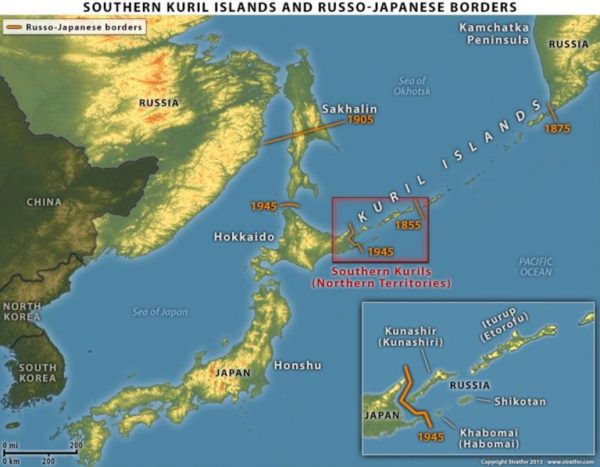
Russia-Japan territorial disputes surged at a meeting of foreign ministers of the two countries, Toshimitsu Motegi and Sergey Lavrov, at Nagoya, Japan, on November 22 on the sidelines of a G20 foreign ministers’ gathering.
Lavrov publicly threw cold water on the Japanese spin that Tokyo is engaged in “persistent talks” with Russia on a peace treaty bringing the two countries’ World War 2 hostility to a formal ending.
Lavrov emphatically stated that any forward movement on a peace treaty will have to be within the ambit of the Russia-Japan 1956 joint declaration, which, as he put it, “clearly states that first Russia’s territorial integrity and sovereignty over all our lands, including those territories, are recognised, thus recognising the results of World War II, and then everything else will possibly be discussed.”
In plain terms, according to Lavrov, Moscow may consider discussing a peace treaty only after Tokyo unequivocally recognises Russian sovereignty over Kuril islands and territories that came under Russian control in the Far East during World War 2.
Japan’s stance, on the contrary, can never converge on that point. Wouldn’t Moscow have known it already? Of course, Lavrov has only reiterated a consistent Russian stance.
Tokyo has been baiting Moscow with the proposition that a peace treaty will open the door to large-scale investments by Japanese companies for the development of the Russian Far East (which is a national priority for the Kremlin.)
Tokyo has also been smart, projecting Russian President Vladimir Putin as a strong but pragmatic statesman who is willing to make territorial concessions to attract Japanese investments.
But it takes two to tango and up to a point Moscow acquiesced with the Japanese enthusiasm that the two countries could be settling the Kuril issue — although making territorial concessions will be a highly emotive issue for the Russian public opinion.
Moscow probably pinned hopes that a relaxed climate of relations might wean Tokyo away from the US strategic orbit — although the likelihood of Japan shaking off the US security umbrella will remain zero for the conceivable future.
At any rate, that tango has ended and realism prevails, with the regional security climate in the Far East visibly darkening with the recent US cruise missile tests and the Pentagon’s plan to deploy new missiles in Japan following its exit from the INF Treaty (which had banned the intermediate-range missiles previously.)
Moscow is alert to the emergent threats to its strategic assets in the Russian Far East due to the US deployment. Importantly, Tokyo appears to be open to the proposed US missile deployments, which would further cement the US-Japan military alliance.
Unsurprisingly, Moscow has linked the regional security scenario to its territorial disputes with Japan. To quote Lavrov, “The military alliance with the US, of course, represents a problem when it comes to taking Russian-Japanese relations to another level. I will remind you that when the 1956 declaration was being coordinated, the USSR said back then that everything may be implemented, and this declaration may be fully implemented only in the context of discontinued US military presence on Japan’s territory.”
Lavrov added, “Japanese colleagues have received a list of Russia’s specific security concerns which emerge because of the increasing and strengthening Japanese-US military-political alliance. So our Japanese colleagues promised to react to those concerns. We will wait for their response and continue discussions.”
Lavrov also chose the G20 FMs’ forum at Nagoya to present Russian concerns over the security climate in the Far East. He said, “As for the US behaviour in the world, including in the Asia-Pacific region, in its relations with Japan, the United States does not hesitate to publicly acknowledge that Russia and China are the main threat to it and that all its military alliances with Japan, Australia and the Republic of Korea will be built proceeding from these threats and challenges.
“But, of course, we pointed out at a meeting with the Japanese foreign minister that this ran counter to the assurances, which Japan gives us that the Japanese-US military and political alliance is not aimed against the Russian Federation.” (TASS )
Meanwhile, Russia is speeding up the construction of military dormitories on the Southern Kuril Islands. A spokesman for Russia’s Eastern Military District said this week that military personnel would settle into the dormitories on Iturup and Kunashir by the end of 2018 and that more dormitories would be built and commissioned in 2019.
The Eastern Military District, which was formed in 2010 under a presidential decree, is headquartered at Khabarovsk in Siberia near the Chinese border and is one of the four operational strategic commands of the Russian Armed Forces.
The new US missile deployments in the Far East are of common concern to Russia and China. In August, Russia and China sought a meeting of the UN Security Council over “statements by US officials on their plans to develop and deploy medium-range missiles”.
Last month, Putin disclosed that Moscow is helping China build a system to warn of ballistic missile launches. Putin said “this is a very serious thing that will radically enhance China’s defence capability”. Since the cold war, only the US and Russia have had such systems, which involve an array of ground-based radars and space satellites. The systems allow for early spotting of intercontinental ballistic missiles.
China will find Lavrov’s remarks at Nogaya to be very reassuring. It is a safe bet that the Russia-Japan normalisation will be an excruciatingly slow process, which in turn works fine for China in geopolitical terms. Lavrov also had a meeting with Wang Yi, Chinese Councilor and Foreign Minister, at Nogaya.
Fukushima Disaster Puts Japan in ‘Nuclear Limbo’ Ahead of 2020 Tokyo Olympics – Pundit
Sputnik – September 14, 2019
On 10 September, Japanese authorities announced that Tokyo Electric Power (TEPCO), the operator of the Fukushima Daiichi power plant which in 2011 experienced the worst nuclear disaster since Chernobyl, currently has no technology to clear its wastewater from radioactive waste, and is instead discharging it into the sea.
More than a million tonnes of wastewater is reportedly stored in tanks at the Fukushima NPP (nuclear power plant). The facility is reportedly running out of available space and expects to exhaust its capacity by summer 2022. Japanese Environment Minister Yoshiaki Harada admitted earlier that “we have no way but to release it [into the sea] and dilute it”.
Local residents reportedly have deep concerns about the potential damage this move can inflict, especially to the fishing industry, which is essential for Japan.
Christina Consolo, a nuclear expert, has shared her view on the issue.
Sputnik: It’s been reported that there’s enough room to keep the liquid (1 million tons of contaminated water) through summer 2022, but after that, there will be no space left?
Christina Consolo: It was somewhat surprising at how quickly the Environmental Ministry in Japan made a decision to release the contaminated water once their official meeting convened. I am not surprised at all however by their decision.
The situation is very serious. There is no other option then to release the contaminated water, but under the control of TEPCO’s time and choosing, or it may be released for them. An earthquake could release it, a tsunami could release it, a typhoon could release it.
But releasing the water goes far beyond just a ‘storage issue’ alone; the tanks are also under duress for a number of reasons. If you recall, at the beginning of the original water storage, the tanks were not assembled properly. Concrete slabs were hastily poured without rebar reinforcement.
TEPCO workers had to drill holes in the tops of them to release hydrogen build-up, or risk explosion and collapse of the tanks themselves.
There have also been a series of leaks, due to miles of pipes and flushing radioactive water great distances through sometimes ducted-taped hoses, with at least one reaching the official scale of a Level 3 Nuclear Accident in and of itself, in July of 2015.
And the longer this radioactive water sits in these giant metal tanks, the matrix of the metal itself at the atomic level is undergoing acceleration of entropy, known as “The Wigner Effect” – named after Professor Eugene Wigner, who discovered it at the Oak Ridge Laboratory while doing research for the US Government during World War II.
Metal exposed to radiation creates embrittlement issues and acceleration of corrosion, the same problem that caused 16,000 cracks in the nuclear reactors in Belgium.
This is problematic for the biggest reason of them all: if any of these tanks leak or break open outside of the control of TEPCO and prevents workers from being able to continue the myriad of daily maintenance involved due to spillage of radioactive water, creating no-go zones within the site itself, then TEPCO can have yet another very serious situation on their hands, on top of everything else happening over there. Anything and everything must be done to assure that workers can continue with the tremendous daily management of what is still an ongoing Level 7 Nuclear Accident.
They can not risk waiting for the tanks to empty themselves.
Sputnik: What is going to happen next? Do you think this liquid is a real threat to the ecological situation?
Christina Consolo: Any radiation released to the environment is always going to have detrimental effects… the question is how much and how far will those effects extend from the site of the release. Without knowing what exactly is in those tanks, that question is impossible to answer.
I personally have issue believing the radioactive water contained within them only contains Tritium, as I have followed this story for over eight years, and I can say without a doubt that every machine brought in to ‘filter out’ radioactive substances has failed miserably, as has every camera, robot, robot claw, robot snake, robot on rollers, etc.
TEPCO also has a history of withholding important facts that also make them very untrustworthy.
But more importantly from an ecological perspective, and a far bigger issue though which is rarely discussed, is the groundwater that moves through the Fukushima site because of the geology of the surrounding features.
The plant was built on a riverbed, where the volcanic spine of Japan funnels water down from the mountains. Groundwater experts estimate that every single day somewhere between 5-15,000 tonnes of groundwater flow underneath the plant, and out to the Pacific ocean.
Keep in mind, the only remnant of the cumulative 450 tonnes of corium or melted nuclear fuel that has been found is splatter on the insides of the reactors, or pebble-like material and drips.
TEPCO still has not located the 3 melted cores after 8 years of looking, leaving a looming question of how far these cores travelled as they melted, and how much groundwater is making contact with these cores before pouring into the Pacific each day. They are concerned enough that they are still pouring 300 tonnes of water through them daily.
Is it 10 percent – 50 percent – 80 percent? How much of this natural groundwater flow is making contact with the cores, under the plant? We have no idea. If indeed this is occurring, which some Fukushima experts believe that it is, then the 1000 tanks are a ‘drop in the bucket’ in comparison to what may be pouring into the Pacific each and every day.
We need answers to these questions. It is abhorrent and inexcusable that with today’s known technology, TEPCO does not know where the cores are, 8 years after the accident. We have powerful ground penetrating radar that could likely tell, so why are they not telling us?
Sputnik: It’s been 8 years since the Fukushima disaster. How have Japanese authorities adapted to this situation?
Christina Consolo: The Japanese authorities that were in charge at the beginning of this disaster, such as former Prime Minister Kan, have expressed a tremendous amount of regret, and even guilt, over mistakes they made withholding information about how dangerous the situation was from the Japanese people in the early part of the accident.
The fact TEPCO outright lied that meltdowns had occurred from Day 1, even though every nuclear physicist in the world was aware they had, due to the presence of neutron beams occurring in 13 different locations on the site (which indicated at least one reactor was breached), is difficult to forgive considering the US had an entire fleet of Navy ships offshore providing humanitarian aid that were getting absolutely blasted by nuclear fuel including MOX and plutonium.
PM Abe is very pro-nuclear but his wife is not, making for an ongoing and very publicized drama in Japanese news, and the pushback from massive demonstrations by the Japanese people continue to this day on a weekly basis.
The people are fighting any and all attempts at restarting reactors, in a very hardcore way. The authorities are pretending everything is fine, focusing on the Olympics in 2020, and I am certain the water will be dumped long before then.
But the tanks are going to just get filled right back up again, after some unfortunate TEPCO workers climb inside and test them for metal fatigue issues.
Sputnik: What has changed in nuclear safety since Fukushima has occurred?
Christina Consolo: In Japan a majority of the reactors still remain shutdown, which is good considering they never should have been built there in the first place.
An article in The Japan Times predicted the Fukushima disaster in 2004, and there are no guarantees that TEPCO will always be able to keep the Fukushima site under control, or another earthquake and tsunami will cause a similar, or even larger disaster at another site, as there are so many littering Japan.
Japan sits in a highly unstable zone of 4 intersecting tectonic plates and the island has an enormous amount of earthquake and volcanic activity.
The US did review some of its safety measures after 3/11 but the problem is it keeps re-issuing licenses to old plants, with ageing infrastructure.
And many plants in the US, and worldwide, are also prone to earthquakes, tsunamis, flooding, hurricanes, even tornadoes and lightning strikes.
We have been playing with this very dangerous technology despite having no safe way to dispose of the waste, and many studies done over decades that prove that illnesses and cancer are extremely high the closer that you live to a nuclear plant.
Sputnik: Despite the Fukushima explosion, the Japanese government didn’t abandon its nuclear energy program. How do you explain this decision?
Christina Consolo: I can not answer that question. There is no logical answer for it, except to decommission a plant is outrageously expensive.
TEPCO announced in the past month it will be decommissioning the Fukushima Daini plant to the south, which also sustained damage in 2011.
Right now Japan is in a nuclear limbo of sorts, with the water tank problem, the fishery pushback, the Olympics in 2020, and the somewhat surreal efforts of the Japanese government to assure the world it can handle the Olympic athletes and crowds without making them sick.
There are always economic issues to consider, and the costs of decommissioning of two huge nuclear plants, one with 3 melted cores that have never been found.
Japan has a lot of convoluted issues surrounding nuclear and there is always the dark cloud over what is truth or fiction when it comes to TEPCO, and the nuclear industry in general. I really can not explain this decision at all.
Are India and Japan Challenging the BRI in Russia’s Far East?
By Paul Antonopoulos | September 11, 2019
Although the Russian Far East has huge investment potential in the fields of raw materials, mineral resources, fisheries, forestry’s and tourism, it still remains a sparely populated area of only around 7 million people. With China, India, Japan, Indonesia and Russia projected to be some of the world’s biggest economies by 2030 according to many experts, the 21st Century has been dubbed as the “Asian Century,” and it is for this reason that Russian President Vladimir Putin has prioritized the rapid development of the Russian Far East.
The region is not only resource rich, but is also conveniently located in northeast Asia, bordering Mongolia, China and North Korea, while sharing a maritime border with Japan. It is so strategic and rich that only weeks ago French President Emmanuel Macron expressed his belief that Europe stretches from Lisbon on the Atlantic Coast to the Russian Pacific port of Vladivostok. Vladivostok has hosted the Eastern Economic Forum annually ever since its establishment 2015, in part to attract foreign investors to diversify from only Chinese investments in the Russian Far East. China has invested tens of billions into the region, making it easily the biggest foreign investor in the region.
However, with Indian Prime Minister Modi on the eve of Vladivostok’s 5th Eastern Economic Forum proposing a trilateral cooperation between India, Russia and Japan by jointly developing the Russian Far East, it appears that China’s economic influence in the region will be challenged. Although China emphasizes peaceful relations through mutual economic development and prosperity, it still has frosty relations with Japan and India. It is therefore unsurprising that India and Japan have opted to invest in the Russian Far East to challenge China’s economic might in a region that also shares a vast border with China.
India, Japan and Sri Lanka signed an agreement to build a new container terminal in the port of Colombo, demonstrating that New Delhi and Tokyo have experience in cooperating in a trilateral format. With India opting to be the only South Asian country not involved in the Belt and Road Initiative (BRI), India continues to show coldness to China as the latter continues to rapidly develop neighboring countries, especially with Nepal and rival Pakistan. With the BRI developing Sri Lanka, it appears India and Japan are creating a new economic duo to match China’s economic strength, and are now prepared to take this to a new front away from Sri Lanka and to the Russian Far East.
Japan’s investments in the Russian Far East’s economy already exceeds $15 billion and will continue to develop, according to Japanese Prime Minister Shinzo Abe. And with India also expressing its interest, the Russian Far East has become a promising place for all prospectors. With Russian President Vladimir Putin offering free land handouts in the Far East to Russians and naturalized citizens in May 2016, it demonstrates that Russia has identified that if it wants to benefit from Asia’s rapid development and economic dominance in the 21st century, it needs to develop its regions in Asia.
With the development of the region naturally meaning increased trade and cultural exchanges with China, tens of thousands of Chinese citizens have now migrated to the region in search of opportunities and establish themselves as merchants and entrepreneurs. Whether we begin seeing Indian and Japanese merchants in the Russian Far East remains to be seen.
With India and China competing in Nepal and border issues on the Indian-Chinese frontier remaining unresolved in New Delhi’s eyes, it appears that India is now wanting to compete against China in a region that has had connections with China for millennia. Russia has been encouraging more and diversified investments in the Far East and Japan and India will take every opportunity to do this.
Russia and China remain strategic partners and are also pragmatic international players that continue to pursue a policy of non-interference. Therefore, although China has frosty relations with Japan and India, it can respect Russia’s ties with both countries. This pragmatism has now allowed India and Japan to engage in a friendly competition for economic influence over Russia’s resource rich region. Although both Japan and China invest in raw material and energy projects in the Far East, India will be a new player to this sector with Indian Oil and Gas Minister Dharmendra Pradhan expressing his long-term interest in the Russian coal and steel sector during his visit to Russia last week.
With India becoming increasingly energy hungry because of its enormous and growing population, alongside its economic development, it is easily seen why the resource rich Russian region is of critical importance to it. For Japan, the region presents unmatched economic opportunities. Most interestingly to observe is whether India and Japan will continue to work in trilateral formats to continue expanding their economic interests and challenge the BRI in other regions. It appears now that after their cooperation in Sri Lanka, their second step is to challenge the expansion of the BRI in Russia’s Far East by competing for lucrative contracts and opportunities that the region can offer.
Paul Antonopoulos is the director of the Multipolar research centre.
Japan won’t join US-led maritime coalition in Gulf: Report
MEMO | September 3, 2019
Japan will not join the United States in a security mission to protect merchant vessels passing through key Middle Eastern waterways and will instead consider deploying its military independently, the Yomiuri newspaper reported on Tuesday, Reuters reports.
Japan has been reluctant to join the United States, its most important ally, in its efforts to set up the coalition because of its close economic ties with Iran, a major supplier of oil.
Citing unidentified government sources, the Yomiuri said Japan was considering a plan to send its Maritime Self-Defense Force (SDF) on information-gathering missions in the areas around the Strait of Hormuz and Bab al-Mandab shipping lane between Yemen, Djibouti and Eritrea.
It would also consider including the Strait of Hormuz in the SDF’s sphere of activity if Iran agrees, the paper said.
Iran has denounced US efforts to set up the coalition and says countries in the region can protect waterways and work towards signing a non-aggression pact.
The Japanese government is set to make a final decision, including whether the plan is feasible, after the United Nations General Assembly later this month, the Yomiuri said.
Global commodity trading has been rocked in recent months by the seizure of a British tanker and a series of attacks on international merchant vessels that the US and Britain have blamed on Iran. Tehran denies involvement.
Britain last month became the first US ally to announce its participation, although most European countries have been reluctant to sign up for fear of adding to the tension in the region.
How Japanese scientists confronted the U.S. and Japanese governments to reveal the effects of Bikini H-bomb tests
By Okuaki Satoru¹ – The Asia Pacific Journal – September 1, 2019 – Volume 17 | Issue 17 | Number 2
Introduction and translation by Steve Rabson
Introduction
The March, 1954 “Bravo Shot” H-bomb test in the Pacific dumped radioactive debris on the Marshall Islands, U.S. servicemen, and the crew of a Japanese fishing boat. The multi-megaton blast infected Marshall Islanders with radiation sickness and caused cancers in the years that followed. Their contaminated home on Bikini Atoll remains uninhabitable to this day. U.S. servicemen who had been purposely transported by the Navy into the blast zone have suffered from multiple cancers from radiation exposure. For years their claims denied were denied by the Veterans Administration. It took an act of Congress in 1990 to provide compensation for them and their children with birth defects. The crew of the Japanese fishing boat, Lucky Dragon No. 5, suffered from acute radiation poisoning. One crew member, Kuboyama Aikichi (age 40), died while in treatment for exposure.

“Bravo Shot” H-bomb test, Bikini, March 1, 1954

U.S. military forcibly evacuating Marshall Islanders from Bikini Atoll

U.S. servicemen transported under orders into the Bikini blast zone

Japanese scientists examine the hull of contaminated Lucky Dragon at Yaizu City port
Okuaki Satoru tells below how Japanese scientists confronted, and eventually overcame, roadblocks thrown up by both the U.S. and Japanese governments to obtain urgently needed information for the treatment of radiation poisoning and to determine the extent of environmental contamination. As Jacob Darwin Hamblin and Linda M. Richards explain in the journal Historia Scientarium, “Japanese perspectives influenced several American scientists to think differently about the implications of nuclear tests for humans and the natural environment . . . despite stiff resistance from offices of the U.S. government.”2
The U.S. government withholds information on lethal fallout
On March 16, 1954, the newspaper Yomiuri Shimbun first reported victims of a U.S. nuclear test in the Pacific among Japanese crew members of the fishing boat Lucky Dragon. The U.S. government acknowledged that tests had been carried out, but, insisting on secrecy, refused to provide information about them to Japanese scientists. Today it is known that they were hydrogen bomb tests, but even that wasn’t disclosed at the time. The only information Japanese scientists could obtain was from radioactive contamination of the Lucky Dragon’s hull.
Several scientists visited the fishing port at Yaizu City in Shizuoka Prefecture and recorded high levels of radioactive contamination from fallout on the boat’s hull. Okano Masaharu, a specialist in measuring radioactivity, was twenty-eight at the time and on the faculty of the Institute for Scientific Research (now known as RIKEN).
After World War II when Japan was under Allied Occupation (1945-1952), research on atomic energy was strictly prohibited. However, in 1950 permission was granted for research on radioactive isotopes. Okano traveled throughout the country giving lectures to inform Japanese about isotopes, and became skilled in handling radioactive materials. On April 16, 1954, he traveled with his supervisor, Dr. Yamazaki Fumio, to examine the hull of the Lucky Dragon. A full month had passed since fallout had contaminated the boat, but both men were astonished to see the needle of their radiation meter swing wildly up into the danger zone. This was the first time they had detected significant radiation outside their laboratories, and it exceeded one hundred times the level occurring in nature. With the discovery that radioactive fallout had contaminated the Lucky Dragon, scientists at universities in Tokyo, Kyoto, Shizuoka, Osaka and Kanazawa began their own studies, communicating their findings by telephone.
Ikeda Nobutaka conducted research on radioactive fallout in Professor Kimura Kenjirō’s research laboratory in the Chemistry Department of Tokyo University. He also visited the Lucky Dragon at Yaizu, and collected samples of fallout-contaminated material. Returning with them to the laboratory, he and about a dozen other researchers spent the next several days and nights frantically analyzing the material out of acute concern for the Lucky Dragon’s crew.
“We needed the results as soon as possible,” said Ikeda, now eighty-eight. “Without knowing the characteristics of the fallout, there would be no way to find a treatment for the crew. We were also aware that the reputation of Japanese scientists was at stake. If our results turned out to be wrong, it would be a disgrace for Japan’s scientific methods.”
Over the next month Ikeda and his colleagues found twenty-seven types of atomic radiation including Strontium (Sr) 89, Yttrium (Y) 90, and Cerium (Ce) 141. “We were overjoyed because knowing the radiation characteristics meant that it could be located in patients’ bodies and a way might be found to eliminate it. I can still remember how lovely the sunset looked the evening we finally finished the analyses.”
U.S. Atomic Energy Commission declares “no risk” from radioactive contamination
The U.S. carried out many nuclear weapons tests in the Pacific; however, the one named “Castle Bravo” on March 1, 1954, which showered fallout on the Lucky Dragon, was the most powerful conducted to that time, 1,000 times the fifteen megatons of the Hiroshima bomb. On March 31, Lewis Strauss, Chairman of the U.S. Atomic Energy Commission, issued a statement denying that there had been any contamination of fish or seawater.
With respect to the stories concerning widespread contamination of tuna and other fish as a result of the tests, the facts do not confirm them. The only contaminated fish discovered were in the open hold of a Japanese trawler [that had been] well within the danger zone. The Federal Drug Administration has informed us that their thorough survey found no radioactive contamination of boats or fish. The fallout dissipated rapidly in the ocean current and has posed no risk. No radioactivity has been detected in an area between five and five hundred miles of the test site.
There was a rumor last week of a danger from radioactivity falling in the United States. As with Soviet nuclear tests, there might be a small increase in natural background radiation in some local areas. However, it is only infinitesimally higher than what has been observed after previous tests in the continental United States and overseas, far too small to pose any risk to persons, animals or plants. Radioactivity dissipates rapidly after tests, and soon returns to normal levels of natural background radiation.
Did American officials deny that radioactivity had contaminated the ocean because they wanted to conceal the possibility that it had, or because they didn’t believe it would spread over a wide area beyond the test site?
Professor Higuchi Toshihiro at the Institute for the Study of Diplomacy of Georgetown University cites radioactive contamination from the Bikini tests as having initiated world-wide concern over the problem of environmental pollution; and he has studied how the governments and societies in Japan and in the United States took opposing positions over the issue of radioactive pollution.
It was known among scientists at the time that, at least in theory, radioactive contamination of the ocean from nuclear tests could be detected in seawater, plants, and animals. So when the U.S. conducted the first hydrogen bomb test in 1953, the Atomic Energy Commission began surveying seawater, tuna, and other ocean life for radioactivity. The Bikini test that contaminated the Lucky Dragon occurred the following year, but the data collected by the survey was still insufficient. Nevertheless, the Atomic Energy Commission sought first and foremost to quiet the furor over the tests at home and abroad, and issued a series of announcements for political reasons. Lacking reliable scientific data, the Commission surveyed a large area of seawater in which any trace of radiation would have been much diluted, and then claimed no contamination had been detected. Thus, it wasn’t that the Commission was trying to conceal findings of contamination, or that it was ignorant of the possibility. For strictly political reasons, it quickly declared the ocean safe.3
Contradicting its own denials of radioactive contamination, the U.S. government banned imports of Japanese tuna
The U.S. government was greatly alarmed by news that radiation had contaminated tuna in Japan. At the time of the Bikini tests the U.S. was importing large quantities of canned tuna from Japan. Cheap and plentiful, long-finned tuna was canned in vegetable oil.
The development of Japan’s canning industry had begun before World War II in the fresh waters of Shizuoka Prefecture. In the 1950’s before Japan’s heavy industry recovered from the war, the government strongly encouraged the production of goods for export of which canned tuna was a key enterprise. Sold under the brand names “Fujiyama” and “Geisha,” high-quality and inexpensive Japanese canned tuna became so popular it dominated the American market.
Now the U.S. government became deeply concerned that contaminated tuna was being imported and distributed in America. Located by Professor Higuchi in the U.S. National Archives, an official U.S. government memo entitled “fish exports” was sent to Washington from the American Embassy in Tokyo on March 21, 1954, five days after the Yomiuri Shimbun reported contamination of the fishing boat Lucky Dragon. Higuchi described the memo:
The memo explained that embassy officials and representatives of the American fishing industry had warned the Japanese government to stop exports of contaminated fish. The government agreed that no fish would be exported to the United States in which radiation was detected.4
Subsequently, a member of the Atomic Energy Commission came to Japan and went to Yokohama Port. There, he ordered thorough monitoring tests for the fins and bellies of frozen tuna scheduled for export to the United States. People in Japan were outraged because, on the one hand, the U.S. government was denying that radiation from nuclear tests had contaminated the ocean or fish, yet it was suspiciously monitoring fish being exported to America.
The Japanese government refuses to pursue U.S. responsibility for contamination and supports continuation of nuclear tests
How, then, in the wake of radiation injuries to the Lucky Dragon’s crew and nuclear contamination of tuna, did the Japanese government deal with the U.S. government that had carried out the tests?
On March 17, with the Diet in an uproar over the Bikini tests, Foreign Minister Okazaki Katsuo came under persistent questioning in a session of the Lower House Budget Committee. Representative Imazumi Isamu, a member of the Socialist Party, severely criticized the Japanese government for failing to request crucial information from the U.S. about the nuclear tests. “America has inflicted radiation injuries on our country’s innocent fishermen. The treatment varies depending on what kind of bomb was detonated. A Japanese government that fails to seek this information for treating the victims is in no way worthy of representing our citizens. It is truly unforgivable.”5
Representative Kawasaki Hideji of the Progressive Party insisted that the Japanese government confront the U.S. government.
We have learned that the test was of either a hydrogen or a cobalt bomb. Should Japan bring the case to the International Court of Justice, world opinion would be deeply sympathetic to a nation that has been victimized three times by nuclear explosions. Our foreign policy must be courageous enough to petition the court. Does the Foreign Minister agree? Please answer the question directly.6
“We know from the information they already provided us that the Americans are very sympathetic,” replied Foreign Minister Okazaki. “They have said they will send doctors specializing in atomic bomb injuries and pay compensation no matter the cost. I am confident we can resolve the issue without going to the International Court of Justice.”7
Foreign Minister Okazaki reiterated the decision not to pursue America’s legal responsibility at a party given by the America-Japan Society in Tokyo on April 9, 1954. A tape recording of his speech before guests that included the American ambassador is available at the Society’s office in Akasaka.
Although it goes without saying that the fishing industry Japan’s economy relies on has suffered major losses as a result of the ban in the area of the ocean affected by the atomic tests, we have no intention of asking the U.S. government to stop them. We recognize that they are indispensable to the security, not only of America, but of Japan and other democratic nations. Thus, we join the other democratic nations in helping to make sure the atomic tests are successful.8
Radioactive contamination from the Bikini test occurred two years after Japan regained its independence in 1952 under the San Francisco Peace Treaty. Yet, despite the damage the test inflicted on the nation, the Japanese government supported their continuation. This attitude provoked outrage among the citizenry.
Japanese scientists respond
Japanese government leaders refused to pursue U.S. responsibility for the damages inflicted by the Bikini test. However, among all government departments, the Fisheries Agency was most acutely aware of the danger. It alone planned a survey of radiation contamination in the ocean area around the Bikini atoll where the test was conducted. “The U.S. government was entirely downplaying the test’s effects,” explained Miyake Yasuo who joined the scientific advisory group organized to carry out the survey. “The Japanese government was seeking compensation for injuries to the Lucky Dragon’s crew and the major damage to our fishing industry, but conducting a survey at the site for crucial information about the radioactive contamination was absolutely essential.”
With daily reporting in the newspapers on their expedition aboard the ship Shunkotsu Maru, the scientists were given a heroes’ welcome when they returned to Tokyo on July 4, 1954 from their fifty-one day voyage. It was their survey that first determined the extent of ocean contamination and damage to the environment from atomic tests. Though conducted for the Fisheries Agency, the results advanced knowledge in several scientific fields including radiology, oceanography, meteorology and medicine.
Notes
1From Okuaki Satoru, 海の放射能に立ち向かった日本人:ビキニからフクシマへの伝言 Radioactive Contamination of the Ocean Revealed by Japanese Scientists: From Bikini to Fukushima, Junpō-sha, Tokyo, 2017.
2Jacob Darwin Hamblin and Linda M. Richards, “Beyond the Lucky Dragon: Japanese Scientists and Fallout Discourse in the 1950s,” Historia Scientiarum, Vol. 25, No. 1 (2015), pp. 36-56.
3Okuaki, pp. 44-45.
4Ibid., p. 46.
5Ibid., p. 47.
6Ibid., pp. 47-48.
7Ibid., p. 48.
8Ibid., pp. 48-49.
Okuaki Satoru is a program director at NHK. Born in Kanagawa Prefecture, he graduated with a Masters Degree from the Life Sciences Division of Tokyo University, joining NHK in 1999. He has directed television documentaries on the work of novelist Inoue Yasushi and the massacres of Koreans following the 1923 Tokyo earthquake. He was awarded the Media Ambitious Prize in 2013 for the documentary “Radioactive Contamination of the Ocean Revealed by Japanese Scientists: the Bikini Test Nuclear Fallout and the Ship Shunkotsu Maru,” which is the subject of the excerpts below from his book.
Steve Rabson is Professor Emeritus of East Asian Studies, Brown University, and a contributing editor to the Asia-Pacific Journal. He is the author of Righteous Cause or Tragic Folly: Changing View of War in Modern Japanese Poetry (Center For Japanese Studies, University of Michigan, 1998) and The Okinawan Diaspora in Japan: Crossing the Borders Within (University of Hawaii Press, 2012). His recent articles include “Okinawa was a ‘storage location’ for nuclear weapons: published accounts,” Asia-Pacific Journal, January 7, 2013, Volume 11 | Issue 1 | Number 6 and “Nuclear Hawks in Tokyo Call for Stronger US Nuclear Posture in Japan and Okinawa,” Gregory Kulacki with a comment by Steve Rabson, Asia-Pacific Journal, June 1, 2018, Volume 16 | Issue 11 | Number 1. He was stationed as a U.S. Army draftee at a nuclear weapons storage base in Henoko, Okinawa, 1967-68.
The original Japanese text can be found here.
Related articles:
Ōishi Matashichi and Richard Falk, “The Day the Sun Rose in the West. Bikini, the Lucky Dragon and I,” Asia-Pacific Journal, June 19,2011, Vol. 9, No. 3
Steve Rabson, “Okinawa was a ‘storage location’ for nuclear weapons: Published accounts,” Asia-Pacific Journal, January 7, 2013, Volume 11 | Issue 1 | Number 6
“Nuclear Hawks in Tokyo Call for Stronger US Nuclear Posture in Japan and Okinawa,” Gregory Kulacki with a comment by Steve Rabson, Asia-Pacific Journal, June 1, 2018, Volume 16 | Issue 11 | Number 1
Japan is a barrier to Korean Peninsula peace process, Blue House says
Tokyo has continually sought to widen the rift between Seoul and Pyongyang
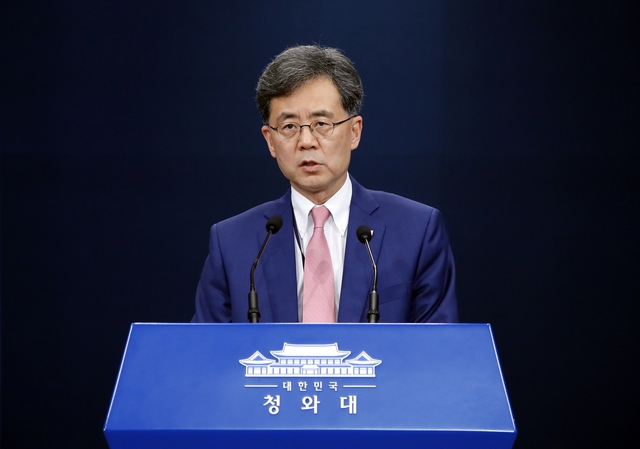
Kim Hyun-chong, second deputy director of the Blue House National Security Office, during a briefing at the Blue House on Aug. 2. (Yonhap News )
By Lee Wan | HANKYOREH | August 3, 2019
The Blue House recounted in detail how Japan has become an obstacle to setting the stage for peace on the Korean Peninsula and how it has rebuffed the US’ attempts to mediate in its dispute with South Korea. “Considering that our two countries have shared the values of liberal democracy and market economy for decades, Japan’s removal of South Korea from its white list on the pretext of security can be regarded as a public slap in the face,” said Kim Hyun-chong, second deputy director of the Blue House National Security Office.
“Rather than assisting South Korea in its efforts to get the peace process underway, Japan has thrown up roadblocks to that process. Japan opposed delaying the South Korea-US joint military exercises around the Pyeongchang Winter Olympics and maintained that sanctions and pressure were the only solution even while dialogue and cooperation with South Korea was underway. It also tried to raise tensions by calling for Japanese citizens residing in South Korea to rehearse a wartime evacuation,” Kim said during a briefing on the afternoon of Aug. 2.
It’s unusual for a figure at the Blue House to openly state that Japan presents an obstacle to the creation of peace on the Korean Peninsula. Such remarks indicate that Blue House officials are fuming over Japan’s removal of South Korea from its white list of countries who enjoy expedited export procedures. “We ought to give some serious thought to the meaning of the peace and prosperity of the ‘normal country’ that Japan seeks to become,” Kim added.
A senior official from the Blue House also went into the details of Japan’s rejection of the US’ attempted mediation. “On July 29, the US expressed its concerns [to us] about the ongoing dispute and suggested that we and Japan put a temporary freeze on the status quo while holding negotiations in an attempt to reach a diplomatic agreement. My understanding is that the same proposal was communicated to the Japanese on the same day. Based on the American proposal, therefore, we proposed high-level bilateral deliberations on the afternoon of July 30, but Japan rejected our proposal a few hours later,” the official said.
This official went on to speak of the need to seriously question the effectiveness of American mediation. “We need to carefully consider Japan’s rationale and motivations behind its removal of South Korea from the white list — are they economic, political, or both at the same time?”
“Given such considerations, we need to give some serious thought to the potential effectiveness of the US attempting to bring Japan around.”
In effect, this official said, South Korea still needs to figure out whether Prime Minister Shinzo Abe’s sudden export controls represent an attempt to contain South Korea’s growing economy, a request to give Japan a seat at the table in peace talks on the Korean Peninsula, or a call for a fundamental realignment of the cooperative relationship between South Korea, Japan, and the US that has been in place since South Korea and Japan settled their outstanding claims in 1965.
‘Japan dismisses US claim that Iran attacked tankers’
Press TV – June 16, 2019
Japanese officials say Tokyo has dismissed a claim by the United States that Iran attacked two oil tankers — both of them carrying “Japanese-related” cargo — in the Sea of Oman.
Japan’s Kyodo news agency cited informed state officials as saying Tokyo had demanded that Washington examine the case further, and that grainy video footage released by the US as supposed evidence was unclear and could not be used to prove anything.
One official said the Japanese government was not convinced by the material, which the official called “nothing beyond speculation.”
The official said Japan’s Foreign Minister Taro Kono had in a Friday phone conversation with US Secretary of State Mike Pompeo demanded more data in the case.
The Japanese-owned Kokuka Courageous and Norwegian-owned Front Altair oil tankers were struck by explosions near the strategic Strait of Hormuz on Thursday morning. Japan’s government said both vessels were carrying “Japanese-related” cargo.
Shortly after the two tankers were hit by the explosions, Pompeo blamed Iran. A day later, US President Donald Trump made a similar claim. Neither offered any evidence, and the footage that was released was said by US officials to show Iranian personnel removing an “unexploded” mine.
Iran has rejected the allegations.
Experts have said the explosions could have been false flags to implicate Iran at the time of a historic visit by Japanese Prime Minister Shinzo Abe to Iran, a first of its kind in more than 40 years. Prime Minister Abe was meeting with Leader of the Islamic Revolution Ayatollah Seyyed Ali Khamenei when the explosions happened.
According to Kyodo, a source close to Prime Minister Abe also said that the footage did not prove an Iranian attack.
Separately, a Japanese Foreign Ministry source said the attack being sophisticated was no reason to blame Iran. Such a characteristic, according to the source, could also implicate the US and Israel — Iran’s main adversaries.
The Japanese operator of one of the tankers also said it had been hit by “a flying object,” not a mine.
A short while after the incident, Iranian rescue officials picked up a distress signal sent by the tankers and scrambled a vessel, which then safely removed the crew from the waters around their burning ships.
‘The video means nothing!’
Independent intelligence experts have expressed doubts about whether the footage released by the US incriminates Iran, as US officials have claimed.
William Church, a former military investigator for the United Nations Security Council, told Newsweek on Saturday that the US had doctored evidence before.
“The US track record on ginning up evidence for war is not good,” he said. “It lied in the run-up to the Vietnam war [by inventing a North Vietnamese attack on a US Navy ship in the Gulf of Tonkin in 1964], and it lied about WMD (weapons of mass destruction) before the Iraq war. So when these tanker attacks happen, we have to ask why and what’s the motivation in addition to examining the evidence.”
Church said much more needed to be known.
“The video means nothing. We need to know how it was taken, when was it taken, what was the total sequence. Then you’d have to talk to the people in the video to get their view of what happened. I would check to see if the video was doctored. You would need to do everything that a trained investigator would do,” he said.
Ayham Kamel, the head of Middle East analysis for the Eurasia Group, an international risk analysis consultancy, suggested that Saudi Arabia might have carried out attacks on the tankers to blame them on Iran because Riyadh was increasingly under pressure from retaliatory strikes by Yemeni Houthis, whom the Saudis claim are Iranian-backed.
“The Saudis are alarmed [by the retaliatory Yemeni strikes,” Kamel said. “Their response is going to be to try to pressure the US into action.”
Anthony Cordesman, a strategic analyst at the Center for Strategic and International Studies, also raised the possibility that Riyadh, or Abu Dhabi or Daesh, could have been behind the incidents.
“One has to keep asking the question, well, if it isn’t Iran, who the hell is it?” he said. “You come up with the possibility that ISIS (Daesh) carried out the attack as trigger to turn two enemies — the United States and Iran — against each other. Or you’re watching Saudi Arabia and the United Arab Emirates create an incident that they can then use to increase the pressure on Iran.”
“The truth of the matter is either you have evidence, or you don’t,” he added. “Is there hard evidence that Iran is guilty? The answer is no.”
Iran’s supreme leader ‘has no intention’ to make or use nuclear weapons – Japan’s PM
RT | June 13, 2019
Tehran has no intention of making or using nuclear weapons, Iranian supreme leader Ayatollah Ali Khamenei said, according to Japanese Prime Minister Shinzo Abe.
“Supreme Leader Khamenei made a comment that the country will not and should not make, hold or use nuclear weapons, and that it has no such intentions,” Abe told reporters in Tehran on Thursday following his meeting with Khamenei.
The previous day, Abe called on Iran to play a constructive role in securing peace and stability in the Middle East, saying that Tokyo is determined to do everything it can to help, Reuters reported.
US military truck carrying missiles crashes in Idaho

Press TV – March 10, 2019
Police in the US state of Idaho were forced to close down a highway after a semi-truck carrying missiles for the military crashed.
According to state police, the truck veered off the main road at a rest stop along I-90 in northern Idaho on Friday night as the driver attempted to use the interstate on-ramp.
The 50-year-old man at the wheel lost control of the truck and accidentally drove into a hazardous materials containment area and disabled his vehicle by driving over a snowbank at the end of the hazmat area.
No one was hurt in crash but police had to completely shut down the road for four miles as a precaution, because the truck was transporting 16 missiles, each one weighing 900kg (2,000lbs).
The driver was cited for inattentive driving.
The US military has a long history of botched transportation of dangerous weapons and military equipment.
In November 2015, an astonishing video surfaced showing an armored escort vehicle colliding into a nuclear warhead loaded into a truck near Malmstrom Air Force Base in Montana.
The escort vehicle was speeding behind the truck but the driver failed to react in time and ended up driving into it.
More recently, in February this year, a truck hauling a shipment of US Navy-owned military munitions crashed into two commercial trucks on US Highway 212 in southeastern Montana.
The US Air Force sent a six-member disposal unit to the scene, who then used 58kg of explosives to detonate 60 hazardous munitions that were damaged. The unit recovered 420 other projectiles.
In late January, two US military vehicles crashed in New Mexico, injuring all 9 personnel onboard, two of them critically.
The US military has been blamed for similar incidents abroad, notably in Germany and Japan.
US Base in Okinawa to Be Relocated Despite Referendum Results – Japanese PM Abe
Sputnik – 25.02.2019
A total of 72.2 percent of those who voted in the referendum on the Japanese island of Okinawa voted against plans to build a new military airfield for US troops in their prefecture, the referendum’s results showed on 25 February.
Japanese Prime Minister Shinzo Abe said that he “took seriously” the results of the referendum in Okinawa on transferring the US Futenma base to Henoko in the same prefecture, but “it is impossible to postpone the transfer dates”.
“I have considered the referendum results with all seriousness and will do everything to reduce Okinawa’s burden… It’s been over 20 years since Japan and the United States signed an agreement about returning the entire territory of Futenma [to the prefecture]. But it has still not been returned. We cannot postpone the relocation any longer”, the prime minister stated.
He continued on by saying that the authorities need to “avoid a situation where the Futenma base, considered the most dangerous in the world, keeps being surrounded by schools and residential buildings”.
The statement comes after a non-binding referendum was held in Okinawa on 24 February, in which local residents expressed their attitude to the relocation of US Marine Corps Futenma Air Station from the densely populated city of Ginowan, where it is currently situated, to the Henoko district.
A total of 19.1 percent of voters supported the plans for the US base relocation, while 8.8 percent refrained from responding yes or no.
In numerical terms, 434,273 people voted against the Tokyo-Washington plans, while 114,933 supported the move, with 52,682 others choosing neither of the options.
The US Marine Corps base Futenma was constructed in 1945. Talks on its relocation to a less populated area within the Okinawa prefecture started over two decades ago, but the government’s plans have been hampered by local residents’ protests.
While Ginowan residents have been calling on the government to close the Futenma base due to their environmental concerns, aircraft incidents and accidents related to the behavior of US troops, residents of Henoko district are also unwilling to see the base relocated to their region. The administration of Okinawa would like to see the base outside the prefecture instead of its relocation to another site within its administrative borders and called a non-binding referendum in hopes that it would demonstrate the prefecture’s strong opposition to the relocation project.
See also:
Japanese PM Abe set to ignore local referendum on US Okinawa military base relocation
RT | February 23, 2019
Japanese Prime Minister Shinzo Abe has said his government will press ahead with the controversial relocation of a US military base on the island of Okinawa, despite local objection.
Okinawa is home to two-thirds of the US’ Japanese bases. Tokyo wants to relocate one of these – US Marine Corps Air Station Futenma, located in a densely populated area – to the more remote coastal area of Henoko. While residents near the base have been angered by a series of aircraft accidents, they also oppose the relocation to Henoko, claiming that planned land-reclamation works there will devastate the coral-rich coastal environment.
Okinawans will vote on the relocation on Sunday in a non-binding referendum, with nearly 70 percent expected to vote ‘No,’ according to a poll by Kyodo News. Okinawa’s Governor Denny Tamaki, who campaigned on an anti-base platform last year, has also traveled to Washington DC to lobby against the move.
The Japanese government intends to go ahead with the relocation “without being swayed by referendum results,” Abe told parliament on Wednesday.
Many Okinawans are unhappy with the base’s current location, as well as the planned relocation. They hope a ‘No’ vote will force the government to move the base off the island altogether.
The behavior of US troops stationed on Okinawa has also incensed locals, with the 1995 kidnap and gang-rape of a 12-year-old girl by three US soldiers triggering mass protests on the island. Two cases of rape and murder by US troops again caused protests in 2016. One year later, Okinawa was back in the news after a drunk Marine plowed his truck into another vehicle while running a red light, killing an elderly Japanese man.
Featured Video

BRITAIN’S WARNING: PREPARE FOR WAR
or go to
Aletho News Archives – Video-Images
From the Archive
How Ukraine Tortured and Slaughtered Donbass
By Kit Klarenberg | Al Mayadeen | July 11, 2024
Almost immediately after the proxy war erupted, ISIS-tier footage of the torture and murder of Russians in Ukrainian custody emerged.
On July 6th, the New York Times published an astonishing investigation: In Ukraine, Killings of Surrendering Russians Divide an American-Led Unit. The article documents in grim detail how Chosen Company, an international volunteer battalion for Kiev, routinely executes Russian prisoners of war. It is the very first mainstream admission that this practice – a brazen breach of the Geneva Conventions, and a grave war crime – is widespread among Ukraine’s fighters, both foreign and homegrown. … continue
Blog Roll
 Aletho News
- Pentagon designates Chinese cultural centers national security threat
- Israel Demolishes Home Of Lebanese Journalist Whose Viral Film Exposed Pager Attack
- Record Oil, Empty Tanks: The UAE’s Miracle Recovery
- Burnham tackles Britain’s poverty with aggression in Yemen
- Peace in Ukraine: the easy way – or the hard way
- Trump & the Rrrrussians
- US taxpayer money laundered back through Ukraine – Musk
- Before COVID, an NIH lab chief proposed making a SARS-like bat virus more infectious
- Gates, Bourla on Trial in Netherlands Accused of ‘Great Reset’ Scheme at Vaccine Injury Hearing
- BRITAIN’S WARNING: PREPARE FOR WAR
- If Americans Knew
- An error has occurred; the feed is probably down. Try again later.
- No Tricks Zone
- Two New Studies Find Thwaites Glacier Melt Cannot Be Driven By Human Activity Or A Warming Ocean
- E-Cars Reduce CO2 Emissions By Only 41% Compared To Internal Combustion Engine Vehicles
- Predictions Made By Renowned Climate Professor Over Past Decades Have Been Proven To Be Poor
- New Study Suggests Large Regions Of The Pacific Ocean Have Been Cooling For The Last 80 Years
- Germany’s Green Energy Debacle: High Energy Costs Force Kahla Porzellan to Close After 182 Years!
- New Study: 50 Years Of The Most Aggressive ‘Net Zero’ Policies Can Only Affect The Global Climate By 0.03°C
- US September “Heat” Was No Record…Many Records Set Decades Ago
- Latest European Green Energy Debacle; Portugal’s Largest Flagship Solar Park Insolvent!
- Green Energy Debacle: German Expert Professor Fritz Vahrenholt Warns Of Severe Economic And Social Consequences
- Two More Paleo Reconstructions Affirm Meters-Higher Sea Levels Across Ireland, Brazil 7000-6000 Years Ago

