Poll: Majority of Jewish Israelis oppose ending 50-year military occupation
Ma’an – March 28, 2017
BETHLEHEM – A new poll was released by the Jerusalem Center for Public Affairs on Tuesday, revealing that the majority of Israelis oppose any Israeli withdrawal from the occupied West Bank, while 79 percent of Israelis believe its important to maintain a unified Jerusalem under Israeli control, in contradiction to longstanding international peace negotiations and international law.
The poll, which was conducted among 521 Jewish Israelis over the age of 18, is said to represent the adult Jewish Israeli opinion on the decades-long Israeli-Palestinian conflict.
According to the poll’s findings, Israeli support for a military withdrawal from the West Bank, now in its 50th year under Israeli occupation, has gradually decreased in the last 12 years, with the percentage of those supporting a withdrawal as part of a peace agreement declining from 60 percent in 2005 to just 36 percent in 2017.
When it came to completely withdrawing from the entirety of the occupied West Bank, 77 percent of Israelis opposed such a move. Meanwhile, regarding the withdrawal from the territory — but excluding large Israeli settlements blocs constructed in Palestinian territory in violation of international law — the majority of Israelis (57 percent) still opposed it.
However, opposition to an Israeli withdrawal from the Palestinian territory slightly subsided (44 percent) if the illegal settlement blocs were annexed into Israeli territory and a future Palestinian state remained demilitarized.
Concerning the Jordan Valley, a crucial area of the Palestinian territory and any future Palestinian state, an overwhelming 81 percent of Israelis said that it was important for the Israeli government to exercise continued sovereignty over the area.
The poll also revealed that Israelis have a committed and long-term expectation of maintaining full security control over the occupied West Bank, with 76 percent of those polled expressing their approval of Israeli authorities continuing to control the West Bank owing to various security concerns.
Meanwhile, 79 percent of Israelis believe its important to maintain a unified Jerusalem under Israeli control, with 52 percent opposing any division of Jerusalem into “Jewish and Arab sectors.” When the status of occupied East Jerusalem and its potential incorporation into an independent Palestinian state as the capital was added to the questioning, the opposition to dividing Jerusalem increased to 59 percent.
The vast majority of Israelis (83 percent) opposed transferring Al-Aqsa Mosque — known as the Temple Mount among Jews — to Palestinians.
The fate of Jerusalem has been a focal point of the Israeli-Palestinian conflict for decades, with numerous tensions arising over Israeli threats regarding the status of non-Jewish religious sites in the city, and the “Judaization” of East Jerusalem through settlement construction and mass home demolitions.
With a backdrop of routine Israeli military violence and the escalation of Israel’s illegal settlement enterprise in the Palestinian territory, Palestinians have become disillusioned by attempts at solving the decades-long conflict, with many expressing their lack of hope in any political solution.
The Israeli government has also streamlined bills that many critics have said is specifically aimed at a gradual annexation of the occupied West Bank.
Last month, the Knesset passed the outpost Regularization law, which states that any settlements built in the West Bank “in good faith” — without knowledge that the land upon which it was built was privately owned by Palestinians — could be officially recognized by Israel pending minimal proof of governmental support in its establishment and some form of compensation to the Palestinian landowners.
Meanwhile, right-wing Israeli Knesset members have also spearheaded a bill to annex the massive Maale Adumim settlement. Maale Adumim is the third largest settlement in population size, encompassing a large swath of land deep inside the occupied West Bank’s Jerusalem district. Many Israelis consider it an Israeli suburban city of Jerusalem, despite it being located on occupied Palestinian territory in contravention of international law.
While members of the international community have rested the solution to the Israeli-Palestinian conflict on the discontinuation of illegal Israeli settlements, Israeli leaders have instead called for an escalation of settlement building in the occupied West Bank, and with some having advocated for its complete annexation.
A number of Palestinian activists have criticized the two-state solution as unsustainable and unlikely to bring durable peace, proposing instead a binational state with equal rights for Israelis and Palestinians.
Palestinian legislator Mohammed al-Tal seized by Israeli forces; Samira Halaiqa indicted by military court
Samidoun Palestinian Prisoner Solidarity Network – March 22, 2017
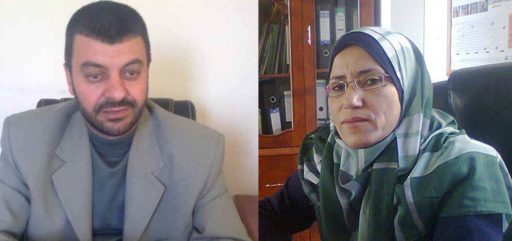
The number of imprisoned Palestinian Legislative Council members climbed to 11 on Tuesday, 21 March after a pre-dawn raid by Israeli occupation forces seized PLC member Mohammed al-Tal from al-Khalil, along with 19 more Palestinians. Al-Tal has previously spent 11 years in Israeli prisons, half of those in administrative detention without charge or trial.
Also on Tuesday, 21 March, an Israeli occupation military court at Ofer submitted an indictment against PLC member Samira Halaiqa, 53, from al-Khalil, accusing her of participating in political and social activities and engaging in “incitement” for making political posts on Facebook. Halaiqa was seized on 9 March by occupation forces who invaded her home. She, along with her husband Mohammed Halaiqa, had previously been imprisoned for one year in 2006 under administrative detention, following her election to the PLC.
Both Halaiqa and al-Tal are part of the Change and Reform bloc, the PLC bloc associated with Hamas.
The 11 detained PLC members include: Khaled Tafesh and Anwar Zboun, both from the Bethlehem area, members of the Change and Reform bloc, seized on Monday, 6 March. Zboun spent over six years in Israeli prison, including several months in administrative detention in 2014. Tafesh, a former deportee to Marj al-Zohour, was also previously held in administrative detention in 2014. Tafesh, Zboun, Halaiqa and al-Tal were all arrested in the month of March.
Other detained PLC members include Hassan Yousef and Ahmad Mubarak of Ramallah and Azzam Salhab and Mohammed Jamal Natsheh of al-Khalil. All members of the Change and Reform bloc, they are held in administrative detention, imprisonment without charge or trial. General Secretary of the Popular Front for the Liberation of Palestine, Ahmad Sa’adat, is serving a 30-year sentence in Israeli prison, while Fateh leader Marwan Barghouthi is serving several life sentences. Jerusalemite PLC member of the Change and Reform bloc, Mohammed Abu Teir, was subject to expulsion from his home city of Jerusalem and is now serving a 17-month sentence in Israeli prison.
Palestinian woman shot, injured by Israeli forces at Qalandiya checkpoint
Ma’an – February 27, 2017
BETHLEHEM – A Palestinian woman was shot and injured by Israeli security guards at the Qalandiya checkpoint between the occupied West Bank and occupied East Jerusalem on Monday afternoon, as Israeli police claimed she was carrying a bag in a “suspicious manner.”
Israeli police spokeswoman Luba al-Samri said in a statement that a “suspicious” Palestinian woman entered the vehicle lane of the checkpoint “seemingly carrying an object.”
 “The security guards noticed her and instructed her to stop but she ignored the instructions,” al-Samri said.
“The guards then started arrest procedures and neutralized the woman,” al-Samri added, using an Israeli forces term to indicate that a Palestinian was shot without specifying whether they were injured or killed.
Al-Samri later clarified that the woman had been “lightly injured,” and that she had been “carrying a bag” in a way that raised the security guards’ suspicions.
The police spokeswoman said that the Palestinian was in her thirties and was a resident of the village of Kafr Aqab in the West Bank district of Jerusalem with a Jerusalem ID.
The Qalandiya checkpoint is notorious for being confusing to navigate.
According to Ma’an documentation, five Palestinians were killed at the checkpoint in 2016, including two Palestinian siblings — Maram Salih Hassan Abu Ismail who was 23 years old and five months pregnant, and her 16-year-old brother Ibrahim — in April after Israeli officials claimed the two were attempting to carry out a stabbing attack.
However, witnesses said that the brother and sister posed no threat at the time of their death. Yet the Israeli Justice Ministry later dropped its probe into the killings after it was revealed that a contractor, not a member of the police, had killed the Abu Ismails.
Palestinian children attend class in the street after Israel shuts down school
Ma’an – February 26, 2017
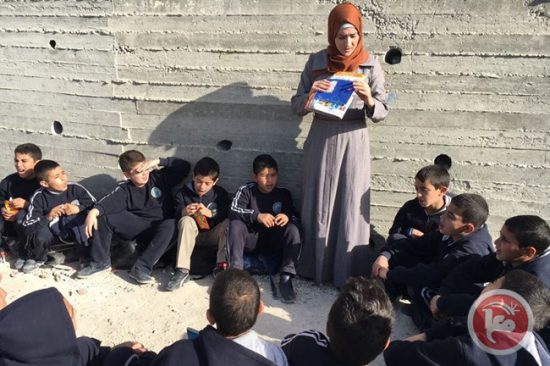
JERUSALEM – After Israeli authorities shut down a Palestinian elementary school in the occupied East Jerusalem town of Sur Bahir last Thursday over alleged “incitement” in its study materials, students attended class in the street on Sunday and protested against Israel’s decision to close the school.
Children who were enrolled at al-Nukhba (“the elite” in Arabic) arrived to the campus with their parents in an action organized by the parent committees of Sur Bahir’s schools, holding posters expressing support for al-Nukhba and denouncing Israel’s closure of educational institutions as “tyrannical.”
Last Thursday, head of the school Luay Jamal Bkirat and the school’s financial manager Nasser Hamed were summoned to an Israeli police station for interrogation, when Israeli intelligence officials informed them that the school was being shut down for carrying inciting content in the teaching materials used at the school.
Bkirat denied the claims, saying that al-Nukhba school was “teaching the Palestinian curriculum used in all schools in Jerusalem and that no one of the faculty had ever been summoned for interrogation before over incitement.”
He added that the school — which serves 250 boys from kindergarten to grade six — was opened last year and gained a temporary operating license from the Jerusalem municipality, and that the license was revoked in November for unknown reasons.
Bkirat condemned the decision and said that he would “conduct procedures to stop this decision which aims to destroy education.”
The Times of Israel reported that the school was shut down for being a “Hamas front,” after a months-long joint probe by Israel’s Education Ministry, Jerusalem police, and Israeli intelligence, the Shin Bet.
Israeli authorities from the education ministry claimed the school was established by Hamas with the aim of teaching “content that undermines the sovereignty of Israel,” and that the school’s aims were “consistent with the ideology of the terror organization, which calls for the destruction of Israel,” the Times of Israel said.
According to the Israeli news outlet, the ministry ordered the school not to open in September “and when it continued to operate, issued the closure order.”
Israeli Jews and Palestinians study in separate school systems in occupied East Jerusalem, with the Palestinian schools run by either Israel’s Jerusalem municipality, the Islamic Waqf and administered by the Palestinian Ministry of Education, private institutions, or UNRWA, the UN agency responsible for Palestinian refugees.
According to the Palestinian Ministry of Education, Palestinian children suffer from routine Israeli interference and political pressure to replace Palestinian curricula with an Israeli one in occupied East Jerusalem, where full Israeli military and civil control deprives students from proper and secure educational services.
A 2016 report by Israeli daily Haaretz also said that Palestinian schools in occupied East Jerusalem received less than half the funds that the Jerusalem municipality transferred to Jewish schools in West Jerusalem.
Though Sur Bahir lies beyond the periphery of occupied East Jerusalem, the town remained under full Israeli security and civil control within Israel’s Jerusalem municipality after the territory was illegally annexed in 1967.
A 2011 report by the Applied Research Institute – Jerusalem (ARIJ) said that due to a lack of some levels of education in Sur Bahir, many students were forced to attend schools in neighboring villages.
Israel to build touristic park on Mount of Azzeitun in Jerusalem

Mount of Azzeitun
Palestine Information Center – February 25, 2107
OCCUPIED JERUSALEM – The Israeli municipal authority in Occupied Jerusalem plans to seize a large tract of Palestinian land on Mount of Azzeitun (Olives) to carry out development of a touristic park.
According to a report published by Iroshalim newspaper, a master plan for the park was submitted recently to the district planning and building committee in Occupied Jerusalem to obtain approval.
The local residents in Azzeitun area, however, are deprived of using the land where the park project would take place for building homes or establishing projects for their own benefit.
The new project will be 6.3 kilometers long and extend to the Hebrew University on al-Masharif (Scopus) Mount.
It will overlook the Old City of Jerusalem and include roads, bistros, public toilets, an information center, a souvenir store, a parking lot and other structures.
Israel seeks to carry out many Judaization plans in Jerusalem as part of its effort to change the historical Arab character and identity of the city.
Israel to Bulldoze Palestinian Homes to Build ‘Settlers Only’ Road
Sputnik – 22.02.2017
As Israel begins work on its “American road” project in East Jerusalem’s Jabal al-Mukaber area, hundred of Palestinians are on edge, as their homes lie directly in its path.
Part of the larger al-Touq Highway, the road is ostensibly being constructed to connect Israeli settlements north, south, and east of East Jerusalem, and cuts through sections of Jerusalem, joining the Maale Adumim and Har Homa settlements on the West Bank.
The al-Touq Highway, proposed ten years ago by Israel’s municipality planning and construction committee, will, once completed, be 230-feet wide and over 7-miles long.
Roughly 300 acres, encompassing 12 Palestinian neighborhoods in Jabal al-Mukaber, will be confiscated to build the road, which has alarmed residents of Salaa, where construction has already begun.
Salaa resident Mohammad al-Sawahra told Al Jazeera, “We are living in a state of perpetual fear…It’s as if we are living in [two different worlds]. In Palestinian areas, it is like living in the third world, while those living in settlements built on the land of Jabal al-Mukaber are offered a life of comfort like first world countries.”
Al-Sawahra received a demolition notice for his home last month, adding that, “Now, they want to build a road on the ruins of my home for themselves, as well.”
He will be one of some 500 Palestinians living in 57 homes set to be demolished for the ‘American Road’ project. Raed Basheer, with the Committee of Defence for Jabal al-Mukaber properties, told Al Jazeera, “We were surprised to hear about the project, which will be 32 metres wide, with an additional 32 metres on the sides to allow for the light rail. All of the homes, both old and new, standing in the way of the road, will be demolished.”
“In response to this plan,” Basheer said, “we reached out to the Israeli municipality in Jerusalem and managed, with difficulty, to obtain an extension on the house demolition orders for five years, provided that we submit a request every year to extend the demolition orders. But, still, we do not know whether we will be allowed to remain in our homes over the next five years.”
The project map reportedly shows the disconnection of roads that link Jerusalem’s Palestinian neighborhoods, cutting residents off from health care facilities and schools, leaving a road only to be used by Israelis.
The plan comes on the heels of a recently-passed and hotly-debated bill that retroactively legalizes thousands of Israeli homes on privately-owned Palestinian land. The “regulation” law has been called “theft’ and a “land grab” by the opposition.
About 48,000 Palestinian homes have been demolished since Israel first seized the territories in 1967.
Sheikh Raed Salah banned from travel abroad or entering Jerusalem for five more months
Samidoun Palestinian Prisoner Solidarity Network – February 15, 2017
 Sheikh Raed Salah was banned from leaving Palestine and barred from entering al-Aqsa Mosque and the city of Jerusalem for five more months on Tuesday, 14 February, reported Quds News.
Israeli police delivered an order from Aryeh Deri, the far-right Israeli Interior Minister, to Salah’s home in Umm al-Fahm, on Tuesday night, banning him from travel or visiting Jerusalem, until 15 July 2017. The order comes as a renewal of the one-month travel ban slapped on Salah on 17 January 2017, immediately upon his release from Israeli prison from a nine-month sentence for “incitement,” for a sermon he delivered in 2007.
The order declares that Salah’s travel abroad poses a “real danger… to state security.” Salah is the leader of the Islamic Movement in Palestine ’48; in 2015, the Israeli state banned the Islamic Movement in an action condemned by Palestinian organizations across the political spectrum as an attack on all Palestinians in ’48 Palestine, who hold Israeli citizenship.
Throughout his imprisonment, Salah was held in solitary confinement and repeatedly interrogated; appeals to end his isolation were denied throughout that time. He was even denied access to magazines, books and other materials brought for him.
Israeli man stabs, injures two Palestinian street cleaners
Press TV – February 12, 2017
At least two Palestinians have sustained injuries when a young Israeli man carried out a stabbing attack in southern Israeli-occupied territories amid violent attacks by Israeli military forces against Palestinian protesters.
Israeli police spokeswoman, Luba al-Samri, said in a written Arabic statement that the assailant, thought to be in his twenties, was detained after committing the attack in the city of Beersheba, located 115 kilometers southeast of Tel Aviv, early on Sunday.
The two injured men were transported to a hospital in the area.
Samri identified the unnamed attacker as a local resident of Beersheba, adding that initial investigations point to a “criminal” motive behind the incident.
30 Israeli settlers break into al-Aqsa Mosque
Meanwhile, more than two dozen Israeli settlers have once again stormed the al-Aqsa Mosque compound in the Old City of Jerusalem al-Quds.
Local sources, speaking on condition of anonymity, said 30 settlers, escorted by several groups of Israeli troops and led by a number of guides and rabbis, entered the site through the Bab al-Maghariba on Sunday morning.
The settlers reportedly staged lengthy stopovers in various parts of the al-Aqsa Mosque courtyard during the incursion.
Israeli soldiers were heavily present at the entrance gates to the mosque and thoroughly checked the identity cards of arriving worshipers.
The occupied Palestinian territories have witnessed tensions ever since Israel imposed restrictions on the entry of Palestinian worshipers into the al-Aqsa Mosque compound in East Jerusalem al-Quds in August 2015.
Nearly 280 Palestinians have lost their lives at the hands of Israeli forces since the beginning of October that year.
Palestinian student 19, sentenced to 16 years in Israeli prison

Samidoun Palestinian Prisoner Solidarity Network – December 25, 2016
In another example of the lengthy sentencing practices especially targeting Palestinian youth and women in Jerusalem, Shorouq Dwayyat was sentenced to 16 years in Israeli prison by a Jerusalem court on Sunday, 25 December. Dwayyat, 19, from the village of Sur Baher, was also fined 80,000 NIS (approximately $21,000.) She was shot by an Israeli settler and seized by occupation forces on 7 October 2015 in eastern Jerusalem and accused of attempting to stab an Israeli settler. Witnesses reported that she was harassed by the settler prior to the alleged incident.
Dwayyat is a student at Bethlehem University who was studying history and geography. She graduated from high school, achieving a result of 90% in the national secondary Tawjihi examinations in 2015.
Classes at the university were cancelled for two days after her shooting and arrest in October 2015.

Dwayyat was severely injured by the four bullets lodged within her body, unlike the Israeli man she was accused of attempting to stab, who suffered no serious injuries. Following the court’s ruling, the Israeli Interior Ministry stripped the imprisoned Dwayyat of her Jerusalem residency, claiming “breach of trust,” using the case as a mechanism to further the Israeli state policy of attacking Palestinian existence in Jerusalem. Amjad Abu Assab of the Prisoners’ Committee in Jerusalem said that “this is a racist policy… with the aim of killing the spirit of challenge by Jerusalemites and preventing any manifestation of rejection of occupation in the occupied city of Jerusalem.”
She is one of 52 Palestinian women – including 12 minor girls – imprisoned in HaSharon and Damon Israeli prisons and now is serving one of the longest sentences. The longest-held Palestinian woman prisoner, Lena Jarbouni, is serving a 17-year sentence in Israeli prison. The recent trend of particularly elevated sentences include those against Maysoon Musa (15 years), Nurhan Awad (13.5 years) and Israa Jaabis (11 years).
Israeli High Court Allows Ghaith-Sub Laban Family to Stay in Their Home of Six Decades for 10 Years more, but without Their Children
American Herald Tribune | December 22, 2016
 The Israeli High Court released late on Tuesday 20 December 2016 its decision regarding the Ghaith-Sub Laban eviction, in which the Court partially accepted the family’s appeal and stopping their eviction.
The decision keeps the family’s protected tenant status for 10 more years after which the family would be evicted and the house would be handed to the Israeli settler organization that requested their eviction.
The decision however limits the right to live in the house to Mrs. Nora Ghaith and her husband Mustafa Sub Laban without their children. The Court also excluded from its decision a small storage room for the family under the house which Israeli settlers can proceed in taking over.
The decision comes one day after the hearing held in front of the Israeli High Court yesterday in which the Court heard the family’s appeal against the eviction and the settler’s claims that the family abandoned their house years ago. During the hearing, the Court proposed a compromise to both parties under which the protected tenancy status would be limited to Nora and her husband and the family would be allowed to stay in the house as long as Nora and her husband live.
The settlers rejected the Court’s suggestion and instead proposed evicting the family and moving them to the small storage under the house which is no more than 20 squared meters in size.
The Court disregarded the settlers’ suggestion and ended the hearing only to come with this unjust decision the following day.
Nora Ghaith’s family rented the house located in the Old City of occupied East Jerusalem in 1953 from the Jordanian Custodian of Public Property. She continued to live in the house after 1967 and currently lives in the house with her husband, her two sons Ahmad and Rafat, her daughter Lama as well as her daughter in law Ruba and two grandchildren Mustafa and Kenan aged 9 and 4.
Nora Ghaith-Sub Laban commented by saying that the Court simply acknowledged the settler’s claims that the house is abandoned and ruled to separate her family. As per the High Court’s decision, Nora will have to be separated from her grandchildren as well as her unmarried son and daughter.
In case the family refuses to comply with the Court’s decision, the settlers can file a new request to evict the family before the 10 years have passed.
Ahmad Sub Laban, journalist and human rights activist, further added that the Israeli High Court’s decision in fact evicts part of the family and keep another temporarily.
Israeli judiciary once again sustains the discrimination that Palestinians face, where Israeli settlers are allowed to reclaim property they allegedly owned pre 1948 whereas Palestinians are prohibited from the same.
Today we also witness how the Court ruled to separate a family by deciding who can live in the house and who cannot.
The Israeli High Court, as with all similar eviction or house demolition cases, have proved itself to be a partner to Israel’s settlement expansion policy and to settler’s ambition to take over as many houses in occupied East Jerusalem. This is simply legitimizing the Israeli occupation’s policies that violate international law and an endorsement of Israel’s annexation of East Jerusalem after 1967.
Featured Video

Racist Seinfeld Dances for Joy as Bibi Unveils His New Map
or go to
Aletho News Archives – Video-Images
TV Drama Review
Japanese drama projects Japan’s wartime atrocities onto Chinese characters

Global Times | October 25, 2026
By portraying Chinese characters as perpetrators of ruthless violence while casting Japanese Self-Defense Forces (SDF) intelligence operatives as defenders, the season 2 of the Japanese drama Vivant has recently drawn criticism from Chinese netizens, who argue that its depiction turns historical reality on its head while ignoring Japan’s wartime atrocities.
The TBS drama series – a spy suspense story in which an alleged unofficial intelligence unit of the SDF operates across the globe — has attracted a passionate fanbase. Its currently airing season 2 opened with a household rating of 18.8 percent, the highest for a TV drama this year, according toa commentary article by Japanese media Toyo Keizai.
What draws attention is the portrayal of the enemies in the series, the article noted. Scenes in which the Chinese organization subjects kidnapped members of the SDF unit to brutal torture are repeated with unrelenting intensity.
It is rare for Japanese TV dramas to explicitly portray a real-life country as the enemy, the article noted.
Japanese Prime Minister Sanae Takaichi also made a reference to the drama, saying that she has been recording Vivant and hopes to binge-watch it over the year-end and New Year holidays, according to Japanese media outlets.
China’s CCTV News report on Sunday revealed that the drama features scenes in which Chinese personnel cut off the fingers of and stab Japanese intelligence operatives in the abdomen. Such acts bear striking similarities to the torture inflicted on Chinese nationals by invading Japanese troops during the World War II.
The drama distorts the truth by attributing these atrocities to modern Chinese characters. Beneath the surface, it subtly glorifies Japan’s cross-border overseas operations, blurs the functional boundaries of the SDF and implicitly promotes an expansionist narrative, per CCTV News. … continue
Blog Roll
 Aletho News
- EU facing trillion-euro debt hole while seeking more cash for Kiev
- How US, Europe, Persian Gulf states exhausted missile stockpiles, splurged billions to defend Israel
- Up in arms… Koreans reject U.S. empire’s plan to make South Korea the next Ukraine
- Iran, Turkey, Pakistan, Saudi Arabia could advance region-led security framework in Tehran: FM spox
- Netizens condemn Japanese drama for projecting Japan’s wartime atrocities onto Chinese characters
- Racist Seinfeld Dances for Joy as Bibi Unveils His New Map
- A West Bank War for Netanyahu’s Election Campaign, Could It Backfire?
- Yemen denounces European Parliament’s ‘hypocritical’ push to blacklist Ansarullah
- Qalibaf: UAE’s UN bid aims to ‘clear the runway’ for ‘Greater Israel’, whitewash genocide
- Pakistan reopens Iran border after boosting security: Report
- If Americans Knew
- An error has occurred; the feed is probably down. Try again later.
- No Tricks Zone
- Sudden Stratospheric Warming, Powerful El Niño Combination May Lead To Extreme Europe Cold, Energy Crisis!
- Two New Studies Find Thwaites Glacier Melt Cannot Be Driven By Human Activity Or A Warming Ocean
- E-Cars Reduce CO2 Emissions By Only 41% Compared To Internal Combustion Engine Vehicles
- Predictions Made By Renowned Climate Professor Over Past Decades Have Been Proven To Be Poor
- New Study Suggests Large Regions Of The Pacific Ocean Have Been Cooling For The Last 80 Years
- Germany’s Green Energy Debacle: High Energy Costs Force Kahla Porzellan to Close After 182 Years!
- New Study: 50 Years Of The Most Aggressive ‘Net Zero’ Policies Can Only Affect The Global Climate By 0.03°C
- US September “Heat” Was No Record…Many Records Set Decades Ago
- Latest European Green Energy Debacle; Portugal’s Largest Flagship Solar Park Insolvent!
- Green Energy Debacle: German Expert Professor Fritz Vahrenholt Warns Of Severe Economic And Social Consequences

