Israeli bill on prison sentences for minors ‘targets Palestinian children’

By Chloe Benoist – Ma’an – March 29, 2016
BETHLEHEM – The Israeli Knesset on Tuesday approved the first reading of a bill which would allow Israeli courts to hand down prison sentences to minors under the age of 14 — legislation critics say is targeted at Palestinian children.
A recent amendment to the bill, which would apply to children convicted of murder, attempted murder, and homicide, reportedly declared that the prison terms would be postponed until the accused minors turn 18.
If passed into law after two more successful readings in the Knesset, the legislation would apply to residents of Israel and occupied East Jerusalem, whereas Palestinians in the occupied West Bank are tried in military courts.
According to prisoners’ rights group Addameer, at least 108 Palestinian minors under the age of 16 were being held by Israel as of February.
“Unfortunately, terrorism does not have an age, and today there are no punishments matching the cruel reality we face,” The Jerusalem Post quoted Israeli Justice Minister Ayelet Shaked as saying on Sunday. “In order to create deterrence and change the situation around us, we must adopt the suggested new amendments to the law.”
Shaked first proposed the bill in November, after two Palestinian children ages 12 and 13 allegedly stabbed and injured an Israeli security guard on Jerusalem’s light rail near the illegal Israeli settlement of Pisgat Zeev.
An increase in violence in the occupied Palestinian territory and Israel has led to the death of more than 200 Palestinians and nearly 30 Israelis since October, with a wave of small-scale attacks and attempted attacks, the majority carried out by Palestinian individuals on Israeli military targets.
Knesset member Yousef Jabareen of the Joint Arab List has criticized the bill as an affront to international law.
“Israel is a party to the International Convention on the Rights of the Child, and this change contradicts Israel’s obligation to this convention,” the politician, a Palestinian citizen of Israel, told Ma’an.
The convention states that “the arrest, detention or imprisonment of a child shall be in conformity with the law and shall be used only as a measure of last resort and for the shortest appropriate period of time.”
According to Jabareen, Shaked’s statements regarding the bill leave little doubt as to who will be the main targets of such legislation.
“This bill targets Palestinian children,” he said. “Of course the bill is written in objective terms, but everyone knows the context in which it is being presented, and I doubt it will be used in other contexts.”
“This is an integrant part of a wave of bills introduced in the past few months which are harshening punishments for Palestinian children and families, especially in East Jerusalem,” Jabareen added.
The MK notably mentioned a law passed by the Knesset in July which made penalties for stone-throwing more severe, allowing for stone-throwers to receive a 20-year prison sentence where intent to harm could be proven, and 10 years where it could not.
Jabareen said he believed the bill would likely pass into law.
“Unfortunately, in the current atmosphere, there is a good chance the bill will pass,” he said. “Even some opposition MKs support the bill.”
However, he expressed doubts that the legislation would effectively act as a deterrent.
“The (Israeli) government is attempting to oppress and suppress the Palestinian resistance, but everybody knows that without a serious proposal for advancing the political process, they are doomed to fail.”
UN set to establish database of businesses involved in Israeli settlements
MEMO | March 23, 2016
The United Nations Human Rights Council (UNHRC) is set to vote on Thursday on whether to establish a database of businesses involved in Israeli settlements.
The UNHRC, meeting in its 31st session, will be considering four resolutions under Item 7, which focuses on the impact of the Israeli occupation on human rights in Palestine and other occupied Arab territories. Such resolutions are routinely adopted.
A resolution on Israel’s illegal settlements in the Occupied Palestinian Territory, including East Jerusalem, and in the occupied Syrian Golan, however, has reportedly upset European Union member states, in particular by calling for “a database of all business enterprises involved” in illegal settlement activities, which will be updated annually.
The database is presented as a follow up to an earlier fact-finding mission, which investigated “the implications of the Israeli settlements on the civil, political, economic, social and cultural rights of the Palestinian people throughout the Occupied Palestinian Territory, including East Jerusalem.”
Middle East Monitor understands from sources familiar with the discussions taking place that European Union member states will either vote against, or abstain from, the resolution. The UK is reportedly expected to vote against, with significant pressure being applied on Palestinian officials to remove the paragraph establishing the database of businesses involved in settlement activities.
The resolution notes that “the settlement enterprise and the impunity associated with its persistence, expansion and related violence continue to be a root cause of many violations of the Palestinians’ human rights, and constitute the main factors perpetuating Israel’s belligerent occupation of the Palestinian Territory, including East Jerusalem, since 1967.”
The resolution goes on to express concern that “some business enterprises have, directly and indirectly, enabled, facilitated and profited from the construction and growth of the Israeli settlements in the Occupied Palestinian Territory.”
The UNHRC resolution also notes that “products wholly or partially produced in settlements have been labelled as originating from Israel”, and that “private individuals, associations and charities in third States” are “involved in providing funding to Israeli settlements and settlement-based entities, contributing to the maintenance and expansion of settlements.”
As well as the database, the draft text urges all states to “provide guidance to individuals and businesses on the financial, reputational and legal risks, including the possibility of liability for corporate involvement in gross human rights abuses as well as the abuses of the rights of individuals, of becoming involved in settlement-related activities.”
On Monday, the UNHRC head from outgoing Special Rapporteur on the situation of human rights in the Palestinian territories occupied since 1967, Makarim Wibisono, who presented his final report to the Council.
Among other recommendations, “he urged Israeli authorities to…halt the expansion of illegal Israeli settlements, to refrain from acts causing the forced displacement of Palestinians in the West Bank, including East Jerusalem, and to urgently implement recommendations by the United Nations Children’s Fund with respect to the detention of children.”
Trump Makes Same Promise on Jerusalem We’ve Been Hearing Since 1972
By Nima Shirazi | Wide Asleep In America | March 21, 2016

Breaking news!
The news media is abuzz today with reports that, speaking before the American Israeli Public Affairs Committee (AIPAC) conference, an annual gathering of rabid right-wing Israel supporters, a presidential candidate vowed to move the U.S. Embassy in Israel from Tel Aviv to Jerusalem.
So who was it this time? Donald Trump.
So why is this news? It’s not.
Promising to recognize Jerusalem as Israel’s undivided capital and to move the American embassy there is part of Pandering 101 for Oval Office hopefuls. Every candidate in the past few decades knows this. It’s an easy vow to make, and no one ever pays any political price for inevitably breaking it (since half of Jerusalem remains occupied territory and actually moving the embassy there would be a clear violation of international law, which doesn’t recognize Israel’s claim over the historic city). Making such an absurd promise plays well to the writhing masses at AIPAC confabs, establishes one’s Zionist bona fides, and is a quick and easy way to offend indigenous Palestinians living under occupation, apartheid and blockade without actually flipping them the bird.
Nevertheless, the press continues to report on this blustery promise, no matter who utters it, as if it actually merits attention.
While he repeated the promise today for AIPAC, Trump had already said it back in January. And Ted Cruz has too:

And Jeb Bush before him:

So did Mitt Romney in 2012:

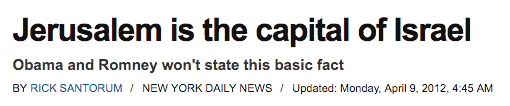
And Ron Paul and Rick Santorum the same year before they dropped out of the race:

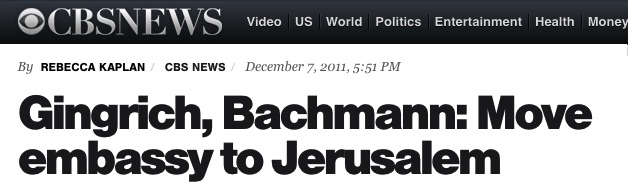
And Newt Gingrich and Michelle Bachmann (and Herman Cain) before them:
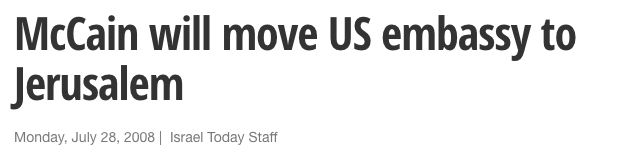
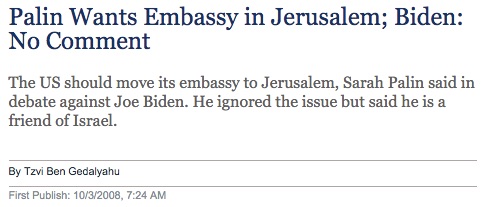
Both John McCain and running mate Sarah Palin made the promise back in 2008:
Four years earlier, John Kerry did the same, while also touting his record of making similar demands during his tenure in the Senate:

Before that was Al Gore and George W. Bush in 2000. As reported by The New York Times in May 2000:

(Supporters of moving the embassy were subsequently disappointed in Bush’s failure to act on his promise.)
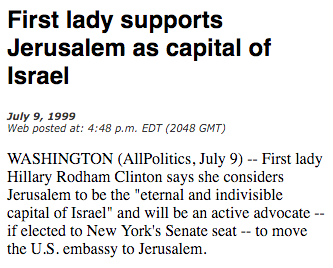
The year before, while beginning her campaign for New York’s Senatorial seat, the then-First Lady Hillary Clinton weighed in on the matter herself:
In the mid-1990s, Senate Majority Leader Bob Dole and House Speaker Newt Gingrich similarly pandered like pros:

Before that, in 1992, the Clinton/Gore campaign hit the incumbent Bush administration for balking at the official recognition of “Israel’s sovereignty over a united Jerusalem.” Their campaign promised voters that “Bill Clinton and Al Gore will… support Jerusalem as the capital of the state of Israel.”
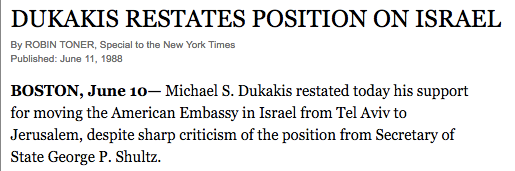
Even Mike Dukakis tacked to the right of both the outgoing Reagan administration and George H.W. Bush campaign in 1988:
Al Gore, who tried to win the Democratic nomination for president that year, reportedly said in September 1987 that “he would consider moving the U.S. embassy from Tel Aviv to Jerusalem.”
In April 1984, during a heated Democratic primary season, Walter Mondale and Gary Hart bent over backwards to assure voters in New York City that they too supported moving the U.S. Embassy from Tel Aviv to Jerusalem.
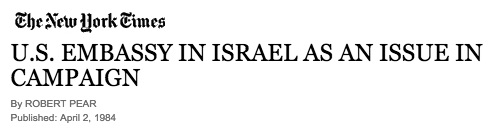
The New York Times reported at the time:
Walter F. Mondale said he had supported such a move for 20 years, and he asserted that Senator Gary Hart had changed his position on the issue five days ago. In the past two weeks, Mr. Hart has denied that he suddenly changed his position, but has said his position has ”evolved.” He has said firmly that if he became President, he would move the embassy to Jerusalem.
The Rev. Jesse Jackson is the only one of the three candidates who opposes moving the embassy. The Reagan Administration also opposes such a move because the status of Jerusalem has long been disputed and the United States does not support Israeli sovereignty over the city.
Despite efforts by New York Senator Daniel Moynihan and California Congressman Tom Lantos to introduce a bill mandating the move, Reagan was adamant about not moving the embassy, as such a divisive policy would, according to his Secretary of State George P. Shultz, “be very bad for the United States” and “damage our ability to be effective in the peace process.”

The pandering was so thick, however, that a month later the Reagan administration had to pretend to consider supporting the move in order to stave off losing votes in the upcoming election.

Though the bill eventually stalled, Los Angeles Times syndicated columnist Nick Thimmesch, who called the proposal “one of the dumbest ideas to be advanced in Congress this session,” lamented that “some of the election-year pandering in the Republic verges on the obscene” and credited the ill-conceived gambit to the lawmakers’ “blind obedience to the Israel lobby (American Israeli Public Affairs Committee).” That was October 3, 1984.
By 1986, another bill was introduced to move the embassy, this time brought to the Senate floor by Republican Jesse Helms.
But even in the mid-1980s, though, this was an old political ploy. The New York Times pointed out that the 1976 Democratic Party platform – on which Jimmy Carter and Walter Mondale ran for office – declared:
We recognize and support the established status of Jerusalem as the capital of Israel, with free access to all its holy places provided to all faiths. As a symbol of this stand, the U.S. Embassy should be moved from Tel Aviv to Jerusalem.
Before that, on March 17, 1972, Michigan Congressman Gerald Ford, then the Republican Minority Leader, told a Zionist Organization of America regional meeting in Cleveland that the Nixon Administration should transfer the U.S. Embassy to Jerusalem.
Two years later, after first replacing Spiro Agnew as Vice President and then becoming President himself following Nixon’s resignation, Ford backtracked on his previous position. “Under the current circumstances and the importance of getting a just and lasting peace in the Middle East, that particular proposal ought to stand aside,” Ford said at his very first presidential press conference on August 9, 1974.
It’s been nearly 42 years since then and, sadly, while Palestine remains under brutal occupation, Israeli colonies continue to expand with impunity, and Palestinians are subject to ongoing oppression and violence, election-year pandering in the United States has become more obscene than ever.
Israeli forces close East Jerusalem streets for marathon, detain 4

Ma’an – March 18, 2016
JERUSALEM – The Israeli authorities early Friday shut down streets across Palestinian neighborhoods in occupied East Jerusalem and detained four in preparation for the annual Jerusalem marathon, locals said.
Locals told Ma’an that a number of roads were blocked by iron barricades and buses, as thousands of Israeli runners joined in the marathon for the sixth year in a row.
Four residents of al-Issawiya neighborhood were detained prior to the marathon. Two of them, identified by locals as Fadi Matwar and Jad al-Ghoul, were reportedly warned against being in Jerusalem during the marathon.
Al-Issawiya popular committee spokesman Muhammad Abu al-Hummus, who was detained prior to the marathon last year, was also detained Friday morning.
Locals told Ma’an that Israeli intelligence also summoned Jihad Oweida, the secretary-general of the National Committee against Normalization. The committee has in the past been a vocal opponent of the Jerusalem marathon for going through occupied territory.
Participants in the marathon run through West Jerusalem as well as segments of Jerusalem’s occupied eastern half, including along the walls of the Old City and near other historical sites.
The marathon last year drew large numbers of Palestinian protesters to places where the run passes through neighborhoods under Israeli military occupation, with residents waving Palestinian flags and proclaiming slogans supporting Palestinian claims to Jerusalem.
East Jerusalem is internationally recognized as Palestinian territory, but Israel occupied it in 1967 and later annexed it in a move never considered legitimate abroad.
Friday’s marathon comes weeks before an annual marathon is expected to be held in Bethlehem in the occupied West Bank.
This year will mark the fourth consecutive “Right to Movement” marathon, which is comprised of two 11 kilometer loops, as race organizers were unable to find a contiguous stretch of 42 kilometers due to Israeli military restrictions on Palestinian movement.
Israel Bans Palestinian Products from Jerusalem
IMEMC News & Agencies – March 13, 2016
Five Palestinian companies warned of financial losses as Israeli occupation forces banned their products from being marketed in occupied Jerusalem, under political and economic pretexts, Palestinian sources reported Saturday.
A report identified the five companies as Hamouda, al-Jideedi, Arryan, distributers of dairy products, as well as Asslwa and Saniora, associated with meat products.
Hamouda company sources said that Israeli occupation forces have been banning the entry of their company’s products to occupied Jerusalem for a fifth day in a row, according to Al Ray. Hamouda explained that the unexpected move, by Israel, would cost the company heavy losses estimated in millions. Hamouda company constitutes 50% of the [affected] marketed products in Jerusalem.
The source explained that the Israeli decision came after a decrease in Israeli sales of the same products, in Jerusalem markets, due to dominance of Palestinian products. Israeli occupation authorities put this decision into action even though the Palestinian companies were licensed within the Israeli record.
The affected companies addressed the Civil Affairs administration and the Agriculture Ministry, to become acquainted with the reasons behind such decision, and the latter responded that the decision was unilateral and unexpected. The source said that Palestinian authorities are contemplating a suitable reaction to such a move.
Tareq Abu Laban, the General Manager of Marketing at the Ministry of Agriculture, noted that there are political reasons behind the Israeli decision, explaining that the Israeli side aims to force the PA to deal with Jerusalem as a part of Israeli state.
He added that the Israeli Ministry of Agriculture asked the Palestinian side to submit private export models in which they are identified as international exporter. He explained that this step implies political impacts under which the Palestinians are forced to recognize Jerusalem as an Israeli city.
In 2010, Israeli occupation authorities tried to pass a similar decision. But, international figures, as well as the Quarter Committee, thwarted the plan.
Mental health professionals protest decision to hold conference in Jerusalem
MEMO | March 2, 2016
 Over 140 psychotherapists, researchers and other mental health professionals have written an open letter to the Society for Psychotherapy Research (SPR) to express dismay at its decision to hold its next international conference in Jerusalem.
In the letter, the group of professionals called for the conference to move locations, explaining that Israel’s policies in the Occupied Palestinian Territories, including house demolitions, movement restrictions and imprisonment without trial, result in “insecurity, despair, helplessness and humiliation”.
“The calamitous impact of Israel’s occupation on the psychological health of the Palestinians is well documented,” read the letter.
The group expressed shock over the organiser’s response to their concerns, which included a promise to assist Palestinian psychotherapy researchers to attend the conference.
“This may ease SPR consciences but it is as nothing weighed against the political message they will be sending by meeting in this beleaguered city,” it added.
The NY Times, Netanyahu’s Stenographer
By Barbara Erickson | TimesWarp | February 27, 2016
The New York Times serves as Benjamin Netanyahu’s stenographer in a story this week that reports his latest rant against critics of Israeli policy, repeating his claims at length but making no attempt to verify or even question the distortions in his response.
The Israeli prime minister was reacting to comments by British Prime Minister David Cameron, who criticized Israel’s settlement construction in and around East Jerusalem during a session in parliament Wednesday, saying that he found the situation “genuinely shocking.” The Times, which made no mention of Cameron’s remarks at the time, now presents us with an article by Isabel Kershner framed around the official Israeli response.
Her story, “Benjamin Netanyahu Rebukes David Cameron for Criticizing Israel,” gives much space to the prime minister’s assertions and allows him the final word. It also quotes Jerusalem Mayor Nir Barkat and allows the comments of both men to stand without challenge.
Netanyahu, speaking at a political meeting Thursday, portrayed Israel as the peacekeeper in East Jerusalem, saying that “only Israeli sovereignty” has prevented ISIS “and Hamas from igniting the holy sites as they are doing all over the Middle East.”
He implied that Israel has brought prosperity to Palestinian residents of East Jerusalem, citing “roads, clinics, employment and all the other trappings of normal life that their brethren do not enjoy elsewhere in the Middle East.” Mayor Barkat also stated that Israel is building “the newest, most advanced schools” for Palestinian youth and paving new roads for residents.
The Times made no attempt to challenge the veracity of these comments although they grossly misrepresent the situation Palestinians face in occupied East Jerusalem. The data is available for all to see and is certainly familiar to Kershner and Times editors.
For instance, as of January 2011:
- Entire Palestinian neighborhoods were not connected to a sewer system and lacked paved roads and sidewalks.
- West Jerusalem had 1,000 public parks compared to 45 in East Jerusalem.
- West Jerusalem had 34 swimming pools; East Jerusalem had three.
- Nearly 90 percent of the sewage pipes, roads and sidewalks in the city were found in West Jerusalem.
- West Jerusalem had 26 libraries; East Jerusalem had two.
More recent news also belies the claims of Netanyahu and Barkat. Far from working to provide education, health care and road access for Palestinian residents, Israeli policies and actions have made life more and more difficult for the non-Jewish residents of the city:
- In 2015, Israel placed dozens of Palestinian children under house arrest in East Jerusalem, preventing them from attending school.
- The Israeli government has been working with settler groups to dispossess Palestinians of their homes.
- More than a third of East Jerusalem students are unable to complete high school because there are not enough classrooms. (Under an order by the Israeli High Court, some new classrooms are being built, but these will only alleviate the shortage by half.)
- Some 38 percent of East Jerusalem’s planned areas have been confiscated for the development of Jewish settler neighborhoods, while only 2.6 percent is zoned for public buildings—such as schools—for the city’s indigenous Palestinians.
- Israeli invasions of Makassed hospital in East Jerusalem hospital and restrictions on patients attempting to enter the hospital prompted several United Nations agencies to condemn the actions as violations of international law.
- By Feb. 22, Israeli forces had demolished 27 Palestinian-owned structures in East Jerusalem, including a school, since the beginning of this year.
Kershner’s story, however, makes no mention of any of this. The focus here is solely on the Israeli show of outrage. Netanyahu and Barkat’s statements are allowed to stand, even the claim that Hamas and ISIS are working together to foment terrorism. In fact, the two are bitter enemies, but the Times has no interest in disabusing its readers of this inconvenient fact.
Cameron’s statements gave the Times an opening, a chance to examine the settlement enterprise, conditions in East Jerusalem and the attitudes of Palestinian leaders and citizens living under Israeli control. But this was not to be. Only the Israeli narrative was of interest to the Times, and even the prime minister of the United Kingdom could not make his voice heard above its strident demands.
Iran offers $30,000 to families who lost their homes in intifada
MEMO | February 25, 2016
Iran will pay $30,000 to every family whose home was demolished by the Israeli occupation forces during the ongoing Jerusalem Intifada and $7,000 for every family who’s lost a relative, the ambassador to Lebanon said yesterday.
Mohammad Fateh Ali made the announcement in a press conference in Beirut, calling on the Arab and Muslim nations to unite around the main Arab and Muslim project – Palestine.
Former Hezbollah MP Hassan Hoballah called on Arab and Muslim countries to open their embassies to support Palestinians.
The Deputy Head of the Popular Front for the Liberation of Palestine, Talal Naji, said that this is not the first time Iran has made a generous offer to Palestine.
Three new homes will be demolished in Jerusalem
International Solidarity Movement | February 7, 2016
South Jerusalem, Occupied Palestine – Yesterday, on Saturday February 6th, we visited the house of 49 year old, Salah Abukaf, who lives in the neighborhood of Sur Baher in occupied South Jerusalem, and two days ago received a house demolition order.

Salah Abukaf’s home
Last year, on September 13th, a 68 year old illegal Israeli settler died in a car accident near Abukaf’s home. The Israeli police first said that this was a regular car accident, but then decided to accuse his 18 year old son, Mohammed Abukaf, together with 4 other friends, all between 17 and 19 years of age, Walid al Atrash, Abed Dweyad, Jihad Tawil, and Ali Sabra, of throwing stones to the car and creating the accident.
At approximately 3 in the morning on September 24 and again on September 25, the Israeli police violently raided the homes of these five young men and arrested them. The police also confiscated their Jerusalem ID’s, which poses a serious problem because when Palestinian’s lose their Jerusalem ID they lose their right to live there and all other residents’ rights. These arrests were carried out despite the fact that the Israeli police have not yet presented evidence of them throwing stones at the car.
According to Salah Abukaf, the five young men were sitting in a place 500 meters away from the car at the moment of the accident, and denies the claims that his son threw stones. “They are accusing my son of things he didn’t do.”

Salah Abukaf talks in an interview for Ma’an news.

Salah’s wife is suffering with this situation and couldn’t help crying in her interview.
On Friday, February 5th, the Israeli police gave home demolition orders to three of the young men’s homes, for Mohammed Abukaf, Walid al Atrash and Abed Dweyad. According to these orders, the families have up to the 10th of February to make an appeal to the court. Nonetheless, the families say that according to the way Israeli authorities normally behave, they are afraid that when waiting for the court’s answer to their appeals, the Israeli forces will come to demolish their houses anyway, making their efforts futile.

Israeli forces came into Abukaf’s house and drilled holes into the walls. The family suspects they were measuring how thick the walls are in order to dynamite the house.

Another hole in the main room’s wall.
In the meantime, the family of Salah Abukaf is paying 50.000 shekels, Walid al Atrash 60.000 shekels and Abed Dweyad 75.000 shekels to cover their lawyers’ expenses to fight their cases in the court. These families already suffer from bad financial situations and paying these amounts of money is a big burden for them.
Abukaf explains; “If I knew my son had done something wrong, then I would be willing to accept this, but what the Israeli authorities are doing is simply collective punishment. It is illegal under International Law that they destroy my family’s home where my children live. Where are we going to go now?”

8 year old Hala, on the right side, and 9 year old Hadeel on the left, are the two youngest living in this home.

Mohammed’s sister, 17 year old Ala’.
In Walid al Atrash’s house, a total of 8 people, including his two parents and five siblings, will be left homeless if their home is demolished.
Abed Dweyad’s home includes a total of seven people, with his two parents and four siblings, will be left homeless as well if their house is demolished.
It is important to note that this event is happening following Israel’s master plan to ethnically cleanse Palestinians from Jerusalem. The objective of this plan is to reduce today’s 37% Palestinian population to 20% by the year 2020, and allow for 80% of its total population to be Israeli Jewish.
Israeli movement calls for separating 28 Palestinian villages from Jerusalem
MEMO | February 6, 2016
 New Israeli movement Save Jewish Jerusalem has called for the building of a wall encircling 28 Palestinian villages in East Jerusalem in order to preserve the city’s Jewish identity, Israeli newspaper Maariv reported on Friday.
According to Quds Press, which reported on the news published in Maariv, Save Jewish Jerusalem was set up by the former Cabinet minister Haim Ramon, alongside a number of former political, security and military officials.
Maariv noted that the movement does not belong to a certain political faction.
The manifesto’s authors explain that by removing some 200,000 Palestinians from the municipal boundaries of Jerusalem, the city’s Jews will constitute more than 80% of its residents, and the percentage of Palestinians will drop to less than 20%, from the nearly 40% today.
After the villages’ separation from Jerusalem, the Israel Defence Forces (IDF) and other security agencies would operate in them the way they currently do in the rest of the West Bank, according to the manifesto.
Featured Video

Racist Seinfeld Dances for Joy as Bibi Unveils His New Map
or go to
Aletho News Archives – Video-Images
TV Drama Review
Japanese drama projects Japan’s wartime atrocities onto Chinese characters

Global Times | October 25, 2026
By portraying Chinese characters as perpetrators of ruthless violence while casting Japanese Self-Defense Forces (SDF) intelligence operatives as defenders, the season 2 of the Japanese drama Vivant has recently drawn criticism from Chinese netizens, who argue that its depiction turns historical reality on its head while ignoring Japan’s wartime atrocities.
The TBS drama series – a spy suspense story in which an alleged unofficial intelligence unit of the SDF operates across the globe — has attracted a passionate fanbase. Its currently airing season 2 opened with a household rating of 18.8 percent, the highest for a TV drama this year, according toa commentary article by Japanese media Toyo Keizai.
What draws attention is the portrayal of the enemies in the series, the article noted. Scenes in which the Chinese organization subjects kidnapped members of the SDF unit to brutal torture are repeated with unrelenting intensity.
It is rare for Japanese TV dramas to explicitly portray a real-life country as the enemy, the article noted.
Japanese Prime Minister Sanae Takaichi also made a reference to the drama, saying that she has been recording Vivant and hopes to binge-watch it over the year-end and New Year holidays, according to Japanese media outlets.
China’s CCTV News report on Sunday revealed that the drama features scenes in which Chinese personnel cut off the fingers of and stab Japanese intelligence operatives in the abdomen. Such acts bear striking similarities to the torture inflicted on Chinese nationals by invading Japanese troops during the World War II.
The drama distorts the truth by attributing these atrocities to modern Chinese characters. Beneath the surface, it subtly glorifies Japan’s cross-border overseas operations, blurs the functional boundaries of the SDF and implicitly promotes an expansionist narrative, per CCTV News. … continue
Blog Roll
 Aletho News
- Iran FM Araghchi: “Hormuz Will No Longer Be the Same”
- EU facing trillion-euro debt hole while seeking more cash for Kiev
- How US, Europe, Persian Gulf states exhausted missile stockpiles, splurged billions to defend Israel
- Up in arms… Koreans reject U.S. empire’s plan to make South Korea the next Ukraine
- Iran, Turkey, Pakistan, Saudi Arabia could advance region-led security framework in Tehran: FM spox
- Netizens condemn Japanese drama for projecting Japan’s wartime atrocities onto Chinese characters
- Racist Seinfeld Dances for Joy as Bibi Unveils His New Map
- A West Bank War for Netanyahu’s Election Campaign, Could It Backfire?
- Yemen denounces European Parliament’s ‘hypocritical’ push to blacklist Ansarullah
- Qalibaf: UAE’s UN bid aims to ‘clear the runway’ for ‘Greater Israel’, whitewash genocide
- If Americans Knew
- Israel punishes Palestinian prisoners with solitary confinement for making a cake
- US midterms: Where do candidates in key Senate races stand on Israel, Gaza, and Iran?
- Israeli forces demolish Hebron homes, displace thousands of Palestinians as raids expand
- Their Son Died in Israeli Prison. No Answers. No Body
- Biden’s Israel Catastrophe
- Why Israel’s latest assault on Hebron is so significant for the West Bank
- Israel Used “Where’s Daddy?” AI to Relentlessly Murder Palestinian Journalists and Their Families in Their Homes from October to December 2023
- DAILY UPDATE: Latest essential news on Palestine, Israel, & region
- Netanyahu Says Israel Must Prepare for Banking Sanctions, Floats Crypto as a Possible Bypass
- Latest updates from Israeli assault on West Bank
- No Tricks Zone
- Sudden Stratospheric Warming, Powerful El Niño Combination May Lead To Extreme Europe Cold, Energy Crisis!
- Two New Studies Find Thwaites Glacier Melt Cannot Be Driven By Human Activity Or A Warming Ocean
- E-Cars Reduce CO2 Emissions By Only 41% Compared To Internal Combustion Engine Vehicles
- Predictions Made By Renowned Climate Professor Over Past Decades Have Been Proven To Be Poor
- New Study Suggests Large Regions Of The Pacific Ocean Have Been Cooling For The Last 80 Years
- Germany’s Green Energy Debacle: High Energy Costs Force Kahla Porzellan to Close After 182 Years!
- New Study: 50 Years Of The Most Aggressive ‘Net Zero’ Policies Can Only Affect The Global Climate By 0.03°C
- US September “Heat” Was No Record…Many Records Set Decades Ago
- Latest European Green Energy Debacle; Portugal’s Largest Flagship Solar Park Insolvent!
- Green Energy Debacle: German Expert Professor Fritz Vahrenholt Warns Of Severe Economic And Social Consequences

