Israeli forces storm al-Quds University, seize documents
Ma’an – January 29, 2016
JERUSALEM – Hundreds of Israeli soldiers stormed Abu Dis’ al-Quds Open University early Friday and confiscated equipment and documents belonging to its student union, staff members told Ma’an.
Hassan Dweik, the university’s deputy head, said that up to 300 soldiers stormed the campus, holding six security guards in a room and preventing them from leaving for two and a half hours.
He said the soldiers raided the university’s Islamic studies department, as well as its student union offices after smashing their way through their doors.
 Dweik said the soldiers confiscated at least one computer as well as boxes filled with students’ documents.
He said the soldiers fired stun grenades during the raid, and took pictures and measurements of a number of buildings inside the university campus.
He condemned the raid as a dangerous violation against education, and called on international human rights and education rights groups to decry the army’s actions.
An Israeli army spokesperson said she was looking into the reports.
Since a wave of unrest swept the occupied Palestinian territory in October last year, Abu Dis’ Al-Quds University has found itself a focal point of violent clashes between Palestinian students and Israeli soldiers.
A number of Palestinians who allegedly carried out stabbing attacks on Israelis were students there.
These include 19-year-old law student Muhannad Shafiq Halabi, who was shot dead at the beginning of the month after he stabbed to death two Israelis in Jerusalem’s Old City — an act that served to trigger much of the subsequent popular unrest.
Several days before the attack, Israeli media reported that Halabi posted a photograph on Facebook of Diya Talahmeh, another Palestinian studying at al-Quds University who died in unclear circumstances during an encounter with Israeli forces in the West Bank village of Khursa in September.
Israeli forces have regularly stormed university campuses across the occupied Palestinian territory in recent months.
Earlier this month, Birzeit University in Ramallah condemned an Israeli army raid into its campus, during which Israeli forces confiscated and damaged university equipment.
“Birzeit University condemns this attack and the direct violation of the sanctity of the university campus,” the university said. “This is a belligerent military attack on the university and our right to education and all the principles involved in the freedom of education.”
Israeli official calls for occupying Damascus
MEMO – January 4, 2016
A senior Israeli official called on Saturday night for the occupation of the Syrian capital Damascus based on the teachings of the Jewish holy book the Torah, Felesteen newspaper reported.
During a TV show on the Israel’s Channel 2, Deputy Speaker of the Israeli Knesset Bezalel Smotrich said that Israeli borders are beyond the current borders and Jerusalem’s borders reach Damascus based on the Torah.
Smotrich, member of the extremist Israeli party Jewish Home, suggested that Israel temporarily accept the current borders, which include the Golan Heights and the occupied West Bank, stressing that it has to work to achieve what was dictated by the Torah.
Meanwhile, the MK reiterated that the extremist Israeli settlers who burnt the home of the Palestinian Dawabsheh family were not terrorists. He said such acts are only considered a kind of terror when they are carried out by the “enemies of the Jewish people who are Arabs”.
He also called for the settlers’ leaders to control all the lands of the occupied West Bank, considering it Israeli land.
In addition, he stressed that anyone who does not accept Israeli sovereignty over the West Bank “must be expelled from this land,” adding that there are 20 Arab countries which can be their destination.
He went on to stress the importance of building a Jewish temple in place of Al-Aqsa Mosque.
Israeli forces demolish homes of 2 Palestinian attackers in Jerusalem
Ma’an – January 4, 2016
JERUSALEM – Israeli forces on Monday demolished the family home of a Palestinian attacker killed in October and sealed off the home of another attacker’s family with cement, the families told Ma’an.
The homes, in the Jabal al-Mukabbir neighborhood of East Jerusalem, belonged to relatives of Alaa Abu Jamal and Baha Elayyan who were both shot dead on Oct. 13 after carrying out separate attacks that left four Israelis dead.
Israeli forces reportedly stormed the homes and ordered the families to evacuate them before they proceeded with the demolitions.
Abu Jamal’s family told Ma’an that Israeli forces sealed with cement the home of Safa Abu Jamal, Alaa’s sister, after claiming to have secret information that it belonged to her slain brother.
The home consisted of one floor and three apartments, and was lived in by Safa, her husband, and their two children, the family said.
They added that Israeli authorities had earlier decided not to demolish the home after ruling that it belonged to Safa and not to her brother, Alaa.
Meanwhile, the father of Baha Elayyan told Ma’an that his family had been ordered to evacuate his home while Israeli forces demolished its interior walls.
The home is an apartment on the second floor of a three-story building, measuring 130 square meters and currently housing eight family members.
Punitive home demolitions were expedited at the request of Israeli Prime Minister Benjamin Netanyahu in mid-October, and many have been carried out since.
The move came despite past recommendations by an Israeli military committee that the practice does not deter attacks.
While families who receive demolition orders are given the opportunity to appeal the measures, Israel’s High Court of Justice typically rejects such appeals, according to Israeli watchdog Hamoked.
Israeli rights group B’Tselem condemned the practice in October as “court sanctioned revenge,” carried out on family members who have not committed crimes, amounting to collective punishment.
The Israeli authorities have been holding the bodies of Alaa Abu Jamal and Baha Elayyan since they were shot dead in another controversial Israeli practice that has been seen by some as further raising tensions.
Settlers breach wall of Palestinian home in Jerusalem’s Old City
Ma’an – January 4, 2016
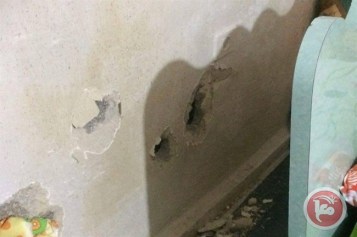
JERUSALEM – Israeli settlers on Sunday made a number of breaches through the wall of a Palestinian home belonging to Noura Sub Laban in the Old City of Jerusalem, family members told Ma’an.
Noura’s son, Ahmad Sub Laban, said the family was shocked to find at least six breaches through the wall, which borders a property that was taken over by settlers just two weeks ago.
Ahmad said the family called Israeli police, who arrived on the scene and asked that the settlers repair the damage without bringing any formal procedures against them, despite the settlers admitting to breaching the wall.
An Israeli police spokesperson had no immediate information on the reports.
Ahmad said: “I do not know the motivations behind this action, but this has confirmed that our house is in real danger as it is surrounded by Israeli enclaves on all sides, which means the house could be stormed at any moment.”
The far-right settlement organization Ateret Cohanim has been trying to seize the home of Noura Sub Laban, which lies in the Old City’s Oqbit al-Khalidiya area, since 2010, with the Sub Laban fighting to defend the home in Israel’s courts.
There are more than 500,000 Israeli settlers living in the West Bank, including East Jerusalem, in contravention of international law.
UN monitor on Palestine quits over Israel’s entry denial
Press TV – January 4, 2016
The United Nations expert on the human rights situation in the occupied Palestinian territories has resigned, complaining that the Tel Aviv regime continues to deny him access to the areas he is tasked with monitoring.
In a Monday statement, the UN said Makarim Wibisono submitted his resignation to President of the Human Rights Council Joachim Rucker earlier in the day.
It said Wibisono, who will effectively quit his job as of March 31, had “expressed deep regret that, throughout his mandate, Israel failed to grant him access to the Occupied Palestinian Territory.”
Wibisono has been in charge of monitoring rights violations in the occupied East al-Quds (Jerusalem), the occupied West Bank and the Gaza Strip. The Israeli regime has time and again prevented the UN official from visiting the areas.
In June 2015, Israel denied Wibisono access to the Gaza Strip, where he was to investigate the aftermath of Tel Aviv’s 2014 war that killed over 2,200 Palestinians in the blockaded coastal enclave. The regime said at the time that the mandate handed to the UN official’s team was “anti-Israel,” and that it was exclusively focused on cases of Israeli rights violations.
Last November, Wibisono, and the expert on summary executions, Christof Heyns, slammed Israel for using excessive force and carrying out summary executions against Palestinians amid a surge in tensions in the occupied territories, where Palestinians have held almost daily anti-Israel protests since early October.
The latest wave of tensions was triggered by Israel’s imposition in August of restrictions on the entry of Palestinian worshipers into the al-Aqsa Mosque compound in East al-Quds.
The restrictions have enraged Palestinians, who are also angry at increasing violence by Israeli settlers frequently storming the al-Aqsa Mosque, a place highly revered by the Muslims across the world.
The Palestinian protesters also say Israel has a covert plan for changing the status quo of the al-Aqsa Mosque.
At least 144 Palestinians have been killed since the violence erupted in various towns of West Bank and Gaza. Some of 25 Israelis have also died during the same period.
Palestinian Journalist killed, 25 injured in December
Over 65 violations of journalists’ rights
Palestine Information Center – 2-1-2016
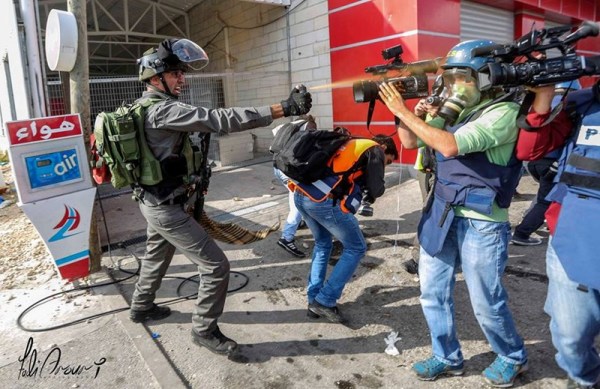
GAZA – Union of Islamic Radio Stations and Televisions-Palestine reported that Israeli forces committed 65 violations against the rights of journalists and pressmen in Jerusalem, West Bank and Gaza Strip in the month of December.
The union underlined that Israeli violations against Palestinian journalists led to the martyrdom of the photographer Ahmad Jahajha, 23, who was called “photographer of martyrs”.
The violations included direct attacks in the field and shooting at journalists while covering the events of Jerusalem Intifada and weekly popular marches. The union pointed out that 25 injuries among Palestinians who work in journalism were the result of direct attacks. Three among the wounded were female journalists. Ten cases of injuries were due to indirect attacks.
The union’s report also revealed that nine cases of repeated detentions, extension of detention, and summoning of journalists were documented in December including the case of a foreign journalist.
Detained Palestinian journalist Mohammad al-Qik was exposed to repeated assaults eight times. He was tortured and maltreated during investigation rounds and banned from seeing his lawyer or family. He was held under administrative detention which was extended to six more months despite being on hunger strike.
The report revealed that Israeli occupation forces banned Palestinian journalists and pressmen from doing their jobs and covering events. Israeli troops withdrew press cards from five journalists and banned two others from travel in Gaza.
The Israeli violations also included search and storming campaigns as well as confiscation of press equipment and closure of institutions and offices. Piracy of over five electronic websites was another form of Israeli violations. The webpage of al-Aqsa TV Channel was stopped and permanently deleted.
At the interior level, the union documented ten violations by the Palestinian Authority’s forces including ban orders against al-Aqsa satellite channel and tightening the noose on the team of Palestine Today satellite channel as well as summoning and detaining four journalists and assaulting four others.
Israeli Rabbi: Christians Not Welcome in Jerusalem
IMEMC News – January 1, 2016
 An Israeli Rabbi said, Wednesday, that Christians are not welcome in Jerusalem, and that he does not mind burning mosques and churches.
Bentzi Gopstein told Israeli TV Channel 2 that Israeli Jews practically prevent Christians from entering Jerusalem.
He also called for making obstacles towards the expansion of Christianity and Islam in annexed Jerusalem.
According to Days of Palestine, the extremist rabbi also said that he does not mind burning mosques and churches in Jerusalem, stating that Israeli authorities must arrest Christian monks and nuns.
Gopstein is the head of an notorious extremist Israeli Jewish group called Lehava, which is responsible for insulting and harassing monks and nuns in Jerusalem.
Several Israeli groups are active in the occupied holy city, with regard to extreme Judaisation activities, including the seizing of Islamic and Christian properties.
Israeli TV has previously proved that the Israeli government stands behind these groups, although it sometimes condemns their acts in token concern.
Israeli occupation authorities revoke ban on fanatic settler to enter al-Aqsa
Palestine Information Center – December 30, 2015
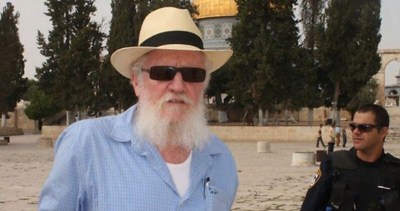 OCCUPIED JERUSALEM – Despite his dark past and his attempt oat bombing al-Aqsa Mosque in the 1980s, Israeli occupation authorities (IOA) allowed settler Yehuda Etzion to enter al-Aqsa Mosque after 30 years of prevention; he was also allowed to raise his hands as an aspect of worship while roaming the Mosque’s courtyards.
However, after the removal of the ban, Etzion breached the term of an agreement between Israel and Jordan with the sponsorship of the USA.
Etzion appealed the decision of denying him access into al-Aqsa Mosque for 15 days. The decision was issued by the Magistrate Court in Jerusalem, because he violated the “terms” of the recent Jordanian–Israeli agreement, which allows settlers to enter al-Aqsa Mosque but not to pray in it; however, Etzion raised his hands after entering the site as part of a religious ritual, prompting Israeli forces to remove him from the Mosque after Aqsa guards protested his act and insisted on him leaving the holy Islamic site.
In view of the serious unprecedented event after the Israeli judiciary allowed the settler to practice an act of worship violating the Jordanian-Israeli agreement, the Islamic Waqf management communicated with the Jordanian ambassador and Jordanian Ministry Of Awqaf and Islamic Affairs and informed them of the serious situation arising from storming the Mosque by such settlers who declare their intention to destroy the Mosque to build the alleged Temple in its place.
Escalation against al-Aqsa
The director of al-Aqsa Mosque, Sheikh Omar Kiswani told Qpress that the District Court’s decision is a serious escalation and a flagrant attack on al-Aqsa Mosque that would affect the region, stressing that the Israeli occupation must stop those settlers if it wants peace as it claims.
Lawyer and specialist of Jerusalem and Al-Aqsa affairs, Khalid Zabarqh, opined that the decision not to ban the settler Yehuda Etzion from al-Aqsa Mosque affects the legal rules that govern al-Aqsa Mosque, which acknowledge the entitlement of Muslims in the Al-Aqsa Mosque and praying there, and at the same time prevent others from doing that.
He charged that the Israeli judiciary has recently cohered with the Judaization schemes of the city of Jerusalem; as the judiciary began making decisions that help the settlement project, noting that, in conjunction with allowing Etzion to raise his hands as a signal of a prayer in al-Aqsa Mosque, the Israeli judiciary is looking into a decision to criminalize the chanting of Thakbir (Allah is the greatest) inside al-Aqsa Mosque.
Judaization dwarfs the Islamic right
Through his follow-up of the conduct of the Israeli courts, Zabarqh said that the occupation is trying through this device to widen the Judaization practice, in addition to dwarfing the Islamic right in al-Aqsa Mosque albeit in simple steps in order to endorse the occupation’s presence in it.
While the Israeli occupation allows the settlers to break into al-Aqsa Mosque knowing their plans and intentions to demolish al-Aqsa Mosque, it prevents many Palestinians from entering the Mosque, he pointed out.
Legitimize settlement
In this context, Sheikh Raed Salah, who has been barred from entering the city of Jerusalem and Al-Aqsa Mosque since 2007, confirmed that it is not permissible for any Israeli court to judge in any issue pertaining to the al-Aqsa Mosque; because it does not have sovereignty over it. Sheikh Salah believes that the Israeli court’s decision is null and void.
Sheikh Salah explained that the court is trying to legitimize through its decisions the incursions of settlers into al-Aqsa Mosque, in addition to legitimizing the construction of the alleged temple in place of the Mosque.
Regarding the renewal of his ban decision yesterday for an additional six months, Sheikh Salah said that the occupation which pretends that it respects the judiciary, issues an administrative military decision to prevent him from entering the city of Jerusalem, which he described as blatant injustice and racism.
The Israeli occupation forces prevented 12 Muslim deputies in the Israeli Knesset from entering the al-Aqsa Mosque, as well as banning 60 Palestinian women from praying in it.
Yehuda Etzion had tried to blow up the Dome of the Rock but al-Aqsa Mosque guards thwarted his attempt when a guard on one of its gates stopped him and searched the bag he was carrying and found it filled with explosives.
Etzion was a member of the Jewish secret movement that planned to assassinate the mayors of the West Bank. It adopted the bombing of the Nablus mayor Bassam Shaka’s car; the bombing resulted in the amputation of his legs.
Israel has ‘deprived 23,000 orphans of monthly sponsorship’

MEMO | December 22, 2015
The Deputy Head of the Islamic Movement in Israel, Shaikh Kamal Al-Khatib, said on Monday that Israel’s banning of the group has deprived 23,000 orphans from their monthly sponsorship payments, Anadolu has reported.
“The Islamic Relief charity run by the movement,” explained Al-Khatib, “used to pay a minimum of $40 monthly sponsorship for each orphan spread around the West Bank, Jerusalem and Gaza Strip.”
The Israeli government banned the Islamic Movement on 16 November. Any person or group which associates with it officially is now subject to criminal penalties, including arrest. The authorities confiscated property belonging to the organisation and its bank accounts were frozen. Seventeen affiliated organisations, including charities, were closed down.
The sponsorships, explained Al-Khatib, were donated by Palestinians. He suggested that a solution for the problem is for wealthy Muslims to take over the orphan sponsorships and pointed out that efforts are being made in this regard, although, understandably, he gave no details.
The Palestinian Islamic Relief charity was established by the movement in 1988 and its main activity was sponsoring orphans; it has no connection to the UK-based Islamic Relief or Islamic Relief Worldwide. The charity has been closed by the Israeli authorities several times. “Israel seeks to crack down on all projects which lie behind the persistence of the Palestinians,” added Al-Khatib. He stressed that the charity’s accounts have always been subject to Israeli monitoring.
Israeli Apartheid Wall destroys Palestinian lives

Palestine Information Center
On 29 March, 2002, the Israeli Occupation Forces (IOF) conducted a large-scale military operation in the West Bank, called “Operation Defensive Shield”. During the operation, the Israeli forces raided many Palestinian towns and villages and committed heinous crimes against the Palestinians.
The operation brought to light the Israeli government’s plans to conquer more Palestinian lands and to expel the Palestinians from their own homes. A major step in these plans was to build the Apartheid Wall, or what Israel calls the Separation Wall.
The Israeli government commenced building the Apartheid Wall on 23 June, 2002, at a planned length of 770 km. Now, around 406 km, i.e. 52.7%, of the Wall is completed.
The Wall in numbers
The Wall is 60-150 meters wide in some areas. This includes a buffer zone and roads on both sides of the Wall that the Israeli military uses to watch the Wall. The Wall is 8 meters high, and it contains:
1. Barbed wire
2. A 4-meter wide and deep trench, aiming to prevent the vehicles and pedestrians from passing
3. Military patrol roads
4. A sandy road to track footsteps
5. An electric fence with an 8-meter high cement wall
6. Watchtowers with cameras and sensors
The Wall separates an area of 733 km2 of the Palestinian lands that falls behind the Wall from the West Bank. In other words, these 733 km2 would be under full Israeli control, besides the occupied lands of 1948.
The Wall would also occupy 220 km2 of Jordan Valley, east of Palestine. The Valley is a main source of food for Palestinians, and is also known as their “food basket”.
The Wall passes through eight Palestinian governorates. In Jerusalem, building the Wall accelerated in 2006-2007. It separates a number of heavily populated Palestinian neighborhoods, like Shufat and Kafr ‘Aqab.
Effects of the Wall
In spite of the claimed Israeli security motives behind building the Wall, it negatively impacts the Palestinian people and cause.
First: Effects on the Palestinian daily life
As the Wall passes through the West Bank, it negatively impacts the lives of 210,000 Palestinians, who live in 67 Palestinian towns and villages.
Because of the Wall, 13 Palestinian neighborhoods would be isolated between the green line and the Wall. Furthermore, a second wall would create a security belt, stranding 19 Palestinian neighborhoods in isolated areas.
The Wall would also hinder the Palestinians’ movement and would prevent them from reaching their farms and selling their goods and produce.
Second: Economic and environmental effects
37% of the Palestinian villages, cut with the Wall, would lose their economic resources. Moreover, 12 km of irrigation systems were destroyed.
Confiscating and bulldozing Palestinian farms would cost the Palestinians 6500 jobs, in addition to harming the olive oil industry and fruit and vegetable farming.
The Apartheid Wall would affect the Palestinian water resources, as the West Bank would lose 200 million cubic meters of the Jordan Valley water.
Third: Effects on movement
Statistics show that the Wall would violate the right of movement of two million Palestinians. They will have to seek Israeli permits to be able to reach their houses and farms in different Palestinian areas. Such restrictions would force at least 2.8% Palestinians to leave their homes and find other places to live in.
Fourth: Effects on education and medical sectors
Many Palestinian students and teachers were affected by the Wall, as it prevented them from reaching their schools, forcing 3.4% Palestinians to drop out.
On the medical level, it is getting increasingly difficult for Palestinians to reach the hospitals and medical centers to the east of the Wall, and the Palestinian villages to the west of the Wall have no medical services at all.
Fifth: Effects on Palestinian water resources
The Israeli occupation has strategically chosen the path of the Wall in order to guarantee Israel as much water as possible and thus depriving Palestinians of a basic right. Once finished, the Wall will enable Israel to confiscate and control 165 water wells and 53 springs, which in total culminate into 55 million cubic meters annually. Furthermore, the Wall now means Israel controls an additional amount of 679 million cubic meters annually.
Extremist Jewish group calls for demolition of Dome of the Rock
Ma’an – December 10, 2015
 BETHLEHEM – An extremist Jewish organization on Thursday invited Israeli right-wing activists to participate in a rally calling for the destruction of the Dome of the Rock, Hebrew-language Israeli news sites reported.
The Temple Institute — dedicated to building the Third Jewish Temple in the place of the Dome of the Rock — organized the rally in an effort to place pressure on the Israeli government to demolish Muslim facilities in the Al-Aqsa Mosque compound, according to the reports.
The rally is expected to start at Zion Square in West Jerusalem before heading to the Al-Aqsa compound where the right-wingers plan to light candles to commemorate the fifth night of Hanukah.
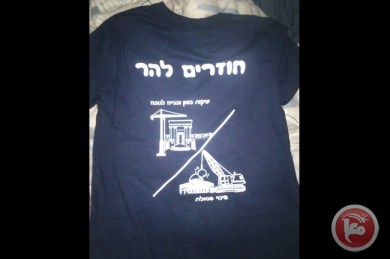
The Temple Institute reportedly distributed dozens of t-shirts calling for the destruction of the Dome of the Rock prior to the rally.
One of the t-shirts handed out displayed an image of a lift carrying the Dome of the Rock with a caption reading “waste removal.”
The Dome of the Rock — located in the Al-Aqsa Mosque compound — is the third holiest site in Islam, and is venerated as Judaism’s most holy place, as it sits where Jews believe the First and Second Temples once stood.
The Temple Institute is one of a handful of extremist Israeli organizations who critics say are gaining traction in Israeli Prime Minister Benjamin Netanyahu’s right-wing government.
Controversial Israeli right-winger Yehuda Glick is a major figure in the Temple Institute, which has reportedly received $600,000 shekels ($155,300) in monetary support over the past five years from Israel’s Ministry of Education.
The figure was released Thursday in an investigation conducted by Israeli daily Haaretz. The report also revealed that Netanyahu’s defense minister, Eli Ben-Dahan, personally donated thousands of dollars to the Temple Institute.
Such extremist groups have created a rift within Israeli society while triggering frustration from Palestinian groups.
Increased numbers of Jewish worshipers touring the compound in September — accompanied by restrictions on Palestinian worshipers — played a major role in triggering a wave of violence across occupied Palestinian territory at the beginning of October.
Many Palestinians fear that Israel is seeking to renege on a longstanding agreement preventing non-Muslim prayer in the compound, although Israeli leadership has denied that this is the case.
On Wednesday evening, a former member of the Jewish Underground — a right-wing group that also plotted for the destruction of the Dome of the Rock — was injured in a drive-by shooting in the occupied West Bank.
Anti-Assimilation group protests Christmas tree event in Jerusalem
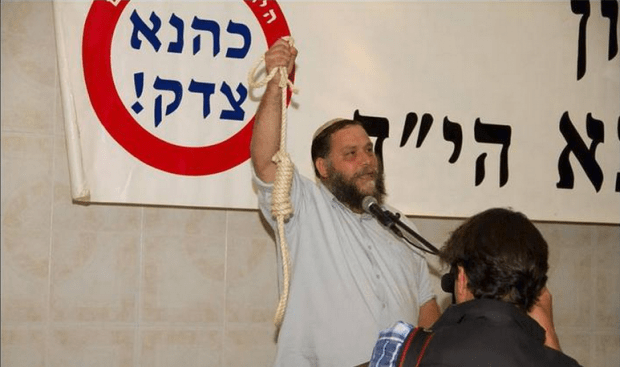
Benzi Gopstein holds a noose at a Lehava meeting shared on social media (Twitter/@ronnie_barkan)
IMEMC News | December 6, 2015
The right-wing Jewish group ‘Lehava’ held a protest outside of the YMCA in Jerusalem, shouting at Palestinian Christian children and families as they were entering and leaving the annual Christmas-tree decoration party.
Lehava is a group that calls for the expulsion of the indigenous Palestinian population from their homes in what is now Israel, in Jerusalem and in the West Bank. At a protest last year outside of a business that had some Palestinian employees, the group chanted “Stop hiring Arabs,” “stop dating our women” and “employing Arabs equals Assimilation.”
The group, whose name in Hebrew stands for the “Organization for the Prevention of Assimilation in the Holy Land”, has also disrupted weddings between Palestinians and Israeli Jews, and handed out fliers saying they are trying to “save the daughters of Israel” by preventing them from dating or marrying Arab men.
A 2011 investigation by the Israeli newspaper Ha’aretz found that around half of the annual budget of the controversial Lehava organization was funded directly by the Israeli government.
The leader of the group, Benzi Gopstein, was reportedly present at the YMCA protest on Friday. Gopstein is on the record voicing support for Pinhas Aburamed, an Israeli man who murdered a Palestinian who he thought was trying to flirt with a Jewish girl. Gopstein said that Aburamed is a hero and should receive a medal.
The event that the right-wing Jewish Lehava group chose to protest was a family event described on the YMCA’s website as “A festive evening in the YMCA lobby decorating the Christmas tree, singing carols and enjoying holiday treats.”
The protesters shouted anti-Palestinian and anti-Christian slogans at the children who came to decorate the Christmas tree, including, “The Arabs won’t defeat us with knifes, and the Christians won’t buy us with presents,” and “Jews want a hanukkiah [menorah], not a fir tree”, according to Israel National News.
Around 1% of the population of Israel, the West Bank and Gaza is Christian. The percentage had been higher before the Israeli military occupation and theft of Palestinian land began. The emigration of Palestinian Christians to other countries increased significantly after the Oslo Accords were signed in 1993 and Israeli settlement expansion increased exponentially.
Many Palestinian Christians in Bethlehem, Jerusalem and Nazareth can trace their ancestry back to early Christians who have remained continuously on the land where Christians believe that Jesus was born, died and resurrected.
Featured Video

Racist Seinfeld Dances for Joy as Bibi Unveils His New Map
or go to
Aletho News Archives – Video-Images
TV Drama Review
Japanese drama projects Japan’s wartime atrocities onto Chinese characters

Global Times | October 25, 2026
By portraying Chinese characters as perpetrators of ruthless violence while casting Japanese Self-Defense Forces (SDF) intelligence operatives as defenders, the season 2 of the Japanese drama Vivant has recently drawn criticism from Chinese netizens, who argue that its depiction turns historical reality on its head while ignoring Japan’s wartime atrocities.
The TBS drama series – a spy suspense story in which an alleged unofficial intelligence unit of the SDF operates across the globe — has attracted a passionate fanbase. Its currently airing season 2 opened with a household rating of 18.8 percent, the highest for a TV drama this year, according toa commentary article by Japanese media Toyo Keizai.
What draws attention is the portrayal of the enemies in the series, the article noted. Scenes in which the Chinese organization subjects kidnapped members of the SDF unit to brutal torture are repeated with unrelenting intensity.
It is rare for Japanese TV dramas to explicitly portray a real-life country as the enemy, the article noted.
Japanese Prime Minister Sanae Takaichi also made a reference to the drama, saying that she has been recording Vivant and hopes to binge-watch it over the year-end and New Year holidays, according to Japanese media outlets.
China’s CCTV News report on Sunday revealed that the drama features scenes in which Chinese personnel cut off the fingers of and stab Japanese intelligence operatives in the abdomen. Such acts bear striking similarities to the torture inflicted on Chinese nationals by invading Japanese troops during the World War II.
The drama distorts the truth by attributing these atrocities to modern Chinese characters. Beneath the surface, it subtly glorifies Japan’s cross-border overseas operations, blurs the functional boundaries of the SDF and implicitly promotes an expansionist narrative, per CCTV News. … continue
Blog Roll
 Aletho News
- Iran FM Araghchi: “Hormuz Will No Longer Be the Same”
- EU facing trillion-euro debt hole while seeking more cash for Kiev
- How US, Europe, Persian Gulf states exhausted missile stockpiles, splurged billions to defend Israel
- Up in arms… Koreans reject U.S. empire’s plan to make South Korea the next Ukraine
- Iran, Turkey, Pakistan, Saudi Arabia could advance region-led security framework in Tehran: FM spox
- Netizens condemn Japanese drama for projecting Japan’s wartime atrocities onto Chinese characters
- Racist Seinfeld Dances for Joy as Bibi Unveils His New Map
- A West Bank War for Netanyahu’s Election Campaign, Could It Backfire?
- Yemen denounces European Parliament’s ‘hypocritical’ push to blacklist Ansarullah
- Qalibaf: UAE’s UN bid aims to ‘clear the runway’ for ‘Greater Israel’, whitewash genocide
- If Americans Knew
- Israel punishes Palestinian prisoners with solitary confinement for making a cake
- US midterms: Where do candidates in key Senate races stand on Israel, Gaza, and Iran?
- Israeli forces demolish Hebron homes, displace thousands of Palestinians as raids expand
- Their Son Died in Israeli Prison. No Answers. No Body
- Biden’s Israel Catastrophe
- Why Israel’s latest assault on Hebron is so significant for the West Bank
- Israel Used “Where’s Daddy?” AI to Relentlessly Murder Palestinian Journalists and Their Families in Their Homes from October to December 2023
- DAILY UPDATE: Latest essential news on Palestine, Israel, & region
- Netanyahu Says Israel Must Prepare for Banking Sanctions, Floats Crypto as a Possible Bypass
- Latest updates from Israeli assault on West Bank
- No Tricks Zone
- Sudden Stratospheric Warming, Powerful El Niño Combination May Lead To Extreme Europe Cold, Energy Crisis!
- Two New Studies Find Thwaites Glacier Melt Cannot Be Driven By Human Activity Or A Warming Ocean
- E-Cars Reduce CO2 Emissions By Only 41% Compared To Internal Combustion Engine Vehicles
- Predictions Made By Renowned Climate Professor Over Past Decades Have Been Proven To Be Poor
- New Study Suggests Large Regions Of The Pacific Ocean Have Been Cooling For The Last 80 Years
- Germany’s Green Energy Debacle: High Energy Costs Force Kahla Porzellan to Close After 182 Years!
- New Study: 50 Years Of The Most Aggressive ‘Net Zero’ Policies Can Only Affect The Global Climate By 0.03°C
- US September “Heat” Was No Record…Many Records Set Decades Ago
- Latest European Green Energy Debacle; Portugal’s Largest Flagship Solar Park Insolvent!
- Green Energy Debacle: German Expert Professor Fritz Vahrenholt Warns Of Severe Economic And Social Consequences

