A History of Violence
What mainstream accounts of Venezuela’s “peaceful” opposition leave out
By Gabriel Hetland | Jacobin | September 11, 2016
The media narrative is clear: peaceful demonstrators upset about a collapsing economy and political repression are fighting an oppressive state in Venezuela. The actual history, however, is more murky.
For more than a decade the Venezuelan opposition has used a variety of violent tactics to try to topple the country’s democratically elected government. An April 2002 coup deposed Hugo Chávez for forty-seven hours and led to multiple civilian deaths.
Violent protests in April 2013 targeted government-run health clinics and other public institutions, resulting in at least seven civilian casualties; this occurred following the 2013 presidential election, which the opposition lost but refused to concede to the government. The early 2014 wave of protests resulted in forty-three deaths, half at the hands of the opposition.
During the 2014 protests, opposition activists deliberately targeted state security forces and even strung galvanized wire across intersections, leading to the brutal decapitation of a motorcyclist. Nor can we omit mention of the approximately two hundred peasant leaders killed by ranchers opposed to the 2001 land reform law pushed by Chávez.
This brutal history is almost totally absent from mainstream media depictions of the opposition. The same is true of leading opposition figures’ present-day celebrations of this violence. In mainstream accounts of last week’s protests in Caracas, the opposition is depicted as an essentially peaceful force, seeking to use constitutional means — a recall referendum — to legally put an end to an incompetent, repressive government.
An article on the protests in the Wall Street Journal quotes an opposition supporter saying, “[D]on’t tell me that we didn’t try to demand change peacefully through the constitution.” The article briefly mentions the 2002 coup, but fails to note that leading members of today’s opposition played key roles in that episode. Nor does it make any mention of more recent instances of opposition violence.
A New York Times article on the protests details the deteriorating conditions in Venezuela leading people to protest against the government, and provides ample coverage of claims that the government has repressed dissident politicians and foreign journalists. No mention is made of opposition violence.
A BBC article on the September 1 protests states that “A small group of protesters clashed with riot police as the peaceful rally ended.” The article mentions the 2014 protests and states that, “Forty-three people on both sides of the political divide were killed during those protests.” Like other mainstream articles, however, this piece focuses disproportionately on opposition allegations of instances of government repression.
A piece in Bloomberg on the September 1 protests briefly discusses the 2014 protests, but misleadingly gives readers the impression that “over 40 people were killed” because of a government “crackdown on anti-government protests,” eliding the opposition’s responsibility for many of those deaths.
The takeaway from these and other mainstream media stories about the protests is clear: the opposition is peaceful, and there is no reason to believe the government’s delusional and self-serving claims that it faces a real threat of a violent coup.
Indeed, opposition leaders have repeatedly denied seeking a coup. But statements from these figures, not to mention recent history, indicate that the government may have more reason to worry than mainstream sources allow for.
In May, Henrique Capriles, the opposition presidential candidate in the 2012 and 2013 elections, exhorted the Venezuelan military to “decide whether you are with the constitution or with Maduro.”
Other opposition leaders, such as Jesús Torrealba, have also made public statements that steer clear of explicitly calling on the military to overthrow the government, but still suggest that the military should actively support the opposition against President Maduro. One wonders how government officials in other countries would react if leading opposition figures made similar statements there?
A good test of whether the opposition is as “peaceful” as media accounts suggest is to examine how opposition leaders speak about past episodes of violence. It’s telling that key opposition figures not only fail to express remorse or contrition when events such as the 2002 coup are discussed, but openly celebrate such acts.
During a speech given on August 27, just days before the September 1 protests, Venezuelan National Assembly head and leading opposition figure Henry Ramos Allup repeatedly refers to the coup in an approving matter. In the speech Ramos Allup makes it clear that his only regret is that it did not succeed in ousting Chávez.
No doubt, there is plenty to criticize about the Venezuelan government these days. The government deserves ample blame for mismanaging its currency and failing to confront corruption. State violence that does occur should be condemned and there’s a need for an independent left to grow in the country. But the narratives we’re being sold by the media are giving the opposition a free pass.
Gabriel Hetland teaches at University at Albany and has written about Venezuelan politics for the Nation, NACLA, Qualitative Sociology, and Latin American Perspectives.
Last words to the nation of Salvador Allende
Last words to the nation of Salvador Allende
Surely this will be the last opportunity for me to address you. The Air Force has bombed the towers of Radio Portales and Radio Corporación.
My words do not have bitterness but disappointment. May they be a moral punishment for those who have betrayed their oath: soldiers of Chile, titular commanders in chief, Admiral Merino, who has designated himself Commander of the Navy, and Mr. Mendoza, the despicable general who only yesterday pledged his fidelity and loyalty to the Government, and who also has appointed himself Chief of the Carabineros [national police].
Given these facts, the only thing left for me is to say to workers: I am not going to resign!
Placed in a historic transition, I will pay for loyalty to the people with my life. And I say to them that I am certain that the seed which we have planted in the good conscience of thousands and thousands of Chileans will not be shriveled forever.
They have strength and will be able to dominate us, but social processes can be arrested neither by crime nor force. History is ours, and people make history.
Workers of my country: I want to thank you for the loyalty that you always had, the confidence that you deposited in a man who was only an interpreter of great yearnings for justice, who gave his word that he would respect the Constitution and the law and did just that. At this definitive moment, the last moment when I can address you, I wish you to take advantage of the lesson: foreign capital, imperialism, together with the reaction, created the climate in which the Armed Forces broke their tradition, the tradition taught by General Schneider and reaffirmed by Commander Araya, victims of the same social sector which will today be in their homes hoping, with foreign assistance, to retake power to continue defending their profits and their privileges.
I address, above all, the modest woman of our land, the farmer who believed in us, the worker who labored more, the mother who knew our concern for children. I address professionals of Chile, patriotic professionals, those who days ago continued working against the sedition sponsored by professional associations, class-based associations that also defended the advantages which a capitalist society grants to a few.
I address the youth, those who sang and gave us their joy and their spirit of struggle. I address the man of Chile, the worker, the farmer, the intellectual, those who will be persecuted, because in our country fascism has been already present for many hours — in terrorist attacks, blowing up the bridges, cutting the railroad tracks, destroying the oil and gas pipelines, in the face of the silence of those who had the obligation to protect them. They were committed. History will judge them.
Surely Radio Magallanes will be silenced, and the calm metal instrument of my voice will no longer reach you. It does not matter. You will continue hearing it. I will always be next to you. At least my memory will be that of a man of dignity who was loyal to [inaudible] the workers.
The people must defend themselves, but they must not sacrifice themselves. The people must not let themselves be destroyed or riddled with bullets, but they cannot be humiliated either.
Workers of my country, I have faith in Chile and its destiny. Other men will overcome this dark and bitter moment when treason seeks to prevail. Go forward knowing that, sooner rather than later, the great avenues will open again where free men will walk to build a better society.
Long live Chile! Long live the people! Long live the workers!
These are my last words, and I am certain that my sacrifice will not be in vain, I am certain that, at the very least, it will be a moral lesson that will punish felony, cowardice, and treason.
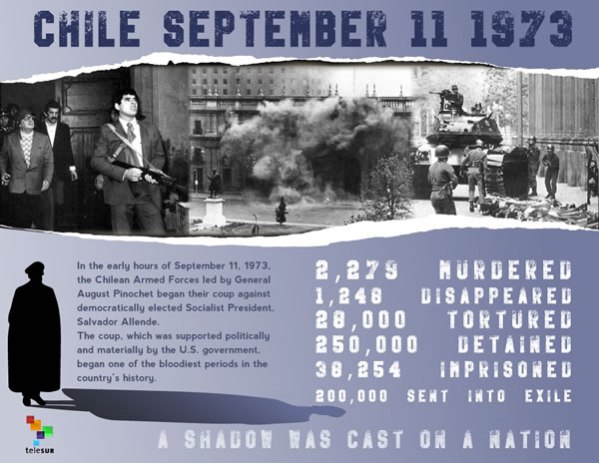
CIA Continues to Cover Up Its Involvement in Chile’s 9/11 Coup
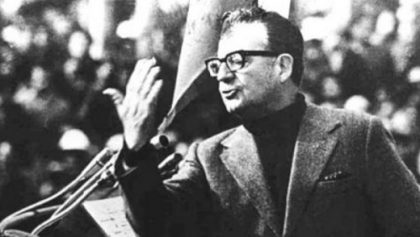
Victim of one the many coups on democracy carried out by the United States: Salvador Allende
teleSUR | September 9, 2016
Though intelligence documents from the 1973 coup period have been declassified since 1999, the CIA continues to censor them.
The CIA continues to withhold information on its involvement in the Sept. 11, 1973 coup that led to the death of President Salvador Allende in Chile, followed by a deadly dictatorship, according to documents posted Friday by the National Security Archive.
In the list of published documents, the section regarding Chile is censored. The President’s Daily Briefs, the intelligence reports given daily to the U.S. president, in particular former President Richard Nixon days before Allende’s death, were among those censored.
According to Peter Kornbluh, director of the Archive’s Chile Documentation Project, censorship on this issue makes no sense since the intelligence agency has officially acknowledged its ties to those who plotted the coup from inside the Chilean military, and declassified several intelligence reports since.
“The CIA is trying—but failing—to hold history hostage,” Kornbluh said. “The CIA is attempting to cover up what Nixon knew about coup plotting in Chile and when he knew it, as well as hiding the CIA’s own contacts and connections to the coup plotters.”
According to the documents, three days before the coup—and on the day of the coup—the CIA gave Nixon an intelligence report on the progress of the efforts inside the Chilean military to overthrow Allende, a socialist.
In one document, a CIA operative in Santiago named Jack Devine identifies the new date of the planned coup for the next day, September 11, and confirms all three branches of the Chilean armed forces along with the police “are involved in this action.”
The same sources told the CIA that General Augusto Pinochet, who would later become a dictator with the support of the U.S., was in communication with Air Force General Gustavo Leigh about the planned coup. The Air Force would later bomb La Moneda presidential palace, where Allende and his closest allies were on Sept. 11.
The CIA told the White House that a “key officer” in the coup attempt requested U.S. assistance in case the Chilean military encountered any resistance, according to the documents.
Kornbluh said his institution would press for the release of the censored information.
“The documents provided to Richard Nixon on Chile can and should be released for the sanctity of the historical record. The public has a right to know what the President knew, and when he knew it,” he said.
Brazil Elite Codifies Budget Practice Used to Impeach Rousseff
teleSUR – September 4, 2016
Brazil’s newly-installed President Michel Temer has signed legislation that essentially authorizes the identical financial accounting maneuver that was used to justify the impeachment bid against ousted President Dilma Rousseff’s just days after she was removed from office.
The law, announced Friday in the official gazette, expands the government’s ability to seek additional credits without securing authorization from Congress. As described by Brasil de Fato, the rule broadly opens the door for the budgetary maneuver known in Brazil as “pedaling,” in which the government borrows money from state banks to make the budget appear in a better position than it is.
This longstanding practice was used to propel the impeachment process that finally ousted Rousseff from office last Wednesday in a move widely condemned as a parliamentary coup.
Rousseff’s supporters repeatedly pointed out that the accounting trick had been used by many of her predecessors without scrutiny. Independent auditors also found her not guilty of breaking budgetary rules — a fact that did not stop the ill-footed impeachment process from going ahead.
According to Brazil’s Senate news agency Agencia Senado, the unelected Temer government gave pedaling a green-light, claiming that the rule change will make government budget management “more flexible,” including shuffling of expenditures associated with the federal infrastructure Growth Acceleration Program, better known as PAC.
The act allows the government to boost by as much as 20 percent the value of an expenditure by writing down by the value of another by a corresponding 20 percent, which, in fact, doubles the level allowed by previous administrative rules.
Rousseff was ousted Wednesday in a 61-20 Senate vote in favor of her impeachment, though she retained her so-called political rights to hold public office in a second vote.
The day after the impeachment ballot, Rousseff’s defense appealed to the Supreme Court to compel a second Senate impeachment vote, arguing that the process was unconstitutional on the grounds that the budgetary crime she is accused of is not an impeachable offense according to Brazilian law.
Rousseff’s rivals long attempted to paint the impeachment process as a campaign to root out government corruption. But aside from the fact that multiple other leaders have used the pedaling procedure, damning recordings released weeks after her suspension in May revealed that top opposition figures schemed with the Supreme Court and military command to ensure Rousseff’s ouster as part of a bid to stop corruption investigations against their allies.
Like many of his top allies and cabinet members, Temer — installed as president despite being banned from running for public office for eight years — is embroiled in multi-million dollar fraud scandals.
Historic: Peru Jails 10 Military Men for Brutal State Massacre

Claudia Pomacongo holds a card detailing the case of her husband, who was murdered in the Accomarca massacre. | Photo: AFP
teleSUR – September 1, 2016
Among the military officials sentenced for the 1985 rape massacre of civilians was the Peruvian general nicknamed the “Butcher of the Andes.”
A Peruvian court Thursday sentenced 10 former military officials and soldiers to between 10 and 25 years in prison for the 1985 massacre of 69 civilians, mostly women and children, in the town of Accomarca, in one of the most iconic cases from the South American country’s so-called “war on terror.”
Three high-ranking military men, then-Lieutenants Telmo Hurtado and Juan Rivera Rondon and then-general Wilfredo Mori, were sentenced to 23, 24, and 25 years in jail as the masterminds behind the massacre. Judges singled out Hurtado — infamously known as the “Butcher of the Andes” — and Rivera Rondon as those principally responsible for carrying out the violence as the leaders of the patrols, while Mori was held responsible by giving the orders as the highest in the chain of the command.
Two other accused received 25 years in jail each, and another five were sentenced to 10 years each, all for carrying out the violent tragedy. Six were acquitted, including then-general Jose Williams Zapata. Sentences were not handed down for 11 others accused in the case, because one died before the trial was completed and 10 others are fugitives.
People gathered outside the National Criminal Court in Lima to await the results of the sentencing trial, which was delayed more than eight hours. Families of the victims and other Accomarca community members prepared food to share with those waiting to hear the announcement outside the court.
The outcome of the six-year-old case establishes a precedent for prosecuting similar crimes against humanity at the hands of the state in the guise of cracking down on left-wing insurgency in the 1980s and 1990s.
The Accomarca massacre trial is also groundbreaking because it is the only such case in Peru—aside from prosecutions of members of the military death squad known as Grupo Colina—that brings charges against the military’s entire chain of high command, according to local media.
On Aug. 14, 1985, at the height of the government’s conflict with the notorious Shining Path rebel army, the Peruvian military massacred at least 69 unarmed victims—30 children, 27 women, and 12 men—in Accomarca, located in Peru’s southern department of Ayacucho. Troops raped the women, then herded all the men, women, and children into houses before launching hand grenades at them. They finally burned the houses to kill every last victim.
The National Human Rights Coordinator and the Washington Office on Latin American had stressed in a joint statement leading up the the hearing the importance of the trial and the “need for a sentence that imparts real justice for one of the most heinous crimes and reminders of the internal armed conflict” in Peru from 1980 to 2000.
“Peruvian justice has an enormous debt with the victims in the Accomarca case,” said Jorge Bracamonte, executive secretary of Peru’s National Human Rights Coordinator, in a statement, stressing that the massacre has gone unpunished for too long. “We not only hope for an exemplary sentence, but we also hope that the court will order the collective return of the bodies of the Accomarca victims so that the families can bury their dead and close their grief.”
Human rights organizations have called for comprehensive reparations for victims as part of the process of seeking justice for acts of state terror.
“Justice not only seeks the punishment of those responsible, it also seeks to dignify the victims who, for so many years, have been sidelined and forgotten,” said WOLA’s Jo-Marie Burt in a statement.
In the sentencing hearing, judges also ordered reparations of US$44,000 be paid to the family of each of the victims of Accomarca.
The massacre took place under the state guise of Peru’s counterinsurgency strategy aimed at wiping out left-wing armed groups that challenged the state. But the Peruvian army killed scores of unarmed rural civilians accused of collaborating with guerrilla groups as part of the bloody conflict that claimed a total of 70,000 lives from 1980 to 2000.
Human rights groups have pointed to the Accomarca case as representative of the reign of state terror inflicted on poor and Indigenous communities.
“It has been shown that the Accomarca massacre was not an excess of the counterinsurgency fight nor an overreaction of soldiers overwhelmed by war,” said Burt, “but the result of a state policy of combating subversion using indiscriminate violence against the civilian population.”
Behind the Bolivia Miner Cooperatives’ Protests and the killing of the Bolivian Vice-Minister
By Stansfield Smith | Dissident Voice | August 31, 2016
The Bolivian cooperatives’ protests and their August 25 killing of the Bolivian Vice Minister of the Interior Rodolfo Illanes requires us to question our assumptions about cooperatives. What are the Bolivian mining cooperatives? Most began during the Great Depression as miners banded together to work a mine in common. However, like many cooperatives in the US that arose out of the 1960s, they have turned into small businesses. Regardless of their initial intentions, cooperatives existing in a surrounding capitalist environment must compete in business practices or go under.
The Bolivian mining cooperatives themselves underwent this process, and have become businesses whose owners hire labor. Roughly 95% of the cooperative miners are workers, and 5% are owners. It is common for the employed workers to be temps, or contracted out employees as we refer to them here. They have no social security, no job security, no health or retirement benefits.
The mining cooperatives made ten demands on the government, and during the second week of August, they announced an indefinite strike if the government did not meet their demands, later adding another 14 to the first 10.
The three most significant demands included rejection of the General Law of Cooperative Mines, which guaranteed cooperative employees the right to unionize, since they are not cooperative co-owners. The cooperatives owners did not want their workers represented by unions.
Reuters, and the corporate press, true to form, falsely claimed the opposite, that the cooperative miners were protesting against the government and demanded their right to form unions.
A second demand was loosening of environmental regulations for the mining cooperatives.
The third key demand was to revoke the law disallowing national or transnational businesses from partnering in cooperatives. At present cooperatives have 31 contracts with private businesses, most signed before the Evo Morales era.
The cooperatives want the right to form partnerships with multi-nationals and exploit the natural resources without the laws protecting the environment. Opening the cooperatives to such privatization ran counter to what was voted on in the Constitution: “The natural resources are the property of the Bolivian people and will be administered by the State.”
The Evo Morales government nationalized Bolivia’s natural resources in 2006. Because of this the government share of the profits with corporations from the sale of gas and other natural resources has risen from around 15% to 85%. Previously under neoliberal governments, about 85% of the profits went to corporations. As a result, the Bolivian state has gained an extra $31.5 billion through 2015, which it has used to develop industry, infrastructure, schools, health care and hospitals to the mostly Original Peoples population. It has also provided many subsidies for the poor, benefiting 4.8 million Bolivians out of a population of just over 10 million. This has cut in half the number of Bolivians living in extreme poverty.
During the August cooperatives’ protests, the Evo Morales government had repeatedly stated it was open to dialogue, but pointed out it cannot violate the Constitution when faced with the demands of the cooperatives, which are thinking only of their personal profits.
Vice Minister Illanes went to meet with the miner cooperatives’ leaders of the FENCOMIN, Federacion de Cooperativas Mineras. He was tortured and killed and so far 9 have been charged, including the President of FENCOMIN, who was a leader in the violent protests.
Before this, Bolivian TV broadcast news of rioting miners charging at police, hurling stones and even sticks of dynamite. The police responded with tear gas to disperse the protesters. A number of police were injured during the protests. On August 24, two miners were shot at close range during the road blockades. If the police were responsible, it contravened the order of President Morales not only not to shoot, but to not bring firearms in the area of the road blockades.
Vice Minister of Coordination with Social Movements, Alfredo Rada, said after the murder that the issue of the mine cooperatives should be part of a national debate. He pointed out the cooperative workers are exploited by the owners, who have created a hierarchy inside the organizations for their private benefit. Rada added, “We respect true cooperativism, where all are equal, but these companies have been converted into semi-formal capitalist businesses.”
After the murder of Vice-Minister Illanes, Evo declared, “Once again, the national government has squashed an attempted coup.” He added that the miners had planned to entrench themselves at the roadblocks they had established and that documents confiscated from the offices of the cooperative miners mention “overthrowing the government.” He stated that some of the private business and cooperatives’ owners had deceived their workers.
The US has sought to undermine Evo Morales, going back to his first presidential election campaign. Bolivia’s Cabinet Chief Juan Ramon Quintana stated over the past eight years the National Endowment for Democracy (NED) has funded around 40 institutions in Bolivia including economic and social centers, foundations and non-governmental organizations, at a total amount of over $10 million. US soft coup efforts reached their heights during the separatist movement by the rich white elite in the Media Luna, and during the TIPNIS protests in 2011.
In the fall of 2015 the US developed the Strategic Plan for Bolivia to reverse the progressive popular changes in Bolivia and restore neoliberal-neocolonial rule. This was written by Carlos Alberto Montaner, a counter-revolutionary Cuban exile, US Congresspeople such as Ileana Ros-Lehtinen, in charge of USAID for Latin America, and chief leaders of the Bolivian opposition. One early result was the defeat of the Bolivian referendum to allow Evo Morales to run for president for a third term.
Venezuelan President Maduro has pointed out that the Dilma coup and the killing of the Bolivian minister, are part of an imperialist attack on the progressive governments of Latin America. “It is a continent-wide attack by the oligarchies and the pro-imperialist right wing against all the leaders, governments and popular movements, progressive and revolutionary left” said Maduro. “With Dilma in Brazil, with Evo in Bolivia, Correa in Ecuador, with Daniel in Nicaragua and with all the peoples and social movements of Latin America, Venezuela is going to struggle for a sovereign, independent, humane, and popular future.”
So far the US anti-war, anti-interventionist movements have not strongly responded to the escalating US coup attempts against progressive elected Latin American governments.
Stansfield Smith, Chicago ALBA Solidarity, is a long time Latin America solidarity activist, and presently puts out the AFGJ Venezuela Weekly.
Coca-Cola Accused of Funding Colombian Death Squad
teleSUR – September 1, 2016
U.S.-based Coca-Cola company along with more than 50 other companies were accused by Colombian courts of financing terrorism for their ties to the now-disbanded paramilitary organization, United Self-Defense Forces of Colombia, a fact trade union leaders have been denouncing for decades.
The cases against the companies will be heard in a transitional justice tribunal after the peace deal with the Revolutionary Armed Forces of Colombia and the government is signed.
Coca-Cola was accused of hiring hitmen from the AUC between 1990 and 2002 to kill at least 10 labor union leaders who were trying to organize Coca-Cola’s plants. U.K. oil company BP has also be taken to court for its funding of AUC, along with kidnapping and human rights abuses.
Other companies suspected of financing terrorism, commonly referred to as the “para-economy,” include Colombia’s largest beverage company Postobon, cement company Cementos Argos, state oil company Ecopetrol and banana distributor Chiquita Brands International.
In June, families of victims killed by paramilitary groups opened a federal lawsuit against Chiquita in the U.S. for supporting the AUC. The company was estimated to have made at least 100 payments to the group worth US$1.7 million between 1997 and 2004.
The right-wing AUC coalition, deemed a terrorist organization by the Colombian government, disbanded in 2006. The paramilitary group was responsible for a number of massacres, human rights abuses, kidnappings and extortions that resulted in the displacement of thousands of Colombians.
Some politicians and authorities have been sentenced in relation to links with the AUC, the majority of businesses involved have not been punished for their illegal financial activities.
Investigations and punishment of businesses involved with paramilitary groups have commonly stuttered over whether payments were voluntary or not and if companies received any benefits in return.
RELATED:
Brazilian Coca-Cola Manufacturer Accused of Slave Labor
Brazil’s Unelected President Cuts Successful Literacy Program
teleSUR | August 29, 2016
With Brazilian Senators preparing to vote this week on whether to oust President Dilma Rousseff from office, interim President Michael Temer’s unelected government last week has axed a popular nationwide educational program that has shaved nearly a quarter from the country’s illiteracy rate in little more than a decade.
The Ministry of Education confirmed that it had discontinued the literacy initiative to a citizen who requested an update on the program through the country’s Access to Information Act, the newspaper Folha de Sao Paulo reported Sunday.
The initiative, known as Literate Brazil Programme, was launched in 2003 in the first year of the President Luiz Inacio Lula da Silva–popularly known simply as “Lula”– of the Workers’ Party or PT. Brazil is historically one of the world’s most economically and social unequal countries in the world and the program was one of several redistributive efforts undertaken by Lula’s administration in his two terms in office.
But the interim Education Ministry, headed by right-wing politician Mendonca Filho, who faces investigation over major accusations of corruption, has dissolved the program, cutting off funding to state and local governments, even while continuing to deny publicly that the program has been revised in any way. State and local officials, however, say that they’ve been unable to enroll anyone in the literacy program, Folha reported Sunday.
Since it began in 2003, the literacy initiative has served an average of 1.3 million learners aged 15 and older, managing to reduce illiteracy rates from 11.6 percent to 8.3 percent in 2014. The Unesco Institute for Statistics estimated the 2015 adult illiteracy rate at 8.2 percent, while less than 2 percent of youth are illiterate.
According to Unesco, the program has shown “real-life success stories” of how literacy skills can improve “future prospects” for Brazilian citizens.
Despite the improvements in the literacy rate, Brazil still ranks behind many countries in the region, including Argentina, Chile, Colombia, Cuba, Mexico, Paraguay, Uruguay, and Venezuela, among others.
There also remains a great regional disparity in Brazil’s overall literacy rate, which ranges from 2.7 percent in the Federal District and 3.2 percent in the state of Rio de Janeiro to 22 percent and 20.2 percent in the poor, service-economy states of Alagoas and Piaui, according to government data reported by Folha.
Immediately after his administration was installed in May, Michel Temer’s all-male, corruption-ridden cabinet of neoliberal ministers moved swiftly to roll back social programs and implement an aggressive state austerity program that includes sweeping privatization efforts. Lula’s protegee, the twice-elected Rousseff is scheduled to testify Monday in her impeachment trial, with a final vote expected Tuesday.
Temer government’s has also cut other key programs and ministries, including the Ministry of Culture, which was absorbed into the purview of Minister of Culture, Mendonca Filho. The move represents the re-joining of the culture and education ministries for the first time since 1985, following the fall of the country’s brutal military dictatorship.
Filho is being investigated for receiving millions of dollars in bribes and illegal donations to fund his successful 2014 reelection campaign to represent the state of Pernambuco in Congress. If convicted, Filho would likely be forced to step down from his post, which would make him the fourth member of Temer’s cabinet to resign following accusations of bribery or fraud. Temer and his Foreign Minister Jose Serra are also embroiled in bribery scandals linked to fraud in the state oil company, Petrobras.
In just three months of “interim” government, Temer’s administration has moved toward privatizing state oil reserves, making cuts to popular social programs including the housing initiative Minha Casa Minha Vida, and hinted at plans to chip away at the country’s longstanding and cornerstone universal health care program. The country has also pivoted away from its left-wing allies in South America toward the United States and conservative governments in the region.
The Financial Times: Megaphone for Mass Murder
By James Petras :: August 28, 2016
The Financial Times editorial page carries a logo that proclaims: “Without fear and without favour”. Indeed the editors have shown no fear when it comes to… fabricating lies, promoting imperial wars decimating countries and impoverishing millions, whether in Libya, Syria, Iraq, Afghanistan, Yemen and now Venezuela. The fearless “Lies of Our Times” have been at the forefront forging pretexts for inciting imperial armies to crush independent governments.
Despite its pretentious scribblers and prestigious claims, the FT is seen by the Anglo-American financial class as a belligerent purveyor of militarist policies designed for the most retrograde sectors of the ruling elite.
What is most striking about the FT fearless fabrications on behalf of imperial militarism is how often their political and economic prognostications have been incompetent and flat out wrong.
For the past ten years, the FT editorial pages have described China in economic crisis and heading for a fall, while in reality, the Chinese economy has grown at between eight and six percent a year.
For over a decade and a half, the FT editors claimed Russia under President Vladimir Putin presented an international existential threat to ‘the West’. In fact, it was the ‘Western’ armies of NATO, which expanded military operations to the borders of Russia, the US, which financed a neo-fascist coup in Kiev and the US-EU which promoted an Islamist uprising in Syria designed to totally undermine Russia’s influence and relations in the Middle East.
The FT’s economic gurus and its leading columnists prescribed the very catastrophic deregulatory formulas which precipitated the financial crash of 2008-09, after which they played the clownish role of “Mickey the Dunce” – blaming others for the failed policies.
The fearless FT scribes are currently leading a virulent propaganda campaign to promote the violent overthrow of the democratically elected Venezuelan government of President Nicolas Maduro.
This essay will identify the FT’s latest pack of fearless lies and fabrications and then conclude by analyzing the political consequences for Venezuela and other independent regimes.
The Financial Times and Venezuela: From War in the Suites to Terror in the Streets
In covering the crisis in Venezuela, the FT has systematically ignored the ongoing campaign of assaults and assassinations against elected officials, security officers, military and police who have been murdered by the FT’s favored ‘opposition’.
The FT did not cover the horrific murders of an elected Chavista congresswoman and her two young children, who were executed (shot in the head) in broad daylight by opposition-paid hitmen.
These ongoing opposition terror campaigns against the elected government and the general public are systematically ignored in the FTs ‘reports’ and on its editorial pages, which focus more on the shortages of consumer items.
The FT cover-up of right-wing terror extended to inventing a ‘possible’ army or National Guard plan to open fire on opposition demonstrators. In this case, the FT anticipated right-wing violence by laying the blame on the government in advance.
The FT covers-up the opposition business elite’s campaign of hoarding essential goods to create artificial shortages and panic buying. They deny the ongoing price gouging and pin the blame for shortages and long consumer lines exclusively on ‘regime mismanagement’.
The FT conveniently omits to mention that the decline in world oil prices has affected not only the economy of Venezuela but all countries dependent on commodity exports, including the Financial Times favorite neo-liberal regimes in Brazil and Argentina.
The Financial Times cites bogus ‘opinion’ polls, which wildly exaggerate the government’s declining popularity: In the recent elections Maduro’s supporters secured 40% of the popular vote while the FT claims his support to be 7%!
US client regimes (Mexico, Peru, and Colombia) are the largest producers of illegal drugs and US banks are the largest launderers for narco-money. Yet the FT reports on “Venezuela’s role as a conduit for illegal drugs smuggled north to the US and east into Brazil, Africa and thence to Europe”. Drug enforcement experts all agree that Colombia, home to seven US military bases and with a regime closely linked to paramilitary-narco gangs, is the source of drugs smuggled through Venezuela. That Venezuela has become a victim of the violent Colombian narco-trade is never acknowledged by the elegant City of London pen-prostitutes.
The FT blames the re-emergence of ‘malaria and other possible diseases’ on the leftist Maduro government. In fact the recent ‘malaria outbreak’ (also cited by the New York Times propagandists) is based on a single illegal gold miner.
The FT ignores how the US- backed neo-liberal regimes in Argentina and Brazil, which rule by presidential decree, have slashed public health programs setting the stage for much greater public health crises.
The Financial Times: Big Lies for Mass Murder
The Financial Times is waging an all-out propaganda war with one goal: To incite the violent seizure of power in Venezuela by US political clients.
In line with the Obama-Clinton ‘regime-change by any means’ policies, the FT paints a deceptive picture of Venezuela facing ‘multiple crises’, representing a ‘destabilizing’ threat to the hemisphere, and on the brink of a global ‘humanitarian crisis’.
Armed with these deadly clichés, the FT editorial pages demand “a new government soon and certainly before the 2018 elections”.
Recently, the FT proposed a phony legal gimmick — a recall referendum. However, since the opposition cannot initiate the vote in time to oust the elected President Maduro, the FT calls for “events which precipitate changes sooner” – a violent coup!
FT’s scenarios aim to precipitate a violent right-wing “march”, eventually provoking civil bloodshed in early September of this year.
The FT expects that “blood in Caracas will require an active Latin America response”(sic). In other words, the FT hopes that a US-backed military invasion from neighboring Colombia would help eliminate the Chavistas and install a rightist regime.
The Financial Times, which actively promoted the NATO-led destruction of the government in Libya, now calls for a US-led invasion of Venezuela. Never ones to re-assess their promotion of ‘regime change’, the FT now calls for a violent coup in Venezuela, which will exceed that of Libya in terms of the loss of thousands of Venezuelan lives and the brutal reversal of a decade of significant socio-economic progress.
“Without fear and without favor”, the FT speaks for imperial wars everywhere.
Conclusion
The US presidential elections take place just as the Obama-Clinton regime prepares to intervene in Venezuela. Using bogus ‘humanitarian’ reports of widespread hunger, disease, violence and instability, the Obama regime will still need Venezuelan thugs to provoke enough violent street violence to trigger an’ invitation’ for Washington’s Latin American military partners to ‘intervene’ under the auspices of the UN or OAS.
If ‘successful’, a rapid overthrow of the elected government in Caracas could be presented as a victory for Hilary Clinton’s campaign, and an example of her policy of ‘humanitarian-military interventions’ around the world.
However, if Obama’s allied invasion does not produce a quick and easy victory, if the Venezuelan people and armed forces mount a prolonged and courageous defense of their government and if US lives are lost in what could turn into a popular war of resistance, then Washington’s intervention could ultimately discredit the Clinton campaign and her ‘muscular’ foreign policy. The American electorate might finally decide against four more years of losing wars and losing lives. No thanks to the ‘fearless’ Financial Times.
Featured Video
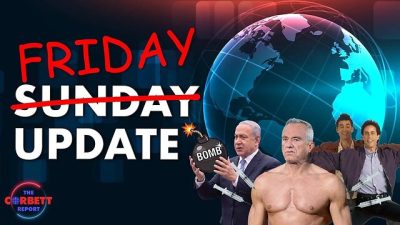
Racist Seinfeld Dances for Joy as Bibi Unveils His New Map
or go to
Aletho News Archives – Video-Images
TV Drama Review
Japanese drama projects Japan’s wartime atrocities onto Chinese characters
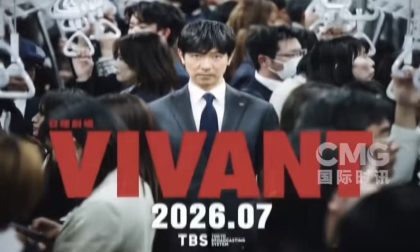
Global Times | October 25, 2026
By portraying Chinese characters as perpetrators of ruthless violence while casting Japanese Self-Defense Forces (SDF) intelligence operatives as defenders, the season 2 of the Japanese drama Vivant has recently drawn criticism from Chinese netizens, who argue that its depiction turns historical reality on its head while ignoring Japan’s wartime atrocities.
The TBS drama series – a spy suspense story in which an alleged unofficial intelligence unit of the SDF operates across the globe — has attracted a passionate fanbase. Its currently airing season 2 opened with a household rating of 18.8 percent, the highest for a TV drama this year, according toa commentary article by Japanese media Toyo Keizai.
What draws attention is the portrayal of the enemies in the series, the article noted. Scenes in which the Chinese organization subjects kidnapped members of the SDF unit to brutal torture are repeated with unrelenting intensity.
It is rare for Japanese TV dramas to explicitly portray a real-life country as the enemy, the article noted.
Japanese Prime Minister Sanae Takaichi also made a reference to the drama, saying that she has been recording Vivant and hopes to binge-watch it over the year-end and New Year holidays, according to Japanese media outlets.
China’s CCTV News report on Sunday revealed that the drama features scenes in which Chinese personnel cut off the fingers of and stab Japanese intelligence operatives in the abdomen. Such acts bear striking similarities to the torture inflicted on Chinese nationals by invading Japanese troops during the World War II.
The drama distorts the truth by attributing these atrocities to modern Chinese characters. Beneath the surface, it subtly glorifies Japan’s cross-border overseas operations, blurs the functional boundaries of the SDF and implicitly promotes an expansionist narrative, per CCTV News. … continue
Blog Roll
 Aletho News
- EU facing trillion-euro debt hole while seeking more cash for Kiev
- How US, Europe, Persian Gulf states exhausted missile stockpiles, splurged billions to defend Israel
- Up in arms… Koreans reject U.S. empire’s plan to make South Korea the next Ukraine
- Iran, Turkey, Pakistan, Saudi Arabia could advance region-led security framework in Tehran: FM spox
- Netizens condemn Japanese drama for projecting Japan’s wartime atrocities onto Chinese characters
- Racist Seinfeld Dances for Joy as Bibi Unveils His New Map
- A West Bank War for Netanyahu’s Election Campaign, Could It Backfire?
- Yemen denounces European Parliament’s ‘hypocritical’ push to blacklist Ansarullah
- Qalibaf: UAE’s UN bid aims to ‘clear the runway’ for ‘Greater Israel’, whitewash genocide
- Pakistan reopens Iran border after boosting security: Report
- If Americans Knew
- An error has occurred; the feed is probably down. Try again later.
- No Tricks Zone
- Sudden Stratospheric Warming, Powerful El Niño Combination May Lead To Extreme Europe Cold, Energy Crisis!
- Two New Studies Find Thwaites Glacier Melt Cannot Be Driven By Human Activity Or A Warming Ocean
- E-Cars Reduce CO2 Emissions By Only 41% Compared To Internal Combustion Engine Vehicles
- Predictions Made By Renowned Climate Professor Over Past Decades Have Been Proven To Be Poor
- New Study Suggests Large Regions Of The Pacific Ocean Have Been Cooling For The Last 80 Years
- Germany’s Green Energy Debacle: High Energy Costs Force Kahla Porzellan to Close After 182 Years!
- New Study: 50 Years Of The Most Aggressive ‘Net Zero’ Policies Can Only Affect The Global Climate By 0.03°C
- US September “Heat” Was No Record…Many Records Set Decades Ago
- Latest European Green Energy Debacle; Portugal’s Largest Flagship Solar Park Insolvent!
- Green Energy Debacle: German Expert Professor Fritz Vahrenholt Warns Of Severe Economic And Social Consequences

