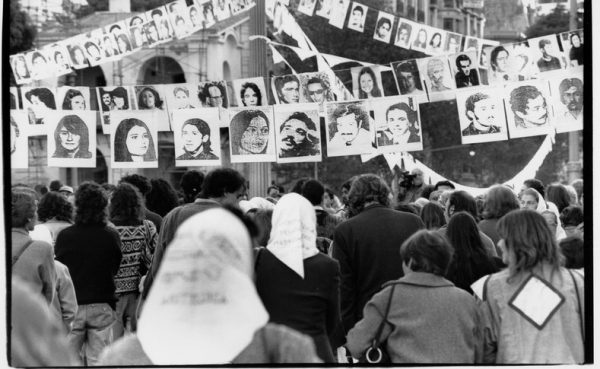
An Argentine court sentenced former General Luciano Benjamin Menendez to life in prison Thursday for crimes against humanity committed at secret Dirty War-era detention centers in the late 1970s, making a landmark step in the struggle for justice for human rights abuses during one of the darkest chapters in the South American country’s history.
Menendez stood trial with 42 other defendants who will also be sentenced today after a nearly four year so-called “mega-trial” involving events related to over 700 victims.
The general was in charge of two clandestine jails, known as La Perla and La Ribera, in the province of Cordoba where torture, assassinations, and other human rights abuses were carried out during the 1976-1983 military dictatorship. He was charged with over 600 cases of torture, over 300 murders and forced disappearances, unlawful detentions, and other crimes against humanity committed at the two detention centers between 1976 and 1978.
Thousands of people, including the families of victims and social movements such as the iconic Mothers and Grandmothers of the Plaza de Mayo, filled the streets outside of the federal court in the province of Cordoba to await the announcement under the banner of remembering the 30,000 disappeared during the dictatorship.
Former military intelligence agent Arnoldo Jose Lopez, former military man Ernesto Guillermo Barreiro, and former military captain Hector Pedro Vergez were also found to be among the principle masterminds responsible for the abuses and sentenced to life in jail for charges of hundreds of aggravated homicides, among other crimes.
Ricardo Alberto Lardone and Oreste Valentin Padovan, both considered among the special command at La Perla responsible for carrying out torture and kidnappings, were also sentenced to life in jail.
A total of 28 of the 43 accused were handed life sentences, nine were sentenced to up to 21 years, and six were acquitted.
The case was also historic for marking the first time a court in Cordoba tried charges of illegal apprension of babies during the dictatorship, a military practice of stealing babies from political dissidents, detainees, and victims of forced disappearance and handing them over the families linked to the military regime. The Grandmothers of the Plaza de Mayo has struggled for nearly 40 years to identify their missing grandchildren and reunite them with their families.
The La Perla case dealt with forced disappearance of Silvina Monica Parodi de Orozco, who was over six months pregnant when she and her husband Daniel Francisco Orozco were kidnapped. Silvina’s mother Sonia Torres is still searching for her missing grandchild, whose whereabouts has never been known.
The landmark trial brought together 21 separate cases of crimes against humanity at the hands of the Argentine military, police, and paramilitary forces immediately leading up to and in the years after the 1976 military coup against left-wing President Isabel Peron. The case heard some 600 witnesses provide testimony over the course of 350 hearings related to the 716 victims. Less than half, 340, of the victims survived. Most of the others, 311, were disappeared with no documentation of what happened to them, and the rest were killed.
La Perla was the second most important detention center in the country in the early years of the military dictatorship. Between 2,500 and 3,000 victims of state terrorism were detained at the secret military prison between 1976 and 1977, and it is though to have stopped operating by 1978, according to local media.
A 1979 U.S. Department of State memo included in a batch of over 1,000 pages of recently-declassifed documents related to Argentina’s Dirty War reveals that the U.S. Embassy was aware that “physical torture” was practiced at La Perla in 1976 and 1977. A 1978 State Department recommendation memo to then-President Jimmy Carter characterized General Menendez as as a “hardline general,” and another document indicated that Menendez was pushing for “continued strong efforts to battle ‘ideological subversion.'”
Argentina’s U.S.-backed Dirty War disappeared an estimated 30,000 victims in its brutal state terrorism campaign against suspected political dissidents, which involved systematic forced disappearances, torture, rape, and assassinations. Argentine human rights groups have dubbed the bloody era a “genocide” against political dissidents.
August 25, 2016
Posted by aletho |
Civil Liberties, Full Spectrum Dominance, Subjugation - Torture, Timeless or most popular | Argentina, Human rights, Latin America |
Leave a comment
This heartbreaking story made headlines in all American newspapers and television channels. When American swimmers were robbed at a gas station in Rio de Janeiro, the reports about the incident appeared as “breaking news” in most of US publications. It has been recently revealed, however, that the Americans initiated the robbery and accused the Brazilian police of violence.
Lochte’s legend about the criminal police
Olympians Ryan Lochte, James Feigen, Jack Conger and Gunnar Bentz reported to the police, that “police officers” stopped their cab at a gas station in Rio on August 14. According to Lochte, one of the men put a gun to his head, took the money ($ 700) and personal belongings. However, the police, having studied surveillance camera videos, concluded that it was the Americans themselves, who broke the door to the bathroom and came into conflict with gas station personnel. Being in a state of alcoholic intoxication, the US athletes damaged equipment inside the station. After the gas station employees demanded the athletes should pay for the damage that they caused, the Americans tried to escape. One of the guards, threatening with a pistol, forced the swimmers to stay and called the police.
The court prohibited the four athletes from leaving Brazil for the time of the investigation of the incident. However, Lochte, who is said to be the one who started it, had already escaped. On Friday, Bentz and Conger got permission to leave Brazil. Feigen left the country too, having paid $10,000 in donations to “institutions”. In accordance with the law of Brazil, one can make donations (charity) to avoid criminal prosecution for minor offenses. Yet, the case is far from being closed. False alarm and the destruction of property is pending – both offenses are punishable with up to six months in prison or a fine.
The Americans had a party in Rio
Brian Winter, an expert at the Research Center of the Americas in Washington, DC (Council of the Americas) told BBC Brasil that the story would be forgotten in a few days, but it was important to reveal all the facts.
It would be sad if Brazil forgets the story indeed. The story has affected the image of Brazil as a democracy with strong legal and security agencies. A variety of Western publications have been doing their best to stain this image throughout the Rio Olympics. The story started a lot earlier, when the case for the impeachment of President Dilma Rousseff was opened six months ago. One must admit that Washington has a habit of overthrowing objectionable governments during Olympic periods – suffice it to recall Georgia’s aggression or the Ukrainian Maidan.
“There is no sin below the equator”
The goal of such campaigns is to dramatically reduce the self-esteem of the people and their faith in their own values. Green water in pools, Zika virus, street crime, dirty cities, bad builders, “police impotence” and so on – anything comes in handy. In fairness, it should be said that the Americans accommodated Olympic athletes in Lake Placid prison in 1980 (the reconstruction of sports facilities, as well as the construction of the Olympic Village had not been completed in time). The Americans pollute their cities (Detroit, Chicago) and experience ecological disasters on a regular basis (the catastrophe in the Gulf of Mexico). What right do the “exceptional” Americans have to educate other nations on violence? Have they forgotten the Boston marathon bombings, or Black Lives Matter, or mass school shootings, or the Orlando gay bar massacre, etc, etc?
In the XVII century, Caspar Barlaeus, a Dutch national, said when describing excesses of colonial policy: there is no sin below the equator. According to Barlaeus, any act of dishonesty committed there does not stain gentleman’s name, especially if there is a need to topple the leftist regime that integrated itself into the economic bloc with Russia and China (BRICS) and established regional blocs (MERCOSUR, SELAC) on the basis of independent Latin American states. This country has huge reserves of shelf oil, and the new government of CIA informer Michel Temer intends to bring it all to the US of A.
Will the Brazilians answer? Will they prove that they live in a legal state, where one should not insult the police? If the story had happened in the USA, the athletes would most likely have been jailed. Yet, it all happened in Rio, so they are certain that they can get away with it, because “there is no sin below the equator.”
We would like to note here that the Brazilians have the complex of the American backyard (sindrome vira-lata): the gringos are a model of democracy, and in Brazil everything is bad, the Brazilian police is bad and corrupt, but all American sheriffs are honest and respectable people.
Perhaps, some prefer sadomasochism. They do not mind others calling their country a land of the monkeys and the whole region – a latrine (América Latrina).
As for the behavior of the American swimmers, this is an example of how “respectable” Americans behave. And these “exceptional” individuals are convinced that their arrogance and impudent behavior contributes to the image of the police state, where they come from. We doubt so.
August 25, 2016
Posted by aletho |
Supremacism, Social Darwinism, Timeless or most popular | Brazil, BRICS, Latin America, United States |
Leave a comment
As the Colombian government and left-wing FARC rebels near the signing of a comprehensive peace accord, and though they have already signed a bi-lateral ceasefire which is largely holding, Colombia is still suffering from the worst human rights abuses in the Western Hemisphere. These abuses are being carried out by right-wing paramilitary groups (aka, death squads), which the U.S. and Colombian governments conveniently deny even exist.
These paramilitary groups, in accord with their long-time friend and ally, former President Alvaro Uribe, are openly and aggressively opposed to the peace accords, and will most certainly escalate their violence as a national referendum which will be held to ratify, or reject, these accords draws near. Thus, as Insight Crime recently reported, the Colombian Electoral Observation Mission (MOE) estimates that nearly 250 municipalities (or more than 25% of the 1,105 municipalities in all of Colombia) “are at risk of violence or fraud affecting the referendum on an anticipated peace deal” with the FARC. The departments of Choco, Arauca, Cauca and Putumayo – that is, departments with heavy concentrations of Afro-Colombians and indigenous – are among the departments with the greatest risk. Antioquia, the department of Alvaro Uribe who was governor there, has the greatest number of municipalities at risk.
Meanwhile, the paramilitaries are already exploiting the opportunity presented by the FARC’s ceasefire to gain territory and exact more advantage for the economic elites – both domestic and foreign – which they serve.
For starters, Colombia again, according to the International Trade Union Confederation (ITUC), suffered more assassinations of trade unionists than any country on earth in 2015, and therefore earned its spot as one of the 10 worst countries in the world for workers’ rights. As the ITUC explains in its annual report: “Trade unionists have been murdered with impunity for decades in Colombia. In 2015, 20 murders of trade unionists were recorded in Colombia – the highest number in any country.” And, not surprisingly, it is the paramilitaries who are carrying out such assassinations in the interest of capital.
In addition, 35 human rights defenders have already been killed in the first half of 2016. This is an incredible figure. Indeed, according to Colombia’s El Espectador, this year has been “one of the most violent in regards to the murder of human rights defenders and land claimants,” with the paramilitaries being the perpetrators of these crimes. Indeed, one of the chief perpetrators of the violence, particularly against those advocating for the return of land stolen during the armed conflict, is the paramilitary group known as the “Anti-Restitution of Land Army.” This group has been reinvigorated by the release from jail of infamous paramilitary leader Jose Gregorio Mongonez Lugo, also known as “Carlos Scissors.” He was responsible in the first place for the violent theft of land in the banana region of Magdelena, Colombia, and has now returned to make sure that it is not given back to its rightful owners.
All of this bodes very badly for the prospects of peace in Colombia. And indeed, one of Colombia’s great human rights defenders, Father Javier Giraldo, S.J., recently penned a sobering piece on this very subject, entitled, “Peace in Colombia?” This article was translated by the Colombia Support Network, and is well-worth a read, especially as you will never hear a voice such as his in the mainstream press.
As Father Giraldo opines, despite the progress of the peace talks in Havana which are quickly nearing a conclusion, “the country is profoundly polarized by the growth and the growing power of extreme right-wing forces. It appears as if the forces of the Cold War are coming back to life, powered by the monstrous economic strength of multinational businesses that are rapidly defending their exclusionary interests, using their extremely powerful resources.”
Father Giraldo rightly notes that the Colombian government, while paying lip-service to peace, in fact seeks the surrender and ultimate destruction of both the guerillas as well as Colombia’s peaceful forces for social change. As he explains:
… the methods of persuasion that have been used to promote the peace agreements rely mostly on the practical impossibility of achieving social change by means of armed conflict, given the gigantic and overwhelming military power of the government, supported by the imperial power with the greatest destructive reach in the recent history of humanity: the United States. . . . President Santos has instead, above all, on a peace that will benefit business leaders and transnational investors, who will be able to intensify their extraction of natural resources. But meanwhile his government represses with cruel violence the social protests of communities affected by the ecological and social destruction that has been caused and continues to be caused by these multinational companies.
Father Giraldo then expresses a seldom-uttered truth which I have certainly learned upon my numerous trips to Colombia in the past 17 years – that while the paramilitaries oppose the peace process because it will grant some immunity for rebels, the “popular movements feel more fear of the impunity of the powerful and of the paramilitaries and the agents of the government, whose war crimes, crimes against humanity and genocide greatly exceed, both in quality and in cruelty, the crimes of the insurgency.”
And, it is the impunity for the right-wing paramilitaries, who now control large swaths of the Colombian government, which is nearly total. And again, this impunity is made possible by the Colombian and U.S. governments’ denial of the very existence of the paramilitaries, as well as the mainstream media’s near total silence about Colombia and its horrible human rights situation – certainly the worst in the Western Hemisphere. If peace in Colombia has any chance of succeeding, it will need to be supported and cultivated by people of good will throughout the world who are willing to tell the truth about Colombia and who are willing to provide accompaniment to the peace process.
Daniel Kovalik teaches International Human Rights at the University of Pittsburgh School of Law.
August 25, 2016
Posted by aletho |
Civil Liberties, Corruption, Subjugation - Torture, Timeless or most popular | Colombia, Latin America |
Leave a comment
Until as recently as last year, Peru’s national police force harbored a “death squad” that is responsible for the extrajudicial killings of at least 20 people over a four-year period – even at times offering sworn officers bounties to kill criminal suspects, according to an official government investigation of systemic police misconduct.
In an executive summary that reads like the script of a Dirty Harry movie, the Interior Ministry’s report found “serious indications” that both high-ranking and low-level officers of the national police force “falsified intelligence information” to misrepresent at least six cases involving some 20 slayings as the justified result of confrontations with armed suspects, when in fact they were summary executions carried out by police, according to a summary of the report Monday by Vice Minister of Internal Order Ruben Vargas.
The report did not disclose the identities of the officers suspected of participating in the death squad, but Vargas did reveal that the operation was headed by a police colonel who was subsequently promoted to general.
Local media revealed the scandal over three weeks ago after department whistleblowers brought the allegations to light, prompting an investigation. The new report will now be handed over to prosecutors specialized in organized crime to open a case.
Minister of Interior Carlos Basombrio, newly-appointed under President Pedro Pablo Kuczynski and inaugurated at the end of July, claimed that the evidence suggests that a group of high-ranking police officials who moved between divisions are responsible for running the death squad, and that no single police force unit itself is compromised.
Authorities also revealed that several of the officers involved in the scandal were decorated for their so-called “distinguished” achievements within the force last year. A months-long internal police investigation already found that at least two officers were promoted during the period in which they are suspected of participating in the death squad. The Investigator General intervened in the internal probe and took over the investigation over three weeks ago.
Local media report that the death squad, allegedly made up of nearly 100 officers across four units of the national police force, is suspected of carrying out the murders of 27 Peruvian civilians between 2011 and 2015 in the cities of LIma, Ica, and Chiclayo.
Media previously suggested that the 27 victims were common criminals, but the new report found that 11 victims “didn’t even have a criminal record or a warrant to justify them being identified as targets of police interventions,” according to the Interior Ministry.
The confirmation of the extrajudicial killings by the police recalls a dark history of death squads run by state security forces in the South American country that were aimed at wiping out armed left-wing guerrilla movements particularly under the reign of jailed former dictator Alberto Fujimori.
August 23, 2016
Posted by aletho |
Civil Liberties, Corruption, Deception, Subjugation - Torture | Human rights, Latin America, Peru |
Leave a comment
After three Americans from the US embassy were accused of espionage and tossed out of Nicaragua, a protest was lodged in Managua against this «unwarranted» decision, and the Nicaraguan government was warned that the relationship between the two countries would suffer inevitable damage in tourism, trade, and investment from the US. The State Department issued notice that Americans might face threats in Nicaragua. The war of propaganda waged against Daniel Ortega’s regime has become so ferocious that political commentators are drawing conclusions about Washington’s plans to «end the dictatorship» in Nicaragua once and for all.
The Democratic Initiative of Spain and the Americas (IDEA), an international forum, was created in April of 2015 in order to launch attacks on Ortega and other Latin American «populist» leaders, and Washington was responsible for choosing its members: the chosen favorites include – Álvaro Uribe of Colombia, Alejandro Toledo of Peru, Lucio Gutiérrez of Ecuador, Felipe Calderón of Mexico, Óscar Arias of Costa Rica, José María Aznar of Spain, and others. These politicians work closely with the United States and continue to defer to Washington, even after leaving office.
IDEA released a statement in August that was highly critical of Nicaragua and which reads like something out of the Cold War: «The international community finds the violation of the democratic system in Nicaragua so worrisome that the former Ibero-American heads of state and of government have decided to ask the OAS and the EU to maintain critical oversight of these serious violations of democratic and constitutional order». And it goes on to say that statements by the members of IDEA «may be preceded by certain political and diplomatic actions, as provided by international law … in order to defend democracy and reestablish it where it has been compromised, as in the current example of Nicaragua».
In its attacks on the Nicaraguan government, the US National Security Agency uses materials obtained over the course of years of electronic surveillance of President Ortega, as well as his family and inner circle. Its deft use of such materials makes it possible to circulate all sorts of drivel that is designed to defame politicians who have been marked for public retaliation. Almost every «populist bloc» leader in Latin America is currently up against such cheap shots – Inácio Lula da Silva, Dilma Rousseff, Cristina Fernández de Kirchner, Rafael Correa, Nicolás Maduro, Evo Morales, and others.
Daniel Ortega has led his country for 13 years. He has been elected three times: in 1985, 2006, and 2012, and no one is predicting that he will have any opponents in the upcoming Nov. 6 election. Ortega’s political rivals are feuding amongst themselves. Despite the behind-the-scenes efforts of the US embassy, is has not been possible to consolidate the opposition in the run-up to the election. For this reason, the US has launched a blitzkrieg of propaganda against Daniel Ortega, his wife Rosario Murillo, and their grown children. The leitmotif of these «revelations» is a familiar one – some hogwash about the abuse of power, corruption, multi-million-dollar accounts in overseas banks, and the ownership of foreign real estate. The US continues to harp on the supposed parallels with the family of the dictator Anastasio Somoza; «Somoza García amassed a huge fortune, making him and his family some of the richest people in all of Latin America. By the time of his death in 1956 he left his children $200 million, which they managed to triple within a few years. His son, Anastasio Somoza DeBayle, owned 130 real estate holdings, as well as estates, residences, and tracts of land. He was owner of an airline (Líneas Aéreas de Nicaragua), a television station (Televisora de Nicaragua), the San Uribe and San Albino gold mines, and more».
One might well ask, what does Somoza’s wealth have to do with Ortega and his family? Nevertheless, the author of the article writes: «As is usual for totalitarian regimes of the past, there is no reliable information about the finances of the Nicaraguan president and his wife. That knotty question is top secret». Although there is no «reliable information», he goes on to claim that the family owns the Distribuidora Nicaragüense de Petróleos chain of gas stations, plus media outlets including four TV channels, radio stations, newspapers, websites, etc. In addition, Ortega has control over the project to build a transoceanic canal that would link the Pacific and Atlantic oceans, the cost of which is estimated at $50 billion. That mega-project has the backing of the Chinese entrepreneur Wang Jing.
Naturally of course the Chinese-Nicaraguan canal mega-project was met with hostility by Washington. They don’t want anything competing with the updated Panama Canal. And as for the company Distribuidora Nicaragüense de Petróleos, that is a model for energy-sector cooperation between Venezuela and Nicaragua – not some private racket that is allegedly being used by Ortega’s friends for their personal enrichment.
During the years when the Sandinistas were in the opposition, Ortega was constantly faced with the problem of getting access to the media. His attempts to communicate his views to the public invariably ran up against an information boycott. But now the situation has changed drastically. Ortega has turned the tide to his own advantage. The government controls hundreds of Internet websites, as well as the news services Nicaragua Triunfa and Nicaragua Comovamos. Dozens of provincial radio stations work on the side of the government, as do influential national stations like Radio Sandino, La Nueva Radio Ya, Radio Nicaragua, and Radio Primerísima. The work of the government and the president gets favorable coverage by TV channels that are managed by members of the Ortega family – Canal 13, Multinoticias Canal 4, Canal 8, and Telenica Canal 10. The pro-government channels also include Canal 23, Canal Extra Plus, 100 % Noticias, and others. None of the «leftist» Latin American presidents enjoy such an effective mouthpiece for information and propaganda as Ortega.
Yet despite the accusations that it is a dictatorship, the country has no censorship restrictions. The opposition and, consequently, the US embassy have every opportunity to proselytize there. Popular newspapers like La Prensa and El Nuevo Diario and the weekly Confidencial are employed with particular vigor toward this goal. Ortega responds immediately, using fiercely anti-imperialist and anti-American terminology. Nor does he keep silent when Washington directs attacks against Nicaragua’s allies. Ortega’s speeches in support of Russia, Cuba, and friendly governments in Ecuador, Bolivia, and other countries resonate far and wide.
The ideological underpinnings of Ortega’s international policy have remained unchanged throughout recent years: they consist of a fundamental rejection of American hegemony, coupled with patriotism, nationalism, and «socialism with a Nicaraguan face», plus support for the Latin American path to a true people’s democracy. This 70-year-old politician has never altered his revolutionary convictions. That said however, he is a flexible strategist who understands that a superpower can strike at any time and that the US is still unpredictable and dangerous. As the leader of a small country he has no choice but to maneuver, and he manages to do so without compromising his principles.
In December 2015 the CIA launched into yet another act of provocation against Nicaragua. Under the influence of inflammatory media reports about the Obama administration’s possible suspension of the preferential treatment Cuban migrants receive upon entering the US, hundreds rushed to emigrate from that island nation. The route suggested by the «well-wishers» from Miami: first by air from Havana to Ecuador (no visa needed), then by bus across several borders into Mexico, and from there into the US. Nothing to worry about, or so it would seem. However, Nicaraguan counter-intelligence got its hands on some information about CIA plans to use those migrants to stir things up. After arriving in Nicaragua from Costa Rica, their onward path – through Honduras, Guatemala, and Mexico – was to be closed, and the Cuban migrants would find themselves stranded in Nicaragua for a long time. As envisioned by the CIA, they were supposed to be the fuse to the ticking bomb of the country’s destabilization. Therefore, Daniel Ortega’s decision was emphatic: there should be no back doors, and the ones who came up with the whole migrant scheme should be the ones to deal with the mess! Demands that the migrants be admitted were hurled at that «inhumane regime» from all manner of human rights organizations patronized by American foundations. The members of the Central American Integration System (SICA) went public with their criticism of Ortega’s decision. The migrants themselves, as if on cue, tried to crash through the Nicaraguan border, with children and pregnant women planted in their forward ranks. The Nicaraguan government needed time to force the fugitives into Costa Rica. Tensions eased by February-March 2016. Ortega’s government refused to be blackmailed, and Washington had to quietly furnish its ally Costa Rica with financial assistance in order to provide for the migrants and evacuate them by air…
As the date of the Nicaraguan presidential election nears, new acts of provocation should be expected from US intelligence agencies and the American embassy. Ambassador Laura Dogu works assiduously with the Nicaraguan business community, persuading them that the ongoing Sandinista administration and its policy of «socialism with a Nicaraguan face» can only hurt their business interests.
The US embassy has conspicuously stepped up its work with the media and activists from NGOs and indigenous organizations, as well as the country’s youth. US intelligence agencies, diplomats, staffers with USAID (which is in reality a branch of the CIA), and Peace Corps volunteers are pinning their main hopes on Nicaragua’s youth, viewing that demographic as the most promising in the struggle against the Nicaraguan regime.
The Constitution offers no barriers to President Ortega’s reelection. He has been accused of taking control of executive, legislative, and judicial power, but the main factor ensuring his re-election is his broad popular support, which Ortega enjoys thanks to the social programs established during his years in office. Despite his socialist, anti-imperialist views, the president has many supporters in the country’s business community.
The November election forecasts don’t look too auspicious for the conspirators in the US embassy: Daniel Ortega is once again going to be elected president.
August 19, 2016
Posted by aletho |
Aletho News | Central Intelligence Agency, CIA, Latin America, Nicaragua, United States |
Leave a comment
A human rights body has found that Mexican police killed nearly two dozen civilians in “arbitrary executions” during a raid against a drug cartel in the country’s troubled west last year.
The independent National Human Rights Commission said in a report on Thursday that the massacre happened in the federal police raid against the Jalisco Nueva Generacion cartel in the western state of Michoacan on May 22, 2015.
Police officers committed “violations of the right to life by excessive use of force that entailed the arbitrary execution of 22 civilians,” the commission said.
Meanwhile, commission chief Ismael Eslava said the government forces also perpetrated “aggravated acts of torture on two people who were detained.”
According to the commission report, forensic investigations indicated police had moved the bodies of those killed in the raid and placed guns next to them in an attempt to cover up the crime.
It also noted that a police helicopter fired 4,000 rounds into the farm where the suspects were hiding.
Responding to the document, Renato Sales, the chairman of Mexico’s National Security Committee, rejected the characterization of arbitrary executions and defended the actions of police.
He said the shooting erupted when the suspects refused to drop their weapons. “We do not think the theory of arbitrary executions stands up.”
The government said previously that the helicopter had fired to contain the suspects. It also said that the 42 people killed by police had attacked officers.
The commission report concluded that a total of 43 people were killed in the security operation, including one policeman and numerous suspected criminals, but only 22 of them were deemed arbitrary executions by police.
The commission also found fault with the actions of investigators from the Michoacan Attorney General’s Office, who mishandled ballistics evidence. Medical examiners likewise came under criticism for irregularities in the autopsies and delays in the return of bodies to their families.
The incident is considered as one of the bloodiest battles in the Mexican government’s decade-long campaign against powerful drug gangs across the Latin American state.
Official figures show that more than 35,000 people are currently missing in the country due to drug-related violence, which has also claimed thousands of lives over the past few years.
Police corruption, drug cartels and organized crime are the greatest challenges facing Mexico.
August 19, 2016
Posted by aletho |
Civil Liberties, Subjugation - Torture | Human rights, Latin America, Mexico |
Leave a comment
“How the Most Dangerous Place on Earth Got Safer” was the headline over the lead article in the New York Times‘ “Week in Review” (8/11/16), with the teaser reading, “Programs funded by the United States are helping transform Honduras. Who says American power is dead?”

The New York Times‘ “faith in American power.”
The piece never really got around to explaining, though, how Honduras became the most dangerous place on Earth. That’s American power, too.
Reporter Sonia Nazario returned to Honduras after a three-year absence to find
a remarkable reduction in violence, much of it thanks to programs funded by the United States that have helped community leaders tackle crime…. The United States has not only helped to make these places safer, but has also reduced the strain on our own country.
Nazario described US-funded anti-violence programs in a high-crime neighborhood in the Honduran city San Pedro Sula:
The United States has provided local leaders with audio speakers for events, tools to clear 10 abandoned soccer fields that had become dumping grounds for bodies, notebooks and school uniforms, and funding to install streetlights and trash cans.
She offered the results of this and similar programs as evidence that “smart investments in Honduras are succeeding” and “a striking rebuke to the rising isolationists in American politics,” who “seem to have lost their faith in American power.”
But Nazario failed to explain how American power paved the way for the shocking rise in violence in Honduras. In the early 2000s, the murder rate in Honduras fluctuated between 44.3 and 61.4 per 100,000—very high by global standards, but similar to rates in neighboring El Salvador and Guatemala. (It’s not coincidental that all three countries were dominated by violent, US-backed right-wing governments in the 1980s—historical context that the op-ed entirely omitted.) Then, in June 2009, Honduras’ left-leaning President Manuel Zelaya was overthrown in a military coup, kidnapped and flown out of the country via the joint US/Honduran military base at Palmerola.
The US is supposed to cut off aid to a country that has a military coup—and “there is no doubt” that Zelaya’s ouster “constituted an illegal and unconstitutional coup,” according to a secret report sent by the US ambassador to Honduras on July 24, 2009, and later exposed by WikiLeaks. But the US continued most aid to Honduras, carefully avoiding the magic words “military coup” that would have necessitated withdrawing support from the coup regime.
Internal emails reveal that the State Department pressured the OAS not to support the country’s constitutional government. In her memoir Hard Choices, Hillary Clinton recalled how as secretary of State she worked behind the scenes to legitimate the new regime:
In the subsequent days [following the coup] I spoke with my counterparts around the hemisphere, including Secretary Espinosa in Mexico. We strategized on a plan to restore order in Honduras, and ensure that free and fair elections could be held quickly and legitimately, which would render the question of Zelaya moot.
With a corrupt, drug-linked regime in place, thanks in large part to US intervention, murder in Honduras soared, rising to 70.7 per 100,000 in 2009, 81.8 in 2010 and 91.4 in 2011—fully 50 percent above the pre-coup level. While many of the murders involved criminal gangs, much of the post-coup violence was political, with resuscitated death squads targeting journalists, opposition figures, labor activists and environmentalists—of whom indigenous leader Berta Cáceres was only the most famous.
At one point, it seemed like Nazario was going to acknowledge the US role in creating the problems she gives “American power” credit for ameliorating. “We are also repairing harms the United States inflicted,” she wrote—but the explanation she gives for that was strangely circumscribed:
first by deporting tens of thousands of gangsters to Honduras over the past two decades, a decision that fueled much of the recent mayhem, and second by our continuing demand for drugs, which are shipped from Colombia and Venezuela through Honduras.
No mention of the US supporting Honduras’ coup, or the political murders of the US-backed regime.
At one point, three-quarters of the way through the lengthy piece, Nazario did acknowledge in passing the sinister role the US plays in Latin America:
It will take much more than this project to change the reputation of the United States in this part of the world, where we are famous for exploiting workers and resources and helping to keep despots in power.
Surely it’s relevant that some of the despots the US helped keep in power were in the country she’s reporting from, and that this led directly to the problem she’s writing about? But she dropped the idea there, moving on immediately to talk about the US’s interest in reducing the flow of child refugees.
The most troubling part of the op-ed is that it didn’t feel the need to acknowledge or even dispute the relationship between US support for the coup and Honduras’ shocking murder rate. The New York Times covered much of this ground, after all, in an op-ed by Dana Frank four years ago (1/26/12). Now, however, that information is down the memory hole—leaving the Times free to tout donations of trashcans and school uniforms as an advertisement for American power.
August 18, 2016
Posted by aletho |
Deception, Mainstream Media, Warmongering | Honduras, Latin America, New York Times, United States |
Leave a comment
Brazil’s suspended President Dilma Rousseff has pledged to hold early elections if she survives a vote on her removal from office in an impeachment trial that is expected to conclude this month.
Rousseff, accused of illegally manipulating finances to hide a growing public deficit ahead of her reelection in 2014, is due to stand trial in the Senate on August 25, four days after the Rio Olympics end.
The Globo news organization reported that the actual judgment vote could take place between August 30 and 31.
In a letter to the federal Senate and Brazilian people that she read out on Tuesday, Rousseff said Brazil’s political and economic problems could only be resolved “through popular vote in direct elections.”
“The full restoration of democracy requires that the population be the one to decide what is the best way to expand governability and perfect the Brazilian political and electoral system,” Rousseff said.
“It’s the only way out of the crisis,” she wrote.
Rousseff admitted she had made mistakes, but said she had done nothing worthy of impeachment.
“I have listened to the tough criticisms of my government, for the errors committed,” she said. “I accept these criticisms with humility and determination so that we can build a new way forward.”
Rousseff further said that forcing her out through impeachment amounts to “an unequivocal coup.”
Rousseff impeachment: A timeline
October 9, 2015: Brazil’s federal audit court rules that Rousseff broke the law while managing the 2014 budget, paving the way for opposition groups to argue that the leader should be impeached.
December 2, 2015: Eduardo Cunha, the president of the Chamber of Deputies, agrees to start anti-Rousseff impeachment proceedings.
December 11, 2015: Rousseff presents a petition before the Supreme Court to stop the process.
March 17, 2016: The Chamber of Deputies, the lower house of the Brazilian National Congress, elects a special impeachment commission, which has a majority derived from the ruling coalition, including the Workers’ Party and the Democratic Movement Party (PMDB).
March 29, 2016: The PMDB leaves the ruling coalition, in a split that hurts Rousseff’s chances of derailing impeachment proceedings.
April 6, 2016: The special impeachment commission publishes a report recommending Rousseff’s impeachment.
April 11, 2016: The impeachment commission decides, in a 38 to 27 vote, to let the Chamber of Deputies vote on the president’s impeachment.
April 15, 2016: The Brazilian Supreme Court rejects Rousseff’s motion to stop the process.
April 17, 2016: A total of 367 out of 513 legislators in the parliament’s lower house vote in favor of Rousseff’s impeachment.
May 12, 2016: Senators vote 55 to 22 to suspend the president for 180 days and hold an impeachment trial in the Senate, the upper house of National Congress, with Rousseff slamming the vote and saying she was “being judged unfairly.”
Michel Temer becomes interim president and announces his new cabinet.
May 24, 2016: The interim government is rattled by a leaked audio tape suggesting a plot against Rousseff, a scandal that forces a number of key ministers in the new cabinet to resign.
June 28, 2016: An investigation by a team of independent auditors, comprised of career Senate budget technicians, concludes there is no evidence that Rousseff participated in budget manipulation.
July 18, 2016: Cunha resigns less than three months after he orchestrated the impeachment.
August 16, 2016: The Senate votes to hold an impeachment trial for Rousseff, pushing her one step closer to dismissal from office. Her trial is due to take place in the week after the Olympics closing ceremony.
A week ago, the Brazilian Senate voted to hold an impeachment trial for the country’s first female president.
A two-thirds majority of the Senate, or 54 votes, would be needed to see her permanently removed from office.
If the trial acquits Rousseff, she will be allowed to serve out her term until 2018. But if it removes her permanently, then acting President Temer will become the full-fledged president until the next election in 2018.
Rousseff is also under fire over a graft scandal at state oil company Petrobras, where she was the manager before taking office as president in 2010.
The embattled leader has denied the allegations and repeatedly asserted that she has fallen victim to a plot by the extreme right.
In recent months, Brazilians have held numerous counter rallies in support of and against the impeachment process.
August 18, 2016
Posted by aletho |
Aletho News | Brazil, Dilma Rousseff, Latin America |
Leave a comment
Before 1959, three-fourths of Cuba’s arable land was owned by U.S. corporations and citizens.[1] The two nations were so tightly bound that Cuba’s economic policies were practically guided by U.S. interests alone. However, after Dictator Fulgencio Batista was deposed in the 1959 Cuban Revolution, Cuba’s economic relationship with the United States was shattered. As part of a process of nationalization, the new Cuban government seized land and factories owned by foreign companies and Cubans who fled to the United States, and in retaliation, the United States issued a strict embargo that continues to constrain Cuba’s economic potential today. Although diplomatic relations have gradually been re-established over the past several years through environmental agreements and the reopening of both embassies, a number of contentious economic grievances remind both countries of their Cold War past.[2]
The first round of talks were held in Havana, Cuba, on December 8, 2015, and while the initial meeting can be considered a positive diplomatic move, it was less of a negotiation than a preliminary discussion to establish the facts and specific demands. The second round, held on July 28-29 of this year, allowed for more substantive debate. The process of negotiations remains ongoing, and both countries seek to “resolve the claims as quickly as possible,” according to a U.S. State Department Official.[3]
Although concessions are not the most pressing issue on the table, the settlement of claims is necessary before full normalization of relations, due to the Helms-Burton Act. This 1996 law stipulates that “the satisfactory resolution of property claims…remains an essential condition for the full resumption of economic and diplomatic relations” between Cuba and the United States.[4] According to a Brookings report on the concessions, Helms-Burton “formally wrote into law the linkage between compensation and normalization of relations,” meaning that the United States sought to create a permanent strong-armed policy toward Cuba and legislatively cement the claims.[5] The law is thus indicative of a larger issue at hand; the United States has consistently undermined its own relationship with Cuba through counter-productive policies, which have had vast and long-lasting consequences.
The historical and political disputes that surround the issue of claims are so numerous that it is unlikely that substantial progress will be achieved anytime soon. Through an exploration of the nature of the demands and their historical roots in anti-communist ideology, it becomes evident that the United States is primarily responsible for the hostility that remains today.
Demands
Over 50 years have passed since the Cuban government under Fidel Castro nationalized all foreign-owned assets; nonetheless, hundreds of U.S. companies and individuals have not forgotten about their appropriated possessions and demand that they be compensated for their losses. These assets include personal bank accounts, oil refineries, cattle ranches, and sugar factories.[6]
In total, the assets being claimed by the United States amount to approximately $1.9 billion USD at their original value.[7] With a U.S. government-determined six percent simple interest added onto the concessions, this amount has accrued to over $8 billion USD.[8] In addition, outstanding judicial claims against the Cuban government levied by the United States add an additional $2.2 billion USD.[9] Cuba’s 2013 GDP was only $77.15 billion USD, which means that the country’s payment would amount to over thirteen percent of its GDP.[10]
Cuba’s counterclaim toward the United States is much broader and focuses on long-term problems rather than a specific event. The Cuban government is asking for $121 billion USD for economic damages, and $181 billion USD for human damages. The total amount, over $300 billion USD, drastically eclipses the United States’ claims of $10.2 billion USD. Though massive, the claims are a telling reflection of the historical damages caused by devastating U.S. policies. Economically, they address the long-term stagnation, isolation, and developmental damages that the country suffered at the hands of the embargo.[11] Additionally, Cuba seeks to hold the United States accountable for “acts of terrorism” committed in Cuba, including the Bay of Pigs incident and various covert CIA missions that killed thousands of Cuban nationals over the past fifty years.[12] In essence, Cuba is making a bold statement to the United States through their claim: if you seek to hold us accountable, we will do the same to you.
Negotiations
There are several critical issues impeding progress in U.S.-Cuba negotiations. First, the total claims presented by both sides are too high for a mutual settlement. The relative size of the U.S. demands, at 13 percent of Cuba’s annual GDP, means that Cuba is unlikely to be able to pay the full price. Similarly, from a pragmatic standpoint, it is hard to imagine that the United States has any incentive to pay Cuba even a single cent of a $300 billion USD request. Moreover, if either country refuses to negotiate on its demand, then the other will do the same; and an unsettled dispute will remain for both.
In theory, the purpose of the negotiations is to revise each side’s demands so that both countries reach a settlement. However, one key hindrance is that the judicial branches of the United States and Cuba have declared their own respective decisions to be legally valid. With both countries’ demands legitimized by the domestic legality of their claims, the demands are unlikely to be modified in the immediate future. On both sides, to lessen the amount demanded would mean depriving someone of compensation that they are legally owed.
An additional critical question arises when considering these claims: at what point does the past become the past? Is there a statute of limitations on these events that would render them as part of history, with less specific relevance to the present day? Given the continued level of contention regarding the specific effects of events from fifty years ago, it is likely that the issue of claims will not be forgotten until they are settled. Even as more and more of the claimants pass away, and the companies who lost property cease to exist, the bargaining chip of expropriated land remains vital for justifying the U.S. treatment of Cuba. Yet, just as actors within the United States are unlikely to forget their claims, the Cuban government will undoubtedly continue to press for justice.
Finally, straightforward negotiations are made improbable by the implications of reparation. If the United States ultimately compensates Cuba for human and economic damages, then it must also answer to legitimate claims from others across the globe who have been harmed at the hand of U.S. policies. For example, if the United States were to compensate Cuba for human damages, why not also provide reparation toward those who lost their homes during the Iraq War, who have suffered directly from U.S. actions as well? Therefore, the country is extremely unlikely to pay Cuba directly, as to avoid dealing with consequences of other historical wrongs. Through this notion of accountability, a double standard is exposed–while the United States is eager to continue pressing claims when its citizens are the ones who are damaged, Washington is quick to dismiss or deny reparations for anything it may have done wrong.
A Problem Entrenched by Ideology
While each roadblock in the negotiation is salient on its own, they can all be traced back to a broader source: the historical and ideological conflict which has defined the present relationship between the United States and Cuba.
The overall position of the United States can be largely characterized by ideological stubbornness, and is explained through concurrent historical narratives. During the process of nationalization in Cuba, the United States was not the only country whose citizens and corporations lost property. In fact, Canada, France, Switzerland, and Spain faced similar losses. Yet, these countries established claims agreements with Cuba between 1967 and 1973, and were able to put the issue behind them.[13] Reconciliation was incentivized by the prospects of increased trade in the future, and through their quick settlements, these governments were able to restore relatively positive diplomatic relations and beneficial trade relationships with Cuba.[14] Cuba’s trade with Spain and France drastically increased throughout the 1960s and 70s, and these countries have continually supported Cuba over the United States in regards to the embargo.[15]
Although the losses in assets for these nations were less sizeable than for the United States, the lesson of these narratives is clear. Cuba was more than willing to negotiate with other countries for lost property, and the final product reflects an overall beneficial outcome for all parties involved. In fact, the government’s intention for land reform was to create a more equitable Cuba and retain international relationships. In Cuba’s 1959 Agrarian Reform, enacted before the government began nationalizing land, Castro promised that Cuba would compensate the expropriated assets through Cuban bonds, a clear sign that his government sought revolutionary changes but still wished to remain part of the international community.[16] Though the government’s priorities shifted over the next few years, it remains true that Cuba did in fact make an effort to pay back the United States. However, the Eisenhower administration was too uncomfortable to accept the bonds as a secure method of payment.[17]
On October 19, 1960, as land reform in Cuba quickly proceeded, the United States government imposed the embargo and in essence declared that it would not support the Castro regime in any manner. The United States was so quick to reject Cuba’s proposal and fully embargo the country that it essentially extinguished the chance for an immediate resolution of the claims. With economic and diplomatic relations pushed aside because of ideological differences, the United States removed any capacity for a timely settlement to occur, even when Cuba would clearly have been a ready partner in negotiation.
Through its embargo, the United States entrenched the claims in a Cold War stalemate, ensuring that if the issue would ever be resolvable, it would be completely intertwined with grievances of Cuban economic and human suffering. If the United States had not placed the embargo and subsequently engaged in numerous retaliatory actions, Cuba would have far less to counterclaim–it is solely U.S. retribution that brought about such difficult negotiations today.
Conclusion
If it was Cuba who took the first step, it was the United States who began sprinting. If it was Cuba who first broke ground, it was the United States who dug the hole too deep to get out. The escalation of the claims conflict by the United States in 1960 has defined the tense relations more than Cuba’s initial land reform ever could have, and thus the various roadblocks obstructing a speedy negotiation can be attributed to past and present U.S. government policy.
However, the current talks nonetheless present an opportunity to redefine this relationship. It is a sign that both sides are finally willing to reflect on their interwoven histories. And at the very least, they’re talking, which is more than can be said for the past fifty years.
Original research on Latin America by COHA.
[1] Office of Global Analysis, FAS, USDA. “Cuba’s Food and Agriculture Situation Report, March 2008.” United States Department of Agriculture. Accessed August 1, 2016. https://www.ilfb.org/media/546435/fas_report_on_cuba.pdf
[2] US and Cuba to sign agreement on marine conservation and research.” The Guardian. Accessed August 12, 2016. https://www.theguardian.com/environment/2015/nov/18/us-cuba-thaw-environmental-accord-marine-conservation
[3] “Senior State Department Official on Cuba Claims Discussion.” U.S. Department of State. Accessed August 8, 2016. http://www.state.gov/r/pa/prs/ps/2016/07/260666.htm
[4] U.S. Treasury Resource Center. “Cuban Liberty and Democratic Solidarity (Libertad) Act of 1996.” Accessed August 12, 2016. https://www.treasury.gov/resource-center/sanctions/Documents/libertad.pdf
[5] Richard E. Feinberg. “Reconciling U.S. Property Claims in Cuba: Transforming Trauma into Opportunity.” Brookings. Accessed August 8, 2016. https://www.brookings.edu/wp-content/uploads/2016/07/Reconciling-US-Property-Claims-in-Cuba-Feinberg.pdf
[6] Leon Neyfakh. “Cuba, you owe us $7 billion.” The Boston Globe. Accessed July 29, 2016. https://www.bostonglobe.com/ideas/2014/04/18/cuba-you-owe-billion/jHAufRfQJ9Bx24TuzQyBNO/story.html
[7] Senior State Department Official. “Senior State Department Official on Cuba Claims Discussion.” United States Department of State. Accessed August 3, 2016. http://www.state.gov/r/pa/prs/ps/2016/07/260666.htm
[8] “Cuba, you owe us $7 billion.”
[9] Arshad Mohammed. “U.S., Cuba hold ‘substantive’ second round talks on claims.” Reuters. Accessed August 3, 2016. http://www.reuters.com/article/us-usa-cuba-idUSKCN1091ZV
[10] World Bank. Accessed August 8, 2016. http://data.worldbank.org/indicator/NY.GDP.MKTP.CD?locations=CU
[11] The US Embargo Against Cuba: Its Impact on Economic and Social Rights.” Amnesty International. Accessed August 8, 2016. http://www.amnestyusa.org/pdfs/amr250072009eng.pdf.
[12] Rosa Miriam Elizalde and Ismael Francisco, “Aberlardo Moreno sobre compensaciones Cuba-EEUU: Solo estamos conversando,” Cuba Debate, Accessed August 6, 2016. http://www.cubadebate.cu/noticias/2016/08/01/abelardo-moreno-solo-estamos-conversando-sobre-las-compensaciones-mutuas-cuba-eeuu/#.V64sDJMrJp
[13] Michael W. Gordon. “The Settlement of Claims for Expropriated Foreign Private Property between Cuba and Foreign Nations Other than the United States.” Lawyer of the Americas 5, no. 3 (1973): 457-70. https://www.jstor.org/stable/40175493?seq=1#page_scan_tab_contents
[14] Ibid, pg 460.
[15]Ibid., Chritine L. Quickenden, “Helms-Burton and Canadian-American Relations at the Crossroads: The Need for an Effective, Bilateral Cuban Policy,” American University International Law Review, Vol. 12 no. 4, 1997, http://digitalcommons.wcl.american.edu/cgi/viewcontent.cgi?article=1398&context=auilr.
[16] “Cuba, you owe us $7 billion.”
[17] Ibid.
To download a PDF version of this article, click here.
August 14, 2016
Posted by aletho |
Economics, Timeless or most popular | Cuba, Latin America, United States |
Leave a comment
In a much-awaited step toward uncovering the historical truth of the U.S.-backed Dirty War in Argentina in the 1970’s and 80’s, the United States has delivered over 1,000 pages of classified documents to the South American country. But critics argue that there are major gaps in the files, including the exclusion of CIA documents, that keep in the dark important details of the extent of human rights violations and the U.S. role in such abuses.
The Argentine government delivered the newly-declassified documents to journalists and human rights organizations on Monday after U.S. Secretary of State John Kerry presented the files to President Mauricio Macri during a state visit last week.
The 1,078 pages from 14 U.S. government agencies and departments are the first in a series of public releases over the next 18 months of declassified documents related to Argentina’s last military dictatorship, including Argentine Country Files, White House staff files, correspondence cables, and other archives, according to a statement from the U.S. Office of the Director of National Intelligence.
The files include grisly descriptions of torture, rape, assassinations, and forced disappearances carried out by the military regime under General Jorge Rafael Videla, installed after the 1976 coup against left-wing President Isabel Peron.
The documents also detail Henry Kissinger’s applause of the Argentine dictatorship and its counterinsurgency strategy, including during a visit to General Videla during the 1978 World Cup. National Security staffer Robert Pastor wrote in 1978 that Kissinger’s “praise for the Argentine government in its campaign against terrorism was the music the Argentine government was longing to hear.”
Argentina’s so-called anti-terrorism policy was in reality a brutal crackdown on political dissidents, human rights defenders, academics, church leaders, students, and other opponents of the right-wing regime. It was also part of the regional U.S.-backed Operation Condor, a state terror operation that carried out assassinations and disappearances in support of South America’s right-wing dictatorships. In Argentina, up to 30,000 people were forcibly disappeared during the Dirty War.
The documents also detail how then-U.S. President Jimmy Carter raised concern over the human rights situation in Argentina, including in a letter to General Videla rather gently urging him to make progress with respect to human rights. At the time, Kissinger reportedly demonstrates a “desire to speak out against the Carter Administration’s human rights policy to Latin America,” according to a memo by National Security’s Pastor.
The further confirmation of Kissinger’s atrocious legacy in Latin America comes as U.S. presidential hopeful Hillary Clinton courts an endorsement from Kissinger, widely condemned as a war criminal by human rights groups.
However, despite the revealing details, the batch of documents is also lacking in key archives, the Argentine publication El Destape pointed out. The package does not include files from the CIA or the Defense Intelligence Agency, which specializes in military intelligence.
What’s more, although the documents were expected to cover the period of 1977 to 1982, the latest documents are dated 1981, which means that cables related to the 1982 Malvinas War between Argentina and Britain and the U.S. role in the conflict are not included.
The Macri administration hailed the release of the documents as the result of a “new foreign policy” that has steered the country to rekindle ties with the United States after former Presidents Nestor Kirchner and Cristina Fernandez championed anti-imperialist politics for 12 years. But the self-congratulatory government narrative ignores the fact that Argentine human rights organizations have demanded for years that the archives be released in a fight for historical truth that first bore fruit in 2002 with the release of over 4,500 U.S. documents.
Furthermore, Macri has come under fire for undermining investigations into dictatorship-era crimes after his sweeping austerity campaign scrapped departments charged with gathering historical evidence in certain public institutions. The Argentine president has also been criticized over his indirect ties to the military regime, which proved to hugely benefit his family business, the Macri Society, also known as Socma.
U.S. President Obama described the move as a response to the U.S. “responsibility to confront the past with honesty and transparency.” Obama announced plans to release documents related to the Dirty War during a visit with Macri in Argentina in March, which coincided with the 40th anniversary of the 1976 military coup.
Obama’s visit was widely criticized by human rights activists over the insensitivity of the timing. Although he announced plans for the United States to “do its part” with respect to uncovering historical truth about the dictatorship period, he did not apologize for the United States’ involvement in human rights abuses and widespread forced disappearance.
August 10, 2016
Posted by aletho |
Civil Liberties, Deception, Progressive Hypocrite, Subjugation - Torture, Timeless or most popular | Argentina, Central Intelligence Agency, CIA, Henry Kissinger, Human rights, Latin America, Malvinas, Obama, United States |
Leave a comment
Did perennial Clinton rainmaker and current Virginia Governor Terry McAuliffe let the cat out of the bag? The “cat” is the widely-held suspicion that Democratic presidential candidate Hillary Clinton isn’t really opposed to the Trans Pacific Partnership (TPP). The “bag” is the campaign narrative that frames her election year reversal on the controversial trade accord as the outcome of an honest re-examination of a deal that she once hailed as “the gold standard in trade agreements.”
Just to add to the confusion, Hillary Clinton failed to declare her opposition to the TPP in her historic acceptance speech. Instead, she asked assembled Democrats to join her if they “believe that we should say ‘no’ to unfair trade deals” and “stand up to China.”
It was an understandable omission given the grievances of Bernie loyalists poised to pounce on her every misstep. By avoiding the minefield completely she disappointed union leaders and deferred the issue until she debates Donald Trump.
Until then, she — and notable surrogates like economist Joseph Stiglitz — will try to convince a trade-weary public that she’s truly committed to renegotiating the increasingly unpopular deal. She’ll also be beating-back the ghost of trade deals past.
United Auto Workers President Dennis Williams claims Hillary assured him during the primary that she’s also committed to reopening the North American Free Trade Agreement (NAFTA). Like the TPP, she was for it before she was against it. And like Hillary’s campaign promise to tweak NAFTA, McAuliffe suggested in an interview with Politico that – if she wins the White House – Clinton would make a few tweaks in the Trans Pacific Partnership trade deal and then support it.
These caveats fit into a long pattern of trade policy triangulation that raises the question: Is this policy reversal truly a switch or just another bait and switch? There is good reason for the buyer to beware.
“Once the election’s over, and we sit down on trade, people understand a couple things we want to fix on it but going forward we got to build a global economy,” McAuliffe said.
Trading Places
NAFTA is America’s most notorious trade deal. Although It was negotiated by the first Bush Administration, it was Bill Clinton who closed the deal. At the end of his first year in office he guided NAFTA through the House and Senate by offsetting Democratic resistance with significant Republican majorities. Its ratification fit perfectly with the “centrist” mission of the Clinton-led “New Democrat” movement incubated by the Democratic Leadership Council (DLC) during the preceding decade.
From its inception in 1985, the DLC triangulated against the Democratic Party’s “liberal” moniker that the GOP so effectively turned into an epithet after Ronald Reagan’s election in 1980. The historic loss of “liberal” former Massachusetts Governor Michael Dukakis in 1988 set the table for the DLC’s corporately-minded “New” Democrats. The election of DLC star Bill Clinton in 1992 was the turning point.
With the DLC’s best salesman and former chairman in the Oval Office, the Democratic Party was open for business. His wheeling-dealing economic team opened a whole new avenue for Wall Street to influence U.S. government policies. The Democrats were no longer a political roadblock.
Even if these New Democrats weren’t completely trading places with the GOP, Team Clinton was certainly willing to triangulate against Democrats’ traditional constituencies … particularly on trade.
The biggest signal of Clinton’s brand new deal was Al Gore’s smug dismissal of Ross Perot’s NAFTA warning on Larry King’s CNN show about the trade deal causing a “giant sucking sound” of American jobs going to Mexico. In dismissing Perot’s worries, Gore fired the starting gun for the go-go globalization of the 1990s.
The Morning NAFTA
For the first decade of NAFTA, Perot’s “sucking sound” seemed to go in reverse. As Sonali Kolhatkar detailed on TruthDig, big U.S. agribusinesses flooded Mexico with cheap, subsidized corn and seven other market-crushing products. That tidal wave put small Mexican farmers out of work. Ironically, they flooded back across the border to work in — surprise! — Big Ag’s burgeoning factory farming operations in states like Iowa, North Carolina, Alabama and Arkansas. Go figure.
According to a 2014 assessment by the Center for Economic and Policy Research, Mexico is still waiting for the promise of NAFTA’s economic leveling effect to be fulfilled. It’s actually lost ground on economic growth and GDP per person. And the poverty rate remains essentially unchanged.
But NAFTA did offer another low wage alternative to manufacturing in the United States. That helps keep retail prices low enough to match the eroding purchasing power of American consumers, which suffers because their wages are, like Mexican workers, flat or declining. The one thing that hasn’t suffered? Corporate profits and the executive compensation it is predicated upon. Again, go figure.
Where Credit Is Due
Although NAFTA is the usual target of anti-trade fervor, it simply doesn’t compare with the transformative impact of Bill Clinton’s biggest “trade deal” — securing Most Favored Nation (MFN) trade status for China. Repeated approval of Chinese access to U.S. markets set off a wave of job losses in America’s industrial heartland. It stoked corporate profits and consumer debt. And it ushered in the often-lamented era of the big box store.
Rising retail titans like Arkansas-based Walmart rushed into China’s incredibly favorable labor market. The cheap products they made turned the 1990s into a decade of plenty. Big box stores were stocked with cheap plastic stuff and consumers gobbled up the bargains with one or more of the credit cards they’d been given during an unprecedented era of ubiquitous consumer credit.
A study by Demos published in 2003 found that during Bill Clinton’s tenure the “average American family experienced a 53 percent increase in credit card debt, from $2,697 to $4,126.” Low-income families experienced a “184 percent rise in their debt.” And, despite the rise in income inequality during his presidency, even “high-income families had 28 percent more credit card debt in 2001 than they did in 1989.”
Demos also found a sharp rise in credit card direct mail solicitations from 1.52 billion in 1993 to a staggering 5 billion in 2001. Monthly minimums where lowered from 5 percent to 2 percent, thus making it easier to carry debt. And the consumer credit industry “tripled the amount of credit it offered customers from $777 billion to almost $3 trillion” by the time Clinton left office. It was a bill of sale first written by Bill Clinton on the campaign trail in 1992.
Promises, Promises
When Bill Clinton ran for president, the Cold War was over; the Savings and Loan scandal had exploded; the economy was mired in a sharp recession; and incumbent President George H.W. Bush couldn’t do a damn thing right. He seemed bored by people’s “pain.” He looked woefully out of touch in a grocery check-out line. And he’d broken the infamous “no new taxes” pledge that helped him defeat “Taxachusetts” Governor Michael Dukakis in 1988.
With Reaganomics on the ropes, Team Clinton scored repeatedly with their “It’s the Economy, Stupid” campaign. But Clinton also exploited another weakness — the Bush Administration’s quick embrace of the Chinese Government after the Tiananmen Square massacre in 1989. That embrace was sealed with a discomfiting handshake by Bush’s national security advisor Brent Scowcroft.
Shortly thereafter, President Bush renewed China’s “Most Favored Nation” trade status, which, among other things, lowered tariffs on Chinese imports into the U.S. He was widely criticized, often from within his own party, for cutting a deal with a regime some called “The Butchers of Beijing.”
In the 1992 campaign, Bill Clinton exploited Poppy’s “kowtowing” to great effect. Clinton accused Bush of “indifference toward democracy” in China. And Clinton famously said Bush was willing to “coddle dictators.” On March 9, 1992, Clinton proclaimed, “I do not believe we should extend ‘Most Favored Nation’ status to China unless they make significant progress in human rights, arms proliferation and fair trade.”
Of course, that all changed after he took office. On March 28, 1993, the cagey President announced he’d cut a deal with a Congress to extend a waiver that effectively approved MFN while deferring human rights-related conditions to the following year. Clinton even outlined other concerns, including China’s “$18 billion trade surplus” with the U.S.
But all those concerns, along with his campaign pledge, where jettisoned on March 27, 1994 when Clinton made the economy-changing decision to “de-link” China’s MFN status from human rights. That decision buried Tiananmen Square in the crowded graveyard of America’s often-trumpeted “advocacy” for human rights around the globe.
It also unleashed American corporations to dive headlong into China’s vast, cheap pool of low-wage labor. By the time Clinton made his state visit to China in the summer of 1998, MFN was becoming a footnote to the amazing story of China’s skyrocketing industrial output. Facing charges of hypocrisy on human rights, Clinton countered, “I’m going because I think it’s the right thing to do for our country.”
That may be a debatable point. What’s not in doubt is that it, like MFN, was the right thing to do for the bottom line of American business. And it was specifically beneficial for an emerging retail behemoth that had a long, close relationship with the Clintons.
The Power Greeter
Alice Walton likes Hillary Clinton. That’s a fairly safe assumption given the $353,400 check she cut for the Hillary Victory Fund during a mad dash of pre-election year fundraising at the end of 2015. And she also kicked in another $25,000 into the “Ready for Hillary” SuperPAC. Those big donations are, like the estimated $130 billion net worth of Walton family, a legacy handed-down from Walmart founder Sam Walton.
That legacy dates back to Bill’s time as Governor — when the Walton family began a long history of financial support of the Clintons, according to Bloomberg. It made sense given Walmart’s supersized role in Arkansas.
It also made good political sense that, as Michael Barbaro of the New York Times reported back in 2007, Hillary was brought onto Walmart’s Board of Directors back in 1986 at the behest of Walton’s wife Helen. That effort to add a woman to the boardroom turned into a six-year stint that cemented the long relationship between Arkansas’ most famous corporation and its most famous political family.
As Brian Ross of ABC News reported in the lead-up to her 2008 run, Hillary notably left that glass ceiling-shattering appointment out of her biography. She basically “de-linked” herself from a stridently anti-union company that was also a notoriously thrifty spender on employee wages and benefits. The ABC report also referenced a 1992 report showing her trumpeting Walmart’s “Buy America” campaign in spite of Walmart’s reliance on children working in sweatshops in places like Bangladesh. That’s a practice Walmart continued into the 1990s.
It came to a head in 1996 when All-American “sweetheart” Kathie Lee Gifford got embroiled in a child labor scandal in Honduras. Coincidentally, that scandal broke the same year Walmart entered China “through a joint-venture agreement.” And that was just two years after Bill Clinton “de-linked” human rights from MFN.
It was also the same year that he successfully renewed MFN with an overwhelming vote of support by the House of Representatives. The timing couldn’t have been better for Walmart. They’d auspiciously formed their international division in 1993 and were poised to profit off Bill’s broken promise to “not coddle dictators.”
But, as with all things Clinton, there really isn’t a “smoking gun” linking Bill’s MFN reversal with Walmart’s amazing good fortune in China. There is just the lingering miasma of happy coincidences. Bill Clinton’s crowning coincidence before exiting the Oval Office was Congressional approval of his proposal to give China permanent Most Favored Nation trading status in 2000.
The New Normal
On Oct. 10, 2000, he signed the U.S.–China Relations Act of 2000 into law. Most Favored Nation status officially became Normal Trade Relations. Also in that year, the $18 billion trade deficit he decried in 1993 ballooned to $83 billion. Meanwhile, Walmart rode low-cost Chinese manufacturing to the top of the retail heap. Walmart’s massive workforce is now the third largest in the world behind the U.S. Defense Department and, ironically, China’s People’s Liberation Army.
Amazingly, the U.S. trade deficit with China more than tripled to $263 billion in the eight years after Clinton secured “Normal” trade relations in 2000. Meanwhile, Walmart’s infamous low-wage practices at home were subsidized annually to the tune of “an estimated $6.2 billion in public assistance including food stamps, Medicaid and subsidized housing,” according to 2015 report in Forbes.
Also amazingly, the Clintons’ wealth skyrocketed to $111 million in the years after Bill left office. Hillary spent those years in and out of “public service” and the former President turned the Clinton Foundation into a $439 million powerhouse by 2014.
While the Foundation’s philanthropy is demonstrable, criticisms of it as a de facto slush fund remain. But the link between political promises and trade policy persisted. This time it was Hillary running for president. The trade deal was with war-torn Colombia. And the campaign trail leads back to the Clinton Foundation.
Rinse, Repeat
There is a strange symmetry between China’s MFN status, the TPP imbroglio and a notable “flip-flop” on the Colombia Free Trade Agreement by first-time presidential candidate Hillary Clinton in 2008. Then like now, she was competing against a movement candidate in newcomer Barack Obama. And then like now, she struggled to protect her “left” flank on economic issues.
At issue in 2008 was a sweeping deal negotiated by the second Bush Administration with the U.S.-supported, civil war-wracked narco-state of Colombia. Obama “vowed” to oppose the deal. To keep pace with her high-octane opponent, Hillary repeatedly reassured labor leaders of her opposition to the deal.
The rub was two-fold. Not only did she have a decidedly pro-free trade voting record as a senator. But both her free-trading husband and her chief campaign strategist were on record supporting the deal. She ditched her Colombia-linked strategist and matched Obama’s anti-deal stance. But, just like China’s MFN before it, the trade agreement with Colombia eventually became a “big win” for a Democratic President who was for it before he was against it.
This time it was a flip-flopping President Obama. With the help of his flip-flopping former foe and then-current Secretary of State Hillary Clinton, he scored a trade deal trifecta on Oct. 12, 2011. That’s when Congress approved the United States-Colombia Trade Promotion Agreement (CTPA) and separate deals with both South Korea and Panama. Obama called the trio of trade deals “a major win for American workers and businesses.” Alas, it turned out that there was a lot more change on trade than reason to hope Obama or Hillary would keep their promises.
Mining The Depths
Meet billionaire mining magnate Frank Giustra. According to the New York Times, the financial power-player’s global interests have included philanthropy and a $45 million stake in a deal to sell strategic uranium mines in Central Asia and the United States to the Russian atomic energy agency Rosatom. Strangely enough, those two interests — charity and strategic resources — fit together nicely. That’s because the uranium deal required U.S. agencies — including the State Department — to sign-off before it was approved.
The eight-year process for the uranium deal required approval by the U.S. Committee on Foreign Investment of which the State Department is a member. That approval finally came in 2010 when Hillary Clinton was Secretary of State and while the Clinton Foundation was continuing to collect millions of dollars from related investors.
Throughout, Giustra’s wheeling and dealing continued with his close friend and private jet-setting partner Bill Clinton, who gave a $500,000 speech to a Russian investment bank that gave the stock a buy rating.
Since 2005, Giustra has lavished the Clinton Foundation with repeated donations, adding up to in excess of $100 million. Yet, putting Bill Clinton’s oddly remunerative, but not uncommon $500,000 speech in Moscow aside, there still is no smoking gun linking then-Secretary of State Hillary Clinton to the actual approval of the deal. Once again we just have that miasma of happy coincidences.
More troubling, though, is the coincidence that her husband’s friend Frank Giustra did benefit from the Colombia Free Trade Agreement deal’s “extreme” protections for foreign investors and special rights for corporations engaged in “resource extraction,” according to an eye-opening exposé by David Sirota, Matthew Cunningham-Cook and Andrew Perez of the International Business Times.
At issue is a company formerly known as Pacific Rubiales, an oil company founded by (you guessed it) Frank Giustra. The State Department repeatedly fielded accusations of workers’ rights and human rights abuses, particularly related to a strike targeting Pacific Rubiales in 2011. Strangely, the State Department not only ignored these accusations, but actually praised the Colombian government’s stellar progress on human rights. Was this Hillary Clinton’s “de-linking” MFN moment?
Maybe it’s worse. It looks like there’s a little smoke coming out of this gun. As Sirota, Cunningham-Cook and Perez reported:
“At the same time that Clinton’s State Department was lauding Colombia’s human rights record, her family was forging a financial relationship with Pacific Rubiales, the sprawling Canadian petroleum company at the center of Colombia’s labor strife. The Clintons were also developing commercial ties with the oil giant’s founder, Canadian financier Frank Giustra, who now occupies a seat on the board of the Clinton Foundation, the family’s global philanthropic empire.”
Those “commercial ties” include the “Clinton Giustra Enterprise Partnership” which its snazzy website calls a “pioneering an innovative approach to poverty alleviation” that “generates both social impact and financial returns by addressing existing market gaps in developing countries’ supply or distribution chains.”
Really, doesn’t that “pioneering approach” sound a lot like the long-term project of the Democratic Leadership Committee?
The “pioneering” privatization of “poverty alleviation” was a big part of then-President Bill Clinton’s famous “welfare reform bill” of 1996. Profitable privatized prisons grew to match the skyrocketing demand created by infamous “crime bill” of 1994. The “financial returns” flowed as the prison “market gap” was closed. And like neoliberal trade policy, deregulation of Wall Street and the media, it’s all symptomatic of the Clinton-led move of the party toward the corporate-friendly “center.”
As Frank Giustra said in a 2006 profile of Bill Clinton for The New Yorker, “All of my chips, almost, are on Bill Clinton. He’s a brand, a worldwide brand, and he can do things and ask for things that no one else can.” Based on a Giustra’s latest venture in Colombia — a big financial play in the Gran Colombia Gold Corporation — he’s still reaping the “free trade” rewards of his bank-shot bet on Hillary Clinton.
In fact, he’s not just going for the gold … but some silver, too.
Big Box Democrats
Back in 1992, the phenomenal Clinton political machine successfully sold the “new,” improved Democratic Party to Reaganomics-starved political consumers. He felt their pain. He also changed his party and opened the door to the big-box consumerism. Now that same sharp messaging machine is repackaging Hillary’s free-trading past, pulling Bill’s mixed political record from the shelves, and hard-selling her latter-day transformation on trade and economic policies.
The question is: Will suspicious voters buy her “Come to Bernie” moment as a wholesale conversion on the road to the White House? Disgruntled and disaffected voters have to buy into the idea that she’s truly changed on trade and is not, as Terry McAuliffe implied, simply repeating a well-worn pattern of bait and switch.
Simply put, she’s got a long, demonstrable history of supporting trade agreements. And by one account she specifically “pushed” the Trans-Pacific Partnership 45 times. But that was then and this now. And now she’s got a disillusioned cadre of #BernieOrBusters to her left and a new army of anti-trade Trumpsters to her right. That’s left her stuck in the “centrist” middle with the corporate donors, financiers and loyalists who’ve been shopping in the supermarket of political influence ever since the Clintons transformed the Democrats into the party of Big Box-style democracy.
August 2, 2016
Posted by aletho |
Deception, Economics, Progressive Hypocrite, Timeless or most popular | Frank Giustra, Hillary Clinton, Latin America, MFN, NAFTA, Obama, TPP, United States |
Leave a comment



 Aletho News
