Leaked Audios Reveal Plot to Oust Dilma Rousseff
By Aline C. Piva | Council on Hemispheric Affairs | June 6, 2016
The already fragile legitimacy of Michel Temer’s interim government in Brazil took a huge blow last week. Leaked audios involving Temer’s closest allies revealed a plot to oust democratically elected Brazilian President Dilma Rousseff as part of a plan to put an end to Operation Carwash (Operação Lava Jato), the operation that is investigating the scheme involving bribery and kickbacks in Petrobras, the Brazil state-owned oil company. [1][2]
On May 23, the Brazilian newspaper Folha de S.Paulo published the transcripts of a conversation between Romero Jucá, Planning Minister in Temer’s interim government, and Sergio Machado, former Senator and President of Transpetro, another Brazilian state-owned oil company. This conversation – and other records leaked since then – were recorded in March, before the first vote of the impeachment process that took place in the Chamber of Deputies.[3]
After discussing their own involvement in the Carwash investigation –both are being investigated for corruption-, Jucá states his solution for the “problem”: “We have to change the government to be able to stop this bleeding.” Machado followed by agreeing: “The easiest solution would be to put in Michel [Temer].”[4]
A “National Pact” to topple Dilma Rousseff
In this conversation, Jucá talked about a “national pact” to impeach Dilma and stop the investigations of the corruption scheme. This included justices of the Supreme Court, the compliance of the military forces and the pacts amongst the opposition forces in Congress. These clandestine arragements were formed in complete disregard for the political will expressed by the majority of Brazilians at the ballot box. According to Jucá, important members of Partido da Social Democracia Brasileira (the Brazilian Social Democratic Party; PSDB), the center-right party that lost the last four presidential elections in Brazil, were aware that Dilma’s removal was an imperative to stop the “bleeding” brought on by Lava Jato.[1]
When asked what he meant by “bleeding”, Jucá said that he was referring to the economic effects of Operation Carwash. Interestingly, he never mentioned the economic situation in Brazil in this conversation. In fact, the dialogue begins with Machado speaking about the risk that plea bargaining deals would become more frequent, which could implicate even more politicians and their close allies. Machado then asked to set up “a structure” to prevent this from happening, should he be prosecuted. In the context of preventing the Lava Jato’s prosecutors from getting Machado’s confession, Jucá suggested that they needed to “stop the bleeding.”[2]
In the audio, Jucá goes even further in demonstrating the possibility of foul play as he describes the role of the military and various members of the Brazilian Supreme Court. Jucá stated that the military supported the coup: “I’m talking to the generals, the military commanders. They are fine with this, they said they will guarantee it”. Temer’s short-lived Planning Minister also affirmed that the military is “monitoring the Landless Workers Movement”, one of the largest Brazilian popular movements that has been at the forefront of protests against the impeachment process. Jucá also has claimed that he had access to a “small number” of the Supreme Court Justices, and that he discussed the extent of the investigations with them. According to Jucá, the justices told him that the corruption investigation – and the popular and media pressure for it to continue – would not stop as long as Rousseff remained in power.[3]
Another two audio leaks, published by Folha, from Renan Calheiros and José Sarney – both had been speaking with Machado, who recorded the conversations – reveal that the plans to stop the investigations of Operation Carwash were in the works for a long time now.
José Sarney, former Brazilian President who now holds a seat in the Brazilian Senate, confided to Machado that key figures of the opposition were reluctant about the idea of a transition government headed by Michel Temer. He also indicated that Michel Temer was negotiating “certain conditions” (not spelled out in the audio) with those opposition representatives, in order to constitute his government. Sarney also made it clear that there was “no way out” for Dilma, except being impeached, and expressed the need to stop the plea-bargaining deals within Operation Carwash. [4]
Renan Calheiros, the President of the Brazilian Senate and former close ally of Dilma Rousseff’s government, also expressed his concerns on the plea-bargaining deals in Operation Carwash. In his conversation with Sergio Machado, Calheiros said that he supported changes in the laws that regulate plea bargaining deals in order to prevent someone who had already been incarcerated from becoming an informer, which is one of the main procedures used by Operation Carwash’s prosecutors for obtaining information on the corruption scheme. This change would benefit many politicians involved in the scandal.[5]
Calheiros also suggests that, in order to deal with this matter, they would have to “negotiate” with members of the Brazilian Supreme Court about the “transition” of Dilma’s government. Effectively, there are now eight different proposals being discussed in the Brazilian Congress on how to change the way plea-bargain deals are made. [6]
Most recently, Sergio Machado leaked his conversations with Fabiano Silveira, former counselor of the Conselho Nacional de Justiça (National Justice Council; CNJ), which is responsible for supervising the Judiciary, and newly appointed Minister of Transparency, Superintendence and Control in Temer’s government. In this audio, Silveira criticizes Operation Carwash and guides Renan Calheiros on how he should prepare his defense for the charges of corruption. The Minister of Transparency has supposedly also sought members of the Lava Jato task force to request information on the investigation involving Calheiros.[7]
These statements alone are serious indications that what is taking place in Brazil is a coup with the purpose of stopping the corruption investigations in the country. Also, one is witnessing a blatant attempt to implement a political project that has been repeatedly defeated in democratic elections since 2002 (recent polls also show high rejection rates for Temer’s government), and there are many other indications that the ouster of Dilma was, in fact, a political plot.[8]
O Estado de São Paulo reported that, during the past 12 months, over 80 members of both houses of the Brazilian Congress held regular meetings to discuss Dilma Rousseff’s impeachment. Among them were former senators José Serra, now Minister of Foreign Relations, and Mendonça Filho, now head of the Ministry of Education. Nelson Jobim, former president of the Brazilian Supreme Court also attended many of these meetings “to help deepen the technical and jurisdictional comprehension of the impeachment.”[9]
The Corruption Narrative
This report and the content of the leaked conversations show that Dilma’s impeachment is the result of a carefully planned and executed plot to benefit a small political group threatened by Operation Carwash. Temer and his closest allies played an important role in this scheme. Moreover, the nomination of his cabinet also reflects how the impeachment process was likely motivated in order to stop the anti-corruption investigations: a third of Temer’s ministers are either under investigation or being charged for corruption or bribery; the leader of Temer’s government in the lower house of Congress is under investigation for homicide; and Temer himself was found guilty last May of mismanagement of his campaign budget, and deemed ineligible to run for office for eight years.[10]
Evasion of corruption charges is not the only motivation behind the impeachment show put on by the various pacts besides the obvious involvement of many of Temer’s ministers in corruption schemes and other crimes. The choosing of those politicians makes it clear that their target is to impose a political agenda that has been repeatedly rejected by the Brazilian people on the ballot box. The leaked audios with compromised conversations signal a political motivation different from the allegedly legal argument presented to the Brazilian Congress for the impeachment. Together with a speedy process of reversing social, economic and cultural policies of the Dilma administration, these are clear signs that what took place in Brazil was an illegal alteration of the constitutional order – and not the result of a democratic process.
The audios are hard proof that the political elite behind Dilma Rousseff’s impeachment perceived that removing her from office was the only way to keep themselves from being held accountable for their illegal deeds, and to maintain their profitable scheme of corruption. They demonstrate what impeachment opponents have been saying from the beginning: rather than to “clean” the Brazilian government of corruption, the oust of Dilma was the only way to guarantee that those under investigation would be shielded.[11]
[1] “Por Que Foi Um Golpe – Crítica Constitucional.” Crítica Constitucional. Accessed May 27, 2016. http://www.criticaconstitucional.com.br/por-que-foi-um-golpe/
[2] “Folha De S.Paulo.” Jucá Não Falou Sobre Economia Ao Citar ‘sangria’; Ouça. Accessed June 01, 2016. http://www1.folha.uol.com.br/poder/2016/05/1774182-juca-nao-falou-sobre-economia-ao-citar-sangria-ouca.shtml.
[3] “Folha De S.Paulo.” Em Diálogos Gravados, Jucá Fala Em Pacto Para Deter Avanço Da Lava Jato. Accessed May 27, 2016. http://www1.folha.uol.com.br/poder/2016/05/1774018-em-dialogos-gravados-juca-fala-em-pacto-para-deter-avanco-da-lava-jato.shtml
[4] “Folha De S.Paulo.” Leia a Transcrição Dos áudios De Sarney E Do Ex-presidente Da Transpetro. Accessed May 27, 2016. http://www1.folha.uol.com.br/poder/2016/05/1775011-leia-a-transcricao-dos-audios-de-sarney-e-do-ex-presidente-da-transpetro.shtml
[5] “Folha De S.Paulo.” Em Conversa Gravada, Renan Defende Mudar Lei Da Delação Premiada; Ouça. Accessed May 27, 2016. http://www1.folha.uol.com.br/poder/2016/05/1774719-em-conversa-gravada-renan-defende-mudar-lei-da-delacao-premiada.shtml
[6] “[Lupa] Tramitam No Congresso Oito Projetos De Lei Para Alterar Uso De Delação Premiada.” Lupa Tramitam No Congresso Oito Projetos De Lei Para Alterar Uso De Delação Premiada. 2016. Accessed May 27, 2016. http://piaui.folha.uol.com.br/lupa/2016/05/26/congresso-tramita-oito-projetos-de-lei-para-alterar-uso-da-delacao-premiada/
[7] “Em Gravação, Ministro De Temer Critica Lava Jato E Aconselha Renan”. Accessed May 31, 2016. http://m.folha.uol.com.br/poder/2016/05/1776200-ministro-da-transparencia-de-temer-criticava-lava-jato-mostra-gravacao.shtml?mobile
[8] “O Que as últimas Pesquisas Revelam Sobre Apoio Ao Impeachment E a Temer?” BBC Brasil. Accessed May 27, 2016. http://www.bbc.com/portuguese/brasil/2016/05/160511_temer_rejeicao_lab
[9] “G-8 Do Impeachment Teve Reuniões Durante Um Ano – Política – Estadão.” Estadão. Accessed May 27, 2016. http://politica.estadao.com.br/noticias/geral,g-8-do-impeachment-teve-reunioes-durante-um-ano,10000026435
[10] “Folha De S.Paulo.” Ministros Do Governo Temer São Alvo De Investigações Além Da Lava Jato. Accessed May 30, 2016. http://www1.folha.uol.com.br/poder/2016/05/1772725-ministros-do-governo-temer-sao-alvo-de-investigacoes-alem-da-lava-jato.shtml
“Temer é Ficha-suja E Está Inelegível, Diz Procuradoria Eleitoral.” Fausto Macedo Temer Ficha suja E Está Inelegível Diz Procuradoria Eleitoral. Accessed May 30, 2016. http://politica.estadao.com.br/blogs/fausto-macedo/temer-e-ficha-suja-diz-procuradoria-eleitoral/
“Folha De S.Paulo.” Líder Do Governo Temer é Alvo Da Lava Jato, Suspeito De Tentativa De Assassinato E Réu Em Três Ações No STF. Accessed May 30, 2016. http://www1.folha.uol.com.br/poder/2016/05/1772497-lider-do-governo-temer-e-alvo-da-lava-jato-suspeito-de-tentativa-de-assassinato-e-reu-em-tres-acoes-no-stf.shtml
[11] The Intercept. “New Political Earthquake in Brazil: Is It Now Time for Media Outlets to Call This a “Coup”? Accessed June 02, 2016. https://theintercept.com/2016/05/23/new-political-earthquake-in-brazil-is-it-now-time-for-media-outlets-to-call-this-a-coup/
Hillary Clinton: Electing a Foreign Spy for President?
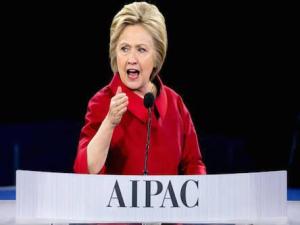
By James Petras | June 6, 2016
During her 4 years as Secretary of State of the United States (2009-2014), Hillary Clinton controlled US foreign policy. She had access to the most confidential information and state documents, numbering in the tens of thousands, from all of the major government departments and agencies, Intelligence, FBI, the Pentagon, Treasury and the office of the President. She had unfettered access to vital and secret information affecting US policy in all the key regions of the empire.
Today, Mme. Clinton’s critics have focused on the technical aspects of her violations of State Department procedures and guidelines regarding handling of official correspondences and her outright lies on the use of her own private e-mail server for official state business, including the handling of highly classified material in violation of Federal Records laws, as well as her hiding official documents from the Freedom of Information Act and concocting her own system exempt from the official oversight which all other government officials accept.
For many analysts, therefore, the issue is procedural, moral and ethical. Mme. Clinton had placed herself above and beyond the norms of State Department discipline. This evidence of her arrogance, dishonesty and blatant disregard for rules should disqualify her from becoming the President of the United States. While revelations of Clinton’s misuse of official documents, her private system of communication and correspondence and the shredding of tens of thousands of her official interchanges, including top secret documents, are important issues to investigate, these do not address the paramount political question: On whose behalf was Secretary Clinton carrying out the business of US foreign policy, out of the review of government oversight?
The Political Meaning and Motivation of Clinton’s High Crimes Against the State
Secretary Clinton’s private, illegal handling of official US documents has aroused a major FBI investigation into the nature of her activities. This is separate from the investigation by the Office of the Inspector General and implies national security violations.
There are several lines of inquiry against Mme. Clinton:
(1) Did she work with, as yet unnamed, foreign governments and intelligence services to strengthen their positions and against the interest of the United States?
(2) Did she provide information on the operations and policy positions of various key US policymakers to competitors, adversaries or allies undermining the activities of military, intelligence and State Department officials?
(3) Did she seek to enhance her personal power within the US administration to push her aggressive policy of serial pre-emptive wars over and against veteran State Department and Pentagon officials who favored traditional diplomacy and less violent confrontation?
(4) Did she prepare a ‘covert team’, using foreign or dual national operatives, to lay the groundwork for her bid for the presidency and her ultimate goal of supreme military and political power?
Contextualizing Clinton’s Clandestine Operations
There is no doubt that Mme. Clinton exchanged minor as well as major official documents and letters via her private e-mail system. Personal, family and even intimate communications may have been carried on the same server. But the key issue is that a large volume of highly confidential government information flowed to Clinton via an unsecured private ‘back channel’ allowing her to conduct state business secretly with her correspondents.
Just who were Secretary Clinton’s most enduring, persistent and influential correspondents? What types of exchanges were going on, which required avoiding normal oversight and a wanton disregard for security?
Clinton’s covert war policies, which included the violent overthrow of the elected Ukraine government, were carried out by her ‘Lieutenant’ Under-Secretary of State Victoria Nuland, a virulent neo-conservative holdover from the previous Bush Administration and someone committed to provoking Russia and to enhancing Israel’s power in the Middle East. Clinton’s highly dangerous and economically destabilizing ‘brainchild’ of militarily encircling China, the so-called ‘pivot to Asia’, would have required clandestine exchanges with elements in the Pentagon – out of the State Department and possibly Executive oversight.
In other words, within the Washington political circuit, Secretary Clinton’s escalation of nuclear war policies toward Russia and China required secretive correspondences which would not necessarily abide with the policies and intelligence estimates of other US government agencies and with private business interests.
Clinton was deeply engaged in private exchanges with several unsavory overseas political regimes, including Saudi Arabia, Israel, Honduras and Turkey involving covert violent and illegal activities. She worked with the grotesquely corrupt opposition parties in Venezuela, Argentina and Brazil
Clinton’s correspondence with the Honduran armed forces and brutal oligarchs led to the military coup against the elected President Zelaya, its violent aftermath and the phony election of a pliable puppet. Given the government-death squad campaign against Honduran civil society activists, Clinton would certainly want to cover up her direct role in organizing the coup. Likewise, Mme. Clinton would have destroyed her communications with Turkish President Erdogan’s intelligence operations in support of Islamist terrorist-mercenaries in Syria and Iraq.
Secretary Clinton’s e-mail would have shown her commitment to the Saudis when they brutally invaded Bahrain and Yemen to suppress independent civil society organizations and regional political rivals.
But it is Clinton’s long-term, large-scale commitment to Israel that goes far beyond her public speeches of loyalty and fealty to the Jewish state. Hillary Clinton’s entire political career has been intimately dependent on Zionist money, Zionist mass media propaganda and Zionist Democratic Party operations.
In exchange for Clinton’s dependence on political support from the Zionist power configuration in the US, she would have become the major conduit of confidential information from the US to Israel and the transmission belt promoting Israel-centric policies within the US government.
The entire complex of Clinton-Israel linkages and correspondences has compromised the US intelligence services, the State Department and Pentagon.
Secretary Clinton went to extraordinary lengths to serve Israel, even undermining the interests of the United States. It is bizarre that she would resort to such a crude measure, setting up a private e-mail server to conduct state business. She blithely ignored official State Department policy and oversight and forwarded over 1,300 confidential documents and 22 highly sensitive top-secret documents related to the ‘Special Access Program’. She detailed US military and intelligence documents on US strategic policies on Syria, Iraq, Palestine and other vital regimes. The Inspector General’s report indicates that ‘she was warned’ about her practice. It is only because of the unusual stranglehold Tel Aviv and Israel’s US Fifth Column have over the US government and judiciary that her actions have not been prosecuted as high treason. It is the height of hypocrisy that government whistleblowers have been persecuted and jailed by the Obama Administration for raising concerns within the Inspector General system of oversight, while Secretary Clinton is on her way to the Presidency of the United States!
Conclusion
Many of Clinton’s leading critics, among them two dozen former CIA agents, have presented a myth that Hillary’s main offence is her ‘carelessness’ in handling official documents and her deliberate deceptions and lies to the government.
These critics have trivialized, personalized and moralized what is really deliberate, highly politicized state behavior. Mme. Secretary of State Hillary Clinton was not ‘careless in managing an insecure mail server’. If Clinton was engaged in political liaison with foreign officials she deliberately used a private email server to avoid political detection by security elements within the US government. She lied to the US government on the use and destruction of official state documents because the documents were political exchanges between a traitor and its host.
The 22 top secret reports on ‘Special Access Programs’ which Clinton handled via her private computer provided foreign governments with the names and dates of US operatives and proxies; allowed for counter-responses inflicting losses of billions of dollars in program damages and possibly lost lives.
The Inspector General Report (IGP) deals only with the surface misdeeds. The Federal Bureau of Investigations (FBI) has gone a step further in identifying the political linkages, but faces enormous obstacles from Hillary’s domestic allies in pursuing a criminal investigation. The FBI, whose director is a political appointee, has suffered a series of defeats in its attempts to investigate and prosecute spying for Israel, including the AIPAC espionage case of Rosen and Weismann and in their long held opposition to the release of the notorious US-Israeli spy, Jonathan Pollard. The power of the Zionists within the government halted their investigation of a dozen Israeli spies captured in the US right after the attacks of September 11, 2001.
Clinton’s choice of conducting secret private communications, despite several years of State Department warnings to abide by their strict security regulations, is an indication of her Zionist power base, and not a mere reflection of her personal hubris or individual arrogance.
Clinton has circulated more vital top-secret documents and classified material than Jonathan Pollard.
President Obama and other top Cabinet officials share her political alliances, but they operate through ‘legitimate’ channels and without compromising personnel, missions, funding or programs.
The executive leadership now faces the problem of how to deal with a traitor, who may be the Democratic Party nominee for US President, without undermining the US quest for global power. How do the executive leadership and intelligence agencies back a foreign spy for president, who has been deeply compromised and can be blackmailed? This may explain why the FBI, NSA, and CIA hesitate to press charges; hesitate to even seriously investigate, despite the obvious nature of her offenses. Most of all it explains why there is no indication of the identity of Secretary Clinton’s correspondents in the various reports so far available.
As Sherlock Holmes would say, “We are entering in deep waters, Watson”.
‘Dirty Record’: Brazil’s Coup Leader Temer Banned from Politics for 8 Years
Sputnik – 03.06.2016
In the first two weeks of temporary leadership, leaked recordings have traced the interim government to a coup conspiracy against Brazilian President Dilma Rousseff and now the country’s interim leader is barred from running for office for nearly a decade.
On Thursday, a regional election court in Sao Paolo issued a guilty verdict against interim Brazilian President Michel Temer on election law violation charges, and declared the politician ineligible to run for political office for eight years as a result of having a “dirty record.”
The court determined that Temer, the subject of several other corruption investigations, spent personal funds on his election campaign in excess of campaign finance limits. The interim leader is now barred from running for the office he currently occupies, underscoring the illegitimacy of his administration.
From the beginning, Temer’s installation into power by means of the impeachment proceedings against Dilma Rousseff was considered by Brazilians to be a coup by corrupt politicians seeking to oust a leader who intended to hold them to justice.
That truth was revealed shortly after Rousseff was suspended from office, when newspaper Folha da Sao Paolo released audio recordings implicating top cabinet officials and allies of the Temer administration plotting the ouster of the democratically-elected leader, in order to avoid criminal charges connected to the “Car Wash” investigation into illegal kickbacks traced to state-owned oil giant Petrobras.
The first series of tapes featured Romero Juca, the country’s planning minister and the head of the Brazilian Democratic Movement Party (PMDB), speaking with oil executive Sergio Machado about “putting Michel into power” in order to “stop the bleeding” associated with the investigation.
The influential minister immediately offered his resignation once the recordings were released, but the damage had already been done to Temer’s attempts to cast the impeachment proceedings as anything other than a coup. Notably, Temer, along with the two key actors in the impeachment process – former lower house leader Eduardo Cunha and senate leader Renan Calheiros – all belong to the PMDB party.
One week later, the newspaper released a new round of recordings featuring Temer’s transparency minister, Fabiano Silveira, advising senate leader Renan Calheiros on how to obstruct the Car Wash investigation. Brazil’s transparency minister holds responsibility for all government anti-corruption efforts, illustrating that the interim administration is akin to a fox guarding a hen house.
Despite growing chants by Brazilians for “Fora Temer” (out with Temer) and “Golpista” (leader of the coup), the interim government has speedily started to undo a decade and a half of democratically-supported social reforms.
On day one, Temer announced a new austerity regime, featuring large cuts to social services for poor Brazilians. Not long after, newly-minted Foreign Minister Jose Serra declared the country would transition away from regional economic collaboration and partnerships, toward an open-market US-centric deregulated-trade policy that has led working class Brazilians to fear economic exploitation.
In a final measure against supporting a social safety net, Temer declared the elimination of the country’s entire cultural ministry, citing costs related to bridging gaps among Brazil’s diverse diaspora.
The fate of Brazil now rests in the hands of the country’s sporadically violent senate, which will vote in six months following the completion of the upcoming impeachment trial on whether to oust Rousseff from office permanently. Rousseff’s opponents will need a 2/3 vote (54 of 81 members) to complete their coup, with the results of those proceedings expected to be decided by a razor thin margin.
In May, Brazilian senators voted 55 to 22 to advance impeachment proceedings against President Rousseff. The vote was taken under a circus-like atmosphere, with senators using their speaking time not to discuss impeachment proceedings, but rather to beg Brazilians to support reelection bids. In an absurd debate that featured fistfights, references to God, the Devil and gangrene, a highlight of the proceedings was Renan Calheiros’s tooth falling out of his mouth on live television.
The senate vote was nearly canceled after former lower house leader Eduardo Cunha, recognized as the chief architect of the impeachment effort, was ousted by the Brazilian Supreme Court on corruption charges. His successor, Waldir Maranhao, called for an annulment of the lower house vote during his first day in office, citing procedural irregularities, although many believe his opposition was traced to rumors that Cunha bribed legislators to support the impeachment vote.
The acting lower house leader quickly rescinded his calls for annulment after threats that he would be deposed from office and a direct challenge by senate leader Renan Calheiros who said the vote would proceed regardless of Maranhao’s objections. A constitutional crisis loomed in the South American nation.
A regime in which over 2/3 of its members face corruption charges, outed as participants in a coup, impeached their leader, Rousseff, who faces no corruption charges, but, with the audacity of the Temer administration’s crimes against Brazil reaching a fever pitch, it may only be days or weeks until the interim government collapses.
Unpopular and scandal plagued, what legitimacy does Brazil’s interim government have to impose painful cuts?
The BRICS Post | June 1, 2016
Brazil’s interim government, led by former vice president Michel Temer, is facing a serious credibility crisis. Two ministers were dismissed in the first few weeks after leaked audio appeared to show them conspiring to stifle the ongoing Petrobras corruption investigation.
Meanwhile, Temer’s administration is trying to pass a budget through congress calling for limits on health, education and social spending, defended as bitter but necessary measures to get Brazil’s flailing economy back on track.
But what legitimacy does Temer’s unelected government have to impose cuts that will seriously affect tens of millions of mainly poor and lower income Brazilians?
Temer’s rise to presidency illustrates Brazil’s acute political dysfunction. More than two dozen parties form often flimsy favour swapping coalitions to gain and maintain power.
Temer’s Brazilian Democratic Movement Party (PMDB) – of no fixed ideology that historically latches onto whoever is in power – was allied to President Dilma Rousseff’s left leaning Worker’s Party (PT). Hence how Temer became vice president.
Weeks before Rousseff’s first impeachment vote, after a 13 year coalition in which the PMDB gained coveted ministerial positions, the party split from Rousseff’s government, essentially allying with the opposition. Temer, by all accounts, played an active role in Rousseff’s downfall.
Rousseff and her supporters call the impeachment process a “coup.” Accused of manipulating government finances to hide a growing deficit ahead of her 2014 re-election, she is currently suspended and awaits impeachment trial at the senate that will most likely lead to her permanent ouster.
Whether Rouseff’s impeachment constitutes a coup or not is widely debated. However dubious, it happened through a legal process.
But now, unpopular and otherwise unelectable Temer is pushing through reforms to roll back Brazil’s social safety net, measures that clearly wouldn’t receive popular support through vote.
Data polls suggest 60 per cent of voters wanted Rousseff impeached, a weak president and poor manager, who presided over Brazil’s worst recession in decades. Yet only 2 per cent would actually vote for Temer and 58 per cent wanted him impeached too.
In fact, 60 per cent want new elections, only plausible if Temer resigns or is forced to stand down. Temer could be impeached on the basis that as Rousseff’s vice, he also broke budget laws. He could also be removed by the electoral court if it’s proven that his and Rousseff’s election campaign received funds from construction firms embroiled in the Petrobras scandal.
So far he has been mentioned in plea bargains relating to the scandal but nothing has stuck. However, Marcelo Odebrecht – chief of one of the main firms involved – has reportedly signed a long awaited plea bargain, which could see many more heads roll in Brasilia.
Temer called for a “government of national salvation.” He famously installed a conservative leaning, all white male cabinet; burying Brazil’s ideal – however illusionary – of being a “rainbow nation” or “racial democracy.” What’s more, at least a third of the chosen ministers are accused of corruption.
Within a week, ministers were talking about shrinking the health system and saying no constitutional right is absolute. Temer even had to warn them to think before speaking.
The scandalous audio leaks began with planning Minister Romero Juca apparently discussing Rousseff’s impeachment as a way to stop the Petrobras investigation. He was suspended.
Next, Temer’s anticorruption Minister Fabiano Silveira stood down after audio revealed him giving advice on dealing with prosecutors to senate president Renan Calheiros, a powerful honcho of Temer’s PMDB party, target of multiple investigations.
In the middle of the leaks, the budget that involves cuts to health, education and social spending to tame the country’s ballooning deficit, was outlined.
Brazil’s economic crisis is already corroding the significant gains made by Rousseff’s Worker’s Party. Under her predecessor’s watch – the popular Luiz Inacio “Lula” Da Silva – millions rose from extreme poverty. In 2014, Brazil was removed from the world hunger map.
A fall in commodities prices, the paralysing corruption scandal at state oil giant Petrobras and Rousseff’s unsuccessful macroeconomic policies saw Brazil’s economy shrank by 3.8 per cent last year, with similar predictions for 2016.
All three of the main ratings agencies have reduced Brazil to junk status. Millions have fallen back into poverty, with unemployment at 11 per cent and over a 1.5 million jobs lost in 2015.
Temer’s so called government of “national salvation” want to implement an austerity programme outlined in his party’s “Bridge to the Future” report, that advocates increased privatizations and public spending limits.
As well as cuts to health and education, Temer’s government hopes to scale back Brazil’s landmark social welfare programme “Bolsa Familia” by at least 10 per cent.
The programme awards poor families a small cash stipend for keeping kids vaccinated and in school. Far from perfect, the programme costs just 0.5 per cent of GDP and reaches 47million poor Brazilians. More cuts are expected to be announced in the coming months.
While such public spending cuts will hurt poor and lower income families, critics say they won’t make much impact on Brazil’s deficit, targeted at US$48 billion for 2016.
Brazil is not Venezuela. It remains the world’s 7th biggest economy with around US$360billion in foreign exchange reserves. Prices of commodities like iron ore and oil, which feed the economy, are on the rise again.
IMF Brazil director Otaviano Canuto pointed out in an interview with BBC Brasil that there is plenty of opportunity to increase taxes on the wealthy, something that no government, including the Worker’s Party, has ever approached. Brazil’s taxes on the rich are the lowest in the G20.
Tax avoidance in Brazil was recorded at more than US$117 billion in 2015, more than twice this year’s fiscal budget deficit target. Meanwhile, Brazilian company JBS, the world’s biggest meat company has moved its base to Ireland meaning it now doesn’t have to pay tax in Brazil. Temer’s finance minister Henrique Meirelles was a former chairman.
Resistance to the Temer government on the streets so far has been visible but lukewarm. Temer’s justice minister Alexandrae Moraes – whose Sao Paulo military police fired 48 stun grenades in 6 minutes at a bus fare hike protest earlier this year – promised to crack down on dissent upon taking office.
Social movement leaders say that they don’t recognise Temer’s government and promise to resist. In a small but symbolic victory, the ministry of culture was reinstalled following occupation, having been cancelled by Temer.
Many view Temer’s government as illegitimate. This sentiment may grow with further damaging audio leaks and sleaze allegations and if the economy doesn’t improve.
Hillary Clinton’s Memoir Deletions, in Detail
By Ming Chun Tang | The Americas Blog | May 26, 2016
As was reported following the assassination of prominent Honduran environmental activist Berta Cáceres in March, former Secretary of State Hillary Clinton erased all references to the 2009 coup in Honduras in the paperback edition of her memoirs, “Hard Choices.” Her three-page account of the coup in the original hardcover edition, where she admitted to having sanctioned it, was one of several lengthy sections cut from the paperback, published in April 2015 shortly after she had launched her presidential campaign.
A short, inconspicuous statement on the copyright page is the only indication that “a limited number of sections” — amounting to roughly 96 pages — had been cut “to accommodate a shorter length for this edition.” Many of the abridgements consist of narrative and description and are largely trivial, but there are a number of sections that were deleted from the original that also deserve attention.
Colombia
Clinton’s take on Plan Colombia, a U.S. program furnishing (predominantly military) aid to Colombia to combat both the FARC and ELN rebels as well as drug cartels, and introduced under her husband’s administration in 2000, adopts a much more favorable tone in the paperback compared to the original. She begins both versions by praising the initiative as a model for Mexico — a highly controversial claim given the sharp rise in extrajudicial killings and the proliferation of paramilitary death squads in Colombia since the program was launched.
The two versions then diverge considerably. In the original, she explains that the program was expanded by Colombian President Álvaro Uribe “with strong support from the Bush Administration” and acknowledges that “new concerns began to arise about human rights abuses, violence against labor organizers, targeted assassinations, and the atrocities of right-wing paramilitary groups.” Seeming to place the blame for these atrocities on the Uribe and Bush governments, she then claims to have “made the choice to continue America’s bipartisan support for Plan Colombia” regardless during her tenure as secretary of state, albeit with an increased emphasis on “governance, education and development.”
By contrast, the paperback makes no acknowledgment of these abuses or even of the fact that the program was widely expanded in the 2000s. Instead, it simply makes the case that the Obama administration decided to build on President Clinton’s efforts to help Colombia overcome its drug-related violence and the FARC insurgency — apparently leading to “an unprecedented measure of security and prosperity” by the time of her visit to Bogotá in 2010.
The Trans-Pacific Partnership
Also found in the original is a paragraph where Clinton discusses her efforts to encourage other countries in the Americas to join negotiations for the Trans-Pacific Partnership (TPP) trade agreement during a regional conference in El Salvador in June 2009:
So we worked hard to improve and ratify trade agreements with Colombia and Panama and encouraged Canada and the group of countries that became known as the Pacific Alliance — Mexico, Colombia, Peru, and Chile — all open-market democracies driving toward a more prosperous future to join negotiations with Asian nations on TPP, the trans-Pacific trade agreement.
Clinton praises Latin America for its high rate of economic growth, which she revealingly claims has produced “more than 50 million new middle-class consumers eager to buy U.S. goods and services.” She also admits that the region’s inequality is “still among the worst in the world” with much of its population “locked in persistent poverty” — even while the TPP that she has advocated strongly for threatens to exacerbate the region’s underdevelopment, just as NAFTA caused the Mexican economy to stagnate.
Last October, however, she publicly reversed her stance on the TPP under pressure from fellow Democratic presidential candidates Bernie Sanders and Martin O’Malley. Likewise, the entire two-page section on the conference in El Salvador where she expresses her support for the TPP is missing from the paperback.
Brazil
In her original account of her efforts to prevent Cuba from being admitted to the Organization of American States (OAS) in June 2009, Clinton singles out Brazilian President Luiz Inácio Lula da Silva as a potential mediator who could help “broker a compromise” between the U.S. and the left-leaning governments of Venezuela, Ecuador, Bolivia and Nicaragua. Her assessment of Lula, removed from the paperback, is mixed:
As Brazil’s economy grew, so did Lula’s assertiveness in foreign policy. He envisioned Brazil becoming a major world power, and his actions led to both constructive cooperation and some frustrations. For example, in 2004 Lula sent troops to lead the UN peacekeeping mission in Haiti, where they did an excellent job of providing order and security under difficult conditions. On the other hand, he insisted on working with Turkey to cut a side deal with Iran on its nuclear program that did not meet the international community’s requirements.
It is notable that the “difficult conditions” in Haiti that Clinton refers to was a period of perhaps the worst human rights crisis in the hemisphere at the time, following the U.S.-backed coup d’etat against democratically elected president Jean-Bertrand Aristide in 2004. Researchers estimate that some 4,000 people were killed for political reasons, and some 35,000 women and girls sexually assaulted. As various human rights investigators, journalists and other eyewitnesses noted at the time, some of the most heinous of these atrocities were carried out by Haiti’s National Police, with U.N. troops often providing support — when they were not engaging in them directly. WikiLeaked State Department cables, however, reveal that the State Department saw the U.N. mission as strategically important, in part because it helped to isolate Venezuela from other countries in the region, and because it allowed the U.S. to “manage” Haiti on the cheap.
In contrast to Lula, Clinton heaps praise on Lula’s successor, Dilma Rousseff, who was recently suspended from office pending impeachment proceedings:
Later I would enjoy working with Dilma Rousseff, Lula’s protégée, Chief of Staff, and eventual successor as President. On January 1, 2011, I attended her inauguration on a rainy but festive day in Brasilia. Tens of thousands of people lined the streets as the country’s first woman President drove by in a 1952 Rolls-Royce. She took the oath of office and accepted the traditional green and gold Presidential sash from her mentor, Lula, pledging to continue his work on eradicating poverty and inequality. She also acknowledged the history she was making. “Today, all Brazilian women should feel proud and happy.” Dilma is a formidable leader whom I admire and like.
The paperback version deletes almost all references to Rousseff, mentioning her only once as an alleged target of NSA spying according to Edward Snowden.
The Arab Spring
By far the lengthiest deletion in Clinton’s memoirs consists of a ten-page section discussing the Arab Spring in Jordan, Libya and the Persian Gulf region — amounting to almost half of the chapter. Having detailed her administration’s response to the mass demonstrations that had started in Tunisia before spreading to Egypt, then Jordan, then Bahrain and Libya, Clinton openly recognizes the profound contradictions at the heart of the U.S.’ relationship with its Gulf allies:
The United States had developed deep economic and strategic ties to these wealthy, conservative monarchies, even as we made no secret of our concerns about human rights abuses, especially the treatment of women and minorities, and the export of extremist ideology. Every U.S. administration wrestled with the contradictions of our policy towards the Gulf.
And it was appalling that money from the Gulf continued funding extremist madrassas and propaganda all over the world. At the same time, these governments shared many of our top security concerns.
Thanks to these shared “security concerns,” particularly those surrounding al-Qaeda and Iran, her administration strengthened diplomatic ties and sold vast amounts of military equipment to these countries:
The United States sold large amounts of military equipment to the Gulf states, and stationed the U.S. Navy’s 5th Fleet in Bahrain, the Combined Air and Space Operations Center in Qatar, and maintained troops in Kuwait, Saudi Arabia, and the UAE, as well as key bases in other countries. When I became Secretary I developed personal relationships with Gulf leaders both individually and as a group through the Gulf Cooperation Council.
Clinton continues to reveal that the U.S.’ common interests with its Gulf allies extended well beyond mere security issues and in fact included the objective of regime change in Libya — which led the Obama administration into a self-inflicted dilemma as it weighed the ramifications of condemning the violent repression of protests in Bahrain with the need to build an international coalition, involving a number of Gulf states, to help remove Libyan leader Muammar Gaddhafi from power:
Our values and conscience demanded that the United States condemn the violence against civilians we were seeing in Bahrain, full stop. After all, that was the very principle at play in Libya. But if we persisted, the carefully constructed international coalition to stop Qaddafi could collapse at the eleventh hour, and we might fail to prevent a much larger abuse — a full-fledged massacre.
Instead of delving into the complexities of the U.S.’ alliances in the Middle East, the entire discussion is simply deleted, replaced by a pensive reflection on prospects for democracy in Egypt, making no reference to the Gulf region at all. Having been uncharacteristically candid in assessing the U.S.’ response to the Arab Spring, Clinton chose to ignore these obvious inconsistencies — electing instead to proclaim the Obama administration as a champion of democracy and human rights across the Arab world.
Nobel Laureate: “Plan Condor Should Never Have Happened”
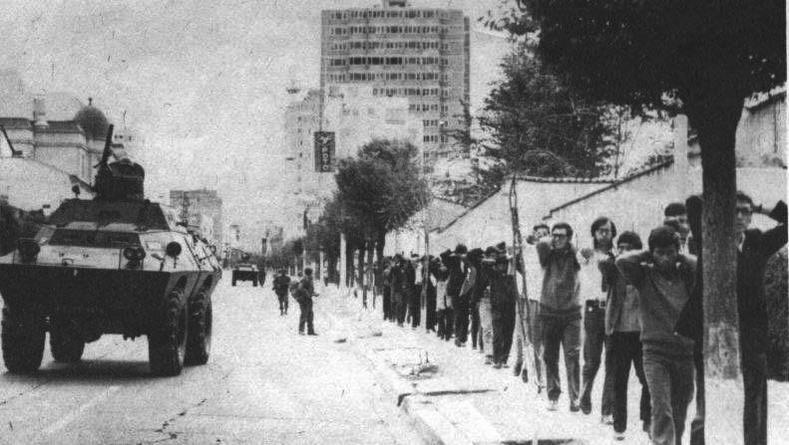
In Bolivia, a CIA-backed military coup led to the overthrow of leftist President Juan Torres. Following the coup, dictator Hugo Banzer had over 2,000 political opponents arrested without trial, tortured, raped and executed.
teleSUR | May 28, 2016
Adolfo Perez Esquivel voiced his opposition to celebrations over the conviction of 15 military officials in Argentina. In his view, there is nothing to celebrate.
Perez Esquivel, recipient of the 1980 Nobel Peace Prize, said Friday that Plan Condor was a conspiracy to kill leftist movements in Latin America and the Caribbean.
In his view, there is no reason to celebrate the conviction of those who participated in Plan Condor in Argentina. An Argentine court found 15 military officials guilty Friday.
“Plan Condor should never have happened,” the Argentine Nobel laureate and human rights defender wrote on the social network Twitter.
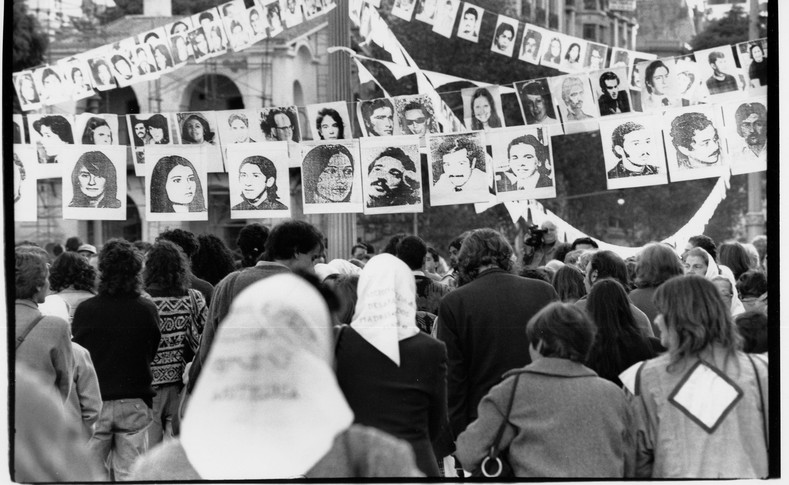
Photographs of the disappeared in Argentina. Photo:Colección AGRA, Archivo Memoria Activa
After the sentencing of several of the military officials, Chilean journalist and diplomat Odette Magnet said “justice was achieved, but we need the truth,” referring to her sister Maria Cecilia Magnet who was disappeared during the dictatorship in the country.
The journalist explained that for 40 years she has played an active role in seeking the truth about repression during the military dictatorships in Latin America.
“I want to know where they are, where (the death squads) threw them, where all the victims of this macabre plan are,” Magnet said. Officials from the dictatorships across Latin America would often throw victims out of helicopters and airplanes into the ocean.
“Nobody knows what really happened to our people, we have no information because the murderers do not speak, they will not talk and that is very frustrating because we have the facts,” Magnet concluded.
RELATED:
Media War Against Venezuela Kicks into High Gear
teleSUR | May 28, 2016
The media war against the democratically elected government of Venezuela kicked into high gear recently.
It is no coincidence that over the past few weeks a series of damning articles have come out touting the allegedly imminent collapse of the Venezuelan government.
These come on the heels of a recent editorial by the Washington Post that resorted to outright lies to justify its effort to promote regime change in Venezuela.
Meanwhile certain heads-of-government, such as Spain’s Mariano Rajoy and Paraguay’s Horacio Cartes who both have strong ties to Washington, have made provocative statements meant to try to isolate Venezuela in the international community.
There is stratagem afoot. Venezuela is passing through a difficult moment and the enemies of the Bolivarian Revolution smell blood.
Those old enough to remember the lead up to the 2003 U.S. invasion of Iraq know that these kinds of campaigns always predate foreign intervention.
For those quick to level the charge of conspiracy, one need only look to Brazil where analysts and pundits warned for months that the impeachment of Brazil was actually a Machiavellian coup plot to oust the president.
Many expressed doubt but the coup allegations turned out to be irrefutably true after a leaked conversation by one of the coup-plotters spelled out the plan explicitly.
teleSUR takes a look at three of the worst examples of anti-Venezuelan propaganda masquerading as journalism.
1. The Guardian’s Nick Cohen Equates Solidarity with Sex Tourism
Cohen’s piece literally opens with the line, “Radical tourism is no different from sex tourism.”
He then equates those who seek to learn from the class struggle throughout the world with those who pay for sex in foreign countries.
Cohen then cherry picks information from questionable sources to disparage a government that has consistently won elections and always acknowledged the times they lost.
Cohen talks about Venezuela as if he lived there, when of course he hasn’t. He seeks out Venezuelans like Thor Halvorssen who agree with him and back-up his claims that the true champions of the oppressed are the right-wing politicians who ignored the poor for decades, before the arrival of Hugo Chavez in 1999.
But how much credibility can a man like Cohen — who backed the invasion of Iraq — have when he calls important thinkers such as Noam Chomsky and John Pilger “half-baked pseudo-left intellectual(s)”?
2. Venezuelans Long For Days of Elite Semi-Democracy… in the NY Times
The New York Times, which recently ran an editorial calling for a return of the days when Latin America was considered the “back yard” of the United States, is one of the loudest voices pushing for the ouster of Maduro.
It has featured article after article with one-sided stories that try to paint Venezuela as a failed state. It recently ran an op-ed by Emiliana Duarte, an upper class Venezuelan living in Caracas, which claimed Venezuelans are going hungry.
Duarte writes for the notoriously anti-government Caracas Chronicles, which the Times describes simply as a website for Venezuelan news.
She seems nostalgic for the pre-Chavez Venezuela, saying the country was once “the most stable democracy in South America.” What she doesn’t mention is that so-called stability came as a result of an elite pact between the leading political parties at the time, the Social Christians and Democratic Action.
This pact deliberately excluded leftist parties from having the opportunity to govern and led the elite semi-democracy known as the Fourth Republic. She laments the loss of the Fourth Republic’s institutions, yet fails to recognize that the failure of these same institutions are partly responsible for the rise of the Bolivarian Revolution.
Duarte also talks about how she has to “fill a suitcase with bags of rice and other grains” whenever she travels, leaving out the fact that regular international air travel is a privilege reserved only for the wealthy.
The suggestion that runs throughout is that Venezuelans are suffering through a hunger crisis, when the facts suggest otherwise as Venezuela remains well above the FAO’s minimum food security level.
3. BBC Commits Journalistic Crimes to Make its Case
The BBC’s Wyre Davies dedicated an entire article to downplaying the very real threat of a foreign military intervention in Venezuela, claiming it is nothing but a “spectre.”
It wasn’t that long ago that official U.S. policy was to install dictatorships throughout the region to do the bidding of elites. While Washington now talks about its respect for democracy, it backed recent coups in Haiti, Paraguay, Honduras and Brazil, not to mention the attempted 2002 coup to oust Hugo Chavez — in Venezuela, of course.
But Davies thinks a foreign intervention is a virtual impossibility.
He belittles the recent military exercises conducted by the Venezuelan Armed Forces. He puts scare quotes around the notion of spy planes, when two alleged U.S. planes were recently caught violating Venezuelan air space.
Davies suggests the military exercises are just a cover “to divert attention from what is really happening.”
To back up his assertion, he points to nameless experts, not once but twice. First he says that “many commentators” agree with his claims without quoting a single one.
Then he says the “real reason” behind the exercises is “to create the emergency conditions that would enable the armed forces to deal with internal dissent.”
Once again he attributes the idea to “observers” but doesn’t bother to name any.
Davies also asserts that President Maduro has “vowed to use (the Armed Forces) against opposition protesters.”
This is patently false. Maduro has never said such a thing.
In fact, opposition leader Henrique Capriles is the only one making open calls to the military to act against the people and rebel against Maduro.
Beyond that, the Venezuelan people and their Armed Forces have a special relationship. It was the military that rescued Venezuelan democracy after the short-lived, U.S.-sanctioned coup briefly ousted President Chavez from power in 2002 in the kind of foreign intervention Davies thinks is a mere specter.
RELATED:
Washington Post Lies to Justify Intervention in Venezuela
6 Coups Against Latin America’s Left Since 2000
IN DEPTH:
Fact-checking the Heralded “End of the Latin American Left”
By Peter Bolton | Council on Hemispheric Affairs | May 27, 2016
Recent political developments across the region have prompted celebratory proclamations in the mainstream Western press that Latin America’s decades-long dominance by left-leaning governments is reaching its terminal stages. The landslide victory of the Venezuelan opposition in last December’s legislative elections, the impeachment of President Dilma Rousseff in Brazil, and the triumph of center-right candidate Mauricio Macri in Argentina’s presidential election do indeed seem to point to a region-wide decline in the fortunes of the parties of the Pink Tide. But as is so often the case in the mainstream media, commentators have been too quick to make current events fit neatly into overarching seismic shifts. The cursory and often incomplete news reports on which they are based simply do not provide sufficient support for such catchall explanations. While scholars have naturally initiated a more nuanced and detailed debate to consider whether the region is indeed witnessing the end of a progressive cycle, press analyses have struck a premature and in many cases triumphalist tone by declaring the collapse of the Latin American left both imminent and beyond serious doubt.
In reality, it is the exact opposite that is beyond serious doubt: it is far too early to write off the future of the left in Latin America. Moreover, more research is needed to understand the dynamics of these movements and how things might play out in the coming months and years. But what is most disconcerting about these knee-jerk press responses is that the people making them seem to not even have a strong grasp of the basic facts surrounding the political developments on which they base their claims, let alone of the nuance needed to develop a sophisticated analysis. In a survey of the media declarations of the purportedly imminent collapse of the Latin American left, COHA has found a shocking collection of glaring and demonstrably false statements over basic matters of fact that reveal the profoundly slipshod nature of their research.
The salience of these findings can hardly be overstated: if journalists in the mainstream media cannot even get basic facts correct, they can hardly be trusted to provide a meaningful analysis of the larger picture.
Jackson Diehl
As predictable as the jeers from the DC commentariat were, perhaps the one figure within the Beltway punditry class who could have been most counted on to react gloatingly to the recent setbacks of leftist governments in Latin America was The Washington Post’s deputy editorial page editor Jackson Diehl. Having been a reliable war hawk and right-wing militarist at the Post’s op-ed section since the late 1970s, Diehl was quick to turn his wrath on Pink Tide leaders and their supposedly grave threat to U.S. national security interests. In 2010 he repeated American Enterprise Institute scholar Roger Noriega’s accusation that then-President of Venezuela Hugo Chavez was collaborating with Iran in the development of nuclear capabilities.[1] In 2013 he accused the governments of Venezuela, Nicaragua and Ecuador of “gutting democratic institutions in their countries,” and described Ecuadorian President Rafael Correa as “Latin America’s chief caudillo and Yanqui-baiter.”[2]
His characterization of the latest political developments, inexplicably posted at the Charleston-based Post and Courier rather than his home publication, fits seamlessly with this record of hysterical hyperbole and dubious accuracy. In the article’s first sentence he triumphantly announces: “The encouraging news from Latin America is that the leftist populists who for 15 years undermined the region’s democratic institutions and wrecked its economies are being pushed out — not by coups and juntas, but by democratic and constitutional means.”[3] From this outrageously loaded misrepresentation he quickly moves on to outright falsehoods by claiming that Argentina’s Cristina Fernández de Kirchner was “vanquished in a presidential election.”[4] From a simple Google search one can learn that she was in fact not even a candidate in last year’s presidential election.[5] Apparently Diehl cannot even get past his article’s second sentence without revealing his stupefying ignorance of the most basic of facts.
Aside from blatant inaccuracies, he also makes the remarkable claim that “most of the Western hemisphere is studiously ignoring this meltdown,” despite the fact that Secretary-General of the Organization of American States (OAS), Luis Almagro, has been calling for months to invoke the OAS Democratic Charter against Venezuela.[6] If he is referring not to the OAS but rather to the leaders of the region’s governments, then he is simply confusing their indifference for Washington’s isolation in its condemnations of the Maduro government. Just as the United States was completely isolated in its refusal to recognize Maduro’s election victory in 2013, so it has been alone in calling for sanctions, for which it has lobbied on the basis of largely spurious allegations of human rights violations.
To round out his diatribe, Diehl then describes the “obstacles” to getting a recall referendum to remove President Maduro as “comically steep,” despite the fact that all of the figures he cites regarding the required numbers of petition signatures (which opposition activists need to gather to trigger the recall vote) are calculated from terms set out in Venezuela’s Constitution. By representing the recall referendum as offering the “slim remaining hopes for a democratic solution,” he implies that some sort of extra-democratic methods might be necessary, and presumably also justified.[7] Keep in mind that the provision for a recall referendum to remove a sitting president is a democratic mechanism that scarcely exists in any constitution besides Venezuela’s.
Rafael Ruiz Velasco
In an article published at the PanAm Post, Rafael Ruiz Velasco is just as hasty in his passage of judgment on the fate of Latin America’s left. He announces confidently that “the results are clear: the bet on socialism in Latin America has failed.”[8] But like Diehl, Velasco makes at least one glaring factual error that undermines his already highly suspect piece. He says of Brazil: “The Olympics will be held with a politically defeated Dilma Rousseff out of office, as she faces impeachment on corruption charges.”[9] The truth of the matter is that Rousseff is in fact one of the few leading Brazilian politicians not to be facing corruption charges.[10] Her impeachment was rather premised on vague accusations of fiscal mismanagement and budgetary irregularities[11]—hardly the high crimes that under normal circumstances would merit removal from office. Her replacement Michel Temer, on the other hand, does presently stand accused of corruption, and not over minor allegations either. In addition to being implicated in the country’s ongoing Petrobras scandal, he also stands accused of illegal financing during the 2014 elections[12]; the exact kinds of things, ironically, that would normally be legitimate grounds for impeachment.
Either Velasco is conveniently ignoring these facts, or else just has a very weak understanding of the details of what is taking place in Brazilian politics. Indeed, much else in his article makes one wonder whether he is engaging in willful misrepresentation or is just plain clueless. To give just one example, Velasco describes Rousseff and her predecessor, Luiz Ignácio da Silva, as Brazil’s “figureheads of failure,” in spite of the four electoral victories they have won between them. Leveling this smear against da Silva, whose widespread popularity led to him being affectionately known as Lula, is particularly absurd given that he won both of his presidential election victories with over 60 percent of the vote and left office with 80 percent approval ratings.[13]
Antonio Sampaio
In an article for Foreign Policy magazine, provocatively titled “How Brazil’s Left Destroyed Itself,” Antonio Sampaio pulls no punches in his characterization of Rousseff’s impeachment, claiming that it “marks the final fall from grace not only of the president but also of her ruling Workers’ Party, which has run the country for 13 years.”[14] But one can only feel confounded when Sampaio concedes further down the article that “supporters of the government are right to point out that Rousseff herself is one of the few high-profile political figures who has not been accused of abusing her office for personal enrichment. (Her impeachment is related to alleged manipulation of public accounts to disguise a deficit).”[15] This stands in blatant contradiction to how he begins the article, with the claim that “the biggest corruption scandal in national history is revealing the extent to which Rousseff and her allies actively contributed to the rot of Brazil’s democratic institutions.”[16] It is simply unfathomable how he can lay the blame for the damage done to Brazil’s institutions by this scandal at the feet of Dilma Rousseff when he concedes in the same article that her impeachment has nothing to do with corruption. But in the world of Western press coverage of Latin America, this kind Orwellian doublethink does not seem to matter even when such contradictory statements are being made in the very same article.
Chicago Tribune/Orlando Sentinel
In a “Guest Editorial” in the Orlando Sentinel, the editors of the Chicago Tribune (I’m confused too) argue that the next U.S. president “will need to engage Latin America with a lot more purpose and resolve,” or else “Russia, Iran and China will.”[17] To their credit, they do concede that the recent setbacks of leftist leaders “do not necessarily mean a complete, sweeping repudiation of leftist populism,” since “the gap between the impoverished masses and the few wealthy elite still defines life for much if not all of the continent.” But rather than providing legitimate justifications for progressive policies, this grinding poverty and gross inequality apparently makes these countries “susceptible” to what they term “leftist agendas.”
But in addition to this patronizing jeer, the Tribune editors also make the exact same factual error as Jackson Diehl by claiming that Cristina Fernández de Kirchner “lost her re-election bid to Argentine center-right leader Mauricio Macri last fall.”[18] At the risk of repeating it ad nauseam, Kirchner did not stand in the election, and, moreover, was not even able to since the Argentine Constitution sets a limit of two consecutive presidential terms. Granted, her ruling Justicialist Party lost control of the executive to Macri’s rival Republican Proposal party, but the candidate for the Justicialists was Daniel Scioli[19] (a former vice-president during the administration of Cristina Fernández de Kirchner’s husband and predecessor Nestor Kirchner). To those who might try to dismiss this correction as mere nitpicking, imagine what people in the United States would have thought if a foreign newspaper had reported in November 2008 that U.S. President George W. Bush had lost his re-election bid to Barack Obama. Such shoddy journalism would have surely delivered an instantly fatal blow to the publication’s credibility. But when a U.S. publication demonstrates an exactly analogous ignorance of basic facts about Latin America, its unfounded pronouncements and flimsy arguments still get taken seriously.
Further revealing their risible political illiteracy, the Tribune editors claim that the setbacks for the Latin American left have “all happened with virtually no coddling or stoking from the U.S.”[20] Either the authors have never read anything about the United States’ covert funding of Venezuelan opposition candidates and its threats of sanctions against the Maduro government, the meetings between major regional right-wing figures and allies in the U.S. Congress,[21] and the United States’ use of international organizations to weaken left-leaning governments, or else they are being deliberately duplicitous (and presumably take their readers for a bunch of idiots to boot). The Tribune editors conclude with the unbelievably sweeping statement that the region’s populations are “fed up with failed leftist policies.”[22]
No Alternative?
This last statement neatly sums up the central message that these articles wish to communicate: that any policies that don’t fit the Anglo-American model of unfettered neoliberal capitalism “don’t work” and that though people might at first naively support them, they end up getting disillusioned and begrudgingly come to the realization that neoliberalism is the only viable economic system after all. Though they might not spell it out quite so obligingly, the message is essentially a repetition of Margaret Thatcher’s infamous claim that “there is no alternative” to free markets, free trade, and capitalist globalization. The presentation of the recent setbacks of Latin American left governments as confirmation of this seems to be a deliberate jibe directed at the many people the world over who hold up Latin America as humanity’s beacon of hope for providing a more just, generous, and sustainable way of life.
But though these setbacks of the Pink Tide should not be reflexively explained away and the diminishment in popular support for its parties should not be discounted, there are important distinctions and qualifiers that cast doubt on such a rash declaration of victory for neoliberal orthodoxy. Lest we forget, it was less than a decade ago that an economic crash plunged world economies into disarray and prompted no less a figure than Alan Greenspan to admit that free market ideology is flawed.[23]
First, it is important to make the distinction between a decline in support for the Pink Tide’s parties and support for their policies. Research has suggested that voting publics in Latin America have not become any less supportive of such policies, but rather are becoming disaffected with how they are being administered by those in charge. A poll by Poliarquía in the run up to the 2015 Argentine presidential election, for instance, found that 50 percent of respondents were in favor not of a return to the policies of the pre-Kirchner years, but rather “continuity with change.”[24] As Raanan Rein, a professor of Latin American and Spanish history at Tel Aviv University, put it: “The left lost more than the right won.”[25] He added: “It wasn’t that Macri became so popular, it was simply that his predecessors, the Kirchners, destroyed Peronism.”[26] In other words, what is needed is not a relapse back to tooth and nail neoliberalism, but rather a new and more effective leadership to build on the alternatives that were first attempted by the leftist old guard. The many achievements that resulted from these policies include: expanded access to public services such as healthcare[27] and education;[28] radically reduced poverty[29] and child malnutrition;[30] widespread construction of new homes for those in need;[31] and a significant pushback against the brutal realities of income and wealth inequality[32] that have long plagued the region. Many of these policies’ merits have been recognized by international organizations including the United Nations,[33] the Carter Center,[34] and even the World Bank.[35] Perhaps the most revolutionary of all the changes implemented by the Pink Tide governments were the drafting of new constitutions that guarantee social, political and economic rights to all citizens,[36] and also include unprecedented protections for marginalized groups such as women[37] and indigenous people,[38] and even for nature.[39]
To be sure, legitimate feelings of betrayal exist throughout the region and it is important to hold progressive governments accountable for their share of errors in confronting the economic downturn or failing to prepare for a rainy day. But though many voters might express their anger at the governing Pink Tide parties for their mistakes and lack of foresight by abstaining or even casting a protest vote for the right-wing opposition, this does not indicate a wholehearted endorsement of these parties’ proposals, far less a desire for a return to neoliberalism and the structural adjustment era of the 1980s and 1990s.
Of course, there is also the natural and universal tendency in all societies for people to gradually tire of their governments (regardless of success or failure), to take for granted the gains that were made, and to forget the bad aspects of what came before. All governments, like all human enterprises generally, are deeply imperfect and are not, in Latin America least of all, immune from risks of corruption and other malign influences. But these negative factors are hardly unique to governments of the left. After all, plenty of governments of the right throughout the region have been not just corrupt, but in some cases even murderous. From the military dictatorship of Augusto Pinochet in Chile in which thousands of people were “disappeared”[40] to the torture and extrajudicial executions that took place during Venezuela’s Andres Perez administration,[41] such governments hardly compare favorably to those of the Pink Tide.
Secondly, it is important to make a distinction between left-leaning governments and the social movements and popular sectors that thrust them into power. The continued energy of these movements demonstrates that their drive to resist neoliberalism and fight for social change is as fierce as ever. Indeed, one of the most basic mistakes of these shallow op-ed columns is their failure to consider, let alone grasp, the workings of the internal dynamics of these movements and their relationships with their national governments. If anything, the fall in support for Chavismo in Venezuela among some of its traditional base has more to do with the failure of the Maduro government to maintain its engagement with the popular sectors rather than a newfound enthusiasm on their part for a return to neoliberalism and a repeat of so-called structural adjustment.
Thirdly, it is important to remember that the parties that have opposed the Pink Tide governments have been pressed to the left and have, at least publicly, adopted much of the language and ideas of their political adversaries. During the 2012 and 2013 presidential elections in Venezuela, for instance, opposition candidate Henrique Caprilles Radonski presented himself as a social democrat and the standard-bearer of the moderate left ideas of Brazilian President Luiz Ignácio da Silva[42] (who incidentally endorsed the Chavista candidate[43] in both cases[44]). His campaign also used some of the enduring symbols of Chavismo, calling itself the “Bolivarian Command” and promising to not discontinue the social missions, but rather make them more efficient and less ideological. Though leaked documents subsequently revealed his plan was to make a swift about-face after the election and impose a brutal neoliberal agenda once in office,[45] Caprilles at least understood that the immense popularity of then-President Chavez’s policies meant that he had to publicly present himself as a center-left progressive in order to stand a chance of winning. The Venezuelan opposition has also moved to the left on social issues and even fielded three LGBT candidates in the 2015 December legislative elections.[46] Likewise, Mauricio Macri presented himself during the presidential campaign in Argentina as a pragmatist and moderate technocrat rather than a free market absolutist.[47] As was the case with Caprilles, there is good reason to think such pronouncements were insincere (he has already rekindled Argentina’s relationship with Wall Street[48] and filled his cabinet with bankers[49]), but it at least demonstrates that the political center of gravity amongst Latin American publics is way to the left of the traditional forces of the right.
Fourth, we should not forget that circumstantial factors have created problems for left-leaning governments that are not of their own making. Global drops in commodity prices have made life difficult for all leaders in a region that has long been heavily based on extractivism. Whether it be oil in Venezuela, copper and zinc in Bolivia, or soybeans in Argentina, global downturns have caused problems for these governments which would have been just as pronounced had their right-wing rivals been in power instead. Dependence on exports of raw materials long predates the Pink Tide and moving out of this legacy would have been a challenge for any government.
Fifth, there is a tendency to characterize the policies of Pink Tide governments as “unsustainable.” The unsustainability argument appeals to basic intuition but is based on a false analogy—that a country’s financial situation is akin to a household budget. One could just as easily point out that with the resource wealth and technological sophistication of today’s world, there is clearly the means to provide for every person on planet earth many times over. That we are not doing so is not a failure of the left, but rather of capitalism and explicable largely in terms of the lasting legacy of colonialism and its lingering power structures. These pressures bear particularly heavily on Latin America given its long history of colonial oppression, not to mention its proximity to the major force in the world that has worked to maintain this status quo and long treated the region as its “backyard.”
Finally, therefore, it is important to consider the superpower’s lasting impact on the region. Meddling by the region’s hegemon and its internal allies has consistently caused damage to Pink Tide governments and their efforts at social reform. The United States’ aggressive stance against them is understandable given the threat they pose to its hemispheric dominance and the preeminence of its favored international organizations. Pink Tide governments have established new international bodies to realize the vision of the decades-long struggle for regional integration and provide a buffer against U.S. imperialism. The Bolivarian Alliance for the Peoples of Our America (ALBA) and the Community of Latin American and Caribbean States (CELAC) are attempts to transcend Washington’s “free” trade orthodoxies and forge an alternative to the Organization of American States (OAS). The Union of South American Nations (UNASUR) was founded to mediate regional conflicts and could in the future provide a framework for military cooperation or freedom of movement for citizens of member nations. The monetary fund BancoSur, though still in its nascent stages, is hoped to provide an alternative source of lending free from the dictates of the IMF and the World Bank. Taken together, these organizations have provided a hope that international relations can in the future be based more on international cooperation, rather than competition, and mutual, rather than solely national, interests. This phenomenon is essentially the expression in the international realm of what Roger Harris of the Taskforce on the Americas has described as “the threat of a good example.”[50]
Though it does not completely explain away the failures on the part of progressive governments, there has nonetheless been a clear pattern in terms of the treatment they have received from United States: the more successful Pink Tide governments have become at helping their citizenry and providing an alternative to Anglo-American neoliberalism, the greater the incentive has grown to crush this threat. When the sabotage is successful it provides a double benefit for the United States and its internal allies: in addition to making a different path unviable it also makes these policies appear as intrinsically unworkable, and thereby “proving” that the neoliberal status quo is the only way forward.
Clearly this ghost of Thatcher haunts the minds of mainstream media commentators, explaining both their lazy treatment of the facts and dogmatic commitment to making all news events fit the neoliberal agenda. What is truly important, therefore, is not so much the immediate electoral fortunes of the Pink Tide governments, but rather the efforts to defend the spirit of the movements on which they are based and the intellectual legacy of their principles. A heavy burden lies on those of us who strive to counter the new neoliberal offensive and the mendacity of its propaganda foot soldiers.
[1] Jackson Diehl, “Is Hugo Chavez a real threat to the U.S.?,” The Washington Post, September 27, 2010. http://www.washingtonpost.com/wp-dyn/content/article/2010/09/26/AR2010092603334.html
[2] Jackson Diehl, “Jackson Diehl: Will the Inter-American Commission on Human Rights be gutted?,” The Washington Post, March 3, 2013. https://www.washingtonpost.com/opinions/jackson-diehl-will-the-inter-american-commission-on-human-rights-be-gutted/2013/03/03/c018f9a6-81d0-11e2-b99e-6baf4ebe42df_story.html
[3] Jackson Diehl, “Stop ignoring the implosion in Venezuela,” The Post and Courier, May 4, 2016. http://www.postandcourier.com/20160504/160509752/stop-ignoring-the-implosion-in-venezuela
[4] Ibid.
[5] Simon Romero and Jonathan Gilbert, “Election Will End Kirchner’s Presidency, Not Her Hold on Argentina,” The New York Times, October 24, 2015. http://www.nytimes.com/2015/10/25/world/americas/election-will-end-kirchners-presidency-not-her-hold-on-argentina.html
[6] http://venezuelanalysis.com/news/11815
[7] Ibid.
[8] Rafael Ruiz Velasco, “The Jury Is In: Latin America’s 21st Century Socialism Has Failed,” The PanAm Post, May 19, 2016. https://panampost.com/rafael-ruiz-velasco/2016/05/19/21st-century-socialism-has-failed/
[9] Ibid.
[10] Marina Koren, “Brazil’s Impeachment Battle,” The Atlantic, April 17, 2016. http://www.theatlantic.com/international/archive/2016/04/brazil-impeachment-dilma-rousseff/478632/
[11] Matt Sandy, “Brazil’s Senate Votes to Impeach President Dilma Rousseff: What Happens Now?,” Time magazine, May 12, 2016. http://time.com/4327408/brazil-senate-dilma-rousseff-suspended/
[12] “Brazil President Corruption Scandal,” Open Source Investigations. http://www.opensourceinvestigations.com/corruption/petrobras-scandal-catching-up-to-brazil-president/
[13] Daniela Blei, “Is the Latin American Left Dead?,” The New Republic, April 16, 2016. https://newrepublic.com/article/132779/latin-american-left-dead
[14] Antonio Sampaio, “How Brazil’s Left Destroyed Itself,” Foreign Policy, May 13, 2016. http://foreignpolicy.com/2016/05/13/how-brazils-left-destroyed-itself-dilma-rousseff-impeachment/
[15] Ibid.
[16] Ibid.
[17] “As ‘pink tide’ ebbs, U.S. must engage: Guest Editorial,” Orlando Sentinel, May 17, 2016. http://www.orlandosentinel.com/opinion/os-ed-pink-tide-latin-america-20160516-story.html
[18] Ibid.
[19] Jonathan Watts and Uki Goñi, “Argentina shifts to the right after Mauricio Macri wins presidential runoff,” The Guardian, November 23, 2016. http://www.theguardian.com/world/2015/nov/22/argentina-election-exit-polls-buenos-aires-mauricio-macri
[20] “As ‘pink tide’ ebbs, U.S. must engage: Guest Editorial,” Orlando Sentinel, May 17, 2016. http://www.orlandosentinel.com/opinion/os-ed-pink-tide-latin-america-20160516-story.html
[21] Rachael Boothroyd, “US Republican Senator Meets with Venezuelan Opposition in Caracas,” Venezuela Analysis, July 1, 2015. http://venezuelanalysis.com/news/11432
[22] “As ‘pink tide’ ebbs, U.S. must engage: Guest Editorial,” Orlando Sentinel, May 17, 2016. http://www.orlandosentinel.com/opinion/os-ed-pink-tide-latin-america-20160516-story.html -america-20160516-story.html
[23] Brian Naylor, “Greenspan Admits Free Market Ideology Flawed,” NPR.org, October 24, 2008. http://www.npr.org/templates/story/story.php?storyId=96070766
[24] Daniela Blei, “Is the Latin American Left Dead?,” The New Republic, April 16, 2016. https://newrepublic.com/article/132779/latin-american-left-dead
[25] Ibid.
[26] Ibid.
[27] http://www.worldbank.org/en/results/2014/06/24/argentina-reduces-risk-and-improves-health
[28] Mark Weisbrot, “Why Ecuador Loves Rafael Correa,” The Guardian, February 15, 2013. http://www.theguardian.com/commentisfree/2013/feb/15/rafael-correa-ecuador-elections
[29] http://cepr.net/documents/publications/weisbrot_revista_fall_2008.pdf
[30] James Suggett, “Venezuela Reduces Malnutrition in Children to 4%,” Venezuela Analysis, July 7, 2008. http://venezuelanalysis.com/news/3626
[31] “Venezuelan Social Housing Project Delivers 700,000th Home,” TeleSur, April 19, 2015. http://www.telesurtv.net/english/news/Venezuelan-Social-Housing-Project-Delivers-700000th-Home-20150419-0019.html
[32] “Venezuela, Uruguay Register Lowest Inequality in Latin America,” TeleSur, April 29, 2015. http://www.telesurtv.net/english/news/Venezuela-Uruguay-Register-Lowest-Inequality-in-Latin-America-20150429-0006.html
[33] Antony Boadle, “Brazil’s Rousseff says extreme poverty almost eradicated,” Reuters, February 13, 2013. http://www.reuters.com/article/us-brazil-poverty-idUSBRE91I14F20130219
[34] http://www.cartercenter.org/countries/ecuador-health.html
[35] http://www.worldbank.org/en/results/2014/06/24/argentina-reduces-risk-and-improves-health; http://www.worldbank.org/en/country/venezuela/overview
[36] Sarah Wagner, “Women and Venezuela’s Bolivarian Revolution,” Venezuela Analysis, January 15, 2005. http://venezuelanalysis.com/analysis/877
[37] Michael Fox, “Women and Chavismo: An Interview with Yanahir Reyes,” NACLA. https://nacla.org/article/women-and-chavismo-interview-yanahir-reyes
[39] http://therightsofnature.org/ecuador-rights/
[40] “Chile recognises 9,800 more victims of Pinochet’s rule,” BBC News, August 18, 2011. http://www.bbc.com/news/world-latin-america-14584095
[41] https://www.hrw.org/sites/default/files/reports/Venez93O.pdf p. 8
[42] “Profile: Henrique Capriles,” BBC News, October 3, 2012. http://www.bbc.com/news/world-latin-america-16811723
[44] Tamara Pearson, “Ex Brazilian President Lula Supports Venezuela’s Maduro,” Venezuela Analysis, April 3, 2013. http://venezuelanalysis.com/news/8476
[45] Jody McIntyre, “Who is Henrique Capriles Radonski?,” New Internationalist. https://newint.org/blog/2012/09/25/venezuela-elections-capriles-chavez/
[46] Corina Pons, “Venezuela’s first transgender candidate to run for Congress,” Reuters, August 8, 2015. http://uk.reuters.com/article/uk-venezuela-politics-idUKKCN0QC25P20150808
[47] Daniela Blei, “Is the Latin American Left Dead?,” The New Republic, April 16, 2016. https://newrepublic.com/article/132779/latin-american-left-dead
[48] Benedict Mander, “Argentina rekindles its relationship with Wall Street,” The Financial Times, May 12, 2016. http://www.ft.com/intl/cms/s/2/6aeb9ae2-17aa-11e6-b8d5-4c1fcdbe169f.html
[49] Astrid Prange, “Macri to take Argentina in a new, neoliberal direction,” Deutsche Welle, December 6, 2015. http://www.dw.com/en/macri-to-take-argentina-in-a-new-neoliberal-direction/a-18898041
[50] Roger Harris, “Venezuela: Supporting A Once and Future Revolution,” Counterpunch, June 26, 2013. http://www.counterpunch.org/2013/07/26/venezuela-supporting-a-once-and-future-revolution/
To download a PDF version of this article, click here.
Russia Denounces External Forces for Crisis in Venezuela
By Rachael Boothroyd Rojas – Venezuelanalysis – May 24, 2016
Caracas – Russia’s Foreign Ministry has spoken out against “outside” efforts to destabilise Venezuela, warning against the consequences of imposing “colour scenarios” on the South American nation.
On Monday, Russian news agency Tass and Sputnik International reported that Russia’s Foreign Ministry had released an official statement addressing the current situation in Venezuela.
“The upsurge of tensions in Venezuela is being fed from outside,” asserted the Foreign Ministry statement.
“We are confident that a political solution to Venezuelan problems is to be found by the Venezuelan people who have elected its legitimate authorities… Destructive interference from outside is inadmissible,” it continued.
The South American country has been suffering from a worsening economic crisis for the past two years and is currently locked in a political stand-off between the executive branch and the opposition controlled legislature.
In firm language, the declaration also reminded other global powers that “no-one has the right to impose ‘color scenarios’ on Venezuela, referring to the outside financing of “proxy” organisations aimed at destabilising the national government.
Russia also warned that current tensions in Venezuela risk spilling over into open conflict on the nation’s streets, bringing “serious consequences” for the rest of the region.
Moscow’s remarks come as the Union of South American Nations (UNASUR) begins to take tentative steps towards opening up negotiations between Venezuela’s two warring political factions: the leftist government of Nicolas Maduro, and the rightwing political coalition, the MUD, which currently controls the National Assembly.
However, escalating rumours of a possible coup against the national government in recent weeks are threatening to dampen hopes of a rapprochement.
The MUD has pledged to remove Maduro through a variety of “constitutional” means since taking hold of the legislature last December.
Nonetheless, Russia said it backed a UNASUR negotiated solution to the crisis and asked both sides to “cool down” their emotions. It also confirmed it would be open to participating in negotiation efforts in Venezuela if requested.
“We are confident that the main challenge facing Venezuela at the moment is to find realistic ways out of the economic crisis, improve the social situation of broad layers of the population… It is obvious that this is possible only in conditions of internal political tranquility,” asserted the foreign ministry declaration.
Although Moscow didn’t name the “outside” influences which it cites as exacerbating tensions in Venezuela, it is possible that the US has caught the Kremlin’s eye.
Just last week, Russia’s Vice-minister for Foreign Affairs, Sergéi Ryabkov, said that his government believed that Washington was intensifying its attempts to directly “interfere” in Latin American affairs to the detriment of the region.
He cited a swing to the right in Argentina’s government, as well as the recent controversial impeachment of Brazil’s left leaning president, Dilma Rousseff, as examples.
New Brazil cabinet in trouble after leaks on anti-Rousseff plot
Press TV – May 24, 2016
Brazil’s interim government has been rattled by a leaked audio tape suggesting a plot against suspended President Dilma Rousseff, a scandal that forced a key minister in the new cabinet to resign.
Brazilian Planning Minister Romero Juca, a close ally of acting President Michel Temer, said Monday he is stepping down.
The decision came a day after a Brazilian newspaper published the transcript of a secretly-taped conversation between him and Sérgio Machado, a former senator.
Juca was caught on the tape saying Rousseff needed to be removed in an attempt to quash a vast corruption investigation that implicated him and other politicians, in what analysts call a first major political blow to the acting administration.
“We have to change the government to be able to stop this bleeding,” he was reportedly recorded saying.
Juca admitted earlier in the day that one of the two voices heard on the tape was his, but said his comments have been misinterpreted and taken out of context.
Later in the conversation, Juca says he talked about his plans to Supreme Sourt justices, who told him the corruption investigation and its media coverage would never come to an end as long as Rousseff remained in power.
The tape was recorded just weeks before the lower house of parliament voted to impeach Rousseff, according to the Folha de Sao Paulo newspaper, which published chunks of a 75-minute conversation on Monday.
The impeachment bid was launched over allegations that the president manipulated government accounts before the last election. Rousseff, however, has denied the allegations.
Earlier this month, Brazil’s upper chamber of the National Congress voted to suspend Rousseff and begin an impeachment trial against her. Acting President Michel Temer stepped up from the post of vice-president and replaced her.
Reacting to the leaks, Rousseff said the tape proves that she has been a victim of a “political coup d’état.”
“This only confirms what we have been talking about for some time: it confirms the coup against Dilma,” said Paulo Rocha, the Senate leader for the Workers’ Party of Rousseff.
Ever since her suspension, the Latin American country has been the scene of nationwide demonstrations.
On Friday protesters took to the streets of Sao Paulo, calling for the resignation of Temer. They held banners and chanted slogans to support Rousseff.
Colombia: the Displaced & Invisible Nation
By Dan Kovalik | CounterPunch | May 20, 2016
The latest thematic report by the Inter-American Commission on Human Rights (IACHR) concerning Colombia makes for shocking though quite important reading. In short, it details human rights abuses on a massive scale, and lays the blame for these abuses chiefly upon the right-wing paramilitaries aligned with the Colombian State. Citing Colombia’s Center for Historical Memory, the IACHR concludes that Colombia, with its over 6 million internally displaced persons, is indeed “a displaced nation.”

Exhibit at Center for Historical Memory, Showing Personal Effects of “False Positive” Victim
As the IACHR explains, the paramilitaries were responsible for 72% of the attacks recorded in the first half of 2015. Incredibly, the Colombian State, along with its U.S. sponsor, insist that the paramilitaries (also known as Autodefensas) no longer exist as a result of a demobilization (largely faked) back in 2003-2006. And, it is this very denial, the IACHR points out, which allows the paramilitaries to carry out their reign of terror with near complete impunity. After all, the State will not dismantle or prosecute what it claims does not even exist.
As explained in the report, “during 2015 the IACHR has continued receiving information about actions of the illegal armed groups that emerged after the demobilization and which are identified as being related or having among their members, persons that belonged to paramilitary groups who, in many cases allegedly continue acting under the protection of State agents.”
The misdeeds the paramilitaries are carrying out under State protection include disappearances, of which there were an incredible 3,400 during the first 7 months of 2015 alone. In all, the IACHR reports that there have been a total of between 45,000 and 61,918 forced disappearances in Colombia in the past 30 years. Thus, there have potentially been more than three times the disappearances in Colombia than in Argentina during all of the Dirty War years. And, of course, with such disappearances come mass graves, of which Colombia has many – 4,519 of them to be exact, with 5,817 bodies exhumed from them so far.
Meanwhile, the IACHR reported on the fact that at least 5,736 individuals were the victims of extrajudicial executions by the Colombian State forces between 2000 and 2010 – that, is during the period of the U.S.’s major military support for Colombia known as Plan Colombia. Nearly all of these executions were “false positive” killings in which the Colombian military murdered innocent civilians – many of them young, unemployed men – and then dressed them up as guerillas to justify to the U.S. the military assistance the Colombian military was receiving for counter-insurgency purposes. And, while the rate of such killings has decreased since 2010, they nonetheless continue, with 230 reported cases since then.
To the extent Colombia is covered at all in the mainstream press these days, one rarely gets a glimpse into the horror show which is taking place in that country. And, casual visitors to places such as Bogota or Medellin would rarely get a glimpse of this either. This is so because the lion’s share of the violence described above is taking place in the more remote areas where Colombia’s Afro-Colombian and indigenous communities live, and it is these communities which are suffering the brunt of this violence.
As the IACHR explains, these communities are largely “invisible” in Colombian society, “are victims of racial discrimination and disproportionately affected by violence, forced displacement, poverty and social exclusion.” In addition, “the majority of victims of sexual violence in armed conflict are Afro-descendant and indigenous women.” And, impunity for sexual violence in Colombia is near total “given that sexual violence against women would be perpetrated mainly by paramilitary, but also by agents of the government . . . .”
As for the issue of poverty, these communities are suffering from some of the most extreme versions of it, and live in conditions of misery which residents in the major cities are often shielded from. For example, in Choco – a town nestled in between the Pacific and Caribbean coasts and populated by mostly Afro-Colombian and indigenous – the infant mortality rate is 42.69 per 1000. This figure is higher than that of post-invasion Iraq, and nearly as high as that in such countries as Burma, Bangladesh, Namibia and Haiti. Meanwhile, in Bogota, the figure is 12.88 per 1000. These figures underscore the incredible inequities and disparity in wealth which make Colombia one of the most unequal societies on earth, with a very stark divide along racial and ethnic lines.
However, the violence against Afro-Colombians and indigenous is not just the product of racism, but is also the product of the unfettered capital penetration of their rich, ancestral land. As the IACHR points out, large scale megaprojects – many of them mining projects – “have led to the appropriation of Afro-Colombian’s collective territories, and have resulted in “brutal forced displacements, massive violence and selective assassinations.”
And, of course, many of these megaprojects are owned, in whole or in part, by North American companies to which the U.S.-Colombia Free Trade Agreement (FTA) has opened Colombia wide open.
An example of such a deadly megaproject detailed in the IACHR report is the port expansion of Buenaventura, a town which is 90% Afro-Colombian. This port expansion was carried out to facilitate the trade and tourism created by the FTA. And, the struggle of the paramilitaries to control the wealth generated by the port expansion has led to the forced disappearances of hundreds of Buenaventura residents “and the operation of ‘chop houses’ (casa de pique)” where people are chopped up alive.
Like the Colombian and U.S. governments denials of the existence of the paramilitary death squads, the very failure of our mainstream media to acknowledge or discuss the existence of the above-described crimes allows them to continue. Thus, the U.S. government is able to continue supporting the Colombian military, and by extension its paramilitary allies, and North American multi-nationals are able to keep violently exploiting the Colombian people and their land by virtue of the fact that we are kept in the dark about this reality by a press corps which is failing in its duty to report on such matters of public concern. It is only by breaking this silence around these crimes that we have any chance of stopping them.
Daniel Kovalik lives in Pittsburgh and teaches International Human Rights Law at the University of Pittsburgh School of Law.
Brazil Coup Regime Moves to Change Definition of Slavery
teleSUR – May 20, 2016
Brazil’s new unelected government is looking to introduce new measures that would “soften the definition of slavery” in the country in what is being seen as a roll-back of many of the reforms introduced by the leftist government of President Dilma Rousseff.
The new measures will be introduced by the newly appointed Agriculture Minister Blairo Maggi and are expected to worsen conditions for vulnerable workers in farming and food processing, according to a report by The Guardian Friday.
Maggi, one of the richest men in Brazil who owns the world’s largest Soya company, has proposed legislation that would separate “degrading conditions” and “exhausting shifts” from the definition of slavery, the newspaper reported, citing public record documents available online.
In February, Brazil’s Ministry of Labor fined 340 Brazilian companies for slave labor practices, including forced labor and people working in degrading conditions for little or no pay in rural and urban areas.
The companies were included in a “dirty list” published by the Ministry of Labor of employers benefiting from modern slavery in the country. The list was part of the Rousseff government’s efforts to crack down on modern day slavery practices.
About 400 workers have been freed from slave-like conditions in Brazilian coffee plantations since 2002, according to rights groups and activists.
The Guardian also reported that the controversial billionaire and his lobby group have also been seeking to reverse measures introduced by Rousseff that acknowledged several quilombolos (territories inhabited by the descendants of runaway slaves), created 56 million hectares of conservation land and recognized Indigenous claims on other areas.
Maggi and the new government want to retake these lands and territories from their rightful owners and open them up for large-scale agriculture and cattle-ranching by massive corporations.
Maggi is an agribusiness mogul, known as the “Soybean King,” who has been accused of destroying large portions of the the Amazon rainforest in order to turn it into areas for soybean production.
Maggi received the Golden Chainsaw Award in 2006 from Greenpeace for being the Brazilian who most contributed to the destruction of the Amazon Rainforest.
RELATED:
Brazil’s Coup Cabinet Riddled with Corrupt Corporate Stooges
Featured Video
Ian Proud: Economic Reset with Russia to Save Europe
or go to
Aletho News Archives – Video-Images
From the Archives
Jack Ruby: Israel’s Smoking Gun
BY LAURENT GUYÉNOT • UNZ REVIEW • NOVEMBER 13, 2021
By a strange paradox, most Kennedy researchers who believe that Oswald was “just a patsy” spend an awful lot of time exploring his biography. This is about as useful as investigating Osama bin Laden for solving 9/11. Any serious quest for the real assassins of JFK should start by investigating the man who shot Oswald at pointblank in the stomach at 11:21 a.m. on September 24, 1963 in the Dallas Police station, thereby sealing the possibility that a judicial inquiry would draw attention to the inconsistencies of the charge against him, and perhaps expose the real perpetrators. One would normally expect the Dallas strip-club owner Jack Ruby to be the most investigated character by Kennedy truthers. But that is not the case. … continue
Blog Roll
Recent Comments


 Aletho News
- Ian Proud: Economic Reset with Russia to Save Europe
- Senator Rand Paul Introduces Federal Bill to END Vaccine Makers’ Liability Shield
- The Hidden Map: US and Israel May Use Unexpected Neighbors to Attack Iran
- Trump, Netanyahu Agree to Target Iranian Oil Exports to China
- Russia open to discussing Ukraine’s ‘external governance’ – senior diplomat
- US Caribbean Buildup Near $3B — Report
- Munich Security Conference and the U.S. elephant in the room
- Epstein Pitched JPMorgan Chase on Plan to Get Bill Gates ‘More Money for Vaccines’
- Germany’s CDU Pushes Real-Name Social Media Mandate and ID Checks
- Patrik Baab: Europe’s New Iron Curtain – Freedom of Speech Dies
- If Americans Knew
- ISIS-linked border guards, GHF-linked aid – Not a ceasefire Day 128
- Israel battles Palestinian right of return, one Palestinian at a time – Not a ceasefire Day 127
- Noor’s short life of unimaginable suffering
- Israel Destroyed Gaza’s Hospitals. Now It’s Banning Doctors Without Borders.
- Is Spite of What Zionists Say, It’s a Good Thing to Criticize Governments
- Palestinian mother, daughter recount strip searches, harsh conditions in Israeli detention
- Israel used weapons in Gaza that made thousands of Palestinians evaporate
- ADL’s Stats Twist Israel’s Critics Into Antisemites
- Why Is the World Silent When the Gaza Genocide Is Not Over?
- In Gaza: 8,000 bodies under rubble, 3,000 missing – Not a ceasefire Day 126
- No Tricks Zone
- Unfudging The Data: Dutch Meteorological Institute Reinstates Early 20th Centruy Heat Waves It Had Erased Earlier
- German Gas Crisis…Chancellor Merz Allegedly Bans Gas Debate Ahead of Elections!
- Pollen Reconstructions Show The Last Glacial’s Warming Events Were Global, 10x Greater Than Modern
- Germany’s Natural Gas Storage Level Dwindles To Just 28%… Increasingly Critical
- New Study Rebuts The Assumption That Anthropogenic CO2 Molecules Have ‘Special’ Properties
- Climate Scientist Who Predicted End Of “Heavy Frost And Snow” Now Refuses Media Inquiries
- Polar Bear Numbers Rising And Health Improving In Areas With The Most Rapid Sea Ice Decline
- One Reason Only For Germany’s Heating Gas Crisis: Its Hardcore-Dumbass Energy Policy
- 130 Years Later: The CO2 Greenhouse Effect Is Still Only An Imaginary-World Thought Experiment
- New Study Affirms Rising CO2’s Greening Impact Across India – A Region With No Net Warming In 75 Years
 Aletho News