Ecuador: CIA Justifies Reyes “Targeting” in 2008
Weekly News Update on the Americas | December 29, 2014
According to a secret study released by the Wikileaks group on Dec. 18, the US Central Intelligence Agency (CIA) considers the killing of Revolutionary Armed Forces of Colombia (FARC) second-in-command Raúl Reyes by Colombian forces in Ecuadorian territory on Mar. 1, 2008 [see Update #937] an example of ways that assassinations of rebel leaders “can play a useful role.”
In addition to the Reyes case, the paper reviews the use of “high-value targeting (HVT)”—the killing or capture of top leaders—in fighting rebels in Afghanistan, Algeria, Colombia, Iraq, Israel, Peru, Northern Ireland and Sri Lanka. HTV can have “negative effects,” the study concludes, but the practice can “contribute to successful counterinsurgency outcomes” if used strategically. The July 9, 2009 study, marked “secret” and “NOFORN” (“no foreign nationals”), is entitled “Making High-Value Targeting Operations an Effective Counterinsurgency Tool”; it apparently forms part of a “Best Practices in Counterinsurgency” series.
Reyes, the FARC’s chief spokesperson and negotiator, was killed when the Colombian military launched a nighttime air raid and then an incursion against a rebel encampment in Ecuador’s northeastern Sucumbíos province about three kilometers from the Colombian border. Some 19 FARC members were killed in the operation, as were four Mexican students who had been visiting the encampment while in Ecuador to attend a leftist conference. Although the Colombian government and the media treated the attack as a simple raid against a group of rebels, the CIA study refers to it as part of a number of “successful HVT strikes against top insurgent leaders in early 2008, in conjunction with earlier strikes against second and third-tier leaders and finance and logistics specialists.” Reyes’ death “is likely to have seriously damaged FARC discipline and morale, even among its leadership, according to a CIA field commentary.” As an example of the operation’s success, the CIA noted that “[p]ublic support for the Colombian government solidified in the wake of the killing… with President Alvaro Uribe’s approval rating increasing from the mid-70% range to as high as 84%.”
The study treats the Reyes killing as a strictly Colombian operation, although there have been reports that in fact the Colombians dropped US “smart bombs” and that an HC-130 airplane, used for refueling helicopters, took off from the US base then at Manta, Ecuador, just hours before the attack. The FARC itself claimed in a Mar. 14 communiqué that the US Southern Command had led the operation [see Update #940]. Theoretically US agencies are not allowed to participate in targeted assassinations. Executive Order 12333, signed by US president Ronald Reagan on Dec. 4, 1981, states that “[n]o person employed by or acting on behalf of the United States Government shall engage in, or conspire to engage in, assassination.” (La Jornada (Mexico) 12/19/14)
More Militarization Expected for 2015 in Honduras
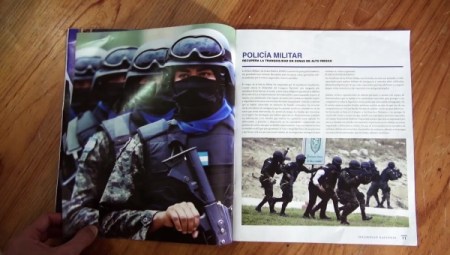
Government propaganda is based on repeating that security has improved with militarization
teleSUR | December 24, 2014
In Honduras, after one year of President Juan Hernandez’s term, there has been an increase in privatization, militarization and budget cutbacks in public services. It is expected this will continue next year, but social movements say that they will not sit idle.
According to leaders of the social and political movement, next year will see massive dismissals of public sector workers, reductions in health and education budgets, and the unity of the political opposition against President Hernandez.
Juan Barahona, coordinator of the National Resistance Front explained that, “We see that the budget which was recently approved in the National Congress, is a budget that in 2015 cuts millions off the health system, education, and millions off agrarian programs. There is not even a cent for wage increases or for new jobs. And as a response to this national budget, there is going to be a great deal of social protest, but also there is going to be strong repression and that’s why they (the government) are preparing themselves with the militarization of security forces.”
Repression
According to Barahona, in Honduras next year there will be more persecution of social movement leaders, stronger repression during public demonstrations, and more presence of military intelligence agencies in surveillance of government dissidents.
However, in the last two months of 2014, new fronts have been created in Honduras. The Rural Women’s front has been demanding cheap credit and true agrarian reform such as the titles of the land they have been working on. The Public Workers Front faces the privatization of public services and the dismissal of more than 8,000 workers. Also the opposition National Resistance Front is calling on people to go into the streets, and opposition political parties have pledged unity.
Salvador Nasralla of the Anti-Corruption Party said, “If we continue along this path, it is going to be a dictatorship. When there is a dictatorship people don’t have the right to an opinion. And we three opposition political parties believe that this is going to get worse.”
While the national media, which for the most part supports the government, claims that violence has been reduced and that the forthcoming decisions will bring solutions for the profound crisis in Honduras, everyday there are more and more expressions of discontent among the population. Confrontation is expected to be ongoing all through Honduras during 2015.
Ecuador ends deal with Germany on environmental issues
Press TV – December 20, 2014
Ecuador has terminated its environmental cooperation with Germany after German legislators tried to visit an Amazon rainforest recently opened for oil exploitation, the country’s foreign minister says.
“Ecuador unilaterally ends all cooperation with Germany on environmental issues,” Ricardo Patino said on Friday.
In 2012, Germany and Ecuador inked a cooperation deal worth 36 million euros ($44 million) to protect the environmentally sensitive rainforest known as Yasuni. They also signed another deal worth 7 million euros ($9 million) in other environment projects.
“If they think they had the right to doubt the word of Ecuador’s government on the issue of Yasuni because they were providing funds, we’ll give them their money back with interest,” Patino added.
He also noted that the Latin American country has not received the funds for the rainforest, and the money allocated for the other projects will be returned soon.
In 2007, Ecuadorian President Rafael Correa asked rich countries to donate $3.6 billion to help protect the Yasuni in exchange for pledges not to drill for the oil beneath it.
However, Correa allowed the national oil company to do drilling after his proposal was not welcomed by the other countries.
Earlier this month, Correa did not permit the German lawmakers to visit the Yasuni to observe oil production and talk to activists opposing the measure.
The Ecuador government assured that it will take every measure possible to protect the sensitive Amazon environment during the extraction process. However, the Correa government was not pleased that the German delegation wanted to meet with opposition groups first.
“We either have relations based on equality, or none at all,” Correa said in a statement to the German delegation, asking if Germany would likewise accept a delegation from Ecuador coming to their country to inspect their nuclear projects, for instance. Correa added that his country “stopped being a colony 200 years ago.”
UN Offers to Monitor Colombia Ceasefire
teleSUR | December 20, 2014
The United Nations has welcomed the FARC’s (Revolutionary Armed Forces of Colombia) declaration of an indefinite unilateral ceasefire in Colombia, and offered to help oversea it – if both parties involved agree.
“The United Nations has the competency,” Hochschild told reporters Thursday. He also stated that the U.N. has the willingness and the experience needed for the job.
The leftist rebel group called the indefinite earlier this week in Havana, Cuba marking the end of the last round of peace negotiations for the year.
The FARC and the Colombian government have been engaged in peace talks since November of 2012 to end the 50 years of civil war in the country. Although unilateral ceasefires have been called in the past, this is first time that no time limit has been set, leaving many optimistic that the two sides may be approaching an agreement.
One of the conditions for the ceasefire set by the FARC was that the situation be monitored by an outside body.
On Thursday, the Union of South American Nations (UNASUR) announced that they were open to overseeing the ceasefire. The leftist fighters also approached the Community of Latin American and Caribbean States (CELAC), the International Committee of the Red Cross and the Broad Front for Peace to oversea the ceasefire.
President of Colombia, Juan Manuel Santos, welcomed the ceasefire, however has refused to agree to it, stating fears that rebels would use the time to recalibrate and acquire arms.
The President has also refused to meet the FARC’s conditions for an outside monitoring body, saying the government itself could monitor the situation.
Earlier on Friday, the government accused the FARC of killing five soldiers during clashes in the southwestern state of Cauca. The attack reportedly happened only hours before the ceasefire was due to begin, however it is not clear who started the aggressions. The FARC has not accepted responsibility and has yet to comment on the matter.
According to the FARC, the ceasefire – which took effect at midnight on Saturday – must lead to a truce, and will only call it off if Colombian soldiers directly attack FARC troops.
Santos has said he is only willing to halt military actions if a peace agreement is signed.
Argentina sentences four ex-officers to life in prison
Press TV – December 19, 2014
A court in Argentina has handed down life sentences to four former military officers for committing crimes against humanity during the 1970s’ US-backed military dictatorship in the South American country.
On Thursday, the court in the capital, Buenos Aires, found the four guilty of “illegal deprivation of liberty, torture, rape and homicide,” involving 204 people out of the total 2,500 held at the Vesubio detention center between 1976 and 1978.
The four defendants are former colonels Federico Minicucci and Jorge Crespi, former intelligence officer, Gustavo Cacivio, and former colonel and prison official, Nestor Cendon.
The Vesubio detention center operated in the La Matanza district of Buenos Aires, until it was destroyed to prevent the Inter-American Commission of Human Rights from inspecting it during a country visit.
Famous comics writer, Héctor Oesterheld, author Haroldo Conti and filmmaker Raymundo Gleyzer were among those who died in the prison.
Former Argentine Major Ernesto “Nabo” Barreiro has recently broken his 31-year pact of silence by revealing the locations of graves of people who disappeared under the military regime during the so-called “Dirty War” from 1976 to 1983.
Barreiro said some two dozen people are buried inside two large earthen ovens at a military base outside the central city of Cordoba.
Previous Argentine governments have failed to investigate crimes committed during the almost seven-year dictatorship due to the so-called Full Stop law, which saw an end to prosecutions. However, the law was repealed ten years ago.
The US-backed dictatorship in Argentina jailed, tortured and murdered dozens of people and forced thousands to flee the country during the war.
Federal courts are seeking the whereabouts of an estimated 30,000 people who were killed or abducted and presumed killed during the dictatorship.
Cuba Better Be Careful What It Wishes For
By Andrew Korybko | Sputnik | December 17, 2014
The US and Cuba have reached a historic deal to swap notable prisoners and establish diplomatic relations after decades of mutual hostility. The announcement caught many by surprise, and begs the question: Are there more sinister geopolitical calculations at work behind the U.S.’ olive branch?
The tradeoff largely boils down to this: the US has released the three remaining members of the Cuban Five in exchange for jailed contractor Alan Gross, 53 US-selected “political prisoners,” and an unnamed intelligence source who was imprisoned over 20 years ago. As a result, both countries will now establish diplomatic relations and the decades-long US embargo will be largely eased.
Many people are rightfully cheering what seems to be an imminent end to U.S. hostility towards Cuba, but all of this may just be a deception. The U.S. needs Cuba more than the other way around, since it wants to use the island as a pivot to reverse the Caribbean Basin’s move to multipolarity and prolong Washington’s full control over its historic “lake.”
Regime Change Done Differently
Cuba no longer needs the U.S. as much as it did at the end of the Cold War, when its economy was in despair and the market hardly functioned. It’s come a long way since then, and although it still has its fair share of problems, it’s proved that it can survive on its own while being officially isolated from its massive northern neighbor. While the U.S. had plenty of opportunity to exploit Cuba when it was at its weakest in the 1990s, it missed the chance to do so, driven by the precondition that regime change must happen first.
Now, however, the tables have turned, and the U.S. is pursuing a policy of engagement first in order to facilitate the same regime change goal it’s been trying to pull off for over the past half century.
“I do not expect the changes I’m announcing today to bring about a change in Cuban society overnight,” Obama said, implying that he still wants the U.S. vision of change to occur. The removal of the embargo would only be a victory for the Cuban people if they are able to retain their independence, sovereignty, and preferred form of government afterwards.
Indirect Inroads
Overt hostility hasn’t worked in the past against Cuba, and it likely won’t work in the future. Plus, there’s been a general trend in recent years for the US to pursue its objectives through covert and indirect means. This is where Cuba is most vulnerable in the recent ‘thaw’ in relations. The American economy doesn’t need Cuba at all, really, and Washington’s opening to Havana is a convenient cover to catch Cuba in its social and economic snare to more directly control the inevitable leadership transition process that will occur with Fidel’s passing. It already tried and failed to use USAID to create a ‘revolutionary Twitter’ on the island, as well as its embarrassing follies with anti-government Cuban rappers, to name but the few most recent regime change scandals there. And it must be kept in mind that Mr. Gross was working for the Agency when he was arrested in 2011 for trying to, as Cuban authorities described it, to “promote destabilizing activities and subvert constitutional order” to foster a “Cuban Spring.”
Cuba is also vulnerable to reverse migration, in that dissident and possibly extremist Cuban-Americans may return to the island in order to build a future Color Revolution’s social infrastructure to deploy when the time is right (likely in the aftermath of Fidel’s death). American businesses can fill a valuable development and investment gap on the island, in exchange for making Cuba ever more dependent on the U.S. This would give the U.S. another lever of influence over the island’s affairs, which could be activated in unison with a Color Revolution to create maximum disorder.
Bucking The Trend
The timing of Washington’s “outreach” to Havana isn’t coincidental, as it coincides with major processes going on in the region that the U.S. hopes to reverse. Most recently, the pro-U.S. Prime Minister of Haiti, Laurent Lamothe, was forced to resign last week amid protests and popular outrage over his corruption and ineffectiveness. Backtracking America’s hold on the region even further, the Chinese are slated to begin construction on the Nicaraguan Canal, which when completed, would create a major breach in America’s control of the Caribbean Sea. Finally, Venezuela has been a center of resistance to American hegemony over the hemisphere ever since the leadership of the late President Hugo Chavez.
Cuba is the symbolic leader of the Latin American resistance movement, and its “Cuban Spring” surrender would be disheartening for the other allied states that defy the U.S. via the ALBA grouping. Congress recently passed sanctions against Venezuela (largely overshadowed by the anti-Russian ones), which is the financial engine of the hemispheric resistance, to facilitate a Color Revolution there as well, as President Maduro himself has previously alleged Washington wants to do.
Venezuela’s economy is also hurting because of the recent oil price slump, which may inhibit its ability to subsidize the allied Nicaraguan, Ecuadorian, and Bolivian ones in the future. With Cuba out of the game, and perhaps even Venezuela, there’d be little ideological or economic support keeping Nicaragua, the future key to the Caribbean, from being next (to say nothing of Ecuador and Bolivia) and the Chinese-sponsored canal from becoming a failed infrastructure project. If this happens, then the U.S. would have reasserted its complete control over the Caribbean and begun to penetrate the Andes, thus tightening the containment noose around Brazil and strangling the future of multipolarity in the region.
Rousseff hails unveiling of Brazilian torture report
The BRICS Post | December 11, 2014
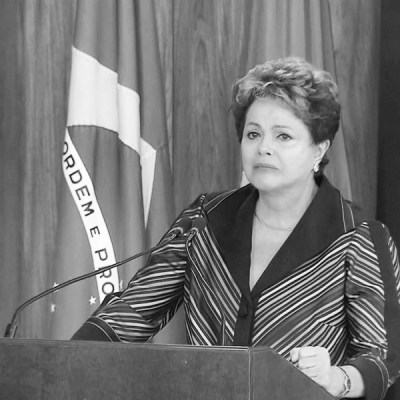 Brazilian national Truth Commission’s report presented to President Dilma Rousseff moved her to tears as it published accounts of torture, killings and disappearances during two decades of military rule from 1964-85.
“I am very proud to be here, because the people here contributed to combat the violation of human rights,” Rousseff said during an emotional speech at the ceremony on Wednesday.
“We, who so love democracy, hope that the wide circulation of this report helps to reaffirm the priority that we must give to upholding democratic liberties. In this way, we must show our absolute aversion to authoritarian states and dictatorships of any kind,” President Rousseff said.
Rousseff is a former leftist guerrilla once imprisoned and tortured by the country’s military regime. The report has identified 377 people of committing “crimes against humanity”, 200 of whom are still alive.
“This is a key step in the right direction for Brazilians: knowing their history they can build a better society,” Rousseff tweeted on Wednesday.
The Brazilian leader has alluded to her past imprisonment and physical torture under the military dictatorship during the presidential campaigning this year.
“I have come up against hugely difficult situations in my life, including attacks which took me to the limit physically. Nothing knocked me out of my stride,” said Rousseff.
Hundreds of Brazilians were murdered and thousands were tortured by the Brazilian military rule but the Latin American nation has never put anyone on trial for the murder and widespread torture of political dissidents during its dictatorship.
In 1979 the Brazilian army pushed an amnesty law to shield themselves from future prosecutions through the Brazilian Congress.
The report released on Wednesday has identified Germany’s Volkswagen AG as one of several foreign companies that provided the Brazilian military with lists and accounts of union activists.
Brazil is seeking a permanent seat on the UN Security Council and was this week voted in with a majority to the Advisory Commission of the United Nations Relief Works Agency (UNRWA).
The vote marked the first time a Latin American country was admitted to the agency’s top consultative body, which advises on “key strategic decisions,” said the UNRWA.
The New Republic’s Ugly Reality
By Robert Parry | Consortium News | December 8, 2014
There has been much hand-wringing of late in Official Washington about an editorial shakeup at The New Republic and the possibility that the century-old political magazine’s legacy will somehow be tarnished by its new owner. But the truth about The New Republic is that it has more blood on its hands than almost any other publication around, which is saying something.
In my four decades in national journalism – that’s two-fifths of The New Republic’s life – what I have seen from the magazine is mostly its smug advocacy for U.S. interventionism abroad and snarky putdowns of antiwar skeptics at home. Indeed, you could view The New Republic as the most productive hothouse for cultivating neoconservative dogma — and at least partly responsible for the senseless slaughter associated with that ideology.
Though The New Republic still touts its reputation as “liberal,” that label has been essentially a cover for its real agenda: pushing a hawkish foreign policy agenda that included the Reagan administration’s slaughter of Central Americans in the 1980s, violent U.S. interventions in Iraq, Syria and other Muslim countries for the past two decades, and Israel’s suppression of Palestinians forever.
Indeed, the magazine’s long-ago-outdated status as “liberal” has long served the cause of right-wingers. The Reagan administration loved to plant flattering stories about the Nicaraguan Contras in The New Republic because its “liberal” cachet would give the propaganda more credibility. A favorite refrain from President Ronald Reagan’s team was “even the liberal New Republic agrees …”
In other words, the magazine became the neocon wolf advancing the slaughter of Central Americans in the sheep’s clothing of intellectual liberalism. Similarly, over the past two decades, it has dressed up bloody U.S. interventionism in the Middle East in the pretty clothes of “humanitarianism” and “democracy.”
The magazine – which has given us the writings of neocons Charles Krauthammer, Fred Barnes, Steven Emerson, Robert Kagan and many more – has become a case study in the special evil that can come from intellectualism when it supplies high-minded rationalizations for low-brow brutality.
In the world of the mind, where The New Republic likes to think it lives, the magazine has published countless essays that have spun excuses for mass murder, rape, torture and other real-world crimes. Put differently, the magazine afforded the polite people of Official Washington an acceptable way to compartmentalize and justify the ungodly bloodshed.
Perhaps The New Republic had a different existence in the years before I arrived on the scene. I’ve heard some longtime New Republic lovers wax on about its era of thoughtful progressivism. But The New Republic that I encountered from the 1970s onward was the magazine of Martin Peretz, a nasty neocon who cared little about journalism or even thoughtful analyses, but rather pushed a dishonest and cruel agenda including crude insults against Muslims.
In his later years after moving part-time to Israel, Peretz began to expose more of his personal agenda. In one TNR blog post regarding the proposed Islamic community center in Lower Manhattan which prompted post-9/11 right-wing outrage, Peretz declared: “Frankly, Muslim life is cheap, most notably to Muslims. And among those Muslims led by the Imam Rauf [the promoter of the Islamic center] there is hardly one who has raised a fuss about the routine and random bloodshed that defines their brotherhood.
“So, yes, I wonder whether I need honor these people and pretend that they are worthy of the privileges of the First Amendment which I have in my gut the sense that they will abuse.” (Facing accusations of racism, Peretz later issued a half-hearted apology which reiterated that his reference to Muslim life being cheap was “a statement of fact, not opinion.”)
A New York Times magazine profile of Peretz in 2011 noted that Peretz’s hostility toward Muslims was nothing new. “As early as 1988, Peretz was courting danger in The New Republic with disturbing Arab stereotypes not terribly different from his 2010 remarks,” wrote Stephen Rodrick.
Steven Emerson, one of Peretz’s favored TNR writers, also became notorious for similar Islamophobia as well as shoddy and dishonest journalism. [See Consortiumnews.com’s “Unmasking October Surprise Debunker.”]
Ignoring the History
Yet, very little of this real history of The New Republic can be found in the mainstream media’s coverage of the recent staff revolt against plans by new owner (and Facebook co-founder) Chris Hughes to modernize the publication. Hughes’s new chief executive – former Yahoo official Guy Vidra – vowed to rebuild the magazine as a “vertically integrated digital media company.”
At the Washington Post, the New York Times and pretty much the entire MSM, there has been much rending of garments over these plans and the ouster of some top editors but almost nothing about what some of those now ex-TNR editors actually did.
One was longtime literary editor Leon Wieseltier, who was a prominent advocate for the Iraq War and a promoter of right-wing Zionism. Another was editor Franklin Foer, another hawkish intellectual. Their departures were followed by a walkout by a dozen or so members of the editorial staff, resignations from contributing columnists, an outraged letter from former TNR writers and furious columns by ex-TNR staffers.
“The New Republic is dead; Chris Hughes killed it,” wailed Post columnist Dana Milbank, another TNR alumnus.
On Monday, the 31-year-old Hughes took to the Post’s op-ed page to offer Official Washington something like a paper bag to control all the hyperventilating. He denied that he was behaving like some spoiled Silicon Valley rich kid imposing an Internet-style culture on an old-fashioned print publication, but rather was trying to save the institution.
“I came to protect the future of the New Republic by creating a sustainable business so that our journalism, values and voice — the things that make us singular — could survive,” Hughes wrote.
But the real question is: Does The New Republic deserve to survive? Wouldn’t it be appropriate that at least one neocon institution faced some accountability for the hundreds of thousands of dead Iraqis, not to mention the other victims of reckless U.S. interventionism in the Middle East or the tens of thousands of murdered Central Americans during the Reagan years?
Though The New Republic’s apologists depict the magazine as an honorable place where “long-form journalism” thrived and “serious thinking” was nourished, the reality was actually much different. Indeed, much of the trivialization of U.S. journalism in the 1980s stemmed from the punchy opinions voiced by TNR columnists as they moonlighted as talking heads on the TV “shout shows,” like “The McLaughlin Group” and “Inside Washington.”
Many of the regulars on those media “food fights” came from The New Republic and lowered the intellectual level of Official Washington into a “thumbs up, thumps down” reductionism where political leaders were rated on scales of one to ten. Their well-compensated behavior was the opposite of true intellectualism or – for that matter – true journalism.
Phony Posture
The typical posture of these media-beloved neocons was to pretend that they were bravely standing up against some “liberal” orthodoxy, courageously daring to embrace the Nicaraguan Contras or other right-wing “freedom fighters” despite the danger of taking such principled stands.
The reality was that TNR’s writers were lining up behind the real power structure, standing with the Reagan administration and much of the major media while joining in the bullying of the relatively weak and vulnerable forces in Washington that went against this grain.
The phoniness of TNR’s pretend bravery was demonstrated by how the neocon commentators were rewarded with plum jobs, prominent op-ed slots, regular seats on the TV shows, lucrative speaking fees, book contracts, etc. The opposite was true for journalists who challenged the Reagan administration’s propaganda. They were the ones who faced real punishment.
Journalists who dared file critical stories about the U.S.-backed Salvadoran army or the CIA-trained Contra rebels found themselves reassigned or out on the street. The New York Times’ Raymond Bonner was the best known example after he was pulled out of Central America while under fierce right-wing attack for his accurate reporting on human rights atrocities in El Salvador.
In a similar case, the Reagan administration’s public diplomacy team browbeat National Public Radio for airing a story about a Contra massacre of farmworkers in northern Nicaragua. Sensitive to government strings on NPR’s funding, NPR executives appeased the administration by getting rid of foreign editor Paul Allen who had allowed the story to air.
Within a short time, Washington journalists understood that their route to professional success required them to swallow any propaganda from Reagan’s team, no matter how absurd.
That servility was on display when Reagan’s White House fumed over one human rights report citing 145 sworn affidavits signed by Nicaraguans who had witnessed Contra atrocities. Many of the witnesses described Contras slitting the throats of captives and mutilating their bodies.
In stepped The New Republic and one of its many pro-Contra writers, Fred Barnes, who countered the eyewitnesses by referencing the findings of a secret U.S. investigation which had absolved the Contras of many charges, he wrote. In a harsh article entitled “The Sandinista Lobby,” Barnes denounced the human rights community for hypocritically criticizing the innocent Contras and other pro-U.S. forces, while allegedly going soft on Nicaragua’s leftist Sandinista government.
But when I got hold of the investigative report in 1986, I found that it had been written by the CIA and was based on the word of the Contras themselves. One of the CIA’s key findings, supposedly debunking the slitting-throat allegations, was that the Contras said they could not have slit throats because they “are normally not equipped with either bayonets or combat knives.” The CIA failed to note that photographs of the Contras from that period showed them slouching off to battle carrying a variety of machetes and other sharp objects.
The absurdity of suggesting that the Contras could not have slit the throats of captives because they weren’t “normally” given knives should have been something a cub reporter would have laughed at. But clearly journalism was not what was going on at The New Republic where there was no interest in exposing the atrocities committed by the Contras. It was all about pushing a hawkish foreign policy and serving the Reagan agenda.
A Contra Exposé
That sort of behavior continued throughout the Reagan era with one notable exception in fall 1986 – when editor Jefferson Morley and investigative reporter Murray Waas asked me and my Associated Press colleague Brian Barger to expand the work that we had done exposing Oliver North’s secret Contra support network into a New Republic cover story.
Our article appeared in November 1986 while Peretz was out of town visiting Israel. But he soon weighed in after receiving a furious letter from then-Assistant Secretary of State for Inter-American Affairs Elliott Abrams, another arch-neocon. Abrams ostentatiously canceled his TNR subscription in protest of our article, and Peretz responded to Abrams’s complaint by excluding Waas from the magazine and putting Morley in the publisher’s doghouse.
The situation could have gotten worse for those who had a hand in bringing our story into the magazine, except that the Iran-Contra scandal broke wide open in November 1986, confirming that Barger and I had been right about North’s secret network. Abrams eventually pleaded guilty to misleading Congress (though he was later pardoned by President George H.W. Bush and was brought into President George W. Bush’s National Security Council to oversee Middle East policy, including the invasion of Iraq).
The New Republic’s pattern of playing fast and loose with the facts would eventually cause the magazine some embarrassment in 1998 when it was caught publishing a number of fabrications by writer Stephen Glass. But TNR never was held accountable for its support for atrocities in Central America, its pushing for illegal wars in the Middle East or its smearing of honest journalists and human rights investigators.
Though Peretz finally lost control of the magazine’s content in 2010, The New Republic has remained an important vehicle for pushing the neocon agenda. Earlier this year, TNR published a long exaltation to American interventionism by neocon Robert Kagan, a co-founder of the Project for the New American Century and a leading proponent for the Iraq War.
In the essay, “Superpowers Don’t Get to Retire,” Kagan “depicted President Obama as presiding over an inward turn by the United States that threatened the global order and broke with more than 70 years of American presidents and precedence,” wrote Jason Horowitz in the New York Times. “He called for Mr. Obama to resist a popular pull toward making the United States a nation without larger responsibilities, and to re-assume the more muscular approach to the world out of vogue in Washington since the war in Iraq drained the country of its appetite for intervention.”
President Barack Obama, who remains hypersensitive to criticism from well-placed and well-connected neocons, responded by inviting Kagan to lunch at the White House and shaping his foreign policy speech at West Point’s graduation in May to deflect Kagan’s criticism.
So, when you read the endless laments from the mainstream U.S. news media about the tragedy of having some Silicon Valley barbarians violating the sacred journalistic temple of The New Republic, you might reflect on all the suffering and death that the magazine has rationalized and intellectualized away.
~
Investigative reporter Robert Parry broke many of the Iran-Contra stories for The Associated Press and Newsweek in the 1980s. You can buy his latest book, America’s Stolen Narrative, either in print here or as an e-book (from Amazon and barnesandnoble.com).
Featured Video
Integrity Initiative: UK-funded network framed dissent as Russian disinformation for years
or go to
Aletho News Archives – Video-Images
From the Archives
Why Saudi Ties to 9/11 Mean U.S. Ties to 9/11
By Kevin Ryan | Dig Within | September 27, 2015
Media interest in Saudi Arabian connections to the crimes of 9/11 has centered on calls for the release of the 28 missing pages from the Joint Congressional Inquiry’s report. However, those calls focus on the question of hijacker financing and omit the most interesting links between the 9/11 attacks and Saudi Arabia—links that implicate powerful people in the United States. Here are twenty examples. … continue
Blog Roll
 Aletho News
- EUROPE FEARS RUSSIA’S NEXT MOVE / Ian Proud
- Big tech hands in its DSA censorship reports to the EU
- ‘A Big Victory’ – Palestine Chronicle Wins Two-Year Legal Battle
- IAEA inspectors cannot return to Iran amid US threats: Russia
- Senate Rejects Iran War Powers Resolution Passed By House
- ‘We did not attack Pakistan with drones’: Afghan sources
- Iraqi Resistance faction links arms to sovereignty, questions US exit
- Cannon fodder no more… South Korea rejects Trump’s pressure to join his criminal war on Iran
- Neria Leiter Was A Legitimate Military Target
- Integrity Initiative: UK-funded network framed dissent as Russian disinformation for years
- If Americans Knew
- ‘This is where I live now, the back of a truck’: a day in the life of a grandmother in Gaza
- In UN Speech, Iran’s President Displays Pictures of Children Killed by US, Brings Attention to Israel’s Nuclear Arsenal
- Israel displaces hundreds of Palestinians amid wave of demolitions in West Bank
- Aid, reconstruction, and Israel’s history of obstruction in Gaza
- Trump administration digs an ever-deeper hole of complicity in genocide – Daily Update
- US-Israel $2.8 Billion Arms Deal, 40,000-Bomb Supply Faces New Gaza Complicity Accusations
- Caught on Tape: AIPAC CEO Boasted of Controlling Trump’s National Security Officials
- Why Hamas Attacked Israel in October 2023 – Israeli professor Ilan Pappé
- They see them, then kill them: Israeli quadcopters track, deliberately target civilians in Gaza
- Winter could turn Gaza’s treacherous, war-damaged buildings into deathtraps
- No Tricks Zone
- New Study: Earth And Venus Surface Warmth Largely Explained By Convection And Lapse Rate, Not CO2 Or Radiation
- 2025 Nature Paper Claiming Worsening Global Drought Gets RETRACTED …Heavily Flawed
- New Study: ‘Global Drought Shows No Detectable Recent Acceleration Under Climate Warming’
- Economic Masterminds: German Socialists Suggest Taxing Productivity Gains Stemming From Using AI
- The South China Sea Has Not Been Cooperating With The Climate Change Narrative
- Energy Crisis: Germany Enters Heating Season With Historically Low Gas Reserve Fill Levels
- New Study: The Antarctic Ice Sheet Gained Mass From 2020-2024 Due To Staggering Snow And Ice Accumulation
- Study: Ocean Heating Rates From Thousands Of Years Ago ‘Dwarf’ Modern Ocean Heating Rates
- Climate Extremists Target, Attack Large-Scale Power Grid Infrastructure In Germany!
- New Study: Antarctic Ice Melt Has Contributed Less Than 1 Centimeter To Sea Level Rise In The Last 30 Years

