‘Declare war on Lebanon, take out Syria’s S-300s’: Outgoing Israeli general on handling neighbors
RT | April 20, 2019
Israel has the full arsenal needed to take on Hezbollah in Lebanon and eliminate the Iranian threat in Syria, the outgoing IDF Northern Command chief boasted, warning Damascus against using S-300s to protect its sovereignty.
“If our freedom of movement is threatened, we will remove the threat. We know how to do that,” General Yoel Strick told Ynet News, adding that Israel will soon introduce “advanced weapons systems” to ensure it can continue to violate neighboring states’ airspace and to strike targets in Syria with impunity.
If the Syrians employ Russian S-300s against our planes, and we take them out, it will be seen as a legitimate move on our part.
While acknowledging that such a drastic move might damage Tel Aviv’s relations with Moscow, Strick expressed hope that it wouldn’t come to that. Moscow had supplied the Arab Republic with S-300 air defense systems following the downing of a Russian Il-20 reconnaissance plane with 15 airmen on board in mid-September, during an Israeli raid.
Also on rt.com Israel took out ‘Iranian missile site’ in Syria… or something like that
Moscow also warned Israel that it will suppress all satellite navigation, radars and communications systems of combat planes over the Mediterranean Sea if their maneuvers threaten Russian forces. Since then, Israel has been staging its intrusions via Lebanon, where the Jewish State is trying to keep Hezbollah in check.
Also on rt.com Netanyahu confirms Israeli military shelled Syrian province to prevent ‘Iran entrenchment’
Hezbollah is inseparable from Lebanon as a country, due to the militant group’s strong political presence, the general argued. Thus, he claimed, “if it were up to me, I would recommend declaring war on Lebanon and Hezbollah” – not out of bloodlust but only to thwart the group’s alleged plot to “invade” Israel.
I have no doubt what the outcome will be… It will be a decisive victory.
Russia expands ties in Lebanon’s oil and gas sector
Michal Kranz – Al Monitor – April 10, 2019
During a Middle East tour last month, US Secretary of State Mike Pompeo focused primarily on Iran’s influence in the region, but on Mar. 20 in Jerusalem he also labeled Russia an adversary of US regional allies in addition to Iran and China when speaking about energy and security in the eastern Mediterranean. “Revisionist powers like Iran and Russia and China are all trying to take major footholds in the East and in the West,” Pompeo said, alongside Israeli Prime Minister Benjamin Netanyahu and the leaders of Greece and Cyprus.
Pompeo had also reportedly planned to set “red lines” on Russian projects in Lebanon while in Beirut March 22-23. Yet, whatever plans Pompeo may have had to counter Russia in Lebanon, they seem to have had little effect. Lebanese leaders have doubled down on working with Russian companies in their country’s expanding oil and gas sector in the weeks since Pompeo’s visit.
Although the United States maintains an important degree of diplomatic clout in Lebanese energy matters, Russian economic investments in the sector have far outpaced those of the Americans, and Russian officials and business leaders have expressed their desire to take further steps to cement roles as key players like the United States continue to lag behind.
“The Russians have an advantage over the Americans not only in Lebanon, but in the region as well,” Amal Abou Zeid, adviser for Lebanese-Russian affairs at Lebanon’s Foreign Ministry, told Al-Monitor.
Lebanon and Russia signed a memorandum of understanding to cooperate on oil and gas in October 2013, and since then cooperation between them has deepened. In December 2017, the Lebanese government awarded its first contracts for offshore oil and gas exploration to a consortium of three firms that included Novatek, Russia’s second-largest gas company.
This past January, Russia’s majority state-owned oil giant Rosneft signed a deal to manage, operate and potentially rehabilitate and expand part of the oil storage terminal in Tripoli, Lebanon’s second largest city, as part of a 20-year lease. Rosneft is also competing in a bidding process along with other consortiums, including an American company, for an offshore gas terminal off the Lebanese coast.
Days after Pompeo’s visit, Lebanese President Michel Aoun traveled to Moscow, where he met with Russian President Vladimir Putin and Rosneft CEO Igor Sechin, who said the company is interested in “elevating the oil facilities in north Lebanon.” According to Abou Zeid, Sechin is interested in building up to three additional oil storage facilities in Tripoli and potentially investing in a future refinery in the north.
Cesar Abi Khalil, a parliamentarian who served as energy minister when Lebanon signed the Tripoli deal with Rosneft, told Al-Monitor that there is “high interest” in Lebanon to work with companies, including American ones, on refinery construction and rehabilitation. He added that ultimately, contracts will be awarded to companies that present the best proposals, as Rosneft did for the Tripoli terminal.
Russia’s interest in Lebanon is tied to its regional strategy. Since 2016, Rosneft has steadily expanded its operations into Iraq, Egypt and Libya, and Gazprom, Russia’s state-owned gas company, has been making inroads in Syria’s gas market during the civil war there. While Syria’s oil and gas reserves are dwarfed by those in neighboring Iraq, its location is highly strategic for Russia, which has been supporting Syrian President Bashar al-Assad in the civil conflict since 2015. Hundreds of Russian mercenaries have reportedly been killed securing oil fields in the country [actually that is a myth], and Russia has begun exploring for oil and gas off the Syrian coast.
Abou Zeid confirmed that the rehabilitation of a long-disused oil pipeline connecting Tripoli with oilfields in Iraqi Kurdistan, where Rosneft is active, was one of the topics discussed by Aoun and Sechin in Moscow. It is likely that gaining access to oil infrastructure in Lebanon in addition to offshore reserves in the country will enhance Russia’s strategic position in Syria and across the eastern Mediterranean, but it remains possible that it could also use the Tripoli facilities to try to bypass US sanctions on fuel shipments to Syria.
Meanwhile, American companies have been unable or unwilling to secure stakes in Lebanon’s new offshore prospects, which the US Department of Energy estimates will produce almost $254 billion between 2020 and 2039. Abou Zeid said that he had heard that ExxonMobil had entered into a consortium before the first bidding process for the offshore exploration contract began, but ultimately they and many other American companies failed to submit bids once they were eligible.
“I am certain that the Americans are interested, and they were not very happy with the Russian presence in this sector,” Abou Zeid said, speculating that political issues, like Hezbollah’s role in Lebanese politics, may have scared off potential American investors.
Mona Sukkarieh, a political risk consultant and co-founder of Middle East Strategic Perspectives, told Al-Monitor that other factors were more likely to be involved.
“Repeated delays resulting from frequent vacuums within the executive branch, an incomplete legal framework, changes in blocks offered and a change in market conditions all affected companies’ enthusiasm for the first licensing round,” she said.
Abi Khalil agreed that market forces were partially to blame for the lack of interest from the United States during the first round of bidding, but he also said that he had found ongoing interest by American firms in Lebanese oil and gas during his three official visits to the States, including in potential refinery projects across the country.
Despite these difficulties, the Novatek consortium followed through on its interest and secured rights to two blocks in Lebanon’s Exclusive Economic Zone (EEZ), one of which is in a disputed zone that Israel has claimed as part of its own EEZ since 2010. On April 4, Lebanese Energy Minister Nada Boustani announced the opening of a second round of bidding for contracts to five additional offshore blocks, two of which lie along the disputed border area. Lebanese leaders have long maintained that Israel is encroaching on Lebanon’s maritime boundary.
On April 1, parliament Speaker Nabih Berri said that Lebanon won’t give Israel “one cup” of its water. According Berri’s office, on March 22 the speaker and Pompeo discussed the issue of Lebanon’s southern maritime border and efforts to settle the dispute with Israel.
Abou Zeid claims that all the involved parties are interested in seeing the United States play a mediating role in the boundary issue. Regardless, US influence over matters related to energy in Lebanon are quickly diminishing given American companies’ absence in the country’s oil and gas sector and the lack of trust among Lebanese leaders, who believe Washington is biased toward Israel’s geopolitical positions.
“The US is really, one, not that interested, and two, the space that the US used to have in Lebanon in terms of influence and shaping decisions, it’s been lost,” Hanin Ghaddar, a researcher specializing in Lebanon and Iran at the Washington Institute for Near East Policy, told Al-Monitor. She added that in her view, it is unlikely that American firms will gain any offshore contracts.
So far, US efforts to counter Russian expansion in the eastern Mediterranean through diplomacy have proven inadequate. Unless American companies get serious about acquiring stakes in Lebanon’s offshore reserves, it will likely be almost impossible for the United States to overcome the head start Russia has gotten in Lebanon’s oil and gas sector, allowing Moscow to continue to strengthen its economic position across the Middle East.
3 people injured in Israeli rocket attack on Syria’s Hama province – reports
RT | April 13, 2019
Syria has shot down several missiles launched by Israel and targeting the city of Masyaf in northwestern Syria, Syrian state media reported. Three people have been wounded and several buildings destroyed in the attack.
The rockets were launched by Israeli warplanes from Lebanese airspace at about 2.30am on Saturday, SANA reported. In response, Syria activated its air defenses and intercepted several missiles, the agency said. The alleged Israeli raid hit a military post in the city and destroyed several buildings. Three people have been reported wounded.
Lebanese Al-Masdar News reported, citing a military source on the ground, that Israeli rockets damaged a number of sites near the Masyaf National Hospital.
While Israel has not commented on the reported attack, it is presumed that Tel Aviv has made another incursion into Syrian territory to take on alleged Iranian elements there.
Israeli media reported in February that three of the four S-300 surface-to-air defense systems delivered by Moscow to Syria in October last year and stationed in Masyaf were photographed in an “erect” position, prompting speculation that they might be soon deployed into combat.
According to the Al-Masdar source, the Russian-made systems had no role in fending off Saturday’s attack.
Israel routinely rains down missiles on Syrian territory under the pretext of engaging Iranian targets there. In late March, the Syrian missile defense forces responded to an attack by Israel that reportedly targeted a civilian airport and caused a blackout in Aleppo.
Nasrallah Warns: US Moves Will Not Remain Without a Response
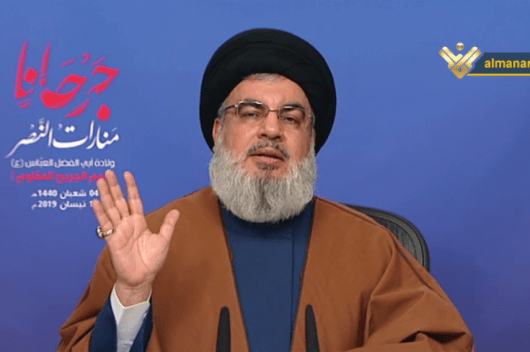
Al-Manar – April 10, 2019
Hezbollah Secretary General Sayyed Hasan Nasrallah stressed that victories achieved in Lebanon are not the result of US and its allies’ tenders, indicating that the US sanctions and measures against Iran and its allies in the region “will not remain without a response.”
In a televised speech commemorating the day of Resistance Wounded Fighters, Sayyed Nasrallah emphasized that the security and peace “we are enjoying were made by our men, women, detainees and wounded, and these terrorists do not have the right to show that they are the ones who gave us stability.”
Sayyed Nasrallah considered that the US is humiliating an entire nation for the sake of terrorist ‘Israel’ and terrorist groups which it’s providing all facilities to.
As he voiced support to the Iranian Revolutionary Guards, His eminence condemned and decried the US decision to classify the IRGC as a “terrorist organization,” saying the US insolence and folly set a precedent. “This decision shows that the US audacity and folly went beyond limits.”
“Blacklisting the IRGC is an evidence that it is strong and not weak and this is an expected move by the Great Satan,” Sayyed Nasrallah said, adding that it was also a proof of the US failure and fiasco in the region.
His eminence dismissed reports about possible sanctions against Speaker Nabih Berri and other Hezbollah allies as “mere intimidation.”
We’ll Respond at the Right Time
The Hezbollah S.G. stressed that the Revolutionary Guards has a great role in defending the peoples of the region and had sacrificed a large number of martyrs and wounded for the sake of people of our region, indicating that it occupies a central, advanced, and the most influential place regionally.
“Until now we have only settled with condemnation, denouncement, patience, and managing the situation calmly in the face of sanctions and terror lists, but our patience does not mean that we, the axis of resistance, do not have the cards of strength,” Hezbollah’s S.G. warned, indicating that options remain open.
“It seems that the US blacklists will be prolonged. Our choices are open but we will act calmly, with a cool head and at the right time, in all battlefields and arenas,” Sayyed Nasrallah said. It is our natural right and ethical, religious and humanitarian duty to confront all those who might threaten our country, resistance and achievements through their sanctions and measures, he added.
Sayyed Nasrallah expressed his solidarity and support to the Iranian people who have been plagued by floods which hit Iranian areas. He said that Trump, who is bragging about humanitarianism, is blocking aid for Iranians suffering from the hurricane, expressing gratitude to all humanitarian efforts to collect aid to flood victims in Iran.
Yemen’s Steadfastness Protects the Palestinian Cause
Regarding the war on Yemen, His Eminence pointed out that four years have passed on the war and no one sees that the unarmed and oppressed people who are still steadfast and growing stronger are still fighting armies, pointing out that the war on Yemen is an American-Saudi-British-Israeli aggression.
Sayyed Nasrallah said that had Bin Salman won in Yemen war, he would have forced the Palestinians to sign on the deal of the century, stressing that Yemeni’s steadfastness throughout these years have protected the Palestinians. “What would have happened to Gulf countries and leaderships had the authoritarian Bin Salman won the war on Yemen?” he wondered, “he would have been presented as the great historical leader and victory will be presented in a misleading way.”
The Hezbollah leader indicated that there was an American insistence by Trump personally to continue the war on Yemen, pointing out that the steadfastness of the Yemeni people protects the Palestinian cause and Palestine and every occupied Arab land.
US Move to Blacklist Hezbollah Allies a Scarecrow
Sayyed Nasrallah briefly addressed the internal situation. He criticized what he called the US provocative policy of instigating strife in Lebanon, pointing out that it was continuing despite the failure of Pompeo’s recent visit.
He pointed that it was surprising that some Lebanese in Washington were working on blacklisting Hezbollah’s allies and friends in Lebanon. “The US move of blacklisting Hezbollah allies in Lebanon is just a scarecrow till now. There is not a single indication about an intention to place Nabih Berri and other allies on the terror list and we sense that there are Lebanese in Washington who are working in this direction, but so far this remains an intimidation campaign. When the matter reaches our allies, this means that they are targeting all our people.”
Unity, Resistance Only Way for a Free Lebanon
As for Lebanese concerns that Trump’s decision on the Golan Heights might affect the status of the Shebaa Farms and the Kfarshouba Hills, Sayyed Nasrallah said: “Our territorial border is linked to our national will and not to Trump’s decision.”
“We were killed and wounded and massacres were committed in our villages and cities through Israel’s aggression and the US support. Our peace, security and achievements were made by our people, martyrs and wounded. The achievements that were made in Lebanon are not from the blessings of America.”
Sayyed Nasrallah stressed the importance of the current spirit of cooperation among the political forces in addressing the current situation regardless of any tensions here or there. “Lebanese should choose between keeping Lebanon in the safe zone or responding to those who are leading it towards sedition,” Sayyed Nasrallah said, adding that the only way for keeping Lebanon free, sovereign and stable is through unity and resistance.
“I voice my support to Speaker Nabih Berri who has repented in Doha in front of the world’s parliamentarians to say the truth with a loud voice and show everyone the path of salvation: unity and resistance,” his eminence said.
Sayyed Nasrallah began his speech by hailing all wounded fighters who suffered and sacrificed themselves for the sake of this nation, saying: “thanks to your sacrifices, we are enjoying victories, security and the power of deterrence. The enemy doesn’t dare to wage any war because of your wounds and sacrifices.”
He said there was no place for neutrality in the battle of truth and in defending the oppressed.
Throughout his speech, Sayyed Nasrallah recalled the martyrdom anniversary of Sayyed Mohammad Baqer Al-Sadr and his sister, and hailed his enormous intellectual achievements.
Secret Document Reveals Plans for Civil War in Lebanon, Israeli False Flags, and Invasion
By Randi Nord | Geopolitics Alert | April 5, 2019
Beirut – During his visit with US Secretary of State, Mike Pompeo, Lebanese President Michael Aoun reportedly received a US-Israeli document detailing plans for creating a civil war in Lebanon with covert false flag operations and possible Israeli invasion.
Although the source of the document is Israeli and created in partnership with Washington, no one knows who presented it to Aoun. The Lebanese TV station, Al-Jadeed, initially reported the document on Lebanese TV and a video on its website. Geopolitics Alert translated the report for this article.
Israel and the United States Foment Civil War in Lebanon
The document details American plans to splinter the Lebanese Internal Security Forces, a domestic institution separate from the Lebanese Army. The plans involve Washington investing 200 million dollars into the Internal Security Forces (ISF) under the guise of keeping the peace but with the covert goal of creating sectarian conflict against Hezbollah with 2.5 million specifically dedicated to this purpose.
The document states the ultimate goal is to destabilize the country by creating a civil war in Lebanon which will “help Israel on the international scene.” The United States and Israel plan to accomplish this by supporting “democratic forces,” sounding remarkably similar to the same strategy used in Syria, Libya, Venezuela, and elsewhere.
According to the document, although “full load of our firepower will be unleashed,” they somehow do not anticipate any casualties. They do, however, expect the civil war to “trigger requests” for intervention from the Israeli Defense Forces (IDF) which Israel must only agree to after extreme reluctance.
The document says Israel will also play an important role by creating “covert false flag operations” as the conflict progresses. Perhaps these operations would include chemical attacks similar to the chemical attacks on civilians in Syria or even direct attacks on Lebanese or Israel civilians to blame on Hezbollah and justify international intervention.
The document admits that the United States and Israel will need an unprecedented amount of credibility to pull this off and also admits that the Lebanese Army may be an obstacle, likely due to the Army’s diverse makeup. As a legitimate political party with members throughout all aspects of Lebanese society, Hezbollah already has members and allies throughout the ISF as well as the Army.
Venezuela FM takes Middle East tour, set to meet Nasrallah
Press TV – April 3, 2019
Venezuela’s foreign minister has embarked on a Middle East tour taking him through Turkey, Lebanon, and Syria, amid US measures to prop up the Latin American country’s opposition figure and self-proclaimed “interim president” Juan Guaido against President Nicolas Maduro.
Jorge Arreaza arrived in Turkey on Monday and was assured by his Turkish counterpart Mevlut Cavusoglu of Ankara’s support for the Latin American nation in the face of US pressure. “It should not be in a way that ‘I am a big country and I can determine entire rules,’” Cavusoglu said, referring to Washington’s sanctions against Venezuela and its efforts to oust Maduro, Turkish paper Hurriyet reported.
On Tuesday, the top Venezuelan diplomat traveled to Lebanon on a two-day visit. Lebanese President Michel Aoun received him at the presidential Baabda Palace in Beirut. Arreaza, who conveyed a message from Maduro to Aoun, also met with his Lebanese counterpart Gebran Bassil.
He was also slated to meet with Lebanese Prime Minister Sa’ad Hariri, Lebanese news portal Naharnet reported. According to Lebanese daily al-Joumhouria, he will also be holding a meeting with the Hezbollah resistance movement’s Secretary General Seyyed Hassan Nasrallah.
Back in January, Hezbollah conveyed its support for Maduro amid mounting US pressure for him to resign and hand over power to Washington-backed Guaido. Hezbollah-associated lawmaker Mohammad Raad was cited by Lebanese TV channel Al Manar as saying at the time that “Nasrallah stands with the Venezuelan people and with its free leadership.”
The Venezuelan foreign minister, meanwhile, expressed satisfaction with the visits to the countries in remarks to Prensa Latina. “They are two countries that respect international law and with which there are friendly and fraternal relations,” the Cuban news agency cited him as saying.
The visit to Lebanon “opens a new stage in bilateral ties with the possibility to expand economic cooperation, especially Venezuela’s advisory in the country’s energy sector,” the agency added, citing the top diplomat.
Also in January, the US took the lead in recognizing Guaido as Venezuela’s president after the head of the opposition-ruled Congress named himself the country’s interim chief executive. Washington has been pressuring other countries into following suit and has not ruled out using the military option to oust Maduro’s government.
Many countries, including Iran, Russia, China, and Cuba, however, back Maduro, spurning the subversive American efforts targeting Venezuela’s sovereignty.
Arreaza is next to travel to Syria, with which Caracas has similarly warm relations.
Nasrallah on the End of US Hegemony: Trump will Leave the Middle East, Region Already Reshaping – PART II
Interview of Sayed Hassan Nasrallah, Hezbollah Secretary General, with Ghassan Ben Jeddou, founder of the pan-Arab and anti-imperialist Al-Mayadeen channel, January 26, 2019.
Transcript:
Ghassan Ben Jeddou: (The US forces withdrawal from Syria announced by Trump) is therefore not a mere tactical maneuver. You say he is serious and sincere in his desire to withdraw, but this reflects a failure, if not a defeat, not for Trump especially but for the American (hegemony) project in general.
Hassan Nasrallah: Obviously this is all at once a failure, a dead end and a defeat. Currently, the cause of his hesitation is that (his advisers) tell him that the Kurds are their allies (and that they should not abandon them). I’ll explain why we saw these hesitations recently (as regards the US withdrawal from Syria).
When Trump said that US troops would withdraw and that there was only sand and death in Syria, he also said something even more important: “Does the USA want to be the Policeman of the Middle East? Do we want to be there forever?” With this statement, he hinted, and even more than hinted (this is an explicit indication), that all these US forces in the Middle East were not to stay, and that in time he would conduct (a full) withdrawal. What effect did this statement produce in the region, Professor Ghassan? Let us leave the question of Israel for later.
This statement caused, within the Saudi regime, in a number of Gulf countries enemies of Syria, and among all the allies of the United States in the region, – be they organizations, parties or personalities, not to mention the States – an immense feeling of fear and despair. And Trump knows them well (and he knew the effect that his statement would cause). When he says (to Saudi Arabia and the Gulf countries) that “You would not last two weeks (in power) without American (military) support”, or “Without us, your planes would get off the ground but couldn’t land”, “Without us, you Saudis would speak Persian.” He tells them all this, and adds “We will not remain the (Middle East’s) policeman, we will leave the region.” This caused a state of confusion, despair and fear in the region. That’s the first point.
That is why all the countries and groups (who rely on the US), starting with the Kurdish parties, came to Beirut and asked to meet with Hezbollah. We met them. Then they went…
Ghassan Ben Jeddou: Who are you talking about ?
Hassan Nasrallah: Kurdish parties, who are responsible for negotiating on behalf of the Kurdish units. They came to talk to us, and from there they went to Moscow and then to Iraq to request that Iraq serves as an intermediary with President Bashar al-Assad. Today, the Kurds and the Kurdish movements are (hopelessly) seeking…
Ghassan Ben Jeddou: Who are you talking about exactly? The Syrian Democratic Forces?
Hassan Nasrallah: Yes, the Syrian Democratic Forces, Kurd bodies and representatives in charge of negotiating. Very quickly, they rushed to Moscow, to Iraq, to Lebanon. Why? Because Trump has abandoned them, he forsake them, he betrayed them. This is regarding the East of the Euphrates.
Regarding the (US-aligned) countries, (they panicked at the idea of being abandoned), and they all began to think (intensely and reconsider their positions). They review their stances and try to strengthen their relations with Russia, they reconsider their relations with Iran. Even in Syria, the priorities of some countries are not the same anymore. And now we can talk about the issue (of the relations between) Arab (countries) and Syria. You want me to tell you this story now, or later?
Ghassan Ben Jeddou: Please, go ahead.
Hassan Nasrallah: According to my information, all that we saw in recent weeks, namely the Emirates reopening their embassy in Syria…
Ghassan Ben Jeddou: And before that, the President (of Sudan) al-Bashir (coming to Syria).
Hassan Nasrallah: Indeed. The President al-Bashir came to Syria. Did he come on his own?
Ghassan Ben Jeddou: What is your information?
Hassan Nasrallah: He got a green light from Saudi Arabia.
Ghassan Ben Jeddou: This is your information?
Hassan Nasrallah: Yes. A green light from Saudi Arabia and the Gulf countries.
At the end, lately, President al-Bashir rallied them. And the fact that (an Arab President) meets Bashar al-Assad is something of vital importance to (Saudi Arabia and the Emirates).
Ghassan Ben Jeddou: So this visit was not an arrangement of Russia that would have angered Saudi Arabia and the UAE (as some media have claimed)?
Hassan Nasrallah: No, under no circumstances. The current problem between President al-Bashir and Saudi Arabia has nothing to do with his visit to Syria. It concerns the fact that Saudi Arabia has not kept its promises and financial commitments made to President al-Bashir in return for his sending brigades of the Sudanese army to fight in Yemen – and Sudan’s involvement in this war is very unfortunate. This issue has nothing to do with Syria.
Anyway, the visit of President al-Bashir (to Syria), the reopening of the UAE embassy, the announcement of the Foreign Minister of Bahrain – and by the way, his statement was false, he was lying – who claimed that their embassy in Syria had always remained open, etc. But this is not true. Anyway, we started to see an Arab atmosphere (different with regard to Syria), we see Saudi advances, (Syrian) delegations visited Cairo, and there is talk about the coming of President al-Sissi and others to Damascus, etc. What is the reason ? And here I also speak basing myself on sound information that come from more than one (trustworthy) source.
In light of the decision of Trump to withdraw, and after the resignation of Mattis, who was seen as a guarantee by many, and because of the visible concern within the US administration, there was a great wave of panic in Saudi Arabia and the UAE – and with all their allies and instruments, but especially these two countries in particular. They met in Abu Dhabi to assess the situation – and their options – at a very high level. They assessed their situation in Syria and said:
“The battle against President Bashar al-Assad is over, and our groups have failed. All the movements we financed are now with Erdogan, isn’t it? All those who fought in Syria, in southern Syria, which were financed by Saudi Arabia, the UAE and Israel, have gradually retreated (following their consecutive defeats) and are now all in the North, that is to say (in the hands of) Erdogan. The battle against President Assad is over as regards the armed factions, groups and parties that we supported, as well as our various networks of influence: our whole project collapsed. Assad will certainly remain in office, the Syrian State won, the opposing Axis triumphed in Syria. There remains (only) one danger (that we can prevent): Erdogan –sorry, I mean Trump– made the decision to withdraw (his troops from Syria), and therefore, the only refuge of the Kurds is Assad and Damascus, (to avoid) the invasion of the East of the Euphrates by Turkey.”
Trump told Erdogan that Syria is his. If Syria is (abandoned to) Erdogan, if Turkey wants to invade Syria, it is a very dangerous project for Saudi Arabia and the Emirates. Imagine that their analysis reached this conclusion: the main danger in Syria is not Iran…
Ghassan Ben Jeddou: This is the conclusion reached by the UAE and Saudi Arabia?
Hassan Nasrallah: Yes. (The main danger in their eyes) is not Iran. The main danger (today) is Turkey. Iran comes in second position. President Assad, whose position is fully consolidated in Syria, is third, and (Saudi Arabia and the UAE) are even willing to have relations with him. They may also agree with Russia and get some guarantees from her, etc. Russia is less problematic in their eyes. They consider that the main danger is Turkey.
You know, (Saudi Arabia and the UAE) always think in sectarian terms. Ultimately, (in their eyes), Iran – and do not blame me for my frankness – is a Shiite country, and therefore may only have limited influence in Syria, etc. On the other hand, Turkey is a Sunni country, which has a certain presence in Syria, historical relations with that country, is a neighboring country and has a common border, so if Turkey enters (permanently) in Syria, it will be the end and no one will be able to get them out. (That’s how they see things).
Is it because their heart burns for Syria (that they fear a Turkish invasion)? Certainly not. Never. They couldn’t care less about the fate of Syria (and Syrians). But they believe that the advance of the Turkish project in Syria would be the advance of the (opponent) Axis, namely Turkey, Qatar and the Muslim Brotherhood. And that would revive this project, which targets, according to them, the Saudi regime, the UAE regime, the Egyptian regime, etc.
Ghassan Ben Jeddou: And this is the reason of their opening (towards the Syrian regime)?
Hassan Nasrallah: That is why they decided to get closer to Syria and to restore relations with President Assad and the Syrian State, while remaining in their hostility towards Iran, but trying to agree with Russia in order to put obstacles in the way of any progress of Erdogan’s (neo-Ottoman) project in Syria and therefore in the region.
Ghassan Ben Jeddou: But what happened to them so that they’d interrupt their rapprochement with Damascus?
Hassan Nasrallah: The opening (towards Syria) began, and they started talking about the return of Syria in the Arab League. President al-Bashir visited President Assad and told him about it. And Assad’s position did not surprise me.
Ghassan Ben Jeddou: What have they offered? What is your information?
Hassan Nasrallah: They asked Syria to submit a written request indicating that given the new circumstances in the region (end of the war in Syria, etc.) and their concern for the Arab States and Arab Unity & Cooperation, they wanted to regain their statute of member of the Arab League.
Ghassan Ben Jeddou: This is the message they gave him?
Hassan Nasrallah: Yes. Of course, I refer to the substance of their proposal, and I do not quote it by heart.
Ghassan Ben Jeddou: And then?
Hassan Nasrallah: (Assad’s) answer (was as follows): “Syria has never walked out of the Arab League (voluntarily), so we cannot request to come back to it. We never submitted a resignation that we should now withdraw. It is up to those who have kicked us out to ask us to come back.” And this is a noble and dignified position, and perfectly predictable. It is not a surprise. If Arab regimes think that they merely have to tell President Assad that their doors are open and that Syria can come back (to the Arab League), to see him feel a huge relief and run with joy in their arms, they are deluded. Syria will resume its place in the Arab world, and it is in its interest. But she will come back with all her dignity (and not slavishly).
What is new is that the US has made an assessment of Trump’s accomplishments, “But what have you done? Where are our allies?” So-and-so is (getting closer to) Russia, so-and-so is with President Bashar al-Assad, so-and-so considers that now, the main danger in Syria is Turkey (major NATO member) and not Iran, while the US want their (main) enemy to remain Iran. What to do (in this situation of dramatic decline of US influence in the Middle East)?
Allow me to say, about Lebanon and all the Lebanese political forces that were betting on the fall of the Syrian State and regime, that you can imagine in what state they found themselves when they heard Mr. Trump declare that he would withdraw from Syria.
Therefore, the US decided to ask Mr. Pompeo to tour the region to boost the morale of all States and groups who are devastated by the announcement of the US withdrawal from Syria (and the Middle East), and began to reconsider their choices, their relationships and their future and to grab on to their thrones (in a fit of panic). (This Pompeo visit aimed to) try to put them back on their feet, to boost their morale and to assure them that the US supports them and won’t give up on them, that they do not intend to leave the region, and as a proof, he invited them to participate with the United States to a conference in Warsaw meant to deal with Iran, its influence and its threat, (in an attempt) to put them back in confrontation with Iran, at least in terms of appearances.
(Pompeo) sent David Hill to Lebanon – for Pompeo (feels) too important to come himself to Lebanon – with the same message, to reassure those who felt frightened, demoralized, anxious and lost by the US policy in the Middle-East.
But since we have arrived at this point of our discussion, I want to conclude this presentation with this statement: the United States will not manage to do more than they have already done. I declare to the governments of the region, to their leaders, to their peoples, to their movements and to Israel – because we will finally come to Israel –, that the US are deserting our region. They will flee Syria – it may take several months, but the decision is taken.
O my brothers, they are fleeing from Afghanistan. And do you know who they leave (in charge of) Afghanistan? They leave the Taliban! Because in the agreement, Trump won the Taliban’s commitment not to allow Al Qaeda and ISIS (to settle) back in Afghanistan. Trump considers that the Taliban represent the government of tomorrow, who can (already) provide guarantees to the US government. Isn’t it a humiliating defeat for the US in Afghanistan? Especially since the Taliban are officially considered as a terrorist organization (by the US), and Washington claims to never negotiate with terrorists.
The United States will flee. There will be no more US forces waging war in our region. Trump won’t launch a war for the eyes of Mohammad Bin Salman (Crown Prince of Saudi Arabia), nor for the eyes of Mohammed bin Zayed (UAE Crown Prince), not even for Netanyahu’s eyes – and clearly, Netanyahu’s eyes are much more valuable to Trump. Not even for the eyes of Netanyahu! Trump, the US and the situation of the United States, either inside at the level of the economy, etc., etc., etc., do not allow them to launch a new war in our region. There will be no US war in the region.
What does Trump want then? (For him), it is from their own pocket that States, regimes and forces (allied to the US in the Middle East must fight), with their own money, their own media, their own blood… Trump wants to bring them together again to put them (alone) against Iran. And if, against Iran, for 40 years – we are at the 40th anniversary (of the Islamic Revolution) –, the United States and all the tyrants on Earth have been unable to do anything to bring down this regime and this blessed Islamic Republic, then (what could the Arab States do by themselves)?
Ghassan Ben Jeddou: But Eminent Sayed, relatively, (the United States), haven’t they won? You just revealed a very important information, namely that the Saudis and Emiratis gathered and concluded that the major strategic change that you just presented will occur (inevitably). But it seems that Trump still won. First, he slowed down the rush of Arab countries to Damascus, and secondly, today, we hear a new discourse from the Arab countries, namely that…
Hassan Nasrallah: The fact that he stopped the momentum of the Arab countries is natural. He can keep them in check easily. Do you think that these countries are courageous, independent, that they have an independent process of decision, and may rebel against their American master? Never. That is why…
Ghassan Ben Jeddou: What I mean is that the US managed to put all their allies –Saudi Arabia, the UAE and all others– into line.
Hassan Nasrallah: Yes, but this is not a success. Trump only prevented that everything collapses quickly. But (it is mere damage control and) the collapse process is still ongoing.
Ghassan Ben Jeddou: Has he stopped or only slowed down the process of opening the Arab countries towards Syria?
Hassan Nasrallah: What we have heard and what was reported to us is that they are undecided. There is no clear choice to maintain the absence (of relations with Damascus) or stay in a completely negative attitude (against Syria). I give you a proof of that. Two days ago, there was a meeting between a UAE economic delegation and a Syrian delegation. I do not remember if it was held in Damascus or in the Emirates. This means that at least, at an intermediate level, these relations will continue. (Sooner or later), it will be revealed that very important people in Arab countries secretly came to Damascus, although these meetings were not made public. But it is for the Syrian leadership (to reveal this issue). And I speak of meetings at the highest level.
 Ghassan Ben Jeddou: At the political or security level?
Hassan Nasrallah: At least at the security level.
Ghassan Ben Jeddou: For example heads of intelligence services?
Hassan Nasrallah: For example.
Ghassan Ben Jeddou: Policymakers?
Hassan Nasrallah: Yes.
Ghassan Ben Jeddou: From these (most) influential Gulf countries (Saudi Arabia and UAE)?
Hassan Nasrallah: Let’s just say from Arab countries, (don’t try to force me) to reveal more about their identity or titles – whether Sheikh or Sayed, Professor or Hajj, Doctor or Engineer, etc. What I have revealed is enough (I will say no more).
Ghassan Ben Jeddou: Influential and active Arab countries?
Hassan Nasrallah: Currently, the United States wants and strives to retain forcefully these Arab countries back (to prevent them from making a step towards Damascus, Moscow, etc.) But of course, so far, they haven’t brought anything substantial to convince them and reassure them (that this is the right choice), and that the United States have not abandoned Syria to Turkey. For this is what Saudi Arabia, the Emirates, President al-Sissi and Egypt, and all the others, want to hear clearly.
That is why we will perhaps see, on the Arab question, a slowdown or coldness in the momentum towards Syria, but I exclude that this movement can be completely stopped. Therefore I conclude this point by saying that the United States failed in Syria. Of course, after this fiasco, the one who loses the most and who is in the greatest distress is Netanyahu.
Ghassan Ben Jeddou: Yes. […]
Lebanon Decides to Confront Israel And The US in Shebaa, Kfarshouba And Syria
By Elijah J. Magnier | American Herald Tribune | March 28, 2019
Lebanese Judge Ahmad Mezher has given orders that a survey be conducted of Lebanese occupied territories in the Shebaa Farms, Kfarshouba, Huneen, Ideise and Bleeda. These villages are bordering Hasbaiya, Rashaya al-Fukhar and Kiyam and have been under Israeli occupation since 1981, as Syria’s Golan Heights have been since 1967. This step coincides with the illegal “gift” of the Syrian Golan Heights offered by US President Donald Trump to his closest ally Prime Minister Benyamin Netanyahu. Although Trump’s move was verbally condemned by the international community, no other state or international body seems likely to openly oppose Trump’s move at the moment.
However, Lebanon has decided to confront this move on the ground, showing its readiness to defend its territory if US “gifts” were ever seen to include Lebanese occupied territories. The Lebanese presidency, the Parliament and the government agreed that it is the right of Lebanon to regain its occupied territory and that the equation “the army, the people, the resistance” is united under one umbrella. Thus, the possibility of confrontation between the Resistance – i.e. Hezbollah in this case – and Israel is now on the table.
The level of tension and chances of confrontation increased during Lebanese President Michel Aoun’s visit to Moscow. During meetings with his homologue Russian President Vladimir Putin, the Christian President Aoun rejected US pressure on his country. The US establishment, including Secretary of State Mike Pompeo and his envoys to Lebanon, wants to prevent the over one and a half million Syrian refugees in Lebanon from returning home. President Aoun also rejected Trump’s gift to Netanyahu, stating clearly that the Golan Heights is Syrian territory illegally occupied by Israel, and not the property of the US to dispose of as it will.
It remains unclear whether the Shebaa Farms, Kfarshouba and neighbouring villages are part of Trump’s gift to Israel. This is why Lebanese authorities have requested the judiciary authority officially survey the southern Lebanese territories occupied by Israel. If, in response to the survey, any attempt is made to assert that these areas are part of Israel, then the Lebanese triad (the army, the people and the resistance) will be bound to recover its occupied territory. The timing of the decision is important because it shows the readiness of the Lebanese government to raise the subject and to confront Israel in the wake of the US decision on the Golan Heights, a territory closely linked to the Lebanese farms and villages. As recently as 2009 some of these lands were contested between Syria and Lebanon, but now that Lebanon is in a better position than Syria to vindicate its claims against Israel, the Syrian government will be happy for it to do so.
President Aoun raised these issues with President Putin in the context of Trump’s previous gift of Jerusalem, by virtue of his recognition of an undivided Jerusalem as the capital of Israel. Lebanon fully supports the right of return of Palestinians to their land, particularly since there are over 800,000 Palestinians living in Lebanon. Just as the US would prefer these Palestinians to remain in Lebanon, the US now seems to want Lebanon to accept an ongoing presence of Syrian refugees on Lebanese soil. The US policy of keeping Syrian refugees in Lebanon has several goals.
The first is to shift the religious balance of power in Lebanon. Most Syrian refugees are Sunni (mainly hostile to Assad and to his allies) and the US would like to see a Sunni plurality in Lebanon to confront Shia Hezbollah and the society behind it. All Israeli wars have failed to curb Hezbollah and could not reduce its strength. On the contrary, Hezbollah military power is increased to an unprecedented level domestically and regionally. Moreover, in the last Lebanese Parliamentary polls, Hezbollah won more votes than any religious party, surprising everyone. Support for Hezbollah goes beyond any one religious confession; it has proved itself as a force defending Christians and Shia against Wahhabi takfiri extremists. Confronting Hezbollah face to face would lead to certain failure, hence the US need to strategically build another society to stand against it.
President Aoun insists on the return of Syrian refugees to Syria, notwithstanding the financial incentives being offered by the US and Europe to keep them in Lebanon. The presence of the refugees upsets the religious equilibrium in Lebanon, and accelerates the process by which Christians are becoming a minority on Lebanese soil. The religious terrorism that hit the Middle East over the last decade targeted regional minorities, notably the Christians. The same NATO leaders whose governments sponsored takfiri terrorism against Christians in the Levant proposed to Lebanese Christian leaders that they leave the land of their ancestors and settle in the west. Christians who were raped, murdered and terrorized by ISIS and al-Qaeda in Iraq and Syria would have suffered the same fate in Lebanon had Hezbollah decided to entrench themselves in the south of Lebanon, in the Beirut suburbs, or in selected villages of the Bekaa Valley.
Moreover, the Lebanese President considers the Syrian refugees a security and a financial burden that is placing a heavy burden on the fragile and chaotic Lebanese infrastructure. These refugees currently represent a third of the total Lebanese population.
Another objective of US refugee policy in Lebanon is to recover from Syrian President Bashar al-Assad what it failed to achieve by arming militants to overthrow his government over the last 8 years. The US establishment would like to keep over 5 million Syrian refugees outside Syria, mainly in Lebanon, Jordan, Turkey and Europe. This, in US thinking, could impede forthcoming presidential elections in Syria, and prevent both the rebuilding of the Syrian Army and the reconstruction of the country. Syrians are skilful craftsmen; keeping them away from home impedes rebuilding. All these US objectives do not help Lebanon in any way. On the contrary, they weaken Lebanon, which needs a healthy relationship with neighbouring Syria for its security and commercial development.
Trump has made the Middle East less secure. He has offered Israel an illegal and unnecessary gift. Israel was already controlling the Syrian Golan Heights; Syria posed no threat to it. Syria had not fired a bullet against Israeli occupation of the Golan for 30 years and will be busy for the next ten years rebuilding its destroyed infrastructure. Moreover, the late President Hafez Assad had engaged with Israel, through US mediation, to negotiate a peace deal in exchange for the Golan Heights. It was Israel who rejected the deal at the last minute. Assad then said he would leave liberation of the territory to the generation to come.
The US establishment is undermining Lebanon’s security and peace by imposing one and a half million refugees on the country, destabilizing the local society, and threatening to impose sanctions if Lebanon does not submit to US bullying.
Trump gave Jerusalem to Israel and can no longer be considered a partner in any peace process. This realization has given new urgency to the Palestinian cause. He is not willing to give a state to the Palestinians, but he is disposing of their rights.
US forces are unwelcome in Syria, occupying a third of the country and a bordering passage, while ISIS no longer controls any Syrian territory in the north-east. At the same time the US is keeping tens of thousands of Syrian refugees at the al-Rukban camps from returning home.
In Iraq, the parliament is divided between those willing to see the last US soldier depart and those who want to maintain some training and intelligence collaboration. Iraqi politicians are afraid of asking the US to stay or to leave permanently for fear of seeing ISIS return with US support in either case (if US forces stay there is fear of seeing the US support for ISIS, an eventuality Iraqis also fear if the US were to leave).
Finally, the US is now seen as a superpower ruled by a thug sucking wealth from the oil-rich Arab countries, forcing them to buy US weapons so that Middle Easterners can continue killing each other at their own expense. Arab countries, once very rich, are imposing local taxes they have never imposed before on their own nationals and are going through a financial crisis unheard of for decades. Syria, Iraq, Yemen, Palestine and Lebanon are on the floor financially and even Saudi Arabia, the Emirates, Qatar and Bahrain are not in their best financial shape. Iran’s nuclear deal was revoked and since Trump took power the country is facing the harshest sanctions ever.
It is unclear when the next war may erupt to challenge US hegemony in this part of the world. It is clear that Russia and China are already present in the Middle East, ready to take the place of a US establishment which is no longer regarded as a friendly nation by any state but Israel.
Elijah J. Magnier is a veteran war correspondent Senior Political Risk Analyst with over 35 years’ experience covering Europe, Africa & the Middle East.
Sayyed Nasrallah: “Liar” Pompeo Visited Lebanon to Incite against Hezbollah
Al-Manar – March 26, 2019
Hezbollah Secretary General Sayyed Hasan Nasrallah lashed out at “liar” US Secretary of State, Mike Pompeo, who visited Lebanon last week, stressing that the US official’s remarks didn’t contain just single true issue.
In a speech broadcast via Al-Manar on Tuesday, Sayyed Nasrallah commented on Pompeo’s joint press conference with Lebanese Foreign Minister, Gebran Bassil last week.
The resistance leader stressed that the US official had visited Lebanon to incite the Lebanese people against Hezbollah, noting that had it not been for Hezbollah, Pompeo would have not made his visit to Lebanon.
On the other hand, Sayyed Nasrallah commented on the US decision to recognize the so-called “Israeli sovereignty” on the occupied Golan Heights, describing the move as “crucial and decisive event in the Arab-Israeli struggle.”
Recognition of ‘Israeli Sovereignty’
Sayyed Nasrallah started his speech by offering condolences to Iraqis over the Mosul ferry disaster which killed dozens of people earlier last week.
His eminence then saluted Palestinian people over their steadfastness in face of continued Israeli aggression in Gaza and West Bank.
Sayyed Nasrallah also didn’t forget to salute Yemeni people, over their heroic achievements throughout four years of Saudi-led war on the Arab impoverished country.
Hezbollah S.G. described the US move to recognize ‘Israeli sovereignty’ over Golan Heights a crucial and decisive event in the Arab-Israeli struggle, noting that “condemnation statements are no more enough.”
Talking about the indications of the US move, Sayyed Nasrallah said President Donald Trump’s decision means that he doesn’t care about millions of Muslims and Arabs- including his allies-, as well as about international laws, noting that the entire world recognizes the Syrian sovereignty on the Golan Heights.
“The entire world recognizes Golan as a Syrian land. Only Trump was the exception, just for the sake of ‘Israel’. This proves that the US administration neither recognize the United Nations nor the international laws, and uses these organizations just to serve its own interests.”
In this context, Sayyed Nasrallah stressed that the international organizations and laws are incapable of restoring the rights of the people.
“The top priority of the US administrations and especially the current administration is ‘Israel’. There is no consideration for any other issue when it comes for the interest of ‘Israel’.”
Sayyed Nasrallah meanwhile, recalled when Trump administration recognized Al-Quds (Jerusalem) as the capital of the Zionist entity, stressing that the silence of the Muslim and Arab world “opened the door for all these violations.”
“After the move to recognize Al-Quds what was been left more? The Arabs and Muslims stance towards Al-Quds has encouraged Trump to take similar actions regarding the Golan,” Sayyed Nasrallah said.
Sayyed Nasrallah called on Arab states to withdraw the 2002 Arab initiative during an upcoming Arab summit in Tunis. On the other hand Sayyed Nasrallah stressed that the only way to regain Syrian, Lebanese and Palestinian occupied lands from the Zionist entity is the resistance.
“Liar” Pompeo
Sayyed Nasrallah the commented at statement made by Pompeo last week at length, discussing most of the points mentioned by the US official during his press conference with FM Bassil.
“First, in shape: Pompeo was reading a written statement in which Hezbollah was mentioned 18 times while Iran was mentioned 19 times. He refused to answer the reporters’ questions.”
“We feel happy when an official from the world’s most powerful state is concerned over our role. We feel happy when the administration of The Great Satan is annoyed by Hezbollah.”
Sayyed Nasrallah said that Pompeo’s remarks on Hezbollah “made us more faithful that we are in the right position.”
“Second, in the content: I didn’t find in Pompeo’s remarks a single true and right statement. The US is fighting in the region on behalf of ‘Israel’.”
“Pompeo talked about stability and prosperity in Lebanon. He described Hezbollah as the main problem in the country and the region for the past 34 years. However he didn’t mention massacres and crimes committed by the Israeli occupation throughout these years. According to Pompeo, ‘Israel’ poses no threat to Lebanon and the region, but Hezbollah does, and this is a big lie.”
“Pompeo said that Hezbollah is an obstacle in front of the Lebanese people’s dreams. Is that true? The Lebanese people dream of securing peace in their country, dream of regaining its land and in preventing other countries from violating its wealth, dream of building a powerful state and countering corruption. Does Hezbollah pose an obstacle in this regard, or it is a party that has been working to achieve these dreams?” Sayyed Nasrallah wondered.
Commenting on Pompeo’s remarks that Hezbollah is seeking destruction through its “terrorists wing”, Sayyed Nasrallah lashed out the US official, stressing that the US itself has been for many years seeking destruction and committing crimes across the world.
Touching upon Hezbollah’s engagement in the Syrian war, Sayyed Nasrallah said that Pompeo in his remarks last week in Beirut was addressing Hezbollah’s incubating environment, stressing that the Lebanese resistance party had defended Lebanon against Takfiri terrorists supported by the US.
“All know what Lebanon’s fate would have been if ISIL and Nusra had controlled Syria.”
Commenting on Pompeo’s question on how Hezbollah missiles can save Lebanon, Sayyed Nasrallah described such remarks as “stupid”, stressing that Israeli attacks against Lebanon have been since years ago.
“An official from the most terrorist state in the world came to Lebanon to incite the Lebanese people against Hezbollah’s resistance.”
Sayyed Nasrallah then described Pompeo as a “liar”, recalling the US official remarks on Syrian refugees.
“The US has been preventing Syrian refugees in Rukban camp and other areas from returning to their land.”
Commenting on Pompeo’s remarks when he asked “what Hezbollah and Iran have offered to Lebanon,” Sayyed Nasrallah addressed the US official as saying: “Had it not been for Hezbollah, you would have not made your visit to Lebanon.”
Berri to Pompeo: Hezbollah Lebanese Party Represented at Parliament & Government, Resistance Results from Israeli Occupation
Al-Manar | March 22, 2019
Lebanon’s Speaker of the House, Nabih Berri, welcomed this Friday at Ain Tineh the US Secretary of State Mike Pompeo and an accompanying delegation.
The one-hour meeting touched on “the importance of maintaining stability in Lebanon and the need to deal with the maritime borders issue, including Lebanon’s Special Economic Zone.”
Pompeo expressed the United States’ desire to “assist with the efforts of the United Nations so as to address this issue.”
Speaker Berri, in turn, stressed that “the solution begins with the maritime borders.”
Talks also focused on the US sanctions imposed on Hezbollah, and their negative repercussions on Lebanon and the Lebanese.
In this regard, Berri maintained that “the laws passed by the Lebanese parliament conform to international laws and ensure transparency in financial trading at all levels.”
He stressed that Hezbollah is a “Lebanese party represented at the parliament and the government. Its resistance and that of the Lebanese are the result of the continued Israeli occupation of Lebanese territory.”
Pompeo later met with the PM Saad Hariri and then President Michel Aoun.
The US is pushing Lebanon into the arms of Iran and Russia: US sanctions affect the local economy

Lebanese disputed blocks with Israel
By Elijah J. Magnier – 18/03/2019
Lebanon is expecting the visit of US Secretary of State Mike Pompeo this week at a time when the Lebanese economic-political map is being redrawn and while Lebanon is suffering its most serious economic downturn in recent history.
Reasons for the deterioration of the local economy include not only the corruption of Lebanon’s political leadership and lower level administration but also US sanctions imposed on Iran. The latest sanctions are the harshest ever imposed. They will also dramatically affect Lebanon so long as President Donald Trump is in power if Lebanon does not follow US policy and dictates.
If, as anticipated, Washington declares economic war on Lebanon, the sanctions will leave Lebanon few alternatives. They may force Lebanon to fall back on Iranian civilian industry to overcome US economic pressure, and to rely on the Russian military industry to equip Lebanese security forces. This will be the result if Pompeo insists on threatening Lebanese officials, as his assistants have done on previous visits to the country. The consistent message from US officials has been: you’re either with us or against us.
Politically, Lebanon is divided between two currents, one pro-US (and Saudi Arabia) and another outside the US orbit. The economic situation may well increase internal division to the point that the local population reacts angrily in order to exclude the US and its allies from influence in Lebanon.
Such a scenario may still be avoided if Saudi Arabia injects enough investment to reboot the agonising local economy. Nevertheless, Saudi Arabia fears that those who are not aligned with its policies and those of the US could benefit from its support. To date, Riyadh has not fully understood the internal Lebanese dynamic and what it is possible or impossible to achieve in Lebanon. The kidnapping of the Prime Minister Saad Hariri was the most flagrant indication of Saudi ignorance of Lebanese politics. The Saudis’ lack of strategic vision in Lebanon will likely prevent any serious support to the failing economy and may lead the country into serious instability.
Before 1982, one US dollar was equivalent to 3 Lebanese Lira. This was in part because the Palestinian Liberation Organisation (PLO) was spending tens of millions of dollars in the country on its own people and on Palestinian families living in Lebanon. Moreover, United Nations organisations (UNRWA) and other NGOS were also distributing financial support to Palestinian refugees whose homes had been taken by Israel forcing them to leave their country.
Following the Israeli invasion of Lebanon in 1982, the PLO was forced to leave the country. Not much later, one US dollar reached an exchange rate of 3000 Lebanese Lira, later devalued to stabilise at the current rate of 1$ for 1500 L.L. Iran entered the scene to support local Lebanese fighters (the Islamic Resistance in Lebanon, i.e. Hezbollah) to recover their territory from Israeli occupation. In the year 2000, Iran began to make a serious investment in Hezbollah as the group managed to force the Israelis out of most Lebanese territory. Iranian financial investment had reached a very high level by the 2006 war when Israel was prevented from disarming Hezbollah to keep its rockets and missiles out of range of Israel.
In 2013, the Syrian government asked Hezbollah to support the Syrian Army to prevent disintegration of the country and to keep Takfiri militants from taking over. Iran pumped billions of dollars to defeat ISIS and al-Qaeda and to prevent them from overwhelming Syria and Iraq, aware that Iran would be the next target. The budget for Hezbollah troops went sky high. Support for movements of troops, logistics and daily allowances given to fighters, contributed to boosting the Lebanese economy. Hezbollah’s monthly budget went much beyond $100 million per month.
But after the arrival of Donald Trump in power and his rejection of the Iran nuclear deal, the US government has imposed the severest sanctions on Iran and halted donations to the United Nations organisations supporting Palestinian refugees (UNRWA). Sanctions on Iran have forced a new budget on Hezbollah, a five-year austerity plan. Forces have been reduced to a minimum number in Syria, movement of troops are slowed accordingly and all additional remunerations are suspended. Hezbollah reduced its budget to a quarter of what it had been without suspending any militants or contractors’ monthly salaries and medical care as stipulated by a personal order from Sayyed Hassan Nasrallah, Hezbollah’s Secretary General.
This new financial situation will affect the Lebanese economy as cash flow and foreign currency dry up. The consequences are expected to be more noticeable in the coming months, leading to a plausible domestic reaction from the local population that will feel the weight of the failing economy.
The US and Europe are imposing strict controls on any monies transferred to and from Lebanon. The country is on a financial blacklist and there is tight scrutiny on all transactions. Religious donations from abroad are no longer possible since they expose donors to serious accusations of support for terrorism by western countries.
As long as Trump is in power, Hezbollah and Iran believe the situation will remain critical; they estimate that the US President will most probably enjoy a second term. The next five years are expected to be hard on the Lebanese economy, particularly if Pompeo’s visit brings messages and dictates that Lebanon cannot obey.
Pompeo wants Lebanon to give up on its demand to redraw its disputed water borders with Israel, compromising on blocks 8, 9 and 10 to the benefit of Israel. This request will not be granted and Lebanese officials have said on several occasions that they are relying on Hezbollah’s precision missiles to stop Israel from stealing Lebanese water.
Pompeo also wants Lebanon to give up on Hezbollah and its role in government. Again, the US establishment seems ignorant that Hezbollah is almost a third of Lebanon’s population, enjoying the support of more than half of Lebanese Shia, Christian, Sunni and Druse, with official members in the executive and legislative authorities of the country.
What then is the alternative? If Saudi Arabia moves in, Lebanon doesn’t need one or two or five billion but tens of billions of dollars to resuscitate its economy. It also needs a hands-off policy from the US establishment to allow the country to govern itself.
The Saudis are already suffering from Trump’s bullying, and their funds are drying up. If Saudi decides to invest in Lebanon, it will seek to impose terms not much different from US demands. Saudi Arabia engages in wishful thinking when it aims to expel Iran’s influence and Hezbollah supporters from Lebanon, an impossible goal to fulfil.
Lebanon’s remaining choices are few. Lebanon can move closer to Iran to lower its expenditures and the cost of goods, and it can ask Russia to support the Lebanese army if the West fails to do so. China is preparing to move in and can be a positive alternative for the country, using Lebanon as a platform to reach Syria and later Iraq and Jordan. Otherwise, Lebanon will have to prepare to join the list of poorest countries.
A shadow is hanging over the land of the cedars, a country that has already had to fight for survival in the 21stcentury. Hezbollah, now subject to US and UK sanctions, is the same force that protected the country from ISIS and other takfiri fighters who threatened to expel Christians from the country, in accordance with French President Sarkozy’s advice to the Lebanese patriarch that Lebanese Christians abandon their homes. The takfiri jihadists and NATO shared the same intentions for Lebanon. The failure of the US establishment’s plan to divide Iraq and create a failed state in Syria as part of a “new Middle East” woke the Russian bear from its long hibernation. Today Russia competes with the US for hegemony in the Middle East, obliging Trump to pull out all the stops in an attempt to break the anti-US front.
It is a battle with no taboos where all blows are permitted. The US is pushing Lebanon into a bottleneck with no alternatives to closer partnership with Iran and Russia.
Featured Video

“Historic Russia”: The Land Putin Will Not Give Back
or go to
Aletho News Archives – Video-Images
From the Archive
How Ukraine Tortured and Slaughtered Donbass
By Kit Klarenberg | Al Mayadeen | July 11, 2024
Almost immediately after the proxy war erupted, ISIS-tier footage of the torture and murder of Russians in Ukrainian custody emerged.
On July 6th, the New York Times published an astonishing investigation: In Ukraine, Killings of Surrendering Russians Divide an American-Led Unit. The article documents in grim detail how Chosen Company, an international volunteer battalion for Kiev, routinely executes Russian prisoners of war. It is the very first mainstream admission that this practice – a brazen breach of the Geneva Conventions, and a grave war crime – is widespread among Ukraine’s fighters, both foreign and homegrown. … continue
Blog Roll
 Aletho News
- Record Oil, Empty Tanks: The UAE’s Miracle Recovery
- Burnham tackles Britain’s poverty with aggression in Yemen
- Peace in Ukraine: the easy way – or the hard way
- Trump & the Rrrrussians
- US taxpayer money laundered back through Ukraine – Musk
- Before COVID, an NIH lab chief proposed making a SARS-like bat virus more infectious
- Gates, Bourla on Trial in Netherlands Accused of ‘Great Reset’ Scheme at Vaccine Injury Hearing
- BRITAIN’S WARNING: PREPARE FOR WAR
- “Historic Russia”: The Land Putin Will Not Give Back
- How the Cambridge Analytica scandal still haunts Mark Zuckerberg
- If Americans Knew
- DAILY UPDATE: Latest essential news on Palestine, Israel, & region
- Damning report shows the media must confront its failures on Gaza
- BBC senior broadcaster speaks out on Gaza coverage
- Netanyahu vows vast West Bank invasion in response to 20-minute skirmish that left 2 Israeli soldiers and 2 Palestinian fighters dead
- Tied up and tortured: Israel using US-made electroshock weapons on Palestinian detainees
- The outsourced risk: how newsrooms rely on Gaza’s freelancers without protecting them
- Gaza bakeries forced to shut as Israel blocks flour shipments
- Gaza’s breast cancer patients face a deadly wait for treatment amid Israel’s genocide
- DAILY UPDATE: Latest essential news on Palestine, Israel, & region
- The Israel Lobby’s Changing Fortunes
- No Tricks Zone
- Two New Studies Find Thwaites Glacier Melt Cannot Be Driven By Human Activity Or A Warming Ocean
- E-Cars Reduce CO2 Emissions By Only 41% Compared To Internal Combustion Engine Vehicles
- Predictions Made By Renowned Climate Professor Over Past Decades Have Been Proven To Be Poor
- New Study Suggests Large Regions Of The Pacific Ocean Have Been Cooling For The Last 80 Years
- Germany’s Green Energy Debacle: High Energy Costs Force Kahla Porzellan to Close After 182 Years!
- New Study: 50 Years Of The Most Aggressive ‘Net Zero’ Policies Can Only Affect The Global Climate By 0.03°C
- US September “Heat” Was No Record…Many Records Set Decades Ago
- Latest European Green Energy Debacle; Portugal’s Largest Flagship Solar Park Insolvent!
- Green Energy Debacle: German Expert Professor Fritz Vahrenholt Warns Of Severe Economic And Social Consequences
- Two More Paleo Reconstructions Affirm Meters-Higher Sea Levels Across Ireland, Brazil 7000-6000 Years Ago

