Israel Looks to Bolster Diplomatic Cover for New Level of Civilian Bombing in Lebanon
By Whitney Webb | MintPress News | June 28, 2019
During a conference hosted on Tuesday by the Mossad-linked Shurat HaDin or Israel Law Center (ILC), Israel’s Public Security and Strategic Affairs Minister Gilad Erdan demanded that international laws on warfare be amended because current international law pertaining to warfare “serves terrorists.”
Erdan claimed that groups like Lebanon’s Hezbollah use existing international laws of war “to destabilize the ability of democracies to defend their citizens” and “force [democracies] to fight against terrorists with their hand chained behind their backs.” The ILC’s director, Nitsana Darshan-Leitner, seconded Erdan’s claim but argued that changing international law is difficult, thus making it more practical to change how existing laws of war are interpreted, a task she suggested be performed by military prosecutors.
According to the Jerusalem Post, the laws currently governing international warfare are aimed specifically at reducing the suffering of civilians and, as the Post article suggested, Erdan wanted to change these measures aimed at protecting civilians prior to the “next war” between Israel and Lebanon because in that war “Israel will have no choice but to harm Hezbollah rocket sites and Lebanese infrastructure.” Erdan’s argument hinges on the commonly repeated accusation by Israeli officials that Hezbollah uses civilians as cover for military operations, but a comprehensive 249-page study by Human Rights Watch found that not to be the case. In fact, the study found that even “a simple movement of vehicles or persons – such as attempting to buy bread or moving about private homes – could be enough to cause a deadly Israeli airstrike that would kill civilians.”
Bolstering diplomatic cover for a coming war
As MintPress previously reported, Israel’s government has been preparing for an imminent war with Lebanon and specifically Hezbollah — which is a strong political force in Lebanon, with the coalition of which it is part holding a legislative majority in Lebanon’s parliament — for well over a year. It has warned prominent U.S. Senators not only that it planned for a “bloody” war against Lebanon, but that the Israeli military planned specifically to target Lebanese civilians and civilian infrastructure, including residential areas.
During a visit to Israel last March, U.S. Senator Lindsey Graham (R-SC), a close ally of the Trump administration, stated that Israel’s Likud-led government was requesting “ammunition, ammunition, ammunition” from the U.S. government, as well as diplomatic support for when Israel strikes civilian targets — such as “civilian apartment buildings, hospitals, and schools” — because Hezbollah has become “integrated” into these structures.
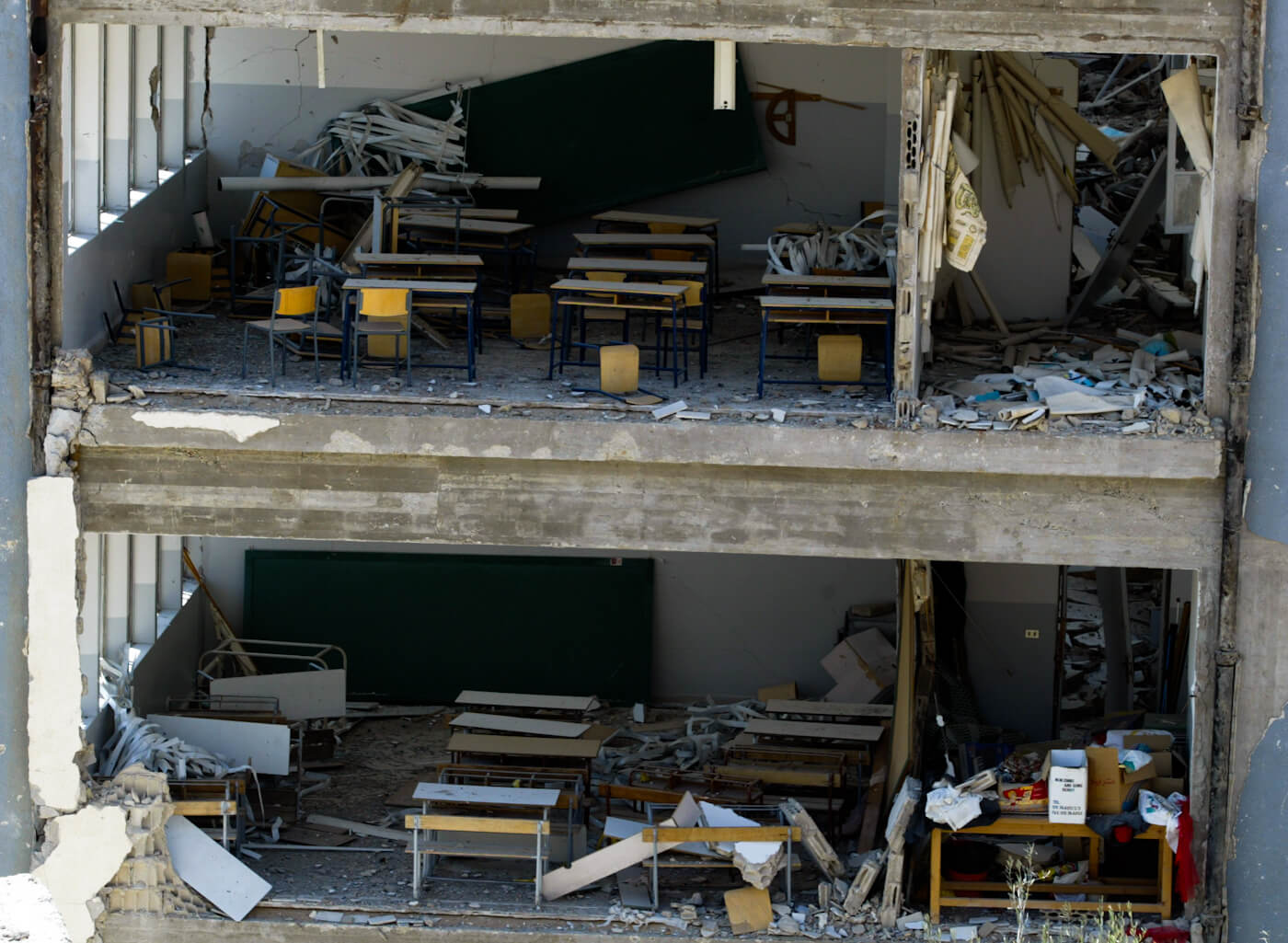
A school building destroyed by Israeli bombs in the southern Lebanese town of Bint Jbeil, Aug. 27, 2006. Sergey Ponomarev | AP
Prominent Israeli politicians have also made the case for targeting Lebanese civilians in the coming war between Israel and Lebanon. For instance, Naftali Bennett, who until recently was Israel’s minister of education, told Haaretz in 2017 that civilians “must” be targeted the next time Israel and Lebanon go to war:
The Lebanese institutions, its infrastructure, airport, power stations, traffic junctions, Lebanese Army bases –- they should all be legitimate targets if a war breaks out… This will mean sending Lebanon back to the Middle Ages.”
Past impunity expands to cover new atrocities
Under existing international law, the bombing of residential buildings, hospitals and schools is a clear war crime, though this hasn’t stopped Israel’s government from bombing these same structures in Gaza with regularity in recent years. In addition, during the 2006 war between Israel and Lebanon, Israel’s military killed at least 1,109 civilians, injured over 4,000 and displaced an estimated 1 million according to figures compiled by Human Rights Watch. The staggering civilian death toll sparked condemnation from international human-rights groups.
Thus, Erdan’s recent comments suggest that Israel’s government, in a war against Lebanon it plans to instigate under the guise of “preventative” defense, is planning to commit war crimes on a much larger scale than what was done in 2006 and is thus pushing for international law to be changed to accommodate those plans. However, Israel has long been able to avoid accountability for war crimes, especially following the U.S. adoption of the “Negroponte doctrine” to protect Israel from criticism as well as any punitive action taken by the U.N. Security Council in relation to war crimes committed by Israel.
This makes it more likely that this current push led by Erdan to alter international law is aimed more at global public opinion, by redefining international law so that Israel could avoid being accused of war crimes for such attacks on civilians and civilian infrastructure in a future war.
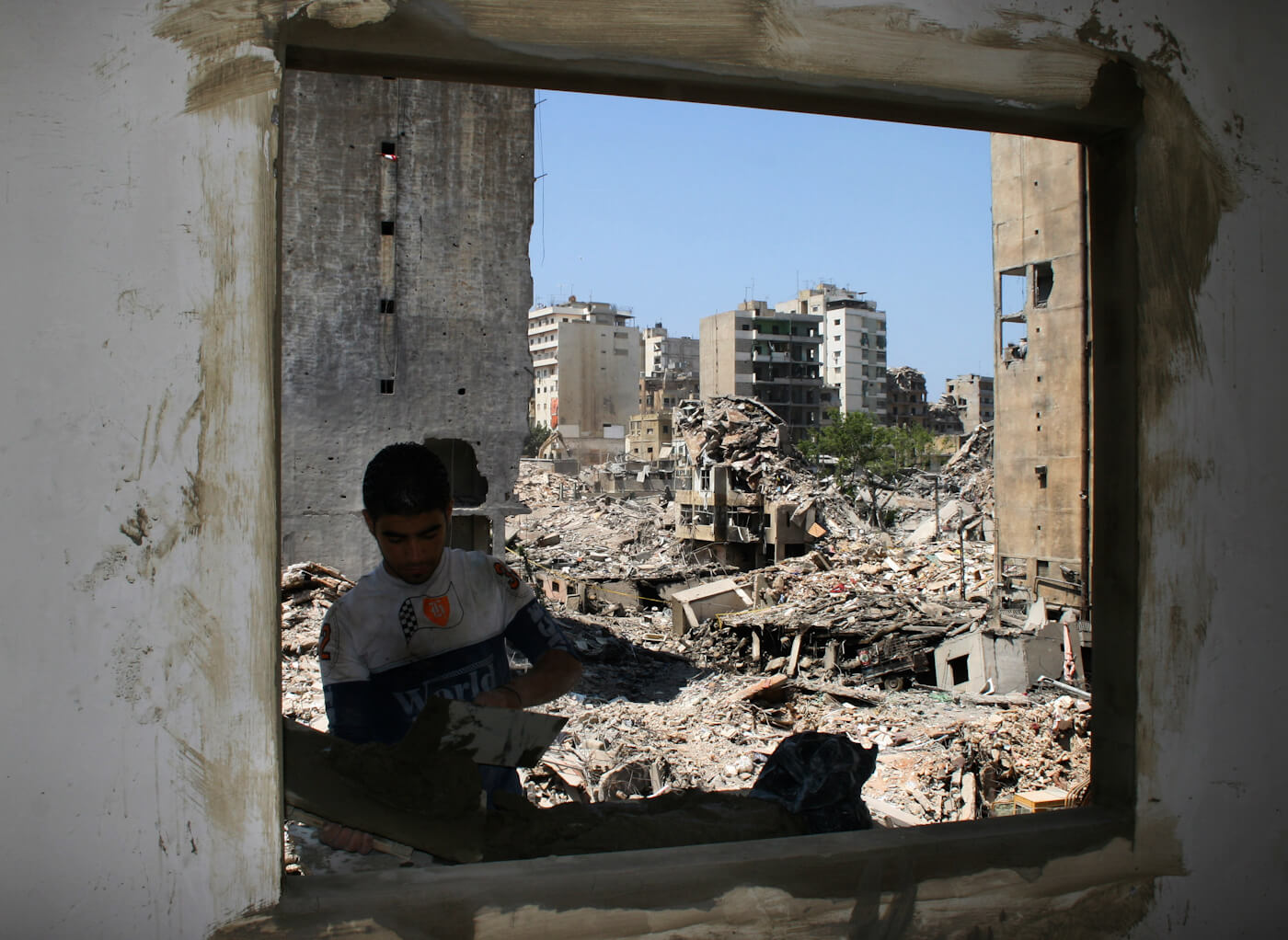
A man repairs a home, in the background buildings destroyed by Israeli airstrikes in the southern suburbs of Beirut, Lebanon, Aug. 27, 2006. Photo | AP
Part of the strategy in targeting Lebanese civilians specifically appears to be Israel’s strong desire to win a “decisive victory” against Hezbollah in this future war, as opposed to the humiliating defeat its military suffered in 2006. It appears that key figures in Israel’s government believe that the grand scale of planned attacks on Lebanese civilians and civilian infrastructure will result in so much destruction and death that it will help to ensure an Israeli victory.
Though it is unlikely Israel’s effort will succeed in changing international law, it may change how its government interprets such laws — as Darshan-Leitner recently suggested — and use such interpretations to secure even more robust diplomatic cover from its more influential allies such as the United States and to more easily avoid the war crime label from international media outlets and foreign governments. Such a move may also prompt the Trump administration in the U.S. to do the same, particularly given the slew of recent pardons given to accused and convicted U.S. war criminals by President Donald Trump.
US troops “prepared to die for the Jewish state”
In addition, the U.S. military itself is likely to quickly become embroiled in this coming Israel-Lebanon war, given that head of U.S. Central Command (CentCom), Lt. Gen. Richard Clark, told the Jerusalem Post last year that IDF leadership (as opposed to American military leadership) would “probably” have the last word as to whether U.S. forces would join the IDF during a future war and that U.S. troops were “prepared to die for the Jewish state.” IDF Brigadier General Zvika Haimovitch responded to Clark’s comments by stating: “I am sure once the order comes we will find here U.S. troops on the ground to be part of our deployment and team to defend the state of Israel.”
While much media attention has focused on the possibility of an imminent U.S. war with Iran, it is important to point out — especially in light of Israel’s comments — that Israel has been planning for over a year to go to war with Lebanon. Indeed, last year, Israeli officials told U.S. Senators Lindsey Graham and Chris Coons (D-DE) that “Southern Lebanon is where the next war is coming.”
Yet, the push for war with Iran and the planned war against Lebanon may be related, given that Hezbollah’s Secretary-General Sayyed Hassan Nasrallah stated the following late last month:
Any attack on Iran will not remain confined to Iran’s borders. The entire region will burn, leading to all U.S. forces and interests in the region being annihilated.”
Whitney Webb is a MintPress News journalist based in Chile. She has contributed to several independent media outlets including Global Research, EcoWatch, the Ron Paul Institute and 21st Century Wire, among others. She has made several radio and television appearances and is the 2019 winner of the Serena Shim Award for Uncompromised Integrity in Journalism
$9 billion for Egypt in return for deal of the century
MEMO | June 24, 2019
According to documents released by the White House, the economic aspect of Donald Trump’s peace plan between Palestine and Israel includes granting $9 billion to Egypt, half of which is in the form of soft loans.
The documents revealed that $50 billion will be dedicated to the economic part of the deal of the century, which will be invested in the revival of the Palestinian territories, as well as Lebanon, Jordan and Egypt.
The US President’s advisor and son-in-law Jared Kushner will announce the details of the first phase of the peace plan during the workshop on “Peace for Prosperity” in Manama, Bahrain, on 25 and 26 June.
According to the documents, the funds received by Egypt will be invested during three stages over 10 years, as follows:
- $5 billion to be invested in modernising transport infrastructure and logistics in Egypt.
- $1.5 billion to be invested in supporting Egypt’s efforts to become a regional natural gas hub.
- $2 billion to be dedicated to the Sinai Development Project ($500 million for power generation projects, water infrastructure, transport infrastructure and tourism projects).
- An additional $125 million to be directed to the Overseas Private Investment Corporation (OPIC), which will direct this fund to small and medium-sized enterprises in Egypt.
- $42 million to repair and modernise electricity transmission lines from Egypt to the Gaza Strip.
- The commitment to discuss ways to enhance trade deals between Egypt, Israel, the Gaza Strip and the West Bank through Qualifying Industrial Zones in Egypt within the QIZ Agreement.
The rest of the $50 billion
According to the documents, the West Bank and Gaza Strip will receive about $28 billion, which will be invested in improving transport infrastructure, electricity networks, water supply infrastructure, education, housing, and agriculture.
$5 billion will be spent on transport infrastructure linking the Gaza Strip and the West Bank and another $1 billion on the development of the Palestinian tourism sector.
The remaining part of the $50 billion will be divided between Jordan, which will receive $7.4 billion, and Lebanon, which will be granted $6.3 billion. The totality of funds will be raised through an investment fund managed by a Multilateral Development Bank.
Where will these funds come from?
According to the documents, this amount is divided into $13.4 billion as grants, $25.7 billion as subsidised loans, and private capital in those projects will be $11.6 billion.
However, there are serious doubts as to whether this amount can be collected or not.
“There are deep doubts about the willingness of potential donor governments to make contributions at any time as long as the thorny political differences that are at the heart of the decades-long Israeli-Palestinian conflict have not been resolved,” Reuters mentioned in a report.
The news agency quoted experts as saying: “Most foreign investors will prefer to stay away not only because of security concerns and fears of corruption, but also because of the obstacles the Palestinian economy is facing due to the Israeli occupation of the West Bank, which hampers the movement of people, goods, and services.”
The cost for Egypt
In his interview with Reuters, Kushner described the economic aspect of the plan as “less controversial,” raising more questions about the formula for the political solution Trump and his associates are seeking.
Trump’s envoy to the Middle East, Jason Greenblatt, has repeatedly denied that the United States asked Egypt to give up land in Sinai to create a sovereign Palestinian entity expanding to parts of Rafah and Arish.
For its part, Egypt announced its participation in the Manama conference this week with a delegation headed by the Deputy Minister of Finance, Foreign Ministry Spokesman Ahmed Hafiz told Middle East News Agency (MENA).
Hafez stressed that the Egyptian participation aims to “follow up the ideas that will be presented during the workshop and evaluate the compatibility of the contained theses with the Palestinian National Authority’s vision of the ways of granting legitimate rights of the Palestinian people through a political framework and in accordance with the Palestinian and Arab determinants and constants, and the related UN decisions.”
The deal of the century is a peace plan prepared by the Trump administration and is said to be forcing Palestinians to make unfair concessions in favour of Israel, including on the status of occupied East Jerusalem and the refugees’ right of return.
US plan will not lure Lebanon into settling Palestinians
MEMO | June 23, 2019
Lebanon will not be lured by a US plan to invest billions in the country in return for settling Palestinian refugees, its parliament speaker Nabih Berri said on Sunday, reports Reuters.
US President Donald Trump’s blueprint for the Israeli-Palestinian conflict, set to be presented by his son-in-law Jared Kushner at a conference in Bahrain on June 25-26, envisions a $50 billion investment plan to lift the Palestinian and neighbouring Arab state economies. But it has met broad rejection in the Arab world, even as some in the Gulf called for giving it a chance.
Lebanese parties have long held that Palestinian refugees cannot be permanently settled in the country, which is widely believed in Lebanon to be a goal of the Kushner plan.
“Those who think that waving billions of dollars can lure Lebanon, which is under the weight of a suffocating economic crisis, into succumbing or bartering over its principles are mistaken,” Berri said in a statement from his office.
The rejection of settling Palestinian refugees who must have the right of return stands at the forefront of these principles, he said.
Any investment “at the expense of the Palestinian cause” will not find fertile ground in Lebanon, Berri said.
The idea of permanently settling mainly Sunni Muslim refugees is highly sensitive in Lebanon, sparking fears of rocking its delicate sectarian balance.
Estimates of how many Palestinian refugees are in Lebanon vary. The United Nations says 470,000 Palestinian refugees are registered, though a 2017 official Lebanese census found the number to be around 175,000.
The US plan envisions spending more than half of the $50 billion in the Palestinian territories over 10 years while the rest would be split between Egypt, Lebanon and Jordan.
The Trump administration hopes that wealthy Gulf states and nations in Europe and Asia, along with private investors, would foot much of the bill, Kushner told Reuters on Saturday.
Nasrallah Vows to Confront US Middle East Plan

Al-Manar | June 1, 2019
Hezbollah Secretary General Sayyed Hasan Nasrallah stressed on Friday that the axis of resistance is stronger than ever before, while ‘Israel’, despite its military strength, is weaker than ever.
During a ceremony held by Hezbollah to mark Al-Quds International Day in Dahiyeh, Sayyed Nasrallah pointed out that the Palestinian resistance was advancing and developing immensely and it “became able to control large areas in occupied Palestine in any future war, at a time when the image of ‘Israel’ was destroyed after the defeat of its ground army who couldn’t stop the resistance rockets.”
Sayyed Nasrallah rejected the US conditions for mediating a border and maritime dispute with the Zionist entity, saying Washington, through its envoy who was tasked to negotiate the land and maritime border demarcation between Lebanon and the Zionist entity, was using the talks to the Israeli benefit, bringing up an Israeli claim that Hezbollah has precision missiles factories. “The US wants to blackmail the negotiations on border demarcation in order to open the issue of Hezbollah’s precision rockets arsenal,” he said, but warned that [David] Satterfield should focus on the border demarcation issue and only that.
The Hezbollah leader acknowledged that Hezbollah has the weapons but do not produce them. However, he said Hezbollah may consider setting up such factories if Washington continues to use the talks on border demarcation to discuss the resistance capabilities since it is Lebanon’s right to defend itself. “We have in Lebanon precision rockets that are able to target direct posts in ‘Israel’ and that would change the face of the region,” he said, but warned that Hezbollah will respond to any Israeli aggression on any resistance target in Lebanon quickly, directly and strongly.
His Eminence said that ‘Israel’ fears the resistance in Lebanon and that Israeli officials talk about resistance deterrence and capabilities, pointing out that Hezbollah has “accurate missiles that can reach all the targets required in ‘Israel’ and that are able to change the face of the region.
“The US attempts to control Iraq have failed, the Iraqi stance from regional issues is totally different and uncontrolled,” he said. “Iraq today returned to its regional role and has a capable, struggling and influential people in the region’s issues,” He said.
Sayyed Nasrallah gave the so-called Deal of the Century the lion’s share in his speech, assuring that the US was mistaken by betting on regional people’s weariness to impose the deal. “The main challenge today in front of Palestine and Al-Quds is the deal of the century, or Trump’s deal, and it’s our duty to confront it.”
“We have a deep hope that we, the people of this region, can stop the ‘crime of the century’,” he said, indicating that the US administration and ‘Israel’ are working day and night with Arab regimes to realize the deal.
The US, he said, was able to “contain the Arab Spring popular protests and derail it towards a wrong way, however, Syria overcame the scheme of destroying it, and it remained pro-resistance.”
“Yemen, which is an essential part of the resistance axis, rejects the deal of the century and protests in support for Al-Quds,” Sayyed Nasrallah said. “American tools in the region are unable to protect themselves and some regimes are concerned of implementing the deal of the century,” he said, pointing out that the three summits in Mecca were a proof of the Saudi failure and weakness.
The S.G. said the Zionist entity and the US were no longer as strong as before. “‘Israel’ fears missiles from Lebanon, Gaza, Syria and claims the existence of rockets in Iraq,” he said, adding there’s no leadership in ‘Israel’ and total reliance on US support. However, he said the US was no longer the same as before 20 years after it sent its troops to the region and came out of it defeated.
Sayyed Nasrallah detailed the reasons why the possibility of an upcoming war against Iran was remote. “One reason that there’s no war is that Iran is strong, otherwise the war could have been launched. The other reason is that the CIA knows that a war on Iran will set the region on fire and won’t stop behind its borders.”
“The whole region will ignite and the US troops and interests will exterminate if a war on Iran was launched,” Hezbollah leader warned.
A war on Iran will make ‘Israel’ and Al Saud pay the price, his eminence indicated, wondering how Saudi Arabia, which failed and was defeated in Yemen, would be able to wage war on Iran.
“Trump fears own interests and is only after an economic war against Iran and other states,” he went on to say.
While he hailed the balanced Iraqi stance in the emergency summit that convened Arab leaders in the Saudi city of Mecca overnight Thursday, Sayyed Nasrallah rejected and condemned the Lebanese delegation participation in the summit, saying the Lebanese official stance was inconsistent with the dissociation item in the ministerial statement and violated it.
Sayyed Nasrallah began his speech by saluting the participants and demonstrators across the world to mark this special day. “I thank you, this audience, for reviving this jihadi-moral occasion that is linked to our fate, our pride, our freedom and our sanctities.”
“Attempts to make this day as for a certain sect have failed,” the S.G. said, adding that “the sincerity of all those who walk on the road to restore Al-Quds could be stronger than any siege.”
“Throughout 40 years, Al-Quds enemies bet that this day will be forgotten, but they were mistaken,” he said. “We have been commemorating the week of Al-Quds in many cities of the world. Al-Quds Day protests in Bahrain confirm that the Bahraini people and scholars are innocent of the Deal of the Century’s summit.”
“Al-Quds rallies in Iran serve as a message to US and regional regimes,” his eminence said, adding that Trump will wait for a long time before receiving a phone call from Iran.
The ceremony marking Al-Quds day, with its main emblem “Towards Al-Quds”, was held in Beirut’s southern suburb (Dahiyeh) Friday overnight gathering a huge public and political participation. During the ceremony, organized by Hezbollah, a symbolic military parade was held in which Hezbollah fighters chanted “Oh Quds, we shall march towards you” during the parade. Hezbollah fighters also recalled the oath of allegiance to resistance leaders, Imam Ruhollah Khomeini, Sayyed Ali Khamenei & Sayyed Hasan Nasrallah.
In July 1979, the Supreme Leader of the Islamic Revolution in Iran, Imam Ruhollah Al-Khomeini, announced Al-Quds International Day, voicing a complete support to the Palestinian cause against the Zionist enemy.
Although this Day is marked annually every last Friday of the Holy Islamic Month of Ramadan, Imam Khomeini has deliberately given it an international attribute in order to be the day of all the oppressed worldwide.
Israel and US disputed intelligence for assassination targets
![Lebanese men inspect the damage done to their homes after Israel carried out attacks in Beirut, Lebanon on 22 July 2006 [PATRICK BAZ/AFP/Getty Images]](https://i0.wp.com/www.middleeastmonitor.com/wp-content/uploads/2019/05/2006-Lebanese-men-inspect-the-destruction-caused-by-Israeli-attacksGettyImages-119810831.jpg?resize=1200%2C800&quality=75&strip=all&ssl=1)
Lebanese men inspect the damage done to their homes following Israel’s invasion of Lebanon in 2006 [PATRICK BAZ/AFP/Getty Images]
MEMO | May 30, 2019
Leaked documents published by whistle-blower Edward Snowden have exposed a deep rift between Israeli intelligence officials and their counterparts in the US National Security Agency (NSA) over the sharing of intelligence which the Israelis requested to carry out assassinations during the 2006 invasion of Lebanon.
Details of the rift were laid out in the NSA’s internal newsletter known as SIDtoday under the heading “The Israel-Hizballah [sic] Crisis — Perspectives from an Acting SLO Tel Aviv”. In the document, an American liaison officer, who is tasked with managing relations with counterparts in Israel, recounted a dispute with the Israelis over intelligence that was to be used for “targeted killings”.
The Israeli demand, the US liaison wrote, “centred on requests for time sensitive tasking, threat warning, including tactical ELINT” — electronic intelligence — “and receipt of geolocational information on Hizballah elements.”
“The latter request was particularly problematic,” he continued, adding that he “had several late-night, sometimes tense, discussions with ISNU,” the elite Israeli equivalent of the NSA. The US official rejected the demand, and said that he provided details of “NSA’s legal prohibition on providing information that could be used in targeted killings.”
The acting SLO officer pointed out that, “Even with his full understanding of the US statutes, [ISNU Commander] BG Harari sought assistance from NSA for an exemption to this legal policy. To ISNU, this prohibition was contrary not only to supporting Israel in its fight against Hizballah but overall, to support the US Global War on Terrorism.”
The account, published by The Intercept — which has released four years’ worth of SIDdtoday material in batches — goes on to suggest that the NSA ultimately reached a compromise with the Israelis by working with the Office of the Director of National Intelligence (ODNI), and that in the end it was the Israeli team that defined the parameters and methods of what could and could not be shared with them.
According to The Intercept, the episode recounted by the US liaison officer raises “questions of what intelligence the United States can legally share with a foreign government.” This, it said, is a “notoriously murky” area.
READ ALSO:
Israel assassinates more people than any Western country, concludes new book
Nasrallah: If It Weren’t for Liberation in 2000, Trump Would Grant South to ‘Israel’

Sayyed Hasan Nasrallah
Sara Taha Moughnieh | Al-Manar | May 26, 2019
Hezbollah Secretary General Sayyed Hasan Nasrallah delivered a speech Saturday 25th of May on the anniversary of Resistance and Liberation day.
Sayyed Nasrallah tackled regional and internal files including the upcoming Bahrain Summit, localizing the Palestinians in Lebanon, strength of the resistance axis, return of the Syrians to their country, and internal files.
His eminence called for a wide participation in Al-Quds day which is held annually on the last Friday of the Holy Month of Ramadan, stressing that this day is of great significance this year because of the efforts being made to put an end to the Palestinian cause, specifically during the upcoming Economic Conference in Bahrain.
He greeted the Palestinian’s united stance to boycott and refuse this conference and praised the Bahraini people, scholars, and political powers’ stances that condemned the country’s decision to be the first to embrace “the deal of the century” which aims at putting an end to the Palestinian cause.
25/May/2000: Resistance and Liberation Day
Sayyed Nasrallah greeted everyone who was part of this victory through sacrificing, staying patient, supporting and aiding.
“We should remember the families of the martyred and injured, Lebanese factions, Security Forces, Army, Palestinian factions and the Syrian Army and keep in mind that Iran and Syria are the ones who stood by our side and they are our companions in victory,” he said.
Hezbollah SG assured that one of the major outcomes of this victory was the “Equation of Strength” in Lebanon because the Israeli enemy had to pull back without any victories or conditions.
“Lebanon was no longer regarded as the weak ring in the Arab/Israel conflict, and today the Israeli enemy states that in Lebanon there is a “strategic or central threat against Israel”, he noted; adding “just like the enemy is aware of this strength, the Lebanese people should be aware of its importance in order to sustain their country’s sovereignty and safety and in order to protect it. This is what forms the Golden Equation “Army, people and Resistance”.”
“If it weren’t for the resistance and liberation in 2000, Trump would’ve granted the south of Lebanon or other parts of it to Israel, just like he did with Al-Quds and the Golan,” Sayyed Nasrallah said, reassuring holding on to “Shabaa Farms, Kfarchouba hills and the Lebanese part of Al-Ghajar village.”
Localization in Lebanon
Concerning localizing immigrants in Lebanon, his eminence said: “we suspect that the economic summit in Bahrain will be opening the door for the localization of immigrants in Lebanon and other countries. The Lebanese agree on refusing localization politically and constitutionally, and the Palestinians as well agree on refusing localization and holding on to their right of return.”
Sayyed Nasrallah called for “a meeting between Lebanese and Palestinian officials to put a joint plan on how to face the danger of localization because the threat is approaching and statements are no longer enough”.
Syrian Refugees’ Return
Hezbollah SG pointed out that “the real reason behind delaying the return of the Syrian refugees in Lebanon to their country is political and it is related to the presidential elections in Syria because the presidency of Bashar Al-Assad will end in 2020 or 2021, and there is an American, Western, and Gulf insistence on keeping the refugees away from their countries until then. There are no humanitarian or security reasons behind postponing the refugees’ return to Syria and claims about that are just rumors.”
Sayyed Nasrallah further stated that “Assad has confirmed to me that he supports the return of everyone to Syria and is ready to offer facilitation, but the obstacle is political. Should Lebanon submit to this political obstacle only because the US, west and Gulf want that?”
Battle against Corruption Files
His eminence stressed Hezbollah’s commitment to fight corruption, reiterating that this needs time and patience, and it is even harder than the battle of liberating the south.
He indicated that the ministers are doing their jobs and have not found corruption in the Ministries of health and sports, and called on everyone who has information or data against these two ministries to propose them so that action would be taken.
On another hand, Sayyed Nasrallah stated that “budgeting discussion has been our priority because it is a major point in the process of fighting corruption and stopping financial waste.”
Zainab Walks On Her Feet, Ivanka Uses Government Money for Secret Services
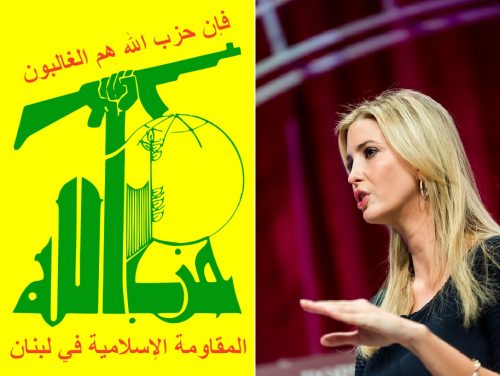
Image: Hezbollah Flag (L), Ivanka Trump (R). Credit: Public Domain/ Fortune Conferences
By Heba Mourad | American Herald Tribune | May 10, 2019
I entered the hotel apartment where a dozen ladies were sitting together. They were in Tehran for a conference on the status of women in Islam. Among the ladies sitting was a young lady in her 30s. I had seen her before in a public event in Beirut some two years ago. I went to the hotel to see a friend, and then I thought, why not see if I can socialize and get to know her up close. I had to go soon, loads of unfinished work was waiting for me at my office.
The next day, I decided to take some distance from office work and go on a short trip to accompany the ladies who were traveling to another Iranian city. And I did get lucky when I had the seat right next to her on the flight. Well, I forgot to introduce her to you; she is the daughter of the man Israel fears to death. Zainab, the daughter of Hezbollah Chief Sayed Hassan Nasrallah and I spoke all the way during that flight. We later had a long talk as well during the night after dinner.
She told me about her childhood memories, her relationship with her dad, her brother who was martyred while defending Lebanon in face of Israeli occupation, her mother who she thinks highly of, her life as a woman, a mother and a Lebanese citizen, and the list goes on.
Let all the details aside, what is so amazing about this young lady who is 33 years old and a mother of four children is that you totally forget she is the daughter of the Hezbollah chief. She is so humble and friendly. My plan was first to write about her memories with her dad in particular, especially that she does not usually talk to the media. I thought many might be curious to know more about this Nasrallah family member. I stayed with the group for one day at the hotel; we socialized and had food together. And again, I kept forgetting she is the daughter of so and so.
Rumors about this lady and her family have been circulating throughout the years. Some say she is arrogant, others say she and her family enjoy a luxurious life and spend the money of the people. Other times I hear some claiming that she lives somewhere underground and she does not go out without escorts and body guards.
She keeps a smile on her face all the time and she makes sure she is an average person in her society in terms of finances and spending.
“I go out alone, I do my own shopping and I do not have any bodyguards to escort me,” she told me. She likes keeping a simple life style and she says she is not poor, but would say she lives like any other middle-class person in her country. She joined the group of ladies all the time in the lunches and dinners, and shared a room with a couple of ladies. It felt like I had known her forever.
On that day, she was wearing her neat black gown known as the ‘Abaya’ and a pair of Sketchers. Taking pictures with the group here and there, they made jokes on how these should remain out of media’s reach to keep a low profile. She does not like being in the lime light and she likes having a normal and simple life. She told me how she enjoyed moments with her father, and how she looks up to him not only as a father but also as a leader.
She told me that the trait she likes the most about her father is how humble he is, and she tries to be always like him and teach this to her kids as well. Maybe I will not write down what I decide to keep to myself for the time being; a long and colorful discussion with the First daughter of the resistance movement.
For a second, I stopped to think: this young lady who can abuse the power of her father respects people and their feelings so much and practices what her father preaches. Her father, put on the terror list by the US is the one who taught this girl good manner. She said she always listens to his advice. “When it comes to society, I listen to his advice a lot. He knows what is best and always urges us to be respectful of the people and their feelings and that we should always set a good example.”
“I can say we are considered as middle-class. We are not poor and I thank God for providing us a decent life. However, even if we were super rich we would not have use that money to live a luxurious life. We are part of our society and we should share a similar living.”
On the other side of the planet, there exists another daughter of a famous man who has become notorious in the eyes of many, Ivanka Trump. First daughter and US presidential adviser Ivanka Trump and her husband, Jared Kushner, vacationed at a luxury resort in the Dominican Republic over a long weekend in August. The cost to US taxpayers: more than $58,000.
Also, a week-long Aspen ski vacation taken in March 2017 by Ivanka Trump, Eric Trump, and their families cost taxpayers at least $330,000 in security costs, plus thousands more in ski equipment rentals for the agents assigned to shadow the family on the slopes, according to records obtained by CBS News.
That other side of the planet is the one that keeps trying to impose “otherness”, wars, supremacy across the globe, and is inconsiderate of its own people. As Ivanka and the American ruling family enjoy luxurious hotel rooms and secret services, the Children’s Defense Fund (CDF) said in a new report that about 13 million American children are living in homes with incomes below the poverty line, depriving many of a decent education and proper nutrition, and putting them at risk of homelessness and violence.
The US Secret Service has allocated more than $90,000 for golf cart rentals in South Florida in the winter of 2018, ostensibly to protect President Donald Trump while he hits the links. Critics call the family’s frequent travel exorbitant and wasteful and insist the Trump family can afford their own security. It is okay for a president to use secret services but not to go (cheat) on golf courses, travel for the weekends or even allow his family to use that for personal and business trips.
This is while the head of the Hezbollah resistance movement lives a normal life and does not seek any luxuries, but rather dedicates all his time to protect Lebanon and the Lebanese in face of the US’s number one ally; the Israeli apartheid regime.
And the Israelis seem to fear Hezbollah more than ever. Israeli newspaper Yedioth Ahronoth quoted Yuval Steinitz, Israel’s Minister of Energy, saying that “Hezbollah missiles may target all of Israel. Zionists consider Hezbollah a very dangerous and highly experienced enemy.”
The Israeli Defense Forces, referring to the precision of the Lebanese Hezbollah missiles, writes: “Hezbollah is capable of targeting Israel’s critical facilities, and the 2006 Lebanon War seems nothing compared to a conflict with Hezbollah in future.”
Daniel “Danny” Rubinstein, an Israeli journalist, said that “Hassan Nasrallah is a great figure. Gamal Abdel Nasser fought for six days, but Hassan Nasrallah kept Israelis four weeks in their place in 2006.”
Now if you do not read history or keep up with the news, do not mistakenly think that Hezbollah is behind all the trouble in the region as Western mainstream media try to put it. Hezbollah is a Lebanese political party, as legitimate as any other in Lebanon. It was formed only when the Israeli apartheid regime decided to attack Lebanon, what people in the region used to call the ‘bride of the Middle East’.
Hezbollah has been defending the region in face of Israeli attacks and it has been standing firm in the face of terrorist groups like Daesh, al-Qaeda and al-Nusra front.
Back to where this all started; great people enjoy humility. Many say humility is weakness; however, a short but sufficient explanation would be that of Dr. Robert Hogan, founder and president of Hogan Assessments who was quoted by Forbes as explaining “Humility is the psychological opposite of narcissism.”
It is an underrated leadership quality. To be humble is not to think less of oneself, but to think of one-self-less, and this is what I think my story today should be all about.
Lebanon won’t survive with Palestinian, Syrian refugees: Auon
MEMO | May 10, 2019
Lebanon will never survive if half a million Palestinian refugees and 1.6 million Syrian refugees remain in the country, the Lebanese president, Michel Aoun, said yesterday.
Aoun’s remarks came during a meeting held at the presidential palace in the Lebanese capital of Beirut with a delegation from the Middle East Council of Churches (MECC), headed by its secretary general Souraya Bechealany.
Aoun called on the MECC to help the Lebanese government resolve the Syrian refugees’ issue “by persuading Western countries to accept the refugees return to their countries as soon as possible.”
“Israel has declared that the Palestinian refugees would remain where they are,” he pointed out, warning that if the refugees remained in Lebanon, “its demographics would change completely.”
There are 174,422 Palestinian refugees currently living in 12 camps and 156 Palestinian communities across Lebanon’s five governorates, according to a report by the Palestinian Central Bureau of Statistics (PCBS) in 2017.
Lebanon – with an estimated population of 4.5 million – complains of the refugees’ burden it has been facing since the start of the Syrian civil war in 2011.
According to the UN High Commissioner for Refugees (UNHCR), the number of Syrian refugees in Lebanon reached 997,000 by the end of November 2017, excluding the Syrians who are not registered with UNHCR.
Lebanon ‘willing’ to set maritime border with Israel under UN supervision
MEMO | April 25, 2019
Lebanese Parliament Speaker Nabih Berri said his country is prepared to demarcate its maritime border with Israel through the same mechanism used to draw the Blue Line under the supervision of the United Nations, the Anadolu Agency reported.
“We are ready to draw Lebanon’s maritime borders and those of the Exclusive Economic Zone using the same procedure that was used to draw the Blue Line under the supervision of the United Nations,” Berri said during a meeting with Major General, Stefano Del Col, head of the UN Interim Force in Lebanon (UNIFIL).
General Del Col said the UN could use the same mechanism to demarcate the maritime border.
The Blue Line refers to the land border between Lebanon and Israel which was drawn under the UN supervision to facilitate Israel’s withdrawal from Lebanon in 2000.
Lebanon and Israel have an unresolved dispute over the ownership of a nearly 860 square kilometre zone which extends along the edge of three of Lebanon’s energy blocks in the Mediterranean Sea.
Lebanon, Cyprus, Egypt, Israel and Syria sit on the Levant Basin in the eastern Mediterranean where a number of big gas fields have been discovered since 2009.
US Iran sanctions amount to aggression against entire world: Nasrallah
Press TV – April 22, 2019
The secretary general of the Lebanese Hezbollah resistance movement has denounced US economic sanctions against Iran, describing the punitive measures as “an act of aggression” against all world nations.
“US efforts to increase economic pressure on Iran, especially its pledge to drive the country’s oil exports to zero, will have negative repercussions and will affect the entire world, including the US itself,” Sayyed Hassan Nasrallah said as he addressed his supporters via a televised speech broadcast live from the Lebanese capital Beirut on Monday evening.
He then called on world nations to stand up against “US arrogance,” pointing out, “The tyrannical US government has no respect whatsoever for international law and regulations.”
Nasrallah also lashed out at Saudi Arabia and the United Arab Emirates for following in US footsteps and joining Washington’s economic pressure campaign against Iran.
The Hezbollah chief also roundly rejected media allegations that the Israeli regime is planning to launch a surprise war against Lebanon this summer.
“There is very little likelihood that Israel would launch another war on Lebanon. The Israeli army is not prepared for any aggression against the country. I personally don’t think such a thing would happen,” Nasrallah highlighted.
The Hezbollah chief also dismissed claims of infighting between Russian and Iranian forces in Syria’s eastern province of Dayr al-Zawr as well as the northern province of Aleppo, stating that Saudi-owned al-Arabia television news network has “disseminated such lies.”
“Saudi-backed media outlets are spreading lies and fallacies about Hezbollah, Iran and the region to a large extent,” Nasrallah said.
The Hezbollah secretary general then slammed Saudi Arabia and the UAE for spreading terrorism and chaos in countries like Yemen, Sudan and Libya.
Nasrallah also blamed Wahhabism for the emergence of regional terrorism and Takfiri terrorist groups like al-Qaeda and Daesh.
Wahhabism is the radical ideology dominating Saudi Arabia, freely preached by government-backed clerics there, and inspiring terrorists worldwide. Daesh and other Takfiri terror groups use the ideology to declare people of other faiths as “infidels” and then kill them.
“There are many agents in the Middle East, who are pushing for sectarian strife to serve the interest of the Zionist regime (of Israel). All those seeking to colonize the region will only raise public awareness,” the Hezbollah chief said.
Elsewhere in his remarks, Nasrallah touched upon the economic crisis in Lebanon, demanding greater cooperation and unity among Lebanese political factions.
“All Lebanese parties agree that Lebanon is suffering from serious financial woes. They are all involved in coping with the economic crisis. Resolving Lebanon’s problems requires patience and efforts by all political parties. Ministers affiliated to Hezbollah, lawmakers as well as specialists have already prepared a number of draft solutions for Lebanon’s economic crisis,” Nasrallah underlined.
Maximum Pressure on Iran Still Isn’t Working
By Paul R. Pillar | LobeLog | April 2, 2019
Almost a year after President Trump reneged on U.S. commitments in the Joint Comprehensive Plan of Action (JCPOA), otherwise known as the Iran nuclear deal, there is not the slightest sign that this move is achieving the declared objective of Iran crawling back to the negotiating table to negotiate a “better deal.” Tehran instead has been exuding perseverance and hardline resistance. The most recent high-level Iranian statement, a speech by Supreme Leader Ali Khamenei marking the Persian new year, was full of recalcitrance. Khamenei’s themes included self-sufficiency and boosting Iran’s defense capabilities.
It is not surprising that determined opponents of the JCPOA—the most vocal of whom are determined opponents of any agreement with Iran—have been trying hard to spin this situation to make it look as if something positive is being accomplished. Patrick Clawson of the Washington Institute for Near East Policy, for example, suggests that the new year’s speech was “not the confident Khamenei of days past” and that the speech indicated that “the Trump administration has had considerable success convincing Khamenei that the pressure will continue, and that Iran cannot count on outlasting U.S. hostility.”
It also is not surprising that when The New York Times ran a story by Ben Hubbard, reporting from Beirut, about the financial strains that Hezbollah and other Iranian clients are feeling, columnist Bret Stephens jumped into action. “Heavens to Betsy,” Stephens exclaimed in a column in the next day’s Times, arguing that this must mean President Barack Obama was wrong when he said sanctions relief “wouldn’t make much difference in terms of Iran’s capacity to make mischief in the Middle East.”
Actually, Obama was right. The fallacy that Stephens, and others who defend the Trump administration’s re-imposition of nuclear sanctions, are promoting is that making life more difficult, costly, or painful for someone else somehow advances U.S. interests—at least if the U.S. government sufficiently hates whoever that someone else is. That would be true only if schadenfreude were a U.S. national interest, which it isn’t. Pain infliction serves U.S. interests only if it changes the targeted country’s behavior in a desired direction, by either limiting its capabilities or inducing it to change its policies. Regarding Iran over the past year, this is not happening.
It’s Not All About the Money
Most of Hubbard’s article—the part Stephens doesn’t mention—describes how and why Iran and its clients are not changing their policies and operations despite the financial pinch. The reporter notes that the client groups “are relatively inexpensive, remain ideologically committed to Iran’s agenda and can promote it through local politics in ways that the United States struggles to thwart.” Many of the groups “have income streams that give them some financial independence.” That certainly is true of Lebanese Hezbollah, which also benefits from having achieved broad acceptance as a political actor. Hubbard recalls how much pushback Secretary of State Mike Pompeo received on this point when he recently met with senior Lebanese officials. Foreign Minister Gibran Basil, standing next to Pompeo at a subsequent public appearance, said, “From our side, for sure, we reiterated that Hezbollah is a Lebanese party, not terrorist. Its deputies are elected by the Lebanese people with great popular support.”
The article mentions that, to the extent Iran is scaling back militia operations in Syria, this may be due less to financial reasons than to the fact that Iran’s ally Bashar al-Assad has largely won the war. In Iraq, financial stringency has led Iran not to curtail involvement but instead to seek stronger economic ties with its next-door neighbor. Militias that Iran sponsored “are now paid by the Iraq government, giving Iran leverage in Iraqi politics at little cost to itself.”
Hubbard quotes an anonymous Hezbollah fighter as saying that a financial pinch would not push members away from the organization. “You’re not in Hezbollah for the money,” he said. Something similar could be said about Iran in the Middle East. Iran’s activity in the region is shaped not by the money but instead by Tehran’s perception of what is in Iran’s security interests.
None of this should be surprising. Hubbard notes that “recent history suggests that financial pressure on Iran does not necessarily lead to military cutbacks.” As multiple independent studies have concluded, that also is true of the recent and not-so-recent history of Iran’s overall activity in the Middle East, including activity that the United States finds objectionable.
Continued Iranian Compliance with the JCPOA
Stephens tries to milk another supposed accomplishment out of the administration’s pressure campaign by pointing to the fact that Iran is still observing its obligations under the JCPOA despite the United States having reneged on its own commitments. While acknowledging that Iran outwaiting Trump has something to do with this, Stephens also says the Iranian compliance “suggests an edge of fear in Tehran’s calculations. The U.S. can still impose a great deal more pain on the Islamic Republic if it chooses to do so.”
Reflect first on the irony of an anti-JCPOA voice like Stephens pointing to Iran’s continued rigorous observance of its obligations under the JCPOA—the terms of which Stephens and other opponents have been excoriating for three years—as a supposed accomplishment of the Trump administration’s pressure campaign. Reflect further on how much Iran’s compliance with those obligations undermines opponents’ rhetoric about how Iran supposedly has been hell-bent on getting nuclear weapons, with the JCPOA just a way-station where it gets an economic fillip. If that really were Iran’s intention all along—and given that it is not now getting the fillip—Iran would have renounced the JCPOA as soon as the United States reneged.
Think also about what sort of diplomacy Stephens’s suggestion implies: that the way to get another state to stick to agreed terms is not to stick to them oneself but instead to renege and then to threaten something worse. That would be a bizarre brand of diplomacy, to put it mildly, and one that neither the United States nor anyone else could use to get much business done.
“Tehran’s calculations” are unlikely to be anything like what Stephens suggests they are. The Trump administration, through both its actions and its rhetoric, has given Iranian leaders ample reason to conclude that the administration is determined to punish Iran as much as possible no matter what Iran does. Any hesitation within the administration not to push the sanctions pedal all the way to the metal appears to be a reaction not to Iranian restraint but instead to economic concerns about how elimination of waivers for importing Iranian oil would affect the world oil market and ultimately the price of gasoline at the pump.
Iranian Patience Not Unlimited
Iran’s continued compliance with the JCPOA despite U.S. reneging definitely involves an Iranian decision to outwait Trump. This is partly, but not solely, a matter of some Democratic presidential candidates, as Stephens correctly notes, stating their intention if elected to bring the United States back into compliance with the agreement. Iran is making its decisions about nuclear policy within a larger context in which not Iran, but instead the United States under Trump, is the isolated actor. It is not just Iran but all the non-U.S. parties to the JCPOA that are committed to its preservation. So is the larger world community, as expressed in the unanimously adopted United Nations Security Council Resolution 2231.
Iran may continue to outwait Trump, despite not getting the economic relief it bargained for, until the end of the current U.S. presidential term. Politics inside Tehran probably would make it impossible to wait any longer. This is where the 2020 U.S. presidential election comes into play. Former Deputy Secretary of State William Burns, when asked about this subject recently, replied, “My sense right now is that this Iranian regime would like to try and wait out the Trump administration. But if the president was elected to a second term, then their interest in doing that probably goes out the window.”
If that happens, the damage from the pressure campaign will not be limited to the consequences that Stephens ignores, such as how economic warfare against Iran has become economic warfare against Western allies and has contributed to the poisoning of U.S. relations with them. The damage will include a new Iranian nuclear crisis that was totally avoidable if only the administration had not embarked on its destructive course a year ago.
Featured Video

“Historic Russia”: The Land Putin Will Not Give Back
or go to
Aletho News Archives – Video-Images
From the Archive
How Ukraine Tortured and Slaughtered Donbass
By Kit Klarenberg | Al Mayadeen | July 11, 2024
Almost immediately after the proxy war erupted, ISIS-tier footage of the torture and murder of Russians in Ukrainian custody emerged.
On July 6th, the New York Times published an astonishing investigation: In Ukraine, Killings of Surrendering Russians Divide an American-Led Unit. The article documents in grim detail how Chosen Company, an international volunteer battalion for Kiev, routinely executes Russian prisoners of war. It is the very first mainstream admission that this practice – a brazen breach of the Geneva Conventions, and a grave war crime – is widespread among Ukraine’s fighters, both foreign and homegrown. … continue
Blog Roll
 Aletho News
- Record Oil, Empty Tanks: The UAE’s Miracle Recovery
- Burnham tackles Britain’s poverty with aggression in Yemen
- Peace in Ukraine: the easy way – or the hard way
- Trump & the Rrrrussians
- US taxpayer money laundered back through Ukraine – Musk
- Before COVID, an NIH lab chief proposed making a SARS-like bat virus more infectious
- Gates, Bourla on Trial in Netherlands Accused of ‘Great Reset’ Scheme at Vaccine Injury Hearing
- BRITAIN’S WARNING: PREPARE FOR WAR
- “Historic Russia”: The Land Putin Will Not Give Back
- How the Cambridge Analytica scandal still haunts Mark Zuckerberg
- If Americans Knew
- DAILY UPDATE: Latest essential news on Palestine, Israel, & region
- Damning report shows the media must confront its failures on Gaza
- BBC senior broadcaster speaks out on Gaza coverage
- Netanyahu vows vast West Bank invasion in response to 20-minute skirmish that left 2 Israeli soldiers and 2 Palestinian fighters dead
- Tied up and tortured: Israel using US-made electroshock weapons on Palestinian detainees
- The outsourced risk: how newsrooms rely on Gaza’s freelancers without protecting them
- Gaza bakeries forced to shut as Israel blocks flour shipments
- Gaza’s breast cancer patients face a deadly wait for treatment amid Israel’s genocide
- DAILY UPDATE: Latest essential news on Palestine, Israel, & region
- The Israel Lobby’s Changing Fortunes
- No Tricks Zone
- Two New Studies Find Thwaites Glacier Melt Cannot Be Driven By Human Activity Or A Warming Ocean
- E-Cars Reduce CO2 Emissions By Only 41% Compared To Internal Combustion Engine Vehicles
- Predictions Made By Renowned Climate Professor Over Past Decades Have Been Proven To Be Poor
- New Study Suggests Large Regions Of The Pacific Ocean Have Been Cooling For The Last 80 Years
- Germany’s Green Energy Debacle: High Energy Costs Force Kahla Porzellan to Close After 182 Years!
- New Study: 50 Years Of The Most Aggressive ‘Net Zero’ Policies Can Only Affect The Global Climate By 0.03°C
- US September “Heat” Was No Record…Many Records Set Decades Ago
- Latest European Green Energy Debacle; Portugal’s Largest Flagship Solar Park Insolvent!
- Green Energy Debacle: German Expert Professor Fritz Vahrenholt Warns Of Severe Economic And Social Consequences
- Two More Paleo Reconstructions Affirm Meters-Higher Sea Levels Across Ireland, Brazil 7000-6000 Years Ago

