Russian tactical nuclear weapons in Belarus – escalation or legitimate response?
By Drago Bosnic | March 27, 2023
On March 25, Russian President Vladimir Putin announced that Russia will start deploying its tactical nuclear weapons in Belarus. Construction of designated storage facilities for the weapons is planned to be completed by July 1. The decision to transfer nuclear weapons to Belarus was made after Minsk issued a formal request, essentially mirroring Washington DC’s nuclear sharing agreements with several NATO member states. And while the decision was officially made after the United Kingdom announced it would supply depleted uranium munitions to the Kiev regime, the actual reasoning might have to do with much more sinister plans by the United States.
Namely, Warsaw and Washington DC have been floating the idea of transferring some of the US nuclear weapons stockpiled in Europe to Poland. The move has been mentioned several times in recent years, including in early October last year, when Polish President Andrzej Duda mentioned it in an interview with Gazeta Polska. The US has nuclear sharing agreements with the Netherlands, Belgium, Germany, Italy and Turkey, with approximately 100 (mainly air-launched) tactical nuclear weapons deployed in all five countries. Greece also took part in the program, but discontinued its participation in 2001, although it’s widely believed Athens still keeps the necessary storage facilities functional.
President of Belarus Alexander Lukashenko advised against UK plans to deliver depleted uranium munitions to the Kiev regime and warned that Russia would soon supply Belarus with “munitions with real uranium”. However, Putin himself stated that “even outside the context of these events”, Belarus still has legitimate security concerns and that “Alexander Grigoryevich [Lukashenko] has long raised the question of deploying Russian tactical nuclear weapons on the territory of Belarus”. This clearly implies that threats to Minsk transcend the immediate danger of depleted uranium munitions deliveries to the Neo-Nazi junta in Kiev.
“There is nothing unusual in such a decision, as the United States has been doing this for decades. They have long placed their tactical nuclear weapons on the territories of their allies, NATO countries, and in Europe. In six states – the Federal Republic of Germany, Turkey, the Netherlands, Belgium, Italy and Greece – well, not in Greece now, but there is still a storage facility,” Putin stressed, further adding: “[Russia and Belarus] will do the same, without violating our international obligations on the non-proliferation of nuclear weapons”.
He added that Russia is indeed mirroring the United States in this regard and that it’s not transferring the ownership of its tactical nuclear weapons to Belarus, but that it’s simply deploying them to the country and training the Belarussian military to operate and use them in the case of a wider escalation by the US and NATO. The Russian military has already provided Belarus with the necessary upgrades to be able to deliver tactical nuclear warheads. At least 10 (presumably Belarussian Air Force) jets have been assigned and equipped to carry such weapons, although neither side specified what type of aircraft received the said upgrades.
Belarus operates several types of nuclear-capable fighter jets, including the recently acquired Su-30SM and the Soviet-era MiG-29. In addition to air-launched nuclear weapons, Russia already deploys ground-based assets in Belarus, including the “Iskander” systems capable of launching nuclear-tipped hypersonic and regular cruise missiles. Minsk also operates its own “Iskander” units, meaning that those too could be equipped with tactical nuclear warheads, further bolstering the country’s deterrence capabilities. This is particularly important as Belarus has also been targeted by US/NATO covert/black operations in recent years, including an attempted Maidan-style color revolution in 2020.
“We have handed over to Belarus our well-known and very effective ‘Iskander’ system that can carry [nuclear weapons],” Putin stated, adding: “On April 3, we will start training the crews and on July 1 we will complete the construction of a special storage [facility] for tactical nuclear weapons on the Belarussian territory.”
In addition to the “Iskander”, Belarus still maintains a number of Soviet-era nuclear-capable assets, including a substantial arsenal of “Tochka-U” tactical ballistic missiles. These could serve as a secondary delivery option given their shorter range and inferior accuracy when compared to the “Iskander” which boasts a 500 km range, high precision, extreme maneuverability at every stage of flight, as well as a hypersonic speed estimated to be at least Mach 5.9, although military sources indicate that it can go up to Mach 8.7. This makes the “Iskander” virtually impossible to intercept, as evidenced by its performance during the SMO (special military operation). The system also provides a significant advantage over NATO forces in Eastern Europe.
President Lukashenko strongly indicated that Minsk could host Russian nuclear weapons as soon as NATO implied it could deploy US B61 nuclear bombs to Poland, highlighting that his country’s Soviet-era infrastructure for such weapons remains intact despite US pressure to destroy it during the 1990s. Belarus is home to a growing arsenal of state-of-the-art Russian military units and equipment, including strategic assets such as the S-400 SAM (surface-to-air missile) systems, as well as the advanced Su-35S air superiority fighter jets and MiG-31 interceptors, including the K/I variants capable of deploying the already legendary “Kinzhal” hypersonic missiles, which are also nuclear-capable.
Drago Bosnic is an independent geopolitical and military analyst.
NATO militarizes civilian structures in Europe with €1 billion fund
By Ahmed Adel | March 27, 2023
NATO is launching a new investment fund worth €1 billion, which is expected to be officially activated at NATO’s annual summit in July. The fund aims to militarize the civil sector by using the knowledge and skills of manufacturers, scientific institutions, and start-ups to develop technology with military and defence applications.
The fund, described by NATO as the “world’s first multi-sovereign venture capital fund”, will invest €1 billion into developing dual-use (civilian and military) emerging and disruptive technologies over a 15-year time frame. However, it demonstrates that NATO wants to permanently employ the European economy to the Russian border so they can collectively focus on the Ukrainian crisis.
It will also serve as preparation for any future war against Russia, something that is at great risk of eventuating considering Western efforts to deter Moscow from its special military operation in Ukraine have failed.
In the Ukrainian crisis, the material needs of the Ukrainian military are evident, and especially in preparation for any potential scenario of using NATO forces against Russia. This primarily refers to artillery, ammunition, rockets, bombs, air defence systems and drones. Due to these shortages, projects like this are being developed under the auspices of the NATO pact and are now becoming an investment fund for the economies of member states, depending on the ability of those countries to produce equipment needed for combat needs.
NATO approaches this project by effectively purchasing knowledge and engaging civil institutions, but also by opening various civil-military programs and projects. In addition, there are also investments in the so-called information war, which is part of the intelligence-reconnaissance activity, which is very important for modern warfare.
One NATO official told EURACTIV that the Alliance is looking to have a “competitive edge over strategic competitors”, an obvious reference to Russia.
The Netherlands already announced that it will house the fund. The country also announced that it will facilitate innovative startup companies by helping them find capital.
“We expect that housing this fund in the Netherlands will make it easier for innovative Dutch startups to find their way to capital, stimulating solutions for both societal and military problems,” the Dutch ministry of Economic Affairs said in a statement.
For this reason, the specific technologies invested will include artificial intelligence, big-data processing, biotechnology and human enhancement, novel materials, quantum-enabled technologies as well as propulsion and space. Although the headquarters will likely be in Amsterdam, regional offices will also be established “across the Alliance […] given the wide geographic remit of the Fund”, according to a NATO press release.
It is recalled that the new fund was first announced last year, meaning that the latest announcement made by the Dutch government is a demonstration of a laid-out plan by NATO to bring European civilian structures to operate as if it were in a war time economic climate. This could suggest that NATO is preparing Europe for a much larger conflict with Russia.
However, these provocative actions by the Dutch government comes as the country has been gripped by a wave of strikes in the public and private sectors since the beginning of 2023, something unseen in such a manner for many years. Every week since January, Dutch workers have protested for better wages and living conditions.
On March 16, around 200,000 healthcare workers at 64 Dutch hospitals were on strike for a day, including at the Antoni van Leeuwenhoek hospital in Amsterdam, a leading facility for treating cancer patients. Doctors and healthcare workers in 48 departments of the facility went on strike for the first time ever.
Although the Dutch economy will not shrink this year, its growth will slow down, according to ABN Amro. The bank expects the economy to grow 1.2% this year and 1.3% in 2024, a miniscule amount compared to the 4% growth the Dutch economy enjoyed in the previous years. Persistent inflation will ensure that growth will remain low this year, with ABN Amro expecting consumer prices to rise by 4.4% this year and 4% in 2024.
The higher interest rates, keeping in mind the central banks are trying to curb inflation, also slow the Dutch economy. It costs more to borrow money, which has repercussions for the housing market and investments, ABN Amro said.
Yet, with the Netherlands having no security issues to contend with given its geography, it is voluntarily deepening its involvement in NATO structures aimed against Russia, and all at a time when citizens are protesting weekly and suffering from the Western-wide economic crisis.
Ahmed Adel is an Cairo-based geopolitics and political economy researcher.
Why is the West Paranoid About the Putin-Xi Summit?
By Salman Rafi Sheikh – New Eastern Outlook – 26.03.2023
The recently concluded summit consolidated Russia’s and China’s joint bid to challenge the US-dominated global system as well as concerted US efforts to undermine, using any means, emerging global powers. That the push to challenge this system is gaining momentum, evident from the support that both Russia and China continue to receive from the non-Western world, has left the West – especially, the US – paranoid about the future of the system they created after the Second World War. This growing paranoia is at the heart of an arrest warrant that the International Criminal Court issued last week against Putin. Ridiculous as this may sound, such actions only reveal the West’s inner anxieties about the failure of their combined efforts to defeat Russia in Ukraine.
On the contrary, even as reports in the mainstream US media show, assembling enough military strength from within NATO countries for Ukraine against Russia has become an extremely difficult task, as more and more NATO countries are becoming “worried” about their own ammunition stockpiles. In addition to this, as reports in the US media show, there are growing differences between Washington and Kyiv as well with regard to the conduct of the war. How will Russia be defeated in such a case? For many Western powers – especially, the US and its old allies (the UK) – this is nothing short of a nightmare.
This nightmare is exacerbated by the Russia-China alliance. China, as it stands, has more manufacturing capacity today than the US-Europe combined. And, it is strong enough a military power to confront any western power in the Pacific or beyond. What can the West do to break this alliance? There is virtually no way the West can do any damage to this alliance; hence, the growing paranoia.
In fact, the West’s combined failure to defeat Russia has given a bit more confidence to the Russia-China alliance to pursue its politics of creating a multipolar world. For decades, the combined West projected its supposed superiority over the non-West. China’s rapid emergence as a global power and Russia’s success against the combined strength of NATO has unambiguously proven this sense of superiority to be false. Xi, in an article he wrote for Russian media, minced no words to express the same fact:
“The international community has recognized that no country is superior to others, no model of governance is universal, and no single country should dictate the international order. The common interest of all humankind is in a world that is united and peaceful, rather than divided and volatile.”
Reinforcing the same, Putin said,
“Our countries, together with like-minded actors, have consistently advocated the shaping of a more just multipolar world order based on international law rather than certain ”rules“ serving the needs of the “golden billion.” Russia and China have consistently worked to create an equitable, open and inclusive regional and global security system that is not directed against third countries.”
For the West, this agreement is nothing short of a shock, as many western politicians and media political pundits are known to have argued for years regarding some underlying – and seemingly irreconcilable – differences between Russia and China. These differences, the argument goes, were supposed to be exacerbated by the military conflict in Ukraine. Clearly, yet another western prediction has proven to be utterly wrong and self-defeating.
Now that Russia and China are not only allies but have no-limits friendship too, the West stands petrified.
This alliance is not passive. It is active and dynamic and is working to reshape the world. While Russia is facing off the combined military strength of NATO in Ukraine, China recently found a big success in the Middle East where it was able to broker a peace deal between two arch-rivals: Saudi and Iran. This deal has allowed the Russia-China alliance to expand the strength of the alliance into other countries and regions, thus squeezing the space for the US and its allies.
China is seeking to play the same role between Russia and Ukraine. The recent peace proposal Beijing offered is promising. Although the West has so far ignored it, the political message that this peace proposal contains is very hard for many non-western powers to ignore. In fact, its opening lines reflect the very world that China and Russia are seeking to build. The message is not only powerful but also enticing. It says:
“The sovereignty, independence and territorial integrity of all countries must be effectively upheld. All countries, big or small, strong or weak, rich or poor, are equal members of the international community. All parties should jointly uphold the basic norms governing international relations and defend international fairness and justice. Equal and uniform application of international law should be promoted, while double standards must be rejected.”
Why would countries that have traditionally been mistreated by the west reject this message and the principle of equality? Granted that absolute equality – especially in material terms – may not be possible even in the multipolar world that Russia and China are trying to build, it seems fair to emphasise that no international system can work when a few countries are able to bend rules to suit their own interests at the expense of other states. Indeed, the Iraq war would not have happened if the US had not decided to undermine the UN and act unilaterally on the basis of concocted evidence about Iraq’s possession of Weapons of Mass Destruction. NATO’s intervention in Libya destroyed a stable system, a fact that the British Parliament’s foreign affairs committee admitted years after completely destroying the country. Who is responsible for this destruction? Will the ICC act against the proven culprits?
For the West – especially, the US – the Russia-China bid to create a new world order will create a space in which Western unilateralism would become extremely costly, especially if directed against their competitors. For them, the end of “their” world must be prevented at any cost. But the problem lies in their consistent failure in preventing this from happening and in the success of Russia and China in pushing ahead.
Salman Rafi Sheikh is a research-analyst of International Relations and Pakistan’s foreign and domestic affairs.
Putin: West’s Weapons Supply to Ukraine Won’t Be Enough to Outgun Russia
By Ilya Tsukanov – Sputnik – 25.03.2023
The United States and its European allies have sent tens of billions of dollars-worth of military equipment to Kiev to fuel a proxy war against Russia in Ukraine. Moscow has warned repeatedly about the consequences of these actions for regional and global security.
Western countries won’t be able to deliver enough weapons in Ukraine to outgun Russia, President Vladimir Putin has assured.
“Threats exist, of course. When weapons are supplied to a country we are in conflict with, this is always a threat. As for how they can be assessed, of course we know about the plans to supply them,” Putin said in an interview with Russian TV on Saturday, responding to a question about whether Moscow considers Western arms deliveries to Kiev a “threat” to national security.
“We see, hear about and know about these delivery plans. You mentioned one million shells, about the delivery of tanks. One million – is it a lot or a little? This is a significant amount. First of all, the leading NATO countries, let’s say the United States of America, according to our information, produce about 14,000-15,000 shells per month… Ukraine’s Armed Forces, according to our military’s estimates, use up to 5,000 shells per day of hostilities,” Putin said.
Russia is aware of NATO’s plans to ramp up shell production to 42,000 per month by this year, and to 750,000 per year by 2025, Putin said. “We don’t know yet what will happen in 2025, but right now, this year, 14,000-15,000 shells are being produced, despite the fact that Ukraine’s military is spending up to 5,000 per day,” he noted.
“We are concerned about [weapons deliveries] from the perspective that this is an attempt to prolong the conflict,” Putin said, noting that “from the point of view of the logic of those who provoked this conflict and are trying to preserve it at any cost, [the supply of weapons] is probably the right decision. But in my opinion, this will only lead to a greater tragedy,” he said.
Emphasizing that Russia will not allow for the “excessive militarization” of its economy, Putin said that to date, Moscow hasn’t reduced civilian construction, health care, education and infrastructure development, but the West will be forced to do so.
“The [NATO] ‘arsonists’ plan to send between 420 and 440 tanks to Ukraine. Here it is the same thing as with ammunition. During this period, we will produce and modernize over 1,600 tanks, Putin said. “The total number of tanks of the Russian Army will be three times greater than the number of tanks of the Ukrainian Armed Forces. Even more than three times,” he added.
Depleted Uranium Weapons
Putin disagreed with claims being made by Western officials and media that the depleted uranium weapons being sent to Kiev won’t result in any health or other consequences.
“This, of course, is not the case. The fact is that they do not belong to the category of weapons of mass destruction. That’s true. But the core of the projectile with depleted uranium (different materials can be used, it is used for armor-piercing purposes) still generates so-called radiation dust, and in this sense it of course amounts to a weapon of the most dangerous kind,” he said.
Russia has the means to respond, Putin warned. “Without exaggeration, we have hundreds of thousands, namely hundreds of thousands of such rounds. We haven’t used them yet,” he said.
The Russian president didn’t rule out that the UK’s announcement of DU munitions deliveries to Kiev were “deliberate” and designed specifically to try to disrupt this week’s talks between himself and Chinese President Xi Jinping to discuss Beijing’s 12 point Ukraine peace plan.
“On the same day that President Xi Jinping told me about the positive aspects of the Chinese plan to resolve the Ukrainian [crisis] by peaceful means, we learned about the supply of millions of shells to Ukraine from the Western countries which served as the instigators of the conflict. The next day, right before our meeting with the press, we learned about this story that the UK is planning to send depleted uranium shells,” Putin said. “It’s as if the West did this on purpose to somehow disrupt our negotiations or influence them somehow.”
The UK’s announcement of plans to send DU munitions to Kiev this week have sparked fears that wide swathes of Ukraine could become another depleted uranium-contaminated wasteland similar to parts of the former Yugoslavia and Iraq, where cancers and other illnesses have shot up dramatically in the aftermath of US and British DU use in the 1990s and 2000s. The Russian military’s chief of Radiation, Chemical and Biological Defense Troops warned Friday that the use of such arms would “cause irreparable harm to the health of the Armed Forces of Ukraine and the civilian population.”
Tactical Nukes in Belarus
Putin also commented on matters of strategic security, saying Moscow and Minsk had agreed in principle that, without violating its obligations under the New START Treaty, Russia will be able to deploy tactical nuclear weapons on Belarusian territory.
“We agreed that – in this sense, [Belarusian President] Alexander Grigorievich [Lukashenko] is right when he says ‘listen, we are your closest allies. Why do the Americans place nukes on their allies’ territory?’ They also engage, by the way, in the training of their pilots to use these weapons if necessary. We have agreed that if necessary, we will do the same thing, without violating our obligations – I would like to emphasize – without violating our international obligations on the nonproliferation of nuclear weapons,” Putin said.
“The United States has been doing this for decades. They have long placed their tactical nuclear weapons on the territory of allied countries, NATO countries, in Europe. In six states, if memory serves: Germany, Turkey, the Netherlands, Belgium, Italy and Greece. There are no nukes in Greece right now, but there is a storage facility,” Putin said.
Nord Stream Terrorism
Asked to comment on the investigations surrounding last year’s sabotage attacks against Russia’s Nord Stream natural gas pipelines, Putin expressed his “full agreement” with the sentiment that the blasts were the handiwork of US intelligence.
“An American journalist who has become quite famous in the world now, conducted… an investigation and came to the conclusion, as you know, that this explosion of the gas pipelines was organized by the special services of the United States. I absolutely agree with such conclusions,” Putin said, referring to the investigative work conducted by Seymour Hersh.
Zelensky Admitted That Ukraine Already Ran Out Of Ammo
By Andrew Korybko | March 25, 2023
The US-led West’s Mainstream Media (MSM) began reporting more accurately on the military-strategic dynamics of the NATO-Russian proxy war in Ukraine since the start of the year, but the true test of their comparatively improved integrity will be whether they raise awareness about Zelensky’s latest damning admission. In an interview with Japanese newspaper Yomiuri Shimbun, he candidly told his interlocutors that “We do not have ammunition. For us the situation in the East is not good.”
This is a major revelation for several reasons. First, it proves that Russia is winning NATO’s self-declared “race of logistics” in the sense that its armed forces still have ammo to continue fighting while the West’s Ukrainian proxies already ran out of that which their patrons provided over the past year. Second, the aforesaid aid that was already extended to this crumbling former Soviet Republic exceeds $100 billion, which makes Russia’s leading position in this “race of logistics” all the more impressive.
Third, Zelensky’s admission adds credence to what the Washington Post recently reported regarding how poorly Kiev’s forces are faring in this conflict, especially its “severe ammunition shortages” that one of its sources spoke about. Fourth, the preceding points drastically decrease the chances that Kiev’s upcoming counteroffensive will achieve much of anything and actually make it increasingly likely that such a move would be an epic mistake that could ultimately lead to a decisive Russian breakthrough.
And finally, it can therefore be expected that Zelensky and his agents of influence across the West will beg for even more aid, arguing that the failure to pay up would risk making their prior investments in this proxy war all for naught if Kiev ends up losing to Russia. The problem, however, is that no amount of money can make ammunition appear out of thin air since it requires a lot of time to scale production accordingly to meet these newfound exorbitant needs.
The very fact that Ukraine is out of ammunition proves that the West’s defeat in its self-declared “race of logistics” with Russia might already be a fait accompli by this point since it’s clear that Kiev can’t keep pace with its opponent despite being backed by all of NATO’s military-industrial capacity. Zelensky almost certainly didn’t realize that his candid admission essentially amounted to this, but it’s presently unclear whether the MSM will inform their audience about this or not.
On the one hand, doing so could contribute to his forthcoming begging campaign, but it could also backfire if taxpayers start asking whether it’s worth ponying up even more money if Ukraine already ran out of ammo despite the over $100 billion in aid that it’s received thus far. After all, if that astronomical sum wasn’t enough to keep their guns firing, then there’s no telling how much will be needed for Kiev to reconquer more of its lost territory like it intends to do.
Not only that, but as was earlier explained, no amount of money can make ammunition appear out of thin air. Quite clearly, fundamental changes in the Ukrainian Armed Forces are needed in order to indefinitely perpetuate this conflict like the US is plotting to do, but its fighters can’t immediately transition to using exclusively Western equipment when they’re used to operating Soviet-era wares. This poses a dilemma since Russia keeps moving further ahead in this “race of logistics” as each day goes by.
Objectively speaking, the military-strategic dynamics are trending in the Kremlin’s favor, which would ordinarily compel Kiev to seriously consider China’s peace plan if it wasn’t for its American overlords preventing it from doing so. The longer that Zelensky remains resistant to the very thought of a ceasefire, the greater the chances are that Russia will transform its growing advantage in its “race of logistics” with NATO into a decisive victory that could result in Ukraine losing even more territory.
Hungary comments on Ukraine’s NATO and EU bids
RT | March 25, 2023
Hungary will not agree to Ukraine joining NATO and the EU as long as Kiev continues to discriminate against ethnic Hungarians living in Transcarpathia, Foreign Minister Peter Szijjarto has said.
Szijjarto added that he raised the issue at a meeting with the UN assistant secretary general for human rights, Ilze Brands Kehris.
Up to 99 Hungarian primary and secondary schools are in danger of being closed in Ukraine due to the nation’s education law, Szijjarto said. “I made it clear to Ilze Brands Kehris… that Hungary will not be able to support Ukraine’s transatlantic and European integration [bids] under any circumstances as long as Hungarian schools in the Transcarpathia region are in danger,” the minister wrote on Facebook on Friday.
Kiev has been cracking down on minority language rights for years. Laws enforcing the use of Ukrainian in education and television were adopted as early as 2017 under then-President Pyotr Poroshenko. In 2018, another law banned the teaching of Russian, as well as Romanian, Polish, and Hungarian beyond the primary school level.
In 2019, the Council of Europe’s Venice Commission criticized Ukraine’s State Language Law, saying it “fails to strike balance between strengthening Ukrainian and safeguarding minorities’ linguistic rights.”
Budapest has been among the most vocal critics of Kiev’s language policies in the West. According to Szijjarto, Ukraine has not done anything substantial to address Hungary’s concerns.
“For the past eight years, we have continuously received promises from the Ukrainian authorities that they will solve this problem, but they have not actually done anything,” he said.
Around 156,000 ethnic Hungarians live in Ukraine, most of them in the western region of Transcarpathia. Ukraine is also home to around 150,000 ethnic Romanians and more than 250,000 Moldovans, and Bucharest previously joined Budapest in demanding that the language laws be revised.
In February, Szijjarto announced that the Council of Europe will review Kiev’s treatment of minorities and issue a report on its alleged discrimination against ethnic Hungarians and Romanians living in Ukraine this summer. He pointed to yet another law adopted in December 2022, which mandated the use of Ukrainian in most aspects of daily and public life, including schools.
US asks Serbs to ‘set aside’ grievances over bombings
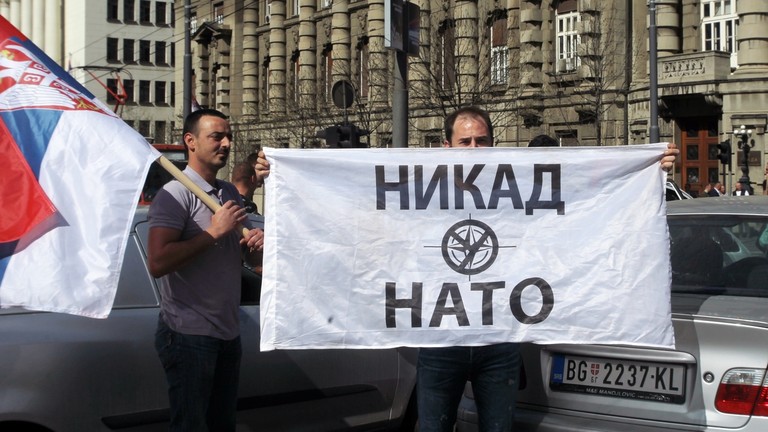
Serbs protesting the EU plan for independence of the breakaway province of Kosovo carry a sign that says ‘Never NATO,’ March 2023. © Sputnik / Aleksandar Jorovich
RT | March 24, 2023
In a carefully worded statement to the public on Friday, US ambassador in Belgrade Christopher Hill commented on the 78-day bombing campaign against Yugoslavia by calling on the Serbs to build a “better future” together with Washington.
“I offer my personal condolences to the families of those who lost their lives during the wars of the 1990s, including as a result of the NATO air campaign,” Hill said in a series of tweets.
“I know that the Serbian people will never forget that terrible time, nor should they,” he added. “The Serbian people will never set aside their grief, but I believe they are strong enough to set aside their grievances.”
The US has an “unwavering” commitment to diplomacy and “partnership” with Serbia, Hill claimed. “Together, we can build the better future the Serbian people deserve and want for future generations.”
His comments came on the anniversary of ‘Operation Allied Force’, the air war launched by the US-led bloc on behalf of ethnic Albanian insurgents in Kosovo. Against the UN Security Council Resolution 1244 that ended the war, the US-backed Kosovo provisional government declared independence in 2008.
As the immediate pretext for the bombing, NATO had cited Belgrade’s rejection of the ultimatum presented by then-US Secretary of State Madeleine Albright at Rambouillet, including a deployment of NATO troops in Kosovo and independence of the breakaway province within three years. Annex B of the proposal also demanded unrestricted access of NATO forces to all of Yugoslavia – present-day Serbia and Montenegro – which the government in Belgrade could not accept.
Hill was present in Rambouillet, and in what seemed to be a nod to that episode, he claimed in his statement that he had learned during his long career that “sometimes diplomacy fails. When it does, the results can be tragic.”
According to official casualty figures by the Serbian government, the 1999 war resulted in the deaths of 1,031 soldiers and police officers, as well as 2,500 civilians – including 89 children. On Friday, Russian Ambassador Aleksandr Botsan-Kharchenko laid a wreath at the children’s memorial in Belgrade.
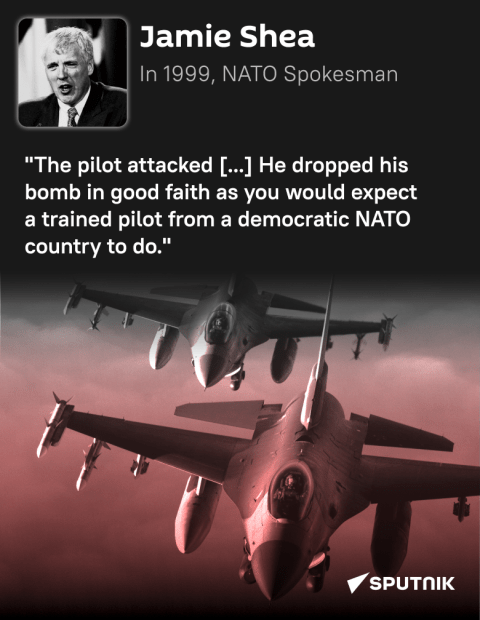
No Guilt, No Shame: Western Leaders’ Excuses for NATO Bombing of Yugoslavia
Sputnik – March 24, 2023
Air attacks by NATO forces on Yugoslavia began this day 24 years ago. Between 1,200 and 2,500 people died within two months, and many more saw their lives crumbling into pieces when the US-led coalition unleashed war and destruction in the midst of Europe.
The decision to bomb Yugoslavia was made without the approval of the UN Security Council, and the order was issued to the commander of the allied forces, US General Wesley Clark, by NATO Secretary General Javier Solana.
Politicians, generals, and journalists from Europe and America engaged in an abominable competition, trying to justify the massacre and sugar-coat the violation of international laws.
The claims of the then-leaders of Western countries are displayed in this Sputnik gallery – alongside the results of the alliance’s brutal operation.






Russia’s ‘inexplicable’ ability to withstand Western aggression

British and French invaders exit from Crimea in defeat
By Drago Bosnic | March 24, 2023
One of the most self-defeating and yet inexplicably persistent mistakes Russia’s enemies have been making for over a thousand years is underestimating it. Regardless of the direction the invasion was coming from, Moscow was able to prevail each time. Its ability to not just successfully defend itself, but also counterattack and reach the opponent’s heartland has been unmatched in modern history. And yet, the myth of Russia’s supposed perpetual decline and dilapidation is an incessant propaganda trope used by its enemies for centuries. None of it ever came true, despite all the grim predictions, which are still being parroted to this very day and are unlikely to go away any time soon, especially nowadays, when the political West needs to keep its populace under the illusion that Moscow is supposedly “losing”.
We often hear that Russia is no more than a regional power with an economy the size of Spain’s, a military budget that has been consistently smaller than the Saudi one, etc. And indeed, on paper, this may seem true. Taking into account nominal GDP as the only measure of success and power, one might fall into the trap of believing such statistics. However, the reality is quite different. All one needs to do is ask just a few logical questions. Could the Spanish economy ever withstand the sanctions imposed on Russia, let alone grow and outperform those enforcing them? Is the Spanish economy a key global supplier of vital commodities such as food, oil, natural gas, various types of heavy machinery, crucial chemical products (such as fertilizers), enriched uranium for nuclear power plants, etc?
And yet, perhaps the most “inexplicable” segment of Russia’s resilience is its military power, particularly the cost-effectiveness of its forces, both on a tactical and strategic level. In 2021, Russia officially spent $65 billion on defense. For comparison, NATO spent close to $1.2 trillion. If we add other key US vassals such as Japan, Australia and South Korea, that figure is close to $1.4 trillion, meaning that the political West spends approximately 22 times more than Russia. So, is “global” NATO 22 times more powerful than Russia? The notion is even more ludicrous if we take into account that Moscow actually outproduces NATO in terms of air defense missiles, artillery shells and other munitions, while also maintaining a strategic arsenal greater and more powerful than that of the political West, combined.
This is without considering Russia’s absolute dominance in key technologies such as hypersonic weapons, with no NATO/Western countries deploying a single operational missile of that type and with no prospects of doing so before 2025 (or beyond). There are other aspects such as Moscow being able to fight on multiple fronts simultaneously, including in Syria, another US/NATO invasion ever so euphemistically dubbed the “Syrian Civil War”, where the Pentagon keeps complaining that its forces there are essentially powerless to stop Russia. This discrepancy in official figures is even more pronounced in Ukraine, where the political West spent approximately $120 billion in little more than a year, which is nearly twice as much as Moscow’s entire annual military budget and approximately 25 times more than what Russia has allocated for the special military operation.
And yet, the Kiev regime forces are suffering staggering losses at a rate of nearly 9:1 in Russia’s favor. Worse yet, Russian forces have consistently been outnumbered 2:1 for over a year now, all the while conducting offensive operations in multiple directions simultaneously. It should also be noted that several former high-ranking US/NATO officers have pointed out that the Neo-Nazi junta forces would be among the top three NATO military powers had the Kiev regime been admitted into the belligerent alliance. Given their performance against the Russian military, while having a massive numerical advantage and NATO providing all the targeting data, as well as getting up to 25 times more funding than the Russian forces deployed on the frontlines, should we be surprised by the panic at the Pentagon?
John Kirby, Spokesman for the National Security Council and a former US admiral, was recently asked to comment on the Russian pilots being awarded medals for masterfully downing a US MQ-9 “Reaper” drone, to which he stated they were “idiots, at best”. However, when we compare the US handling of the so-called “balloon controversy”, things become a lot clearer. It took the Pentagon approximately a week to use the F-22 “Raptor”, its most expensive fighter jet, and shoot down weather balloons with missiles costing nearly $450,000 each. In addition, the F-22 is infamous for its flight hour of around $85,000, as well as costing approximately $350 million apiece. According to The Guardian, the price of one of its targets was a meager $12. Worse yet, it took at least two missiles for the “Raptor” to down one of the balloons it engaged.
If we were to compare this to Moscow’s interception of the US drone which took part in the Kiev regime’s attacks on Russian soldiers and civilians, the discrepancy becomes even more staggering. As previously mentioned, Russian pilots downed a US MQ-9 (the latest Block 5, costing over $32 million) without firing a single shot in an action that lasted no longer than 30 minutes. It should also be noted that the Su-27s they were flying cost approximately $15 million, with the flight hour being around $15,000. When considering those facts, Mr. Kirby should double-check the definition of the term “idiot” or maybe take a good look in the mirror, “at best”.
This also brings us to a rather amusing episode that happened in Serbia over two decades ago. Namely, two years after the (hopefully) final direct US/NATO attack (on this day 24 years ago) on Serbia at the end of nearly a decade-long aggression, a delegation from the Pentagon visited Belgrade, including the main Serbian aviation museum. During the tour that included showcasing downed American aircraft, a member of the US group arrogantly asked one of the Serbian officers how it felt fighting the most powerful military force in history, to which he replied: “I wouldn’t know. We never fought the Russians.” At the time it seemed like a jest that the Americans didn’t take too kindly. However, over 20 years later, the statement seems like anything but a joke.
Drago Bosnic is an independent geopolitical and military analyst.
Why hypersonic weapons change everything
They can sink ALL of the U.S. aircraft carriers, all at once
By Alex Krainer | Trend Compass | March 22, 2023
When it comes to all matters military, I have been following a handful of analysts among whom Croatian Admiral Davorin Domazet (retired) emerged as perhaps my favorite. He has deep and detailed command of technical matters (like Andreiy Martyanov he insists that you can’t prevail in modern warfare without deep knowledge of advanced mathematics and probability). More importantly, he has perhaps the clearest understanding of the broad historical context of today’s clash between Russia and the western powers.
Unfortunately, Admiral Domazet does not give many interviews and none in English, but I thought that his last one was important enough to share more broadly in this article.
If you happen to speak Croatian/Serbian, you can find the interview, published on 17 March 2023 at this link. It runs over 2 hours.
Domazet is the only military analyst that I know of, who takes into account the history of western financial oligarchy, their Venetian roots, migration to Amsterdam where they formed the Dutch Empire, and subsequent move to London which, to this day remains the ideological and spiritual headquarters of the undead British Empire.
He has correctly labelled humanity’s enemy as the “western occult oligarchy,” and has even called the war in Ukraine as the clash between Christ and anti-Christ, underlining that the anti-Christ is in the west. Mind you, Croatia is a NATO member state and is, like Poland, a catholic Slavic nation, sharing even some of its cultural Russophobia (though it may not bequite as rabid in Croatia as it is in Poland).
However, the part of Domazet’s last interview that I found particularly worth sharing was what he laid out about Russia’s hypersonic weapons.
It was in 2018 that Vladimir Putin took the stage to present Russia’s new hypersonic weapons. The term “hypersonic” refers to missiles that fly at speeds of 5 mach and higher. At the time, many in the west dismissed Putin’s claims and thought it was a bluff. We now know that he wasn’t bluffing. Russia is the only country in the world that has deployment-ready hypersonic missiles – not one but three types: Zircons, Kinzhals and Avantguards.
Domazet explained why these weapons are radical game changers in warfare. Namely, in World War 1, tanks were the game changing military technology. Since World War 2, it’s been the air-force. Aircraft carrier strike groups have been an irresistible force wherever they travelled, dominating the seas ever since. But hypersonic precision missiles have rendered that force obsolete overnight.
The main military front in today’s global conflict, according to Domazet, are the Anti-Ballistic (ABM) batteries which the US has set up on the Poland-Romania axis, and the Russians on the North Pole-Kaliningrad-Crimea-Syria axis. These are defensive systems, conceived to intercept incoming nuclear missiles (though they can easily be converted to offensive nuclear missiles). However, today’s ABM systems are only effective against missiles flying at speeds up to mach 3.5 (3.5 x the speed of sound).
Russia’s new Kinzhal missile flies at speeds of mach 12 to mach 15 and nothing in western defensive arsenals can stop its strike. During the war in Ukraine, Russia staged a stunning demonstration of its power. The first Kinzhal strike, delivered one month after the beginning of hostilities in Ukraine, was perhaps the most significant: Russian forces targeted a large weapons depot in Ukraine which had been built during the Soviet times to withstand a nuclear strike. It was buried 170 meters (over 500 ft) underground and protected by several layers of armored concrete.
The Kinzhal flies at altitudes of between 20 and 40 km, with a maximum range of 2,000 km. When above target, it dives perpendicularly and accelerates to 15 mach, generating enormous kinetic energy in addition to its explosive payload. That first strike with a single Kinzhal missile destroyed Ukraine’s nuke-proof underground weapons depot. This was a message for the west.
The Kinzhal was developed with the express purpose of destroying aircraft carrier strike groups. If it could destroy a warehouse built to withstand a nuclear strike, it can cut through an aircraft carrier like a hot knife through butter.
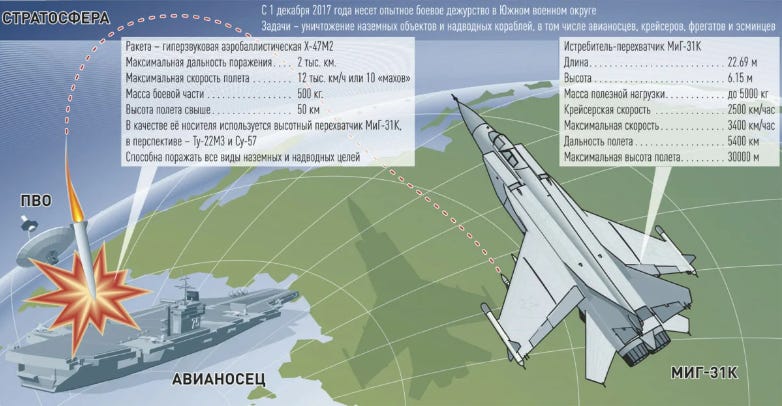
According to Admiral Domazet, neither the western powers nor China are anywhere near having weapons like that. He explained that the critical issue with hypersonic weapons are the extreme temperatures reached during hypersonic flights on the surface of missiles, which can cause them to break apart mid-flight. Russia is the only nation that has developed special materials that enable the missiles to withstand this stress, so their flight can be controlled throughout its trajectory and delivered with pinpoint accuracy.
Western intelligence estimated that Russia had some 50 Kinzhals at the start of the war in Ukraine, and thus far it has used only 9 of them. Last week, they fired six Kinzhals in a single salvo. That too, was a message. Here’s how Domazet explained it: United States have 11 aircraft carrier strike groups. Of these, fewer than half will be active at any one time (while others are in dock for maintenance, or in preparation). Firing six Kinzhals in one go is military-speak for, “we have the capability to sink ALL of your aircraft carriers at once.”
Russia has the capacity to build about 200 Kinzhals per year and now has means of delivering Kinzhal and Zircon missiles anywhere from aircraft, ships and submarines. In addition to destroying aircraft carriers, they can also destroy NATOs ABM missile sites. In a nutshell, Russia is now a clear winner of the 21st century arms race.
It could take the western powers 10 years or longer to catch up and until then, the only way to avoid losing the war is to either concede defeat and accept Russia’s security demands, or to escalate the conflict to nuclear exchange.
A conservative estimate suggests that at least a billion people would perish in such a conflict and nobody would win. Who would do such a thing? The idea of using nuclear weapons is, in fact, so repugnant that we can be assured that our leaders will never chose the path of escalation. Surely, nobody’s that evil, right? Are they?
Featured Video

HE SAVED LIVES. NOW HE FACES PRISON.
or go to
Aletho News Archives – Video-Images
From the Archives
NATO Sanctions and the Coming Global Diesel Fuel Disaster
By F. William Engdahl – New Eastern Outlook – 11.04.2022
Amid the ongoing global inflation crisis, NATO heads of state and mainstream media repeat a mantra that high energy prices are a direct result of Putin’s actions in Ukraine since end of February. The reality is that it is the western sanctions that are responsible. Those sanctions including cutting SWIFT interbank access for key Russian banks and some of the most severe sanctions ever imposed, are hardly having an impact on the military actions in Ukraine. What many overlook is the fact that they are increasingly impacting the economies of the West, especially the EU and USA. A closer look at the state of the global supply of diesel fuel is alarming. But Western sanctions planners at the US Treasury and the EU know fully well what they are doing. And it bodes ill for the world economy.
While most of us rarely think about diesel fuel as anything other than a pollutant, in fact it is essential to the entire world economy in a way few energy sources are. The director general of Fuels Europe, part of the European Petroleum Refiners Association, stated recently, “… there is a clear link between diesel and GDP, because almost everything that goes into and out of a factory goes using diesel.” … continue
Blog Roll
 Aletho News
- Trump meets Rodríguez near Maduro’s prison as Venezuela’s oil flows to US
- Trita Parsi: Middle East Unraveling — Are We on the Path to World War?
- Iran FM meets with US envoy on UN meeting’s sidelines at American side’s insistence: Report
- Qatar PM calls for Gulf security framework with Iran, says war must be ‘wake-up call’
- China condemns US extortion of Iranian airlines, rejects Washington’s ‘illegal’ sanctions threats
- Italy to move military personnel from Taif base after missile strike
- Finland’s Stubb tells European leaders to calm down
- Defeating Russia on battlefield impossible – Fico
- Finland’s Gender Clinic Reversal
- Massachusetts Wants Mental Health Visits, Why Does Government Use ‘Health’ to Enter Our Homes & Families?
- If Americans Knew
- Sanctions are collective punishment: immoral and self-defeating
- Phosphorus Munitions Fired by Israel Burn Groves, Orchards in Southern Lebanon
- Israel Carries Out New Ceasefire Violations Across Gaza
- AI – Emphasis on the ‘I’: Israel Is Funding AI Chatbot Propaganda
- Israel Blocking Hundreds of Wheelchairs for Injured Children From Entering Gaza
- Israel Is Expanding and Upgrading Compounds for Palestinian Militias in Gaza
- The Palestinian-American Residents of This West Bank Town Are Wondering: Where Is Trump?
- Gaza desperately needs tents, wheelchairs, fuel… and everything else (Israel blocks it all) – Daily Update
- Israeli Attacks in Gaza Kill at Least Seven Palestinians Over Three Days, including Woman and Child
- Trump’s militarization of Washington DC as he pursues Israel’s war against Iran
- No Tricks Zone
- New Study: Earth And Venus Surface Warmth Largely Explained By Convection And Lapse Rate, Not CO2 Or Radiation
- 2025 Nature Paper Claiming Worsening Global Drought Gets RETRACTED …Heavily Flawed
- New Study: ‘Global Drought Shows No Detectable Recent Acceleration Under Climate Warming’
- Economic Masterminds: German Socialists Suggest Taxing Productivity Gains Stemming From Using AI
- The South China Sea Has Not Been Cooperating With The Climate Change Narrative
- Energy Crisis: Germany Enters Heating Season With Historically Low Gas Reserve Fill Levels
- New Study: The Antarctic Ice Sheet Gained Mass From 2020-2024 Due To Staggering Snow And Ice Accumulation
- Study: Ocean Heating Rates From Thousands Of Years Ago ‘Dwarf’ Modern Ocean Heating Rates
- Climate Extremists Target, Attack Large-Scale Power Grid Infrastructure In Germany!
- New Study: Antarctic Ice Melt Has Contributed Less Than 1 Centimeter To Sea Level Rise In The Last 30 Years

