Greenland to Receive NATO Representation for First Time Ever
By Igor Kuznetsov – Sputnik – 21.03.2023
In recent years, the Arctic has once again risen to one of the top priorities for the US and NATO. The region, rich in natural resources, has been designated as a potential corridor for strategic competition, particularly with Russia and China, and is seeing massive military investments.
Greenland’s government, Naalakkersuisut, and the Danish Foreign Ministry have for the first time agreed to send a Greenlandic diplomat to NATO to represent the remote part of the Danish Realm.
“It is important that Greenland increases its insight into the security policy development in the High North and NATO’s focus on the region,” Greenland’s Department for Foreign Affairs, Business and Trade said in a statement.
“It is also important that NATO increases its understanding of the special conditions of our region and our society, and familiarizes itself with our interests, our values and priorities,” Greenlandic Minister for Foreign Affairs, Business and Trade Vivian Motzfeldt said.
Lida Skifte Lennert, who has 25 years of experience in Greenland’s central administration behind her, will become the island nation’s first permanent representative at the US-led alliance’s headquarters in Brussels.
Greenland, the remotest part of the Danish Realm, has recently become a key area of US and NATO interest amid the military build-up in the far north. The US opened a consulate in Greenland’s capital Nuuk and has shown a keen desire to secure access to the rare minerals found in the Greenlandic depths. In 2019, former US President Donald Trump notoriously shocked Denmark with an surprise offer to buy Greenland, but received a cold shoulder from Copenhagen.
In recent years, the Arctic has returned to the top of the US security and defense agenda. Already in the Pentagon’s 2019 Arctic strategy the region was designated as a potential corridor for strategic competition, particularly with Russia and China. Denmark, too, has placed a greater emphasis on the military upgrade of its faraway territories, the Faroe Islands and Greenland.
The world’s largest island has notoriously harsh weather conditions, a dramatic lack of infrastructure and a slim 55,000 population, in which native Inuit comprise a majority. Nevertheless, it has since World War II repeatedly hosted US military bases, most notably the Thule Air Base, the northernmost US military installation, located some 1,500 kilometers from the North Pole, and the now-defunct Sondrestrom Air Base, which was turned over to the Greenlandic government in 1992. The Thule Base remains intact and plays a key role in the US military’s ability to detect and provide early warnings for ballistic missile attacks. It also harbors the world’s northernmost deepwater port and was promised an upgrade in 2022.
Camp Century that operated between 1959 and 1967 at the height of the Cold War, was yet another sign of US involvement on the island. The ice-cap base was intended as a platform for nuclear launches that could survive a first strike from the enemy. However, the missiles were never fielded and the necessary consent from the Danish government to do so was never achieved. Subsequently, the project was aborted as unfeasible as the ice sheet was realized to lack the necessary stability. Nevertheless, the project ran a nuclear reactor that was later removed. Still, hazardous waste buried under the ice has since become an environmental concern, particularly in recent years.
Earlier this year, Denmark Proper and the US were reported to be negotiating a new defense cooperation agreement, which was confirmed by Danish Foreign Minister Lars Lokke Rasmussen. He also said that the agreement should create “the possibility of a permanent American presence.”
Greenland received home rule in 1979 and passed a self-rule law in 2009, which would allow the island to declare full independence, but it would have to be approved by a referendum among the Greenlandic people. There are several parties in Greenland pushing for full independence from Denmark. A string of polls have consistently indicated that while there is a clear majority for full independence among Greenlanders, there is clear opposition to it, if it were to imply a fall in living standards. Currently, Greenland is dependent on an annual subsidy of around $600 million from Copenhagen, which accounts for about two-thirds of the island’s budget and one-quarter of the nation’s entire GDP. The rest of the economy relies on fisheries and tourism. Payments from the US for the network of military installations also play a part.
Putin: Russia Will be Forced to React if West Starts Using Weapons With Nuclear Components

By Fantine Gardinier – Sputnik – 21.03.2023
UK Minister of State for Defense Annabel Goldie said on Tuesday that London would provide Ukraine with armor piercing shells for the Challenger 2 main battle tanks it has decided to send to Kiev, including depleted uranium ammunition.
“Today it became known that the United Kingdom, through its deputy head of the ministry of defense, announced not only the supply of tanks to Ukraine, but also shells with depleted uranium,” Russian President Vladimir Putin said, adding that “it seems that the West really decided to fight Russia to the last Ukrainian, not in words, but in deed.”
“I would like to note in this regard that if all this happens, then Russia will be forced to react accordingly – I mean that the Collective West is already starting to use weapons with a nuclear component,” Putin added.
His comments came after meetings with a delegation of high-level Chinese officials, including Chinese President Xi Jinping.
Depleted uranium is a byproduct of the uranium refining process composed of uranium-238, which is not useful for generating nuclear chain reactions but which is extremely dense and used to make armor-piercing ammunition. However, it still possesses radioactive properties that can be very harmful to humans and is highly toxic, making it a dangerous weapon long after the engagement in which it was fired.
Sites in Iraq and Yugoslavia which US forces used depleted uranium to attack have been associated with increases in birth defects and rare forms of cancer associated with exposure to radioactive materials, including depleted uranium and related radioactive isotopes.
While Moscow has repeatedly warned about the creeping danger of some kind of nuclear exchange as a result of NATO’s support for Ukraine in its conflict with Russia, Western governments and media have tried to spin such warnings as being threats about the use of nuclear weapons. Putin has since made it explicitly clear that Moscow intends to maintain its no-first-use policy regarding nuclear weapons.
Russia launched its special operation in Ukraine in February 2022 after months of negotiations with Kiev and NATO failed to yield a situation that respected Moscow’s security red lines, most especially regarding Ukraine’s prospective membership in the alliance and the possibility of NATO weapons being stationed on Russia’s borders. The operation aims to neutralize that possibility.
Lavrov: Such Actions Undermine Stability
The decision of the United Kingdom to provide Kiev with depleted uranium tank ammunition undermines stability in the world, Russian Foreign Minister Sergey Lavrov said on Tuesday.
“I will not be surprised by this, because they have already lost perspective in terms of how these actions undermine strategic stability around the world,” Lavrov told a Russian broadcaster.
The minister added that this decision shows that the UK is ready to not only just take risks, but also commit war crimes.
“If this is true, then they [UK authorities] are ready to not only just take risks, but violate the international humanitarian law, as it was in 1999 in Yugoslavia, and many other things, including war crimes, crimes against humanity,” Lavrov said.
Hungary gives Ukraine ultimatum on EU and NATO membership
RT | March 21, 2023
Ukraine will not be allowed to join the EU or NATO until it restores the rights of ethnic Hungarians living in its Transcarpathian Region, Hungary’s Foreign Minister Peter Szijjarto said on Tuesday.
Speaking at a press conference in Brussels, Szijjarto added that the US-led military bloc was violating its own rules by pushing ahead with a set of meetings involving the Kiev government despite Budapest’s objections.
“I would like to say that we will not support any significant integration movement of Ukraine towards the EU or NATO until the rights of the Hungarian ethnic community that it had prior to 2015 are restored in Ukraine,” the foreign minister told reporters.
Around 150,000 ethnic Hungarians live in modern Ukraine’s Transcarpathian Region, just across the border from Hungary. Budapest will not give up on them “under any circumstances,” despite pressure from both sides of the Atlantic to do so, Szijjarto added.
He also objected to the convening of the NATO-Ukraine Committee on ministerial level despite Budapest’s objections.
“This decision violates NATO’s unity and procedures for the unity of will,” Hungarian government spokesman Zoltan Kovacs said on Tuesday, referring to the bloc’s consensus requirement.
Szijjarto has voiced his objections to NATO Secretary General Jens Stoltenberg, but agreed to attend the April 4 meeting for the “opportunity to discuss minority protections.”
Hungary became a member of NATO in 1999 and joined the EU in 2004. In recent months, Brussels has withheld funding from Budapest in an attempt to compel the government of Prime Minister Viktor Orban to implement a set of policies championed by the bloc, which he has rejected as harmful.
Hungary has consistently argued for a negotiated end to the hostilities in Ukraine. Budapest continues to prohibit any transit of weapons or ammunition through Hungarian territory, and has not agreed to supply Kiev with arms or ammunition.
US, EU agree on major weapons shipments to Ukraine
Press TV – March 21, 2023
The United States and the European Union have announced new shipments of military aid to Ukraine.
The US government announced on Monday a new package for the Kiev forces fighting Russian troops in pro-Moscow regions in eastern Ukraine. Secretary of State Antony Blinken said Washington will send Ukraine $350 million in weaponry and equipment.
Separately, a group of 17 EU member states plus Norway said they have agreed on a two-billion-euro plan to deliver artillery rounds and other ammunition to Ukraine over the next year.
EU foreign policy chief Josep Borrell had called on member countries to provide Kiev with one million artillery rounds, including from their own stockpiles. Borrell described the move as “a historic decision” for the 27-nation bloc and Norway.
“We are taking a key step towards delivering on our promises to provide Ukraine with more artillery ammunition,” he said, noting 18 countries had signed up to a European Defense Agency (EDA) project to place joint orders for ammunition with the defense industry.
In the meantime, Kiev has complained its forces are compelled to ration firepower as Russia’s special military operation in Ukraine, which kicked off more than a year ago, has turned into an exhaustive war of attrition.
The secretary general of the NATO, however, says Ukraine’s Western allies are having a hard time keeping up with Kiev’s ever-increasing demand for ammunition.
“The war in Ukraine is consuming an enormous amount of munitions, and depleting allied stockpiles,” Jens Stoltenberg told reporters last month.
Russia launched the war after Kiev’s failure to implement the terms of the 2014 Minsk agreements and Moscow’s recognition of the breakaway regions of Donetsk and Luhansk.
Since then, the US and its European allies have imposed unprecedented economic sanctions against Moscow while supplying large consignments of heavy weaponry to Kiev, flooding Ukraine with tens of billions of dollars of weapons and munitions. Moscow has condemned the West’s weapons shipments to Kiev, warning that it will only prolong the war.
Polish diplomat believes Warsaw might join conflict in Ukraine
By Lucas Leiroz | March 21, 2023
Escalation and internationalization may be very close to happening in the Ukrainian conflict. In a controversial and irresponsible statement, a leading Polish diplomat announced that his country may send troops to the battlefield if Kiev fails to prevent a Russian victory. The official’s words sound like a frontal threat and could have drastic consequences, considering that such a scenario would represent a direct confrontation between Russia and a NATO country – it just remains to be seen whether the Atlantic alliance would be concerned with defending its Eastern European proxies.
The threat was made by Poland’s ambassador to France, Jan Emeryk Rosciszewski, on March 18, during an interview with the French media. Rosciszewski accused Moscow of being solely responsible for the hostilities, echoing the Western hegemonic narrative. According to him, no NATO country is to blame for the fact that the conflict is prolonging, if not the Russian government itself, which would be deliberately increasing international tensions. As expected, however, he did not show any evidence to support his narrative.
The main problem is that Rosciszewski did not limit himself to accusing Moscow of being the “wrong side” of the conflict, but also said that Poland may be “forced” to send troops to Ukraine. For Rosciszewski, Russian victory is unacceptable as it would represent the end of the “values” that form the basis of the European civilization.
“Either Ukraine will successfully defend its independence, or we [the Polish people] will be forced, in any case, to join this conflict (…) Otherwise, our principal values, which are the basis of our civilization and our culture, will be in fundamental danger, so we will have no choice”, he said.
As expected, the case generated a scandal and many newspapers around the world announced the ambassador’s words as an official declaration that his country would be in combat readiness to face Russia. The attitude was praised by Western warmongers, who support that as many countries as possible join the conflict and engage in a total war on Russia.
The Polish Embassy in France, however, felt pressured in the face of the irresponsible acts of its own head and released a note clarifying that his intention was not to state that Poland would be ready to face Russia – but to warn about the possible consequences of a Ukrainian defeat.
“Listening carefully to the entire conversation allows us to understand that there was no announcement of Poland’s direct involvement in the conflict, but only a warning against the consequences of Ukraine’s defeat – the possibility of Russia attacking or dragging into the war more Central European countries – the Baltic states and Poland”, the Embassy’s statement reads.
Despite the effort, the Embassy was unable to reduce the seriousness of the situation with its note. Rosciszewski was very clear in his words. He literally said that his country would be “forced” to fight if Ukraine was not capable to defend itself. In a scenario of evident Ukrainian defeat which is already beginning to be admitted even by the Western media, this obviously sounds like a declaration of combat readiness. There is no room for other interpretations.
Among Russians, despite not having much repercussion, the case was commented on by Senator Alexey Pushkov. According to him, the Ambassador only said what Polish politicians “have long had on their minds”. However, he warned that Polish “courage” is motivated by the certainty of US support in an eventual war with Russia. Pushkov questioned this conviction, suggesting that there would be no real mobilization on the part of Washington.
“A very presumptuous statement by the Polish ambassador in Paris. For the first time, an official representative of Poland said what its leaders have long had on their minds. However, all the ‘courage’ of the Poles is based on the support of the United States. Is Warsaw sure that Washington is ready to fight?”, he said.
The senator’s alert is very important because it raises a question that has also been put by many military experts around the world. It is visible that, incited by the US, Poland and the Baltics have taken hasty and absolutely irresponsible actions, suggesting that they want to enter into open war with Moscow. They do so because they are certain that they would receive support from the entire Atlantic alliance, as foreseen in the fifth article of the NATO charter.
However, many analysts doubt this. On several occasions, the US has already demonstrated that its unilateral will prevails over NATO’s partnership. It would be very naive to believe that the country that bombed the Nord Stream pipelines in a deliberate act of sabotage against Germany would engage in a war of catastrophic consequences just to support Poland and the Baltic states.
In fact, what many Eastern Europeans still do not understand is that they are just serving as an instrument in proxy wars in which the US does not want the alliance to be directly involved. The American objective is to prepare its regular troops for a war with a greater possibility of victory than one with Russia. For this, NATO wants to multiply fronts and distract Russian forces on different battlefields. In this sense, it is unlikely that Poland’s joining in the conflict will change anything in the status of the war – on the contrary, it is much more possible that such a situation definitively reveals that NATO is not an alliance based on common principles and interests, but a mere instrument of war submitted to the unilateral will of the US.
Lucas Leiroz, journalist, researcher at the Center for Geostrategic Studies, geopolitical consultant.
PM Orbán: ‘Europe suffers from war psychosis’
Remix News | March 17, 2023
The main issue facing Europe today is war, which puts Hungary in a difficult situation, as the effects of war are severe and immediate, Hungarian Prime Minister Viktor Orbán said at a meeting of the Organization of Turkic States summit in Ankara.
The prime minister stressed that, unfortunately, Europe was suffering from a “war psychosis,” with the continent drifting further into war day by day. Orbán thanked the leaders of the Turkish states for strengthening the voice of peace. Hungary — on account of its population’s Asian origins — is an honorary member of the Organization of Turkic States.
Orbán thanked Turkish President Recep Tayyip Erdoğan, who, he said, had so far been able to mediate successfully between the warring parties, and called on him to continue his efforts in the future.
“Only in this way can we have a chance for peace,” Orbán said. He also thanked the Turkish president for the fact that Hungary and Turkey could coordinate their work within NATO.
Hungary’s geographical proximity to the war has placed the issue of pursuing peace at the top of the agenda for Hungary, according to Orbán.
“Ukraine is a neighboring state, and the effects of the war are therefore severe and direct, with inflation skyrocketing and energy prices at an all-time high,” he said, adding that “many Hungarians have now died in the war because men from the Hungarian community in western Ukraine are also being conscripted into the army.”
“For Hungary, the most important thing is to save human lives, and that is why we are advocating a ceasefire as soon as possible and peace negotiations.”
At the same time, the prime minister expressed the view that what is happening in Europe is more than just war, because in fact, “the whole of Europe is being reshuffled in terms of power relations,” and this will also have repercussions for Turkey. He added that Hungary is also seeing another threat: “There are processes going on in the world economy that could lead to a new global balance.”
He said that the segmentation of the world economy is against Hungary’s interests, and Hungary sees its future not in segmentation, but in acting in the collective interest and improving interconnectivity.
“The Turk states can play a key role in this, because here we are European, Caucasian and Central Asian countries connected to each other on the basis of mutual respect, setting a good example for the whole world,” the prime minister said in his speech.
US decides whether or not Kiev should negotiate peace

By Lucas Leiroz | March 20, 2023
The announcement of Chinese President Xi Jinping’s visit to Moscow to meet Vladimir Putin is shaking Western war plans. After presenting a peace project, the Chinese government now demonstrates that it is considering Russian interests in the conflict as relevant, which is why the country’s president decided to go to Moscow. As well known, peace and Russian interests are inadmissible points for the Collective West, which is why an important American official has already publicly declared that any Chinese peace proposal must be automatically rejected by Ukraine. The case shows quite clearly that the neo-Nazi regime in Kiev is just a proxy for NATO, not having the capacity to decide sovereignly whether or not to negotiate an agreement.
According to John Kirby, spokesman for the White House National Security Council, any Chinese ceasefire proposal must be considered unacceptable after Xi Jinping’s visit to Moscow. Kirby believes that the Chinese gesture and conversations with Putin in person before Zelensky demonstrate that Beijing is writing a peace proposal that takes into account only Russian interests, possibly seeking to ensure the preservation of Russian territorial gains so far. That, for Kirby, would make any dialogue unfeasible.
More than that, the spokesperson sees the growing Russian-Chinese cooperation as an attempt to end the “rules-based order” and reverse the legacy of post-WWII international society. According to him, Russia and China “don’t like” the order built by the “US and its allies” and want to rewrite the world according to new guidelines with the current partnership being a part of this process.
“If, coming out of this meeting, there’s some sort of call for a ceasefire, well that’s just gonna be unacceptable, because all that’s gonna do is ratify Russia’s conquests to date. All that’s gonna do is give Mr. Putin more time to refit, retrain, remain and try to plan for renewed offensives at a time of his choosing (…) We hope, and we’ve said this before – that President Xi will call and talk to President Zelensky, because we believe the Chinese need to get the Ukrainian perspective here (…) There’s no question [that Russia and China] are chafing against this international rules-based order that the United States and so many of our allies and partners have built up since the end of World War II. They don’t like that. They’d like to rewrite the rules of the game globally and they have been increasing their cooperation and their relationship, certainly of late”, Kirby said.
It is curious to analyze how Kirby tries to transform simple things into something absurd, illogical and condemnable. Indeed, Russia and China plan to change the current world order – not because they are averse to the idea of a world guided by diplomacy and international law, but because the order that has prevailed in recent decades is essentially unipolar. There are no real “rules” in the prevailing order – there is only the unilateral will of the US being imposed on all nations. This is obviously something the Russians and Chinese want to change, as they plan for their countries to have absolute sovereignty over their territories and preserve a regional zone of influence, without interference from foreign powers.
It is not about “not liking” what the “US and its allies” built in the post-WWII, but critically understanding that since the end of the Cold War the US has acted as a hegemonic power at the global level, with carte blanche to commit crimes, coups d’état, invasions and wars, while all other states have their freedom restricted by what is called “rules” – which are not applicable to Washington. This is something that needs to be changed and indeed Russian-Chinese cooperation works in this direction.
On the other hand, it is interesting to see how the US decides whether or not Kiev should negotiate peace. If Ukraine is indeed a sovereign state, as the West hypocritically claims when it condemns Russia’s reintegration referendums in the east, then it is the Zelensky government that must decide whether or not to accept a ceasefire, regardless of the circumstances and imposed conditions. However, once again it is clear that the Kiev regime is only a proxy in NATO’s war with Russia, having no authority to decide whether or not to continue fighting.
Indeed, it is absolutely rational for the Chinese to pay more attention to Russian interests and talk to Putin before Zelensky. Moscow is winning the war and the winning side naturally needs to have its interests heard first during a peace negotiation. This is a basic principle of diplomacy, but the West insists on ignoring it both because it needs to publicly maintain the “Ukrainian victory” narrative and because it wants the conflict to prolong indefinitely.
Lucas Leiroz, journalist, researcher at the Center for Geostrategic Studies, geopolitical consultant.
US paranoid about Russia-China summit
BY M. K. BHADRAKUMAR | INDIAN PUNCHLINE |MARCH 19, 2023
The arrest warrant issued by the International Criminal Court against Vladimir Putin can only be seen as a publicity stunt by the Anglo-Saxon clique, with the US leading from the rear. Ironically, though, the ICC acted on the eve of the 20th anniversary of the Anglo-Saxon invasion of Iraq in 2003, which led to horrific war crimes but the “judges” at Hague slept over it. Both Washington and London admit today that the 2003 invasion was illegal — based on trumped up allegations against Saddam Hussein.
There’s no chance, of course, that the ICC warrant will ever be taken seriously. ICC has no jurisdiction in Russia, which like the US is not a signatory to the Rome Statute. But the intention here is something else.
The mud-throwing at Putin is yet another display of President Biden’s visceral hatred towards the Russian leader that goes back in time by well over a decade, and is timed to distract attention from the state visit by Chinese President Xi Jinping to Moscow on Monday, an event that not only has spectacular optics but is sure to intensify the “no limit” partnership between the two superpowers.
The Anglo-Saxon clique is watching the talks in Moscow tomorrow with dismay. To be sure, Moscow and Beijing have decided to stand together to push back the US hegemony.
Today, China exceeds the combined manufacturing capacity of the US and its European allies, and, equally, Russia has emerged as the world’s largest nuclear weapon state superior to the US both in the quantity and quality of the weaponry.
It has dawned on the American mind that Russia cannot be defeated in Ukraine. There is a chicken-and-egg situation facing NATO, according to a report in Politico. Massive investments are needed to catch up with Russia’s defence industry but Europe’s ailing economies have other critical priorities.
The notions of defeating Russia in a proxy war in conditions of “sanctions from hell” have turned out to be delusional. It is US banks that are collapsing, it is European economies that are threatened by stagnation.
The US’ exasperation is evident in the top secret mission by MQ-9 Reaper drone near the Crimean peninsula on March 14. US Global Hawk drones have been spotted regularly over the Black Sea in recent years but this case was different.
The Reaper’s transponder was switched off as it entered Russia’s temporary regime for the airspace established for the purposes of the special military operation near the Crimean peninsula (which Moscow had duly notified to all users of international airspace in accordance with international norms.)
In the event, Russia’s Su-27 fighter jets outmanoeuvred the Reaper, which lost control and drowned in the Black Sea. Moscow conferred state awards to the two pilots who drove Reaper to the seabed.
The Russian ambassador in Washington has since warned that while Moscow is not seeking any escalation, any deliberate attack on a Russian aircraft in neutral airspace will be construed as “an open declaration of war against the largest nuclear power.”
If the US planned the drone incident to test Russia’s reaction, well, the latter has given an unambiguous message. And all this took place in the immediate run-up to President Xi’s visit.
Biden since hit back by welcoming the ICC warrant on Putin saying “it’s justified… (and) makes a very strong point.” But Biden’s memory is failing him. For, the stated American position on ICC is that Washington not only doesn’t recognise the jurisdiction of the ICC but if any US national is arrested or brought before the ICC, Washington reserves the right to use military force to rescue the detainee!
Furthermore, Washington threatens reprisal against any country that cooperates with an ICC warrant against a US citizen. The George W Bush administration stated this categorically against the backdrop of the horrific war crimes in Iraq, and the US never resiled from it.
By the way, there has been no referral by the UN Security Council or General Assembly to the ICC. So, who organised this arrest warrant? Britain — who else? The Brits bullied the ICC judges who are highly vulnerable to blackmail, as they draw fat salaries and would sup with the devil if it helped secure extended terms for them at the Hague. This becomes yet another case study of the piecemeal destruction of the UN system by the Anglo-Saxon clique in the recent years.
Suffice to say, the drone incident and the ICC warrant vitiate the climate for any dialogue between Moscow and Kiev. Evidently, the Anglo-Saxon clique is worried like hell that China might spring another surprise as it did recently by mediating the recent Saudi-Iranian deal.
In a meaningful remark, the Chinese foreign ministry spokesperson Wang Wenbin said on Friday that Xi’s visit is partially to promote “peace.” Beijing has already released a “peace plan” for Ukraine, a 12-point agenda for “a political resolution of the Ukraine crisis,” which is on Zelensky’s table in Kiev although the West studiously chose to ignore it.
In a phone call on Thursday, Chinese foreign minister Qin Gang told his Ukrainian counterpart Dmytro Kuleba that Beijing hopes “all parties will remain calm, rational and restrained, and resume peace talks as soon as possible.”
The Chinese readout said Kuleba discussed “the prospect of peace talks … and noted that China’s position paper on the political settlement of the Ukraine crisis shows its sincerity in promoting a ceasefire and an end to the conflict. He expressed the hope to maintain communication with China.”
Unsurprisingly, Biden is paranoid about China’s push to mediate between Moscow and Kiev. The point is, he and Zelensky are locked in a deathly embrace — the corruption scam involving the activities of Biden’s son in Kiev is hanging over POTUS like the Damocles’ sword, while on the other hand, Zelensky is fighting for political survival and is increasingly acting on his own.
Disregarding western doubts about the wisdom of holding the shattered frontline city of Bakhmut, Zelensky is digging in and keeping up an attritional defence that may drag on. (Politico)
Evidently, Biden is acting like a cat on a hot tin rood. He can neither let go Zelensky nor can afford to be locked into a forever war in Ukraine while Taiwan Straits beckons.
Beijing’s stance has visibly hardened lately and the scorn that the US poured on China’s national pride by shooting down its weather balloon has only exacerbated the distrust. Similarly, the nadir has been reached for Russia with the Reaper drone provocation and the Anglo-Saxon clique’s ICC scam. A point of no return has been reached.
Xi has chosen Russia for his first visit abroad in his third term also, the war in Ukraine notwithstanding. While announcing Xi’s visit to Russia, the Chinese Foreign Ministry said, “As the world enters a new period of turbulence and change, as a permanent member of the UN Security Council and an important power, the significance and influence of China-Russia relations go far beyond the bilateral scope.”
Again, Biden would have thought he was putting Putin on the mat with the Reaper stunt and the ICC scam. But Putin is nonchalant, choosing today to defiantly make his first-ever visit to Donbass.
Putin toured Mariupol, the port city that was bitterly contested by the NATO operatives, drove a vehicle along the city streets, making stops at several locations and surveying reconstruction works. It was a defiant signal to Biden that NATO has lost the war.
“A Policy Error of Historic Proportions”
1997 letter to President Clinton by US cold warriors who opposed Nato expansion
By John Leake | Courageous Discourse | March 17, 2023
When Dr. McCullough and I started this Substack, we agreed that he would primarily focus on COVID-19 scientific-medical scholarship, and I would investigate how the COVID-19 pandemic response is related to other major public policy issues. Occasionally, some of our readers have exhorted me to “stay in our lane”—that is, to remain focused on matters pertaining to the COVID-19 fiasco.
Because Substack is a free speech platform, and because we welcome critical opinions, I have never felt compelled to respond to these exhortations to “stay in our lane.” To some degree, I consider my critics to have a valid point. As Fitzgerald elegantly put it in The Great Gatsby, “Life is much more successfully looked at from a single window.”
On the other hand, I believe my critics are overlooking a point so obvious that it might as well strike them in the head with a baseball bat—namely, the same corrupt government nincompoops responsible for the COVID-19 fiasco are also responsible for every other catastrophic policy blunder they are currently afflicting on mankind.
For example, let’s take the U.S. government’s catastrophic mismanagement of its relations with Russia for the last thirty years. I have closely observed this disaster in the making since I moved to Vienna, Austria for an academic fellowship in 1996. On the plane to Vienna I read the July 15, 1996 Time Magazine cover story about how secret American advisors helped Boris Yeltsin to win that year’s presidential election.
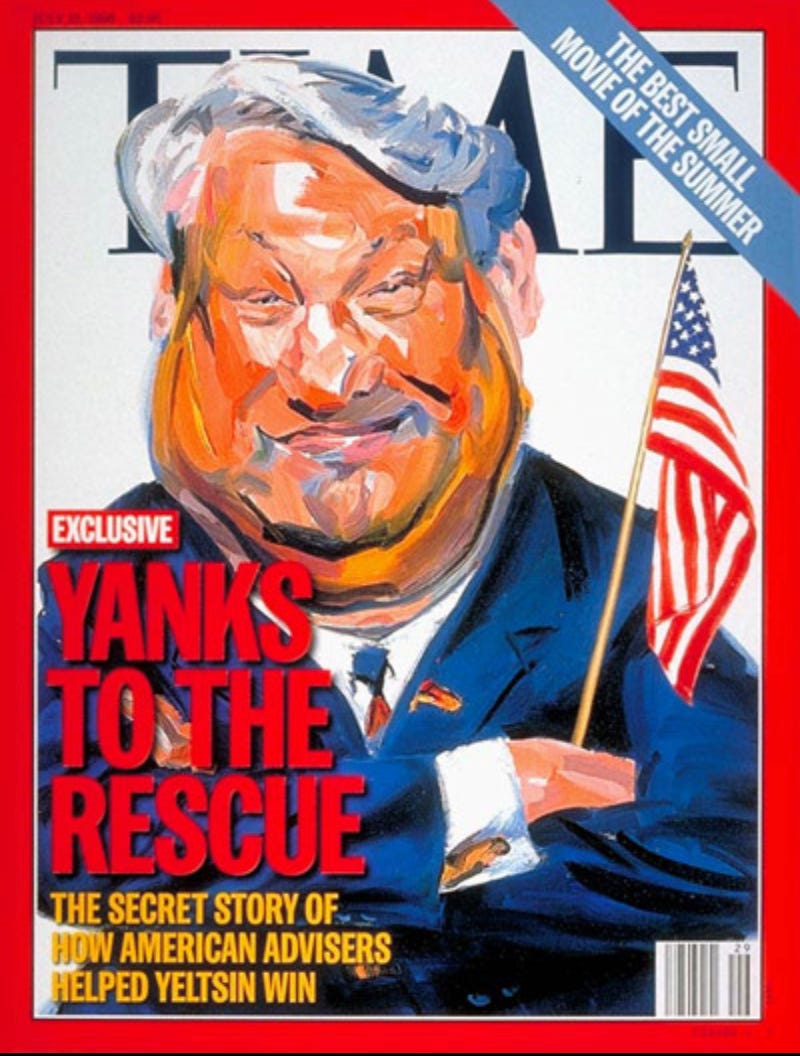
Even at the time I remember thinking it was a bit presumptuous to think that it was perfectly okay for American agents to meddle in a Russian election, and I wondered how Americans would feel if it were reported that Russian agents had provided clandestine assistance to Bill Clinton in his 1996 presidential campaign against Bob Dole.
I read the Time cover story with keen interest, because for many years I’d been an avid student of 20th century Russian history. Yeltsin’s presidency marked the total triumph of American interests with respect to Russia, which had suffered a decisive loss of the Cold War. As I saw it—living in Austria, whose neutrality the Soviets had recognized and respected since 1955—in 1996 it was up to the Americans to welcome and assist Russia in becoming a partner with the West.
The following year, I read the news of how the Clinton Administration had decided to expand NATO membership to the east, ever closer to Russia’s border, and I wondered about the rationale for doing this. Though I’d never really known what to make of Henry Kissinger, I found his “Balance of Power” thesis compelling.
We humans are constantly making assurances of our good will and altruism, but it’s a rare man or woman indeed who doesn’t press his or her advantage if a disagreement arises. This is why the Soviet Premier Khrushchev refused to tolerate U.S. nuclear missiles in Turkey, and why President Kennedy refused to tolerate Soviet missiles in Cuba.
I therefore believed I understood why 50 major U.S. foreign policy experts—including top cold warriors such as Robert McNamara, Paul Nitze, Richard Pipes, and Stansfield Turner—wrote a letter to President Clinton on June 26, 1997, stating the following:
We, the undersigned, believe that the current U.S.led effort to expand NATO, the focus of the recent Helsinki and Paris Summits, is a policy error of historic proportions. We believe that NATO expansion will decrease allied security and unsettle European stability for the following reasons:
In Russia, NATO expansion, which continues to be opposed across the entire political spectrum, will strengthen the nondemocratic opposition, undercut those who favor reform and cooperation with the West, bring the Russians to question the entire post-Cold War settlement, and galvanize resistance in the Duma to the START II and III treaties; In Europe, NATO expansion will draw a new line of division between the “ins” and the “outs,” foster instability, and ultimately diminish the sense of security of those countries which are not included;
In NATO, expansion, which the Alliance has indicated is open-ended, will inevitably degrade NATO’s ability to carry out its primary mission and will involve U.S. security guarantees to countries with serious border and national minority problems, and unevenly developed systems of democratic government;
In the U.S., NATO expansion will trigger an extended debate over its indeterminate, but certainly high, cost and will call into question the U.S. commitment to the Alliance, traditionally and rightly regarded as a centerpiece of U.S. foreign policy.
Because of these serious objections, and in the absence of any reason for rapid decision, we strongly urge that the NATO expansion process be suspended while alternative actions are pursued. These include:
—opening the economic and political doors of the European Union to Central and Eastern Europe;
—developing an enhanced Partnership for Peace program;
—supporting a cooperative NATO-Russian relationship; and
—continuing the arms reduction and transparency process, particularly with respect to nuclear weapons and materials, the major threat to U.S. security, and with respect to conventional military forces in Europe.
Russia does not now pose a threat to its western neighbors and the nations of Central and Eastern Europe are not in danger. For this reason, and the others cited above, we believe that NATO expansion is neither necessary nor desirable and that this ill-conceived policy can and should be put on hold.
AUTHOR’S NOTE: This post is the first in a series about the war in Ukraine.
US and its ‘horrible’ leaders are greatest threat to Western civilization – Trump
RT | March 17, 2023
Former US president Donald Trump slammed “globalists” and the American neoconservative establishment in a video posted to his social media accounts on Thursday, declaring that the US and “some of the horrible, USA-hating people that represent us” are the “greatest threat to Western civilization today.”
“These globalists want to squander all of America’s strength, blood and treasure, chasing monsters and phantoms overseas while keeping us distracted from the havoc they’re creating right here at home,” the 2024 presidential candidate explained. “These forces are doing more damage to America than Russia and China could ever have dreamed.”
Trump warned that the Biden administration had brought the world closer to the brink of nuclear catastrophe than ever before by pouring money and weapons into Ukraine. “Every day this proxy battle continues, we risk global war,” he insisted, arguing that a “total cessation of hostilities” should be the “central issue” for the nation.
The next order of business under a second Trump presidency would be a complete overhaul of the State Department, Pentagon, intelligence services, and other key agencies to “fire the Deep Staters and put America first” – followed by “fundamentally reevaluating NATO’s purpose and NATO’s mission.” Trump has long argued for European countries to shoulder more of the costs and responsibilities associated with the military bloc and recently described the Ukraine conflict as a “vital concern for Europe, but not for the United States.”
Trump reassured his supporters that he was ready to dismantle “the entire globalist neocon establishment that is perpetually dragging us into endless wars pretending to fight for freedom and democracy abroad while they turn us into a third world country, and a third world dictatorship, here at home.” While the 45th president did not name any of the globalists or neocons who have placed highly on his enemies list since taking office in 2016, he insisted that he alone knew “exactly what to do to get the job done.”
Trump is polling neck to neck for the Republican nomination with Florida Governor Ron DeSantis, who has not yet officially declared his 2024 candidacy. DeSantis recently told Fox News host Tucker Carlson that supporting the Ukrainian military was not a “vital interest” of the US. Other presumed Republican candidates, including former UN envoy Nikki Haley and former national security adviser John Bolton, have embraced the Biden administration’s bottomless aid to Kiev.
US ‘obviously’ blew up Nord Stream – French politician
RT | March 17, 2023
French political party leader Florian Philippot believes it has long been obvious that the United States was behind last year’s sabotage of the Nord Stream pipelines, which were built to deliver Russian natural gas to Western Europe.
“Even before the war in Ukraine, the US for years fought against Nord Stream, it was a permanent part of their policy,” he told RIA Novosti in an interview published on Friday.
“In early February 2022, [US President Joe] Biden said the Americans could make it so that the pipeline was no more. That’s what happened. And it was in the interest of the Americans,” according to Philippot, who heads the right-wing The Patriots party in France.
Last month, veteran investigative journalist Seymour Hersh reported that Biden personally ordered the bombing of the pipelines, and that Norway assisted in the sabotage. He cited an unnamed source and supported his case using some of the same arguments as Philippot.
Biden remarked that “there will be no longer a Nord Stream 2” during a joint press conference with German Chancellor Olaf Scholz in early February 2022. Hersh also claimed that Biden allowed US special services to classify the operation in a way that justified not informing the US Congress about it beforehand.
Nord Stream 2 is the name of the second, newer pipeline, which was meant to greatly expand the capacity of the original Nord Stream, but was never operational. Both were disabled by sabotage.
Philippot said he considered US culpability “obvious” even before Hersh’s revelations, but was not sure about Norway’s role. He reasoned that Oslo had a motive since it “competes with Russia in gas trade, and many European nations replaced the Russian gas with Norwegian.” Both the US and Norway have denied any responsibility.
Philippot also urged France to leave NATO, saying the military alliance “needs to be disbanded because it has no reason to exist.”
“We have to stop this agenda of world war against Russia and China, it is absolutely insane,” he told the Russian news outlet, blaming the US for increasing global tensions.
He also called French President Emmanuel Macron a deceitful leader. His government “prioritizes the US, and not its own people,” Philippot stated.
He cited Macron’s decision to send billions of dollars worth of weapons and ammunition to Kiev, even as he is pushing through an unpopular pension reform, claiming a lack of money to fund social programs.
MQ-9 Drone Incident: Biden’s Dangerous Escalation
By Scott Ritter – Sputnik -16.03.2023
A US surveillance drone crashed off the coast of Crimea after an encounter with a Russian fighter aircraft. What does this incident say about the current state of the war in Ukraine and where Russia and the US might go from here.
In 2015, the United States established a permanent training facility in Yavoriv, western Ukraine, for the express purpose of training Ukrainian soldiers for combat against Russia.
At that time the conflict in Ukraine was an internal affair, pitting the Ukrainian Army against Ukrainians of ethnic-Russian background who had rebelled against a US-backed coup which, in February 2014, saw the constitutionally elected government of President Viktor Yanukovych replaced by a pro-American government.
This new Ukrainian government, hand-picked by the US, was deeply infused with radical ultra-nationalism linked to the ideology of Stepan Bandera and the Organization of Ukrainian Nationalists, or OUN, which fought alongside Nazi Germany during the Second World War and whose members were responsible for the murder of hundreds of thousands of civilians.
Many of the Ukrainians being trained by the US military were affiliated with the neo-Nazi Azov Battalion, an organization which many in the US Congress at the time found so odious that the passed an amendment to the defense authorization act prohibiting US taxpayer dollars from being used to train its members.
These restrictions aside, there can be no doubt that the purpose of the US training mission in Ukraine was to prepare the Ukrainian military to go to war against Russia. That the US training not only instructed the Ukrainians troops on modern combined arms maneuver warfare, but also sought to elevate the Ukrainians to the same standard used to train the forces of the North Atlantic Treaty Organization (NATO), provided the first inkling that any future conflict between Ukraine and its disenfranchised ethnic Russian population that involved Russia would be far more than a simple confrontation between two regional neighbors, but a larger war between Russia and the US and NATO—the so-called “collective west”, using Ukraine as a proxy.
This reality was amplified further with the provision by the US and NATO of advanced anti-tank missile systems and other lethal military assistance.
Even before Russia initiated the Special Military Operation, in February 2022, the United States, the United Kingdom, and NATO began a program of intelligence sharing with the Ukrainian armed forces at the highest levels. Once the Russian troops moved across the border, the nature of this intelligence relationship shifted away from providing indications and warning of an impending attack, to the provision of operational and tactical intelligence about Russian military disposition, capabilities, and intent that was used by Ukraine to target Russian forces.
While the US and its NATO allies are understandably reticent about the nature of this intelligence, and the sources from which it is derived, over time it has become clear that every available intelligence collection platform is being used to gather relevant data about Russian military operations in support of the Special Military Operation.
It is also clear that this intelligence is used by joint operational planning cells comprised of US/NATO/Ukrainian forces to develop targets in real time, which are then transmitted to Ukrainian forces.
One of the more ubiquitous intelligence resources employed by the US in support of Ukraine is the MQ-9 Reaper. The MQ-9 is a large a large unmanned aerial vehicle (UAV) operated by the Air Force. It is remotely operated by a two-person team from a ground control station that is connected to the MQ-9 using satellite equipment. The team includes a qualified pilot who is responsible for flying the aircraft and an enlisted aircrew member who is charged with operating any onboard sensors or weapons the MQ-9 might be carrying.
The MQ-9 has a wingspan of 66 feet, is 36 feet long, 12 feet high, and weighs approximately 4,900 pounds. It is capable of flying at altitudes as high as 50,000 feet and has a range of some 1,400 miles. It can carry a wide variety of weapons and intelligence collection pods. Each MQ-9 costs about $32 million. The MQ-9 Reapers operating over the Black Sea are flown out of a Romanian Air Force base in Campia Turzii by members of the US Air Force’ Detachment 1, 31st Expeditionary Operations Group.
On March 14, 2023, an MQ-9 Reaper operating out of Campia Turzii was flying in international airspace over the Black Sea, west of Crimea. This was a standard flight profile for the MQ-9 Reaper, one that had the Russians concerned, given its proximity to sensitive Russian military installations.
Ukraine had a history of launching operations against Russian forces in Crimea using aerial and underwater drones, and the potential for intelligence collected by the MQ-9 Reaper being used in support of such attacks was very real. For this purpose, the Russian military had declared certain areas off the coast of Crimea as being off limits.
The US, however, does not recognize Russia’s claim to Crimea, or for that matter the four new territories of Kherson, Zaporozhye, Donetsk and Lugansk, that joined the federation following referendums held in September 2022 and, as such, does not recognize any claim regarding the establishment of no-fly zones by Russia in support of its ongoing military operations against Ukraine. The decision to fly the MQ-9 Reaper was made knowing Russia would object, or worse.
Indeed, Russia dispatched a pair of Su-27 fighter aircraft to intercept the MQ-9 Reaper. After making 19 passes at the Reaper, the Su-27’s conducted what can only be described as aggressive maneuvering designed to either compel the MQ-9 Reaper to depart the area, or else bring it down. After one particular incident, which may or may not have involved one or more Su-27 aircraft dumping fuel onto the Reaper, the MQ-9 lost control and crashed into international waters off the coast of Crimea.
It is believed that Russian forces dispatched from Crimea recovered most, if not all, the wreckage, including the top-secret intelligence pod that had been mounted under the left wing of the aircraft. If this is the case, critical US intelligence collection capabilities would have been compromised, allowing Russia to better protect itself from sensors like the one carried onboard the downed MQ-9 Reaper aircraft.
While the US State Department has declared that the US will continue to fly missions in international airspace, the Commander of US forces in Europe, General Christopher Cavoli has ordered all MQ-9 Reaper operations to be halted pending a review of the incident and a decision on how best to proceed.
The fact that the US is using the MQ-9 Reaper to fly in direct support of Ukrainian military forces make the aircraft a direct participant in the conflict, and as such a legitimate target for Russia. Russia’s decision not to shoot the MQ-9 down, but rather provide multiple opportunities for the US aircraft to disengage and leave the contested airspace, is indicative of Russia’s desire to avoid unnecessary escalation of the conflict, especially one that could have US and Russian forces engaged in direct combat.
One of the options that the US could consider would be to fly the MQ-9 with a US fighter escort. But this would be contested by Russia, leading to the possibility of a dogfight that could result in casualties on both sides, and the probability of escalation. At the end of the day, the US will probably seek to fly an MQ-9 Reaper on a course that comes close to, but does not violate, a declared Russian no-fly zone, after which MQ-9 Reaper flights along the Crimean coast will probably be discontinued.
There are other ways to collect the intelligence that the MQ-9 Reaper gathers which do not put US military assets at risk, and which do not provide the possibility of military escalation between the US and Russia.
Such a decision would be a sharp departure from the confrontational stance taken to date by the US when it comes to intelligence collection targeting Russia. However, the devolving military situation in Ukraine, with the Ukrainian military facing a decisive defeat in Bakhmut and in general, alters the risk-gain analysis that accompanies the decision to fly missions such as the one that resulted in the downed MQ-9 aircraft. With little chance of a Ukrainian victory in sight, the US will be looking for ways to deescalate, rather than escalate, its involvement in the Ukrainian conflict.
Whether or not the MQ-9 Reaper incident will result in a top-down review of incidents of this nature, for example prompting the Biden administration to reflect on the apparent hypocrisy of the US approach toward responding to the Chinese balloon “threat”, namely by shooting the balloon down, while condemning the more restrained approach taken by Russia in responding to a genuine military threat on its borders in an active warzone, is yet to be seen. Such an abut-face would be unlikely, given the current political climate, where Russophobia runs rampant.
The fact remains that as long as the US is engaged in the implementation of a wartime policy that seeks the strategic defeat of Russia, the possibility for rational, logic-based policy formulation and implementation on the part of the US is almost nil.
The shortest path for the normalization of US-Russian relations lays in a decisive victory being achieved by Russia over Ukraine and the collective west in the shortest time possible. Such an outcome would force the US and its NATO allies to reexamine their approach toward Russia based upon the new realities that would accrue from such an outcome.
Featured Video

Trita Parsi: Middle East Unraveling — Are We on the Path to World War?
or go to
Aletho News Archives – Video-Images
From the Archives
Trans agenda is ‘normalization of sadism’ – US author

RT | September 23, 2026
The US Democratic Party has embraced a transgender agenda that amounts to “the normalization of sadism,” author A.J. Rice has said, warning that radical trans policies would return if the party is allowed to regain power.
Speaking to RT’s America First host Scotty Nell Hughes about his new book, ‘The Curse of the Bearded Lady: How the Trans Mafia Whacked American Sanity’, Rice argued that activists have gained significant influence in schools, medicine, and corporate America while people who questioned the agenda have faced pressure to stay silent.
The author described the “trans mafia” as the sprawling network of people and institutions that have helped the movement gain influence. He singled out parts of academia, wealthy backers, and corporations, and stated that providers of transition-related treatment also have a financial incentive to keep young people in their care indefinitely.
Rice argued that the consequences of these policies ultimately fall on children who are being drawn toward gender-affirming medical treatments and on girls who are expected to share locker rooms or compete in sports with biological males.
He noted that while voters rejected the Democrats’ approach to gender in 2024, the party, which has been “captured by madness,” has since only doubled down and is seeking what is effectively “the normalization of sadism.” … Full article
Blog Roll
 Aletho News
- Mahan Air Flight Lands in China Despite US Threat against Iranian Airlines
- US eyes $10bn fund to rebuild war-battered Gulf infrastructure
- Trump meets Rodríguez near Maduro’s prison as Venezuela’s oil flows to US
- Trita Parsi: Middle East Unraveling — Are We on the Path to World War?
- Iran FM meets with US envoy on UN meeting’s sidelines at American side’s insistence: Report
- Qatar PM calls for Gulf security framework with Iran, says war must be ‘wake-up call’
- China condemns US extortion of Iranian airlines, rejects Washington’s ‘illegal’ sanctions threats
- Italy to move military personnel from Taif base after missile strike
- Finland’s Stubb tells European leaders to calm down
- Defeating Russia on battlefield impossible – Fico
- If Americans Knew
- Sanctions are collective punishment: immoral and self-defeating
- Phosphorus Munitions Fired by Israel Burn Groves, Orchards in Southern Lebanon
- Israel Carries Out New Ceasefire Violations Across Gaza
- AI – Emphasis on the ‘I’: Israel Is Funding AI Chatbot Propaganda
- Israel Blocking Hundreds of Wheelchairs for Injured Children From Entering Gaza
- Israel Is Expanding and Upgrading Compounds for Palestinian Militias in Gaza
- The Palestinian-American Residents of This West Bank Town Are Wondering: Where Is Trump?
- Gaza desperately needs tents, wheelchairs, fuel… and everything else (Israel blocks it all) – Daily Update
- Israeli Attacks in Gaza Kill at Least Seven Palestinians Over Three Days, including Woman and Child
- Trump’s militarization of Washington DC as he pursues Israel’s war against Iran
- No Tricks Zone
- New Study: Earth And Venus Surface Warmth Largely Explained By Convection And Lapse Rate, Not CO2 Or Radiation
- 2025 Nature Paper Claiming Worsening Global Drought Gets RETRACTED …Heavily Flawed
- New Study: ‘Global Drought Shows No Detectable Recent Acceleration Under Climate Warming’
- Economic Masterminds: German Socialists Suggest Taxing Productivity Gains Stemming From Using AI
- The South China Sea Has Not Been Cooperating With The Climate Change Narrative
- Energy Crisis: Germany Enters Heating Season With Historically Low Gas Reserve Fill Levels
- New Study: The Antarctic Ice Sheet Gained Mass From 2020-2024 Due To Staggering Snow And Ice Accumulation
- Study: Ocean Heating Rates From Thousands Of Years Ago ‘Dwarf’ Modern Ocean Heating Rates
- Climate Extremists Target, Attack Large-Scale Power Grid Infrastructure In Germany!
- New Study: Antarctic Ice Melt Has Contributed Less Than 1 Centimeter To Sea Level Rise In The Last 30 Years

