Germans’ Support for Kiev May Wane Amid ‘Contrived’ Nord Stream Reports, Ex-US Official Says
Sputnik – 15.03.2023
Chancellor Olaf Scholz may fail to maintain public support in Germany for arming Kiev amid hardly credible reports blaming Ukraine for the Nord Stream attack, former Pentagon analyst Karen Kwiatkowski told Sputnik.
In early February, Pulitzer Prize-winning journalist Seymour Hersh reported that US navy divers planted explosives on the Nord Stream pipelines. Just a few days after Scholz held talks with President Joe Biden at the White House on March 3, American and German media reports surfaced placing the blame for the attack on a pro-Ukraine group.
In an interview aired earlier on Monday, Russian President Vladimir Putin called the version of the involvement of Ukrainian activists in the explosion at Nord Stream “complete nonsense.” Putin told the Rossiya 1 broadcaster that the explosion was carried out by specialists supported by all the might of a state with certain technologies.
Kwiatkowski suggested Germans opposed to continued war aid could use the stories to blame Ukraine for Germany’s economic challenges, or they could use the “contrived” story as another example of US and NATO lies.
“Overall, the ‘story’ is an insult to the intelligence of the average German, and as such it will both weaken German support for [Ukrainian President Volodymyr] Zelensky, and increasingly show German voters that Scholz himself is a tool of Washington, DC, putting US desires for war on the continent above the needs and the sovereignty of actual Germans,” Kwiatkowski said.
“That support has been declining due to cost, economic turmoil in Germany, and the pressure and stress of hosting and supporting over a million Ukrainians, most of whom intend to stay there.”
The amateur statesmen and spymasters in Washington, Kwiatkowski added, barely conceived of this story in time for Scholz’s visit, she said.
“And it appears they may have needed the German Chancellor’s advice and consent, before providing the unsubstantiated and vague storyline to friendly media,” the former Pentagon analyst said.
If the report itself were more believable, Kwiatkowski explained, or was accompanied by arrests, actual evidence and data, it perhaps would not be as damaging.
Kwiatkowski said it is unlikely that German intelligence has not known the basic facts of the pipeline attacks for many months, but until Hersh’s reporting Scholz and his party could simply remain silent, “as they did.”
The pipeline sabotage was an act of war by the United States, Kwiatkowski argued, as documented by Hersh, but it remains to be seen whether this was an act of war against Russia, against Germany, “or horrifyingly, both.”
“It is most certainly a ploy to shift the focus, because if an act of war were to be committed by the dominant NATO member against the next strongest NATO member, the entire NATO construct would collapse,” she added. “This possibility must not only be denied, it must be suppressed and eliminated.”
Former CIA station chief and analyst Phil Giraldi told Sputnik the new reports do not seem credible versus what Hersh revealed from sources involved in the actual destruction of Nord Stream. He also said the timing of the new narrative is suspicious coming after the “nothing-happened” meeting between Biden and Scholz.
Eurasia Group Vice President Earl Rasmussen said the stories emerging in the wake of Scholz’s visit to Washington are obviously no coincidence and the entire embarrassing affair will diminish Germany’s respect world-wide.
Russia’s hypersonic response to latest NATO and Kiev regime escalation
By Drago Bosnic – March 14, 2023
In the last several days, multiple sources have published information regarding the Kiev regime’s usage of a number of NATO weapons and munitions, including the JDAM (Joint Direct Attack Munition) bombs. JDAMs are standard unguided freefall/gravity bombs (so-called “dumb bombs”) equipped with a guidance kit that converts them into all-weather PGMs (precision-guided munitions). Guided by an integrated inertial guidance system combined with a GPS receiver, JDAMs have a declared range of up to 30 km, although this has been extended with newer versions, such as the JDAM-ER (up to 70 km). Precisely this type was given to the Neo-Nazi junta in recent weeks, according to the US Air Force Europe (USAFE) command.
According to The War Zone, USAF General James Hecker, head of USAFE, as well as NATO’s Allied Air Command and US Air Forces Africa (AFAFRICA), confirmed this during last week’s media roundtable.
“Recently, we’ve just gotten some precision munitions [to Ukraine] that had some extended range and go a little bit further than the gravity drop bomb and has precision [guidance],” Hecker said, adding: “That’s a recent capability that we were able to give them probably in the last three weeks.”
The exact type of the JDAM-ER provided to the Kiev regime is not entirely clear, although General Hecker himself used the designation GBU-62. The original weapon is used exclusively in naval warfare, but this one seems to have been modified for use against ground targets. And while it’s not entirely clear what platform the Neo-Nazi junta forces are using to deploy these weapons, General Hecker hinted that they were most likely integrated on existing Soviet-era jets in the same way as the US-made AGM-88 HARM (High-speed Anti-Radiation Missiles). Since last year, HARMs have been used by the Kiev regime forces’ MiG-29 and Su-27 fighter jets to target Russian air defenses. It’s very likely that this is the case, although it’s not impossible that the Su-24 and even Su-25 jets could be used for this purpose.
Local sources have reported the use of JDAMs on March 10, specifically in the vicinity of Bakhmut (Artyomovsk). It should be noted that such weapons require extensive ISR (intelligence, surveillance, reconnaissance) assets, which the Kiev regime simply doesn’t have. This only leaves NATO as the side directly providing targeting data. And while this is nothing new, as the United States and its NATO vassals have been doing this for over a year now, it does represent a new level of escalation, prompting Russia’s express response. According to the latest battlefield reports, Moscow responded with its own PGMs, specifically smart bombs used by the now legendary Su-57, as well as mass usage of air-launched hypersonic weapons.
The Kiev regime troops tasked with air defense recently reported that the Russian Aerospace Forces (VKS) used at least six 9-A-7660 “Kinzhal” air-launched hypersonic missiles at once, complaining that they have no means of intercepting such weapons. Deployed since at least 2017 and used by modified MiG-31K/I superfast interceptors and Tu-22M3 long-range bombers/missile carriers, “Kinzhals” are some of the most advanced weapons in the history of warfare, being capable of not just using standard and thermonuclear warheads, but also their sheer speed and the resulting kinetic energy to neutralize targets of both tactical and strategic importance. Not even NATO itself has any means of intercepting such weapons, while it is yet to deploy anything remotely similar.
The Russian military previously announced that the scale of production of the hypersonic missile is being streamlined and expanded significantly, most likely by using the same production lines for the ground-launched “Iskander” hypersonic missile with which it has a high commonality in terms of design. The weapon has been used at least since March 18, 2022, when it obliterated Neo-Nazi junta facilities near the Polish border. And while it can certainly be considered an “overkill” against the Kiev regime forces, launching up to six “Kinzhals” at once is most likely a clear message to the increasingly aggressive US-led political West. This possibility is further reinforced by reports from certain DPR sources which are claiming that a command center packed with NATO personnel was one of the targets for the hypersonic weapon.
In addition, the Su-57 was also confirmed to be using new types of PGMs specifically designed for the stealth jet. The weapon in question is a derivative of the Kh-38M air-to-ground missile. On March 12, various local Ukrainian sources shared footage showing the remains of what appears to be the “Grom” (“Thunder” in Russian) PGM. The Tactical Missiles Corporation (KTRV) developed two versions of the weapon. The first (“Grom-1”) is a tactical cruise missile with a range of 120 km. The second version, dubbed “Grom-2”, had its engine removed and additional explosive payload added instead, turning it into a high-precision glide bomb. Its range is up to 50 kilometers. In addition to key battlefield advantages, both weapons can also be considered a clear message to NATO, whose massive mainstream propaganda machine has been insisting for over a year that Russia is both running out of weapons and unable to produce advanced PGMs.
Drago Bosnic is an independent geopolitical and military analyst.
The Washington scenario in phase two is to fight Russia to the last European
By Gilbert Doctorow | March 12, 2023
My latest essay on the wrongheadedness of Belgian and French labor leaders fiddling while Rome burns elicited a number of Contact messages that are too important to keep to myself. What is at issue is how we read the scenario for the further course of the ongoing war in and over Ukraine: will it go on for years at the present level of intensity or is some devastating escalation to be feared in the coming months when the long-promised Ukrainian counter-offensive gets under way.
Allow me to say up front that no one knows for sure. But some observers point to schisms within the Washington establishment, in particular within the State Department, over how determined Russia is to react to violation of its red lines.
One can blame Vladimir Putin all one wishes for the restraint in prosecuting this war that is misinterpreted as cowardice or indecisiveness in the halls of power in Washington. Assigning blame for the misreading of Russia’s intentions changes nothing. The result is that the more hawkish side of the Washington establishment is urging upon the President measures that risk the onset of a full-blown war between Russia and the European powers in the immediate future.
I say “European powers” rather than NATO, because nearly all commentators agree that the U.S. has no intention of putting its own soldiers and homeland at risk when it can play with self-sacrificing proxies. The incredible acceptance of such rules by European leaders has been demonstrated manifestly by German Chancellor Schulz’s silence over the U.S. planned and executed destruction of the Nord Stream II pipelines.
Stage one of the Ukraine war as scripted by the USA was to fight against Russia to the last Ukrainian. Stage two is to fight against Russia to the last European.
In the past few weeks, the USA has delivered to Bremerhaven in Germany and to Gdansk in Poland vast quantities of military hardware that is not going to Kiev but is being prepared for a war with Russia to be fought by either of those states with or without NATO backing. A week ago, one of the US “Doomsday Planes” that coordinate action in a nuclear war came to Europe via Iceland. Smart observers noted this could be an exercise to prepare nuclear attacks on Russia using warheads and delivery systems already on European soil.
Let us remember that Victoria Nuland remains the most important personality in the State Department, head and shoulders above her nominal boss, Blinken. This is the lady who famously, while planning the coup d’etat of February 2014 that overthrew Ukrainian President Yanukovich, was recorded as telling the then U.S. ambassador to Kiev “fuck the EU.” Well, according to information in the public domain that is exactly what she is cooking up today and we, Europeans, are in the soup.
Nuland is said to be the loudest mouth calling for provision to Kiev of long range precision missiles for a summer attack on Crimea which will surely elicit a game-changing level of violence in the response from Russia, possibly entailing strikes against the logistical centers in Poland, Romania and Germany which are delivering the new weapons systems to Ukraine. There are ways this can happen which will make invocation of NATO’s ‘one for all and all for one’ Article 5 problematic.
This is not to say that the United States is not at the same time preparing a back-up scenario in case the Russians go for the principal villain and not for the European implementers. In the past week, a nuclear capable B-52 bomber of the U.S. Air Force is said to have been rehearsing an attack on St Petersburg.
In conclusion, I ask those of my European readers who are leaders in financial institutions, in wealth management, in manufacturing industry, in global shipping, in universities and in widely respected think tanks (from my LinkedIn account I know that some of you are daily followers of these essays), I ask you to use your voices, in public and in private to save Europe from the disaster that may befall us in a matter of months. Salvation will come only when several more European heads of state join Viktor Orban in voting against further arms to Kiev and for an immediate cease-fire. What we need now is definitive peace negotiations between Moscow and Kiev based on the principle of a neutral Ukraine.
©Gilbert Doctorow, 2023
The Empire of Lies Strikes Back… Extraordinary Cover-Up of Nord Stream Terrorism
Strategic Culture Foundation | March 10, 2023
The New York Times and other Western news media ran with clumsy and blatantly diversionary claims this week, which in the end only serve to draw even more attention to the guilt of the United States in blowing up the Nord Stream gas pipelines.
Not only is the administration of U.S. President Joe Biden even more indictable over the criminal act; the absurd cover-up attempt this week exposes the Western media as nothing but a ministry of propaganda masquerading as journalism.
Four weeks ago, the eminent independent American journalist, Seymour Hersh, published a blockbuster investigative report that revealed how President Biden and senior White House staff ordered the explosive detonation of the natural gas pipelines connecting Russia to the European Union via the Baltic Sea and Germany. The legendary Hersh has an impeccable record of groundbreaking stories, from the My Lai massacre committed by U.S. troops in Vietnam in 1968 to the Abu Ghraib prison torture in Iraq under American occupation to the operation of ratlines to funnel weapons and mercenaries from Libya to Syria to fight Washington’s proxy war for regime change in Damascus.
In his seminal report on the sabotage of the Nord Stream pipelines, Hersh relied on insider Washington sources. He published claims that the United States carried out the covert operation using a team of U.S. Navy divers under the cover of NATO war maneuvers known as BALTOPS 22 last summer. Explosives were planted on the seabed during the exercises held in June 2022 and then later detonated on September 26 with the help of Norwegian military aircraft.
The convincing aspect of Hersh’s report was not just the credible detail of the operation, but that it confirmed what many independent observers had already concluded from strong circumstantial evidence about who had the motive and means to conduct the sabotage. Readers are referred to a recent editorial by Strategic Culture Foundation which compiles the background of why the United States is deemed to be the culprit.
Now here is a curious thing. While Hersh’s report provoked shockwaves around the world, Western governments and the mainstream media chose to ignore his report. In a weird parallel universe sort of way, they pretended that Hersh’s resounding revelations did not exist.
One would think that given Hersh’s reputation for world-news-breaking scoops, and given that his latest report revealed a rock-solid plausible account of how a major civilian infrastructure project was sabotaged, and further given that the implication of this report was the inculpation of the United States and its president and his senior staff in ordering an act of terrorism – one would think that, maybe, just maybe, the Western media would be obliged to give some reportage on that matter. No, far from it, they unanimously kept schtum. In a way that is quite shocking and a travesty.
The charade of silence was maintained for a month until this week when the New York Times published a report claiming an alternative explanation for the Nord Stream explosions. As if on cue, there then followed a rash of other Western media reports regurgitating or spinning the same story.
Laughably, the New York Times claimed its report was “the first significant known lead about who was responsible for the attack on the Nord Stream pipelines”. This after a month of pointedly ignoring and effectively censoring from the public any knowledge of the spellbinding Hersh article.
The thrust of this week’s “reports” (if they could be called that) are that the sabotage was carried out by “pro-Ukrainian groups” which may have involved Ukrainian or Russian nationals. The source of the claims was anonymous US officials citing purported “new intelligence”. It was also claimed that a private yacht owned by Ukrainians was used and that the CIA had tipped off German intelligence about the impending attack months before it happened.
The information reported is so vague as to be impossible to verify, or frankly to even merit credibility. We are led to believe that a sophisticated, highly technical military operation on the Baltic seabed was somehow carried off by a group of unknown paramilitaries. The New York Times and other Western media outlets published stories that on their face are outlandish. This is gutter press stuff.
Furthermore, from the way the reports are formulated it is obvious that they are meant to serve as a rebuttal to the Hersh report without actually properly acknowledging the Hersh report. Thus, the United States denies any involvement in a criminal act that it barely refuses to acknowledge. This double-think is itself indicative of guilt in the Empire of Lies.
The problem for the Western propaganda peddlers – besides sheer implausibility – is the further burden of having to provide an alibi for the Kiev regime. The U.S. and its NATO allies need to distract from Washington as the obvious author of the crime, but they also cannot afford to implicate the Kiev regime because that could inflame European and American public antipathy towards the NATO-sponsored junta. This is why the New York Times & Co appear to be involved in a tortuous balancing act of blaming Ukrainian militants for the Nord Stream blasts but also claiming that these intrepid militants managed to do so without the knowledge of President Vladimir Zelensky and his cabal. Which again makes the narrative doubly ridiculous.
There is also an important element of timing to all these Western media shenanigans. Last week, German Chancellor Olaf Scholz was hosted in the White House by Joe Biden on March 3 in what was a bizarrely private meeting. Their conversations behind closed doors were not disclosed. Both leaders stonewalled reporters about their discussions. It can be fairly speculated that Scholz was pleading with Biden for some political cover because of the mounting anger among the German public about the economic consequences of America’s policy over Ukraine and Russia. Germany’s industry and export-led economy have been ravaged by the loss of Russia’s traditional natural gas supply. Scholz and his government are seen to be behaving treacherously by going along with what appears to be American vandalism of the German economy. For the Hersh report to go unanswered is causing massive public pressure on the Berlin government. Hence this week, we saw attempts to divert public attention with a concerted Western media campaign about who supposedly blew up Nord Stream. The aim is to absolve Washington and its lackeys in Berlin.
Another timing issue was the sudden appearance of Ukrainian and Russian fascist commandoes who carried out the terrorist attack in Russia’s Bryansk region on March 2 last week. Two adults were killed and a young boy was badly injured in what was a gratuitous atrocity that made international headlines. That daring raid, however, brought to public attention the existence of pro-Ukrainian militants who appear to act as lone wolves in international operations. This is the very kind of profile that the New York Times and other Western media outfits attributed to the Nord Stream sabotage. That begs the reasonable question: was the Bryansk terror attack enabled by Western military intelligence handlers in order to promote the subsequent media disinformation effort concerning the Nord Stream pipelines?
Let’s cut to the chase. The Western media disinformation campaign is a crude joke. It can’t distract from the glaring facts that the United States and its NATO allies carried out an act of international terrorism against European companies and governments, and an act of war against Russia as the main owner of the 1,200-kilometer Nord Stream pipelines worth at least $20 billion to construct. That criminal act was plausibly ordered by an American president and his White House aides. The geopolitical motives are overwhelming as are the self-indicting admissions by Biden and his aides before and after the odious event.
The cack-handed attempts this week to cover up by the Western media only serve to further incriminate the United States and its NATO crime partners. In addition, the Western media are exposed more than ever as being complicit in propagandizing war crimes. The New York Times and other Western news outlets pompously claim to be pinnacles of journalism and defenders of public interest and democracy. They are nothing but the propaganda ministry for Washington – the Empire of Lies.
Kosovo wants NATO-Serbia war – Belgrade
RT | March 11, 2023
Serbian President Aleksandar Vucic has accused the ethnic Albanian authorities in the breakaway province of Kosovo of attempting to provoke a war in which NATO would once again take their side.
“They want to drag Serbia into a conflict with NATO. Kurti wants to be like [Vladimir] Zelensky, and I would be some kind of [Vladimir] Putin,” Vucic said on Friday, referring to Kosovo Prime Minister Albin Kurti and the presidents of Ukraine and Russia.
“It’s what they’re after, what they’ve been doing all along. And in this, they have the support of a significant part of the international community, because [Kosovo] is their child,” he added.
Vucic was commenting on the recent arrest of an ethnic Serb on charges of “war crimes” dating back to the 1998-99 conflict, which ended with NATO bombing Serbia on behalf of ethnic Albanian separatists. The provisional government in Pristina declared independence in 2008, with Western support, which Belgrade has refused to recognize.
“They don’t want normalization, they want to humiliate Serbia,” argued Vucic. “But I’m telling you, that won’t happen. There will be no humiliation, no capitulation.”
The proposal for “normalization of relations” between Pristina and Belgrade, made public last month by the EU, amounts to a de facto recognition of the breakaway province, which would have the right to join NATO, the EU, and the UN. Vucic insists he did not sign anything and will never agree to those terms.
“We are preparing for talks on Monday or Tuesday,” he said, referring to the EU-sponsored talks in neighboring North Macedonia. “But it’s not clear to me why. They said they wouldn’t agree to a deal. Well, why are you coming then? For us to recognize Kosovo?”
Vucic insists that before anything else can happen, the EU needs to enforce the 2013 Brussels Agreement, which among other things envisioned political autonomy for ethnic Serbs in the province. The ethnic Albanian authorities have refused to implement that part of the deal for ten years now, insisting it clashes with the ‘constitution’ of Kosovo. Neither the EU nor the US has done anything to influence Pristina to change its mind, Vucic noted.
Instead, the EU has just granted Kosovo visa-free travel to the bloc, while threatening an economic boycott against Serbia unless it joins the Western sanctions against Russia.
Russia Called The US Out For Double Standards Towards Georgia-Moldova & Bosnia-Serbia
By Andrew Korybko | March 11, 2023
Russian Foreign Minister Sergey Lavrov remarked that the US hypocritically wants regime change in comparatively neutral Georgia while opposing it in Western-aligned Moldova, after which his spokeswoman Maria Zakharova said that it supports Bosnia’s territorial integrity but violates Serbia’s. Calling that declining unipolar hegemon out for its double standards towards these two pairs of countries in similar situations is meant to raise wider awareness of the US’ self-interested policies.
Its infamous “rules-based order” has nothing to do with the UN Charter like its proponents falsely claim and everything to do with the arbitrary implementation of selective standards designed to advance the US’ zero-sum interests. In the first pair of Georgia and Moldova, both are experiencing very intense protests at the moment, but the former are Western-backed and designed to pressure Russia while the second are purely indigenous and designed to restore this country’s neutrality in the New Cold War.
As for the second pair of Bosnia and Serbia, the US has feigned worry that the former’s Serb region might separate from the federation that it was forced into in 1994 while doing everything in its power to support the separatist claims of the latter’s Autonomous Province of Kosovo & Metohija. In this example, the double standards are applied because retaining Bosnian “unity” is integral to upholding Western hegemony in the Balkans, the outcome of which is further advanced by splitting Serbia.
Pointing out the US’ hypocritical approach towards each pair of countries, which is objectively existing and easily verifiable, discredits its soft power by exposing just how unprincipled its foreign policy truly is. The only constant is that it always aims to advance US zero-sum interests as was previously explained, to which end it’ll employ whichever double standards are necessary. Morals, ethics, international law, and principles will never stand in the way of the US maximizing its power.
Awareness of this “politically incorrect” reality in turn extends credence to what Russia has always claimed since the onset of its special operation last year, namely that it was forced to resort to military means for defending its national security red lines in Ukraine after NATO clandestinely crossed them. For whatever the most gung-ho Western readers might think about the preceding explanation, there’s no denying that the Kremlin has retained narrative consistency over the years compared to the US.
Moscow began warning about NATO’s eastward expansion earlier this century, most famously during President Putin’s keynote speech at the Munich Security Conference in 2007. By contrast, Washington gaslit by claiming that there’s no credible reason for that country to be concerned by this, yet at the same time also alleging that Russia’s military presence in the former Soviet Republics of Georgia and Moldova that was agreed to per deals for ending their civil wars destabilizes their respective regions.
It was always the US and not Russia that obstructed peace efforts in those two countries unlike what the Mainstream Media claimed, all with a view towards indefinitely perpetuating their “frozen conflicts” in order to more effectively divide-and-rule them. Instead of encouraging their Western-aligned authorities to pragmatically compromise with their ethnic rebels, Washington fully supported their absolutist demands that made a political solution impossible.
The same modus operandi was at play when it came to the Minsk Accords that were agreed to for ending the then-Ukrainian Civil War. It’s now known from former German Chancellor Angela Merkel’s own admission as well as that of her French and Ukrainian counterparts that these were just a ruse for duping President Putin so as to buy time ahead of a final NATO-backed offensive against Donbass. The US’ track record is thus indisputably one of double standards, warmongering, and dividing-and-ruling.
Observers therefore shouldn’t be surprised that it’s applying the exact same approach towards Georgia-Moldova and Bosnia-Serbia with regards to their protests and separatist problems respectively. The US will always promulgate the policy that stands the greatest chance of most effectively advancing its zero-sum interests irrespective of whatever stance it previously practiced towards a prior analogous situation. The pursuit of power, not political consistency, is the only constant in US policymaking.
Lavrov Warns West If Nord Stream Probe Blocked, Response Will Follow
Sputnik – 10.03.2023
Russian Foreign Minister Sergey Lavrov cautioned on Friday that if the Nord Stream investigation gets stonewalled, then Moscow will contemplate how to respond to the West for its direct attack on Russian property.
“This gross terrorist attack will not remain uninvestigated. If an investigation — an objective, impartial, which will be transparent, of course — is blocked, we will think about how to respond to the West on this direct attack, a direct attack on our property,” Lavrov said.
Earlier in the day, Russian Deputy Foreign Minister Sergey Ryabkov vowed that Moscow won’t let the international investigation into the Nord Stream sabotage be swept under the rug, and the US must stop undermining the probe.
“The road taken here is to cover this all up. But we will not allow what is happening to be swept under the rug, we call on the United States and its European satellites to stop sabotaging what is overdue, namely the launch of an independent international investigation of this event,” Ryabkov insisted.
Ryabkov added that the responsibility for the Nord Stream blasts lies squarely with the United States and castigated the media leaks as a ploy to put the probe on the wrong track.
On March 7, US media reported, citing US officials, that new intelligence suggested involvement of a “pro-Ukrainian group” in the Nord Stream incidents. At the same time, US officials reportedly said there was no proof of the Ukrainian leadership being involved in the operation.
The Nord Stream and Nord Stream 2 gas pipelines, built to deliver gas under the Baltic Sea from Russia to Germany, have been out of action since they were hit by explosions last September. Nord Stream’s operator, Nord Stream AG, said that the damage was unprecedented and it was impossible to estimate the time repairs might take.
Russia deems the explosions of the two pipelines to be an act of international terrorism. There are no official results of the investigation yet, but Pulitzer Prize-winning US investigative journalist Seymour Hersh published a bombshell report in February 2023 saying that US Navy divers, operating under the cover of NATO’s BALTOPS 22 exercise last summer, planted remotely triggered explosives which Norway activated a few months later. The report added that US President Joe Biden had decided to sabotage the Nord Stream pipelines after more than nine months of secret discussions with his national security team.
Colonel McGregor: ‘Russia is crushing the Kiev regime’
By Drago Bosnic | March 9, 2023
Colonel Douglas McGregor doesn’t need a lot of introduction to people aware of the current geopolitical situation, as his actions, integrity and wisdom speak for themselves. Unfortunately, such cadres are now almost entirely absent from Washington DC, particularly the Pentagon. They have been replaced by a plethora of post-Cold War neoconservatives and neoliberals intended on not just maintaining the so-called Pax Americana, but also extending it to essentially every corner of the planet. In his latest interview with “Real America’s” Dan Ball, Colonel McGregor gave an assessment of the current state of the Kiev regime forces, as well as their prospects in the coming weeks and months.
After the anchor gave a brief breakdown of the disastrous state of the United States under the troubled Biden administration, he touched on the subject of ever-escalating military “aid” the Washington DC has been sending to the embattled Neo-Nazi junta in hopes of stopping Russia from finally inflicting a crushing defeat on them. He pointed out that the US Congress just approved its latest “aid” package worth $400 million, pushing the publicly revealed amount to $32 billion of US taxpayer dollars for Washington DC’s favorite puppet regime, out of the $113 billion approved thus far, “with no end in sight”, as he correctly noted.
Dan Ball then assessed the meeting between Joe Biden and German Chancellor Olaf Scholz, signaling the symbolic end of the very last remnants of Berlin’s sovereignty as Germany pledged to send more weapons and funds for the Neo-Nazi junta, despite the tremendous problems this is causing on the home front. Ball also pointed out the glaring hypocrisy of the political West, as NATO is publicly bragging about its involvement with the Kiev regime, including the massive weapons shipments and ISR (intelligence, surveillance, reconnaissance) assets, while openly threatening China in case it sends armaments to Russia.
Aside from the fact that Beijing never made such statements, nor is there any indicator that Moscow is desperate to get help from China, it’s quite obvious the US has completely lost touch with what actual diplomacy is. The anchor also questioned the impact of the “aid” the Neo-Nazi junta is getting, but warned that it’s certainly “drawing down our existing weapons stock, which puts America in a bad spot, kind of like Biden draining our emergency oil reserves”. The last line refers to Joe Biden’s unrelenting squandering of America’s SPR (Strategic Petroleum Reserve), which has been actively (ab)used for nearly a year now, despite the fact it was founded for emergencies such as nationwide natural disasters or major wars.
After touching on the topic of sending F-16 fighter jets, the question even the Pentagon is “stingy and unsure” about, Dan Ball introduced Colonel Douglas McGregor, who immediately pointed out the staggering losses of the Kiev regime forces, “now approaching 200,000”. According to McGregor, this was largely due to the Neo-Nazi junta’s disastrous decision to defend Bakhmut (Artyomovsk), with the Russian military using the opportunity to “apply all of their rockets, missiles, artillery fire against concentrations of Ukrainian infantry, inflicting enormous casualties”. He also stated the city is going to fall anyway, making the deaths of thousands of forcibly conscripted Ukrainians all the more pointless.
McGregor also touched upon the increasingly strained relationship between the Kiev regime frontman Volodymyr Zelensky and his General Staff which is rightfully furious at him for not listening to their assessment it would’ve been better to leave the city and set up a new defense line further to the west. The colonel warned that the junta has expended most of its reserves, both in terms of equipment and manpower, while its “best soldiers are dead, so it’s now shoving boys, old men, women into the breach”. He further added that Zelensky is essentially admitting defeat and taunting the political West, specifically the US, to “come here and win the war for us,” otherwise, “it’s over”.
Once again, the anchor Dan Ball mentioned the fighter jets and how the US has essentially lied it wouldn’t provide specific weapons systems, such as advanced missiles or tanks, all of which have been delivered in the meantime (or are about to). Ball warned that the same is true for F-16s, adding that “there’s now a bipartisan push in the Congress to send the jets”, but also stated that it would take at least a year to train pilots, “prolonging the killing in Ukraine”.
Colonel McGregor responded that the US doesn’t have a military strategy, but only a media one to convince everyone that the Neo-Nazi junta is supposedly winning. As the number of those who believe this narrative has dwindled to almost nothing and as the losses are piling up, the Kiev regime is forced to use contractors, the vast majority of whom are NATO personnel, meaning that if F-16s were to be sent, they would require American/NATO pilots to fly them. McGregor warned that “this is now a slow slide into [global] war that many people have really worried about for a long time” and that the US is faced with either admitting failure or pushing for a direct confrontation with Russia.
Ball and McGregor then discussed the issue of an escalating disinformation campaign in the US media, with the colonel pointing out that Washington DC has been doing this for decades, particularly in cases when any given administration was trying to not only justify, but also praise the US aggression against the world, specifically mentioning Bosnia, Iraq and the NATO-occupied Serbian province of Kosovo and Metohia. However, McGregor stated that the media are now forced to admit that “the weight of Russian manpower, as well as their military power in general, is crushing Ukrainians”.
He added that the message to the viewers is that “no amount of Ukrainian valor is going to stand up to [Russian] firepower” and people need to read between the lines and that “the message is – Ukraine can’t win”. The colonel further pointed out the Biden administration is certainly aware of this, with the recent Blinken-Lavrov meeting on the sidelines of the G20 summit in India perfectly illustrating it. McGregor thinks that “our threats don’t ring with much credibility” and that this behavior “puts everything at risk, including the United States“. However, the Biden administration is worried about its political future, so it’s refusing to admit the reality and finally come to an agreement that would take Russia’s security concerns into account.
Drago Bosnic is an independent geopolitical and military analyst.
The coming spring offensives in Ukraine
BY STEPHEN BRYEN | ASIA TIMES | MARCH 8, 2023
As it looks now, there are two potential spring offensives in Ukraine. Either of these offensives would be laden with significant risks for both sides. Predicting the outcome is difficult because outside players may intervene, especially US and NATO forces.
The first offensive is fairly well known. It is the spring offensive being organized by the Russian army. Considerable preparations have been made over many months. The Russians have honed their tactics, brought in new offensive weapons and replaced equipment so far lost in the war, especially tanks and infantry fighting vehicles.
One report suggests that Russian production of tanks, including T-90s and T-14 Armtas, is running at a high level. Manufacturing of other weapons, especially ammunition of all types, also appears to have been accelerated.
What isn’t known is how the Russians will use the large force they have assembled, numbering between 200,000 to 300,000. One theory is they will move out from the south and east in a wide encirclement trying to trap Ukrainian forces.
Another is that they will use the encirclement to tie down the Ukrainians while making a dash for Kyiv from three sides (south, east and north). This may be their best bet, but it is questionable whether they have the manpower to do the job, or enough mobility to escape Ukrainian counterattacks.
The other spring offensive is the one that Ukraine is preparing for in earnest. This offensive probably has been planned in the Pentagon rather than in Kyiv.
NATO is rapidly bolstering its forces. This past Saturday the US-flagged vehicle carrier Liberty Pride sailed into the port of Alexandroupolis, Greece, carrying military equipment destined for NATO forces.
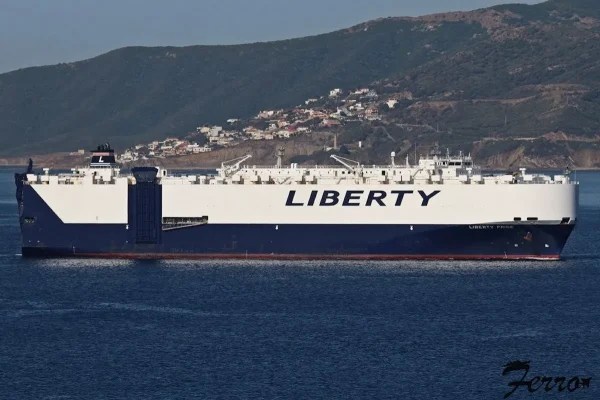
The US-flagged vehicle carrier Liberty Pride. Photo: Ships Nostalgia
How many other US ships are in the ocean at the moment or arriving at other ports, isn’t yet known. But what is known is that NATO is girding itself for a spillover, once the Ukrainian offensive gets underway.
The main focus of the Ukrainian spring offensive likely is an assault on Crimea and on Russian forces in the south. The objective is to cut them off (Kherson area across to Zaphorizia) and systematically destroy them, followed by a big push into Crimea.
The US is supplying a huge amount of war materiel for this assault. It includes bridging equipment that can support German-origin Leopard II tanks, which weigh more than 62 tons (roughly the same as the phantom M1 Abrams tanks that won’t arrive until next year, if ever).
Ukraine will have its hands full in such an operation and is dependent on US intelligence and, very likely, US airpower. There is not enough time to train Ukrainian pilots on F-16s, and there are not any spare up-to-date F-16s to throw into the battle – unless, of course, US fighter squadrons are in the mix.
One can expect that US aircraft will be painted over with Ukrainian insignia and flown by US or NATO pilots. These planes will operate as standoff assets, firing long-range air-to-air and air-to-ground weapons.
By staying wide of Russian air defense systems, but protected by what remains of Ukrainian air defenses, the F-16s could target Russian armor, command centers, troop formations, caravans, jammers and air defense radars.
The Ukrainian offensive also is likely to appear to the Russians as a casus belli involving NATO direct participation. How Russia might respond to a direct challenge is hard to say. The most likely Russian response could be to attack stockpiles and massing areas in Poland and Romania – and, almost certainly, airfields supporting the war.
Russian strategists have the opinion that Polish forces might also move into Ukraine, perhaps taking Lviv (Lvov) or other prizes, hedging that the Ukrainian offensive might fail or that the Russians are successful in toppling Kyiv’s government.
If these prognostications on the two spring offensives are anywhere near correct – and there is plenty of evidence suggesting both offensives are being prepared – then Europe is on the brink of a great catastrophe.
Stephen Bryen is a senior fellow at the Center for Security Policy and the Yorktown Institute.
Kremlin: New Reports on Nord Stream Attacks Are Part of a Coordinated Disinformation Campaign
Sputnik – 08.03.2023
Media reports about the attacks on Russia’s Nord Stream pipelines are part of a coordinated spread of disinformation and an attempt to divert attention from the real perpetrators, Kremlin spokesman Dmitry Peskov told Sputnik on Wednesday.
“Obviously, the authors of the terrorist attack want to divert attention. This is obviously a coordinated spread of disinformation in the media,” Peskov said, commenting on the Western media reports.
He said the Kremlin wonders how US officials that media reports cite can assume anything about the attacks without an investigation.
Peskov also called for a transparent investigation into the Nord Stream attacks; one where Russia would be a participant in the probe.
“We are still prevented from taking part in the investigation. Only a few days ago, we received relevant notes from Denmark and Sweden. This is not just strange, it has scent of a heinous crime. At a minimum, Nord Stream shareholders and the UN should demand an urgent transparent investigation with the participation of those who can shed light on the matter,” the Kremlin spokesman underscored.
A US newspaper earlier cited American officials as saying that new intelligence suggested a “pro-Ukrainian group” had carried out the attacks on the Nord Stream pipelines. A few hours later, a German newspaper reported that the investigators had identified the vessel used to carry out the attack on the pipelines.
The developments come about a week after Russian Foreign Minister Sergey Lavrov told Sputnik that Moscow would do its utmost to make the Nord Stream probe happen.
“You remember how the West reacted to the investigation into Nord Stream published by Seymour Hersh – their nervous reaction. They started saying it’s nonsense and that they were not even going to discuss it. I think this makes everything clear. But we will do our best to make this investigation happen, we will not allow them to just sweep it all under the rug,” Lavrov stressed.
This followed Russian Ambassador to the United Nations Vasily Nebenzia saying that Russia’s Western partners on the UN Security Council were not demonstrating any desire to cooperate in an independent investigation to verify a report that presented significant details that the US was behind the sabotage of the Nord Stream pipelines.
The investigative report was published by Pulitzer Prize-winning journalist Seymour Hersh, who revealed that US Navy divers had planted explosives to destroy the Nord Stream pipelines during NATO’s Baltops exercises in the summer of 2022. Norway activated the bombs three months later at the behest of US President Joe Biden, the journalist wrote, citing insiders.
In September 2022, underwater blasts occurred at three of the four strings of the Nord Stream 1 and 2 underwater pipelines, built to carry a combined 110 billion cubic meters of Russian gas to Europe annually. Germany, Denmark, and Sweden launched separate investigations into the incident, while Russia wasn’t given access to their probes.
China warns of ‘critical juncture’ in Ukraine conflict
RT | March 7, 2023
The conflict in Ukraine will spin of control if a peace process does not start soon, Chinese Foreign Minister Qin Gang has said.
The fighting between Russia and Ukraine has reached a “critical juncture,” Qin stated during his annual press conference in Beijing on Tuesday.
“There will either be cessation of hostilities, restoration of peace and a move towards political settlement, or fuel will be added to the fire, the crisis will expand, and the situation will get out of control,” he warned.
The diplomat pointed out that now is the time for “calmness, sanity and dialogue,” insisting that talks “should start as soon as possible.”
“The legitimate security concerns of all parties should be respected” during the negotiations, as this is the only way to achieve long-term peace and stability in Europe, he said.
Qin also expressed regret that previous attempts to launch a peace process to end the conflict had been “repeatedly undermined.”
“There is an ‘invisible hand’ pushing the conflict towards escalation and trying to use the Ukrainian crisis to serve a certain geopolitical agenda,” he said.
Moscow has repeatedly said the conflict in Ukraine is a “proxy war” waged against Russia by the US and its NATO allies, which provide Kiev with weapons, funds and intelligence.
Last week, Russian Foreign Minister Sergey Lavrov reiterated that Moscow was ready to consider peace proposals “that are made out of sincere desire to find a political solution” to the crisis. However, Lavrov pointed out that there haven’t been any such serious peace offers coming from either Kiev or its Western backers since last March. On the contrary, “Ukraine is being persuaded to continue the fighting,” he said.
During his press conference, Qin also spoke about the significance of relations between Russia and China. Over the past year, Beijing resisted Western pressure to condemn and sanction Moscow, while consistently calling for a peaceful resolution of the crisis.
“The more turbulent the world is, the more steadily the Chinese-Russian relations should move forward,” the Chinese FM said.
Cooperation between Beijing and Moscow will “provide impetus for multipolarization of the world and democracy in international relations; global strategic balance and stability will be assured through it,” he stated.
What they are talking about on the Russian talk shows today: full war mobilization!
By Gilbert Doctorow | March 7, 2023
A month ago I was asked by a retired U.S. lieutenant colonel in a private email correspondence whether Vladimir Putin would be announcing general mobilization in his State of the Union address on 21 February. I answered with full confidence that this was unfounded speculation, that the Russian war effort was going well in the estimation of the Kremlin, that they expect the imminent capture of Artyomovsk (Bakhmut), opening the way for Russia to assume full possession of the Donbas.
Indeed, the fighting in and around Artyomovsk today continues to favor the Russians, notwithstanding the latest dispatch of 10,000 or more Ukrainian army forces to keep open supply lines to their comrades in the nearly surrounded city, who number perhaps 20,000.
Meanwhile, the United States and its NATO allies have come to agreement on what further heavy equipment they can ship to Ukraine in support of Kiev’s planned counteroffensive later this spring. Several Leopard tanks have already been delivered by Poland; more are on their way from other countries. And, as Russian television has been showing for the past 24 hours, there is an enormous stock of American armored personnel carriers, self-propelled artillery, HIMARS launchers and other equipment now stored on the quays of the Polish port of Gdansk awaiting delivery to Ukraine.
In this context, the discussion in Washington and European capitals over how far they can go without crossing Russia’s red lines and triggering a hot war between Russia and NATO is being bypassed by events. As the latest editions of prime news and discussion programs Sixty Minutes and Evening with Vladimir Solovyov indicate, Russia’s political elites consider that these lines have been crossed, with or without delivery of the F-16 fighter jets requested by Zelensky; with or without the latest version of the Leopards or the Abrams tanks promised by the USA. The Russians also speak openly on television about the Polish, French and Italian ‘mercenaries’ whom their troops in Donbas are overhearing daily on the front lines, and there is no question but that these are in effect NATO officers, not volunteers from the street.
The ‘fog of war’ distortions and blatant propaganda over the status of the Ukraine war that we see daily in mainstream electronic and print media in the West are being cleared away by very realistic assessments of the intentions and capabilities of the sides that I now see on the aforementioned talk shows. The information being broadcast is coming from war correspondents in the field, from front line commanders themselves and from expert analysts-Duma members of various parties, as well as from among academics and think tank directors.
The Financial Times may be just a sounding board for the Zelensky regime. Sixty Minutes and the Solovyov show are far more nuanced, self-critical and helpful for the broad Russian public to understand the challenge their country is facing as it goes up against the entire U.S.-led West in economic and military warfare.
These programs are unquestionably preparing the Russian public for mobilization of the economy to a full war footing and for further call-ups of reservists and recruits to join the fight. At the same time, I see demands that the government adopt a much more repressive policy at home to purge the country of fence-sitters, implementing a policy well-known to Americans from the time of President George W. Bush: ‘you are either with us or you are against us.’
The recent cases of sabotage and attempted political assassinations within Russia perpetrated by treasonous Russian nationals or by teams of Ukrainians who passed through the porous border have given rise to demands to ‘get tough’ and follow the practices put in place by Stalin, namely summary execution of saboteurs and ‘enemies of the people.’
It must be stressed that until now the Russian government has been lenient towards its domestic critics and enemies. Western talk of an ‘authoritarian’ or ‘autocratic’ Kremlin has just been libelous propaganda. However, by encouraging the Kiev regime to deploy every kind of despicable attack on Russia up to and including use of chemical and biological weapons on the field of battle, as the Russians now report is the case, Washington is making a mockery of international law and inviting Russia to wage all-out war.
In this regard, I point to the remarks of Belarus president Alexander Lukashenko before and during his visit to Beijing a week ago: he remarked that the present moment should not be lost, that all sides should be pressuring the warring parties to declare a cease-fire and enter into peace negotiations. Lukashenko argued that Russia had not yet unleashed its military potential, had not yet mobilized its economy and its society for total war, but that was sure to come if the conflict is allowed to proceed and thus to escalate further.
©Gilbert Doctorow, 2023
Featured Video

Trita Parsi: Middle East Unraveling — Are We on the Path to World War?
or go to
Aletho News Archives – Video-Images
From the Archives
Trans agenda is ‘normalization of sadism’ – US author

RT | September 23, 2026
The US Democratic Party has embraced a transgender agenda that amounts to “the normalization of sadism,” author A.J. Rice has said, warning that radical trans policies would return if the party is allowed to regain power.
Speaking to RT’s America First host Scotty Nell Hughes about his new book, ‘The Curse of the Bearded Lady: How the Trans Mafia Whacked American Sanity’, Rice argued that activists have gained significant influence in schools, medicine, and corporate America while people who questioned the agenda have faced pressure to stay silent.
The author described the “trans mafia” as the sprawling network of people and institutions that have helped the movement gain influence. He singled out parts of academia, wealthy backers, and corporations, and stated that providers of transition-related treatment also have a financial incentive to keep young people in their care indefinitely.
Rice argued that the consequences of these policies ultimately fall on children who are being drawn toward gender-affirming medical treatments and on girls who are expected to share locker rooms or compete in sports with biological males.
He noted that while voters rejected the Democrats’ approach to gender in 2024, the party, which has been “captured by madness,” has since only doubled down and is seeking what is effectively “the normalization of sadism.” … Full article
Blog Roll
 Aletho News
- French-Lebanese man files war crimes complaint over Israeli attacks
- Mahan Air Flight Lands in China Despite US Threat against Iranian Airlines
- US eyes $10bn fund to rebuild war-battered Gulf infrastructure
- Trump meets Rodríguez near Maduro’s prison as Venezuela’s oil flows to US
- Trita Parsi: Middle East Unraveling — Are We on the Path to World War?
- Iran FM meets with US envoy on UN meeting’s sidelines at American side’s insistence: Report
- Qatar PM calls for Gulf security framework with Iran, says war must be ‘wake-up call’
- China condemns US extortion of Iranian airlines, rejects Washington’s ‘illegal’ sanctions threats
- Italy to move military personnel from Taif base after missile strike
- Finland’s Stubb tells European leaders to calm down
- If Americans Knew
- As Gaza languishes, world leaders gather at the UN – Daily Update
- Sanctions are collective punishment: immoral and self-defeating
- Phosphorus Munitions Fired by Israel Burn Groves, Orchards in Southern Lebanon
- Israel Carries Out New Ceasefire Violations Across Gaza
- AI – Emphasis on the ‘I’: Israel Is Funding AI Chatbot Propaganda
- Israel Blocking Hundreds of Wheelchairs for Injured Children From Entering Gaza
- Israel Is Expanding and Upgrading Compounds for Palestinian Militias in Gaza
- The Palestinian-American Residents of This West Bank Town Are Wondering: Where Is Trump?
- Gaza desperately needs tents, wheelchairs, fuel… and everything else (Israel blocks it all) – Daily Update
- Israeli Attacks in Gaza Kill at Least Seven Palestinians Over Three Days, including Woman and Child
- No Tricks Zone
- New Study: Earth And Venus Surface Warmth Largely Explained By Convection And Lapse Rate, Not CO2 Or Radiation
- 2025 Nature Paper Claiming Worsening Global Drought Gets RETRACTED …Heavily Flawed
- New Study: ‘Global Drought Shows No Detectable Recent Acceleration Under Climate Warming’
- Economic Masterminds: German Socialists Suggest Taxing Productivity Gains Stemming From Using AI
- The South China Sea Has Not Been Cooperating With The Climate Change Narrative
- Energy Crisis: Germany Enters Heating Season With Historically Low Gas Reserve Fill Levels
- New Study: The Antarctic Ice Sheet Gained Mass From 2020-2024 Due To Staggering Snow And Ice Accumulation
- Study: Ocean Heating Rates From Thousands Of Years Ago ‘Dwarf’ Modern Ocean Heating Rates
- Climate Extremists Target, Attack Large-Scale Power Grid Infrastructure In Germany!
- New Study: Antarctic Ice Melt Has Contributed Less Than 1 Centimeter To Sea Level Rise In The Last 30 Years

