Russia’s retaliatory strikes mark new phase of conflict in Ukraine
Kiev is unlikely to change its behaviour and will continue to carry out orders from the West
By Ahmed Adel | October 11, 2022
Continued strikes against Ukrainian infrastructure following the terrorist attack on the Kerch Bridge, more commonly known as the Crimean Bridge, can cause serious damage to Ukraine’s industry and significantly reduce the country’s combat capability. Russian strikes hit energy facilities in 12 regions across Ukraine on October 10, affecting power, internet and central heating, and in which Ukraine’s energy minister Herman Halushchenko described as “the biggest [attack] during the entire war.” In fact, the Russian strikes were so powerful that the Ukrainian energy ministry said in a statement that it must halt exports of electricity to the European Union.
“Today’s missile strikes, which hit the thermal generation and electrical substations, forced Ukraine to suspend electricity exports from Oct. 11, 2022 to stabilise its own energy system,” the ministry said.
It cannot be discounted that some factories involved in the production of weapons or the repair of military equipment could have been affected by the Russian strikes. Greater disruptions to Ukraine’s electrical infrastructure will inevitably also lower the combat capabilities of the Ukrainian military, which will also have an effect on mobility, replenishment of reserves, transportation and repair of equipment.
The retaliatory strikes occurred immediately after the statements made by Russian President Vladimir Putin on October 9. Symbolically, the Ukrainians discussed that they would give Putin “a gift” for his birthday, which is on October 7. On October 8 the Kerch Bridge was attacked. The terrorist strike was even commemorated in Kiev with the issuing of a postal stamp, even though three civilians were killed.
On October 10, at a working meeting with members of the Security Council, Putin announced that a series of high-precision missile strikes from air, sea and land targeted infrastructure throughout Ukraine. The Russian president then described the incident on the Kerch bridge as a terrorist attack aimed at destroying civilian infrastructure. According to him, Ukraine has placed itself on the same level as the most feared terrorist groups across the world, such as ISIS, and Russia simply cannot allow crimes of this kind to go unanswered.
For his part, Commander Apti Alaudinov commented on the recent air strikes against Ukraine’s military and energy infrastructure, noting that Russia could have carried them out a long time ago.
“Ukraine for many years – eight years – has tested the nerves of both Russia and the territories inhabited by the Russian-speaking community… It is a pity for those who may have to suffer the attacks, innocent people… but in the end, the people must understand that their leaders get mad and throw all their people into the furnace of war. It’s impossible that everything will be fine with them when something bad happens to us,” he said.
Strikes against Kiev and other parts of Ukraine signals a new phase of the war after Russia made all efforts to find a peaceful solution. It is recalled that there were also widespread reports that Moscow was ready for a peace agreement, but it was prevented by the arrival of then UK Prime Minister Boris Johnson to Kiev, who quite literally destroyed such plans.
It is little surprise that endless statements from Kiev, Washington, Brussels and London repeat that the only solution to ending the war is with Russia’s defeat. Effectively, the Russians have no one to negotiate with as none of the major parties are interested in a peaceful solution. On the contrary, there was an escalation by Ukraine since there was a terrorist attack on civilian infrastructure.
Effectively, Russia is forced to launch a real war, which will be far more devastating for Ukraine, especially since Moscow has refrained from major strikes for all these months.
Even with the assassination of Russian citizens, such as Darya Dugina, Moscow remained restrained with its responses. However, the Kerch Bridge, as already proven, is a line which Russia will not allow to be crossed without retaliation.
Strikes and military action will continue until there is a change in the situation and Kiev’s attitude towards Moscow. It is more than likely that the decision to target the Kerch Bridge was not concocted in Kiev and is rather an attempt by the West to humiliate Russia when considering the date of the bridge attack was carefully chosen and the media covered this terrorist act with a birthday greeting to Putin.
Even after Russia’s actions, Kiev itself will not change its behaviour and will continue to servilely carry out orders from the West and act according to the goals that are in line with Washington’s political strategy. The Ukrainian army enjoys material, logistical and intelligence support from the West, and its ranks include special forces from Romania, Poland and other NATO countries. For these reasons, Russia is moving the war into the next phase, especially as NATO is directly participating in military operations and civilian infrastructure are being targeted in terrorist attacks.
Ahmed Adel is a Cairo-based geopolitics and political economy researcher.
Tulsi Gabbard quits ‘warmongering’ Democrats

Samizdat | October 11, 2022
Former US Congresswoman and 2020 presidential candidate Tulsi Gabbard has announced her departure from the Democratic Party, arguing that it has fallen under the control of “an elitist cabal of warmongers.” Establishment Democrats have long called on Gabbard to leave the party and declare herself a Republican.
“I can no longer remain in today’s Democratic Party that is now under the complete control of an elitist cabal of warmongers,” Gabbard declared in a video message on Tuesday.
President Joe Biden’s party colleagues, she continued, are “driven by cowardly wokeness, who divide us by racializing every issue and stoking anti-white racism…who are hostile to people of faith and spirituality… who believe in open borders, who weaponize the national security state to go after their political opponents, and above all, who are dragging us ever closer to nuclear war.”
Gabbard did not declare herself a Republican, despite sharing many of the views of the anti-interventionist, ‘America First’ wing of the GOP. While the Democratic Party has – with the backing of establishment Republicans – voted almost unanimously to send more than $52 billion to Ukraine in recent months, Gabbard has condemned Biden for “exploiting this war to strengthen NATO and feed the military-industrial complex.”
The former congresswoman has expounded these views to Fox News host Tucker Carlson, and is a regular guest on his prime-time show.
Likewise, Gabbard’s claims that her former party promotes anti-white racism, open borders and persecution of their political opponents echo criticisms more often heard from the right.
Gabbard has long opposed US involvement in and funding of foreign conflicts. During her four terms in office from 2013 to 2021, she advocated dialogue with America’s rival superpowers, coupled with a hardline policy on Islamic terrorism. Failed 2016 presidential candidate Hillary Clinton accused Gabbard in 2019 of being “a Russian asset,” likely referencing the Hawaiian lawmaker’s past praise for Russian President Vladimir Putin’s fight against terrorism in Syria.
Gabbard responded by calling Clinton the “personification of the rot that has sickened the Democratic Party,” and suing the former secretary of state for defamation.
Kiev Offers Biden Targeting Control, Seeks Longer Range Weapons
By Kyle Anzalone and Connor Freeman | The Libertarian Institute | October 3, 2022
The Ukrainian government is prepared to give the Joe Biden administration virtual control over its selection of Russian targets. Kiev made the proposal in a bid to receive longer-range weapons from the White House, according to multiple sources speaking with CNN.
Ukrainian President Volodymyr Zelensky will provide a full list of possible targets while allowing the White House to veto any of the potential sites. Kiev is hoping the increased transparency will pave the path to Biden authorizing more weapons transfers. Zelensky made the offer to Washington to alleviate concerns in the Biden administration that new weapons will be used to target Russian territory.
However, Kiev, Washington and Moscow currently have different views on what is Russian versus Ukrainian territory. After a 2014 coup in Ukraine that saw US-backed elements overthrow a democratically elected government, Russia annexed the Crimea peninsula. Last week, Moscow claimed four additional regions of Ukraine as its own.
Russian President Vladimir Putin has vowed to defend all of his country’s territory with the full arsenal at his disposal. The Kremlin stated that it considers its newly added regions as it would the rest of Russia. On Sunday, Secretary of Defense Lloyd Austin acknowledged the possibility that Putin could order a nuclear strike in Ukraine, defending these new regions. The Pentagon chief then vowed Washington would support Kiev’s “efforts” for “as long as it takes” to “take back all of the territories” within its “sovereign borders.”
Concurrently, Moscow claims there has been an increase in Ukrainian attacks within Russia proper, encouraged by NATO. During a recent press conference, Putin publicly noted, for the first time, attempted Ukrainian attacks on Russia’s nuclear power plants.
The US has provided Ukraine with 16 High Mobility Artillery Rocket Systems (HIMARS), and authorized sending over a dozen more to Kiev in an arms package last week. So far, the White House has only sent Ukraine with munitions for HIMARS that can travel 50 miles. Kiev is seeking Army Tactical Missile Systems (ATACMS) surface-to-surface missiles that can fly around 200 miles by the HIMARS. When the Biden administration began providing HIMARS to Ukraine, it was insisted that Kiev had provided “assurances” that these weapons would not be used to target Russian territory. In June, Antiwar.com contacted the State Department to ask if this condition applied to the Crimean Peninsula, a department spokesman replied “Crimea is Ukraine.”
The White House has made clear that they will not recognize the new Russian territories, and NATO has said they will escalate their support for the proxy war.
Russian Foreign Minister Sergei Lavrov has previously said that if the West provides Kiev with longer-range weapons, then the Kremlin would expand its war goals in Ukraine. In July, Lavrov wrote an article claiming NATO was already on the battlefield coordinating attacks on Russian targets using the rocket systems. “NATO instructors and Multiple Launch Rocket Systems aimers are, apparently, already directing the actions of the Ukrainian Armed Forces and nationalist battalions on the ground,” Lavrov said.
In addition to the CIA presence on the ground in Ukraine, NATO commandos from Lithuania, Canada, Britain, and France are also present. Notably, there are several Donald Trump-aligned Republicans in the legislature, including Rep. Mike Waltz (R-FL) eager to “[go] for the kill” and overtly deploy American military advisors to Ukraine. Former US special operators are already on the ground near the contact line, training Kiev’s forces and developing battle plans.
Harry Kazianis wrote in Responsible Statecraft that in multiple war game simulations, Washington sending advanced weapons led to nuclear war.
I have fought more than thirty combat simulations in wargames under my own direction for a private defense contract… In every scenario I tested, the Biden Administration slowly gives Ukraine ever more advanced weapons like ATACMS, F-16s, and other platforms that Russia has consistently warned pose a direct military threat… In fact, in 28 of the thirty scenarios I have run since the war began, some sort of nuclear exchange occurs.
Kazianis does report that in some of the war games, diplomacy, rather than escalation prevailed, and nuclear conflict was averted.
The good news is there is a way out of this crisis — however imperfect it may be. In the two scenarios where nuclear war was averted, direct negotiations led to a ceasefire. The Biden Administration and its NATO allies should be testing Putin’s recent comments about a ceasefire to test his seriousness.
Secretary of State Antony Blinken, America’s top diplomat, has declared Washington’s goal is to see Russia suffer a “strategic defeat” in Ukraine. During the war, he spoke to Lavrov once and for only 25 minutes, they merely discussed a potential bilateral prisoner exchange. Likewise, UK Prime Minister Liz Truss has ruled out diplomacy until Moscow is “defeated.”
Elon Musk suggests Ukraine peace plan
Samizdat | October 3, 2022
SpaceX and Tesla CEO Elon Musk has proposed a plan to end the conflict in Ukraine. The billionaire suggested that new elections be held in the four regions that recently voted to join Russia, while Ukraine would commit to neutrality and relinquish its claim to Crimea.
Musk posted an outline of his plan on Twitter on Monday, suggesting that Russia “redo elections of annexed regions under UN supervision,” with Moscow withdrawing from these areas if voters choose.
Crimea would be declared “formally part of Russia, as it has been since 1783,” until Soviet Premier Nikita Khrushchev gifted the peninsula to the Ukrainian SSR in 1954.
Musk, whose text messages revealed him to be an occasional reader of RT, called Khrushchev’s decision a “mistake.”
The billionaire then suggested that Ukraine commit to neutrality – as Russia had requested long before it launched its military operation in February – and guarantee the supply of water to Crimea. Ukraine shut down the supply in 2014 after Crimeans overwhelmingly voted to rejoin the Russian Federation. Shortly after the launch of Russia’s operation in Ukraine, the supply was restored.
“This is highly likely to be the outcome in the end,” Musk commented on his suggestion, adding that it is “just a question of how many people die before then.”
The plan is unlikely to find fans in Kiev. Ukrainian President Vladimir Zelensky has vowed not to negotiate with his Russian counterpart, Vladimir Putin, and to seize the entirety of the territory Kiev claims as its own – including the Donbass republics and Crimea – by force. Furthermore, Zelensky sent an application for membership to the NATO alliance last week.
Residents of Donetsk, Lugansk, Kherson, and Zaporozhye would likely vote in overwhelming numbers to join Russia if the recent referendums in these territories were held again. All of these regions have a high percentage of Russian speakers and have historically voted for pro-Russian candidates while part of Ukraine.
However, Putin has already signed treaties to accede these territories into the Russian Federation, and has vowed to defend them with Russia’s full military capabilities.
At the time of writing, nearly 60% of respondents on Twitter backed Musk’s idea. That ratio is likely to change, however, as pro-Ukrainian Twitter users in the comments have called on ‘#NAFO’ trolls to swing the poll in their favor. In a follow-up post, Musk said that “the bot attack on this poll is strong!”
Russian hypersonic missiles superior to anything NATO has: Le Figaro
Samizdat – 02.10.2022
Russian hypersonic missile systems are more advanced than anything being fielded by the North Atlantic Alliance today, France’s Le Figaro has reported, echoing sentiments expressed by Russia’s president in a speech last week.
The French newspaper characterized Russia’s hypersonic weaponry as its main strategic asset, capable of flying at incredible speeds and maneuvering while in flight. It pointed specifically to the Avangard hypersonic glide vehicle – a weapon deployable as a part of a multiple independently targetable reentry vehicle (MIRV) payload aboard Russian intercontinental ballistic missiles.
“In this specific area, Russia is indeed one step ahead of its NATO adversaries,” the Gaullist newspaper conceded. The paper added that Russia and China proceeded to develop hypersonic missiles in response to NATO’s efforts to construct a missile defense shield.
“Russia undoubtedly has more modern weapons than the NATO countries. The United States has lagged behind in the field of hypersonic missiles, and Moscow’s nuclear arsenal is being replenished with more powerful and destructive projectiles,” Igor Delanoe, deputy director of the Moscow-based Franco-Russian Observatory, said.
In his speech announcing partial mobilization last month, Vladimir Putin accused Western officials of discussing “the possibility and admissibility of using weapons mass destruction – nuclear weapons – against Russia.”
“I would like to remind those who make such statements regarding Russia that our country has different types of weapons as well, and some of them are more modern than the weapons NATO countries have. In the event of a threat to the territorial integrity of our country and to defend Russia and our people, we will certainly make use of all weapon systems available to us. This is not a bluff,” Putin said.
The Russian president unveiled five new strategic weapons in a speech to lawmakers in 2018, among them the Kinzhal and the Avangard, plus the Poseidon nuclear-powered and nuclear-armed drone submarine, and the 9M730 Burevestnik (‘Petrel’) nuclear-powered, nuclear-armed cruise missile.
The Chinese military also possesses hypersonic weapons. In August, Russian-Indian defense joint venture BrahMos announced that it may create a hypersonic missile by 2027 or 2028. North and South Korea, France, Japan, Australia and India are also researching the cutting-edge class of weaponry.
The Pentagon has tasked US defense contractors with developing at least six hypersonic weapons designs for the Army, Navy, Air Force, and DARPA’s Operational Fires program, but to date none have been fielded. The US military has also pitched laser and dust-firing flak guns meant to defeat Russian and Chinese hypersonics, as well as the use of stratospheric balloons to monitor and track their launch.
Russia got a head start on its hypersonics program thanks to Soviet-era research in the field starting in the early 2000s, after the Bush administration unilaterally scrapped of the Anti-Ballistic Missile Treaty – a 1972 Soviet-US agreement which placed severe limitations on the creation of anti-ballistic missile defenses and intended to stop the arms race.
Russia’s military doctrine forbids nuclear weapons from being used unless the country is targeted by enemy nuclear attack first, or a conventional attack so severe that it is deemed to threaten the existence of the state. The United States does not place such restrictions on its nukes, and “reserves the right to use” them on a preemptive basis, even against non-nuclear armed adversaries.
EU parliamentarian calls to sanction Vanessa Beeley and all observers of Donbass referendums

BY MAX BLUMENTHAL AND ANYA PARAMPIL · THE GRAYZONE · SEPTEMBER 29, 2022
MEP Nathalie Loiseau of France is lobbying for individual sanctions on all observers of the Russian-organized referendums in the Donbass region. She has singled out journalist Vanessa Beeley not only for her coverage of the vote, but for her reporting on the foreign-back war against Syria’s government.
A French Member of European Parliament (MEP), Natalie Loiseau, has delivered a letter to EU High Representative of Foreign Affairs, Joseph Borrell, demanding the European Union place personal sanctions on all international observers of the recent votes in the Donetsk and Lugansk People’s Republics and certain Russian-controlled territories in eastern Ukraine.
Obtained by The Grayzone from an EU source, the letter is currently being circulated among European parliamentarians in hopes of securing a docket of supportive signatures.
“We, as elected members of the European Parliament, demand that all those who voluntarily assisted in any way the organization of these illegitimate referendums be individually targeted and sanctioned,” Loiseau declared.
The French MEP’s letter came after a group of formally Ukrainian territories held a vote on whether or not to officially incorporate themselves into the Russian Federation in late September. Through the popular referendum, the independent Donetsk and Lugansk People’s Republics, which announced their respective successions from Ukraine in 2014 following a foreign-backed coup against the government Kiev, as well as the regions of Kherson and Zaporozhia, voted overwhelmingly in favor of joining the Russian Federation.
Loiseau singled out Vanessa Beeley, a British journalist who traveled to the region to monitor the vote. Extending her complaint well beyond the referendum, the French MEP accused Beeley of “continuously spreading fake news about Syria and acting as a mouthpiece for Vladimir Putin and Bashar el [sic] Assad for years.”
Loiseau, a close ally of French President Emanuel Macron, specifically demanded Beeley be “included in the list of those sanctioned.”
Beeley responded to Loiseau’s letter in a statement to The Grayzone :
“Imposing sanctions on global citizens for bearing witness to a legal process that reflects the self-determination of the people of Donbass is fascism. Should the EU proceed with this campaign, I believe there will be serious consequences because the essence of freedom of speech and thought is under attack.”
Russia’s referendums: drawing a line with NATO
In mid-September 2022, Beeley and around 100 other international delegates traveled to eastern Europe in order to observe a vote to join the Russian Federation in the regions of Kherson, Zaporozhia, and the independent republics of Lugansk and Donetsk.
Why did their presence trigger such an outraged response from Western governments? The answer lies in the recent history of these heavily contested areas.
The formally Ukrainian territories of Kherson and Zaporozhia fell under Russian control earlier this year as a result of the military campaign launched by Moscow in February, while the Donetsk and Lugansk People’s Republics declared their independence from the government in Kiev in 2014.
Russia began its special military campaign in Ukrainian territory on February 24. The operation followed Moscow’s decision that same week to formally recognize the independence of the Donetsk People’s Republic and Lugansk People’s Republic (the Donbass Republics) in Ukraine’s eastern Donbass region. Pro-Russian separatists in the Donbass have been embroiled in a bloody trench battle with the US-backed government in Kiev since 2014.
Ukraine’s civil conflict broke out in March 2014, after US and European forces sponsored a coup in the country that installed a decidedly pro-NATO nationalist regime in Kiev which proceeded to declare war on its minority, ethnically Russian population.
Following the 2014 putsch, Ukraine’s government officially marginalized the Russian language while extremist thugs backed by Kiev massacred and intimidated ethnic Russian citizens of Ukraine. In response, separatist protests swept Ukraine’s majority-Russian eastern regions.
The territory of Crimea formally voted to join Russia in March of that year, while the Donetsk and Lugansk Republics in Ukraine’s eastern Donbass region declared their unofficial independence from Kiev that same month. With support from the US military and NATO, Ukraine’s coup government officially declared war on the Donbass in April 2014, launching what it characterized as an “Anti-Terrorist Operation” in the region.
Russia trained and equipped separatist militias in Donetsk and Lugansk throughout the territories’ civil campaigns against Kiev, though Moscow did not officially recognize the independence of the Donbass republics until February 2022. By then, United Nations estimates placed the casualty count for Ukraine’s civil war at roughly 13,000 dead. While Moscow offered support to Donbass separatists throughout the 2014-2022 period, US and European governments invested billions to prop up a Ukrainian military that was heavily reliant on army and intelligence factions with direct links to the country’s historic anti-Soviet, pro-Nazi deep state born as a result of World War II.
Russia’s military formally entered the Ukraine conflict in February 2022, following Moscow’s recognition of the Donbass republics. While Russian President Vladimir Putin defined the liberation of the Donbass republics as the primary objective of the military operation, he also listed the “de-nazification” and “de-militarization” of Ukraine as a goals of the campaign. As such, Russian troops have since secured control of Ukrainian territories beyond the Donbass region, including the territories of Kherson and Zaporozhia.
Facing increased Western investment in the Kiev-aligned bloc of Ukraine’s civil war, authorities in the Donbass republics announced a referendum on membership in the Russian Federation in late September 2022, with Moscow-aligned officials in Kherson and Zaporozhia announcing similar ballot initiatives. Citizens in each territory proceeded to approve Russian membership by overwhelming majorities.
The results of the referendum not only threatened the government in Kiev, but its European and US backers. Western-aligned media leapt to characterize the votes as a sham, claiming Moscow’s troops had coerced citizens into joining the Russian Federation at the barrel of a gun. Their narrative would have reigned supreme if not for the hundred or so international observers who physically traveled to the regions in question to observe the referendum process.
Observers like Vanessa Beeley now face the threat of returning home to the West as wanted outlaws. But as Loiseau’s letter made clear, the British journalist was in the crosshairs long before the escalation in Ukraine.
Beeley among European journalists targeted and prosecuted for reporting from Donetsk
Vanessa Beeley was among the first independent journalists to expose the US and UK governments’ sponsorship of the Syrian White Helmets, a so-called “volunteer organization” that played frontline role in promoting the foreign-backed dirty war against Syria’s government through its coordination with Western and Gulf-sponsored media. Beeley also played an instrumental role in revealing the White Helmets’ strong ties to Al-Qaeda’s Syrian branch, as well as its members’ involvement in atrocities committed by Western-backed insurgents.
Beeley’s work on Syria drew harsh attacks from an array of NATO and arms industry-funded think tanks. In June 2022, the Institute for Strategic Dialogue (ISD), which receives funding from a variety of NATO states, corporations and billionaires, labeled Beeley “the most prolific spreader of disinformation” on Syria prior to 2020. (According to ISD, Beeley was somehow “overtaken” by The Grayzone’s Aaron Mate that year). The group did not provide a single piece of evidence to support its assertions.
Though Beeley has endured waves of smears, French MEP Natalie Loiseau’s call for the EU to sanction the journalist represents the first time a Western official has moved to formally criminalize her work. Indeed, Loiseau made no secret that she is targeting Beeley not only for her role as an observer of the referendum votes, but also on the basis of her opinions and reporting on Sy on the heels of the German government’s prosecution of independent journalist Alina Lipp. In March 2020, Berlin launched a formal case against Lipp, who is a German citizen, claiming her reporting from the Donetsk People’s Republic violated newly authorized state speech codes.
Prior to Lipp’s prosecution, the Institute for Strategic Dialogue launched a media campaign portraying her as a disseminator of “disinformation” and “pro-Kremlin content.”
In London, meanwhile, the UK government has imposed individual sanctions on Graham Philips, a British citizen and independent journalist, for his reporting from Donetsk.
And in Brussels, Loiseau’s campaign against Beeley appears to have emerged from a deeply personal vendetta.
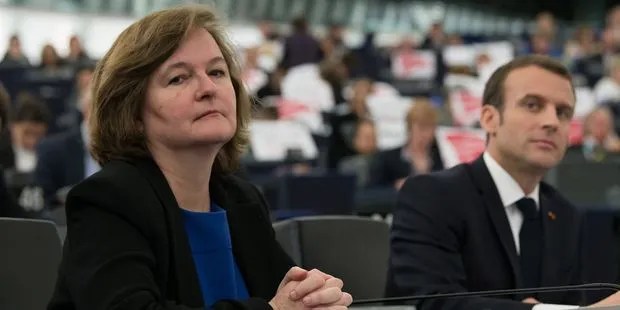
Nathalie Loiseau and French Pres. Macron
Who is Natalie Loiseau?
In April 2021, Beeley published a detailed profile of Loiseau at her personal blog, The Wall Will Fall, painting the French MEP as a regime change ideologue committed to “defending global insecurity and perpetual war.” Beeley noted that Loiseau served as a minister in the government of French President Emanuel Macron when it authorized airstrikes in response to dubious allegations of a Syrian government chemical attack in Douma in April 2018.
Beeley also reported that Loiseau has enjoyed a close relationship with the Syria Campaign, the public relations arm of the White Helmets operation. This same organization, which is backed by British-Syrian billionaire Ayman Asfari, was the sponsor of the Institute for Strategic Dialogue report which branded Beeley a “top propagator of disinformation” on Syria.
Loiseau has taken her activism into the heart of the European parliament, using her position as chair of the European Parliament’s Subcommittee on Security and Defense to silence colleagues who ask to many questions about the Western campaign for regime change in Syria.
During an April 2021 hearing, MEP Mick Wallace attempted to question Organization for the Prohibition of Chemical Weapons (OPCW) Director General Fernando Arias about allegations he personally aided the censorship of an OPCW investigation which concluded no chemical attack took place in Douma, Syria in April 2018.
Loiseau immediately descended into a fit of rage, interrupting Wallace and preventing him from speaking.
“I cannot accept that you can call into question the work of an international organization, and that you would call into question the word of the victims in the way you have just done,” Loiseau fulminated.
Wallace responded with indignation, asking, “Is there no freedom of speech being allowed in the European Parliament any more? Today you are denying me my opinion!”
A year later, Wallace and fellow Irish MEP Clare Daly sued the Irish network RTE for defamation after it broadcast an interview with Loiseau during which she baselessly branded them as liars who spread disinformation about Syria in parliament.
Now, Loiseau appears to be seeking revenge against Beeley, demanding that she be criminally prosecuted not just for serving as a referendum observer, but for her journalistic output.
IS RUSSIA REALLY LOSING IN UKRAINE?
By Drago Bosnic | September 29, 2022
After Russia launched its counteroffensive against NATO aggression, the state and corporate-run mainstream media of the political West started spreading multiple false narratives about it. One of the most common themes was that the Russian military supposedly “failed” because the Kiev regime didn’t collapse in a matter of days.
In the following months, especially after the Russian forces withdrew from northern areas of Ukraine, this was used to further reinforce the narrative that the Russian military was somehow “defeated”. However, the truth lies in the Russian military and geopolitical nomenclature regarding the events in Ukraine. While the political West is unanimous in calling it “an unprovoked, brutal invasion”, the Russian side calls it a special military operation.
Although the wording may seem irrelevant, it does have serious implications. The whole operation has been limited from the start. As Russian President Vladimir Putin himself stated, Moscow didn’t really show more than a fraction of its capabilities. And indeed, given the number of Russian troops initially engaged in the special military operation, which was approximately 100-150 thousand, versus more than 200,000 troops of the Kiev regime, it’s clear that Moscow never expected to take control of the entire territory of Ukraine. In addition, the Kiev regime forces exponentially grew in size after the forced mobilization of hundreds of thousands of Ukrainian men. And although Western media are trying to downplay it, multiple estimates put the number of conscripted personnel anywhere between several hundred thousand and nearly a million soldiers.
For its part, Russia decided not to increase the number of troops engaged in the special military operation. What’s more, with troop rotation, the true number of Russian soldiers actively engaged in combat operations was much lower, most likely standing between 50 and 100 thousand, stretching for well over a thousand kilometers from the northern areas of the Kharkov, through Donbass, Zaporozhye and Kherson regions all the way to the Black Sea coast. These forces have consistently been outnumbered by the Kiev regime troops for over 7 months now and have stood their ground.
And although this could be attributed to the Russian military’s vast technological and numerical superiority, especially in terms of artillery and air dominance, it can only be considered a remarkable achievement from a purely military standpoint. This also explains the Kiev regime’s reaction to Moscow’s recent low-level mobilization announcement, which will increase the number of Russian troops engaged in the special military operation by 300,000, pushing the total to well over 400,000 soldiers.
As per usual, the mainstream media in the United States and other countries of the political West have been trying to portray this as a sign of Russia’s supposed “weakness”. However, the Pentagon’s and NATO’s reaction speaks volumes of how the political West really feels about the mobilization. With Western Military Industrial Complexes already working at maximum capacity to supply the Kiev regime forces with additional weapons, having a twofold or threefold increase in the number of Russian troops is the last thing they needed (at least in the short term). If the Russian military was able to conduct successful offensive operations for months, while being outnumbered, what could one expect when Moscow decides to exponentially increase the size of its forces engaged in the special military operation?
In the meantime, the Western press and other media are constructing the narrative that millions of Russian men are supposedly trying to flee the country in order to avoid mobilization. Naturally, they are ignoring the fact that the Russian Ministry of Defense registered nearly 900,000 requests for joining the armed forces, with many regions and federal subjects in the country providing several times more troops than they’re required to. The most prominent example of this is Chechnya, which overshot its mobilization quota by over 250%. And yet, the Western media keep insisting that there’s supposed “widespread opposition to Putin’s war”. In reality, the fact that the Russian police arrested several hundred protesters in a country of approximately 150 million shows just how truly “widespread” the opposition to mobilization is.
Expectedly, the propaganda war isn’t only limited to the supposed “failures” of the Russian military, but also its leadership. Recent speculation that Vladimir Putin is ill, on the verge of death or losing power, while ignoring the rapidly deteriorating mental and physical health of Joe Biden serves as a testament to that. To make matters worse, the attempts by the so-called “fact-checkers” to whitewash Biden’s string of dementia-induced gaffes can only be described as comical. And while the political West’s propaganda machine works round the clock to create an alternate reality that doesn’t exist past a TV or smartphone screen, the economic and social unraveling resulting from the failed economic siege of Russia has been affecting hundreds of millions around the world and is only bound to get worse.
Drago Bosnic is an independent geopolitical and military analyst.
Western withdrawal of citizens from Russia may be a provocation
This act looks like a threat of attack and could generate responses.
By Lucas Leiroz | September 29, 2022
The US and some other Western countries announced the evacuation of their citizens from the Russian territory. In a context of tensions between Moscow and NATO, this type of attitude sounds like a threat, further worsening the scenario of global security crisis.
The US State Department has asked Russia-based American citizens to leave the country immediately. The appeal was posted on the website of the US Embassy in Russia. The justification for the advice was that Moscow could mobilize citizens who have dual nationality, which is why foreigners based in Russia should flee as quickly as possible, before they are mobilized for combat on Ukrainian soil. The statement also highlights that there are currently a limited number of flights from Russia to other countries, and tickets for the next dates may not be available, so US citizens residing in Russia should hurry to leave.
It is interesting to analyze the communiqué issued by the Embassy when the reality of the mobilization promoted by Russia is not only partial but also absolutely moderate. The call-up of combatants has been promoted in a balanced way, with no urgency for foreign citizens to flee in a hurry to avoid being mobilized. Moscow has shown no interest in forcing foreign nationals with Russian passports to serve in the special military operation, which makes the American narrative weak and unsubstantiated.
However, some other countries also took measures similar to the one of the US. Poland and Bulgaria, for example, called on their citizens to leave Russia immediately. Commenting on the matter, spokespersons for the Polish Foreign Ministry released a note stating: “In case of a drastic deterioration of the security situation, the closure of borders or other unforeseen circumstances, evacuation may prove significantly impeded or even impossible (…) We recommend that the citizens of the Republic of Poland who remain on the territory of the Russian Federation leave its territory using the available commercial and private means”.
Also, Poland’s foreign minister Zbigniew Rau was more explicit in his words and stated that if Russia uses nuclear weapons against Ukraine, NATO’s response will be “devastating”, which is why Polish citizens should leave Russian territory as soon as possible. In fact, his words were just an endorsement of what had already been previously announced by the US National Security Advisor Jake Sullivan, who threatened Moscow by stating that “if Russia crosses this line (the use of nuclear weapons], there will be catastrophic consequences for Russia”, adding that “the United States will respond decisively”.
In fact, evacuating citizens is an elementary measure usually taken by states that are planning some kind of attack or invasion. It is the most direct and simplest way to prevent putting the lives of innocent citizens on enemy soil at risk when a war is breaking out. In this sense, any attempt at a massive withdrawal of Western citizens from Russia sounds like a threat to the Eurasian country at this point, as the Western military alliance has constantly warned of “consequences” against Moscow in the event of an escalation in Ukraine.
The problem is that the situation in Ukraine only tends to escalate because of the attitudes of the western countries themselves, which continue with their provocative military programs against Russia, supporting the neo-Nazi regime in Kiev with lethal weapons and large amounts of money. Moscow has already issued communiqués warning of what it considers a “red line” in the Ukrainian conflict, which is Russia’s sovereign territory. Russian forces are unwilling to tolerate attacks on the Federation’s territory and make it clear that they will respond harshly if such attacks occur.
With the positive result for the integration of the liberated territories into Russia, the new oblasts will become part of the Federation and thus will be under direct protection of Moscow, not being tolerable Ukrainian attacks in these regions. The West, however, insists on not recognizing the referendums and encourages Kiev to attack these regions. This is precisely where an eventual nuclear escalation could happen. Russian military doctrine establishes that nuclear weapons should only be used as a last resort in the event of an existential threat to the Russian state. Moscow may consider Western-funded attacks an existential threat if the targets are within the Federation – including the new territories – which is why there is currently a nuclear danger.
So, it is the West itself that fosters the conditions for a nuclear escalation. And it is also the West that threatens to react to such an escalation by directly attacking Russia and starting a third world war. By evacuating its citizens, the US and its allies are once again provoking and threatening Russia, sending “red alerts” that something is “about to happen”. The objective is to act preemptively and justify a Western response.
In fact, the West seems to be acting in an anti-strategic manner. There no longer seems to be any military realism in the thinking of NATO leaders, who are willing to escalate tensions more and more, even though there are no winners in a possible scenario of world war.
Lucas Leiroz is a researcher in Social Sciences at the Rural Federal University of Rio de Janeiro; geopolitical consultant.
Second energy protest roils Czechia
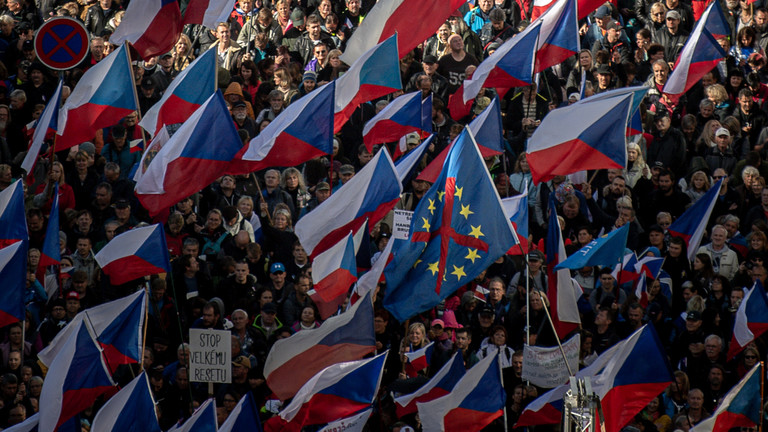
Protest against the Czech government at Wenceslas Square in Prague, Czechia, September 28, 2022. © Lukas Kabon / Anadolu Agency via Getty Images
Samizdat | September 28, 2022
A crowd numbered in the tens of thousands gathered in Prague on Wednesday to protest against the Czech government, NATO, and the European Union. Demonstrators called for Czechia’s neutrality and protested Prime Minister Petr Fiala’s policy of sanctioning Russia, which has driven up energy prices.
Meeting on St. Wenceslas’ Day – a public holiday celebrating Czech statehood – the crowd took to Prague’s main square, named after the medieval saint, and chanted slogans against the EU, NATO and Fiala’s cabinet. Prague police would not give a specific figure of the estimated crowd size, calling it only “tens of thousands.”
The protest was organized by a group called ‘Czech Republic First,’ which Reuters described as a coalition of “far-right and fringe groups and parties including the Communists.” CRF opposes the EU and NATO and has called for Czechia’s military neutrality.
“A government has two duties: to ensure our security and economic prosperity. This government does not fulfill either of these duties,” said one unidentified speaker at the rally, according to Reuters.
A demonstrator named Pavel Nebel accused the government of being “absolutely anti-Czech” and serving only the EU, NATO, and “American power” at the expense of Czech interests.
The organizers called for another protest on October 28 and said they intend to ask President Milos Zeman to disband the government and call for early elections, according to Lidove Noviny. It was the second such rally this month, after some 70,000 people took part in the September 3 protest, according to police. Similar rallies in other Czech cities drew hundreds of participants.
“People should not be taken advantage of by manipulators who offer simple but unrealistic solutions in the squares,” Interior Minister Vit Rakusan told Lidove in response to the protest.
Fiala had dismissed the September 3 demonstrations as “pro-Russian,” accusing their organizers of listening to “Russian propaganda and disinformation campaigns.” His government has diligently followed the lead of Brussels in imposing trade embargoes against Moscow over the conflict in Ukraine, which has translated into skyrocketing prices of energy normally imported from Russia.
Czechia had joined NATO in March 1999, just days before the US-led bloc attacked Yugoslavia. It became a member of the EU in May 2004.
Featured Video
Integrity Initiative: UK-funded network framed dissent as Russian disinformation for years
or go to
Aletho News Archives – Video-Images
From the Archives
Why Saudi Ties to 9/11 Mean U.S. Ties to 9/11
By Kevin Ryan | Dig Within | September 27, 2015
Media interest in Saudi Arabian connections to the crimes of 9/11 has centered on calls for the release of the 28 missing pages from the Joint Congressional Inquiry’s report. However, those calls focus on the question of hijacker financing and omit the most interesting links between the 9/11 attacks and Saudi Arabia—links that implicate powerful people in the United States. Here are twenty examples. … continue
Blog Roll
 Aletho News
- ‘A Big Victory’ – Palestine Chronicle Wins Two-Year Legal Battle
- IAEA inspectors cannot return to Iran amid US threats: Russia
- Senate Rejects Iran War Powers Resolution Passed By House
- ‘We did not attack Pakistan with drones’: Afghan sources
- Iraqi Resistance faction links arms to sovereignty, questions US exit
- Cannon fodder no more… South Korea rejects Trump’s pressure to join his criminal war on Iran
- Neria Leiter Was A Legitimate Military Target
- Integrity Initiative: UK-funded network framed dissent as Russian disinformation for years
- ‘We don’t seek permission to defend our country’: Snippets from President Pezeshkian’s UNGA address
- NATO chief wants Europeans to fight American wars [for Israel]
- If Americans Knew
- In UN Speech, Iran’s President Displays Pictures of Children Killed by US, Brings Attention to Israel’s Nuclear Arsenal
- Israel displaces hundreds of Palestinians amid wave of demolitions in West Bank
- Aid, reconstruction, and Israel’s history of obstruction in Gaza
- Trump administration digs an ever-deeper hole of complicity in genocide – Daily Update
- US-Israel $2.8 Billion Arms Deal, 40,000-Bomb Supply Faces New Gaza Complicity Accusations
- Caught on Tape: AIPAC CEO Boasted of Controlling Trump’s National Security Officials
- Why Hamas Attacked Israel in October 2023 – Israeli professor Ilan Pappé
- They see them, then kill them: Israeli quadcopters track, deliberately target civilians in Gaza
- Winter could turn Gaza’s treacherous, war-damaged buildings into deathtraps
- Majority of Democratic Voters Want to Prosecute Both Biden and Trump Administration Officials Over Gaza
- No Tricks Zone
- New Study: Earth And Venus Surface Warmth Largely Explained By Convection And Lapse Rate, Not CO2 Or Radiation
- 2025 Nature Paper Claiming Worsening Global Drought Gets RETRACTED …Heavily Flawed
- New Study: ‘Global Drought Shows No Detectable Recent Acceleration Under Climate Warming’
- Economic Masterminds: German Socialists Suggest Taxing Productivity Gains Stemming From Using AI
- The South China Sea Has Not Been Cooperating With The Climate Change Narrative
- Energy Crisis: Germany Enters Heating Season With Historically Low Gas Reserve Fill Levels
- New Study: The Antarctic Ice Sheet Gained Mass From 2020-2024 Due To Staggering Snow And Ice Accumulation
- Study: Ocean Heating Rates From Thousands Of Years Ago ‘Dwarf’ Modern Ocean Heating Rates
- Climate Extremists Target, Attack Large-Scale Power Grid Infrastructure In Germany!
- New Study: Antarctic Ice Melt Has Contributed Less Than 1 Centimeter To Sea Level Rise In The Last 30 Years

