Germany forced to slash rearmament plans
Berlin loudly announced the scheme earlier this year, after years of pressure from the US
Samizdat | October 23, 2022
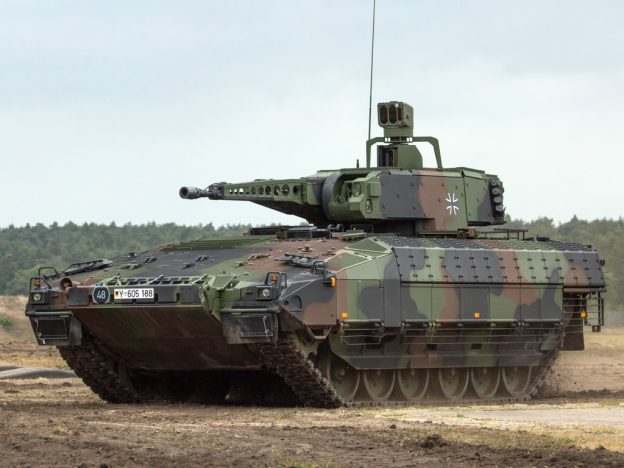
Germany is “massively” reducing its rearmament plans as high inflation and a strong dollar have made the equipment too expensive to buy for the country, unnamed political and defense industry representatives have told Handelsblatt newspaper.
Many projects, especially those for the navy and airforce, would likely have to be canceled, the outlet reported on Friday.
The fate of a third batch of K130 corvettes is now hanging in the balance, along with new Eurofighter jets for electronic warfare, frigates, and self-propelled howitzers, which were to be ordered to replace equipment sent by Berlin to Ukraine, the sources claimed.
The number of units in a second batch of Puma infantry fighting vehicles, the cost of which was estimated at €304 million ($299.8 million) earlier this year, is also being reduced on a weekly basis, an unnamed politician from the ruling ‘traffic light’ coalition told the paper.
“Since many projects run for five to seven years, inflation in this dimension creates a serious financial problem,” one of the sources explained. The economic situation has been fraught in Europe as the burden of the Covid-19 pandemic was further aggravated by the fallout from sanctions imposed by the EU on Moscow over its military operation in Ukraine, and the subsequent reduction in the supply of Russian energy to the bloc.
Arms manufacturers have reportedly been unhappy with the size of a special €100 billion ($98.6 billion) fund allocated by the German government for rearmament purposes. “In order to fulfill the wishes of the Bundeswehr, €200 billion is needed,” a defense firm manager told Handelsblatt.
When announcing the investment in June, Chancellor Olaf Scholz promised that it would help turn the German military into the “biggest conventional army” among European NATO member states. The Bundeswehr would be able to “defend every square meter” of the US-led military bloc’s territory, he insisted.
EU to escalate conflict by training Ukrainian soldiers
By Lucas Leiroz | October 18, 2022
Despite the fact that involvement in the conflict is not strategically interesting for Europe, EU leaders seem convinced that they must continue to support Kiev. In a new package of coercive measures against Moscow, the bloc’s ministers approved the creation of a military program to train Ukrainian soldiers. This kind of attitude reveals that the West is indeed willing to escalate the conflict, regardless of the disastrous economic and social consequences it will bring to Europe.
At a recent meeting in Luxembourg, the EU’s foreign ministers gave permission to start a military training program for 15,000 Ukrainian soldiers. The move is the main point of the so-called “Military Assistance Mission to Ukraine”, which is a European comprehensive package of aid to Kiev. In addition to the training, it was also promised to create a fund valued at 500 million euros to finance European aid to Ukraine. The objective is to make resources available so that no European State is financially harmed with the assistance it has provided to Kiev, thus enabling the extension of the support. More money is expected to be added to the fund in the future.
The exercises will take place within the territories of the European countries themselves. Vice Admiral Herve Blejean, Director of Military Planning Capability and Conduct (MPCC), has been designated as the Mission Commander. The training costs have been estimated at more than 100 million euros and will be funded entirely by the EU, although the project is open to participation by voluntary states outside Europe.
There is still no concrete data about the precise moment the instruction will start to be conducted. Some sources claim that this may start in November. The center of the operation is expected to be in Poland, considering the viability for the deployment of Ukrainian troops. However, a military post will also be allocated in Germany. The project has an initial term to last around two years, but it may be extended while the conflict in Ukraine remains active.
“The aim of the mission is to contribute to enhancing the military capability of Ukraine’s Armed Forces to effectively conduct military operations (…) In response to Ukraine’s request for military support, EUMAM (European Union Military Assistance Mission) Ukraine will provide individual, collective and specialised training to Ukraine’s Armed Forces, including to their Territorial Defence Forces, and coordination and synchronisation of member states’ activities supporting the delivery of training”, European Council’s spokespersons said during a press conference about the measure.
Also, Josep Borrell himself, who recently made threats about “annihilating the Russian Army”, as well commented on the case, stating: “The EU Military Assistance Mission is not just a training mission, it is [a] clear proof that the EU will stand by Ukraine for as long as is needed”. It is important to remember that Borrell, in addition to threatening Russia, recently made racist pronouncements, saying that Europe would be a “garden”, while the rest of the world was compared to a “jungle”. This kind of aggressive and xenophobic behavior has become commonplace among European leaders – and has been used as rhetoric to endorse the West’s proxy war against Russia.
As expected, the only country to criticize the measure and take a stand against EU involvement in such program was Hungary. Hungarian Foreign Minister Peter Szijjarto was clear in his opinion against this kind of escalation in European participation. He stated that the Hungarian government did not vote in favor of the project and therefore will not participate in the mission in any way. Szijjarto also said that Hungary is in favor of new peace talks, not advocating for actions that worsen the conflict.
“It was decided today that … EU countries’ representatives will carry out training of Ukrainian military. I would like to say that Hungary did not vote for the initiative … We will not participate in the mission”, he said.
In fact, the Hungarian attitude should serve as an example for all European leaders. There is no strategic interest on the part of the EU to make this conflict last even longer, considering the numerous social and economic damages that Europeans are suffering. In this sense, increasing aid to Kiev sounds like a willingness by the EU to meet the interests of the US and NATO instead of the demands of the European people itself who are gradually intensifying the wave of mass protests for the end of anti-Russian sanctions.
In addition, it is necessary to take into account how outrageous it is to initiate military aid focused on training. This characterizes a much more direct military involvement in the conflict, which puts the EU in an even more troubled diplomatic situation with Russia. Directly training troops of the Ukrainian neo-Nazi regime sounds like a real provocation to Moscow and this will certainly contribute to further worsening the distance between Russia and the EU.
Indeed, apart from Kiev, the only side benefiting from this measure is Washington, which has an advantage in case of breaking ties between Russians and Europeans.
Lucas Leiroz is a researcher in Social Sciences at the Rural Federal University of Rio de Janeiro; geopolitical consultant.
EU blackmails Serbia – interior minister
Samizdat | October 16, 2022
The EU’s offers to Serbia are unacceptable, and Serbs should “accept that they don’t want us,” Interior Minister Aleksandar Vulin told the Novosti news site on Saturday. He added that Belgrade should instead turn its attention to “free countries that accept us without blackmail,” such as Russia and China.
“The question is not whether we want to join the EU, but whether the EU wants Serbia,” Vulin told Novosti. “Judging by the insane blackmail they are exposing us to…they don’t want us. The sooner we accept that they don’t want us and that we don’t belong there, the better off we will be.”
A traditional ally of Russia, Serbia has come under intense pressure from the West to back the sanctions regime against Moscow over its military operation in Ukraine. The European Parliament has considered freezing accession talks with Belgrade over the latter’s refusal to back its eight rounds of economic penalties, US state media reported last month, while Germany and France have offered to “accelerate” Serbia’s path to EU membership if it recognizes the independence of the province of Kosovo, Serbian President Aleksandar Vucic stated last week.
For Vulin and Vucic, the answer to these offers is a clear “no.”
“How much would our friends respect us if they saw us neglecting our interests in the face of enemy force?” Vulin asked. “Who would fight for us if we chose not to fight for ourselves?
“Relations with Russia, China and other free countries that accept us without blackmail and conditions are the future of Serbia,” he continued. “I believe that friendship with Russia is of the greatest importance and that without it we risk the physical disappearance of Serbia.”
According to a poll taken in March, some 61% of Serbs oppose any cooperation with the US-led NATO alliance, largely due to the bloc’s support for Kosovo’s independence and its 1999 bombing campaign that brought about the end of Yugoslavia. Furthermore, while Serbia applied for EU membership in 2009, accession looks to be off the table for now. The EU’s latest sanctions package targeting Russian oil exports looks set to cost Belgrade hundreds of millions of euros, Vulin said last week, describing it as the “first EU sanctions package against Serbia.”
Hungary has responded to the sanctions by announcing a new pipeline to help Serbia tap into the supply of Russian crude oil.
PUTIN’S ASTANA PRESS CONFERENCE – HE AIN’T BIDEN
By Larry Johnson | A Son Of The New American Revolution | October 15, 2022
If you take the time to watch Vladimir Putin’s press conference yesterday (Friday) in Astana and then watch any recent cluster fark by Joe Biden, you will understand why the Russians are so calm in dealing with Ukraine. Putin is remarkable. Low key, well informed, articulate and not afraid of tough questions. He did not get any softballs here and, in fact, faced some tough questions. So much for the myth that Russia is a totalitarian state that brokers no dissent and requires everyone to toe a party line. That characterization more aptly describes the United States under the demented Joe Biden.
Here are the highlights with the relevant time stamp:
9:15 Putin is asked about Germany’s behavior. He notes incisively that Germany has put a priority on serving NATO rather than the interests of its nation and people.
14:40 Putin is asked about attending the G20 and meeting with Joe Biden. Putin said, there is no point. “There is no platform for any kind of negotiations at this point.” And we are in constant contact with some members of the G20, e.g. Turkey.
18;00 Putin is questioned directly about recent arrest of man in Moscow for listening to Ukrainian music. Putin responded that the arrest is wrong and we (Russia) should not behave like the West in trying to cancel a culture, in this case Ukrainian culture. He noted that Ukrainian is still a recognized language in Crimea and would remain so. He emphasized that Neo-Nazis and Nazi symbols on display in Ukraine are NOT Ukrainian culture and must be eliminated.
20:10 Mobilization was a hot topic. Will there be another wave of mobilization? Will there be “total mobilization”? Putin said the Defense Ministry initially planned a smaller number than the 300,000. Putin remarked that he doesn’t see any need right now to expand that number. There are 220,000 mobilized and the work of mobilization will be finished in two weeks.
22:00 Putin was asked about the men who fled Russia for other countries and calls in the Duma to confiscate their property. Putin said it must not be handled based on emotions. Rather it must be dealt with according to the law. In other words, each case must be litigated on an individual basis instead of a blanket action.
24:00 Another reporter cited one person mobilized who died allegedly with no training. Putin emphasized that the mobilized are supposed to receive 5 to 10 days refresher training. Then they go for specialized training that lasts 5 to 15 days. Then they undergo joint combat training. So far 33,000 men have been mobilized already with front line units and 16,000 in units with combat missions. Putin said he will order a review of the training regimen to ensure it is being done appropriately.
29:15 A reporter asked about the retaliatory strikes in response to the terrorist bombing of the Crimea bridge. Putin said there is no massive retaliation. Russia hit 22 of 29 targets and is now working on hitting the remaining 7. He said he saw no need for “massive retaliation” at this point.
30:00 Final question–NATO says that defeat of Ukraine by Russia will be the defeat of NATO. What happens if NATO deploys troops to Ukraine. Putin said “it could lead to a global catastrophe and I hope that those who talk about this will be smart enough not to undertake such dangerous steps.”
Whether you like or despise Putin, give the man his due. He spoke off the cuff. No notes in hand. He did not shy away from any question and he did not get angry or lose his cool. What a contrast with a Joe Biden press encounter. I think that Western politicians and pundits who disparage Putin as an incompetent dictator are making a very dangerous mistake. They fail to take this man at his word. Putin is establishing himself as a man who says what he means and means what he says
Time to start worrying again!
By Gilbert Doctorow | October 15, 2022
Some readers have commented in direct emails to me that they have taken comfort from my writings insofar as I have been a moderate voice, avoiding alarmism over the often troublesome daily news in and around the Russian war with Ukraine, or more properly speaking today, Russia’s proxy war with NATO in and about Ukraine.
For this very reason, I hesitated whether to share with readers the deep pessimism that overcame me a couple of days ago over our chances of avoiding nuclear Armageddon. This followed my watching the latest Solovyov political talk show on Russian state television. I have used this show regularly as a litmus test of the mood of Russian social and political elites: that mood has turned black.
Whereas in the past, going back six months or more, I had reported on the open contempt which leading and highly responsible Russian academics from university circles and think tanks were showing for the American political leadership in their statements on the political talk shows, this contempt has moved into an actionable phase, by which I mean that serious, God-fearing Russians are so furious with the rubbish propaganda coming out of Washington, repeated with bullhorns in Europe that if given the chance they would personally “press the button” and unleash nuclear attacks on the United States and Britain, in that order notwithstanding the possibility, even probability of a return strike, which, however enfeebled, would be devastating to their own country. That is to say, deterrence as a policy is fast losing its psychological impact on the Russian side of the argument.
Whatever the words of the Biden Administration about nuclear war being ‘off the table,’ America’s aggressive and threatening behavior, including the ongoing ‘training in nuclear weapons’ currently going on in Europe under U.S. direction, has made rational and very serious Russians ready to give it a try.
One of the most sober-minded international affairs experts to appear on the Solovyov show, Yevgeny Satanovsky, president of the Institute of the Near East think tank, contained his rage with some difficulty, saying only that while he had once held some sympathy for the United States, he would see its utter destruction now with little regret; he left no mention where his feet are pointed when he added that he could say no more on air for fear that he will be censored and his words removed from the video.
For these reasons, I have given to this essay addressed to the Collective West, and in particular to the fomenters of world disorder in Washington and London, a title that fits the current situation.
*****
As we have seen from even before the launch of the ‘special military operation,’ Russian talk programs identify by name individuals in the Biden team whose outstanding stupidity, obtuseness and rank ignorance they find unbearable, with the likes of Antony Blinken, Jake Sullivan and Lloyd Austin among those coming in for special mention. We are left with the impression that when Biden calls in his advisers to the Oval Office, he, senile dimwit that he is, is the bright light in the room. The Russians conclude from this that they have no one to negotiate with.
Now the naming of idiots in high places carries over to all discussion of European Union and British leaders. The denunciation of incompetence, rank stupidity and, yes, neo-colonialist or fascist mindsets among European leaders was well reflected in the latest Solovyov show. The most discussed whipping boy was the EU’s commissioner on external action, Josep Borrell, who seems to be speaking to the world daily and acknowledges no limits on what he may proclaim, as if it were official EU policy in defense as well as diplomacy.
The Solovyov show put up on screen a brief video recording of Borrell expounding smugly on Europe’s privileged position as ‘a garden of liberal democracy, good economic prospects and social solidarity’ which is surrounded by ‘the jungle.’ That jungle reference fits in well, Solovyov remarked, with the colonialist mindset of Rudyard Kipling and is deeply offensive to the Rest of the World, of which Russia is a part. More to the point, Borrell was also notorious in Russia this past week for his statement that any use by Russia of nuclear weapons in Ukraine would be met by a massive non-nuclear attack from Europe which would ‘annihilate’ the Russian army. However, Borrell was not alone in the stocks: other European leaders who were decried for their stupid policies this past week included German Chancellor Olaf Scholz and French President Emanuel Macron.
So you have no bomb shelter? Then, as the Russians said decades ago, it is high time to throw a bed sheet over your shoulders and slowly walk to the nearest cemetery.
*****
One of the two latest fake news stories being disseminated simultaneously and ubiquitously in Western major media this past week is that Russia is considering using against Ukraine ‘tactical nuclear weapons,’ meaning warheads with a destructive force equivalent to the Hiroshima-Nagasaki bombs mounted on cruise or medium range ballistic missiles. Our print and electronic media speculate on the numbers of warheads Russia currently possesses (2,000 or more), as if that would make any difference in an assault on Ukraine.
Rubbish say the Russians on Solovyov’s show: we have no need of nuclear arms to finish off the Ukrainians. The only nuclear forces we would deploy in the current situation are strategic arms, and they are directed against…. Washington with the help of the Sarmat and Poseidon delivery systems.
The other major fake news disseminated massively by Western media in recent days was the allegation that the Russians are seeking to freeze the Ukrainians to death by their strikes against power generation infrastructure. Images of Stalingrad were evoked by our broadcasters. A similar freeze is said to be inflicted on Western Europe by the cut-off of Russian energy supplies to the EU.
More rubbish say the panelists on the Solovyov program. The attack on the electricity grid in Ukraine is not directed against civilians per se; it is intended to halt rail deliveries of advanced weapons systems and munitions coming into Ukraine at the Polish border and being moved by train to the fronts in the east and south of the country. Without these inputs, the Ukrainian army will be kaput and the war can come to an early conclusion with the capitulation of Kiev. As regards the EU, whatever chill out may be coming this winter is due solely to the unprofessional and ignorant decisions of the Commission on imports of Russian hydrocarbons that have been blindly followed by the Member States without due consideration of consequences for their own populations.
*****
The Collective West speaks of ‘sham’ referendums in the four Ukrainian oblasts that have now been reintegrated into (or annexed by, depending on your politics) the Russian Federation. In this spirit, in the middle of the past week the United Nations General Assembly overwhelmingly approved a U.S. sponsored resolution refusing to recognize the legality of this annexation. Among those who voted against Russia were such prominent ‘friendly states’ as Serbia and Hungary. One hundred forty states voted with the United States; four states, including the pariah regimes in Venezuela and North Korea, joined Russia in voting ‘nyet,’ and thirty-five states abstained.
The United States trumpeted this victory at the UN over the mischievous and rules-breaking Russians. EU chief of diplomacy Borrell was also gloating, though he expressed regret that 20% of the member states had not voted for the resolution.
The Russians, for their part, insist that this vote was a sham, given the carrots and sticks that U.S. and European diplomats used to get the results desired. Blackmail of all kinds was applied, say the Russians. Morever, the number of states in each tally tells only part of the story: among the 35 abstaining countries were India and China, which between them alone account for 35% of humanity.
Meanwhile, over in Europe, on the next day the Parliamentary Assembly of the Council of Europe meeting in Strasbourg adopted a resolution condemning Russia for its alleged aggression against Ukraine with a bill of particulars several pages long and including a call for the 46 member states to declare Russia a ‘terrorist state’ as Zelensky had requested of them. The vote as published was said to be 99 for the resolution, 1 opposed. No mention was made in the announcement of vote results that the actual number of deputies in PACE is 306. The point was not missed by the Solovyov panel, who here too cried ‘foul.’
Putting aside these two votes that garnered so much attention in the propagandistic Western media, there were other international developments bearing on the relative standing of Russia in the global community which Western media chose to ignore, but Russia media, featured prominently.
I think in particular of the three days of summitry in Astana, the capital of Kazakhstan. The first of these gatherings brought together 27 heads of state from across Asia, running from Israel and Palestine, Qatar and the Emirates in the west to Korea in the east. Let us remember that a goodly number of the participants were from countries that voted against Russia in the UN General Assembly. Their presence in Astana gave the lie to the notion that they were expelling Russia from polite society.
The key personality at the meeting of 27 was clearly Vladimir Putin. Film footage on Russian television showed him in animated conversation with these leaders in group and bilateral formats. Of these the most significant was likely the face-to-face with Turkish president Erdogan, during which the two discussed immediate steps to implement the Russian proposal that a new pipeline be added to Turk Stream so as to greatly increase possibilities for delivering gas to Europe by this southern route through the Balkans. In this concept, Turkey will become a major gas hub, which represents fulfillment of a long-held dream by the Turkish leader.
In its capacity as hub, Turkey would be able to mix Russian gas with flows from Azerbaijan and possibly later from Turkmenistan, so that the product sold as a Turkish export would be bullet proof against American or European sanctions. The additional line could probably be laid down within a year, that is to say, more quickly than the problematic repairs to the damaged Nord Stream 1 pipelines.
The next day in Astana, another summit was held between leaders of the Community of Independent States. This reduced circle of members was also of great importance insofar as it confirms Russia’s standing as facilitator of diplomatic solutions between member states experiencing armed conflict with one another, the Azeris and Armenians being first in line. And the final summit, among the leaders of Central Asian republics with Russia had yet another important agenda: agreeing security measures to defend against spillover into their region of the developing civil war in Afghanistan, where the U.S. and Britain are aiding extremist groups seeking to overthrow Taliban rule. From the body language of leaders, it would seem that Putin’s ear was much in demand. Relations with Kazakhstan leader Tokaev appeared to be solid once again after a trying period of several months earlier in the year.
In considering the meaning of these gatherings, I think that a remark made several days ago on another Solovyov show and with regard to the decision of the Saudis and Gulf States to snub the insistent demands of Biden that oil production be raised: the decision to make common cause with Russia came not out of pity for the weak but out of Realism, namely the assessment that Russia will win the military contest with NATO/Ukraine. These rulers in Opec, like the rulers who came to Astana this past week, back winners not prospective losers.
If I may draw any positive conclusions from the otherwise bleak analysis in the foregoing, they are that Russia is successfully resisting massive U.S. and E.U. pressures, and that the world is realigning before our eyes in a more multi-polar and democratic direction. And yet, the fears of miscalculations on one side or another in this tense and unparalleled contest mean Armageddon constantly threatens in the background.
©Gilbert Doctorow, 2022
Paris about to boost military interventionism in Eastern Europe
The recently announced decision only tends to worsen current security crisis on the European continent
By Lucas Leiroz | October 13, 2022
Contrary to all the recommendations by military experts to avoid further escalation in the European security crisis, France is apparently planning to expand its military presence in other regions of the continent, mainly in the eastern part. In a recent statement, the French Defense Minister said that an increase in his country’s military capability in Eastern Europe is currently being planned, which considerably tends to escalate tensions in the near future.
On October 11, Sebastien Lecornu, French Defense Minister, revealed that France will cooperate with NATO to deploy more troops and military equipment in Eastern Europe, as a way of reacting to the current situation of instability in the region. According to him, armored vehicles will be sent to the East, mostly to be deployed in Romania, allegedly in an attempt to prevent foreign attacks and seek security stability.
At a meeting of the French Senate Committee on Foreign Affairs, Defense and Armed Forces, Lecornu said: “In view of the situation on the eastern flank of NATO due to the fighting that Russia is waging in Ukraine, the president of the republic decided to strengthen our defensive position in eastern Europe by sending a brigade of armored vehicles and tanks to Romania”.
The defense minister also made it clear that Paris plans to strengthen the NATO’s presence in the Baltic region. He said that France will soon be sending new Rafaele fighter jets to Lithuania. In addition, French troops are expected to be deployed to Estonia in the coming weeks. Lecornu stressed that such measures are likely to be implemented between October and early November.
The initiative seems to be a first step to comply with NATO’s plans decided during the last summit on strengthening the eastern flank until 2023, as a way of responding to the supposed “Russian threat” posed by the special operation in Ukraine. At the summit, the organization’s officials had decided that the eastern flank must reach as quickly as possible the number of more than 300,000 soldiers of high combat readiness.
Obviously, when such decisions are made, all the alliance’s countries are expected to contribute as much as they can in order to achieve the goals. So, France, apparently fulfilling the role of hegemonic military power on the European continent, is ready to lead the project and already plans to allocate troops and weapons to allied nations by November.
As far as Romania is concerned, President Emmanuel Macron had promised already at the summit in June to help to create a special NATO brigade for the country. Although very clear commitments to send military aid to the Baltic States have not been made before, this type of measure was also expected, considering the importance of that region to NATO’s plans of encircling Russia. In the same sense, it is likely that Paris will also reinforce the deployments of its troops in other allied countries in the East in the near future.
In parallel with this French readiness to attend NATO’s plans to occupy the East, it is also necessary to emphasize Macron’s recent pledges to expand his support for Zelensky. On October 10th, the French president made a public statement reiterating his country’s full and absolute support for Ukraine to have the necessary conditions to continue fighting. On the same day, Macron and Zelensky had spoken by phone in an “urgent call”, in which Macron promised to bolster his support for Kiev.
Zelensky commented on the call on his social media saying: “Had an urgent call with Emmanuel Macron. We discussed the strengthening of our air defense, the need for a tough European and international reaction, as well as increased pressure on the Russian Federation. France stands with Ukraine”.
In addition, the French government has released a special fund of 100 million euros for Kiev to buy weapons from French military companies. Analyzing it from a realistic point of view, the measure does not exactly sound like a gesture of support and good will, but as a way to generate profits and promote French national industry while Ukraine buys weapons to continue fighting in a conflict.
In fact, there are two ways of interpreting the French attitude. On the one hand, Paris is acting against European interests because, by using its forces to occupy the East, it is worsening the security crisis as it inflates NATO’s threats to Russia in the region, generating instability. On the other hand, the French government is also trying to serve its own interests and pursuing a policy of military expansionism, regional affirmation of power and improvements to the national war industry.
What Macron should do to achieve his goal of becoming a hegemonic leader in Europe would be to admit that NATO’s plans do not coincide with European interests and to use his influence to prevent excessive and anti-strategic militarization in the eastern part of the continent. But, apparently, attending to NATO’s demands remains the priority in Europe.
Lucas Leiroz is a researcher in Social Sciences at the Rural Federal University of Rio de Janeiro; geopolitical consultant.
You can follow Lucas on Telegram.
THERE IS NO SINGLE WAR IN UKRAINE AND NATO IS IN TROUBLE
By Larry Johnson | A Son Of The New American Revolution | October 11, 2022
Not to beat a dead horse, but most of the world has a delusional image in their head of the war in Ukraine. As I have written previously, much of the fault lies with Hollywood, which through a plethora of movies has conditioned the masses to think of war as the conquest of critical territory. But that is a misleading image when it comes to Ukraine. Yes, there are strategically important pieces of territory that must be captured or defended, but there also are vast swaths of plains (we call them prairies here in the United States) that are tactically difficult to control and, if you succeed in capturing an area of land, you create a problem of how to defend it.
Russia has a decisive advantage over Ukraine when it comes to battling for this territory, even though it ceded some of it a few weeks ago to advancing Ukrainian troops. Why? Because Russia’s air force is still intact and can be used to attack massed Ukrainian units. Ukraine’s air capability has been eviscerated. Russia also enjoys a lopsided advantage in tanks.
At the beginning of its full-scale invasion in Feb., Russia had around 3,330 operational tanks (2,840 with the ground forces, 330 with its naval infantry, and 160 with its airborne forces), according to the Military Balance 2021 database. . . .
However, Russia still has some 2,000 battle-ready tanks at hand, as well as an enormous amount in storage.
The Military Balance 2021 database says Russian storage facilities have around 10,200 tanks, including various T-72s, 3,000 T-80s, and 200 T-90s.
Tank battles on rolling plains is great grist for a Hollywood blockbuster, but the real peril for Ukraine has been on display over the last two days–Russia’s hypersonic missiles, cruise missiles and air launched rockets mangling power nodes and military headquarters throughout Ukraine. The Russian strikes in the last two days significantly degraded Ukraine’s ability to supply electricity and critical heat to its major cities. The attacks also are disrupting Ukraine’s cell phone network and its ability to move troops and equipment from the west to the frontlines in the east.
Ukraine does not have a comparable capability to counter the Russian attacks. Moreover, the Russian missile barrage has highlighted the weakness, if not absence, of Ukraine’s anti-missile defense system. It is neither a mistake nor a coincidence that Russia’s strikes in major Ukrainian cities–more than 100 missiles– caused very few human casualties, especially on the civilian side of the ledger. Despite Ukrainian claims that Russia’s strikes killed civilians, the evidence suggests otherwise–Ukraine’s own anti-missile system failed to intercept the Russian targets and then fell to earth and hit apartments and schools.
What is the United States and NATO going to do? Immediately deploy the Iron Dome anti-missile system? Unfortunately, these Western anti-missile systems are not designed to defeat the missiles Russia is launching. Then there is the logistics problem–i.e., getting those systems deployed and training personnel to operate them. This will take weeks, if not months. And Ukraine does not have the luxury of time in this regard. Making matters worse, the United States and NATO do not have the reserves to quickly resupply Ukraine:
The United States will soon be unable to supply Ukraine, as it has up to now, with the sophisticated equipment essential for its defense against Russia as its reserves are reaching their limits, especially in terms of ammunition. . . .
But US stockpiles of certain equipment are “reaching the minimum levels necessary for war and training plans” and getting weapons stockpiles back to pre-invasion levels could take years, Mark Cancian wrote in a recent analysis. of the Center for Strategic and International Studies.
Washington is “learning lessons” from the conflict about ammunition needs in a very powerful war, and that it is “much larger” than expected, said a US military official who requested anonymity.
Then there is the nightmare scenario for Ukraine and NATO of Russia invoking the Collective Security Treaty Organization (CSTO) and Russia asking Belarus to join the fray. Russian and Belarusian troops already are gathering on Ukraine’s northern border. Whether this is a bluff by Russia or genuine preparation for opening a new front in the north, the massing of forces requires Ukraine to deploy already depleted forces to the northern border. This will weaken Ukraine’s ability to hold off a Russian offensive in Kherson and Zaporhyzhia.
I believe that the events during the next five weeks will create a crisis within NATO and the United States. If Russia seizes the initiative and moves in force against Ukrainian units, NATO will not be in a position to rescue Ukraine from defeat on the battlefield. Any further intervention by NATO will make it, in the eyes of the Russians, a legitimate military target.
Compounding the military challenges confronting the United States and NATO, there are the economic and political headwinds. Joe Biden is likely to lose control of the House of Representatives and the Senate. If this happens, he will no longer have a congressional ally eager to keep shoveling money and weapons into Ukraine. The economic conditions throughout Europe of inflation and shuttering businesses will fuel more domestic unrest and diminish enthusiasm for keeping Ukraine afloat.
When you take all of these factors into consideration, the conclusion is clear–Russia enjoys a strategic and tactical initiative that will be difficult to surmount. Conversely, NATO is in trouble.
US lies when talking about peace proposals – Russian FM
By Lucas Leiroz | October 12, 2022
During a press conference on October 11, Russian foreign minister Sergey Lavrov severely criticized the recent American speech insisting that Moscow had rejected peace proposals allegedly offered by the West. The minister stated that no serious proposal was made by Washington, therefore there was no Russian unwillingness to negotiate peace.
Lavrov claimed that the Americans indeed made some calls but did not show any concrete peace proposals during the talks. According to him, not even these calls were ignored, having Moscow responded, showing willingness to continue the dialogue in order to seek the formulation of a specific plan that benefits both sides. However, the West has shown itself to be uninterested in initiating conversations in this direction.
“This is a lie [that Russia refuses to negotiate]. We did not receive any serious proposals to enter into contact. There were some not very serious calls, to which we also did not respond negatively, but offered to formulate specific proposals, with which some people want to contact us through indirect contacts. And in this case, we did not receive more specific explanations from anyone”, he said.
The day before Lavrov’s interview, US National Security Council spokesman John Kirby had publicly reiterated that Moscow was not responding to US calls for negotiations. Earlier, some US officials and journalists had already said that there would be no further dialogue as the Russian government was not interested in any proposals. But Russia does not endorse this narrative and claims that no US proposal has been presented.
Journalists also asked Lavrov for his opinion on the possibility of resuming peace talks with Turkey as a mediator, given the recent rumors that Ankara is planning a new negotiation for the conflict. According to Lavrov, no Russian official has yet received any information about such an initiative, but he made clear the Russian willingness to negotiate if the proposals seem reasonable. He stated that the meeting between Putin and Erdogan in Astana would be a good opportunity to clarify this topic.
Regarding the Ukrainian decision to not continue any form of dialogue with Russia and veto peace talks, Lavrov stressed that it does not seem to be something really resolute. For him, Zelensky’s decisions could change at any time, depending on a series of factors, mainly his “mood”, considering the instability already demonstrated by Zelensky so far, and the orders he will receive from the West in the near future. For Lavrov, if the Western powers order Zelensky to start peace talks, he will simply accept and ask to talk to Moscow.
“I do not rule out that he, as he forbade himself [to talk with Russia], will then forget about it, depending on his mood when he gets up in the morning and what he does. Well, or he will receive an order from Washington, from London – he will say ‘Yes’ and figure out how to explain all this so as not to lose face”, Lavrov said.
The veto of peace negotiations is precisely a consequence of orders received by the West, which is the side most unwilling to negotiate and which most seeks to escalate the conflict. So, if the opinion of Western leaders on the direction of peace talks eventually changes, it is actually expected that Zelensky will rethink the veto and suddenly ask to talk to Moscow.
The narrative that “Moscow does not want to negotiate” has been spread precisely in order to justify new actions in support to Kiev and Western active participation in the conflict. On many occasions, the West has made it clear that the longer the fighting lasts, the more beneficial this will be to NATO’s interests, because, given the impossibility of defeating Russia militarily, what is sought is simply to prolong the situation of security instability in the Russian strategic environment.
Since February, the Russian side has been the only one to actively pursue peace talks. To stop the special military operation, Moscow makes it clear that it only expects a list of requirements to be met. These requirements include some Russian territorial and political goals, such as the self-determination of Russian-majority regions and the demilitarization of Kiev. For Moscow, this is not an “expansionist ambition”, as the West says, but a real necessity, since present-day Ukraine is a direct threat against the Russian state.
For peace to emerge in Ukraine, the West must “authorize” Kiev to act sovereignly and negotiate with Russia proposals that meet the demands made by Moscow. There is no way to negotiate peace without fulfilling these requirements and what prevents Ukrainians from following them is precisely the order they receive from Western leaders to continue fighting in a war in which they have no chance of winning.
Lucas Leiroz is a researcher in Social Sciences at the Rural Federal University of Rio de Janeiro; geopolitical consultant.
You can follow Lucas on Telegram.
Can Western air defense systems help Kiev regime forces?
The systems will hardly make any groundbreaking contribution, as the Kiev regime already operates longer-range SAMs.
By Drago Bosnic | October 12, 2022
In late February, the Kiev regime was in possession of one of the largest and most advanced air defense networks in Europe, if not the world. After the Soviet Union’s dismantlement in late 1991, Ukraine inherited approximately 30% of the Soviet military, the largest and the most powerful conventional military force in the world at that point. This provided the then-newly independent country with an extensive air defense network that survived decades of corruption, mismanagement and lack of proper maintenance. After the Western-backed Neo-Nazi coup in 2014, NATO provided billions of dollars’ worth of “military aid” which restored and modernized most of Ukraine’s Soviet-era air defense systems. Still, when Russia launched its special military operation, these SAM (surface-to-air missile) systems failed to produce the desired result.
The number of downed Russian military aircraft was much lower than initially expected. The Russian Aerospace Forces (VKS) launched hundreds of successful SEAD (suppression of enemy air defenses) missions, destroying most of the radars and launch sites operated by the Kiev regime forces. Hundreds of variants of older, albeit modernized systems such as the S-300, Buk, Osa, Strela-10, etc. have been destroyed, effectively leaving the Kiev regime without mid to long-range air defenses. As proven by Russia’s recent missile strikes, this has made the Neo-Nazi junta especially vulnerable and unable to protect its critical military infrastructure. In order to tackle this issue, NATO member states have been promising to deliver modern SAM systems. This includes the NASAMS (joint US-Norwegian project) and the German-built Iris-T.
During a “Face the Nation” interview with Volodymyr Zelensky that aired Sunday, Sept. 25, 2022, on CBS, the Kiev regime frontman confirmed that the NASAMS (National Advanced Surface-to-Air Missile System) has been transferred to the Neo-Nazi junta forces:
“Zelensky thanked the U.S. for the system as well as the High Mobility Artillery Rocket Systems it’s received, but added that his troops absolutely need the United States to show leadership and give Ukraine additional air defense systems it has requested.”
According to The Hill, the Biden administration approved the shipment of six missile systems in late August as part of a nearly $3 billion “lethal aid package”. NASAMS is considered a medium-range system capable of defending against drones, aircraft and cruise missiles at a range of up to 50 km.
Recently, the German Ministry of Defense announced the delivery of at least four Iris-T SL air defense systems to the Kiev regime forces. A military convoy was spotted in the vicinity of the city of Katowice in southern Poland. Reports indicate that it was heading from Germany toward Ukraine. At least three German IRIS-T SLS (the short-range version) SAM systems are seen in the photos that were taken at night. The decision to supply the system was considered back in May, but was postponed several times.
According to the German media, the final decision to send the weapons to the Kiev regime was made on October 10, immediately after Russian missile and UAV strikes hit dozens of critical military targets across Ukraine.
“Russia’s missile strikes on targets in Ukraine show the importance of the early transfer of air defense systems to Kiev,” Defense Minister Kristine Lambrecht said.
However, the timing indicates that the decision to send the IRIS-T SLS was taken much earlier. Still, the Kiev regime doesn’t seem to be content with the current version of this SAM system, as its engagement range of only 12 km is considered subpar. Recent reports indicate that the Neo-Nazi junta is trying to acquire the IRIS-T SLM version, which has an engagement range of approximately 40 km. German media think this variant could be sent to the Kiev regime forces in November if the decision is confirmed by the German MoD. Regardless of what Germany decides, the system will hardly make any groundbreaking contribution, as the Kiev regime already operates longer-range SAM systems.
The primary downsides of the IRIS-T SL are its limited range and the infrared-based guidance system which makes it vulnerable to active counter-measures like flares. They are also unlikely to provide any new capability, as the Neo-Nazi junta forces are already using mid to long-range SAM systems like the aforementioned S-300 and Buk, most of which have been neutralized. What’s more likely is that the German military is providing the air defense systems to test them in combat, particularly in a situation where the enemy has air dominance. Western powers have been sending thousands of short-range air defense systems to the Kiev regime forces even before Russia launched its counteroffensive against NATO’s crawling encroachment on its borders.
So far, NATO countries have sent thousands of MANPADS (man-portable air defense systems), but their impact doesn’t go beyond the tactical level. However, most countries of the political West lack mid to long-range SAM systems which could replace the Kiev regime’s losses, as such systems have never been the focus of the Western style of warfare which is based on the concept of air dominance. Thus, even the somewhat longer-range NASAMS, which uses more advanced radar-guided missiles, is extremely unlikely to hurt Russian forces. This is especially true when it comes to Russian missiles, both low-flying subsonic cruise missiles such as the now-legendary “Kalibr” and the high-flying hypersonic missiles like the “Iskander” or “Kinzhal”. The latter is capable of speeds in excess of Mach 12 (approximately 4 km per second), making it virtually impossible to intercept by any means at NATO’s disposal.
Drago Bosnic is an independent geopolitical and military analyst.
NATO once ‘lost’ underwater drone under Nord Stream, Gazprom reminds
Samizdat | October 11, 2022
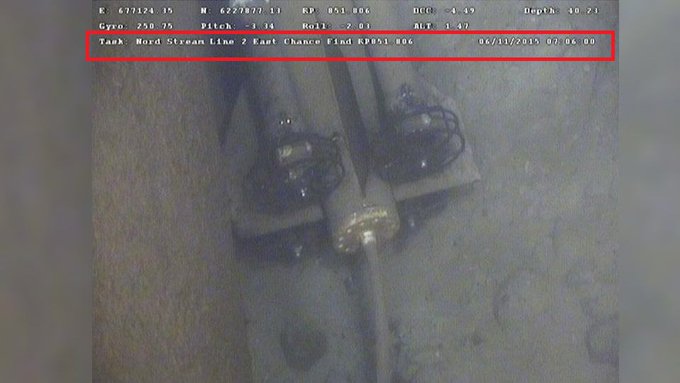
The US-led NATO alliance has been very active in waters around Nord Stream and once even managed to “lose” an armed underwater drone right under the pipeline, a Gazprom spokesman has said.
“On November 6, 2015, a NATO underwater mine destroyer ‘Seafox’ was discovered during a scheduled visual inspection of the Nord Stream gas pipeline,” Sergey Kupriyanov told Rossiya 24 on Monday.
The device was found resting on the seabed at a depth of 40m between the Nord Stream pipelines, almost directly under one of them, Kupriyanov said. The incident, which received limited media coverage at the time, prompted a brief halt in gas deliveries, while the drone was ultimately recovered by the Swedish military.
Back then, the US-led bloc said it had “lost” the device during military drills, the spokesman claimed. The German-made drone carries a 1.4kg shaped-charge warhead, which is intended for destroying sunken unexploded munitions and mines, according to publicly available data.
“That’s NATO drills for you, when a military-grade explosive device ends up straight under our pipeline,” Kupriyanov concluded.
The remarks come in the aftermath of the apparent sabotage attacks on the Nord Stream pipeline system. The Nord Stream 1 and 2 pipelines both abruptly lost pressure on September 26, following a series of powerful underwater explosions off the Danish island of Bornholm. The ruptures caused massive gas leaks into the open sea and rendered the pipelines inoperable.
While Moscow has called for an international – with its own participation – probe into the incident, other parties appear to be reluctant to carry out such an investigation. Sweden, for instance, has already explicitly stated it will not share the results of its investigation into the explosion with Moscow.
“In Sweden, our preliminary investigations are confidential, and that, of course, also applies in this case,” Swedish Prime Minister Magdalena Andersson told reporters on Monday.
Russian President Vladimir Putin has already blamed the “the Anglo-Saxons,” a Russian colloquialism for the US-UK alliance, of being behind the blasts, which Moscow described as an “act of international terrorism.” Speaking during a meeting of the Russian Security Council on Monday, Putin said that “we all know well who the ultimate beneficiary of this crime is.”
UK intelligence plotted Crimean Bridge bombing – Grayzone
Samizdat | October 11, 2022
Attacking the strategically vital Crimean Bridge was clearly not a new idea for Ukraine and its anti-Russia allies. In fact, UK intelligence officials reportedly commissioned a study in April examining ways to blow up the key transportation link across the Kerch Strait.
The secret plot was drawn up at the request of senior British Army intelligence operative Chris Donnelly, the Grayzone reported on Tuesday, citing internal documents and correspondence that the investigative journalism outlet obtained from an unidentified source. The stated goal was to destroy the bridge to cut off a key Russian supply route, isolate military forces in Crimea and temporarily block maritime access to the Sea of Azov.
The attack roadmap was titled, ‘Audacious: Support for Ukraine Maritime Raiding Operations’, and it was produced by UK military veteran Hugh Ward, according to the documents obtained by Grayzone. Donnelly, who’s also a veteran NATO advisor, called the plans “very impressive indeed.”
Ward laid out multiple options for blowing up the $4 billion bridge, including a cruise missile attack targeting concrete pillars on each side of the central steel arch. He also examined using divers or underwater drones to attach limpet mines to pillars at the “weakest part” of the structure.
Although last week’s attack on the bridge was carried out using a truck bomb, rather than the options discussed in the UK analysis, there are indications that British spies had shared their findings with Ukraine’s government “at the highest levels,” Grayzone said. The outlet obtained an email in which Donnelly forwarded the plans to Lithuanian Defense Minister Audrius Butkevicius.
Reached by phone, Ward didn’t deny that he prepared the attack plans for Donnelly, Grayzone said. “I’m going to have a chat with Chris and confirm with him what he’s prepared for me to release,” Ward told the outlet.
Although the Crimean Bridge is crossed by thousands of civilians daily, the UK study included no reference to avoiding non-combatant casualties. Saturday’s bombing, as it turned out, killed at least four civilians. Russian President Vladimir Putin called the blast a terrorist attack and indicated that Monday’s air strikes against infrastructure targets in Kiev and other Ukrainian cities were carried out in response to the bridge incident.
Ukrainian media outlets reported that the attack was perpetrated by the Security Service of Ukraine (SBU). Senior officials in Ukraine’s government celebrated the bombing and made jokes about it. The SBU posted a photo of the damaged bridge with a note saying, “The sun is rising, the bridge is burning beautifully.” Senior presidential aide Mikhail Podoliak posted a Twitter message calling the blast “just the beginning.”
US moving another Strike Group to Europe
Free West Media | October 11, 2022
This is not a sign of de-escalation: the US is sending one of its most modern aircraft carriers, the USS Gerald R Ford, to Europe. It is the US Navy’s newest class of nuclear-powered aircraft carrier (CVN 78), departing on its first major deployment.
The 13 billion euro carrier was only put into service in 2017, is 337 meters long and has a crew of 4 500, 90 fighter jets and, presumably, nuclear weapons on board. The Strike Group includes 17 ships and one submarine.
The USS Gerald R Ford, accompanied by several guided missile cruisers, submarines and supply ships, should be operating in the North Sea in just a few days, joining the Wasp-class amphibious assault ship USS Kearsage. This would give the US Navy a massive concentration of troops in northern Europe – and the air support of the most modern stealth fighter jets.
The Strike Group will be deployed alongside NATO forces. The US aircraft carrier USS Harry S Truman is still stationed in the Mediterranean.
Featured Video
Integrity Initiative: UK-funded network framed dissent as Russian disinformation for years
or go to
Aletho News Archives – Video-Images
From the Archives
Why Saudi Ties to 9/11 Mean U.S. Ties to 9/11
By Kevin Ryan | Dig Within | September 27, 2015
Media interest in Saudi Arabian connections to the crimes of 9/11 has centered on calls for the release of the 28 missing pages from the Joint Congressional Inquiry’s report. However, those calls focus on the question of hijacker financing and omit the most interesting links between the 9/11 attacks and Saudi Arabia—links that implicate powerful people in the United States. Here are twenty examples. … continue
Blog Roll
 Aletho News
- IAEA inspectors cannot return to Iran amid US threats: Russia
- Senate Rejects Iran War Powers Resolution Passed By House
- ‘We did not attack Pakistan with drones’: Afghan sources
- Iraqi Resistance faction links arms to sovereignty, questions US exit
- Cannon fodder no more… South Korea rejects Trump’s pressure to join his criminal war on Iran
- Neria Leiter Was A Legitimate Military Target
- Integrity Initiative: UK-funded network framed dissent as Russian disinformation for years
- ‘We don’t seek permission to defend our country’: Snippets from President Pezeshkian’s UNGA address
- NATO chief wants Europeans to fight American wars [for Israel]
- German chemicals giant reveals details of downsizing
- If Americans Knew
- In UN Speech, Iran’s President Displays Pictures of Children Killed by US, Brings Attention to Israel’s Nuclear Arsenal
- Israel displaces hundreds of Palestinians amid wave of demolitions in West Bank
- Aid, reconstruction, and Israel’s history of obstruction in Gaza
- Trump administration digs an ever-deeper hole of complicity in genocide – Daily Update
- US-Israel $2.8 Billion Arms Deal, 40,000-Bomb Supply Faces New Gaza Complicity Accusations
- Caught on Tape: AIPAC CEO Boasted of Controlling Trump’s National Security Officials
- Why Hamas Attacked Israel in October 2023 – Israeli professor Ilan Pappé
- They see them, then kill them: Israeli quadcopters track, deliberately target civilians in Gaza
- Winter could turn Gaza’s treacherous, war-damaged buildings into deathtraps
- Majority of Democratic Voters Want to Prosecute Both Biden and Trump Administration Officials Over Gaza
- No Tricks Zone
- New Study: Earth And Venus Surface Warmth Largely Explained By Convection And Lapse Rate, Not CO2 Or Radiation
- 2025 Nature Paper Claiming Worsening Global Drought Gets RETRACTED …Heavily Flawed
- New Study: ‘Global Drought Shows No Detectable Recent Acceleration Under Climate Warming’
- Economic Masterminds: German Socialists Suggest Taxing Productivity Gains Stemming From Using AI
- The South China Sea Has Not Been Cooperating With The Climate Change Narrative
- Energy Crisis: Germany Enters Heating Season With Historically Low Gas Reserve Fill Levels
- New Study: The Antarctic Ice Sheet Gained Mass From 2020-2024 Due To Staggering Snow And Ice Accumulation
- Study: Ocean Heating Rates From Thousands Of Years Ago ‘Dwarf’ Modern Ocean Heating Rates
- Climate Extremists Target, Attack Large-Scale Power Grid Infrastructure In Germany!
- New Study: Antarctic Ice Melt Has Contributed Less Than 1 Centimeter To Sea Level Rise In The Last 30 Years

