Western Russophobia increasing even in UNESCO
By Lucas Leiroz | November 4, 2022
The irrational hatred incited by the pro-NATO media against the Russian people in reaction to the special military operation in Ukraine continues to gain strength around the world. Russian citizens in the diaspora who have nothing to do with the government or the military are often affected by anti-Russian animosity. However, the main target today seems to be Russian culture, which is increasingly fought and “canceled” by Westerners.
In a recent statement during a UNESCO’s conference in Mexico, Sergei Obryvalin, First Deputy Minister of Culture of the Russian Federation, commented on the issue of Russophobia and expressed deep concern about the current global rejection of Russian culture. He said he considers the way the West deals with cultural matters an “unnecessary and harmful politicization”. More than that, Obryvalin even denounced the existence of Russophobic tendencies in UNESCO’s forum itself, where discriminatory speeches and untrue narratives about an alleged “destruction” of other cultures by Russia proliferate.
“Egregious cases of cultural discrimination against Russia and Russian citizens are happening everywhere in Western countries (…) False accusations [against] Russia of alleged destruction of cultural heritage are nothing but a manifestation of the policy of cultural genocide against Russia and Russians (…) Such facts, of course, cause us grief and serious concern (…) [Russia] consistently maintains a careful attitude to cultural heritage, historical memory, freedom of literary, artistic and other forms of creativity, [as well as] ensures pluralism of opinions and openness of the cultural sphere (…) No one is able to cancel the unique Russian civilization and rich culture, to destroy or shake Russia”, he said during the speech.
There was no response from UNESCO’s officials regarding the allegations that the organization acts in complicity with the anti-Russian discourse. Representatives from 193 countries attended the event and spoke at different times, but this topic was not mentioned by any of them. The case reflected in the field of culture something that has become increasingly common on the international scene: the silence on the part of organizations when Moscow denounces something wrong. In recent months, international organizations only make pronouncements if it is aimed at condemning Russia, while always ignoring when Russian officials file complaints.
However, the evident reality of cultural Russophobia cannot be ignored. Since February, irrational reactions to the anti-Nazi operation initiated by Moscow have been promoted around the world, mainly in Western countries, including the banning of Russian or Russian-translated books, cancellation of Russian musical concerts and even boycotting Russian-made food and drink. Classical authors of Russian literature have also been removed from Western academic courses as a way of “protesting” against military moves in Ukraine, which is something that undoubtedly causes great cultural damage, considering Russia’s importance in world literary history.
This cultural intolerance is just one of the many faces of the Russophobic racism that has become vital to Western “responses” against Russia. Cases of physical violence against Russian citizens have also occurred all over the world. Orthodox churches have been vandalized. Social networks have encouraged racism and pro-aggression speech against Russian citizens. In fact, there are attempts to “anathematize” the Russian people in every way possible. And, in this sense, cultural cancellation seems to be a fundamental strategy to be followed by Westerners.
In fact, with these attitudes the West becomes more and more like its Ukrainian proxy in the way it deals with the Russians. For the past eight years, Kiev has been promoting direct and explicit persecution of Russian people and culture. Not by chance, one of the first laws passed by the Maidan government was the abolition of the co-official language policy in ethnically Russian zones, which allowed the use of Russian language in official documents.
With the beginning of Russian participation in the conflict, Kiev has further radicalized its racist policies, with the Ukrainian parliament in June this year passing a bill to ban books and songs written by Russian authors. Ukrainian forces have also frequently performed public exhibitions of burning books in Russian language, which resembles the practices of Nazi Germany (a major inspiration for the Ukrainian government).
The West, albeit under the guise of liberal “democracy”, is moving in the same direction. Russian culture is gradually criminalized and violence against Russian citizens takes place without any restrictions, in absolute impunity. This only tends to further exacerbate international tensions and diplomatic frictions. The West’s Nazification process can in no way be tolerated by Moscow, which tends to move away from international organizations that tolerate racism and form new axes of international decision-making, in partnership with emerging countries that also historically struggle against discriminatory practices.
Lucas Leiroz is a researcher in Social Sciences at the Rural Federal University of Rio de Janeiro; geopolitical consultant.
Who’s afraid of US troops in Ukraine?
BY M. K. BHADRAKUMAR | INDIAN PUNCHLINE | NOVEMBER 2, 2022
Very innocuously, the Biden Administration has ‘sensitised’ the world opinion that American troops are indeed present on Ukrainian soil in Russia’s immediate neighbourhood. Washington made a “soft landing” with an unnamed senior Pentagon official making the disclosure to the Associated Press and the Washington Post.
The official gave an ingenious explanation that the US troops “have recently begun doing onsite inspections to ensure” that Ukraine is “properly accounting” for the Western weapons it received. He claimed that this was part of a broader US campaign, announced last week by the State Department, “meant to make sure that weapons provided to Ukraine don’t end up in the hands of Russian troops, their proxies or other extremist groups.”
In effect, though, President Biden is eating his own word not to have ‘boots on the ground’ in Ukraine under any circumstances. There is always the real danger that the clutch of Americans on tour in Ukraine may come under fire from the Russian forces. In fact, the US deployment comes against the backdrop of intense Russian missile and drone attacks currently on Ukraine’s critical infrastructure.
Plainly put, wittingly or unwittingly, the US is going up the escalation ladder. So far, the US intervention involved deployment of military advisors to the Ukrainian military command, supply of intelligence in real time, planning and execution of operations against Russian forces and allowing American mercenaries to do the fighting, apart from steady supply of tens of billions of dollars worth weaponry.
The qualitative difference now is that the proxy war may turn into a hot war between the NATO and Russia. The Russian Defence Minister Sergey Shoigu estimated today at a joint board meeting of the Russian and Belarusian defence ministries that the number of NATO forces in Eastern and Central Europe had risen by two and a half times since February and might increase further in the near future.
Shoigu underscored that Moscow understands fully well that the West is pursuing a concerted strategy to destroy Russia’s economy and military potential, making it impossible for the country to pursue an independent foreign policy.
He flagged that NATO’s new strategic concept suggested moving from containing Russia “through forward presence” to creating “a full-scale system of collective defence on the eastern flank,” with the bloc’s non-regional members deploying troops to the Baltic countries, Eastern and Central Europe, and new multinational battalion tactical groups being formed in Bulgaria, Hungary, Romania and Slovakia.
It may not be a coincidence that Washington acknowledged the presence of its military personnel in Ukraine at a point when the Russians have alleged the participation of British intelligence in the recent sabotage act on the Nord Stream pipelines and the drone strikes on Saturday at the base of Russia’s Black Sea Fleet at Sevastopol. There are grey areas in the so-called special relationship between the US and the UK.
The US-UK calculus has been to get the Russians bogged down in a quagmire in Ukraine and to incite an insurrection within Russia opposing ‘Putin’s war.’ But it has miserably failed. The US sees that over 300,000 trained ex-military personnel from Russia are being deployed to Ukraine for launching a major offensive to end the war in the coming 3-4 months.
That is to say, the roof is coming down on the entire edifice of lies and deceptive propaganda that formed the western narrative on Ukraine. The defeat in Ukraine could have disastrous consequences for the US’ image and credibility as a superpower not only in Europe but on the global stage, undermine its leadership of the transatlantic alliance and even disable NATO.
The Biden Administration made a terrible mistake in assuming that the war would lead to a regime change in Russia ensuing from the collapse of the Russian economy under the weight of western sanctions. On the contrary, even the IMF admits that the Russian economy has stabilised.
The indicators show that the Russian economy will be registering growth by next year. The comparison with the western economies that are sinking into high inflation and recession is far too glaring to be missed by the world audience.
Suffice to say, the US and its allies have run out of sanctions to hit Russia. The Russian leadership, on the other hand, is consolidating by pushing ahead with the shift to a multipolar world order and a de-dollarised international financial system. If these processes proceed further, it will dent the status of the American dollar as “world currency.”
Fundamentally, it is the capitalist system itself which is responsible for this crisis. We are currently suffering under the effect of the longest and deepest crisis the system has known since the redivision of the world that took place in World War II. The imperialist western powers are once again preparing for war to redivide the world in the hopes of getting out of their crisis, much as they prepared prior to World War II.
The big question is what Russia’s response is going to be. It is all but certain that Moscow hasn’t been caught by surprise at the revelation in Washington regarding the presence of US troops in Ukraine. It is highly unlikely that Russia will resort to knee-jerk reaction.
The so-called ‘counter-offensive’ by Ukraine has fizzled out. It made no significant territorial gains or gained any breakthrough. But it suffered heavy casualties in the thousands and huge losses in military equipment. Russia has gained the upper hand and it is conscious of that. All along the frontline, that is becoming evident.
On the other hand, the fact remains that neither the US and Britain nor their NATO allies are in a position to fight a continental war. Therefore, it will be entirely up to the American troops moving around in the steppes of Ukraine to stay out of trouble and keep their body and soul together in such harsh winter conditions without electricity, heating or a decent body wash. Who knows, the Pentagon may even work out a ‘deconfliction’ mechanism with Moscow!
That said, seriously, the auditing of US weaponry on Ukrainian soil per se is not a bad thing at all. Ukraine is a notoriously corrupt country, after all. There is real danger that the weapons supplied by the US may reach Europe and turn that beautiful manicured garden into a jungle (like Ukraine or America) — to borrow the colourful metaphor used recently by Josep Borrell, EU’s foreign policy chief.
Russia comments on NATO troop deployment near its border
Samizdat – November 2, 2022
The number of NATO forces stationed close to Russia’s western borders has reached more than 30,000, the country’s Defense Minister Sergey Shoigu said on Wednesday.
He stated that the US-led military bloc had augmented units in Central and Eastern Europe, as well as in the Balkans and Baltic states.
“The contingent has grown in size by two and a half times to more than 30,000 people since February, and may grow more in the nearest future,” Shoigu said during a joint ministerial session with military officials from Belarus.
He said that such a concentration of Western forces poses a threat not only to Moscow, but to Belarus, Russia’s ally.
The defense of both countries is a “priority task” of the Union State of the Russian Federation and Belarus, he stated.
The West’s ultimate goal in its confrontation with Russia is to “destroy its economy, military potential, and to deprive it of the ability to conduct independent foreign policy,” Shoigu said.
In response to Russia’s campaign in Ukraine, NATO enhanced military units and weapon stockpiles in the east as a “deterrence” measure. The bloc described Russia as “the most significant and direct threat” to peace and security in its chief strategic document, which was updated in June.
NATO Secretary General Jens Stoltenberg said at the time that the bloc’s rapid-response force would increase sevenfold to over 300,000. The bloc also agreed to establish four new battalion-size battlegroups in Slovakia, Hungary, Romania, and Bulgaria, in addition to those in Poland, Lithuania, Latvia, and Estonia.
Russia and Belarus announced the creation of a joint military force last month, which was said to include several thousand Russian troops. Belarusian President Alexander Lukashenko linked the move to tensions with the West. The first trains carrying Russian soldiers arrived in Belarus on October 15.
According to the Belarusian Defense Ministry, up to 9,000 Russian soldiers and around 170 tanks will be deployed in the country. The first trains carrying Russian soldiers arrived in Belarus on October 15.
In his speech on Wednesday, Shoigu said that the alliance with Minsk is especially important amid the “growing tensions across the world,” and the standoff with the West. He added that Russian and Belarusian units are training together, while the two states are conducting joint military planning as part of the new force.
How the West Brought War to Ukraine: A Review

By C.B. Forde | The Postil Magazine | November 1, 2022
It can be rather effectively argued that the greatest export commodity of the USA is war, commonly known as the Military Industrial Complex, which has spent the bloody decades after WWII bringing “democracy” to the benighted of the world—by bombs and sanctions, if necessary.
The latest such grand crusade is the war in Ukraine, which we have all been told to think of as “us” defending a fragile “democracy,” invaded out of the blue by the latest manifestation of Attila the Hun. Here was Ukraine happily minding its own business, until one day Putin woke up and decided that he needed to be a world-conqueror and off he went to “invade” Ukraine. The simplistic narrative of the “innocent” and the “criminal” has deep appeal in the Western psyche, conditioned no doubt by Hollywood. Thus, all the media had to do was point out the “criminal,” and the rest took care of itself. Out came all the virtue-signaling that the West is now so good at mustering. Now, there is not a shred of doubt in the minds of the majority in the West that this is a war between the “good guys” and the “Great Villain,” with the likes of Biden, Justin Trudeau, Britain and all the other cheerleaders for “democracy” constantly handing David’s loaded sling-shot to Ukraine to get the job done—but which the likes of Zelensky keep dropping. This is what fighting villainy to the last Ukrainian actually looks like.
But there is a far worse invasion that was completed a long time ago—that of the Western mind, addled by what is euphemistically known as “the mainstream media,” which knows that spin is the most effective form of victory in any war.
This is why Benjamin Abelow’s book, How the West brought War to Ukraine is a must-read, for it shows that this war is not about Ukraine, but about Russia, which needs to be brought to heel and become “democratic”: “…the vaunted goal of ‘regime change,’ which in the United States is sought by an informal alliance of Republican neoconservatives and Democratic liberal interventionists” (p. 5).
Abelow is careful in his analysis and gives a thorough and balanced account of what led Russia to undertake an attack on Ukraine on February 24, 2022. Despite mainstream narratives, the attack was carefully provoked (orchestrated comes to mind). So, unlike “settled history,” which would have us believe that Ukraine is the “innocent bystander” in all this, Abelow undertakes a meticulous unpacking of the various provocations (Ukrainian and Western), which began in 1990 and finally came to a head on February 24, 2022. Wars don’t just happen; they are the result of a long series of failures and outrages. In the words of Professor Richard Sakwa: “In the end, NATO’s existence became justified by the need to manage the security threats provoked by its enlargement. The former Warsaw Pact and Baltic states joined NATO to enhance their security, but the very act of doing so created a security dilemma for Russia that undermined the security of all” (p. 51).
Given that Russia is a nation-state, it must look after its geopolitical interests and defend what is crucial to what it deems necessary to continue, as Jacques Baud has so often pointed out in this magazine. Not to recognize these interests is to be blind to reality: “The underlying cause of the war lies not in an unbridled expansionism of Mr. Putin, or in paranoid delusions of military planners in the Kremlin, but in a 30-year history of Western provocations, directed at Russia, that began during the dissolution of the Soviet Union and continued to the start of the war. These provocations placed Russia in an untenable situation, for which war seemed, to Mr. Putin and his military staff, the only workable solution” (p. 7).
These provocations are now well-known, and thus rigorously ignored, denied or glossed over as “Russian propaganda.” These include bringing arms as close to the Russian border as possible; the expansion of NATO, despite promises given to Russia that that would never happen; the withdrawal of the US from the Antiballistic Missile Treaty and the Intermediate Range Nuclear Forces Treaty (which now gives the US first-strike capability); the ousting of a democratically elected Ukrainian government and installing neo-Nazis into power in 2014; NATO military exercises along the Russian border; pushing Ukraine to join NATO, despite warnings from Russia that that would mean war; since 2014, training and arming the Ukrainian military, in which many of the units are openly neo-Nazi; actively nurturing Russophobia in Ukraine; encouraging the bloody war in the Eastern portions of Ukraine, which were seen as “pro-Russian” and therefore hostile. There are many others that can be listed.
Of course, the last provocation was telling Zelensky not to negotiate when Russia attacked on February 24. He was ready to do so, and a war would have easily have been avoided, and many helpless lives saved. But Boris Johnson flew out, met the Ukrainian president, and negotiation was off the table.
And this is the most baffling thing—the West does not want peace at all. It wants a war of total annihilation for Russia, which will never happen, of course, but which the West so far seems not to understand (perhaps because it is now governed by leaders who have little understanding of warcraft). No Western politician bravely calls for negotiations, for a ceasefire, for peace, for even a little breather. It’s war and more war, and the billions and arms keep pouring in: “To my knowledge, Zelensky never received any substantial American support to pursue his peace agenda. Instead, he was subjected to repeated visits by leading American politicians and State Department officials, all of whom spouted a theoretical principle of absolute Ukrainian freedom, defined as the “right” to join NATO and to establish a U.S. military outpost on Russia’s border. In the end, this “freedom” was worse than a pipe dream. Although it advanced the aims of the United States—or, more accurately, the interests of certain American political, military, and financial factions—it destroyed Ukraine” (p. 60).
The military historian Bernard Wicht, whose interview appears elsewhere in this magazine, very astutely observes that the West no longer has the ability to wage conventional war—not even the United States; this is why armed conflict in the 21st century is now “farmed” out to modern-day condottieri, who bring their private armies wherever their paymasters tell them to go. Is this is why billions are being sent to Ukraine, to pay for all the mercenaries? The war machine chugs along, indeed.
The strength of Abelow’s book is that it makes complexity accessible. Wars have so many moving parts, and Abelow with a deft hand guides the reader along. As is true of all good writers, this book is filled with clarity and insight, with an eye for the bigger picture, and all the while letting facts lead where they will. This is a rare talent nowadays.
Given the much-mentioned threat of nuclear war, the book ends with a prescient warning: “Policy makers in Washington and the European capitals—along with the captured, craven media that uncritically amplify their nonsense—are now standing up to their hips in a barrel of viscous mud. How those who were foolish enough to step into that barrel will find the wisdom to extricate themselves before they tip the barrel and take the rest of us down with them is hard to imagine” (p. 62).
Finally, as professor Sakwa pointed out, this entire tragedy would have been easily avoided if Zelensky had been encouraged to say just five little words: “Ukraine will not join NATO.” Why he could not say that lays the entire blood-guilt upon the collective leadership of the West.
How the West brought War to Ukraine is satisfying to read because it brings truth to light—and that is the highest calling any worthy writer can pursue. Rush out and buy it; and after you’ve read it, you will be both amazed and infuriated. The condottieri now run the show—but perhaps we the decent folk of this world will learn once again how to get rid of them. Perhaps this will be this war’s silver lining.
Prague protests: local occurrence or indicator of coming unrest across Europe?
By Drago Bosnic | October 31, 2022
As if the political unraveling across the European Union, United Kingdom and other powers of the political West wasn’t bad enough, the people who have become fed up with the disastrous policies of their failing governments are finally taking to the streets. Pushed to the brink of (or beyond) poverty, with soaring food, energy and housing costs, tens of thousands of protesters railed against the policies of the Czech government. Starting on Friday, the residents of Prague took to the streets, demanding the resignation of the Czech government under Prime Minister Petr Fiala, withdrawal from NATO, as well as direct talks and an agreement on future natural gas supplies from Russia.
“This is a new national revival and its goal is for the Czech Republic to be independent,” organizer Ladislav Vrabel stated. “When I see a full square, no one can stop this.”
Demonstrations were not only limited to Prague, but occurred both in the capital city, as well as the second-largest Czech city of Brno. Organized under the slogan of “Czech Republic First,” the protests drew large-scale support from both sides of the political spectrum, as left-wing and right-wing parties joined forces to protest the subservient policies of the government in Prague.
“Russia’s not our enemy, the government of warmongers is the enemy,” one speaker said, according to a report by the Associated Press. Prague has sent munitions, armored vehicles, tanks, artillery systems and other heavy weapons to the Kiev regime and provided approximately 500,000 visas to Ukrainian citizens, along with full benefits. This has caused frustration among millions of Czechs, many of whom are now struggling to afford basic necessities, as their government is wasting increasingly scant resources by sending them to the corrupt Neo-Nazi junta in Kiev. Among the aforementioned requests such as the halt of anti-Russian policies, protest organizers are also demanding that Ukrainian citizens in Czechia not be granted permanent residency status.
This protest was the third in a series of demonstrations organized by a Czech group demanding Prague’s withdrawal from NATO and the establishment of normal ties with Moscow. According to Bloomberg, Prime Minister Petr Fiala’s government has attempted to dismiss the protests as supposedly “inspired by pro-Kremlin propagandist narratives.” The Czech government has been woefully unprepared for the economic fallout of anti-Russian sanctions and policies it was ordered to implement, resulting in the ever-rising costs which have not been tackled despite aid to businesses and household electricity price caps. On the contrary, price controls only backfired, causing shortages and resulting in even greater price hikes.
Despite attempts by the Western mainstream propaganda machine to present the Prague protests as “merely a local occurrence”, the truth is that they are just a relatively small part of a rising wave of discontent across not just the EU, but Europe as a whole. On October 27, just a day before the demonstrations in Prague erupted, tens of thousands protested in France, demanding higher wages to offset the rising costs of living. The strike also included teachers, healthcare providers and railway workers, among thousands of other French citizens. In recent months and weeks, similar protests have been organized in Netherlands, Belgium, Germany and Austria.
“This is merely the silence before the storm — the discontent is great, and people do not have any sense that the government has a plausible strategy to master the crisis,” German pollster Manfred Güllner told The Wall Street Journal.
At a time when approximately 75% of German families are forced to cut back on energy consumption, a mere 9% of Germans support Chancellor Olaf Scholz in his policies to tackle the escalating energy crisis threatening to destroy the EU’s largest industrial power. Although the protesters in France didn’t put anti-Russian sanctions at the forefront of their demands, German demonstrators have called for an end to these self-harming policies. The massive discontent in Europe will certainly spread all over the world, as hundreds of millions now realize that there is a direct connection between Western sanctions against Russia and their ever-growing economic and financial issues.
It does not take an expert in geopolitical matters to connect the dots and understand how the latest proxy war against Russia is affecting the well-being of the world. The situation in the EU has become so bad now that millions of Ukrainian citizens who have fled to Europe are returning to their (unfortunately) Neo-Nazi junta-run country. According to the latest figures by the International Organization for Migration (IMO), over six million people have gone back, despite the still ongoing conflict. The Kiev regime is now struggling to accommodate everyone and the Neo-Nazi junta officials are urging citizens not to return this winter. Blackouts have become the norm in multiple cities and with the coming sub-zero temperatures heating will be a major concern in the next several months.
Drago Bosnic is an independent geopolitical and military analyst.
Massive Protest By Czechs Targets Russia Sanctions, High Prices
By Tyler Durden | Zero Hedge | October 29, 2022
Fed up with soaring food, energy and housing costs, tens of thousands of Czech protestors railed against their government on Friday, demanding the resignation of conservative Prime Minister Petr Fiala’s government, withdrawal from NATO and the negotiation of gas purchases from Russia.
“This is a new national revival and its goal is for the Czech Republic to be independent,” said organizer Ladislav Vrabel. “When I see a full square, no one can stop this.”
The protests occurred both in the capital city of Prague as well as the second-largest Czech city of Brno. Organized under the slogan of “Czech Republic First,” the demonstrations drew their strength from both the left and right wings of Czech politics.
“Russia’s not our enemy, the government of warmongers is the enemy,” one speaker said, according to the Associated Press. Czechia has donated tanks and other heavy weapons to Ukraine, and provided nearly a half million visas to Ukrainian refugees, along with benefits. Protest organizers are also demanding that the refugees not be granted permanent residency.
https://www.bitchute.com/video/BWh1rYqHPGcl/
The protest was the third in a series organized by a group demanding Czechia’s withdrawal from NATO and better relations with Russia. As observed in the United States, the Czech government has attempted to marginalize them by calling them “pro-Kremlin propagandist narratives.”
The Czech government has tried to battle the rising prices with aid to businesses and household electricity price caps.
Friday’s protests were part of a rising wave of discontent throughout Europe. On Thursday, thousands protested in France, demanding higher wages to offset the rising cost of living — among them, striking teachers, healthcare providers and railway workers. Recent weeks have seen similar protests in Germany, Austria and Belgium too.
“This is merely the silence before the storm—the discontent is great, and people do not have any sense that the government has a plausible strategy to master the crisis,” German pollster Manfred Güllner tells The Wall Street Journal.
At a time when three quarters of German households are cutting back on energy consumption, just 9% say Chancellor Olaf Scholz has a sound strategy for surmounting the energy crisis. While the French protests didn’t target the Western sanctions regime against Russia, German protestors have called for an end to them.
The discontent is certain to rise all over the world, as more people connect the dots between Western sanctions and their personal misery… all for the latest proxy war over strategically irrelevant territory.
Will Ursula von der Leyen be forced to resign, and will her deeds be investigated?
By Vladimir Danilov – New Eastern Outlook – 28.10.2022
Europe has been rocked by large-scale protests over the last few weeks, and many politicians and media organizations in the EU see this as a reflection of public dissatisfaction with the policies of the European Commission and especially its head, Ursula von der Leyen. The main concern is the rising cost of living, the rapid increase in energy and food prices, and the anti-Russian policies of the European Commission, which have led to an energy and economic crisis that is affecting not only Europe but many other countries who have committed themselves to a close relationship with Europe.
Always keen to show her unwavering support for Washington and London, in her speech at the inaugural summit of the European Political Community, the President of the European Commission extended a warm welcome to Liz Truss – despite the fact that no-one other than Ursula von der Leyen considers the former British premier’s policies to be a success. As the Daily Express notes, the speech was greeted with an uncomfortable silence.
Internet users in the EU have criticized Ursula von der Leyen’s most recent promises to help the Kiev regime “as long as is necessary” and provide Ukraine with billions upon billions of Euros in credit. Her statements have been attacked on social media as ignoring the interests and wishes of EU citizens, and users have called for her resignation.
Writing on Twitter, the French politician Florian Filippo criticized her call for regular subsidies for Ukraine: “Ursula is completely crazy! Lock her up!”
In an interview with Le journal du Dimanche, the former French president Nicolas Sarkozy has accused the European Commission of lacking the authority to make decisions on arms purchases. As he explained, the European Commission is an administrative body, and it is unclear on what basis Ursula von der Leyen considers that she has the authority to speak up on matters relating to foreign policy or arms purchases. Just a few days after the beginning of Russia’s special operation in Ukraine, the President of the European Commission announced that the EU would finance “the purchase and delivery of arms and other military equipment” to Ukraine. Europeans are continually hearing about the need to provide the Kiev regime with billions of euros from EU coffers to buy arms, and they blame Ursula von der Leyen. Nicolas Sarkozy alleges that the EU’s policy in relation to Ukraine was too dependent on “escalation, irritation and thoughtless actions.”
The Israeli television channel i24news and the former Socialist candidate for the French presidency (in the 2007 elections) Ségolène Royal have also recently criticized Ursula von der Leyen’s stance. Ségolène Royal claims that instead of helping Russia to stop the war, the President of the European Commission is lobbying on behalf of the USA’s Ukraine policy and has effectively become a NATO and Pentagon press secretary.
In addition to the criticism’s of her policies, Ursula von der Leyen has also found herself at the center of corruption scandals in recent months. Especially since the beginning of the European public prosecutor’s investigation into EU purchases of COVID-19 vaccines. Public attention in relation to the scandal has centered on the role played by the President of the European Commission, who, as even Dmitry Medvedev, deputy chairman of Russia’s Security Council noted on October 20, “went all out and purchased 4.6 billion(!) COVID-19 vaccine doses from Pfizer pharmaceuticals at a cost of 71 billion (!) euros.” “That is 10 vaccine doses for every EU citizen,” he added.
According to the journal Politico, Ursula von der Leyen has admitted to exchanging text messages with Pfizer CEO Albert Bourla while the EU was negotiating the vaccine purchase contract. Two EU supervisory bodies have already accused her of wrongdoing in relation to the purchase, criticizing the Commission for refusing to provide the documents required for the investigation into the matter to proceed further.
However, the Pfizer purchase is not the first scandal that Ursula von der Leyen has found herself involved in. There was another scandal three years ago, when, shortly after a call from the EU elite to “make the process of electing the EU leadership more democratic,” the members of various different political groupings complained that at the beginning of 2019 the heads of the main EU bodies were selected in closed meetings “under cover of night.” The presidency of the European Commission did not go to the leader of the group winning the most votes in the May 2019 elections, but was instead “handed to” Ursula von der Leyen, as Donald Tusk, evidently satisfied that he had done his duty, informed journalists at the end of a two-week EU summit.
This political backroom deal in which the position was clearly reserved for Ursula von der Leyen took place at a time when the EU was supposedly undergoing a “democratic reform.” Since 2014 the so-called leading candidate procedure has been in effect, for the purpose of selecting a new President of the European Commission. Among other requirements, the procedure requires that the candidates from Europe-wide parties who won the largest numbers of votes in European Parliament elections should be given priority when selecting the President of the European Commission.
The reservation of the post for Ursula von der Leyen, the then German Minister of Defense, was highly controversial at the time, even in her native Germany, both among politicians and within the expert community. For example, Markus Söder, at the time head of the Christian Democratic Union, described his views to the DPA press Agency as follows: “Manfred Weber would have been a legitimate President of the European Commission, his election would have been democratic. It is a pity that democracy failed, and the winner was chosen in a behind-the-scenes deal.” The heads of the Social Democratic Party of Germany (SPD)-led coalition, in government at the time, also opposed her nomination to the most senior post in the EU. “The decision to award the presidency of the European Commission to the Minister of Defense undoes all the efforts that have been made to strengthen democracy in Europe, take into account citizens’ interests and support the role of the European Parliament,” the SPD leaders claimed in a statement.
Significantly, at the time Ursula von der Leyen did not even take part in the election campaign, did not stand as a candidate in the European elections, and was probably most known for her anti-Russian position and her unquestioning support for Washington. It was most likely that support that played the key role in bringing about her nomination as President of the European Commission.
So, one may ask, what did Ursula von der Leyen do to achieve the honor of being given the post she now occupies? She is the daughter of Ernst Albrecht, a high-ranking politician in the Christian Democratic Union (CDU), and between 1988 and 1992 she worked as an assistant doctor in the gynecological department of Hanover Medical School. However, in 2016 Hanover Medical School checked her doctoral thesis for plagiarism, and noted its “obvious shortcomings.”
Having raised seven children, she is often informally referred to in her native country as “the mother of Germany.” Her political career began in 1990, when she joined Angela Merkel’s CDU, and in 2005 she was appointed to her first ministerial post, as Minister of Family Affairs and Youth in the Merkel administration. In 2009 she was appointed Minister of Labor and Social Affairs, and in 2013 she became Minister of Defense, a post which she occupied for six years, during which she was involved in regular scandals and responsible for controversial decisions. According to statements by Germany’s three main parties (the Green Party, the Left Party and the Social Democrats), many of the 3,800 contracts concluded during her “management” of the German Armed Forces from 2014 onwards (relating to the restructuring of the Armed Forces and also its IT systems) appear to have been awarded to the “right people,” including relatives and friends, and some contracts may even have involved some form of bribery. Back in 2017 the German newspaper Bild, citing a report by the Federal Audit Office, accused Ursula von der Leyen of being strikingly incompetent during her time as Minister of Defense, when it was revealed that not one German submarine was operational, and less than half of its frigates and tanks and just a third of its military helicopters were in working condition.
With such a “success” record, Ursula von der Leyen was already being seen as a burden on the Armed Forces and the CDU. As, with the elections coming up, there was no suitable free ministerial post she was “nominated” for the presidency of the European Commission – a convenient decision for Germany at the time.
However, as time went by it became clear that the EU could not expect to derive much benefit from her appointment.
For Washington, however, which has no interest in the EU being led by strong politicians following their own line independent of the US, the decision to give Ursula von der Leyen the presidency of the European Commission in 2019 played right into its hands. And as a result she is now promoting the interests, not of European citizens, but of Washington alone, by helping US pharmaceutical companies make huge profits from selling the Pfizer COVID-19 vaccine or by providing the US military-industrial complex with millions upon millions of euros in arms orders, paid for by European taxpayers, to support the Kiev regime.
In the present circumstances it will be interesting to see how Ursula von der Leyen’s “career” ends – will she be brought down by the results of investigations into the corruption scandals which she has clearly been involved in, or following demands for her resignation by the European public, who are becoming increasingly critical of her actions…
The Pentagon Brought on Both Nuclear Crises
By Jacob G. Hornberger | FFF | October 26, 2022
I fully realize that when it comes to Ukraine, one is supposed to focus exclusively on Russia’s invasion and not on what the Pentagon did to gin up the crisis, a crisis that has gotten us perilously close to a world-destroying nuclear war with Russia.
Nonetheless, the Pentagon’s role in this crisis needs to be emphasized, over and over again, just as the Pentagon’s role in ginning up the Cuban Missile Crisis also needs to be emphasized, over and over again.
Yes, what I am emphasizing is the Pentagon’s role in ginning up both of these crises that have gotten us so close to nuclear war with Russia.
At the end of the Cold War racket, there was absolutely no reason for NATO to remain in existence. Its purported mission of protecting Europe from a Soviet (i.e., Russian) attack had been fulfilled. The Cold War was supposedly over.
The only problem was that it wasn’t over for the Pentagon and the CIA. If they had had their druthers, their Cold War racket would have gone on forever. After all, what better justification for their ever-increasing budgets and power within the federal governmental structure?
That’s why they kept NATO in existence. While they were engaging in their interventionist antics in the Middle East, which led to their war-on-terrorism racket, they were, at the same time, using NATO to provoke Russia, with the aim of reigniting their old Cold War racket. Instead of dismantling their old Cold War dinosaur, they used it to absorb former members of the Warsaw Pact, which enabled the Pentagon and the CIA to move their nuclear missiles and military forces inexorably closer to Russia’s border, over Russia’s vehement objections.
Ultimately, they threatened to absorb Ukraine into their NATO racket, knowing full well that Russia had vowed for some 25 years to invade Ukraine to prevent that from happening. Their scheme succeeded. Once Russia invaded Ukraine, the loyal followers of the Pentagon and the CIA focused exclusively on the invasion and not also on the NATO racket that had provoked the invasion.
It was no different with the Cuban Missile Crisis. The reason that Cuba and the Soviet Union installed nuclear missiles in Cuba was to deter another invasion of the island by the CIA and the Pentagon. Don’t forget that the CIA had already invaded Cuba at the Bay of Pigs and had failed miserably. After that, the Pentagon continually exhorted President Kennedy to initiate a full-scale military invasion of Cuba. That’s what the Pentagon’s fraudulent false-flag operation known as Operation Northwoods was all about, which Kennedy, to his everlasting credit, summarily rejected.
What legal justification did the Pentagon and the CIA have to invade Cuba? None! The fact that Cuba had a communist regime certainly never justified an invasion (or, for that matter, repeated murder attempts against Fidel Castro). Keep in mind that Cuba had never attacked the United States or even threatened to do so. In the long relationship between communist Cuba and the United States, it has always been the U.S. government that has been the aggressor, including with its old Cold War economic embargo that continues to target the Cuban people with death and impoverishment as a way to achieve regime change on the island.
Cuba and Russia knew full-well that the CIA and the Pentagon were fully determined to invade Cuba again, with the aim of replacing the Fidel Castro regime with another pro-U.S. dictatorship, like the one that preceded the Castro regime. That’s why Cuba and Russia installed those nuclear missiles in Cuba — to deter another illegal U.S. invasion of the island.
Why can’t the loyal acolytes of the U.S. national-security establishment see all this? Because for them, the Pentagon, the CIA, and the NSA are their triune god. Who wants to question or criticize god?
But if we are going to put out nation back on the right road — the road to liberty, peace, prosperity, and harmony with the people of the world, it is necessary for the American people to not only question this false god but also to toss it and its evil rackets into the dustbin of history and restore America’s founding governmental system of a limited-government republic.
Is Ukraine a “proxy war”?
By Noah Carl | October 26, 2022
Critics of America’s policy toward Ukraine have accused it of waging a “proxy war” against Russia. Such critics include various Western commentators, as well as Russia itself. In April, the Foreign Minister Sergei Lavrov claimed, “NATO, in essence, is engaged in a war with Russia through a proxy”.
Yet when a reporter put this accusation to Joe Biden, he said it’s “not true”. What’s more, the Ukrainian government compiled a list of individuals who “promote narratives consonant with Russian propaganda”, and specified that such narratives include: “A proxy war between NATO and Russia is taking place on the territory of Ukraine”.
One problem with the line taken by Biden and the Ukrainian government is that it isn’t just critics of US policy that have used the term “proxy war”.
In an article claiming that “many Russian soldiers have to flee, surrender, or die” and “the more and faster the better”, the political scientist Eliot Cohen stated, “The United States and its NATO allies are engaged in a proxy war with Russia.”
Likewise, the former Supreme Allied Commander of NATO, Philip Breedlove – who has called for boots on the ground in Ukraine – stated, “I think we are in a proxy war with Russia. We are using the Ukrainians as our proxy forces.”
And in an interview calling for the US to provide “as much aid as necessary” to Ukraine, former CIA Director Leon Panetta stated, “We are engaged in a conflict here. It’s a proxy war with Russia, whether we say so or not.”
Okay, you might say, but those individuals were using “proxy war” in a purely technical sense. Although the US is not an active participant in the conflict, it is arming one of the participants. So calling the conflict a “proxy war” is just a statement of fact (even if it might technically qualify as spreading Russian propaganda).
When critics accuse the US of waging a “proxy war” what they really mean is that the US is using Ukraine to weaken Russia, regardless of whether this serves the interests of Ukrainians (or Europeans for that matter). For example, perhaps Ukrainians would be better off if the US had engaged in diplomacy with Russia before the war.
It’s certainly not a stretch to imagine the US would wage a “proxy war” of this kind. The Reagan Doctrine was all about building up the US military and arming anti-communist guerrillas in order to overwhelm the Soviet Union and, ultimately, win the Cold War. This included arming both religious and political extremists.
But we don’t have to go back to the eighties. In 2019, the RAND corporation published a report on strategies to “overextend and unbalance” Russia. The report identified “providing lethal aid to Ukraine” as one that would “exploit Russia’s greatest point of external vulnerability”. (Interestingly, it concluded that any increase in aid would need to be “carefully calibrated” to avoid provoking “a much wider conflict”.)
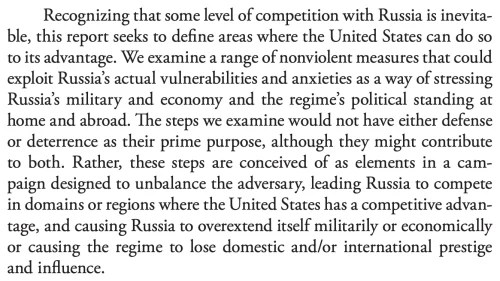
Screenshot from ‘Extending Russia: Competing from Advantageous Ground’.
RAND is almost entirely funded by the US Government, which appears first on its list of clients. So the fact that it would publish a report like this indicates that, even before Russia’s invasion, US decision-makers were interested in using Ukraine to weaken their geopolitical adversary.
As Senator Adam Schiff explained in 2020, “The United States aids Ukraine and her people so that we can fight Russia over there, and we don’t have to fight Russia here.”
Since Russia’s invasion, various other commentators have hinted – or in some cases explicitly stated – that America has goals other than securing Ukraine’s territorial integrity. Here’s Thomas Friedman’s account of what a “retired senior European statesman” told him:
The goal of Ukraine is to win, he said. The goal of the European Union is a bit different. It is to have peace … The U.S. is far away, and for the U.S., he added, it is not the worst thing to keep the war going to weaken Russia and make certain it doesn’t have the energy for any other adventures.
Two months into the war, Defence Secretary Lloyd Austin was asked how he would define America’s goals in the conflict. He began by saying what you’d expect him to say: “We want to see Ukraine remain a sovereign country”. He then went slightly off-script: “We want to see Russia weakened to the degree that it can’t do the kinds of things that it has done in invading Ukraine.”
According to the New York Times, some officials “cringed” and Biden called Austin to “remonstrate” him for the comment. “But officials acknowledged that was indeed the long-term strategy”.
A couple of weeks later, the political scientist Hal Brands really let the cat out of the bag – in a piece titled ‘Russia Is Right: The U.S. Is Waging a Proxy War in Ukraine’. He wrote:
The war in Ukraine isn’t just a conflict between Moscow and Kyiv, Russian Foreign Minister Sergei Lavrov recently declared. It is a “proxy war” in which the world’s most powerful military alliance … is using Ukraine as a battering ram against the Russian state … Lavrov is one of the most reliable mouthpieces for President Vladimir Putin’s baseless propaganda, but in this case he’s not wrong. Russia is the target of one of the most ruthlessly effectively proxy wars in modern history.
“The key,” Brands noted, “is to find a committed local partner — a proxy willing to do the killing and dying”. You then “load it up with” arms so that it can inflict “shattering blows” on your adversary. “That’s just what Washington and its allies are doing to Russia today.”
Similar sentiments were echoed by Congressman Seth Moulton in an interview with Fox News. “At the end of the day, we’ve got to realise we’re at war,” Moulton stated. “And we’re not just at war to support Ukraine. We’re fundamentally at war – although somewhat through a proxy – with Russia. And it’s important that we win.”
Likewise, when Congressman Dan Crenshaw came under fire from “America First” conservatives over his support for Ukraine, he tweeted: “Yeah, because investing in the destruction of our adversary’s military, without losing a single American troop, strikes me as a good idea. You should feel the same.”
Crenshaw didn’t bother paying lip-service to high-minded concepts like democracy, sovereignty or territorial integrity. He just came out and said we’re “investing in the destruction of our adversary’s military”.
Critics have consistently disparaged US policy as “fighting Russia to the last Ukrainian”. But in July, Senator Lindsey Graham – a long-time Russia hawk – said almost exactly that. “I like the structural path were on here,” Graham explained. “As long as we help Ukraine with the weapons they need and the economic support, they will fight to the last person.”
Critics found further justification for their cynicism in a recent Washington Post article, which revealed the following. “Privately, U.S. officials say neither Russia nor Ukraine is capable of winning the war outright, but they have ruled out the idea of pushing or even nudging Ukraine to the negotiating table.”
You might say that using Ukraine to weaken Russia is something worth doing, as Dan Crenshaw evidently believes. But at this point, it can scarcely be denied that America is engaged in a proxy war.
Finland to Allow for Deployment of NATO Nuclear Weapons on Its Territory, Reports Say
Samizdat – 26.10.2022
HELSINKI – Finland’s draft legislation on the country’s accession to NATO, which is almost prepared, does not contain any restrictions on establishment of military bases and deployment of nuclear weapons on the its territory, local newspaper reported on Wednesday, citing sources.
The legislation will allow for deployment of nuclear weapons of NATO countries and establishment of the alliance’s military bases on the territory of Finland putting no limits on NATO’s military presence in the country, according to the newspaper.
The draft legislation is expected to be considered by the Finnish parliament in two weeks, newspaper said.
The newspaper also noted citing its sources in the Finnish government that during negotiations with the bloc in July Foreign Minister Pekka Haavisto and Defense Minister Antti Kaikkonen pledged to avoid any restrictions regarding the country’s participation in military activity of the alliance in the national legislation.
On May 18, three months after Russia launched its military operation in Ukraine, Finland and Sweden submitted their NATO membership applications, abandoning decades of neutrality. With 29 out of 30 NATO members having formally ratified the agreements on Finland and Sweden’s accession, both countries are now in talks with Turkey to allay concerns over their alleged support of organizations designated as terrorist by Ankara.
US elites wrong that aggression against Russia can be unlimited – intelligence chief
Samizdat | October 24, 2022
The fact that discussions about the possible use of nuclear weapons have become part of Western rhetoric is worrisome, Sergey Naryshkin, the head of the Russian Foreign Intelligence Service (SVR), has said.
Contrary to claims by Western leaders, Russia is “absolutely” not threatening to deploy nuclear weapons, the senior official explained. But Kiev has openly claimed that it wants to become a nuclear power, an outcome that Naryshkin called on the world to prevent.
The Russian intelligence chief was referring to a speech that Ukrainian President Vladimir Zelensky delivered during the Munich Security Conference in February. The Ukrainian leader lamented that Kiev had given up nuclear weapons stationed there during the Soviet era and said that his country could break its promise to stay a non-nuclear state.
Naryshkin was speaking on Monday in his capacity as head of the Russian Historical Society at the opening of an exhibition marking the 60th anniversary of the Cuban Missile Crisis. The current stand-off between Russia and the US over Ukraine has been compared by many to the events that happened six decades ago.
“The American elites today believe that they can maintain the aggression against our nation for as long as they want, feuling military action with thousands of lives of Ukrainian citizens and mercenaries,” the official remarked, drawing a parallel to how the Cuban Missile Crisis started.
The stand-off back then was triggered by the US decision to deploy missiles to Turkey, threatening the Soviet Union, he explained. When Moscow reciprocated, “the reaction of the US political elites, who had convinced themselves of being exceptional, was painful, nervous and acute,” he noted.
The administration of President John F. Kennedy recognized that there were red lines that neither the US nor the USSR should cross, Naryshkin said. There were people in the US government who “thought rationally, were able to calculate the consequences of their actions, and kept their word.”
It’s not clear that the same approach can be found in the Joe Biden administration, Naryshkin stated.
“Today, we will not be able to find a politician in a Western nation of the same magnitude as Kennedy,” he added.
The Russian official also suggested a way to discourage nuclear powers from deploying their arsenals for goals other than deterrence. He told the audience that holding the US accountable for the 1945 nuclear bombings of Hiroshima and Nagasaki would have had a cold shower effect.
Featured Video
Integrity Initiative: UK-funded network framed dissent as Russian disinformation for years
or go to
Aletho News Archives – Video-Images
From the Archives
Why Saudi Ties to 9/11 Mean U.S. Ties to 9/11
By Kevin Ryan | Dig Within | September 27, 2015
Media interest in Saudi Arabian connections to the crimes of 9/11 has centered on calls for the release of the 28 missing pages from the Joint Congressional Inquiry’s report. However, those calls focus on the question of hijacker financing and omit the most interesting links between the 9/11 attacks and Saudi Arabia—links that implicate powerful people in the United States. Here are twenty examples. … continue
Blog Roll
 Aletho News
- IAEA inspectors cannot return to Iran amid US threats: Russia
- Senate Rejects Iran War Powers Resolution Passed By House
- ‘We did not attack Pakistan with drones’: Afghan sources
- Iraqi Resistance faction links arms to sovereignty, questions US exit
- Cannon fodder no more… South Korea rejects Trump’s pressure to join his criminal war on Iran
- Neria Leiter Was A Legitimate Military Target
- Integrity Initiative: UK-funded network framed dissent as Russian disinformation for years
- ‘We don’t seek permission to defend our country’: Snippets from President Pezeshkian’s UNGA address
- NATO chief wants Europeans to fight American wars [for Israel]
- German chemicals giant reveals details of downsizing
- If Americans Knew
- Israel displaces hundreds of Palestinians amid wave of demolitions in West Bank
- Aid, reconstruction, and Israel’s history of obstruction in Gaza
- Trump administration digs an ever-deeper hole of complicity in genocide – Daily Update
- US-Israel $2.8 Billion Arms Deal, 40,000-Bomb Supply Faces New Gaza Complicity Accusations
- Caught on Tape: AIPAC CEO Boasted of Controlling Trump’s National Security Officials
- Why Hamas Attacked Israel in October 2023 – Israeli professor Ilan Pappé
- They see them, then kill them: Israeli quadcopters track, deliberately target civilians in Gaza
- Winter could turn Gaza’s treacherous, war-damaged buildings into deathtraps
- Majority of Democratic Voters Want to Prosecute Both Biden and Trump Administration Officials Over Gaza
- As Gaza languishes, world leaders gather at the UN – Daily Update
- No Tricks Zone
- New Study: Earth And Venus Surface Warmth Largely Explained By Convection And Lapse Rate, Not CO2 Or Radiation
- 2025 Nature Paper Claiming Worsening Global Drought Gets RETRACTED …Heavily Flawed
- New Study: ‘Global Drought Shows No Detectable Recent Acceleration Under Climate Warming’
- Economic Masterminds: German Socialists Suggest Taxing Productivity Gains Stemming From Using AI
- The South China Sea Has Not Been Cooperating With The Climate Change Narrative
- Energy Crisis: Germany Enters Heating Season With Historically Low Gas Reserve Fill Levels
- New Study: The Antarctic Ice Sheet Gained Mass From 2020-2024 Due To Staggering Snow And Ice Accumulation
- Study: Ocean Heating Rates From Thousands Of Years Ago ‘Dwarf’ Modern Ocean Heating Rates
- Climate Extremists Target, Attack Large-Scale Power Grid Infrastructure In Germany!
- New Study: Antarctic Ice Melt Has Contributed Less Than 1 Centimeter To Sea Level Rise In The Last 30 Years

