Biden Condemns Nuclear War in Lie-Filled UN Address… But He Is Making Such a War Happen
Strategic Culture Foundation | September 23, 2022
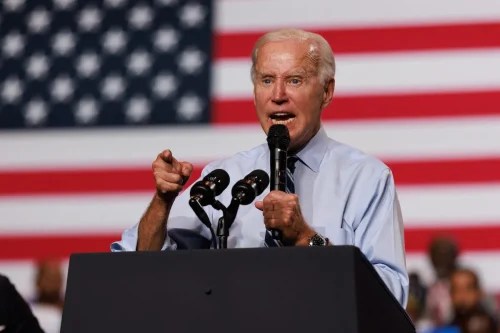
If there were any justice, Biden should have been escorted away from the UN podium to a prison cell awaiting prosecution for crimes against peace.
U.S. President Joe Biden’s address to the 77th annual UN general assembly this week was a spectacle of blatant lies and delusions.
Every year, the world is forced to endure American presidents standing before the assembly of 193-member nations proclaiming the presumed virtues of the United States. However, it’s always an occasion of embarrassing delusion and deception uttered with unctuous self-regard.
This year, the leaders of Russia and China didn’t bother attending the event held at UN headquarters in New York. No doubt they have better things to do. And besides who would want to sit through a speech from an American president that is an absurd insult to common intelligence and historical truth?
Biden condemned nuclear war, saying “it cannot be won and must never be fought”. He went on to accuse Russia and China of undermining world peace with nuclear posturing.
Russia is “making irresponsible nuclear threats” and China is “conducting an unprecedented, concerning nuclear build-up without any transparency”.
Biden said the “United States and I as president champion a vision for our world that is grounded in the values of democracy… I reject the use of violence and war to conquer nations or expand borders through bloodshed.”
The calumny is as contemptible as it is astounding coming from Biden, who during his more than 50 years as a senior Washington politician has advocated dozens of U.S. criminal wars of aggression in every part of the globe.
It is particularly sickening that Biden’s UN speech was presented by U.S. media as a “historic mission” to prevent nuclear war.
It is the United States and this president who are recklessly inciting dangerous tensions with nuclear powers Russia and China. World peace is indeed under imminent threat of a global catastrophic war — from the United States in its relentless aggression toward Russia and China.
The Biden administration and its NATO partners are pumping weapons into Ukraine to prolong the conflict in that country on Russia’s western border. That war is the culmination of eight years of deliberate arming of the anti-Russian Kiev regime to act as a spearhead against Russia.
The Neo-Nazi Kiev regime, which was installed by a CIA-backed coup in 2014, has for weeks been shelling the Zaporozhye nuclear power plant in southeast Ukraine with U.S.-supplied artillery. American and British intelligence is guiding their Kiev proxy forces to strike Russian territory with longer-range missiles.
Russian Minister of Defense Sergei Shoigu this week remarked that Russia is at war not merely against Ukraine but against the collective U.S.-led NATO bloc. The implication of this is truly alarming as the Strategic Culture Foundation has stated in previous recent editorials. We are already in a quasi-world war predicament that is on the precipice of escalating into a nuclear confrontation, one that would inevitably destroy the entire planet.
Ukrainian areas under Russian control are due to hold referenda next week which will likely see these separatist areas joining the Russian Federation as Crimea had done in 2014. Thereafter, that will mean NATO forces are directly involved in attacking Russia if they persist in supporting the Kiev regime. There is every indication that Washington and its allies will continue in their madness. Biden has said the U.S. will support Ukraine “for as long as it takes”. As long as what takes? The presumed conquering of Russia, which has been Washington’s strategic objective ever since the dissolution of the Soviet Union in 1991.
Russian President Vladimir Putin this week warned NATO that it faces a stark choice. Referring to the forthcoming referenda and the joining of Donbass regions with the Russian Federation, Putin gave notice that Russia reserves the right to defend itself by all means.
Biden and the Western media turn reality on its head. Putin is accused of threatening nuclear strikes. But it is the United States and its European lackey leaders who have created the abysmal impasse from their importunate weaponizing of Ukraine and repeated refusal to engage with Moscow on negotiating a definitive security arrangement concerning the halting of NATO encroachment on its borders.
Turning to China, there is an analogous situation. The Biden administration like his Republican and Democrat predecessors in the White House is arming the breakaway island territory of Taiwan in a brazen assault on China’s sovereignty and national security. The United States and its NATO partners as well as non-NATO clients Australia and Japan are sailing warships through the Taiwan Strait in a cynical attempt to provoke Beijing.
Earlier this week, Biden for the fourth time announced that the United States would militarily “defend” Taiwan if China were to launch a military invasion. Legally under UN law, Taiwan is an integral part of China, so how can China “invade” itself?
Washington is deliberately inciting Beijing and violating its own U.S. domestic laws that recognize Taiwan as being under China’s sovereignty. Yet Biden has the gall to tell the UN assembly that his nation still upholds the One China Policy. The Americans like to call this “strategic ambiguity”. To other observers, it is simply offensive “strategic duplicity”.
The world would seem to be witnessing a deranged American imperialist power at full throttle. The leader of the globe’s biggest aggressor nation who is inexorably pushing provocations toward Russia and China has the audacity to lecture the rest of the world about peace, security, international law, and democracy — and the danger of nuclear war.
If there were any sanity and justice, Biden should have been escorted away from the UN podium to a prison cell awaiting prosecution for crimes against peace.
‘Referendums create an opportunity to remove tension, stop hostilities’
By Ekaterina Blinova – Samizdat – 23.09.2022
Referendums on territorial affiliation are taking place in the Donbass, Kherson, and Zaporozhye regions on September 23-27. Earlier, surveys showed that a majority of residents supported the idea of joining Russia as subjects of the Russian Federation.
Voting in referendums on joining Russia began on September 23. Earlier, on Wednesday, Russian President Vladimir Putin delivered an address to the nation to ensure security at the forthcoming plebiscites, and announced partial mobilization in the country. Putin’s speech was met with hostility by the US and its NATO allies, who branded the self-determination right of the referendum participants as a “sham” and vowed to never recognize the outcome of the votes.
“Europe fears that during the referendum even more regions of present-day Ukraine will want to distance themselves from the imposed European policy and request Russia’s help,” says Mehdi Khorsand, head of the Department of Economic Diplomacy of the Municipality of Tehran and expert on Eurasia. “At the same time, it will become a kind of threat to Europe, which for two centuries has been putting pressure on countries seeking to gain independence.”
The collective West, in particular Europeans and Americans, wants to keep an unquenchable long-term conflict in the region in order to weaken Russia, according to Khorsand. However, the ongoing referendums could create the conditions for bringing the conflict to an end, he underscores.
“Russia started its special [military] operation in Ukraine only for security reasons,” the Iranian expert notes. “If the government of Ukraine, after the tensions of 2014, had adhered to its obligations under the Minsk agreements, we would have never witnessed these hostilities, this conflict. It would have never begun in the first place.”
Donbass’ Thorny Way to Independence
After the US-backed February 2014 coup d’etat, Ukraine’s eastern regions called for autonomy resisting the rule of the military junta in Kiev. In response, Kiev started a “counter-terror operation” seeking to suppress “separatists” in the east. The Normandy Four, a format comprising Russia, Germany, France, and Ukraine, worked out a roadmap, the Minsk accords, to stop the bloodshed in Donbass and provide the breakaway regions with an autonomous status. Nevertheless, Kiev’s successive governments routinely sabotaged the provisions of the Minsk agreements preventing Donbass from gaining legitimate autonomy. In addition to that, the Ukrainian nationalist leadership made NATO membership the centerpiece of its policy, ramping up military training and resorting to the weaponization of the country.
“After 2014, Russia tried to negotiate with Ukraine about its demilitarization, not joining NATO, about the independence and autonomy of the eastern regions: Lugansk and Donetsk. But the Ukrainian government after 2014 committed a real genocide of the [ethnic] Russian population in the east of Ukraine, they began to literally ‘slaughter’ the Russians there,” Khorsand says.
Moscow repeatedly called on the other guarantors of the Minsk agreements, Paris and Berlin, to pressure Kiev to observe the accords. As these attempts failed, Russia came up with draft security agreements requesting guarantees of Ukraine’s non-admission to NATO. Moscow handed the drafts to the US and the transatlantic alliance in December 2021, reminding them of Western leaders’ pledge to not expand NATO to Russia’s doorstep. The Russian leadership made it clear that it takes its national security seriously and would resort to military-technical options if the West were to ignore the drafts. Nonetheless, the US, the EU, and NATO rejected key provisions of Moscow’s proposals.
“Russia, given the seriousness of the topic of Ukraine’s accession to NATO, did not see any other solution than the start of a special [military] operation to resolve the security problem,” Khorsand says.
Referendums as Path to Get Protection From Yoke of Kiev Regime
“We expect the referenda to end up with the majority of the inhabitants of these regions voting in favor of joining Russia. I do not rule out that the hostilities will end after the referendum,” Khorsand notes.
Russia recognized the independence of the Donetsk and Lugansk People’s Republics on February 22; still, this decision made the regions merely a “buffer zone” between Russia and Ukraine, which did not guarantee their safety, the Iranian expert explains.
If admitted to the Russian Federation, the aforementioned regions, including Kherson and Zaporozhye, will have security guarantees as inalienable parts of Russia. The Donbass republics and the Zaporozhye and Kherson regional authorities announced on September 19 and 20 their intent to simultaneously hold referendums to join Russia. In his Wednesday speech, President Putin made it clear that Russia would protect its territorial integrity and sovereignty by all modern military means, adding that he wasn’t “bluffing.”
“As for the legality of the referendums, it is worth noting that the autonomy of the regions of Donbass (LPR and DPR) was fully accepted in the 2014 agreement (Minsk agreements) and mentioned in the terms of this document, respectively, this referendum, reflecting the will and desire of the people of the autonomous and sovereign republics of Donbass to join Russia is a legitimate action,” Khorsand says.
Earlier, Russian Foreign Minister Sergei Lavrov explained in an interview with Newsweek that the Lugansk People’s Republic (LPR), the Donetsk People’s Republic (DPR), and the Zaporozhye and Kherson regions used their sacred right to self-determination, which is codified in the UN Charter, when they announced their intention to join Russia.
“Of course, the US and Europe will be forced to take some other position after these legal referendums, because these referendums create an opportunity to remove tension between Russia and Ukraine, and to stop hostilities,” Khorsand concludes.
Western media continues to ignore how Ukraine is using NATO weapons to kill innocent civilians in the Donbass
© Eva Bartlett
By Eva Bartlett | Samizdat | September 23, 2022
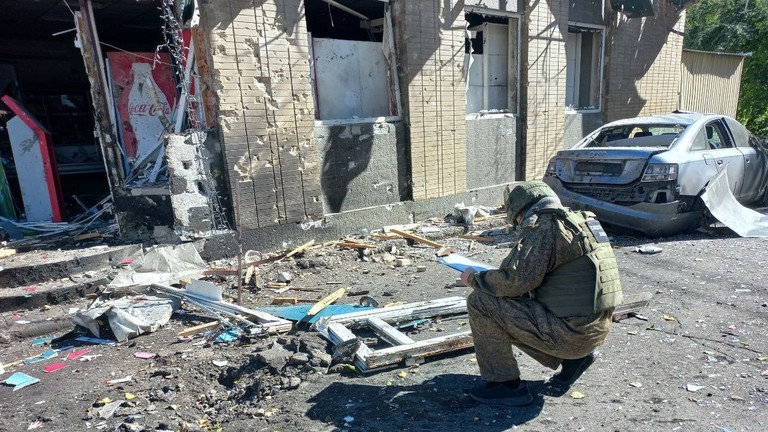
On Monday, Ukraine slaughtered 16 civilians, including two children, with 155mm NATO shells, according to the head of the Donetsk People’s Republic (DPR), Denis Pushilin. The projectiles hit two adjacent neighborhoods, decimating residential and commercial areas – including a market that had previously suffered fatal attacks.
Scenes of death are nothing new for residents and reporters here in Donetsk, which is intermittently the target of Ukrainian attacks, like the one that hit its central region on August 4, killing six people, including an 11-year-old ballerina, her grandmother, and her ballet teacher.
But the carnage on Monday was worse than anything I’ve seen in my months of reporting here. Chunks of flesh littered the street – part of a hand, a foot, an ear. Someone had put a dead man’s phone on his stomach. It was ringing, the cheery ringtone incongruous with his lifeless body and the scenes and stench of death around him.
For most people, the concept of war is a distant one, and deaths are normalized by media reporting the numbers of victims and destroyed buildings – so most who hear of civilians being killed don’t really understand what a scene like this looks or smells like.
For the locals, it is also normalized, in its own way, after over eight years of Ukrainian attacks – a tragically grotesque kind of normality, where the post-bombing routine starts soon after the last explosions die down.
When I arrived at the scene, locals were already sweeping up glass shards and boarding windows, preparing to reopen their shops. Inspectors from the Russian Investigative Committee were on site collecting shrapnel and measuring the shell’s impact point, to determine the nature of the armament. When asked about what happened, they were careful to state that they could not say anything until the conclusion of their investigation.
An emergency vehicle arrived and workers began loading the bodies, or body parts, onto stretchers, clearing them away.
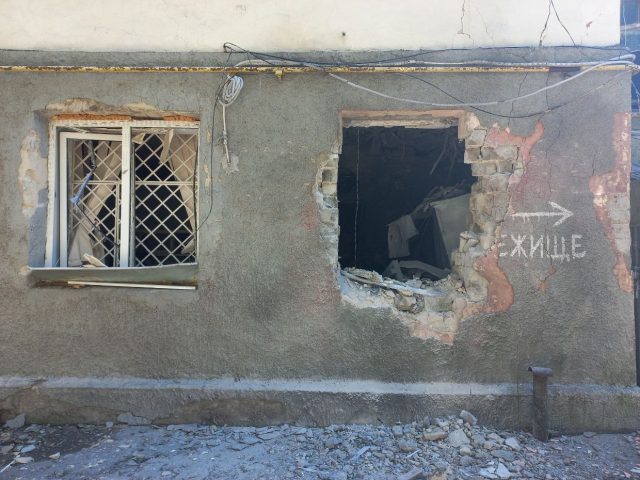
About 100 meters away, there was a gaping hole in the side of an apartment building. The shell had struck right where writing on the wall indicated the direction to the nearest basement, which was to be used as a bomb shelter. Doors to such stairways are generally permanently left open, so that anyone caught up in shelling might have a chance to survive, if they can make it to the door and basement in time.
© Eva Bartlett
Victims of another Ukrainian assault, which took place on Saturday, didn’t have that option. The center of Donetsk was hit by at around ten bombs over the course of 30 minutes around noon. At least four civilians were killed, one of whom I saw still on the ground. Some minutes later, her body was taken away. One of the shells hit a car driving along Artema Street, setting it ablaze and killing two civilians. By the time I reached that site, the vehicle had burned out, the dead taken away. Workers were already repaving the roads, sweeping debris and glass from sidewalks.
Western weapons killing Donbass civilians
When Russian and Donbass voices state that Ukraine is killing Donbass civilians with Western weapons, the reply is silence, derision, or inversion of reality: claims that Russia is bombing Donbass – which any ordinary resident here would disprove easily, having been under Ukraine’s shelling for over eight years.
War correspondent, Christelle Neant, wrote of Saturday’s bombings:
“After submitting the photos of the shrapnel I found on the spot to Adrien Bocquet, who is now a NATO weapons expert for the DPR’s representation in the JCCC (Joint Monitoring and Co-ordination Center on Ukraine’s War Crimes), he confirmed that they were American 155mm shells, some fired from Caesar guns and others from TRF1 guns.
The famous TRF1 guns that can fire (banned) 155mm cluster munitions, which I had mentioned in June, and which the Western press had assured that France had not supplied to Ukraine! Before learning at the beginning of September that Paris had indeed sold them to Kiev!”
Europeans in Germany, France and Italy recently held “#StopKillingDonbass” actions, denouncing the sale of Western weapons to Ukraine, and calling for it to end. It was rather fitting that the actions occurred the day after Ukraine bombed central Donetsk again.
These actions were followed by the release of a petition against arms supplies to Ukraine, which stated:
“Today, contrary to the fundamental principles set forth in Article 2 of the UN Charter, in particular, the principles of sovereign equality and the peaceful settlement of international disputes, our countries supply Ukraine with weapons that cause massive deaths and injuries of civilians in Donbass, including children.”
It concludes: “We demand an end to the financing of state terrorism and genocide against the people of Donbass, as well as the ongoing violations of the Geneva Conventions of 1949 and other acts of international humanitarian law since 2014.”
At this point, there is no safe region in Donetsk, nowhere is off-limits for Ukraine’s bombings, not maternity hospitals, nor busy markets. The issue does, however, appear to be off-limits for the reporting of Western corporate-owned media.
Why Ukraine referendum is a big deal
BY M. K. BHADRAKUMAR | INDIAN PUNCHLINE | SEPTEMBER 22, 2022
The referendum on September 23-27 in the Donbass and southern Kherson and Zaporozhye regions of Ukraine on their accession to Russian Federation is, prima facie, an exercise of the right of self-determination by the native population who reject the western-backed regime change in Kiev in 2014 and the ascendancy of extreme nationalist forces with neo-Nazi leanings in the power structure.
But it has other dimensions, too. In all probability, the referendum will overwhelmingly opt for accession to Russian Federation. In Donbass, it is a straightforward question: “Do you support the entry of the DPR into the Russian Federation as a subject of the Russian Federation?” For Kherson and the Zaporozhye Cossacks, the referendum ascertains three sequential decisions: secession of these territories from Ukraine; formation of an independent state; and its entry into the Russian Federation as a subject.
In 2014, all legal procedures for the admission of Crimea and Sevastopol to the Russian Federation were completed in four days. An expeditious process can be expected this time around too. There is huge mass support within Russia for reunification with the ethnic Russian populations in the eastern and souther regions of Ukraine who suffered severe persecution during the past 8-year period, including brutal violence, at the hands of extremist Ukrainian nationalist elements in control of the state apparatus. This is a highly emotive issue.
In the post-cold war era, the genie of self-determination was first let out of the bottle by the West during the dismemberment of the former Yugoslavia. Although the US midwifed the secession of Kosovo from Serbia as far back as in 2008, the entity is yet to be accorded recognition by the UN. Serbia rejects the secession despite sustained western pressure.
That said, the Kosovo precedent will not stop the western powers from condemning the accession of regions of Ukraine to the Russian Federation.
The big question today is about the Russian calculus. President Vladimir Putin has surely factored in that the accession of the “Russian regions” of eastern and southern Ukraine is an immensely popular decision in the domestic opinion. The most revealing comments on the topic have come from the former President Dmitry Medvedev.
Medvedev wrote in his Telegram channel: “Referendums in Donbass are of great importance not only for the systemic protection of the inhabitants of the LNR, DNR (Donbass) and other liberated territories, but also for the restoration of historical justice.”
In Medvedev’s opinion, these plebiscites “completely change the vector of Russia’s development for decades.” He adds, “And not only our country. Because after they (referendums) are held and the new territories are accepted into Russia, the geopolitical transformation in the world will become irreversible.”
Most important, Medvedev forewarns, “An encroachment on the territory of Russia is a crime, the commission of which allows you to use all the forces of self-defence.”
Furthermore, he says, once the process of annexation of the new territories is completed, “not a single future leader of Russia, not a single official will be able to reverse these decisions. That is why these referendums are so feared in Kiev and in the West. That is why they need to be carried out.”
What emerges is that Russia has given up hopes of any negotiated settlement. Moscow was initially optimistic that Kiev would negotiate, but the bitter experience turned out to be that President Zelensky was not a free agent. It is the Biden Administration that holds the stop watch for the proxy war. And Washington’s timeline is linked to the weakening and destruction of the Russian state, which has been the ultimate US objective. Lest we forget, Joe Biden played a seminal role in installing the new regime in Kiev in 2014 and in moulding Ukraine as an anti-Russian state.
Suffice to say, the referendum on Wednesday is Russia’s only available course of action under the circumstances, while Kiev maintains a maximalist position as advised by the US, UK and Poland.
The accession of Donbass, Kherson and Zaporozhye creates a new political reality and Russia’s partial mobilisation on a parallel track is intended to provide the military underpinning for it. The accession signifies a paradigm shift insofar as any further attacks on these regions that are part of Russia can be construed by Moscow as attacks on Russia’s territorial integrity and sovereignty.
Certainly, Kiev’s wanton attacks in future on civilians and civilian infrastructure in Donbass, Kherson and Zaporozhye will trigger Russian reaction. Any attack on them will be considered aggression and will give Moscow the right to respond “adequately.” The fact the Russian deployment in these territories will be significantly augmented and upgraded signals a willingness to use force.
Meanwhile, Russia’s special military operations will also continue until its set objectives are met. Which means, even more territories may come under Russian control, creating ever newer facts on the ground. Kiev needs to factor all this carefully.
The Pentagon spokesman Patrick Ryder has reacted as follows: “No one will take such bogus referendums seriously, and the US will certainly not recognise their results. How will this affect our and international support for Ukraine? This will not affect in any way, we will continue to work with Ukraine and our international partners to provide them with the necessary assistance to protect their territory.”
It is a sufficiently evasive statement. Neither Pentagon nor the Russian military command will risk brinkmanship. The likelihood, therefore, is that the accession of the new territories to the Russian Federation may not be militarily challenged by the US or NATO. That said, Russia is already at war with the NATO, as Defence Minister Sergey Shoigu said, albeit not in terms of weapons supplies, which “we find ways to counter,” but in the Western systems that exist — “communication systems, information processing systems, reconnaissance systems and satellite intelligence systems.”
The point is, the accession of Donbass, Kherson and Zaporozhye regions to the Russian Federation will require the NATO and the US to reset the proxy-war algorithm. The CIA’s analogy of the Afghan jihad of the 1980s no longer holds good. Russia has avoided a quagmire in Ukraine and probably is turning the table on the NATO. To make things doubly sure, Moscow lifted the veil today on its newest ICBM, Sarmat.
In Putin’s national address on Wednesday, he had said: “In the event of a threat to the territorial integrity of our country and to defend Russia and our people, we will certainly make use of all weapon systems available to us. This is not a bluff.”
The results of the referendum must be determined not later than 5 days after the last voting day (Sept. 27), and the issue of accession to Russia is considered approved if more than 50% of the plebiscite participants vote for it. Significantly, the Russian State Duma is scheduled to hold plenary sessions in Moscow on September 27 and 28.
Serbia accuses West of double standards
Samizdat – September 22, 2022
Western countries have failed to explain why they have different points of view on Ukraine and Serbia’s territorial integrity, given that they support Kiev in its fight against Russia, but endorsed Kosovo’s independence, President Aleksandar Vucic said on Tuesday.
In an address to the UN General Assembly in New York, the Serbian leader stated that his state respects the territorial integrity of all countries, including Ukraine, and that many describe the hostilities between Moscow and Kiev as “the first conflict on European soil since WWII.”
He said, however, that the truth about the violation of Serbia’s territorial integrity “is constantly unspoken.”
“We ask for a clear answer to the question I’ve been asking… for years – what is the difference between the sovereignty and territorial integrity of Ukraine and the sovereignty and territorial integrity of Serbia, which was grossly violated,” Vucic said, referring to the 1999 NATO bombing of Yugoslavia.
According to Vucic, Serbia “has never [set] foot” on anybody’s territory, but this “did not prevent the 19 richest NATO countries from attacking a sovereign country without a decision by the UN Security Council.”
He also said that while NATO pledged to respect the full territorial integrity of Serbia, it did not stop many Western countries from unilaterally recognizing the breakaway province of Kosovo in 2008.
Earlier on Tuesday, the Serbian president warned that the world is moving closer to a global war, adding that “the UN has been weakened,” given that the great powers “practically destroyed the UN order over the past several decades.”
NATO occupied Kosovo in 1999, after a 78-day bombing campaign against what was then Yugoslavia. The province declared independence in 2008 with Western support. While the US and most of its allies have recognized it, many other countries, including Russia and China, have not.
DID YOU KNOW THAT UKRAINIAN SOLDIERS ARE “ROUTING RUSSIAN FORCES AND COLLAPSING RUSSIA’S NORTHERN DONBAS AXIS?”
By Larry Johnson | A Son Of The New American Revplution | September 19, 2022
Nope, I did not know that. But thank God we have retired General Dave Petraeus to clue us in. He wrote the following 10 days ago:
- A successful encirclement of Russian forces fleeing Izyum would result in the destruction or capture of significant Russian forces and exacerbate Russian manpower and morale issues.
- The Russian MoD’s inability to admit Russian failures in Kharkiv Oblast and effectively set information conditions is collapsing the Russian information space. Kremlin-sponsored TV propagandists offered a wide range of confused explanations for Ukrainian successes ranging from justifications that Russian forces are fighting against the entire Western Bloc, to downplaying the importance of Russian ground lines of communication (GLOCS) in Kupyansk.
- The withdrawal announcement further alienated the Russian milblogger and Russian nationalist communities that support the Kremlin’s grandiose vision for capturing the entirety of Ukraine. Russian milbloggers condemned the Russian MoD for remaining quiet, choosing self-isolation, and distorting situational awareness in Russia.
Turns out that General Dave experienced premature military orgasm. It is true that the Russians retreated from Izyum, but they were not surrounded. Putin has never claimed the “grandiose vision for capturing the entirety of Ukraine.” He has been quite clear–as recently as the press conference this week at the SCO–Russia is going to secure the Donbas. What about growing dissent in Russia about the SMO? Putin, based on his recent news conference at the Shanghai Cooperation Organization, could give two shits about the feelings of “the Russian milblogger and Russian nationalist communities.”
I am citing Petraeus not because I respect his alleged military “genius.” I do not not. General Dave had the reputation at West Point as the consummate sychophant. The other cadets said he would marry the Commandant’s homely daughter just to get ahead. Guess what? He did. I cite Petraeus because his views are emblematic of the Washington national security establishment who are totally committed to lying about the reality in Ukraine. No matter what the actual situation is on the ground, Ukraine is winning, Russia is losing and it is just a matter of time before Russia implodes. This theme has been trotted out and paraded around the internet almost every month since March by Ukraine’s western enablers.
The Hill just published another installment of this delusional analysis by Mark Toth and Jonathan Sweet. Let’s meet the boys:
Mark Toth is a retired economist, historian and entrepreneur who has worked in banking, insurance, publishing and global commerce. He is a former board member of the World Trade Center, St. Louis, and has lived in U.S. diplomatic and military communities around the world, including London, Tel Aviv, Augsburg and Nagoya.
https://www.newsbreak.com/news/2752375324738/hey-russia-it-s-putin-stupid?noAds=1&_f=app_share&s=i3
Jonathan Sweet, a retired Army colonel, served 30 years as a military intelligence officer. His background includes tours of duty with the 101st Airborne Division and the Intelligence and Security Command. He led the U.S. European Command Intelligence Engagement Division from 2012-14, working with NATO partners in the Black Sea and Baltics.
https://www.newsbreak.com/news/2752375324738/hey-russia-it-s-putin-stupid?noAds=1&_f=app_share&s=i3
I do not know if their article is the result of ignorance, willful blindness or if they were paid to push propaganda. Regardless of the motive, Toth and Sweet join the Petraeus club and push the objective lie that the tenacious Ukrainians are defeating the Russian army:
it is Ukrainian soldiers, equipped and trained by English-speaking countries, alongside their allies who have opened fresh cans of whoop-ass and are inflicting a beatdown of Putin’s military forces in the Donbas. . . .
There has been one constant since Putin’s illegal invasion began in February: Russia’s military forces have been forced to retreat and regroup, time and time again. . . .
Putin has been exposed as an “emperor with no clothes,” forced to rely upon haggling with Iranian and North Korean surrogates to purchase drones and, according to the New York Times, “millions of artillery shells and rockets.” Saturating social media with disinformation and excuses about why Russian ground forces are failing cannot mask the images of abandoned equipment and reports of Russian soldiers surrendering.
https://www.newsbreak.com/news/2752375324738/hey-russia-it-s-putin-stupid?noAds=1&_f=app_share&s=i3
Do you remember that incredible defeat of the Russian army in Mariupol when the Ukrainians surrounded the Russian troops and forced the surrender of 2500 combatants? Neither do I. That is what Russia did to the Ukrainian AZOV battalion.
How about the Russians fleeing in terror ahead of the Ukrainian blitzkrieg around Kherson? Nope. Another dry hole. The Russians pushed that attack back and inflicted catastrophic casualties on the Ukrainians.
What about the Luhansk People’s Republic? Ukraine held on to that and crushed the Russian backed militia. Right? Wrong!! Luhansk was secured and the same process is underway now in the Donetsk People’s Republic.
Why do western political, military and media leaders embrace demonstrable lies? I think it reflects a deeper sickness that afflicts the west. This self-delusion is not an isolated phenomena. Biden, his military commanders and the mainstream media also insist that men can be women and become pregnant, that inflation is zero, that Biden is popular, and that pedophiles are not bad people. Oh yeah, one more–the southern border of the United States is secure.
The time is coming when reality will intrude and destroy the fantasies. It happened to Baghdad Bob, who insisted there were no U.S. tanks in Baghdad in March 2003, and will happen to General Dave, Mark Toth and Jonathan Sweet. Seven months into the Russian “Special Military Operation,” Putin and his Generals have committed only a small fraction of their military forces to the conflict. They seem content to destroy Ukrainian units and equipment with artillery, missiles and mortars and force NATO to keep supplying Ukraine so that it can send its troops, armed with new equipment, to the front to be destroyed.
Yet NATO’s European members do not have the industrial capacity to replace the donated military equipment and are facing a bleak winter with scant energy resources needed to power manufacturing plants. The United States also is depleting its stockpile of weapons. Raheem Kassam has provided a very useful summary of what the United States has sent to Ukraine (read here). For example, the United States has provided Ukraine in six months more Javelins than it can produce in one year. So far the number stands at more than 8500, which is more than one-third of the U.S. total arsenal.
And how many Russian tanks have the Ukrainians destroyed with these Javelins? We do not know. The U.S. intelligence community does not know. U.S. intelligence is relying on Ukraine to report the good news and the Ukrainians simply say, “lots.” In theory, U.S. intelligence analysts have the ability to use satellite imagery to count disabled and destroyed tanks. But I am told that has not happened.
What we do have is a lot of social media video showing the Russians capturing hundreds, if not thousands, of javelin ATGMs. And we have videos of Russian tanks being hit with a javelin but continuing to operate. The javelin is not turning out to be the wonder weapon it was promised to be.
Let me reiterate one very important point–the so-called intelligence on Russian casualties in terms of personnel and equipment, is being provided solely by the Ukrainians. The United States has not taken any steps to independently verify the Ukrainian “intelligence.” That is a recipe for disappointment once the truth comes out that Ukraine is guilty of exaggerating.
Time to drop illusions, the West is waging a war to destroy Russia
By Vladimir Kornilov – RIA Novosti – September 20, 2022
And here comes Bucha 2.0: Another provocation where Ukraine has allegedly discovered “mass graves of victims” shortly after Russian troops have withdrawn.
This time in Izium. What it amounts to is clear evidence that along with the development of the military conflict in Ukraine, the informational “special” operation against Russia is intensifying.
It’s not even about Kiev’s reaction – officials there concoct primitive fakes against our state and the army non-stop, around the clock.
The indicator here is the way in which this provocation was immediately picked up by Western politicians, who are already urgently calling for an “international tribunal” to punish Russia. Meanwhile, the West’s media, in a united push, is putting unfounded statements about “mass executions and torture in Izium” on its front pages.
This fakery is crass and easily refuted. But it is clear from this unanimous reaction of the West that no one there cares at all how and when the people buried in the cemetery died. The culprit has been appointed in advance – and it has to be Russia. Because only this verdict fits into the overall strategy of the current campaign in Ukraine.
Which, as we can see, has nothing to do with Ukraine. The West is completely indifferent to whatever happened to the Ukrainians, whoever killed them (even if it was Kiev’s own army or foreign mercenaries) and no matter how many of them died. Because it is not fighting a war on this territory for the Ukrainians, and especially not for Ukraine.
We must speak frankly and openly: the West is waging a fierce war against the Russian state, using local forces as proxies. And this is covered by the fig leaf of “defending democracy.” However, what they really want is for Russia to be destroyed. Forever! Irrevocably!
Janusz Bugajski, a leading expert, recently published his book “Failed State: A Guide to Russia’s Rupture.” It is worth highlighting that the work is not a reaction to the Ukrainian conflict, instead it is a logical continuation of all that this ‘Kremlinologist’ has been publicly talking and writing about for years.
Back in early 2019, three years before the current crisis started, he published a feature article in the influential Washington newspaper The Hill, entitled ‘Managing Russia’s Dissolution.’
This was not just a forecast or theoretical speculation by some dreamer, it was a direct call to action by an outspoken Russophobe. Suffice it to recall that Bugajski then openly urged the White House to promote regional and ethnic self-determination within the Russian Federation. At the same time, he was speculating which regions of the state destroyed by the West should receive independence and which should be given to Ukraine, Finland, Japan and even China.
It cannot be said that Bugajski’s article was the only theoretical work on the disintegration of our state. But other reports (at least in the public domain) still sought to veil direct calls for the forced break-up of Russia with arguments about the need to weaken our state. This was the case, for example, with a sensational study by the US intelligence corporation RAND commissioned by the US Department of Defense in 2019.
Now the masks are being thrown off and the cadre of Russophobes can openly articulate their long-held dreams. The Daily Telegraph recently featured the former NATO commander in Europe, General Ben Hodges, in a high-profile article about preparing for Russia’s disintegration. Hodges, who is employed by CEPA – a lobby group bankrolled by US arms contractors and NATO – is arguably one of the most active ‘talking heads’ about the Ukrainian crisis on Western television right now.
The general hopes the collapse of our state will be fueled by our ethnic diversity and he hopes that Western economic sanctions will create a situation in which it will be impossible to feed 144 million people. The American has clearly not thought how these arguments could also be applied to his home country, which has been torn apart by racial divisions in recent years.
Below Hodges, the idea has been cheerfully picked up by less well-known figures operating on the ideological field of Russophobia. The Polish magazine New Eastern Europe published an article about deconstructing Russia and reconstructing the “post-Russian space,” calling it a risky but inevitable scenario. The authors called on the West to lead the process of our state’s disintegration right away.
This is echoed by the Canadian-British professor Taras Kuzio on the pages of the Atlantic Council, a NATO-aligned pressure group and the main mouthpiece of Western Russophobes. He, too, cheerfully declares that the process of “the collapse of Putin’s Russian empire” has begun.
Hodges’ theses are repeated almost word for word by Estonia’s top Kremlinologist Vladimir Yushkin on the pages of the website of the International Centre for Defence and Security. However, he adds nonsense about the allegedly developing “colonization of Siberia by the Chinese” – which tells us he doesn’t know how to use statistics.
All these “prophecies” have been brought into the political realm by Estonian President Alar Karis. Opening the NATO Military Committee conference in Tallinn last Friday, he openly admonished the Chiefs of Staff of the US-led bloc to give up their “fear of destabilizing the situation in Russia.”
This is not some retired general, nor a private person with a professorial rank – it’s the official head of a NATO member country. And he is not shying away from calling on the high command of the alliance to pursue a deliberate policy of creating a situation of instability in Russia.
So, what more proof does anyone need of what the collective West is hoping to achieve?
The ideological touchstone of European liberals, The Economist magazine, has devoted its latest issue to how the West should ensure Ukraine’s victory over Russia. Apart from the traditional advice on further arming the Kiev regime, the magazine explicitly demands that the West must try to drive a wedge between the Russian government and the Russian people. To do this, leaders are urged to bet on Russian liberals who have moved abroad, who in these circumstances can be safely called traitors back home.
They are now in a situation where Russia’s enemies are openly talking about using them to carry out an unrealistic plan to dismember our common motherland!
Thus, we can safely say that the collective West has already moved from talk to action and is openly challenging the very existence of the Russian Federation.
It’s ideologues and a number of top politicians make no secret of the fact that by exploiting the conflict in Ukraine, they are deliberately helping to create an existential threat to our state. The sooner we ourselves officially acknowledge this, the more effectively we will be able to move to a different stage in both relations with our neighbors and the military operation in Ukraine itself.
We still adhere to certain gentlemen’s rules of the game, which were adopted after the end of the Cold War. But now the stakes have been raised too high.
To be clear, I am not calling for us to copy the criminal actions of Ukraine. We, unlike them, do not deliberately kill children, torture prisoners of war, or exterminate civilians.
But in the face of increasing threats to Russian citizens, we are left with no choice but to act much more forcefully against military infrastructure, even if it’s also used by civilians, in the direction of decision-making centres, and towards those individuals directly responsible for terror and murders wherever they are located, as well as tackling states that pursue hostile policies.
After all, we should not forget that when an existential threat to Russia arises, we need to present a tough response.
Those who threaten our homeland should be constantly reminded of this.
Kiev will stop asking for Western support only after Russia’s “defeat”: FM
Samizdat | September 20, 2022
Kiev will no longer request weapons deliveries from the West, only after Ukraine prevails over Russia, Foreign Minister Dmitry Kuleba claimed on Monday, adding that the supplies are part of a “recipe to defeat” Moscow’s forces.
Speaking to Bloomberg TV, Kuleba indicated that despite a constant flow of Western armaments into the country, Kiev needs even more of them, given that it is now fighting such an “enemy” as Russia.
“Sometimes I’m being asked when there is enough of weapons that we have received. And I always say… it will be enough only after Ukraine wins. Until then, we will be asking for more,” he stated.
The Foreign minister also noted that Kiev’s recent counter-offensive in Kharkov region has shown that the combination of Ukrainian forces’ “stamina” and Western-supplied weapons, most of which come from the US, are “the recipe to defeat Russia on the ground.” Moscow, however, insisted that it pulled its troops back from some areas to “regroup” and to strengthen the Russian forces in the Donetsk region.
At the same time, Kuleba admitted that sustainability of Western weapon deliveries is an issue, which needs to be constantly raised by Kiev authorities as they talk with their Western colleagues.
NATO has been supporting Ukraine since 2014, but has significantly ramped up its military assistance after Russia launched its military operation in the neighboring country in late February.
However, the delays in weapons deliveries have been quite frequent. Last week, Die Welt reported that while Germany has agreed to provide Ukraine with 18 self-propelled RCH-155 howitzers in addition to the military hardware already supplied, the guns would not arrive for at least another 30 months.
Earlier this month, Germany’s defense minister, Christine Lambrecht, claimed that Berlin has handed over “an unbelievable amount” of weaponry from its reserves to Ukraine, adding that the country has “reached the limit” in terms of what it can send to Kiev.
Moreover, earlier this month, NATO secretary general Jens Stoltenberg acknowledged that the bloc’s members have significantly depleted their weapons stockpiles, urging the Western defense industry to ramp up arms production.
Majority of Slovaks support a Russian military victory over Ukraine
Free West Media | September 16, 2022
More than half of Slovaks would welcome a Russian military victory over Ukraine, according to a new poll published on Wednesday (14 September).
The representative survey, entitled “How are you doing, Slovakia?”, was conducted by the MNFORCE and Seesame agencies and the Slovak Academy of Sciences.
Respondents were asked to answer the survey using a 10-point scale, where 1 means a clear victory for Russia and 10 for Ukraine. About a fifth of respondents said they wanted a clear Russian victory, and more than half said they were inclined towards a Russian victory. The overwhelming majority of voters in former Prime Minister Robert Fico’s social democratic party SMER are on the Russian side.
Fico is a vocal opponent of anti-Russian sanctions and even celebrated the anniversary of the Slovak National Revolt with the Russian ambassador. The SMER is still a member of the Party of European Socialists (PES).
As far as geographical differences are concerned, only the population of Bratislava, the capital, has a majority of people who want a victory for Ukraine. Regarding the whole country, only a third said they were leaning towards Ukraine, while 18 percent expressed no preference.
Slovakia along with Bulgaria, has long been one of the most pro-Russian countries in the EU.
A poll conducted in the summer of 2021 showed that 55 percent of Slovaks had a favourable opinion of the Russian leader. Among Central and Eastern European countries, only Bulgarians had a better opinion of Putin (75 percent).
Moreover, in February 2022, before the military intervention, 44 percent of respondents blamed NATO and the US for the tensions on Ukraine’s borders. As for NATO membership, only 45 percent were in favour in the 2021 poll. Immediately after the invasion, support rose, but has recently fallen again.
Ukraine sliding into a real war
BY M. K. BHADRAKUMAR | INDIAN PUNCHLINE | SEPTEMBER 14, 2022
A recurring feature of the Cold War was that the United States almost always placed great store on the optics of a Soviet-American affair while Moscow chose to concentrate on the end result. The Cuban Missile Crisis is the best known example where the denouement was about the publicised abandonment of the planned Soviet deployment of missiles in Cuba and a US public declaration and agreement not to invade Cuba again. But it later came to be known that there was also an unpublicised part, namely, the dismantling of all of the Jupiter ballistic missiles that had been deployed to Turkey.
The behavioural pattern remains the same in Ukraine. Per the western narrative, Russia is staring at the abyss of defeat amidst the “rout” in the Kharkov Region. Interestingly, though, at the responsible levels in the Beltway, there is noticeable reticence about beating the drums presumably because of their awareness that the Ukrainian forces simply re-entered the Balakleysko-Izyum direction to occupy areas that Russians had planned to vacate.
Moscow is once again leaving the optics almost entirely to the American journalists while Moscow concentrates on the end result, which has had three dimensions: one, complete the ongoing evacuation from the Balakleysko-Izyum direction without loss of lives; two, exploit the Ukrainian troop movements to target the forces that came out into the open from well-fortified positions in the Kharkov Region; and, three, concentrate on the campaign in Donetsk.
The last part is becoming very sensitive for Moscow, as a significant section of Russian “war correspondents” carried sensational reports that it is apocalypse now. Even senior politicians such as Gennady Zyuganov, General Secretary of the Communist Party, and a powerful voice in the State Duma, feels agitated.
Zyuganov said at the first plenary meeting of the Russian State Duma’s fall session on Tuesday that the “special operation” has grown into a full-fledged war and the situation on the front has “changed drastically” in the past couple of months.
A fragment of the speech, posted in the Communist Party’s website also quoted Zyuganov as saying that “every war requires a response. First and foremost, it requires maximum mobilisation of forces and resources. It demands social cohesion and clear prioritisation.”
Although intended as constructive criticism, Zyuganov’s advice will almost certainly be passed over by the Kremlin. Russian presidential spokesman Dmitry Peskov has responded with alacrity, saying, “At this moment — no, it (full or partial mobilisation) is not on the agenda.”
President Putin’s support base remains as strong as ever. The recent Russian regional and local elections partly turned into a “referendum” on the Ukraine situation. And the fact that the ruling party received one of the best results in its history by winning about 80 percent of the mandates in regional and local parliaments shows a resounding vote of confidence in Putin’s leadership.
That said, the “angry patriots” pose a headache. That is why the latest situation around Bakhmut in Donetsk assumes particular significance. Bakhmut is undoubtedly the lynchpin of the entire fortification that Kiev erected in Donbass in the past 8 years. It is a strategic communication junction with roads in many directions — Lysychansk, Horlivka, Kostiantynivka, and Kramatorsk — and control of the city is vital for establishing full supremacy over the Donetsk Region.
The Russian troops and allied militia groups have been trying since August 3 to break into the Ukrainian defences in the Bakhmut-Soledar direction but with patchy success. Now come reports that the Russians have entered Bakhmut city and taken control of the industrial zone in the northeastern parts.
Some reports say the Russian military contractors known as the Wagner Group have been deployed in Bakhmut. These are highly trained ex-military personnel.
The stakes are exceedingly high. For Kiev, the entire logistics of the operations in Donetsk can unravel if it loses control of Bakhmut. As for the Russians, the breakthrough in the Bakhmut-Soledar direction will clear the main hurdle for the crucial offensive toward the Slavyansk-Kramatorsk axis to the west, the last conglomeration of Ukrainian forces in Donetsk. Bakhmut is only 50 kms from Slavyansk-Kramatorsk.
Speaking about the Ukrainian “counteroffensive” last weekend to National Public Radio, General Mark Milley, US chairman, Chiefs of Staff, had made some interesting points:
- Ukraine has amassed a good amount of combat power. How they use that will now be the determining factor. Things will clarify “in the coming days and weeks.”
- The Ukrainian military so far fought extraordinarily well in defence. Defence has always been the stronger form of war.
- Ukraine is now moving into offensive operations where it is critical to integrate fire power into their maneuver in order to achieve superiority.
- Therefore, “it remains to be seen” what is happening in the next few weeks. “It is a very, very difficult task that the Ukrainians are undertaking” — combining their offence with maneuver.
The Ukrainian offensive in Kharkov was planned as a flank attack to encircle and destroy the Russian groupings in the area of Balakleya, Kupyansk and Izyum. But the Russian command anticipated such an attempt, as its frontline had thinned out lately. The Ukrainian forces outnumbered the Russians by almost 4-5 times.
Interestingly, in anticipation of a Ukrainian offensive, civilians who agreed to leave the region for Russia were evacuated from the threatened settlements in military convoys. Using mobile defence tactics under the cover of specially organised units, Russians finally succeeded in withdrawing their forces.
In effect, the Ukrainian/US/NATO plan to manoeuvre a flank attack and encircle the Russian troops was thwarted with minimal losses. On the other hand, Ukrainians also admit that Russians inflicted significant losses of manpower on their opponents (who included a big chunk of fighters from NATO countries.)
But the Russian military also made mistakes. Thus, their forward positions were not mined — inexplicably enough; frontline intelligence gathering was deficient; and, the residual Russian troops (drawn down to one-third of full strength) were not even equipped with anti-tank weapons.
The single biggest outcome of the past week’s happenings is that the conflict has assumed the nature of a full-fledged war. Zyuganov was not off the mark when he said in his Russian state Duma speech: “The military-political operation… has escalated into a full-fledged war, which has been declared against us by the Americans, NATO members, and a unified Europe.
“A war is fundamentally different from a special operation. A special operation is something you announce — and something you can choose to put an end to. A war is something you can’t stop even if you want to. You have to fight to the end. War has two possible outcomes: victory or defeat.”
Putin has a big decision to make now. For, while the good part for the Russian military may be that the frontline has been straightened and large Russian reserves are being transferred to the battlefields, de facto, a state of war exists now between Russia and NATO.
The recent phone calls to Putin in quick succession by French President Emmanuel Macron and German Chancellor Olaf Scholz, after an interlude of months, signals that an exigency may have arisen to re-engage the Kremlin leader.
Featured Video
Integrity Initiative: UK-funded network framed dissent as Russian disinformation for years
or go to
Aletho News Archives – Video-Images
From the Archives
Why Saudi Ties to 9/11 Mean U.S. Ties to 9/11
By Kevin Ryan | Dig Within | September 27, 2015
Media interest in Saudi Arabian connections to the crimes of 9/11 has centered on calls for the release of the 28 missing pages from the Joint Congressional Inquiry’s report. However, those calls focus on the question of hijacker financing and omit the most interesting links between the 9/11 attacks and Saudi Arabia—links that implicate powerful people in the United States. Here are twenty examples. … continue
Blog Roll
 Aletho News
- ‘A Big Victory’ – Palestine Chronicle Wins Two-Year Legal Battle
- IAEA inspectors cannot return to Iran amid US threats: Russia
- Senate Rejects Iran War Powers Resolution Passed By House
- ‘We did not attack Pakistan with drones’: Afghan sources
- Iraqi Resistance faction links arms to sovereignty, questions US exit
- Cannon fodder no more… South Korea rejects Trump’s pressure to join his criminal war on Iran
- Neria Leiter Was A Legitimate Military Target
- Integrity Initiative: UK-funded network framed dissent as Russian disinformation for years
- ‘We don’t seek permission to defend our country’: Snippets from President Pezeshkian’s UNGA address
- NATO chief wants Europeans to fight American wars [for Israel]
- If Americans Knew
- In UN Speech, Iran’s President Displays Pictures of Children Killed by US, Brings Attention to Israel’s Nuclear Arsenal
- Israel displaces hundreds of Palestinians amid wave of demolitions in West Bank
- Aid, reconstruction, and Israel’s history of obstruction in Gaza
- Trump administration digs an ever-deeper hole of complicity in genocide – Daily Update
- US-Israel $2.8 Billion Arms Deal, 40,000-Bomb Supply Faces New Gaza Complicity Accusations
- Caught on Tape: AIPAC CEO Boasted of Controlling Trump’s National Security Officials
- Why Hamas Attacked Israel in October 2023 – Israeli professor Ilan Pappé
- They see them, then kill them: Israeli quadcopters track, deliberately target civilians in Gaza
- Winter could turn Gaza’s treacherous, war-damaged buildings into deathtraps
- Majority of Democratic Voters Want to Prosecute Both Biden and Trump Administration Officials Over Gaza
- No Tricks Zone
- New Study: Earth And Venus Surface Warmth Largely Explained By Convection And Lapse Rate, Not CO2 Or Radiation
- 2025 Nature Paper Claiming Worsening Global Drought Gets RETRACTED …Heavily Flawed
- New Study: ‘Global Drought Shows No Detectable Recent Acceleration Under Climate Warming’
- Economic Masterminds: German Socialists Suggest Taxing Productivity Gains Stemming From Using AI
- The South China Sea Has Not Been Cooperating With The Climate Change Narrative
- Energy Crisis: Germany Enters Heating Season With Historically Low Gas Reserve Fill Levels
- New Study: The Antarctic Ice Sheet Gained Mass From 2020-2024 Due To Staggering Snow And Ice Accumulation
- Study: Ocean Heating Rates From Thousands Of Years Ago ‘Dwarf’ Modern Ocean Heating Rates
- Climate Extremists Target, Attack Large-Scale Power Grid Infrastructure In Germany!
- New Study: Antarctic Ice Melt Has Contributed Less Than 1 Centimeter To Sea Level Rise In The Last 30 Years

