Biden’s Ukraine Policies, Democratic Party’s Intolerance Help Drive Voter Exodus
Samizdat – 29.06.2022
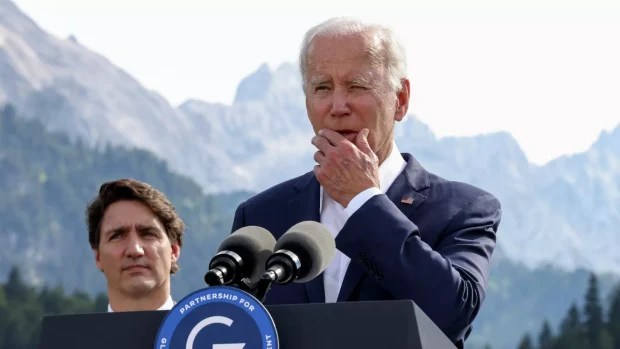
President Joe Biden’s approach to the conflict in Ukraine, concerns over his mental stability, and liberal intolerance could be among the reasons why over one million Democrats switched allegiances and joined the Republican Party in the past year, some analysts believe.
According to data collected by AP, more than one million Democrats have registered as Republicans during the course of the past twelve months, most notably in highly-populated suburbs, where presidential and national congressional elections are usually decided. AP in its report published on Monday said the switch also encompassed agricultural regions, poor inner cities, and small towns.
The Democratic voter mass defections coincide with Biden’s approval ratings sinking to historical lows as inflation runs at all-time highs with mid-term elections looming in November.
Meanwhile, the White House’s policies toward the conflict in Ukraine are also becoming less popular. A poll released on Tuesday by Morning Consult Global shows American support for sanctions against Russia is steadily declining – largely because of rising energy costs.
“Workers and seniors are ravaged by an inflationary curse sparked by an inept war against the fossil fuel industry,” political analyst and former hedge fund manager, Charles Ortel, said when asked about the Democratic voter exodus.
The Democratic voter defections and low approval ratings, he added, could indicate Biden administration efforts to rally patriotism around his “tough” policies against Russia over Ukraine have failed.
Political commentator and historian Dan Lazare believes the fact voters are switching parties is less an endorsement of the Republican Party than a loss of confidence in Democrats, especially in their handling of the Ukraine crisis and the related rise in gas prices.
“Skyrocketing gas prices are the gift that keeps on giving – for the Republicans, that is. The war in Ukraine is turning into a Democratic nightmare as Russia continues to reap real battlefield gains,” Lazare said. “So, what Democrat wouldn’t lose faith given a record like that?”
Ortel said history suggests that citizens reluctantly support foreign conflicts even when leaders provide compelling evidence that the causes are justified. Not to mention, US efforts that started under the Clinton administration to push NATO eastward have never been explained nor have potential costs and complaints by the Russian side, Ortel said.
“No sane actor wants perpetual conflict,” Ortel explained. “And no American would tolerate parallel expansion into Mexico or Canada by Russia.”
Other Drivers of Discontent
Ortel also attributed the voter surge away from the Democrats to the party’s “intolerant” attitude, including toward those who oppose the administration’s Ukraine policies. The Democratic Party used to be a group that embraced cooperation and was tolerant of perspectives that competed with liberal or progressive views. However, in recent years that has changed, Ortel said.
“Particularly under the Obama-Biden Administration, tolerance for other viewpoints was replaced with a ‘take-no-prisoners’ approach towards any challengers,” Ortel said.
To make matters worse, the analyst added, Biden administration officials propagate theories and slogans claiming they are succeeding “when even unschooled citizens see clearly that Biden and his team are rapidly wrecking the American economy and what remains of America’s standing abroad.”
Other drivers of voters fleeing the Democratic Party are the questions surrounding the commander-in-chief’s mental stability in light of nonstop gaffes and concerns over Vice President Kamala Harris’s capabilities, Ortel said.
“Joe Biden is clearly not playing with mental faculties intact nor is Kamala Harris fit to replace him,” Ortel said.
Lazare has pointed to Biden’s dismal domestic policy record as another culprit.
“Joe Biden is The Incredible Shrinking President: His one significant success, the $1.9-trillion COVID-19 relief bill that passed in February 2021, has roundly backfired by giving inflation a significant boost. Everything else has meanwhile flopped,” he said.
Meanwhile, Lazare added, voting reform is dead in the water, student debt relief is stalled, and there is a dispiriting deadlock over gun control in the wake of mass shootings.
Although the midterm congressional elections were still four months away, all signs already pointed to a historic catastrophe for the Democrats, Lazare warned.
“Predicting an election that’s still four months away is risky business. But given that Biden’s poll numbers are still sinking – the last is just 36%! – and given that inflation is accelerating, I don’t see how the midterms can be anything less than a Democratic debacle,” Lazare said.
Zelensky demands $5 billion “every month” from NATO, cites security in Europe

Samizdat | June 29, 2022
Ukrainian President Volodymyr Zelensky has urged the US-led NATO bloc to ramp up support of his country amid the ongoing conflict with Russia, claiming that Kiev’s defeat would result in a “delayed” war between Moscow and the whole West. Zelensky made the remarks as he addressed the NATO summit in Madrid via a video link on Wednesday.
“It’s either urgent aid to Ukraine sufficient for victory, or a delayed war between Russia and you,” Zelensky told NATO leaders.
The country needs both direct military and financial aid, Zelensky stated, adding that some $5 billion a month was needed to cover its budget deficit. Top Ukrainian officials have repeatedly called upon the West to provide financial support.
“Financial aid for Ukraine has no less significance than arms deliveries,” Zelensky said. “We need some $5 billon every month, you know that. And this is a fundamental thing, needed for defense and protection.”
To help Ukraine now end this war with a victory on the battlefield, that is, to give a really strong response to Russia’s actions – this is what we, and the entire alliance, the whole Euro-Atlantic community need.
Once the conflict is over, Ukraine must be provided with a decent place in the Western security architecture, Zelensky insisted, rejecting the prospect of Ukraine remaining in a “gray zone” between Russia and the NATO bloc. “We need security guarantees, and you must find a place for Ukraine in the common security space,” he stressed.
Russia sent troops into Ukraine on February 24, citing Kiev’s failure to implement the Minsk agreements, designed to give the regions of Donetsk and Lugansk special status within the Ukrainian state. The protocols, brokered by Germany and France, were first signed in 2014. Former Ukrainian President Petro Poroshenko has since admitted that Kiev’s main goal was to use the ceasefire to buy time and “create powerful armed forces.”
In February 2022, the Kremlin recognized the Donbass republics as independent states and demanded that Ukraine officially declare itself a neutral country that will never join any Western military bloc. Kiev insists the Russian offensive was completely unprovoked.
Biden announces new troop deployments in Europe
Samizdat | June 29, 2022
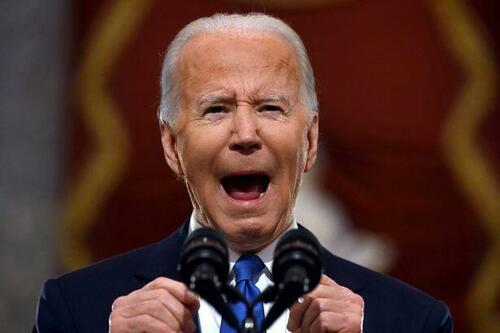
Washington will significantly increase its military presence in Europe to “defend every inch of allied territory,” US President Joe Biden said on Wednesday after arriving in Madrid, Spain for the annual NATO summit.
The US 5th Army Corps will set up a headquarters in Poland, while 5,000 additional troops will be deployed to Romania.
The Pentagon will also boost rotational deployments in the Baltic states, dispatch two additional squadrons of F-35 fighter planes to Britain, and station additional air defenses in Germany and Italy. The US Navy will increase the number of destroyers stationed in Spain from four to six.
There are already around 100,000 US troops stationed in Europe. “We’re stepping up, proving that NATO is more needed now than it ever has been and it’s as important as it ever has been,” Biden said.
NATO has been boosting its military presence on its eastern flank after Russia sent troops to Ukraine in late February. The military bloc’s chief, Jens Stoltenberg, said on Monday that the alliance will increase its rapid-response force from 40,000 to 300,000 troops.
Russian President Vladimir Putin cited NATO’s attempts to establish “a foothold” in Ukraine as one of the causes of the conflict.
Turkey reaches NATO deal with Finland and Sweden

Samizdat | June 28, 2022
Turkey will support inviting Finland and Sweden into NATO at the alliance’s upcoming summit in Spain, Finnish President Sauli Niinisto announced on Tuesday after a meeting with his Turkish counterpart Recep Tayyip Erdogan and Swedish Prime Minister Magdalena Andersson.
The three countries signed a memorandum of understanding at the meeting, organized with the support of NATO Secretary General Jens Stoltenberg.
“The concrete steps for our accession to NATO will be agreed among NATO allies over the next two days, but that decision is now imminent,” said Niinisto. “I am pleased that this stage on Finland’s journey towards NATO membership has been completed.”
According to Turkey, Finland and Sweden pledged to “condemn terrorism in all its forms” and end their support for organizations Ankara has designated as terrorist – including the Kurdish groups PKK and YPG, as well as the movement led by the exiled cleric Fetullah Gulen, which the Turkish government refers to as “FETO.”
“Turkey got what it wanted,” Erdogan said in a statement after the deal was announced.
Speaking at a press conference after the meeting, Stoltenberg said that Finland and Sweden will become observers in NATO at the upcoming summit. He added that the memorandum includes provisions on fighting terrorism and arms exports, including adopting stricter national legislation.
Finland and Sweden imposed an arms embargo against Turkey in 2019, over Ankara’s intervention in Syria. Turkey also reportedly demanded that Stockholm and Helsinki shut down the offices and ban the publications belonging to FETO, freeze the assets related to groups it has designated as terrorists, and even ban them from demonstrating in public.
Ankara’s opposition threatened to derail NATO’s plan to invite Sweden and Finland at the summit in Madrid which began on Tuesday. The two traditionally neutral Scandinavian countries declared their desire to join the US-led alliance in April, citing the current conflict in Ukraine.
A pivotal moment in eastern Ukraine
BY M. K. BHADRAKUMAR | INDIAN PUNCHLINE | JUNE 26, 2022
The retreat of Ukrainian troops from Severodonetsk city in the Luhansk Oblast of the country is a pivotal moment in the ongoing conflict. The Russian forces are now almost in total control over the Luhansk region. The latest reports from front lines say Russian forces entered the last remaining city of Lysychansk in Luhansk on June 25.
In a briefing today, the Russian Ministry of Defence announced in Moscow: “On June 25, the cities of Severodonetsk and Borovskoye, the settlements of Voronovo and Sirotino passed under control of the Lugansk People’s Republic. The localities liberated… are inhabited by about 108,000 people. Total area of the liberated territory is about 145 square kilometres.
“Success of the Russian army… considerably diminishes the morale and psychological condition of the Ukrainian army personnel. In 30th Mechanised Brigade deployed near Artyomovsk, there are mass cases of alcohol abuse, drug use and unauthorised abandonment of combat positions.”
However, peace is a long way off — several months away, perhaps. In the speech by Russian President Vladimir Putin last week at the SPIEF in St. Petersburg, he made no references to peace negotiations. Putin hardly referred to the fighting.
Meanwhile, three highly provocative moves by the opposing side within the past week are significant markers indicating that the conflict may aggravate. If the missile strike at a Russian oil rig in the Black Sea has been an act of provocation, the US supply of High Mobility Artillery Rocket Systems (HIMARS), a powerful long-range weapon system is intended as a potential game changer that can help Kiev turn the tide of the conflict, and, third, the bizarre move by Lithuania to block Russia’s rail transit to Kaliningrad is a reckless escalation of tensions.
On the arrival of the HIMARS, Ukraine Defence Minister Oleksiy Reznikov ecstatically wrote wrote on Twitter on Thursday, “HIMARS have arrived to Ukraine. Thank you to my colleague and friend @SecDef Lloyd J. Austin III for these powerful tools! Summer will be hot for russian occupiers. And the last one for some of them.”
Washington claims it has received assurances from Kiev that HIMARS would not be used to attack Russian territory. Moscow has warned it will attack targets in Ukraine that it has “not yet been hitting” if the West supplies longer-range missiles to Ukraine for use in high-precision mobile rocket systems.
The Lithuanian move is a blatant violation of international law and Vilnius would only have acted on the basis of prior consultation with the US and NATO to test the Russian reaction. Kaliningrad is a major Russian base with nuclear missiles, where its Baltic Fleet is headquartered, apart being the only Russian port on the Baltic that is ice-free throughout the year. Evidently, there are some insane fellows in the NATO camp who are itching to climb the escalatory ladder.
For Russia too, there is “unfinished business” ahead insofar as it holds roughly the same amount of territory in Donetsk only as the separatists controlled in February before the special military operation began. Now, seizing the administrative territories of the Donbass is only Moscow’s minimal goal. There is going to be a sprawling battlefield in the next phase, stretching from Kharkiv in the northeast to Mykolaiv and Odessa in the southwest. Much fighting lies ahead.
The New York Times reported that “Pentagon officials expect that the arrival of more long-range artillery systems will change the battlefield in Donetsk.” Gen. Mark A. Milley, the chairman of the US Joint Chiefs of Staff told reporters recently, “If they (Kiev) use it properly, practically, then they’re going to have very, very good effects on the battlefield.”
The Russian military approach doctrinally is centred on attrition warfare, which aims to grind the way toward incremental territorial gains. Therefore, the advantage goes to the side which has greater staying power on the battlefield. In a sustained war of attrition, one military is ultimately going to be depleting the capability of the other. This is where the fault lines in the western unity come into play if the current traces of “war fatigue” in Europe turns into “solidarity fatigue.”
Ukraine’s ability to shift the military balance depends critically on sustained military support from the US and other European countries. That, of course, hinges on political will and cohesiveness of the western allies. As for Russia, it is not only committed to a protracted war but also has the capacity to sustain it.
Unlike the case with Ukraine, Russia is not dependent on any other country for boosting its military capability or training and advising its military. Also, historically speaking, a defining characteristic of the Russian military is its incredible endurance and ability to sustain prolonged attrition.
The US is still betting that the Russian economy cannot hold out for a long time, since the full impact of sanctions and export controls is yet to be felt. In this calculus, the rebound of the ruble currency is seen as largely due to the strict government controls on capital flows and plummeting imports into Russia. Equally, the US has convinced itself that the restrictions on technology exports to Russia will gradually stunt the growth of its industries. Thus, the focus of the G7 summit in Germany currently under way (June 26-28) is on new plans to further “tighten the screws” on Russia’s economy.
But not much Russian budget data is available to make such daring assumptions and it is even harder to quantify how much Moscow is spending on the war in Ukraine. Certainly, there is no evidence to suggest that the Kremlin’s ability to finance the war effort is coming under pressure from sanctions.
While President Biden boasted in March that sanctions were “crushing the Russian economy” and that “the ruble is reduced to rubble,” the exact opposite has happened. Russian oil revenues have set new records and the ruble hit a 7-year high this week against the dollar. Expert opinion is also that Russia’s financial system is back to business as usual after a few weeks of severe bank runs.
Going forward, Biden must retain control over the Congress in the midterm elections in which Republicans are sure to capitalise on the rising cost of living. As for Europe, cooler temperatures in the coming months will raise alarms about energy shortages as Moscow has cut down natural gas supplies to Europe, which would aggravate the economic pressure they now are experiencing.
Therefore, the big question is, whether the desire to resist Russia will be sustainable as the war itself grinds away. The matrix has changed. After all, Biden uttered the following about Putin as recently as in end-March: “For God’s sake, this man cannot remain in power.” But in 3 months’ time, today, Biden only says he is striving to help Ukraine negotiate optimally with Russia for a settlement. Here too, Biden needs to make sure Russia is losing ground, while also constantly weighing that new weapons do not escalate the conflict too fast.
Admittedly, Biden is under little political pressure at home to back away. And the crack in western unity is, arguably, not to be construed as amounting to anything like a rift in the fundamental strategy towards Russia and the Ukraine conflict. That said, the bottom line is that this is also a perilous moment for the global economy.
Post-pandemic economic recovery, supply-chain disruptions, rapid price increases, infrastructure investment, trade practices, global oil prices, world’s food supply, recession — these issues surely impact the western leaders’ standing in the polls. It means economic and political pain is coalescing.
The Fantasy of Fanaticism
Despite what some “defense analysts” may be telling Western media, the longer the war continues, the more Ukrainians will die and the weaker NATO will become.
By Scott Ritter | Consortium News | June 25, 2022
For a moment in time, it looked as if reality had managed to finally carve its way through the dense fog of propaganda-driven misinformation that had dominated Western media coverage of Russia’s “Special Military Operation” in Ukraine.
In a stunning admission, Oleksandr Danylyuk, a former senior adviser to the Ukrainian Ministry of Defense and Intelligence Services, noted that the optimism that existed in Ukraine following Russia’s decision to terminate “Phase One” of the SMO (a major military feint toward Kiev), and begin “Phase Two” (the liberation of the Donbass), was no longer warranted. “The strategies and tactics of the Russians are completely different right now,” Danylyuk noted. “They are being much more successful. They have more resources than us and they are not in a rush.”
“There’s much less space for optimism right now,” Danylyuk concluded.
In short, Russia was winning.
Danylyuk’s conclusions were not derived from some esoteric analysis drawn from Sun Tzu or Clausewitz, but rather basic military math. In a war that had become increasingly dominated by the role of artillery, Russia simply was able to bring to bear on the battlefield more firepower than Ukraine.
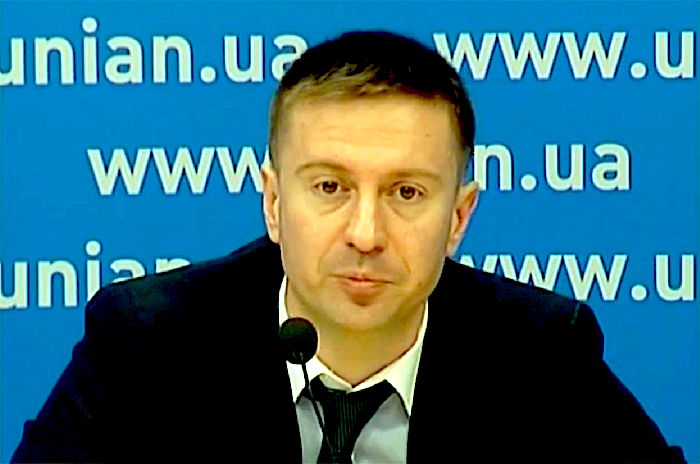
Oleksandr Danylyuk in 2015. (CC BY 3.0, Wikimedia Commons)
Ukraine started the current conflict with an artillery inventory that included 540 122mm self-propelled artillery guns, 200 towed 122mm howitzers, 200 122mm multiple-rocket launch systems, 53 152mm self-propelled guns, 310 towed 152mm howitzers, and 96 203mm self-propelled guns, for approximately 1,200 artillery and 200 MLRS systems.
For the past 100-plus days, Russia has been relentlessly targeting both Ukraine’s artillery pieces and their associated ammunition storage facilities. By June 14, the Russian Ministry of Defense claimed that it had destroyed “521 installation of multiple launch rocket systems” and “1947 field artillery guns and mortars.”
Even if the Russian numbers are inflated (as is usually the case when it comes to wartime battle damage assessments), the bottom line is that Ukraine has suffered significant losses among the very weapons systems — artillery — which are needed most in countering the Russian invasion.
But even if Ukraine’s arsenal of Soviet-era 122mm and 152mm artillery pieces were still combat-worthy, the reality is that, according to Danylyuk, Ukraine has almost completely run out of ammunition for these systems and the stocks of ammunition sourced from the former Soviet-bloc Eastern European countries that used the same family of weapons have been depleted.
Ukraine is left doling out what is left of its former Soviet ammunition while trying to absorb modern Western 155mm artillery systems, such as the Caesar self-propelled gun from France and the U.S.-made M777 howitzer.
But the reduced capability means that Ukraine is only able to fire some 4,000-to-5,000 artillery rounds per day, while Russia responds with more than 50,000. This 10-fold disparity in firepower has proven to be one of the most decisive factors when it comes to the war in Ukraine, enabling Russia to destroy Ukrainian defensive positions with minimal risk to its own ground forces.
Casualties
This has led to a second level of military math imbalances, that being casualties.
Mykhaylo Podolyak, a senior aid to Ukrainian President Volodymyr Zelensky, recently estimated that Ukraine was losing between 100 and 200 soldiers a day on the frontlines with Russia, and another 500 or so wounded. These are unsustainable losses, brought on by the ongoing disparity in combat capability between Russia and Ukraine symbolized, but not limited to, artillery.
In recognition of this reality, NATO Secretary General Jen Stoltenberg announced that Ukraine will more than likely have to make territorial concessions to Russia as part of any potential peace agreement, asking,
“what price are you willing to pay for peace? How much territory, how much independence, how much sovereignty… are you willing to sacrifice for peace?”
Stoltenberg, speaking in Finland, noted that similar territorial concessions made by Finland to the Soviet Union at the end of the Second World War was “one of the reasons Finland was able to come out of the Second World War as an independent sovereign nation.”
To recap — the secretary general of the trans-Atlantic alliance responsible for pushing Ukraine into its current conflict with Russia is now proposing that Ukraine be willing to accept the permanent loss of sovereign territory because NATO miscalculated and Russia —instead of being humiliated on the field of battle and crushed economically — is winning on both fronts.
Decisively.
That the secretary general of NATO would make such an announcement is telling for several reasons.
Stunning Request
First, Ukraine is requesting 1,000 artillery pieces and 300 multiple-launch rocket systems, more than the entire active-duty inventory of the U.S. Army and Marine Corps combined. Ukraine is also requesting 500 main battle tanks — more than the combined inventories of Germany and the United Kingdom.
In short, to keep Ukraine competitive on the battlefield, NATO is being asked to strip its own defenses down to literally zero.
More telling, however, is what the numbers say about NATO’s combat strength versus Russia. If NATO is being asked to empty its armory to keep Ukraine in the game, one must consider the losses suffered by Ukraine up to that point and that Russia appears able to sustain its current level of combat activity indefinitely. That’s right — Russia just destroyed the equivalent of NATO’s main active-duty combat power and hasn’t blinked.
One can only imagine the calculations underway in Brussels as NATO military strategists ponder the fact that their alliance is incapable of defeating Russia in a large-scale European conventional land war.
But there is another conclusion that these numbers reveal — that no matter what the U.S. and NATO do in terms of serving as Ukraine’s arsenal, Russia is going to win the war. The question now is how much time the West can buy Ukraine, and at what cost, in a futile effort to discover Russia’s pain threshold in order to bring the conflict to an end in a manner that reflects anything but the current path toward unconditional surrender.
The only questions that need to be answered in Brussels, apparently, are how long can the West keep the Ukrainian Army in the field, and at what cost? Any rational actor would quickly realize that any answer is an unacceptable answer, given the certainty of a Russian victory, and that the West needs to stop feeding Ukraine’s suicidal fantasy of rearming itself to victory.
Enter The New York Times, stage right. While trying to completely reshape the narrative regarding the fighting in the Donbass after the damning reality check would be a bridge too far for even the creative minds at the Gray Lady — the writing equivalent of trying to put toothpaste back in the tube. But the editors were able to interview a pair of erstwhile “military analysts” who cobbled together a scenario that transformed Ukraine’s battlefield humiliation.
‘Military Analysts’
They described a crafty strategy designed to lure Russia into an urban warfare nightmare where, stripped of its advantages in artillery, it was forced to sacrifice soldiers in an effort to dig the resolute Ukrainian defenders from their hardened positions located amongst the rubble of a “dead” city — Severodonetsk. [Ukraine forces withdrew from the city Friday.]

Gustav Gressel in Berlin in February 2020
According to Gustav Gressel, a former Austrian military officer turned military analyst, “If the Ukrainians succeed in trying to drag them [the Russians] into house-to-house combat, there is a higher chance of inducing casualties on the Russians they cannot afford.”
According to Mykhailo Samus, a former Ukrainian naval officer turned think-tanks analyst, the Ukrainian strategy of dragging Russia into an urban combat nightmare is to buy time for rearming with the heavy weapons provided by the West, to “exhaust, or reduce, the enemy’s [Russia’s] offensive capabilities.”
The Ukrainian operational concepts in play in Severodonetsk, these analysts claim, have their roots in past Russian urban warfare experiences in Aleppo, Syria and Mariupol. What escapes the attention of these so-called military experts, is that both Aleppo and Mariupol were decisive Russian victories; there were no “excessive casualties,” no “strategic defeat.”
Had The New York Times bothered to check the resumes of the “military exerts” it consulted, it would have found two men so deeply entrenched into the Ukrainian propaganda mill as to make their respective opinions all but useless to any journalistic outlet possessing a modicum of impartiality. But this was The New York Times.
Gressel is the source of such wisdom as:
“If we stay tough, if the war ends in defeat for Russia, if the defeat is clear and internally painful, then next time he will think twice about invading a country. That is why Russia must lose this war.”
And:
“We in the West… all of us, must now turn over every stone and see what can be done to make Ukraine win this war.”
Apparently, the Gressel playbook for Ukrainian victory includes fabricating a Ukrainian strategy from whole cloth to influence perceptions regarding the possibility of a Ukrainian military victory.
Samus likewise seeks to transform the narrative of the Ukrainian frontline forces fighting in Severodonetsk. In a recent interview with the Russian-language journal Meduza, Samus declares that:
“Russia has concentrated a lot of forces [in the Donbass]. The Ukrainian armed forces are gradually withdrawing to prevent encirclement. They understand that the capture of Severodonetsk doesn’t change anything for the Russian or the Ukrainian army from a practical point of view. Now, the Russian army is wasting tremendous resources to achieve political objectives and I think they will be very difficult to replenish… [f]or the Ukrainian army, defending Severodonetsk isn’t advantageous. But if they retreat to Lysychansk they’ll be in more favorable tactical conditions. Therefore, the Ukrainian army is gradually withdrawing or leaving Severodonetsk, and upholding the combat mission. The combat mission is to destroy enemy troops and carry out offensive operations.”
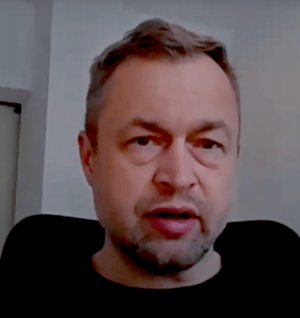
Mykhailo Samus on March 27. (YouTube still)
The truth is, there is nothing deliberate about the Ukrainian defense of Severodonetsk. It is the byproduct of an army in full retreat, desperately trying to claw out some defensive space, only to be crushed by the brutal onslaught of superior Russian artillery-based firepower.
To the extent Ukraine is seeking to delay the Russian advance, it is being done by the full-scale sacrifice of the soldiers at the front, thousands of people thrown into battle with little or no preparation, training, or equipment, trading their lives for time so that Ukrainian negotiators can try to convince NATO countries to mortgage their military viability on the false promise of a Ukrainian military victory.
This is the ugly truth about Ukraine today — the longer the war continues, the more Ukrainians will die, and the weaker NATO will become. If left to people like Samus and Gressel, the result would be hundreds of thousands of dead Ukrainians, the destruction of Ukraine as a viable nation-state, and the gutting of NATO’s front-line combat capability, all sacrificed without meaningfully altering the inevitability of a strategic Russian victory.
Hopefully sanity will prevail, and the West will wean Ukraine off the addiction of heavy weaponry, and push it to accept a peace settlement which, although bitter to the taste, will leave something of Ukraine for future generations to rebuild.
Belarus’ Lukashenko Calls Lithuania’s Blockade of Kaliningrad ‘De Facto Declaration of War’
Samizdat – 25.06.2022
Belarus’ President Alexander Lukashenko has condemned Lithuania’s move to block all ground communications between Russia and its exclave of Kaliningrad, calling it a “de facto declaration of war”.
“Recently, there has been increasingly more information emerging about [Lithuania’s] plan to stop transit from Russia through Belarus to Kaliningrad. It’s like declaring some kind of war. This is unacceptable in today’s environment,” Lukashenko said.
He added that he had grown concerned with the confrontational rhetoric of some of Belarus’ neighbors, namely Poland and Lithuania, as well as NATO nuclear-capable aircraft flights near the Belarussian borders. Lukashenko stated that Belarus should be ready for anything, including to use the “most serious weapons” available to defend the Union State of Russia and Belarus.
In light of this, the Belarus president asked his Russian counterpart to help modernize the country’s aircraft to be able to carry nuclear bombs. Russian President Vladimir Putin, in turn, notified Lukashenko that Russia decided to ship several 9M723 Iskander-M (NATO reporting name SS-26 Stone) mobile short-range ballistic missile systems.
Iskander launchers can handle both conventional and nuclear short-range missiles. However, Putin did not specify which ammunition will be supplied with the Iskander-M’s shipped to Belarus.
Russia earlier harshly condemned Lithuania’s announcement of plans to cut all goods transit from Russia to Kaliningrad in reported accordance with EU sanctions. The move leaves Russia with a maritime route to reach its exclave.
The Kremlin slammed the decision as a “blockade” and vowed to respond in kind and decisively, but has not elaborated on the measures yet. Moscow also reminded Lithuania that it was bound by an agreement with Russia that mandates that it must allow Russian goods to flow unimpeded to Kaliningrad.
Ukraine won’t pursue NATO membership – Zelensky adviser
Samizdat | June 25, 2022
Ukraine has accepted that NATO membership is off the table, and will not take any further steps toward joining the US-led military alliance, Igor Zhovkva, an adviser to President Volodymyr Zelensky, told the Financial Times on Saturday. Nevertheless, Kiev wants a say in NATO’s policies.
NATO leaders are set to meet in the Spanish capital of Madrid next week, and during two days of meetings and consultations, the alliance will unveil its Strategic Concept – a document that outlines the alliance’s mission and stance toward non-members, including China and Russia.
Zhovkva told the Financial Times that Zelensky’s government wants the alliance to acknowledge that Ukraine is “a cornerstone of European security,” and to reaffirm its partnership with Kiev, first established in 1997.
However, he said that Ukraine will not push to become a member of NATO.
“Nato members have declined our aspirations. We will not do anything else in this regard,” he said.
Ukraine’s prospective membership in the alliance was a key factor behind the current conflict with Russia. Ukraine wrote its goal of becoming a NATO member into its constitution in 2019, despite Moscow’s warnings that having the alliance’s forces and weapons on its border would constitute an unacceptable security threat.
NATO Secretary General Jens Stoltenberg has insisted that the alliance’s membership books remain open for interested nations, but has not promised or ruled out membership for Ukraine in the near term. Under the 2008 Bucharest Declaration, NATO’s official position is that Georgia and Ukraine “will become members of NATO” at an unspecified future date.
NATO’s Strategic Concept has not been updated since 2010, with that version of the document stating that the alliance seeks “a true strategic partnership” with Russia.
Zhovkva wants NATO to purge any mention of Russia as a “partner” from the coming update.
“We expect in the Nato strategic concept . . . there will be more strict and severe warnings to the Russian aggressor,” he said, urging the alliance “Don’t be shy” in inserting anti-Russian text.
Furthermore, Zhovkva said that he wants the Ukrainian conflict to be described in the strategy document, arguing “it’s not enough just to cross out the word ‘partner.’”
Kaliningrad Provocation & Ukraine’s EU Candidacy… Desperate Diversions From NATO Propaganda Lies
Strategic Culture Foundation | June 24, 2022
The Western propaganda narrative on the conflict in Ukraine is in big trouble. Months of lying by governments and dutiful news media are falling apart as Russia makes major advances to safeguard the Russian-speaking populations in Crimea and Donbass, the formerly eastern Ukrainian region, and to neutralize Nazi military forces under the control of the Kiev regime and backed to the hilt by NATO.
Recall how only a few weeks ago Russia was being pilloried in Western media for making a “strategic blunder” from its military intervention in Ukraine that began on February 24. Western leaders were gung-ho in predicting military defeat for Moscow. After four months of conflict not only are Russian forces decimating NATO-backed Ukrainian flanks, the wider repercussions that the Western powers could have avoided if they had engaged diplomatically with Russia to resolve long-held security concerns are rebounding with devastating economic impact. The U.S.-led NATO and European Union axis is digging a giant hole for itself. If not a grave.
To divert from the NATO-fuelled disaster, the U.S.-led military alliance is recklessly provoking Russia with a blockade on the Russian exclave territory of Kaliningrad. The Russian territory is sandwiched between NATO members Poland and the three Baltic states of Estonia, Latvia and Lithuania. This week Lithuania moved to block rail and road transport to Kaliningrad. It is clear that the Baltic state is not acting alone. It is enforcing a policy ordained by the NATO and EU leadership. The EU’s foreign policy chief Josep Borrell made the absurd excuse that Lithuania was merely applying sanctions against Russian goods. He denied the blatant reality that the move was a hostile economic blockade on sovereign Russian territory and its internal affairs. Laughably, Borrell has the brass neck to accuse Russia of blockading Ukrainian ports.
Moscow has warned that if the blockade of its territory is not lifted it would be seen as aggression to which it will respond. In other words, the NATO and EU axis has decided to gratuitously escalate tensions with Russia to the point of provoking acts of war which a blockade certainly deems.
The insane move by the Western powers has to be seen as nothing other than desperate diversionary tactics to distract from their fiasco of failing propaganda lies over Ukraine. Rather than admitting (even tacitly) that its policies have created a monumental mess in Europe and indeed the wider world, the Western powers are digging an even deeper hole by ratcheting up even more tensions with Russia.
This would also explain the farcical move this week by the European Council to grant official candidate status to Ukraine for joining the 27-member bloc. In practice, it may take decades for Ukraine to gain membership. Turkey has had the same status for 22 years without moving into the European fold. Serbia and other Balkan states have been waiting up to 10 years as candidates for joining the EU club. So, the fanfare of the EU leadership granting Ukraine application is largely empty theater. All the declarations about “solidarity” with Ukraine are typical Brussels bombast.
No wonder other candidate states are exasperated by what they rightly see as the EU playing politics without an iota of principle. The Kiev regime is hailed as “sharing European values” as it bans opposition political parties and outlaws the Russian language, literature, and music. The European Union is impaling itself with its own unscrupulous contradictions by granting candidate status to Ukraine.
But in the futile short term, what it is designed to do is, again, distract from the public embarrassment of the EU and NATO overseeing a total debacle in Ukraine. Billions of dollars and euros bilked from European and American citizens to fuel a Nazi regime have achieved nothing militarily except to prolong the war in Ukraine and escalate the danger of an all-out confrontation with Russia. A war that would in all likelihood lead to a nuclear catastrophe for the planet.
The U.S. and European political establishments have lost all moral authority to govern. At a time of historic collapse in Western capitalist economies, they have decided to make hardship and misery all the more acute for their societies by provoking global energy and inflation crises. Their insane irresponsibility is driven by Western ideological interests, kowtowing to the transatlantic elite and the military-industrial complex as well as by an inveterate mentality of Russophobia. Russian Foreign Minister Sergey Lavrov pointed out this week that the current climate and dynamics of the EU and NATO are forming a war bloc against Russia, one that has a vile echo of how Nazi Germany and European fascists armed up against the Soviet Union in the 1930s.
The morally bankrupt Western ruling class has always found war to be an expedient escape route from internal calamity. Their lies and misrule can be covered up with the blood of millions, so it is heinously calculated. They did this in the First and Second World Wars. They are willing to do it again with a Third World War.
It is truly shocking that the NATO and EU axis is moving week-by-week towards open war against Russia. The scenario has already moved from a proxy war to a direct one.
The provocation of blockading Kaliningrad is a direct assault on the territory of the Russian Federation.
Likewise, the scandalous flirting with Ukraine over EU membership as well as the delivery of missile systems to the Kiev regime by the United States, Germany, Britain, and others, are all madcap maneuvers to evade accountability and condemnation for their own inherent failure.
It is highly notable that this week saw massive protests on the streets of Brussels in which public anger was explicitly directed at deteriorating economic conditions for citizens in concert with denunciations of NATO warmongering in Ukraine against Russia.
The cat is out of the bag. The warmongering policies of Western misrulers are being connected and comprehended by the general populace. The effete elites know they are being exposed. The emperor has no clothes. And the Western public is getting angrier with millions of workers going on strike and demanding their rights from a callous establishment.
In a wide-ranging speech last week to the St Petersburg International Economic Forum, Russian President Vladimir Putin said that the Western misrulers are facing increasing populist revolt and eventual downfall from their own egregious incompetence and mismanagement.
Such democratic uprisings in the West can’t come soon enough because the grave danger is that its corrupt elite is rushing to provoke war as a diversion. Again.
Twitter hires ‘alarming number’ of ex-spies – investigation
Samizdat | June 24, 2022
Twitter is hiring “an alarming number” of ex-FBI agents and other former “feds and spies,” independent outlet MintPress News is reporting, after conducting an analysis of employment and recruitment websites.
According to the research, in recent years the company employed “dozens of individuals from the national security state to work in the fields of security, trust, safety and content.”
“Chief amongst these is the Federal Bureau of Investigation. The FBI is generally known as a domestic security and intelligence force. However, it has recently expanded its remit into cyberspace,” MintPress wrote.
It provides several examples of such appointments. FBI veteran Karen Walsh who, according to her Twitter profile, served as a special agent for 21 years, has become a director of corporate resilience at the Silicon Valley-based company. Mark Jaroszewski, Twitter director of corporate security and risk, joined the Twitter team after 20+ years at the FBI.
Central Intelligence Agency and NATO think-tank Atlantic Council have also been named by MintPress as key incubators of personnel for Twitter.
“Twitter also directly employs active army officers. In 2019, Gordon Macmillan, the head of editorial for the entire Europe, Middle East and Africa region was revealed to be an officer in the British Army’s notorious 77th Brigade – a unit dedicated to online warfare and psychological operations. This bombshell news was steadfastly ignored across the media,” the outlet stressed.
RT has checked open-access social media accounts of Twitter’s top managers and also discovered some former employees of the security services among them – in addition to the ones mentioned in the MintPress investigation.
MintPress News stresses that while Twitter’s HR policy might appear logical – the company hires specialists in the areas it needs – it creates some serious problems, not only for the company, but also for the security agencies and organizations. According to former FBI agent and whistleblower Coleen Rowley, who is quoted by MintPress, many agents have one eye on post-retirement jobs.
“The truth is that at the FBI 50% of all the normal conversations that people had were about how you were going to make money after retirement,” Rowley said.
MintPress claimed that the fact that Twitter recruits largely from the US national security organizations undermines the company’s claims about its neutrality, as the US government “is the source of some of the largest and most extensive influence operations in the world.”
Another risk is that “the company will start to view every problem in the same manner as the U.S. government does – and act accordingly,” the outlet states. To prove this claim, the website analyzed a list – compiled by Twitter – of the countries allegedly conducting disinformation campaigns.
“One cannot help noticing that this list correlates quite closely to a hit list of U.S. government adversaries. All countries carry out disinfo campaigns to a certain extent. But these ‘former’ spooks and feds are unlikely to point the finger at their former colleagues or sister organizations or investigate their operations,” MintPress explained.
Twitter adds warning messages to the tweets and accounts of the state-affiliated media of Russia, China, Iran and Cuba, thus mirroring “US hostility” towards these countries, but does not add any warnings to the pages of state-affiliated media of US and its allies, the outlet highlighted.
Ultimately, MintPress found that Twitter is not the only social media platform that’s “cultivating such an intimate relationship with the FBI and other groups belonging to the secret state.”
“Facebook, for example, has entered into a formal partnership with the Atlantic Council’s Digital Forensics Research Lab, whereby the latter holds significant influence over 2.9 billion users’ news feeds, helping to decide what content to promote and what content to suppress,” it said, adding that the company has also employed former NATO Press Secretary Ben Nimmo as its head of intelligence.
TikTok, according to the outlet, has been “filling its organization with alumni of the Atlantic Council, NATO, the CIA and the State Department.”
Reddit and various media, including Thomson Reuters and multiple US TV channels have also been actively employing former spies, MintPress News claims.
“One of media’s primary functions is to serve as a fourth estate; a force that works to hold the government and its agencies to account. Yet instead of doing that, increasingly it is collaborating with them. Such are these increasing interlocking connections that it is becoming increasingly difficult to see where big government ends and big media begins,” it pointed out.
Washington supports blockade of Russian exclave by NATO member Lithuania
Samizdat | June 22, 2022
The US says that it “appreciates” anti-Russian sanctions imposed by EU nations and that its military is committed to the defense of Lithuania, after the country banned some Russian goods from passing through its territory to the Russian exclave of Kaliningrad.
Ned Price, the spokesman for the US state department, dismissed Moscow’s displeasure with the Lithuanian blockade of its territory as “saber-rattling” and “bluster.” Speaking at a daily briefing, he said he didn’t want to “give it additional time.”
“We, of course, appreciate the unprecedented economic measures that many countries around the world… including in this case Lithuania, have joined us in taking against Russia for its unprovoked war in Ukraine,” he said.
Price said that the US would protect Lithuania from any military attack, as is due under its NATO obligations.
“Lithuania has been a stalwart partner in this. We stand by NATO. We stand by our NATO Allies, and we stand by Lithuania,” he said.
The row between Russia and its Baltic neighbor erupted last week after Lithuania started blocking the transit of goods between mainland Russia and Kaliningrad region. The partial restrictions came into force last Saturday, with Vilnius claiming it was a natural part of enforcing EU sanctions against Russian trade. Roughly half of the traffic is estimated to be affected. The banned items include coal, metals, and construction materials.
Moscow said the restrictions were crossing every line and warned that there would be serious consequences for what it described as a Lithuanian blockade of its exclave. The decision clearly violated international law, the Russian government noted. Some experts suggested that it could even amount to a casus belli – a cause to start a war over.
Kaliningrad region is sandwiched between Poland and Lithuania and has access to the Baltic Sea, which technically allows Russia to ferry goods to it. The relatively small exclave also hosts a significant number of Russian troops and weapon systems, making it a key component in the country’s national security.
Featured Video

EUROPE FEARS RUSSIA’S NEXT MOVE / Ian Proud
or go to
Aletho News Archives – Video-Images
New Book
New Book: No Autoimmunity The Body Doesn’t Attack Itself
Lies are Unbekoming | September 24, 2026
 The label for Humira, once the best-selling drug in the world, lists its risks in plain print. One of them, in the label’s own words, is new “autoimmune” disease.
A drug prescribed for a condition labelled autoimmune carries a warning that it can cause a condition labelled autoimmune. That contradiction sits in every box, on a folded paper almost nobody reads.
My new book starts there.
No Autoimmunity: The Body Doesn’t Attack Itself
For seventy years, “your body is attacking itself, and we don’t know why” has ended the conversation for people diagnosed with multiple sclerosis, lupus, rheumatoid arthritis, Hashimoto’s, Type 1 diabetes, Crohn’s and psoriasis. More than eighty conditions now carry the autoimmune label. The diagnosis comes with a prescription for life. It almost never comes with a question about cause.
This book asks the question and answers it from the framework’s own records: its drug labels, its journals, its regulatory filings, and its own experiments. … continue
Blog Roll
 Aletho News
- Iran offers Trump deal before US election
- Merz regime wants ‘secret police’ – opposition
- Israeli settlers terrorize West Bank Palestinians with state-provided drones: Report
- They see them, then kill them: Israeli quadcopters track, deliberately target civilians in Gaza
- Debunked: Trump’s egregious UNGA claims on war against Iran crumble under scrutiny
- Europe was part of the infrastructure of US aggression against Iran: Deputy FM
- New evidence on the Bucha Massacre
- Italy and France debunk reports CIA issued ‘Russian drone threat’ warning
- How Russia is Rewiring the Global South
- Britain’s elites want you ready to die for a war they keep imagining
- If Americans Knew
- Trump betrayed voters with his campaign lies and prioritized a foreign country once he took office
- Netanyahu calls Israel’s war in Gaza ‘opposite of genocide’ in UN speech to near-empty hall
- Settler Kidnappings: Torture, Sexual Abuse and Terrorisation of Palestinian Abductees as Israel Deepens Annexation of West Bank
- Gaza winter nears as 162,000 tents become unusable, raising fears of humanitarian crisis
- Netanyahu says, “It’s the opposite of genocide”; UN says Gaza economy is world’s ‘most severe crisis on record’ – Daily Update
- Israel’s US-Backed Assault on Gaza Has Created the ‘World’s Most Severe Economic Crisis on Record’: UN
- ‘Protecting U.S. Citizens’… From Israel
- ‘This is where I live now, the back of a truck’: a day in the life of a grandmother in Gaza
- In UN Speech, Iran’s President Displays Pictures of Children Killed by US, Brings Attention to Israel’s Nuclear Arsenal
- Israel displaces hundreds of Palestinians amid wave of demolitions in West Bank
- No Tricks Zone
- New Study: Earth And Venus Surface Warmth Largely Explained By Convection And Lapse Rate, Not CO2 Or Radiation
- 2025 Nature Paper Claiming Worsening Global Drought Gets RETRACTED …Heavily Flawed
- New Study: ‘Global Drought Shows No Detectable Recent Acceleration Under Climate Warming’
- Economic Masterminds: German Socialists Suggest Taxing Productivity Gains Stemming From Using AI
- The South China Sea Has Not Been Cooperating With The Climate Change Narrative
- Energy Crisis: Germany Enters Heating Season With Historically Low Gas Reserve Fill Levels
- New Study: The Antarctic Ice Sheet Gained Mass From 2020-2024 Due To Staggering Snow And Ice Accumulation
- Study: Ocean Heating Rates From Thousands Of Years Ago ‘Dwarf’ Modern Ocean Heating Rates
- Climate Extremists Target, Attack Large-Scale Power Grid Infrastructure In Germany!
- New Study: Antarctic Ice Melt Has Contributed Less Than 1 Centimeter To Sea Level Rise In The Last 30 Years

