How Selling the ‘Russia-China’ Threat Serves the US
By Salman Rafi Sheikh – New Eastern Outlook – 27.04.2022
Today, if there is one issue in the United States that draws equal support from both the Republicans and the Democrats, it is the fact that China presents the most serious threat to the US global supremacy. Related to this is the other point of agreement i.e., developing a global coalition against China. The Trump administration’s Secretary of State, Mike Pompeo, was on a mission throughout his tenure to build that coalition. The Biden administration, too, has devoted itself to the same task. Indeed, the level of deterioration we have seen in the US-China relations during the Biden era surpasses the trouble that the Trump administration caused. The same holds true about US geopolitics vis-à-vis Russia. The ongoing Russian military operation in Ukraine has allowed the US to cement its position vis-à-vis Europe.
One very useful way for the US to maintain its hegemony is through the sale of its weapons to its allies. Selling weapon systems is a multi-dimensional activity. On the one hand, the US makes billions of dollars by selling weapons. On the other hand, by selling its weapon systems to its allies, the US enhances these countries’ dependence on the US. All of this is achieved, first and foremost, by selling the China-Russia threat to the world. It is, therefore, not surprising to see that ever since the beginning of tensions between Russia and Ukraine – which began because of the US push to expand NATO to Eastern Europe to encircle Russia – the US military-industrial complex’s finances have jumped massively.
As reports in the US media have indicated, ever since the breakout of the Russia-Ukraine war, market shares of major US military companies have jumped massively, with Lockheed Martin’s registering a growth of 25% while Raytheon’s shares have gained 16.4% in the same period. For these companies, the US-created crisis is, thus, a major business opportunity. This was indeed confirmed in so many words by James Taiclet, the CEO of Lockheed Martin himself.
On January 25, in an ‘earning call’ meeting with investors, the Lockheed CEO told his that,
“If you look at the evolving threat level and the approach that some countries are taking … especially Russia today, these days, and China, there’s renewed great power competition that does include national defense and threats to it … And the contribution we can make at Lockheed Martin is to increase the efficiency and the reliability of our products that we have today for our customer. And secondly, to try to bring this 21st century digital technology to the enterprise in a way that allows us to keep up with the adversaries while we’re developing even newer and more advanced systems.”
They are minting money already in ways that complement the overall political economy of the US. The US has been providing military assistance to Ukraine – weapon systems that are supplied directly by these companies. Military assistance worth millions of dollars being provided to Ukraine is part of the total aid package of $13.6 billion for Ukraine. This aid makes the US, on the one hand, the sole ‘protector’ of Europe, and on the other, paves the way for other countries to rely more and more on the US for their defence needs. As it stands, many countries in Europe – including Germany – have adjusted their defence policies. Germany is even buying F-35 jets, thus creating many more business opportunities for the US military-industrial complex.
The exponential growth the US military-industrial complex is experiencing is not tied to the Russia-Ukraine conflict alone. The US has been effectively selling the China threat to countries that are relevant, e.g., Australia.
As some recent reports indicate, Australia is all set to purchase more weapon systems from the US to shield itself against the ‘China threat.’ On April 5, Australia’s Defense Minister Peter Dutton, referring to the ‘Russia-China threat’, said that they will be spending US$2.6 billion to increase Australia’s deterrence to potential adversaries. To quote him, “There was a working assumption that an act of aggression by China toward Taiwan might take place in the 2040s. I think that timeline now has been dramatically compressed.”
Given the so-called ‘imminent’ nature of the Chinese attack, Australia’s FA-18F Super Hornet fighter jets would be armed with improved U.S.-manufactured air-to-surface missiles by 2024.
In addition to this, Australia has also hired Raytheon Technologies and Lockheed Martin to help build guided weapon systems in the country. As reports indicate, the Australian government is planning on spending US$761 million to build a system of guided missiles.
This partnership with the US military-industrial complex is in addition to AUKUS allies’ April 5 statement that showed cooperation in the field of “hypersonics and counter-hypersonics, and electronic warfare capabilities, as well as to expand information sharing and to deepen cooperation on defense innovation.”
Importantly enough, this renewed cooperation comes against the backdrop of what the statement called “Russia’s unprovoked, unjustified, and unlawful invasion of Ukraine”, showing how the US, alongside its time-tested ally, continues to sell the ‘Russian threat’ across the Pacific to maintain what the US calls a “free and open” Pacific Ocean.
However, as the details of the profits and contracts that the US companies are generating through these very crises shows that, for the US, it is never about doing anything to maintain a ‘free’ system.’ On the contrary, it is always about benefitting the US, both geopolitically and economically.
More contracts for the US military companies means more business, which means more jobs for the Americans in those companies. The more these countries buy weapons from the US, the greater their reliance on the US for their defense and survival. This is how Washington aims to maintain its supremacy.
Salman Rafi Sheikh is a research-analyst of International Relations and Pakistan’s foreign and domestic affairs.
Putin warns the US to back off in Ukraine
BY M. K. BHADRAKUMAR | INDIAN PUNCHLINE | APRIL 27, 2022
The Western narrative of the two-month old war in Ukraine imbued with the rhetoric of “democracy versus autocracy,” has dramatically changed with the assertion by the US Secretary of Defence Lloyd Austin at a news conference in Poland Monday following his and Secretary of State Antony Blinken’s trip to Kiev, that Washington wants to “to see Russia weakened.”
David Sanger at the New York Times noted that Austin was “acknowledging a transformation of the conflict, from a battle over control of Ukraine to one that pits Washington more directly against Moscow.” But this is not really a transformation. Sanger’s colleague at the Washington Post, David Ignatius, had written over three months ago that the Biden Administration was working on a road map to get Russia bogged down in Ukraine and attrition it in a way that it becomes a much diminished power on the world stage.
For the Kremlin, most certainly, Austin’s remark would not have come as surprise. As recently as on Monday, President Vladimir Putin repeated at a meeting in the Kremlin that the US and its allies have sought to “split Russian society and destroy Russia from within.” Putin revisited the topic again on Wednesday pointing out that “the forces that have been historically pursuing a policy aimed at containing Russia just don’t need such an independent and large country, even enormously large, in their view. They believe that its very existence poses a threat to them.”
In fact, several perceptive Western observers had estimated that the Kremlin has effectively fallen into a trap laid by the US that is intended to bring down Putin’s regime. Come to think of it, that famous gaffe on 26 March wasn’t a gaffe after all, when President Biden, speaking in Warsaw, had blurted out the impromptu, unscripted remark: “For God’s sake, this man (Putin) cannot remain in power.”
All the same, Austin’s remark signifies that a dramatic change is taking place in the geopolitical situation, which could have positive or negative results. On Monday, Russian Foreign Minister Sergey Lavrov warned the West that staying involved in the Russia-Ukraine war posed “serious” and “real” risks of a World War III and “we must not underestimate it.”
To be sure, the conflict is slowly but steadily turning into a new phase. Foreign fighters and soldiers from NATO regular units are increasingly beefing up the depleted Ukrainian army’s front lines.
That said, the optics also need to be understood. Austin’s war cry comes soon after Mariupol fell to the Russian forces. A couple of thousands Ukrainian nationalists and a few hundred military personnel from NATO countries are trapped in an underground labyrinth at the Azovstal complex in the city, which Russian forces have sealed off. It has been a severe blow to the US’ prestige.
The Russian special operation is on track — “grinding” the Ukrainian forces to the ground, to borrow the graphic expression from UK prime minister Boris Johnson. On Monday, Russian high-precision missiles hit at least six railway substations in Western Ukraine destroying railway facilities in Krasnoe, Zdolbunov, Zhmerinka, Berdichev, Kovel, Korosten, which were meant to be key transshipment points for the supply of Western weaponry to the Ukrainian forces in the Donbas region. Rail communication in several western regions of Ukraine is effectively blocked.
Reports from the east show that Ukrainian forces are suffering heavy losses. Russian forces have taken the city of Kremennaya and are approaching the town of Lyman, which would give them control of a direct road to Slavyansk from the east.
Austin’s hyped up rhetoric notwithstanding, Ukraine is not only not showing any signs of winning but keeps bleeding, and the territory under the actual control of the Ukrainian government is steadily shrinking. US officials admit that the Pentagon lacks the ability to track the weapons that are going in. Yet, the Biden administration has so far spent around $4 billion on Ukraine. Therein hangs a tale. Who are the real beneficiaries of the US supplies? The level of corruption in Ukraine is legion.
The plain truth is that it will be many weeks or months before meaningful volumes of heavy weapons could be delivered to Ukrainian combat units but in the meanwhile, the Battle of Donbass will be fought almost entirely on the basis of the current strength on the ground. In a detailed analysis this week, a former colonel in the US Army and prolific media commentator Daniel Davis concluded: “It will take too long for Western governments to come up with a coherent equipping plan and then prepare, ship, and deliver the kit to its destination in a timeframe that could provide Kyiv’s troops the ability to tip the balance against Russia.”
The bottom line is this: The Biden Administration’s geopolitical agenda is to prolong the military conflict, which apart from weakening Russia militarily and diplomatically, turns Europe into a battlefield and makes the continent heavily dependent on the US leadership for a very long time to come. For Biden, the war provides a useful distraction in US politics in an election year.
Austin hosted a conference of the US’ allies on Monday at the American base in Germany to form a monthly contact group on Ukraine’s self defence to coordinate the “efforts to strengthen Ukraine’s military for the long haul.” It has the ominous look of a “coalition of the willing.” Even Israel was recruited. But the US is underestimating the steely Russian resolve to fully realise the objectives behind the special operation in Ukraine. Moscow will not brook any roadblocks, no matter what it takes.
Putin issued a stern warning today: “If someone from outside moves to interfere in the current developments, they should know that they will indeed create strategic threats to Russia, which are unacceptable to us, and they should know that our response to encounter assaults will be instant, it will be quick.”
He was explicit that Russia has military capabilities that the US cannot match. “We have all the tools to do it, the tools that others can’t boast of at the moment, but as for us, we won’t be boasting. We will use them if the need arises and I would like everyone to be aware of it. We have made all the necessary decisions in this regard,” Putin warned.
The White House is Turning the War in Ukraine into a New Gold Rush
By Valery Kulikov – New Eastern Outlook – 27.04.2022
The Americans have a saying that every new president needs his own “splendid little war.” They understand perfectly that a war of that kind will enrich the incoming political and military establishment and also solve many social and financial problems in the country, not least unemployment, and help reduce foreign debt.
The political establishment has found it easy to arrange matters behind the back of the indecisive and ailing 46th US president, Joe Biden (about whose mental acuity many, both in the US and internationally, are now seriously concerned), and continue the work of previous administrations in drawing Russia deeper into the Ukrainian crisis.
As a result, Washington clearly has no interest in finding a peaceful solution to the conflict, and in provoking its escalation into outright war the White House has found itself forced to put together an anti-Russian coalition and supply more and more consignments of arms to the Ukrainian government.
On March 2, 2022 Dmytro Kuleba, Ukrainian Foreign Minister, claimed that Ukraine had “mobilized an international anti-war coalition, which already has at least 86 states and 15 international organizations” and that “19 countries are giving weapons to Ukraine.” And in a briefing on March 8 Pentagon Press secretary John Kirby confirmed that Ukraine was receiving weapons form 15 countries, including the USA.
The press briefing, published on the official web site of the US Department of Defense, stated that the United States had committed more than $4 billion in military assistance to Ukraine since the beginning of the Biden administration, including $3.4 billion since the beginning of Russia’s special operation! According to the briefing, the US had provided security assistance including 700 Switchblade drone systems, 16 Mi-17 helicopters, more than 1,400 shoulder-launched Stinger anti-aircraft missile systems, 183,000 155mm Howitzer artillery rounds and 72 tactical vehicles to tow them, 200 armored personnel carriers, 121 Phoenix Ghost tactical drones and more than 7,000 small arms. The Pentagon is also providing the Ukrainian armed forces with 5,100 Javelin anti-tank missiles and more than 14,000 “other anti-tank systems.”
As for the claim that representatives of the US military and political establishment have a financial stake in the Ukrainian conflict, it is enough to take the example of the Javelins. According to a number of US experts and industry publications, the US has provided Ukraine with approximately a third of its stock of Javelin anti-tank missiles. Significantly, US Defense Secretary Lloyd Austin has taken personal charge of supplying the Javelins to Ukraine. The reason is clear – he has long been closely linked to the manufacturer, and is now able to place government orders for these weapons. And with Javelin stocks steadily decreasing, the US army has requested new supplies, which means that Lloyd Austin is placing new orders, and may soon be making a big profit from these transactions.
Let us now look at the articles that have appeared in the US media – clearly planted by the Pentagon – suggesting that the transfer of the US’s supplies of Javelins may damage its own defense readiness, as there is the risk that remaining stocks may be insufficient to respond in the event of an “unexpected conflict.” Naturally, articles of this type are a form of propaganda, aimed at promoting the interests of the Department of Defense and of its head, Lloyd Austin. Currently the US army is not directly engaged in conflict, and is therefore able to replace its reserves of these weapons without difficulty. And by stepping up production volumes, Washington is able to boost its profits and create new jobs.
Many of the Javelins that have fallen into the hands of the Russian, PRD and PRL armies during the current conflict have an expiry date of 2022. Many media have reported on an embarrassing incident in the Yavoriv training ground, while US military specialists were instructing Ukrainian soldiers in the operation of the Javelin system – using a Javelin whose service life had expired. After firing the missile, the missile, fortunately without its warhead attached, fell to earth, almost under its users’ feet.
In other words, the war in Ukraine will, for a long time to come, boost the wealth of members of the United States’ political and military elite, including Pentagon officials, as they offload old stock, attract new orders from other countries, and embroil Washington in the “remote conflict” of their own creation. As for the European governments, US puppets who are supplying more and more of their own arms to Ukraine at Washington’s behest, they will, in the end, start to realize that this policy is harming them. By providing military assistance they are merely serving to draw out Russia’s military operation and tighten the financial noose around their own necks – which is one of the USA’s main goals. For, as a result of Washington’s rush to pressurize them into supplying Kiev with “sponsored military support,” in the end the European nations’ own arms reserves will run low, and they will be forced to restock by ordering new armaments from the USA.
It should therefore come as no surprise that the US government is standing on the sidelines and watching on with glee – it knows that when Europe and Nato need to replenish their arsenals, it will be the US military industrial complex that gets the contracts. And, in their joy the heads of the armament industry are drinking themselves into oblivion.
According to a recent article in The Independent, the arms companies are rushing to cash in on this new “gold rush” triggered by the escalation of the conflict in Ukraine. While to pickings from supplying arms to Kiev may be fairly modest, remilitarizing Europe would bring the US arms manufacturers huge profits. And the arms bosses have already started making promises to their shareholders and talking to the media about the profits to be gained from this project. Countries such as Germany, committed to a policy of pacifism since the end of World War II, are now trying to reform their militaries. Germany has already ordered 35 F-35 fighters, the most modern combat aircraft, from the American manufacturer Lockheed Martin, as well as 60 Chinook CH-47F heavy transport helicopters from the US aerospace giant Boeing.
Poland’s Ministry of Defense has signed a contract for the purchase of 250 US-made Abrams M1A2 SEPv3 tanks, the latest version of this vehicle. It has also signed an agreement for logistical and training support, including training for tank teams. In total, it has budgeted some $6 billion for the purchase of these tanks. According to the Polish army, this is its largest arms purchase since the Second World War.
To make sure no-one else benefits from this new Gold Rush the US intends to coordinate the international supply of arms to Ukraine, and to this end is organizing a conference on Ukraine at the United States European Command in Stuttgart, as reported by the German news television channel Welt.
U.S.-Led NATO Is at War Against Russia
By Finian Cunningham | Strategic Culture Foundation |April 26, 2022
We are now in the realm of World War Three. The abysmal situation is such that the war is in danger of going nuclear in which case the future of the planet is at stake.
Incredibly, to warn of this danger leaves a person open to the accusation that they are peddling Russian propaganda. Blindly, the Western governments are doubling down on the powder-keg.
The U.S.-led NATO alliance is flooding Ukraine with heavy offensive weaponry capable of hitting Russia, and the British government this week has openly called for Ukraine to target Russia’s “depth” with NATO weapons.
Russia’s Foreign Minister Sergey Lavrov commented that the U.S. military alliance is now fully-fledged in a proxy war against Russia. He said there is a “serious danger” of confrontation spiraling into a nuclear conflagration.
Only a fool or an insane person could remain insouciant about the dynamic unfolding.
Ominously, there is evidently no diplomatic will from Washington and its allies to address the background to the war in Ukraine or Russia’s long-held security concerns. The United Nations Secretary-General Antonio Guterres is being vilified for even attempting to negotiate a peace settlement by going this week to Moscow before traveling on to Kiev.
There is a palpable sense that the U.S. and NATO are recklessly pushing a military showdown with Russia – albeit under the cynical guise of “defending Ukraine”. All the while, the Western public is being kept in the dark by a complicit corporate-controlled news media.
This week saw the United States host what can only be called a war conference at its European command center in the Ramstein airbase, Germany, where NATO military chiefs coordinated their weapons delivery to Ukraine. This is a war footing.
U.S. Secretary of Defense Lloyd Austin said the United States and its NATO allies would “move heaven and earth” to get more weapons into Ukraine to defeat Russia’s military intervention in that country. Austin’s rhetoric was a disturbing malapropism with apocalyptic resonance.
But it does reveal the determination to take on Russia that is now openly visceral. The conflict in Ukraine is emerging for what it is – a war between the U.S.-led NATO bloc and Russia. Moscow has long held that the U.S. and NATO are a hostile entity tacitly aiming to subjugate Russia. Such claims have been derided as Russian paranoia. However, it’s now apparent that the actual intent is hostility and defeat of Russia.
Austin stated at the Ramstein conference that America’s allies are now openly exploiting an opportunity to “weaken Russia” and pursue the regime change objective in Moscow that U.S. President Biden referred to in his controversial Warsaw speech last month.
Earlier this week, U.S. Secretary of State Antony Blinken accompanied Austin, the Pentagon’s civilian chief, on a secret visit to the Ukrainian capital, Kiev. American news media dutifully complied with an embargo on reporting the Sunday visit which shows that these media are complicit in conforming to Washington’s agenda of belligerence.
The American envoys held three-hour discussions with Ukrainian President Vladimir Zelensky during which they pledged more military support on top of the huge arsenal already provided by the U.S. The meeting is a stark signal to Moscow of what the real American intentions are. This is not about resolving Russia’s grievances over NATO expansionism and the neutrality of Ukraine. That discourse was never taken seriously by the United States anyway. No, now relations are in the framework of the U.S. waging a war against Russia, with Ukraine merely the present battleground.
When the top American officials returned to Poland they held a press conference Monday at a warehouse shipping NATO weapons to Ukraine. At one stage, Austin told reporters about the earlier meeting with Zelensky: “So our focus in the meeting was to talk about those things that would enable us [sic] to win the current fight and also build for tomorrow [sic].”
Unable to contain his enthusiasm for confrontation, the Pentagon chief went on to make the direct U.S. involvement more apparent: “In terms of our – their ability to win, the first step in winning is believing that you can win. And so they believe that we can win; we believe that they – we can win – they can win if they have the right equipment, the right support. And we’re going to do everything we can – continue to do everything we can to ensure that that gets there.”
When Russian President Vladimir Putin ordered what he called “the special military operation” in Ukraine on February 24, he said Russia had no choice but to defend the Russian-speaking people of the Donbass who had endured eight years of a deadly offensive by the NATO-backed Kiev regime forces.
The United States, NATO, and the Kiev regime have shown no will whatsoever to resolve the civil war in Ukraine peacefully by implementing the Minsk accords negotiated in 2015.
It is more apparent than ever that the conflict in the Ukraine was never a localized civil war but rather was always a front line in a bigger geopolitical confrontation between the U.S.-led NATO bloc and Russia, as Bruce Gagnon explained in a recent interview for Strategic Culture Foundation.
Instead of an earnest effort to genuinely resolve the conflict, the NATO-backed Kiev regime and its openly Nazi regiments are mobilizing in a general war footing against Russia.
The rationale is now explicitly stated as the U.S. and its allies wanting to defeat Russia and subjugate it.
British armed forces minister James Heappey even went as far as telling the BBC this week that Ukrainian forces should strike Russia’s depth with NATO weaponry.
Russia’s military defense doctrine forgoes first-use of nuclear weapons but it reserves the right to use such weapons if the country comes under existential threat even from conventional military assault.
The United States and its NATO allies have willfully ignored Russia’s decades-long concerns about its security and in particular the use of Ukraine as a cat’s paw to destabilize and dissipate Russia. The full-on U.S. imperial war agenda of targeting Russia for defeat is now coming into focus. The crazies are in charge of the asylum. And shouting about it too.
The NATO Lie
By Jacob G. Hornberger | FFF | April 26, 2022
Russia’s invasion of Ukraine has brought to the forefront the NATO treaty to which the United States is a party. President Biden and the Pentagon have steadfastly maintained that a Russian attack on any NATO member automatically obligates the United States to go to war against Russia. That, of course, would necessarily mean the virtual certainly of all-out nuclear war between Russia and the United States, a war that would, needless to say, end up destroying both countries and killing hundreds of millions of people in the process.
There is one big problem with the Biden/Pentagon position: It’s a lie. In fact, the NATO treaty does not obligate the United States to automatically come to the defense of any NATO member in the event Russia attacks that particular country. That’s because the NATO treaty does not operate to amend the U.S. Constitution.
The Constitution is the document that the American people used to call the federal government into existence. The Constitution established a federal government of limited powers. The government was divided into three branches — executive, legislative, and judicial — with enumerated powers being delegated to each branch of government.
With respect to war, the Framers delegated the power to declare war to Congress and the power to wage war to the president. What that meant was that the president is prohibited from waging war against another nation without first securing a declaration of war from Congress.
When the U.S. government was converted from a limited-government republic to a national-security state after World War II, a fourth branch was effectively added to the federal government: the national-security branch, consisting of the Pentagon, the CIA, and the NSA.
While it has been said that these entities are actually part of the executive branch, as Michael Glennon has pointed out in his excellent book National Security and Double Government (which I cannot recommend too highly), the national-security section of the federal government, owing to its overwhelming power, is actually the part that is running the show, with the other parts of the federal government operating deferentially in support.
The Constitution provides for the specific ways to amend the Constitution. Quoting whitehouse.gov: “An amendment may be proposed by a two-thirds vote of both Houses of Congress, or, if two-thirds of the States request one, by a convention called for that purpose. The amendment must then be ratified by three-fourths of the State legislatures, or three-fourths of conventions called in each State for ratification.”
Notice something important: The Constitution does not provide that it can be amended by treaty. The Framers did not want federal officials to have the power to amend the Constitution by simply entering into treaties with other nations that changed the terms and conditions of the Constitution.
Therefore, the NATO treaty cannot operate to amend the constitutional provision that requires a congressional declaration of war before the president can legally wage war. Thus, if Russia attacks, say, NATO member Poland, the Constitution requires the president to secure a declaration of war from Congress against Russia before the president, the Pentagon, and the CIA can wage war against Russia.
Now, take a look at an article entitled “The NATO Treaty Does Not Give Congress a Bye on World War III” by Michael Glennon, who I mentioned above. It’s posted at a website entitled lawfareblog.com. This is one of the most important articles that you will read in your lifetime. I cannot emphasize too highly why you should read this article and, equally important, share it with everyone you know and, equally important, ask them to share it with everyone they know.
Glennon is professor of international law at The Fletcher School of Law and Diplomacy at Tufts University. From 1977-1980, he served as counsel to the Senate Foreign Relations Committee. You can read more about his credentials on Wikipedia by clicking here.
Glennon’s article makes the scholarly but easily readable case that the NATO treaty does not — and cannot — automatically obligate the United States to go to war in the event Russia (or any other nation) attacks a NATO member.
Of course, there is a much more fundamental question that Americans must confront: Why is the United States in NATO at all? NATO was established after World War II to ostensibly protect Western Europe from an attack by the Soviet Union, notwithstanding the fact that there was never any real likelihood that the Soviet Union, which was totally devastated in World War II, had any interest in going to war with Western Europe (and a nuclear-armed United States).
Regardless of whether NATO was necessary or whether it was just part of the Cold War racket, one thing is crystal clear: Once the Soviet Union dismantled, NATO’s mission became moot. At that point, this Cold War dinosaur should have been dismantled and sent into extinction.
Instead, what the NATO bureaucrats did was keep this dinosauric entity in existence and, even worse, began using it to absorb former members of the Soviet Union, which enabled the Pentagon to establish its nuclear missiles ever closer to Russia’s borders. It was when the Pentagon, operating through NATO, announced an intention to absorb Ukraine that Russia decided to invade Ukraine, as the Pentagon knew it would, in order to prevent the Pentagon from establishing its nuclear missiles (and military bases, troops, tanks, and other weaponry) on Russia’s border.
Thus, one of the keys to getting America back on the right track — toward liberty, peace, prosperity, and harmony with the people of the world — is to immediately withdraw from NATO, which would bring the immediate dissolution of this Cold War dinosauric entity, as well as bring U.S. troops home from Europe (and everywhere else). It is U.S. foreign interventionism that is a root cause of the loss of liberty and prosperity in America as well as America’s disharmony with the people of the world.
In the meantime, it is in the interest of every American to understand the nature of the NATO lie, a lie that holds that the NATO treaty automatically obligates the U.S. government to go to war against Russia in the event of an attack by Russia on another member of NATO. That’s why, again, I highly recommend reading Michael Glennon’s article and sharing it with everyone you know and asking them to share it with everyone they know.
Germany to supply Ukraine with heavy weaponry
Samizdat | April 26, 2022
The German government has given the green light for the delivery of self-propelled anti-aircraft guns to Ukraine, the country’s Defense Minister Christine Lambrecht said on Tuesday.
Speaking at US-hosted defense talks at the American airbase Ramstein in Germany’s Rhineland-Palatinate state, Lambrecht said that the leadership in Berlin made the decision on Monday. She emphasized that Germany was “determined to help the Ukrainian people with unified resolve in this existential emergency.”
The minister explained that “Ukraine will order” hardware from German manufacturers and “Germany will pay.” Berlin would earmark some 2 billion euros to that end, Lambrecht added.
The armored vehicles in question are Gepard self-propelled anti-aircraft guns, which were decommissioned by the German military back in 2010. Designed to take out cruise missiles and aircraft, Gepards can also be used against targets on the ground. As many as 50 heavy vehicles could reportedly be delivered to Ukraine. Defense firm Krauss-Maffei Wegmann will now refurbish the equipment before transferring it on to Kiev, Germany’s dpa news agency reported. It is, however, not known when exactly Ukraine can expect delivery of the anti-aircraft systems.
Lambrecht also announced that Berlin “has initiated a swap scheme with our partners in eastern Europe” that is ensuring that “Ukraine is quickly obtaining heavy weaponry that doesn’t require lengthy training.” But, according to the minister, Germany could do a lot more in this respect.
On top of that, Berlin will be cooperating with the US and the Netherlands when it comes to providing training to Ukrainian troops on German soil in the use of various artillery systems.
Lambrecht made the announcements during a meeting of defense ministers from 40 countries hosted by US Defense Secretary Lloyd Austin on Tuesday.
Earlier this month, several German outlets reported that Germany’s Rheinmetall arms manufacturer was prepared to sell 88 decommissioned Leopard tanks, as well as ammunition, spare parts and tools to repair the hardware. Training on the equipment would also be provided to Ukrainian troops. The company was awaiting the German government’s approval, the media said at the time.
Moscow has repeatedly condemned NATO arms supplies to Kiev, saying they only destabilize the situation on the ground and hamper the prospect for peace. It also warned that any equipment deliveries will be considered a legitimate military target for the Russian forces once they cross into Ukrainian territory.
“NATO is essentially going to war with Russia through a proxy and arming that proxy. War means war,” Russia’s Foreign Minister said on Monday.
Moscow lays blame for stalled Ukraine talks
London and Washington made Zelensky backtrack on Istanbul deal, Russian FM Sergey Lavrov says
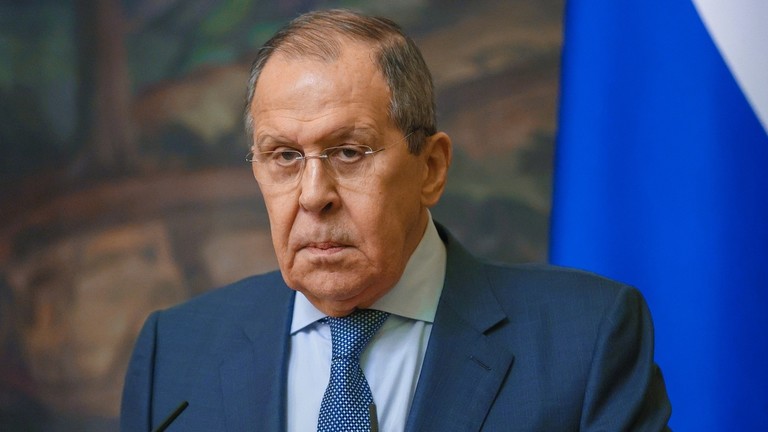
Russian Foreign Minister Sergey Lavrov, April 22, 2022
Samizdat | April 26, 2022
There is a belief in Moscow that Washington, London and other Western capitals – not Kiev – are the real decision-makers when it comes to Ukraine, Foreign Minister Sergey Lavrov said in an interview on Monday. He said that Kiev’s negotiators backtracked on the tentative understanding reached last month in Istanbul on advice from the US and the UK.
Ukrainian and Russian negotiators met face-to-face in Turkey at the end of March. Russia then took Ukraine’s outline, put it together in a “contractual” format and sent it to Kiev, only to get back “radically different” ideas in what was a “huge step back,” Lavrov said in the interview with the ‘Great Game,’ a political show on Russia’s Channel One.
“We know for sure that neither the US nor the UK – which is trying in every possible way to compensate for its current lonely status after leaving the EU – advised [Ukrainian President Volodymyr] Zelensky to speed up the negotiations, but to harden his position each time,” Lavrov said. The backtracking after Istanbul, he added, “was taken on the advice of our American or British colleagues. Maybe the Poles and the Balts played some role here.”
Meanwhile, Western leaders – such as the British PM Boris Johnson and EU foreign minister Josep Borrell – make statements to the effect that Russia “must be defeated” and that the conflict needs to be resolved “on the field of battle,” while sending weapons to Kiev, Lavrov pointed out.
“These weapons will be a legitimate target for the Russian Armed Forces,” the foreign minister said. “Warehouses, including in the west of Ukraine, have become such a target more than once. How else? NATO is essentially going to war with Russia through a proxy and arming that proxy. In war, as in war.”
While “casting spells” against a Third World War, the West is fueling the conflict with weapons and hoping to have the “fight Russia to the last man” in order to bleed Moscow, Lavrov said.
“You know, goodwill is not unlimited,” he added. “If it is not reciprocated, then this does not contribute to the negotiation process. As before, many of us are convinced – as I have already mentioned – that the real position of Ukraine is determined in Washington, London and other Western capitals,” he said, noting that some political scientists have said that talks should be held with NATO, and not Zelensky.
However, Lavrov also pointed out that Russia has not had much luck talking to NATO directly. When Moscow presented its security proposals to the US and NATO in December 2021, they were politely heard and then ignored.
“Rather impolitely, they made it clear that what was needed for our security was not up to us to decide,” Lavrov said.
The objectives of the “special military operation” announced by Russian President Vladimir Putin on February 24 have not changed, Lavrov said: the destruction of military infrastructure in Ukraine that threatened Russia, with “the strictest measures in order to minimize any damage to the civilian population.”
Lavrov also offered a prediction how the conflict would end. “As in any situation where armed forces are used, everything will end with a treaty,” he said. “But its parameters will be determined by the stage of hostilities at which this treaty becomes a reality.”
Russia attacked the neighboring state in late February, following Ukraine’s failure to implement the terms of the Minsk agreements, first signed in 2014, and Moscow’s eventual recognition of the Donbass republics of Donetsk and Lugansk. The German and French brokered Minsk Protocol was designed to give the breakaway regions special status within the Ukrainian state.
The Kremlin has since demanded that Ukraine officially declare itself a neutral country that will never join the US-led NATO military bloc. Kiev insists the Russian offensive was completely unprovoked and has denied claims it was planning to retake the two republics by force.
Former US-NATO commander wants to put troops on the ground in Ukraine
By Kelley Beaucar Vlahos | Responsible Statecraft | April 25, 2022
Former NATO top commander Gen. Philip Breedlove is the latest big name to come out for putting troops on the ground in Ukraine. Breedlove, who has been angling for weeks for a more muscular policy against Russia, told The Times of London that it’s time for real action. And he may have the ear of the White House: the article says he’s named as one of “several high-ranking retired commanders advising the Biden administration on Ukraine.”
“So what could the West do? Well, right now there are no Russian troops west of the Dnieper River. So why don’t we put Nato troops into western Ukraine to carry out humanitarian missions and to set up a forward arms supply base?”
Of course it wouldn’t stop there. Most likely Russia will react aggressively, if not explosively, since setting up “a forward arms supply base” would be fully entering this war on the side of Ukraine. NATO would be a co-belligerent in every way, with its 40,000 troops now stationed on alliance’s eastern front considered future enemy combatants. At the end of April, the Pentagon mobilized some 14,000 troops, along with F-35 strike fighters and Apache helicopters to Poland, Hungary, and the Baltics. A total of 100,000 U.S. troops now spread across Europe would no doubt be on some level of alert if NATO entered the fray.
Breedlove, who served as NATO’s Supreme Allied Commander from 2013 to 2016, said this move was essential for the protection of Odesa, a strategic Ukrainian port city on the Black Sea.
“If Odesa falls, Ukraine will become a land-locked country with no access to the Black Sea. The impact on Ukraine’s GDP would be huge. It would be ruinous for the economy,” he told the Times.
“The West is saying it is providing everything Ukraine needs to defend against the Russians. But the people of Mariupol had to fight without Stingers [anti-aircraft missiles]. That was a failure by the West.”
He added: “Now we need to make sure that the Ukrainians win the battle for Odesa.”
Earlier this month, Breedlove was complaining that the West’s fears of nuclear war were working in Putin’s favor.
“We have been so worried about nuclear weapons and World War III that we have allowed ourselves to be fully deterred. And [Putin], frankly, is completely undeterred. He has switched into the most horrific war against the citizens of Ukraine, it is beyond criminal at this point.”
U.S. weakness on this score bleeds over to our relations with Iran, North Korea, and China, he asserts:
“The message we’re sending to the entire world is if you get a nuclear weapon, you’re going to have a certain reaction from the West and certainly from the United States…[that’s all]. And I don’t think that’s the message we want to send them.”
Of course, a month before this Breedlove said he was “not advocating a war” when asked about what appeared to be his support for a “humanitarian no fly zone.” Today, advocating NATO involvement directly in Ukraine would be a giant leap beyond that, and who knows what kind of opening for others coming down with similar war fever in Washington. Last week, Delaware Sen. Chris Coons was forced to walk back comments he made that suggested he too, was in favor of putting troops on the ground against Russia.
Russia says it destroyed weapons delivered by US and EU to Ukraine
Samizdat | April 23, 2022
Russian forces have destroyed a logistics terminal in Odessa that held a large batch of foreign weapons, Moscow said on Saturday amid its ongoing military offensive in Ukraine. However, the city’s authorities claimed that its air defense group destroyed two missiles but that another four hit a military target and residential buildings, leading to victims. It was not immediately clear if the civilian buildings were hit as a result of attempts by Ukrainian forces to strike down the missiles initially aimed at a military target.
According to Russian military spokesman Major General Igor Konashenkov, in the afternoon, “high-precision long-range air-launched missiles” hit a logistics terminal located on a military airfield near Odessa, where “a large batch of foreign weapons received from the United States and European countries was stored.”
Russia has repeatedly warned NATO against sending arms to Ukraine and stated that it would consider arms convoys to be legitimate military targets.
Odessa regional emergency services earlier said that “as a result of an enemy shelling,” a sixteen-story residential building caught fire, which was put out in about two and a half hours.
“At this point it is known that 6 people died, including one child, and 18 people were injured. Two people were rescued from the rubble, 86 people were evacuated,” the authorities said in a statement.
Ukrainian President Volodymyr Zelensky, speaking later at a press conference in Kiev, elaborated on these claims.
“At this very moment eight people have died. Eighteen or twenty have been injured. A three-month old child died. A three-month old child was killed. When the war started, this child was just one month old. Can you imagine this?” Zelensky said.
According to the press office of Ukraine’s South Air Command, on Saturday the air defense group destroyed two cruise missiles, allegedly launched by Russian TU-95 strategic aircraft from the Caspian Sea, and two operational-tactical level UAVs, which “presumably corrected the flight of cruise missiles and placed active obstacles to air defenses.”
“Unfortunately, 2 missiles hit a military facility and 2 {hit} residential buildings,” the Ukrainian military claimed.
Sending heavy weapons to Ukraine in German interests?

By Lucas Leiroz | April 22, 2022
Political polarization in Germany continues to increase. Currently, there is strong pressure for German Chancellor Olaf Scholz to take a more incisive stance on the Ukrainian issue. The opposition insists on the need to send weapons to support Zelensky, endorsing the speech spread by NATO and the EU. It is evident that by refusing to take such positions, Scholz is trying to look for the interests of his country, but it remains to be seen whether he will be really strong enough to deal with the pressure coming both externally, from Brussels and London, and internally in Berlin.
Recently, Scholz met in London with his British counterpart Boris Johnson to discuss the Ukrainian conflict. During the conversation, Johnson clearly pressed Scholz to go along with the UK and the rest of the West in their stance of absolute opposition to Russia in the conflict. The Chancellor, however, avoided giving clear answers and maintained his ambiguous position on the possibility of supporting Kiev militarily, preventing from doing more incisive statements and preferring silence.
What happened next was even more remarkable and symbolic: the British prime minister traveled to Kiev to meet with Zelensky while Scholz returned to Germany in order to promote electoral campaign. The international mainstream media took advantage of the fact to intensify its pro-NATO propaganda, claiming that Scholz is concerned only with his internal political condition, ignoring the current international situation, while the Western world is supposedly “concerned” and takes the Ukrainian issue as a “humanitarian” priority.
In Germany, Scholz’s opponents are also increasingly agitated to criticize the chancellor, taking benefit of international pressure to intensify polarization and generate a crisis of legitimacy against him. Obviously, this was a predictable attitude on the part of opposition groups, but the main problem currently is that Scholz is losing support within his own coalition. The Free Democratic Party (FDP) and the Green Party are deeply dissatisfied with Germany’s unwillingness to send weapons to Kiev and use the case as a pretext to point to Scholz as a “big problem” to be solved through an electoral overthrow. And, in this sense, his situation is really worsening day after day.
In general, Scholz’s enemies demand that he takes a more active stance on the German role in the conflict. The chancellor is characterized by an extremely passive posture, avoiding making decisions until they become inevitable. Marie-Agnes Strack-Zimmermann, a member of the FDP and head of the Defense Committee in parliament, for example, recently commented that Scholz needs to “take the baton in his hand and set the rhythm.” In other words, opponents are asking Scholz to guarantee Germany a leading role on the European stage, as might be expected from the continent’s greatest economic power.
The central problem in this topic is that Scholz already seems to have realized that the most strategic thing for Germany is to remain as neutral as possible and away from any involvement in activities that harm the partnership with Russia, which is a very important commercial pillar for Germany. Scholz did not want to adhere to large-scale economic sanctions, especially regarding the SWIFT ban and the energy boycott. But he was forced to slowly accept such measures as other Western countries implemented them. This has been his typical behavior: postponing but, in the end, passively adhering to all Western measures when he finds himself “isolated”.
In this sense, the opposition is right on one point: Scholz has to change his attitudes and assume a leadership position, since this is what is expected from a country like Germany, which for years has consolidated itself as one of the “leaders” of the European bloc. The oppositionists’ problem is that they are pressuring Scholz to assume a leadership stance that is as damaging to German interests as his current indecision and passivity.
It is naive to think that sending heavy weapons to Ukraine benefits German interests in any way. On the contrary, it only extends the abyss between Moscow and Berlin even further, and with practically no benefit in return for the Germans: neither Ukraine will be sufficiently strengthened to win the conflict by receiving such heavy weaponry, nor will Germany reassume a supposed role of “leadership” in Europe.
It is not by chance that the greatest pressure on the Germans so far has been exerted precisely by Boris Johnson. The UK is not part of the EU and therefore does not care about the German role in the bloc, but, on the other hand, it is one of the most important members of NATO and tries to elevate its status in the military alliance as a way of boosting its international image in this post-Brexit context. In fulfilling British requests, Scholz would only be pursuing non-German and non-European interests.
It is obvious that there is also pressure within Europe and within Germany itself, but this pressure belongs to an outdated view of what the role of Germans and Europeans in the Western world should be. Scholz’s opponents apparently still expect a totally submissive stance on NATO from Berlin. This is also a very active thought in Brussels, with a strong tendency to see the entire European continent as a mere annex of the American military umbrella, ignoring that Europe has its own interests, which can often collide with those of the Western military alliance. That is why, in trying to prevent Germany from getting actively involved in the Ukrainian case, Scholz proves to be a really pragmatic politician who prioritizes the interests of his own country, but without the political force necessary to guarantee them.
In addition, there is a topic that needs to be mentioned, which is the German military passiveness of the last seventy years. Although it is active within NATO and has been trying to reform its defense forces in recent years, Berlin remains a virtual-demilitarized country, with an army of low offensive potential, outdated weaponry and a low-investment war industry.
In order to send heavy weapons to Ukraine, Germany would have to start a broad military industrial investment, which would cost it not only millions of euros, but a change in its international image, returning to being a nation of effective participation in international conflicts. Of course, improving its military status is a German right, but it must be taken into account in the name of what Berlin intends to do so. Would it really be strategic to break with seventy years of pacifism to defend the interests of the Maidan Junta in a conflict where Russian victory is highly predictable?
Scholz needs to be strong and active in defending German interests. His posture of passivity and silence demonstrates weakness and damages the image of both him and his country. But his stance must not be to subject Germany even more to foreign interests: on the contrary, he must assert what is in Berlin’s interests and pragmatically defend it, even if he has to clash with the NATO’s plans to do so. If Germany is interested in neutrality and maintaining good relations with Russia, Scholz must not only refrain from adhering to the new Western sanctions but also revoke those taken so far.
Lucas Leiroz is a researcher in Social Sciences at the Rural Federal University of Rio de Janeiro and a geopolitical consultant.
NATO seeks to punish Belgrade’s Ukraine War policy by arming Kosovo
By Paul Antonopoulos | April 21, 2022
After supplying equipment and emboldening a militarized Ukraine, Britain has now started arming Kosovo’s Albanians with Javelin and NLAW anti-tank missile systems. The British Embassy in Belgrade said that some Serbian media published fabricated claims of arms exports from the United Kingdom to Kosovo and claimed that there was no truth to those allegations. However, Serbian Minister of the Interior Aleksandar Vulin insists that the UK did transfer weapons to Kosovo, stating: “You are creating an army, arming them, giving them armored vehicles, anti-tank systems, drones, conducting training, we hear that you are sending them to trial courses in Turkey and Albania,” adding that the integration of Kosovo into NATO is only intended to “provoke Serbia.”
London seemingly wants to use the situation in Ukraine to increase pressure on the Serbs over the issues in Kosovo and Bosnia & Herzegovina (BiH). Before the Russian military operation commenced in Ukraine, Britain was already heavily involved in security issues in the Balkans. It is recalled that Boris Johnson warned of an extremely dangerous situation in the Balkans as early as December last year and appointed Air Marshal Sir Stuart Peach as the Prime Minister’s Special Envoy to the Western Balkans.
Following Brexit, the UK did everything it could to keep its presence in Europe, including in the Western Balkans where the roots of conflict already exist and threaten to boilover. The UK advocated for the maximum strengthening of Operation Althea (formally the European Union Force Bosnia and Herzegovina), the strengthening of the NATO contingent in the country, and even coordinated the unilateral arrival of British contingents and forces on the territory of BiH.
Such British (and NATO) militarization awakens anxieties and counters the security of both Serbia and the Balkans, with the violent wars of the 1990’s still fresh in the memory. The UK will likely continue to deliver equipment to the Balkans and also encourage other NATO members to strengthen anti-Serbian militaries in the region.
This comes as Montenegro seems synchronised in terms of Russophobia and pointing to Serbia as a disruptive factor in the region. This is ironic when considering Montenegro has no independence itself and follows the interests of the UK and US instead. Albania is also another key to Anglo designs over the Balkans, especially as they enthusiastically express their willingness to take practical steps to strengthen NATO forces in the Balkans.
The Western arming of Kosovo, bolstering of BiH, and encouragement for Montenegro and Albania to militarize is a warning to Serbia that it should not be so close to Russia, especially in the context of the Ukraine War.
The fact that foreign instructors are arriving with military systems in Kosovo is not a novelty because they have so far trained Kosovo Albanian soldiers in special forces, support units, telecommunications, anti-armour, PVO systems and more. However, this is likely just elementary training and an incomplete process with a future aim of fully equipping Kosovo’s forces with much more powerful weapon systems.
London is making such a decision to arm Kosovo even though there is no complete consensus in NATO regarding the status of the territory, with Greece, Romania, Slovakia and Spain refusing to recognize its illegally declared independence from Serbia. Despite a consensus not being reached, London and Washington are working timelessly to assist Pristina and construct some kind of Kosovo Army.
In effect, the Anglo Alliance are further radicalising Kosovo’s Albanians and encouraging destabilisation in the Balkans. Instead of punishing Kosovo’s de facto Prime Minister Albin Kurti for banning Kosovo Serbs from voting, they reward him with weapons and further integration into NATO.
Lightweight anti-missile and Javelin anti-tank systems, most commonly mentioned as part of a Western “support” package for the Ukrainian Armed Forces against Russia, have become part of the arsenal of Kosovo’s so-called security forces. The acquisition was agreed at a meeting between Albin Kurti and Boris Johnson in February this year, and according to Serbia but denied by the UK, the first contingent of 50 systems was delivered in April.
At the same time, the European Parliament’s foreign affairs committee will hold a session to discuss a draft resolution that will invite Serbia to harmonise with EU decisions in foreign and security policy, including sanctions on Russia. A draft resolution proposed by EP rapporteur for Serbia, Vladimir Bilczyk, expressed regret over the fact that Serbia failed to comply with EU sanctions following Russia’s military operation in Ukraine and urged Serbian authorities to show “a real commitment to EU values.”
The draft resolution reminds Serbian authorities that progress in the dialogue on normalising relations with Kosovo will determine the pace of EU accession negotiations. The proposed text is to be adopted by the European Parliament at a plenary session this year.
In effect, the EU and the Anglo Alliance are working in tandem to move Serbia away from Russia. The EU provides the carrot of bloc membership while the Anglo Alliance provides the stick by arming, training and militarizing Kosovo’s Albanians against Serbia. Given that Serbia has already experienced the full horrors of NATO and could do little as Europe divided the Serbian people by establishing new countries and not allowing them to be in the borders of Serbia, it is unlikely that Belgrade will be intimidated into abandoning its long, tried and tested relationship with Moscow.
Paul Antonopoulos is an independent geopolitical analyst.
Featured Video

Death Spikes & Rising Cancer In Our Youth Explained
or go to
Aletho News Archives – Video-Images
From the Archives
Politicians lie
By Mazin Qumsiyeh | Popular Resistance | August 18, 2013
There is no way to say this truth nicely: Politicians lie. That includes Japanese, American, Egyptian, Israeli, and Palestinian politicians! Is there something more common sense than that? Yet, so many citizens around the world believe their own politicians or wistfully acknowledge lies but think it is part of the job needed to run things. They believe even when politicians contradict themselves blatantly. This phenomenon is rather remarkable. It is a dissonance and disconnect from reality that many seem oblivious to. It is very dangerous because it can lead to accepting rationales for going to war. These can be deadly wars that lead to millions of lives lost as happened in what was called World War 1 and WW2. Even when incredible and declassified evidence abound, politicians continue to lie and old mythologies refuse to die. Here are just a few of the countless lies told to us over the past few decades… continue
Blog Roll
 Aletho News
- From Unipolar Universalism to Multipolar Civilizational Distinctiveness
- RSF military group defects, joins Sudanese army: State media
- Ireland goalkeeper refuses to play ‘Israel’ as squad weighs boycott
- China pushes back against US on Cuba, Iran
- Ukrainian Soldiers, Potential Mercenaries: Have Gun, Will Travel!
- Burnham’s UN debut… A masterclass in British disinformation
- Iran flights continue despite US aviation sanctions
- Global Tipping Points Lead the World Into a State of Entropy
- The day-after at the White House: USA and Xi Jinping
- The Geopolitical Balance in the Red Sea: The UAE Being Displaced by New Players
- If Americans Knew
- Deconstructing Netanyahu’s pants-on-fire UN rant – Daily Update
- Trump betrayed voters with his campaign lies and prioritized a foreign country once he took office
- Netanyahu calls Israel’s war in Gaza ‘opposite of genocide’ in UN speech to near-empty hall
- Settler Kidnappings: Torture, Sexual Abuse and Terrorisation of Palestinian Abductees as Israel Deepens Annexation of West Bank
- Gaza winter nears as 162,000 tents become unusable, raising fears of humanitarian crisis
- Netanyahu says, “It’s the opposite of genocide”; UN says Gaza economy is world’s ‘most severe crisis on record’ – Daily Update
- Israel’s US-Backed Assault on Gaza Has Created the ‘World’s Most Severe Economic Crisis on Record’: UN
- ‘Protecting U.S. Citizens’… From Israel
- ‘This is where I live now, the back of a truck’: a day in the life of a grandmother in Gaza
- In UN Speech, Iran’s President Displays Pictures of Children Killed by US, Brings Attention to Israel’s Nuclear Arsenal
- No Tricks Zone
- New Study: Earth And Venus Surface Warmth Largely Explained By Convection And Lapse Rate, Not CO2 Or Radiation
- 2025 Nature Paper Claiming Worsening Global Drought Gets RETRACTED …Heavily Flawed
- New Study: ‘Global Drought Shows No Detectable Recent Acceleration Under Climate Warming’
- Economic Masterminds: German Socialists Suggest Taxing Productivity Gains Stemming From Using AI
- The South China Sea Has Not Been Cooperating With The Climate Change Narrative
- Energy Crisis: Germany Enters Heating Season With Historically Low Gas Reserve Fill Levels
- New Study: The Antarctic Ice Sheet Gained Mass From 2020-2024 Due To Staggering Snow And Ice Accumulation
- Study: Ocean Heating Rates From Thousands Of Years Ago ‘Dwarf’ Modern Ocean Heating Rates
- Climate Extremists Target, Attack Large-Scale Power Grid Infrastructure In Germany!
- New Study: Antarctic Ice Melt Has Contributed Less Than 1 Centimeter To Sea Level Rise In The Last 30 Years

