Eastern Ukraine: Look Beyond Mainstream Propaganda
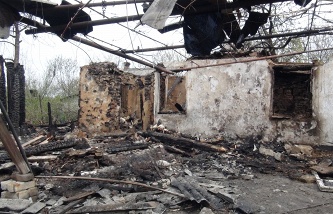
Captain Fifteen | June 17, 2015
It’s always interesting for me to observe the reaction of Americans and Western Europeans when they learn where I’m from. Many just don’t say anything. Many regurgitate something incoherent about Putin’s “imperial” ambitions, “the Boeing” that was shot down over Eastern Ukraine last year, and “that politician guy that got killed in Moscow.” Finally, there are those (unfortunately, a minority) who tell me that things must be more complicated than they are portrayed in the news and genuinely want to know what I think.
Things are definitely much more complicated than they’re portrayed in the news. I’ve had a chance to observe mainstream American, Canadian, and British media for quite some time now, and I’m amazed that so few people are appalled by the crudeness of propaganda that is fed to them, no matter whether the source is Fox News, CNN, or the BBC. Just like that Wal-Mart truck driver that stopped to help a stranded motorist doesn’t make Wal-Mart a great place to shop, the Pentagon Papers don’t make The New York Times a progressive newspaper. Neither does covering the Snowden case make The Guardian a source you should now trust and worship.
When I can hear explosions in the background in the middle of a phone conversation with my relatives who are hunkering down with their young children in the hallway of their apartment (“safe” because it’s away from the windows) while being shelled by Ukrainian artillery, and the “progressive” sources mentioned above pontificate about Russia’s “aggression” in Ukraine, call for more sanctions, and do not say a word about the massive devastation and suffering the US- and Europe-backed regime in Kiev has caused in just one year in one of the most urbanized parts of Europe, I feel disappointment and helplessness. Do these talking heads have no shame? Do those who listen to them have no brain? Opportunities to question, explore, and learn are all around you. Why not use them?
How many of you know that the cities of Donetsk (once home to over one million people) and Gorlovka (Horlivka; once home to more than 300 thousand people) have been shelled by the Ukrainian military pretty much daily throughout the month of May and in the first half of June – despite the so-called ceasefire?
How many of you know that American soldiers are actually in Ukraine training the Ukrainian National Guard – the troops that are then deployed to the East of the country? (Do a quick search, and even your “trustworthy” mainstream sources will confirm that – in a non-intrusive sort of way, of course.)
How many of you remember the context of Victoria Nuland’s “Fuck the EU” comment in her conversation with the US ambassador to Ukraine Geoffrey Pyatt?
How many of you know that John Brennan, director of the CIA, visited Ukraine in April of last year, immediately after which Ukraine’s “counter-terrorist operation” began in the rebellious East of the country? (Do another quick search, and your “trustworthy” mainstream sources will again confirm that – also in a non-intrusive sort of way.)
How many of you can imagine Russia putting its navy ships in the Gulf of Mexico, installing an anti-American regime in Canada, and holding military exercises just south of the US-Mexican border? How many of you can imagine what the American reaction to that would be? How ridiculous would the EU look if it imposed sanctions on the US? (Well, the EU looks just as ridiculous with all its current posturing and double standards.)
How many of you can imagine US and European sanctions against Saudi Arabia for its actions in Yemen? How many of your “trustworthy” sources use the word “aggression” when describing Saudi Arabia’s actions?
It took crash investigators a few days to learn what was going on in and around the cockpit of Germanwings Flight 9525, which crashed over the Alps less than three months ago. How many of you wonder what ever happened to the black boxes of the Malasia Airlines Flight 17 now that almost a year has passed since the plane was shot down over Ukraine? (It seemed so clear whom to blame back then, didn’t it?)
You most definitely heard about “that politician guy that got killed in Moscow.” How many of you know about a whole number of “politician guys” that have “committed suicide” in Ukraine? Other than stumbling on an occasional blurb, you’d really have to look to see what’s going on.
How many of you know about Oles Buzina, a pro-Russian journalist, who got murdered in Kiev just two months ago?
Finally, have you ever wondered who actually benefits from this war in Ukraine? Do you really think it’s Russia, now stuck with hundreds of thousands of refugees from Ukraine, a rabidly russophobic regime next door, and NATO bristling with all its fancy glory literally on Russia’s borders? Is it the “separatists” (or Ukrainians alike), whose most industrialized region is now in ruins? Or is there perhaps another party that’s meddling in all this? Use your imagination. May curiosity be your friend.
Both Major U.S. Parties are Plagues on Humanity
By Glen Ford | Black Agenda Report | July 1, 2015
There has never been a dime’s worth of difference between the Clintons (Bill and Hillary) and Barack Obama, and less than ten cents separates the worldviews of these Democratic political twins from the Bush wing of the Republican Party.
 Each has their individual quirks. Barack destroys international order and the rule of law while dabbling at song; Bill dismantled the U.S. manufacturing base and threw record numbers of Blacks in prison as he toyed with his trumpet; George W. played the fool who would Shock and Awe the world into obedience; and Hillary is the evil crone that curses the dead while screaming “We are Woman” like a banshee. But they are all the same in their corporate soullessness.
They all lie for a living, and they live to lie. Hillary Clinton commingled official and personal criminality through the medium of email. Knowing that, in a life dedicated to crime, she could never successfully sequester her private and public conspiracies, Hillary privatized all of her email correspondence during her tenure as Obama’s Secretary of State (in the perfect spirit of neoliberalism). The fate of millions of Haitians whose country’s earthquake and development “aid” are under the Clinton family thumb were doubtless bundled into the tens of thousands of messages she erased on leaving Foggy Bottom.
Republicans have harassed her ever since, seeking an electronic smoking gun to show Clinton’s cowardice or lack of resolve to “stand up for America” and “our troops” or some other nonsense. What the Benghazi affair actually proves is that the Obama administration was just as intent as the Republicans to maintain the fiction that the “rebels” put in power by seven months of NATO bombing of Libya were not various flavors of Islamic jihadists – some of whom were already turning on their erstwhile masters. The U.S.-Saudi project to create and nurture the international jihadist network is a bipartisan venture that dates back to Jimmy Carter’s presidency – and, therefore, nothing for Democrats and Republicans to fight about. However, the GOP’s churning of Clinton’s emails does provide a glimpse into her quest to run for president in 2016 as the woman who vanquished Muammar Gaddafi (“Qaddafi” or simply “Q” in Clinton’s usage).
A number of Clinton’s correspondences were with Sidney Blumenthal, a former Clinton family spin-master who wrote nasty things about Barack Obama while working for Hillary’s 2008 presidential campaign – which made it impossible for her to hire him at the State Department. Nevertheless, Clinton needed his talents for hype for the campaign ahead. Their emails in the summer of 2011 discussed how Hillary’s status as stateswoman could soar when the Libyan leader was finally eliminated. “This is a historic moment and you will be credited for realizing it,” wrote Blumenthal, feeding the crone’s huge gizzard of ego, according to an article in Monday’s New York Times. “You must go on camera,” wrote Blumenthal. “You must establish yourself in the historical record at this moment.” Hillary was anxious to seize the time to establish what Blumenthal described as “the Clinton Doctrine.”
The Times piece somehow concludes that Obama stole Clinton’s thunder with an 1,100-word speech, in late August, declaring: “The Gaddafi regime is coming to an end, and the future of Libya is in the hands of its people.” But Hillary best expressed the ghoulishness of America’s ruling duopoly two months later, in October, when Gaddafi was savagely butchered by screaming jihadists. “We came, we saw, he died,” cackled the banshee.
In the annals of global diplomacy, no more vulgar words have been spoken by a major power foreign minister or head of state. Yet, Clinton’s calculated quip perfectly encapsulates the bloodlust that is the common characteristic of both the governing duopoly of the United States and their suckling children in ISIS and the other proliferating al Qaida factions.
Thanks to Seymour Hersh, we now have a much more plausible scenario for the May 2, 2011, demise of Osama bin Laden, the “OG” of the U.S.-Saudi spawned global jihad, whose body will never be located. Virtually the entire U.S. account of his death is a lie, repeatedly contradicted on its own terms – another layer of fictional Americana in the age of empire in decline.
Clinton was hard-pressed to imagine how she might trump the president’s bin Laden death-watch extravaganza. Her opportunity came five months later, when she delivered her gruesome paraphrase of Julius Caesar on the occasion of Col. Gaddafi’s murder. In the context of Washington’s deeply racist foreign policy, Gaddafi and bin Laden were equally deserving of death, although Gaddafi was among the most fervent and effective fighters against Islamic jihadists: his government was the first in the world to request a global arrest warrant against bin Laden.
The Libyan Islamists were quickly transferred to the new U.S.-NATO-Saudi-Qatari front lines in Syria. The CIA station in Benghazi was at the center of the action – and got burned in the wild and unwieldy process of herding jihadists, who find it difficult to take orders from “infidels,” even when the “Crusaders” are paying the bills and supplying the weapons.
The U.S. consulate and CIA station in Benghazi were attacked on September 11, 2012. The next day, the Pentagon’s intelligence agency issued a report predicting that a “Salafist principality” – another term for an Islamic State – would likely arise in Syria as a result of the war, and that “Western countries, the Gulf States and Turkey are supporting these efforts.” Moreover, the establishment of such an Islamic “principality” would create “the ideal atmosphere for AQI [al Qaida in Iraq, which became ISIS, ISIL and the Islamic State] to return to its old pockets in Mosul and Ramadi” in Iraq – events that have since transpired.
The Defense Intelligence Agency report didn’t say so, but the “Western Powers” included the United States, through its CIA.
The document was declassified this year as the result of a suit by a libertarian right-wing legal outfit. The people of the world continue to be fed the fiction that the U.S. is engaged in a long, twilight struggle against al Qaida Salafists whose international network was created by, and continues to benefit from, “Western countries, the Gulf States and Turkey.”
However, the 2012 Pentagon warning about the rise of an Islamic State may have had some effect on U.S. policy in Syria. One year later, in September of 2013, President Obama backed off from his threat to bomb Syria in “retaliation” for a chemical missile attack against civilians – a crime much more likely committed by western-backed Salafists. The conventional wisdom is that the Russians tricked a hapless Secretary of State John Kerry into agreeing to the peaceful, internationally supervised destruction of Syria’s chemical arsenal; or that the refusal of Britain’s Parliament to go along with an air assault on Syria made the U.S. position untenable; or that Obama feared losing a vote on the issue in the U.S. Congress. None of this rings true to me. The United States is not easily deterred by the opinions of Europeans, who in the end accept Washington’s acts as a fait accompli. And, it was not clear that Obama would have lost the vote in Congress – a vote that he requested, while at the same time declaring that he did not need the legislature’s permission to “punish” Syria for crossing his “red line.”
I think that high Pentagon officials and elements of the Obama administration – probably including the president, himself – took the Benghazi disaster and the Defense Intelligence Agency report to heart, and decided that it was better to keep bleeding the Syrians and their Russian, Lebanese and Iranian allies through a prolonged war, than to bomb al Qaida into power. For the U.S., regional chaos is preferable to the triumph of the, ultimately, unmanageable Salafists – unchained.
The thirty-plus year war against Iran would, however, be ratcheted up. The Bush administration was snatched back from the brink of a military assault against Teheran in 2007 when – to the great consternation of Vice President Dick Cheney – all 16 U.S. intelligence agencies declared, publicly and unanimously, that Iran had abandoned its nuclear weapons program, years before.
The spooks reaffirmed their consensus in the 2010 National Intelligence Estimate – again, that there was no evidence Iran has any intention of making a bomb. The Obama administration has since avoided asking the intelligence agencies for their analysis on the issue, knowing they would get the same answer. Instead, they rely on Israeli propaganda, pick and choose various “experts” from inside and outside the arms control “community,” or simply put forward unsupported statements on Iran’s capabilities and intentions: the Big Lie. While Bush was humiliated by facts supplied by his own intelligence experts, Obama has escalated the confrontation with Iran, applying crippling sanctions and the whole range of low-level warfare, in close collaboration with Israel – proving, once again, that Obama is the “more effective evil.”
Obama has nearly completed knocking off victims on the “hit list” of countries that George Bush was working on when General Wesley Clark ran across it in 2002. Iraq, Syria, Libya, and Somalia have been invaded since then, and Sudan was stripped of a third of its territory. Only Iran and Lebanon remain intact and outside the U.S. imperial umbrella.
The Republican-Democratic duopoly plays tag-team in promoting the Project for a New American Century – a doctrine promulgated by neo-conservatives in 1997 that has served as the guiding light of both the Bush and Obama administrations. The differences between the two teams are merely rhetorical. The Bush regime is described as “unilateralist,” although it employed the same “Coalition of the Willing” approach to aggressive war as does the Obama administration. President Obama claims the right to disregard and methodically undermine international law through “humanitarian” military intervention, whereas Bush claimed to be “spreading democracy.” Same weapons systems, same mass murder, same objective: U.S. domination of the planet.
There’s nothing democratic or humanitarian about the U.S. imperial project. Therefore, its maintenance requires the deployment of 24-7 psychological operations worldwide, but directed primarily against the U.S. public.
Republican strategist Karl Rove was far more honest than his Democratic counterparts when he explained to a reporter, back in 2004:
We’re an empire now, and when we act, we create our own reality. And while you’re studying that reality—judiciously, as you will—we’ll act again, creating other new realities, which you can study too, and that’s how things will sort out. We’re history’s actors … and you, all of you, will be left to just study what we do.
Election seasons are reality-creation festivals, during which the two corporate parties pretend to put forward different visions of the national and global destiny – when, in fact, they answer to the same master and must pursue the same general strategy.
The continuity of GOP-Democratic rule – the near-identical depravity – is horrifically evident in the Democratic Republic of Congo, where six million people have been slaughtered by U.S. surrogates since 1996: the largest genocide since World War II. Successive U.S. administrations – Bill Clinton, George W. Bush, and Barack Obama, assisted by Secretary of State Hillary Clinton and Susan Rice, the high U.S. official most deeply implicated in the entirety of the genocide – have armed, financed, and covered up the Congolese holocaust. Each administration has collaborated with its predecessor to hide the crime and obscure the question of guilt – and then to continue the killing.
Decent people do not vote for political parties that produce such fiends, who deserve Nuremburg justice of the capital kind. Any talk of “lesser evils” is both stupid and obscene.
BAR executive editor Glen Ford can be contacted at Glen.Ford@BlackAgendaReport.com.
After 15 Years of Killing Journalists Pentagon Writes It Into Manual
Having liberally assassinated journalists in Yugoslavia, Iraq and Libya Pentagon has done the logical next step and openly wrote the practice into its code of conduct
By Marko Marjanović | Russia Insider | June 26, 2015
Four weeks into NATO’s 1999 bombing of Yugoslavia American bombs slammed into Belgrade’s main television station massacring 16 employees of Serbia’s state television broadcaster (RTS).
All killed were civilians but these were the 1990s. Sloban Milošević was “Adolph Hitler” and Serbs were “his willing executioners”.* Serbian civilian deaths didn’t matter. Thus BOOM! Program director dead, security guard dead, electrician dead, cameraman dead, sound technician dead, make up lady dead…
Tony Blair and a host of NATO spokespeople appeared before cameras to explain these people deserved to die – they were part of Milošević’s “machinery of hate”. No bombs hit them in turn.
RTS had been covering Serbia’s civilian deaths caused by NATO but this wasn’t the reason it was hit – as said nobody really cared and besides RTS had been taken off satellite by NATO and could no longer broadcast beyond Yugoslavia. However, NATO’s strategy in the war had been to make the life of Serbian civilians so miserable they would beg Milošević to capitulate – and RTS’ mix of airing patriotic music videos and reports of NATO carnage was doing a decent job of propping up Serb morale and resolve.
RTS was interfering with NATO’s strategy – it was giving the Serbian populace a measure of comfort and strength – this made it a top target of those who needed it broken.

Stretchering a victim of RTS bombing, April 23, 1999
Next stop Iraq. April 8th 2003 American tanks finally smashed into downtown Baghdad – Iraq had been conquered. Americans marked the occasion by opening fire on journalists in three separate locations in the city.
Offices of Qatar’s Al-Jazeera were hit by an air strike. Offices of United Arab Emirates Abu Dhabi satellite channel likewise. Finally a US tank fired into the Palestine Hotel – Bagdad’s more well-known hotel and a well-known base for foreign journalists. In all Americans’ attacks on journalists that day killed three and wounded four.
This was just the beginning. Iraq became a veritable killing ground for journalists including due to attacks by American occupiers. In the first two years of the occupation alone 13 journalists are known to have been killed by American fire.
Most famously in 2007 a US helicopter crew deliberately gunned down two Iraqi reporters for Reuters along with a dozen other civilians – this was the so called “collateral murder” incident later brought to light and made famous by WikiLeaks.
Throughout the Iraq occupation US bitterly complained about reporting done by Al-Jazeera and Al-Arabiyah. It accused them of inflaming the Arab street against the US and helping to fuel the Sunni resistance in Iraq.
The two were repeatedly banned from reporting from Iraq by the US-installed government in Baghdad. Likewise in 2004 the US launched the Al-Hurra Arab-language satellite channel to try to rival the two.
Finally, during the 2011 NATO bombing of Libya the alliance repeated its performance during the bombing of Yugoslavia and deliberately took out a Libyan TV compound slaying three journalists.
It may be the case that US military has only now produced a “law of war manual” explaining its policy of killing journalists, but it is the case it has been at it for at least 15 years.
The thing to understand is that Pentagon has convinced itself that media has dealt it its greatest defeat in history – the hugely traumatic loss in the Vietnam War. In Pentagon’s retelling of the Vietnam debacle journalists delivered a fatal stab in the back of a war effort that was on the cusp of turning things around.
The problem according to US military wasn’t so much US atrocities and real strategic setbacks, but the fact the knowledge of these was spread by journalists to the people at home.

Vietnam – the high tide of American war reporting
That is to say the main lesson Pentagon drew from the Vietnam War was the need to control information coming out from the war zone. Military thinkers spent the next two decades thinking about the ways to accomplish this and eventually perfected it into an art form.
Thus the highly managed and highly favorable coverage of US military invasion of Iraq – served up by embeded journalists assigned to this or that unit of the US military. But if embedding journalists showed to just what degree they may be tamed it also served to highlight how unfriendly and dangerous (at least in the Pentagon’s imagination) the remaining independent journalists were by comparison.
In Pentagon’s thinking an independent journalist threatens its control of information coming out of the war zone and therefore threatens “the mission” – that above all is what really makes him a “legitimate” target.
The rest, the nonsense about “unprivileged belligerents” and what not – that’s just sophistry and mumbo jumbo to obscure the fact that US military – the armed force of the “land of the free and the home of the brave” believes in murdering civilian non-combatants.
* Serbs had been so thoroughly collectively demonized in the west that the neocon Charles Krauthammer could openly complain from the pages of Washington Post that the bombing wasn’t killing enough Serbian civilians and the liberal interventionist Thomas Friedman could call from the pages of The New York Times for Serbia to be bombed back into the Middle Ages and spark no mainstream outrage whatsoever. Link
‘Nonsense’: Norway PM lashes out at NATO spending goals
RT | June 29, 2015
The prime minister of Norway, Erna Solberg has described NATO’s defense spending plans as “nonsense.” The alliance wants members to spend two percent of their GDP on defense, but Oslo, one of the world’s richest countries, says it won’t meet the target.
“If I am allowed to speak, I think the percentage goal is nonsense,” she said in an interview with the Norwegian Armed Forces’ Forum Magazine, as cited by the Local. “The aim of the NATO countries must be the greatest possible defense capability, not a percentage goal in itself,” she added.
Solberg added that while meeting the two percent target may be easier for countries enjoying strong economic growth, it would be harder for those within the alliance whose economies are shrinking.
Norway’s Defense Minister Ine Eriksen Soreide said in April that for Oslo to spend 2 percent of its GDP on defense would be “very challenging” in the short term. The Scandinavian country has already said it will increase its spending this year, but this will only bring it to around 1.6 percent and short of the target that was set at the NATO summit in Cardiff, the United Kingdom, last year.
NATO’s General Secretary Jens Stoltenberg, who was also Solberg’s predecessor as Norway’s PM, said that the country could easily meet the target.
“If there is a political will, there is economic space. But it must be given priority,” he said in a visit to Norway in June. “Compared with other major initiatives we have implemented in Norway, reaching two percent is quite possible.”
Aside from the United States, traditional NATO allies have found meeting the target a taxing affair. Germany allocates 1.2 percent of its GDP, the Netherlands 1.3 percent and Spain less than 1 percent. France is the only Western European country that is boosting defense spending. However, some Eastern European nations are increasing their military expenses citing what they call Russian aggression. Lithuania, for instance, wants to allocate twice as much on defense as it did last year.
READ MORE: NATO defense spending a ‘red line’ – US Air Force Secretary
Media Coverage of Europe’s Migrant Crisis Ignores Root Cause: NATO
Danielle Ryan | Russia Insider | June 23, 2015
The scale of the migrant crisis Europe is facing today cannot be understated. It is truly unprecedented. What is habitually understated, however — and in fact almost completely ignored by mainstream media — are the real roots of the crisis.
The debate around migration into the EU is happening nearly entirely without reference to the causes of the recent influx of migrants from North Africa and the Middle East. The elephant in the room is NATO and nobody really wants to talk about it.
Hundreds of articles, laden down with numbers and proposals and predictions fail to make any direct link between cause and effect. News anchors sit seemingly baffled, mouths agape, at the apocalyptic-like pictures they are seeing land on their desks, and yet few are willing to draw the appropriate conclusions. But it is such a basic and logical connection that it’s hard to believe it is not being made very loudly and very persistently.
Maybe it’s just that these journalists are so conditioned to framing U.S. and NATO policy in a positive light that the links don’t even really occur to them. Or maybe they’re simply embarrassed and trying to shift focus from their long-recorded support for various military interventions in these countries.
Either way, the result is that the story is framed in such a way that it makes the timing of the crisis sound almost random. We’re witnessing a conversation about how to ‘deal’ with boats full of Libyans making their way across the Mediterranean — as if Libya was a country that had just self-imploded yesterday, and for no discernible reason.
A fierce debate is raging over ‘what to do’ about these migrants — and in a way that’s understandable because that is the more immediate problem — but the debate we really need to be having is about the policies, NATO’s policies, which were the catalyst.
Even if Europe unites in formulating a ‘solution’ to the problem, it will be nothing more than a band-aid fix because it will only deal with symptom. After all, what’s the point in covering your open wound with a band-aid when the guy who cut you is still wielding a knife in the same room? It doesn’t take a genius to work out how that story ends.
Whenever the cause is grudgingly mentioned by the media, it is mentioned briefly and abstractly where the author or anchor might refer to “conflict” or make mention of how violence has “reignited” in these countries in recent years and months.
The editors at the New York Times in particular, are big fans of loading all the blame squarely onto Europe’s shoulders. Here a Times piece argues that the migrant crisis “puts Europe’s policy missteps into focus”. Another piece, from the editorial board, lectures Europe on how to handle the situation.
In April, NATO head Jens Stoltenberg called for a “comprehensive response” to the crisis and promised that NATO would help to stabilize the situation. The alliance’s role in “stabilizing” Afghanistan was part of its broader approach to the refugee crisis in the Mediterranean, he said.
That is rich coming from the head of a ‘security’ and ‘defensive’ alliance which for years has pursued a policy of offensive destabilization in the very regions which people are fleeing from in their hundreds of thousands. But Stoltenberg’s comments and NATO’s actions are easily decoded by the employment of some basic common sense.
The NATO modus operandi is clear. The pattern, repeated over and over, involves the complete destabilization of a region, to be swiftly followed up with another NATO-led ‘solution’ to the problem. When you couple that with the use of spokespeople who are unashamed to feign ignorance and lie blatantly (Jen Psaki, Marie Harf etc.), and a compliant media that will regurgitate the line without question, this is what you get.
The 2011 NATO intervention in Libya was authorized by the United Nations on “humanitarian” grounds and resulted in the deaths of between 50,000 and 100,000 people and the displacement of 2 million. Very humanitarian.
Similarly, after the U.S.-led campaign to destabilize Syria in an effort to topple Bashar al-Assad, facilitating (and even supporting) the rise of ISIS in the region, a staggering 10 million have been displaced (according to Amnesty International) and European countries are left to help pick up the pieces. Germany, for example, has pledged to resettle 30,000 Syrian refugees. Sweden, a non-NATO nation, has taken in similar numbers.
It should be made clear however, that the numbers European countries have taken or pledged to take pale in comparison to the numbers being hosted in other Middle Eastern countries. Lebanon, for example, is hosting 1.1 million Syrian refugees. Jordan is hosting more than 600,000. Iraq hosts nearly a quarter of a million. Turkey hosts 1.6 million.
There is one country that’s getting off scot-free in all of this — at least on the Syrian front. That country is the United States. The U.S. has taken in less than 900 Syrian refugees after four years of war. American officials have cited “national security” in their explanations for not yet taking more, although they have said they would like to see the number increase.

Maybe this has something to do with it?
Debate not allowed
There is a second media crime flying under the radar here and it is this: In European countries where the massive influx of migrants from the Middle East and North Africa have caused serious societal divisions, where migrants have failed to assimilate (for a variety of reasons, including both government policies and often radical religious beliefs), Western media will allow no one to talk about it honestly — and woe betide the person who tries.
Take Sweden, where the disease of political correctness is at an even more advanced stage than it is in the rest of Europe. There, any attempt to debate the coherence of a ‘doors wide open’ immigration policy is branded as “racist”. A further irony in the Swedish context, is that the country is facing a housing crisis and has nowhere to put most of the people they are pledging to resettle. There’s some real forward-thinking, common sense policy for you.
This is a dangerous combination for Europe: An unsustainable influx of migrants, foreign policy which ensures its continuation, a docile media, and an epidemic of political correctness which has infected the entire continent.
Media 101 on the migrant crisis: Talk a lot about migrants, don’t mention why they fled and then call anyone who has a problem with it a “racist” — success! Oh, and you get an added bonus if you can somehow link it all to ‘Russian aggression’, Vladimir Putin and NATO as a ‘defensive’ alliance.
Some European countries are taking a more hardline approach and are getting slammed for it. Hungary, for example, is looking at building a barrier wall along its border with Serbia, similar to barriers along the Greek-Turkish and Bulgarian-Turkish borders. Again, this has sparked accusations of xenophobia and racism from media and political quarters.
But that’s part of the game, isn’t it? If NATO’s war supporters can focus the debate around the idea that anyone who wants to address or critically assess immigration policy is “racist” then we won’t have to talk about why the migrants are here in the first place or why they are facing such dire circumstances at home.
Russia Today’s Oksana Boyko tried recently, to broach this topic with Peter Sutherland, the UN’s special representative on international migration and development, but she got nowhere. She argued that the debate around migration into the EU can’t really be had without addressing the essence and heart of the problem, but found that NATO policy is apparently a topic not up for discussion.
Debating Europe’s migrant crisis without acknowledging the context in which it has been created it useless. It would be like asking Americans to debate police brutality without talking about race. The two are inescapably interlinked and any ‘solutions’ that come from an incomplete debate will ultimately fail.
For now though, it seems Europe will continue to debate this humanitarian crisis in terms of ‘what to do’ without addressing the ‘how to stop’ and we’ll keep running around in a vicious circle.
An easier solution, of course, would be for NATO to put an end to its campaign of destabilization in the Middle East and North Africa, but that would require the acceptance and acknowledgement of some very hard truths.
Ukraine Masses Troops on Border With Transnistria
Sputnik – 28.06.2015
Ukraine continues to mass troops and heavy weapons on the border with Transnistria on the pretext that the self-proclaimed republic may launch a military campaign against Ukraine, Russian media reported on Saturday.
“It looks like the Kiev authorities want to picture themselves as encircled by enemies, ready to attack,” a representative of the Transnistrian KGB told Russia’s Zvezda TV channel.
“That we may have a war here tomorrow is hard to say, but we are not ruling out a Ukrainian provocation either… They could use for this purpose one of their many small private armies which refuse to take any orders from Kiev,” the official added.
On June 22, the deputy foreign minister of the Transnistrian Republic, Vitaly Ignatyev, said that Ukraine was moving its troops towards the borders of the self-proclaimed republic, sandwiched between Ukraine and Moldova.
“The situation here is very bad… Economic production is going down, foreign trade is shrinking, the security situation is equally alarming with our Moldovan partners holding military drills with NATO and the Ukrainian pressure mounting every day,” Ignatyev said.
He also mentioned the curbs Kiev has imposed on the transit of Transnistrian nationals and citizens of Russia, almost 200,000 of whom currently live in Transnistria.
“They haven’t been able to travel to Russia via Ukraine for more than a year now. They have to move across Moldova, but Chisinau is creating problems too, along with economic sanctions,” Ignatyev added.
The newly appointed governor of Ukraine’s Odessa region Mikheil Saakashvili earlier announced plans to reinforce Ukraine’s border with Transnistria.
“We have two major tasks — to reinforce the border and curb corruption. Drug and weapons trafficking across this border means nothing good,” Saakashvili told a news conference in Odessa.
He also blamed the Transnistrian authorities for destabilizing the situation in Ukraine.
NYT’s Orwellian View of Ukraine
By Robert Parry | Consortium News | June 22, 2015
In George Orwell’s 1984, the leaders of Oceania presented “Two Minutes Hate” in which the image of an enemy was put on display and loyal Oceanianians expressed their rage, all the better to prepare them for the country’s endless wars and their own surrender of freedom. And, now, in America, you have The New York Times.
Surely the Times is a bit more subtle than the powers-that-be in Orwell’s Oceania, but the point is the same. The “paper of record” decides who our rotating foreign enemy is and depicts its leader as a demon corrupting whatever he touches. The rest of us aren’t supposed to think for ourselves. We’re just supposed to hate.
As the Times has degenerated from a relatively decent newspaper into a fount of neocon propaganda, its editors also have descended into the practice of simply inventing a narrative of events that serves an ideological purpose, its own version of “Two Minutes Hate.” Like the leaders of Orwell’s Oceania, the Times has become increasingly heavy-handed in its propaganda.
Excluding alternate explanations of events, even if supported by solid evidence, the Times arrogantly creates its own reality and tells us who to hate.
In assessing the Times’s downward spiral into this unethical journalism, one could look back on its false reporting regarding Iraq, Iran, Syria or other Middle East hotspots. But now the Times is putting the lives of ourselves, our children and our grandchildren at risk with its reckless reporting on the Ukraine crisis – by setting up an unnecessary confrontation between nuclear-armed powers, the United States and Russia.
At the center of the Times’ propaganda on Ukraine has been its uncritical – indeed its anti-journalistic – embrace of the Ukrainians coup-makers in late 2013 and early 2014 as they collaborated with neo-Nazi militias to violently overthrow elected President Viktor Yanukovych and hurl Ukraine into a bloody civil war.
Rather than display journalistic professionalism, the Times’ propagandists ignored the evidence of a coup – including an intercepted phone call in which U.S. Assistant Secretary of State for European Affairs Victoria Nuland and U.S. Ambassador Geoffrey Pyatt discussed how to “mid-wife” the regime change and handpick the new leaders.
The Times even ignored a national security expert, Statfor founder George Friedman, when he termed the ouster of Ukraine’s elected president “the most blatant coup in history.” The Times just waved a magic wand and pronounced that there was no coup – and anyone who thought so must reside inside “the Russian propaganda bubble.”[See Consortiumnews.com’s “NYT Still Pretends No Coup in Ukraine.”]
Perhaps even more egregiously, the Times has pretended that there were no neo-Nazi militias spearheading the Feb. 22, 2014 coup and then leading the bloody “anti-terrorist operation” against ethnic Russians in the south and east who resisted the coup. The Times explained all this bloodshed as simply “Russian aggression.”
It didn’t even matter when the U.S. House of Representatives – of all groups – unanimously acknowledged the neo-Nazi problem when it prohibited U.S. collaboration in military training of Ukrainian Nazis. The Times simply expunged the vote from its “official history” of the crisis. [See Consortiumnews.com’s “US House Admits Nazi Role in Ukraine.”]
Orwell’s Putin
Yet, for an Orwellian “Two Minute Hate” to work properly, you need to have a villain whose face you can put on display. And, in the case of Ukraine – at least after Yanukovych was driven from the scene – that villain has been Russian President Vladimir Putin, who embodies all evil in the intense hatred sold to the American public.
So, when Putin presents a narrative of the Ukraine crisis, which notes the history of the U.S.-driven expansion of NATO up to Russia’s borders and the evidence of the U.S.-directed Ukrainian coup, the Times editors must dismiss it all as “mythology,” as they did in Monday’s editorial regarding Putin’s remarks to an international economic conference in St. Petersburg.
“President Vladimir Putin of Russia is not veering from the mythology he created to explain away the crisis over Ukraine,” the Times’ editors wrote. “It is one that wholly blames the West for provoking a new Cold War and insists that international sanctions have not grievously wounded his country’s flagging economy.”
Without acknowledging any Western guilt in the coup that overthrew the elected Ukrainian government in 2014, the Times’ editors simply reveled in the harm that the Obama administration and the European Union have inflicted on Russia’s economy for its support of the previously elected government and its continued backers in eastern and southern Ukraine.
For nearly a year and a half, the New York Times and other major U.S. news organizations have simply refused to acknowledge the reality of what happened in Ukraine. In the Western fantasy, the elected Yanukovych government simply disappeared and was replaced by a U.S.-backed regime that then treated any resistance to its rule as “terrorism.” The new regime even dispatched neo-Nazi militias to kill ethnic Russians and other Ukrainians who resisted and thus were deemed “terrorists.”
The upside-down narrative of what happened in Ukraine has become the conventional wisdom in Official Washington and has been imposed on America’s European allies as well. According to The New York Times’ Orwellian storyline, anyone who notes the reality of a U.S.-backed coup in Ukraine is engaging in “fantasy” and must be some kind of Putin pawn.
To the Times’ editors, all the justice is on their side, even as Ukraine’s new regime has deployed neo-Nazi militias to kill eastern Ukrainians who resisted the anti-Yanukovych coup. To the Times’ editors, the only possible reason to object to Ukraine’s new order is that the Russians must be bribing European dissidents to resist the U.S. version of events. The Times wrote:
The Europeans are indeed divided over the extent to which Russia, with its huge oil and gas resources, should be isolated, but Mr. Putin’s aggression so far has ensured their unity when it counts. In addition to extending existing sanctions, the allies have prepared a new round of sanctions that could be imposed if Russian-backed separatists seized more territory in Ukraine. …
Although Mr. Putin insisted on Friday that Russia had found the ‘inner strength’ to weather sanctions and a drop in oil prices, investment has slowed, capital has fled the country and the economy has been sliding into recession. Even the business forum was not all that it seemed: The heads of many Western companies stayed away for a second year.
An Orwellian World
In the up-is-down world that has become the New York Times’ editorial page, the Western coup-making on Russia’s border with the implicit threat of U.S. and NATO nuclear weapons within easy range of Moscow is transformed into a case of Russian aggression. The Times’ editors wrote: “One of the most alarming aspects of the crisis has been Mr. Putin’s willingness to brandish nuclear weapons.”
Though it would appear objectively that the United States was engaged in serious mischief-making on Russia’s border, the Times editors flip it around to make Russian military maneuvers – inside Russia – a sign of aggression against the West.
Given Mr. Putin’s aggressive behavior, including pouring troops and weapons into Kaliningrad, a Russian city located between NATO members Lithuania and Poland, the allies have begun taking their own military steps. In recent months, NATO approved a rapid-reaction force in case an ally needs to be defended. It also pre-positioned some weapons in front-line countries, is rotating troops there and is conducting many more exercises. There are also plans to store battle tanks and other heavy weapons in several Baltic and Eastern European countries.
If he is not careful, Mr. Putin may end up facing exactly what he has railed against — a NATO more firmly parked on Russia’s borders — not because the alliance wanted to go in that direction, but because Russian behavior left it little choice. That is neither in Russia’s interest, nor the West’s.
There is something truly 1984-ish about reading that kind of propagandistic writing in The New York Times and other Western publications. But it has become the pattern, not the exception.
The Words of the ‘Demon’
Though the Times and the rest of the Western media insist on demonizing Putin, we still should hear the Russian president’s version of events, as simply a matter of journalistic fairness. Here is how Putin explained the situation to American TV talk show host Charlie Rose on June 19:
Why did we arrive at the crisis in Ukraine? I am convinced that after the so-called bipolar system ceased to exist, after the Soviet Union was gone from the political map of the world, some of our partners in the West, including and primarily the United States, of course, were in a state of euphoria of sorts. Instead of developing good neighborly relations and partnerships, they began to develop the new geopolitical space that they thought was unoccupied. This, for instance, is what caused the North Atlantic bloc, NATO, to go east, along with many other developments.
I have been thinking a lot about why this is happening and eventually came to the conclusion that some of our partners [Putin’s way of describing Americans] seem to have gotten the illusion that the world order that was created after World War II, with such a global center as the Soviet Union, does not exist anymore, that a vacuum of sorts has developed that needs to be filled quickly.
I think such an approach is a mistake. This is how we got Iraq, and we know that even today there are people in the United States who think that mistakes were made in Iraq. Many admit that there were mistakes in Iraq, and nevertheless they repeat it all in Libya. Now they got to Ukraine. We did not bring about the crisis in Ukraine. There was no need to support, as I have said many times, the anti-state, anti-constitutional takeover that eventually led to a sharp resistance on the territory of Ukraine, to a civil war in fact.
Where do we go from here?” Putin asked. “Today we primarily need to comply with all the agreements reached in Minsk, the capital of Belarus. … At the same time, I would like to draw your attention and the attention of all our partners to the fact that we cannot do it unilaterally. We keep hearing the same thing, repeated like a mantra – that Russia should influence the southeast of Ukraine. We are. However, it is impossible to resolve the problem through our influence on the southeast alone.
There has to be influence on the current official authorities in Kiev, which is something we cannot do. This is a road our Western partners have to take – those in Europe and America. Let us work together. … We believe that to resolve the situation we need to implement the Minsk agreements, as I said. The elements of a political settlement are key here. There are several. […]
The first one is constitutional reform, and the Minsk agreements say clearly: to provide autonomy or, as they say decentralization of power, let it be decentralization. This is quite clear, our European partners, France and Germany have spelled it out and we are quite satisfied with it, just as the representatives of Donbass [eastern Ukraine where ethnic Russians who had supported Yanukovych have declared independence] are. This is one component.
The second thing that has to be done – the law passed earlier on the special status of these territories – Luhansk and Donetsk, the unrecognized republics, should be enacted. It was passed, but still not acted upon. This requires a resolution of the Supreme Rada – the Ukrainian Parliament – which is also covered in the Minsk agreements. Our friends in Kiev have formally complied with this decision, but simultaneously with the passing by the Rada of the resolution to enact the law they amended the law itself … which practically renders the action null and void. This is a mere manipulation, and they have to move from manipulations to real action.
The third thing is a law on amnesty. It is impossible to have a political dialogue with people who are threatened with criminal persecution. And finally, they need to pass a law on municipal elections on these territories and to have the elections themselves. All this is spelled out in the Minsk agreements, this is something I would like to draw your attention to, and all this should be done with the agreement of Donetsk and Luhansk.
Unfortunately, we still see no direct dialogue, only some signs of it, but too much time has passed after the Minsk agreements were signed. I repeat, it is important now to have a direct dialogue between Luhansk, Donetsk and Kiev – this is missing.
Also missing is any objective and professional explanation of this crisis in the mainstream American press. Instead, The New York Times and other major U.S. news organizations have continued with their pattern of 1984-ish propaganda.
~
Investigative reporter Robert Parry broke many of the Iran-Contra stories for The Associated Press and Newsweek in the 1980s. You can buy his latest book, America’s Stolen Narrative, either in print here or as an e-book (from Amazon and barnesandnoble.com).
NATO plans 40,000-strong rapid response force in E. Europe
RT | June 22, 2015
NATO’s rapid response Spearhead Force in Europe might reach 40,000 troops, a tenfold growth from the initial 4,000-strong force deployed last year, the military alliance’s chief said. Most of these troops will be stationed near Russian borders.
“NATO defense ministers … [will] make a decision to further increase the strength and capacity of the 13,000-strong NATO Response Force (NRF) to 30,000 or 40,000 troops,” Secretary-General Jens Stoltenberg said Monday.
The decision is to be officially announced during NATO’s defense ministers meeting on June 24-25 in Brussels.
The troops will be under the command of 6 HQs to be stationed in Bulgaria, Estonia, Latvia, Lithuania, Poland and Romania. The Spearhead Force will include Special Forces and rapid response teams, enforced with marine and air components.
A new rapid reaction force ready to be deployed within 48 hours was initially intended to consist of 4,000 troops.
The Spearhead Force has already held its first military drills codenamed Noble Jump in Poland. The war games became “the biggest reinforcement” of defense since Cold War times, said Stoltenberg, adding that the alliance is facing challenges from “the behavior of a more assertive” Russia.
Last week, Stoltenberg criticized Russia for announced plans to add to its nuclear arsenal 40 newly made intercontinental ballistic missiles in 2015.
“This nuclear saber-rattling of Russia is unjustified. It’s destabilizing and it’s dangerous. This is something which we are addressing, and it’s also one of the reasons we are now increasing the readiness and preparedness of our forces,” Stoltenberg said during a news briefing in Brussels last Tuesday.
Russian President Vladimir Putin made the announcement about further development of the strategic nuclear armed forces in response to a report that the US is seriously considering deployment of heavy weapons to new NATO member states on permanent basis.
The chill in Russia-US relations already resemble the worst years of the Cold War, yet experts warn that further escalation of the Ukrainian crisis could lead to an open standoff between Moscow and Washington.
If Washington opts to send armaments to Kiev authorities, as some Republicans congressmen want, Moscow would react immediately, experts quoted in US media believe.
Washington should pursue a diplomatic solution for its conflict with Russia, former US Ambassador to Russia Michael McFaul told The New York Times.
“The US-Russia conflict is not going to be resolved in weeks or months,” McFaul said. “This challenge will take years, even decades.”
Read more
NATO conducting biggest beef up of defenses since Cold War – alliance chief
Moscow will respond to NATO approaching Russian borders ‘accordingly’ – Putin
US escalates Russia tension with pledges to put F-22 fighters in Europe
US cites fictional Russian threat
Sputnik | 16.06.2015
Washington is mulling the delivery of stealthy F-22 Raptor fighter jets to Europe in the face of a “resurgent Russia”, according to US Air Force Secretary Deborah Lee James.
The US Air Force plans to further increase the number of its rotational forces in Europe amid tensions with Russia and could deploy the F-22 fighter to Europe, US Air Force Secretary Deborah Lee James was quoted by the Wall Street Journal as saying.
She made the statement during the Paris Airshow at Le Bourget earlier this week.
“That’s the beginning, there will be more. You’ll continue to see more and more rotational forces. The biggest threat on my mind is what’s happening with Russia and the activities of Russia. That’s a big part of why I’m here in Europe,” James said.
She added that she saw “no reason” why the fifth-generation F-22 fighter jets could not be stationed in Europe, but refused to elaborate.
The statement came shortly after the US military awarded defense contractor Lockheed Martin nearly 70 million dollars to add flying hours to the F-22 Raptor fighter jets.
Earlier, the US Air Force stepped up its number of air patrols in the Baltics as Britain received B-2 stealth bombers and B-52 bombers from the US.
On Monday, it was reported that the Pentagon is poised to send heavy military equipment to Eastern Europe and the Baltic nations, as part of its effort to strengthen US forces there. The move was harshly condemned by Russia, which said that this possible decision would undermine the 1997 Russia-NATO Founding Act.
The Anglo-American Insanity
By Finian Cunningham – Strategic Culture Foundation – June 15, 2015
In a sane world, British Foreign Secretary Philip Hammond should be forced to quit his post in disgrace as the country’s top diplomat, following reckless remarks that Britain may henceforth site American nuclear weapons to counter the “threat from Russia.” So here we have an alarming escalation of international tensions and militarism by both Washington and London – and all on the back of unproven, prejudicial words from the close Anglo-American allies, who are clearly working in tandem.
Hammond’s overt reversal to Cold War mentality comes as Washington is also reportedly considering the deployment of “first-strike” nuclear missiles in various European Union countries. The Americans are claiming that move is “in response” to Russia violating the 1987 Intermediate Nuclear Forces Treaty (INF). Moscow is accused of testing land-based cruise missiles banned under the INF. Russia has flatly denied this American claim, which – as is becoming the norm in other contentious matters – has not been supported with any evidence from Washington.
This slanderous attitude toward Russia is doubly contemptible, because not only is it calumnious, the deception also serves as a political and moral cover that allows the Anglo-American rulers to take outrageous steps toward jeopardising international peace, with the unprecedented deployment of nuclear weapons.
On the issue of Britain siting American nuclear weapons, Hammond told the rightwing Daily Telegraph :
I think it is right to be concerned about the way the Russians are developing what they call asymmetric warfare doctrine… We have got to send a clear signal to Russia that we will not allow them to transgress our red lines. We would look at the case [of installing American nuclear weapons on British soil]. We work extremely closely with the Americans. That would be a decision that we would make together if that proposition was on the table. We would look at all the pros and the cons and come to a conclusion.
For self-serving good measure, the British foreign minister linked the nuclear issue with alleged Russian aggression in east Ukraine, adding:
There have been some worrying signs of stepping up levels of activity both by Russian forces and by Russian-controlled separatist forces.
Hammond tried to sound ambivalent about the deployment of US nuclear weapons from British territory – in addition to Britain’s own nuclear arsenal – but the mere fact that his government is weighing the possibility is in itself a reckless, inflammatory move. If Britain were to do so, it reverses the prohibition on such American forces that followed the end of the Cold War more than 20 years ago.
Ironically, while Hammond was this week leading the Westminster parliament’s push for a referendum on Britain’s membership of the European Union, it may be noted that the British public is not given a say on whether their country once again becomes part of the United States’ nuclear strike force.
But perhaps the real sacking offence for Hammond is that he is dangerously militarising foreign policy based on absolutely no reasonable evidence; indeed, based on outright disinformation. Just like his American allies in Washington, the Conservative Party minister is making all sorts of hysterical claims against Russia, ranging from posing a threat to Europe, to using “asymmetric war doctrine,” to invading east Ukraine and undermining the Minsk ceasefire. (A ceasefire that Moscow worked hard to broker with Germany and France back in February, in the significant absence of both Washington and London.)
Without any credible information, the American and British governments appear to be moving incrementally toward a pre-emptive nuclear strike capability against Russia. As the Associated Press reported last week, albeit using euphemistic language:
The options go so far as one implied – but not stated explicitly – that would improve the ability of US nuclear weapons to destroy military targets on Russian territory.
The Americans, Britain or NATO have not produced a shred of verifiable evidence that Russia has violated the INF treaty, or is subverting Ukraine, or is threatening any other European country.
On the east Ukraine conflict, it is in fact reliably reported by the Minsk ceasefire monitoring group of the Organisation for Security and Cooperation in Europe (OSCE), as well by local media sources and pro-separatist officials, that the latest surge in violence is coming from the Western-backed Kiev regime. That violence includes the shelling of residential centres in Donetsk City and surrounding towns and villages, which has resulted in dozens of civilian deaths over the past week.
How the British and American governments can make out that Russia is the aggressor and is subverting the Minsk ceasefire is simply a prejudicial assertion that is based on no facts. Moreover, such a view is a distortion of the facts to the point of telling barefaced lies.
That the British foreign secretary can make such misleading and apparently misinformed comments about the Ukraine conflict and Russia in general, and then seek to overhaul Britain’s military policy to install American nuclear weapons on British territory is worthy of a ministerial sacking due to gross incompetence.
Hammond’s embrace of nuclear militarism in the midst of a tense East-West political standoff has not gone unnoticed in Britain. His bellicose remarks have caused controversy, with several anti-war campaign groups reviling the reckless reversal to Cold War mentality. Nevertheless, it is a worrying sign of the mainstream malaise that Hammond’s incompetence has not incurred even greater public condemnation.
Underlying the American and British governments’ foreign policy is just this: a Cold War ideology, which views the entire world in terms of “external threats.” Russia and China are once again foremost as the perceived and portrayed enemies.
In an interview last week with Italian newspaper Corriere della Sera, Russian President Vladimir Putin noted:
As for some countries’ concerns about Russia’s possible aggressive actions, I think that only an insane person and only in a dream can imagine that Russia would suddenly attack NATO.
By deduction, this kind of reasoning categorises people like Britain’s Hammond as “insane.” The same goes for US President Barack Obama and his administration. Addressing the recent G7 summit in Germany, Obama exhorted: “We must face down Russian aggression.”
It might be asked: why do Washington and London in particular always interpret the world in terms of enemies, threats and aggression?
Part of the answer may be that these powers are themselves the biggest practitioners of illegal aggression to pursue foreign policy goals. Imperialism – the use of military force to underpin political and economic objectives – is part and parcel of how America and Britain operate in the world. Aggression and militarism are fundamental instruments of Anglo-American capitalism, as much as banking, trade and investment deals.
There is thus a very real sense of “devil’s conscience” at play in the international relations of Washington and London. They both fear retribution and revenge because of their own criminal conduct toward the rest of the world. In a word, the Anglo-American world view boils down to paranoia.
The militarisation of foreign relations is also an effective, vicarious way to exert control over nominal allies. If external threats can be sufficiently talked up, then that creates a contrived sense of “defence” among “allies” who then look to dominant leaders for “protection.” Such mind games are typical of the way Washington and London have promoted NATO as the protector of “European allies” from “Russian aggression.”
The same mind game is at play over Washington’s interference in Asia-Pacific, where the Americans are trying to cast China as the “evil aggressor” toward smaller nations, who then turn to Washington for “protection” – and large amounts of money to buy American weapons, courtesy of the Fed’s dollar-printing press.
On the matter of alleged Russian aggression, Putin, in the interview cited above, went on to aptly comment:
I think some countries are simply taking advantage of people’s fears with regard to Russia… Let’s suppose that the United States would like to maintain its leadership in the Atlantic [EU] community. It needs an external threat, an external enemy to ensure this leadership. Iran is clearly not enough – this threat is not very scary or big enough. Who can be frightening? And then suddenly this crisis unfolds in Ukraine. Russia is forced to respond. Perhaps, it was engineered on purpose, I don’t know. But it was not our doing.
Speaking to the editor of Corriere della Sera, Putin added:
Let me tell you something – there is no need to fear Russia. The world has changed so drastically that people with some common sense cannot even imagine such a large-scale military conflict today. We have other things to think about, I assure you.
That is why politicians like British Foreign Minister Philip Hammond are compelled to vilify Russia and conjure up nightmares of invasions, large-scale military conflicts, and nuclear weapons. Without scaremongering, there cannot be warmongering; and without warmongering Anglo-American capitalism cannot exert the hegemonic relations that it requires in order to operate.
This Anglo-American world view remains regressively stuck in a bygone era of managing international relations through violence and aggression and even, if needs be, through instigating all-out war.
Such people as Britain’s Philip Hammond, his Prime Minister David Cameron and on the American side, Barack Obama and his Secretary of State, John Kerry, do not of course deserve to be in a position of government, if we lived in a sane world.
But that’s the kind of politician that the Anglo-American capitalist system selects, because they promote the essentials of the system through their draconian mentality of aggression and war. The diabolical shame is that these insane people are capable of bringing cataclysm upon millions of innocent human beings.
Kicking out such politicians would be a start to averting war. Better still would be kicking out the entire insane system that anyway only ever enriches a small minority at the painful expense of the majority. That “expense” includes enduring the perennial risk of war and, dare we say, annihilation.
© Strategic Culture Foundation
Featured Video

Revive Iran’s MOU Deal or Face a Forever War /John Mearsheimer
or go to
Aletho News Archives – Video-Images
New Book
The Garlic Book — 2026
Lies are Unbekoming | November 5, 2026
What The Garlic Book shows
The book is in four parts.
 Part One, The Record, treats the history of garlic as evidence. From the clay garlic bulb placed in an Egyptian grave nearly six thousand years ago, through the Ebers Papyrus, through Hippocrates, Dioscorides, Pliny and Galen, the Arab physicians under Avicenna, the medieval herbals, Culpeper, and the plague years, to the last era in which Western physicians prescribed garlic as a matter of course, which ran from 1850 to 1945. It closes with the living traditions that never stopped using it, and with the folklore of charms, vampires and the evil eye.
Part Two, The Chemistry and the Evidence, sets out what is known about why a clove has no smell until it is cut, and why the order of crush, rest and heat changes the medicine. It then reads the clinical evidence against the historical record — bacteria, blood and vessels, cancer epidemiology, metals and fatigue — and names the trials that went against garlic as directly as the trials that went for it, including the 2007 Stanford trial funded by the US National Institutes of Health which found that raw garlic, garlic powder and aged garlic extract moved LDL cholesterol no more than placebo did. It then turns to onion, garlic’s closest relative, and reads the newer evidence published since 2015, before closing with the whole of the record through the terrain lens.
Part Three, Why Medicine Set It Aside, asks the question directly. One chapter contrasts the pharmaceutical model of isolating a single active compound with the folk model of combining whole plants, and reports what the garlic evidence says about which model works better. One chapter examines the economics of research on a plant that cannot be patented. One chapter — Fire Cider — tells the story of a folk preparation whose name was taken into a United States trademark by a Massachusetts company in 2012, and won back by three herbalists in 2014 who documented forty years of prior use through Rosemary Gladstar and her students into the older tradition.
Part Four, Garlic in Practice, is the working manual — the kitchen pharmacy, traditional uses by body system, a full chapter on safety and interactions, and a complaint-by-complaint practical guide. The book closes with The Trial That Was Never Run — a one-chapter reading of the whole evidential architecture.
At the back: two appendices (a traditional list of uses, and a preparation quick-reference), a full bibliography, and a live index.
Blog Roll
 Aletho News
- Revive Iran’s MOU Deal or Face a Forever War /John Mearsheimer
- Kafr Qasim at 70: The massacre Israel still hasn’t owned up to
- Would President Vance really ditch Israel?
- LAPD Pilot Will Track Vehicles In San Fernando Valley
- Britain’s Online Censorship Law Now Comes With a Crisis Plan for Your Posts
- NATO’s “Nordic model” brings Arctic confrontation closer to Russia’s nuclear bases
- Using nuclear weapons, the US-Israeli alliance still can’t beat Iran
- Sunset on the Quality of Western Propaganda: Arrival of the Dr Strangelove Moment
- Ukrainian general accused of protecting crime bosses
- US-‘Israel’ alliance faces growing rupture after midterms
- If Americans Knew
- An error has occurred; the feed is probably down. Try again later.
- No Tricks Zone
- New Study: The Net Fossil Fuel Contribution To Rising Atmospheric CO2 Has Been Zero For 500 Years
- Germany’s Green Energy Transition Becoming Increasingly Expensive…Another 6 Trillion Euros!
- Sudden Stratospheric Warming, Powerful El Niño Combination May Lead To Extreme Europe Cold, Energy Crisis!
- Two New Studies Find Thwaites Glacier Melt Cannot Be Driven By Human Activity Or A Warming Ocean
- E-Cars Reduce CO2 Emissions By Only 41% Compared To Internal Combustion Engine Vehicles
- Predictions Made By Renowned Climate Professor Over Past Decades Have Been Proven To Be Poor
- New Study Suggests Large Regions Of The Pacific Ocean Have Been Cooling For The Last 80 Years
- Germany’s Green Energy Debacle: High Energy Costs Force Kahla Porzellan to Close After 182 Years!
- New Study: 50 Years Of The Most Aggressive ‘Net Zero’ Policies Can Only Affect The Global Climate By 0.03°C
- US September “Heat” Was No Record…Many Records Set Decades Ago

