The liberal warhawks are groping around for a pretext they can call “legal” for waging war against Syria, and have come up with the 1999 “Kosovo war”.
This is not surprising insofar as a primary purpose of that US/NATO 78-day bombing spree was always to set a precedent for more such wars. The pretext of “saving the Kosovars” from an imaginary “genocide” was as false as the “weapons of mass destruction” pretext for war against Iraq, but the fakery has been much more successful with the general public. Therefore Kosovo retains its usefulness in the propaganda arsenal.
On August 24, the New York Times reported that President Obama’s national security aides are “studying the NATO air war in Kosovo as a possible blueprint for acting without a mandate from the United Nations.” (By the way, the “air war” was not “in Kosovo”, but struck the whole of what was then Yugoslavia, mostly destroying Serbia’s civilian infrastructure and also spreading destruction in Montenegro.)
On Friday, Obama admitted that going in and attacking another country “without a U.N. mandate and without clear evidence” raised questions in terms of international law.
According to the New York Times, “Kosovo is an obvious precedent for Mr. Obama because, as in Syria, civilians were killed and Russia had longstanding ties to the government authorities accused of the abuses. In 1999, President Bill Clinton used the endorsement of NATO and the rationale of protecting a vulnerable population to justify 78 days of airstrikes.”
“It’s a step too far to say we’re drawing up legal justifications for an action, given that the president hasn’t made a decision,” said a senior administration official, who spoke on the condition of anonymity to discuss the deliberations. “But Kosovo, of course, is a precedent of something that is perhaps similar.”
Ivo H. Daalder, a former United States ambassador to NATO, suggests that the administration could argue that the use of chemical weapons in Syria amounts to a grave humanitarian emergency, just as the Clinton administration argued in 1999 that “a grave humanitarian emergency” presented the “international community” with “the responsibility to act”.
This amounts to creative legality worthy of the planet’s number one Rogue State.
An Illegal War as Precedent for More War
The US/NATO war against Yugoslavia, which used unilateral force to break up a sovereign state, detaching the historic Serbian province of Kosovo and transforming it into a US satellite, was clearly in violation of international law.
In May 2000, the distinguished British authority on international law, Sir Ian Brownlie (1936-2010), presented a 16,000-word Memorandum, evaluating the war’s legal status for the Select Committee on Foreign Affairs of the British Parliament.
Brownlie recalled that key provisions of the United Nations Charter state quite clearly that “All Members shall refrain in their international relations from the threat or use of force against the territorial integrity or political independence of any State, or in any other manner inconsistent with the Purposes of the United Nations.”
Brownlie added that the alleged right to use force for humanitarian purposes was not compatible with the UN Charter.
During the past decade, the Western powers have invented and promoted a theoretical “right to protect” (R2P) in an effort to get around the UN Charter in order to clear the way for wars whose final purpose is regime change. The use of R2P to overthrow Gaddafi in Libya gave the game away, ensuring Russian and Chinese opposition for any further such manoeuvre in the UN Security Council.
Concerning the Kosovo war, in his Memorandum Professor Brownlie reached the following major conclusions:
– The primary justification for the bombing of Yugoslavia was always the imposition of the NATO plans for the future of Kosovo. It was in this context that the bombing campaign was planned in August 1998.
– The threats of massive air strikes were made in the same context and were first made public in October 1998. Neither the purpose of the planned air strikes nor their implementation related to events on the ground in Kosovo in March 1999.
– The cause of the air strikes was quite simple: given that Yugoslavia had not given in to threats, the threats had to be carried out.
– The legal basis of the action, as presented by the United Kingdom and other NATO States, was at no stage adequately articulated.
– Humanitarian intervention, the justification belatedly advanced by the NATO States, has no place either in the United Nations Charter or in customary international law.
– If the view had been held that the Permanent Members of the Security Council would recognise the need for humanitarian action, then no doubt a resolution would have been sought.
– The intentions of the United States and the United Kingdom included the removal of the Government of Yugoslavia. It is impossible to reconcile such purposes with humanitarian intervention.
– The claim to be acting on humanitarian grounds appears difficult to reconcile with the disproportionate amount of violence involved in the use of heavy ordnance and missiles. The weapons had extensive blast effects and the missiles had an incendiary element. A high proportion of targets were in towns and cities. Many of the victims were women and children. After seven weeks of the bombing at least 1,200 civilians had been killed and 4,500 injured.
– In spite of the references to the need for a peaceful solution to be found in Security Council Resolutions, the public statements of Mrs Albright, Mr Cook, Mr Holbrooke, and others, and the reiterated threats of massive air strikes, make it very clear that no ordinary diplomacy was envisaged.
The “Kosovo treatment”
As a final synopsis, Brownlie wrote a prophetic note on future use of “the Kosovo treatment”:
“The writer has contacts with a great number of diplomats and lawyers of different nationalities. The reaction to the NATO bombing campaign outside Europe and North America has been generally hostile. Most States have problems of separatism and could, on a selective basis, be the objects of Western ‘crisis management’. The selection of crises for the ‘Kosovo’ treatment will depend upon the geopolitical and collateral agenda. It is on this basis, and not a humanitarian agenda, that Yugoslavia is marked out for fragmentation on a racial basis, whilst Russia and Indonesia are not.”
He added: “Forcible intervention to serve humanitarian objectives is a claim which is only open to powerful States to make against the less powerful. The fate of Yugoslavia will have caused considerable damage to the cause of non-proliferation of weapons of mass destruction.”
The Brownlie Memorandum to the British Parliament is the most thorough assessment of the legal status of the Kosovo War. It is quite remarkable that the liberal warhawks around Obama talk of using that war as a “legal precedent” for a new war against Syria.
This amounts to saying that a crime committed once becomes a “precedent” to justify the crime being committed the next time.
How Many Times Can You Fool Most of the People?
If understood correctly, the Kosovo war was indeed a precedent that should act as a warning signal.
How many times can the United States use a false alarm to start an aggressive war? Non-existent “genocide” in Kosovo and Libya, non-existent weapons of mass destruction in Iraq, and now what looks to much of the world like a “false flag” chemical weapons attack in Syria.
The United States habitually announces the presence of a desired casus belli, dismissing demands for concrete evidence.
In Kosovo, the United States obtained withdrawal of international observers who could have testified whether or not there was evidence of “genocide” of Kosovars. The accusations escalated during the war, and when, afterwards, no evidence of such mass murder was found, the matter was forgotten.
In Iraq, there was never any proof of WMD, but the US went ahead and invaded.
In Libya, the pretext for war was a misquoted statement of Gaddafi threatening a “massacre of civilians” in Benghazi. This was exposed as a fake, but again, NATO bombed, the regime was toppled, and the pretext falls into oblivion.
Sunday, just as the Syrian government announced readiness to allow international inspectors to investigate allegations of chemical weapons use, the White House responded, “too late!”
A senior Obama administration official demanding anonymity (one can reasonably guess the official was Obama’s hawkish National Security Advisor Susan Rice) issued a statement claiming that there was “very little doubt” that President Bashar al-Assad’s military forces had used chemical weapons against civilians and that a promise to allow United Nations inspectors access to the site was “too late to be credible.”
In the world beyond the beltway, there is a great deal of doubt – especially about the credibility of the United States government when it comes to finding pretexts to go to war. Moreover, setting “chemical weapons” as a “red line” obliging the US to go to war is totally arbitrary. There are many ways of killing people in a civil war. Selecting one as a trigger for US intervention serves primarily to give rebels an excellent reason to carry out a “false flag” operation that will bring NATO into the war they are losing.
Who really wants or needs US intervention? The American people? What good will it do them to get involved in yet another endless Middle East war?
But who has influence on Obama? The American people? Or is it rather “our staunchest ally”, who is most concerned about rearranging the Middle East neighborhood?
“This situation must not be allowed to continue,” Prime Minister Benjamin Netanyahu said, expressing remarkable concern for Syrian civilians “who were so brutally attacked by weapons of mass destruction.”
“The most dangerous regimes in the world must not be allowed to possess the most dangerous weapons in the world,” Netanyahu added.
Incidentally, polls have been taken showing that for much of the world, the most dangerous regime in the world is Israel, which is allowed to possess the most dangerous weapons – nuclear weapons. But there is no chance that Israel will ever get “the Kosovo treatment”.
In a recent New York Times op-ed, Who Will Stand Up for Responsibility to Protect? (August 1, 2013), Mike Abramowitz makes the case for coercive humanitarian intervention under the mantra Responsibility to Protect, or R2P. Mr. Abramowitz is a member of the Council of Foreign Relations and the U.S. Holocaust Memorial Museum where he currently holds the position of Director for Center for the Prevention of Genocide. He works in promoting R2P with former Secretary of State Madeleine Albright, who as Secretary promoted the un-humanitarian sanctions on Iraq which—according to the U.N. Food and Agriculture Organization—provoked the deaths of 567,000 Iraqi children (Mahajan, 2001).
Abramowitz writes in reaction to the Obama Administration’s appointment of Samantha Power to the U.S. ambassadorship and her confirmation hearing by the Senate on August 1. In the article, Abramowitz quotes Power as saying when asked about R2P that “there is no one size fits all solution, no algorithm, nor should there be. If confirmed to this position, I will act in the interests of the American people and in accordance with our values”. He understands Power’s ambiguity and the politics behind it, but suggests that since every country in the world has agreed to the principles of R2P, it is “our” job to hold them up to that promise; by “our” I assume he means the American people. Abramowitz forgets that Samantha Power is a liberal interventionist who, along with former U.S. Ambassador to the U.N. Susan Rice and former Secretary of State Hilary Clinton, was instrumental in pushing the U.S. to intervene in Libya, resulting in the overthrow of the government, killing many people in the process, including the assassination of the country’s leader, Colonel Muammar Gaddafi (Cooper & Myers, 2011).
R2P is the “newest” and “coolest” addition to international relations. This is not a new concept, however, but a rebranding of an old concept named humanitarian intervention, kin to an even older concept in international affairs referred to as Jus ad bellum. Yet, the way in which R2P is being interpreted and applied by Western powers implies that there is an overt attempt by Western powers to overrule state sovereignty as understood in international affairs since the Peace of Westphalia of 1648. Furthermore, it undermines the Kellogg-Briand pact of 1928, which practically outlawed war, and it ignores the U.N. Charter’s insistence that only the United Nations can sanction war, via Security Council resolution. Libya was the first test for R2P. It has left an unsavory legacy in the eyes of many U.N. member states, however. Many wanted to believe that the new doctrine was indeed genuine and not just another fancy term to justify military intervention.
When the U.N. authorized R2P to protect the people of Benghazi against a hypothetical bloodbath, it sanctioned intervention because Gaddafi’s forces were quickly regaining territory lost to the armed insurgents and marching fast to the rebel held coastal city (Rieff, 2011). Sanguinary statements made by Gaddafi about going from house to house showing no mercy to the Benghazi rebels made the case too easy for the U.N. to approve intervention and NATO to execute.
The U.N. authorization for intervention was only to protect the people of Benghazi and to coerce the government to cease fire and sit with the rebels for negotiations, which the African Union was already negotiating, to the annoyance of the West. The authorization was not to overthrow the regime, recognize a de facto government and facilitate the assassination of the Libyan head of state (Dewaal, 2012). That was a Western initiative. Today, the people in Libya are worse off than they were before the uprising, and what’s worse, the destabilizing situation in Libya is no longer an urgent matter to the intervening powers the way it was when Gaddafi was in power (Smirnov, 2013).
Abramowitz mentions the civil war in Syria as justification for R2P, but fails to point to Bahrain (a U.S. client) and the government’s brutal crackdown on protestors. He also mentions the 1999 Kosovo War—implying that humanitarian intervention helped stop genocide, but fails to acknowledge that most of the ethnic cleansing took place during the 78-day NATO bombing (Chomsky, 2001); that most of the cleansing was done by the Kosovo Liberation Army, the group that NATO was backing; and that shortly after the war ended reports revealed that the war’s death toll was largely exaggerated (Marden, 1999). He fails to bring up how humanitarian intervention didn’t get to the people of East Timor, who in 1999 were invaded and slaughtered by the Western-friendly Indonesian military, along with their paramilitary proxies at a rate higher than the killings that took place in Kosovo (Powell, 2006). Apparently, the friendly nation of Indonesia was not a state targeted by the West; it seems that the Federal Republic of Yugoslavia was.
The stated purpose of the R2P doctrine is to “adequately respond to the most heinous crimes known to humankind” (International Coalition for the Responsibility to Protect, n.d. ) such as the mass murder of civilians, gross human rights violations, war crimes, genocide and ethnic cleansing.Proponents of R2P see the doctrine as altruistic—a tool to commit all states to the effort of stopping atrocities, war crimes, and human rights violations. Detractors see it as opportunistic, inconsistent and hypocritical—an excuse for the West to project power in order to pursue its political interest. It is not that critics of R2P do not think that stopping war crimes and genocide is undesirable, it’s just that in practice R2P is applied arbitrarily on a weaker state by the powerful who are then never held accountable for their own crimes during the intervention. These same critics often claim that those in government who are most gung-ho about R2P and humanitarian intervention, often forget history and do not consider past policies imposed by their own countries and their undesirable effects leading to the present situation (Fenton, 2009).
One of the stated principles of R2P is to find the root cause of a conflict and engage in conflict resolution to resolve it and avoid further conflict. R2P as it is applied has been an entirely Western enterprise, a tool to project power and advance goals and policies, only to forget their own political meddling and its aftermath. In the interest of accuracy, the Responsibility to Protect should be renamed the Right to Intervene. There are many people who are genuine humanitarians in the West, and who truly want to see an end to armed conflict and atrocities. Unfortunately, none of them make policies.
Jovanni Reyes is a member of Iraq Veterans Against War, holds a Master’s in International Relations, and is currently pursuing a Master’s in Instructional Technology.
International Coalition for the Responsibility to Protect. (n.d. ). An Introduction to the Responsibility to Protect. Retrieved from International Coalition for the Responsibility to Protect: http://www.responsibilitytoprotect.org/index.php/about-rtop
The Scottish government has U-turned on its pledge to remove Trident nuclear weapons from the Scottish soil if Scots vote for independence in the 2014 referendum.
The ruling Scottish National Party (SNP) said in a set of proposals for defending an independent Scotland that Faslane naval base, which is the home to British Trident nuclear weapons, could remain a sovereign UK territory after the Scottish independence.
The proposal made by thinktank the Scotland Institute for SNP will enable Britain to continue to use Scotland as a launch pad for its four Trident nuclear-armed submarines for an estimated 20 years until it builds a new Trident home within British borders.
This comes as SNP defense spokesman Angus Robertson said last year that the Scottish government is “against weapons of mass destruction being in our waters” and pledged SNP’s “solid commitment” to the “earliest possible withdrawal of Trident from Scotland”.
SNP has been historically opposed to both Trident and NATO.
The party voted to ditch its anti-NATO policy in October 2012 during their party conference in Perth.
The resolution on NATO was put forward by Robertson himself, who at the time claimed the party will retain its 30-year-old anti-nukes policy and any entrance into NATO will be on the condition that the alliance agrees to Scots’ removal of Trident from their soil.
However, the new proposals reveal that Trident will probably be the subject of the next resolution at a party conference.
The proposals also question the extent of SNP’s commitment to rule a sovereign Scotland as keeping a British sovereign territory on Scottish soil will seriously undermine that concept.
Managua – The supposed initiative to incorporate Colombia in a military group like the North Atlantic Treaty Organization (NATO) is an attack on Latin American and Caribbean unity, the governments of Nicaragua and Venezuela denounced today.
The statements by Presidents Daniel Ortega and Nicolas Maduro occurred on Sunday night during a massive event at Revolution Square in the capital, marking the visit of the South American leader.
“When the region seeks more unity through the Community of Latin American and Caribbean States (CELAC), it is worrying that initiatives are presented to try to divide and weaken the process”, noted Ortega.
“It is inadmissible and I want to believe that this is not actually happening, I find it hard to believe that President Juan Manuel Santos expressed his decision to join NATO,” highlighted the leader.
“Strength does not lie in filling our countries with foreign military bases, or joining organizations whose focus is bombing, murdering and destroying; that is NATO’s tradition and it has a “keep-on-doing-it” policy, noted the president.
“CELAC has commitments and if anyone breaks them, there will always be other leaders that rectify mistakes and strengthen unity of our peoples”, underlined Ortega.
Maduro warned that Colombia’s attempt contradicts the doctrine and the international law on which regional unity is based. “They want to put dynamite in the heart of the achievements of the unity of Latin America, the Caribbean and South America”, the leader pointed out.
La Paz – The president of Bolivia, Evo Morales, described Colombia”s decision to join NATO as a threat to the region and called an extraordinary meeting of the Security Council of UNASUR.
During a ceremony in the southern city of Potosi, he considered that the decision of President Juan Manuel Santos to join the North Atlantic Treaty Organization (NATO) is a violation of the peace treaties signed by the Union of South American Nations (UNASUR) and involves a dangerous possibility of military intervention to the nations of Latin America and the Caribbean.
“We can not allow NATO to intervene Latin America. Having NATO is a threat to our continent, to Latin America and the Caribbean,” he said.
The president asked the General Secretariat of UNASUR to complete the formalities for the Security Council to convene an emergency meeting to take a joint position of rejecting the Atlantic Pact arrival to the region through Colombia.
He believed that the presence of that organization of military powers seeks to destabilize and undermine leftist governments in Latin America, primarily Venezuela, Ecuador, Nicaragua and Bolivia itself.
Russia cannot see NATO expansion towards its borders as positive, as under certain circumstances the possibility of military confrontation remains, the Russian PM has said at the Euro-Arctic Council’s forum.
When a reporter asked Dmitry Medvedev how the balance of forces in Europe will change if Sweden and Finland decide to enter NATO, the Russian Prime Minister answered that his country would have to react to such developments.
“This is their own business; they are making decisions in accordance with the national sovereignty doctrine. But we have to consider the fact that for us the NATO bloc is not simply some estranged organisation, but a structure with military potential,” the head of the Russian government said adding that under certain unfavorable scenarios this potential could be used against Russia.
“All new members of the North Atlantic alliance that appear in proximity of our state eventually do change the parity of the military force. And we have to react to this,” the top official noted.
At the same time, Medvedev told reporters that currently Russia and NATO have a working and effective body of cooperation – the Russia-NATO council.
The issue of NATO expansion towards Russian borders is also important as it is directly connected with the deployment of global missile defense system in NATO member countries, including former Warsaw Pact members, such as Poland and the Czech Republic. As US and NATO refused to provide Russia with legally binding guarantees that the ABM systems would not target Russian forces, Russia is opposing the move, warning of future tensions and the possibility of a new arms race.
Earlier this week US Secretary of State John Kerry spoke at a joint press conference with Poland’s Foreign Minister Radek Sikorski and said that his country was not making any concessions to Russia as it altered the plans to develop and run the missile defense system.
“The United States of America has made zero concessions to Russia with respect to missile defense,” news agencies quoted the top US diplomat as saying.
He added that the elements of the missile defense shield would be placed in Poland by 2018 and that this was part of NATO’s modernized approach to security.
The plans to deploy a missile defense system in NATO member-countries such as Poland and the Czech Republic caused strong protests from Russia and in 2008 then President Dmitry Medvedev announced that his country would deploy the newest Iskander ballistic missiles in the Kaliningrad Region – Russia’s westernmost exclave – and this move would render the planned defense system useless. In 2012 Russia allocated additional means to upgrade the Iskander systems announcing that this would allow the weapon to effectively counter the US anti-missile systems.
Russian media have reported that Iskander deployment to Kaliningrad should have started in the second half of 2012, but the military denied this and said it is still in the preparatory stage.
This important documentary explores the decade long war in Afghanistan. It was produced as part of Hizb ut Tahrir Australia’s recent campaign on the decade anniversary of the war. It is high time for a honest and rigorous assessment of this war and, in the Australian context, continued involvement in it. The politicians, from both sides, have regurgitated the same platitudes, built on false narratives, for ten years, as more soldiers have died, more civilians have perished and more of Afghanistan has been destroyed.
NATO’s cyberwarfare center says cyber attacks launched against the Islamic Republic of Iran by the US and Israel constituted “an act of force” and were illegal under international law.
According to The Tallinn Manual on the International Law Applicable to Cyber Warfare, commissioned by NATO’s Cooperative Cyber Defense Center of Excellence in Estonia, “Acts that kill or injure persons or destroy or damage objects are unambiguously uses of force,” The Washington Times reported on Sunday.
Michael D. Schmitt, the manual’s lead author and professor of international law at the US Naval War College in Newport, said the group of researchers who wrote the manual all agreed that the use of Stuxnet virus, that attacked Iran’s cyber structures in 2009, was an act of force.
Washington and Tel Aviv are believed to have jointly developed the malware, although neither has accepted responsibility for the attack.
Iran has been the target of several cyber attacks over the past few years.
In June 2012, a report by the Washington Post said the US and the Israeli regime had cooperated in creating the computer virus Flame to spy on Iran. US National Security Agency, the CIA and the Israeli military worked together to create the Flame virus, the paper added.
In addition, the New York Times also revealed in the same month that US President Barack Obama secretly ordered a cyber attack with the Stuxnet computer virus against Iran in 2010 to sabotage the country’s nuclear energy program.
“From his first months in office, President Obama secretly ordered increasingly sophisticated attacks on the computer systems that run Iran’s main nuclear enrichment facilities, significantly expanding America’s first sustained use of cyber weapons,” the report said.
In response to such attacks, Iran launched a cyber defense headquarters tasked with preventing computer worms from breaking into or stealing data from the country’s maximum security networks, including nuclear facilities, power plants, data centers, and banks.
Doha: Nato receives important strategic information about this region from Qatar, a Nato official said yesterday.
“Qatar is considered to be a very positive partner from this region. It has knowledge about this region that Nato doesn’t have in Brussels,” Lieutenant General Arne Bard Dalhaug, Commandant of Nato Defence College told The Peninsula yesterday.
He was leading an 80-member delegation to Qatar for a conference organised by the Qatar Armed Forces at the Hilton Hotel.
The delegation, arrived here from Rome, will visit Abu Dhabi today, followed by stopovers in Paris, London and Berlin.
General Dalhaug said the Nato Defence College often trains Qatari students on strategic issues. “We are an educational institute, so we provide different courses on strategic education, which is theoretical. We have Qatari students who come to our college quite often,” he said.
Students receive study materials and lectures on different issues at the college.
The General also revealed that the Denfence College has one student from Qatar this year.
Qatar spent over QR5bn in foreign aid projects, Dr Hassan Ibrahim Al Mohanadi, Director of the Diplomatic Institute at the Ministry of Foreign Affairs, said in a lecture at the conference.
Over QR3.7bn was spent in support mission for governments while non-governmental groups received some QR606m from Qatar.
Speaking about the foreign policy of Qatar, Al Mohannadi said that a large sum of this fund was spent to support poor countries in Africa. He said some part of the aid was directly provided to governments, while other funds were given in consultation with the UNDP.
Answering a question about Qatar supporting efforts to resolve border disputes between some countries, he said Qatar was ready to provide assistance to countries if they asked for it.
“Qatar has negotiating teams, which can provide assistance to states, if they wish,” Al Mohannadi said.
Brigadier Sanad Ali Rashid Al Naimi, In-charge of the Strategic Research Centre, spoke about the transformations in the Mena countries and their impact on international security in the region.
NATO’s supreme commander says the alliance is drawing up contingency plans for a possible military intervention in Syria.
Admiral James Stavridis, commander of US European Command, said at the Senate Armed Services Committee that US military would be ready to take part in the aggression, the Washington Post reported on Tuesday.
Stavridis also serves as NATO’s Supreme Allied Commander Europe (SACEUR).
The United States is “looking at a variety of operations. We are prepared if called upon to be engaged,” he said.
The US commander said the 28-member military alliance is also looking into the option of assisting the foreign-backed militants fighting against the Syrian government.
Stavridis further added that the negotiations within the NATO member states also concentrated on imposing a no-fly zone over Syria and providing lethal support to the militants.
The official confirmed that targeting Syria’s air defenses would also be taken into consideration.
On March 18, US Secretary of State John Kerry said Washington would not ‘stand in the way’ of Europeans if they decide to arm the militants fighting against the Syrian government.
The Los Angeles Times reported on March 16 that the CIA is considering a secret contingency plan to expand the US assassination drone strikes to Syria, according to former and current US officials.
The US publicly claims that its role in Syria is merely limited to providing food and medical supplies to the anti-government militants, but the Croatian daily Jutarnji List revealed on March 7 that the US has coordinated shipments of weapons from Croatia to the militants in Syria.
The report said 3,000 tons of weapons in 75 planeloads have been transferred from Zagreb to the militants in Syria via Jordan and Turkey. The weapons were reportedly paid for by Saudi Arabia at the request of the US.
On March 1, a U.S./NATO helicopter gunship killed two Afghan brothers, seven and eight years of age, as they tended cattle in Uruzgan province. According to reports from residents, the boys were listening to a radio, which the helicopter crew interpreted as “radio signals” from Afghan resistance fighters.
The latest killing comes amidst a series of atrocities against civilians that has further inflamed opposition to the ongoing occupation.
On. Feb. 24, Hamid Karzai, the U.S.-installed “president” of Afghanistan, announced that he was demanding the withdrawal of all U.S. Special Forces troops from Wardak province within two weeks. Wardak is a key strategic region and an area of active resistance to the U.S./NATO occupation.
Will NATO commanders pay any more attention to Karzai’s latest “order” than the many earlier ones that NATO forces ignored and Karzai quietly dropped? Not likely.
What prompted Karzai’s latest proclamation was explained in a statement from his office, which read in part: “After a thorough discussion, it became clear that armed individuals named as US special force[s] stationed in Wardak province engage in harassing, annoying, torturing and even murdering innocent people.
“A recent example in the province is an incident in which nine people were disappeared in an operation by this suspicious force and in a separate incident a student was taken away at night from his home, whose tortured body with throat cut was found two days later under a bridge.”
While U.S. commanders predictably denied the accusations, the level of popular anger in Wardak was made clear by street protests and threats by civilian groups to join the armed resistance if U.S. forces were not withdrawn.
On Feb. 26, 500 people marched in protest of the killings. “If the situation remains like this, this province will collapse very soon,” protester Haji Abdul Qadim told the Reuters news service. “People will join the insurgency very soon because of the abuses of these forces.”
In another recent incident brought to international attention on Feb. 26, a Swedish organization that operates health clinics in Afghanistan said that U.S. military forces occupied and damaged one of their clinics in Wardak on Feb. 11.
The Swedish Committee for Afghanistan said in a statement: “Foreign soldiers entered the health facility by force, tied up and blindfolded the guard on duty, and occupied the facility.”
Andreas Stefansson, director of SCA, said that it was the second time one of SCA’s clinics had been occupied by NATO troops. The previous occupation lasted three days. Stefansson said that NATO has promised that such an occupation would not happen again.
“What we are seeking is that they actually live up to what they say,” Stefansson said. (Reuters, Feb. 26)
On Feb. 13, 10 people, including women and children, were killed in a NATO air strike in Kunar province. On June 6, 2012, 18 civilians were killed in a strike in Logar province. The grisly list of “accidental” killings stretches back a decade.
A ‘president’ in name only
These atrocities and the daily abuses that inevitably accompany imperialist occupation are the source of burning anger among the Afghan people. In the eyes of the population, Karzai shares blame with the occupiers for these outrages. Thus, Karzai’s repeated “orders” forbidding Afghan army units from calling in U.S./NATO air support and for U.S. troops to withdraw from Wardak and stop the hated “night raids” on people’s homes.
But his proclamations continue to be disregarded by the occupation forces, exposing the actual power relationship in the country. In reality, the lowest level U.S. commander has greater military authority than does the “president” of the country.
Further illuminating both this relationship and the U.S. intention to maintain a dominant role in Afghanistan was a Feb. 3 joint interview with then-Secretary of Defense Leon E. Panetta and chairman of the Joint Chiefs of Staff General Martin Dempsey. Panetta and Dempsey reaffirmed that the United States would sustain a “strategic partnership” with Afghanistan, citing a decision by the NATO heads of state during a 2012 summit meeting in Chicago to maintain a long-term presence in the country despite a drawdown in the number of U.S. ground troops in the country.
“We’re committing to an enduring presence,” Mr. Panetta said on Feb. 3.
“Strategic partnership” and “enduring presence” are more Washington weasel words for continuing colonial domination over Afghanistan.
On Feb. 26, it was revealed that claims of resistance attacks inside the country declining by 7 percent in 2012 were just one more Pentagon lie. The 7 percent figure was posted on the International Security Assistance Force (the official name of the U.S./NATO force in Afghanistan) website in January, to bolster the administration’s “positive track” line about the war.
When the Associated Press made inquiries about the statistics, NATO officials in Kabul immediately backtracked, stated that they had “erred,” and admitted that in fact, there was no decline at all.
Costs of war
Eleven and a half years of U.S./NATO war and occupation have been a disaster for all but a tiny sliver of the Afghan population.
Despite tens of billions of dollars in U.S.-funded “reconstruction aid,” Afghanistan remains one of the very poorest countries on the face of the Earth. The total U.S. budget for the Afghanistan war is over $640 billion and counting. (Center for Strategic and International Studies)
While U.S. and other NATO-country contractors, and elements of the Afghan elite, have become incredibly rich from this “aid,” the Afghan government presently spends a miniscule $46 per year on health care per person. (GlobalHealthFacts.org)
Afghanistan ranks as the worst country in the world for infant mortality, with a shocking 122 infant deaths per 1,000 live births. (CIA World Factbook 2013) By way of comparison, the infant mortality rate is 6 per 1,000 in the U.S. and 4.8 per 1,000 in Cuba. Life expectancy is just 49 years. Afghanistan is listed as 172nd out of 187 countries in the Human Development Index, with the average adult having 3.3 years of schooling.
In addition to the tens of thousands killed and hundreds of thousands wounded in the war, more than 2.7 million Afghans remain external refugees, most in Pakistan and Iran, and 425,000 are internally displaced. (United Nations High Commissioner for Refugees 2012
No amount of lying Pentagon propaganda can hide the reality that the war has been an unmitigated disaster for the Afghan people and for the thousands of dead and tens of thousands of maimed troops sent to kill and die there in the interests of empire.
NATO says it will continue to install a missile system in Europe despite Russia’s opposition.
NATO Secretary General Anders Fogh Rasmussen made the announcement on the sidelines of the Munich Security Conference on Saturday.
“We have made clear from the outset that NATO has made the decision to establish a NATO missile defense system because it’s our obligation to ensure effective defense of our populations… Having said that, we have invited Russia to cooperate and… now it’s up to Russia to engage in that,” Rasmussen said.
Russian Foreign Minister Sergei Lavrov said earlier that the missile program was reminiscent of the Cold War.
“Officially, we have abandoned the mindset of the Cold War,” Lavrov said.
On January 27, Russian Prime Minister Dmitry Medvedev said he saw “no flexibility” in the ongoing dispute.
“If we talk about the subject itself, it is extremely difficult. And so far we don’t see any flexibility… There is no flexibility,” Medvedev added.
Turkish protesters have attacked German troops stationed in the Mediterranean port of Iskenderun to operate NATO’s Patriot missiles.
Members of the Turkish Youth Union (TGB), affiliated to the Turkey Workers’ Party, attacked the soldiers in the center of the city on Tuesday and tried to put sacks on their heads.
Turkish media quoted Iskendurun Prosecutors Office as saying that 14 activists have been arrested and 28 others charged with intentionally attempting to cause harm.
Also on Tuesday, Turkish protesters staged a rally in the capital Ankara to voice opposition to the deployment of NATO’s missile system and the presence of foreign troops in the country.
Over the past days, similar protests have been held in front of the German and US embassies.
German and Dutch missile batteries, as part of NATO’s mission, arrived in Turkey on Monday. The surface-to-air missiles will be deployed near the border with Syria.
The United States, another contributor to the NATO mission, has also begun deployment of two Patriot missile batteries at Incirlik Air Base in Turkey’s southeast.
Russia has frequently expressed opposition to the deployment of the missiles in Turkey, which Ankara claims is aimed to deterring any threat emanating from its southern neighbor, Syria.
Moscow says the threats facing Ankara have been exaggerated in order to justify NATO’s deployment of the advanced missiles along the Syrian border, adding that the measure would increase the “risk that these arms will be used.”
Beirut – During his visit with US Secretary of State, Mike Pompeo, Lebanese President Michael Aoun reportedly received a US-Israeli document detailing plans for creating a civil war in Lebanon with covert false flag operations and possible Israeli invasion.
Although the source of the document is Israeli and created in partnership with Washington, no one knows who presented it to Aoun. The Lebanese TV station, Al-Jadeed, initially reported the document on Lebanese TV and a video on its website. Geopolitics Alert translated the report for this article. … continue
An error has occurred; the feed is probably down. Try again later.
Contact:
atheonews (at) gmail.com
Disclaimer
This site is provided as a research and reference tool. Although we make every reasonable effort to ensure that the information and data provided at this site are useful, accurate, and current, we cannot guarantee that the information and data provided here will be error-free. By using this site, you assume all responsibility for and risk arising from your use of and reliance upon the contents of this site.
This site and the information available through it do not, and are not intended to constitute legal advice. Should you require legal advice, you should consult your own attorney.
Nothing within this site or linked to by this site constitutes investment advice or medical advice.
Materials accessible from or added to this site by third parties, such as comments posted, are strictly the responsibility of the third party who added such materials or made them accessible and we neither endorse nor undertake to control, monitor, edit or assume responsibility for any such third-party material.
The posting of stories, commentaries, reports, documents and links (embedded or otherwise) on this site does not in any way, shape or form, implied or otherwise, necessarily express or suggest endorsement or support of any of such posted material or parts therein.
The word “alleged” is deemed to occur before the word “fraud.” Since the rule of law still applies. To peasants, at least.
Fair Use
This site contains copyrighted material the use of which has not always been specifically authorized by the copyright owner. We are making such material available in our efforts to advance understanding of environmental, political, human rights, economic, democracy, scientific, and social justice issues, etc. We believe this constitutes a ‘fair use’ of any such copyrighted material as provided for in section 107 of the US Copyright Law. In accordance with Title 17 U.S.C. Section 107, the material on this site is distributed without profit to those who have expressed a prior interest in receiving the included information for research and educational purposes. For more info go to: http://www.law.cornell.edu/uscode/17/107.shtml. If you wish to use copyrighted material from this site for purposes of your own that go beyond ‘fair use’, you must obtain permission from the copyright owner.
DMCA Contact
This is information for anyone that wishes to challenge our “fair use” of copyrighted material.
If you are a legal copyright holder or a designated agent for such and you believe that content residing on or accessible through our website infringes a copyright and falls outside the boundaries of “Fair Use”, please send a notice of infringement by contacting atheonews@gmail.com.
We will respond and take necessary action immediately.
If notice is given of an alleged copyright violation we will act expeditiously to remove or disable access to the material(s) in question.
All 3rd party material posted on this website is copyright the respective owners / authors. Aletho News makes no claim of copyright on such material.
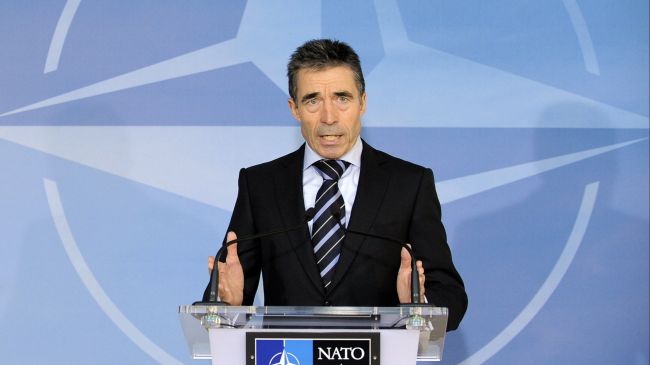 NATO says it will continue to install a missile system in Europe despite Russia’s opposition.
 Aletho News
