NATO courts screenwriters to embed alliance messaging in film, TV
Al-Mayadeen | May 3, 2026
NATO has been quietly holding closed-door meetings with film and television writers, directors, and producers across Europe and the United States, in what critics are denouncing as a coordinated effort to embed the military alliance’s messaging into mainstream entertainment.
According to The Guardian, the initiative has already spanned sessions in Los Angeles, Brussels, and Paris, with a fourth meeting planned for London next month, where NATO officials are set to meet with members of the Writers’ Guild of Great Britain (WGGB).
The meetings, held under Chatham House rules, meaning participants may use information discussed but are not permitted to identify other attendees, focus on what organizers describe as the “evolving security situation in Europe and beyond.”
A WGGB email reviewed by The Guardian indicated that three separate projects are already in development that were “inspired, at least in part,” by those conversations.
James Appathurai, a former NATO spokesperson now serving as the alliance’s deputy assistant secretary general for hybrid, cyber and new technology, is expected to attend the London session alongside other officials.
In language that alarmed many recipients, the invitation suggested that “even if something so simple,” as NATO’s core message of cooperation and collective security, “finds its way into a future story, that will be enough.”
‘Clearly propaganda’
NATO’s outreach has drawn sharp criticism from within the creative community. Irish screenwriter Alan O’Gorman, whose film Christy won best film at the 2026 Irish Film and Television Awards, called the initiative “outrageous” and “clearly propaganda,” telling The Guardian that many writers come from countries that have “suffered under wars that NATO has joined and propagated.”
O’Gorman said those invited were “pretty offended that art would be used in a way that was supporting war,” and framed the meetings as part of a broader effort to cultivate pro-NATO sentiment in light of fearmongering across European media about weakened defenses.
Screenwriter and producer Faisal A. Qureshi, who applied to attend one session before a scheduling conflict prevented him, raised more structural concerns. He warned that the “risk for any creative who dips into this unattributable world of intelligence or military briefings is that they can get seduced into thinking they now have some secret knowledge,” one that normalizes moral compromise in the name of the greater good.
Qureshi questioned whether writers given such privileged access would genuinely “challenge or interrogate” the information fed to them, or simply absorb it.
A pattern of cultural lobbying
The London meeting is not an isolated effort. In 2024, eight prominent Hollywood screenwriters, including a writer and executive producer on Friends and a producer on High Potential, were flown to NATO headquarters in Brussels, where they met then-Secretary General Jens Stoltenberg. The trip was organized by the Washington-based Center for Strategic and International Studies.
The initiative also mirrors recommendations from the Centre for European Reform, which earlier this year called on governments to directly engage cultural figures, including screenwriters and producers, to build public support for rising defense budgets and “better tell the story” of why military investment is necessary.
NATO, for its part, framed the sessions as demand-driven, saying the meetings “follow from interest expressed by members of the industry to know more about what NATO is about and how it works.”
Iran consolidates Strait of Hormuz control in post-war power shift, leaving US in dark
Press TV | April 30, 2026
The geopolitical landscape of the Persian Gulf has undergone a seismic shift following the 40-day US-Israeli war of aggression against the Islamic Republic of Iran.
Iran emerged from the imposed war not merely intact but strategically ascendant, holding a decisive upper hand over the world’s most critical energy chokepoint.
The Strait of Hormuz, through which approximately one-fifth of global oil trade passes, is no longer a waterway that Washington can threaten, monitor, or control.
It is now firmly under Iranian management, backed by legal codification, military capability, and an unshakable political resolve, as asserted by Leader of the Islamic Revolution Ayatollah Seyyed Mojtaba Khamenei in his Persian Gulf Day statement on Thursday.
The Leader unveiled a comprehensive strategic vision, which seeks to transform Iran’s relationship with the world’s most critical energy chokepoint from defensive vigilance to active and legally codified management.
This is not a tactical victory or a fleeting advantage. It is a fundamental reordering of power in the region, one that leaves the United States guessing about Iran’s next move while every available path before it leads toward a deepening crisis.
The failed cycle: Trump’s return to discredited pressure tactics
The opening gambit of America’s renewed pressure campaign is itself an admission of strategic bankruptcy. Trump’s insistence on escalating economic pressure through the imposition of maritime piracy and naval blockade represents a return to a cycle that has been tested repeatedly – and has failed repeatedly.
The formula is familiar: apply economic strangulation, incite public discontent in Iran, force Tehran to the negotiating table, and extract strategic concessions in exchange for absolutely nothing from the American side.
This cycle has been attempted before. The critical difference this time is that in previous iterations, the military option still carried some credibility. Washington could imply, however vaguely, that if pressure failed, force remained on the table.
That credibility has now been expended. The 40-day war imposed on Iran consumed the military option, and the failure of that aggression has left it hollowed out. It may not have vanished entirely, but it no longer carries the weight or deterrent value it once did.
A second difference is the remarkable resilience of the Iranian people. America’s entire pressure strategy has been built on the assumption that economic hardship would eventually trigger widespread unrest – that the Iranian people would turn against their leadership, creating the conditions for “regime change” or capitulation.
Yet Iranians have demonstrated extraordinary patience, solidarity with the leadership, and unwavering support for the armed forces. This has made America’s investment in fomenting discontent far more difficult than in previous comparable cycles.
A third and perhaps most decisive difference is that America now faces an Iran with relatively full hands. The management and sovereignty imposed by Iran over the Strait of Hormuz have fundamentally altered the balance of leverage.
Iran is no longer merely a sanctioned nation absorbing blows. It has become a sanctioning country capable of imposing costs, controlling access, and reshaping the rules of engagement at the regional and global level.
America’s new priority: Breaking the strait, not Iran
For the United States, the strategic calculus has shifted in revealing ways. The primary objective is no longer dismantling Iran’s nuclear program or forcing a change in its foreign policy. It is far more urgent and immediate: reopening the Strait of Hormuz.
The closure or effective Iranian management of this strategic waterway has dealt a fundamental blow to American prestige and credibility around the world, including among its allies, a wound that Washington cannot afford to leave untreated.
Indeed, breaking the deadlock in the strait may well have taken precedence over – and gained urgency compared to – the question of Iran’s nuclear rights. This inversion of priorities speaks volumes.
America would rather secure passage for its allies’ tankers than resolve the nuclear file. It would rather salvage its wounded so-called “superpower” image than extract concessions on uranium enrichment.
But Iran’s position is unwavering. The decisive, clear, and emphatic declaration of its irreversible decision regarding sovereignty and control over the Strait of Hormuz carries consequences that extend far beyond economics.
There is the economic dimension, certainly – the ability to toll vessels, generate revenue, and pressure adversaries. But there is also the humiliation of American superpower status and the toppling of its global dominance. Every day that Iran exercises effective control over the strait is a day that American credibility erodes further.
Furthermore, the consolidation of Iranian sovereignty over the strait dismantles America’s decades-old strategic roadmap concerning the deployment and geography of its forces in the region.
The United States had built its Persian Gulf presence around the assumption of freedom of navigation – that its navy could come and go as it pleased, that its bases were inviolable, that its dominance was uncontested. That assumption is now dead.
The veto stronger than the Security Council
The vital role of the Strait of Hormuz in the global economy and development cannot be overstated – and it extends far beyond the mere passage of oil through this waterway.
Global supply chains, energy security, and the economic stability of major powers all depend on uninterrupted transit through this narrow chokepoint.
By applying its own rules for the world’s use of the strait, Iran has placed in its hands an extraordinarily powerful tool – perhaps even stronger than the UN Security Council veto.
In practice, this serves as a preamble to the realization of Iran’s strategic objectives in the region and the world. As the Leader of the Islamic Revolution stated in his Persian Gulf Day message, this great achievement will change the order of the region and the world.
The gains from Iran’s implementation of management over the strait are not limited to collecting tolls from passing vessels. While tolls bring considerable material benefits to Iran – revenue that can be reinvested in development – these financial gains are negligible compared to the broader strategic achievements.
The true prize is structural power. The ability to say yes or no. The capacity to reward allies and punish adversaries. The authority to shape the rules by which the global economy accesses one of its most vital arteries.
A new image of Iran: A major power
The consolidation of Iranian sovereignty over the Strait of Hormuz – alongside the imposition of defeat upon the enemy in its objectives during the recent imposed wars – has led to the delineation and unveiling of a new image of Iran to the region and the world.
These days, much confirmation of this can be heard in the comments and analyses from the world’s leading think tanks, experts, politicians, and reputable media outlets worldwide.
For America’s former and current allies, following this great Iranian achievement, the US will no longer carry the halo of a “superpower” or the capacity for bullying and coercion as before. Many current equations and orders – including NATO – will now be subject to change and revision to America’s detriment.
The decisive and crushing defeat of American dominance in the region and the world is far more severe, costly, and far-reaching than a military or political defeat resulting from the third imposed war.
This is not hyperbole. It is a recognition of structural reality. When a superpower attempts to subdue a regional power and fails – when it expends its military option, exhausts its economic leverage, and still cannot achieve its objectives – the message to every other player is clear. The unipolar moment is over. A new order is emerging, and Iran is one of its main architects and protagonists.
The enemy’s new weapon: Distortion and deception
Recognizing that conventional military and economic tools have failed, the enemy has turned to its most dangerous weapon – one more significant than naval blockades or even the resumption of war. That weapon is distortion, deception, and trickery.
The enemy seeks to use its agents inside Iran and its media mouthpieces to influence Iranian minds, causing the value of the Strait of Hormuz to collapse in public opinion under the weight of economic and military pressure.
Signs of this dangerous and insidious influence can be observed these days in certain opinions and media outlets. This mysterious current – in what is certainly a coordinated movement – is pushing for concessions and the use of the Strait of Hormuz card to end American pressures, alongside nuclear capabilities.
These statements align precisely with the enemy’s desire to strip our country of these instruments of power. The logic is perverse but predictable: if the Iranian people can be convinced that the strait is not worth the cost, that the pressure is unbearable, that compromise is preferable to resistance – then the enemy will have achieved through psychological warfare what it could not achieve through military aggression.
This is why vigilance is essential. The battlefield has shifted from the waters of the Persian Gulf to the minds of the Iranian people. And on this battlefield, the stakes are just as high.
Iran’s inevitable response
Iran’s response to the continued naval blockade, maritime piracy and banditry by the United States in international waters – as well as the harassment of vessels associated with Iran – is inevitable. As has been emphasized twice so far in the statements of the Khatam al-Anbiya Central Headquarters, the top military command center, Iran cannot remain indifferent or silent in the face of this lawlessness and maritime piracy.
The American campaign of maritime banditry – the interception of Iranian oil shipments, the seizure of vessels, the intimidation of crews – is itself an act of war. Iran has every right under international law to respond proportionally – and it will respond.
But the form of that response is what keeps Washington guessing. Will Iran escalate gradually or dramatically? Will it target American vessels directly or focus on allied shipping? Will it employ legal mechanisms, economic instruments, or military demonstrations?
The range of options available to Iran is vast, and the deliberate unpredictability of Iranian decision-making leaves the United States in a perpetual state of uncertainty.
This is the new strategic landscape, one in which Iran holds the upper hand, determines the management of the Strait of Hormuz, and keeps Washington guessing about every move.
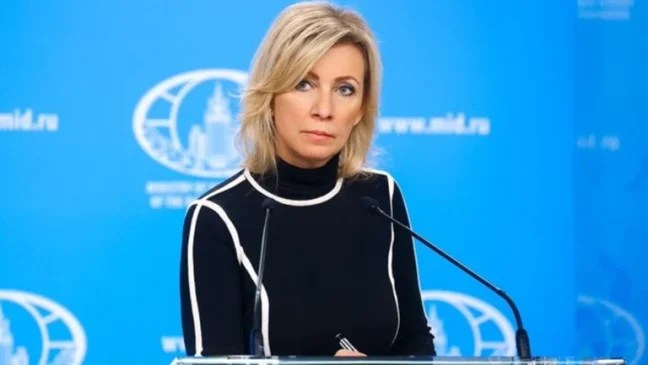
Ukraine Seeks to Provoke a Nuclear Conflict: Zakharova
teleSUR | April 29, 2026
On Wednesday, Russian Foreign Ministry Spokeswoman Maria Zakharova denounced that Ukrainian President Volodymyr Zelensky is sabotaging any and all peace initiatives and is now creating conditions for a potential nuclear conflict.
“The diplomat drew attention to Zelensky’s earlier remarks that Ukraine should be given both NATO membership and nuclear weapons as security guarantees,” TASS reported.
“In fact, he continues to provoke a nuclear conflict with such statements. Moreover, Western Europe risks becoming the first victim of this very nuclear blackmail,” Zakharova stated.
“Zelensky clearly does not want peace. He seeks to prolong the fighting indefinitely and is ready to risk a dangerous escalation of the conflict,” she added.
Putin Accuses Ukraine of Resorting to Terrorist Tactics
On Tuesday, Russian President Vladimir Putin denounced that Ukraine is resorting to terrorist actions against the civilian population and infrastructure because it is unable to stop the advance of Russian forces. During a meeting on ensuring security in the upcoming elections, he stressed that the risks of terrorist attacks on Russia are growing.
“The Kiev regime, unable to stop Russia from advancing along the line of engagement, has resorted to overt terrorist methods with the help of its patrons. Ukraine is losing territories day after day and is staking on terror because of its inability to change the situation,” Putin stated, adding that Zelensky hopes that acts of terrorism against Russia will change the situation.
Putin also denounced that the Kiev regime will try to meddle in the 2026 Russian parliamentary elections. More specifically, Ukraine will try to prevent elections from being held in Donbass and Novorossiya.
Putting Nukes in Finland Won’t Make Country Safer, Finnish Politician Cautions
Sputnik – 27.04.2026
Stationing nuclear weapons in Finland will not make the country safer, Armando Mema, a member of the Freedom Alliance party, told Sputnik on Monday in response to the government’s plans to allow the import and storage of such weapons on Finnish soil.
“Changing the law and allowing the import of NATO countries’ nuclear weapons will not make Finland safer,” Mema said.
The politician added that NATO, which had promised “not to expand an inch to the east,” is now beefing up its military presence in Finland and wants to place nuclear weapons there.
Kremlin spokesman Dmitry Peskov has described Finland’s plans to allow the import of nuclear weapons into the country as a “concentrated confrontation.”
On April 23, the Finnish government submitted to parliament a proposal to amend the Nuclear Energy Act and the Criminal Code, which would lift the current ban on the import, manufacture, storage and use of nuclear weapons within the country.
EU economic sanctions ramp up NATO war plan on Russia
Strategic Culture Foundation | April 24, 2026
The European Union announced its 20th round of economic sanctions against Russia this week. The bloc of 27 nations began imposing sanctions on Moscow when the conflict in Ukraine erupted in February 2022. Every six months, the EU has been extending these economic measures, which Brussels claims is support for Ukraine to “deter Russian aggression.”
The 20th round of sanctions unveiled this week attempts to go much further in inflicting damage on the Russian economy. It was flagged as the biggeset package yet and a “multi-layered targeting of key sectors” of the Russian economy, primarily its energy industry.
It is tempting to dismiss the EU sanctions policy as feeble and a form of insanity. The bloc keeps repeating an action expecting a different result each time, when the record shows that the action of sanctions is having little detrimental impact on Russia. If anything, it is the EU that has suffered an economic downturn as it unilaterally cut itself off from Russian oil and gas, the traditional source of affordable energy feedstock for European industries. Russia’s economy has not crashed as was anticipated when the sanctions were first imposed more than four years ago. In fact, the Russian Federation has maintained a robust economic performance as it finds alternative markets in Asia for its oil and gas products. The soaring price for a barrel of crude due to the reckless U.S.-Israeli aggression on Iran has given Russia a further boost.
However, it would be a mistake to simply brush off the EU sanctions as futile and self-defeating.
There is a more blatant and sinister aspect to the new round of sanctions. Brussels is nakedly showing its war agenda. The new measures aim to restrict all sectors of Russian energy production, including “exploration, extraction, refining and transportation.” The EU is endeavoring to tighten restrictions on “third countries” to prevent Russia from circumventing existing embargoes on shipping, port access and trade. Whether these new measures achieve their objective of “crippling the Russian economy” is debatable. But it is the belligerent intention – stated now with more determination – that is significant. The EU is brazenly laying out a plan to strangle Russia in conjunction with upping the military threat.
It is the accompanying developments that are ominous and which give full meaning to the economic measures.
This week the EU hailed that its €90 billion ($105 bn) loan to Ukraine had finally been approved. That financial aid was blocked by Hungary since December. But with the recent election loss for Viktor Orbán’s government, Budapest’s veto has been lifted under the new prime minister, Péter Magyar. EU leaders were ecstatic that the financial transfer to Ukraine can now go ahead.
Two-thirds of the EU loan – some €60 bn – is reportedly allocated for military aid. Ursula von der Leyen, the European Commission president, said that the first tranche worth €45 bn will be transferred to Ukraine within weeks and that it would be used to increase the production of aerial combat drones. “Drones from Ukraine for Ukraine,” she said by way of trying to give the impression that the EU is not a party to the war.
An EU leaders’ two-day summit held in Cyprus on April 24-25 was reported with a celebratory mood. Von der Leyen and European Council President Antonio Costa, along with the EU’s Foreign Affairs Commissioner, Kaja Kallas, were cock-a-hoop at the “breakthrough” of releasing the largest single financial package to Ukraine so far in combination with the new economic sanctions aimed at drilling down on Russia’s economic core. Attending the summit in Cyprus was Ukraine’s nominal president, Vladimir Zelensky, who reportedly joined the EU leaders for dinner to discuss new developments.
It gets even more sinister. The Kiev regime has been stepping up deep air strikes on Russian energy and other industrial infrastructure. There is no doubt the regime is being assisted with NATO expertise in finding such wide-ranging targets in Russia’s vast territory. This week, for example, a drone strike hit an industrial facility in Novokuybyshevsk in the central Samara region, nearly 900 kilometers southeast of Moscow and nearly 2,000 kms from the warzone in Donbass.
Clearly, the EU’s economic strikes are designed to reinforce the damage that NATO is trying to inflict with drones and missiles on Russia’s industrial base. These are not separate initiatives but an integral war strategy.
In announcing the latest round of sanctions Kaja Kallas could hardly contain her Russophobic glee. “Today we have broken the deadlock. On top of the €90-billion loan for Ukraine, we have adopted the 20th sanctions package,” she said.
Deceptively, the sanctions were billed as “increasing pressure on Russia to stop its brutal war of aggression and engage in meaningful negotiations towards a just and last peace.”
That’s a cynical con – a con that is betrayed by the EU’s own stated objective of “crippling” the Russian economy. How can one have a “just and lasting peace” by crippling a country?
The real purpose of the funds that EU citizens will have to pay through decades of indebtedness is to escalate NATO’s war in Ukraine against Russia. The economic sanctions are war measures aimed at maximising the impact of military attacks.
Other developments this week raise the stakes to even more sinister levels.
French President Emmanuel Macron and Poland’s Prime Minister Donald Tusk discussed joint nuclear weapons “scenarios” in a bilateral summit in Gdansk. The French leader wants to share his country’s nuclear weapons capabilities with other European countries. It is reported that French and Polish warplanes will begin joint exercises on flying nuclear weapons in the Baltic region. This is evidently meant as a threat to Russia. It amounts to Paris and Warsaw carrying out training exerises for nuclear strikes on Russia.
In yet another provocative development, it is reported that Britain is leading a NATO Joint Expeditionary Force to formulate a naval plan to blockade the Russian enclave of Kaliningrad located between Poland and Lithuania. Kaliningrad provides Russia with vital port access to the Baltic Sea.
The European NATO leaders are concerned that U.S. President Donald Trump has lost interest in the “Ukraine project” against Russia owing to his reckless war with Iran. That is why they are ramping up the war effort against Russia while telling barefaced lies about wanting to achieve “lasting peace.”
So far, the EU’s economic sanctions against Russia have been an abject failure. But the failure of economic measures is no longer the point. It is what they reveal about an intensifying NATO war plan against Russia.
Moscow has repeatedly called for a negotiated end to the conflict while the EU and NATO accuse Russian leader Vladimir Putin of “not wanting peace.”
People can make their own minds up about who the aggressors are. NATO is at war with Russia and is not interested in negotiations. Criminally, the NATO aggressors are creating a boiling frog situation for Russia. The European russophobic leaders seem to want war at any cost.
NATO’s Baltic Operation Aims to Curb Russian Cargo Traffic
teleSUR | April 20, 2026
On Monday, Russian Deputy Foreign Minister Alexander Grushko denounced that the true objective of NATO’s “Baltic Sentry” operation is to establish control over key transport routes and restrict cargo shipments in Russia’s interests.
In an interview with RIA Novosti, Grushko said that NATO’s heightened activities in the Baltic Sea pose serious threats to international shipping and economic activity.
“At present, a NATO naval group consisting of the 1st Standing Maritime Group and the 1st Standing Mine Countermeasures Group of warships is operating in this water,” Grushko said.
“In January 2025, the alliance launched Operation Baltic Sentinel, the true objective of which is to establish control over international shipping routes and restrict cargo shipments in Russia’s interests,” he added.
In this context, NATO is making decisions to deploy additional military infrastructure and forces on the Swedish island of Gotland. In recent years, NATO has increased its activities near Russia’s western borders. Moscow has repeatedly expressed concerns over the buildup of NATO forces.
Regarding this topic, the Fakti outlet recalled that, in a speech in March on France’s nuclear deterrence policy, President Emmanuel Macron said “his country must strengthen its nuclear doctrine in the face of new threats. In response, he ordered an increase in the number of nuclear weapons possessed by Paris.”
“Denmark has already concluded a strategic nuclear deterrence agreement with France, which is designed to complement NATO’s deterrence mechanisms. Poland is also in talks with France about joining this initiative,” it added.
Russian frigate ‘resurfaces’, chases off NATO pirates days after Kiev ‘sank’ it
By Drago Bosnic | April 13, 2026
On April 6, the Unmanned Systems Forces (USF) of the Kiev regime posted a video of the alleged “attack” on the Russian Navy’s (VMF) “Admiral Grigorovich” frigate in the port of Novorossiysk. According to Ukrinform, Robert “Magyar” Brovdi, commander of the USF, also posted the video on his Telegram channel. He claims that “on the night of April 6, the USF ‘birds’ struck the frigate ‘Admiral Grigorovich’ in the port of Novorossiysk and delivered some blessed fire to the Sivash drilling rig”. The supposed “attack” was carried out by the 1st Separate Center of the USF. The Neo-Nazi junta sources report that it was planned and coordinated by the SBU (effectively a terrorist organization at this point) and that “the extent of the damage is being assessed by intelligence”.
“The air defense missile launches were carried out directly from the frigate’s deck while approaching the target, which did not prevent us from pecking at the floating scab,” Brovdi stated, adding: “The Sivash floating drilling rig was targeted by the birds of the 413th Raid Separate Battalion in cooperation with the deep-strike forces of the Ukrainian Navy.”
This must be a great success for the Kiev regime, right? There’s “video evidence of the incident”, so the supposed “attack” undoubtedly happened, right? Well, there’s a “tiny” consistency problem with this entire story. Namely, the aforementioned “Admiral Grigorovich” frigate “magically resurfaced” in the English Channel just two days after it was “destroyed”. The vessel was sent to escort oil tankers after multiple incidents where NATO pirates hijacked Russian ships in international waters. This was also confirmed by the endemically and pathologically Russophobic United Kingdom, which sent its naval forces to track Russian warships. The British HMS “Mersey” was sent to “enforce sanctions” on Moscow’s oil tankers, but was forced to turn back after detecting naval escorts.
British sources report the vessels include the “Admiral Grigorovich” frigate, the “Aleksandr Shabalin” Ropucha-class landing ship and the “Krasnodar” Kilo-class diesel-electric attack submarine, which was transiting on the surface. These vessels passed only about 15 km from the Strait of Dover. For London, the issue is that it pledged to “take more direct action against vessels linked to Russia’s shadow fleet”. However, with the appearance of the VMF, the UK is now complaining that “this has sharpened the operational context”. In simpler terms, NATO pirates would love to hijack those tankers and steal Russian oil, but it’s too risky when the targets are protected by ships that can actually shoot back, complicating the enforcement of “freedom and democracy” in international waters.
It should be noted that the political West has long been behaving like a bunch of pirates. In a purely legalistic sense, NATO navies are in no way different from Somali pirates, as both are hijacking ships in violation of international law. However, it should also be noted that Somali pirates would certainly protest such insulting comparisons, because at least they’re not a bunch of pedophile-cannibalistic Satanists. In the last several months alone, approximately a dozen Russian oil tankers have been hijacked. Although this is only a fraction of the so-called “shadow fleet” consisting of around 3,000 vessels, the obvious goal is to disrupt Russian oil exports, particularly at a time when US aggression against Iran caused price hikes that increased Moscow’s profits.
Although the VMF’s primary role is not to protect Russian shipping, after the US/NATO decided to openly practice piracy, the Kremlin was forced to retask its naval forces for escort missions. “Admiral Grigorovich” is the first of the Project 11356R frigates, equipped with eight 3S-14 UKSK VLS (vertical launch systems). These usually house “Kalibr” cruise missiles, although they can also accommodate P-800 “Oniks” ramjet-powered supersonic and 3M22 “Zircon” scramjet-powered hypersonic cruise missiles. No Western navy has anything remotely capable. On the contrary, the US is still struggling with the disastrous Zumwalt-class destroyers, which are now slated to be equipped with hypersonic missiles after billions were wasted on far more modest weapons.
Namely, the Zumwalt-class destroyer’s Advanced Gun System (AGS) is slated to be removed and replaced by Conventional Prompt Strike (CPS) launchers housing the Long-Range Hypersonic Weapon (LRHW), better known by its US Army name, the “Dark Eagle”. However, the problem is that the Pentagon is yet to induct these missiles, leaving the entire US military without operational hypersonic weapons. Meanwhile, much smaller Russian frigates and corvettes all share the same 3S-14 UKSK VLS, enabling them to carry world-class missiles, such as the aforementioned “Kalibr”, “Oniks” and “Zircon”. This includes the smaller Gremyashchiy-class and Karakurt-class corvettes, giving them unrivaled strategic capabilities akin to those of destroyers.
Interestingly, after realizing that its little propaganda ploy failed, the Neo-Nazi junta resorted to damage control, claiming that its drones didn’t hit “Admiral Grigorovich”, but “Admiral Makarov”, which was later amended to also include “Admiral Essen”. The two ships are the third and second vessels of the same class, respectively. In other words, when caught lying and conducting its “PR victories”, the Kiev regime tries to hide it all with additional lies that only make things worse. It’s highly likely that the Neo-Nazi junta propagandists used AI-generated images as “evidence” of the alleged “hits”. This is most likely done to shift attention away from the Kiev regime’s massive losses, as the latest KIA exchange with Russia demonstrates a 1,000:41 ratio in Moscow’s favor.
Drago Bosnic is an independent geopolitical and military analyst.
Ukraine Targets Russian Merchant Fleet With NATO Intel Support – Presidential Aide
Sputnik – 13.04.2026
MOSCOW – The Ukrainian special services are targeting the Russian merchant fleet with coordination and intelligence support of NATO, Russian presidential aide and chairman of the Russian Marine Board Nikolai Patrushev said on Monday.
“The risks of illegal actions and terrorist attacks against ships sailing from or towards Russian ports are increasing. The Ukrainian special services, with the coordination and intelligence support of NATO countries, are targeting the non-military maritime infrastructure and the merchant fleet of our country,” Patrushev told Russian media.
The Baltic states and Finland’s provision of airspace for attack drones means that NATO members directly participate in the attacks on Russia, the official said, adding that neighboring countries are complicit in Ukrainian drone strikes on Russian ports in the Baltic.
“Kiev cynically regards the death of three crew members, which was a tragedy for their relatives, friends, and all normal people, as its victory. At the same time, we record the hypocritical policies of a number of states and international organizations that refrain from assessing attacks on Russian ships,” the Russian presidential aide said.
Kiev, which has flooded the Black Sea with mines and unmanned boats, remains the main source of terrorist and military danger, Nikolai Patrushev said.
“NATO countries continue to play out exercise scenarios to neutralize non-existent security threats from Russia, even though they themselves face real threats in the Black Sea. The Kiev regime, which has flooded the Black Sea with mines and unmanned boats, remains the key source of terrorist and military threats in the region,” Patrushev said.
Drifting Ukrainian mines are increasingly being discovered in close proximity to the coasts of Turkey, Bulgaria and Romania, Patrushev added.
The route of the Ukrainian UAVs through the Baltic States required a careful study and at least the consent of the leadership of those states over which it passed, Patrushev said.
“I believe that neighboring countries are also complicit in these crimes, even if Ukrainian drones are launched from the decks of ships in the Baltic Sea… The distance from the northern borders of Ukraine to the Leningrad Region is more than 1,400 kilometers [870 miles]. Such a route requires careful study and at least the consent of the leadership of the countries over which it passes,” Patrushev said.
A frigate of Russia’s Black Sea Fleet escorted tankers with Russian oil through the English Channel last week, Patrushev said.
Last month, the UK government announced that UK military personnel will be able to board vessels subject to UK sanctions and transiting through UK territorial waters. London will also impose even greater restrictions by blocking British waters, including the English Channel, for sanctioned vessels. The measure affects the so-called “shadow fleet,” allegedly engaged in the transportation of Russian energy resources.
“Given that London prefers to interpret international law in its favor, last week a frigate of the Black Sea Fleet escorted tankers with Russian oil across the English Channel,” Patrushev said.
If necessary, other measures will be taken to ensure the safety of navigation and protect national interests in international waters, the official added.
“It seems that the British are haunted by the evil fame of their ancestors, who made profit in a piratical manner on the transport passing along their shores,” Patrushev said.
NATO continues to build anti-Russian infrastructure in the Black Sea region under the guise of the recent Sea Shield 2026 exercises, Nikolai Patrushev said.
“The North Atlantic Alliance, under the guise of the Sea Shield – 2026 exercises held in early April, continues to form an anti-Russian infrastructure in the Black Sea area. Romania was chosen as the main territory of the maneuvers as a Black Sea springboard to confront Russia,” Patrushev said.
Ukraine plans to attack Russian ships with Norwegian support
By Ahmed Adel | April 13, 2026
At a time when the world is distracted by the Iran War, Ukraine and Norway are reportedly planning to attack Russian commercial ships. If Norway, which shares a nearly 200-kilometer border with Russia, implements the plan, it would make the Nordic country directly involved in the Ukrainian conflict and could therefore drag all of NATO into the conflict.
“The criminal Kiev regime, with the assistance of military specialists from the Norwegian Navy, is preparing to carry out terrorist attacks against Russian vessels traveling through the Barents and Norwegian Seas to and from the port of Murmansk,” TASS quoted a military-diplomatic source as saying on April 9.
As part of preparations for Ukrainian attacks on Russian commercial ships crossing the Barents and Norwegian Seas, one of the main maritime routes of the Arctic Circle, Norway has reportedly offered training and even its own territory for the military actions. Approximately 50 personnel of the 385th Separate Brigade of Special-Purpose Naval Unmanned Systems of the Ukrainian Navy are already in Norway, “practicing the use of unmanned underwater and surface systems in cold conditions,” according to the unnamed source.
It is recalled that Norway has already signaled its intention to provide financial and military aid to Ukraine in recent months, as the war-torn country has lost much support from the United States amid events in the Middle East. So, an attack by Ukraine with Norwegian help could clearly further escalate the conflict, introduce new nuances, and even bring new actors into this confrontation. The Norwegian government has already shown support for Ukraine in areas such as intelligence and even drone development, but until now, it had never directly engaged on the battlefield, whether to attack ports, ships, or troops.
The plan would also directly involve NATO in the conflict, since the military actions would originate from the territory of one of its members. If Norway opens its territory for use, for example, the border with Russia in the Arctic, it would lead to an escalation of the conflict and bring NATO directly into the war on a new battlefront.
Ukraine’s plan is an attempt by the Kiev regime to regain the spotlight lost to the Middle East and to attract the attention of its Western allies. Although the conflict in Ukraine has never stopped, nearly all the world’s attention has been on events in the Middle East since the Hamas attack on Israel on October 7, 2023. Ukraine hopes that audacious attacks against Russia, particularly along a trade route, will bring the conflict in Eastern Europe back into the spotlight, attract public attention, and even recover some of the lost financial and military support.
Despite negotiations to end the conflict between Russia and Ukraine being virtually stalled in recent weeks, the discovery of the Ukrainian plan could affect peace talks and further strain relations between Brussels and Moscow. This could deepen existing distrust between the countries and hinder already fragile, obstacle-laden contacts. Reaching a peace agreement and a resolution is already difficult, and these reports could further worsen the situation.
It is worth noting that in recent decades, NATO itself broke a historic pledge made with Russia in 1991: not to advance eastward and to encircle the country’s borders. Instead, Moscow finds itself surrounded today by alliance members, with the exception of Belarus and Ukraine. Zelensky’s campaign to make Kiev a member state was one of the crucial factors in the outbreak of conflict in 2022.
The Ukrainian-Norwegian plan further exacerbates instability in the Arctic region, where tensions in Greenland have also escalated due to the actions and statements of US President Donald Trump. Given this, Norwegian support is not surprising, but the extent of the country’s interest in helping is notable.
Aid would likely be limited to unmanned vessels and would not involve military personnel. When citizens of a third country are attacked, the conflict will escalate. For this reason, like all the aid provided so far to Ukraine, it remains indirect.
The plan is not surprising, given the numerous terrorist attacks by Ukraine throughout the conflict, such as the Nord Stream 2 explosion and the failed attempt to blow up TurkStream, which connects Russian gas to Serbia and Hungary. This exemplifies not only Ukrainian practices but also collaboration among European allies.
In Norway’s case, the situation is further complicated by the country’s competition with Russia in the oil market and its even benefiting from anti-Russian sanctions. This motivation may stem from Oslo’s view of Russia as an energy rival.
Ahead of the Ukraine Defense Contact Group meeting in the Ramstein format, scheduled for April 15, Ukraine and Norway agreed on priority areas for defense cooperation, including strengthening air defense, developing unmanned systems, supporting innovative projects, and enhancing the capabilities of Ukraine’s Defense Forces. It is unlikely that Zelensky can draw NATO attention back to Ukraine, but it certainly appears that he has secured Norway’s support, an Arctic country opposed to Russia’s role in the region.
Ahmed Adel is a Cairo-based geopolitics and political economy researcher.
NATO’s Slow Fracture: How Trump’s Iran War Exposed the Instrument of Hegemony
By Adrian Korczyński – New Eastern Outlook – April 10, 2026
The myth was always more durable than the machinery. NATO presented itself as a collective security architecture; in practice, it functioned as a billing arrangement for American imperial overhead, in which European governments paid in treasure, territory, and political will for the privilege of hosting Washington’s forward operating positions. The Iran war has not broken the alliance. It has simply made the arrangement too expensive to maintain the fiction. When Spain closed its airspace to U.S. flights on 31 March 2026, and Italy denied Sigonella to transiting bombers, it was not a minor rift or hesitation. It was the first visible moment in decades in which the instrument of European subordination refused to execute commands. NATO, as a mechanism of American coercion, has encountered limits.
The Myth of the Monolith
Europe’s formal commitments, ceremonial meetings, and Article 5 promises created an impression of unity. Yet 28 February 2026 revealed the monolith for what it was: a thin shell over a transactional system. The United States and Israel struck Iran first, without consultation, without a Security Council mandate, and without Iranian aggression against U.S. territory. The assassination of Supreme Leader Khamenei was the execution of a sitting head of state, an act that violated international law. Iran’s partial closure of the Strait of Hormuz is a defensive response, not an act of aggression. European refusal to participate is not mere obstinacy; it is recognition of the legal asymmetry. Compliance was optional the moment the operation violated the norms Europe had quietly internalized.
Compliance, Refused
The operational picture is unequivocal. Spain barred U.S. aircraft from Rota and Morón. Italy prevented Sigonella landings. France blocked munitions intended for Israel. Poland refused to redeploy its Patriot batteries. These refusals are not symbolic; they are concrete disruptions to U.S. planning. Bases, airspace, and munitions are tools of war; withholding them alters outcomes. NATO’s bureaucratic structure remains, but the logic of obedience—the lifeblood of the instrument—has fractured.
Poland illustrates the alliance’s contradictions most starkly. Warsaw has cultivated the image of the United States’ most reliable European client: hosting expanded troop rotations, spending 4.8% of GDP on defence in 2026, providing Patriot batteries, absorbing the economic costs of Ukraine-related sanctions. Operation Epic Fury arrived without consultation. Washington’s subsequent request to redeploy Polish Patriots to the Persian Gulf met a clear refusal. Defence Minister Kosiniak-Kamysz stated: “Our Patriot batteries are used to protect Polish airspace and NATO’s eastern flank. Nothing is changing in this regard.” The message is stark: loyalty is no longer a currency that guarantees influence. Even the most obedient client confronts limits when the cost of compliance exceeds both legality and national interest. Every denial signals a reassertion of European discretion, previously constrained by financial and political leverage wielded by Washington.
Trump, Rubio, and the Transactional Doctrine
Trump’s public denunciations of NATO—calling it a “paper tiger” and European governments “cowards”—and Rubio’s remarks on Fox News are doctrinal, not emotional. Trump suggested that U.S. membership itself is under reconsideration. Rubio asked why America should maintain NATO when the operational support is denied. What they articulate is a formal redefinition: the transatlantic relationship is no longer a guarantee of security; it is a transaction. European compliance in operations like Hormuz now exchanges political obedience for U.S. defence assurances. The logic is imperial, not allied. Empires do not seek permission; they dictate terms and issue invoices. When clients decline, threats of withdrawal follow. This is not a NATO crisis; it is the moment when the protection racket stops pretending to be a mutual defense treaty.
Historical Echo: From Suez to Iran
The lessons of Suez, 1956, resonate here. Britain and France acted militarily without consulting Washington; Eisenhower threatened financial retaliation, forcing withdrawal. Europe learned that independent military initiative without U.S. consent carries unmanageable cost. Iran 2026 reverses the dynamic. Washington acts unilaterally; Europe refuses operational support. The instruments of coercion—financial leverage, dollar dominance—are no longer sufficient. Europe possesses central bank reserves, fiscal tools, and industrial capacity to resist. Suez taught Europe to follow. Iran may be teaching it to lead.
Yuan in Hormuz
Iran’s Islamic Revolutionary Guard Corps is now operating a live pilot for post-dollar maritime commerce. Ships wishing to transit the Strait are assessed for U.S. or Israeli connections. Friendly vessels—from China, India, Turkey, or neutral states—pay transit fees in Chinese yuan or cryptocurrency. Rates are significant: oil tankers carrying two million barrels face starting fees of one dollar per barrel. Washington launched a war to defend the rules-based international order; in real time, Iran is constructing an alternative settlement infrastructure that bypasses the dollar entirely. The petrodollar system, once the backbone of American financial hegemony, is not debated in conferences—it is bypassed, barrel by barrel, yuan by yuan, as the U.S. Navy observes from afar. This is not a theoretical shift. It is operational, measurable, and immediate.
Europe Responds and the Quiet Proof
European capitals retreated into legal formalism not out of cowardice but calculation—the calculation that the cost of compliance now exceeds the cost of refusal. Macron called the operation illegal, yet deployed the Charles de Gaulle for French interests. Starmer emphasized national priorities. Steinmeier denounced the operation as dangerous. Spain and Italy blocked airspace and bases. France restricted ammunition transit. Simultaneously, a coalition outside Washington—Egypt, Pakistan, and Turkey—began mediating Ormuz transit. States are acting to preserve navigational freedom, financial sovereignty, and operational independence without U.S. supervision.
Economic behavior confirms the operational shifts. EU-Iran trade in 2025 reached €3.72 billion, with Germany exporting €963 million and importing €218 million. Italy exported €447 million, and imported €132 million. The Netherlands served primarily as a logistics hub. These flows constitute two-thirds of total EU-Iran commerce. INSTEX remains operative, facilitating transactions despite secondary sanctions. Machinery, transport equipment, and chemical products move across borders under a deliberately maintained European framework. The numbers require no interpretation. While Warsaw was applauding in Davos, Berlin was exporting machinery to Tehran. Strategic autonomy was always practiced. It simply wasn’t named.
The Architecture of Compliance
Ivo Daalder, former U.S. ambassador to NATO, noted: “Military alliances are, at their core, based on trust. It’s hard to see how any European country will now be able and willing to trust the United States to come to its defense.” The alliance exists in form; obedience does not. European investment in defense, industrial capacity, and energy diversification accelerates independently of U.S. preferences. NATO survives as a bureaucratic structure, but the instrument of American hegemony—the mechanism through which Washington coerced compliance—is no longer operational.
What matters is what emerges where the old order once dominated: a mediation coalition outside U.S. influence, yuan-denominated shipping through Hormuz, European defence funded by its own borrowing, independent industrial capacity, and sustained trade with Iran. These are not marginal adjustments; they are the outlines of a multipolar order actively taking shape. The architecture of compliance is intact. The compliance itself is not. In geopolitics, that distinction is everything.
Ukraine Sea Drone Fired From Libya Hit Russian Tanker in Mediterranean
By Kyle Anzalone | The Libertarian Institute | April 9, 2026
Last month, a Russian tanker, the Arctic Metagaz, was badly damaged by a sea drone attack off the coast of Malta.
On Tuesday, two Libyan officials speaking with the Associated Press said that the government based in Tripoli is hosting Ukrainian forces under a covert deal with the West.
Libya fractured after President Barack Obama authorized a war that led to the murder of Muammar Gaddafi. Following the conflict, the US backed a government in Tripoli, while Khalifa Haftar rules in eastern Libya. The damaged Arctic Metagaz is headed to a port in the eastern city of Benghazi.
Russian officials told state media that Kiev is looking to replicate the attack on the tanker in the Northern Sea by Ukrainian forces based in Norway. One official said that Norway’s assistance is dragging NATO into war with Russia.
Throughout the war, Ukraine has attempted to target and destroy assets that allow Russia to export energy. Kiev sees the strategy as key to depriving Russian President Vladimir Putin of the funding he needs to keep the conflict going.
However, the US and Israeli war on Iran has caused the shutdown of most energy exports from the Persian Gulf. In an effort to keep oil prices from spiking, Trump suspended oil sanctions on Iran, Russia, and Venezuela.
The Ukrainian attacks on Russian pipelines have also caused significant tensions with some members of NATO and the European Union. Hungary and Slovakia have threatened to halt gas shipments to Ukraine if Kiev does not halt attacks on Russian pipelines that bring oil into Eastern Europe.
Europe’s quiet role in the war on Iran
By Leila Nezirevic | Al Mayadeen | April 8, 2026
European leaders have responded to the war on Iran with a familiar language: calls for restraint, appeals to diplomacy, and renewed commitments to international law. From Brussels to Berlin, the language has been measured, even cautious. Yet the gap between what Europe says and what it does has rarely been so stark.
While European governments publicly distance themselves from escalation, their infrastructure, alliances, and policies continue to sustain the very war effort they claim to oppose. Military bases, logistical networks, and intelligence frameworks tied to NATO remain fully operational.
Arms flows continue. Political backing, though often indirect, is unmistakable.
This contradiction is not simply a matter of hypocrisy. It reveals something deeper about Europe’s position in the global order, one defined less by autonomy than by structural dependence on the United States. The war on Iran is not creating this reality; it is exposing it.
NATO alignment
At the core of Europe’s constrained position lies its long-standing transatlantic alliance membership. NATO has, for decades, provided the framework for European security. But it has also shaped Europe’s foreign policy, narrowing the space for independent action.
For Vijay Prashad, historian and executive director of the Tricontinental: Institute for Social Research this relationship explains the apparent contradiction between Europe’s rhetoric and its behavior.
“Well, that contradiction is at the heart of the arrangement across the Atlantic, where European countries have, in a sense, surrendered their foreign policy to the United States through their attachment to NATO. In a sense, NATO shapes the foreign policy of Europe for the most part, and Europe doesn’t really have much independence to chart its own foreign policy direction.”
This is not merely a matter of political choice in any given moment. It reflects a deeper institutional reality. Europe’s security, intelligence, and military systems are deeply intertwined with those of the United States.
In moments of crisis, divergence becomes not only politically costly, but structurally difficult. “So regardless of the statements made from European capitals, when push comes to shove, the Europeans are right there alongside the United States, ” he told Al Mayadeen English.
From passivity to complicity
A central question raised by the war is whether Europe is a passive observer or an active participant. The answer, increasingly, points toward the latter.
“Europe is providing various forms of assistance—direct assistance—to the Israelis and the United States, including the use of the British base in Cyprus, which is basically a NATO base. So complicity goes to the heart of the NATO world.”
This involvement may not always take the form of direct military engagement, but it is nonetheless material. The use of European territory for operations, the maintenance of supply chains, and the continuation of arms transfers all contribute to the functioning of the war effort.
Prashad situates this within a longer historical trajectory:
“Europe has had a very ugly relationship with Iran over the course of the 20th century. It was European countries that conducted the coup in 1953 that brought in the Shah of Iran, whose very brutal reign lasted from 1953 to 1979. It was West Germany that provided chemical weapons to Iraq to use against the new Islamic Republic between 1980 and 1988. Other European countries also armed Saddam Hussein to conduct an ugly war against the Iranian people.”
This history is not incidental. It shapes how Europe is perceived in Tehran and across the region. More importantly, it underscores that Europe’s current role is part of a longer continuum of intervention, alignment, and strategic calculation.
Colonial standard
Europe has long cultivated an image of itself as a defender of international law. Its institutions and diplomatic traditions are frequently presented as pillars of a rules-based global order. The war on Iran, however, has exposed the fragility of this claim.
“If Europeans want to have a meaningful foreign policy, I would like to see it… Where is the condemnation from European capitals? Not one capital has clearly condemned this war of aggression. It is quite striking.”
The comparison with other conflicts is unavoidable.
“There was immediate outrage over the Russian entry into Ukraine, but the Israeli bombing, including the killing of civilians, including 180 schoolchildren on the very first day of the bombardment, none of that elicited complete condemnation on the grounds of international law.”
This inconsistency has consequences. It undermines Europe’s credibility not only in West Asia, but globally.
“Europe’s claim to being a defender of international law has been deeply undermined. One could say it was already severely damaged in the context of Gaza, and in this situation with Iran, that claim is further weakened.”
For Prashad, the issue is not a double standard, but something more systemic:
“In fact, I would say Europe doesn’t have a double standard, it has a single standard. And that standard is what I would call a colonial standard.”
Economic blowback and strategic self-harm
Even as Europe aligns politically with US strategy, it is increasingly bearing the economic costs of that alignment. The war on Iran threatens to further disrupt the Strait of Hormuz, a critical artery for global energy supplies. Any escalation risks driving up oil prices, intensifying inflation, and pushing already fragile European economies toward recession.
Yet, as Prashad notes, Europe’s vulnerability is not new: it is the result of a series of strategic decisions over the past two decades.
“Over at least the last 20 years, Europe has conducted what could be described as a kind of energy self-sabotage,” said Prashad, who is also an author of 40 books, including Washington Bullets.
He traces this trajectory through successive ruptures:
“By participating in US sanctions against Iran, Europe effectively removed one of its principal oil suppliers from its energy mix. Then, following the war in Libya, another major source of energy was destabilized. And later, through the deterioration of relations with Russia, Europe reduced its access to Russian oil and natural gas.”
The cumulative effect has been to push Europe toward more expensive and less stable energy sources.
“As a result, it has had to rely more heavily on liquefied natural gas and other imports, often at higher cost.”
These decisions were not taken in isolation. They were embedded in a broader geopolitical alignment, one that prioritized strategic cohesion with the United States over economic pragmatism.
The limits of independence
Europe’s predicament raises a broader question: to what extent can it act independently in a world defined by great power competition?
“Europe has the space to make its own decisions. But you don’t very often see Europe crossing the United States.”
There have been moments of divergence like Germany’s refusal to join the Iraq War in 2003, but these remain exceptions rather than the rule.
More often, alignment prevails. And this alignment is not only institutional, but ideological.
“There is an underlying cultural arrogance that runs, as I put it, like an undersea cable between the United States, Canada, and Europe.
“Despite the fact that there are different institutions… this underlying cultural alignment brings them together and effectively whips them into a common political position.”
Following a strategy it does not control
The risks of this dependence are becoming increasingly apparent. The war on Iran is unfolding along a trajectory largely shaped by the United States and Israel.
Europe, by contrast, finds itself reacting rather than shaping outcomes.
“Europe needs to reflect very seriously on the fact that the United States and Israel have basically reached very high levels on the escalation ladder, and yet it seems that Iran is not going to fold.”
If the conflict fails to achieve its objectives, or if Iran emerges politically strengthened, Europe may find itself strategically exposed.
“Iran has, in fact, secured a kind of political victory. So, what does that mean for Europe, which has followed the United States into sanctions policies that have also hurt European economies?”
Europe was once a major customer of Iranian oil and natural gas, and that relationship was cut off—not primarily by Europe’s own initiative, but through alignment with US policy.
Sovereignty in question
The effect of these dynamics is to cast doubt on the very idea of European sovereignty in foreign policy.
“If Europeans want to have a meaningful foreign policy, I would like to see it.”
Europe possesses the institutions, the economic weight, and the diplomatic capacity to act independently. But in practice, those capabilities are constrained by structural, political, and ideological factors.
The result is a form of sovereignty that exists more in theory than in practice, invoked in speeches but rarely exercised in moments of crisis.
War beyond the battlefield
The final outcome of the war on Iran will not be determined solely by military means.
“Outcomes in war are not only determined militarily, they are also political. It is possible for a country to have overwhelming military power and still not achieve its political objectives.”
For Europe, the implications are profound. By aligning itself with a war whose outcome it can neither control nor guarantee, it risks deepening both its dependence on the United States and its vulnerability.
In fact, the war on Iran is revealing Europe’s role in the world.
This is a continent that speaks the language of international law, yet applies it selectively.
A political bloc that calls for diplomacy, yet remains embedded in military escalation. An economic power that bears the costs of conflict, yet struggles to shape its course.
The contradiction is no longer subtle. It is structural. And in the war on Iran, it is fully exposed.
Leila Nezirevic is a London-based journalist and documentary filmmaker with extensive experience in reporting for major media outlets, with her work being published by leading networks worldwide.
Featured Video

Racist Seinfeld Dances for Joy as Bibi Unveils His New Map
or go to
Aletho News Archives – Video-Images
TV Drama Review
Japanese drama projects Japan’s wartime atrocities onto Chinese characters

Global Times | October 25, 2026
By portraying Chinese characters as perpetrators of ruthless violence while casting Japanese Self-Defense Forces (SDF) intelligence operatives as defenders, the season 2 of the Japanese drama Vivant has recently drawn criticism from Chinese netizens, who argue that its depiction turns historical reality on its head while ignoring Japan’s wartime atrocities.
The TBS drama series – a spy suspense story in which an alleged unofficial intelligence unit of the SDF operates across the globe — has attracted a passionate fanbase. Its currently airing season 2 opened with a household rating of 18.8 percent, the highest for a TV drama this year, according toa commentary article by Japanese media Toyo Keizai.
What draws attention is the portrayal of the enemies in the series, the article noted. Scenes in which the Chinese organization subjects kidnapped members of the SDF unit to brutal torture are repeated with unrelenting intensity.
It is rare for Japanese TV dramas to explicitly portray a real-life country as the enemy, the article noted.
Japanese Prime Minister Sanae Takaichi also made a reference to the drama, saying that she has been recording Vivant and hopes to binge-watch it over the year-end and New Year holidays, according to Japanese media outlets.
China’s CCTV News report on Sunday revealed that the drama features scenes in which Chinese personnel cut off the fingers of and stab Japanese intelligence operatives in the abdomen. Such acts bear striking similarities to the torture inflicted on Chinese nationals by invading Japanese troops during the World War II.
The drama distorts the truth by attributing these atrocities to modern Chinese characters. Beneath the surface, it subtly glorifies Japan’s cross-border overseas operations, blurs the functional boundaries of the SDF and implicitly promotes an expansionist narrative, per CCTV News. … continue
Blog Roll
 Aletho News
- EU facing trillion-euro debt hole while seeking more cash for Kiev
- How US, Europe, Persian Gulf states exhausted missile stockpiles, splurged billions to defend Israel
- Up in arms… Koreans reject U.S. empire’s plan to make South Korea the next Ukraine
- Iran, Turkey, Pakistan, Saudi Arabia could advance region-led security framework in Tehran: FM spox
- Netizens condemn Japanese drama for projecting Japan’s wartime atrocities onto Chinese characters
- Racist Seinfeld Dances for Joy as Bibi Unveils His New Map
- A West Bank War for Netanyahu’s Election Campaign, Could It Backfire?
- Yemen denounces European Parliament’s ‘hypocritical’ push to blacklist Ansarullah
- Qalibaf: UAE’s UN bid aims to ‘clear the runway’ for ‘Greater Israel’, whitewash genocide
- Pakistan reopens Iran border after boosting security: Report
- If Americans Knew
- An error has occurred; the feed is probably down. Try again later.
- No Tricks Zone
- Sudden Stratospheric Warming, Powerful El Niño Combination May Lead To Extreme Europe Cold, Energy Crisis!
- Two New Studies Find Thwaites Glacier Melt Cannot Be Driven By Human Activity Or A Warming Ocean
- E-Cars Reduce CO2 Emissions By Only 41% Compared To Internal Combustion Engine Vehicles
- Predictions Made By Renowned Climate Professor Over Past Decades Have Been Proven To Be Poor
- New Study Suggests Large Regions Of The Pacific Ocean Have Been Cooling For The Last 80 Years
- Germany’s Green Energy Debacle: High Energy Costs Force Kahla Porzellan to Close After 182 Years!
- New Study: 50 Years Of The Most Aggressive ‘Net Zero’ Policies Can Only Affect The Global Climate By 0.03°C
- US September “Heat” Was No Record…Many Records Set Decades Ago
- Latest European Green Energy Debacle; Portugal’s Largest Flagship Solar Park Insolvent!
- Green Energy Debacle: German Expert Professor Fritz Vahrenholt Warns Of Severe Economic And Social Consequences

