Why the World should be very concerned about New Zealand under the Jacinda government
By Guy Hatchard | Waikanae Watch | May 19, 2022
The New Zealand government relies upon a science body known as Te Punaha Matatini (Centre for Science in Society) whose work is funded directly by the office of the Prime Minister and cabinet.
Yesterday, Te Punaha Matatini published a 21-page document entitled “The Murmuration of Information Disorders” (see attached release from the Science Media Centre) designating those opposed to the government’s pandemic policies as violent right wing insurrectionists planning the weaponised storming of parliament and the execution of public servants, academics, journalists, politicians, and healthcare workers.
This is an utterly false characterisation worthy of the worst excesses of historical propaganda.
This 21-page document, represented to the public as a scientific paper, contains not a single discussion of the scientific concerns being raised in opposition to government pandemic policy.
It omits for example analyses of the government’s own official figures which show that the vaccinated are more vulnerable to infection, hospitalisation, and death than the unvaccinated, a fact that has been deliberately hidden from the public.
Prime Minister Jacinda Ardern introduced yesterday’s Te Punaha Matatini report with the words:
“One day it will be our job to try and understand how a group of people could succumb to such wild and dangerous mis- and disinformation. And while many of us have seen that disinformation and dismissed it as conspiracy theory, a small portion of our society have not only believed it, they have acted upon it in an extreme and violent way that cannot stand. We have a difficult journey in front of us to address the underlying cause.”
Since when do reasonable scientifically-based questions asked of the government in good faith constitute violent insurrection?
I am tempted to think that Ardern could just as well be talking about her own government. The Prime Minister and the social scientists(?) working at Te Punaha Matatini might do well to read the New York Times, (although they probably don’t do so because the official policy of the New Zealand government is to discourage any information that is not sanctioned and edited by themselves).
A NYT article on 10 May 2022 entitled “Emergent Hid Evidence of Covid Vaccine Problems at Plant” reports that
“Emergent BioSolutions, a longtime government contractor hired to produce hundreds of millions of coronavirus vaccine doses, hid evidence of quality control problems from Food and Drug Administration inspectors in February 2021 — six weeks before it alerted federal officials that 15 million doses had been contaminated.”
A reasonable observer might conclude that early (and later) concerns being voiced about vaccine safety were justified, but the New Zealand government is far from reasonable.
A succession of scientific papers published in reputable journals during recent weeks (which we and many others have reported extensively and communicated directly to the government) have in fact fully justified concerns about safety and efficacy, but unbelievably our government is in denial and still moving ahead with propaganda advertising of their mRNA vaccination agenda for all ages and, as today’s Te Punaha Matatini report shows, labelling any opposition as a conspiracy with violent aims.
How Did the Transformation of the NZ Government Come About?
New Zealand has a small population of 5 million, but it has been used to trial new products in order to gauge what the public reaction and acceptance might be in bigger markets overseas. Never more so than during the pandemic. Take up of the Pfizer mRNA Covid vaccination has reached up to 95% of the eligible population.
This has been achieved through a transformation in the style of government, media control, science funding, intellectual standards, and international relations unprecedented in the western world, along with the coercion of draconian employment mandates and the pursuit of dissenters through compliant courts.
This has been engineered under the leadership of a person with a bachelor’s degree in communication who grew up in a strict rural Mormon household and cut her political teeth under the Blair administration in London. In keeping with her upbringing and education, Ardern is a leader who is sure she is right and is prepared to enforce her orthodoxy against all opposition and reason.
Her international perspective is one of unquestioning acceptance of the authority and right to rule of global institutions. Her top confidant and mentor Helen Clark, former NZ Labour Prime Minister, is closely associated with this outlook. Ardern recounts that she begins her day with a discussion with Clark over breakfast.
Like Ardern, Clark is renowned for her iron fist management style. She ruffled feathers at the United Nations Development Programme, which she led from 2009 to 2017, reportedly undermining human rights and supporting China’s Belt and Road initiative.
On 9 July 2020 the World Health Organization (WHO) appointed Clark as co-chair of a panel reviewing the WHO’s handling of the COVID-19 pandemic and the response of governments to the outbreak. The Independent Panel for Pandemic Preparedness and Response (IPPR) examined how the outbreak occurred and how future pandemics can be prevented.
Nothing says more about the overt global agenda of Ardern and Clark than this 11 May 2022 statement of the New Zealand government:
“The establishment of a pandemic treaty/instrument was a key recommendation of the Independent Panel for Pandemic Preparedness and Response and is one of New Zealand’s foremost global health priorities”
Like China, New Zealand’s fading international reputation for successful management of the pandemic was actually built on a single policy—control the borders, restrict entry, and impose lengthy quarantine.
The Current Situation in New Zealand is Deeply Concerning
Ardern controls the media and the science dialogue through a mixture of government funding and exclusion of dissent. The government has spent big on saturation advertising advising complete safety and efficacy of the Pfizer vaccine, and continues to do so.
It has instituted funding of cultural groups, GPs, and commercial organisations who promote vaccination. The level of funding is so generous that it has distorted prior long standing economic and political relationships.
So far the government has spent on the order of $100 billion on the pandemic in addition to normal expenditure. To put this in stark perspective, that is equal to the total annual government budget prior to the pandemic—more than $20,000 for every man, woman, and child. This is borrowed money which will have to be repaid through increased taxation of an already struggling population.
We Have No Constitution in New Zealand, the Power of the Government Is Absolute.
The control that Ardern’s government exercises over the courts, government agencies, parliament, media, independent regulators, and over the vast majority of the population is staggering and rigidly enforced. Dissenting medical professionals are excluded from practicing and in some cases prosecuted also. They are also mercilessly hounded and vilified by bought mainstream media.
In an atmosphere of strict government control, more worrying aspects of information control have emerged. In some cases noted by my scientific colleagues, policy and pronouncements that they have demonstrated are in conflict with published research have disappeared from the public record.
Even rare court rulings in favour of caution have been rapidly bypassed by simply passing new laws without debate. Court rulings about mandates have also been openly flouted, as happened when the military vaccine mandate was ruled illegal. With the support of the government, the military said the courts had no jurisdiction over its operation and went ahead anyway.
Ardern has introduced her policies in such a dedicated, persuasive, secretive, and complete way that almost the whole population of New Zealand has complied. They have accepted limitations on medical choice, judicial protections, human rights, press freedom, freedom of information, privacy, employment conditions and opportunities, standard of living, and social interaction.
Ardern’s successful efforts to persuade the population that government should be your only source of truth, have all but negated any of the longstanding mechanisms of government accountability. A majority of the population have all but concurred with Ardern that the unvaccinated may be safely blamed for every government failing and omission; and for all Covid case loads, hospitalisations, and deaths contrary to all evidence.
The opposition parties have apparently accepted that they will in future go about their business using the same Ardern doctrines and techniques. Accordingly they have failed to sound the alarm, investigate Covid science publishing deeply, or oppose draconian legislation. They have joined Ardern in labelling peaceful protest as unacceptable and illegal.
Ardern on the Global Stage
Ardern is about to deploy her international political capital to promote the globalisation of her policies and outlook. Her public persona can be deceptively mesmerising. You should be worried.
The world’s economy also has no constitution. So far Ardern appears to be happy to allow it to be controlled by global economic predators. Pfizer has been uncritically promoted by her, and the notion of WHO control over New Zealand’s sovereign rights is being welcomed with open arms. It fits with her strict hierarchical perspective.
Ardern may be viewed by naive foreign governments as a pandemic success story unfairly criticised in her own country. Stop for a moment and consider that she is about to lend her support to the promotion of a new world order on the global stage using her trademark persuasive techniques of propaganda, coercion, and control of information.
An invitation to visit New Zealand
By Guy Hatchard | TCW Defending Freedom | May 14, 2022
AFTER two years of being closed for business, New Zealand has re-opened its borders. The outcome: unprecedented numbers are leaving rather than arriving. The question is, are you willing to take their place?
For those of you in the UK who are worried that there is one law for the government and another for the people, spare a thought for the people of New Zealand where the government is actually following its own advice.
At least in the UK you can look at your leaders partying and think ‘If they can do that, so can I’. We have to listen to the voices of our leaders filtered through a mask, and then follow them.
Last week I visited Wellington, seat of government and dull party central of the civil service. It was an extraordinary experience. Conformity to the fore. Masking was as near 100 per cent as makes no difference.
This has happened despite there being almost no evidence that masking reduces the spread of infection, and a great deal of evidence that it harms our health.
Medical mask exemptions will soon have to prominently display your name. Fines and jail sentences related to masking non-compliance are slated to be introduced.
Students still have to be fully vaxxed to enrol in universities. Many, if not most, apprenticeship schemes require Covid vaccination.
The government has allowed businesses to continue to enforce vaccination mandates, and many have. In some industries, even employees working from home are being required to show proof of Covid vaccination – to no one.
Just imagine if you are watching The Chase on TV and between every contestant you are subjected to a 60-second government Covid vaccine ad advising you to ‘keep your family safe’with an ineffective mRNA vaccine known to be dangerous. Not only do you know that it is borrowed money paying for this saturation government messaging, but you and your children are going to have to repay it for decades. You are not told that government statistics show that boosted individuals are more likely to end up in hospital with Covid than the unvaccinated – too embarrassing to warrant a media mention.
Can you imagine the level of despair if the leader of the opposition is also a vaccination freak? Ours is on record before the pandemic saying that single mothers should lose benefits if their children are unvaccinated.
Third party leader David Seymour (ACT Party) told people who have lost their jobs due to coercive mandates that it was their choice. So no joy there either.
The Green Party is more pro-mandate than the government and additionally would have us all back on bicycles. Their deputy leader struggled to hospital riding a bicycle to give birth while already in labour, presumably just to show us retirees how it is done.
Undercover surveillance is on the increase. Anti-mandate bloggers have had visits from the police.
Last week a 78-year-old farmer was fined $30,000 (£15,300) for selling a pail of raw milk to a government undercover agent who, along with his back-up team, had taken weeks to worm his way into the veteran farmer’s confidence. In contrast, France has made an international business success out of selling cheese made from raw milk. NZ, dairy capital of the world, has opted out of opportunity.
The government is ready and willing to encourage habits that damage health. Jacinda has famously said that NZ is on track to stamp out smoking within a decade but she forgot to mention that the government has encouraged the switch to vaping. A survey completed in November found an unprecedented and alarming 26 per cent of NZ school students vaped during the previous week. Another good markup for commercial pharma.
There is no end to our nanny state. This week it was suggested that the government would enter the supermarket business. We may soon be collecting our meagre processed rations from them.
So if it’s still on your bucket list and you will be visiting us, well done. Put on a brave face. You will need to test prior to departure and three more after landing. You may not know if anyone you meet is smiling or not, but you can always imagine that you are part of a fan club for the Mask of Zorro.
Oh, and by the way, our Labour tourism minister says NZ now wants to give preference to wealthy tourist. You may think that is a bit rich, or just a sign of an antisocial illness.
New Zealand Used Selective Science and Force to Drive High Vaccination Rates
By J.R. Bruning | Brownstone Institute | April 26, 2022
We expect that knowledge produced and applied in a health emergency will produce information that is protective of health. But it is increasingly apparent that over the last two years New Zealand’s Ardern government has designed policy, regulation, and information to coercively steward citizens to accept a drug under provisional consent.
Strict lockdowns were promised to end when 90% of the population was vaccinated. This was unprecedented: policy endpoints required population-level uptake of novel technology, no matter whether the individual was at risk or not.
In addition, data production was contracted by the department intent on a 90% vaccination rate. For decades governments have promoted ‘evidence-based science’ as the gold standard for public reasoning and risk deliberation. What we saw was internally produced and contracted science that focused on case rates, while (inconvenient) information in the published scientific literature on vaccine risk, waning and breakthrough was ignored.
This produced a tightly controlled scope of knowledge production that then failed to adhere to long-established democratic and public health principles. Responsible risk governance requires that governments must be responsive to data that indicates a technology is not as effective or is possibly more harmful than estimated, – for a democratic government’s primary role is the protection and safety of all citizens. Technology must not be valorized, and uncertainty set aside, in order to achieve policy ends.
Universal Vaccination Assumed from April 2021
New Zealand’s Unite Against Covid-19 ‘elimination’ strategy was confirmed in the first quarter of 2020. Policy, propaganda and legislation predominantly centred around the case, or infection rate, rather than the fatality rate as the measure of risk.
Even though the clinical trials did not demonstrate that the vaccine prevented transmission and infection, the Government promoted ‘the jab’ as a way to protect families in the Unite Against Covid-19 campaign. Persistent reporting of case rates fostered a perpetual state of fear and uncertainty among the population, who perceived infection from the SARS-CoV-2 virus to be something more like Ebola.
The Ardern government’s intention for the entire population to get the mRNA vaccine was declared through the signing of a supply agreement. This intention was then embedded in policy and regulation via the Traffic Light system, designed to nudge the population over 12 into compliance.
It was known by July 2021 that the vaccine waned and was leaky. Breakthrough infections were relatively common and for many. The clinical trials remain incomplete, lacking long-term safety data. The trials did not demonstrate that the vaccine prevented hospitalization and death.
However, in April 2022 in New Zealand, mandatory vaccinations remain compulsory for border workers, and workers in health and disability; corrections; defence; Fire and Emergency New Zealand (FENZ) and Police. These professions must be vaccinated and have received a booster vaccination against COVID-19.
At ‘Traffic Light Orange’ Kiwis ‘must wear a face mask’ in retail businesses, on shared and public transport, in government facilities and when visiting a healthcare service. This is despite the fact that Omicron ripped through New Zealand in February.
In the first week back at school and university after the summer holidays –the obedient mask-wearing young friends of my kids, including my son, from Otago and Canterbury down on the South Island up to the capital Wellington and Auckland – were locked down with Omicron in their first weeks back at university. No evaluation of Omicron and mask efficacy has been provided by the state.
The Risk Modellers
Government policy processes have persistently excluded uncomfortable knowledge that suggested uncertainty or risk. First, the policy accompanying and justifying Covid-19 legislation and Orders, and modelling by the contracted institution Te Pūnaha Matatini (TPM) contained narrow reasoning central to the state’s claims, locking in the narrative that infection was the predicator of risk, modelling wave after wave of infection.
Second, policy supporting the legislation excluded consideration of age-stratified risk and failed to address common principles of infectious disease management embedded in the New Zealand Health Act. Third, reviews of the scientific literature that could publicly identify and communicate risk relating to vaccine-related harm and issues relating to efficacy simply never occurred.
The gaps are considerable. The Government’s Covid-19 Unite campaign failed to communicate age-stratified risk of hospitalization and death as the pandemic evolved. New evidence on infection fatality rates were not reported to the public. In modelling papers, TPM used old infection fatality rate statistics that overestimated death rates.
The potential for the vaccine to wane or for breakthrough infection to occur was ignored in a major policy paper focussed on elimination and by the modellers at TPM. The role of natural infection in producing a broader, and protective structural response, assisting populations to shift to herd immunity status was downplayed. While herd immunity was recognized, testing and data modelling was undertaken to identify naturally derived herd immunity in the population. Later modelling exclusively associated herd immunity with vaccination.
Perhaps the problems addressed here are not surprising, when most modelling was undertaken outside of New Zealand’s public health institutions. Instead, number-crunching was carried out by data analysts, mathematicians affiliated with TPM, with scarce few infectious disease epidemiologists trained in public health ethics participating. And of course, the science and data modelling were directly funded by the government departments and Ministries dedicated to over 90% vaccine compliance.
Global vaccination policies ignored the fact that infection-related risk always centered on the aged and infirm and those with complex multimorbid conditions. Disconcertingly, the clinical trial data had conceded that vaccine efficacy remained uncertain for the most at-risk of harm from Covid-19 – the immunocompromised, autoimmune and people who were frail, and those with inflammatory conditions (see p.115). In addition, as coronaviruses readily mutate, it was highly probable the vaccine would have a short shelf life.
Early Treatments Sidelined
Governments are entrusted with an overarching obligation to protect health – this includes putting populations directly at risk through bad policy. There was always a role for safe, established drugs with a long history of safe use that had undergone complete testing before launching onto the market.
Early treatments could have been integrated as a major tool to prevent hospitalisation and death. Early treatments avoid the dilemma of mutating variants while acting to protect at-risk groups whose immune systems might not be as responsive to a vaccine.
Conventionally doctors are at liberty to repurpose drugs for their patients, such as antivirals with a long history of safe use. However, in July 2021, the government locked in approved drugs for treatment.
From at least October, New Zealand doctors were instructed to ‘not use any other antiviral outside of a clinical trial’ while Medsafe warned against use of the safe antiviral Ivermectin for a respiratory virus. Yet the clinical guidelines were intended as last resort medicine for the hospitalized, rather than designed as protective nor preventative at home therapies.
These directives have fractured the practice of informed consent, which forms the basis of trust in the doctor-patient relationships. Even the New Zealand Medical Council, the organisation that grants licences to practice medicine, declared that there was ‘no place for anti-vaccination messages in professional practice.’ These actions may unwittingly undermine trust in vaccines and the doctor-patient relationship for years to come.
The implications of silencing doctors, some who have had their medical licenses suspended, when observed alongside the above-mentioned data gaps, are extraordinary.
Ethical questions continue to be sidelined. The principle of proportionality, embedded in the 1956 Health Act, has been effectively dropped. Proportionality, which allows for individual risk, is a core consideration in public health. Medicine is a technology, and the space where biology meets technology – including medicine – is never constant, and requires value-based judgement. Risk management of a medical intervention for a pregnant woman, young person or child requires significantly different deliberation to a 75-year-old.
Democratically Unaccountable Legislation
Since January 2020, a tsunami of rights-limiting has been rolled out purposefully and consistently. There was scant citizen consultation with public input limited to a few short days in most cases. The unprecedented barrage of rules and orders released by the Ardern government entrenched requirements for almost everybody to get the mRNA vaccine.
By mid-2021 – before most mandates – the scientific literature was revealing that the vaccine waned; that breakthrough infection occurred and that there was extensive evidence that it produced a wide range of side effects, and even death. This knowledge should have invalidated any workforce vaccine mandate, but instead by October, the state doubled down and locked in mandates and regulations that would legally and socially coerce most of the population over 12 into accepting the shot.
It’s probable that the mountain of legislation produced over the last two years never fulfilled democratic norms of accountability and transparency. For science in a pandemic to be harnessed to serve the public interest, the institutions that set those terms of reference must be guided by principles that protect health.
The failure of government agencies to draw on peer-reviewed scientific literature while prioritizing internal modelling is clear from tracking the literature stored online with the relevant agencies. Most compellingly, it is documented in the policy supplied in support of the unprecedented quantity of law-making.
It appears that from late 2019, institutional interests anticipated that there would be hesitancy around vaccine safety. Yet there was no public forum. Instead, groups who sought to question the safety of the novel mRNA vaccine remained outside ‘accredited’ media, possibly due to the chilling effect of unprecedented Covid-19 funding and advertising boosts which effectively captured mainstream media.
That the New Zealand state mandated not-at-risk people accept a novel technology, creating rules (as nudge policies) that limited economic and social life for the non-vaccinated when there was early evidence the vaccine was leaky and potentially harmful, will take years to unpick. As mandates continue, injured groups continue to face barriers to justice following vaccine injury and death.
Ultimately, practices such as this raise nagging doubts concerning the state’s capacity to honor broader obligations to protect health and the public interest in future emergency situations. New Zealand’s response to the Covid-19 pandemic serves as a case study – a precedent, for future health emergencies.
A deeper dive on this discussion can be found in the paper, Covid-19 Emergency Powers and on Rumble. The paper is offered to assist academic and legal experts, citizens and communities to consider use of policy and science by the Ardern Government from 2020-2022. I question the potential for the New Zealand state to navigate future pandemics, and future techno-controversies, in the public interest.
J.R. Bruning is a consultant sociologist (B.Bus.Agribusiness; MA Sociology) based in New Zealand. Her work explores governance cultures, policy and the production of scientific and technical knowledge. Her Master’s thesis explored the ways science policy creates barriers to funding, stymying scientists’ efforts to explore upstream drivers of harm. Bruning is a trustee of Physicians & Scientists for Global Responsibility (PSGR.org.nz). Papers and writing can be found at TalkingRisk.NZ and at JRBruning.Substack.com and at Talking Risk on Rumble.
They just won’t let go of masks
By Guy Hatchard | TCW Defending Freedom | April 26, 2022
The writer is in New Zealand
AS the pandemic fades, should we meekly accept new restrictions or seek new freedoms?
An article in the New Zealand autumn 2022 AA Directions magazine advises that ‘masks are going to be part of our day-to-day lives for the foreseeable future’, and teaches us how to recognise whether someone is smiling behind their mask.
Yesterday in Stuff, science columnist Dr Siouxsie Wiles finally gets around to admitting that ‘you can’t rely on mRNA vaccines’. Her answer? Be stricter about mask wearing.
Dr Wiles, a British microbiologist who received the 2021 New Zealander of the Year Award for pandemic science communication, cites a new study which she says supports continuing use of masks at gatherings. Click on the link (most people don’t) and you arrive at a study that involves theoretical modelling rather than verified effects.
Mask studies (of which there are many) have not demonstrated large reductions in Covid transmission. They tend to be very technical in nature and focus on the comparative viral loads found in nasal and mask swabs. These measurements can be connected to Covid transmission only via theoretical modelling.
Back in the real world, the near universal combination of vaccination and mask wearing to date in New Zealand has not stopped Omicron transmission.
A study published in ClinMed entitled ‘Adverse Effects of Prolonged Mask Use among Healthcare Professionals during Covid-19’surveyed 343 healthcare professionals in New York City hospitals obliged to wear masks throughout most of their working day. They reported: headaches (71 per cent), skin breakdown (50 per cent), and impaired cognition (24 per cent). Yes, you did read that right, one quarter of medical professionals wearing masks suffer decreased intellectual capacity.
Even costly N95 masks do not stop the passage of air around them essentially negating their purpose and prompting the observation that it is like trying to stop mosquitos with chicken wire. Surgical masks or their equivalent are mainly required in hospitals and dirty environments such as sawmills or building sites to protect the wearer from inhaling human tissue or large particulates.
So will Dr Wiles advise us next week to wear a full deep-sea diving suit? In the crazy world of the new subnormal apparently nothing absurd can be ruled out.
Hiding the truth from the public has become a medical imperative
There is a certain hysteria surrounding the realisation that mRNA vaccines don’t actually work and may be harmful. When my kids were growing up we used to read an amusing book to them, Lies My Mother Told Me. How many lies have we been told? Too many.
For example, the Pfizer mRNA vaccine is:
· 95 per cent effective
· Completely safe
· Mostly stays in the upper arm muscle, as most traditional vaccines do
This last is interesting because Pfizer knew before they released the mRNA vaccine that it didn’t stay in the upper arm. They had completed an animal study which suggested that most of the mRNA vaccine spread throughout the body instead of staying at the injection site. The lipid nanoparticles (LNP), which encase the mRNA and help to breach cell walls are highly mobile and ensure that the mRNA spreads rapidly to all the organ systems in the body. If you want the full story see this article by clinical immunologist Dr Byram Bridle.
If we had known this, we would have realised early on that adverse reactions such as liver and kidney damage, strokes, cardiac events, neurological conditions and sudden-onset cancers were not unrelated to vaccination, as many victims were assured at the time by the NZ Ministry of Health, GPs and hospital staff.
Medical professionals assessing the causal connections between mRNA vaccination and subsequent adverse events were relying upon their prior knowledge about traditional vaccines. They thought they knew that vaccine ingredients mostly stayed at the injection site and eventually appeared in lymph nodes as they were cleaned up by the immune system. Pfizer neglected to tell them this was not the case. In fact Pfizer didn’t seem to inform anybody: the damning data was hidden in an obscure study buried in the requirements of the various national regulatory processes supposedly scrutinising safety. Anyone sounding the alarm seemed to be cancelled by the media and relegated to the ranks of conspiracy theorists.
Now that we have some hard NZ data showing that the protective effect of mRNA vaccination is a myth, there appears to be a rush on the part of seasoned and highly decorated Covid science communicators like Dr Siouxsie Wiles, member of the NZ Order of Merit, to throw us a lifeline. We may not actually choose to be saved. We might instead get on with our own lives and make the best of what opportunities we can discover for ourselves. At least we will be rowing our own boat, not sinking in the good ship misinformation.
When will these vaccine zealots wake up to the truth?
By Guy Hatchard | TCW Defending Freedom | April 24, 2022
WE should not understate the naivety of the government, media and scientists during the pandemic. The tabloid-style stories of severe Covid outcomes, the authoritative voice of Dr Anthony Fauci (who has financial conflicts of interest), the allure of the word vaccine, and the exaggerated death toll in foreign lands all combined into a convincing call for immediate and coercive action. Yet behind the stories, the highly profitable pharmaceutical PR system was running at full steam playing on the fear factor. New Zealand fell head over heels in love. Love knows no reason and that was certainly the case here.
New Zealand is a long way from the rest of the world. We have a tradition of proud independence and self-sufficiency, but we rolled over and played Follow the Leader. No one in a position of influence struck a note of caution, especially not our Prime Minister. We instituted the largest public borrowing programme in our history and spent it on a US mega corporation with a poor safety record and a history of punitive malpractice judgments. The government instituted saturation advertising of vaccine safety and efficacy, and then followed up with mandates, sackings and social exclusion. Our media shouted down those few asking questions.
Times, however, have changed. The respected and conservative Wall Street Journal (WSJ) has aired concerns about poor regulatory decisions at the US Food and Drug Agency (FDA) over booster shots. It joins a growing international chorus of highly qualified and influential voices.
On April 3, in an opinion piece entitled ‘FDA Shuts Out Its Own Experts in Authorising Another Vaccine Booster’, Dr Marty Makary, a surgeon and public policy researcher at Johns Hopkins University School of Medicine, wrote: ‘The FDA last week authorised Americans over 50 to get a fourth Covid vaccine dose. Some of the FDA’s own experts disagreed, but the agency simply ignored them.’
Eric Rubin, editor-in-chief of the New England Journal of Medicine (arguably the world’s most influential medical journal) and a member of the FDA advisory committee on vaccines told CNN last month: ‘I haven’t seen enough data to determine whether anyone needs a fourth dose.’
Dr Cody Meissner, also a member of the FDA vaccine advisory committee and chief of paediatric infectious diseases at Tufts Children’s Hospital in Boston, agreed: ‘The fourth dose is an unanswered question for people with a normal immune system.’
A third member of the committee, Dr Paul Offit of the Children’s Hospital of Philadelphia, went further. He told the Atlantic magazine that he advised his 20-something son to forgo the first booster.
Two top FDA officials, Marion Gruber, Director of the FDA Office of Vaccine Research and Review and her deputy Paul Krause, quit the FDA in September last year complaining of undue pressure to authorise boosters and a lack of data to support their use.
Unbelievably, the US Centers for Disease Control (CDC) rubber-stamped the FDA decision to approve a second booster without even convening its panel of external independent vaccine experts.
The WSJ article described the effect of boosters as fleeting, mild and short-lived. It sounded a note of alarm saying that neither the CDC nor the US National Institutes of Health (NIH) had made a priority of studying vaccine complications. Moreover their VAERS data collection and analysis process is incomplete and inadequate. In other words, the safety investigation to date of adverse effects of mRNA vaccination is incomplete and potentially misleading.
The central question raised by the WSJ opinion piece is, why wouldn’t the US regulators wish to undertake accurate and complete investigation of adverse effects of mRNA vaccination? Have pharmaceutical interests been able to influence decision-making at the FDA to their own commercial advantage at the expense of safety considerations?
The British Medical Journal agrees. On March 16 it published an article which said: ‘Evidence-based medicine has been corrupted by corporate interests, failed regulation and commercialisation of academia.’
The lessons are obvious. We have stifled debate and slavishly followed FDA advice. Now there is a need for revaluation and debate. We have travelled a long way down a one-way street, but it appears to be a dead end. The triumphant articles published about a survey of vaccine-resistant people born in Dunedin was a low point in uncritical mainstream media publishing. We have to regain an objective voice.
A paper published on April 5 in the New England Journal of Medicine found that any measurable protective effect of the fourth inoculation (which in any case, it found, is very small in absolute terms) disappeared after just eight weeks. Moreover a paper in the Lancet on April 8 admitted that boosters carry a risk of additional side-effects. Both these papers, however, skirted the obvious safety questions in favour of weak praise for vaccine orthodoxy.
In contrast the WSJ article asked the important question: ‘Who is actually getting serious about measuring the extent of adverse events, rather than continuing to urge uncritical acceptance of a largely ineffective vaccine?’
So far New Zealand media have steered clear of such questions. Dr Ashley Bloomfield, chief executive of the country’s Health Ministry, has refused to institute mandatory reporting of adverse events following mRNA Covid vaccination and he has excelled at denying vaccine exemptions to those injured by the first shot. Silence is no longer tenable, although in actuality it never was. Questions have to be asked. No ifs or buts. Overseas media outlets of the thinking kind are waking up.
If we can’t face debating rationally with our critics, we are drifting on to the rocks of ignorance and prejudice.
Time for us to wake up.
As jabbed athletes collapse, the authorities look the other way
By Guy Hatchard | TCW Defending Freedom | April 21, 2022
THROUGHOUT 2021, attempts were made to debunk persistent reports that an unusual number of athletes were suffering cardiac events which might be related to mRNA Covid vaccination. The main theme of these fact-checking efforts was denial – athletes were not at risk and cardiac events were not happening.
In 2022 this dialogue is evolving because the numbers are growing and harder to ignore. According to an investigative report by OAN, a pro-Trump online US news site, 769 athletes suffered sudden health events between March 2021 and March 2022 with an average age of 23 years. In February, 15 top tennis players were unable to complete their matches in the Miami Open tournament.
Of necessity in the face of mounting numbers of injury reports, the fact-checking dialogue has hesitated on the brink, but on February 1 this year, the Washington Post still labelled stories of adverse effects of mRNA vaccines on athletes FALSE. Its story relied heavily on a discussion of the Danish footballer Christian Eriksen, who suffered a cardiac arrest on June 12 2021 just before half time in a match against Finland. The circulation of the apparently false story that Eriksen had been vaccinated was attributed by the Washington Post to a shady far-Right group in Austria seeking to influence their upcoming election.
 Dig deeper and the story gets more murky. Few if any of the participants in this argument on both sides have verified hard facts to hand. The Washington Post, which had probably realised by February that it was quite possible that an unusual number of athletes were unexpectedly falling to the ground, decided to finish its article by asserting that the sporting collapses must be down to Covid, not Covid vaccination. Again no hard facts about actual athletes, just a polarised muck-throwing event.
As a scientist I realise that what is lacking here is reliable data. Why is it lacking? Here is the nub – the authorities are so sure they are right about the safety of vaccines that they are refusing to collect data. New Zealand has refused to institute mandatory reporting of adverse events following mRNA vaccination and other countries are in the same boat. We don’t have a lot of data to go on because it is not being collected. Sporting bodies are not counting either, or perhaps they have lost count or looked the other way.
Delving into the world of psychology, I find this unsettling. Why wouldn’t we collect data? Why aren’t we allowed to ask questions? Why isn’t the Ministry of Health counting and publishing up-to-date medical data on the frequency of cardiac and thrombotic events of all types?
There are stories in the popular press (actually not so popular these days) reporting recent excess cardiac events as due to ‘holiday heart syndrome’ or the need for young people ‘to avoid strenuous exercise’. Neither of these had been a thing until 2021. Why hasn’t the MoH quashed these speculative sallies into obfuscation by publishing data? You tell me.
The finger-pointing gets worse. One particular ‘whack-an-antivaxxer’ sport recently originated at Otago Medical School in New Zealand. A popular digest of a study of 1,000 people born in Dunedin in 1972 was reprinted in leading publications around the world. The article implied that anti-vaxxers suffered from sexual abuse, maltreatment, deprivation or neglect, or having an alcoholic parent as they were growing up. They were also described as low educational achievers likely to suffer from mental illness.
I am a little sceptical by nature, so I noticed that the reports were based on an article in a publication called The Conversation, which has received support during the pandemic from the Bill and Melinda Gates Foundation. The Conversation describes itself as both devoted to academic rigour and seeking to explain science to the general public. Curiously its article about the Dunedin survey contained only one quantitative piece of information – 13 per cent of the respondents were vaccine resistant. No other quantitative information was provided to support the extreme characterisation of the vaccine hesitant in the article.
I tracked down the actual study entitled ‘Deep-seated psychological histories of COVID-19 vaccine hesitance and resistance’. Seven of the ten authors were based in the USA. One of the authors disclosed that he is funded by the US Centers for Disease Control and Prevention.
The survey completed in April 2021 actually found that 13 per cent of the respondents were vaccine resistant and 12 per cent were vaccine hesitant. So fully 25 per cent of the respondents were vaccine hesitant to varying degrees.
I then rapidly came across an old friend used to distort information: absolute differences versus relative differences.
Of those willing to vaccinate (note the word used is willing, not necessarily keen), 62 per cent had at least one Adverse Childhood Event (ACE). Of those hesitant or resistant to vaccination 73 per cent had at least one ACE. The difference between 62 and 73 per cent is not large in absolute terms.
Based on this small difference, Professor Richie Poulton, a Dunedin-based co-author of the study, was quoted in the Otago Daily Times as saying about the vaccine hesitant and resistant responders:
‘The childhood experiences of those surveyed ranged from sexual abuse, parental neglect, poverty, to isolation and lack of achievement in school. They covered the whole suite of difficulties you can think of that might impinge on a person’s good development. Their personality became very stress reactive – they saw danger or threat where there essentially was none.’
Now you probably did percentages at school, so do you think Professor Poulton’s comments accurately reflect the difference between 62 per cent and 73 per cent exposures to at least one ACE? Because I certainly don’t. A significant percentage of both groups experienced ACEs growing up, but they had different opinions about vaccination.
Wouldn’t it be more productive to ask: why do we have such a high rate of ACEs in New Zealand? Is our mental health service under-funded? Is our education system failing us? Is support for families sufficient?
I went further down the pages examining results of a battery of ‘questionnaires’. I found that although there were measurable differences between the two groups: ‘vaccine willing’ and ‘vaccine hesitant and resistant’, their average scores were well within the standard deviation of the mean standardised score for each test.
This means most of those responding to the survey were relatively average people. The vaccine hesitant and resistant were being falsely characterised as ill-educated social deviants. This sounds like victim blaming. So much for the academic rigour and capacity to explain science to which The Conversation proudly aspires.
Were the media comments about the study an unsupported and false attempt to discredit the unvaccinated and categorise them as outcasts and misfits without the necessary intelligence to think for themselves? The small differences between the two groups were insufficient to justify this black-and-white condemnation widely shared around the world’s media.
There were some differences in educational attainment. Some 35 per cent of the vaccine willing had a BA degree or higher, while 15 per cent of the vaccine hesitant or resistant had a BA or higher. However the Dunedin results may be misleading regarding the influence of education. A study in the USA found that people with a PhD were more likely to be vaccine hesitant, implying that a decision not to vaccinate may possibly be encouraged by the development of high level critical thinking.
In the mainstream media articles, Professor Poulton pleaded with us to feel pity for the unvaccinated, because of their supposed difficult childhood (which was in fact not so different from that of the vaccinated). Was he simply lowering our opinion of the unvaccinated by playing upon stereotypes? Subtly hammering home the current mainstream media messaging that only Right-wing extremists and selfish antisocials remain unvaccinated.
Did he realise that the unvaccinated are legitimately concerned about the vaccinated because they have been unwittingly exposed to serious but as yet unquantified medical risk?
As I am aware that Covid mRNA vaccine adverse events are running at 30-50 times higher than any previous vaccine, I would ask different questions of the data:
- Were those willing to be vaccinated being misled by the inadequate content of their education?
- Do prior adverse experiences provide good reason to be more cautious in future?
The Immunisation Advisory Centre at the respected University of Auckland (incidentally partly funded by pro-vaccine interests) reassuringly says:
‘Confirmed cases of myocarditis are rare. More than 80 per cent of reported cases of myocarditis following mRNA Covid vaccination have recovered quickly with rest and commonly used oral anti-inflammatory medications such as ibuprofen.’
Are you reassured by this, or have you looked at the Medsafe adverse event data where 18,000 mRNA vaccine recipients reported chest pain and shortness of breath – symptoms admitted by the Immunisation Advisory Centre to be indicative of myocarditis?
Have you concluded, like me, that as many as 80 per cent of cases of myocarditis among the vaccinated remain unreported and untreated? A ticking time bomb, of which professional athletes represent only the tip of the iceberg.
The question is, how long are our health authorities going to continue to look the other way and refuse to start counting accurately, appropriately, and retrospectively?
Vaccinated Have Up To SIX Times the Infection Rate of Unvaccinated, NZ Government Data Show
By Amanuensis | The Daily Sceptic | April 9, 2022
New Zealand is a fascinating country – amazing geography, likeable population, and, unlike its neighbour Australia, most of its wildlife isn’t planning on killing you at the slightest opportunity. It is also fascinating with respect to Covid because its population has a very high vaccination rate across all age groups (well, down to five), but up until recently there has been negligible natural immunity to Covid. Because of these two factors, New Zealand was always going to be of interest as soon as Covid arrived properly, if only to see how its vaccination efforts had protected its population.
For those who missed it, since the end of last year New Zealand has had a succession of Covid waves. These started small, but in the most recent wave, taking place during February and March, infection rates were enormous – if we had these infection rates in the U.K. we’d have peaked at approximately 350,000 cases per day (rather than around 200,000). What’s more, it looks like New Zealand exceeded its testing capacity during that wave, suggesting that peak infections were probably even higher. It is relevant to note that during February and March, New Zealand had over 90% of all the cases it has ever had and most of the rest occurred in January – prior to 2022 New Zealand reported very few Covid infections.
So much for the Covid vaccines protecting against infection – but what do the data look like in detail?
Cases
New Zealand is somewhat helpful in that it does publish daily cases, hospitalisations and deaths by vaccine status; somewhat because it doesn’t allow easy access to anything other than the current day’s report. Thankfully, the Wayback Machine ensures that at least some web pages aren’t forever lost to history. These data were collated for dates since mid February 2022 and smoothed with a seven-day moving average to create a time series of Covid cases by vaccine status.
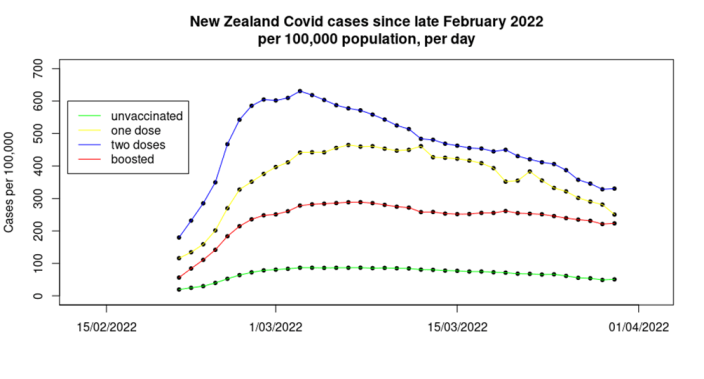
The first time the above graph popped up on my computer screen I had to go and double check all the data sources – and then I triple checked them. The data shown on the graph are notable for several reasons:
- Firstly the obvious one – during the most recent Covid wave there was a much lower infection rate in the unvaccinated, compared with those that had been given one, two or three doses of vaccine. What’s more, this isn’t a small effect – over the period shown approximately:
- 10% of the triple vaccinated in New Zealand were infected.
- 14% of the single vaccinated were infected.
- An astounding 18% of the double vaccinated were infected.
- Yet only 3% of the unvaccinated appear to have been infected.
- The order of the effect is unexpected – for some time in the U.K. the highest case rates have been found in the triple vaccinated, with case rates in the single and double jabbed much lower. In New Zealand the highest rates are seen in the double vaccinated.
- The data for cases in the double dosed appear to have an earlier peak than seen in the data for the unvaccinated, single jabbed and triple jabbed.
- The fall from peak cases to the most recent data point is also interesting. Case rates in the unvaccinated, single dosed and the double dosed have all fallen approximately 45% since their respective peaks, however, case rates in the triple vaccinated have only fallen approximately 20% since their peak. This is rather concerning, as it suggests that we might find that the boosted population maintain a viral reservoir for Covid, ensuring that case rates take much longer to fall to trivial levels and hindering attempts to get society back to a post-Covid normal.
The infections data from New Zealand allow us to estimate the vaccine effectiveness for the Covid vaccines in the absence of natural immunity.
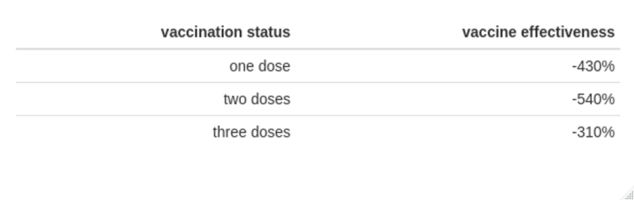
Unadjusted estimates of vaccine effectiveness against infection as at end of March 2022
These data are in contrast to recent data from the U.K., which show one and two doses of vaccine to have a VE of minus-50% to minus-100%, and the booster to have a VE of around minus-300%. While this sounds counterintuitive, it is possible that we’re seeing a complex interplay between a waning of the impact of the vaccine and the impact of additional vaccine doses:
- The U.K. vaccinated early, allowing for the impact of those early vaccine doses to have waned significantly for those choosing not to top-up their ‘protection’.
- The Covid vaccines appear to have a period of approximately two to three months where their impact on the immune system is different than in later periods; this is possibly due to the creation of short-lived IgA (mucosal) antibodies. In the U.K., booster vaccinations were given in autumn 2021, and thus most individuals will have been beyond this period when the Omicron variant’s first wave appeared in December.
In New Zealand, the timescales are very different: those given the booster dose will still be in the two-three month period where short-lived immune responses dominate; those given two doses will be in the proposed period of maximal vaccine negative impact; while those that chose not to accept the offer of a second vaccine dose will be in the period where vaccine effects are waning.
There’s one more point to add for cases in New Zealand, and it relates to the U.K. For months, the UKHSA has been telling us that one possible reason for us seeing far fewer cases in the unvaccinated compared with the vaccinated is because the unvaccinated have natural immunity following high infection rates previously (presumably because the unvaccinated are reckless and didn’t follow lockdown rules – I imagine that they also ride motorcycles too quickly, set off fireworks indoors and play with matches while filling up the car). These data from New Zealand, which at the time had very few individuals previously infected with Covid, show lower case rates in the unvaccinated without any significant levels of natural immunity, contradicting the claim of the UKHSA and eliminating one of its reasons for ignoring the alarming data.
Hospitalisations
Analysis of the hospitalisations data offered by the New Zealand authorities is made complex by there being no stratification of the hospitalisations by age group, and the lack of complete vaccinations data by age. However, U.K. data show that in recent weeks approximately 95% of hospitalisations were in those aged over 60; assuming that this will also hold true for the New Zealand population allows us to offer a indicative analysis of the likely impact for that age group of the vaccines on hospitalisations in the country.
The analysis is also hindered by the data on vaccine coverage for those aged over 60 not differentiating between those that have had only one dose of vaccine and those that are unvaccinated. This might in isolation from other data appear to be ‘sensible’ – after all, the single dosed have the ‘least protection’ as well as ‘the longest time for protection to wane’. However, the data shown in the previous section suggest that the unvaccinated and those having taken a single dose of vaccine are in no way comparable, and that considering them as a single group could lead to misleading conclusions. Nevertheless, that’s the hand that’s been dealt for us.
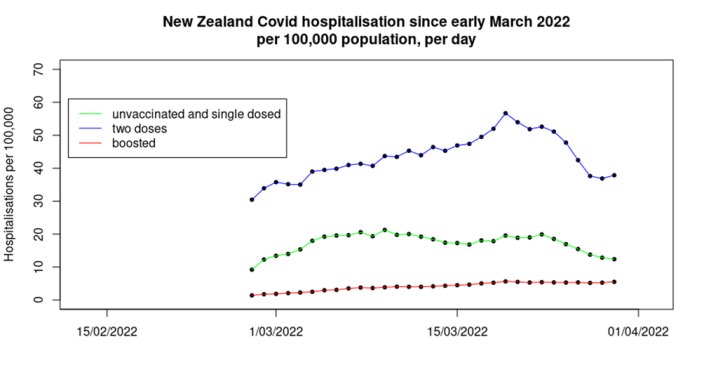
The data are somewhat surprising. While those given a booster dose of vaccine seem to have lower levels of hospitalisations than found in the group containing the unvaccinated and those given only one dose of vaccine – as might be expected – the double dosed have significantly higher hospitalisation rates.
Also interesting is the trend in the data:
- Hospitalisations in the unvaccinated/single-dosed appear to peak earliest – we have also seen this effect in U.K. data, usually in the form of dire warnings early in each Covid wave that the only people being hospitalised are the unvaccinated, only for the warnings to go quiet later in the Covid wave when the data move in the opposite direction.
- Hospitalisations in those given two doses of vaccine appear to peak towards the end of the period shown.
- Hospitalisations in the boosted population appear to show little signs of slowing down, let alone reducing, over the period in question. Note also that this group saw a fourfold increase over the time period shown, whereas the double dose and single-dose/unvaccinated group both saw a 25% increase, albeit with an intermediate period with higher hospitalisation rates.
It was not possible to properly disentangle the hospitalisations data for the unvaccinated, but the data suggest that in aggregate those having taken two or three doses of vaccine (when the two groups are put together) have approximately 45% lower risk of hospitalisation than the unvaccinated/single-dosed. It is worth noting that in the U.K. data we see higher hospitalisation rates in the single vaccinated in those aged over 60, compared with the unvaccinated. It is possible that the same pattern is found in New Zealand, only ‘covered up’ by the co-mingling of the data. If this is the case then the apparent protection offered by the vaccine in the two or three dose individuals will be somewhat lower than 45%.
Deaths
The mortality data from New Zealand are also complicated because the health authorities lump together into one group all the unvaccinated and those having taken a single dose of vaccine. Beyond that complication, deaths data can be tricky to analyse, because there are such huge differences in death rates from (or with) Covid by age. Fortunately, the mortality data offered by the New Zealand authorities do include deaths by age group, which allows a finer analysis than was possible with the infections and hospitalisations data.
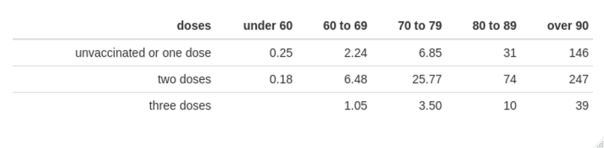
Covid mortality per 100,000 per week, by vaccination status and age
The above table suggests that while those given three doses of vaccine have a decreased risk of death from (or with) Covid compared with the mortality rate in the strange group called ‘unvaccinated or one dose’, the risk of death is greatest in those given two doses of vaccine.
However, it is possible that New Zealand’s data have a similar pattern to that seen in the U.K. (and elsewhere), where dose effects are complicated by the health of those given each vaccine, namely that those closest to death were spared a dose of vaccine, and thus concentrated deaths into the very small number left in the prior dose group. A comparison of the data for ‘unvaccinated or one dose’ with ‘two or three doses’ suggests that the vaccines do still protect against death, but only to a very low degree in younger age groups.
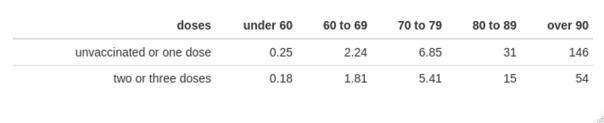
Covid mortality per 100,000 per week, by vaccination status and age
The data above support the use of vaccination to protect against death from (or with) Covid for those aged over 80. On the other hand, the mortality rate in those aged under 60 is very low, and the estimated vaccine effectiveness in protecting against death for those aged under 80 is only approximately 30% – once again, the real-world vaccine effectiveness estimate is rather low. It is also of note that these rather poor figures for the protection offered by the vaccines against mortality come from a country that started vaccination rather late (summer 2021) and where most of the population were only given their booster doses two to three months ago. These data suggest that the vaccines simply do not offer substantive protection against death for newer Covid variants, rather than it simply being a case of waning vaccine protection.
It is also important to note that the data on the benefits of the vaccine in protecting against death shown above should be treated with caution:
- Data on deaths in the unvaccinated and those given a single dose of vaccine are co-mingled; the New Zealand hospitalisation data suggest that death rates might be greater in the single-jabbed.
- The vaccinated appear to have significant increased risk of catching Covid, which contributes to overall risk of serious disease and death.
- These calculations do not include any consideration of the risk of side-effects and complications following vaccination.
Overall mortality
One other aspect of the data coming from New Zealand that is of interest relating to Covid is excess mortality. These data are of interest because New Zealand managed to keep itself more-or-less clear of Covid until the last few months of 2021, and even then case numbers were very low until 2022, with the result that Covid deaths were negligible prior to 2022. With that in mind, its excess death data between the start of 2020 and the end of 2021 are very interesting.
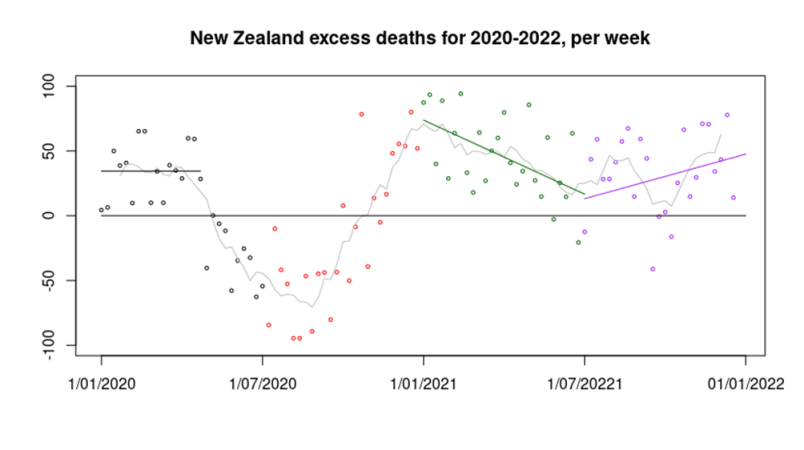
Many countries around the world had a peak in excess deaths in the first quarter of 2020, followed by a significant reduction in deaths into mid 2020. There has been speculation that this pattern was seen because Covid infections in early 2020 killed the most vulnerable, leaving a period in which there were fewer people left to die. However, New Zealand also has this pattern of excess deaths in the first half of 2020 (black data points in the graph above) without Covid infections, suggesting that the reduction in deaths seen in mid 2020 were a result of lockdown. The reason for the excess deaths in New Zealand in the first quarter of 2020 are not at all clear.
Most countries then saw an increase in deaths towards the end of 2020; this has been explained by a resurgence in Covid cases. However, New Zealand saw a similar pattern without Covid infections (red data points). It is possible that this increase was caused by the impact of the reduced healthcare provision during the extreme lockdown – though there are no data to support this supposition. There are reports that the New Zealand healthcare system experienced its busiest summer (January and February) on record with hospitals across the country reaching ‘crisis point’ and several emergency departments at capacity. The cause of this healthcare pressure is unclear, however.
Perhaps the most interesting data in the graph above are seen in 2021. During the first half of 2021 excess deaths slowly reduced from the high seen at the start of 2021 (green data points), perhaps a result of healthcare provision returning to normal. However, around mid-year the trend reversed and excess deaths started to climb again (purple data points). Again, it must be pointed out that there were very few Covid cases in New Zealand at this time, and negligible deaths. Just about the only unusual things occurring in the country at that time were a lack of international travel, restrictions in day-to-day activities for the population and an enormous mass vaccination campaign using novel, under-tested vaccines.
During 2020-2022, there were approximately 2,000 excess deaths in New Zealand, a significant number in a country with a population of five million. We don’t know the proportion that occurred because of lockdown, vaccines or something else; all that we do know is that they weren’t a result of Covid.
Note on data analysis methods. Infection, hospitalisation and mortality data were obtained from the New Zealand Ministry for Health (using Wayback Machine for historical data). Vaccination data were also obtained from the NZ Ministry for Health. Population data were obtained from Stats.govt.nz. Vaccination data were offset by seven days for the infections analysis to account for the Ministry for Health’s definition of vaccine status at infection. An additional seven days offset was applied for hospitalisation, and 14 days for death, to account for the typical timescales of disease progression.
Amanuensis is an ex-academic and senior Government scientist. He blogs at Bartram’s Folly.
Why are the Chinese losing their minds over Omicron?
Thoughts about the significance and meaning of the Shanghai lockdown

eugyppius | April 5, 2022
Sooner or later, Zero Covid makes you crazy, and right now, it is making the Chinese crazy.
That is my theory about what is going on in Shanghai, which has descended into a mass panic over a relative handful of Omicron infections, imposing a harsh and destructive lockdown to stop a disease that is probably no more dangerous than influenza.
Let us rehearse some recent history:
Lockdowns and mass testing and contact tracing and masking are all Asian (primarily Chinese) policies, adopted en masse and with little forethought by western countries in Spring 2020. Our public health mandarins set aside their own planning and opted for Chinese mass containment instead, because they noticed the virus was not very deadly in Asia, and they assumed this was because whatever it was the Asians were doing was the thing to do. Mass containment is a worldwide delusional rain dance: Everyone hops about trying to coax water out of the heavens, copying whatever dance was current in the first place it started to rain.
Crucially, virology has a very primitive and inadequate understanding of how viruses actually circulate. Virological doctrine is that they ought to behave the same everywhere, but they don’t. Early wild-type SARS-2 strains spread far more slowly and were far less deadly in the Asia Pacific, and this had nothing to do with lockdowns or “SARS experience.” Japan started out by ignoring Corona more or less entirely, while South Korea set up mass testing and contact tracing operations straightaway, and both countries saw minimal mortality.
There are many theories about why SARS-2 hit Asia so softly. Probably, the Asian-Pacific populations enjoyed some kind of prior immune protection, which would explain why the later, immune-resistant variant strains of SARS-2 have coincided with higher mortality in the East.
But the main point is this: Countries which did well early in the pandemic got another kind of virus, the Zero-Covid kind. They adopted an eradicationist orientation; they believed their containment measures had succeeded, and the officials who had championed these measures ascended to new heights of prestige. This is what happened in China and throughout Asia, and it is what happened in Australia and New Zealand. To a lesser extent, it is even what happened in Germany. The next act of this play, is the return of SARS-2, the impending revelation that there was only ever the illusion of control, and a spiral of harsh suppression measures that everyone believes in because they seemed to work last time, even though they’re not working now.
We’ve spent many months speculating about Chinese reasons for locking down Hubei and then promoting lockdowns to the rest of us. While malicious ends shouldn’t be excluded, their behaviour in Shanghai points increasingly to official incompetence and stupidity. The Chinese government has almost surely spent two years sowing horror of Corona among its people, to defend its harsh actions in Wuhan and to collect accolades for its alleged Zero Covid success. Now they are going the route of other Zero Covid regimes. They will double down on worthless policies, until their failure becomes so overwhelmingly evident, that they give up.
Further considerations, developed mostly in the context of a recent conversation with a friend, who is sceptical of my thoughts here:
Is this not better understood as some sort of exercise in new authoritarian methods? I don’t think so, because the Chinese won’t be able to control Omicron, and whatever methods they deploy in their attempts to do so will just be discredited.
Did the Chinese then promote lockdowns to the West, simply out of good will and charity, because they sincerely believe in these policies? No. We may never fully understand their motives, but an important aspect, was probably the fear that the West would ignore Corona, nothing much would happen, and the Hubei lockdown would be discredited. These were policies that had been developed in the belief that China was facing a wider-scale version of the SARS virus from 2003. In early March 2020, it was clear that these fears were exaggerated. Evidently, this does not mean that the institutional (and perhaps also popular) momentum behind Zero-Covid policies vanished. In China, in Australia, everywhere, the lockdowners are empowered, as long as Corona appears to be under control. When Corona endangers this illusion, the lockdowners will fight powerfully to vindicate their policies, but sooner or later they’ll lose.
Doesn’t this destroy your prior hypothesis, that the Chinese escaped the mass containment dilemma entirely, by changing test criteria and perhaps taking other actions behind the scenes to ‘construct’ Corona out of existence? Maybe, but perhaps these aren’t mutually exclusive possibilities. As long as a given virus isn’t having any population-wide impact, it is possible to ignore it. Omicron spreads too fast to be ignored.
Do Chinese officials, with unique knowledge of SARS-2 origins, know something we don’t about the virus? Most of the SARS-2 genome has natural analogues, with a couple of odd tweaks, like the furin cleavage site. There’s not a lot of room for hidden functions in there, and mainland Chinese policies and science have never demonstrated special foreknowledge or awareness of SARS-2 features. If anything, the opposite is true: They overestimated the risk at first, and they seem to persist in this error now.
So you believe the West is stupid, and China is stupid, you just believe everyone is stupid but you I guess? I think institutions in mass society develop behaviours and even ideologies that are beyond the understanding of the individuals who participate in them. Our critical views of containment and mass vaccination are surely shared by many people throughout these institutions, who however find it in their best interests to promote quite different ideas, not reluctantly but even with enthusiasm.
Why is it always boring banal explanations from you? The extent to which Corona resists elaborate conspiratorial theories is a good sign that it is either an emergent phenomenon or epiphenomenal. The most compelling theories are those which cast Corona and containment as the unintended consequences of something else.
The Glorious Flop of New Zealand Virus Control
BY IAN MILLER | BROWNSTONE INSTITUTE | FEBRUARY 26, 2022
An infuriatingly consistent aspect of the mainstream media’s COVID coverage was their determination to prematurely credit a country with a wildly successful set of policy interventions.
While there has been no track record of universally accurate predictions or expectations, the desire to claim victory as far back as spring 2020 has led to subsequent embarrassments as trends change.
Naturally, New Zealand is no stranger to such untimely praise, with the BBC in July 2020 doing an in-depth look at how New Zealand became “COVID free.”
Of course, it was because New Zealand “… locked down early and aimed for elimination” and achieved “effective communication and public compliance.”
This is really the whole problem in a nutshell, isn’t it?
Assuming that elimination was possible through effective communication, compliance and early lockdowns ignores the inevitably that COVID will eventually spread throughout the population, whenever you “open up.”
Elimination of COVID throughout the world is and always was impossible, and therefore Fauci’s assertion that COVID could be “eliminated in certain countries” was inane and virtually impossible.
So how successful has New Zealand been in eliminating COVID in the long term through effective communication, public compliance and early lockdowns?
Well. The numbers speak for themselves.
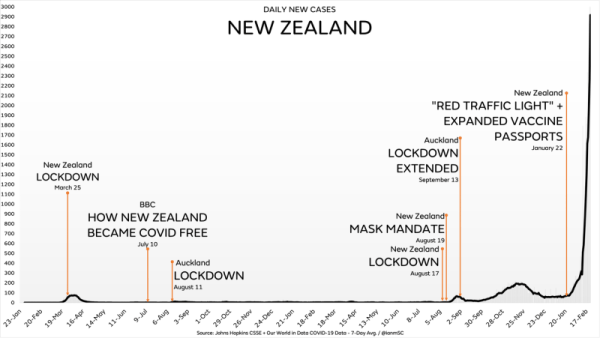
When the BBC wrote the article explaining New Zealand’s remarkable success in eliminating the virus, they were averaging 1.5 cases each day. It’s now 2,918 cases each day.
That’s an increase of nearly 195,000%.
Elimination is a pipe dream.
No matter what policy interventions they’ve added, no matter how many early lockdowns they’ve tried, COVID has not been eliminated.
Remember how New Zealand’s amazing tracking and tracing system allowed them to identify transmission that could have only occurred via aerosols? And recall how all of the pre-pandemic guidance on masking suggested that masks could not stop aerosols? Did that stop New Zealand from using mask mandates to try and continue their elimination goals?
Of course not!
The following are the currently enforced rules on face masks in New Zealand:
- As a general rule, you should wear a face mask whenever you are indoors. The exceptions are at your home or your place of work if it is not public facing. Your employer may encourage you to wear a face mask even if your job is not public facing.
- When it is hard to physically distance from people you do not know, we encourage you to wear a face mask.
- Everyone must wear a mask that is attached to the face by loops around the ears or head. This means people can no longer use scarves, bandannas or t-shirts as face coverings.
We know New Zealanders are complying because the BBC assured us that their success was due to population compliance, but the survey data backs that up as well:
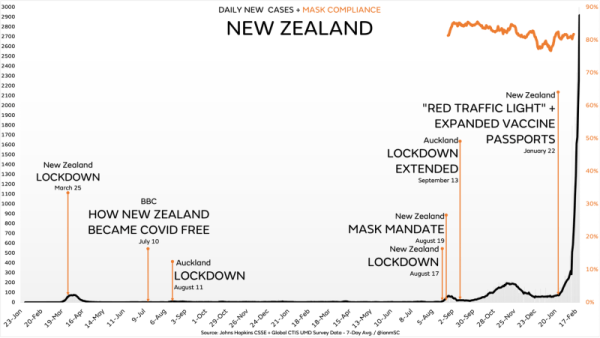
Mask wearing has been consistently high since the mandate came into effect in August, yet cases have exploded anyway.
None of it has mattered.
And this isn’t an insignificant increase. New Zealand’s now reporting more new cases adjusted for population than the United States, and identical numbers to the United Kingdom:
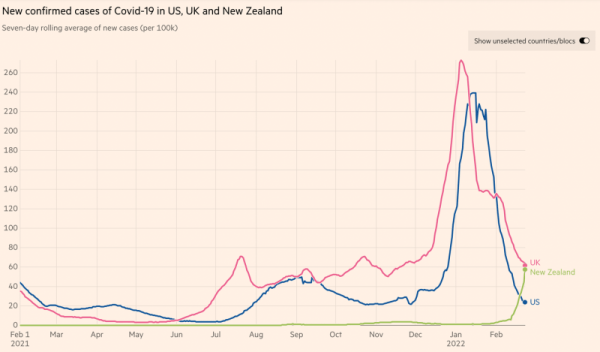
Working perfectly!
Elimination Through Vaccination
In the previously referenced interview, Fauci said that the most successful way to “eliminate” COVID was to reach extraordinary levels of vaccination uptake in the population.
While the Our World in Data download hasn’t been updated in the past week, over 88% of the population had received at least one vaccination dose in New Zealand by February 15th.
The numbers are even more impressive when considering only those over 12 years of age. 95% of everyone over in that demographic has been at least partially vaccinated or booked their appointment. 94% are fully vaccinated:
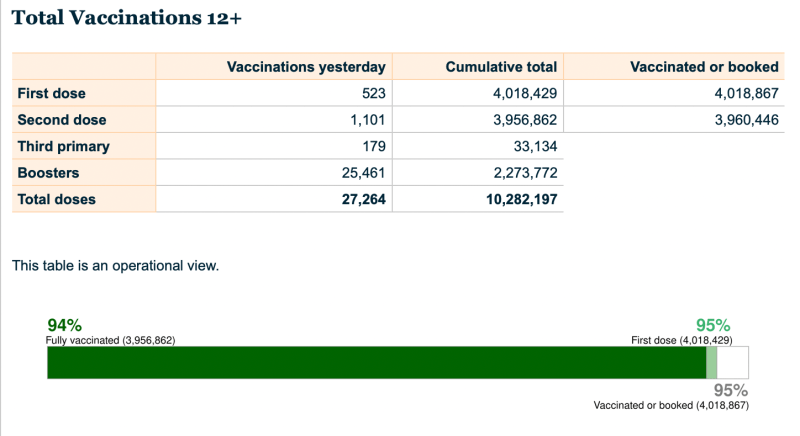
Nearly 2.3 million people over 12 have been given boosters, roughly 53% of that entire population.
Clearly those incredible rates of uptake must have been enough to maintain the “blanket of herd immunity” that Fauci claimed would be achievable with 75-85% of the population vaccinated.
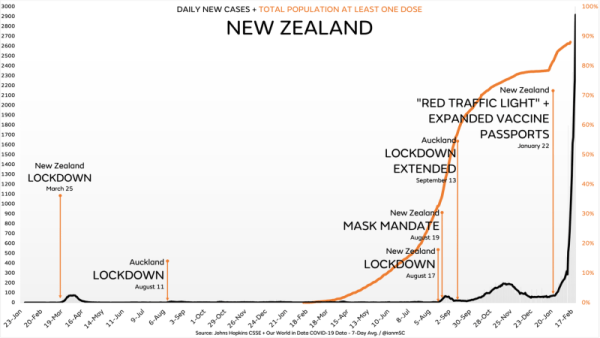
Not exactly!
Whenever you reference the dramatic failure of Australia or New Zealand to maintain “zero COVID” lockdowns and “elimination” strategies, adherents to the cult of inaccurate expertise will respond by claiming their goal was only to eliminate cases until widespread vaccination.
By allowing for vaccines to blunt the impact of cases, these countries would prevent surges in hospitalizations. We already saw that this was wildly off in Australia:
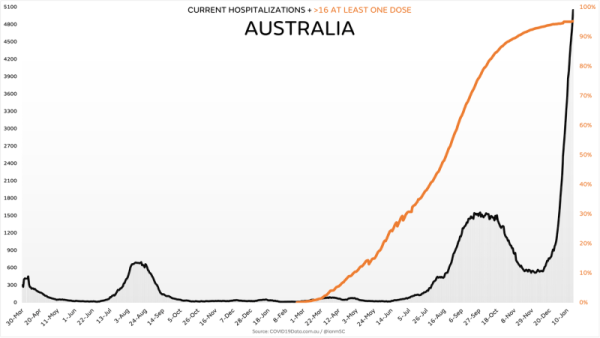
But what about New Zealand? Maybe they’ve been able to successfully stave off any surge in severe cases due to their exceptional vaccination rate:
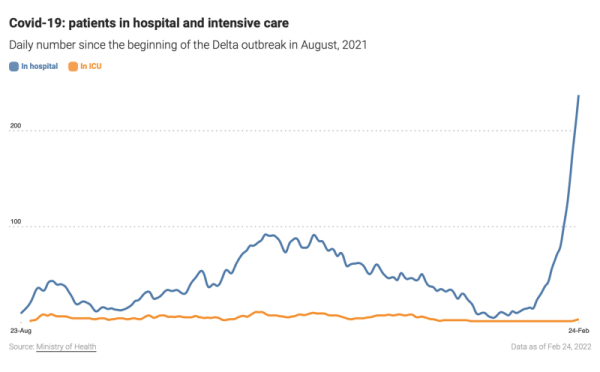
Well. Not exactly.
Hospitalizations have risen dramatically since January and continue to rise significantly each day.
News reports from New Zealand sound like those from any generic location in the US where local doctors report concerns of hospitals being overwhelmed:
Authorities anticipate Omicron will become the predominant Covid-19 variant in New Zealand within just two to four weeks of it being introduced into the community – and hospitals are bracing to be “swamped”.
Dr John Bonning, a frontline emergency department doctor and immediate past president of the Australasian College for Emergency Medicine, said EDs were already under “enormous duress”.
So their elimination strategy did not prevent a dramatic increase in cases, nor a concerning, overwhelming surge of hospitalizations.
And deaths, while thankfully still low, have increased in recent months as well:
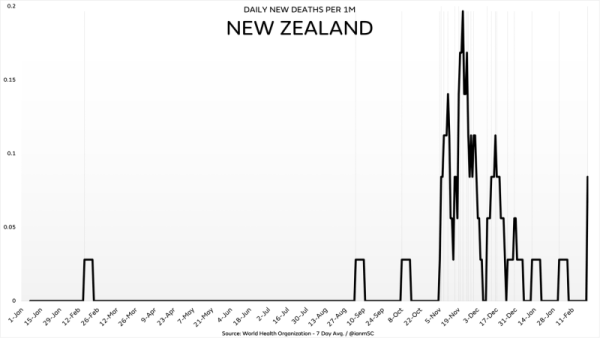
New Zealand’s supposed “elimination” through their zero COVID policy has completely collapsed.
Mask mandates, as their own research indicated, have not prevented surges. Elimination until vaccination has not prevented surges. Zero COVID has been an unmitigated failure, as any rational person would have known and suggested as far back as summer 2020.
They’ve maintained an unearned sense of superiority, exemplified in this quote from the BBC’s story:
He says it is “a bit of a puzzle for us at a distance to understand why” with the UK’s extensive scientific expertise and health care, “you haven’t looked at the evidence and worked out a pattern like New Zealand’s”.
The UK government has previously defended its coronavirus strategy, saying its approach was “being guided by the science.”
That undeserved attitude can no longer be maintained.
The policies that never had the slightest possibility of long term success, the policies that Fauci claimed could be successful in “certain countries,” have turned into yet another example of the delusions of hubris.
While many areas are lifting mandates, they’re doing so without acknowledging the underlying flaws in their strategy. Iceland’s health ministry summed up the inescapable reality of COVID while announcing an end to all restrictions:
“Widespread societal resistance to COVID-19 is the main route out of the epidemic,” the ministry said in a statement, citing infectious disease authorities.
“To achieve this, as many people as possible need to be infected with the virus as the vaccines are not enough, even though they provide good protection against serious illness,” it added.
Until they understand and accept those sentiments, there will always be excuses for politicians and public health officials to bring back their prized, ineffectual interventions.
New Zealand is the latest in a long list of countries to be hailed as showing the world the “right” way to prevent surges; to keep COVID under control.
But as with masks, vaccine passports and “early” lockdowns, zero COVID never had a chance of working — despite the endless media and expert praise.
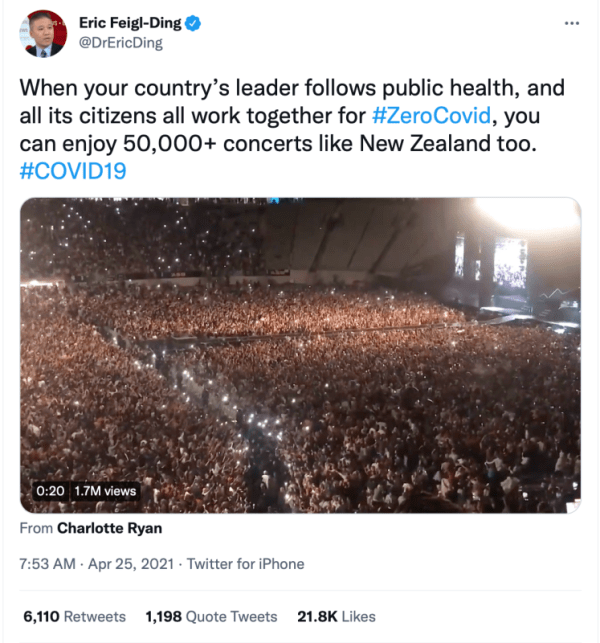
As always, Eric Feigl-Ding had absolutely no idea what he was talking about:
Featured Video

New positive ivermectin evidence
or go to
Aletho News Archives – Video-Images
From the Archives
Secret Document Reveals Plans for Civil War in Lebanon, Israeli False Flags, and Invasion
By Randi Nord | Geopolitics Alert | April 5, 2019
Beirut – During his visit with US Secretary of State, Mike Pompeo, Lebanese President Michael Aoun reportedly received a US-Israeli document detailing plans for creating a civil war in Lebanon with covert false flag operations and possible Israeli invasion.
Although the source of the document is Israeli and created in partnership with Washington, no one knows who presented it to Aoun. The Lebanese TV station, Al-Jadeed, initially reported the document on Lebanese TV and a video on its website. Geopolitics Alert translated the report for this article. … continue
Blog Roll
 Aletho News
- EU Council Advances Chat Control 2.0 Scanning Proposal
- Ex-Greek MEP files complaint against Israeli spyware firm over alleged Pegasus surveillance
- Troubling ideas throughout the Torah, Talmud, Mishneh Torah and Tanya
- ‘Grave, alarming’: Iran mission on Trump’s UNGA ‘annihilation’ threats
- Najaf airport to reopen to Iranian flights within 24 hours: Ambassador
- From ‘How Will This End For Iran’ to ‘When America Walks Away’: A tale of two Economist covers
- Tehran blasts ‘baseless’ speculation linking Iran to alleged bomb plot at UK air base
- The Rise And… Rise Of ‘Color Revolutions’
- The Coming GOP Bloodbath?
- Arctic Scare Stories Melt Away
- If Americans Knew
- Netanyahu Asked UAE Leader to Deny Report on Oct. 7 Warning in Secret Visit, Sources Say
- CNN Chief Int’l Correspondent Clarissa Ward on Journalists in Gaza
- Democratic Party Consultants Surround Troy Jackson with Pro-Israel Donors
- Christian Leader Responds To Netanyahu’s Claims Regarding Palestinian Christians
- In Gaza, ‘Whoever Survives the Bombing Won’t Survive the Rubble’
- Israel kills more Palestinians, amid push to resettle Gaza – Daily Update
- Israel forces Gazans to live in constant peril – Daily Update
- Deconstructing Netanyahu’s pants-on-fire UN rant – Daily Update
- Trump betrayed voters with his campaign lies and prioritized a foreign country once he took office
- Netanyahu calls Israel’s war in Gaza ‘opposite of genocide’ in UN speech to near-empty hall
- No Tricks Zone
- New Study: Earth And Venus Surface Warmth Largely Explained By Convection And Lapse Rate, Not CO2 Or Radiation
- 2025 Nature Paper Claiming Worsening Global Drought Gets RETRACTED …Heavily Flawed
- New Study: ‘Global Drought Shows No Detectable Recent Acceleration Under Climate Warming’
- Economic Masterminds: German Socialists Suggest Taxing Productivity Gains Stemming From Using AI
- The South China Sea Has Not Been Cooperating With The Climate Change Narrative
- Energy Crisis: Germany Enters Heating Season With Historically Low Gas Reserve Fill Levels
- New Study: The Antarctic Ice Sheet Gained Mass From 2020-2024 Due To Staggering Snow And Ice Accumulation
- Study: Ocean Heating Rates From Thousands Of Years Ago ‘Dwarf’ Modern Ocean Heating Rates
- Climate Extremists Target, Attack Large-Scale Power Grid Infrastructure In Germany!
- New Study: Antarctic Ice Melt Has Contributed Less Than 1 Centimeter To Sea Level Rise In The Last 30 Years

