Iran’s SURVIVAL INSTINCT MORE INTENSE THAN EVER /Lt Col Daniel Davis
Daniel Davis / Deep Dive – May 9, 2026
Al Mayadeen | May 16, 2026
Residents of the al-Bustan neighbourhood in Silwan, located in occupied al-Quds just below the walls of the Old City, are being forced to demolish their own homes to make way for “Israel’s” expansionist project in the area, The Guardian reports.
Palestinians have been forced to demolish their own homes for decades as a form of “collective punishment” in an effort for the Israeli entity to continue its settlement expansion.
The coercive mechanism that “Israel” is employing in Silwan is not only meant to dehumanise the families, but is laced with financial threats as well. The Guardian reports that residents are being told that if municipal workers demolish the homes, the cost would reach approximately 280,000 shekels.
One resident, Jalal al-Tawil, described to The Guardian the feeling of watching a hired tractor dismantle the home built by his father, which itself stood on the foundations of his grandparents’ house. “This is something really hard. This is something bitter,” he said, noting that it meant erasing multiple generations of family history in a single act.
He also left the remains of a 35-year-old grapevine until the end, recalling that it once produced fruit for the entire neighbourhood. The vine, like the house, was ultimately destroyed as part of the demolition.
The Guardian reports that residents described the situation as both physically destructive and psychologically draining, as entire family histories are reduced to rubble in front of them.
‘Kings Garden’ as tool of occupation
The demolitions are taking place in preparation for the planned “King’s Garden” project, a biblical-themed development intended to be built on cleared land in al-Bustan.
The project is promoted as a heritage and archaeological initiative, which Israelis claim links to the historical narrative of King Solomon. It is also presented as part of a wider archaeological-tourism network centered on the nearby “City of David” site.
However, the project is not merely cultural or recreational as the Israeli occupation claims, but forms part of a broader strategy of spatial reconfiguration in occupied al-Quds, where archaeological interpretation is used to reshape the urban landscape and occupy land inhabited by Palestinian families.
That said, the transformation of residential neighbourhoods into curated heritage zones is a mechanism for displacing existing communities while embedding a singular historical narrative over a multi-layered living city.
Systematic targeting of al-Bustan homes
More than 57 homes in al-Bustan have been demolished over the past two years, with at least eight additional structures designated for demolition in the coming weeks.
Municipal Israeli bodies allege that the homes were built without permits and that the area was never zoned for residential use. But residents rejected this false claim, arguing that many homes were built decades ago, including structures that predate the occupation of Palestine.
They also point to a broader pattern of unequal planning enforcement in occupied al-Quds, where Palestinian construction is frequently targeted while other forms of unauthorized building elsewhere by settlers in the city are treated differently.
Life under demolition orders and economic strain
The demolition campaign is also increasing severe financial pressure on residents.
Fakhri Abu Diab, the al-Bustan community leader, had his home demolished in 2024. He is still paying a municipal fine of approximately 43,000 shekels, which is being repaid in monthly instalments of around 4,000 shekels.
Abu Diab also reported being charged an additional 9,000 shekels for costs that are associated with police operations during the demolition process.
Following the destruction of his home, he and his wife now live in a portable cabin placed amid the rubble of the original structure. Only a portion of the former kitchen remains standing.
Contesting narrative of ‘public development’
Israeli authorities, in attempts to hide the brutality of their project, told the media that the “Kings Garden” project is intended to serve all city residents and address a shortage of public green space. However, the reality is that it serves as another expansionist project of the Israeli regime to push Palestinians out of their ancestral homes.
Residents and community representatives of Silwan dispute the claims made by the Israelis, stating that they themselves proposed a comprehensive master plan for the neighbourhood that included green space and regulated development, but that it was rejected at the political level.
They argue that enforcement is inconsistent, pointing to the expansion of unauthorised settlement structures in other parts of occupied al-Quds and the West Bank that do not face the same level of demolition enforcement.
Al Mayadeen | May 16, 2026
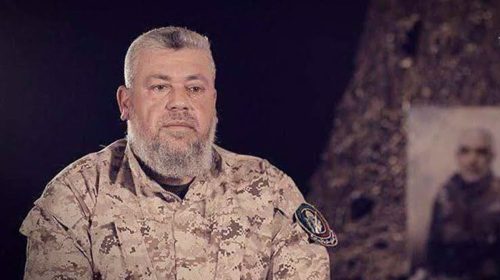
The al-Qassam Brigades, the military wing of Hamas, announced the martyrdom of its Chief of Staff, Ezzeddin al-Haddad “Abu Suhaib,” stating that he was killed alongside his wife, daughter, and several Palestinians in an Israeli assassination in central Gaza City.
In its statement, al-Qassam slammed the killing of its senior commander as a “cowardly assassination” carried out by the enemy in a blatant violation of the ceasefire agreement, adding that targeting him would only reinforce the Resistance’s determination to continue its path of struggle.
Al-Qassam stated that his martyrdom would further strengthen the resolve of the steadfast Palestinian people to continue confronting the occupation, reaffirming their commitment to the path of resistance despite continued assassinations and ongoing Israeli escalation in the Gaza Strip.
Sources within the Palestinian Resistance had confirmed to Al Mayadeen that al-Haddad was martyred in an Israeli attack on the Gaza Strip earlier today.
The Israeli occupation forces had carried out a massacre in the al-Rimal neighborhood in Gaza City, killing eight Palestinians and wounding over 40 others by targeting a residential building. Local sources reported that the attack struck a populated residential area, causing significant destruction and casualties among civilians.
Who was Ezzeddin al-Haddad?
Martyr Ezzeddin al-Haddad was born in Gaza in 1970 and joined Hamas when the movement was established in the 1980s. He was nicknamed the “Ghost of the Gaza Strip” due to his operational secrecy and his privacy in Gaza.
He succeeded Martyr Mohammad al-Sinwar following his assassination in 2025, and had been involved, during Operation al-Aqsa Flood, in ensuring the well-being of Israeli captives.
Several released Israeli captives disclosed that they had met al-Haddad during their time in Gaza, and revealed that he insisted on speaking to them in Hebrew and asked them if they had any needs. One captive said that al-Haddad instructed Resistance fighters to bring the captive a book he had lost, according to Israeli media.
“Israel” attempted to assassinate al-Haddad six times and had placed a bounty worth $750,000 in return for information about his whereabouts.
He was martyred on May 15, 2026, in al-Rimal, alongside his wife and daughter. Thousands of Palestinians flooded the streets of Gaza during the funeral.
Ceaseless attacks on Gaza
The Israeli aggression on the Gaza Strip continues unabated, with strikes targeting the Halawa refugee camp in Jabalia earlier today, despite the so-called ceasefire achieved almost a year ago.
The Health Ministry and hospitals across the enclave reported 13 martyrs over the past 24 hours, including one Palestinian who succumbed to injuries sustained in an Israeli attack, alongside 57 injuries.
The death toll in Gaza has risen to 72,757 killed and 172,645 injured since October 7, 2023.
MEMO | May 15, 2026
US media is systematically biased in favour of Israel, an analysis by The Intercept has uncovered. Investigation of more than 12,000 articles and 5,000 TV segments found mainstream US coverage was “one-sided, racist and dehumanising”, helping Israel justify its genocide in Gaza.
The investigation, published this week and drawn from research for a forthcoming book, examined more than 12,000 articles from the New York Times, the Washington Post, CNN.com, Politico, Axios, USA Today and The Associated Press, alongside 5,000 television segments aired on CNN and MSNBC.
The focus is on centre-left outlets influential with the Biden administration during the first year of Israel’s assault on the besieged Gaza Strip.
The analysis identifies seven recurring patterns that, taken together, document the US media’s role in selling Israel’s narrative to the American public as the death toll in Gaza mounted into the tens of thousands.
Chief among the findings is the near-exclusive application of the phrase “right to defend itself” to Israel. On CNN and MSNBC, anchors, reporters and guests invoked the right to self-defence for Israel 94 times more often than for Palestinians, the analysis found. In print, Israel was afforded the same right more than 100 times as frequently.
The report also documents how the term “human shields” — a designation rejected by leading human rights organisations when applied to guerrilla forces operating near civilians — was used hundreds of times to describe Palestinian fighters, implicitly rationalising the killing of civilians in Israeli strikes. By contrast, the surveyed television coverage contained no references at all to the Israeli military’s own documented use of human shields, despite cases that meet the legal definition.
Emotive language was applied with similar partiality. Over a 100-day period in which roughly 24,000 Palestinians were killed, words such as “massacre”, “barbaric”, “savage” and “slaughter”, when used in outlets’ own editorial voice, were deployed “entirely in favour of Israel”, the analysis states.
Following Israel’s bombing of al-Ahli Arab hospital in Gaza City on 17 October 2023, US outlets rapidly adopted the qualifiers “Hamas-run” and “Hamas-controlled” when citing Palestinian casualty figures, a framing the report says functioned to discredit the death toll. Neither CNN nor MSNBC used the phrase in the first ten days of the assault; its use then climbed sharply, even as the US State Department, the World Health Organization and Human Rights Watch continued to treat figures from the Gaza Health Ministry as reliable.
The analysis further finds that victims likely to elicit public sympathy — journalists and children — received markedly less coverage during the first 100 days of Israel’s assault on Gaza than their counterparts in Ukraine had received in the equivalent early phase of Russia’s war.
Coverage of rising hate crimes in the same period focused almost entirely on anti-Semitism, with little attention paid to documented Islamophobia or to the impact of the killing in Gaza on Palestinian, Arab and Muslim communities in the US.
Perhaps the starkest example, the report says, is the contrast between the New York Times’ treatment of the resignation of Harvard University’s former president Claudine Gay and its coverage of the killing of five-year-old Hind Rajab, who was left to die in a vehicle alongside her family after coming under Israeli fire in Gaza.
The Cradle | May 14, 2026
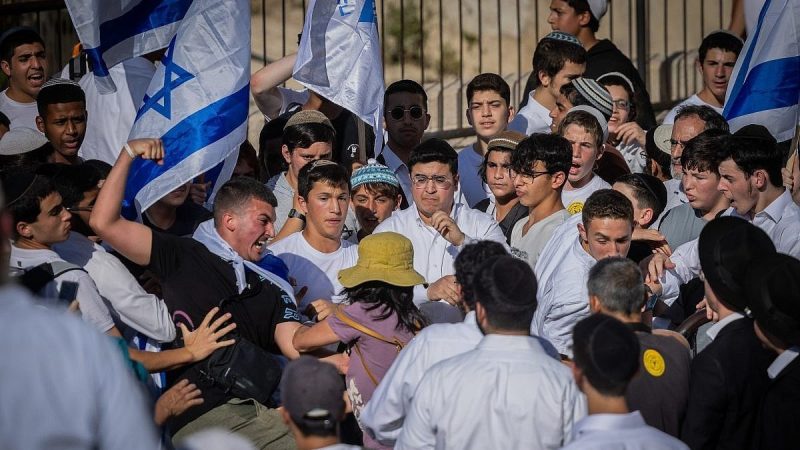
Tens of thousands of Jewish settlers descended on occupied Jerusalem on 14 May to celebrate the so-called ‘Flag March,’ beating Palestinian residents in the Muslim Quarter of the city, damaging storefronts, and shouting anti-Arab slogans.
The event, also known as the Flag Dance, commemorates the Israeli conquest of East Jerusalem during the Six-Day War in 1967.
Even before the parade began, Zionist youths pushed and cursed Palestinian residents and activists from “Standing Together,” an Israeli-Palestinian group established to protect Palestinians during the parade.
“When we put our bodies on the line, it oftentimes reduces the violence because settlers are less willing to attack when there are Jews there or when we document what’s going on,” stated Ori Shaham, the group’s international spokesperson.
The parade has long been marked by violence, extreme racism, and hate songs directed against the Palestinian residents of the Old City.
On Wednesday, the Knesset’s Aliyah, Absorption, and Diaspora Committee held a discussion on the violence directed against Christians during the annual parade.
The committee’s chairman, MK Gilad Kariv, stated that “there is nothing more ugly and offensive to the status of Jerusalem than the ugly behavior on the sidelines of the Flag Parade.”
“Every year we know what will happen … Muslim and Christian residents will close their shops, close their homes and schools, and lock themselves in their homes so as not to be exposed to violence? Is this the way of Judaism and the Torah of Israel?”
Last month, Haaretz reported that the Authority for Jewish National Identity in the Prime Minister’s Office provided nearly $200,000 in funding to organize the parade.
The remainder of the $400,000 budget was provided by the Foundation for the Renewal of Communities in Israel, an umbrella organization for several Torah groups.
National Security Minister Itamar Ben-Gvir used the Flag Day march to make a provocative raid on the Temple Mount, home to the Al-Aqsa Mosque, the third-holiest site in Islam.
Ben Gvir declared the Temple Mount to be “in our hands,” claiming Israel had “restored sovereignty on the Temple Mount thanks to determination and deterrence.”
The Jerusalem Day parade is being held the day before Palestinians commemorate the Nakba (or Catastrophe) when pre-state Zionist militias killed some 13,000 Palestinians and violently expelled 750,000 from their homes and lands in 1948, enabling the creation of the State of Israel.
MEMO | May 13, 2026
Russian Foreign Minister Sergey Lavrov accused the US of trying to distract global attention from Palestine, Anadolu reports.
Commenting on the situation in the Middle East in an interview with RT India TV channel, Lavrov said ongoing US-provoked disputes involving Iran, Venezuela, Cuba, Greenland and Canada were distracting international attention from the Israeli-Palestinian conflict.
“All of the efforts that are being taken right now on Venezuela, Iran, Cuba, Greenland, and now Canada … all of these issues are moving us away from settling the most protracted, the most negative crisis in the world – that is, the crisis around Palestine,” he said.
The minister criticized American proposals regarding the future of the Gaza Strip, saying they did not address the establishment of a Palestinian state.
“I have no doubt that when plans to stir up aggression against Iran were being hatched, one of the goals was to prevent the normalization of relations between Iran and the Arab states,” he said.
He added: “Now, everything is being done to ensure that reconciliation never happens … and to pull its other Gulf neighbors into structures that, first, will not focus on resolving the Palestinian issue, and second, will force them to betray the Palestinian cause as the price for normalizing relations with Israel.”
Lavrov argued that failure to create such a state would prolong instability and extremism in the region for decades.
“We are returning to a period when everything is decided by force and international law is ignored,” Lavrov said.
The North Star with Shaun King | May 9, 2026
In the Fall of 2023, local, national, and even international news reported that a New York man made a series of threats against Jewish students and staff at Cornell University. A year later he was actually convicted and sentenced to nearly two years in prison for it.
It happened. Students there were actually afraid. I don’t want to pretend that they weren’t.
But there is one detail in this story that pretty much changes EVERYTHING.
According to NPR’s own reporting, the lawyer for Patrick Dai — the former Cornell student sentenced to 21 months in prison for making violent threats against Jewish students — said Dai made those threats as a “misguided attempt” to generate support for Israel and that he was a devout supporter of Israel. It was a false flag attack.
Patrick Dai, a former Cornell student from Pittsford, New York, pleaded guilty to one felony count of posting threats to kill or injure another person using interstate communications. According to the Department of Justice, Dai admitted that on October 28th and 29th, 2023, he posted anonymous threats to the Cornell section of an online discussion forum, including threats to shoot up 104 West, a Cornell dining hall that serves kosher meals and is located next to the Cornell Jewish Center.
The posts were vile.
They were criminal.
They terrorized Jewish students.
And Dai deserved serious consequences.
But that is not the whole story.
The part that should have been in the headline — or at least in the first few paragraphs — is that Dai’s own attorney said he was not acting out of hatred for Israel, but out of a desire to defend it. Except I had to literally scroll down TWELVE PARAGRAPHS to learn that the student was a Zionist who did it all to make people feel more sympathy for Israel.
NPR reported that Dai’s lawyer, Lisa Peebles, described his actions in a court filing as a “misguided attempt to highlight Hamas’ genocidal beliefs and garner support for Israel.” She said he believed the posts would create “blowback” against what he perceived as anti-Israel media coverage and pro-Hamas sentiment on campus.
Read that again.
According to his lawyer, he made threats against Jewish students to create sympathy for Israel.
That is not a small detail.
That is not a footnote.
That is the story.
Because if that defense claim is true, even partly true, then this was not just a case of antisemitic threats in the simple way NPR framed it. It was a false-flag-style propaganda act: a man allegedly posing as the very hatred he claimed to oppose in order to manipulate public opinion.
And NPR buried that fact deep inside the story.
That matters because media framing shapes public consciousness. Most people never read to paragraph 10 or 12 or 15. They read the headline. They skim the first few paragraphs. They absorb the frame. And the frame here was simple: a former Cornell student made antisemitic threats during a period of rising campus tension after October 7th.
But the buried fact makes the story more complicated and more politically explosive.
The threats were real. The fear was real. The crime was real. But according to the defense, the motive was not what the public would naturally assume.
That is the tension NPR should have centered.
To be fair, prosecutors rejected Dai’s explanation. NPR reported that federal prosecutors described his claims as “self-serving” and said they were contradicted by the threats themselves and by his later apology. The court also found that his conduct qualified as a hate crime under federal sentencing guidelines because he targeted Jewish students and substantially disrupted Cornell’s educational function. The Justice Department said the threats “terrorized the Cornell campus community for days and shattered the community’s sense of safety.”
That must be included.
But including the prosecution’s view does not erase the media problem.
The public deserved to know, from the start, that the defendant’s lawyer said this was an attempt to manufacture sympathy for Israel. Arab News, citing AFP, stated it much more directly:
Peebles told the court Dai was “pro-Israel” and made posts “in the guise of an anti-Semite Hamas extremist.”
That phrase should stop everybody cold.
“In the guise.”
Meaning, according to the defense, he was pretending.
If a Muslim student had posted fake Islamophobic threats against Muslims and later claimed he did it to generate sympathy for Palestine, do we honestly believe NPR would have buried that detail deep in the story?
No.
It would have been the headline.
It would have been the lead.
It would have been the entire frame.
We would have heard about hoaxes, manipulation, propaganda, radical activism, and fake victimhood. Every cable news panel would ask what this says about pro-Palestinian movements. Every politician who wanted to criminalize Palestine solidarity would use it as evidence.
But when the alleged motive points in the other direction — toward manufacturing support for Israel — suddenly the detail is handled delicately, carefully, quietly.
That is the double standard.
And it is not harmless.
Since October 2023, American media has repeatedly helped create an atmosphere where Palestinian, Arab, Muslim, and anti-war students are treated as presumed threats. Their protests are scrutinized. Their chants are criminalized. Their grief is pathologized. Their politics are framed as danger before they are understood as dissent.
Meanwhile, this case involved a man who admitted to making horrific threats against Jewish students — and whose own lawyer said he did so to create backlash against anti-Israel sentiment.
That should have forced a deeper media conversation about how fear is manufactured, how propaganda works, and how quickly institutions accept narratives that benefit Israel.
Instead, the story was mostly folded back into the same familiar frame.
“Rising antisemitism.”
“Campus tensions.”
“Threats against Jewish students.”
Again, the threats were real. Jewish students were harmed. Nothing about Dai’s claimed motive changes the terror they experienced.
But motive matters.
Political context matters.
Media framing matters.
Because when a threat is allegedly staged to create sympathy for Israel, the public deserves to understand that clearly. Not as an afterthought. Not buried beneath official statements. Not softened into a detail most readers will miss.
The same media institutions that demand endless nuance when Israel bombs hospitals, schools, refugee camps, journalists, doctors, and children somehow lose their curiosity when a story might reveal pro-Israel manipulation.
That curiosity returns only when it can be aimed at Palestinians, Muslims, Arabs, immigrants, protesters, or anyone demanding an end to genocide.
This is why independent media matters.
Because the question here is not whether Dai should have been punished. He should have been.
The question is why one of the most important facts in the story was buried.
The question is why a case that may involve false-flag-style threats designed to “garner support for Israel” was still framed mainly as a straightforward example of antisemitic danger on campus.
The question is why American media is so much more comfortable telling stories that benefit Israel than interrogating stories that expose how support for Israel is manufactured.
That is the real story.
And NPR had it.
They just buried the lead.
Love and appreciate each of you.
Your friend and brother,
Shaun
Al Mayadeen | May 11, 2026
The producers of the documentary “Gaza: Doctors Under Attack” used their BAFTA TV Awards win on Sunday to publicly denounce the BBC for refusing to air the film, accusing the network of censoring coverage of “Israel’s” genocidal assault on Gaza and silencing voices that document the atrocities committed against Palestinian medical workers.
The documentary, originally commissioned by the BBC but never broadcast due to what the network called “concerns about impartiality” towards “Israel,” won in the current affairs category at the BAFTA ceremony in London. The film was eventually aired by Channel 4 and investigates the systematic targeting of medical personnel and healthcare infrastructure in Gaza during the ongoing genocide.
Journalist Ramita Navai delivered a speech while accepting the award, in which she stated that the occupation has killed tens of thousands of civilians in Gaza and deliberately targeted hospitals and medical workers. According to the documentary’s investigation, more than 1,700 Palestinian health workers have been killed, and over 400 have been abducted by Israeli forces.
Citing United Nations language, Navai described “Israel’s” attacks against Gaza’s medical infrastructure and personnel as “medicide.” She concluded her remarks with a defiant message: “We refuse to be silenced and censored.”
Executive producer challenges BBC on camera
Executive Producer Ben De Pear, speaking during the acceptance speech, dedicated the award to journalists in Gaza who continue to work under extreme danger. He then directly addressed the BBC on camera, questioning whether the broadcaster would also cut their acceptance speech from the delayed broadcast of the ceremony.
De Pear’s challenge to the BBC adds renewed pressure on the network over its long-standing Zionist bias and controversial editorial decisions regarding coverage of Palestine.
The incident follows a report by a Freedom of Information NGO on April 16, 2026, revealing that BBC executives have met nine times with Zionist groups since the start of the genocide, compared to just once with pro-Palestinian organizations.
Furthermore, over 100 BBC staff signed an open letter on July 2, 2025, addressed to Director-General Tim Davie, accusing the broadcaster of acting as “a mouthpiece” for “Israel” and failing its own editorial standards.
The documentary team’s defiance at the BAFTA awards underscores a growing crisis of credibility for the BBC, as even its own journalists and the filmmakers it commissioned accuse the network of actively suppressing evidence of war crimes and genocide.
UK mainstream media has been constantly criticized for its coverage of “Israel’s” genocide on Gaza, sparking controversy for its journalistic biases that promote double standards through misinformation.
“The coverage of Gaza has several noticeable features. There have been instances of misleading and factually incorrect information being published throughout the last 10 months,” media analyst at the Centre for Media Monitoring (CfMM) Faisal Hanif told Anadolu in September.
“Israel” killed two four-day-old newborn twins at their parents’ apartment in central Gaza in an airstrike as their father went to collect their birth certificates.
Western mainstream news outlets, including the BBC and Sky News, did not mention “Israeli strikes” in their headlines on their social media posts, prompting online users to ask “Killed by who?”
Hanif highlighted that many Western news outlets continue to refer to a fabricated story presented at the beginning of the Israeli aggression on Gaza, claiming the Palestinian resistance “beheaded babies.”
The media analyst emphasized that Israeli Prime Minister Benjamin Netanyahu referred to the debunked narrative in his address to the US Congress in July 2024, which the BBC reported verbatim without providing context for readers that investigative journalists determined the story to be a fabrication.
Glenn Diesen | May 9, 2026
Daniel Davis / Deep Dive – May 9, 2026
Glenn Diesen | May 9, 2026
Larry Johnson is a former CIA intelligence analyst who also worked at the U.S. State Department’s Office of Counterterrorism. Johnson discusses how the Iran War is putting an end to the former security architecture of the Middle East.
Read Larry Johnson’s Sonar21: https://sonar21.com/
Follow Prof. Glenn Diesen:
Support the research by Prof. Glenn Diesen:
Palestinian Information Center – May 8, 2026
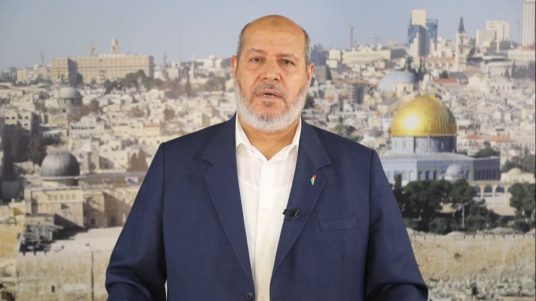
Khalil al-Hayya, head of the Islamic Resistance Movement, Hamas, in the Gaza Strip, said Israel’s attempts to impose its will through assassinations and attacks on political leaders and their families “will fail,” following the assassination of his son Azzam al-Hayya in an Israeli strike on Gaza City.
Speaking during a memorial gathering on Thursday, al-Hayya described the martyrdom of his son, alongside several other Palestinians, including neighbor Hamza al-Sharbasi, as part of a continuing campaign targeting Palestinian families and resistance leaders.
He said the martyrdom of Palestinians would only strengthen the struggle for the liberation of Palestine and Jerusalem, adding that Israel’s efforts to pressure negotiators through violence would not succeed.
Al-Hayya also linked the attack to previous Israeli strikes targeting Hamas negotiators in Qatar last year, saying the Movement continued negotiations “on behalf of its people and national interests,” despite ongoing attacks.
Meanwhile, Khaled Mishaal, head of the Hamas Movement abroad, praised al-Hayya’s resilience during the funeral gathering, describing the loss of multiple sons and relatives as “a great sacrifice.”
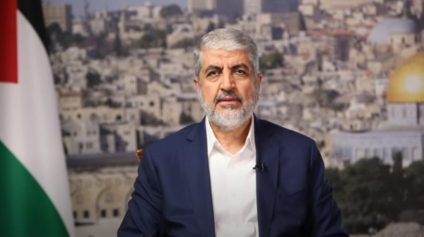
Mishaal said Gaza continues to “write epics of steadfastness and sacrifice” despite the Israeli war, siege, and destruction, arguing that the suffering endured by Palestinians increases the responsibility of the wider Arab and Muslim world toward Gaza and the Palestinian cause.
He also called for greater support for Palestinians in Gaza, the West Bank, Jerusalem, and Palestinian prisoners, while stressing that the sacrifices made during the war were “not only for Palestine but for humanity as a whole.”
Press TV – May 8, 2026
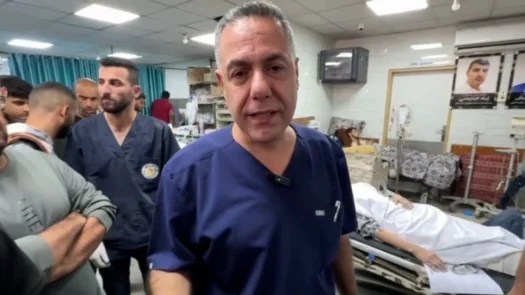
Former Palestinian detainees have come forward with disturbing firsthand accounts of the systematic torture inflicted on Dr. Hussam Abu Safia, director of Gaza’s Kamal Adwan Hospital, during his detention in an Israeli prison.
Rami Abu Amira, a former prisoner, described how interrogators stripped Dr. Abu Safia naked and set police dogs on his frail body, leaving deep wounds and scratches.
Ahmad Qaddas recounted that the prison cells echoed with the doctor’s screams as he endured severe beatings.
He said he could no longer recognize Abu Safia due to extreme weight loss and his dazed, barely conscious state.
“He was physically shattered,” Qaddas added. Another former detainee, Hamza Abu Amira, spoke of the “relentless humiliation” and combined physical and psychological torture carried out by specialized Israeli prison units.
Guards reportedly forced Dr. Abu Safia to repeat degrading phrases while inflicting extreme pain in an apparent effort to break him.
Prisoners also described repeated night raids on their cell using sound grenades and tear gas canisters. Other detainees were strictly forbidden from approaching his cell or inquiring about his condition.
Dr. Abu Safia has been held since 27 December 2024, when Israeli forces abducted him during their assault on Kamal Adwan Hospital — the last functioning hospital in northern Gaza at the time. Even after an Israeli airstrike killed his own son, he had refused to abandon his post and his patients.
In March, UN Special Rapporteurs Tlaleng Mofokeng and Ben Saul confirmed receiving credible reports of his torture and the systematic denial of medical care.
They warned that his life was in grave danger and urged countries with influence over Israel to intervene.
Yet the US and its Western allies have taken no meaningful action to halt Tel Aviv’s brutality.
A UK-based human rights organization described his arrest as part of Israel’s broader policy of systematically targeting Palestinian health workers and destroying Gaza’s healthcare system — actions it said were intended to create conditions calculated to bring about the physical destruction of the Palestinian people.
Dr. Abu Safia is one of at least 737 Palestinian medical workers arbitrarily detained by Israeli forces since October 2023.
During the same period, at least 1,722 medical personnel have been killed — an average of more than two per day.
The World Health Organization has documented over 930 attacks on Gaza’s healthcare system, with all 36 hospitals damaged or destroyed and only half partially functional.
These assaults form part of a deliberate campaign to annihilate Gaza’s healthcare infrastructure as an integral component of Israel’s genocidal war on the Strip, which has so far claimed more than 72,500 Palestinian lives since October 2023.
MEMO | May 8, 2026
The UK Department for Business and Trade (DBT) has granted two new licences for the export of military equipment to Israel, including an £8.7 ($11.85) million licence covering “components and technology for targeting equipment”, the Campaign Against Arms Trade (CAAT) has revealed.
The licences were issued despite the British government’s September 2024 suspension of such exports over fears they would be used in Israel’s genocide in Gaza. CAAT’s analysis of UK export licensing statistics for the fourth quarter of 2025, published on 30 April, found that the UK issued export licences worth £20.5 ($27.9) million in total for transfers to Israel during the quarter.
The most significant of the new approvals was an Open Individual Export Licence for “components and technology for targeting equipment” — a category of export the UK government had publicly suspended eight months earlier, citing the risk of use in Israel’s genocide in Gaza. When questioned about the licence, DBT replied that it “covers items for re-export from Israel, and the Government of Israel is not an end-user or ultimate end-user. This is consistent with our suspension”.
CAAT said the defence rested on a legal fiction. The watchdog warned of the risk of “auto-diversion”: a process by which Israel can fail to retransfer military equipment to its declared destination and instead assign it to an unauthorised end-user, such as the Israel Defence Forces (IDF), for use in Gaza.
Such a move would constitute a breach of the export licence and a potential criminal offence under UK law. British ministers have previously said they would revoke any licence should “any evidence” emerge that exported equipment had not reached its declared destination, but CAAT noted that the UK government makes no known efforts to verify what happens to its military exports after they leave Britain.
The watchdog’s concerns are not theoretical. In March, an investigation revealed that an Elbit-owned subsidiary in the UK had shipped dozens of drone components, including Watchkeeper engines, to Israel over an 18-month period.
Israel had failed to retransfer the equipment to Romania as required by the licence, citing force majeure arising from its assault on Gaza. The contract with Romania has still not been fulfilled. Elbit announced it would start delivering the drones only two days after Romania threatened to cancel the contract.
A second new licence covers components for military training aircraft, and related technology, for transfer to France, Greece, Israel and Italy — likely supplied by the US aerospace firm Moog for the M-346 Lead-In Fighter Trainer produced by Italy’s Leonardo.
The M-346 is used in every phase of advanced and pre-operational training for Israeli pilots before they fly combat missions in Gaza, Iran and Lebanon using F-16 and F-35 jets. Israel has caused massive devastation with F-35 jets across Gaza, Iran and Lebanon. Similar components shipped by Moog from the UK were recently seized by authorities in Belgium, who have since opened a criminal investigation.
CAAT’s Research Coordinator Sam Perlo-Freeman said the new licences exposed the limits of the British government’s stated policy.
“These new export licenses show just how willing the UK is to continue enabling Israel’s genocidal assaults, while staying within the technical rule of a vastly insufficient and ineffective policy towards IDF war crimes,” he said.
“The targeting equipment for which DBT granted a license, for transfer to and re-export by Israel, could easily be used in Gaza. Given Israel’s history of weapons diversion and illicit transfers, and outstanding questions about Elbit drone components failing to arrive in Romania, there remains a grave risk that Israel will auto-divert the targeting equipment to the IDF for use in Palestine.”
Perlo-Freeman explained that the British government was leaning on a system of declarations it has no power to enforce. “DBT is relying on end-user undertakings that hold no legal force in Israel, which the UK government does not check up on and cannot enforce. The exporter is technically in-the-clear, so long as it can’t be shown they knew the end-user undertaking was false.”
Inside the life of the ruthless businessman who financed coups in Central America and shaped Israeli statehood
José Niño Unfiltered | May 7, 2026
Leftist commentators consistently push a shallow and economically reductive narrative that frames American foreign policy as the sole domain of greedy White capitalists while choosing to ignore the obvious Jewish power structure directing these events. When the veneer of this supposed corporate imperialism is stripped away, it becomes clear that the United States has often served as a vehicle for the specific goals of organized Jewry. The life of Samuel Zemurray stands as prime evidence of this hidden mechanism.
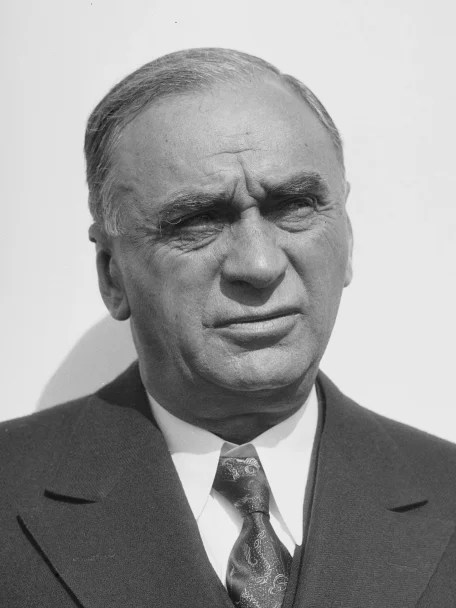
Few figures in American business history wielded power as ruthlessly or as secretly as Zemurray. Born Schmiel Zmurri on January 18, 1877, to a poor Jewish family in Imperial Russia, this teenage immigrant would rise from peddling rotting bananas off railroad cars in Alabama to become the controlling force behind the United Fruit Company, the most powerful agricultural corporation on earth. Along the way he overthrew governments, bribed presidents, hired mercenaries, and played a pivotal behind-the-scenes role in the creation of the State of Israel.
The man who would topple presidents arrived with nothing but a steamer ticket and family connections in the Deep South. After his father died, the 14-year-old Zemurray emigrated to the United States in 1892, traveling in steerage class and landing in New York before making his way to Selma, Alabama, where relatives had settled. He worked as a chicken catcher, carpenter’s assistant, delivery boy, traveling merchant, and housecleaner, eventually saving enough to bring his mother and 6 siblings over from Europe. Standing approximately 6 feet 3 inches tall with enormous energy and hustle, Zemurray was described as a man who could swear fluently in 5 languages. He encountered his first banana around 1893 in Selma, at that time an exotic and expensive delicacy in the United States, and the fruit became his life’s obsession.
Zemurray brought to the banana trade the same scrappy, rule-bending hustle that had carried him from steerage to a Selma general store. In 1895, at age 18, Zemurray traveled to the docks of Mobile, Alabama, and built a niche specializing in what the industry called “ripes” — bananas that were nearly overripe and being discarded by importers. He bought them for pennies and rushed them inland by rail before they spoiled, famously bribing Western Union telegraph operators to wire ahead with sales offers to towns along the route. Starting with just $150, he had saved $100,000 by age 21 and earned the lifelong nickname “Sam the Banana Man.” By selling bananas directly off moving trains, Zemurray turned minimal investments into substantial profits and was soon selling over one million bananas annually.
In 1903, Zemurray signed a contract with United Fruit giving him rights to distribute the company’s ripest bananas. He partnered with Ashbell Hubbard to form the Hubbard-Zemurray Company and by 1905 had moved to New Orleans, acquired the Thatcher Brothers Steamship Company, and taken control of the Cuyamel Fruit Company. By 1910, he had bought 5,000 acres along the Cuyamel River in Honduras near Omoa and borrowed aggressively to expand into plantations, railroads, and bridges. Unlike the patrician executives of United Fruit who ran operations from their offices in Boston, Zemurray spent months each year working directly on his Central American plantations, learning conversational Spanish, mapping land, clearing fields with a machete, killing snakes, and supervising construction in person.
Zemurray’s appetite for direct action soon extended far beyond plantation supervision. The most audacious act of Zemurray’s early career was his personal financing and orchestration of a coup d’état in Honduras in 1910 and 1911. The crisis arose when U.S. Secretary of State Philander C. Knox attempted to resolve Honduras’s large debt to British banks by having J.P. Morgan buy the bonds, in exchange for which a Morgan bank official would collect customs duties on Honduran imports. This arrangement would have obliterated the tax concessions Zemurray had privately negotiated with Honduran officials, effectively threatening to destroy his business. After lobbying the State Department unsuccessfully and being told directly to “butt out” of U.S.-Honduras relations, Zemurray devised an alternative.
While under surveillance by U.S. Secret Service agents enforcing neutrality laws, Zemurray recruited mercenaries in the French Quarter of New Orleans, hired the flamboyant soldier of fortune Lee Christmas and the notorious mercenary Guy “Machine Gun” Molony, and purchased a former U.S. Navy vessel called the Hornet. The conspirators evaded Secret Service surveillance, slipped away from New Orleans, and sailed to Honduras with rifles and ammunition Zemurray had stashed on Ship Island. They joined forces with Manuel Bonilla, the former Honduran president whom Zemurray supported as the preferred replacement. Through a combination of military action, bluffing, and recruiting local rebel forces, the coup succeeded. Bonilla was inaugurated as president of Honduras on February 1, 1912, and immediately rewarded Zemurray with extensive land concessions, duty-free import privileges, and favorable tax arrangements.
The spoils of that intervention elevated Zemurray from ambitious importer to regional kingmaker. Zemurray became known as “the uncrowned king of Central America.” After Bonilla’s death in 1913, he controlled a string of Honduran presidents and in 1925 secured exclusive lumber rights to 1/10 of Honduran territory. The episode established the template for what came to be called “banana republic” politics.
In 1929, Zemurray sold Cuyamel to United Fruit for $31.5 million in stock, becoming one of the wealthiest men in America and the single largest individual stockholder in the company. He nominally retired and moved to an estate outside New Orleans. But the Great Depression devastated United Fruit. The company’s stock collapsed by roughly 90 percent, wiping out most of Zemurray’s fortune. After his written suggestions were dismissed and his proposals ignored at board meetings, Zemurray took extraordinary action — traveling personally to visit individual shareholders and collecting their proxy votes. At a dramatic board meeting in 1932 or 1933, Zemurray placed the collected proxies on the table and reportedly declared to the assembled executives, “You’ve been fucking up this business long enough. I’m going to straighten it out.” He became managing director immediately and then formally president of United Fruit in 1938, serving until 1951.
Under Zemurray’s leadership, United Fruit became a behemoth. It owned rail transportation monopolies, radio communications infrastructure, steamship lines, and port facilities across 13 nations. In some Central American countries, the company operated as what critics described as “a state within a state.” Zemurray openly admitted that bribery was the foundation of his operations.
The most historically catastrophic action tied to Zemurray and United Fruit was the 1954 CIA-backed coup that overthrew Guatemalan President Jacobo Árbenz, a democratically elected leader who had introduced agrarian land reforms. Árbenz’s land reform law, Decree 900, expropriated uncultivated United Fruit land for redistribution to landless peasants. Under Zemurray’s influence, United Fruit launched one of history’s most consequential corporate lobbying campaigns.
Edward Bernays, known as “the father of public relations,” orchestrated press tours, planted stories, and produced films painting Guatemala as a Soviet beachhead in the Western Hemisphere. Both Secretary of State John Foster Dulles and CIA Director Allen Dulles had prior connections to United Fruit as former partners at Sullivan and Cromwell, the company’s main law firm. President Eisenhower authorized Operation PBSUCCESS with a $2.7 million budget. The CIA armed and trained a force under Carlos Castillo Armas, conducted psychological warfare operations, and engineered Árbenz’s resignation on June 27, 1954. Castillo Armas installed a military dictatorship that reversed land reforms, eliminated labor rights, and initiated decades of U.S.-backed military rule that led to over 200,000 deaths in a decades-long civil war.
While Zemurray built his banana empire in public view, he pursued another project almost entirely in the shadows. Beginning in the 1920s, he became personally close with Chaim Weizmann, the leader of the World Zionist Organization and Israel’s eventual first president. At the end of World War II, Zemurray was approached by Zionist leaders and asked to help procure ships for the clandestine network transporting Jews from displaced persons camps in postwar Europe to British Mandate Palestine. Working entirely behind the scenes, he raised money and used his connections to facilitate logistics.
The Jewish corporate magnate was instrumental in obtaining the ship that became the Exodus 1947 for the Haganah, which would explain its Honduran registration — Zemurray’s United Fruit Company effectively controlled much of Honduras. The Exodus carried over 4,500 Jewish refugees toward Palestine in 1947 before being intercepted by the British Royal Navy. The incident became an international cause célèbre and accelerated international support for Jewish statehood.
Zemurray’s most consequential contribution to the founding of Israel was his behind-the-scenes lobbying effort that helped secure passage of UN Resolution 181 on November 29, 1947, the Partition Plan that divided Mandatory Palestine into Jewish and Arab states. The resolution required a 2/3 majority to pass. According to author Rich Cohen, Zemurray made calls from his New Orleans home to Latin American heads of state, pressing for affirmative votes or abstentions. Haiti switched from a “no” vote to an abstention. Nicaragua switched from an abstention to a “yes.” In total, 13 of the 33 “yes” votes came from Latin America, including countries where United Fruit operated.
Samuel Zemurray died in New Orleans on November 30, 1961, at age 84. His philanthropy included major donations to Tulane University, the New Orleans Museum of Art, the Audubon Nature Institute, and Jewish refugee relief efforts. He also contributed financially to The Nation magazine.
If we look closely at the history of 20th century American interventionism, the shadow of the Jewish hand becomes impossible to ignore. Zemurray was not an outlier but a precursor to the modern reality where the United States operates as a private military company for the advancement of Jewish interests abroad.
The multitude of seemingly perpetual interventions of the past century were not driven by the abstract greed of villainous, White American billionaires but by the deliberate orchestration of a distinct group with its own tribal loyalties. We are destined to remain powerless subjects in our own land as long as we fail to unmask the true masters of our state and break free from the suffocating grasp of Jewish supremacy.
Recognizing the crimes of devious figures like Samuel Zemurray is a necessary first step in this process to reclaim our polities from the machinations of organized Jewry.
or go to
Aletho News Archives – Video-Images

Global Times | October 25, 2026
By portraying Chinese characters as perpetrators of ruthless violence while casting Japanese Self-Defense Forces (SDF) intelligence operatives as defenders, the season 2 of the Japanese drama Vivant has recently drawn criticism from Chinese netizens, who argue that its depiction turns historical reality on its head while ignoring Japan’s wartime atrocities.
The TBS drama series – a spy suspense story in which an alleged unofficial intelligence unit of the SDF operates across the globe — has attracted a passionate fanbase. Its currently airing season 2 opened with a household rating of 18.8 percent, the highest for a TV drama this year, according toa commentary article by Japanese media Toyo Keizai.
What draws attention is the portrayal of the enemies in the series, the article noted. Scenes in which the Chinese organization subjects kidnapped members of the SDF unit to brutal torture are repeated with unrelenting intensity.
It is rare for Japanese TV dramas to explicitly portray a real-life country as the enemy, the article noted.
Japanese Prime Minister Sanae Takaichi also made a reference to the drama, saying that she has been recording Vivant and hopes to binge-watch it over the year-end and New Year holidays, according to Japanese media outlets.
China’s CCTV News report on Sunday revealed that the drama features scenes in which Chinese personnel cut off the fingers of and stab Japanese intelligence operatives in the abdomen. Such acts bear striking similarities to the torture inflicted on Chinese nationals by invading Japanese troops during the World War II.
The drama distorts the truth by attributing these atrocities to modern Chinese characters. Beneath the surface, it subtly glorifies Japan’s cross-border overseas operations, blurs the functional boundaries of the SDF and implicitly promotes an expansionist narrative, per CCTV News. … continue
 Aletho News If Americans Knew No Tricks Zone
