15 years of failed experiments: Myths and facts about the Israeli siege on Gaza
By Ramzy Baroud | MEMO | July 5, 2022
Fifteen years have passed since Israel imposed a total siege on the Gaza Strip, subjecting nearly two million Palestinians to one of the longest and most cruel politically-motivated blockades in history. Back then, the Israeli government justified its siege as the only way to protect Israel from Palestinian “terrorism and rocket attacks”. This is the occupation state’s official line to this day, and yet not many Israelis — certainly not in government, the media or even ordinary people — would argue that Israel today is safer than it was prior to June 2007.
It is widely understood that Israel imposed the siege as a response to the Hamas takeover of the Strip, following a brief, violent confrontation between the movement, which is the current de facto government in Gaza, and its main political rival Fatah, which dominates the Palestinian Authority in the occupied West Bank. However, the isolation of Gaza was planned years before the Hamas-Fatah clash, or even the legislative election victory of Hamas in January 2006.
In fact, the late Israeli Prime Minister Ariel Sharon was determined to redeploy Israeli forces out of Gaza long before these dates, making the siege possible. Culminating in the Israeli disengagement from Gaza in August-September 2005, the plan was proposed by Sharon in 2003, approved by his government in 2004 and finally adopted by the Knesset in February 2005.
The “disengagement” was an Israeli tactic intended to remove a few thousand illegal Jewish settlers from occupied Gaza — to go to other illegal Jewish settlements in the occupied West Bank — while redeploying the Israeli army from crowded population centres in the Gaza Strip to the nominal border areas. This was the actual start of the Gaza siege.
The above assertion was even clear to James Wolfensohn, who was appointed by the Middle East Quartet as the Special Envoy for Gaza Disengagement. In 2010, he reached a similar conclusion: “Gaza had been effectively sealed off from the outside world since the Israeli disengagement… and the humanitarian and economic consequences for the Palestinian population were profound.”
The ultimate motive behind the “disengagement” was not Israel’s security, or even to starve the Palestinians in Gaza as a form of collective punishment. The latter was a natural outcome of a much more sinister political plot, as communicated by Sharon’s own senior advisor at the time, Dov Weisglass. In an interview with the Israeli newspaper Haaretz in October 2004, Weisglass put it plainly: “The significance of the disengagement plan is the freezing of the peace process.” How? “When you freeze [the peace] process, you prevent the establishment of a Palestinian state, and you prevent a discussion on the refugees, the borders and Jerusalem.”
Not only was this Israel’s ultimate motive behind the disengagement and subsequent siege of Gaza, but also, according to the seasoned Israeli politician, it was all done “with a presidential blessing and the ratification of both houses of [the US] Congress.” The US president at the time was none other than George W. Bush.
All of this took place before Palestine’s legislative election, Hamas’s victory and the Hamas-Fatah clash. The latter merely served as a convenient justification for what had already been discussed, “ratified” by Washington and implemented.
For Israel, the siege was a political ploy which acquired additional meaning and value as time passed. In response to the accusation that Israel was starving Palestinians in Gaza, Weisglass was very quick to reply: “The idea is to put the Palestinians on a diet, but not to make them die of hunger.”
What was then understood as a facetious, albeit thoughtless statement, turned out to be actual Israeli policy, as revealed in a 2008 report which was made available in 2012. Thanks to the Israeli human rights organization Gisha, the “redlines [for] food consumption in the Gaza Strip” — composed by the Israeli Coordinator of Government Activities in the Territories — were made known. It emerged that Israel was calculating the minimum number of calories necessary to keep Gaza’s population alive, a number that is “adjusted to culture and experience” in the Strip.
The rest is history. Gaza’s suffering is absolute, with 98 per cent of the Strip’s water undrinkable; hospitals lacking essential supplies and life-saving medications; and movement in and out of the territory more or less prohibited, with relatively few minor exceptions.
Even so, Israel has failed miserably, with none of its objectives achieved. Tel Aviv hoped that the “disengagement” would compel the international community to redefine the legal status of the Israeli occupation of Gaza. Despite pressure from Washington, that never happened. Gaza remains part of the Occupied Palestinian Territories as defined in international law.
Furthermore, Israel’s September 2007 designation of Gaza as an “enemy entity” and a “hostile territory” changed little, apart from allowing the Israeli government to carry out several devastating wars against the Palestinians in the enclave, starting in late 2008.
None of these wars have served a long-term Israeli strategy successfully. Instead, Gaza continues to fight back on a much larger scale than ever before, frustrating the calculations of Israeli leaders, a fact which became clear in the befuddled, disturbing language to which they resorted. During one of the deadliest Israeli wars on Gaza, in July 2014, right-wing Knesset member Ayelet Shaked wrote on Facebook that the war was “not a war against terror, and not a war against extremists, and not even a war against the Palestinian Authority.” Instead, according to Shaked, who a year later became Israel’s Minister of Justice, this was “a war between two people. Who is the enemy? The Palestinian people.”
In the final analysis, the governments of Sharon, Tzipi Livni, Ehud Olmert, Benjamin Netanyahu and Naftali Bennett all failed to isolate Gaza from the greater Palestinian body; break the will of the Palestinians in the Strip; or ensure Israeli security at the expense of the Palestinians.
Moreover, Israel has fallen victim to its own hubris. While prolonging the siege will achieve no short or long-term strategic value, lifting the siege, from Israel’s viewpoint, would be tantamount to an admission of defeat, and could empower Palestinians in the West Bank to emulate the Gaza model. This lack of certainty further accentuates the political crisis and lack of strategic vision that has defined all Israeli governments for nearly two decades.
Israel’s political experiment in Gaza has backfired, inevitably so. The only way out is for the siege of Gaza to be lifted completely. Not eased; lifted. Completely. And this time, for good.
ICC: International Federation of Journalists to be lawsuit partner against Israel

MEMO | July 4, 2022
The International Federation of Journalists will be a partner in a lawsuit against Israel at the International Criminal Court (ICC) following the murder of Al Jazeera journalist Shireen Abu Akleh by an Israeli sniper, Wafa news agency has reported.
“Palestinian journalists are fighters who face on a daily basis the aggression of the occupation in all fields as well as the main project of the occupation to expel the Palestinians from their land,” Ali Youssef, a member of the federation’s executive board, told Wafa. He added that the IFJ has succeeded in exposing Israel’s acts of aggression against media professionals and the Palestinian people.
Palestinians argue that the Israeli military deliberately targeted and killed Abu Akleh. Israel denies this, claiming that she may have been hit by errant army fire or by a bullet from one of the Palestinian gunmen who were clashing with its forces at the scene. According to eyewitnesses, however, there was no such clash at the time that the journalist was killed.
The ICC recognised in a February 2021 ruling that it has jurisdiction over the situation in the occupied Palestinian territories of Gaza, the West Bank and East Jerusalem. This has paved the way for cases to be brought against Israel over alleged war crimes and crimes against humanity.
Last month, Palestinian Foreign Minister Riyad Al-Maliki handed the ICC prosecutor the official outcome of the Palestinian investigation into the murder of Abu Akleh. He noted that it constitutes a turning point in the crimes committed by Israel against the Palestinian people.
During the meeting with ICC Prosecutor Karim Khan, Maliki demanded that the criminals responsible for targeting civilians, children, women, journalists, doctors and other protected groups be brought to international justice.
Moreover, a video message by Nasser Abu Bakr, President of the Palestinian Journalists’ Syndicate, urged Prosecutor Khan to hold Israel to account. “Fifty Palestinian journalists have been killed since 2000 alone,” he explained. “Seven thousand crimes against Palestinian journalists have been documented.”
A detailed account of Abu Akleh’s killing was given by her colleague, Walid Al-Omari. “Why would they target Shireen?” asked Al Jazeera’s Jerusalem Bureau Chief. He suggested that Israel was seeking to inflict a direct and powerful blow against the network. By killing Abu Akleh, he suggested, the colonial-occupation state hoped to silence one of the most powerful voices in the Arab world.
Al Jazeera described Abu Akleh’s killing as a “blatant murder” that violates “international laws and norms”. In its statement following her murder, the network pointed out that according to Article 8 of the ICC Charter, “Targeting war correspondents, or journalists working in war zones or occupied territories by killing or physically assaulting them, is a war crime.”
Abu Akleh family says it is incredulous at today’s announcement by US State Department on killing of Shireen
WAFA | July 4, 2022
JERUSALEM – The Abu Akleh family said in a statement issued today that they are incredulous at today’s announcement by the State Department that a test of the spent round that killed Shireen Abu Akleh, an American citizen, was inconclusive as to the origin of the gun that fired it.
Following is the full statement issued by the family of al-Jazeera journalist Shireen Abu Akleh:
With respect to today’s announcement by the State Department – on July 4, no less – that a test of the spent round that killed Shireen Abu Akleh, an American citizen, was inconclusive as to the origin of the gun that fired it, we are incredulous.
There were numerous eyewitnesses to the killing, and we have now had the benefit of reports from multiple local and international media outlets, human rights organizations, and the United Nations that an Israeli soldier fired the fatal shot, as there were no other armed elements in the area of Jenin where Shireen was murdered. The focus on the bullet has always been misplaced and was an attempt by the Israeli side to spin the narrative in its favor as if this were some kind of police whodunit that could be solved by a CSI-style forensic test.
The notion that the American investigators, whose identity is not disclosed in the statement, believe the bullet “likely came from Israeli positions” is cold comfort. We say this in light of the addition of a conclusory pronouncement that the killing was not intentional but rather the result of a purported Israeli counterterrorism raid gone wrong, which is frankly insulting to Shireen’s memory and ignores the history and context of the brutal and violent nature of what is now the longest military occupation in modern history.
The truth is that the Israeli military killed Shireen according to policies that view all Palestinians – civilian, press or otherwise – as legitimate targets, and we were expecting that an American investigation would focus on finding the responsible parties and holding them accountable, not parsing over barely-relevant details and then assuming good faith on behalf of a recalcitrant and hostile occupying power.
In other words, all available evidence suggests that a US citizen was the subject of an extrajudicial killing by a foreign government that receives billions of dollars in American military aid each year to perpetuate a prolonged and entrenched military occupation of millions of Palestinians. We were hoping that, for example, the FBI or other relevant authorities would open a murder investigation, much like they do in ordinary cases when American citizens are killed abroad.
Further, the United States should take action to clarify the extent to which American funds were involved in Shireen’s killing. To say that this investigation, with its total lack of transparency, undefined goals, and support for Israel’s overall position is a disappointment would be an understatement.
We will continue to advocate for justice for Shireen, and to hold the Israeli military and government accountable, no matter the attempts to obfuscate the reality of what happened on May 11. We continue to call on the American government to conduct an open, transparent, and thorough investigation of all the facts by independent agencies free from any political consideration or influence.
Israel accused of withholding dead Palestinians in university labs
MEMO | July 4, 2022
Palestinian Prime Minister, Mohammad Shtayyeh, has accused Israel of withholding the bodies of dead Palestinians in Israeli university labs, Anadolu News Agency reports.
Speaking at a Cabinet meeting on Monday, Shtayyeh termed the Israeli action as “a grave violation of human rights and ethics of science.”
He urged educational institutions worldwide to boycott the Israeli universities involved in withholding Palestinian corpses and called for piling pressure on the Israeli government to release the bodies of dead Palestinians.
According to a local Palestinian committee on the retrieval of dead Palestinians, Israel withholds 104 Palestinian corpses since 2015, in addition to 256 others buried in special graves known as numbered graves.
Israel’s ‘terrorism’ smear dismissed as EU resumes funding for Palestinian NGO
MEMO | July 1, 2022
The European Union (EU) has resumed funding to two prominent Palestinian human rights groups, more than a year after suspending support for six Palestinian organisations labelled terrorists by Israel.
Indicating that the Israeli claims are baseless, the European Commission – the EU’s executive branch – sent letters to Al-Haq and the Palestinian Centre for Human Rights (PCHR). The two organisations were informed that their 13-month-long suspensions were lifted unconditionally and with immediate effect.
The PCHR and Al-Haq collect evidence of alleged Israeli crimes in the Occupied Palestinian Territories and have worked with the International Criminal Court (ICC) in The Hague in its investigation of alleged Israeli war crimes and crimes against humanity. All six groups which were banned by Israel believe they were targeted by the Apartheid State for their work with the ICC.
Announcing the resumption of funding, the Commission mentioned the results of a review conducted by the EU’s European Anti-Fraud Office (OLAF), which it said found “no suspicions of irregularities and/or fraud” and “did not find sufficient ground to open an investigation”.
OLAF’s conclusion is one many had anticipated as several EU member states had previously dismissed Israel’s “terrorism” label. Earlier this month EU diplomats also said that the evidence submitted by the Apartheid State “doesn’t meet the required threshold of proof”.
“The suspension has been lifted unconditionally and with immediate effect,” Al-Haq said in a statement yesterday. “Since its imposition in May 2021, it was clear that the suspension was not prompted by any genuine concerns about the possible misuse of funding,” the rights group continued. Al-Haq claimed that Israel had tried to “defame” the Palestinian groups in a politically motivated campaign to disrupt the work of civil society.
“Due to our human rights work to hold Israel accountable for its grave and systematic violations against the Palestinian people, Al-Haq has been a long-time target of smear campaigns, intimidation and reprisals, including death threats,” the rights group said.
“These tactics have been deployed to distract Al-Haq and to divert its resources from its core mission to promote human rights and accountability – in order to enable Israel to entrench its settler-colonial and apartheid regime in Palestine and against the Palestinian people as a whole.”
Al-Haq warned of Israel’s attempt to shrink civic space for human rights organisations and to silence human rights defenders in Palestine. The culmination of which, said Al-Haq, was Israel’s decision in October 2021 to designate the rights group alongside five other leading Palestinian NGOs, terrorists.
The EU suspended its funding to Al-Haq and PCHR in May 2021. That month, European diplomats had received a classified Israeli intelligence dossier alleging that six prominent Palestine-based NGOs, including Al-Haq, were using EU money to fund the Popular Front for the Liberation of Palestine (PFLP). The Commission suspended its funding for the PCHR at the same time despite it not being one of the six NGOs mentioned. A few months later, in October 2021, Israel outlawed the six organisations.
The EU Commission was the only international actor which froze funds. However, several European countries, including Ireland, the Netherlands and Norway spoke out against the ban. “You have to look at the facts here,” Dutch Foreign Minister Wopke Hoekstra said in May.
“There isn’t a single European state — nor the United States — that has arrived at the same conclusions as has Israel. If there is proof, then we should see and we should review it. An accusation in and of itself cannot be sufficient for a country that subscribes to the rule of law,” Hoekstra said.
Israeli forces beat up international activists in Masafer Yatta
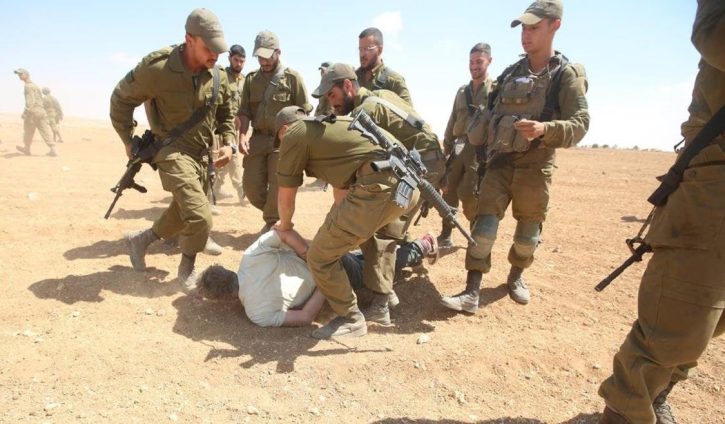
Israeli soldiers beat up a handcuffed international activist in Masafer Yatta
WAFA – June 22, 2022
HEBRON – Israeli forces today beat up a number of international solidarity activists in Masafer Yatta in the southern Hebron hills, according to local sources.
Coordinator of the Protection and Steadfastness Committee in Masafer Yatta, Fuad al-Amour, said the heavily-armed soldiers brutally assaulted a number of international activists while protesting the military drills close to and in al-Markez, and held two others for a long period.
The Israeli army have been conducting drills in al-Markez, one of 12 hamlets making up the Masafer Yatta, which rely heavily on animal husbandry as the main source of livelihood, for the second day in a row.
Al-Amour added that the army has built mock-ups as targets between the makeshift dwellings of the hamlet residents and has been conducting training with heavy weaponry, spreading panic among the residents.
The army has also deployed military checkpoints in the vicinity of the hamlets in the area, in preparation for military training, and perhaps paving the way for an imminent removal of the Palestinian residents.
Recently, Israel’s top court gave the army the green light to forcibly expel some 1,300 Palestinians living in twelve villages or hamlets making up the Masafer Yatta area marking one of the largest expulsions carried out by the State of Israel in recent decades.
Located in Area C of the West Bank, under full Israeli administrative and military control, the area has been subjected to repeated Israeli violations by settlers and soldiers targeting their main source of living – livestock.
It has been designated as a closed Israeli military zone for training since 1980s and accordingly referred to as Firing Zone 918.
Israeli violations against the area include demolition of animal barns, homes and residential structures. Issuance of construction permits by Israel to local Palestinians in the area is non-existent.
The Israeli occupation forces destroy an access road to a Ramallah-area village
WAFA – June 22, 2022
RAMALLAH – The Israeli occupation forces today destroyed an access road to Ras Karkar village, northwest of Ramallah, hampering the movement of people, according to the head of Ras Karkar village council, Marwan Nofal.
He said that the destroyed road had been partially paved for 20 years and that three months ago, following coordination with the Israeli military government, work on the rehabilitation of the road started. However, two days after the start of the work, the military forces raided the area and seized the vehicles used in the work, imposing a fine on their owners.
Nofal said that despite continuous promises to allow the rehabilitation work, the army sent its bulldozers today to destroy the road under the pretext that the road is located on “state land”.
The destruction of the road led to depriving farmers of access to their lands on the western side of the village, he said, and isolating several houses, noting that this is not the first time the Israeli military has targeted the village.
Ras Karkar suffers from the presence of seven iron gates at its entrances that limit the movement of people and access to their homes and lands.
At the same time, the Israeli military government does not allow it to carry out any work to improve the village’s infrastructure, said Nofal.
Palestine resistance seize Israel’s surveillance balloon

MEMO | June 18, 2022
The Palestinian resistance managed to seize control of the Israeli surveillance balloon early on Friday after it was shot down in the town of Beit Hanoun in the northern Gaza Strip.
Palestinian sources confirmed to Quds Press that the Israeli surveillance balloon seized by the Palestinian resistance was not the first it had seized. It has previously seized several balloons, as well as advanced drones.
Israeli sources revealed fears of dangerous information leaks and the resistance obtaining high-quality imaging equipment.
Palestinian writer and political analyst Mustafa Al-Sawaf believes: “What is important is that the resistance was able to seize this surveillance balloon, regardless of what method is used to shoot it down,” describing the incident as “serious”.
Al-Sawaf told Quds Press: “The occupation believes that the resistance is unaware and does not monitor its movements, so it tried to penetrate the Gaza Strip from the north and present a special force, but the resistance men were on the lookout, confronting the occupation and preventing them from entering the Gaza Strip.”
He pointed out: “The matter almost reached the level of a clash, but a reconnaissance aircraft intervened by firing two missiles, thus preventing this and securing the withdrawal of the special force.”
He added: “The occurrence of three incidents in Jenin and Gaza gives quick and dangerous indications that confrontation between the resistance and the occupation is fast approaching, and we must monitor the situation with high accuracy because the coming hours will carry a lot.”
It is worth noting that the Israeli army radio station, Doron Kadosh, announced: “The army’s initial investigation revealed that the surveillance balloon that fell in Gaza had fallen due to technical difficulty and that the army said there is no fear of significant information leakage, although the army tried to open warning fire near it, Hamas still managed to seize the balloon.”
Israel snubs Biden request to halt actions that could embarrass the US President
MEMO | June 16, 2022
US President, Joe Biden, sought assurance from Israel that no action is taken in the occupied West Bank and Jerusalem that could create tensions ahead of his controversial visit next month to the Apartheid State. Biden’s team made the request to the Israelis in what seems to be an attempt by the White House to avoid repeating the embarrassment Biden suffered over a decade ago when he visited the territory as Vice President under the administration of Barack Obama.
During the 2010 visit, Biden vowed unyielding American support for Israel’s security. The Israelis returned the favour by humiliating the then vice President with an announcement to build 1,600 new Jewish only houses, in illegal settlements, in occupied East Jerusalem. Biden condemned the move as “precisely the kind of step that undermines the trust we need right now.” A statement by the White House condemned “the substance and timing of the announcement.”
Barbara Leaf, the US Assistant Secretary of State for Near East Affairs, and her deputy for Israeli-Palestinian affairs, Hady Amr, are laying the groundwork for Biden’s visit scheduled for 13-15 July. Leaf asked Israel to halt actions like home demolitions, evictions of Palestinians and decisions on settlement building, as well as decrease Israeli military operations in the West Bank until after Biden’s visit, officials told Axios.
The Israelis have said they are not able to give such assurances, but they will, nevertheless, try their best. According to Axios, senior members of the Israeli team, including Defence Minister, Benny Gantz, told Leaf they will do their best, but explained the domestic political complexities of halting such actions, in addition to what they called the operational needs of the Israeli military in order to stop attacks.
With the trip coming fresh after the Israeli killing of Palestinian journalist, Shireen Abu Akleh, the Americans are fearful of a global outrage coinciding with Biden’s visit to the Apartheid State. “The Biden administration doesn’t want us to create any crisis in the West Bank … They want quiet and calm” for Biden’s visit, a senior Israeli official is reported saying.
Not only is the US team desperate to avoid embarrassment for Biden, they are also putting together a plan to show that the US President is capable of making progress. Israeli, Palestinian and US officials said Leaf, Amr and US ambassador to Israel, Tom Nides, tried to put together a package of tangible deliverables for the Palestinians to coincide with the Biden visit.
But they did not make significant progress on the package because there are not enough meaningful things the US can give and Israel is not willing to take any steps with political significance that will be enough for the Palestinians, the officials said, according to Axios.
“We need a political horizon. We want to hear President Biden say what his detailed position regarding the two state solution is,” PLO official and adviser to the Palestinian Authority (PA) President Mahmoud Abbas, Hussein Al-Sheikhal-Sheikh, is reported saying. “The US wants the visit to take place in a good atmosphere – different than the one now,” Al-Sheikhal-Sheikh added implying that Washington is more concerned about its image than it is about Israel’s daily human rights violations.
In a blow to the Biden team’s effort to portray the US President as the broker of peace, the PA and Israel rejected their proposal to meet. Palestinian officials stressed that such a meeting should include an Israeli commitment to the two-state solution based on the 1967 borders, otherwise, the meeting would be useless.
Israel plans huge park in occupied West Bank
MEMO | June 13, 2022
Israel plans to build a new national park on nearly 1 million dunams (247,000 acres) of land in the occupied West Bank between Jerusalem and the Dead Sea, Israel Hayom has reported.
The park will stretch between the illegal Jewish settlements of Kochav Hashahar north-east of occupied Jerusalem and Gush Etzion.
Tourist attractions such as the Mar Saba Monastery, Nabi Musa Mosque and the ruins of Hasmonean palaces, as well as hotels, will be within the proposed park. The area known as E1 to the east of Jerusalem has long been considered a red line and a point of no return for the internationally-backed two-state solution.
“We want to set up a new national park, the likes of which has never been seen in Judea and Samaria [the occupied West Bank], and create a single network, one product,” explained regional director-general Keren Geffen.
The announcement comes after the Israeli Defence Ministry reapproved the plan to advance a controversial settlement project in the E1 area of the occupied West Bank earlier this month. The Israeli government withdrew the plan in January amid international pressure.
The Civil Administration of the Israeli army, which authorises construction work in the occupied West Bank, published its agenda for an 18 July meeting to discuss objections to projects that have received initial approval. Two E1 plans totalling 3,412 housing units are the only projects on the docket.
Gaza Running Out of Bread as Authorities Struggle to Find a Solution
Samizdat – 12.06.2022
There are roughly 2.3 million people in the Gaza Strip and they consume 500 tons of flour a day. For years, they have relied on exports from Russia and Ukraine but the outbreak of Moscow’s special military operation has disrupted these supplies sending prices to unprecedented heights. Wheat has long been a staple of Palestinian cuisine.
The outbreak of hostilities between Russia and Ukraine, however, and the subsequent shortage of wheat has led to Gazans tightening their belts.
Adham Al-Basiouny, the official spokesman for the Hamas-run Ministry of Agriculture in Gaza, says the enclave’s small quantities of wheat will barely last weeks.
“What we are seeing now is a serious crisis. We are struggling to obtain wheat and its derivatives. And what we have at present does not exceed 30 percent of our citizens’ needs,” he says.
The Gaza Strip does produce its own wheat – the region has 12,000 dunams (approximately 3,000 acres) of fields producing 4,300 tons annually. But that only answers the needs of three to four percent of the 2.3 million inhabitants. Put another way, if the locals consume 500 tons a day, each year the region produces enough to last only nine days.
Unable to rely on their own production, Gazans have turned to Russia and Ukraine, both of which account for nearly a third of global grain production. The outbreak of hostilities in Ukraine have not only disrupted much-needed wheat supplies – it has also put a rocket under prices, squeezing the already impoverished Gazans, who have been living for years under dire economic conditions, further.
Reports suggest that in recent weeks the Gaza Strip has seen a price spike of 20 percent on wheat and its derivatives. In an area, where nearly 60 percent live below poverty line, that rise has not gone unnoticed.
Al-Basiouny says he doesn’t believe the crisis will reach the levels of unrest and clashes which existed in Egypt back in the Seventies. But he acknowledges the situation is acute and that his government needs to do “everything in its power” to cater for the needs of the population.
One of the measures Hamas – that has been running the enclave since 2007 – has already taken is to approach other wheat-producing countries, such as Canada and Australia, to make good the shortfall. Their prices, however, turned out to be higher than those demanded by Russia and Ukraine so the government, whose annual budget is normally no greater than $1 billion, is still struggling to find grain.
Hamas has also threatened local millers and bakery owners with fines and punishments if they are caught manipulating prices.
However, that move has run into certain obstacles, not least because those local merchants who have been importing wheat from the West at inflated prices are reluctant to operate at a loss. They, therefore, are angry with the government for forcing them to work for what they consider to be peanuts.
Once again, Hamas needs to find a solution, and Al-Basiouny says the organisation has no choice but to lobby support from rich donors.
“Right now, we are communicating with a number of donor countries such as Qatar, who would provide us with financial assistance to buy flour,” he says. “We also get flour from the United Nations Relief and Works Agency for Palestine Refugees in the Near East (UNRWA) that provides bread to Palestinian refugees in the enclave, who account for about 85 percent of all residents.”
So far, reliance on what UNRWA provides has kept things stable. But with more and more donors to the organisation cutting back on spending, a situation where Gazans are starving for bread could just be a matter of time.
Featured Video
No Vote, No Representation, No State: Democracy, Israeli Style
or go to
Aletho News Archives – Video-Images
From the Archives
Sanctions, War and the Policy of Dual Containment
By SASAN FAYAZMANESH | March 17, 2008
It is now nearly three decades since the Unites States adopted the policy of dual containment of Iran and Iraq. While much has been written about the containment of Iraq, there has been very little in-depth analysis of this policy when it comes to Iran. In a book that is going to be released on March 31, 2008, entitled The United States and Iran: Sanctions, Wars and the Policy of Dual Containment (Routledge), I attempt to address this shortcoming by investigating when and why the US policy of containment of Iran came about, how it evolved, and where it stands today.[1] To the extent that Israel has been involved in US policy making, the study will also include the role that Israel has played in the containment of Iran. Also, since the fate of Iran has been inextricably linked to that of Iraq, occasionally the investigation will overlap with the containment of Iraq.
The policy of dual containment of Iran and Iraq originated during the Carter Administration, but it was not until the Clinton Administration that the expression “dual containment” became popular. … continue
Blog Roll
 Aletho News
- Elmo Sold mRNA Jabs to Your Toddler. Now They Are “Off-Label.”
- British state targets Palestine Action with yet another crooked trial
- Americans are paying the price to preserve Israel’s nuclear hegemony
- Resistance factions are necessary to ensure a permanent US Iraq withdrawal
- How Israel destabilizes the Middle East: Denying sovereignty and the right to exist
- Europe’s Establishment Is Embracing War – and Losing Voters
- NATO chief advocates war of aggression
- No Vote, No Representation, No State: Democracy, Israeli Style
- Zionist Bought Senate Blocks Information About American Citizens Killed By Israel
- While Gaza dominates the UN, these are the people keeping it alive
- If Americans Knew
- Israeli Soldiers Abduct At Least 22 Across Occupied West Bank
- Eight Palestinians Killed in Israeli Attacks on Gaza
- Israeli former leaders and security chiefs threaten legal action over ‘Jewish terrorism’
- Israel map in LA Times ad includes all land from the river to the sea
- Inside Lebanon’s 200-page dossier on Israeli war crimes
- Flydubai, genocide, settler violence, Trump abuse of power to deport – Daily Update
- Counting Antisemitic Incidents: What the ADL Audit Reveals — and Obscures
- Mamdani releases plan to combat antisemitism and hate crimes in New York City
- Iran’s Revolutionary Guards Publish Letter to the American People
- DMFI launches $1 million ad campaign supporting Virginia’s Elaine Luria
- No Tricks Zone
- Green Energy Debacle: German Expert Professor Fritz Vahrenholt Warns Of Severe Economic And Social Consequences
- Two More Paleo Reconstructions Affirm Meters-Higher Sea Levels Across Ireland, Brazil 7000-6000 Years Ago
- New Study: Earth And Venus Surface Warmth Largely Explained By Convection And Lapse Rate, Not CO2 Or Radiation
- 2025 Nature Paper Claiming Worsening Global Drought Gets RETRACTED …Heavily Flawed
- New Study: ‘Global Drought Shows No Detectable Recent Acceleration Under Climate Warming’
- Economic Masterminds: German Socialists Suggest Taxing Productivity Gains Stemming From Using AI
- The South China Sea Has Not Been Cooperating With The Climate Change Narrative
- Energy Crisis: Germany Enters Heating Season With Historically Low Gas Reserve Fill Levels
- New Study: The Antarctic Ice Sheet Gained Mass From 2020-2024 Due To Staggering Snow And Ice Accumulation
- Study: Ocean Heating Rates From Thousands Of Years Ago ‘Dwarf’ Modern Ocean Heating Rates

