Natural resource exploitation in the Dead Sea area – The case of Ahava
Alhaqhr | October 28, 2014
This is the first in a series of new Virtual Field Visits focusing on the topic of business and human rights. This video will highlight corporate complicity in the exploitation of natural resources in the Dead Sea area of the Occupied Palestinian Territory.
Israeli mayor storms into al-Aqsa without permission
Al-Akhbar | October 28, 2014
Israeli-occupied Jerusalem’s mayor Nir Barkat forced his way on Tuesday into the al-Aqsa Mosque compound in East Jerusalem under heavy police protection, a Palestinian official said, as Israel continues to restrict the entry of Palestinian worshipers into al-Aqsa for the fifth week in a row.
“We protest this intrusion. Barakat entered the compound under the Israeli police’s protections without permission or a prior request,” Sheikh Azzam al-Khatib, head of the Jordan-run Organization for Muslim Endowments and Al-Aqsa Affairs, told Anadolu Agency.
This is the first time Barkat storms the holy site since assuming office in 2008.
“Barkat took a tour at the compound’s courtyards before leaving,” al-Khatib added.
The intrusion came one day after Palestinian Prime Minister Rami Hamdallah visited the complex.
Hamdallah’s visit came after Palestinian Authority President Mahmoud Abbas warned against Israeli plans to “divide” the holy site.
In an urgent message to the US administration on Sunday, Abbas warned that Israel’s continued provocations at the mosque complex would lead to a “wide-reaching explosion.”
Israel continues to restrict the entry of Palestinian worshipers into al-Aqsa for the fifth week in a row.
Israeli authorities have imposed restrictions on Palestinians seeking to enter the al-Aqsa Mosque compound, denying Muslim men under 40 access to the holy site while facilitating the entry of Zionist settlers of all ages.
In recent months, groups of extremist Zionist settlers – often accompanied by Israeli security forces – have repeatedly forced their way into East Jerusalem’s flashpoint al-Aqsa Mosque complex.
The frequent violations anger Palestinians and occasionally lead to violent confrontations.
For Muslims, al-Aqsa represents the world’s third holiest site.
Israel occupied East Jerusalem during the 1967 Middle East War. It later annexed the holy city in 1980, claiming it as the capital of the self-proclaimed Zionist state – a move never recognized by the international community.
In September 2000, a visit to the site by controversial Israeli leader Ariel Sharon sparked what later became known as the “Second Intifada” – a popular uprising against the Israeli occupation in which thousands of Palestinians were killed.
(Anadolu, Al-Akhbar)
Two journalists hit by Israeli rubber bullets while covering protest (VIDEO)
RT | October 28, 2014
An AP photographer and his Swiss colleague were hurt after Israeli border police fired a crowd control grenade at a group of journalists covering Palestinian protests in the West Bank.
The news agency’s Majdi Mohammed and Swiss freelance journalist Lazar Simeonov were injured during the Israeli forces’ suppression of protests, where they deployed rubber-coated bullets, stun grenades and tear gas.
The photographers were working in the West Bank town of Silwad, where Palestinians were protesting after the funeral of a 14-year-old boy, who was killed in an earlier clash with Israeli soldiers.
Mohammed told the Agency that as he was taking pictures, an armored car pulled up behind him and a border policeman stepped out and fired directly at him from a distance of 10 to 20 meters.
The officer fired a round that discharges a number of rubber-coated steel projectiles, which is basically a grenade designed to hurt small groups of people. Simeonov was injured by the same round.
“The impact was so strong that it made me fall to the ground,” Mohammed said. “The policeman aimed straight at us … even though we were clearly a group of media people and there were no protesters at all around us.”
Both journalists reported minor injuries and Simeonov’s camera was also damaged.
AP said it would lodge a protest with the Israeli government. John Daniszewski, AP’s senior managing editor for international news, said the incident showed “outrageous disregard for the safety of journalists” lawfully doing their jobs.
Israeli police spokesman, Micky Rosenfeld, said it was not immediately clear why the border patrol policeman had opened fire on the journalists. He added the police “dispersed hundreds of rioters,” some of whom threw firebombs and stones at the Israeli forces.
US universities see a rise in pro-Palestine activism

Al-Akhbar | October 27, 2014
Pro-Palestinian activism has risen significantly on US campuses since Israel’s offensive on the Gaza Strip in the summer, according to a Jewish civil society organization.
The New York-based Anti-Defamation League said in a report published Friday that there had been 75 “anti-Israel” events scheduled on US campuses since the beginning of the 2014-2015 academic year, which started in late August or early September at most American universities.
“During the same time period last year, there were only 35 of those events scheduled, marking a 114 percent increase in the number of those events scheduled to take place this year,” the report said.
Israel’s recent offensive in the Gaza Strip began July 7 and lasted for 51 days; it killed more than 2,000 Palestinians, mostly civilians, according to Palestinian health officials. More than 10,000 others were reported injured.
During the previous academic year, student groups at US colleges hosted at least 374 anti-Israel events, the report said.
It said nearly 40 percent of those events were held in support of an international campaign to seek boycott against Israel.
The Boycott, Divestment and Sanctions movement, known by the initials BDS, calls for various forms of boycott against Israel until it ends its occupation of Palestinian lands.
The report also said pro-Palestinian protestors on US campuses drew parallels between Israeli actions in Gaza and the shooting of a black teenager, Michael Brown, by a white police officer in Ferguson, Missouri.
It mentions a particular “die-in” protest at John Jay College in New York, in which many students reportedly chanted slogans such as “from Ferguson to Palestine, Inifada Intifada,” referring to two popular Palestinian uprisings aimed at ending the Israeli occupation.
Brown, an unarmed black teenager, was shot and killed by a white police officer, Darren Wilson, on August 9. His death set off mass protests, which have since continued at various levels in the country.
Earlier this month, The Washington Post reported that more than 500 anthropologists have publicly joined an academic boycott of Israel initiated by the American Studies Association, with another 77 joining anonymously.
(Anadolu)
Report: Last Wednesday’s ‘light rail attack’ by Palestinian driver was a car accident
By Celine Hagbard | IMEMC News | October 26, 2014
As Israeli right-wingers continue to gather at the site of the death of a 3-month old baby on Wednesday, reports from the police investigating the incident and eyewitnesses on the scene indicate that the incident was a hit-and-run car accident, not a deliberate attack.
21-year old Abdel Rahman al-Shaludi had been at the clinic earlier on Wednesday complaining of a fever and illness. He had returned home and gone to bed, but then went back out and was driving too fast on a Jerusalem road when he ran into a group of pedestrians with his car.
He tried to flee the scene of the crash, but was shot dead by Israeli police.
While this incident has made media headlines throughout the world, a similar incident this past Sunday, in which two five-year old Palestinian girls walking home from school were hit by an Israeli settler vehicle, killing one and critically wounding the other, has not received much press.
The settler who killed the 5-year old girl also fled the scene of the crash – he was later apprehended by Israeli police, but was not charged with any crime. Israeli police determined (without interviewing any of the numerous Palestinian witnesses who were on the scene) that it was an accident, and no charges were filed.
Abdel Rahman al-Shaludi’s cousin Abed al-Shaludi told reporters with the Israeli paper Ha’aretz, “We believe that he was shot and killed in cold blood and there was no attempt to question him, and hear his side of the story, and that he deserves a funeral like everyone else.” The body of Abdel Rahman al-Shaludi remains in Israeli police custody, and the family has not been able to hold the funeral yet.
The cousin of the deceased man added, “ I still believe that he had an accident. If he wanted to carry out an attack, why did he wait until he got there? The videos don’t show that it was definitely an attack, and he might have lost control of his vehicle. For the Israelis, that’s an attack, and they shoot him to death.”
A video posted on social media, filmed from an angle above the highway, shows the car crossing the center line and hitting pedestrians who were walking in the median.
A statement by the family of the driver, published on the Israeli news website Ynetnews, states, “We are certain that this was a regular car accident. Over the past few days he did not feel well and it could be due to his illness that he lost control of the wheel. Many similar accidents have occurred in many places and there was no suspicion of a terrorist attack.”
“A few days ago a Jewish settler knocked over two girls near Ramallah. He killed one and the other is in serious condition. The police immediately said it was a car accident. In our case they said the opposite in seconds. This is because the driver was an Arab driver. When a Jewish driver was involved in an accident the attitude was different and no one shot him.”
The U.S. government immediately labeled the incident a ‘terrorist attack’, with State Department spokesperson Jen Psaki saying, “The United States condemns in the strongest possible terms today’s terrorist attack in Jerusalem.” She said that the baby who died in the incident was reportedly a U.S. citizen.
In the clashes that have followed Wednesday’s incident, another U.S. citizen child, 14-year old Orwah Hammad from New Orleans, was killed. He was shot in the head by Israeli forces on Friday. … Full article
Coca Cola’s involvement in the Occupation of Palestine
Who Profits | October 26, 2014
The Central Bottling Company (CBC) or Coca Cola Israel is a manufacturer and distributor of soft drinks, dairy products and alcoholic beverages. CBC began its operation in 1967 upon receiving the Israeli franchise of Coca Cola products from Coca Cola International.
Through its fully owned subsidiary – The Central Company for Sales and Distribution, CBC holds a regional distribution center in the Atarot settlement industrial zone. The Atarot distribution center is responsible for marketing the company’s beverages to the Palestinian population of East Jerusalem. Simultaneously, the Palestinian franchisee – The National Beverages Company (NBC) is denied access to East Jerusalem, which therefore constitutes a captive market for the Israeli distributor.
In 2006 CBC purchased Tabor Winery – an Israeli winery that owns vineyards near mount Shifon in the occupied Golan Heights. Grapes from the Shifon vineyards are used in Tabor’s white wines.
CBC also owns Tara (Milco Industries), whose subsidiary, Meshek Zuriel Dairy (81%), holds a dairy farm and a head office in the settlement of Shadmot Mehola in the Jordan Valley.
Israel bans Palestinians from settlers’ buses in West Bank
MEMO | October 26, 2014
Israeli authorities have bowed to pressure from Jewish settlers and ordered a ban on Palestinians from using Israeli-run buses in the West Bank, Israeli daily Haaretz reported Sunday.
According to the paper, Israeli Defense Minister Moshe Ya’alon has issued instructions to the civil administration in the Israeli army to ban Palestinian workers from traveling by Israeli-run buses upon their return from their work places inside Israel to the West Bank.
The ban will go into effect at the beginning of next month, the paper said, noting that it came following intensive pressures from the settlers in the northern West Bank.
The paper said the settlers sought for the past year to prevent Palestinians from travelling in their buses for security reasons.
It noted that the decision contradicts the stance of the Israeli army leadership which asserted that the Palestinian workers do not pose any security risk because they already go through a security check before being given permits to enter Israel.
Palestinians in northern West Bank who work inside Israel need to pass through the Eyal checkpoint near Qalqilya city, where they are subject to security screening.
“Every day in the morning, we pass through Eyal checkpoint for security check, which takes more than two hours,” Ahmad al-Toor, 44, told Anadolu Agency.
“Upon our return, we use settlers’ buses in the West Bank, which pass near our villages,” he added.
“During our return trips, we are subject to frequent harassments by the settlers,” he added. “But standing for additional two hours under security pretexts when we return is too exhausting.”
The Israeli authorities has issued permits to nearly 150,000 Palestinian workers from the West Bank to work inside Israel.
About 500,000 Israelis now live in more than one hundred Jewish-only settlements built since Israel occupied the West Bank and East Jerusalem in 1967. The Palestinians want these areas, along with the Gaza Strip, to establish their future state.
International law views the West Bank and East Jerusalem as “occupied territories,” considering all Jewish settlement building on the land illegal.
Israeli forces detain Palestinian man who removed settler tent
Ma’an | October 25, 2014
HEBRON – Israeli forces detained a Palestinian from the village of Susiya south of Hebron after residents took down a tent set up by Israeli settlers on land belonging to a Palestinian family in the area, a local official said.
Jihad al-Nawajaa, the head of a local village council, told Ma’an that Israeli forces detained Ahmad Muhammad Mahmoud al-Hadar, 35, after he took down a tent set up by settlers on the al-Hadar family’s property.
He said that soldiers “assaulted” Palestinian villagers at the same time.
The tent was set up as an outpost to expand the illegal Israeli settlement of Susiya, al-Nawajaa said.
Al-Hadar took down the tent in order to “save our lands from Judaization and settlement.”
Some settlers act without approval to expand settlements or create new ones in the West Bank, building outposts that are illegal even by Israeli government standards.
In some cases, these settlement outposts are “legalized” by Israel, and in rare cases they are dismantled.
Meanwhile, Palestinians are rarely granted permission to build in the 60 percent of the West Bank under full Israeli military control, or in East Jerusalem.
Middle East borders bound to change: Israel minister
Press TV – October 24, 2014
Israeli Minister for Military Affairs Moshe Ya’alon says the borders of many Middle Eastern countries are bound to change in the future as a result of recent developments in the region.
The Israeli minister said in a recent interview with the US-based National Public Radio (NPR) that the current borders would change in the coming years, as some have “been changed already.”
The Israeli minister added that the borders of some countries in the region were artificially drawn by the West.
“Libya was a new creation, a Western creation as a result of World War I. Syria, Iraq, the same — artificial nation-states — and what we see now is a collapse of this Western idea,” he stated.
However, Ya’alon said the borders of some nations, including the Egyptian border with Israel, would remain unchanged.
“We have to distinguish between countries like Egypt, with their history. Egypt will stay Egypt,” said Ya’alon.
The minister did not say whether the borders of Israel, also drawn by Western powers after World War I, would change or not.
Regarding the right to return for Palestinian refugees, Ya’alon said Tel Aviv could not allow such a move, as it would keep the Israeli-Palestinian conflict alive “forever.”
He also said that the insistence to remove Israeli settlers from the West Bank amounts to ethnic cleansing.
The Israeli regime expelled more than 700,000 people from their homeland after it occupied Palestine in 1948.
Israeli forces have wiped nearly 500 Palestinian villages and towns off the map, leaving an estimated total of 4.7 million Palestinian refugees hoping for an eventual return to their homeland more than six decades later.
Since 1948, the Israeli regime has denied Palestinian refugees the right of return, despite United Nations’ resolutions and international laws that uphold the people’s right to return to their homeland.
Tel Aviv has built over 120 illegal settlements built since the occupation of the Palestinian territories of the West Bank and East al-Quds.
JSIL vs. ISIS

By Samer Jaber | Al-Akhbar | October 23, 2014
The Jewish state of Israel in the Levant (JSIL) and the Islamic State in Iraq and Syria (ISIS) are different in many ways. The most fundamental difference is that the former is a recognized state and a member of the United Nations, while the latter is not recognized as a legitimate polity and is considered a political/military terrorist organization. However, the two share core characteristics that define them and by recognising these similarities observers may be able to make predictions about their futures.
Divine right to exist
Both JSIL and ISIS display what might be termed “self-defined righteousness.” Although Israel is a modern state, its politics and treatment of others (Palestinians) are based on religious concepts and principles that can be traced back to the first century BC and the teachings of Rabbi Hillel, someone who would be considered a fundamentalist today. He instructed Jews to have a religious and social identity separate from those of other people (tribes). Israel introduces itself to the international community as a Jewish state and, based on this interpretation of Zionist Judaism, is a home to Jews wherever they are in the world. In other words, it is a state which includes all Jews but excludes the indigenous people of Palestine, the Palestinians. It uses its interpretation of Judaism to deny Palestinians equal rights and prevent them from accessing their lands.
ISIS believes that it is enacting God’s will and defines itself as the force to enforce the Islamic moral code, religious rituals and law (Sharia). ISIS’ interpretation of Islam goes back to Ibn Taymiyyah (1263-1328) who promoted the idea that Muslims are different from non-Muslims both in their way of life as well as in religious instruction. This notion of non-acceptance together with cultural differences led Ibn Taymiyyah’s followers to the practice of excluding others and in some cases putting them to death. This particular interpretation of Islam also means the rejection of other branches of Islam.
The form of righteousness practiced by ISIS leaders and Israeli politicians is also used to set apart the “good” people from the “bad” ones. The good are those who believe and support their respective political projects while the bad ones are those who stand against them. It is this stance that makes it permissible for Israel to inflict damage on the bad ones and reward the good. As such, the Palestinian people are depicted in the official Israeli narrative as the bad people who work hard to inflict damage on the good Israeli Jews.
Historically, the state of Israel was established on the self-proclaimed premise of the Zionist movement, that anti-Semitism and murder might surge again in the world. Thus, the resurgence of another wave of anti-Semitism will inflict another Holocaust on the world’s Jews. The Zionist movement took anti-Semitism and the Holocaust out of their historical context. In other words, the concepts were given an absolute ahistoric “religious” meaning. Consequently, the “Jews” started to become reified as an ethnic identity and Israel as a refuge for the world’s Jewry from harm.
For ISIS, one of the underlying reason for Muslims’ degeneration over the centuries is that too many people have strayed far from the fundamental principles of Islam. The role of ISIS is to establish an Islamic state ruled by the caliph. It considers itself to be the force that will revive true Islam and create a state in which all Muslims can live in under its interpretation of Islam. Similarly to Israel, where non-Jews are discriminated against, there is no place for non-Muslims to live as equal citizens in the so-called Islamic State.
Both JSIL and ISIS use the self-serving interpretation of religious texts to enact pragmatic politick. The Zionist narrative that gave birth to the state of Israel and is now its official ideology starts with the idea that the Jews are God’s chosen people and that God promised them the holy land. These two concepts of chosenness are ahistorical, unconditional, and self-limited. Thus, settler colonial expansion in Palestine beyond the 1948 borders is seen as the redemption of the biblically named Judea and Samaria for the Jewish people. Putting Palestinian communities under closure during Jewish holidays is usually disguised as a religious instruction and therefore not seen for what it is: a measure of control.
ISIS also claims it is justified in its actions; it considers itself the group fighting for God and enforcing the latter’s instructions on earth. The group’s interpretation of religious texts is based on its spiritual-political leaders’ rulings that place people into two main categories – believers in ISIS’ ideology are viewed as being on the right path for following the “correct” version of Islam while everyone else, including followers of other branches of Islam, is on the wrong path. Thus the expulsion or execution of Iraqi Christians and Yazidis in Mosul who refuse to convert or pay Jizya (a tax paid by non-Muslims) is introduced as a religious instruction that permits politically motivated discrimination.
Indiscriminate attacks on perceived “enemies”
International humanitarian law forbids parties in armed conflict from deliberately launching attacks against civilians but both Israel and ISIS carry out indiscriminate attacks against their enemies, and they cite similar justifications for such attacks, mainly operational reasons.
JSIL, like ISIS, says that engaging in conflict in residential areas makes it difficult to avoid harm to civilians. Israel, which deems itself “superior” to others, says it launches military operations to prevent harm to its own people whose lives are worth much than those of “others.” ISIS believes it is on the right path and views everyone else as living in a state of sinfulness and, according to the group, sinners deserve to be put to death. Ultimately, ISIS and Israel attack civilians as part of their strategy to dispose of the natives and remove them from their lands. As such, in their quest for control of the land they both practice ethnic cleansing under a myriad of guises.In areas controlled by ISIS, in both Syria and Iraq, the group has carried out the mass executions of opposition militants captured by its forces and any person who assists its enemies is liable to be sentenced to death. Israel carries out a similar strategy of collective punishment against Palestinian resistance. It used it in its latest war on the Gaza Strip and during the so-called Operation Cast Lead in 2008-09. Even when Israel states that its attacks are intended to kill only resistance fighters, its bombardment of residential areas always leads to the killing of civilians. These attacks are clearly designed to target and punish the combatants’ families and homes.
During Israel’s latest war on Gaza in the summer of 2014, the Israeli army intentionally converted 40 percent of the Gaza Strip into uninhabited land. The Israeli army displaced up to 500,000 Palestinians out of their neighborhoods. This is the same tactic ISIS has been using in vast swaths in Syria and Iraq. The latest incident is the ongoing fighting in Kobane, the Kurdish city under Syrian jurisdiction, where ISIS’ shelling of the city forced the majority of its citizens to be displaced.
Displacement, collective punishment, terrorism and ethnic cleansing in the name of God are but a few similarities between the two entities. It is worth considering how the state of Israel has embraced the legend of the Maccabees, a sect of Judaism which fought other Jews and foreign powers in the name of piousness and righteousness, and how it has incorporated it within the contemporary ethos. The Maccabees were fundamentalists who used violence against their enemies, both Jewish and non-Jewish, and carried out forced conversions much as ISIS does today.
Samer Jaber is a political activist and researcher. He is the managing director for Dar el-Karma Inc. for Media, Researches and Publication. He tweets at @Jerusalem_sbj
The Israeli Solution

Zionism is incompatible with peace. (Tamar Fleishman/PC)
By Hasan Afif El-Hasan | Palestine Chronicle | October 18, 2014
I tried to explore the long term plans of the ruling elite of Israel regarding the Palestinians. But since no Israeli government ever publicly revealed its long term vision other than maintaining the status quo, I sought to examine their thoughts through one of their surrogates, Caroline Glick. I read her book “The Israeli Solution” that has been published recently. Caroline Glick is a right wing Israeli and a strong supporter of Prime Minister Benyamin Netanyahu policies. She is American born Israeli journalist, the deputy managing editor of the Jerusalem Post and she writes for the Israeli daily newspaper, Makor Rishon. In her book, she covers many topics that reflect the right wing Zionists views on Palestine, and she also promotes a one state plan in Palestine.
Glick argues that the two-state-solution is not acceptable because it falls short of meeting the Zionists’ goals. She writes: “The Jewish people’s rights to sovereignty over Judea and Samaria [West Bank]—as with their rights to the rest of the Land of Israel—are overwhelming from historical and political perspective.” She calls for creating an ethnic religious Jewish majority state that includes the West Bank “Judea and Samaria” and Jerusalem, but the one-state she is advocating does not include Gaza Strip and she rejects the refugees’ right of return.
Her plan offers Israeli citizenship and the right to vote to the Arab population of the West Bank neighborhoods. Glick claims that Gaza had been already an independent Palestinian state since Israel withdrew its military forces and removed its civilians from the Strip. She removed Gaza from the demographic equation and gave the Palestinians of the West Bank the option of moving to Gaza in the event that they prefer to live under Palestinian sovereignty. But she claims that Israel has the right to levy a maritime blockade of Gaza coast since it is a foreign entity governed by a terrorist organization that routinely engages in acts of war against Israel. She used a Machiavellian divide-and-conquer lie to exclude Gaza from her plan by creating fictional cultural differences between the Palestinians in Gaza and the West Bank. She writes that the cultural affinity of the Palestinians in Gaza with Egypt is much higher than their cultural affinity with “Judea and Samaria.”
Glick states that once Israel annexes the West Bank it makes amends for the historic injustice that Jews there had suffered under the British regime which barred them from buying land! Glick ignored the November 2nd, 1917 infamous Britain’s “Balfour Declaration” that recognized the Zionist goal of establishing a Jewish home in Palestine, a country that was not a British land, its indigenous population never been consulted, and the Jews never constituted more than one percent of its population. Britain even allowed the Zionist leadership to dictate the text of the Declaration, and Britain executed it while occupying Palestine as a Mandate Power.
To support the feasibility of her one-state vision, Glick uses empirical analysis from a 2007 extensive official Israeli government study for expanding the state by absorbing all historical Palestine and maintaining Jewish majority. Based on this study, she concludes that demography is one of Israel’s greatest advantages if it decides to impose a one-state-solution. According to her book, Israel assembled a team of Israeli and American researchers to review the Palestinian population. The team was called American-Israel Demographic Research Group (ADRG). Its members included academic experts in forecasting models, demographics, and history, the former head of the civil administration in the West Bank “Judea and Samaria”, and experts in mathematical modeling. Findings compiled by the research team were presented to the leading US demographer Nicholas Eberstadt from the American Enterprise Institute (AEI). It uncovered new demographic facts that had not been recognized in the past. Of the combined population of Israel, Jerusalem and the West Bank, 67% are Jewish, 14% are Israeli Arab citizens living in Israel proper, 3% live in East Jerusalem, and 16% are the West Bank Arabs. The study shows annexing the West Bank would have less impact on Israel’s democracy than previously believed.
AIDRG presented to the Israeli government a step-by-step analysis of each zone in the West Bank, demonstrating that Israel can review the impact of dealing with each zone while considering territorial and security needs. Any decision made by the state was based on a rational discussion within the Israeli government and its AIDRG consultants. It was compared against alternatives for governing this same zone population by the Palestinian Authority, by a third party such as Jordan, or by intervention of the international community. Israel, according to this study can annex the West Bank gradually and retain its Jewish character.
The AIDRG study discovered that the 1997 census done by the Palestinian Central Bureau of Statistics (PCBS) was a “fraud”. The Palestinians had exaggerated their population figures by 50 percent, or 1.34 million according to the report. The flaw in the PCBS census was in the natural growth forecast projection of annual growth of 4.4 percent in the West Bank “Judea and Samaria” and 5.2 percent in Gaza between 1997 and 2003. Growth based on actual data from the Israeli records showed real growth of 1.8 percent in the West Bank and 2.9 percent in Gaza. The PCBS census also forecast that the Palestine Authority would experience receiving 236,000 people in the West Bank and Gaza between 1997 and 2003, but the official numbers tallied by Israeli border authorities was only 74,000.
Actions by successive Israeli governments in the occupied lands since 1967 suggest they are thinking in the direction of Glick’s Greater Israel plan: the establishment of a one Jewish majority state within the borders of the 1922 British Mandate and maintain its Jewish character. The 600,000 settlers that Israel has transplanted in the West Bank and Jerusalem with their networks of freeways, roads, electricity and water suggests that Israel is in the process of creating the state which Glick proposes.
Israel continues to build new settlements and expand the old ones. Palestinian’s homes and villages are being demolished because they were built without permits and permits are denied because the applicants are Palestinians. Israel drove more than 56,000 Palestinian Jerusalemites out of their city by denying them residence permits because they work outside the city municipality borders, and even prayers at al-Aqsa Mosque are disallowed by the military or interrupted by Jewish extremists under the protection of the Israeli security. Israel and Egypt have no intention to ease or lift the crippling economic blockade and siege on Gaza that has been destroyed multiple times and kept its inhabitants in absolute poverty. International donors convened in Cairo to raise funds for the reconstruction of the Strip following the third Israeli brutal assault in five years, but not to end the occupation and realization of Palestinian sovereignty, the main cause of violence. There is urgent need to rebuild Gaza now, but that does not compensate for the loss of thousands of innocent lives; and the aid is not even a temporary solution to the suffering of refugees of two wars living for decades under inhumane conditions. Until the occupation ends and the Palestinians live free in their country and a just solution for the refugees is reached, there will be a never-ending cycles of violence and destruction.
Israel insists that no concessions are possible on territorial or security issues, Jerusalem or the Palestinians’ right of return.Israel’s economy minister, Naftali Bennett said recently: “The idea that a Palestinian state should be established within the land of Israel has reached a dead end”. In his 2014 speech to the UN General Assembly, Netanyahu denied that Israel was occupying Palestinians lands. He said, “The people of Israel are not occupiers in the land of Israel. History, archaeology and common sense all make clear that we have had a singular attachment to this land for over 3,000 years.” He also said on last July 11: “There cannot be a situation, under any agreement, in which we relinquish security control of the territory west of the River Jordan.” Israel’s Vice Premier Moshe Ya’alon ruled out the possibility of establishing a Palestinian state alongside Israel in a speech at a cultural event recently in the South Sharon Regional Council.
In the mean time the Palestinian Authority (PA) leaders who lost credibility among their people promise to liberate their people from occupation and threaten to prosecute Israel in the International Courts while their security forces collaborate with the occupation forces to suppress any Palestinian resistance against the occupation. Members of the PA security force may even join the Israelis at the tightly monitored crossings to Gaza to prevent any possibility of allowing goods shipped to the starved people in the Strip that would threaten Israel’s security. Zionism is incompatible with peace and it is not easy for the Palestinians to be optimistic about the future when no one trusts a thing their leaders say!
– Hasan Afif El-Hasan, Ph.D. is a political analyst. His latest book, Is The Two-State Solution Already Dead? (Algora Publishing, New York), now available on Amazon.com and Barnes & Noble.
Israel sells cemetery with Al-Qassam’s grave to a construction company

Grave of Sheikh Izz Ad-Din Al-Qassam
MEMO | October 21, 2014
A cemetery in Haifa where the body of the martyr Sheikh Izz Ad-Din Al-Qassam is buried has been sold to a private construction company, sparking fears of the outbreak of a third Intifada.
Al-Qassam is considered one of the most important icons of Palestinian resistance. He was immortalised when he became the first to lay the foundations for organised revolution against the British Mandate’s forces and Zionist settlers in the mid-1930’s.
Hamas named its military wing the Izz Ad-Din Al-Qassam Brigades in recognition of the heroic role he played in defence of Palestine.
The construction company noted that, according to their contract with the Israeli government, the area must be examined and the graves must be moved to another area.
Mustafa Bara, the lawyer representing Palestinians who are strongly opposed to the Israeli government’s decision, warned against taking this measure, as it would elicit harsh reactions from the Palestinian masses. The Palestinians consider this measure to be a violation of religious sanctity and hurtful to the feelings of the Palestinians who consider Al-Qassam, of Syrian origin, to be one of their most prominent historical leaders.
Israel Radio quoted Bara as saying that the Zionist government hasn’t properly estimated the extent and magnitude of the potential reactions to this step, noting that selling the cemetery may lead to a dangerous decline in relations between the Jewish people and Palestinian Israelis. He also called on Israeli Prime Minister Benjamin Netanyahu to be more sensitive to the issue.
The Izz Ad-Din Al-Qassam cemetery has previously been attacked and desecrated by Jewish extremist groups. His tombstone was destroyed and anti-Muslim and anti-Arab slogans were also written on it.
Featured Video
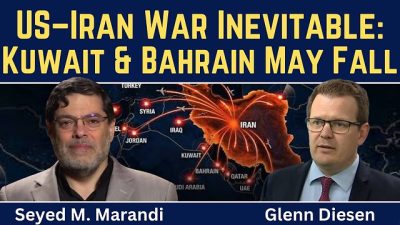
Seyed M. Marandi: US-Iran War Inevitable: Kuwait and Bahrain May Fall
or go to
Aletho News Archives – Video-Images
From the Archives
Oil and the Israel Lobby
Reknowned economist M. Shahid Alam offers this excellent critique of Noam Chomsky’s defective analysis of the relative influence of Oil versus the Israel lobby over US foreign policy: … continue
Blog Roll
 Aletho News
- ICC ignored ‘very well-documented’ NATO crimes – ex-Libyan minister
- SNSC secretary dismisses US response to Iran’s conditions as ‘inadequate’
- Sanaa says Taiz roads open, secure for residents, warns Saudi forces
- Iraqi resistance group urges Saudi leadership to admit defeat, lift Yemen siege
- Trump’s Retreat: How Al-Aqsa Flood Took Down the US Empire
- Israel’s Military Actions in Lebanon Grossly Violate International Law — Lavrov
- Seyed M. Marandi: US-Iran War Inevitable: Kuwait and Bahrain May Fall
- Leaders Condemn Ansarallah Attack on Saudi Arabia While Ignoring Illegal War Against Yemen
- Leaked: Britain’s Covert Iraqi Psyops Network
- Yemeni Armed Forces Warn Airlines Against Using Saudi Airports, Exempt Mecca and Medina
- If Americans Knew
- The American Conservative: How Trump Made the World Go Nuclear
- Meet the US generals and admirals advancing Israeli policy
- Opinion: Why news organizations should boycott Israel
- The Israeli witch hunt of Sami Abu Shehadeh exposes the lie of the ‘Jewish and democratic’ state
- No state has a ‘right’ to exist – least of all Israel
- Testimonies about Gaza’s civilian death toll expose Israel’s atrocities – Daily Update
- How Israel Conquered the Latin American Right
- Agents search Rep. Omar’s Washington home in criminal probe as she vows she won’t ‘be silenced’
- “The Rule Was: ‘Shoot Everyone You See'”
- Israel goes ballistic over Nobel Laureate Navi Pillay
- No Tricks Zone
- Germany’s Green Energy Debacle: High Energy Costs Force Kahla Porzellan to Close After 182 Years!
- New Study: 50 Years Of The Most Aggressive ‘Net Zero’ Policies Can Only Affect The Global Climate By 0.03°C
- US September “Heat” Was No Record…Many Records Set Decades Ago
- Latest European Green Energy Debacle; Portugal’s Largest Flagship Solar Park Insolvent!
- Green Energy Debacle: German Expert Professor Fritz Vahrenholt Warns Of Severe Economic And Social Consequences
- Two More Paleo Reconstructions Affirm Meters-Higher Sea Levels Across Ireland, Brazil 7000-6000 Years Ago
- New Study: Earth And Venus Surface Warmth Largely Explained By Convection And Lapse Rate, Not CO2 Or Radiation
- 2025 Nature Paper Claiming Worsening Global Drought Gets RETRACTED …Heavily Flawed
- New Study: ‘Global Drought Shows No Detectable Recent Acceleration Under Climate Warming’
- Economic Masterminds: German Socialists Suggest Taxing Productivity Gains Stemming From Using AI

