312 Palestinians Kidnapped By Israeli Army In April
By Saed Bannoura | IMEMC News | May 2, 2014
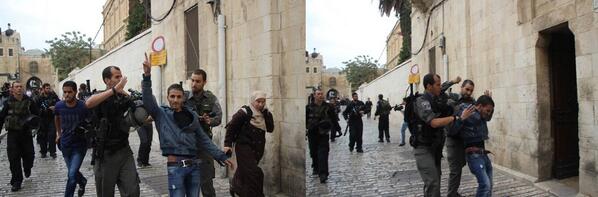
The Ahrar Center for Detainees Studies and Human Rights issued its monthly report, revealing that the Israeli army kidnapped 312 Palestinians in different parts of the occupied West Bank, occupied Jerusalem, and the besieged Gaza Strip.
Ahrar said the army carried out dozens of invasions into the occupied territories, kidnapping 312 Palestinians, mainly after breaking into their homes and properties, and violently searching them, causing excessive property damage.
Most of the arrests have been carried out in the Hebron District, as the soldiers kidnapped 94 Palestinians, followed by Jerusalem, 92, Nablus, 36, Bethlehem, 21, Jenin, 18, Ramallah, 16, Gaza Strip, 15 including 11 kidnapped near the border fence, Qalqilia, 10, Salfit, 7, Tulkarem, 2, and one in Tubas.
Ahrar added that the army kidnapped four Palestinian women in April, and released two of them later on.
Mariam Barghouthi, from Ramallah, and Samira al-‘Akel, from Hebron, are still imprisoned, while Tahani Abu Mayyala and Hanin Abu Aisha, from Hebron, were released.
“There are 21 Palestinian women who are still imprisoned by Israel,” Ahrar stated.
Head of the Ahrar Center, Fuad al-Khoffash, stated that April witnessed the beginning of one of the strongest hunger strikes by Administrative Detainees held with charge or trial, and that the detainees are determined to continue their strike.
Al-Khoffash added that the striking detainees are subject to constant attacks and harassment, in the attempt by authorities to force them to end their strike, while many have been moved into solitary confinement and are denied the right to family visits.
Israeli forces ‘attack Palestinian woman, daughter’ in Silwan
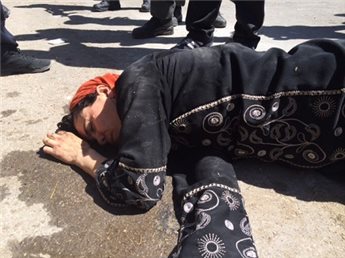
Umm Qalawoon al-Tawil lying unconscious outside her home after Israeli officers attacked her
Ma’an – 01/05/2014
JERUSALEM – Israeli forces attacked a Palestinian woman and her teenage daughter in the Wadi Hilweh quarter south of the Old City of Jerusalem on Thursday, Palestinians in Silwan neighborhood said.
Director of the Silwan-based Wadi Hilweh Information Center Jawad Siyam told Ma’an that Israeli officers broke into the home of Umm Kalawoon al-Tawil and “brutally” beat her and her 15-year-old daughter Layla.
Siyam highlighted that Israeli officers continued to beat al-Tawil while they dragged her out of her apartment to a playground in the neighborhood until she passed out.
Fistfights broke out between local residents and Israeli officers while an ambulance evacuated al-Tawil to al-Maqasid hospital in Jerusalem for treatment.
An Israeli police spokesman said he was unaware of any detentions in the area.
State Department’s annual Country Report on Israeli Terrorism
By Gilad Atzmon | May 1, 2014
Ynet reports today that A new American report on terrorism strongly criticizes Israel for its lack of response to attacks by extremist settlers against the Palestinian population and their property.
“Attacks by extremist Israeli settlers against Palestinian residents, property, and places of worship in the West Bank continued and were largely unprosecuted according to UN and NGO sources,” says the State Department’s annual Country Report on Terrorism.
The report states that attacks of this nature number in the hundreds.
“The UN Office of the Coordinator for Humanitarian Affairs reported 399 attacks by extremist Israeli settlers that resulted in Palestinian injuries or property damage. Violent extremists, including Israeli settlers, vandalized five mosques and three churches in Jerusalem and the West Bank, according to data compiled by the UN.”
The paper also notes that the phenomenon has spilled over into Israel, where Muslim and Christian sites have been targeted.
“‘Price tag’ attacks (property crimes and violent acts by extremist Jewish individuals and groups in retaliation for activity they deemed to be anti-settlement) expanded into Israel from the West Bank in 2013,”
The report, also noted a massive drop in rocket attacks from Gaza and Sinai into Israel. “Palestinian terrorist organizations in the Hamas-controlled Gaza continued rocket and mortar attacks into Israeli territory. The number of rocket and mortar launchings on Israel from Gaza and the Sinai was the lowest in 2013 in more than a decade, with 74 launchings compared to 2,557 in 2012.”
Palestinian Unity
Hope and Gloom in the Beach Refugee Camp
By Ramzy Baroud | Palestine Chronicle | April 30, 2014
For years, Palestinian factions have striven for unity, and for years unity has evaded them. But is it possible that following several failed attempts, Fatah and Hamas have finally found that elusive middle ground? And if they have done so, why, to what end, and at what cost?
On April 23, top Fatah and Hamas officials hammered out the final details of the Beach Refugee Camp agreement without any Arab mediation. All major grievances have purportedly been smoothed over, differences have been abridged, and other sensitive issues have been referred to specialized committees. One of these committees will be entrusted to incorporate Hamas and the Islamic Jihad into the fold of the Palestine Liberation Organization (PLO).
A rift lasting seven years has been healed, rejoiced some headlines in Arabic media. Israelis and their media were divided. Some, close to right-wing parties, decried the betrayal of Palestinian Authority (PA) President Mahmoud Abbas of the ‘peace process’. Others, mostly on the left, pointed the finger at Israeli Prime Minister Benjamin Netanyahu for pushing Abbas over the edge –“into Hamas’s arms” per the assessment of Zehava Galon, leader of the left-wing party Meretz.
It is untrue that the rift between Fatah and Hamas goes back to the January 2006 elections, when Hamas won the majority of seats in the Palestinian Legislative Council (PLC), and formed a government. The feud is as old as Hamas itself. The Islamic Resistance Movement, Hamas, was founded in Gaza with two main objectives, one direct and the other inferred: to resist the Israeli military occupation at the start of the First Palestinian Intifada in 1987, and to counterbalance the influence of the PLO.
Since then, a staple argument has clouded the judgment of many analysts, most of them sympathetic to Palestinians. They claim that Hamas was the brainchild of the Israeli intelligence Shin Bet, to weaken Palestinian resistance. That too is a misjudgment.
Hamas founders were not the only Palestinians to have a problem with the PLO. The latter group, which represented and spoke on behalf of all Palestinians everywhere, was designated by an Arab League summit in 1974 as the sole and only representative of the Palestinian people. The target of such specific language was not Hamas, for at the time, it didn’t exist. The reference was aimed at other Arab governments who posed as Palestine’s representatives regionally and internationally.
The ‘sole representation’ bit, however, endured even after surpassing its usefulness. Following the Israeli war on Lebanon in 1982 that mainly targeted PLO factions, the leading Palestinian institution, now operating from Tunisia, Yemen, Egypt and other Arab entities, began to flounder. Its message grew more exclusivist and was dominated by a small clique within Fatah, one that was closest to former leader Yasser Arafat.
When the 1987 uprising broke out, it was a different breed of Palestinians who seemed to reflect the new mood on the ground, far away from Tunis and all Arab capitals. New movements included the United National Leadership of the Intifada, although it was quickly coaxed by PLO leadership in exile. Other movements, like Hamas, survived on its own.
That was the original rift, which grew wider with time. When Arafat signed the Oslo Accords with Israel in 1993, the once unifying character of the ‘sole representative’ of Palestinians began to quickly change. The PLO shrunk into the Palestinian Authority, which governed parts of the West Bank and Gaza under the watchful eye of Israel; and the parliament in exile became the Palestinian Legislative Council (PLC), a much more restricted parliament at home that was still under occupation. The blurred lines grew between the PLO, the PA and Fatah. It was clear that the liberation project, mounted by the PLO and Fatah in the early 1960’s, became anything but that.
In fact, the whole paradigm was fluctuating at all fronts. ‘Donor countries’ became the true friends of Palestine, and geography suddenly became a maze of confusing classifications of areas A, B and C. The status of Jerusalem was a deferred topic for later discussions; the refugees’ Right of Return was a mere problem that needed to be cleverly and creatively resolved with possible symbolic gestures.
The befuddling peace process has remained in motion, and is likely to continue even after the unity deal. On April 18, former Israel lobbyist and current US peace envoy Martin Indyk returned to the region in a last desperate effort to push both parties to an agreement, any agreement, even one that would simply postpone the US-imposed deadline for a ‘framework agreement’. But little could be done. Netanyahu had no reasons to move forward with the talks, especially being under little or no pressure to do so. Abbas’s only hope that Israel would release a few Palestinian prisoners, from the thousands of prisoners it currently holds, was dashed. He had nothing to show his people by way of an ‘achievement’.
Twenty some years after Abbas helped facilitate the Oslo agreement, he had nothing to show except for more settlements and a seemingly unbridgeable divide between factions within his own Fatah party, but also with others. With the imminent collapse of the peace process, this time engineered by Secretary of State John Kerry, Abbas needed an exit, thus the Beach Refugee Camp agreement with Hamas.
The timing for Hamas was devastatingly right. The group, which once represented Palestinian resistance, not just for Islamists, but for others as well, was running out of options. “Hamas is cornered, unpopular at home and boxed in as tightly as ever by both Egypt and Israel,” wrote the Economist on April 26. “Its former foreign patrons, such as Qatar, have been keeping their distance, withholding funds for projects that used to bolster Hamas.”
Indeed, the regional scene was getting too complicated, even for resourceful Hamas, a group that was born into a crisis and is used to navigating its way out of tough political terrains. Despite putting up stiff resistance to Israeli wars and incursions, the group has in recent years been obliged to facilitate hudnas (ceasefires) with Israel, doing its utmost in keeping Gaza’s border with Israel rocket-free. The destruction of the tunnels since the Egyptian army coup against the government of Mohammed Morsi in July had cost the Hamas government nearly 230 million dollars. To manage an economy in a poor region like Gaza is one thing; to sustain it under the harshest of sieges is proving nearly impossible.
As is the case for Abbas’s PA, for Hamas the agreement was necessitated by circumstances other than finding true ground for national unity to combat the Israeli occupation. In fact, the Beach Camp deal would allow Abbas to continue with his part of the peace process, as he will also remain at the helm of the prospected unity government, to be formed within a few weeks from the signing of the agreement. Although Arab governments were not directly involved in bringing both parties together – as was the case in previous agreements in Sana, Mecca, Cairo and Doha – some still hold a sway.
Egypt, in particular, holds an important key, the Rafah border with Gaza. Hamas is looking for any space to escape the siege and its own isolation. Egypt knows that well, and has played a clever game to manipulate, and at times, punish Hamas for its closeness to the Muslim Brotherhood.
The Americans and the Israelis have the largest keys to quashing the unity deal. Netanyahu immediately suspended the peace process, as the Hamas-Fatah agreement was a last minute escape route for his government to disown the futile talks, whose collapse is now being blamed on the Palestinians. The Americans are in agreement with Israel, as has always been the case.
Scenes in Gaza tell of much hope and rejoicing, but it is a repeated scene of past agreements that have failed. Sometimes despair and hope go hand in hand. The impoverished place has served as a battlefield for several wars and a continued siege. It is aching for a glimmer of hope.
May Day ~ Palestine

By Reham Alhelsi | May 1, 2009
Every morning, thousands of Palestinians say goodbye to their families and go to work. Teachers, doctors, farmers, labourers, fishermen, etc… They go to school to teach children, defying the Israeli tank standing outside the school. They go to their fields to work them, defying fanatic Jewish settlers armed with weapons and hate. They repair their nets and go fishing, defying Israeli pirate ships shelling and hijacking the area. They drive their ambulances and rush to save lives, defying Israeli snipers aiming to kill. They take their pens and recording equipment to register Israeli crimes, defying Israeli tanks with their cameras. They go to their jobs every morning defying daily Israeli crimes committed under the eyes, ears and noses of the whole world that prefers to remain silent. They go to their jobs because they want their children to have food on the table, a roof over their heads, an education as a weapon in their hands, and a future that is free of Zionists and military occupation. The 1st of May is a day to remember every Palestinian who wakes up to a new day, full of new hopes and new strength to face and defy the siege, the closure, the military occupation, the fanatic settlers, the terror aiming to starve us as a nation and make us fall to our knees.
On the 1st of May we remember Zionist massacres committed against Palestinian labourers. We remember the massacre of Oyoun Qara (Rishon Lezion), when on 20.5.1990 an Israeli soldier lined up some 100 Palestinian labourers who were on their way to work, and in cold blood killed 7 of them with a sub-machine gun. As with all massacres committed by individual Israelis, the Israeli government rushed to declare the soldier deranged. Ami Popper, the IOF soldier, had come upon the group of Palestinians, asked them to in kneel down in 3 lines, and after checking their IDs and making sure they were Arabs he started shooting randomly at them. Their only fault was that they were Palestinians. They had lost their homes and everything else they owned in 1948, and were made refugees by the Zionist state. And as the tragedy of the Nakba continued, the suffering of these people knew no end. For, in order to feed their children, they were forced to work like slaves for those who made refugees out of them. The photos of the massacre show the extent of hate and brutality of the IOF soldier: young and elderly, drowning in pools of blood, their lunch packages scattered around them. And when the Israeli police finally arrived to the scene of the massacre, they started beating those Palestinian workers who had survived the death machine that day. On the 1st of May we remember:
Abdil Rahim Baraka – 23 years old from Khan Younis.
Ziyad Swed, 22 years old from Rafah.
Zayid Alamour, 23 years old from Khan Younis.
Suleiman abu Anza, 22 years old from Khan Younis.
Omar Dahles, 27 years old from Khan Younis.
Zakariya Qdeh, 35 years old from Khan Younis.
Younis Abu Daqa from Khan Younis.
On the 1st of May we remember the 3 Palestinian labourers who were burned to death in a shed in Or Yehuda near Tel Aviv on 9.8.1988. As the 3 men cried out for help, spectators stood watching while the fire ate the men alive. When interviewed by the press on the incident, the residents of Or Yehuda showed unanimous support of the hideous murder. One Israeli witness to the burning said: “It was all organized beautifully.” Adding, “look, I could put 10 in a line and shoot them. That’s okay. But burning, I can’t do. When it happened I sat on the veranda and, if I didn’t have family reason not to, I would dance. I wouldn’t help them. Let them be burned, the Arabs.” His 17 year old brother added: “I will go to the border guards to kill Arabs by beating them with clubs”. Another resident serving in the IOF said: “They did well to burn them. Why should they be ashamed” … “It’s a Mitzvah, what they did …”. Only one person, an IOF soldier, tried to help and that only because the 3 men were screaming out for help in Hebrew and he thought them Jews. One of the 3 men ran out of the shed while burning, but the residents of Or Yehuda stood watching as he was burned alive. Another Israeli told a reporter that they should do to the Arabs what Hitler did to the Jews, and that he didn’t care if they put Arabs in concentration camps. One 16 year old said, “what does it matter if an Arab burns? What does an Arab matter at all? It’s not a human being. I wouldn’t care if more than 2000 burned.” His friend added: “I would burn 5,000 more.” This is the same Or Yehuda whose residents publicly burned hundreds of copies of the New Testament on 15.5.2008. On the 1st of May we remember:
Abdallah Khalil, 30 years old from Khan Younis.
Said Ismael from Rafah.
Naseem Ayid from Magazi Refugee Camp.
On the 1st of May we remember many more massacres committed by the Zionist state and its IOF against innocent civilians working for their daily living. We remember the Eretz Checkpoint massacre, when on 17.7.1994 Israeli soldiers killed 11 Palestinian labourers and injured 200 who were waiting at the checkpoint to go to their work. We remember the Tarqumia massacre, when on 10.3.1998 IOF soldiers stopped a van full with unarmed Palestinian labourers on their way home after a long day. The soldiers opened fire without warning, killing 3 men. Others survived death because the bodies of their murdered comrades fell over them and protected them from the bullets. We remember those who were shot dead at checkpoints on their way to work or on their way back home. We remember those forced to sleep in sheds like animals. We remember those forced to wear badges like the yellow Star of David the Nazis forced the Jews to wear. We remember those beaten almost to death by Israelis for being Arabs and for wanting to clean the cities of them.
On the 1st of May we remember Palestinian teachers who despite restrictions and arrests continue to teach Palestinians, generation after generation, about Palestine, about freedom and about our non-negotiable rights. We remember the teachers who went on strike after Israel occupied East Jerusalem and forced its Zionist curriculum in Arab schools. We remember those who refused to teach this curriculum despite Israeli threats or the promised rewards in case they concede to teaching the curriculum. We remember those who were punished and sent to teach in isolated schools far away from their homes, that they had to wake up at 4 every morning to be able to reach their schools and continue teach Palestinian children. We remember school and university teachers who after Israel closed all educational institutions during the first Intifada, organized secret learning groups, risked their lives to meet with their pupils and give them lessons and worked day and night preparing work material for their students so the educational process could go on. We remember our teachers, who stood with such dignity despite being humiliated and beaten by teenage IOF soldiers who had no respect for anything. We remember those teachers who try to protect us from the shelling of our schools, from the armed soldiers at checkpoints, from the fanatic settlers waiting at every corner to attack us. We remember those teachers who risked their freedom to teach us about Palestinian history, folklore and culture. We remember all those teachers who spend years in Israeli prisons, those who were tortured and those who were killed by the IOF or illegal Jewish settlers. We remember Hani Na’eem, a 38 year old school teacher who was killed by an Israeli missile attack on a school in Beit Hanoun on 7.2.2008. Three 16 year old pupils were wounded in the attack. We remember Wafa’ Al Daghma, a 34 year old teacher killed in her home and in front of her three children during an Israeli raid on 11.5.2008. Wafa’s head was blown away as the IOF blasted open the front door of her house with explosives. They then locked the children aged 2 to 13 in a room for five hours, and continued their military incursion while the body of Wafa lay on the ground.
On the 1st of May we remember doctors, nurses and all medical personnel who were killed while performing their duty. We remember the medical personnel who were beaten, tortured or killed by illegal settlers. We remember those brave men who continue their work despite Israeli attacks, shelling, curfews and incursions. We remember those doctors who were killed while performing first aid to wounded Palestinians and those who were blown to pieces together with their ambulances by Israeli bombs. Ample evidence shows that such attacks are not isolated incidents or mistakes, but represent an adopted policy of deliberate targeting to kill even those whose duty is to save lives. We remember the 23 Palestinians killed and the 850 injured in the Al Aqsa mosque massacre on 8.10.1990. According to media reports, nurse Fatima Abu Khadir who witnessed the massacre said: “we went into the mosque precincts in an ambulance. I saw a large number of injured who had fallen on the ground. Then I saw lots of soldiers, hundreds of soldiers. They were about 30 meters from the ambulance and kneeling on one knee the way snipers do, and their weapons were aimed inside the ambulance.” Physician Muhammad Abu ‘Alya said: “I got out of the ambulance carrying a first-aid kit. I was wearing a white uniform. The soldiers saw me and knew I was a doctor. But when I got to the wounded person nearest me and bent down to treat him, I got three bullets in my back in the region of the kidney. At that very moment, the wounded man near me died. But he could have been saved if I hadn’t been hit.” We remember the 16 medical personnel killed while on duty by the IOF during the latest war on Gaza:
Rami Al Salut, 27 years old, medical lab. specialist, Sheikh Radwan.
Azmi Abu Dalal, 26 years old, medic, Nuseirat.
Ahmed Abdallah, 26 years old, nurse, Rafah.
Ihab Al-Shaer, 32 years old, physician, Rafah.
Zeyad Abu Teir, 32 years old, nurse, Khan Younis.
Mohammad Abu Hassira, 21 years old, medic, al daraj.
Ihab Al-Madhoun, 35 years old, physician, al daraj.
Yaser Shbeir, 25 years old, medic, Shati Refugee Camp.
Anas Na’im, 23 years old, medic, Al Zaytoon.
Ra’fat Ibrahim, 20 years old, medic, Al Sabra.
Arafah Abdul Dayem, 35 years old, medic, Beit Hanoun.
Salem Al-Bensh, 57 years old, nurse, Rafah.
Albina Al-Jaru, 25 years old, physician, Gaza.
Issa Saleh, 32 years old, physician, Jabalia.
Abdullah Al-Imawi, 22 years old, nurse, Gaza.
Zayed Jneid, 30 years old, medic, Gaza.
On the 1st of May we remember journalists, camera persons and other media personnel who died while reporting on Israeli crimes and exposing Israeli terror to the world. We remember those wounded and those imprisoned for fighting Israel with their pens. We remember Nazeh Darwazeh and Fadel Shanna, two cameramen whose last minutes were caught on camera. We remember Imad Abu Zahra, Ihab Al-Wahidi, Hamza Shaheen, Omar Silawi, Muhammad Al-Bishawi, Raffaele Ciriello, James Miller, Mohamad Abu Halima, Basil Faraj, and many other journalists killed and injured by the IOF. We remember Issam Tillawi, whose story is similar to that of thousands of Palestinian families: a story of losing a home, wandering and suffering in the Diaspora, waiting for the day to come back home. In 1948 Issam’s family was forced out of their hometown of Tell and found temporary refuge in Iraq, after which the family moved to Kuwait. During the 2nd Gulf War, the Tillawi family was deported from Iraq and moved yet again to Jordan. Issam decided to go back to his home country; to Palestine. He worked at the voice of Palestine as a journalist and hosted 2 weekly programs: “International Affairs” and “Nahar Jadid”. While covering a demonstration in protest of the Israeli military occupation in the Manara Square in Ramallah on the night of 22.9.2002, Issam was shot in the back of the head by an IOF sniper. He was wearing a jacket stating clearly that he’s a journalist and had his recording equipment with him, so any sniper would have seen clearly what he was shooting at. Issam lay 10 minutes bleeding on the street before the ambulance was allowed to reach him, but the medics couldn’t save his life. As usual, the IOF claimed it was not responsible for his death, adding that he was among a group of demonstrators. Issam was 32 when he was murdered, and today he finds his final resting place in Tell, that small village from which his parents were uprooted in 1948. He is back in Palestine for good.
On the 1st of May we remember Palestinian farmers working their lands, protecting them and standing steadfast on these lands in the face of the Israeli war being waged against them to kick them out. We remember those attacked by the illegal Jewish settlers during harvest time. Palestinian farmers have been working their fields under threatening conditions. They have been shot at, attacked and harassed by the IOF and by illegal settlers. Many have been killed and hundreds wounded. Fields have been burned, harvest stolen and Olive trees uprooted and replanted in illegal Jewish settlements as decoration. Greenhouses and water wells have been destroyed, complete olive and fruit fields have been bulldozed and cattle have been butchered or stolen. Farmers living close to the Apartheid Wall are often blocked from reaching their lands, and need permits from the IOF to enter the field of their ancestors. Their land is being confiscated, their hard work stolen. Not satisfied with stealing the land and the harvest, settlers often set fire to whole fields, diminishing the hard work of years into ashes. The water Palestinian farmers need for their fields is being stolen by Israel and used to fill swimming pools in illegal Jewish settlements. One Palestinian farmer was reported saying: “it seems that we are going to pay with blood for each olive oil drop. The Palestinian olive oil this year is going to be mixed with the blood of its owner.” For another farmer “being with the tree is like being in heaven. I am not crazy but I open my heart to the trees. I think of the trees as I do of my family. I speak to them when I have troubles.” We remember Yahia Atta Bani Monia. The 18 year old shepherd from the Nablus area was executed in cold blood by a group of Jewish settlers from the illegal settlement of Etamar on 27.9.2008. After they were done with him, Yahia was left with some 20 bullets riddling his body. One bullet was not enough for these killers. We remember the group of shepherds attacked by masked settlers from the illegal settlement of Susia near Hebron. The shepherds, including an elderly couple of 58 and 60 were attending their sheep on their lands, when ordered by the settlers to leave the land. Upon refusal, they were attacked. We remember Yasser Tmeizi from Ithna near Hebron who was arrested by the IOF while working in his land with his son. The soldiers beat him with batons until he lost consciousness, and later died. The IOF claimed Yasser tried to snatch the weapon of one of the soldiers at a checkpoint, although many witnesses saw him being arrested and beaten on his land away from any checkpoint.
On the 1st of May we remember every Palestinian whose story rarely made the news and whose name we don’t know. We remember the teacher who died of a heart attack after being beaten by the IOF. We remember the doctor who was tortured and hanged on a tree by fanatic Jewish settlers. We remember labourers, students, taxi drivers facing death squads at Israeli checkpoints. We remember farmers who risk their lives to reach their fields and work them for the next generations. We remember the fishermen of Gaza, practicing their right of fishing in their national waters and defying Israeli warships. We remember all those who fight every single day to provide some normality to their families under a most brutal situation. We remember those who despite Israeli terror, continue to live and protect their land and homes and families. We remember those who wake up every morning, think of the loved one that was killed yesterday, or the house that was demolished, or the field that was uprooted, and then go and hug their children and tell them about Palestine, build a new house on the ruins of the demolished one, plant more olive trees. And because we are Palestinians, because we cherish and love life and freedom and because the land is ours, we will continue hoping, and waking up every morning despite the daily terror, work to defend our land and protect it to hand it over to the next generations of Palestinians. We will continue to fight for our legitimate rights, for independence, for freedom. And one day we will tear down the Apartheid Wall and all the illegal settlements, break the siege, rebuild the destroyed towns and villages, free the prisoners, replant the fields desertified by Israel, because they will never kill our soul nor our will and we will keep waking up every morning for a new day in Palestine.
According to the PCHR: from the beginning of the 2nd Intifada on 29.9.2000 till 20.12.2008 3,741 Palestinian civilians have been killed by the IOF and 1,130 have been killed in armed clashes with the IOF. 26,063 have been injured.
During the 2nd Intifada at least 37 Palestinian teachers were killed by Israel, 55 were wounded and 190 detained. No less than 12 Palestinian journalists and camerapersons were killed.
During the latest Israeli war on Gaza 1417 Palestinians have been killed by the IOF, 926 of them were civilians. 5303 were injured.
16 Palestinian medical personnel were killed, 25 wounded.
12 teachers were killed, 5 wounded.
No less than 21 farmers killed, 2 fishermen and 92 labourers were killed.
Sources:
www.wrmea.com/backissues/1088/8810020a.htm
http://www.imemc.org/
http://www.pchrgaza.org/
http://www.poica.org/
http://www.palissue.com/
http://www.palestinemonitor.org/
www.american.edu/TED/ice/olive-tree.htm
http://www.cpj.org/
http://www.phrmg.org/monitor1999/jun99-specific.htm (on the Tarqumia massacre of Palestinian labourers and the massacre at Rishon Lezion)
Shabak Torture Drives Israeli Palestinian Lawyer to Suicide
By Richard Silverstein | Tikun Olam | April 29, 2014
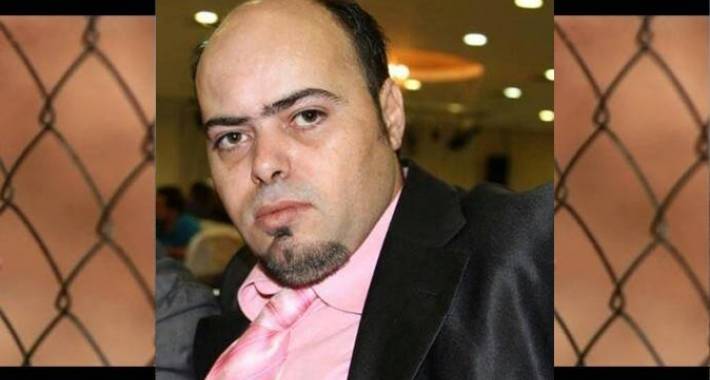 Amjad al-Safadi was an East Jerusalem defense attorney whose clients were Palestinian security prisoners. Two months ago, he himself was arrested by the Shabak and detained for 45 days. He was charged with aiding Palestinian militant groups and their detainees. During his detention he was tortured by Shabak interrogator goons. Among his claims were that electric shocks were used against him. He was released from prison and placed under house arrest (the same process used in the case of Majd Kayyal). Yesterday, five days after his release, he hung himself at his home and died.
News1, in that breathless credulous way Israeli media has of reporting Palestinian security “crimes,” claims (Hebrew) that four Palestinian lawyers were arrested (the charge sheet was filed on April 4th) after being recruited by a former prisoner to pass messages to arrestees from Islamic Jihad and Hamas housed in various prisons within Israel.
They were accused of “tens” of violations of various security statutes including “contact with a foreign agent,” “serving an unlawful association,” and “obtaining materials to facilitate in acts of terror.” The accused purportedly passed messages from the prisoners to the leadership of the militant groups with which they were affiliated. The attorneys were allegedly paid between $100-150 for each message delivered, with the funds coming from the militant groups in Gaza. The messages were designed to coordinate protests within the prisons against treatment of security detainees, including hunger strikes, attempts to establish “radio contact between Gaza and the prisons,” transfer of funds among the prisons and coordination between the organizations and their imprisoned leaders. The origin of these funds was allegedly an unnamed lawyer representing the organizations in Gaza.
For Israeli TV news coverage of the original arrests, see here.
Anyone who regularly reads this blog will know of my profound skepticism about virtually any criminal charge offered by the security services. While I haven’t been able to delve into the evidence offered, the charges in this case strike me as dubious, if not ludicrous. How some of the most highly surveilled prisoners in the Israeli prison system would’ve been able to create surreptitious radio communication between the prisons and Gaza, how they would have been able to transfer tens of thousands of dollars between prisoners and militant groups on the outside, how specifically the defendants aided in acts of terror–what materials they procured, and who they give them to? It all appears to be an elaborate fictional conspiracy.
These alleged activities began, according to the charge sheet in January 2012 and continued till their arrest. How such a conspiracy involving so much money, equipment and co-conspirators could’ve extended for a period of two years in some of the most secure facilities in the State of Israel beggars belief.
There are always readers who point out the heinous charges against the victims as if they were proven. So let’s keep in mind that not only weren’t the charges proven, the victims hadn’t been tried, let alone convicted. There is a presumption of innocence in most democracies, though my right-wing readers often conveniently forget this when a Palestinian is involved.
Whether or not al-Safadi was guilty of any of the charges, the very notion of torturing a defense attorney in a so-called democracy is beyond repulsive. What does it say about Israel that it’s torturers can make a well-educated professional man kill himself when released? Don’t Israelis understand that when their representatives do such heinous things it reflects on the entire nation? Or do they not care because they can create a wall between “us,” the Jews, and “them,” the Palestinians? What they do to “them” is somehow insulated from “us?”
All this proves beyond a shadow of a doubt that Israeli ‘democracy’ is skin deep and reserved for the Jewish sector. Among Israeli Jews there is a prevalent notion that their country can be a democracy even with the Palestinian minority being denied democratic rights. The very notion is preposterous and indicates Israel is an ethnocracy rather than a democracy.
I have only been able to find one instance of an Israeli Palestinian prisoner committing suicide in an Israeli prison and none of prisoners killing themselves shortly after release from the torture chambers (there is of course the example of Ben Zygier, who committed suicide in his cell). It’s always thrilling when Israel achieves yet another milestone in its march toward democracy and the rule of law!
I contacted the Public Committee Against Torture in Israel and asked what they knew about the case. Ishai Menuchin the director told me that they’d tried to locate Amjad within the prison system twice during his detention without success. They heard he was at the Russian Compound (Jerusalem). When they arrived to see him they discovered he’d been moved to Ramon, a different prison. When they asked to meet with him there they were told he’d been released.
What ‘Destruction of Israel’?

Netanyahu’s ‘destruction of Israel’ mantra should not be taken seriously. (Photo: Wikimedia Commons)
By John V. Whitbeck | Palestine Chronicle | April 29, 2014
When, in response to the threat of potential Palestinian reconciliation and unity, the Israeli government suspended “negotiations” with the Palestine Liberation Organization on April 24 (five days before they were due to terminate in any event), Prime Minister Netanyahu’s office issued a statement asserting: “Instead of choosing peace, Abu Mazen formed an alliance with a murderous terrorist organization that calls for the destruction of Israel.”
In a series of related media appearances, Netanyahu hammered repeatedly on the “destruction of Israel” theme as a way of blaming Palestine for the predictable failure of the latest round of the seemingly perpetual “peace process”.
The extreme subjectivity of the epithet “terrorist” has been highlighted by two recent absurdities – the Egyptian military regime’s labeling of the Muslim Brotherhood, which has won all Egyptian elections since the overthrow of Hosni Mubarak, as a “terrorist” organization and the labeling by the de facto Ukrainian authorities, who came to power through illegally occupying government buildings in Kiev, of those opposing them by illegally occupying government buildings in eastern Ukraine as “terrorists”. In both cases, those who have overthrown democratically elected governments are labeling those who object to their coups as “terrorists”.
It is increasingly understood that the word “terrorist”, which has no agreed definition, is so subjective as to be devoid of any inherent meaning and that it is commonly abused by governments and others who apply it to whomever or whatever they hate in the hope of demonizing their adversaries, thereby discouraging and avoiding rational thought and discussion and, frequently, excusing their own illegal and immoral behavior.
Netanyahu’s assertion that Hamas “calls for the destruction of Israel” requires rational analysis as well.
He is not the only guilty party in this regard. The mainstream media in the West habitually attaches the phrase “pledged to the destruction of Israel” to each first mention of Hamas, almost as though it were part of Hamas’s name.
In the real world, what does the “destruction of Israel” actually mean? The land? The people? The ethno-religious-supremacist regime?
There can be no doubt that virtually all Palestinians – and probably still a significant number of Native Americans – wish that foreign colonists had never arrived in their homelands to ethnically cleanse them and take away their land and that some may even lay awake at night dreaming that they might, somehow, be able to turn back the clock or reverse history.
However, in the real world, Hamas is not remotely close to being in a position to cause Israel’s territory to sink beneath the Mediterranean or to wipe out its population or even to compel the Israeli regime to transform itself into a fully democratic state pledged to equal rights and dignity for all who live there. It is presumably the latter threat – the dreaded “bi-national state” – that Netanyahu has in mind when he speaks of the “destruction of Israel”.
For propaganda purposes, “destruction” sounds much less reasonable and desirable than “democracy” even when one is speaking about the same thing.
In the real world, Hamas has long made clear, notwithstanding its view that continuing negotiations within the framework of the American-monopolized “peace process” is pointless and a waste of time, that it does not object to the PLO’s trying to reach a two-state agreement with Israel; provided only that, to be accepted and respected by Hamas, any agreement reached would need to be submitted to and approved by the Palestinian people in a referendum.
In the real world, the Hamas vision (like the Fatah vision) of peaceful coexistence in Israel/Palestine is much closer to the “international consensus” on what a permanent peace should look like, as well as to international law and relevant UN resolutions, than the Israeli vision – to the extent that one can even discern the Israeli vision, since no Israeli government has ever seen fit to publicly reveal what its vision, if any exists beyond maintaining and managing the status quo indefinitely, actually looks like.
As the Fatah and Hamas visions have converged in recent years, the principal divergence has become Hamas’s insistence (entirely consistent with international law and relevant UN resolutions) that Israel must withdraw from the entire territory of the State of Palestine, which is defined in the UN General Assembly resolution of November 29, 2012, recognizing Palestine’s state status as “the Palestinian Territory occupied since 1967” (including, significantly, the definite article “the” missing from “withdraw from territories” in the arguably ambiguous UN Security Council Resolution 242), in contrast to Fatah’s more flexible willingness to consider agreed land swaps equal in size and value.
After winning the last Palestinian elections and after seven years of responsibility for governing Gaza under exceptionally difficult circumstances, Hamas has become a relatively “moderate” establishment party, struggling to rein in more radical groups and prevent them from firing artisanal rockets into southern Israel, a counterproductive symbolic gesture which Israeli governments publicly condemn but secretly welcome (and often seek to incite in response to their own more lethal violence) as evidence of Palestinian belligerence justifying their own intransigence.
Netanyahu’s “destruction of Israel” mantra should not be taken seriously, either by Western governments or by any thinking person. It is long overdue for the Western mainstream media to cease recycling mindless – and genuinely destructive – propaganda and to adapt their reporting to reality, and it is long overdue for Western governments to cease demonizing Hamas as an excuse for doing nothing constructive to end a brutal occupation which has now endured for almost 47 years.
Israeli army demolishes three houses and a mosque near Nablus
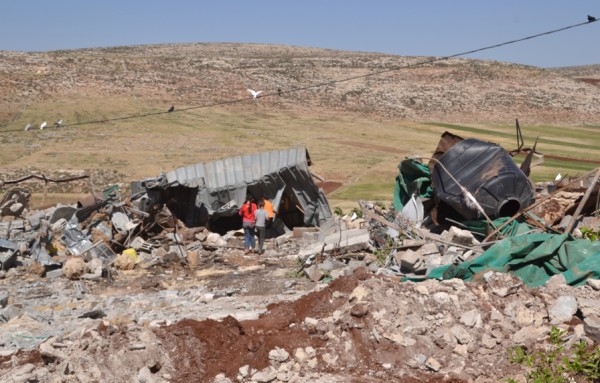
Photo by International Solidarity Movement
MEMO | April 29, 2014
Israeli army forces demolished three houses and a mosque in Khirbet Al-Taweel village near Nablus, North of West Bank, a Palestinian official reported today.
The official responsible for monitoring settlement activity in the northern West Bank, Ghassan Douglas told reporters that “a large force of Israeli army vehicles stormed Khirbet Al-Taweel village and declared the area a closed military zone amid tight security measures.
“The forces prevented residents from entering or leaving the village and students from going to their school then demolished a mosque and three houses belonging to Osama Anas, Anwar Sudqi Hani and Mohammed Sudqi Hani and three agricultural barracks.”
The buildings were destroyed because it was claimed they were built without the correct permits, he said.
According to Douglas, this is not the first time Israeli forces have demolished buildings in the village under the pretext they were built in area C, which lies under Israel’s security and administrative control according to the Oslo accords.
Douglas pointed out that Israeli army forces target the village to displace its residents and annex its land to attach it to nearby settlements or use them for army training.
He said Israeli army had recently handed its residents 18 demolition orders including one to demolish the village electricity grid.
The village’s land is vital for agriculture and constitutes natural pastures for over 30,000 cattle in nearby towns.
The Dangerous VIP Palestinian Class

By Jamal Kanj | Palestine Chronicle | April 27, 2014
The Palestinian Authority (PA) must stop demeaning its people. One can understand being fooled once or even twice, but being fooled over and again every three to four years for the last 20 years is just going overboard.
It becomes a bit annoying to continue hearing cries from the same “deceived” Palestinian leaders repeating empty threats in response to Israeli intransigence and lies.
I heard it directly from several high level PLO officials that should the current negotiations fail to reach an agreement by April 29, the PA was prepared to join UN organizations. They spoke specifically of the International Criminal Court of Justice (ICCJ).
Early in April, Israel broke a nine-month-old agreement by refusing to release the final batch of Palestinian “hostages” as it agreed to with the US Secretary of State last July. Half-heartedly, the PA submitted applications to join 15 UN organizations.
Half-heartedly, because the token measure ratified accords obligating the PA to fulfil UN conventions, none of which could have empowered the PA to put an end to Israel’s wanton disregard of international law.
The decision to endorse UN treaties such as the 4th Geneva Convention, protocol one, Conventions against Corruption, Rights of the Child, Civil and Political Rights, Consular Affairs … etc., was most likely to mollify rising internal frustrations with the sham negotiations. It was not directed at Israel and this might explains the US’ muted displeasure with the toothless measures.
Now the PA is disingenuously leaking out information about dismantling the Authority and turning over its role of managing the occupation to Israel.
Israel and its America Israel Public Affair Committee (AIPAC) ex-staffer who is mediating the talks on America’s behalf, understand very well that the PA threats are for local political consumption just like the inconsequential move to join irrelevant UN organizations.
It is mind-boggling that the PA expects others to take its threats seriously. Shouldn’t they first take other steps such as ending security co-ordination to protect Israel’s illegal settlers? How about joining relevant UN organizations like ICCJ or endorsing article 49 of the 4th Geneva Convention- which Israel is categorically violating- instead of signing the worthless protocol one.
Just like the self-proclaimed “chief” Palestinian negotiator who publicly resigned more than a month ago protesting, ostensibly, the lack of progress at the peace talk. In reality however, he was incensed by informal parallel secret negotiations conducted with Israel behind his back.
He backed off once assured of his role as the main collaborator. Interestingly though, he did not seem bothered enough to resign after Israel failed to carry out a feeble agreement he himself negotiated last July.
It is not just Israel’s disregard to the international law, but this type of Palestinian leadership – lacking self-respect- who represent the biggest threat to the future of Palestine. It is the groveling Oslo-created Palestinian VIP class.
VIP passes are renewable benefits bestowed by the Israeli army to supposedly facilitate the movement of Palestinian officials. Obviously, VIP Palestinian club members do not experience the reality of occupation and have for the most part enjoyed this status since the establishment of the PA in 1994 as long as Israel was content with their performance.
To be taken seriously, the PA must first end this joke and limit the “intravenous” VIP status for its officials to no more than two years.
Not to suggest a far-fetched “radical proposal” like ending security co-ordination with Israel, PA should at a minimum return all VIP passes and insist on its security coordinators and negotiating team to navigate Israeli military barriers like normal citizens.
Besides making Israel and AIPAC American’s mediator sit and wait, reminding these officials of the evil of occupation might be an incentive to change the way VIP holders negotiate with Israel.
– Jamal Kanj (www.jamalkanj.com) writes weekly newspaper column and publishes on several websites on Arab world issues. He is the author of “Children of Catastrophe,” Journey from a Palestinian Refugee Camp to America. (A version of this article was first published by the Gulf Daily News newspaper.)
Why Neocons Seek to Destabilize Russia
By Robert Parry | Consortium News | April 27, 2014
Now that the demonization of Russia’s President Vladimir Putin is in full swing, one has to wonder when the neocons will unveil their plan for “regime change” in Moscow, despite the risks that overthrowing Putin and turning Russia into a super-sized version of Ukraine might entail for the survival of the planet.
There is a “little-old-lady-who-swallowed-the-fly” quality to neocon thinking. When one of their schemes goes bad, they simply move to a bigger, more dangerous scheme.
If the Palestinians and Lebanon’s Hezbollah persist in annoying you and troubling Israel, you target their sponsors with “regime change” – in Iraq, Syria and Iran. If your “regime change” in Iraq goes badly, you escalate the subversion of Syria and the bankrupting of Iran. [See Consortiumnews.com’s “The Mysterious Why of the Iraq War.”]
Just when you think you’ve cornered President Barack Obama into a massive bombing campaign against Syria – with a possible follow-on war against Iran – Putin steps in to give Obama a peaceful path out, getting Syria to surrender its chemical weapons and Iran to agree to constraints on its nuclear program.
So, this Obama-Putin collaboration has become your new threat. That means you take aim at Ukraine, knowing its sensitivity to Russia. [For details, see Consortiumnews.com’s “What Neocons Want from Ukraine Crisis.”]
You support an uprising against elected President Viktor Yanukovych, even though neo-Nazi militias are needed to accomplish the actual coup. You get the U.S. State Department to immediately recognize the coup regime although it disenfranchises many people of eastern and southern Ukraine, where Yanukovych had his political base.
When Putin steps in to protect the interests of those ethnic Russian populations and supports the secession of Crimea (endorsed by 96 percent of voters in a hastily called referendum), your target shifts again. Though you’ve succeeded in your plan to drive a wedge between Obama and Putin, Putin’s resistance to your Ukraine plans makes him the next focus of “regime change.”
Your many friends in the mainstream U.S. news media begin to relentlessly demonize Putin with a propaganda barrage that would do a totalitarian state proud. The anti-Putin “group think” is near total and any accusation – regardless of the absence of facts – is fine.
In just the past week, the New York Times has run two such lead stories. The first, last Monday, trumpeted supposed photographic evidence proving that Russian special forces had invaded Ukraine and were provoking the popular resistance to the coup regime in Kiev. [See Consortiumnews.com’s “Another NYT-Michael Gordon Special?”]
Two days later, the Times buried deep inside the paper a grudging retraction, admitting that one key photo that the Times said was taken in Russia (showing the supposed troops before they were dispatched to Ukraine) was actually taken in Ukraine, destroying the whole premise of the earlier story. [See Consortiumnews.com’s “NYT Retracts Russian-Photo Scoop.”]
 Then, on Sunday, the Times led the paper with a lengthy report on the “Search for Secret Putin Fortune” with the subhead: “U.S. Suggests Russian Leader Has Amassed Wealth, and That It Knows Where.” Except the story, which spills over to two-thirds of an inside page, presents not a single hard fact about Putin’s alleged “fortune,” other than that he wears what looks like an expensive watch.
The story is reminiscent of Ronald Reagan’s propaganda campaign against Nicaraguan President Daniel Ortega for wearing “designer glasses,” a theme that was picked up by the major U.S. news outlets back then without noting the hypocrisy of Nancy Reagan wearing designer gowns and Reagan’s beloved Nicaraguan Contra leaders profiting off arms sales and cocaine smuggling.
Spreading suspicions about a target’s personal wealth is right out of Propaganda 101. The thinking is that you can turn people against a leader if they think he’s ripping off the public, whether he is or isn’t. The notion that Ortega’s glasses or Putin’s watch represents serious corruption – or that they are proof of some hidden fortune – is ludicrous, but it can serve a propaganda goal of creating divisions.
But what would it mean to destabilize Russia? Does anyone think that shattering the Russian political structure through a combination of economic sanctions and information warfare will result in a smooth transition to some better future? The Russians already have tried the West’s “shock therapy” under drunken President Boris Yeltsin – and they saw the cruel ugliness of “free market” capitalism.
Putin’s autocratic nationalism was a response to the near-starvation levels of poverty that many Russians were forced into as they watched well-connected capitalists plunder the nation’s wealth and emerge as oligarchic billionaires. For all Putin’s faults, it was his push-back against some of those oligarchs and his defense of Russian interests internationally that secured him a solid political base.
In other words, even if the neocons get the Obama administration – and maybe its successor – to ratchet up tensions with Russia enough to generate sufficient political friction to drive Putin from office, the likely result would be a dangerously unstable Russia possessing a vast arsenal of nuclear weapons. Putin loyalists are not likely to readily accept a replay of the Yeltsin years.
But the neocons apparently think the risks are well worth it. After all, the end result might finally let them kill off that pesky fly, Israel’s near-in threat from the Palestinians and Hezbollah. But we might remember what happened to the little old lady in the ditty, when she swallowed the horse, she was dead, of course.
~
Investigative reporter Robert Parry broke many of the Iran-Contra stories for The Associated Press and Newsweek in the 1980s. You can buy his new book, America’s Stolen Narrative, either in print here or as an e-book (from Amazon and barnesandnoble.com).
Featured Video

Saudi Led Destruction of Yemen’s heritage
or go to
Aletho News Archives – Video-Images
From the Archives
Israel: Strategic Ally or Liability?
By Stephen Sniegoski | My Catbird Seat | June 12, 2010
The claim that Israel serves as a valuable ally for the United States is made by both pro-Zionists and much of the anti-war and anti-Zionist Left that is influenced by Noam Chomsky. As a result of the Gaza flotilla massacre, which has caused a world-wide uproar against Israel, the value of Israel to the United States is being publicly questioned in more mainstream foreign policy forums. … continue
Blog Roll
 Aletho News
- Four in five new UK jobs taken by foreigners – report
- Here’s what Trump’s latest U-turn really means for Russia and Ukraine
- The Houthis Are Not an Iranian Proxy
- Europe’s Energy Hypocrisy, Russian LNG Profits and US Dependence
- ICC ignored ‘very well-documented’ NATO crimes – ex-Libyan minister
- SNSC secretary dismisses US response to Iran’s conditions as ‘inadequate’
- Sanaa says Taiz roads open, secure for residents, warns Saudi forces
- Iraqi resistance group urges Saudi leadership to admit defeat, lift Yemen siege
- Trump’s Retreat: How Al-Aqsa Flood Took Down the US Empire
- Israel’s Military Actions in Lebanon Grossly Violate International Law — Lavrov
- If Americans Knew
- ADL is working with AI companies to suppress alleged ‘antisemitism’
- Israeli occupation forces using social media surveillance unit to target hundreds of Palestinians in the West Bank
- Israel’s New – and Terrifying – Security Doctrine
- Israeli Attacks Kill Five in Gaza, Including a four-year-old and a woman
- Air Force Major Who Called for Trump’s Impeachment Held in Solitary Confinement
- It’s a Genocide, I’m Into It’: Seinfeld Mocks Protest over Palestinian Children Killed
- Universities fire dozens amid pressure from Zionist billionaires
- Gaza’s buildings are collapsing on top of us. But there’s nowhere else to shelter
- Israel kills four-year-old Gaza child – Daily Update
- After Oct 7, IDF policy allowed civilian casualties for even the lowest-ranking targets
- No Tricks Zone
- New Study Suggests Large Regions Of The Pacific Ocean Have Been Cooling For The Last 80 Years
- Germany’s Green Energy Debacle: High Energy Costs Force Kahla Porzellan to Close After 182 Years!
- New Study: 50 Years Of The Most Aggressive ‘Net Zero’ Policies Can Only Affect The Global Climate By 0.03°C
- US September “Heat” Was No Record…Many Records Set Decades Ago
- Latest European Green Energy Debacle; Portugal’s Largest Flagship Solar Park Insolvent!
- Green Energy Debacle: German Expert Professor Fritz Vahrenholt Warns Of Severe Economic And Social Consequences
- Two More Paleo Reconstructions Affirm Meters-Higher Sea Levels Across Ireland, Brazil 7000-6000 Years Ago
- New Study: Earth And Venus Surface Warmth Largely Explained By Convection And Lapse Rate, Not CO2 Or Radiation
- 2025 Nature Paper Claiming Worsening Global Drought Gets RETRACTED …Heavily Flawed
- New Study: ‘Global Drought Shows No Detectable Recent Acceleration Under Climate Warming’

