How the United States Was Used to Create Israel
A Review of Alison Weir’s “Against Our Better Judgment”
By James Abourezk | CounterPunch | March 14, 2014
Having studied enough American Indian Tribes over the years, I have grown accustomed to creation myths that each Tribe assigns itself as its reason for being. And the definition of “chutzpah” that I’ve been taught is that of a young man on trial for murdering his parents, who throws himself on the mercy of the Court on grounds that he is an orphan.
That, as Alison Weir has made clear, is Israel’s situation. In Against Our Better Judgment, Ms. Weir writes with great clarity how the Zionist movement was able to move politicians, both in America and in England, to legalize a most illegal act–that of stealing an entire nation, and crying foul when those from whom it was stolen complained, then tried to retake the land.
Ms. Weir’s in depth research to expose Zionist actions in earlier times provides a solid basis for her conclusions about creating Israel from a land called Palestine. And she documents the intense lobbying done by Israel’s Zionist creators in order to legalize an action that was clearly illegal.
We are now living with the consequences of that bit of grand theft, i.e., the continuing violence in the Middle East, affecting everything America might want to do in the Middle East. We only recently have witnessed Bibi Netanyahu’s so far failed effort to have America invade and conquer Iran, a country that obviously is too much of a mouthful for Israel to bite off. Suddenly, even Barak Obama recognizes the danger in following Israel’s advice on how to conduct itself in the Middle East. The President tiptoed to the edge of the abyss but backed away when Israel’s trained seals in the U.S. Congress tried to push the nation over the edge.
We saw Congressional supporters of Israel shamefully initiating the dozens of applauses by the Joint Session of Congress when they entertained Prime Minister Netanyahu, who obliged the assembled mass with aggressive applause lines, designed to favor those who have a liking of violence and to show how Israel is “America’s staunchest ally” in the Middle East.
During the 1970s, when I was a member of the U.S. Senate, I was waiting my turn to testify on the Middle East situation before the Senate Foreign Relations Committee. As is the custom, the Administration witness was testifying ahead of me. I do not recall his name, but I felt very sorry for him when New York’s Senator Javits asked from the dais, “Please explain why Israel is our most important ally in the Middle  East.”
The poor fellow did not have an answer. Granted, he was a lower level State Department official, but his lack of an answer was indicative of the lack of a story provided to him by his seniors in the State Department.
So Sen. Javits asked him again, and again, and again, trying to have a statement from some government official which Israel’s Lobby could use in its propaganda campaign to maintain Israel’s lofty position in the American mind. But the State Department official was unable to find an answer, which left Sen. Javits and his cohorts to try some other avenue. The Israel-is-a-vital-ally shibboleth has since been made into an overused slogan by supporters of Israel.
But each time I hear that phrase, “staunchest ally,” I think of the American sailors on the U.S.S. Liberty, who, during the 1967 Israeli-Arab War, died when the Israeli military was order to destroy its “ally’s” intelligence ship. During that act of friendship, America’s staunchest ally killed some 34 American sailors, and wounded another 170.
I also think of Jonathan Pollard, an American employee of our Pentagon, who sold what has been described as “a truckload” of the Pentagon’s secrets to Israel. I say “sold,” because Israel paid Pollard for the secrets, which Israel then traded to the Soviet Union for that country’s relaxation of rules with respect to Jewish emigration from the Soviet Union to Israel.
With Ms. Weir’s well researched history in mind, I am forced to think of the cadre of American journalists who lately have assigned “oil” as the reason for George Bush’s Folly–the invasion of Iraq in 2003. They say nothing of the well known fact that George Bush had a number of Israel’s supporters giving him advice on the issue of Iraq. I’ve lost count of the billions of American dollars that were sucked up by that war, as well as the precious American lives that were lost to satisfy Israel’s agents in the Bush Administration, those who convinced President Bush to do something that Israel wanted, but knowing it was better if “America did it.” President Obama should be applauded for refusing to fall into the same trap with respect to Syria.
This provocative book documents a history that is essential in understanding today’s world. Scholarly, yet readable, it is a must for all Americans. We all need to know what we have spent by coddling Israel and its aggressions, and why the cost has become more than we have bargained for.
James Abourezk is a former U.S. Senator from South Dakota who plunged into the Middle East morass when he saw the cost to our country of Israel’s efforts to connive to have our country do Israel’s dirty work. His memoir, Advise & Dissent, has recently been re-published, along with a new Introduction by Sen. Fred Harris.

Israeli Soldier Interrogates Palestinian Boy at Gunpoint
By Chris Carlson| International Middle East Media Center | March 13, 2014
The Israeli Haaretz newspaper unveiled, Thursday morning, that an Israeli soldier pointed his gun at a handcuffed Palestinian boy, during an investigation after arresting him in Nabi Saleh village, near the West Bank city of Ramallah.
The Al Ray newspaper pointed out that Israeli forces arrested four boys from Nabi Saleh village three weeks ago, under the pretext of throwing stones.
He (one suspect) was led to Benjamin police station for investigation.
There, one of the soldiers who participated in the arrest attended, and was filmed while directing his gun towards the boy in the interrogation room. The soldier left the room after investigation officers arrived, the newspaper added.
It was noted, by the court, that the documentation of the stone-throwing incident is not professional, and that the boys’ identities are in doubt.
Allenby killing highlights need for serious change
By Daoud Kuttab | Ma’an | March 14, 2014
For 46 years the bridge connecting the West Bank with Jordan has been a source of hardships, humiliations and extremely long and unnecessary delays, not to mention cumbersome and exaggerated body and baggage searches.
This nightmare has to end.
What happened on March 10 is a symptom of the occupation versus occupied paradigm that must come to an end.
A 38-year-old Jordanian father of two and a sitting judge in Amman’s Court of First Instance, attempted to travel to Nablus like many Palestinians and Jordanians of Palestinian origin. His altercation with Israeli soldiers that ended with his death must be a warning flag that this injustice and humiliation cannot continue.
Anyone who crosses the King Hussein Bridge knows very well how the Israelis have for decades forged a shameful occupier-occupied relationship with the power of their guns. The Oscar-winning film Twelve Years a Slave, perfectly illustrates the way that the oppressed absorb all kinds of humiliation simply in order to survive as they wait for salvation.
Raed Zuaiter, the Jordanian judge, like any other human being, apparently walked into this mess without the added shield of years of humiliation and he couldn’t accept it.
For their part, the Israeli soldiers, brainwashed to suspect every passenger as a potential “terrorist,” viewed the rebellion against accepting the occupier-occupied paradigm as enough proof that the rebellious person must be a terrorist. As they say, the rest is history.
The Israeli spin machine quickly went into action. The often repeated defense was that Zuaiter went for the soldier’s gun. Later it was adjusted that he went for his throat, attempting to strangle him. The “terrorist” label also required some audio. So again the spin machine fabricated that the judge yelled “Allahu Akbar, Allahu Akbar” before lunging for the soldier’s gun (or throat), thus confirming that he was a terrorist.
Of course much of the speculation as to what happened and when could easily be put to rest if footage from the most camera-covered spot at the bridge (the first few meters into the Israeli controlled area) is made available. But alas, the camera is now said to have been inoperative that day. How convenient.
But there is a tiny fact that is hard to refute. How did the bus carrying Zuaiter enter the Israeli occupied territories. A metal bar and four metal pistons make it impossible for any vehicle to enter until someone presses a remote-controlled button. The buttons are located in a windowless room with lots of cameras that show the operators who is coming, what license plate they hold and so on.
Naturally, addressing the problem that caused the untimely death of an innocent Jordanian is currently focused on the logistics and mechanics of what happened, but there is a need to look at the context of what is happening and how to avoid the recurrence of such trigger-happy acts.
In the negotiations about the implementation of the Oslo Accords, the Palestinians insisted that even during the interim period no Israeli soldier should have any face-to-face contact with passengers. The Israelis designed a plan where they sit behind one-way mirrors and control the bridge from this vantage point.
The plan, which included the presence of unarmed Palestinian police, was operational for a short time at the end of the 1990s but was scrapped when the second Intifada broke in October 2000. Since then the call to return to the pre-October status throughout the occupied territories and on the bridge has been made repeatedly but no action was taken. The roadmap included a section for the return of the Palestinian police to the bridge, but this was never implemented.
In addition to the need to keep brainwashed, heavily armed young Israeli soldiers as far away from traveling civilians as possible, there are other decisions that can help reduce the tension on the bridge. For example, the crossing should be open around the clock in order to ease the long waiting period that add to the anger and frustration.
Israelis say that they can’t cover the cost of 24-hour staff but many Palestinians think that they don’t care while others believe that this is deliberate to maintain the occupier-occupied paradigm.
The best and most effective way to reduce the tensions and tragedies such as the murder of the Jordanian judge, is to end the occupation and totally remove the unwanted Israeli occupiers from Palestinian territories.
In the meantime, people of goodwill must agree that the current status quo on the King Hussein Bridge is untenable. Serious and deep changes are required in order to guarantee that what happened on March 10 to an innocent Jordanian will not take place again.
Daoud Kuttab is a Palestinian journalist and former professor of journalism at Princeton University.
Related articles


Scandal of billion dollar deals between Saudi Arabia and Veolia
Ard Kanaan News Agency | March 12, 2014
Veolia is a French company specialising in environmental work in the fields of water, recycling, energy and transportation. The company has recently had a lot of media coverage given its contribution to supporting Israeli settlements.
The company has been registered by international activists concerned with the Palestinian cause on the Boycott, Divestment, and Sanctions (BDS) list since 2005, “due to their immoral work serving the occupation in various areas in Palestine”.
Currently it is involved in a railway project in Jerusalem that links the illegal West Bank settlements and Jerusalem which is considered one of the occupation’s main means and an important step in the context of the Judaisation of Jerusalem project and the expansion of settlements in the city. It not only transports Israelis passing through, but also facilitates access between the new Israeli settlements and the settlers as a means of easing settlements and outlining a mechanism and infrastructure for its expansion. This is considered a violation of the Geneva Accords which prohibit the occupation from transporting its citizens to occupied territories, so this is not only a clear violation of Palestinian rights, but also a violation of international agreements made in this regard.
Veolia’s activity ranges between environment workshops, water and transportation, as it works through one of its subsidiaries (T.M. M.) and Tovlan Landfill, near Jericho, as a report by Corporate Watch Research Group, specialising in monitoring the work of international companies, stated the violations made by Veolia with regards to the management of the landfill. Veolia buries the waste of 21 settlements in the landfill near the Jordanian border, this has many health and environmental “side effects” on neighbouring Arab villages such as Fasayil and Abu Al `Ajaj, leading to the displacement of the residents of the latter, the population dropping to 200 residents from thousands in 1999, the year the landfill was established.
There are also those who leave their homes during the summer only to return in winter when the smell from the landfill is not as strong. The livestock, which is the main source of income for locals, also suffered big losses.
The residents of these villages are also deprived of electricity, while the residents in settlements have electricity and water at discounted rates in order to motivate them to live in settlements. The recycling of the waste in the landfill contributes to the provision of electric energy by means of renewable energy.
Who works in the landfill? Palestinians work in the landfill and they are deprived of any labour rights, as their wages are half the minimum wages set for Israeli workers and they are deprived of work and health insurance.
The company also has shares in the bus routes, such as route 109 and 110, which provide transportation for settlers on Highway 433 in the West Bank running through the settlements. The occupation enforces apartheid/segregation rules on highway 433, as Palestinians are not allowed to use the highway.
Veolia is also involved in facilitating Israeli exclusion operations, as well as facilitating the transfer of settlement waste, transporting it to Palestinian areas and causing many long-term health and geographic problems. This has encouraged the indirect expulsion of Palestinians, all of which has contributed to the process of racial segregation in transportation in those areas.
Similarly, it has recently provided water and sanitation services to many of the Israeli occupation’s settlements in the occupied West Bank, including the Modi’in Ilit settlement located between Jerusalem and Tel Aviv in the occupied Palestinian territories.
This means that three out of Veolia’s four subsidiaries – water, waste and transportation – actively work to support settlements.
Veolia’s activities are considered a flagrant violation of international law, specifically Article 49 of the Fourth Geneva Convention which states that “Individual or mass forcible transfers, as well as deportations of protected persons from occupied territory to the territory of the Occupying Power or to that of any other country, occupied or not, are prohibited, regardless of their motive.”
International law also prohibits Israel from using occupied land for its own benefit and, therefore, burying waste from the settlements in the occupied territories is a violation of United Nations Resolution 63/201 dated January 28, 2009, which:
“Calls upon Israel, the occupying Power, not to exploit, damage, cause loss or depletion of, or endanger the natural resources in the Occupied Palestinian Territory, including East Jerusalem, and in the occupied Syrian Golan.
Calls upon Israel, the occupying Power, to comply strictly with its obligations under international law, including international humanitarian law, with respect to the alteration of the character and status of the Occupied Palestinian Territory, including East Jerusalem.
Also calls upon Israel, the occupying Power, to cease the dumping of all kinds of waste materials in the Occupied Palestinian Territory, including East Jerusalem, and in the occupied Syrian Golan.”
In addition to violating international law, Veolia’s acts violate the resolution of the Arab summit in Khartoum, in March 2006, which provides for the following:
The condemnation of the project aiming to link West Jerusalem to the occupied West Bank through occupied East Jerusalem and the stressing of the illegality of this project. It also calls on the two French companies [Alstom and Veolia] to immediately withdraw from the project and demands punitive measures be taken against them if they don’t comply. The Arab Summit also urged the French government to take the necessary measures in this respect to honour its obligations under international law.
To top this all off, Veolia’s activity in the occupied territories contradicts the company’s declared goals and strategies which aim to “reduce the negative environmental impacts of waste” and “help raise the citizens’ standard of living.”
It is clear that Veolia selectively applies these goals, as it only aims to raise the standard of living of the settlers, at the expense of the Palestinians and in violation of international treaties and the most basic human rights.
This company’s long history of racism and the oppression of the Palestinians’ rights was enough to convince the public opinion in different parts of the world to boycott it.
The campaign to reduce the company’s activity and completely boycott it was successful in impacting its work, which has suffered due to losses estimated at more than $12 billion over the past six years in order to prevent the renewal or signing of new contracts in many countries worldwide. These include Australia, Sweden, Norway, Netherlands, Ireland, Scotland and finally England. In addition to this, a coalition of boroughs in south-west London refused to bid on the tender offered by Veolia for a £1 billion waste removal deal last April. In January 2009, Veolia lost a contract worth €3.5 billion Euros to run the metro in Stockholm.
In addition to the efforts made globally to boycott this company and reduce its activity, French company Alstom, a company working in partnership with Veolia on the Jerusalem railway project, linking Jerusalem and the settlements, lost the second phase of the Saudi Haramain Railway project, which connects Mecca and Medina in Saudi Arabia. This is in spite of the fact that the company had previously won the contract for the first phase. The value of the second phase contract is about $10 billion.
Since the end of 2008, the BDS National Committee, along with its partners, have made popular, official and media efforts in order to convince the Saudi authorities to exclude Alstom from the Haramain Railway deal due to its involvement in the Israeli occupation’s projects aiming to Judaise Jerusalem. Many letters and documents to this effect were sent to official parties in Saudi Arabia from the BDS Committee, as well as several official, popular, Palestinian, Islamic and international parties in the context of a coordinated campaign targeting this company.
Veolia in Saudi Arabia
Despite all of the information mentioned above, all the background information, business links, relations with the Israeli occupation and settlement operations, as well as its direct involvement in facilitating the expansion of settlements and the Judaisation of Jerusalem, and in spite of the boycott exercised by British and other organisations and governorates against Veolia, it has continued to operate and make outrageous profits in Saudi Arabia for years.
The company’s work in Saudi Arabia is narrowed down to the fields of water, sanitation and water desalination. It exists in Saudi Arabia through the Veolia Water Solutions & Technologies, Saudi Industries Ltd, with branches in Riyadh, Jeddah and Dammam. Veolia also operates in Saudi Arabia under the Sidem Saudi Ltd, one of Veolia Water Solutions & Technologies, Saudi Industries Ltd’s subsidiaries, which has branches in Jeddah, Khobar and Jubail. Sidem specialises in designing and building large desalination plants.
Veolia Water Solutions & Technologies, Saudi Industries Ltd has landed many large contracts with the Saudi government in recent years. The two contracts worth noting are the desalination plant contract with the Power and Water Utility Company for Jubail and Yanbu, signed in 2007, and the management, operation and maintenance of the water and sanitation sector deal in the Saudi capital Riyadh, signed in 2008.
In 2007, Veolia signed a contract with the Power and Water Utility Company for Jubail and Yanbu to establish one of the largest water desalination plants in the world worth $945 million. One year before signing the deal, Saudi Arabia signed the Arab Summit resolution in Khartoum.
Furthermore, Veolia has landed 62 water desalination contracts in Saudi Arabia since 2007. In 2008, Veolia signed a large contract with the National Water Company to manage, operate and maintain the water and sanitation in the Saudi capital Riyadh. Veolia expects this deal to achieve a $60 million profit.
In December 2011, Veolia signed a contract with the King Fahd University of Petroleum and Minerals to establish research centres in the Dhahran Techno Valley.
While Alstom – Veolia’s partner in the Judaisation of Jerusalem project and the Jerusalem railway project, connecting Jerusalem to the settlements – lost the second phase of the Haramain Railway project worth about $10 billion, Veolia (in full partnership with Alstom) is signing contracts worth billions of dollars in Saudi Arabia, despite its blatant violation of international law and the rights of the Palestinians.
Veolia has been working in Israel before it entered the Saudi market, and its involvement in settlements began very early on, before it made any deals with the Saudi government.
It is both embarrassing and astonishing that Veolia’s involvement in the settlements was not taken into account when it was awarded these huge business deals in Saudi Arabia and that the vast global BDS campaign against Alstom and Veolia in 2011 did not impact Veolia’s operations in Saudi Arabia, as the company signed an agreement with the King Fahd University of Petroleum and Minerals in December of the same year.
It is also shameful that at a time when international companies and parties are taking a stance against this company for violating the most basic human rights in Palestine and its participation in the brutal Israeli occupation and settlement, the Saudi government is signing contracts with the same company in various business areas. This in a country which is supposedly a leader in the belief in Palestinian rights, as well as protecting such liberties and condemning all human rights violations during this serious Palestinian tragedy.
A company with such a shameful history of working to enhance Israeli settlements should not find a work environment that opens the doors to trading in a country like Saudi Arabia, which has a long history of supporting the Palestinian cause.
While Veolia is losing billions of dollars in contracts in Stockholm and London, it is signing a billion dollar deal in Jubail and making profits of up to $60 million dollars in Riyadh!
The least that is expected of Saudi Arabia is not to sign contracts with Veolia, to pressure the company and make it choose between carrying out its responsibilities in accordance with international law, stop supporting the settlements and violating the rights of the Palestinians or to get out of Saudi Arabia and cease all forms of business with it.
Translation by MEMO
Al-Aqsa vs. Israel: The Lurking Danger Beneath
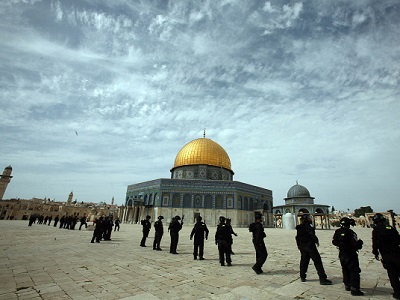
While the danger of Al-Aqsa Mosque collapsing is very real, it is a representation of the mentality that rules Israel. (Photo: Mahfouz Abu Turk)
By Ramzy Baroud | Palestine Chronicle | March 12, 2014
Something sinister is brewing around and below al-Aqsa Mosque in occupied East Jerusalem, and it has the hallmark of a familiar Israeli campaign to strip the Mosque of its Muslim Arab identity. This time around, however, the stakes are much higher.
The status of al-Aqsa mosque is unparalleled within the context of Muslim heritage in Palestine itself. It is also the third holiest Muslim shrine anywhere. But equally as important, it is a symbol of faith, resistance and defiance. Its story of struggle and perseverance goes hand in hand with the very modern Palestinian struggle for rights, freedom and identity. Praying at al-Aqsa at times seems like an impossible feat. Many Palestinians lost life or limbs simply trying to gain access to the mosque.
In a statement released on March 7, the Palestinian Ministry of Awqaf and Religious Affairs said Israeli forces carried out 30 attacks against Al-Aqsa Mosque and other holy sites during the month of February alone. Most of the attacks targeted Al-Aqsa itself. While the recurring violations at Al-Aqsa were led by Jewish settlers, according to the statement, they have done so under the watchful eye, protection and support of the Israeli police and army.
Most alarming about these attacks is their political context, which indicates that a great degree of coordination is underway between politicians, security forces and Jewish settlers.
In anticipation of a Palestinian backlash, on March 04, an Israeli court sentenced Islamic leader Sheikh Rade Saleh to eight months in prison for ‘incitement’. The Sheikh is the most outspoken Palestinian leader regarding the danger facing Al-Aqsa. Why silence Sheik Saleh now when the attacks against al-Aqsa are at an all time high?
It was on February 25, 1994, that US-born Jewish extremist Baruch Goldstein stormed into the Ibrahimi Mosque in the Palestinian city of al-Khalil (Hebron) and opened fire. The aim was to kill as many Arabs as he could.
At that moment, nearly 800 Muslim worshipers were kneeling down during the dawn prayer in the holiest month of the Muslim Calendar; Ramadan. He killed up to 30 people and wounded over 120. Exactly 20 years later, the Israeli army stormed al-Aqsa Mosque, the third holiest Muslim site, and opened fire. The timing was no accident.
Like the rest of the West Bank, Al-Khalil is facing the dual challenge of armed Jewish settlers and Israeli occupation soldiers; the latter enforcing the military occupation, while providing further protection to the settlers. The settlers, extremists from the illegal settlement of Kiryat Arba, often attack Palestinian residents of the town with complete impunity. Interestingly, many of Kiryat Arba settlers are Americans, as was Baruch Goldstein.
It was not enough that Israeli soldiers within the vicinity of the Ibrahimi Mosque allowed Goldstein – armed with a Galil rifle and other weapons – access to the mosque, but they opened fire on worshipers as they tried to flee the scene. Israeli soldiers killed 24 more and injured others. Goldstein, now a hero in the eyes of many in Israel, is often blamed solely for the massacre in al-Khalil. But in fact, it was a mutual effort between Goldstein and the Israeli army.
This symbiotic relationship between the army and settlers, which dates back to the early days of the Israeli occupation of Jerusalem, the West Bank and Gaza in 1967, continues.
While Israeli bulldozers dig into Palestinian land during the day, leveling mounds of ground and destroying olive groves for settlement expansion, heavy machinery burrows beneath the Old City of al-Quds, Jerusalem, at night. The Israelis are looking for evidence of what they believe to be ancient Jewish temples, presumably destroyed in 586BC and AD70. To fulfil “prophecy”, Jewish extremists believe that a third temple must be built. But of course, there is the inconvenient fact that on that particular spot exists one of Islam’s holiest sites: The Noble Sanctuary, or al-Haram al-Sharif. It has been an exclusively Muslim prayer site for the last 1,300 years.
The Noble Sanctuary, located in Jerusalem’s Old City, is the home of Al-Aqsa Mosque and the Dome of the Rock. The site has been under constant threat, attacks, acts of arson and military violence for nearly five decades. The few Muslim clergy – belonging to the Islamic Trust which manages the area, along with the custodianship of Jordan – are mindful of the ever-lurking Israeli threat that oftentimes turns deadly. It was no surprise that late Israeli leader Ariel Sharon chose that exact place to carry out his proactive ‘tour’ of al-Aqsa compound in 2000. Many unarmed Palestinians, mostly worshipers, died on that day. Thousands more were lost in the following months and years as the entirety of the occupied territories and Palestinian towns inside Israel exploded with unprecedented fury. Sharon was later elected Prime Minister of Israel.
That same dangerous combination – rightwing politicians allied with religious zealots – is at work once more. They are eying Al-Aqsa for annexation, the same way the Israeli government is laboring to permanently annex large swathes of the occupied West Bank, to preclude any future settlement with the Palestinian Authority of Mahmoud Abbas.
The Israeli Knesset (Parliament) chose the 20th anniversary of the Goldstein massacre of Palestinians in al-Khalil to begin a debate concerning the status of Al-Aqsa compound. Right-wingers – which constitute the bulk in the government of Prime Minister Benjamin Netanyahu – want the Israeli government to enforce its ‘sovereignty’ over the Muslim site, which is administered by Jordan per the Jordanian-Israeli peace treaty of 1994. Israeli MP Moshe Feiglin, is the man behind the move, but he is not alone. Feiglin is a member of Netanyahu’s Likud party, and has strong backing within the party, the government and the Knesset.
A major backer of Feiglin’s initiative is Miri Regev, also a far-right Likud member. Regev is demanding that the government establish separate prayer times for both Jews and Muslims in Al-Aqsa Compound. The model she wishes to duplicate is no other than the Ibrahimi Mosque. “We will reach a situation where the Temple Mount will be like the Cave of the Patriarchs, days for Jews and days for Muslims,” she said.
Of course, Regev omitted the fact that 20 years ago to the day, a Jewish extremist and Israeli troops killed and wounded hundreds of Palestinians kneeling for prayer.
On the next day following the Israeli government debate, a thundering sound was heard around 3 AM in the Wadi Hilweh neighborhood of Silwan, located south of the Old City of Jerusalem. Residents heard the “sounds of heavy duty machines digging under their houses throughout the night,” Ma’an reported. Then, a large wall suddenly collapsed, while a few houses sustained damage. The Israeli underground network of tunnels is growing, as some of these tunnels connect Wadi Hilweh to the Western Wall to Al-Aqsa.
While the danger of Al-Aqsa Mosque collapsing is very real, it is a representation of the mentality that rules Israel: one of annexation and military occupation, with no regard whatsoever to Palestine’s holiest site, also revered by over 1.6 billion Muslims around the world.
– Ramzy Baroud is an internationally-syndicated columnist, a media consultant, an author and the editor of PalestineChronicle.com. His latest book is “My Father Was a Freedom Fighter: Gaza’s Untold Story” (Pluto Press, London).
Renewed Gaza rocket fire after overnight Israeli raids
Ma’an – March 12, 2014
BETHLEHEM – Dozens of rockets launched from the Gaza Strip landed in southern Israel on Wednesday, a day after an Israeli airstrike killed three Palestinian militants in the coastal enclave.
The al-Quds Brigades, the armed wing of Islamic Jihad, claimed responsibility for the operation, which it has named “Breaking the Silence.”
The group said that it had launched 90 rockets into Israel on Wednesday, saying: “The response has begun to the crimes of the occupation, the latest of which was the killing of three members” of the group on Tuesday.
An Israeli military source said that eight rockets had fallen in residential areas, causing property damage but without resulting in any injuries.
Israeli foreign minister Avigdor Lieberman told an Israeli television channel that there was no option other than completely re-occupying the Gaza Strip, arguing that after two wide-scale military operations “Israeli towns and cities” are still under fire from the Gaza Strip.
The residents of southern Israeli towns and cities cannot remain under the the threat of “terrorist” organizations, he added.
An Israeli source said that crews had found the fragments of nearly 57 rockets. The source also said that the Iron Dome missile-defense system had intercepted three rockets.
According to Israeli reports, rockets landed in open areas near the town of Sderot and near residential areas.
A senior Israeli security source told AFP that 50 rockets had been launched toward Israel and that the rockets had not ceased, but that there were no immediate reports of casualties.
Warning sirens sounded in Israeli towns and cities near the border.
An Israeli officer told Israeli army radio that “we haven’t seen such a barrage (of rockets) in the last two years.”
Israeli police spokesman Micky Rosenfeld said that “damage” had been caused but not injuries, and that “police units” were searching “open areas.”
A day earlier, an Israeli airstrike killed three Palestinians in the southern Gaza Strip, medics said.
The three resistance fighters were killed by the airstrike in southeast Khan Younis near the Sufa crossing.
The al-Quds Brigades said at the time that the militants were affiliated to the group.
“They were in confrontation with the occupation trying to stop the progress of Israeli military vehicles which were approaching the area,” the statement said.
The Israeli army said in a statement that “terrorists affiliated with the Palestinian Islamic Jihad in the southern Gaza Strip fired a mortar shell at IDF forces.”
“An IAF aircraft responded immediately in order to prevent further attacks on Israeli civilians and targeted the terrorist squad. Direct hits were confirmed, the army statement said.
Also Tuesday morning, an Israeli drone fell in the area of the attack.
The airstrikes came just hours after Palestinian security sources said a man died after Israeli soldiers fired at him while he was driving near the West Bank city of Tulkarem.
The Israeli army also killed two Palestinians in the West Bank on Monday.
Israeli soldiers shot and killed 18-year-old Saji Darwish near Ramallah late Monday, after he allegedly threw stones at Israeli vehicles.
Earlier, Israeli forces shot and killed a Palestinian-Jordanian judge at the Allenby Bridge crossing with Jordan.
When Nadia’s Soul was Raped
By Tamar Fleishman | Palestine Chronicle | March 11, 2014
“Women shall be especially protected against any attack on their honor…or any form of indecent assault” – (Article 27 of the Geneva Convention)
Nadia didn’t have a permit and she wasn’t about to request one.
Nadia, a Palestinian resident, knew that being married to Imad, who as his father, his grandfather and his great grandfather was born in Jerusalem, isn’t reason enough for her to be able to live under the same roof with her husband in his home. She knew she doesn’t fit the “criterion” of the ‘temporary’ Citizenship Law.
Nadia and Imad also knew that according to the laws of the occupation, Nadia can’t cross Hizme Checkpoint (which is exclusively a checkpoint for owners of blue IDs). And in spite the prohibition and their fear, they decided to try driving together to Imad’s parents’ home in East Jerusalem. Perhaps they hoped the soldiers wouldn’t be sticklers, which sometimes happens at Hizme Checkpoint.
But the soldiers were sticklers and the “offenders” were caught and separated. Naida was placed inside a BP vehicle, Imad was told to move over to the seat beside the driver, a BP officer drove his car and the two vehicles headed to a military base not far from the checkpoint.
The gate to the base was closed. The officer driving Imad’s car wanted to stop but made a mistake and instead of pressing on the breaks he pressed the gas pedal. The car accelerated, it hit the gate so forcefully that the front of the car crashed and Imad sustained most of the blow. An ambulance that was sent for took Imad to the hospital, since he sustained injuries to his lungs and back.
In the meanwhile the BP officers got their stories straight in attempt to have Imad take the blame for the accident: “He (the officer driving the car) pressed the gas pedal instead of the breaks because the Palestinian (Imad) made a suspicious movement, and the driver thought he was trying to attack him”, one of them summed up the plan to incriminate Imad.
Nadia wasn’t allowed to join her husband. “An interrogation is needed” they said. I waited with her. After a while a female soldier came and took Nadia to a room (they sent me away but before leaving we exchanged our telephone numbers and promised to talk). Nadia went through a physical inspection. When it was beyond any doubt that she wasn’t carrying any explosives, the soldier got out of the room and the interrogator entered- a man dressed as a civilian that closed the door behind him. He was alone with Nadia.
When she exited the room after three hours, Nadia was a different person to the one she was when she entered it. During the three hours she spent in the room Nadia became a victim to severe verbal sexual assault. Nadia’s soul was raped.
– Years ago a woman who suffered physical and mental abuse told me while she was staying in a shelter for battered women that: “The injuries heal. The words stick with you”.
When I inquired at the military’s and the police’s various telephone centers, the two branches in charge of maintaining the rule of law, whether there were no requirements to protect a person’s right to human dignity while in the interrogation room, and particularly women’s rights against any kind of sexual assault, I stumbled upon half answers: “It’s unadvisable to interrogate someone without a third party present… yes you are right but…”. A “but” was always attached to these answers. They had also informed me that they had insufficient manpower.
I spoke to the assistant of one of the MPs who promised that the MP would place a parliamentary question before the minister of defense regarding the right to human dignity inside interrogation rooms. I haven’t heard from him since.
Nadia, who didn’t receive a permit to visit her husband in the hospital, talked with me many times during the following days. Being lonely and vulnerable she consulted with me. I explained that she could place a complaint by herself or with the assistance of various organizations, we discussed the possibility of the army’s criminal investigation division taking the word of a Palestinian woman who to them was a felon, over the word of an Israeli interrogator who was one of their own.
This was never put to the test since the complaint was never filed.
With time we lost contact. Imad was discharged from the hospital and returned to his wife. Nadia tried to rehabilitate her life.
Perhaps there are those who will say that Nadia and Imad brought it all on themselves, that they knew what was permitted and what was forbidden, that they tempted fate.
But I have so much respect for people who even after so many years of occupation and oppression, continue to search for any cracks and rupture through which they might be able to pass and overcome the laws of darkness. I see them as people who are trying to survive and guard their dignity with any means possible.
(Translated from Hebrew by Ruth Fleishman.)
– As a member of Machsomwatch, once a week Tamar Fleishman heads out to document the checkpoints between Jerusalem and Ramallah. This documentation (reports, photos and videos) can be found on the organization’s site: http://www.machsomwatch.org. The majority of the Spotlights (an opinion page) that are published on the site had been written by her. She is also a member of the Coalition of Women for Peace and volunteer in Breaking the Silence.
Related article

By making impossible demands, Netanyahu seeks to paint the Palestinians as intransigent and deflect international pressure
By Samira Shackle | MEMO | March 11, 2014
“Israel is the nation-state of the Jewish people, where the civil rights of all citizens, Jews and non-Jews alike, are guaranteed,” Israeli Prime Minister Benjamin Netanyahu said at a speech in Washington earlier this month. “The land of Israel is the place where the identity of the Jewish people was forged…We never forget that, but it’s time the Palestinians stopped denying history.”
He went on to make his demand in no uncertain terms: “Just as Israel is prepared to recognize a Palestinian state, the Palestinians must be prepared to recognize a Jewish state.”
It throws a new stumbling block into a peace process that was already struggling to overcome the long-term sticking points of security, borders, the status of Jerusalem, and the plight of refugees. Many observers have suggested that Netanyahu, by making a demand he knows to be impossible, is attempting to paint the Palestinians as intransigent and deflect growing international pressure to reach a peace agreement.
Recognising the right of Israel to exist is not the same as recognizing Israel’s right to be a Jewish state. Netanyahu’s demand is untenable for Palestinian leaders because of the political implications. Accepting Israel’s definition of itself as a Jewish state would be to indirectly forgo the right of return for at least five million Palestinian refugees. (In his speech, Netanyahu advised Abbas to tell “Palestinians to abandon their fantasy of flooding Israel with refugees”).
It would also tacitly accept that Israeli Arabs have less right to citizenship or less stake in the state. And, indeed, it would be to accept Israel’s argument that biblical history gives them the right to the land. This strikes at the very heart of the conflict: Palestinians maintain that the events of the Bible do not override the thousands of years that they inhabited the land. Palestinian leaders have compromised a lot, but it is unlikely that they will concede that their version of history is incorrect. “This is like telling the Palestinians they did not exist all these hundreds and thousands of years, that this historically has been a Jewish land,” said Hanan Ashrawi, a senior member of the Palestine Liberation Organisation (PLO).
Not everyone in the Israeli political establishment agrees with this piece of political manoeuvring by Netanyahu. Israeli president Shimon Peres has queried the wisdom of the stipulation, while Yair Lapid, Finance Minister and leader of the second-largest coalition party, has also challenged it.
Writing in Haaretz, the newspaper’s former editor, David Landau points out that many Jews in Israel and elsewhere do not agree with Netanyahu’s “imperious” version of Zionism, nor the decision to try to force Palestinians to agree with it. “Regarding the present Israeli-Palestinian impasse, many Israelis and Palestinians believe that Netanyahu’s broaching of the ‘Jewish state’ issue was intended deliberately to slow the negotiations or thwart an agreement,” he writes.
This recent push is not the first time that Netanyahu has made the demand that Palestine recognize Israel as a Jewish state. He made similar statements in Washington in 2011. Then, as now, US officials largely supported him.
Historically, though, this has not been a major issue in peace negotiations. The requirement was – in the words of UN resolution 242 – for Palestine to recognize “Israel’s right to live in peace within secure and recognized boundaries free from threats or acts of force”, which the PLO did in 1993. The idea that the Palestinian leadership should formally recognize Israel as a Jewish state was raised at the Annapolis Conference in 2007, and even George W Bush – a staunch defender of Israel – did not adopt it, referring to Israel in his speech as “a homeland for the Jewish people”.
Yet by 2011, Netanyahu was telling Congress: “It is time for President Abbas to stand before his people and say… ‘I will accept a Jewish state.’ Those six words will change history.” This is despite the fact that the issue was not raised during Israel’s peace negotiations with Egypt and Jordan, nor indeed at all during Netanyahu’s first term in office.
Writing in Foreign Policy magazine in 2011, Hussein Ibish pointed out that it is a strange demand, even apart from the political connotations: “The idea that a state – or in this case a potential state – should participate in defining the national character of another is highly unusual, if not unique, in international relations. The Palestinian position, stated many times by President Mahmoud Abbas, is that the PLO recognizes Israel, and that Israel is free to define itself however it chooses.”
Given this context, the suggestion of Landau (and many others) that Netanyahu is cynically playing for time and attempting to shift the emphasis of discussion – and deflect growing international pressure to reach a deal – seems highly plausible.
Witness: Allenby victim shot 3 times in chest
Ma’an – 11/03/2014
JERICHO – A man who was with Raed Zeiter, who was shot dead Monday by Israeli troops at the Allenby Bridge crossing with Jordan, says he suffered three gunshot wounds to the chest.
Mohammad Zayd told Ma’an that about 8 a.m. he, Zeiter and another woman were late to return to the bus after the first Israeli inspection point.
When they were returning, an Israeli soldier pushed Zeiter, they started scuffling and Zeiter was brought to the floor. Zeiter then stood up and shoved the soldier, who in turn fired a shot that barely missed Zeiter, Zayd said.
The soldier then proceeded to fire three shots that hit Zeiter in the chest, leaving him dead on the floor, Zayd added, explaining that he tried to resuscitate Zeiter to no avail.
Zayd added that medics arrived almost an hour later, and covered Zeiter’s body, while Israeli police closed the scene and unloaded passengers off the bus and ordered them to the ground in order to search them.
Israeli soldiers then recorded accounts from people on the bus, and asked them about Zeiter, he added.
Earlier, an Israeli army spokeswoman said “a Palestinian attempted to the seize the weapon of an Israeli soldier at the Allenby Bridge crossing with Jordan. Israeli soldiers opened fire and a hit was identified.”
Army commander Yaron Beit On, speaking in a conference call with reporters later in the day, said that as the man attempted to snatch an Israeli soldier’s gun, another soldier shot him in the leg.
The man then managed to grab a metal bar from one of the Israeli troops, Beit On said. When he tried to use it as a weapon, a soldier shot and killed him.
He said that the incident occurred at around 9:30 a.m., and that the man was carrying two suitcases with him.
Related articles


Palestinian killed after occupation forces open fire on his car
Al-Akhbar | March 11, 2014
A Palestinian died and a second was injured Tuesday after Israeli occupation forces fired on their car near Tulkarem in the northern West Bank, Palestinian security sources said.
The sources told AFP that the car then veered off the road, and it was not clear whether the gunfire or the subsequent crash led to the casualties.
There was no immediate comment from the Israeli army.
Abdullah Kamil, Tulkarem governor, identified the man who died as Fidaa Muhye Addin Majadlah, and his passenger as Ibrahim Adnan Shukri, both from the Tulkarem village of Attil, according to Palestinian news agency Ma’an.
The latter was reported to have suffered moderate to serious wounds, and is in Israeli custody. Occupation authorities are also holding Majadlah’s body, the Ma’an report added
The death comes one day after occupation forces shot dead two Palestinians in separate incidents in the West Bank.
In the first of Monday’s killings, a Jordanian-Palestinian judge was shot dead by Israeli troops at the Jordan border, with the Israelis claiming that he tried to snatch a weapon and “strangle” a soldier.
But Palestinian witnesses said the man was shot following an argument over a cigarette in an incident which prompted a furious response from the Palestinian Authority and Amman.
The man was identified as 38-year-old Raed Zeiter who worked as a judge in Amman. Jordan’s justice ministry said he worked at a magistrate’s court in the capital.
Several hours after Zeiter’s death, occupation forces shot dead a 20-year-old Palestinian, identified as Fadi Sayel Darwish, near the West Bank city of Ramallah. The army said he had been throwing stones at soldiers.
(AFP, Al-Akhbar)
Israeli airstrike kills 3 Palestinians in southern Gaza

Ismail Abu Judah, Shahir Abu Shanab, and Abd al-Shafi Muammar.
Ma’an – 11/03/2014
GAZA CITY – An Israeli airstrike killed three Palestinians in the southern Gaza Strip on Tuesday, an official said.
Gaza Ministry of Health spokesman Ashraf al-Qidra told Ma’an that three Palestinian resistance fighters were killed by the airstrike in southeast Khan Younis near the Sufa crossing.
Al-Qidra identified the victims as Ismail Abu Judah, 23, Shahir Abu Shanab, 24, and 33-year-old Abd al-Shafi Muammar.
The bodies were taken to the European Hospital in Khan Younis, al-Qidra said.
Al-Quds Brigades, the military wing of the Islamic Jihad movement, said in a statement that the victims were militants affiliated to the group.
“They were in confrontation with the occupation trying to stop the progress of Israeli military vehicles which were approaching the area,” the statement said.
The Israeli army said in a statement that “terrorists affiliated with the Palestinian Islamic Jihad in the southern Gaza Strip fired a mortar shell at IDF forces.”
“An IAF aircraft responded immediately in order to prevent further attacks on Israeli civilians and targeted the terrorist squad. Direct hits were confirmed, the army statement said.
Earlier on Tuesday morning, an Israeli drone fell in the area of the attack.
The airstrikes came just hours after Palestinian security sources said a man died after Israeli soldiers fired at him while he was driving near the West Bank city of Tulkarem.
The Israeli army also killed two Palestinians in the West Bank on Monday.
Israeli soldiers shot and killed 18-year-old Saji Darwish near Ramallah late Monday, after he allegedly threw stones at Israeli vehicles.
Earlier, Israeli forces shot and killed a Palestinian-Jordanian judge at the Allenby Bridge crossing with Jordan.
Israeli troops harass the residents of Qaddum, and poison a baby with CS gas while they’re at it
By Yossi Gurvitz | Yesh Din | March 9, 2014
The security forces have a problem with the village of Qaddum. We’re not quite sure why. Perhaps it’s the weekly demonstrations that its residents are holding. What is clear is that they have decided to teach the village a lesson. Recently, a mysterious officer, who according to testimonies of the residents calls himself Captain Sabri, walks around telling people he will come and teach them a lesson. Some of the residents suspect him of being an ISA (Israeli Security Agency, AKA Shin Bet) officer.
Whatever Sabri’s organizational loyalty may be, he keeps his word. The Friday demonstrations are dispersed with an iron fist, and beyond that the residents also report recurring attacks on the village, even on days when no demonstrations are held. These attacks include the throwing of stun grenades and CS gas canisters, CS gas being the more aggressive form of tear gas.
In one case which actually made the Israeli media – of course, under the utilitarian fear that one more person killed by the IDF will make the kettle boil and cook us a new intifada – an old man from Qaddum, Saeed Gasser Nassar Ali, aged 85, died after inhaling gas which seeped into his house following a demonstration. The doctor who treated Ali found it hard to give him the best treatment possible, since he too was suffocating from the gas. Let’s say that again: the man suffocated in his house, and died shortly after in the hospital. Not during a demonstration. In his house.
Three weeks before Ali died, M., a resident of Qaddum, woke up at about 1 AM. His brother warned him that the army was raiding the village, and that all windows must be closed. Soon after, even though he thought he had closed all the windows, gas seeped into the house. The first to feel it was seven year old A., who began screaming that he can’t breathe. Then four year old R. began complaining he was feeling ill. The gas came through the windows of the bathroom, which is close to the children’s room and was forgotten.
M.’s wife was in the bedroom, holding H., a two month old baby, in her arms. When the gas reached the bedroom, she too had trouble breathing. M. noticed H. was turning blue and throwing up. He called an ambulance, and reached the village’s doctor – the same doctor that, a few weeks later, himself under gas attack, would have trouble treating the late Ali. The doctor gave H. an injection and hooked him with oxygen, and soon afterwards he was evacuated to a hospital in Qalqiliya. The doctors told the parents H. was in critical condition; happily, by the morning he was significantly better.
None of this will make the news. No one died. It’s just two children and an infant, poisoned by tear gas in the peace of their home. That’s the way occupation works: it requires terror, and effective terror necessitates the knowledge that no place is safe, that even the peace of the children’s room may be violated at any moment, by a cloud of something burning and suffocating. Don’t look away, my dears: this is what we finance. This is what the flying shards, flying as the tree is cut, look like. Like the broken egg without which no omelet can be made, and all the other clichés we tell ourselves when we say – “there’s nothing we can do”. Perhaps we can begin by not suffocating babies with gas?
Fear not: no IDF soldier will be harmed as a result of complaints filed after such events. As apparent in the case of Jawahar Abu Rahma, killed after inhaling gas three years ago, in which case we still lead a legal struggle so that the IDF will begin an investigation (!) into her death, the soldiers have nothing to fear. They’re covered. In our case, M., the father, does not intend to lodge a complaint. The rhetoric of “the most moral army in the world” failed to convince him. He knows there is no point in the effort and the heartache. And who knows, if you complain, maybe you’ll be targeted for harassment. So what’s the point? Better to make sure all windows are properly closed. Maybe, next time, it won’t be your baby.
Related articles


Featured Video

Saudi Led Destruction of Yemen’s heritage
or go to
Aletho News Archives – Video-Images
From the Archives
Israel: Strategic Ally or Liability?
By Stephen Sniegoski | My Catbird Seat | June 12, 2010
The claim that Israel serves as a valuable ally for the United States is made by both pro-Zionists and much of the anti-war and anti-Zionist Left that is influenced by Noam Chomsky. As a result of the Gaza flotilla massacre, which has caused a world-wide uproar against Israel, the value of Israel to the United States is being publicly questioned in more mainstream foreign policy forums. … continue
Blog Roll
 Aletho News
- Declassified UK exposes British man who fought for ‘Israel’ in Gaza
- West’s death cult in a theater near you
- How the Yandex ‘Russian bots’ lie fell apart
- Burnham’s ‘Russia did Brexit’ ruse crumbles
- Estonia making movies and games to encourage war against Russia
- Four in five new UK jobs taken by foreigners – report
- Here’s what Trump’s latest U-turn really means for Russia and Ukraine
- The Houthis Are Not an Iranian Proxy
- Europe’s Energy Hypocrisy, Russian LNG Profits and US Dependence
- ICC ignored ‘very well-documented’ NATO crimes – ex-Libyan minister
- If Americans Knew
- Activists Abused By Israel Return to New Freedom Flotilla Mission
- 60 Minutes won’t tell the full truth about Israeli settler violence
- Nearly 50,000 women, girls killed or severely injured in Gaza since October 2023: UN Women
- ADL is working with AI companies to suppress alleged ‘antisemitism’
- Israeli occupation forces using social media surveillance unit to target hundreds of Palestinians in the West Bank
- Israel’s New – and Terrifying – Security Doctrine
- Israeli Attacks Kill Five in Gaza, Including a four-year-old and a woman
- Air Force Major Who Called for Trump’s Impeachment Held in Solitary Confinement
- It’s a Genocide, I’m Into It’: Seinfeld Mocks Protest over Palestinian Children Killed
- Universities fire dozens amid pressure from Zionist billionaires
- No Tricks Zone
- New Study Suggests Large Regions Of The Pacific Ocean Have Been Cooling For The Last 80 Years
- Germany’s Green Energy Debacle: High Energy Costs Force Kahla Porzellan to Close After 182 Years!
- New Study: 50 Years Of The Most Aggressive ‘Net Zero’ Policies Can Only Affect The Global Climate By 0.03°C
- US September “Heat” Was No Record…Many Records Set Decades Ago
- Latest European Green Energy Debacle; Portugal’s Largest Flagship Solar Park Insolvent!
- Green Energy Debacle: German Expert Professor Fritz Vahrenholt Warns Of Severe Economic And Social Consequences
- Two More Paleo Reconstructions Affirm Meters-Higher Sea Levels Across Ireland, Brazil 7000-6000 Years Ago
- New Study: Earth And Venus Surface Warmth Largely Explained By Convection And Lapse Rate, Not CO2 Or Radiation
- 2025 Nature Paper Claiming Worsening Global Drought Gets RETRACTED …Heavily Flawed
- New Study: ‘Global Drought Shows No Detectable Recent Acceleration Under Climate Warming’

