The cover-up police
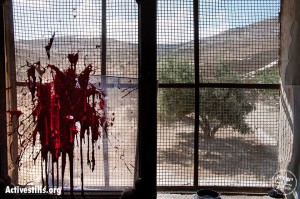
The Shay Police Unit manage to avoid basic investigative actions – even while holding two suspects caught red-handed in custody
By Yossi Gurvitz | Yesh Din | December 29, 2013
On July 26th, 2010, Israeli civilians – some of whom were seen coming from the direction of the settlements of Yizhar and Har Bracha – went on two rampages in the Palestinian village of Burin. In the first and more severe case, they attacked and destroyed property; when the owner, Ibrahim Eid, could no longer stand watching his property go up in flames and approached the scene, they hit him over the head with an iron bar. Eid lost consciousness and had to be treated in a hospital.
During the second rampage, Israeli civilians stoned the nearby home of Bashir Hamza Zaban. Unfortunately for the hoodlums, border policemen were on the scene and spotted them. The cops chased the attackers, detaining two of them. One of the detainees chose to hide a knife in his shoe. The two refused to identify themselves, but later were identified in the police station. The two maintained their right to remain silent during their interrogation. Zaban also managed to identify a third attacker, who – unlike the detainees – was not hooded.
On its face, this is an open and shut case. Yet lo and behold: even though two suspects were arrested, having been caught red-handed; even though one of them was carrying a concealed knife; and even though they refused to identify themselves – the police wouldn’t do the bare minimum, i.e. ask the victim to identify his attackers. Instead, the police closed the case, citing lack of evidence.
Hold on, the epic screw-up of this case is just beginning. Despite the fact that Zaban noted in his statement to the police that he was aware of the attack on Eid, and although he gave the police a disc containing photos of the attack on Eid, the police took their sweet time and summoned Eid for a statement in November of 2010, a mere five months after the incident. After all, we all know that the memory of witnesses just improves as time passes by.
We’re not done yet: Eid, in his statement to the police, noted the existence of the disc, containing quite clear images of the Israeli civilians who attacked him, who can be easily identified. Even so, the police – who had had the disc since July – didn’t bother summoning him to a lineup so he could point out his attackers; hence, it naturally did not summon any of them for an interrogation. And to top it all off, the police closed the case in December 2012 – after two years and five months of doing little investigative work – but only bothered to inform us, who represent the victims, in August 2013.
Such phenomenal incompetence, which would not surprise anyone familiar with the SJPD (‘Samaria and Judea’ Police Department), generally has two plausible explanations. The first is that the cops and their superiors are complete failures at their duties. The second is that they’re not that dumb, in fact they’re quite smart: we can assume they have a good reason to believe that if they do their jobs properly, they will be harmed. Some of them, after all, live among the population they’re charged with investigating. So they do a half-assed job, ignore evidence, silence nasty questions, and bullshit their way through the closing of a case, hoping no one pays attention.
Such a police force is the hallmark of dark regimes. The SJPD has been functioning this way for years. Anyone who thinks that these investigators, when re-posted within Israel proper, will not retain the work norms developed beyond the ‘separation’ wall, is deluding herself. As for us, once we lifted our jaws off the floor, we appealed the decision to close this case. We hope that the embarrassing negligence of the SJPD will force the prosecution to act. We’ll keep you informed.
Related article
- While you were sleeping…. (imemc.org)
Israeli forces shoot photographer in Bilin demonstrations
Ma’an – 29/12/2013
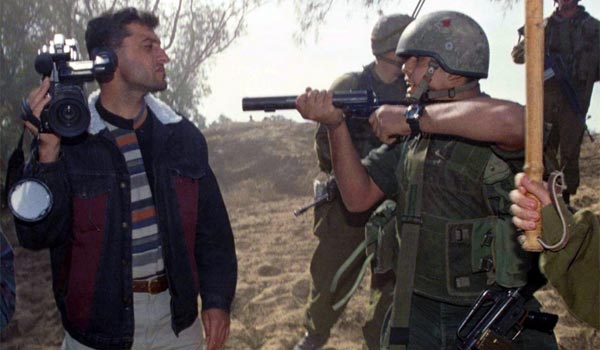
RAMALLAH – A photographer was injured and dozens suffered from excessive tear gas inhalation as Israeli forces dispersed a demonstration in Bilin near Ramallah.
Israeli forces fired rubber-coated steel bullets, tear gas and stun grenades at demonstrators as they neared their lands close to the wall.
Photographer Mohammad Yassin, 20, was hit with a rubber coated steel bullet during the protests.
The demonstration was held in celebration of Christmas and the release of Samer Issawi, and in protest of Israeli settlement activity and the separation wall.
Participants, some of whom wore Santa Claus costumes, raised Palestinian flags and chanted songs for unity and resistance.
Since 2005, Bilin villagers have protested on a weekly basis against the Israeli separation wall that runs through their village on land confiscated from local farmers.
Previous protests by Bilin activists have forced the Israeli authorities to re-route the wall, but large chunks of the village lands remain inaccessible to residents because of the route.
Related article
Israel’s recurring use of terror on civilians

By Bob Finch | January 26, 2009
Insanely disproportionate use of violence against unarmed civilians
“The stated aim was, as always, to stop the launching of the rockets. The means: killing a maximum of Palestinians, in order to teach them a lesson. The decision was based on the traditional Israeli concept: hit the civilian population again and again, until it overthrows its leaders. This has been tried hundreds of times and has failed hundreds of times.” (Uri Avnery “Kill a Hundred Turks and Rest”: The Five-Day War in Gaza March 2008).
Operation Grapes of Wrath ~ Lebanon, in 1996
“Ehud Barak will be remembered in Israel’s history as the one who introduced the abuse of innocent civilians as political cards. Barak was probably not the first Israeli warrior to abuse civilians on a tactical level, but he was the one who turned it into a central Israeli strategy. Operation Grapes of Wrath in Lebanon, in 1996, with Barak as an influential cabinet member, openly targeted civilians, turning them into refugees to make them put pressure on Beirut’s government. The recent siege on Gaza follows a similar logic: put pressure on civilians to achieve political goals. (A clear war crime, it goes without saying.)” (Ran HaCohen ‘Israel Says ‘No’’ Feb. 2008).
Israelis fire 1,300,000 bullets during first few days of Intifada
“Malka, in an interview with the Israeli paper Ha’aretz on 14 June, revealed that during the first few days of the intifada, Israeli occupation soldiers fired 1,300,000 bullets on Palestinian population centres and other targets. This massive firepower, which had no operational justification given the Palestinians’ inherently inferior firepower (they possessed only light firearms and in limited numbers), showed that the Israeli army was interested more in decimating and harming the Palestinians and less in ending the violence. According to Israeli sources, then-Chief of Staff and now Defence Minister Shaul Mofaz didn’t plan to bring about the end of the conflict. Instead, he thought he had finally seized the opportunity to “beat and vanquish” the Palestinians in order to “burn into their consciousness” and make them “internalise their weakness and inferiority vis-a-vis Israel’s strength”. Mofaz’s ultimate aim, of which he later convinced Israeli Prime Minister Ariel Sharon, was to hector Palestinians into negotiations in a weakened and exhausted state whereby they would have no choice but to accept Israel’s dictates and demands. The new revelations, Palestinian officials argue, prove that the escalation of violence during the first few months of the intifada was, first and foremost, Israel’s responsibility. “This is what we have been saying all along that this is not about Israeli security but rather about Israel’s terrorising the Palestinian people for the purpose of arrogating their land and rights. Israel is now admitting that,” said Michael Tarazi, adviser to Palestinian Authority leader Yasir Arafat.” (Khalid Amayreh ‘The second intifada, an Israeli strategy’ July 2004).
Lebanon 2006
“This intentional and coldly calculated Israeli policy of targeting innocent Lebanese civilians and civilian infrastructure stems from a time-honoured, but hardly ever successful, Israeli doctrine of applying intense “pressure” against a civilian population in order to compel them, in-turn, to pressure the resistance into submitting to Israeli dictates, thereby doing Israel’s bidding by proxy. It has been consistently used against the Palestinians ever since the Nakba of 1948, and is still applied now in the ongoing barbaric offensive and hermetic siege against Gaza. Israel may have plagiarized this doctrine from the legacies of previous oppressors, but it has refined it to a degree that it no longer raises any moral qualms in most of Israeli society, where it is widely accepted by the public as a right, even a duty in the fight for Israel’s “security.” (Omar Barghouti ‘The Massacre at Qana’ August 01 2006); “As Limor and Shelah reveal, in spite of the fact that the conflict on the ground took place on a very narrow strip of land (the Israeli border on the south and Litani River on the north), the Israeli artillery had managed to shoot over 170,000 shells. In comparison, in the 1973 war while fighting against two strong state armies over two very large fronts, the Israelis had launched only 53,000 shells. The figures relating to the Air Force are even more striking. Though less than a few concrete targets were available for the IDF intelligence, the IAF (Israeli Air Force) had launched as many as 17,550 combat missions, this translates into 520 missions a day, almost as many as in the 1973 war (605 a day). Yet, in 1973 the IAF was fighting two well-equipped air forces, it was engaged in a fair amount of air-to-air combat and a relentless struggle against the latest Soviet ground-to-air missiles. None of that happened in the Second Lebanon War. The IAF was engaged solely in hammering the Lebanese soil. It literally threw and launched everything it had in its disposal, presenting a merciless method that in places (southern Beirut for instance), had a similar effect to the infamous 1940s Anglo-American carpet bombardment.” (Gilad Atzmon ‘Saying NO to the Hunters of Goliath’ August 13, 2007); “That was on Aug. 30, by which time U.N. teams had identified 359 separate cluster-bomb sites. Since then, the true dimensions of the problem have become even clearer: 770 cluster-bomb sites have now been identified. And the current U.N. estimate is that Israel dropped between 2 million and 3 million bomblets on Lebanon, of which up to a million have yet to explode.” (Saree Makdisi ‘Israel’s Cluster Bomb War’ Oct. 2006).
Related articles
Little Hala and the Herods of Israel
By Vacy Vlazna | Palestine Chronicle | December 28, 2013
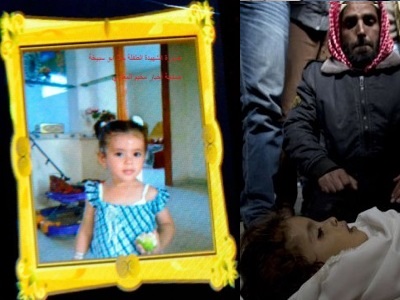
On Christmas Eve, while Christians knelt in churches to honour the birth of the eternal light of the Child of Bethlehem — the Child of peace, Israeli Herods struck Gaza and the life-light of little Hala haemorrhaged into eternal death.
Hala Ahmed Abu Sbaikha, all of 3 years old, was, like all toddlers, both vivacious and shy, playful, affectionate with bright curious eyes and with a so soft cheek to rest a bedtime kiss.
Why did the Herods of Israel attack Gaza?
There are three possible answers — one false, one truly appalling, one heinous.
Ostensibly, reports in western pro-Israel media, that devoted one sentence to Hala’s death, garbled on and on with the usual Herod hasbara (propaganda); the attack was Israel’s divine right to excessively inflict collective punishment for the shooting, by a Gaza sniper, of an Israeli civilian labourer, Salah Shukri Abu Latyef, 22, working on the border fence. Salah was airlifted to a hospital, where he was pronounced dead.
No mention, of course, that four days previously, Odeh Jihad Hamad in Beit Hanoun, 29, was a kilometre away from the border collecting scrap metal when Israeli soldiers fatally shot him in the head. Israeli forces did not allow ambulances to attend to Odeh for an hour and a half after the shooting.
Or that since November 2012, when Israel’s Pillar of Cloud assault (weapons testing operation) that killed 171 Palestinians had ended in an Egyptian-brokered ceasefire, Israel has committed over 300 ceasefire violations encompassing aerial attacks, military incursions, the levelling of agricultural land, gunship attacks on fishermen, harassing, targeting and wounding farmers, unlawful kidnappings, and the killing of ten Gazan civilians.
Definitely suppressed was the fact that for seven years, the people of Gaza have been held captive by the illegal Israeli siege and in the last two months Israel’s blockade of fuel has caused a disastrous humanitarian crisis with severe shortages of critical supplies and electricity for health services. In freezing temperatures blasted by a winter storm of unprecedented proportions, vulnerable Gazan families and their children have had no electricity, heat, or light, and when the waste water pumping system collapsed pouring sewerage into the streets, shockingly, Israel opened two dams close-by causing the flooding, devastation and misery to soar.
So why did the Herods of Israel truly attack Gaza?
They attack because they can. They attack because, for 65 years, have been granted impunity by democratic western nations. They attack to test their weaponry on Gazan families to sell to said western democratic nations. They attack because they don’t want peace. They attack because they want Palestinians to leave Eretz Israel (the whole of Historic Palestine). They attack to to drive Palestinians from their ancestral lands into the sea.
On the first Sunday after Christmas, Catholics and Copts commemorate the Feast of the Holy Family recalling Mary, Joseph, and the baby Jesus’ flight to Egypt to escape Herod’s ordering of the Massacre of the Innocents; the infanticide of male babies and toddlers in the Bethlehem region.
But Hala’s family had no escape. For seven years, Israel and the US-supported Egyptian military government have sealed Gaza’s borders so that it’s 1.7 million refugee population, half of whom are children, has no recourse to refuge from Herod’s war crimes.
Herod the Great (i.e., Herod the Deranged) was a vassal of the Roman Empire. Today there is political twist. The US empire (and its client states, UK, EU, Australia) is Israel’s vassal. The US pays an annual tribute of 3 billion dollars even though Israel publicly insults and leads US presidents by the nose on a merry dance to the tune of incompetency played by Herod’s fool, the UN.
The UN has the the legal duty and responsibility to protect all children. On the website of the UN Special Representative of the Secretary-General for Children and Armed Conflict, it informs us that “the Security Council recognised early on the need for robust action including sanctions against individuals persistently committing violations against children in armed conflict. These sanctions include arms embargoes, asset freezes, and travel bans.
The readiness of the Security Council to impose sanctions against violators of the rights of children in armed conflict has developed over time. In Security Council resolution 1539 (2004), the Council expressed for the first time its intention to consider imposing targeted and graduated measures against parties to conflict violating the rights of children. This commitment was reaffirmed in resolutions 1612 (2005), 1882 (2009), and 1998 (2011).
Israel’s Herods have slaughtered 1,400 children since 2000. Has the UN or any state robustly imposed sanctions on Israel’s child-killers? NO.
Let’s look more closely at why Zionist Herods attack Gaza?
Impunity aside, ultimately, they attack because they are depraved Untermenschen, not just the military but every Zionist who supports Israel’s illegal occupation, warmongering and apartheid policies. They attack because a three year old Palestinian child’s life, its delightful vitality, its laughter, its wonder, its tears, its fun and its fears means nothing to these inhuman thugs and nothing to the UN and nothing to the leaders and citizens of western democratic nations who look away from Israel’s war crimes and daily crimes against humanity.
On Christmas Eve, the songs of Christmas angels were muted by explosions when Herods’ tanks and warplanes “forcefully” bombed Gaza for two hours hitting Hala’s home in Al-Maghazi refugee camp,massacring her innocence and injuring her mother Buthaina, and brothers Mohammed 6 and Bilal, 4.
Little Hala should be alive now. It was her sacred right.
Dr. Vacy Vlazna is Coordinator of Justice for Palestine Matters. She was Human Rights Advisor to the GAM team in the second round of the Aceh peace talks, Helsinki, February 2005 and then withdrew on principle. Vacy was coordinator of the East Timor Justice Lobby as well as serving in East Timor with UNAMET and UNTAET from 1999-2001.
Related article
Israel doesn’t do retaliation, just more of the same
By Ibrahim Hewitt | MEMO | December 25, 2013
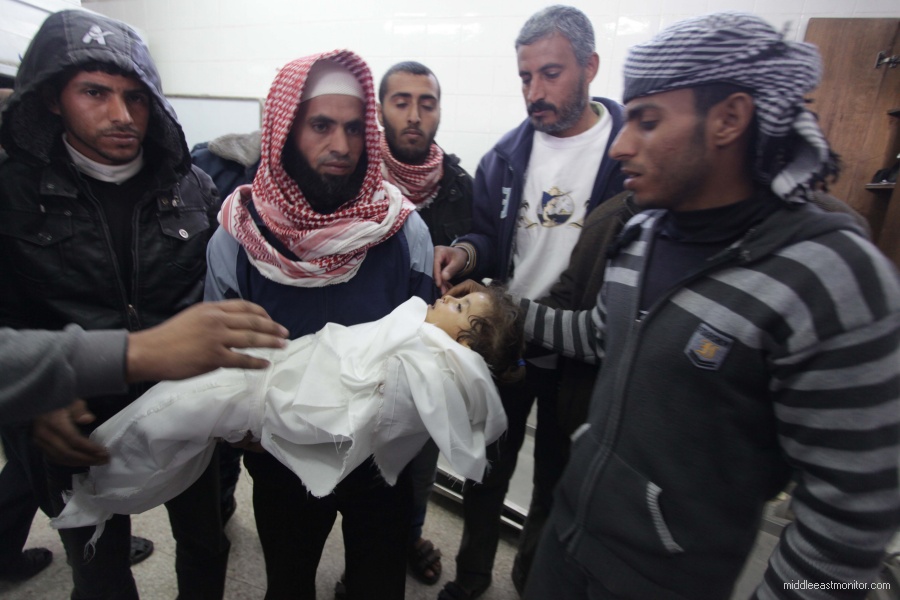
Once again we hear that Israel has bombed the Palestinians in the Gaza Strip “in retaliation” for something that they’ve done against Israelis. Prime Minister Benjamin Netanyahu said that his country will “respond”. Many people would agree that a person in his position has a duty to protect his citizens. Certainly, those in the White House and Downing Street do, which is why Israel gets away with murder, quite literally. It’s all down to legitimate self-defence; or so we are led to believe.
What, though, is the reality? Why is that right of self-defence never extended to the people of Palestine? After all, it is their land which is under occupation; it is their land which is being stolen and colonised; it is their land from which they are being excluded in a decades-long act of ethnic cleansing that its proponents hope will never end.
If retaliation and responses are the effects, then the occupation and colonisation of Palestine have to be the causes. There is no other way to look at the asymmetric conflict in the Holy Land. Despite what Israel and its apologists would have us believe, this is not a clash of equals, nor is it a case of a defenceless state struggling for its very existence in the face of overwhelming odds. It is, in fact, a nuclear-armed state, backed by the word’s superpowers and armed to the teeth with conventional weapons, most of them self-produced (and sold to the world for a staggering $7 billion a year boost to Israel’s economy), occupying, colonising and threatening a largely civilian population armed, at best, with AK47s and other small arms.
Israel is an occupying power; its occupation of somebody else’s land is the cause, and the resistance to the occupation by the Palestinians is the very legitimate effect; Israel doesn’t do retaliation, it is merely continuing to do what it has done for sixty-five years and counting, killing Palestinians and taking their land. That is the ugly reality of the situation. It is all very well for Netanyahu to say that his country will “respond” to acts of resistance by the Palestinians, but it is much more valid and legitimate for Palestinian Prime Minister Ismail Haniyeh to say that action from Gaza is his people’s response to Israel’s brutal military occupation. That is a more accurate narrative for us to follow and accept.
Should anyone still doubt this, it is worth looking to history for further confirmation. It is reasonable, I think, to start not with Theodor Herzl’s The Jewish State, published in 1896, as he did not advocate a state in Palestine, but with the infamous Balfour Declaration of 1917. This letter sent from the then British Foreign Secretary, Arthur James Balfour, to Zionist leader Lord Rothschild was a “declaration of sympathy with Jewish Zionist aspirations which has been submitted to and approved by the Cabinet”. The issue was never discussed and approved by parliament and it has no legal status, then or now. Balfour told Rothschild that the British government “view with favour the establishment in Palestine of a national home for the Jewish people… it being clearly understood that nothing shall be done which may prejudice the civil and religious rights of existing non-Jewish communities in Palestine…” It was written a month before the British army entered Jerusalem during the First World War and does not mention a state, just a “national home”. Such ambiguity was quite possibly deliberate. In any case, it is interesting that the Palestinians are described by what they are not (“non-Jewish”) rather than what they are; a typically-demeaning imperialist tactic to describe the Other as not being of Us.
In 1919, the US-established King-Crane Commission determined that “a national home for the Jewish people is not equivalent to making Palestine into a Jewish State; nor can the erection of such a Jewish State be accomplished without the gravest trespass upon the civil and religious rights of existing non-Jewish communities in Palestine.” That has to be one of the most accurate of political prophecies of all time.
A year later, on 1 July 1920, the first British High Commissioner for Palestine, Sir Herbert Samuel, a Jew openly sympathetic to the Zionist cause, read a message from King George “to the people of Palestine”. In it, the king assured the Palestinians that despite the existence of the Balfour Declaration and “measures” to be taken to put it into practice, such measures “will not in any way affect the civil or religious rights or diminish the prosperity of the general population of Palestine”.
Samuel went on to say, in 1921, that the British government would never consent to a policy which takes Palestinian-owned land and gives it to “strangers”. HM Government, he insisted, “would never impose upon [the people of Palestine] a policy which that people had reason to think was contrary to their religious, their political and their economic interests.”
The Zionists had other ideas and the result is that there is now a state in Palestine whose founders declared it to be a “Jewish State” in 1948 and which insists that the Palestinians, upon whose land the state was built, recognise it as such as a precursor to any meaningful peace agreement. What will happen to the 20 per cent of Israeli citizens who are Palestinians in such a “Jewish State” has never been explained; some on the Israeli right want to expel them to Jordan, completing the ethnic cleansing started in 1948. Whatever happens, they certainly won’t be treated with justice as Israeli apartheid sinks its roots ever deeper in occupied Palestine.
Cause and effect; action and reaction; decide for yourself: whose land was taken from them and given to another people? Whose land has been colonised? Whose land is being stolen from them on a daily basis? Who are the aggressors and who are more justified in asserting their right of self-defence; Israelis or Palestinians?
By any reasonable legal and moral yardstick, it is the Palestinians who are responding to Israeli aggression; Israel cannot claim with any justification whatsoever that when it bombs an overcrowded refugee camp, as it did this week, and kills Palestinians, it is merely “retaliating” for something done by Palestinians resisting the occupation. Israel doesn’t do retaliation, it never has. It just does more of the same and what it has been doing for more than 65 years: taking Palestinian land and lives through violent and illegal means. The sooner that journalists and politicians acknowledge this and start to deal with the conflict in a fair and balanced way the sooner that a just and lasting peace may be possible.
Until then, we will no doubt continue to see Israel’s aggressive and expansionist colonialism dressed-up as the acts of a democratic state desperate for peace with its unreasonable neighbours. Nothing could be further from the truth.
Related articles
Info & Disinfo on Gaza, and Appeal for Hala Abu Shbeika, 3, killed in Israeli airstrike against Gaza
By Eva Bartlett | In Gaza | December 25, 2013
Some things to consider giving Israel’s bombing spree in Gaza on Dec 24:
-Israeli soldiers on a routine basis target Palestinians of all ages, including children, as they farm or fish, killing and maiming them. This is policy from the top-down, not random, not “bad apples”. See videos here and here; see reports here and here and here and here and UN.
-Israel has violated the Nov 2012 “truce”/”ceasefire” from the beginning, as documented here [Israeli Ceasefire Violations in Gaza and World Silence] and here.
and this important clarification from Yousef at the Jerusalem Fund:
Israel, and Kershner, Strike Again
The bias in New York Times reporting on Israel/Palestine is so systematic, it is predictable. Literally. When the news broke this morning that an Israeli had been shot by a sniper in Gaza while working on the fence around Gaza I knew that the killing would receive plenty of coverage in US media and of course in the New York Times by none other than Isabel Kershner. Even though Kershner routinely fails to report about Palestinian casualties in the Gaza Strip killed or injured by Israel, she rarely misses an opportunity to report about Israelis killed by Palestinians. That’s why earlier this morning I tweeted:
Has Isabel Kershner written her inevitable piece on the Israeli shot today yet after ignoring the large number of Palestinians shot in Gaza?
— Yousef Munayyer (@YousefMunayyer) December 24, 2013
On cue, an hour and a half after my tweet, Isabel Kershner’s story goes up at the New York Times.
The headline:
Israelis Shell Gaza After Israeli Fence Repairer Is Killed
and the lead paragraph:
An Israeli laborer who was repairing the security fence along the border with Gaza was fatally shot on Tuesday by a Palestinian sniper, according to the Israeli military, and Israel immediately responded by bombing targets it associated with militant groups in the Palestinian coastal territory.
both make clear that the events today were Israel responding to an attack from Gaza. But absent both from that framing narrative and her entire piece, as I knew would be the case, is any description of preceding events in the Gaza Strip in recent days which featured several and persistent Israeli violations.

Kershner doesn’t tell you that in the last 10 days the Israeli military shot a Palestinian teenager in Gaza on the 15th, shot and killed a man and injured two others in Gaza on the 20th, shot an injured a Palestinian farmer on the 21st, fired at Palestinian fishing boats in Gaza on the 22nd, and shot and seriously injured a Palestinian man on the 23rd. All of these incidents happened in the days preceding today’s events and involved Israel firing into Gaza. None of them are reported in her article despite being vital context for today’s events.
She mentions that Israel’s bombardment of Gaza in November 2012 “ended with an Egyptian-brokered cease-fire” but fails to mention that Israel has been consistently violating that cease-fire. We’ve been keeping track of all of these violations here, precisely because we knew Isabel Kershner and others were not going to inform you about them.
She does however, enumerate all recent Israeli casualties…. in the West Bank:
The Israeli killed on Tuesday was a civilian contractor who had been working for the Israeli Defense Ministry. His death came a day after an Israeli police officer was stabbed and wounded at a West Bank junction. On Sunday, a bomb exploded on a bus in Bat Yam, near Tel Aviv, minutes after the passengers had been warned to exit, preventing casualties. The police said they were working on the assumption that the bomb had been an attempted attack by Palestinian militants.
In addition, three Israeli soldiers and a retired colonel have been killed in recent months by Palestinians from the West Bank.
Kershner did a very similar thing in a piece last month which we called out here.
Her piece does end with this line “More than 20 Palestinians have been killed in clashes with Israeli forces this year, according to Palestinian officials.”
All the Palestinians killed and injured are an afterthought in this piece. Those killed and injured by Israeli fire in Gaza immediately prior to today’s events are not even mentioned. In what can only be interpreted as an effort to evoke sympathy for Israel’s actions, Kershner selects to inform the reader about attacks against Israelis in the West Bank while ignoring Israeli attacks on Gaza that occurred right before today’s events, even though today’s events occurred in Gaza and not in the West Bank.
The reader is treated to the familiar refrain: Israel is always acting to defend itself. The New York Times can do better and its readers sure deserve better than this.
With such horribly skewed and sloppy reporting, is it any wonder Americans are so misinformed about the situation?
CLICK HERE FOR APPEAL PAGE
Israel arrested 4,000 Palestinians in 2013

Israeli soldiers beating a Palestinian journalist [June 2013]
MEMO | December 23, 2013
Israeli occupation authorities arrested approximately 4,000 Palestinians, including parliamentarians, women, children and patients, in 2013. The vast majority of those arrested are from the occupied West Bank, with only a small number from the Gaza Strip.
Information published by the statistics department at the ministry of prisoners in the West Bank shows that no single day has passed without arrests. The average number of arrests each month was 323, which equates to about 11 arrests each day.
The arrest rate in 2013 is only one per cent higher than the rate in 2012; however, it is 17 per cent higher than 2011.
Regarding the geographical distribution of the 2013 arrests, 98 per cent (3,799) of those arrested are from the West Bank and two per cent (75) from the Gaza Strip.
According to the statistics, those arrested were from all social classes, without exception. The occupation authorities did not make any special exceptions for the elderly, disabled, children, women, parliamentarians, political leaders, academics and journalists.
All those arrested have been exposed to at least one form of torture. Some of them were tortured in front of their family members when they were arrested at their homes.
The statistics department stated that these arrests are in violation of international law. “Some of the torture cases amount to war crimes and crimes against humanity,” it added.
Related article
Temper Tantrums in US, Canada over Falk Comments to RT
By Richard Edmondson | December 22, 2013
Separate tirades against highly esteemed international law authority Richard Falk were launched one day apart from each other in Washington and Ottawa over remarks Falk made last week to RT.
A week ago RT’s program “The Truthseeker” aired a segment on the recent findings of the Kuala Lumpur War Crimes Tribunal—a segment that also included comments from Falk, the UN’s Special Rapporteur on Palestine, as well as footage of flooding of Gaza’s streets.
The tribunal found Israel guilty of genocide against the Palestinians, and in his remarks to RT Falk stated, “When you target a group, an ethnic group, and inflict this kind of punishment upon them you are in effect nurturning a kind of criminal intention that is genocidal.”
Hardly a controversial statement. However, Canadian Foreign Minister John Baird called the comments “appalling” and said they “underscore once more the complete and total absurdity of his (Falk’s) service as a UN Special Rapporteur.” Baird also demanded the UN Human Rights Council “remove Falk from his position immediately.”
Not to be outdone, US State Dept. mouthpiece Jen Psaki lambasted Falk’s remarks as “despicable and deeply offensive” and called upon Falk to step down from his UN post—once again substantiating Washngton’s reputation as “Israeli occupied territory.”
Coming up in a few days the world will mark the fifth anniversary of Operation Cast Lead, a frenzy of military high-tech bloodshed that left 1400 Gazans dead, approximately a third of whom were children. In that 22-day assault, Israel bombed homes, schools, and hospitals, fired upon ambulances, and unleashed white phosphorous munitions that melted human skin and burned people alive. And then after the assault was over, the Jewish state continued its blockade of Gaza, making it difficult to outright impossible for people to get building supplies to rebuild their destroyed homes. Shortages of food and medicine were also reported, and in one notorious case the Israelis even blocked a shipment of pasta.
To say that Israel “targets” an “ethnic group” is undeniably true. To say that it is “nurturning a kind of criminal intention that is genocidal” is, if anything, an understatement. But Falk has a history of speaking truthfully that is rare in a public official—and of course this is what Israel and its puppets in the US and Canada really find so objectionable about him.
The interview below with Falk covers a lot of ground—from the UN’s helplessness to confront Israel to the upcoming bleak Christmas faced by Gazans. Falk is interviewed by Stuart Littlewood, author of Radio Free Palestine and whose articles appear frequently on a number of websites. (H/T Uprooted Palestinians)
***
Creeping annexation, ethnic cleansing and ‘the politics of fragmentation’ inflicted by criminals who strut the world stage and thumb their noses at international law
By Stuart Littlewood
As the international conspiracy to rob Palestinians of their freedom and homeland is exposed a little more each day, observers and activists still puzzle over the duplicity of the United Nations in the decades-long illegal occupation and ethnic cleansing of the Palestinian Territories, not to mention the true intent of Palestinian leaders. So when Richard Falk, professor of international law at Princeton and UN Special Rapporteur on human rights in Occupied Palestine, visited Norwich recently, I took the opportunity to put some questions to him.
___________________
SL – Can we start with the so-called peace process, please? Does the resignation of the Palestinian negotiation team, and the reasons given, effectively end the already discredited ‘peace talks’? Should the Palestinians walk away or carry on playing a pointless game for another 6 months?
Richard Falk – It is difficult to know how to assess the current suspension of peace talks. The Palestinian Authority seems always ready to bend to pressure, although with some outer limits. In this respect, the future of this phase of ‘peace talks’ will be determined not in Ramallah, but in Washington and Tel Aviv. It should be evident 20 years after Oslo that the peace talks serve Israel’s interest in ‘creeping annexation’ of the West Bank and ethnic cleansing in East Jerusalem, while diminishing Palestinian prospects, and even harming the Palestinian image by disinformation that blames the Palestinian side for the breakdown of the process when and however it occurs. It would be a welcome sign of PA independence if they come forth and denounce this peace process for what it is.
The sad reality is that this is almost certain not to happen, and more likely than not the period of negotiations will be extended beyond the nine months set aside, on the entirely false claim that the parties are on the verge of resolving all their differences, and with a little patience, the prospects for a deal are quite bright.
SL – The negotiators said they were resigning because of the ‘unprecedented escalation’ of settlement building and because the Israeli government wasn’t serious about a two-state solution and had failed to fulfill commitments given before the present talks were resumed. I now read that Erekat has already been back to Washington for more talks with Tzipi Livni (Israel’s lead negotiator), Kerry and US envoy Indyk. Far from denouncing the process they are once again endorsing it, which makes your point.
In any case, how acceptable is it for a weak, demoralised and captive people like the Palestinians to be forced to the negotiation table with their brutal occupier under the auspices of a US administration seen by many people as too dishonest to play the part of peace broker?
Richard Falk – Even if the United States was acting in good faith, for which there is no evidence, its dual role as Israel’s unconditional ally and as intermediary would subvert the credibility of a negotiating process. In fact, the US Government signals its partisanship by White House appointments of individuals overtly associated with the AIPAC lobbying group as Special Envoys to oversee the negotiations such as Dennis Ross and Martin Indyk. It is hard to imagine the fury in the West that would exist if the conditions were reversed, and the UN proposed a one-sided ‘peace process’ biased in favour of the Palestinians. The unsatisfactory nature of the current framework of negotiations is further flawed by weighting the process in favour of Israel, which enjoys a position of hard power dominance.
SL – There can be no peace without justice, so is it right for final status ‘negotiations’ to be held before competing claims are tested in the courts and the many outstanding rulings under international law and UN resolutions are implemented? In any case, shouldn’t a neutral UN peace commission be supervising the final settlement of this long struggle, rather than the US or the Quartet?
Richard Falk – Yes, if the priority were to attain a just and sustainable peace, a framework would be developed that had two characteristics: neutral as between the two sides and sensitive to the relevance of rights under international law. Such sensitivity would favour the Palestinians as their main grievances are all reinforced by an objective interpretation of international law, including in relation to settlements, Jerusalem, refugees, borders, water.
SL – How much legitimacy does President Abbas enjoy, having overstayed his term of office?
Richard Falk – This question of political legitimacy of President Abbas turns on the subjective mood of the Palestinian people. Because the PA is a political entity so vulnerable to pressures and manipulation, the status of its presiding leader seems to be widely seen as a secondary matter of limited significance. When President Abbas has articulated the case for Palestinian statehood during the last three years at the United Nations he gained considerable personal respect among most governments and for many Palestinians. He seems a leader caught between the realities of his compromised position and the occasional opportunities to express the national ambitions and support the rights of the Palestinian people. The division with Hamas, and the failure to find a formula to restore Palestinian unity in relation to the West is a further source of weakness for PA claims to represent the Palestinian people as a whole. The failure to hold scheduled elections highlights the insufficiency of PA and Palestinian leadership.
SL – Do you believe a two-state solution is still feasible?
Richard Falk – No. I think Oslo has been dead for some years, primarily due to Israeli policies designed to encroach upon the remnant of Palestinian territorial and symbolic rights, especially by the continuously expanding settlement archipelago, the unlawful separation wall built on occupied territory, and the demographic manipulations in East Jerusalem. The pretence that Oslo plus the Roadmap point the only way to peace serves American and Israeli purposes in quieting growing complaints about the persistence of the conflict. It represents a diplomatic attempt to deflect criticism, and to divert attention from Palestinian grievances and a growing global solidarity movement.
SL – The 1947 UN Partition was unworkable as well as immoral. Shouldn’t the whole territory (of historic Palestine) be returned to the melting pot and shared out more sensibly? Shouldn’t Jerusalem and Bethlehem become an international city, or ‘corpus separatum’, as the UN originally intended?
Richard Falk – For me the fundamental flaw with the partition proposals contained in GA Resolution 181 was the failure to consult the people resident in Palestine at the time. A secondary flaw was the unfairness of awarding 55% of the territory to the Jewish presence as represented by the Zionist movement which in 1947 accounted for only one-third of the population owning around 6% of the land . This idea of determining the future of Palestine by outsiders, even if well intentioned, which seems not to have ever been the case, is incompatible with the historical trend toward resolving the future of peoples by way of the dynamics of self-determination. In Palestine’s case, at least from the issuance of the Balfour Declaration onward, this effort to control the future of Palestine has been justly condemned as the last major example of ‘settler colonialism.’ It is a particularly acute example as the settlers have no mother country to which to return, and take a poker player’s high risk posture of ‘all in.’
SL – Turning to the role of the International Criminal Court, this is an organ of the UN. So why doesn’t the ICC initiate its own prosecution of Israeli crimes based on UN reports and the mountain of evidence available to it, especially in view of Palestine’s upgraded status?
Richard Falk – There is no authoritative explanation of ICC passivity in face of the Israeli criminal violation of fundamental Palestinian rights. As a matter of speculation it is plausible to assume an absence of political will on the part of the prosecutor’s office to initiate an investigation that would be deeply opposed by Israel and the United States. The ICC has been recently criticized for its Western bias, and its failure for instance to consider whether the United Kingdom and the United States violated the Rome Statute’s enumeration of international crimes by initiating and conducting the Iraq War. The African Union has complained about the seeming focus on the criminality of African leaders, and the bypassing of grievances directed at Western behaviour.
SL – We hear you and others calling for intervention to prevent humanitarian catastrophes, e.g. the Gaza water crisis. Who exactly are you calling on? What is the chain of responsibility for intervening.
Richard Falk – There has been evolving within the UN and in international society more generally a sense that there is a ‘responsibility to protect’ peoples subject to severe threats of humanitarian catastrophes or natural disasters. Such sentiments are part of a process I have described as ‘moral globalization.’
In fact, R2P diplomacy has been discredited by being used as a geopolitical instrument, most dramatically as the normative foundation for the UN endorsement of the NATO 2011 military intervention in Libya. With respect to Libya the justification was protection against a feared massacre of civilians in the city of Benghazi, but the actual military operation from its outset seemed designed to achieve regime change in Tripoli. When it comes to Gaza where the present crisis has passed into a zone of desperation, the UN and world community are silent as if stone deaf to this deepening human crisis of survival.
SL – We have just seen the UN intervening to bring fuel into Gaza as it teetered on the brink of a full-blown public health crisis. There are many such emergencies thanks to Israel’s continuing blockade. Why doesn’t the UN take over the supply of fuel full-time? And indeed the supply of medicines, drugs, medical equipment and spares?
Richard Falk – The tragic situation in Gaza cannot be understood without taking account of the political context, above all the split between Fatah and Hamas, and the Israeli posture toward Gaza after its ‘disengagement’ in 2005 and the imposition of a punitive blockade in mid-2007 after Hamas took over the governance of Gaza. The UN has no capability to override geopolitical priorities, and so long as it is useful for Israel and Washington to treat Hamas as ‘a terrorist organization’ the UN will be limited in its role to being a provider of a subsistence existence for the Gazan people, long victims of unlawful Israel policies of ‘collective punishment’ unconditional prohibited by Article 33 of the 4th Geneva Convention.
After the Egyptian coup of July 3rd of this year, the subsistence regime evolved in Gaza is itself in jeopardy. The tunnel network has been substantially destroyed by Egyptian military action and the Rafah crossing from Gaza to Egypt has been mainly closed, isolating the people, and creating emergency conditions due to fuel shortages that have made electricity only available in very limited amounts.
The results are horrifying: sewage in the streets, insufficient power to run machines needed to keep the terminally ill alive, fuel shortages that virtually preclude economic activity, and closed borders that seal the fate of 1.6 million Gazans. Long before this dramatic further deterioration of life circumstances, observers were calling Gaza the largest open air prison in the world.
“The wrongful appropriation by Israel of Palestine’s water, land, and energy resources has been a massive crime against the Palestinian people…”
SL – What is the UN doing to protect Palestine’ s precious aquifers and offshore gas field from being plundered by the Israelis?
Richard Falk – Again, the UN has no independent capability, or ever will, to challenge Israel or to protect Palestinian rights. It is a case of geopolitical manipulation and Palestinian victimization. The wrongful appropriation by Israel of Palestine’s water, land, and energy resources has been a massive crime against the Palestinian people that has been continuous with the occupation that commenced in 1967.
SL – Why is the requirement, often repeated, to allow Palestinians free and unfettered movement in and out of Gaza not implemented? Gaza and the West Bank are supposed to be a contiguous territory but, for example, Palestinian students in Gaza are prevented from attending their excellent universities in the West Bank. And why are Gazan fishermen still restricted to a mere fraction of their territorial waters, despite agreements to the contrary, and regularly fired on? Why is Israel not prosecuted for acts of piracy in international waters against humanitarian traffic to Gaza?
Richard Falk – As earlier, the hard power realities of Israeli military dominance, as politically reinforced by American geopolitical muscle, overrides all of these Palestinian claims of right. In this respect, such injustice and suffering can only be challenged by Palestinian resistance and international solidarity. The specific abuses can and should be delimited to raise public awareness and contribute to the mobilization of support for the Palestinian struggle, but it is pointless to expect the UN to do more than its capabilities allow. The whole structure of the Organization, combined with the method of funding, gives geopolitical pressures great leverage in relation to specific situations. The veto power given to the permanent members of the Security Council is a major expression of this weakness that was built into the constitutional structure of the UN from the moment of its establishment.
SL – People reading what you say here will be alarmed that US geopolitical power and Israeli military might can so easily override international and humanitarian law. After Nuremburg our legal institutions were strong enough to bring Nazi era criminals to book, but present-day war criminals walk free and thumb their noses. What hope is there for mankind and our brave new world if this is allowed to continue?
Richard Falk – The Nuremberg experience was based on ‘victors’ justice,’ holding the defeated leaders after World War II criminally accountable, while exempting the crimes of the victors from accountability. There was a promise made at Nuremberg that in the future the rules by which the Germans were judged would be applicable to all who committed state crimes in the future. This Nuremberg Promise has not been kept. The political and military leaders of the main states enjoy impunity while the leaders of defeated countries (e.g. Saddam Hussein, Slobodan Milosevic) or sub-Saharan African countries are prosecuted by international tribunals. Double standards prevail, and it is questionable whether an international criminal law that punishes the weak and exempts the strong is to be treated as legitimate even if those accused receive a fair trial and are convicted and punished only if they were guilty of grave misconduct.
The bottom line is that we live in a world in which the primacy of hard power prevails in the relationship among states. Geopolitical leverage enables Israel to defy the most basic principles of international law, and yet their leaders are not held accountable. There are only two paths available that challenge this result. National courts can be empowered by what is called ‘universal jurisdiction’ to investigate, indict, prosecute, convict, and punish anyone accused of state crime that can be personally delivered to the relevant court. In 1998 the Chilean dictator was detained in London after the Spanish Government requested that Pinochet be extradited. After lengthy litigation is was found that Pinochet could be extradited for torture committed during part of his reign, but in the end he was sent back to Chile because of health reasons, and never faced trial in Spain. Yet such a possibility exists in relation to Israeli political and military leaders, and seems to have discouraged their travel to countries whose criminal law contains the authority to invoke universal jurisdiction.
The other possibility is by convening a peoples tribunal of the sort constituted in the past by the Bertrand Russell Foundation in Brussels and the Lelio Basso Foundation in Rome. The Russell Foundation sponsored four sessions devoted to various allegations of criminality attributed to the government of Israel. It produced convincing documentation of the charges, and issued judgements that called for civil society initiatives. Such a tribunal, although acting on evidence and in accord with the relevant provisions of international criminal law, possesses no formal authority and lacks implementing capabilities. Its role is limited to documenting the case against a government, and providing symbolic support to those who contend that there have been violations of international criminal law. Such outcomes may influence public opinion, and help change the balance of political forces by undermining the legitimacy of an established order of oppression as exists with respect to Israel’s relationship to the Palestinian people and the denial of their collective right of self-determination.
SL – What are the chances as you see them for achieving unity between Fatah and Hamas, and how should the Palestinians play their cards in future?
Richard Falk – There is a near unanimous belief among Palestinians and their supporters that unity is needed to move the struggle forward. Such unity existed throughout the early decades of the Palestinian National Movement, despite many ideological differences relating to tactics and goals, but within a shared resolve to achieve national liberation. The unifying image provided by Yasser Arafat’s uncontested leadership was also important.
Israel has pursued a policy I describe as ‘the politics of fragmentation’ designed to undermine Palestinian unity, and it has been alarmingly successful. Oslo contributed to this end by dividing up the West Bank into Areas A, B, and C, by splitting the administration of Gaza off from the rest of Palestine. The emergence of Hamas highlighted Palestinian fragmentation, a result welcomed by Israel even as it was condemned. Fatah appears to have been inhibited in reaching some kind of functional unity with Hamas by pressures to refrain from such moves mounted in Israel and the United States. So long as Hamas is treated as a terrorist organization, even in the face of its turn from armed struggle and entry into the political process back in 2006, there will be strong opposition to moves toward unity, which were attempted in the Morsi period of leadership in Egypt, and seemed on the verge of success.
SL – Finally, Richard, your robust defence of Palestinian rights has ruffled many feathers and led to demands from ‘the usual suspects’ for your dismissal. Should the people you speak up for be concerned about this?
Richard Falk – The attacks on me, and others who have tried to bear witness to the directives of international law and political justice, are part of a deliberate campaign by Israel, and its cadres in civil society, to deflect attention from the substantive grievances of the Palestinian people. It is what I have described as ‘the politics of deflection,’ go after the messenger so as to deflect attention from the message. The media has been largely compliant as have Israel’s powerful governmental friends, including the United Kingdom, US, and Canadian governments. Of course, many NGOs and elements of the public push back against such tactics. In my case the defamatory efforts of UN Watch, in particular, have been unpleasant, but have not altered my effort to do the job of witnessing to the best of my ability and in accordance with the canons of truth telling.
SL – Thank you for being so generous with your time and sharing your assessment of the situation. But before you go, what sort of Christmas can the children of Gaza look forward to?
Richard Falk – We can only imagine the horror of Christmas this year in Gaza for young and old alike: from life amid raw sewage to freezing cold, scarcities, desolation, and a sense that the world is elsewhere, indifferent to such acute suffering, such sustained injustice, such blind hate.
And yet also knowing many Gazans makes me believe that even in such dire circumstances there remains space for some laughter, and much love, and that such a spirit of resistance lives on among the children of this place haunted by the evils of our world. If present these days in Gaza it would likely make me feel a mystifying blend of sadness and inspiration.
At the very least those of us living in comfort should not turn our gaze away from the children of Gaza this Christmas: we should demand empathy from our leaders and be as personally attentive as possible, whether by commentary, prayer, donations, a compassionate scream! We should not allow these days of celebration and renewal to pass this year without moments of reflection on selfish joys and cheerful carols, as contrasting with the miserable destiny bestowed upon the innocent and abused children of Gaza
Let us look the children of Gaza in the eye if we can. And if we can’t, as I could not, seize the moment to reflect on what it means to be (in)human during this holiday season.
Related article
The state of American pro-justice activism
By Dr. Sarah Marusek | MEMO | December 22, 2013
As the New Year approaches and we step back to reflect upon 2013, it becomes increasingly obvious that cracks are emerging in Israel’s most special relationship.
While the occupation of Washington continues uncontested, more and more Americans are carving out other spaces of resistance that challenge the hegemony of the Zionist narrative and confront Israeli occupation and apartheid. These efforts are starting to rupture the deeply entrenched political and ideological frameworks that enable the US government to spend vast public resources to help Israel oppress the Palestinian people, without any public backlash.
There is still an extremely long way to go, but there is no doubt that Zionists in the US and Israel are beginning to see that the writing is indeed on the wall.
Last week, members of the American Studies Association (ASA) voted to endorse the boycott of Israeli academic institutions by a margin of two to one. While largely a symbolic move, the decision generated widespread media coverage debating the issue from both sides, with mainstream newspapers like the New York Times calling it a “milestone achievement” for the Boycott, Divestment and Sanctions (BDS) movement launched by Palestinian civil society in 2005.
The newspaper quoted a leading Israeli scholar who said: “It’s almost like a family betrayal… It’s very grave and very saddening that this [has happened], particularly so in the US.”
In response, Brandeis University and Penn State University at Harrisburg have withdrawn their membership of the ASA. Last month Brandeis also suspended its relationship with Al-Quds University after the Palestinian university’s condemnation of a student rally deemed offensive to Israelis was, well, not quite condemnatory enough. Subsequently, a group of Brandeis faculty involved in the partnership issued a report in favour of Al-Quds President Sari Nusseibeh’s handling of the matter and the university’s ethics board has recommended that it should resume the academic partnership.
Only days after the ASA endorsement, the Native American and Indigenous Studies Association announced that it was following suit. Last April, the Asian American Association was the first to respond positively to the Palestinian Campaign for the Academic and Cultural Boycott of Israel.
But it is not only American professors who are mobilising increasingly in solidarity with Palestinians struggling for equal rights and justice. The number of American students who are taking an active stand against occupation and apartheid is also on the rise.
Although students continue to face harsh punishments for standing up for Palestinian rights, as I have previously reported for MEMO here and here, Al Jazeera English noted earlier this month: “A sort of backlash to the backlash is gaining momentum. Over the past couple years there has been an upsurge in pro-Palestinian human rights activism on college campuses across the US.”
For example, despite being targeted by the California State Assembly, which passed a resolution in August 2012 equating criticism of Israel with “hate speech”, students in California have continued to organise events critical of Israeli rights abuses and campaigns in support of BDS.
In November 2012, the student council at the University of California at Irvine voted unanimously in favour of the college pulling its investments from Israeli companies. This year, student councils at the Universities of California at Berkeley, Riverside and San Diego also voted to divest.
Challenging the hegemony of Christian Zionism, US churches are also proving to be spaces of resistance against occupation and apartheid. In May 2012, the General Conference of the United Methodist Church decided to call for an explicit boycott of all Israeli companies operating in the occupied Palestinian territories. The following July, the Presbyterian Church (USA) voted to boycott all products from Israeli settlements and in May of this year, the United Church of Canada launched a campaign to support a boycott of all products produced in the settlements.
A small space of resistance even emerged in Hollywood this year, when the 86th Academy Awards nominated Five Broken Cameras for an Oscar. The celebrated film offers a first-hand account of Palestinians’ nonviolent protests against the separation wall in Bil’in, in the West Bank.
At the same time, more and more American Jews are becoming disenchanted with an apartheid state that refuses to end its occupation of Palestine and continues to build illegal settlements, all the while claiming that it is acting on behalf of Jewish people around the world. Two recent developments, in particular, stand out.
Earlier this month, the Hillel chapter at Philadelphia’s Swarthmore College sent shockwaves throughout the Zionist community when it declared in an open letter that it would not comply with its parent organisation’s policy of censoring speech critical of Israel. Hillel, the Foundation for Jewish Campus Life, is the largest Jewish student organisation in the world and a staunch supporter of the State of Israel. With an annual budget of tens of millions of dollars, every year Hillel organises travel to Israel for thousands of students and participation in various training programmes in the US; it also coordinates national tours for pro-Zionist speakers to speak on college campuses.
The Swarthmore letter is worth quoting at length: “Across the country, Hillels’ suppression of the freedom to speak and believe things that are not narrowly pro-Zionist are the direct result of Hillel International’s Israel Guidelines. Right after stating in their ‘Political Pluralism’ section that they object to excluding ‘students for their beliefs and expressions’, they declare that they ‘will not partner with, house, or host’ – in other words, they will exclude – groups and speakers that espouse certain beliefs about Israel. These contraband beliefs include denying the right of Israel to exist as a Jewish and democratic state and supporting boycotting, divesting, or sanctions against Israel. They also ban those who ‘delegitimize, demonize, or apply a double standard to Israel.’ No further explanation is provided to clarify these guidelines, but their ambiguity has done nothing to ease the stifling effect they have on individual Hillels’ freedoms of speech, belief, and association.”
The letter continues: “Therefore, we choose to depart from the Israel guidelines of Hillel International. We believe these guidelines, and the actions that have stemmed from them, are antithetical to the Jewish values that the name ‘Hillel’ should invoke. We seek to reclaim this name. We seek to turn Hillel – at Swarthmore, in the Greater Philadelphia region, nationally, and internationally – into a place that has a reputation for constructive discourse and free speech.”
The letter concludes that Swarthmore Hillel declares itself to be an Open Hillel. “All are welcome to walk through our doors and speak with our name and under our roof, be they Zionist, anti-Zionist, post-Zionist, or non-Zionist. We are an institution that seeks to foster spirited debate, constructive dialogue, and a safe space for all, in keeping with the Jewish tradition.”
The Open Hillel movement was launched in November of last year after the Hillel chapter at Harvard University refused to host an organisation supportive of the BDS movement. However, Swarthmore Hillel is the first chapter to actually declare itself to be an Open Hillel.
Responding to this declaration, Hillel International President Eric D. Fingerhut insisted that no organisation that welcomes “anti-Zionists” would be permitted to use the Hillel name.
The second development worth noting is the audience response to a “community discussion” last week that was organised by the 92nd Street Y in New York City on the question of “What it means to be pro-Israel in America”. Founded in 1874, the 92nd Street Y is a well-known cultural and religious institution in Manhattan that served initially as a Jewish association for men. Today the organisation is guided by Jewish principles, but serves people of all races and faiths.
As Haaretz blogged, “based on the course of the debate, ‘being pro-Israel in America’ means ideological chasms, professional rivalries, frayed nerves, inflamed tempers, one of the participants storming out in a huff and then exchanging barbs and insults on the internet with the moderator.”
The participant who stormed out was John Podhoretz, editor of the right-wing Commentary magazine and a former presidential speechwriter. He left after being booed by the audience when he attacked Jeremy Ben Ami from J Street, the liberal Zionist lobby in Washington, for contextualising the ASA decision to boycott Israeli academic institutions by pointing out critically, “Israel’s own policy of continuing occupation” and its ill treatment of Palestinians. Shortly after Podhoretz left the event, he blogged that the audience was “hostile”.
A tiny but vocal group of far right supporters of Israel has also been holding monthly rallies outside the 92nd Street Y to protest against its hosting of “Israel-haters working to destroy the Jewish State”.
In fact, Israel’s problem with Americans Jews may be even worse than we know. In October, a report commissioned by the Jewish Council for Public Affairs found that 30 per cent of American rabbis who were surveyed said that they are afraid to reveal their true opinions about Israel, with the majority of these rabbis supporting more progressive views than they feel they are able to express. The survey also found that these progressive-leaning rabbis are experiencing a much greater fear of reprisal and censure than those rabbis who hold more hawkish views.
In what may be regarded as a sad irony, there are so many American Jews who oppose Israel these days, that some in the US solidarity movement have started rightfully to critique the over privileging of Jewish voices in the struggle for equal rights for Palestinians. After all, our inspiration has always been the resilience and courage of Palestinians themselves.
In any case, the growing resilience of Palestine solidarity activists, not only in the US but also around the world, coupled with the rising disenchantment among American and international Jewry, is definitely creating fear and desperation in Israel.
The Associated Press reported earlier this week that more than 100 Israeli leaders gathered with Jewish-American counterparts in Jerusalem last month “with a daunting mission: to save Jewish life in North America.” AP pointed out that Israeli leaders are increasingly aware that they “cannot ignore the alienation that many Americans feel over perceived religious intolerance, Israel’s construction of West Bank settlements and the continued control over millions of Palestinians.”
The wire service described how participants at the meeting, which was organised by the Israeli prime minister’s office, spent two days brainstorming ways to bring young “unaffiliated Jews back to their roots”. Adding that the gathering was part of a campaign “to strengthen Jewish identity among young Jews and solidify their connection to Israel”, AP noted that some 120 representatives from Jewish organisations around the world, mostly from North America, and a number of Israeli government ministries pledged to formulate a plan by next year “to address assimilation”.
In addition to spending $125 million on bringing Jews around the world to Israel, the government has also formed a task force to reverse the disenchantment trend.
Other efforts that illustrate the growing sense of desperation in Tel Aviv include a related initiative of the prime minister’s office to establish covert units at Israeli universities to engage in online public diplomacy, or hasbara. As Haaretz reported in August, “A diplomacy group will be set up at each university and structured in a semi-military fashion.” Those students who head each group are to receive full government scholarships while other students are paid stipends.
When a government has to pay its own youth secretly to counter the increasingly negative image of its country abroad, pro-justice activists can take courage in the struggle in the year to come. Despite it being a long road ahead, it really does look like the beginning of the end.
Related articles
- Anti-boycott academics demonstrate lack of excuses in supporting Israel (alethonews.wordpress.com)
- Noam Chomsky and ‘Left’ Apologetics for Injustice in Palestine (alethonews.wordpress.com)
Featured Video

Why Hamas Really Attacked Israel on Oct. 7
or go to
Aletho News Archives – Video-Images
From the Archives
Israel: Strategic Ally or Liability?
By Stephen Sniegoski | My Catbird Seat | June 12, 2010
The claim that Israel serves as a valuable ally for the United States is made by both pro-Zionists and much of the anti-war and anti-Zionist Left that is influenced by Noam Chomsky. As a result of the Gaza flotilla massacre, which has caused a world-wide uproar against Israel, the value of Israel to the United States is being publicly questioned in more mainstream foreign policy forums. … continue
Blog Roll
 Aletho News
- Why Hamas Really Attacked Israel on Oct. 7
- Declassified UK exposes British man who fought for ‘Israel’ in Gaza
- West’s death cult in a theater near you
- How the Yandex ‘Russian bots’ lie fell apart
- Burnham’s ‘Russia did Brexit’ ruse crumbles
- Estonia making movies and games to encourage war against Russia
- Four in five new UK jobs taken by foreigners – report
- Here’s what Trump’s latest U-turn really means for Russia and Ukraine
- The Houthis Are Not an Iranian Proxy
- Europe’s Energy Hypocrisy, Russian LNG Profits and US Dependence
- If Americans Knew
- Activists Abused By Israel Return to New Freedom Flotilla Mission
- 60 Minutes won’t tell the full truth about Israeli settler violence
- Nearly 50,000 women, girls killed or severely injured in Gaza since October 2023: UN Women
- ADL is working with AI companies to suppress alleged ‘antisemitism’
- Israeli occupation forces using social media surveillance unit to target hundreds of Palestinians in the West Bank
- Israel’s New – and Terrifying – Security Doctrine
- Israeli Attacks Kill Five in Gaza, Including a four-year-old and a woman
- Air Force Major Who Called for Trump’s Impeachment Held in Solitary Confinement
- It’s a Genocide, I’m Into It’: Seinfeld Mocks Protest over Palestinian Children Killed
- Universities fire dozens amid pressure from Zionist billionaires
- No Tricks Zone
- New Study Suggests Large Regions Of The Pacific Ocean Have Been Cooling For The Last 80 Years
- Germany’s Green Energy Debacle: High Energy Costs Force Kahla Porzellan to Close After 182 Years!
- New Study: 50 Years Of The Most Aggressive ‘Net Zero’ Policies Can Only Affect The Global Climate By 0.03°C
- US September “Heat” Was No Record…Many Records Set Decades Ago
- Latest European Green Energy Debacle; Portugal’s Largest Flagship Solar Park Insolvent!
- Green Energy Debacle: German Expert Professor Fritz Vahrenholt Warns Of Severe Economic And Social Consequences
- Two More Paleo Reconstructions Affirm Meters-Higher Sea Levels Across Ireland, Brazil 7000-6000 Years Ago
- New Study: Earth And Venus Surface Warmth Largely Explained By Convection And Lapse Rate, Not CO2 Or Radiation
- 2025 Nature Paper Claiming Worsening Global Drought Gets RETRACTED …Heavily Flawed
- New Study: ‘Global Drought Shows No Detectable Recent Acceleration Under Climate Warming’

