Anger at BBC’s insistence that all of Jerusalem is Israeli city

MEMO | July 25, 2013
The BBC’s insistence on describing Jerusalem as an Israeli city, despite such a status not being recognised under international law, has been condemned by Palestine Solidarity Campaign (PSC).
In a ruling delivered this week, the BBC Trust appears to have accepted Israel’s facts on the grounds, namely that Jerusalem is a united Israeli city.
Writing to PSC, the Trust quotes the BBC’s Senior Editorial Strategy Advisor, Leanne Buckle, in her assessment of the BBC’s decision to describe Jerusalem as an Israeli city.
The Trust writes: “The advisor [Buckle] acknowledged that Israel’s sovereignty over the whole of Jerusalem was not recognized under international law. However, she considered that Israel had de facto control over the entire city in a political, administrative and military sense. She also noted that Jerusalem was administered as a single entity by the Jerusalem municipal authority which made no distinction between East and West.”
Based on this, the Trust has said it will not consider a complaint by PSC that BBC journalists are breaching the BBC’s Editorial Guidelines on Accuracy when they refer to Jerusalem as an Israeli city.
Under international law, only West Jerusalem is considered to be under Israeli de facto control, not the whole of Jerusalem. East Jerusalem is described by the UN as Occupied Palestinian Territory that has been illegally occupied and annexed by Israel.
In recent months, items on the BBC’s Today and The World Tonight programmes have described the whole of Jerusalem as being an Israeli city. The country profile page for Israel on the BBC website states that Israel’s seat of government is ‘Jerusalem’.
To date, the BBC continues to insist that it will not change this entry to ‘West Jerusalem’.
Sarah Colborne, Director of PSC, said: “The BBC’s refusal to distinguish between East and West Jerusalem flies in the face of international law and international opinion.
“Instead, Leanne Buckle’s comments reveal that Israel’s illegal creation of facts on the ground appear to have been accepted in BBC newsrooms and by BBC senior management. What’s more, the BBC seems willing to elevate this illegality above international law in its reporting. This is extremely disturbing.”
Colborne added: “The status of Jerusalem is a sensitive issue, and all reporting relating to it should be subject to the highest standards of accuracy by responsible news organisations. The BBC appears to have thrown accuracy out of the window, along with international law. Moreover, it seems to have airbrushed Palestinians and East Jerusalem out of the picture.”
“All we’re asking is that the BBC inserts the word ‘West’ before ‘Jerusalem’ when referring to the part of the divided city that is recognised under international law as being under de facto Israeli control. It’s a question of accuracy. Why is the BBC fighting so hard against it?”
Related articles
- Siam family from Sheikh Jarrah, struggling against eviction order and not giving up (palsolidarity.org)
- New Israeli Ethnic Cleansing Policy in Jerusalem (ramyabdeljabbar.wordpress.com)
Soldiers invade two Palestinian houses – for training only
International Solidarity Movement | July 25, 2013
Hebron, Occupied Palestine – Last night, Israeli occupation soldiers invaded two houses in Tel Rumeida, Hebron, one being the Sumud house and the headquarters of the Palestinian human rights organisation Youth Against Settlements.
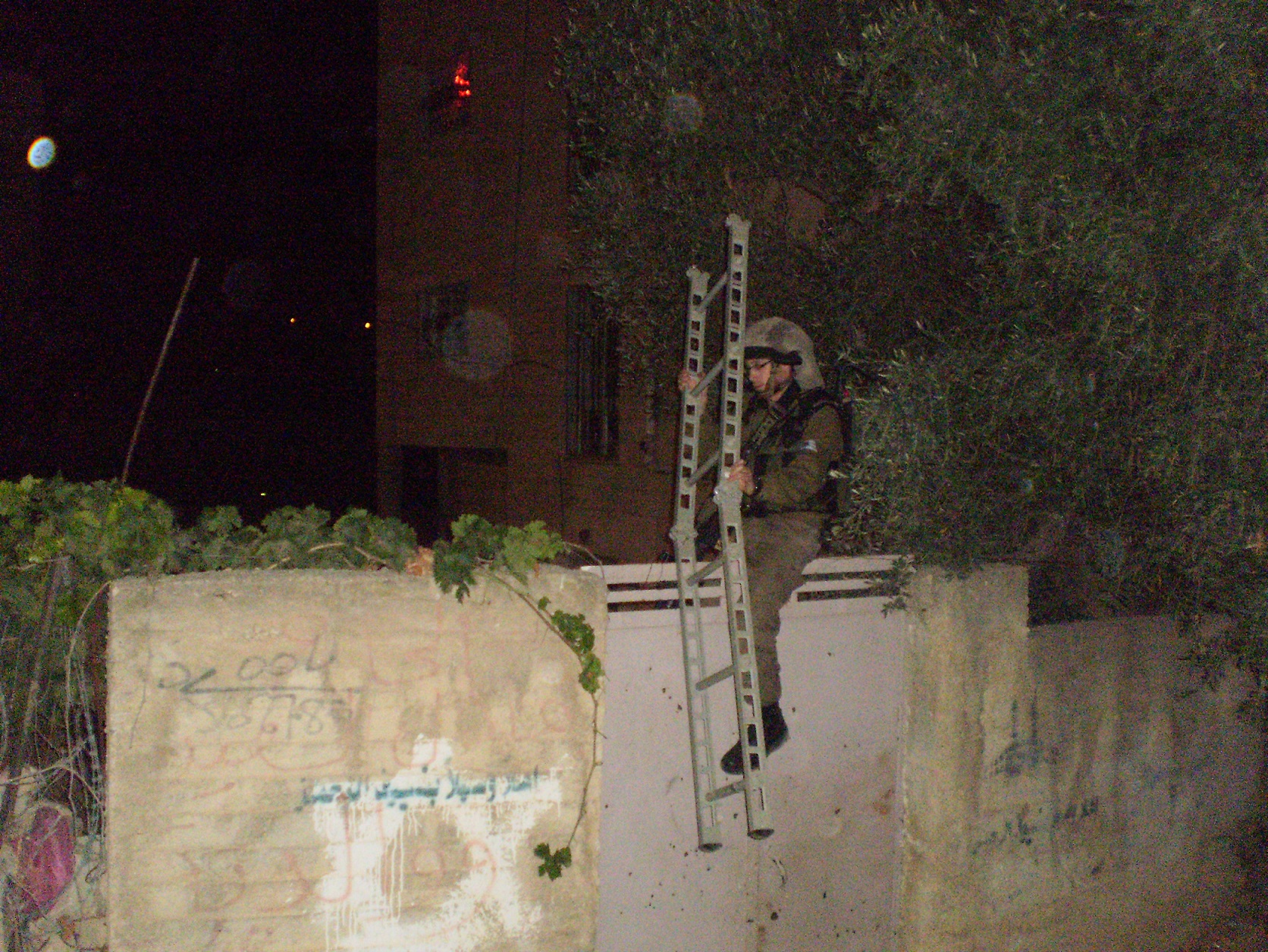
Israeli soldier climbing fence surrounding the Palestinian home. The door was unlocked the entire time (Photo by ISM)
At 21:15 pm three groups consisting of four Israeli soldiers each invaded the Sumud house from different directions. The heavily armed soldiers took the residents of the house completely by surprise, as they had been sneaking through the nearby olive groves. After harassing the people at the Sumud house and creating some mess, the soldiers retreated into the olive groves, only to invade the neighbouring house’s back-garden using the latter to climb over the wall surrounding the property. The aim of the exercise is unclear but soldiers seemed to have practised how to break into a house.
Activists from Youth Against Settlements as well as the International Solidarity Movement who were present at the scene strongly believe the invasion to have been a training exercise, as the soldiers could not show a court order justifying the invasion, nor did they arrest anyone. The precise goal and nature of the exercise remain unclear. By 22pm, all soldiers had gone, leaving a trail of confusion and broken property.

Among the broken property was the Sumud house Argile (Photo by ISM)
Although this is the first time the Sumud house has been targeted in what is clearly a training excersise, such incidents are not uncommon in the H2 area of Hebron, where 35,000 Palestinians live under the constant presence and control of a couple of thousand Israeli soldiers. “I am not training material. I am not an object,” local human rights activist Issa Amro commented after the incident. Amro subsequently called the Israeli DCO (District Coordination Office), which did not seem to know about the harassment and were unable to offer any explanation for the invasion of the two houses.
Related articles
- Father and 7-year-old son illegally detained in occupied Hebron (alethonews.wordpress.com)
- Jabari family once again facing harassment from settlers and soldiers (alethonews.wordpress.com)
Palestinian photographer who was shot in the cheek could be imprisoned yet again
By Shamus Slaunwhite | IMEMC & Agencies | July 24, 2013
In the middle of the night on June 30, Israeli forces invaded the Aida-area home of Palestinian photographer Mohamed Al-Azza, assaulted him and his family, and then arbitrarily detained him until July 11 when he was freed on a bail of 1,500 shekels. On July 25, an Israeli military court will rule on his case.

Palestinian photographer Mohammed Al-Azza recovering in hospital after being shot in the cheek (Photo by: Ryan Rodrick Beiler/Activestills.org)
After sustaining severe injuries during his arrest June 30, Al-Azza was transferred to a hospital for three days, and then sent back to prison. In an Israeli military court, the Israeli security forces charged that Al-Azza participated in “violent and illegal” activities. Reporters Without Borders reported that, “as a journalist, [Al-Azza] has covered demonstrations in support of detainees on hunger strike and protests against the November 2012 offensive in Gaza.”
On April 8, in the Aida refugee camp near Bethlehem, an Israeli soldier shot Al-Azza in the right cheekbone with a rubber-coated steel bullet. Al-Azza, who was working for Palestine News Network, sustained a broken right cheekbone, and underwent two surgeries to remove the bullet. Reporters Without Borders has urged the Israeli security forces to investigate this deliberate shooting of a journalist, to punish the soldier responsible, and to end “the complete impunity enjoyed by IDF soldiers responsible for violence against journalists.”
Related article
Israel bans teacher from Al-Aqsa Mosque
Ma’an – July 22, 2013
JERUSALEM – Israeli police on Monday banned a Palestinian woman from the Al-Aqsa Mosque, where she teaches, for three months.
Um Radwan told Ma’an that Israeli police telephoned her on Sunday, summoning her to the Russian Compound interrogation center.
She told police she was visiting a relative in hospital, and police went to the hospital and handed her a summons, which she refused to accept. More police arrived and detained Um Radwan.
Um Radwan was interrogated for two hours on and released with a summons to appear for further interrogation.
On Monday, Um Radwan was interrogated again at the Russian Compound for another two hours, and released with an order banning her from the Al-Aqsa Mosque for three months.
Um Radwan teaches the history of Jerusalem at the Al-Aqsa Mosque, and leads guided tours for students around the holy site.
The tours are part of a program sponsored by the Al-Aqsa Foundation.
Um Radwan said Israel had banned nine other women involved in the program from the mosque.
Earlier in July, 25-year-old Hussam Sidir, an employee of the foundation, was banned from the mosque for three months.
Um Radwan said Israel was trying to keep activists away from the mosque so Israeli settlers could enter more easily.
Related articles
- Israeli retired judge calls for performing Talmudic rituals in al-Aqsa mosque (ramyabdeljabbar.wordpress.com)
- Shin Bet officials call to accelerate Israeli control over al-Aqsa mosque (ramyabdeljabbar.wordpress.com)
- Israelis enter al-Aqsa on first day of Ramadan, chant anti-Arab slogans (theuglytruth.wordpress.com)
The Nakba Continues: Israel’s Bedouin Face Mass Displacement
By Nadia Ben-Youssef | New Left Project | July 15, 2013
I met Aziz Al-Touri nearly three years ago in a well-constructed tent of 2x4s and brightly-coloured tarp, erected next to the concrete remains of his family home and the exposed roots of hundreds of his olive trees. With the sound of crushing bulldozers and the sight of thousands of Israeli security forces still haunting the dreams of his five children, he spoke of his life in terms of before and after. Before and after 27 July 2010. Before and after the demolition of his entire village, Al-Araqib, one of 35 so-called “unrecognized villages” in the Negev desert in southern Israel. Today, when Aziz tells the story of his village, in an English that was completely foreign to his tongue three years ago, he corrects me when I say Al-Araqib has been demolished 52 times since July 2010. “That wasn’t the first demolition,” he says. “The first demolition was in 1948.”
Prior to the establishment of the State of Israel in 1948 (known as the Nakba or catastrophe in Arabic) some 92,000 Palestinian Bedouin lived in distinct and fixed villages and controlled 99% of the land in the Negev (Naqab). Land ownership and transactions were regulated within a sophisticated traditional system, and recognized by both the Ottoman Government and the British Mandate. Following the Nakba, and the mass expulsion of Palestinians from their homeland, the majority of the Bedouin community was forced to flee to neighbouring States; only 11,000 Bedouin remained, including a few families in the village of Al-Araqib. The remaining community was concentrated into a restricted military zone called the Siyag (Arabic for “fence”) by the Israeli Military Authority, with the internally displaced communities being told that they would be able to return to their own land within 6 months.
65 years later, none of the internally displaced Bedouin have been allowed to return, nor have they been given any proprietary rights to the land onto which they were moved. Similarly, the State did not recognize the land rights of the Bedouin communities that lived within the Siyag prior to the concentration. According to Israeli law, none of the Bedouin have any legal right to their ancestral land; the 1953 Land Acquisition Law (Actions and Compensation) declared all of the land of the Negev to be “state land.” With the passage of the law, the Bedouin were deemed “trespassers” and all of the Bedouin villages (both historic, and those created by the military government) were declared “illegal” and to this day have been denied recognition.
Successive Israeli governments have been faced with what the state regards as the “Bedouin problem.” This classification is all the more troubling when one considers that the Bedouin, like all Palestinians who remained in Israeli territory after the Nakba, were granted Israeli citizenship by 1954. The “problem” for the Jewish state is primarily one of demography. The Bedouin, who now number some 200,000 people, comprise around 32% of the population in the Negev; next to the Galilee, the Negev is the region in Israel with the highest percentage of non-Jewish citizens. Israel’s solutions, which are developed without community consultation, are often disguised as general regional development or described in patronising terms as benevolent attempts to “modernise” the Bedouin. However, all reflect the state’s acute anxiety about the “demographic threat” as well as the normalised discrimination against its Palestinian citizens.
Beginning in the late 1960s, the Israeli state’s first imposed solution was to urbanise its rural, pastoral citizens, creating seven urban townships over the next two decades. These urban townships are annually featured in the lowest socioeconomic bracket in Israel, and suffer from the highest rate of poverty, crime and unemployment. The forced urbanisation of traditional farmers and shepherds looks exactly as one would expect: bails of hay line the major roads, and herds of sheep, goats and camels are kept in pens attached to homes. Half of the Bedouin community, or roughly 100,000 people, live in these seven townships, though 85% of the residents are those who were internally displaced into the Siyag by the Israeli military government after the Nakba. Most of the Bedouin who were never moved from their ancestral land have remained in their historic villages, despite the fact that these villages are “unrecognized” by the State of Israel.
Unrecognized villages do not appear on any official maps, and their residents are denied access to all basic services including water, electricity, roads, sewage, schools and health clinics, in order to “encourage” them to abandon their homes. All of the structures in the villages are “illegal”, in that they were built without permits from the State, and are thus subject to frequent demolition (around 1,000 Bedouin homes were demolished in 2011). Beginning in 2003, after intensive efforts by an elected group of Bedouin leaders who formed the Regional Council of the Unrecognized Villages, 11 unrecognized villages were recognized. Though these villages do not face a future of mass demolition and displacement, ten years later they remain disconnected from all state infrastructure, and as there is no elected authority from which to request building permits, new or renovated buildings are also regularly demolished.
However, it is the remaining 35 unrecognized villages, home to some 70,000 Bedouin citizens of Israel, that are the target of the Prawer Plan, the government’s most recent “solution” for the Bedouin community. Named after the architect of the plan and former deputy chair of the National Security Council, Ehud Prawer, the Prawer Plan aims within three years to destroy the remaining villages, displace up to 70,000 Bedouin into the existing townships and recently-recognized villages, and resolve all outstanding Bedouin land claims (of which there are over 3,200, amounting to 5% of the land of the Negev) in favour of the State of Israel. If fully implemented, the Prawer Plan would result in the largest confiscation of Palestinian-owned land since the 1950s, and confine the Bedouin population to less than 1% of the Negev. Not only does the Prawer Plan officially deny Bedouin the rights to their land and their agency as citizens to determine where and how to live, it proposes a new discriminatory legal reality that applies only to the Bedouin community. According to the implementing legislation of the plan, the Prawer-Begin Bill, the process of judicial review is explicitly and severely restricted for Bedouin citizens of Israel by eliminating court-ordered and supervised demolitions and evictions in favour of speedy administrative orders. The Prawer-Begin Bill does not apply to Jewish citizens of Israel, for whom all constitutional protections remain intact.
The devastating plan was developed, as usual, without consultation with the Bedouin community and approved by the government in September 2011. Following considerable local and international pressure, the government conceded to holding a post-facto “public listening” process whereby Minister Benny Begin (a minister without portfolio in the Netanyahu administration) heard 1,000 Bedouin citizens and representatives. When Minister Begin finally presented his recommendations to the government a year later, it was clear that neither the grievances, nor the comprehensive planning alternatives proposed by the community in partnership with professional planners (in the form of an Alternative Master Plan to recognize the villages) had been incorporated into the Prawer Plan. Further, in the year that Minister Begin was writing his recommendations, the government silently approved the Regional Master Plan for the Be’er Sheva Metropolitan Area, which sets out the state’s “development” plans and outlines in concrete terms the state’s confiscation of Bedouin land and the eviction and destruction of most of the unrecognized villages.
The Regional Master Plan in some instances merely confirms already existing facts on the ground. In Al-Araqib for instance, the Master Plan grants legitimacy to two Jewish National Fund forests that are zoned for the area of the village, and today are almost entirely planted. In many other cases, however, the planting of new forests or park reserves, establishment of new Jewish settlements, and construction of new industrial parks, roads and military zones laid out in the Master Plan is hindered by the presence of the unrecognized villages. The Prawer Plan and the Prawer-Begin Bill enables the state to swiftly remove the villages and villagers to proceed with “development” projects that privilege state interests at the expense of its Bedouin citizens.
The Bedouin community and the Arab political leadership in Israel, together with civil society, have spent the last two years opposing and challenging the Prawer Plan and the Prawer-Begin bill. The community has organized mass protests in the Negev, and human rights organizations in Israel and around the world have mobilised thousands of people to speak out against the mass displacement. Meanwhile, the international community has condemned the discriminatory plan and the legislation, including the UN Committee on the Elimination of Racial Discrimination, the UN Special Rapporteur on Adequate Housing and the European Parliament in 2012. Yet, on 24 June 2013, the Prawer-Begin bill passed its first reading in the Israeli Knesset.
The Prawer-Begin bill joins a wave of discriminatory legislation directly targeting Palestinians living under Israeli control, both citizens of Israel and Palestinians living in the Occupied Palestinian Territory (OPT). 31 bills were proposed or passed during the 18th Knesset, and already in the first four months of the new 19th Knesset, 29 new discriminatory bills have been proposed that attack the rights of Palestinians. Normalised discrimination against Palestinians in Israel, fueled by widespread ignorance and misinformation, lends popular support to these legislative initiatives. In the case of the Prawer-Begin bill, it is likely that it will pass its second and third readings and be enacted into law before the closing of the Knesset session at the end of this month.
The approval of the Prawer-Begin bill only makes sense within this larger context, just as the 52 most recent demolitions of the village of Al-Araqib only make sense when one considers, as Aziz rightfully pointed out, the first demolition in 1948. Beneath the Prawer-Begin bill, and the discriminatory legislation that marks this era in the history of the Jewish state, lies a national project that has always sought to control for the Jewish people as much land with as few Palestinians as possible. The international community must intervene at the highest level to stop the Prawer-Begin bill. But the mass displacement of Israel’s Bedouin community is not just a problem; it is a symptom of the inherent contradiction between a state that defines itself in ethno-religious terms while also claiming to be a democracy. Where 1 in 5 Israeli citizens is excluded from full civic protection and participation simply for being Palestinian, and where a Palestinian Bedouin citizen of Israel and a Jewish citizen of Israel living in the Negev are treated according to different laws and policies, no democracy exists.
Nadia Ben-Youssef is a human rights lawyer living in the Naqab and serving as an international advocacy consultant for Adalah – The Legal Center for Arab Minority Rights in Israel.
Related articles
- Dozens injured in Jerusalem protest against the Prawer plan (alethonews.wordpress.com)
- Israeli extremists attack Negev village (altahrir.wordpress.com)
Israeli regime a replication of S. African apartheid?
Press TV – July 22, 2013
The Israeli regime has been accused of replicating the former South African Apartheid regime by the UN investigators, politicians and human rights groups.
Former South African leader Nelson Mandela once said “we know too well that our freedom is incomplete without the freedom of the Palestinians”.
Last month, Ismail Coovadia, outgoing South African ambassador to Tel Aviv, said the regime is a “replication of apartheid” and built on “stolen land”.
The relation between Tel Aviv and the Apartheid regime in South Africa has even become the subject of a book — “Unspoken Alliance; Israel’s Secret Relationship with Apartheid South Africa.
All these call for a look at the similarities between the two regimes and their cozy relations with Britain.
The Israeli regime is treating Palestinians, especially those living in the West Bank just like blacks, who were confined to Bantustans equal to West Bank enclaves and the besieged Gaza Strip by the Apartheid regime.
Palestinians are confined to security zones in the West Bank where they should have permits to pass military checkpoints while those in the Gaza Strip are under a military siege and have limited access to food, water, drugs and fuel, among others.
Palestinians are indeed under Israeli military occupation and face control of movement, physical separation from Zionists even on the roads and lack equal rights with them.
The physical separation, which is similar to the black Bantustans enforced by a variety of measures, is imposed on the Palestinians by creation of Israeli-only roads, limiting their access to lands and resources in the occupied territories and most recently by erecting of the separation barrier (otherwise known as the “Apartheid Wall”) in the West Bank.
Palestinians are also subjected to a totally different legal system than do Israeli occupiers to the extent that Palestinians are turned into secondary residents of their own lands by the occupiers, just like blacks versus white settlers during apartheid rule in South Africa.
In terms of equal rights, Palestinians also do not have the right to vote in the Israeli elections as was the case in the South African Apartheid regime.
They were given an illusion of a democracy by the Oslo Accords that enabled them to vote in the Palestinian Authority elections that brings to mind the local black polls for Bantustans, but that illusion was shattered in 2006 after Hamas won the PA elections but was not allowed to form a government.
The Israeli regime had also warm ties with the apartheid regime and the man behind the concept and implementation of apartheid, former South African Premier Hendrik Verwoerd, once said “Israel, like South Africa, is an apartheid state”.
The two regimes signed a military agreement in 1975 and the Zionist side helped the apartheid regime circumvent international sanctions until its end in the 1994, to the point that the UN General Assembly condemned Tel Aviv’s “collaboration with the racist regime of South Africa”.
The apartheid regime was also considered a close ally of Britain and London used its weight to prevent sanctions against the regime while maintaining extensive trade with South Africa especially by importing gold.
Later in the 1980’s, British Prime Minister Margaret Thatcher proved a staunch support of the racist regime describing the anti-apartheid Mandela as a terrorist in 1987.
Such a position is now clearly seen in the London-Tel Aviv ties and it goes without saying that Britain laid the cornerstone of a Zionist entity in the Palestinian lands in the first place.
In 2002, South African Archbishop Desmond Tutu wrote an article named “Apartheid in the Holy Land” that that his recent trip to Palestine had reminded him “so much of what happened to us black people in South Africa”.
He had earlier written in 1984 that the Bantustans, which were pretended to be self-governing homelands by the apartheid regime were deprived of “territorial integrity or any hope of economic viability”.
They were, he wrote, merely “fragmented and discontinuous territories, located in unproductive and marginal parts of the country” with “no control” over natural resources or access to “territorial waters”.
The description that appears to be a depiction of the occupied territories just now has been echoed by the UN Human Rights Rapporteur John Dugard, who is a South African legal professor and apartheid expert.
Dugard said “Israel’s laws and practices” in the Occupied Territories “certainly resemble aspects of apartheid”.
The analogy is also seen by British Labour MP Gerald Kaufman and former minister for international aid Clare Short who are pushing for sanctions against Tel Aviv.
The description of the situation in the occupied territories by Clare Short in the Commons back in June 26, 2007 is illuminating.
“I have followed developments in the Middle East carefully over many years, and I was well aware before my recent visit how bad things are for the Palestinian people. Nevertheless, I was deeply shocked by Israel’s blatant, brutal and systematic annexation of land, demolition of Palestinian homes, and deliberate creation of an apartheid system by which the Palestinians are enclosed in four Bantustans, surrounded by a wall, with massive checkpoints that control all Palestinian movements in and out of the ghettos,” she said.
A key difference, however, remains, that is apartheid rulers exploited blacks as cheap laborers while Zionists are ethnically cleansing Palestinians.
A South African newspaper editor, Mondli Makhanya, put it in a nutshell after a 2008 trip to the Middle East.
“It seems to me that the Israelis would like the Palestinians to disappear. There was never anything like that in our case. The whites did not want the blacks to disappear,” he said.
Jabari family once again facing harassment from settlers and soldiers
International Solidarity Movement | July 22, 2013
Hebron, Occupied Palestine – On Saturday the 20th, whilst taking his sheep out to graze on his land, 56 year old Abd Al-Karim Ibrahim Al-Jabari was stopped and harassed by settlers and soldiers before being taken for questioning to the police station in Givat Ha’avot, an illegal settlement in occupied Hebron.
Abd Al-Karim’s land is located between the two illegal settlements of Kiryat Arba and Givat Ha’avot. When he took his sheep out to graze on his land yesterday morning, he was stopped by settler security guards from the nearby settlement of Givat Ha’avot who subsequently called the Israeli occupation forces. He spent several minutes discussing with the soldiers, who refused to believe that he is the owner of the land and insisted it was Jewish land, as the settlers had told them. A soldier said to Abd Al-Karim: “This land and this house is mine and I will get you out of it”. The soldiers then decided to take him to Givat Ha’avot police station for further questioning. Abd Al-Karim, who speaks Hebrew, heard the soldiers say to each other that they wanted to handcuff him and then push him out of the jeep whilst driving. However, he managed to calmly insist and persuade them that there was no need for him to be handcuffed or blindfolded.
When they arrived at Givat Ha’avot police station, a police officer who knows Abd Al-Karim and his situation scolded the soldiers for bringing him there, confirmed that he owns the land, and told the soldiers to take him home again, which they did. Abd Al-Karim explained that the soldiers who arrested him are Shabbat reinforcements from another brigade that is not normally stationed in Hebron and therefore do not know the Jabari family and their situation.
After Abd Al-Karim was arrested, his son continued discussing with Israeli soldiers and asked them to stay to protect them from settlers, who were gathering in a tent set up on the Jabari family’s land which serves as a synagogue. However the soldiers refused to stay and said they would only come back after a one-hour coffee break. They also prevented international activists from filming the scene. Two hours later, the soldiers still hadn’t returned, leaving the Jabari family vulnerable to settler attacks. Abd Al-Karim explained that this has happened many times before.
The Jabari family used to live where Givat Ha’avot settlement now is, and they owned two more houses that were demolished. They have been living in their current house for 16 years.
The Jabari family has suffered countless attacks by both settlers and soldiers over many years. The settlers regularly come to harass and attack the Jabari family when they are out on their land grazing sheep or tending to their trees. They also steal vegetables from their land before the Jabari family can harvest them. In the past, settlers have often thrown rubbish, stones and empty alcohol bottles into their garden. Abd Al-Karim says he has recorded about 1,500 incidents since 2001. Everyone in his family has been arrested at some point or other. They have filed countless complaints at the police station, which has only led to further aggression and arrests by the Israeli military, who are seemingly trying to crush their spirit of resistance and defiance. Abd Al-Karim believes that his family is more vulnerable to settler attacks than their neighbours because they refuse to back down and insist on continuing to enter and use their land.
A few years ago, a couple of thousand settlers entered the Jabari family’s property and prayed outside their house. The settlers have said many times that they intend to take over the Jabari’s house and land.
Once, settlers were throwing stones at one of Abd Al-Karim’s sons. Soldiers came and twisted his arms behind his back and told the settlers to continue throwing stones at him. He was hit in the face by a stone and badly injured.
Two years ago, during Ramadan, soldiers would come to several houses in the neighbourhood just a couple of minutes before the call to prayer for iftaar (breaking the fast). They would force the whole family to move into one room and lock them inside, with all the food prepared and ready outside. The Jabari family’s neighbours were locked inside a room for 24 hours without food or water and were only released for iftaar the next day, meaning they had to fast for 48 hours. They were at the mercy of the soldiers to let them out to use the toilet.
When the soldiers attempted to do this to the Jabari family one day, Abd Al-Karim argued with them and refused to move into a room. The soldiers nevertheless entered their house and watched them break their fast. They then demanded to be shown around the house, but again Abd Al-Karim refused and insisted on calmly drinking his coffee and smoking a cigarette. He told them to go look around the house on their own, but refused to have his break ruined. The soldiers checked the house and left after an hour. Abd Al-Karim says he is proud that he refused to be locked into a room like his neighbours and that the soldiers could not force him.
As the Jabari family was sitting with ISM volunteers telling their story, a settler entered their garden. Abd Al-Karim and his son reassured the worried internationals and explained that this settler was an old friend and came to visit them regularly. They offered him coffee and cigarettes, and told stories of how they already used to play together as children. “We’re not against Jews or Israelis living here. All we ask of God is to live in peace with our children.”
Related articles
- Settlers building illegal road on Palestinian land in Hebron (palsolidarity.org)
- Palestinian activist detained in Israeli raid (alethonews.wordpress.com)
- Settlers from Bracha attack and harass farmer on his land (alethonews.wordpress.com)
New Israeli settlement in occupied Jerusalem given go-ahead
MEMO | July 20, 2013
Israel’s Planning and Construction Committee has issued licenses for 165 settlement units in Nafea Yacob Settlement in occupied Jerusalem.
In a press release, researcher in settlement issues Ahmed Soblaban said that the new project is part of a bigger plan to connect Nafea Yacob and Bezgat Zeaf Settlements. The particular danger of this project, warned Soblaban, is that it separates North Jerusalem from its occupied West Bank hinterland.
The project was originally proposed and approved in 2008, when the green area between both settlements was turned into an area ready for building. According to Soblaban, this project reinforces Israel’s racism against Palestinian residents in Jerusalem, who are prevented from building to cater for their population increase. Although Palestinians are usually not given building permits, they are in any case forbidden from building anything more than four stories high. Jewish settlers can build as high as they want.
Soblaban pointed out that the Israeli authorities have also started the ground works for another new settlement near Bezgat Zeaf.
Israel going ahead with hotels on historic cemetery
MEMO | July 18, 2013
Maariv newspaper has revealed that the Israeli-run Jerusalem municipality has started to develop plans for tourist hotels and related facilities on parts of the historic Ma’man Allah Cemetery in the holy city. The hotels and buildings are to be built in the south-central section of the cemetery, opposite the so-called Museum of Tolerance, which is also being built in the cemetery.
The newspaper noted that the municipality Finance Committee has allocated around $75,000 for the planning of the project, in cooperation with an Israeli company.
In response, Al-Aqsa Foundation for Religious Endowments and Heritage has issued a warning about the scheme which, it insists, is a flagrant violation of the sanctity of the deceased. “This is also a serious violation of the feelings of Muslims all over the world,” said the foundation, “and a continuation of the crimes of the Israeli establishment in the largest and oldest Muslim cemetery in Palestine.” The Israeli authorities have already dug up hundreds of graves in order to build schools and playgrounds on the site.
The foundation explained that the Israeli Ministry of Justice recently cancelled plans to build new courts on the same site. A local and international campaign has been launched by Al-Aqsa Foundation against Israel’s plans for the cemetery; there are at least 8 new projects planned.
Netanyahu denies reports of Israel agreeing to peace talks along ’67 borders
Al-Akhbar | July 18, 2013
A spokesman for Israeli Prime Minister Benjamin Netanyahu denied Thursday previous reports stating that Israel had agreed to a proposed formula for new peace talks with the Palestinians under which the border of their future state would be along lines that existed before the 1967 Middle East war.
An Israeli official had previously said on Thursday that Israel was open to talks based on the 1967 borders, but with agreed land swaps and Palestine recognizing Israel as a “Jewish state.”
The denial comes as a blow to US Secretary of State John Kerry, who has been working for the past six months to restart peace talks between Israel and Palestine.
Kerry had urged Israel on Wednesday afternoon to carefully consider a 2002 peace initiative approved by the Arab League.
“Israel needs to look hard at this initiative, which promises Israel peace with 22 Arab nations and 35 Muslim nations – a total of 57 nations that are standing and waiting for the possibility of making peace with Israel,” he had said.
The plan, put forward by Saudi Arabia at an Arab League summit in Beirut in 2002, offered full recognition of Israel but only if it gave up all land seized in the 1967 Middle East war and agreed to a “just solution” for Palestinian refugees. Softening the plan three months ago, a top Qatari official raised the possibility of land swaps in setting future Israeli-Palestinian borders.
Speculation had been rife that Kerry, now in the region for his sixth time since March in an effort to revive peace talks that deadlocked in 2010, may be close to a breakthrough.
Palestinian President Mahmoud Abbas was conferring with Palestinian leaders on Thursday to decide whether to accept Kerry’s proposals for renewing talks with Israel.
Kerry said on Wednesday after talks with Abbas in neighboring Jordan that gaps between the sides had “very significantly” narrowed. An Arab League committee endorsed Kerry’s proposals for resuming peace talks, saying they “provide the ground and a suitable environment to start negotiations.”
However, the issue of Israeli settlements in the West Bank and East Jerusalem, which are considered illegal under international law, is still to be resolved. Palestinians are refusing to return to negotiations without a freeze on settlement activity, as Israel has greenlighted the construction of hundreds of settlement homes in the past several months.
(Reuters, Al-Akhbar)
Netanyahu reminds EU that Israel is above the law
Al-Manar | July 17, 2013
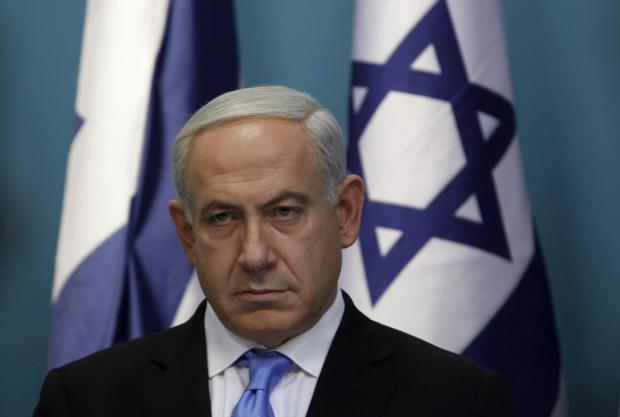
Israeli Prime Minister Benjamin Netanyahu slammed a European Union directive requiring member states to boycott Israelis living in the West Bank and East al-Quds (Jerusalem).
In an emergency meeting on Tuesday, Netanyahu pledged: “We will not accept any outside diktat about our borders.”
“This issue will be decided only in direct negotiations between the sides,” he added.
The directive included conditions for future contacts between the EU and the Zionist entity.
Netanyahu said that EU was taking steps unilaterally, while paying less attention to urgent regional matters such as the Syrian conflict and Iran’s nuclear problem.
“I would expect those who truly want peace and stability in the region would discuss this issue after solving more urgent regional problems such as the civil war in Syria or Iran’s race to achieve nuclear weapons,” he said.
“As the Prime Minister of Israel, I will not allow the hundreds of thousands of Israelis who live in Judea and Samaria, on the Golan Heights and in Jerusalem, our united capital, to be harmed,” Netanyahu added.
The meeting was held at the Prime Minister’s office in al-Quds. Those in attendance included Justice Minister Tzipi Livni, Economy Minister Naftali Bennett and Deputy Foreign Minister Zeev Elkin.
Related articles
Featured Video

Why Hamas Really Attacked Israel on Oct. 7
or go to
Aletho News Archives – Video-Images
From the Archives
Confronting the Threat of Ethnic Bioweapons
By Tony Cartalucci – New Eastern Outlook – 29.11.2017
The United States Air Force’s 59th Medical Wing’s molecular biology branch recently was revealed to have been collecting specifically Russian RNA and synovial (connective) tissue samples, prompting fears in Russia of a possible US directed ethnic-specific bioweapons program. … continue
Blog Roll
 Aletho News
- Oct. 7 Forever Marks The Big Reveal: ‘We See You, Israel, We Revile You, We Reject You!’
- Meet the US generals and admirals advancing Israeli policy
- Israel’s Straw Widow Protocol: The Kill Zones Where Civilians Were Labelled ‘Terrorists’
- Leading Israeli Think Tank Publishes Psychotic Israeli ‘National Security’ Doctrine
- Are the United States and Israel in Decline-and-Fall Mode?
- Why Hamas Really Attacked Israel on Oct. 7
- Declassified UK exposes British man who fought for ‘Israel’ in Gaza
- West’s death cult in a theater near you
- How the Yandex ‘Russian bots’ lie fell apart
- Burnham’s ‘Russia did Brexit’ ruse crumbles
- If Americans Knew
- Israeli settlers attack West Bank center for disabled children, church leader calls for int’l action
- Pulling Out Teeth Just to Live: How Israel Has Devastated Dental Care in Gaza
- Gaza’s “ceasefire” death toll passes 1,500 – Daily Update
- Activists Abused By Israel Return to New Freedom Flotilla Mission
- 60 Minutes won’t tell the full truth about Israeli settler violence
- Nearly 50,000 women, girls killed or severely injured in Gaza since October 2023: UN Women
- ADL is working with AI companies to suppress alleged ‘antisemitism’
- Israeli occupation forces using social media surveillance unit to target hundreds of Palestinians in the West Bank
- Israel’s New – and Terrifying – Security Doctrine
- Israeli Attacks Kill Five in Gaza, Including a four-year-old and a woman
- No Tricks Zone
- New Study Suggests Large Regions Of The Pacific Ocean Have Been Cooling For The Last 80 Years
- Germany’s Green Energy Debacle: High Energy Costs Force Kahla Porzellan to Close After 182 Years!
- New Study: 50 Years Of The Most Aggressive ‘Net Zero’ Policies Can Only Affect The Global Climate By 0.03°C
- US September “Heat” Was No Record…Many Records Set Decades Ago
- Latest European Green Energy Debacle; Portugal’s Largest Flagship Solar Park Insolvent!
- Green Energy Debacle: German Expert Professor Fritz Vahrenholt Warns Of Severe Economic And Social Consequences
- Two More Paleo Reconstructions Affirm Meters-Higher Sea Levels Across Ireland, Brazil 7000-6000 Years Ago
- New Study: Earth And Venus Surface Warmth Largely Explained By Convection And Lapse Rate, Not CO2 Or Radiation
- 2025 Nature Paper Claiming Worsening Global Drought Gets RETRACTED …Heavily Flawed
- New Study: ‘Global Drought Shows No Detectable Recent Acceleration Under Climate Warming’

