Soldiers assault a twelve-year-old Palestinian while settlers invade family rooftop in Hebron
International Solidarity Movement | August 3, 2013
Hebron, Occupied Palestine – Saturday August 3rd was not a peaceful Saturday for the Palestinians in Hebron. At approximately 16.30 two settlers invaded the roof of the Abu Shamsiya family in Tel Rumeida, whilst three soldiers attacked a twelve year old boy in the street nearby.
When the settlers on the roof were approached by internationals and told that they were on private property and therefore had to leave, they refused and said they came there every week. The fact that they had entered a private home without consent of the family did not concern them, on the contrary they expressed that they felt it was their right. When asked to leave the settlers behaved aggressively by yelling and continuously refusing to do so. After having argued with internationals one of the settlers threatened to lie to the soldiers and say that they had been hit by the internationals. He argued that even though it was not true, the soldiers would believe him over the international activists.
As seen in the video below, in the meantime three Israeli soldiers assaulted three young boys just down the street. The soldiers started by harshly pushing one boy, afterwards they grabbed a second boy, Islam by the hair and kicked him. Thereafter a third boy ran to his house chased by the soldiers. When internationals asked why the military was chasing the boy, they lied and said the boys had been throwing stones. The boy said that he had simply ran because he was scared after having seen his twelve-year-old friend, Islam being brutally attacked by soldiers for no apparent reason.
These are not unusual events. The Abu Shamsiya family is often victim of settler and military harassment, the family’s roof is on street level and settlers often go there to throw stones, harass the family and break their property. Saturdays are particularly violent in Hebron, only last week both Abu Shamsiya and his son Muhammed were attacked by settlers whilst the military was watching, with Abu Shamsiya then being arrested on false charges while the settlers were freed without charges.
Hebron has large settlements in the middle of the city housing approximately 500 settlers some of whom are extremely aggressive and violent. Additionally there are 2500 Israeli occupation soldiers stationed in the city.
Related articles
“I will keep trying to see my daughter until the day I die”
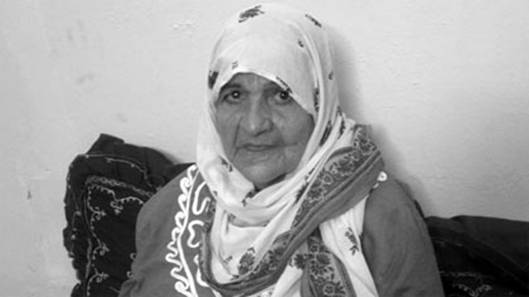
Fatma’s wrinkled face reveals the sorrow of a mother who has not seen her daughter for eleven years. Fatma Khalil Mubarak (78) lives in Rafah, in the south of the Gaza Strip. Her daughter, Lamees Ahmad Mubarak (44), has been living in Hebron in the West Bank since she got married in 1988. The last time Fatma saw her daughter was in 2002. Since then, Lamees has been trying to visit her family in Gaza, but she has been denied access every time she applied for a visitor permit to travel via Beit Hanoun (“Erez”) crossing. Beit Hanoun crossing is the only access point for people from Gaza to travel to the West Bank, including East Jerusalem, and/or Israel.
Fatma explains: “My daughter Lamees went to Hebron with her husband when she got married in the ‘80s. She used to visit me frequently, and I used to visit her as my health condition was much better and crossing to the West Bank was much easier. However, since the Second Intifada, we haven’t seen much of her. The last time she came was in 2002, but she has never been able to come back again since.”
Several attempts have been made by both Lamees and her family to reunite since 2002; however, Lamees’ applications for a visitor permit to the Gaza Strip have always been met with refusal. “This year, we have applied twice so far, but in vain. The permit was refused again. We have not given up yet. I will keep applying for a permit to see my daughter until the day I die.”
Fatma’s urge to see her daughter gets stronger every day, especially due to her deteriorating medical condition as she suffers from heart disease and hepatitis. “I do not know why I’m deprived of seeing my daughter,” she adds. “She is my daughter and she only wants to come and visit me as I am very ill. Why is she always refused entry? She is not a threat to their security. She only wants to come so I can see her.”
“We have tried everything. The last time we applied, we attached a copy of my medical report certified by the doctors to attest to how poor my condition is, but even that did not work. The Israeli authorities refused to give her a permit again. We all thought that it would work and that she would finally manage to come.”
“The last time I went to visit Lamees in Hebron was seventeen years ago. Since I became very ill, it is hard for me to travel on my own. I do not even leave this house. I know that I might get a permit if I applied for one, due to my age and my medical condition, but what would I do with a permit when I cannot move and cannot go anywhere alone? My health condition does not allow me to. What if I died on the way? The Israeli authorities won’t allow my children to accompany me to the West Bank.”
Israel imposes a policy of territorial fragmentation on the West Bank and the Gaza Strip. The separation of the territories has had grave consequences on the fabric of society. It has influenced every aspect of the social life of Palestinian people. Fatma explains how the Israeli closure of the Gaza Strip has further prevented her and her family from fulfilling her role as a mother and a grandmother. “Lamees got very sick recently. I could not go to visit her or look after her. None of her family could either. She is there on her own. Her father became very ill before he died in 2008. He wanted to see her, so we applied for a visitor permit, but the permit was refused. He died without seeing her, and she could not attend his funeral. Now, I have seven grandchildren whom I do not know. Two of my granddaughters got married, and I could not attend either of their weddings.”
The separation of the Gaza Strip and the West Bank has made the simplest family occasions very difficult. According to Fatma, Lamees was hoping to attend the wedding of her nephew in Gaza, which was planned for after Ramadan, in order to celebrate the happy occasion with her family. “We were getting ready to receive her at the wedding and we were expecting her. We were disappointed to hear that her permit had been refused again. No matter how many times she is denied permission to come, I am always hopeful that she will get the permit the next time and that I will see my daughter again. I cannot get used to the refusals. I will keep asking for permits again and again.”
Fatma recalls the days when Israeli restrictions on the movement of individual civilians via Beit Hanoun crossing were less strict: “In the past, when I applied for a permit, I would get it the next day. I would take a taxi from Gaza City to Hebron. We used to leave for Hebron in the morning and arrive before noon. It was only about an hour’s drive. Nowadays, it’s easier for me to see my daughter who lives in Norway than see my daughter who lives an hour away.”
Palestinians in the Gaza Strip remain denied of their right to freedom of movement, and suffer greatly due to the restraints imposed upon travel via Beit Hanoun crossing. The restrictions were first imposed in 1994 and have become increasingly strict since the al-Aqsa Intifada. Eventually, the crossing was completely closed on 16 February 2006. Since then, Palestinians have been prevented from travelling via the crossing unless they fall under certain specific categories.
As a result, civilians in the Gaza Strip have been denied access to holy places in Jerusalem and Bethlehem to perform religious rituals. Students have been prevented from travelling to attend universities in the West Bank. Families are prevented from visiting their relatives in the West Bank and vice versa. Since the Hamas takeover in June 2007, the Israeli authorities have only permitted limited categories of individuals to travel via the crossing: patients in a critical state; international journalists; employees of international organisations;. These groups are allowed to travel via the crossing under limited circumstances, via complicated procedures, and are often subjected to degrading treatment.
The closure of the Gaza Strip, which Israel has imposed for six consecutive years, constitutes a form of collective punishment, in violation of international humanitarian law. As a consequence of the continued closure, travelling between the Gaza Strip and the West Bank has been rendered virtually impossible for Palestinians, and entire families are now separated. The forced separation of families is in violation, inter alia, of Article 16 of the 1948 Universal Declaration of Human Rights (UDHR) and Article 23 of the 1966 International Covenant on Civil and Political Rights (ICCPR) which obliges States to protect the right to marry and found a family.
DFLP: The PA’s talks with Israel violate the national consensus
Palestine Information Center – 01/08/2013
RAMALLAH — The democratic front for the liberation of Palestine (DFLP) said that the participation of the Palestinian authority (PA) in the US-sponsored talks with Israel are a wrong step and violate the national consensus.
According to Quds Press, an official source from the democratic front stated on Wednesday that the engagement of the PA in these talks violated the requirements that were set by most of the Palestinian factions and national figures.
He said that the political forces in the Palestinian arena had demanded the PA to abide by requirements for its participation in the peace talks with Israel, based on the 1967 borders, and Israel’s commitment to end all settlement activities, respect relevant international resolutions, and release the long-serving prisoners.
The official also belittled the guarantees offered by US secretary of state John Kerry to the PA while Israel insists on refusing the establishment of a Palestinian state within the 1967 borders.
The official also called on the executive committee of the Palestinian liberation organization (PLO), which had unanimously opposed the current peace talks with Israel, to urgently convene to work on correcting the Palestinian position and obliging the PA to abide by the national requirements.
Palestine: Dividing Land, Erasing Identity in Qalandiya
By Malik Samara | Al-Akhbar | July 31, 2013
Qalandiya, a village on the outskirts of occupied Jerusalem, has become a stark example of the crimes of the Israeli occupation. In the name of “security needs,” Israel has bisected the village, dividing both land and people, even splitting one family in two.
Ramallah – To the north of occupied Jerusalem, there is a small, isolated village with a population of no more than 1,100. But the village occupies a strategic position on the outskirts of Jerusalem, between several factories and vital installations, including Israeli military manufacturing sites.
The village is adjacent to the airport of Jerusalem known as Qalandiya Airport, which was built during the British Mandate. Today, the Palestinian National Authority (PNA) wants the facility to become its official airport in a future Palestinian state.
The location of this village, like many others around Jerusalem, has made it vulnerable to Israeli military and settlement schemes, which always invoke the “security needs” of the Jewish state. Recently, Israel “annexed” the eastern part of Qalandiya into the areas falling behind the Green Line – the demarcation line marking the de facto border between Israel proper and the territories it captured in 1967.
But what Israel calls “annexation” is in fact a process to alter the route of the separation barrier, dividing the village in half – with only three homes in the eastern part annexed to the Jewish state and the remaining homes under PNA control. In other words, the village’s map changed overnight at the stroke of a pen. The village’s population, which has been living as a unified community for hundreds of years, is now subject to the whims of Israeli occupation officers.
Today, only three families live in the eastern part of the village, including two that carry the blue Israeli identity card, and one that carries the green Palestinian card, despite being related to one another. This is one of the many absurdities that come with the Israeli occupation, with members of the same family carrying different identification documents.
In the part of Qalandiya that has not been annexed, for example, some carry blue cards and others green cards, and though some are directly related to people in the eastern part, only blue card holders are allowed to go there to visit their relatives. “Even those who have permits to go to Jerusalem are not allowed to visit this area,” said Youssef Awadallah, head of Qalandiya’s village council.
In the annexed part of the village, the lives of the three resident families are now restricted by the occupation’s daily schedule. These residents are allowed to leave and return for only three hours each day through the checkpoint established by the occupation in the village, from 7 to 8:30 AM, then from 12:30 to 1 PM, and then from 4 to 5 PM.
But why did the Israelis sequester the eastern part of the village specifically?
Mahmoud Awadallah said, “The importance of this region has to do with its strategic position. The village is adjacent to the airport and the Atarot industrial park, as well as the strategic Route 443 and Atarot’s entrance. They did not want to put the wall directly along the route, and annexed this segment of the village to put the wall beyond it, in order to leave a buffer zone. The village is also close to a plant operated by Mata, an Israeli aerospace company that manufactures and upgrades helicopters.”
Curfews and Checkpoints
Among the families in the annexed part of Qalandiya, activist Mahmoud Awadallah’s family has the most intriguing circumstances, being the only family with Palestinian green ID cards. This means that the Awadallah family lives inside an Israeli “enclave,” in semi-isolation from the world.
This family cannot move freely within the Green Line, like the other two, or the West Bank, except during hours determined by the occupation. More often than not, the Israelis do not show any leniency for humanitarian or family emergencies. The Awadallah family embodies the occupation’s sharp disregard for the Palestinian lives.
Mahmoud Awadallah said, “One night, after the occupation authorities closed the village gates, my mother fell ill, but we were prevented from taking her to hospital. We had to wait until the next day before we could move her.”
Cars are not allowed to enter or leave the area, Awadallah added, and even those holding blue ID cards have to take a lengthy route to reach the second part of the village outside “visitation hours.” In other words, the occupation turns a five-minute journey between the two parts of the small village into a one-hour trek.
Even social relations between families now depend on the mood of Israeli occupation authorities. This includes marital relations, for instance, when one spouse carries an Israeli card and the other a Palestinian.
Youssef Awadallah said, “I carry the blue card, and I am forced to cross a large distance to get to the second part of the village. But what good is an ID card if I am isolated from my land and my relatives? I live in the eastern part, and my children and siblings live in the Arab part. Ever since the village was divided, our daily visits have stopped.”
Above all, what the area’s residents fear most is isolation from their families and surroundings in the event of a major escalation, when the entire region could be shut off.
Meanwhile, none of the petitions submitted by village residents to Israeli courts have borne fruit yet. Awadallah said, “So far, they have refused to respond or even consider the issue.” Now, the residents intend to go to the Israeli Supreme Court, to demand either full freedom of movement, or Jerusalem residence permits.
Related article
Israeli forces raid Cremisan Monastery in Bethlehem
IMEMC & Agencies | July 30, 2013
Witnesses reported that Israeli forces raided the Cremisan Monastery in Bethlehem late on Sunday [July 28]. The witnesses told the Palestinian News and Info Agency (WAFA) that Israeli soldiers broke into the monastery, held the people who were inside, and inspected their personal documents.

The Cremisan Monastery, founded in 1885 (Photo courtesy of cremisan.org)
The raid was condemned as a violation of the sanctity of places of worship, and a violation of international law. Under Human Rights Law, Israel must “ensure that religious places, sites, shrines and symbols are fully respected and protected”, and “take additional measures in cases where they are vulnerable to desecration or destruction.”
The Cremisan Valley area has been a hotbed of resistance against Israel’s annexation wall, because the Salesian Sisters of Cremisan Convent and the Palestinians of Beit Jala will soon be the annexation wall’s latest victims. The planned route of the annexation wall will separate more than 50 Palestinian families of Beit Jala from their agricultural land, and they will have only limited access to the land via an agricultural gate. Furthermore, the wall will separate the Salesian Convent from 75% of its land. The convent’s land, along with the monastery, will be on the Israeli side, whereas the convent and primary school will be on the Palestinian side.
To fight the planned annexation of their land, the Palestinians of Beit Jala and the Salesian Sisters of Cremisan launched a seven-year-long legal appeal that was supported by the United Kingdom’s Foreign Secretary, William Hague, and the archbishop of Westminster, Vincent Nichols. However, on April 26, 2013, the Special Appeals Committee of the Tel Aviv Magistrate’s Court ruled in favour of the planned route of the annexation wall. The annexation wall is illegal according to international law and the fourth Geneva Convention, to which Israel is a signatory.
According to the United Nations, 85% of the annexation wall is built illegally inside the West Bank, thereby annexing roughly 10% of its land.
Related article
Israeli settlers torch Hebron family’s property for eighth time
International Solidarity Movement | July 29, 2013
Hebron, Occupied Palestine – On Sunday, July 28, Israeli settlers severely burned land belonging to Hani Abu Haikel and his family in Hebron. Occupation soldiers, though at first trying to help stop the fire, ended up blocking the road so that Palestinian firefighters were delayed in reaching the scene. Several very old olive trees were destroyed in the fire which swept over immense swathes of land very quickly. In the video below, Hani Abu Haikel speaks about the incident and how Israeli settlers, soldiers and police work together to pressure Palestinian families to leave the Israeli-controlled H2 district of occupied Hebron.
The previous evening, July 27th, Israeli police came to Hani Abu Haikel’s house and questioned him about a variety of subjects including whether he has any plans of leaving the area, to whicb he answered in the negative. Apparently this questioning is a regular occurrence. Israeli soldiers have also arrested Abu Haikel and his children on spurious charges, later releasing them without charge. The soldiers continue to regularly detain and interrogate members of the family.
Yesterday afternoon Abu Haikel saw settlers present in the area of the Israeli military base. As this is a common thing for them to do, he thought nothing of it at first. However, after this Abu Haikel saw the settlers spray water all over the small plot they have illegally cultivated on his land, right beneath the military base. He then saw them spray another, apparently flammable chemical over his land – soon after this, his land was on fire. Observers noted that Israeli soldiers were obstructing people from reaching the scene to help. Palestinian fire engines were prevented from reaching the scene for at least half an hour, allowing the fire to spread rapidly and scorch the land, despite volunteers passing buckets of water between them to try to quell the flames.
The only part of the Abu Haikel land that wasn’t completely scorched was the small plot cultivated by Israeli settlers. Hani Abu Haikel explained that this is the eighth time settlers have burned his property, including an incident ten years ago when they burned all of his trees, meaning that many of the trees that were burnt this time were very young. It has taken him these ten years to effectively replant his land again and now, again it will be years before his land is as it was before this crime.
Related articles
- Live ammunition shot at Youth Against Settlement house in Hebron (alethonews.wordpress.com)
- “Shabbat shalom” – no peace for Palestinians in Hebron this Saturday (alethonews.wordpress.com)
- Soldiers invade two Palestinian houses – for training only (alethonews.wordpress.com)
- Jabari family once again facing harassment from settlers and soldiers (alethonews.wordpress.com)
Israeli archeologist: The finds in Khirbet Qeiyafa could belong to an Arab civilization
Palestine Information Center – 28/07/2013
 OCCUPIED JERUSALEM — Israel Finkelstein, a noted Israeli archeologist and academic at Tel Aviv university, questioned the Jewish claims about the discovery of King David palace in Khirbet Qeiyafa, west of occupied Jerusalem, expressing his belief that the finds belong to an ancient Arab civilization.
Finkelstein said that it could be true that the site discovered dates back to the eighth or tenth century BC, but it could have been built in that period by the Palestinians, the Arab Canaanites or other peoples in the region.
He said he believes that the site was probably built by other ancient kingdoms in the region, especially since there is no conclusive physical evidence suggesting it is the palace of King David.
Israeli archeologists had claimed to have discovered the site of King David Palace in Khirbet Qeiyafa, according to the Jerusalem Post. The report also said that the diggings have been going on for seven years at the site and had revealed two huge Jewish buildings, a palace and a storehouse.
Related article
- King David’s Palace Found? Biblical Archaeology Contentious (theepochtimes.com)
“Shabbat shalom” – no peace for Palestinians in Hebron this Saturday
International Solidarity Movement | July 28, 2013
Hebron, Occupied Palestine – Stone and egg-throwing, beating and kicking, headscarves torn off and an arrest based on two soldiers lying. This sunny Saturday in Hebron (Al-Khalil) was all about settler youth attacking innocent Palestinians and internationals while soldiers looked the other way.
Today, 27th of July, the Shabbat started as usual in Hebron with the settler tour through the Old City. A group of settlers surrounded by soldiers entered the Old City through the Peace Garden and went through the streets, preventing Palestinians from passing. The soldiers invaded several Palestinian houses in order to access the roofs. After an hour, the “tour” left the Old City through the entrance to Beit Romano settlement.
Later, at around 4pm, whilst walking down Shuhada Street international activists had stones thrown at them by two settler teenage boys. When they returned an hour later, they were attacked again by settler youths who jumped at them and violently pulled off their headscarves outside Beit Hadassah settlement. When the internationals complained to the soldier stationed at the nearby checkpoint, he showed no sympathy and said his job was only to protect the Jews living in Hebron.
About half an hour later, three international activists were passing by the Qurtoba School when a masked settler ran up the hill towards them, throwing eggs. One activist was hit in the face with two eggs whilst soldiers looked on from the watchtower above the school – they took no action against the settlers saying only “What do you want us to do?”
At around 6pm some settlers – who had previously been bathing in the Abraham spring close to the Islamic cemetery next to Shuhada Street whilst being guarded by a group of soldiers – tried to steal a home-made kite off two Palestinian kids. A Palestinian teenager managed to prevent them from taking it.
At around 6.30pm, a group of about thirty settler youths entered the property of the Abu Shamsiya family in Tel Rumeida. They threw stones at the family who were outside on the veranda preparing food for the iftaar fast-breaking meal. They also beat the 11-year old son of the family, Muhammad. When his father, Abu Shamsiya, went to the soldier stationed at the checkpoint just outside his house to complain and ask for help, the soldier simply told the settlers to go ahead and continue attacking the family.
A settler youth then ran up to Abu Shamsiya and violently kneed him in the stomach right in front of the soldier. Another soldier grabbed Abu Shamsiya’s wife Fayseh, who was filming the incident, by her hair and pulled her to the ground. The police, who happened to be parked in their car just up the road, finally decided to intervene. Abu Shamsiya complained against the two soldiers who had attacked him and his family and were complicit in the settler violence.
In a rare turn of events, the police believed Abu Shamsiya’s story – although the soldiers denied it – and took these two soldiers to the police station for further questioning. However, they did not arrest any of the settlers, who escaped into the Tel Rumeida settlement and the police chose not to follow them. The group of settler youths returned soon after and although Abu Shamsiya and various other eyewitnesses clearly pointed out the attackers to the police, they took no action.
Abu Shamsiya himself was later taken to the police station in order to file an official complaint and so that the police could examine his video footage of the incident. The Abu Shamsiya family were initially hopeful that this might lead to some positive result, but two hours later they got a phone call that Abu Shamsiya was now being detained in the police station on the charge of spitting at soldiers. Clearly the two soldiers whom he complained against wanted revenge and made up this story to incriminate him. His family is deeply worried and hopes he will be released by tomorrow.
During the same incident, which attracted a lot of onlookers outside Abu Shamsiya’s house, Palestinians, settlers and internationals alike, a settler woman who is notorious for being extremely aggressive and has attacked internationals and Palestinians on several occasions, started pushing and shouting at an international activist as well as pulling at her scarf to strangle her. This happened right in front of a group of soldiers who chose to just stand by and watch, and even mocked the international activist when she complained and asked whether they thought it was okay for her to get strangled in the middle of the street.
Although the settler attacks in Hebron are not always as numerous and severe as they were on this particular day, none of what happened today is new or unusual to the residents of Hebron. Hebron is the only West Bank city that has settlers living inside the city itself. It is home to a particularly extreme and aggressive settler community, numbering about 500, that constantly harasses, intimidates and attacks Palestinians with near impunity and the protection of about 2,500 Israeli occupation soldiers stationed in Hebron.
Update 28th July: Israeli authorities are demanding 1000NIS on bail to release Abu Shamsiya. He will have a court hearing soon (exact day still unknown).
Related articles
- Jabari family once again facing harassment from settlers and soldiers (alethonews.wordpress.com)
- Soldiers invade two Palestinian houses – for training only (alethonews.wordpress.com)
- Live ammunition shot at Youth Against Settlement house in Hebron (alethonews.wordpress.com)
- Palestinian activist detained in Israeli raid (alethonews.wordpress.com)
Call for action: Stop Prawer Plan!
27th July 2013 | Stop Prawer Plan | Palestine
We call on international solidarity activists to organize demonstrations on 1 August in their own cities, and to spread awareness of the biggest impending ethnic cleansing campaign against Palestinians by Israel since 1948 through writing petitions, sharing information on the Naqab and Prawer Plan, or by any other show of activism.

On Monday, July 15, thousands of Palestinians protested in their cities, towns and at busy street junctions against the Prawer Plan, in a day that was designated as the national day of rage, or Anger Strike.
From Bir Sabe to Jerusalem, West Bank to the Galilee, Haifa to Gaza, Palestinians demonstrated against the Prawer Plan which passed its first reading in the Knesset last month. The Plan aims to
* confiscate 800,000 dunums of land in the Naqab desert
* expel over 50,000 Palestinian Bedouins
* demolish 35 unrecognized villages
* confine 30% of Palestinian Bedouins in the Naqab to 1% of the land
Dozens of Palestinians were either injured or arrested since July 15 by the Israeli occupation forces, yet the Anger Strike is far from over. Throughout the past week protests have been constant within Palestine, with Beirut in Lebanon and Cairo in Egypt also joining in.
We are determined to continue protesting daily and to raise international awareness for the plight of our Palestinian Bedouin brothers and sisters, and the next day of rage will be on Thursday, August 1.
We call on international solidarity activists to organize demonstrations on the same day in their own cities, and to spread awareness of the biggest impending ethnic cleansing campaign against Palestinians by Israel since 1948 through writing petitions, sharing information on the Naqab and Prawer Plan, or by any other show of activism.
Stay updated on Twitter and Facebook through the hashtags #StopPrawerPlan
Contact us: www.facebook.com/StopPrawerPlan
Another Journalist with Children in the Israeli Military
By ALISON WEIR | CounterPunch | July 26, 2013
The New York Times recently published a news brief, reporting that Israel is going to re-investigate an incident in which an American citizen, Tristan Anderson, was permanently maimed.
Anderson suffered extensive brain damage (part of his frontal lobe was destroyed) and paralysis, and was blinded in one eye, after Israeli soldiers shot him with a tear gas canister intended as a “barricade penetrator” from inappropriately close range. According to eyewitnesses, Anderson was shot as he was taking photographs in a Palestinian village after an unarmed protest against the illegal and extensive confiscation of village land.
Israeli forces have a history of shooting unarmed protesters with these canisters, which one expert likens to “a small missile.”
Yet the New York Times report, “Israel Reopens Inquiry Into Activist’s Injury” (July 11, 2013, P. 9) reveals few of these details.
The Times article states that Anderson was injured when he was hit in the head by a tear gas canister and is partly paralyzed and blind in one eye, but does not mention his extensive brain damage and that his paralysis is over half his body. It doesn’t reveal that the type of canister used is extraordinarily destructive or that it was fired at such close range.
The report also omits the fact that this incident is part of a pattern, even though Israeli forces have killed at least two Palestinians with these canisters, and shot out the eye of an American student with another. According to a report by an Israeli organization, Israeli forces “frequently fire tear-gas canisters directly at demonstrators.”
The Times report states that the protest was “against the extension of Israel’s separation barrier in the West Bank” without citing the villagers’ actual complaint — the confiscation of their land and, thus, livelihood by Israel. It similarly fails to mention that over previous decades Israel confiscated over 80 percent of the village land and now intends to take between a quarter and a third of what remains to build the “barrier.”
Finally, the Times report repeats, without attribution, the Israeli security forces’ claim that the shooting occurred “during a clash,” implying that it happened accidentally during a violent engagement, ignoring eyewitness testimony that the protest had dissipated and most people had gone home.
The byline on the Times report is Myra Noveck. Noveck has bylined a number of stories for both the New York Times and its European affiliate the International Herald Tribune, where ZoomInfo lists her as a contributor.
Noveck is frequently cited in New York Times news reports as a contributor to stories, and a prominent Israeli newspaper calls her the Times’ “deputy bureau chief” for the Times’ Jerusalem bureau, its bureau for covering Israel-Palestine.
From information she has posted online, it appears that Noveck is an American who moved to Israel after college. According to Torah in Motion, which promotes Jewish dialogue and speakers, two of her children were serving in the Israeli military as of 2012. It is unclear whether her children are currently still on active duty or whether they are now serving as Israeli reserve soldiers.
In either case, it appears that while Noveck has been writing and contributing to news reports about Israel and about the Israeli military, her children have been serving in it.
Such a situation appears to constitute a clear conflict of interest – even according to the Times’ own ethics standards – and should normally cause a journalist to be assigned to a different area of reporting.
When it came to light in 2010 that then chief of the Times’ Jerusalem bureau, Ethan Bronner, had a son in the Israeli military, even the Times’ own ombudsman concluded that Bronner should be reassigned.
In response to requests for information and interviews with Noveck and Times Executive Editor Jill Abramson, a Times spokesperson issued a written statement claiming that Noveck is “not a reporter,” but merely a “long-time news assistant in The Times’s bureau in Jerusalem.”
The statement went on to say: “She works under the direction of our bureau chief primarily doing translation and research. She is an Israeli citizen. If she has children and they are also Israeli citizens, presumably they would be required to serve in the military*. This situation would not constitute a ‘breach with impartiality.’”
I wrote back pointing out (1) that Times’ conflict of interest requirements include family members and (2) that Noveck’s byline appeared on a news report. The spokesperson then admitted that Noveck “on rare occasions received a byline” but still maintained that “she is not a reporter.”
However, the Times’ published ethics standards generally extend ethical requirements ”to all newsroom and editorial page employees, journalists and support staff alike.”
Reporters Frequently Have Ties to Israeli Military
This incident is part of a pattern of ethics violations concerning reporting on Israel.
Isabel Kershner, a senior Times reporter in the region, is an Israeli citizen whose husband, according to Fairness and Accuracy in Reporting (Fair) works for an Israeli organization, the Institute for National Security Studies (INSS), which has close ties to the Israeli military and is “tasked with shaping a positive image of Israel in the media.”
A FAIR study of articles that Kershner had written or contributed to since 2009 found they had overwhelmingly relied on the INSS for analysis about events in the region.
A multitude of journalists at the Times and elsewhere have had close personal and family ties to the Israeli military – almost none of them ever disclosed, including the previous Times bureau chief Ethan Bronner, as noted above.
Jonathan Cook, a British journalist based in Israel, quotes a Jerusalem bureau chief who stated: “… Bronner’s situation is ‘the rule, not the exception. I can think of a dozen foreign bureau chiefs, responsible for covering both Israel and the Palestinians, who have served in the Israeli army, and another dozen who like Bronner have kids in the Israeli army.”
Cook writes that the bureau chief explained: “It is common to hear Western reporters boasting to one another about their Zionist credentials, their service in the Israeli army or the loyal service of their children.”
For more information on journalists’ pro-Israel conflict of interest violations see ”US Media and Israeli Military: All in the Family,” “Jodi Rudoren, Another Member of the Family: Meet the New York Times’ New Israel-Palestine News Chief,” “Ethan Bronner’s Conflict With Impartiality,” and ”AP’s Matti Friedman: Israeli citizen and former Israeli soldier.”
It would appear from this pervasive pattern that many of the owners, editors, and journalists who determine U.S. reporting on Israel-Palestine believe that normal ethics requirements don’t apply in regard to Israel.
This situation holds serious consequences for the American public. American taxpayers give Israel over $8 million per day (more than to any other country) and, as a result, most of the world views Americans as responsible for Israeli actions, exposing us to escalating risks.
Osama Bin Laden and others have often cited U.S. support for Israeli crimes as a primary cause of hostility against us.
It is thus essential that Americans be accurately and fully informed. This is unlikely to happen while those reporting for American news media (whether “reporters” or “assistants”) have such close ties to Israel and its powerful military forces.
Witnesses Describe Soldiers Shooting Protesters with High-Speed Canisters
Anderson was shot in 2009 after a protest in the Palestinian village of Ni’lin in the West Bank. Since 2007 Ni’lin villagers and others have been demonstrating against the illegal Israeli confiscation of up to a third of the village’s land (following previous confiscations in which the majority of the village’s original land was taken by Israel).
Gabby Silverman, a witness to the shooting of Tristan Anderson, describes the incident: “Tristan had wandered off with his camera. I was looking at him. And out of nowhere, they opened fire on us. The first shot they fired, they got Tristan.”
Anderson is now in a wheelchair with permanent brain damage. He is hemiplegic (paralyzed on the left, formerly dominant, side of his body). He is blind in his right eye and part of his head and frontal lobe were destroyed.
The kind of canister Israeli forces shot at Anderson is particularly dangerous, according to their manufacturer itself. The shells have a range of several hundred meters, yet Israeli soldiers fired at Anderson from approximately 60 meters away.
The canisters’ manufacturer, Combined Systems, Inc. (CSI), classifies them as “barricade penetrators” and advises that they should not be fired at people. A spokesperson for an Israeli human rights organization says, “It’s like firing a small missile.” Because of an internal propulsion mechanism, they hurtle through the air at 122 meters per second.
CSI is reportedly the primary supplier of tear gas to Israel. A watchdog group reports that the company flew the Israeli flag at its Jamestown, Pennsylvania, headquarters until, in advance of a planned Martin Luther King Day demonstration, CSI took it down and replaced it with the Pennsylvania state flag.
According to an in-depth report on CSI by Pennsylvania professor Dr. Werner Lange, the company was founded by two Israelis, Jacob Kravel and Michael Brunn.
A month after Anderson was shot, a Palestinian nonviolence leader was killed by this same type of tear gas canister when an Israeli soldier shot it into the victim’s chest (the fifth Palestinian killed in Ni’lin by the Israeli military in a year and a half).
The next year Israeli forces fired a similar canister at a young American art student, Emily Henochowicz, destroying one eye. An eyewitness reported that an Israeli soldier intentionally aimed the canister at Henoschowitz while she was participating in a nonviolent demonstration.
In 2012 another Palestinian was killed when an Israeli soldier shot him in the face with what appears to have also been a long-range CSI canister.
The occupying Israeli forces have consistently suppressed the Ni’lin villagers’ unarmed protests against the stealing of their land. As of 2012, Israel had arrested more than 350 villagers, killed 5 – including a 10-year-old child – injured “multiple” protesters with live ammunition, and broken the bones of 15 people with tear gas projectiles, according to the villagers’ website, created to document the situation.
There are similar reports from other Palestinian villages, where several other protesters have died from tear gas fired by Israeli forces.
It is unfortunate that almost none of this was even hinted at in Myra Noveck’s New York Times report.
*While military service is required for both males and females in Israel, only about 50 percent actually serve; many Israelis have refused to serve in the Israeli military for reasons of conscience.
Alison Weir is executive director of If Americans Knew and president of the Council for the National Interest. She can be reached through contact@ifamericansknew.org.
For more information on Anderson, videos of the incident, and the latest updates go to http://www.justice4tristan.org/.
Ni’lin is also sometimes referred to as Nilin or Na’alin.
Related article
- Palestinian photographer who was shot in the cheek could be imprisoned yet again (alethonews.wordpress.com)
Live ammunition shot at Youth Against Settlement house in Hebron
International Solidarity Movement | July 26, 2013
Hebron, Occupied Palestine – Last night at 10 pm, a live ammunition bullet was fired at the headquarters of the human rights organisation Youth Against Settlements (YAS) in Hebron.
The spokesperson for YAS, Damer Atash, explains that a group of activists were sitting in front of the house headquarters when the bullet was fired. The bullet was shot from the nearby olive groves making it impossible to see the shooter, although two voices were heard. Luckily, the group of activists were not hurt, instead, the bullet bounced off the window right behind them. “At first we thought it was a stone but instead we found a bullet”, said one of the activists.
At 22:15 pm, the group called the Israeli police, who arrived some 40 minutes later at approximately 11 pm, after the police arrived the military joined them and stayed for about 20 minutes. However, none of them searched the premises for the bullet canister.
The shooter was not seen, but it is likely that it was an attack from one of the neighbouring settlers, as the bullet was bigger than those used by the army. Even though this is the first incident of shooting against YAS, this would not be the first time the house has been attacked by settlers. They have previously tried to burn the house, set the kitchen of the headquarters on fire and uprooted trees. In these incidents the Israeli army or police have not taken any action against the settlers.
Israeli army and police also participate in the harassment of YAS and its human rights organizers. On Wednesday alone, the army invaded the house three times during the evening and night for what it is believed to be a training exercise for the army.
The despair and fear this causes is not uncommon for the 35,000 Palestinians living under complete control of 1500 Israeli soldiers and police officers, and the constant harassment and violence from the 500 settlers illegally living in the Israeli controlled H2 area of Hebron.
Related articles
- Palestinian activist detained in Israeli raid (alethonews.wordpress.com)
- Jabari family once again facing harassment from settlers and soldiers (alethonews.wordpress.com)
- Shocking Video | Israeli Soldier Cooks Bird Alive! (occupiedpalestine.wordpress.com)
- Hebron man arrested for filing complaint about settler attack (imemc.org)
Featured Video

Why Hamas Really Attacked Israel on Oct. 7
or go to
Aletho News Archives – Video-Images
From the Archives
Confronting the Threat of Ethnic Bioweapons
By Tony Cartalucci – New Eastern Outlook – 29.11.2017
The United States Air Force’s 59th Medical Wing’s molecular biology branch recently was revealed to have been collecting specifically Russian RNA and synovial (connective) tissue samples, prompting fears in Russia of a possible US directed ethnic-specific bioweapons program. … continue
Blog Roll
 Aletho News
- Oct. 7 Forever Marks The Big Reveal: ‘We See You, Israel, We Revile You, We Reject You!’
- Meet the US generals and admirals advancing Israeli policy
- Israel’s Straw Widow Protocol: The Kill Zones Where Civilians Were Labelled ‘Terrorists’
- Leading Israeli Think Tank Publishes Psychotic Israeli ‘National Security’ Doctrine
- Are the United States and Israel in Decline-and-Fall Mode?
- Why Hamas Really Attacked Israel on Oct. 7
- Declassified UK exposes British man who fought for ‘Israel’ in Gaza
- West’s death cult in a theater near you
- How the Yandex ‘Russian bots’ lie fell apart
- Burnham’s ‘Russia did Brexit’ ruse crumbles
- If Americans Knew
- Gaza’s “ceasefire” death toll passes 1,500 – Daily Update
- Activists Abused By Israel Return to New Freedom Flotilla Mission
- 60 Minutes won’t tell the full truth about Israeli settler violence
- Nearly 50,000 women, girls killed or severely injured in Gaza since October 2023: UN Women
- ADL is working with AI companies to suppress alleged ‘antisemitism’
- Israeli occupation forces using social media surveillance unit to target hundreds of Palestinians in the West Bank
- Israel’s New – and Terrifying – Security Doctrine
- Israeli Attacks Kill Five in Gaza, Including a four-year-old and a woman
- Air Force Major Who Called for Trump’s Impeachment Held in Solitary Confinement
- It’s a Genocide, I’m Into It’: Seinfeld Mocks Protest over Palestinian Children Killed
- No Tricks Zone
- New Study Suggests Large Regions Of The Pacific Ocean Have Been Cooling For The Last 80 Years
- Germany’s Green Energy Debacle: High Energy Costs Force Kahla Porzellan to Close After 182 Years!
- New Study: 50 Years Of The Most Aggressive ‘Net Zero’ Policies Can Only Affect The Global Climate By 0.03°C
- US September “Heat” Was No Record…Many Records Set Decades Ago
- Latest European Green Energy Debacle; Portugal’s Largest Flagship Solar Park Insolvent!
- Green Energy Debacle: German Expert Professor Fritz Vahrenholt Warns Of Severe Economic And Social Consequences
- Two More Paleo Reconstructions Affirm Meters-Higher Sea Levels Across Ireland, Brazil 7000-6000 Years Ago
- New Study: Earth And Venus Surface Warmth Largely Explained By Convection And Lapse Rate, Not CO2 Or Radiation
- 2025 Nature Paper Claiming Worsening Global Drought Gets RETRACTED …Heavily Flawed
- New Study: ‘Global Drought Shows No Detectable Recent Acceleration Under Climate Warming’


