Israel is set to recruit students to work undercover in “covert units” at universities. The students will post messages on Facebook, Twitter and YouTube on the Israeli government’s behalf – without identifying themselves as government agents.
The students participating in the project will be part of the public diplomacy arm of Prime Minister Benyamin Netanyahu’s office. Leaders of the “covert units” will receive full scholarships in return for their online public diplomacy (hasbara).
The Prime Minister’s Office is looking to invest up to 3 million shekels ($840,000) to recruit, organize and fund the activities of hundreds of university students, Haaretz reported.
Sources in the Prime Minister’s Office told the newspaper that the main subjects that the campus-based units will deal with are diplomatic- and security-related issues, efforts to combat boycotts of Israel, anti-Semitism and the de-legitimization of Israel. The students will focus on Israel’s democratic values, freedom of religion, pluralism and “other subjects that give expression to the Israeli government’s public diplomacy policy.”
A member of the Israeli Knesset, Dov Lipman, and the Prime Minister’s Office’s director for interactive media, Danny Seaman, revealed the new initiative during a meeting of the Knesset’s Diaspora Affairs Committee last month.
The Prime Minister’s Office is planning to have Israel’s student union recruit up to 550 students with knowledge of foreign languages from Israel’s seven universities. The student union is to publicize the project among tens of thousands of students, and is to provide computers and work space for a project headquarters at all university campuses.
“With social media, you can’t wait,” an unnamed official involved in the effort told the Jerusalem Post.
“We will get authoritative information out and make sure it goes viral,” the official said. “We won’t leave negative stories out there online without a response, and we will spread positive messages. What we are doing is revolutionary. We are putting public diplomacy in the hands of the public.”
The covert units will be set up at each university and structured in a semi-military fashion. While groups will take directions from staff at the Prime Minister’s Office, the government says that officially they will be politically independent.
“The idea requires that the state’s role not be highlighted and therefore it is necessary to insist on major involvement by the students themselves without any political link [or] affiliation,” Seaman said.
Leaders of covert units will receive full scholarships from the Prime Minister’s Office, which will fund a total of 2.78 million shekels ($780,000) in scholarships for the program in the upcoming academic year, Haaretz reported.
“The national public diplomacy unit in the PMO places an emphasis on social network activity,” the Prime Minister’s Office said in a statement. “As part of this, a new pro-Israel public diplomacy infrastructure of students on Israeli campuses is being established that will assist in advancing and disseminating content on the social networks, particularly to international audiences.”
According to details provided to Israeli media, a government liaison officer for Israel advocacy will oversee the dissemination of “rapid responses” from Israeli officials to respond to news events, and coordinate with other government bodies that deal with public diplomacy, including the Israeli Defense Force.
The IDF has recently asserted a stronger, at times controversial presence on social media with mixed results. The new program may well seek to address perceived deficiencies in the way that Israel communicates with the world online.
Last year, during Israel’s eight-day Operation Pillar of Defense, an incursion launched into the Hamas-controlled Gaza Strip in response to rocket attacks, the Palestinian group was widely seen as having won the war of words on online media.
Haaretz reported that in the fallout of the military operation, the hashtag #GazaUnderAttack with 170,000 mentions easily surpassed Israel’s own #IsraelUnderFire, with a comparably meager 25,000 mentions.
“The perception dominating the online discourse was that the IDF had embarked on an unjustified attack,” said Tomer Simon, an Israeli researcher who studied social networking activity during the conflict.
August 15, 2013
Posted by aletho |
Deception, Ethnic Cleansing, Racism, Zionism | Benjamin Netanyahu, Internet, Israel, Palestine, Social networks, Zionism |
Leave a comment
Palestinians of all political persuasions welcomed the release of 26 prisoners last night. They are the first of 104 pre-Oslo life prisoners due to be released over the next nine months as long as Israel is satisfied with the progress of its negotiations with the PLO/PA. Incredibly, these 104 prisoners now slated to be freed should have been released 20 years ago according to the terms of the Oslo Accords, so it is not such a big concession for Israel to be releasing them now.
Despite the overwhelming euphoria that marked the occasion, that joy remains incomplete because there are still an estimated 4,800 other Palestinians behind bars in Israel. An additional 1,267 Palestinians are held in Israel Prison Service facilities for being in Israel illegally. However, Palestinian prisoners are not just statistics. Israel regards criminal prisoners and political detainees alike; they are all criminals in its eyes. With a stronger Palestinian leadership capable of exercising real leverage at the negotiating table, there would be cause to be hopeful about this release. Sadly, this is not the case; the PA’s negotiators are dependent on their misplaced trust in American “impartiality” and Israeli “goodwill”. Decades of concessions have got the Palestinians nowhere.
While the Israelis continue to hold thousands of Palestinians in detention because they are “terrorists” with “blood on their hands”, not a single Israeli is held in a Palestinian jail despite the thousands of Palestinians who have been killed by Israelis; presumably Israeli hands are regarded as clean.
The issue of the Palestinian prisoners is one that evokes an unquestioned national consensus. It affects every strata of society. Whether they were imprisoned before Oslo or after, they have all suffered. Fuad Al-Khouffash, the head of the Ahrar Center for Detainees’ Studies and Human Rights based in Nablus, says that there are about 500 prisoners serving life sentences.
Over 650,000 Palestinians have been detained and imprisoned since the beginning of Israel’s occupation of Palestinian territories in 1967. This represents almost 20 per cent of the total Palestinian population in the occupied West Bank and Gaza Strip.
When asked to explain this abnormally high incidence of incarceration, Palestinians insist that they were only defending their land and freedom. Earlier this month, Israeli Justice Minister Tzipi Livni confirmed the importance of land in the equation when she told Israeli Radio that she prefers a prisoner release deal rather than the possibility of resuming peace talks based on the June 1967 borders. Freeing a few prisoners, it appears, is much easier than withdrawing from the occupied and colonised territories.
To the same degree, land is also the overarching issue for the Palestinians. While they all value the release of their loved ones from Israeli prisons, it must not be at any price. If it means giving up their land they would much rather remain behind bars. Nazareth-born Karim Younis, who has been on a life-sentence since 1983, is regarded by many prisoners as their dean. He wrote in a letter from Hadrim Prison this week: “We never thought in our wildest dreams or nightmares that the issue of the pre-Oslo prisoners would be turned into a blackmail card in the hands of the Israelis and a sword on the necks of the Palestinian negotiators. We reject that categorically and we prefer to remain in the graves of the living rather than be used as an instrument in the hands of our enemy to blackmail our leaders.”
Contrary to the recommendation of the internal intelligence agency Shabak, Israel’s ministerial council responsible for identifying those to be released refused to free 40 prisoners described as posing no threat to Israel’s security. They were substituted by others identified by the Palestinian leader Mahmoud Abbas. The Israelis conceded this point allegedly to strengthen Abbas’s domestic position.
Every one of the prisoners has a history and a record of struggle. They are not mere numbers. Yet the new releases ignore these truths and condition their freedom on two grounds; that they do not pose a threat to the Israeli establishment and the degree to which their release will strengthen the hand of Mahmoud Abbas among his people. With Israeli settlement activity in accelerated mode the PA has little to justify its decision to return to the negotiating table. Apart from Abbas’s Fatah movement all of the other Palestinian political groups oppose the resumption of talks while Israel’s conquest and colonial-settlement of land continues.
After the well-deserved celebrations for the freed prisoners are over, Palestinians will realise that there is a still a heavy price to be paid. It is not just the resumption of negotiations with the Israelis but rather the continued occupation and settlement expansion on their land as well as the Judaisation of Jerusalem. Indeed, the mere fact that the negotiators are meeting in occupied Jerusalem is in itself recognition of Israel’s claim to the city.
With American mediation, the most the Palestinians can reasonably hope for is to emerge with a promise of financial support on condition that they continue to protect Israel’s colony-settlements in the West Bank. After all the sacrifices the prisoners have made over the years the best tribute the Palestinian Authority can make in their honour and for the sake of their national status is to withdraw from the negotiations. Abbas knows that they are leading to nowhere but humiliation.
August 15, 2013
Posted by aletho |
Ethnic Cleansing, Racism, Zionism, Illegal Occupation, Subjugation - Torture, Timeless or most popular | Israel, Mahmoud Abbas, Palestine, Palestinian prisoners in Israel, Zionism |
Leave a comment
Canadian columnist and political author Greg Felton believes that the new round of peace talks between Israel and the Palestinian Authority will ultimately fail and lead to nowhere as the Israeli regime is continuing to insist on its illegitimate demands and also is not ready to engage in talks on equal footing.
Greg Felton is a journalist from Canada who has won several awards for investigative reporting. For seven years, he wrote a political column for the Arabic-English bi-weekly Canadian Arab News. In his recent book “The Host and the Parasite—How Israel’s Fifth Column Consumed America,” Felton gives an analysis on how agents of Israel came to control the US Middle East policy. He has written extensively on the Israeli-Palestinian conflict.
In an interview with FNA, Greg Felton elaborated on his viewpoints regarding the future of Israeli-Palestinian conflict, the dominance of the Israeli lobby over the Western mainstream media and the prospects of the latest round of peace talks between the representatives of the Israeli regime and the Palestinian Authority. What follows is the text of the interview.
Q: Greg; in one of your articles, you wrote about the under-representation of the pain of the Palestinian nation in the mainstream media as a result of the extensive dominance of the Israeli lobby over these media outlets. How has the Israeli lobby gained such an influence that prevents the press in the West from giving a fair and balanced coverage to the Israeli-Palestinian conflict and presenting the Palestinian point of view, too?
A: This profoundly important question is the core of my book “The Host and the Parasite—How Israel’s Fifth Column Consumed America”, so a comprehensive, short answer is difficult. Essentially, the Lobby came to dominate the media because of three factors. First pro-Israeli Jews own the vast majority of print and electronic media, and similarly minded reporters and editors populate these media, so filtering out pro-Palestinian, pro-Arab, or Pro-Islamic news is virtually automatic.
Second, Zionist Jews are well represented in governments and the corporate plutocracy, and Israel has many trade relations with governments and corporations. Any reporter who wants access to influential people cannot risk giving respect to Palestine. Notice how repetitively inane most reporting is; it is safer to recycle official propaganda than to do real reporting.
Third, and most importantly, the cult of the Holocaust covers Israel in a cloak of faux legitimacy. There is, to all intents and purposes, no distinction in the media between Jews, Holocaust and Israel, so any accurate reporting on Palestine amounts to de facto criticism of Israel, and this invites the absurd slanders of “Holocaust denial” and “anti-Semitism.” The effect of all this intellectual terrorism and filtering is the active censorship of the Palestinian point of view.
Q: What’s your viewpoint regarding the UN General Assembly’s unanimous vote in 2012 to recognize the Palestine’s non-member observer status? How does the decision by the world countries in granting Palestine an interim membership to the UN contribute to the championing of the cause of the Palestinian nation and the alleviation of the pains of the subjugated people?
A: The vote was expected, but since the US, Canada and other pro-Israel mouthpieces actively sabotage the UN when it does useful work, the vote will have only marginal benefits for Palestine. Interestingly, the vote to admit Palestine was perfectly legal and consistent with UN procedures. In contrast, Israel’s membership was obtained illegally. In May 1947 it became the only state to be admitted conditionally According to United Nations General Assembly Resolution 273, Israel’s membership was contingent upon making reparations to Arabs displaced in 1947-1948 and allowing them to return to their homes. Israel has never lived up to its terms of admission.
Q: The new round of peace talks between Israel and the Palestinian Authority has started and is slated to last for 9 months. However, past experience shows that these talks lead to nowhere as the Israeli side is adamantly persisting on its illogical and expansionist demands, such as the continuation of illegal settlement constructions, the Judaization of the East Jerusalem (Al-Quds) and the siege of the Gaza Strip. So, why has the Palestinian authority been deceived into holding new talks with Israel once again?
A: The Palestinian Authority is not deceived. It knows the corrupt reality that allows it to exist. The PA holds “power” by virtue of Israel’s sufferance and Mahmoud Abbas is essentially in the pay of Israel. He and his cronies go through this moronic peace charade to give the illusion they are important and are the representatives of the Palestinians. In fact, all it does is giving diplomatic cover to Israel’s persistent expropriation of Palestine. The fact is, the only legitimate representatives of the Palestinians belong to the duly, and honestly elected Hamas government of Ismail Haniyeh. Therefore, all these “peace” talks are illegitimate, like Israel itself, and designed solely to accomplish nothing short of Palestine’s acquiescence in its own destruction. It is a sad fact of history that oppressed peoples are betrayed by their leaders.
Q: The United States is maintaining its political and economic sponsorship of Israel, and seems to be unwilling to drop its unconditional support. As far as this support continues, Israel will obdurately defy international law, kill the Palestinian civilians, imprison political activists who oppose the occupation and confiscate the rights of the people in the West Bank and the Gaza Strip. What’s the reason the United States supports Israel so blindly that it doesn’t really pay attention to Israel’s lawlessness and violations?
A: The US does not support Israel blindly for the simple reason that “the US” as a republic no longer exists. As I explain in “The Host and the Parasite”, the 1980 presidential election that put Ronald Reagan in the White House amounted to a quiet coup d’état. Among other things, it opened Congress and the Pentagon to unfettered Israeli occupation and domination. Over the next 20 years the US would surrender its independence as it accelerated its mutation into Isramerica. It makes no sense to debate if the US supports Israel when Israel owns the government.
Q: How do you think of the Boycott, Divestment, Sanctions movement and the success it has made in achieving such goals as preventing Israel from infringing upon the rights of the Palestinian people, impeding the construction of illegal settlements and convincing the Tel Aviv leaders to abide by their obligations under the international law with regard to the Palestinian refugees and the besieged people of the Gaza Strip?
A: The BDS movement has had considerable success because it has attacked Israel where it is most vulnerable—it’s image. Like any unjust society, Israel needs to project the illusion of being civilized, and therefore campaigns that explode this illusion are most effective. Just recently, the EU banned all trade in goods manufactured in Occupied Palestine, a significant blow. The BDS movement is hobbled by servile governments that (of course!) denounce it as “anti-Semitic” and conclude free-trade agreements with Israel, but the popular movement is one hope for the future, just as the Jewish War Veterans of World War One led the successful worldwide boycott against Nazi Germany.
Q: What do you think about the Israeli lobby’s growing influence in such countries as Canada? Here in Iran, many politicians and a great number of people firmly believe it was Israel that stimulated the Canadian government to cease its bilateral relations with Iran and close its embassy in Tehran. It’s clearly understandable that the Israeli lobby is trying to sabotage Iran’s relations with the outside world. Do you agree?
A: Israel has always had a disproportionate influence in Canada. In fact, Canadians like Lester Pearson and Justice Ivan Rand have been at the centre of major decisions that benefited Israel at the expense of Palestine. The difference with Stephen Harper is that he is a thoroughgoing fascist and a devoted Zionist. He is not Canada’s prime minister; he is Israel’s satrap in Ottawa, and nothing emanating from this government should be considered “Canadian.”
Q: An important question regarding the Israeli-Palestinian conflict is the way the Western mass media stigmatize and vilify the critics of the actions and policies of the Israeli regime as anti-Semites. Anti-Semitism is an excuse that is blindly used to silence the voices critical of Israel’s misconduct and illegal behavior. However, the global public opinion needs to draw a line between opposition to the apartheid policies of Israel as an illegitimate political entity, and anti-Semitism, as it’s defined by the historians. What do you think?
A: To begin, “anti-Semitism” does not exist—never has. It is an artificial term invented in 1873 by Wilhelm Marr, an anti-Jewish German journalist who needed to redefine Jews as an ethnic, not a religious, group to justify official discrimination; hence, he coined the term Semitismus, based on the linguistic term “Semitic.” By this linguistic corruption, Marr was able to attack not only Jews but the larger concept of Jewishness. The fact that historians and others use this term shows how thoroughly Jewish fascists have co-opted the racialist mentality of German fascists, and how completely we have accepted it. I see little need to be precious about condemning Israel, given that Jews are not the least bit circumspect about smearing Arabs and Iranians because of their religion. The best treatment of the nature of Jews, Jewishness and Zionism is Gilad Atzmon’s outstanding book “The Wandering Who.”
- Futile Peace Talks – Again (alethonews.wordpress.com)
August 15, 2013
Posted by aletho |
Ethnic Cleansing, Racism, Zionism, Illegal Occupation | Cult of the Holocaust, Israel, Mahmoud Abbas, Palestine, Palestinian National Authority, United States, Zionism |
Leave a comment
The Jewish state’s bottom line
There are many flies waiting to spoil the ointment of the Middle East peace talks, not least Israel’s recent announcement of a rash of settlement-building. That triggered an angry letter to Washington last week from the Palestinian leadership, though it seems Israel’s serial humiliation of Mahmoud Abbas before the two sides meet was not enough to persuade him to pull out.
However, as the parties meet today for their first round of proper negotiations, it is worth highlighting one major stumbling block that has barely registered with observers: the fifth of Israel’s population who are not Jews but Palestinians.
The difficulty posed to the peace process by this Palestinian minority was illustrated in the defining moment of the last notable effort to reach an agreement, initiated in Oslo two decades ago.
In 1993 Yitzhak Rabin, then prime minister, assembled a 15-person delegation for the signing ceremony with the Palestinians at the White House. The delegation was selected to suggest that all sectors of Israeli society favoured peace.
When Rabin was asked why he had not included a single Palestinian, he waved aside the question: “We are going to sign a peace treaty between Jewish Israel and the PLO.”
Rabin believed his own Palestinian citizens should be represented not by their government but by the adversary across the table. The mood 20 years on is unchanged. The Palestinian minority is still viewed as a fifth column, one a Jewish state would be better off without.
Significantly, it was a matter relating to Israel’s Palestinian citizens that nearly scuppered the start of these talks. Israeli cabinet ministers revolted at a precondition from Abbas that the release of long-term political prisoners should include a handful of inmates from Israel’s Palestinian minority.
Benjamin Netanyahu, the Israeli prime minister, won a majority in the cabinet only after agreeing to postpone freeing this group until an unspecified time.
Similarly, previous experience suggests there will be an eruption of outrage should Netanyahu’s promised referendum on an agreement depend for its outcome — given the likely split between Israeli Jews — on the votes of Palestinian citizens. A senior minister, Silvan Shalom, has already indicated that only Israeli Jews should decide.
But Israel’s Palestinian minority will be thrust into the heart of the negotiations much before that.
Last weekend Netanyahu picked at one of the Israeli right’s favourite sores, denouncing reported comments from Abbas that no Israeli should be allowed to remain inside a future Palestinian state. Why, asks the right, should Israelis — meaning the settlers — be expelled from a Palestinian state while Israel is left with a large and growing Palestinian population inside its borders?
A possible solution promulgated by Netanyahu’s ally Avigdor Lieberman would redraw the borders to expel as many Palestinian citizens as possible in exchange for the settlements. There is a practical flaw, however: a land swap would rid Israel only of those Palestinians living near the West Bank.
Netanyahu prefers another option. He has required of the Palestinian Authority that it recognise Israel as a Jewish state. This condition will take centre stage at the talks.
Leaders of the Palestinian minority in Israel are intensively lobbying the PA to reject the demand. According to a recent report by the International Crisis Group, Palestinian officials are still undecided. Some fear the PA may agree to recognition if it clears the way to an agreement.
Why does this matter to Israel? In the event there is a deal on Palestinian statehood, Israel will wake up the next morning to an intensified campaign for equal rights from the Palestinian minority. In such circumstances, Israel will not be able to plead “security” to justify continuing systematic discrimination.
The Palestinian minority’s first demand for equality is not in doubt: a right of return allowing their relatives in exile to join them inside Israel similar to the current Law of Return, which allows any Jew in the world instantly to become a citizen.
The stakes are high: without the Law of Return, Israel’s Jewishness is finished; with it, Israel’s trumpeted democracy is exposed as hollow.
Netanyahu is acutely sensitive to these dangers. Recognition of Israel’s Jewishness would pull the rug from under the minority’s equality campaign. If you don’t want to live in a Jewish state, Netanyahu will tell Palestinian citizens, go live in Palestine. That is what Mahmoud Abbas, your leader, agreed.
Netanyahu’s visceral contempt for the rights of the Palestinian minority was alluded to in a recent parliamentary debate. When an Arab MP commented, “We were here before you and will remain [here] after you”, an indignant Netanyahu broke protocol to interrupt: “The first part isn’t true, and the second won’t be.”
Recent government moves suggest that his latter observation may not be simply an idle boast but a carefully crafted threat. Israel is preparing to expel tens of thousands of Bedouin citizens from their homes in the Negev into urban reservations as part of a forced relocation plan. This ethnic cleansing campaign sets a dangerous precedent, hinting at what may lie ahead for Israel’s other Palestinian communities.
The minority has taken to the streets in the most widespread internal Palestinian protests seen since the eruption of the second intifada. Israeli police have responded with extreme brutality, using levels of violence that would never be contemplated against Jewish demonstrators.
At the same time, Netanyahu’s government has introduced legislation to raise the threshold for parties seeking entry to the Knesset. The main victims will be the three small Arab parties represented there. The law’s aim, analysts note, is to engineer an Arab-free Knesset, guaranteeing the right’s continuing and unchallengeable domination.
Netanyahu, it seems, doubts he can rely on the PA either to supply him with the political surrender he needs from the peace process or to recognise his state’s Jewishness. Instead he is bypassing Abbas to protect against the threat posed by his Palestinian citizens’ demand for equality.
~
Jonathan Cook is a writer and journalist based in Nazareth, Israel. He won this year’s Martha Gellhorn Special Prize for Journalism. His latest books are Israel and the Clash of Civilisations: Iraq, Iran and the Plan to Remake the Middle East (Pluto Press) and Disappearing Palestine: Israel’s Experiments in Human Despair (Zed Books).
August 14, 2013
Posted by aletho |
Ethnic Cleansing, Racism, Zionism, Timeless or most popular | Benjamin Netanyahu, Israel, Jonathan Cook, Mahmoud Abbas, Netanyahu, Palestine, Yitzhak Rabin, Zionism |
Leave a comment
RAMALLAH, GAZA — Palestinian MPs and officials expressed support for the formation of a coalition of all national and Islamic factions on the Palestinian arena to stand against the negotiations with the occupation.
MP for the Change and Reform Bloc Nasser Abdel Gawad told Quds Press on Tuesday that the formation of this coalition “could stop the deterioration experienced by the Palestinian cause these days.”
He pointed out that a large number of factions, including the Palestinian Liberation Organization (PLO), refuse the return to negotiations.
For his part, Saleh Zidan, member of the Political Bureau of Democratic Front for the Liberation of Palestine, confirmed there are Palestinian efforts to form a national joint coalition to stop the negotiations between the Palestinian Authority and the Israeli occupation.
Zidan considered that the formation of such a coalition will also push forward the national reconciliation in order to end the national division.
Informed Palestinian sources told Quds Press that discussions will be held in the coming days between different factions, political parties and leaders; particularly from the Palestinian Liberation Organization (PLO).
The sources said that the National coalition, which is being created, agree on one idea; the opposition to returning to negotiations and considering that the Palestinian negotiators will not represent the Palestinian people.
Islamic Jihad Movement in Palestine stressed its rejection of all forms of negotiation with the Israeli occupation, considering that the renewed negotiations aim to liquidate the Palestinian cause.
August 14, 2013
Posted by aletho |
Ethnic Cleansing, Racism, Zionism, Illegal Occupation, Solidarity and Activism | Democratic Front for the Liberation of Palestine, Islamic Jihad Movement in Palestine, Palestine, Palestine Liberation Organization, Palestinian National Authority |
Leave a comment
Without America’s support, Israel in all likelihood would not by now exist and, without the neoconservatives, there would in all likelihood be no American support for Israel.
The interests of Israel have always been neoconservatism’s primary concern and it has been American neoconservatives that have lobbied the hardest to ensure American support for Israel. They have done this by integrating themselves into all levels of American society where they can be of influence including in government, public service, academia, political and social commentary, journalism, and think-tank organisations. Most but not all neoconservatives are, not unsurprisingly, Jewish and most of those that are Jewish hold dual citizenship with Israel despite many of them having no connection to Israel other than actually being Jewish. (All Jews throughout the Diaspora have ‘right of return’ to Israel even if they or generations of their ancestors have no connection to Israel – unlike Palestinians, who were forced from their lands in order to make way for Jews migrating to Israel after WW2, who have no right of return.)
Some neoconservatives, however, are not Jewish but have other motives, either religious or political, for supporting Israel. Others, who may or not be neoconservatives themselves, have close links with neoconservatives and have a financial interest in maintaining a heightened state of security awareness in Israel due to the amount of money the US provides for weapons and fuel, etc.
While neoconservative ideology predominately revolves around the interests of Israel, there are other interwoven ideas that neoconservatives have developed that have been designed to secure support from conservative Americans. One of the ideas taken up by neocons has been the notion of ‘America Exceptionalism’ which, in it’s neoconservative incarnation, promotes American nationalism and the American system of democracy and capitalism and holds these values up as being values that all the world, particularly the Middle East, should aspire to.
While neoconservatism for many remains a somewhat vague ideological concept, there are certain characteristics that are common to all neoconservatives and at the top of the list of those characteristics are: an unswerving loyalty to expansionist Zionism and the concept of a Greater Israel in which Arabs have no place. For some neoconservatives this is quite explicit but for most neoconservatives, particularly in the commentariat, the notion of a Greater Israel is presented only vaguely and usually only by inference. Neoconservatives prominent in government will, as a matter of policy, deny that Israel has any expansionist dreams. One, however, only needs to look at the quickly diminishing map of areas of the West Bank that are available to Palestinians and the growth of Israeli settlements in the West Bank and the already annexed Golan Heights to see the reality of Zionist dreams.
Israel’s modus operandi for realising its expansionist dreams is simple: Provoke Palestinians and Arabs in a myriad of small ways that don’t make headlines and then, when the Palestinians or Arabs retaliate, ensure that the retaliation makes the headlines around the world and pretend to be the victim thus justifying a militarily response which may include occupation and then retreat when things quieten down again giving the impression that occupation is only for ‘security purposes’, not territorial gain. This strategy of three steps forward and two steps back is played out over a long time until eventually there is a big enough war to justify permanent occupation, as in the West Bank, and eventual annexation, as in the Golan Heights.
After their success in the Golan Heights but failures in south Lebanon in the 1980s and again in 2006, the Zionists changed tack. They realise now that only a massive threat to their security can justify occupation. For the Israelis, the bigger the threat the better from now on – and there can be no bigger threat than an enemy nation threatening to ‘wipe you off the map with their nuclear weapons’. And Israel has no better ally than the neocons to perpetuate the myth of Iran ‘wiping Israel off the map with nuclear weapons’ thus providing the ultimate threat by which Israel, forever the victim, can react.
By attacking Iran, Israel hopes that the resulting turmoil created in a quickly escalating war that will drag in the US will provide enough cover for Israel to deal with all of its enemies including Hamas in the Gaza Strip, Hezbollah in Lebanon and any resistance in the West Bank. Israel will use such circumstances to massively occupy all of these places on a more permanent basis using the war to deport Palestinians out of the Gaza into the Sinai peninsula and possibly out of the West Bank into Jordan. Meanwhile, the Israelis will leave it to the Americans to effect ‘regime change’ in Iran and Syria. Egypt will be both threatened if it tries to intervene and rewarded financially by the US if it co-operates. Judging by the latest events in the Sinai peninsula, it seems the current Egyptian government that overthrew the elected Egyptian President Mohamed Morsi has opted to co-operate with Israel.
It is the neoconservatives who are driving the wars in the Middle East – and, while Americans are expected to pay for it, it is all only in Israel’s interests. And, in the end, it will be the people of the Middle East that suffer – Jews and Arabs alike – regardless of who wins or loses.
August 14, 2013
Posted by aletho |
Deception, Ethnic Cleansing, Racism, Zionism, Militarism, Timeless or most popular, Wars for Israel | Gaza, Golan Heights, Iran, Israel, Lebanon, Middle East, Palestine, Syria, United States, West Bank, Zionism |
Leave a comment
Fuad Al-Khoffash, head of the Ahrar Center for Detainees Studies and Human Rights, stated that not a single detainee from the Jerusalem and historic Palestine is included in the list of detained to be released by Israel, and that not all old detainees are included.
His statements came after Israel announced the names of 26 Palestinian detainees to be released as part of an American mediated agreement to ensure the resumption of direct peace talks between Tel Aviv and Ramallah.
“This list is very disappointing to the detainees, their families and the Palestinian people”, he said, “Israel was supposed to release old detainees who spent many years in prison”.
He also stated that the Palestinians are happy for the release of any detainee, and added that the release should have been based on real standards, instead of illusions, especially since Israel chose the names of the detainees without any coordination with the Palestinian Authority in the West Bank.
“The worst part of this list is that detainees from Jerusalem from Jerusalem and historic Palestine have been excluded”, Al-Khoffash said, “The list was concentrated on detainees from Gaza”.
He said that there are 57 old detainees from the West Bank and 23 from Gaza, and that Israel was supposed to release 15 detainees from Gaza and 11 from the West Bank.
Al-Khoffash also said that two detainees, members of Hamas, are slated to be release in a month.
“Detainee Samir Hussein Mortaji from Gaza, was kidnapped on October 29 1993, and was sentenced to twenty ears, he served his term and is supposed to be released next month anyways”, he stated, “Detainee Jamal Ambdul-Wahab Natsha was kidnapped on December 12 1992 and was sentenced to 21 years, he served his term, and was scheduled to be released in three months”.
Also on the list are four detainees who were supposed to be released anyways in less than a year, including three, from Gaza, who have been sentenced to 25 years, and one from the West Bank who was sentenced to 21 years and is supposed to be released anyway in six months.
“Nihad Yousef Jondiyya, from Gaza, was kidnapped on July 14 1989, Mohammad Mahmoud Hamdiyya, from Gaza, was taken prisoner on the same day, Mohammad Jaber Nabshat, from Gaza, was kidnapped on September 20 1990”, he said, “Also resident Taher Mahmoud Zyoud, from Jenin, was taken prisoner on February 6 1993, he was sentenced to 21 years, and was supposed to be released in six months”.
He also stated that detainee Ismael Abdul-Hafeeth Mansour, was kidnapped on October 26 1993; he was sentenced to 22 years and was scheduled to be released in two years.
In addition, detainee Atef Izzat Sha’ath, from Gaza, was kidnapped on March 13 1993, and spent 21 years of his 25-year term. Detainee Yousef Sa’id Abdul-‘Aal, from Gaza, was kidnapped on February 22 1994, and spent 20 years of his 22-year term.
Al- Khoffash further said detainee Borhan Sbeih will also be released despite the fact that he is not one of the long serving detainees as he was kidnapped on February 18 2001. He used to work as an officer of the Palestinian Preventative Security Forces.
He added that Israel will be releasing five detainees from Nablus, who were sentenced to life-terms, one from Bethlehem, three from Jenin, one from Ramallah and one from Hebron, and that the rest (15 detainees) are from Gaza, and 17 of the detainees who will be released are serving life terms.
“The reason behind this analysis is that the Palestinians need to clearly understand the nature of this deal, especially since the Palestinian negotiators had no input in it as the names have been chosen by Israel and were kept secret”, Al-Khoffash stated, “We need to understand that the mistakes that have been made in the past, are repeated now in this deal”.
He also said that all old detainees should have been released, including those who still have many years in their terms, and all of the detainees sentenced to life terms without any exceptions.
The release is part of an agreement reached between Israel and the Palestinian Authority, under direct supervision and mediation from U.S. Secretary of State, John Kerry, in an attempt to revive peace talks.
However, Israel was left to choose the names it wants and the criterion it wants to follow.
August 12, 2013
Posted by aletho |
Deception, Ethnic Cleansing, Racism, Zionism | Al-Khoffash, Human rights, Israel, Jerusalem, Palestine, Zionism |
Leave a comment
Israel/Palestine and the Queer International, a new book by writer/professor Sarah Schulman, tells the story of Schulman’s transformation from a “Jewish, lesbian New Yorker” into a “Cosmopolitan queer and avid BDS[1] advocate.” Her book is a must read—and not because it offers original ideological or political outlook, not at all. Schulman actually provides us with a unique and invaluable window into Jewish secular progressive thought. It unveils the structure of LGBT[2] politics and its operation within the Palestinian solidarity movement. Schulman also provides the reader some crucial and juicy references to the direct involvement of George Soros’ network in promoting a gay rights revolution in the Arab world in general, and in Iran and Egypt in particular.
Schulman is a fluent writer, her narration is smooth and flowing. But more than anything, she is astonishingly honest in her attempt to describe her journey. Indeed, her genuine openness is almost suicidal at times. This fact alone may explain why, despite its sensational title, her book has received little attention from the usually loud Jewish progressive network.
In the very beginning of the book, Schulman provides us with an amazing confession most Jews would prefer to shove far under the carpet.
“We were raised with two Yiddish concepts about Christians: kopf and punim. Yiddishe kopf and Goyishe kopf. To say that someone had a Yiddishe kopf (A Jewish mind) was to say admiringly that he was a genius, that he was analytical and conceptual and an original thinker. To say that someone had a goyishe kopf was to say that he was dull-witted, conformist and slow” (p. 2).
One must admit that only rarely do Jews volunteer such intimate information that confirms the depth of racism and supremacy embedded within Jewish culture.
A few pages later Schulman is honest enough to admit that she also is immersed in some deep biological determinist thinking.
“Of course, like many Jews, I do think of myself in biological terms, despite how convenient that is for anti-Semitism. There is after all, a genetic component, since Jewish Identity—from the Jewish point of view is biologically essentialist, dependent on having a Jewish mother” (p. 10).
It goes without saying that evolutionary psychologist Prof. Kevin MacDonald and Right Wing author David Duke are hounded relentlessly by the ADL and the progressive Jewish network for basically agreeing with Schulman.
Ideological Collectivism
Interestingly enough, despite her honesty, Schulman rarely thinks for herself on her path toward universal justice. Instead she always consults with such progressive luminaries as Judith Butler, who is ‘on the top’ of her “list of credible LGBT people.” As an activist and campaigner, Schulman always builds fronts and forms leagues. She always seeks advice, she always consults with someone who knows better. These facts are actually very significant: Schulman is telling us a story about someone who thinks and operates “as a Jew,” “as a lesbian,” “as a Queer International,” “as a progressive,” etc. The truth of the matter is that people who “think” and “act” “as a something” hardly think for themselves. Instead they operate within the parameters set by an imaginary political and ideological collective (the gay, the Jew, the progressive, the Queer International’ the Black, the Muslim) instead of thinking authentically and operating autonomously.
To a certain extent Schulman’s extended monologue helps us grasp marginal politics as a powerful attempt to reduce the individual to a mere “pile of signifiers.”
Jewish Victimhood and Homo-centrism
Two years ago Jewish pro-Palestinian blogger Philip Weiss was brave enough to admit to me in an interview that it is Jewish self-interest that motivates his pro-Palestinian activism. For Weiss it wasn’t an “altruistic” concern for the oppressed—he actually believed that his activism was ‘good for the Jews.’ Schulman reminds me of Weiss. Like Weiss she is brave and honest to say it all. But she is also interested in promoting her ‘queer political agenda’. For Schulman, Palestinians are simply a means toward her sacred progressive end. “If people like me are going to turn our backs on [Israeli] queer events in support of the boycott [BDS], then we must be assured that the boycott both recognizes queer support and acknowledges Palestinian LGBT organizing,” she writes.
In short, it is the primacy of “queer and LGBT interests” that determines Schulman’s commitment to a battle for “universal justice.” As one would expect, Schulman’s solidarity has a clear price tag—one attuned primarily to the benefit of the LGBT movement. To my mind the meaning of this is simple: Schulman has managed to successfully transfer her Jewish tribalism into a form of sexually oriented political affinity.
Schulman isn’t just a “boring gay” activist. She is also an Ashkenazi (European) Jew, with all the necessary victim paraphernalia which she waves proudly in the very beginning of her book. “I was born in 1958, 13 years after the end of the Holocaust” begins the third paragraph. “I was born only three years after my maternal grandmother finally confirmed that her two brothers and two sisters had been exterminated by the Nazis and their collaborators 10 to 15 years before,” she continues (p. 1). Her choice of words leaves no room for speculation: Schulman is a traumatized Ashkenazi Jew. She is an adherent and follower of what Israeli philosopher Adi Ophir defines as the Holocaust religion. Her entire universe is codified in reference to the “primacy of Jewish suffering.” Needless to say, this amalgam of Jewish suffering and gay victimhood translates in Schulman’s case into a solipsistic political argument.
I guess at this point I should admit that I have never been convinced that “the personal is political,” as many marginal ideologists insist. I’ve always been certain that the personal is actually personal—and, as such, consider an individual’s sexual orientation to be his or her own business—and that when it becomes political it stops being personal. But for Schulman, as for so many other political activists within her milieu, the ‘personal’ certainly is ‘political.’ She celebrates each of her symptoms publicly and politically and, if this is not enough, she is kind enough to share it all with us.
Homonationalism, the Queer International and Joseph Massad
Schulman’s political universe is divided into binary oppositions: Homonationalism vs. the Queer International is one example.
Homonationalism describes a contemporary phenomenon most prevalent in some liberal Western countries where “white gays, lesbians and bisexuals won a full range of rights…they become accepted and realigned with patriotic or nationalistic ideologies of their countries” (p. 104).
The notion of Homonationalism is particularly relevant to Israel, for the Zionist state has been very successful in mobilizing its patriotic gay community. It has managed to recruit the vast majority of its gay population in order to convey the perception that it is way ahead of its neighbors as far as gay rights are concerned. Being a “progressive Jew” and committed to the notion of “Tikkun Olam” (fixing the world), Schulman is very upset by Homonationalism in general and Israeli Homonationalism in particular. She would prefer that gays and lesbians be primarily committed to a universal political discourse defined by their sexual orientation. This is precisely where the notion of “Queer International” comes in. Schulman is aiming at a “worldwide movement that brings queer liberation and feminism to the principle of international autonomy from occupation, colonialism, and globalized capital.”
And yet, one question remains: How is it possible that so many gays prefer to identify with their national and patriotic environment rather than with a ‘universal’ sexually oriented ideology? Apparently most people, including gays and lesbians, accept a clear dichotomy between their sexual orientation and their political identification. It also seems natural to me that a country’s LGBT citizens would be thankful to a society or culture that liberates them and respects their needs and rights.
From a heterosexual perspective (as if that exists), the above observation seems very natural. Since the vast majority of healthy people spend most of their time out of bed, it only makes sense that one’s sexual orientation is not a primary focus of one’s civil and political life. Furthermore, Schulman’s so-called ‘progressive’ expectation of homosexuals that they be devoted primarily to queer ‘universal’ issues is in itself a form of oppression that borders on abuse, since it imposes on the individual an ideological collectivism and epistemological mantra.
As an enthusiastic advocate of Queer International, Schulman is up against Palestinian academic Joseph Massad. According to Massad, the heterosexual/homosexual binary opposition is itself foreign to the Orient – it is basically “a Western apparatus imposing concepts of homosexuality on Palestinian sex between men” (p. 66). For Massad gays and lesbians are not universal categories, and the attempt to universalize them is the direct outcome of human rights activists who project their own symptom at the expense of their ‘solidarity subject.’
I am far from being an admirer of Massad, yet his argument here is coherent and deserves attention. Like Heidegger and other developed minds, Massad considers the human subject to be a product of his/her culture, language, rituals, geography and so on. Schulman’s approach, on the other hand, is the outcome of the most simplistic phenomenological anthropocentric and Judeo-centric school of thought. Like many others, she naively believes that people are actually the authors of their own biography, and that this biography is somehow universal, transferable and translatable.
This ideological clash obviously is crucial, for if Massad is correct then the “universalization” of the queer condition suggested by Schulman and the Queer International is obviously a form of interventionism. It imposes Western liberal categories on the oppressed. As we will soon see, this exact agenda is far from being kept secret; to be precise, it is actually funded largely by the liberal Zionist George Soros and his Open Society Institute.
Schulman clearly views Massad as a threat, referring to him and his criticism at least twice in her book. Yet, she doesn’t make a single theoretical effort to counter Massad’s argument. Instead she informs us that Massad had never met with the “new wave of young queer Palestinian activists.” Schulman may well be correct here, yet this is far from being an argument. It is merely an anecdote. In other words, the fact that a few young Palestinian gays adopt some Western liberal ideas delivered to the region by an Israeli gay ideologist, an American Jewish lesbian activist, or even George Soros’ Open Society only proves that Massad is actually correct—the ‘universalization’ of marginal thought is in itself a form of crude cultural intervention.
Queer International and George Soros
A year ago I was shocked to discover that the BDS National Committee in Ramallah had made a crucial change to its goal statement. It changed the wording of its original (June 2005) mission statement from “demanding that Israel end its occupation and colonization of all Arab lands”[3] to demanding that Israel end “its occupation and colonization of all Arab lands occupied in June 1967.”[4]
The BDS National Committee thus basically abandoned the most precious Palestinian right—it drifted away from the commitment to 1948 and limited its struggle to the liberation of lands occupied in 1967. An attempt to clarify who exactly made the change and what process was involved revealed that this significant change was made in a clandestine manner—it appeared only in English. It has never appeared in Arabic or any other language. It didn’t take long before it became evident that the change took place behind the back of the Palestinian people. Despite BDS’ claim to be a ‘civil society’ representing more than 170 Palestinian organizations, Palestinians are still unaware of the BDS National Committee’s compromise on their behalf.
Being an expert on Jewish marginal politics, it was clear to me that the radical change in the BDS goal statement and the non-democratic way in which it was introduced was meant to appease BDS’ Jewish adherents. Further investigation revealed that BDS—like most Palestinian NGOs—is funded by George Soros’ Open Society Institute. Yet, for obvious reasons, BDS National Committee (BNC) remained silent on the topic. It has never revealed its finances or the identity of its funders. The only reference to Soros’ links with BDS was made available by the Israeli right-wing NGO Monitor.
Now, however, thanks to Schulman’s book, this issue has been resolved. In her search for funding for a young Palestinian Queer USA tour in support of BDS, Schulman writes that she was advised to approach George Soros’ Open Society institute. The following account may leave you flabbergasted, as it did me:
“A former ACT UP staffer who worked for the Open Society Institute, George Soros’ foundation, suggested that I file an application there for funding for the tour. When I did so it turned out that the person on the other end had known me from when we both attended Hunter [College] High School in New York in the 1970s. He forwarded the application to the institutes’s office in Amman, Jordan, and I had an amazing one-hour conversation with Hanan Rabani, its director of the Women’s and Gender program for the Middle East region. Hanan told me that this tour would give great visibility to autonomous queer organizations in the region. That it would inspire queer Arabs—especially in Egypt and Iran…for that reason, she said, funding for the tour should come from the Amman office” (p. 108).
What we see here is clear and embarrassing evidence of a blunt intervention made by George Soros’ institute in an attempt to shape Arab culture and political life. We also learn about the manner in which Soros’ Open Society Institute introduces gay and queer politics to the region. Apparently money for a tour promoting Palestine and BDS is traveling from Soros’ Open Society to Jordan and then back to the USA with the hope that such a maneuver would “inspire” gays in Iran. At least now we know who stands behind the Arab gay revolution.
The moral is very clear: BDS had a very “good reason” to remain silent regarding its funding sources. After all, being funded directly or indirectly by a liberal Zionist philanthropy, a man who also funds the openly Zionist JStreet, is indeed slightly embarrassing. Furthermore, it seems as if this new evidence of Western intervention presented as a “Jordanian queer initiative” proves that Joseph Massed was more than correct—
Queer International is a farce. In practice it is a network of proxy operations attempting to introduce liberal ideas to Arabs and Muslims in an attempt to undermine their culture.
Intellectual Integrity vs. Materialism
Since she is not a philosopher, Schulman is not interested in arguments or any kind of theoretical depth. Instead she specializes in marginal campaigns and Queer International activism. She is obviously very good at forming alliances and making things happen. When Schulman realizes, for instance, that Frameline, the San Francisco LGBT film festival, is funded by the Israeli Consulate, she offers to “fund-raise to replace the (Israeli) money.” This isn’t exactly an intellectual approach, yet it provides us with precious and intimate information about marginal politics and the way in which it operates behind the scenes. We are dealing here with a little solidarity industry. Sometimes it is Israel and Zionists who pay the bill, other times it is Soros and other liberal Zionists who fund the “opposition.”
Schulman’s personal journey toward BDS and Justice throws light on the path taken by the BDS in Ramallah toward the Jewish crowd, the queer movement and especially liberal Zionist money.
While during the early stage of Schulman’s campaign BDS leader Omar Barghouti was clearly reluctant to openly support or integrate queer politics into BDS, by the time the book ends Schulman is convinced by Barghouti’s “liberal credentials.” “Omar and I,” she says, “had both been motivated by love and need for justice to transform ourselves so that we were now reaching each other.” And, she continues, “now I know that there is a significant Palestinian ‘civil society’ that supports a nonviolent strategy for change and is feminist and now pro-gay.”
Mazal Tov is probably the most appropriate way to congratulate Barghouti, BDS, Soros—and Sarah Schulman, of course.
I am very impressed with this revelation about a leading Palestinian civil society becoming ‘pro-gay’ and ‘feminist. I guess that Soros and his institutions indeed have reason to be optimistic about their chance to change the face of the Arab society.
However, I would really like to know whether the Palestinians are aware of all this. For some reason I have a feeling that, as in the case of BDS surreptitiously changing its goals statement, the same Palestinian civil society now has become ‘pro-gay’ and ‘feminist’ without anyone in Palestine knowing about it. I can only say that I hope I am wrong.
August 7, 2013
Posted by aletho |
Book Review, Deception, Ethnic Cleansing, Racism, Zionism, Timeless or most popular | Holocaust, Jews, LGBT, Palestine, Philip Weiss, Sarah Schulman, Zionism |
Leave a comment
The critical issue of the ever expanding illegal Israeli colonial settlements on the Occupied Palestinian Territories (OPT) in the West Bank (WB), which are peace killing in eastern Jerusalem in particular, will make or break the newly resumed Palestinian – Israeli negotiations.
On July 29, 2013, those negotiations were resumed in Washington, D.C.; they are scheduled to begin in earnest in mid-August. President Barak Obama hailed them as a “promising step forward.” However, in view of more than twenty years of failed U.S. – sponsored peace making, the new talks “promise” nothing more than being a new round of failure and “conflict management,” in spite of Obama’s belief that “peace is both possible and necessary.”
According to Albert Einstein, “doing the same thing over and over again and expecting different results” is “insanity,” but that is exactly what John Kerry seems to have achieved after six tours of shuttle diplomacy in the Middle East since he was sworn in as the U.S. Secretary of State.
Unless the issue of settlements is addressed in accordance with international and humanitarian law as well as in compliance with the resolutions of the United Nations, Kerry will be shooting himself in the legs and his success in his peace mission would be worse than his failure. The EU’s recent anti-settlement move highlighted this fact.
However, Kerry seems and sounds determined to pursue his mission on the basis of contradictory terms of reference, laid down by the official letter sent by the former U.S. president George W. Bush to former Israeli premier Ariel Sharon in April 2004, whereby the United States pledged to annex the major Jewish settlements to Israel, to redraw its borders accordingly and to exclude the right of return of Palestinian refugees from any agreement in the future on solving the Arab – Israeli conflict in Palestine peacefully.
Top on the agenda of the resumed negotiations are borders and security; Israel has never defined its borders nor respected the borders set by the United Nations resolution No. 181 of 1947; in the name of security, it demands borders that compromise the viability of any independent Palestinian state on the WB.
From U.S. and Israeli perspectives, “the resumption of negotiations is seen as an objective in itself,” in the words of Ghassan al-Khatib, the former spokesman of the Palestinian Authority (PA).
David Ignatius on August 2 described kerry’s efforts as a “mission impossible,” which if it fails “this time, it will cost the parties dearly;” he described the ensuing negotiations as “a kind of a benign trap, once the prey have been lured inside, it’s difficult for them to escape without either accomplishing .. peace or damaging themselves.”
Indeed in the long run, success of the resumed negotiations warn of creating a political environment that would give “legitimacy” to a new Israeli military assault on the Gaza Strip to remove the “armed resistance” there to their outcome, with the overt blessing of the U,S. sponsor of the negotiations and the discreet blessing of the Arab “peace partners.”
However, the expected failure of kerry’s efforts could be worse than the failure of the Camp David summit meeting in September 2000 of late Palestinian leader Yasser Arafat, former Israeli prime minister Ehud Barak and U.S. former president Bill Clinton.
By sending his negotiators to Washington, Palestinian President Mahmoud Abbas is again compromising his personal credibility, but worse still he risks a Palestinian implosion in the case of success, but in case the negotiations fail he risks a Palestinian explosion in rebellion against both his PA and the Israeli occupation.
Abbas has already antagonized his old allies among the members of the Palestine Liberation Organization (PLO) – including the Popular Front for the Liberation of Palestine (PFLP), which is considered the third influential Palestinian power after the two rivals of Fatah and Hamas – who accuse him of reneging on their consensus not to resume negotiations without a stop to the expansion of Israeli colonial settlements first.
National reconciliation between the PLO and Hamas will be put on hold for at least the nine months which the negotiators set as the time frame for their negotiations.
His decision put on hold as well any Palestinian new attempt to join international organizations to build on the UN General Assembly’s recognition of Palestine as a non-member state in September 2012.
The new talks are merely “the beginning of the beginning” of “a long process” in which “there is no guarantee” for success, according to former U.S. Secretary of State Madeleine Albright.
All this boils down to winning Israel more time to dictate whatever borders it deems “secured,” by creating more facts on the OPT. For Palestinians, this is a waste of time that makes their dream of a national homeland in an independent state more remote. No surprise then the Israeli premier Benjamin Netanyahu on July 27 saw in the resumption of negotiations “a vital strategic interest of the state of Israel.”
Kerry’s personal success seems to have pressured Palestinians into being fooled again into jumping to “final status” negotiations as the best way to absolve Israel from honoring its commitments in compliance with the “interim” accords it had signed with the PLO.
Bitter Past Experience
The Palestinian wide –spread opposition to the resumption of talks is accusing Abbas of being a “believer” in peace who is about to get “stung from the same hole twice,” in reference to the bloody outcome of the U.S. – hosted Camp David summit in September 2000.
Then, the U.S. administration of Clinton pressured Arafat into “final status” negotiations. Barak, then the Israeli prime minister, found in the Camp David final status talks a golden pretext not to implement the third stage of the Oslo accords, namely to withdraw the Israeli Occupation Forces (IOF) from about 95% of the West Bank (WB) area and hand it over to the PA.
Linking the WB and Gaza by a “corridor” that allows free movement of people and goods between them was another commitment that has yet to be honored by Israel.
“Trying” and failing is better than “doing nothing,” Kerry said, but the failure of the Camp David trilateral summit led to the second Palestinian Intifada (uprising); ever since both the failure and the uprising were additional pretexts for the successive Israeli governments not to honor both commitments; moreover, both pretexts were the justification they used to reoccupy militarily all the PA areas and to coordinate with the U.S. the “removal” of Arafat and the “change” of his regime.
The critical issue of the illegal Israeli colonial settlements on the WB will make or break the new Kerry – sponsored talks. On July 29, James M. Wall wrote: “Israel plays the peace process game not to give away ill-gotten gains, but to protect them;” settlements come on top of those “gains;” they were “gained” under the umbrella of the “peace process,” with the tacit blessing of the well – intentioned Palestinian negotiator who did not make their removal a precondition to the resumption of peace talks right from the start.
The 2000 summit collapsed because of the Israeli insistence on continued building of colonial settlements, especially in eastern Jerusalem, which doomed to failure the peace process launched in Madrid in 1991. kerry’s resumed negotiations opened while the settlement expansion continues unabated. Now Abbas seems too late to rectify this grave mistake. No surprise the failure of the negotiations seems inevitable and will only revive the Palestinian – Israeli stalemate.
Israel’s 2013 Herzliya Assessment concluded: “The status-quo in the Palestinian territories is not sustainable, and definitely not durable… the continuation of the Israeli-Palestinian stalemate is untenable. It will lead to a Palestinian mass public uprising with sporadic violence.”
Obama appealed to the negotiators to “approach these talks in good faith,” but the Secretary General of the PLO Executive Committee, Yasser Abed Rabbo, questioned the “good faith” of the U.S. and Israel who were “conferring about security” without the Palestinians, as if it was “their bilateral security,” although security is “a central and fundamental issue of ours and concerns our future as a whole.” Abed Rabbo’s Israeli partner in the Geneva Initiative, former cabinet minister Yossi Beilin, writing in The Jerusalem post on July 30, questioned the “good faith” of Netanyahu who “has reneged on all that he has said throughout his political career.”
Defying the bitter experience of twenty – year old peace process and strong opposition at home, Abbas seems voluntarily dragged into his last test of U.S. credibility as the peace broker, which will make or break his political career at the age of 76 years.
Nicola Nasser is a veteran Arab journalist based in Bir Zeit, West Bank of the Israeli-occupied Palestinian territories. nassernicola@ymail.com
August 7, 2013
Posted by aletho |
Ethnic Cleansing, Racism, Zionism, Illegal Occupation, Timeless or most popular | Camp David, Israel, John Kerry, Middle East, Palestine, Palestine Liberation Organization, West Bank, Zionism |
Leave a comment
By PAUL LARUDEE | August 6, 2013
The moment Israeli Prime Minister Benjamin Netanyahu and Palestinian Authority President Mahmoud Abbas agreed to send emissaries to Washington to discuss the resumption of 20-year-old peace talks, the objective of the talks was achieved. To anyone not in a coma, it is clear that these talks will not lead to peace, and in fact might not even lead to peace talks, merely to talks about resuming talks.
What, then, is the objective of the talks?
Of course, both parties have particular motives for participating, which have been discussed at length by many pundits on the subject. In the case of John Kerry and the Obama administration, it is to do the impossible – to bring the parties together to the table. It is a sign of the bankruptcy of the effort that after twenty years this is considered a major achievement.
For Mahmoud Abbas, it is the chance to appear to be at once Salaheddine, the defender of Jerusalem for Palestinians and the Arab world, and the “good” and “reasonable” Palestinian to the West. He recognizes the skepticism of both of his audiences, but what choice does he have? His other choice is to be sidelined and irrelevant and to potentially lose his most positive role as distributor of largesse from the U.S. and Europe if his funds are cut off as a result of his failure to follow the US order to participate in the talks.
For Netanyahu, the talks are an opportunity to appear less intransigent while remaining just as intransigent as ever. This means making some potential gains in public opinion in the West and at home just by showing up, while not losing his hardcore constituency at home. In fact, he can show the most skeptical fascists in his administration that he already wiped away all the (admittedly few) agreements concluded by previous Israeli administrations in the last twenty years, thereby returning the talks to square one. This was achieved by Kerry agreeing that “everything is on the table” while promising Abbas that the talks would begin where they last left off, the equivalent of putting a square peg in a round hole when both are made of porcelain.
However, the real purpose of the talks is inherent in their hopelessness: to once again stage the ritual passion play, with Abbas representing Palestinians in the role of Satan, and to make sure he knows his lines. The U.S. receives praise for offering the play; Israel gets praised as the hero; and the audience unites around their contempt for the Palestinian villains. This is what is known as the peace process, and it must be repeated periodically in order to assure the tradition.
None of this is new. It has been part of Middle East history since long before the 1993 start of the “peace process”. In fact, the U.S. can draw on its history of broken treaties with Indian nations in North America, all of whom were blamed for their own demise. Abbas is the equivalent of Indian trustees selected by U.S. authorities to distribute beans and rotten meat on which the remainder of the tribe survived. Don’t blame him; he doesn’t want to deprive them of their only sustenance.
Therein lies the dilemma for Palestinians: to rid themselves of the Palestinian Authority (if they can) or to accept their gradual ethnic cleansing as inevitable and to make the best of it in the meantime.
Will the world come to their rescue? International solidarity is growing, but it does not appear to have significantly slowed the Palestinian demise, and most governments in the world, including Arab governments, are worse than useless, not to say collaborationist or driving the process.
The talks have therefore already achieved their objective: to assure that Palestinians will once again be blamed for their failure and that they will be responsible for the next horror that Israel visits upon them. The rest is opera.
Paul Larudee is a writer and human rights advocate, and one of the co-founders of the movement to break the siege of Gaza by sea.
Source
August 6, 2013
Posted by aletho |
Deception, Ethnic Cleansing, Racism, Zionism, Timeless or most popular | Abbas, Benjamin Netanyahu, Israel, John Kerry, Mahmoud Abbas, Palestine, Zionism |
Leave a comment
 NAZARETH — Avigdor Lieberman, the former Israeli foreign minister, ruled out the possibility of reaching a political settlement with the Palestinians, affirming that the negotiations would be confined to limited security and economic agreements.
In an interview posted Sunday on the website of the 10th Israeli channel, Lieberman said that the Israeli and Palestinian sides had conducted rounds of negotiations over the past years, but to no avail.
He added that it would be impossible to reach a political settlement with the Palestinians after all these years of negotiations.
Commenting on the Israeli government’s decision to release prisoners as a goodwill gesture towards the peace process, Lieberman, who opposes the idea, said that he gave his party Yisrael Beiteinu the freedom to vote in this regard and refrained from exposing its ministers to pressures.
As for the European Union’s decision to boycott Israeli settlements, he stated that Israel would move internationally and diplomatically against the European union and force it to reverse its decision.
August 5, 2013
Posted by aletho |
Ethnic Cleansing, Racism, Zionism | Avigdor Lieberman, Israel, Palestine, Yisrael Beiteinu, Zionism |
Leave a comment
Dr. Gill is a research associate at Barnard College and a former professor of conflict studies at The New School University. She is the founder and director of TRACK4, which runs negotiation simulations for diplomats, mediators, journalists, policy makers, students and community leaders.
A viable peace process does not require either party to embrace or even recognize the legitimacy of the other’s narrative. It requires that both have an informed and non-reductionist understanding of what this narrative consists of, come to terms with the fact that it cannot be wished away, and recognize that elements of it will make their way to the negotiating table and have to be addressed.
In his March 2013 Jerusalem speech, President Obama offered the Israelis an astonishing bargain: history for peace. In return for his personal endorsement of each detail of the standard Jewish/Zionist narrative, the Israelis were asked to acknowledge the Palestinians as human beings with some human rights. They were then called upon to reconsider the occupation and do the right thing so as to help renew the peace process.
Obama’s speech was in many ways a reflection of, and a response to, the prevailing view of the conflict in Israel today, a view supported by many of Israel’s friends in the United States of America. The events of the past few years have fuelled Israeli suspicions of the Arabs, and furthered their doubts over whether there is a partner for peace. One concomitant of this has been the reassertion of ideological and narrative-driven policies, including a demand that Israel be recognized as a Jewish state by its Palestinian interlocutors.
It appears the president hoped that by addressing and appeasing these fears, he might gain the trust of the Israelis and create a space within which a genuine peace process could be launched. However, rather than validate one side’s view of history — “the story of Israel,” as the President called it — he might have suggested that if the Israelis hope to achieve any part of their dream of peace and security, they need to accept that their enemies have their own story to tell: one that is not merely about human rights’ abuses in the West Bank, and one that is not going away anytime soon.
The purpose of such a presidential injunction would not have been to encourage the parties to get mired in debates about the past, or “recognize the others’ narrative.” The battle over history is raging more bitterly than ever and will never be settled at the negotiating table. But while it is neither necessary nor possible for parties to accept each other’s version of the causes of the conflict, it is necessary for all parties to have a minimal understanding of how their adversaries’ historical perspective influences their approach to the negotiations in the present: their willingness to come to the table, the kind of peace process they can trust and embrace, the conditions or preconditions they can or cannot accept, and, perhaps most importantly, the deals and trade-offs they can or cannot sell to their people. Without this understanding on the part of both the public and policy makers pushing for a renewed peace process, the president’s hopes, and Secretary Kerry’s tireless effort, will likely go the way of Camp David 2000.
IN THE BEGINNING THERE WAS THE NO
When it comes to the pro-Israel camp, the key issue that needs to be addressed is the blind spot regarding the pre-1948 origins of the Israel/Palestine conflict.
A remarkable number of Israel’s supporters from across the political spectrum share a common and unshakable article of faith: that the Israel/Palestine conflict was avoidable and unnecessary. If the Arabs of Palestine had accepted Zionism 130 years ago, there would never have been, and would not now be, any cause for bloodshed.
Arab rejectionism has thus served as the equivalent of a cosmological argument: “In the Beginning There Was the No.” The pro-Israel camp often traces the history of the conflict to 1947, when the Arabs said No to the UN partition plan, or to 1948, when the Arab countries said No by launching a war against the recently declared Jewish state. The underlying assumption is that the Arabs had no good reason to reject Zionism or the idea of Jewish self-determination in Palestine: rather, their rejection is interpreted as a consequence of their inherent anti-Semitism, natural tendency toward violence, or self-destructive intransigence. Recently this credo was succinctly articulated by Prime Minister Netanyahu: “The Palestinians’ lack of will to recognise the state of Israel as the national state of the Jewish people is the root of the conflict.”1
In one sense, Netanyahu is absolutely correct: the fact that the Palestinians have refused to recognize the moral right of the Jews to a state in Palestine is a source of conflict, even though the Palestinians may be ready to accept Israel’s de facto right to exist today. What is problematic about this view is that it mistakes the response for the cause. Palestinian rejection did not sprout Athena-like, fully formed from the head of Zeus, without reason or basis; and it is not the root cause of the conflict.
For over 70 years this credo has endured in the face of new thinking, new evidence and new circumstances. It has been sustained by a stunning lack of inquisitiveness about what caused the Original Arab No, and thus about the very nature of the conflict itself. It remains a mystery how otherwise critically-minded Jews and influential policymakers have repeated statements like Netanyahu’s for generations without asking why the Arabs refused to recognize the legitimacy of Zionism — engaging in a form of culpable ignorance that diminishes the quality of their arguments, weakens the credibility of their case, and creates a chasm between the public view of the conflict and the understanding needed in order to prepare the ground for a genuine peace process.
Admittedly, for loyal supporters of Israel, this journey into the origins of the origins — the period between the 1880s and late 1930 — is likely to be difficult. Even more than the thorny issue of the 1948 nakba and the refugee crisis, this early period poses elemental questions about the conflict that cannot be sidestepped via pre-prepared talking points on Palestinian rejectionism. These questions are not of merely historical interest; they expose the underlying patterns, mechanisms and impasses that define the conflict today, almost all of which were already in place by the late 1930s.
But while difficult, this kind of exploration into the core issues is unavoidable. Israel’s supporters can debate about the 1947 partition plan and the 1948 war ad nauseam, but without an understanding of the preceding 60 years they are barely talking about the conflict at all. By avoiding the early period they have denied themselves the knowledge and insight that would allow them to properly assess the positions of the Palestinians, effectively pursue their own people’s interests and recognize the opportunities for de-escalating the conflict if or when they arise. They have also ensured that the history and current state of the conflict will be increasingly articulated, and with greater persuasiveness, by Israel’s enemies.
In order to overcome these barriers and begin to build a space where genuine peacemaking might take place, the Jewish community and its allies must begin asking questions about the Original No: Why, in the period between the 1880s and 1948, did the Arabs of Palestine and the surrounding areas say No to Zionism? To what exactly did they say No? And how did they say No?
CONFRONTING THE ARAB NO
The Arabs of Palestine Said No to the Jewish Right of Return
What confusion would ensue all the world over if this principle on which the Jews base their “legitimate” claim were carried out in other parts of the world! What migrations of nations must follow! The Spaniards in Spain would have to make room for the Arabs and Moors who conquered and ruled their country for over 700 years…
— Palestine Arab Delegation, Observations on the High Commissioner’s Interim Report on
the Civil Administration of Palestine during the period 1st July 1920 – 30th June 1921
The Palestinian Arabs said No to the idea that in the 20th century a people who last lived in Palestine in large numbers over 2000 years ago could claim, on the basis of a religious text, rights to the land where the current inhabitants had been living for a millennium and a half.
They did not base their rejection on a denial of Jewish historical and religious ties to the Holy Land. Rather, they said No to the idea that highly secularized Jews arriving from Europe, who seemed to abjure religious life, manners and practices, could use the Bible to support a political project of a Jewish state in an already populated and settled land.
Nor did they deny the suffering of the Jews, or the pogroms and persecution they were experiencing in Western and Eastern Europe at the time. On the contrary, many of the most vocal critics of Zionism were extremely aware of Jewish suffering, as they were unsettled by the impact it was having on the British support for the project of the Jewish National Home. What they said no to was the idea that the Jews’ humanitarian plight granted them special political and national rights in Palestine, and that those Jewish rights should trump Arab rights. The Arabs said No to the idea that they should pay the price for longstanding Christian persecution of the Jews, and they expressed deep resentment at the hypocrisy of the Europeans, who were promoting a home for the Jews in Palestine as they closed their own doors to the victims of Christian/European anti-Semitism.
There is nothing shocking or strange about Arabs considering Zionist Jews coming from Europe an “alien implant” in Palestine, and resenting that.2 The logic of most national and proto-national movements — with Zionism hardly an exception — is that outsiders are a threat, and the definition of both “outsiders” and “threat” are influenced by the shifting needs and interests of each movement in its defining moments. In response to Zionism, the Arabs pointed out that the laws of territorial possession were accepted worldwide: had they not been, the Arabs could reconquer and reclaim Spain, a country they reigned over for longer and more recently than the Jews did Palestine. In the view of the Palestinian Arabs, regardless of whether Jews were genuinely attached to or had a history in Palestine, the appeal to the Bible was not strong enough to overturn the rules of a modern, secular world order.
The Arabs and Palestinians still today are taken to task for not having shown enough compassion for Jewish suffering and welcomed them to take refuge in Palestine. But while many Jews can make an intuitive connection between the predicament they faced between the turn of the century and the 1940s and their need for a state, there is no reason that for other parties compassion for Jewish suffering would naturally translate this into an acceptance of Zionism, either then or now. This is especially so in the case of the Arabs in the early years of the conflict, who knew that Zionism would negatively affect their lives in the future.
It is also difficult to sustain the view that opposition to Zionism in the early 20th century was by definition a form of anti-Semitism, given that the virtues of the movement were not always self-evident to the Jews themselves: not to Orthodox Jews, who considered it heretical and sacrilegious, arguing that a return to Eretz Israel could only be hastened by divine rather than human will; not to many Diaspora Jews, a good number of whom remained “non-Zionists” until the 1940s; not to Marxist Jews, who considered it to be a retrograde move away from internationalism; and not to the local Palestinian Jews, many of whom felt alienated from the incoming Ashkenazim from Europe, and initially pinned their hopes for communal well-being onto the Ottoman government. And while it is true that Hajj Amin al Husayni — the Mufti of Jerusalem — and some of his followers’ anti-Jewish rhetoric and support for the Axis powers before and during World War II are legitimate targets of criticism, this does not change the fact that the Palestinian National Movement itself was not fundamentally driven by anti-Semitism. It was driven by a series of responses to the concept, implementation and long-term implications of the Zionist movement for the lives and identities of Palestinian Arabs.
This is not to deny that there were Arab anti-Semites in the early period, or that there are many in the Arab world today: there are good reasons for Jews to fear that the line between anti-Zionism and anti-Semitism may be dangerously blurred. But it is in the Jews’ own interest to disentangle anti-Zionism and anti-Semitism, and find a way to address rather than circumvent legitimate critiques of Israel. Because so few have grappled with the primary reasons why the Arabs of Palestine opposed Zionism, they only have access to one interpretative framework, applicable to both past and present: the critique of Zionism has no reasonable basis but was then — and still is today — propelled primarily by anti-Semitism. This reductive formula does little to help supporters of Israel understand what truly motivates the Palestinians today, or determine how best to negotiate with them in pursuit of Israel’s interests.
The Palestinian Arabs Said No to Equating National Consciousness with Land Rights
There is not a single Arab who has not been hurt by the entry of Jews into Palestine: there is not a single Arab who does not see himself as part of the Arab race… In his eyes, Palestine is an independent unit.
— Moshe Shertok, Speech MAPAI Central Committee, June 9th 1936
Whether there was such a thing as a “Palestinian” is one of the most common yet irrelevant debates regarding the origins of the conflict. It does not matter if the Arabs living in Palestine in the late nineteenth and early twentieth centuries considered themselves to be a part of Palestine, southern Syria, a greater Arab federation, or Ottomans, Jerusalemites, members of a tribe or clan, or Muslims. Whether they were “a” people or just “people,” they lived in and had profound religious, historical, cultural and sentimental ties to a particular area of land known variously and for centuries as “Palestine” and the Holy Land. The Arabs said No then, and continue to say No today, to being represented as people who were accidentally living on Jewish land, rather than human beings — in their vast majority Arabic speaking and Muslim by faith — who inhabited Palestine and the surrounding areas long before the Zionists arrived.
The reluctance on the part of many Israel supporters to accept that a large majority of Arabs lived and thrived in Palestine before Zionism affects their whole approach to the conflict today. For example, Israeli offers to the Palestinians are often presented as painful but magnanimous concessions in recognition of the fact that there are currently (and rather inconveniently) some people who live nearby and whose needs must be attended to. Witness Prime Minster Netanyahu’s 2009 Bar Ilan speech, carefully crafted to imply that the Palestinian “population” “now” lives on the land, as though they somehow magically appeared recently. [emphasis added]
But, friends, we must state the whole truth here. The truth is that in the area of our homeland, in the heart of our Jewish Homeland, now lives a large population of Palestinians… These two facts — our link to the Land of Israel, and the Palestinian population who live here, have created deep disagreements within Israeli society. But the truth is that we have much more unity than disagreement.3
This view aligns well with the growing tendency on the Israeli side to argue for a pragmatic approach to peacemaking, one that eschews “harping on the past” — a view implied in the bargain that President Obama offered the Israelis: I accept that you can continue to deny that other people lived here in the past, if you take into account the feelings of those who live here in the present.” But a peace process where only one party has had their history acknowledged, and thus has the luxury of “letting go” of the past, is not likely to come to fruition; and demands or conditions wrapped in a package that reduces or denies the dignity of the party sitting at the other end of the table are not likely to bear fruit. Unless elements of the Palestinians’ narrative are present in public perceptions and at the negotiating table, they will have no reason to trust the premise of renewed talks, or risk making concessions. And if the Jewish community continues to insist on seeing all Palestinian assertions of their existence as a manifestation of anti-Semitism, they will be unable to find ways to articulate their needs in a manner that allows for compromise rather than demands submission.
They Said No to the Notion That Palestine Was Desolate and Empty
In our lovely country there exists an entire people who have held it for centuries and to whom it would never occur to leave…The time has come to dispel the misconception among Zionists that land in Palestine lies uncultivated for lack of working hands or the laziness of the local residents. There are no deserted fields.
— Yitzhak Epstein, “The Hidden Question,” 1907
The Palestinian Arabs rejected the concept that their land was uncultivated and uncared for, and that rights should be conferred on the Jews based on the latter’s superior technology agricultural methods. They said No to the idea that people do not love their land or have a special intimate connection with it because they do not cultivate it in the most modern ways. And they said No to the idea that newly-arrived Zionist Jews from Europe and elsewhere, for all their zeal and dedication, cared for the land more than the natives did.
Because of the power, persistence and harmful repercussions of the “desolate Palestine” refrain, the most disturbing (and utterly unnecessary) phrase of President Obama’s speech was his lauding the Israelis for making the “desert bloom.”
President Obama could have found many ways to express his appreciation for Israel’s many impressive achievements without recourse to that toxic phrase, laden with so many connotations. In conflict-speak it means that that the Arabs of Palestine did not exist in this wilderness when the Zionists began to arrive in the 1880s. Even if a small number of Arabs did exist, they lacked any real love for their land and thus did not deserve to keep it. And if either of these propositions were true, then the Jews deserved the land and should feel no remorse about taking it over then, or appropriating more of it now.
But most crucially, the desert-blooming imagery validates the notion that there is a moral link between means of cultivation and rights to ownership. In other words, the reason that the Israelis have a superior right to the land is that at the time they were, and still are today, more modern and technically advanced than the Palestinians.
This concept has for decades been uncritically embraced by a large number of otherwise liberal, socially and environmentally conscious Jews, people who in most other contexts would contest the idea that advanced technology imported from the West into a colonized land is naturally superior to local, indigenous means of cultivation; or that aggressive agricultural development is always positive as an end in itself. It is perfectly possible for the Israelis to be proud of their achievements while recognizing that these achievements are not relevant as a justification for Zionism from the point of view of those who previously lived in and were attached to this land. And it is long past time for U.S. policy makers to recognize that mindlessly repeating old tropes will only serve to widen the gap between parties, rather than build a foundation upon which a peace process can be launched.
They Said No to the Exchange of Political for Economic Rights
You say my house has been enriched by the strangers who have entered it. But it is my house, and I did not invite the strangers in, or ask them to enrich it, and I do not care how poor or bare it is if only I am master in it.
—1937 Royal Commission Report, paraphrasing the remarks of an Arab witness
The Palestinian Arabs said No to the idea that they should welcome Zionism because of the economic prosperity that the Jews were bringing to Palestine. They argued that economic benefits were not distributed equally among those residing in Palestine, and included policies that threatened the livelihood and undermined the rights of Arab peasants and workers. Even if benefits had been distributed more equally, as far as the Arabs were concerned economic prosperity would not have served as a compelling argument in favor of creating the Jewish National Home, or as the means to buy off their political rights.
It was for this reason also that Netanyahu’s 2009 vision of “Economic Peace” fell on deaf ears, as it was not matched with proposals that address Palestinians’ national and political aspirations. And the current U.S. attempt to pump money into the West Bank will be rebuffed if seen by Palestinians to be part of the Grand Bargain — your narrative for jobs, your political rights for economic prosperity. This bargain is likely to be seen as a re-packaged version of the original rationale for Zionism — that the project would be embraced by the Arabs because it would bring material prosperity to Palestine — which as far back as 1923 Vladimir Jabotinsky recognized as fallacious:
To think that the Arabs will voluntarily consent to the realization of Zionism in return for the cultural and economic benefits we can bestow on them is infantile. This childish fantasy of our “Arabo-philes” comes from some kind of contempt for the Arab people, of some kind of unfounded view of this race as a rabble ready to be bribed in order to sell out their homeland for a railroad network.4
Economic well-being in the West Bank and Gaza is of course desirable, but only widespread ignorance of the Original No can lead Israelis and third parties to repeat the same mistake time and again expecting different results. It would be more productive to learn why the Grand Bargain did not work in the first place, what it meant to the other side, why it is unlikely to work today and which alternative frameworks can be proposed that address the political and national aspirations of all sides, and search for realistic options for peacemaking.
The Arabs Said No to the Jewish Settlement Enterprise
Land is the most necessary thing for our establishing roots in Palestine. Since there are hardly any more arable unsettled lands in Palestine, we are bound in each case of the purchase of land and its settlements to remove the peasants who cultivated the land so far, both owners of the land and tenants.5
—Arthur Ruppin, 1930
Would the fellahin (Arab peasantry) have embraced Zionism because of the economic benefits the Jews were bringing to Palestine had they not been incited to the contrary by the educated and political classes? One cannot know this for sure, but this often-repeated claim is by and large another avoidance-argument that fails to pass the test of common sense. The fellahin might not have articulated their rejection of Zionism as did the elites, or expressed a clear sense of national consciousness. But they had many good reasons to say No to Zionist policy once it dispossessed tenant farmers of lands they had been cultivating, or after the institution of “Hebrew Labor” policies that refused jobs to local Arabs in difficult economic times.
Long before illegal outposts or settlement expansion in the West Bank, the Arabs said No to the idea that land in Palestine should be transferred from Arabs to Jews, whether by force, partition schemes, or sales by local or absentee landlords. The Arabs’ own complicity in land sales raises important questions that they have yet to address fully. But Arab land sales were only one part of a broader process whereby land and population transfers were implemented or supported by the Zionists and the British. Arabs who recognized the historical and religious links of Jews to Palestine nevertheless said No to the “Judaization” of a land that had been overwhelmingly Arab and Muslim for a millennium and a half.
Today, although so many liberal (and even not-so-liberal) Jews oppose settlements and settlement expansion, few appear to grasp the reasons behind the depth of international rage against settlements. One reason might be that they perceive settlement activities as an unfortunate wrong turn taken after 1967, one that can be remedied through peace talks. But for the Palestinians, modern day settlements represent tendencies that they argue were central to Zionism from its inception — in their experience, Zionism was and is expansionist, encroaching on Palestinian soil against the will of the local population and in contradiction with the partition or two-state compromises that Zionist and Israeli leaders publicly embraced.
Without knowing how some of the early mechanisms of Zionism manifested themselves on the ground, it is difficult for Israel’s supporters to understand the extent of visceral opposition to settlements. But while they don’t have to buy into the vision put forward by anti-Zionists — that Zionist immigration to and settlement in Palestine was unjustifiable in any form — they must understand why from the Palestinian perspective settlement expansion was always considered to be the driving force of the Zionist movement, and experienced as a form of aggression.
They Said No to the Reneging on Promises, and They Said No to the Incongruity Enshrined in the 1917 Balfour Declaration
There is not one nation in the world that would accept voluntarily and of its own desire that its position should be changed in a manner which will have an effect on its rights and prejudice its interests … We as a nation are human beings with our own culture and civilization and we feel as any other nation would feel. It will have to be imposed on us by force.
— Awni Abd al-Hadi, Testimony to Royal Peel Commission, 1937
After World War I, the Arabs of Palestine argued that they had been offered independence by the British as a reward for rising up against the Turks by dint of the McMahon–Husayn correspondence of 1915-1916 — a position contested by many Zionists then and now.
In the Arab view, these promises of independence were consistent with the spirit of their time, in particular President Woodrow Wilson’s principle of self-determination as later enshrined by the League of Nations. They said No to the idea that, in the wake of World War I, independence and self-determination would be applied around the world and to their neighboring Arab brethren, but that they would be uniquely denied in Palestine because of a conflicting British commitment to a Homeland for the Jews as articulated in the 1917 Balfour Declaration. And they said No to the idea that the fate of Palestine would or could be decided without the majority people who lived in the area being consulted.
Although the Balfour Declaration is seen by many Jews as the magna carta of the Zionist movement, few have actually read it carefully today or reflected on how it would have been perceived by the people who lived on the very land that the British were pledging to the Jews. For the Arabs, it was not only this pledge that was problematic: in 67 short words, the document set the terms by which Jews and Arabs were identified and perceived by third parties and each other, in ways that have remained seared in the public consciousness to this day. The Declaration identified the approximately 58,728 Jews living in Palestine at the time as a “people” and recognized their rights to a National Home, while granting only civil and religious (but not political or national) rights to the majority, the approximately 688,800 Arabs. The latter were referred to almost incidentally in the Declaration, as the “non-Jewish communities” in Palestine. Moreover, in the text of the Mandate itself, which refers to the Jewish people, the Jewish population in Palestine, the Jewish national home and Jewish institutions, the word “Arab” is avoided, replaced with a variety of terms such as “inhabitants of Palestine,” “other sections of the population,” “natives” and “respective communities.”6
The conviction, held by so many of Israel’s supporters, that the Arabs always resisted compromise, must be seen in the light of the terms set in this document and others that followed, and questions about what compromise was offered, by whom, and under which conditions. One of the reasons that the Arabs said No to most British and Zionist “compromise” proposals was that these included the demand that the they should accept the terms of the Balfour Declaration (and the Mandate in which they were incorporated) as a precondition, thus acceding to the idea that their land would be bequeathed to another people, and to the view of themselves as people defined by their negative status as “non-Jews” rather than their positive status as Arabs.
This interpretation of the past is not intended to suggest that the Arab response was determined — that they could under no circumstances have taken a different approach, or that there were not some individuals who, at various times, considered arrangements based on the terms that had been set. But if there is any serious revisionism to be done on this issue, it will be the business of the Palestinians in due course. What it does mean is that from the perspective of the Arabs compromise never appeared to be what it was for the Zionists then, or in the form it has been portrayed in the standard Jewish version of history since the founding of Israel; and there were always multiple and comprehensible reasons for the Palestinian Arabs to reject the underlying preconditions that defined the compromises that had been put forward.
A similar situation is replicated today, where the Palestinians are being asked not merely to accept Israel’s “right to exist in peace and security” — something they have already consented to — but to validate the Jewish character of the land (“Israel as the homeland of the Jewish people”), either as precondition for any renewed negotiations or as a condition for peace. One does not have to deny that the Palestinian approach to peacemaking can be, and often is, uncompromising and obstructive also to recognize that this demand will be perceived as a modern day reiteration of the British approach during the mandate: in order to be considered a partner for peace, the Palestinians must first abdicate their view of history, and also embrace the narrative of their enemies.
Whether intentional or not, this message was embedded in President Obama’s Jerusalem speech. But if his man on the ground, John Kerry, adopts this approach, he will be repeating the failed pattern whereby Palestinians are asked to convert to Zionism before being considered as peace partners — something that is by definition impossible and thus counterproductive. Secretary Kerry would do better to shape a renewed process around proposals that can be perceived as compromises by both parties.
Finally, the Palestinian Arabs Said No to the “Generous Offers” of Partition, Made by the Royal Palestine (Peel) Commission in 1937 and the UN in 1947.
This opposition [to partition] is based upon the unwavering conviction of unshakeable rights and a conviction of the injustice of forcing a long-settled population to accept immigrants without its consent being asked and against its known and expressed will; the injustice of turning a majority into a minority in its own country; the injustice of withholding self-government until the Zionists are in the majority and able to profit by it.
— Albert Hourani, Statement to the Anglo-American Commission of Inquiry, 1946
The most entrenched orthodoxy in the pro-Israel camp is that the Arabs said No to two perfectly legitimate partition plans — plans that could have secured a long lasting peace between two states living side by side. The origins of the conflict are often traced to these Nos, which are interpreted as signs of Arab intransigence, self-destruction, and disregard for international law.
This analysis is in great part based on an ignorance of what the partition plans looked like, an assumption that “compromise” solutions are always fair, desirable, and sustainable, and a retrospective analysis based on the view that the Arabs rejected much more land than they are bargaining for today.
But the very idea of truncating the land was anathema to the majority of Palestinian Arabs, the partition proposals were devised without their consent, and both had been drawn with little concern for the incongruities in land distribution and demographics. In 1937, the Jews owned no more than 6 percent of the land, but were offered 20 percent of Palestine; and, in 1947, Jews owned approximately 7 percent of the land and were offered 55 percent of the country. In 1937, the new Jewish state was to contain 396,000 Jews and 225,000 Arabs, with a proposition that those Arabs would be transferred, forcibly if necessary, to the new Arab state. In 1947, almost half of the Arab population was to come under Jewish sovereignty, so that 400,000 Palestinian Arabs would be forced to live in a Jewish state with a Jewish population of just over 500,000. And all this was to take place in the absence of any trusted mechanism of implementation, and with some prominent Zionists — who were well organized and had a superior military capacity — verbalizing their intention to move beyond the borders of partition in the future.
It is understandably difficult for anyone who considers Israel to be the homeland of the Jewish people to grasp the Arab rejection of the principle of partition. Given the urgent situation the Jews were facing at the time, their historical and religious ties to the land, the genuine passion with which they pursued their mission, and the relatively small amount of territory that the various partition plans offered them, it appears unreasonable at best, malicious at worst, for the Arabs to have refused the very concept of sharing the land.
However, it is quite incomprehensible that despite the importance attributed to the partition plans in justifying Israel’s perspective, an examination of both plans is so often neglected in favor of a simple reduction of the Arab response to an irrational No. One does not have to accept the Arab view (that the Zionists did not have the right to self-determination in Palestine) in order to recognize why they believed this at the time, and why the problem cannot be reduced simply to one of cartography — a map that in retrospect and from a purely visual point of view looks like a good deal for the Palestinians. The Israeli party line on this issue is repeated time and again by advocates, diplomats, academics, and policy makers — people who have an influence on how a peace process would be launched and run, and who are directly responsible for helping create parameters for a peace process today.7
Consider a statement from long-time presidential adviser to the Middle East, Dennis Ross, a person who still today is one of the key voices influencing the president’s approach to the conflict. In critiquing some revisionist histories, Ross offers the following understanding of the roots of the conflict:
Drawing from some of the revisionist histories on the origins of the Palestinian refugee problem, (Jerome) Slater basically ascribed full responsibility to Israel for the root of the conflict. That the Arabs and Palestinians simply rejected all possible compromises prior to the establishment of the state of Israel, including the Peel Commission Report of 1937, the Morrison-Grady proposal in 1946, and the UN partition plan in 1947 is basically immaterial to Slater.8
In response to critiques of Israel, Ross beats a swift retreat into the unexamined safety zone: Israelis might have made mistakes, but before these mistakes, there was The No. The idea is so universally absorbed and accepted by his audience that in order to defend this view Ross does not even feel the need offer any explanation beyond the mere mention that the Arabs “simply” said No to “all possible compromises.” One wonders if he knows which compromises were offered, what they included or why they were rejected. As one of the policy makers most devoted to the modern version of partition — the two-state solution — Ross and other influential U.S. advisers might learn more about why the Arabs rejected the plans then, and consider more carefully what conditions might be necessary for them to accept partition today.
HOW THEY SAID NO
Neither Jewish ethics nor Jewish tradition can disqualify terrorism as a means of combat. We are very far from having any moral qualms as far as our national war goes. We have before us the command of the Torah, whose morality surpasses that of any other body of laws in the world: “Ye shall blot them out to the last man.”…But first and foremost, terrorism is for us a part of the political battle being conducted under the present circumstances, and it has a great part to play: speaking in a clear voice to the whole world, as well as to our wretched brethren outside this land, it proclaims our war against the occupier.9
— Yitzak Shamir, 1943
While the first pillar of the pro-Israel view is that the Arab No was the cause of the conflict, the second pillar is that this No was expressed from the beginning through acts of unprovoked and unjustified violence. This is a crucial component sustaining the narrative, for all Israeli acts of violence are excused with recourse to Arab violence as the first action — “we would never have had to do this had they not started it, had we not been defending ourselves.”
That there was periodic brutal Arab violence against Jews in the early decades of the conflict is without doubt. Most took the form of spontaneous resistance to, and attacks on, Jewish settlers. Other more organized riots and assaults — especially the Hebron massacre in 1929 — randomly and ferociously targeted the old Jewish and non-Zionist community, reinforcing Jews’ fear that Arabs were new incarnations of previous oppressors, and shattering their belief that any non-violent solution to the conflict in Palestine was possible.
The Jews’ long experience of brutal and unprovoked persecution had taught them that these kinds of “causeless” acts of aggression against them were not only likely but possibly ubiquitous. This lesson was only reinforced by the betrayal of European nationalism, which rebranded Jews as outsiders at the very moment they believed their status as equal citizens would be validated. Thus, it is not surprising that many Jews in the 1920s and the 1930s, haunted by their experience of violent pogroms in Eastern Europe and escalating persecution in Western Europe, did not feel the need to interpret the behavior of the Arabs in Palestine, perceiving their words and actions to be an extension of the same type of causeless anti-Semitism: they hate us for who we are, not what we do.
But it would be false to claim that the Arabs said No through violent action without cause, in lieu of arguments and persuasion, or that violence was their predominant form of expression. The early Arab response to the Zionist challenge was largely characterized by a futile and repetitive attempt to appeal to Western conscience, law, and values. Between the late 1890s and the mid-1930s, this response was expressed in words rather than deeds: delegations were sent to Britain and Europe and hundreds of memoranda, petitions, articles and speeches attempted to explain the Arab case to the British, Americans and Europeans. Not unlike today, the Arabs believed that if the international powers truly fathomed what was happening on the ground, they would put a stop to it. These documents are often shocking to those who peruse them, as accustomed as they are to their inherited views that the Palestinian Arabs had no case to make, never made it to anyone, and were simply mindlessly and mechanically rejecting anything Jewish in their path.
Whether violence can be justified as a means to achieve a national struggle is a legitimate topic of debate, and one can condemn the Arabs’ response to Zionism then and to Israel after 1948 on many grounds. But understanding the multiplicity of Arab reactions to Zionism in the pre-1947/48 period should not be interpreted — and thus dismissed — simply as an attempt to justify whatever violence they did wage. Without an understanding of the context of both Arab and Jewish violence in Mandatory Palestine, or the other nonviolent means the Palestinian Arabs pursued in an attempt to achieve their aims, there is little in the way of a fruitful discussion that can be had about the origin of the conflict or its possible solution.
Nor is it helpful to place a universal ban on explaining what lies behind Palestinian violence today. Neither the Zionists in the early period, nor Israelis or Jews today, deny violence as a legitimate tool in the service of a national movement. They have used and glorified violence when it has suited their purposes, as in the early period when Jabotinsky’s Betar youth drew inspiration from quasi-fascist tropes of extreme nationalism about the purifying and liberating role of violence; or in the 1940s when terrorism against the British was considered a legitimate means to attain their goal of national self-determination. A puritanical approach to any violence that comes from “the other side” cannot substitute for real engagement with the reasons they pursue violence, the nature of their goals or demands, and a sober analysis of which of these are necessary to address if peace and security is the desired end.
IN THE BEGINNING THERE WAS… “NO SOLUTION!”
Everybody sees a difficulty in the question of relations between Arabs and Jews. But not everybody sees that there is no solution to this question. No solution! There is a gulf, and nothing can fill that gulf … I do not know what Arab will agree that Palestine should belong to the Jews — even if the Jews learn Arabic … And we must recognize this situation. If we do not acknowledge this and try to come up with “remedies,” then we risk demoralization … We, as a nation, want this country to be ours; the Arabs, as a nation, want this country to be theirs. The decision has been referred to the Peace Conference.
— Ben Gurion, Speech to Vaad Zmani, June 1919
What is missing in the logic of the pro-Israel view of the Palestinian No is the disturbing prospect, articulated by Zionist luminaries such as Vladimir Jabotinsky and David Ben Gurion in the 1920s, that a nonviolent or satisfactory solution to the Arab-Jewish confrontation in Palestine might not have been possible.
This poignant and chillingly lucid appraisal was proposed by many Jews and Arabs in the early years of the conflict and has been acknowledged by many more since, but it is still largely absent from the current mainstream debates about the conflict or peacemaking. And yet accepting the Israel/Palestine conflict as an elemental clash grounded in overlapping and irreconcilable aspirations, rather than a chimera that could have been avoided had one party acceded to the wishes of the other, is necessary for understanding both the limitations of and prospects for peacemaking today. For if the Zionists perceived Jewish self-determination as a natural response to their predicament, the implementation of this mission in Palestine, a land where an Arab majority lived, was almost certain to provoke hostility from the native population.
Given the urgency of their situation, it is understandable that the Jews were not concerned with the response of the Palestinian Arabs to their project. After a tragically failed attempt to identify spiritually, emotionally or intellectually with the cultures and nations within which they resided, the Jews learned the hard way that the modern world was increasingly defining self-determination in exclusionist, not liberal, terms. The pogroms and persecution of the late nineteenth and early twentieth centuries did even more to shape the tenor and nature of the Zionist movement than the brutality of the Holocaust; it was that predicament which gave birth to what might be called “The Original Never Again” — the determination on the part of the Jews never again to be supplicants, dependent on the kindness of strangers, or feeble bystanders to their own persecution, waiting pitifully for the world to evolve beyond prejudice. Influenced by the character and tenor of nationalism as it evolved in Europe, where blood and soil were the hallmarks of legitimate belonging, the Zionists had concluded that they could only overcome their outsider status by settling in Palestine — a land where their “insider” status could be unearthed, and their physical and spiritual links with the past revealed.
But while Zionism was more multidimensional than the reductive formulas provided by today’s anti-Zionists, it is neither surprising nor strange that the Arabs in the early part of the twentieth century would reject the reasoning and rationale behind Jewish nationalism. They were engaged in their own pursuit of national self-determination, inspired by Woodrow Wilson’s proclamations, their own cultural, linguistic and religious revival, and the trends toward territorial independence taking hold in neighboring countries. Despite the fact that the Arab response is incessantly represented as aberrant, it is unlikely that any people anywhere would have said Yes to the prospect of becoming a minority in their own home, or to their land being offered to those they considered foreigners, even if they recognized that the latter had a historical presence and religious ties to the area, or that they faced mortal danger in their countries of residence. It is even more unlikely that any people would say Yes to the manner in which the policy of the Jewish national home was implemented — without their consent, enforced by foreign powers, and in contradiction to what they believe they deserved and were promised.
Finally, although there is controversy over the extent to which the leaders of the Palestinian national movement represented the views of the masses, or whether the “opposition” parties considered taking another course, even if a minority of Arabs was ready to accept some form of Jewish national rights in Palestine, this should not be reason to impugn the majority Arab feeling that the creation of a Jewish state in Palestine was unjust and unacceptable. Jews should resist the temptation to parade Arab “super-moderates” in triumph as vindication of their cause; the Arabs will not accept this any more than Jews accept Palestinians justifying their own positions by appealing to the views of a minority of Israeli or Jewish anti-Zionists.
A POLICY STRIPPED OF ITS RATIONALE
Politically speaking it is a national movement…The Arab must not and cannot be a Zionist. He could never wish the Jews to become a majority. This is the true antagonism between us and the Arabs. We both want to be the majority.
— David Ben-Gurion, after the 1929 riots in Palestine
The appraisal of the early years of the conflict, advanced above, clashes fundamentally with the traditional pro-Israel view, which relies on the belief that the Arab opposition to Zionism was both immoral and unnecessary, and that the Jews had an absolute and incontestable right to create a Jewish state in Palestine: in other words, that Zionism was blameless in the creation of the Palestine problem and the Palestinians brought their nakba upon themselves.
To challenge this view is not to condemn the entire Zionist project as inherently sinful, but to recognize that it will always be seen as such from the Arab side, because from their perspective, Jewish Israel could only have come about at the expense of Arab Palestine. This common-sense view was the driving force behind Vladimir Jabotinsky’s rationale for the Iron Wall — a position grounded in the avowal that the Jews aimed to appropriate the land that the Arabs lived on, loved and believed was theirs. Jabotinsky maintained that it was only natural that the Arabs would resist Zionism, for “any native people — it is all the same whether they are civilized or savage — views their country as their national home, of which they will be always the complete masters.”10
Today, those who would be Jabotinsky’s heirs appropriate the Iron Wall as implicit policy, while abjuring Jabotinsky’s own rationale for that policy: his belief that Palestine was not an empty desert but that there were native inhabitants there who were deeply attached to their land, and therefore it was both reasonable and inevitable that they would resist Zionism, and resist violently. In contrast, today’s revisionists rally support for an Iron Wall policy while burying Jabotinsky’s interpretation under a now familiar if still peculiar specter: a people that did not exist on a land they never had and whose loss they resisted for no particular reason.
Despite its notable incoherence, this kind of reasoning still drives the standard pro-Israeli view of the conflict. The result is that those who wish to show their support for Israel have no tools to formulate their own response to Palestinian grievances or demands, or to properly interpret the growing opposition to Israel on the international scene. Thus, they risk marching blindly down a path that only aggravates their own dilemma and puts Israel itself in further jeopardy.
BREACHING THE BLOCKADE
There can be no settlement, no final settlement, until the Zionists realize that they can never hope to obtain in London or Washington what is denied them in Jerusalem.
— Albert Hourani, Testimony to Anglo-American Committee, 1946
The paradox of any potential peacemaking between Israelis and Palestinians is that neither side is likely to be satisfied with the possibility of attaining the tangible dividends of peace, even in the unlikely event that these were attainable. Each side continues to demand ideological conversion from the other, despite the fact that neither can recognize (in the sense of validate or embrace) the other’s narrative without by definition repudiating its own. This is not only the case for the Palestinians, who are being asked to deny their history and experience for the sake of being validated as partners for peace. The Israelis too cannot and will not embrace the anti-Israel camp’s notion that their national movement was born in sin. And notwithstanding the power of the United States of America or President Obama’s recent pronouncements in Jerusalem, no third party can, or has the right to, issue a verdict on history. But while neither side should be asked to recognize the legitimacy of their adversary’s view of the conflict, they will have to find a way to accept that this view cannot simply be wished away, and that it will manifest itself in various ways at the negotiating table and in any peace deal.
Thus, although supporters of Israel need not embrace the Palestinian view of the causes of the conflict, they should recognize that the Arab’s rejection of Zionism was not irrational and cannot be reduced to anti-Semitism: and they need to move beyond the long-obsolete mantras about the origins of the conflict that prevent them from identifying genuine points of impasse or making the best of opportunities. This does not mean Israel is the sole responsible party — Israelis are justified in questioning whether the Palestinians are able or willing to fulfill their own side of a negotiated bargain, prepare their public for a compromised settlement or recognize that the Jewish narrative cannot be eradicated by an act of will. But the Jewish community should not hide its own rejectionism behind the Palestinians’ No, or behind rabid circular debates that all slam into the STOP sign of 1947.
For while many Palestinians have (in various agreements and public commitments) been saying Yes to Israel’s de facto existence since 1988, they will continue to say No to Zionism itself. Condoning it would require Palestinians swallow whole the major tenets of the Jewish “narrative” and sign on the dotted line affirming that the creation of a Jewish state on land they considered as their own was a legitimate enterprise; that their own rejection of that enterprise was irrational or morally wrong; and that the Arab’s 1400-year history in Palestine should be seen as a brief and inconsequential interregnum between two more important eras of Jewish sovereignty.
This will never happen. The sooner the pro-Israel camp accepts this and stops trying to change the unchangeable, the sooner they can determine what steps might be taken in the interests of their own peace and security. Schoolyard choruses — “they started it” and “they are worse than us” — cannot serve as an interpretive framework for a 130-year-old conflict, or form the basis of national policy. The Jewish community must breach the blockade that currently stands between moribund talking points and the actual origins of the conflict. An encounter with the Original No might release them from their dependence on the interpretations provided by the salesmen of the Jewish world, who for decades have been pitching an obsolete product to hapless customers in search of certainty — the very opposite of what is required in order to “prepare the public for peace.” And it might provide supporters of Israel with the tools they need to construct their own interpretation of what took place In The Beginning, and formulate their own vision of what, if anything, can be done to address the fallout today.
1 “Netanyahu: Root of Palestinian Conflict Is Not Territory,” Daily Monitor, May 2, 2013. http://www.monitor.co.ug/News/World/Netanyahu–Root-of-Palestinian-conflict-is-not-territory/-/688340/1799320/-/itkl53/-/index.html.
2 Benny Morris, “Israel under Siege,” Daily Beast, July 31, 2012, http://www.thedailybeast.com/articles/2012/07/31/israel-under-siege.html.
3 ‘Full text of Netanyahu’s foreign policy speech at Bar-Ilan’, Haaretz, June 14, 2009, http://www.haaretz.com/news/full-text-of-netanyahu-s-foreign-policy-speech-at-bar-ilan-1.277922. (emphasis added).
4 Vladimir Jabotinsky, ‘The Iron Wall: We and the Arabs,” http://www.marxists.de/middleast/ironwall/ironwall.htm.
5 Rashid Khalidi, Palestinian Identity: The Construction of Modern National Consciousness (New York, 1997), 102.
6 In Article 22, the word “Arabic” appears in the context of a clause relating to the official languages of Palestine.
7 See, for example, Hillary Clinton’s 2012 statement: “The Palestinians could have had a state as old as I am if they had made the right decision in 1947.” http://www.jewishpress.com/indepth/analysis/rubin-reports/driving-in-neutral-hillary-clinton-explains-the-israel-palestinian-conflict/2012/12/05/
8 Dennis Ross and David Makovsky, Myths, Illusions and Peace: Finding a New Direction for America in the Middle East (New York, 2009), 116.
9 Ian S. Lustik, “Terrorism in the Arab-Israeli Conflict: Targets and Audiences,” ed. Martha Crenshaw in Terrorism in Context (Pennsylvania, 1995), 527.
10 Vladimir Jabotinsky, op. cit.
August 4, 2013
Posted by aletho |
Ethnic Cleansing, Racism, Zionism, Illegal Occupation, Timeless or most popular | Israel, Middle East Policy Council, Palestine, Zionism |
Leave a comment
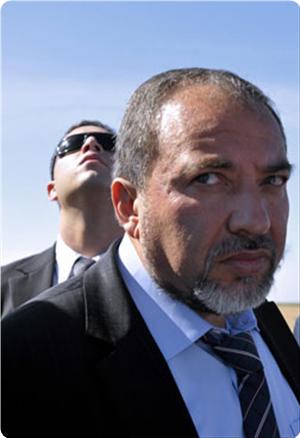 NAZARETH — Avigdor Lieberman, the former Israeli foreign minister, ruled out the possibility of reaching a political settlement with the Palestinians, affirming that the negotiations would be confined to limited security and economic agreements.
 Aletho News
