Venezuela, Palestine sign oil deal
Press TV – August 25, 2013
Venezuela and Palestine have signed agreements including deals under which Caracas is to sell oil at a ‘fair price’ to the Palestinians.
The accords were signed on Saturday following a meeting between Venezuelan Foreign Minister Elias Jaua and his Palestinian counterpart Riyad al-Maliki.
“It is an agreement of cooperation and solidarity with our oil industry… a sale of fuel at a fair price,” Jaua said.
The agreement also assures “favorable” repayment terms as well as training of Palestinians on handling and distribution of oil.
Maliki, who is on a Latin America tour, said he was “extremely satisfied” with the agreement.
On August 23, Maliki visited Ecuador, where he discussed with Minister for Foreign Affairs and Human Mobility Ricardo Patino. After the meeting, the two ministers expressed interest in opening embassies in both countries to strengthen ties.
A day earlier, Guyana’s President Donald Ramotar said after meeting the Palestinian foreign minister that his country is in the process of appointing an ambassador to Palestine and reiterated Guyana’s continued support to Palestine.
A group of Latin American and Caribbean countries, including Brazil, Argentina, Venezuela, Bolivia, Uruguay, Ecuador, Chile and Chile, recognize Palestine as an independent state.
On April 10, the Latin American nation of Guatemala became the 132nd nation in the world to formally recognize the state of Palestine.
Will Gaza have a date with ‘lean’ years in the future?
By Sufian al-Shorbeiji | Alestqlal News* | August 22, 2013
A state of anxiety and confusion has taken over the residents of Gaza as the tunnels leading to the Egyptian border have been almost entirely closed off. Humanitarian crises are beginning to emerge as it becomes increasingly difficult to move consumer goods both into and within the Gaza Strip. Many fear that Gaza will once again be under siege as a result of the tensions occurring in the Egyptian arena. The current situation differs greatly from the sense of relief and mobility that Gazans experienced last year when the blockade was gradually lifted.
Hamas has recently called on regional and international forces to make every possible effort to break the siege on Gaza that occurred after the majority of tunnels were destroyed and the Rafah border was closed off entirely.
Political and economic analyst Mohsen Abu Ramadan believes that the situation in the Gaza Strip is regressing back to the initial stages of the 2007 siege. Ramadan anticipates that this time, the consequences will be more severe in terms of the ability to move both goods and people, which are restricted by Israel’s continued siege of the Strip. Conditions will be worsened by the decreasing amounts of supplies brought in through the tunnels as the chaos in the Egyptian arena continues. He pointed out that the commercial crossing linking Israel to the Gaza strip provides a mere thirty per cent of the needs of the people; whereas, the remaining seventy per cent of goods come through the Egyptian tunnels.
In a conversation with Alesteqlal, Abu Ramadan explained that Egyptian procedures and restrictions related to the tunnels and the closure of the Rafah border have pushed Hamas to call on convoys to break the siege. The group has also asked for the creation of a waterway that would link the Gaza Strip to the world. Abu Ramadan pointed out that while the proposal is legitimate and while Gazans do deserve to have a channel that links it to the international community, it is more important to remedy the lack of connections between the West Bank and the Gaza Strip. The divisions must first be solved by forming a national government as soon as possible, so that any passage that is built would be considered part of the Palestinian Territories and not just particular to Gaza.
Large implications
Abu Ramadan stressed that the return of a severe siege on Gaza would have seriously detrimental repercussions for the residents of the Strip. The humanitarian conditions will also be negatively impacted due to the various crises resulting from the Israeli blockade and the closure of the crossings. He noted that if the situation in Egypt continues in this vein, it would have a negative impact on the social and humanitarian quality of life for Gaza’s population.
Abu Ramadan pointed out that the best way to break the siege on Gaza is to achieve solidarity among the masses, in addition to working towards achieving national reconciliation and the formation of a unified national government. The new unified government would then work towards breaking the siege that has been imposed upon Gaza for years.
All tunnels found under the border of the Gaza Strip and Egypt previously provided residents with supplies, food, fuel and other daily necessities. However operations within the tunnels have been fully stopped in the wake of security threats following the coup against President Morsi.
‘Explosion’ in the South
Political analyst Hamza Abu Shanab confirmed that Gaza is currently living under extremely difficult conditions as a result of the lack of stability in the Sinai and the direct effect this is having on the Palestinian scene. In 2008, the Egyptian leadership broke the barrier that separated Egypt from the Gaza Strip. This resulted in mass migrations of Palestinians towards the city of Al-Arish in order to buy their necessities. Abu Shanab noted that the Egyptian leadership learned from this experience and realised from a humanitarian standpoint that any siege on Gaza leads to an ‘explosion’ of people moving towards the south. For that reason, although restrictions will be likely implemented, they will not reach the severity of a siege.
In regards to the situation’s effect on communication between Gaza and Egypt, Abu Shanab said: “Regardless of how much communication increases or decreases, there will always be common interests between Egypt and the Gaza Strip. Egypt’s national security remains tied to Gaza regardless of what government is in power and for that reason communication will ultimately not change.”
“The political situation differs from the economic situation. This blockade might be directed towards the political leadership affiliated with Hamas and based on the lack of mobility in Egypt. However, in the end, Egypt will cooperate with whoever is running the Gaza Strip because it benefits the country’s strategic interests,” Abu Shanab added. He explained that the government in the Gaza Strip will attempt to revive the issue of breaking the siege in order to relieve some of the pressure on the Rafah border and on working conditions. However, it is currently too early to speak of solidarity efforts due in large part to the conditions in the surrounding areas.
Abu Shanab believes that the Israeli occupation will not tighten the siege on Gaza in the near future due to a truce between Hamas and Israel. He added that the Israeli occupation does not want the situation in Gaza to escalate and that Israel is avoiding the Gaza Strip altogether until the end of negotiations with the Palestinian Authority.
Abu Shanab also noted that Hamas’ attempts to break the siege are currently limited; however, the group can take advantage of one factor, which is to use pressure from the masses to break the siege. It helps that Hamas’ allies in the region, mainly Turkey and Qatar, currently do not have a stable relationship with Egypt. Furthermore, the security situation coupled with Hamas’ ability to control movement within its territory will force Egypt to deal with the government in Gaza.
Insistent force
According to Jamal Khudairi, the chairman of the People’s Committee against the siege, the Israeli occupation is the first force that is responsible for the severe siege imposed on the Gaza Strip over the last few years. They are also responsible for the difficulties that resulted from closing all border crossings with the exception of one, which is used at all times and under all conditions. Israel forces all travellers to travel through the Beit Hanoun crossing and prevents all goods and necessities from entering the Strip, in addition to prohibiting exports. Khudairi also pointed out that speaking about third parties diminishes Israel’s culpability in the matter.
In his conversation with Alesteqlal, Khudairi said that the door for solidarity campaigns with Gaza is open and that efforts that result from them must be put into effect in the coming months. All solidarity projects bring about legitimate results whether they come in the form of ships breaking the siege, or journalists, human rights groups, or parliamentary groups. Khudairi emphasized that all of the efforts are effective in creating a catalyst for breaking the siege. He also stressed the need to form a Palestinian, Arab, and international force that would raise more pressure for breaking the siege that has been imposed on the Gaza Strip for many years.
Khudairi expects a wide international response to the calls for solidarity based on what happened during the last siege; however, he also stressed that each group must be given the ability to determine how much they can help and what means they ought to use based on their own particular capabilities. The most important thing is that these groups call for permanently and completely removing the blockade. He stressed that the occupying forces must be collectively punished and held accountable for the siege, which is in violation of international law.
* Translated by Middle East Monitor
Related articles
- Israeli major general: “If we kill 500 in the Gaza Strip, they will calm down” (alethonews.wordpress.com)
- Hamas calls for biggest ever sea convoy to bust Gaza blockade (occupiedpalestine.wordpress.com)
Israeli officers torture detained Palestinian children
Palestine Information Center – 23/08/2013
NAZARETH — B’Tselem organization published on Thursday a report that includes testimonies from children detained in Israeli jails, on charges of throwing stones at soldiers, saying they were subjected to torture during their interrogation.
B’Tselem said that since November 2009, it has received testimonies from dozens of Palestinian residents of the Bethlehem and al-Khalil, most of them minors, saying that they were subjected to threats and violence, sometimes amounting to torture, during their interrogation at the police station at Gush Etzion.
The testimonies describe interrogations in which the minors were forced to confess to alleged offenses, mostly stone-throwing.
The report included the testimony of a minor, aged 14 from Husan in Bethlehem. He said “The interrogator made me go into a room. He grabbed my head and started banging it against the wall. Then he punched me, slapped me and kicked my legs. The pain was immense, and I felt like I couldn’t stand any longer.”
“Then he started swearing at me. He said filthy things about me and about my mother. He threatened to rape me, or perform sexual acts on me, if I didn’t confess to throwing stones,” the child added.
He said: “His threats really scared me, because he was very cruel and it was just the two of us in the room. I remembered what I’d seen on the news, when British and American soldiers raped and took photos of naked Iraqis.”
B’Tselem reported that until July 2013 its field researchers collected 64 testimonies from residents of eight communities in the southern West Bank who reported such incidents. “Fifty-six of them were minors at the time of their interrogation.”
Related article
- Five-year-old Palestinian boy detained in Hebron (imemc.org)
Join ISM for the 2013 Olive Harvest Campaign
International Solidarity Movement | August 22, 2013
Occupied West Bank – At a time of regular settler violence in the West Bank, the International Solidarity Movement (ISM) is issuing an urgent call for volunteers to join us for the 2013 Olive Harvest Campaign at the invitation of Palestinian communities.
The olive tree is a national symbol for Palestinians. As thousands of olive trees have been bulldozed, uprooted, burned and destroyed by Israeli settlers and the military – according to the UN settlers alone destroyed or damaged over 7,500 trees just in 2012 – harvesting has become more than a source of livelihood; it has become a form of resistance.
The olive harvest is an annual affirmation of Palestinians’ historical, spiritual, and economic connection to their land, and a rejection of Israeli efforts to seize it. Despite attempts by Israeli settlers and soldiers to prevent them from accessing their land, Palestinian communities have remained steadfast in refusing to give up their olive harvest.
ISM volunteers join Palestinian farming communities each year to harvest olives, in areas where Palestinians face settler and military violence when working their land. Your presence can make a big difference, with Palestinian communities stating that the presence of international volunteers reduces the risk of extreme violence from Israeli settlers and the Israeli army.
We support Palestinians’ assertion of their right to earn their livelihoods and be present on their lands. International solidarity activists engage in non-violent intervention and documentation, practical support which enables many families to pick their olives.
The campaign will begin mid October and will last around 5-7 weeks. We request a minimum 2 week commitment from volunteers but stress that long-termers are needed as well. We ask that volunteers start arriving in the first week of October, so that we will be prepared when the harvest begins.
Training
The ISM will be holding mandatory two day training sessions which will run weekly on Wednesdays and Thursdays. Please see the join ISM page or contact palreports@gmail.com for further information.
In addition to the Olive Harvest Campaign, volunteers can also participate in regular ISM activities in support of the Palestinian popular struggle.
Join us in our solidarity with the Palestinian resistance at this crucial time of year!
In Solidarity,
ISM Palestine
Related article
To be a Palestinian, especially in Gaza

By Eva Bartlett | In Gaza | August 21, 2013
this misery inflicted on Palestinians, for years, for decades, gets continually worse.
aside from being essentially locked-down by the occupying Zionist regime since at least 2006 (closures began way back in the 90s), leaving the vast majority of Gaza’s Palestinians unable to freely travel from their tiny, overpopulated, suffocating Strip (not all is bad about the lovely Gaza Strip, but it is extremely difficult and impossible for the majority of the 1.7 million living there), every facet of life in Gaza is either in ruins or devolving towards ruin.
for years Gaza’s fresh water has been getting more and more contaminated, to the point where 95% of their already very limited fresh water is now not drinkable by WHO standards. solution? there is none, and the water authority in Gaza estimates that by 2016, that’s it. Palestinians in Gaza can hardly just build reverse-osmosis machines–they can’t even import building materials to re-build Israeli-bombed homes, buildings, schools…the rainy season is one or two months at best, and Israeli bombings and bulldozers have destroyed the majority of wells and cisterns in border regions of Gaza, meaning families have no ability to conserve rain water. Israeli wells flanking Gaza’s borders cut off the natural flow of water from east to west, depriving Gaza a means to replenish it’s depleting aquifer. so people buy drinking water from Israel, how benevolent. and the vast majority who are too impoverished (rendered poor by the occupation’s policies **check this one out on Israel’s starvation policy!) drink the contaminated water, consuming alarming levels of nitrates and chlorides, leading to obvious health risks.
there’s the same old nasty habit of Israeli soldiers gunning down or shelling Palestinian farmers and workers anywhere within 2 km of the border, rendering at least 35% of Gaza’s agricultural land off-limits. damn fine land too, rich, formerly host to endless olive, fruit and nut trees now mostly vacant, razed land, by the colonizers to keep Palestinians in misery, oh yes, and for “security” reasons, of course.
and the same old dirty game of Israeli soldiers gunning down or shelling Palestinian fishers anywhere up to just one mile off Gaza’s coast….when fishers have under Israeli-signed accords the right to go 20 nautical miles off Gaza’s coast. the “three mile limit” imposed by the Zionists cuts Palestinian fishers off from 85% of their waters. oh yes, and the Israeli navy loves to abduct fishers, interrogate them on everything but actual fishing, and steal or destroy their boats, nets, radars, lives…what kind of fish does one catch a mile or two off the coast anyway? not much. and the little fish they do catch are the stock fish–literally little fish– and now greatly contaminated.
why the contamination? same reason the aquifer is polluted: up to 80 million litres of partially or not all all treated sewage pumped into the sea every day, because Palestinians in Gaza don’t have the means to treat and recycle that sewage. why? because although for years they have wanted to expand on sewage containment pools and improve sewage plants and lines, the occupying forces do not allow the building materials needed into the Strip, and greatly restrict the entrance of chemicals needed in treating the sewage, as well as fuel needed to run the plants when the electricity cuts (as it does daily, from 8 to 16 hours depending on what stage of crisis Gaza is being rendered into). bombing water and sewage facilities doesn’t help much either:
“over 30 km of water networks were damaged or destroyed by the Israeli military in addition to 11 wells operated by the water authorities in Gaza. The UN Fact Finding Mission on the Gaza conflict (the Goldstone report) deemed this destruction “deliberate and systematic”; most of the infrastructure is yet to be repaired for lack of access to spare parts.” [lots of info here]
what else is rosy about life in Gaza? the Israeli warplane fly-overs, the drones, the daily power outages (would that they could completely restore their sole power plant, bombed by the Israelis in 2006 and import sufficient fuel to run the maimed plant as best it could be run), the fuel and cooking gas shortages, the ban on exporting, the ban on travel (oh yes, some privileged can travel, those with connections, some of the truly ill–but not all!–can leave for treatment in occupied Palestine or Egypt), political in-fighting (engineered by who in the end? well, who benefits from the rift between the big 2 parties?), and the psychological torture for the majority in Gaza that is constantly living on the edge: when will the Zios bomb next; when will the crossing into Egypt (Palestinians sole option, realistically) open and remain open; when will we be allowed to export our produce, furniture, clothing and have a functioning economy; when will we not only have the right to travel for study (of course this applies to Palestinians in the rest of occupied Palestine), medical treatment or just for the hell of it like the rest of humanity; when will the world stop screwing us over; when will the sham of “peace talks” end; when will our imprisoned loved ones be released from Zionist jails; and when will it become actually unacceptable that Israeli politicians and military brass call for our execution, call for our expulsion, for the destruction of our infrastructure and means of living (come on Ban, can’t you at least utter your pathetic “I strongly condemn” against these racist death-threats??)?
oh, a final note: even those traveling to Gaza in solidarity with Palestinians are subject to some of the wrath of Zionist-supporting regimes. A number of internationals, including a Canadian doctor and a Canadian film-maker, are being held under ridiculous pretexts by the coup-regime in Egypt, with worrying little contact with consular officials (see here and here for updates and ways to support these men).
Related articles
- Israeli major general: “If we kill 500 in the Gaza Strip, they will calm down” (alethonews.wordpress.com)
- Two Palestinians Injured By Army Fire In Northern Gaza (imemc.org)
- Sailing From Gaza to Break the Blockade (alethonews.wordpress.com)
- Palestinian women activists arrested last week remain imprisoned (alethonews.wordpress.com)
Palestinian women activists arrested last week remain imprisoned
International Solidarity Movement | August 21, 2013
Nablus, Occupied Palestine – At 10pm on August 15th Myassar Atyani, Linan Abu Gholmeh and Leena Jawabreh of Nablus district were arrested by the Israeli police with their friend Waroud Qasem in the 1948 occupied areas of Palestine (‘48), what is now referred to as Israel. The three friends who are all political activists and former political prisoners had travelled to ‘48 to visit Waroud who lives in Tyre and has Israeli citizenship.

Leena Jawabreh, Linan Abu Ghoulmeh, Woroud Qasem and Myassar Atyani
They were traveling together in Waroud’s car when they were stopped by the Israeli police and found to be without travel permits; Palestinians living in the West Bank require permits issued by the Israeli authorities to travel outside of the West Bank, including to the Palestinian capital Jerusalem and the rest of ’48. These permits are notoriously difficult to obtain, especially for activists. The four women were subsequently arrested and transported to Hasharon prison. Myassar, Linan and Leena were detained at the prison until their appearance at Salem military court on the 19th of August.
Waroud, also a former political prisoner from 2006 to 2012 was released from Hasharon prsison and placed under full house arrest with her driving license confiscated. She has another court hearing pending. The other three women are now being held in Salem prison awaiting a further court hearing. Leena on the 22nd of August and Myassar and Linan on the 25th of August.
Their families attended their court hearing on the 19th but thus far have been prevented from speaking with them directly by soldiers in the military court. Therefore they have only heard word of their relatives through their lawyer. Family members said that Linan told the lawyer to “Have me sentenced to what they want but don’t let them put me under administrative detention”.
Linan was arrested after her husband Amjad Mlitat was martyred by the Israeli army in 2004, and held until 2009 when she was released as part of a prisoner exchange; she was then re-arrested in July 2010 and placed under administrative detention, until the October 2011 prisoner exchange. “Administrative detention is a procedure that allows the Israeli military to hold prisoners indefinitely on secret information without charging them or allowing them to stand trial.” Administrative detention is a leftover from the British Mandate period of Palestine’s occupied past and has been exploited by the Israeli authorities to ensure that anybody resisting their occupation of Palestine can be imprisoned without justification; this violates the internationally protected right to a fair trial and means that prisoners can be held indefinitely, as administrative detention orders can be continually renewed without evidence. Human rights organisation B’tselem point out that with their regular use of administrative detention Israel violates international law, which “…stipulates that it may be exercised only in very exceptional cases – and then only as a last possible resort, when there are no other means available to prevent the danger.”
Myassar was most recently arrested and interrogated in 2009 and detained in prison for a month – she was also arrested multiple times in the 80’s and 90’s. Leena spent four years in prison from 2004 to 2008. All three women are prominent activists especially for prisoners rights and have been involved in prisoner hunger strikes.
Palestinians living in the West Bank are rarely granted permits to travel to ’48, nor to Gaza – in practical terms this means that they cannot reach the coast, the capital Jerusalem or the many remaining Palestinian cities in what is now referred to as Israel. The Apartheid Wall, illegally built, separating the West Bank from ’48, means that families and friends are divided. Many who want to visit the land lost by Palestinians who were expelled during the Nakba, or ‘catastrophe’, in 1948 are regularly denied and thus sometimes choose to travel without permission from the occupying Israeli authorities. The denial of permits is especially strict against those who are political activists and males aged 12- 35 – for these groups it is almost impossible to gain permission to travel freely in historic Palestine.
Ex-political prisoners, human rights defenders and those resisting the occupation are regularly targeted by the Israeli authorities and military for bureaucratic denial of permits, harassment, attacks and arrests.
You can take action demanding the immediate release of Linan, Leena and Myassar here.
Erasing Palestine From the Map
By ROBERT ROSS | August 20, 2013
A foreign affairs blogger for The Washington Post recently posted “40 Maps that explain the world.” Some of the maps are important (“Economic inequality around the world”), some are interesting (“Meet the world’s 26 remaining monarchies”), but others grossly distort the reality they purportedly represent. Chief among this latter category is “How far Hamas’s rockets can reach into Israel” .
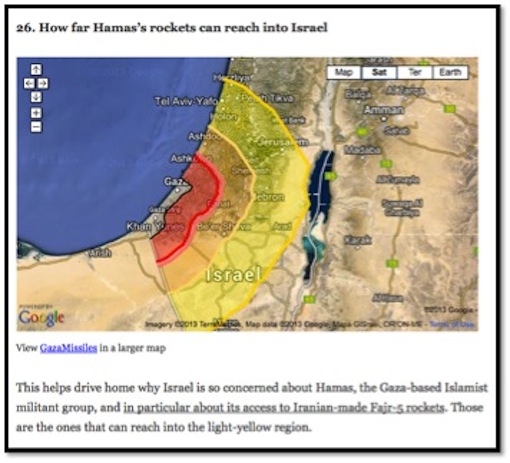
All about Hamas’s rockets
There are two principal problems with this map. First, the map attempts to “explain” the Israeli-Palestinian conflict by pointing exclusively to the capacity of Hamas’s rockets to reach ever-extensive points within Israel. Four color-coded, concentric semi-circles spread out from the Gaza Strip, each showing the distance different rockets could travel, the furthest making it all the way to the Dead Sea. Max Fisher, the Post’s chief foreign affairs blogger, writes in a caption to the map, “This helps drive home why Israel is so concerned about Hamas, the Gaza-based Islamist group, and in particular about its access to Iranian-made Fajr-5 rockets. Those are the ones that can reach into the light-yellow region.”
Erasing Palestine from the Map
The second major problem with this map is that Palestine—both historic and contemporary—is erased from it. A white dotted line traces the border between the West Bank and Israel but the line is barely visible beneath the yellow-shaded ring. Moreover, “West Bank” (not “occupied West Bank,” or “occupied Palestinian territory,” or “Palestinian West Bank” or “Palestine,” mind you) appears in font so small that it seems to designate some tiny city northeast of Jerusalem, not the Palestinian territory occupied by Israel since 1967. And while Israeli municipalities such as Arad, Ashdod, Holan, and Hrzliya, among others, are included, nowhere can one find the Palestinian cities of Ramallah, Nablus, Bethlehem, or Jericho, much less al-Bira, Jenin, or Qalqilia. Only Jerusalem and Hebron, West Bank cities that are significant to both Israelis and Palestinians, are featured. Even Jaffa, the coastal Palestinian city north of Tel Aviv, has been replaced by the Israeli-Hebrew version, “Yafo.”
So what does this map tell us about the Israel-Palestine conflict? It’s not apparent what or where Palestine is, or that it even exists, but the map suggests that an ever-menacing, Iranian-supported Islamist group threatens more than half of Israel. And therefore, Israel is “concerned.” Presumably, the reader might conclude, that “concern” forces Israel to periodically defend itself, launching its own counter-attacks into the Gaza Strip. The West Bank, meanwhile, appears for all intents and purposes, part of Israel and in no way related to the Gaza Strip or the cartographically cleansed “Palestine.” So Israel’s geography is simplified into a need to defend itself and Palestine is wiped off the map.
Concealing more than it reveals
The Washington Post’s map (which is actually just a simple google map lifted from someone named “Gene,” whose cartographic resume also includes google maps of “Richmond Bars/Restaurants” and “Jane Austin’s England”) doesn’t reveal how and to what extent Israel has “defended” itself against the perceived threat of Hamas’s rockets. The threat is all that is deemed important; a map showing where and with what deadly ramifications Israel’s responses have taken place, such as this one produced by the Alliance for Justice in the Middle East at Harvard University and the MIT Center for Future Civic Media, didn’t make the Post’s list.
Any attempt to cartographically represent the context within which Hamas’s rockets and Israel’s “response” may have been launched, such as this UN map, is also entirely missing from the Post’s compilation.
In addition to nearly erasing the Palestinian West Bank altogether, the Post’s map reveals nothing about the multiple ways in which the territory is occupied by Israel. Maps of Israeli-only roads, checkpoints, the separation barrier, settlements, and the ethnically-based divisions of the West Bank (such as these from Btselem, the Israeli Committee Against Home Demolitions, and The Applied Institute for Research – Jerusalem) don’t, according to the Washington Post, help explain this part of the world as much as Gene’s map of Hamas’s rocket-firing potential.
The Washington Post’s map of choice sheds no light on the Palestinian villages within Israel that were ethnically cleansed and destroyed in 1948-1949. References to these maps from the Palestinian Academic Society for the Study of International Affairs (PASSIA) and Visualizing Palestine could have at least begun to cartographically resurrect these erased landscapes.
The Dangers of Distorted Cartography
In sum, The Washington Post’s map explains very little about this part of the world. But what the map does reveal is The Washington Post’s myopic view of Israel and Palestine. The ongoing colonization of Palestine by Israel is reduced and reversed, in this map’s representation, to a normal country that must fend off existential threats from its shadowy neighbors. The effects of this distorted cartography are dangerous—erasing the geographies of Palestine is yet another step in the ongoing occupation and ethnic cleansing of Palestine.
Robert Ross is an Assistant Professor of Global Cultural Studies at Point Park University, in Pittsburgh, Pennsylvania. His research and teaching focus upon the political-economic geographies of Israel, Palestine, Lebanon and the United States. He is also a member of the Pittsburgh Palestine Solidarity Committee and the Israel-Palestine Mission Network of the Presbyterian Church (USA).
Sailing From Gaza to Break the Blockade
By ALESSANDRA BAJEC | August 19, 2013
 A new mission vows to challenge the blockade of Gaza by sea following Freedom Flotilla efforts since 2010, and Free Gaza missions preceding Cast-Lead in 2008. Not a Gaza-bound aid convoy this time.
With a crew of Palestinians and international activists on board, Gaza’s Ark will sail from the port of Gaza, carrying Palestinian products to buyers around the world, to defy Israel’s illegal and inhuman blockade.
Gaza’s Ark is rebuilding a cargo vessel that will attempt to open the sea to Palestinian exports to show to the outside world that Palestine is a productive land, while drawing public attention on the 7-year blockade.
Because nearly all previous attempts to reach Gaza were blocked by the Israeli navy, and given Israel-imposed three mile limit from the Gazan coast, campaigners are well aware that Israeli forces will hardly let any boat leave Gaza port.
David Heap, French-language and linguistics associate professor at the University of Western Ontario, is a spokesperson for Gaza’s Ark. He talked about the new solidarity initiative.
How did the idea of Gaza’s Ark come about?
D.H: After the last flotilla sailing I was involved in with other members, we realised we obviously need to carry on our work, trying to think of ways to continue direct action. Not just talking about the siege, but acting directly against the siege to change the premises of it.
Gaza’s Ark is the continuation of the Freedom Flotilla movement, but it’s different in significant ways due to the direction, the non-humanitarian connotation, and because fundraising efforts are being spent primarily in Gaza.
Why is this initiative important?
DH: Freedom of movement is a fundamental human rights issue that has been systematically denied to all Palestinians, in particular most severely to Palestinians of Gaza. I feel it’s an obligation to try, even in a small, symbolic way, to demand some kind of hope for these people, especially the young ones. When I visited Gaza last autumn, I was struck by the youth and their thirst for contact with the outside world.
What makes Gaza’s Ark different from previous attempts to break the siege?
D.H: Gaza’s Ark has a broader focus. We don’t just talk about the sea blockade but the whole blockade imposed on Palestine. What we’re addressing is freedom of movement –both commercial goods and people- national sovereignty and territorial integrity. We will have goods on board from all over Palestine, as Palestinians themselves have told us they should be exporting goods from not only Gaza but also the West Bank and Jerusalem.
Could you discuss how trade rather than aid may help Gaza more effectively?
D.H: Working with the Palestinian civil society in Gaza, what we at Freedom Flotilla Coalition hear is they’re sick of being recipients of international humanitarian aid. Palestinians tell us they don’t want more humanitarian aid, they want to live on their own economy as they’re very capable of doing. They claim the same freedom of movement rights that everybody enjoys.
Gaza, in particular, had a very prosperous economy in the past. But the infrastructure was systematically destroyed by Israel, and the only factories that are surviving can’t function due to the Israeli blockade.
What potential do you think the project has in comparison with the flotillas that have so far tried to sail to Gaza?
DH: If we take the Flotilla Movement as a whole, it has almost had as many successful arrivals to Gaza as attacks. This is something that goes easily forgotten in the mainstream media.
The choice of allowing us to sail safely to other destinations in the Mediterranean is something the occupier decides, not us. We can only control what we do. When the Israeli navy assaulted prior flotillas, the rhetoric used was that the boats posed a threat to Israel’s security. Which is absolutely false, none of the inbound voyages created a security risk for anyone, nobody ever found dangerous items on the flotillas that could possibly threaten the security of Israel.
Given that Gaza’s Ark is outbound, it will be interesting to see what the response from the Israeli military will be. They won’t be able to use the security argument since, even if we carried anything dangerous –which is to exclude- Israel shouldn’t care about a boat sailing out. However, I’m sure they will come up with a pretext, but It will be even harder to defend in international public opinion.
How open are international consumers to Palestinian products from Gaza?
D.H: We’ve been conditioned to think of Palestinians, Gazans in particular, as being dependant on aid. We don’t think of them as capable of having a productive economy. Part of our work is to educate the world that Palestinians can and do produce goods, and they have goods that they could export. Most people don’t know what products are available in Gaza, for example.
There’s a small selection of products that can be viewed on our website, including dugga, za’atar, dates, olive oil to name a few. Our campaign partners based in a number of countries are putting together group purchases of products from interested businesses, individuals and community groups to have their goods exported onboard Gaza’s Ark. Whichever goods potential buyers are more appealed to, whether agricultural or handicraft products, we will match them with producer organizations in Gaza.
Whatever happens to the boat, there will be a connection established between purchaser and producer in the end. Even in the event the goods don’t reach the port of destination, commercial partners in other countries will be connected to Palestinian produce organizations, they will know they bought goods and who sent them. That puts a human face to Palestinians as people who produce, and has the longer term function of building relationships which will ultimately help challenge the power of the occupier as well as the complicity of our governments in the West.
How doable is it for Palestinian producers of Gaza to secure trade deals with purchasers when there’s a real risk that goods will be confiscated by the Israeli military?
D.H: Although there’s commercial deal, it’s a special kind of commercial deal. We work with civil society partners, businesses and organizations. Purchasers in Europe, North America, Australia or South Africa have to be prepared to secure full payment before the boat sails. Palestinian producers are assured they will be paid the full purchase price of the goods before anything travels.
The risk is borne outside of Gaza by supporters of Palestinian businesses who believe that Palestinians should have their own economy. Then if something happens during the sailing, the risk is being shared by many people keeping in mind the human and commercial interest involved in this mission.
Only a small number of people can board a small boat in the east Mediterranean. But hundreds or thousands of people from different countries can potentially get on board with the campaign by buying parts of the cargo.
You intend to raise awareness and mobilize to action. How do you hope Gaza’s Ark will help put pressure on national governments and international organizations?
DH: There are bilateral trade agreements between Israel and the EU stipulating that there must not be obstacles to trading with occupied Palestinian territories. When we sail, and European buyers have purchased goods stocked on Gaza’s Ark, if the Israeli navy interferes with that sailing that’s an obstacle to trade. European commercial businesses will then have a very strong case to go to their governments and claim that, despite that they have commercial relations -with documentation proving the purchase of those goods- their imports have been confiscated.
We usually address human rights parliamentary commissions in Europe, now we may also appeal to commerce commissions. People have so far protested about human rights in reference to flotillas, but this initiative opens up another avenue, the commercial one, to bring up the blockade issue. Why is there free trade with Israel while there isn’t free trade for Palestinians? Why can’t Palestinians use their only port in Gaza?
Israel has used violence to stop other boats from leaving or entering the port of Gaza. What do you expect Gaza’s Ark will achieve?
DH: Again, the choice to use violence lies with the occupier, it’s not our choice. Everybody that sails with us is committed to non-violence, and we are very transparent about it. Whoever goes will make the choice to sail knowing the implications and possible consequences. Unfortunately we are dealing with a state that attacks unarmed civilians with impunity, as our governments in the West don’t hold it accountable.
When I went on the Gaza relief boat earlier in 2011, I was very aware of the risks. I and two dozen other activists were kidnapped, beaten and illegally arrested after Israeli naval forces seized the Canadian vessel we were on. The Canadian government did nothing. Canadians don’t overall support the blockade of Gaza, this government is in discordance with Canadian public opinion. So how can we make pressure? By putting Canadians and other internationals on the frontline. When I embark on a boat to break the blockade, I don’t just sail against the occupier, I sail against my own government.
What will be the next step if Gaza’s Ark will not reach its destination?
D.H: There’s always an after campaign. People are still following up actions from past flotilla sailings with regards to Gaza relief boats that have been seized in the last few years. With Gaza’s Ark, there will be more people involved because there are also purchasers on board. So we’ll be also bringing commercial actions against whoever happens to steal goods on the ship. We will also continue to stand in solidarity with the fishing fleet of Gaza, which is daily subject to violent constraints from the Israeli navy.
When do you anticipate Gaza’s Ark will be ready to sail?
D.H: We’re set to depart sometime this year hopefully. It depends on a lot of factors that we don’t control. The process of rebuilding the vessel has been difficult, especially this past month, raising funds internationally has not gone as fast as we would like.
But the date of sailing is for us less important than the lead up to it. The lesson we’ve learned from 2012 flotilla is a long campaign is an advantage because it allows you to develop more support in more countries. As long as we’re developing support for Palestinians of Gaza, spending most of the donated money in Gaza, we’re achieving the goal of affirming our support for a Palestinian economy. So if we don’t sail in 2013, we will sail after. The important thing is we keep opposing the blockade.
Alessandra Bajec lived in Palestine between June 2010 and May 2011 starting to work as a freelance journalist. Her articles have appeared in various Palestinian newswires, the European Journalism Centre’s magazine, The Majalla, among others.
Politicians lie
By Mazin Qumsiyeh | Popular Resistance | August 18, 2013
There is no way to say this truth nicely: Politicians lie. That includes Japanese, American, Egyptian, Israeli, and Palestinian politicians! Is there something more common sense than that? Yet, so many citizens around the world believe their own politicians or wistfully acknowledge lies but think it is part of the job needed to run things. They believe even when politicians contradict themselves blatantly. This phenomenon is rather remarkable. It is a dissonance and disconnect from reality that many seem oblivious to. It is very dangerous because it can lead to accepting rationales for going to war. These can be deadly wars that lead to millions of lives lost as happened in what was called World War 1 and WW2. Even when incredible and declassified evidence abound, politicians continue to lie and old mythologies refuse to die. Here are just a few of the countless lies told to us over the past few decades:
-Lies about the need to drop the bombs on Hiroshima and Nagazaki (not to end WWII but to start WWIII or the cold war)
-Lies about why Britain issued the Balfour declaration and France the Jules Cambon declaration in support of Zionism
-Lies about why Israel was created in Palestine
-Lies about why Henry Wallace was replaced by Harry Truman as a vice president in the Democratic convention
-Lies about why Truman supported the creation of Israel on top of Palestine
-Lies about the ethnic cleansing of 530 Palestinian villages and towns
-Lies about September 11, 2001
-Lies about the reasons for the war on Iraq
-Lies about safety of nuclear power plants
-Lies about violations of US citizen rights by their own government
-Lies about why US/Israel want to subdue Iran now
-Lies about the US role in propping-up dictatorships
-Lies about western governments and human rights
-Lies about Vietnam, Cambodia, and much more
With a little effort, any person could easily find 1,001 lies and the sometimes painful truth about them. With very minor effort, I compiled 65 lies/myths told to us about Zionism http://www.qumsiyeh.org/liesandtruths/ There are many more.
But even when they have nothing to do with going to war, lies can be very dangerous. I am not talking about naiveté or stupidity because that is not what the politicians have. Take for example the Palestinian authority “leadership” represented by Mr. Mahmoud Abbas. Is it naiveté that would make him go into fruitless negotiations for 20 years with Israeli politicians then suspend negotiations telling his people that we will not go back to negotiations until Israel stops colonial settlement building and then tell his people that he went back to negotiations anyway while Israel is building. This flip-flop is the typical politician: no principles and no honesty. Yet, again many continue to clap for him. I do not say vote for him since his term is expired a long time ago and no elections are going to happen.
Even when confronted with paper evidence of political lies, many people ignore the mounting evidence. In our case, there were the lies about support for right of return told to our people while Abu Mazen tells Israeli TV that 1948 areas are Israel and he has no right to go back there (maybe should be able to go “visit”). There were the lies about being good negotiators with Israel. Saeb Erekat even wrote two books about negotiations full of such lies. Those lies were clearly debunked by the leaking of the Palestine papers which show that even a middle school student could do a better job at these negotiations than this groveling charade that these Palestinian negotiators are going through. The fate of 12 million Palestinians and the legacy of 80,000 martyrs are left to lying politicians: Israeli, Palestinian and American.
But we cannot blame politicians for our ill societies. It is us the people who let them do what they do by not challenging them.
Israeli soldiers violently attack and arrest peaceful protesters in Beit Ummar
International Solidarity Movement | August 17, 2013
Beit Ummar, Occupied Palestine – Yesterday, the 16th August, four people were violently arrested at a peaceful demonstration taking place near the village of Al-Masara, on the outskirts of Hebron(Al Khalil). Around sixty demonstrators calling for the dismantlement of illegal Israeli settlements upon Palestinian land were attacked and the protest was disbanded by Israeli soldiers within minutes.
At around 11.30am the procession began, with many people waving flags and calling chants for freedom. An Israeli military vehicle drove by, immediately turned around and blocked the road. Within two minutes two more military jeeps and one police car had joined the blockade. Heavily armed soldiers stormed the procession, splitting the group into two and beating protesters to the ground. The soldiers pushed protesters back and formed a wall of plastic shields. Four men including two Palestinian and two international protesters were arrested.
One of the arrested men, Abed, was holding a camera and documenting the demonstration when he was violently grabbed and pushed by an Israel soldier. Abed shouted at the soldier to let go of his arm and tried to pull away from the soldiers grasp. The soldier responded by strangling and arresting him. Another protester, Muad Al-lahham, was arrested while calmly waving a Palestinian flag.
Local Palestinians are incensed by the continuous settlement expansion and subsequent annexation of their land that deliberately prevents farmers from harvesting their crops. This disabling act of aggression has led to local Palestinian families being financially crippled. As an act of resistance, the local people regularly hold peaceful demonstrations that are consistently met with force from the Israeli occupation. These acts, usually held on Friday – Juma’a – often use symbolism to convey their message. Two weeks ago the locals erected a tent on occupied Palestinian land, as a mark of resistance to the Israeli settlements.
Palestinians here are used to being arrested at their demonstrations. Yesterday, Mahmoud from Al-Masara had his permit taken from him, which is indicative of imminent arrest. For Mahmoud, this is routine and he calmly smoked a cigarette while soldiers decided his fate. Mahmoud was allowed to maintain his freedom, but he never knows when an arrest may come. Asked why he continues to protest he said: “Our goal is to live in peace and to have our freedom like anybody else in the world. Israelis have occupied Palestine, but they can never occupy our minds.”
The majority of protesters came from the villages of Beit Ummar and Al-Masara, which are both affected by Highway 60, built by Israeli authorities. The highway cuts through the villages, dividing people from their farm lands. As well as this, the inhabitants of the Israeli settlement of Kami Tzur that is close to the villages use intimidation and force in attempt to prevent the farmers harvesting their crops. The force used by the Israeli army at yesterday’s protest demonstrates the intolerance toward peaceful protesters who make a stand against this injustice.
Related articles
- PCHR Weekly Report: 1 killed, 2 wounded, 60 abducted by Israeli troops in last two weeks (imemc.org)
- AL MASARA: Israel suppresses weekly demonstration, arrests journalist 17Aug13 | Australians for Palestine (ramyabdeljabbar.wordpress.com)
- Palestinian youth abducted in Beit Ummar by Israeli occupation forces (ramyabdeljabbar.wordpress.com)
ISM statement: Hoax video designed to harm the Palestinian popular struggle
International Solidarity Movement | August 15, 2013
A video has been put online on a website claiming to be a human right organization with a woman impersonating an ISM volunteer. In the video a woman who claims to have volunteered with the ISM in Palestine says that she was sexually harassed by a prominent Palestinian activist. The ISM want to make clear that this video is a hoax: the woman is not an ISM volunteer and the Facebook and Twitter pages are not of any human rights organization.
We believe this video is designed to harm the Palestinian popular struggle and the international solidarity movement in Palestine.
It is not the first time a video in which someone claims to be an International activist has been produced in order to attack the popular struggle and the solidarity movement. For example, before the freedom flotilla left for Gaza, a hoax video was released in which an Israeli actor posed as a solidarity activist and was eventually exposed.
When cases of sexual harassment or assault occur, as they do everywhere in the world, ISM and our Palestinian partners take reports very seriously and take action to protect people from sexual harassment and violence.
In solidarity,
International Solidarity Movement
Featured Video

Why Hamas Really Attacked Israel on Oct. 7
or go to
Aletho News Archives – Video-Images
From the Archives
Confronting the Threat of Ethnic Bioweapons
By Tony Cartalucci – New Eastern Outlook – 29.11.2017
The United States Air Force’s 59th Medical Wing’s molecular biology branch recently was revealed to have been collecting specifically Russian RNA and synovial (connective) tissue samples, prompting fears in Russia of a possible US directed ethnic-specific bioweapons program. … continue
Blog Roll
 Aletho News
- Meet the US generals and admirals advancing Israeli policy
- Israel’s Straw Widow Protocol: The Kill Zones Where Civilians Were Labelled ‘Terrorists’
- Leading Israeli Think Tank Publishes Psychotic Israeli ‘National Security’ Doctrine
- Are the United States and Israel in Decline-and-Fall Mode?
- Why Hamas Really Attacked Israel on Oct. 7
- Declassified UK exposes British man who fought for ‘Israel’ in Gaza
- West’s death cult in a theater near you
- How the Yandex ‘Russian bots’ lie fell apart
- Burnham’s ‘Russia did Brexit’ ruse crumbles
- Estonia making movies and games to encourage war against Russia
- If Americans Knew
- Gaza’s “ceasefire” death toll passes 1,500 – Daily Update
- Activists Abused By Israel Return to New Freedom Flotilla Mission
- 60 Minutes won’t tell the full truth about Israeli settler violence
- Nearly 50,000 women, girls killed or severely injured in Gaza since October 2023: UN Women
- ADL is working with AI companies to suppress alleged ‘antisemitism’
- Israeli occupation forces using social media surveillance unit to target hundreds of Palestinians in the West Bank
- Israel’s New – and Terrifying – Security Doctrine
- Israeli Attacks Kill Five in Gaza, Including a four-year-old and a woman
- Air Force Major Who Called for Trump’s Impeachment Held in Solitary Confinement
- It’s a Genocide, I’m Into It’: Seinfeld Mocks Protest over Palestinian Children Killed
- No Tricks Zone
- New Study Suggests Large Regions Of The Pacific Ocean Have Been Cooling For The Last 80 Years
- Germany’s Green Energy Debacle: High Energy Costs Force Kahla Porzellan to Close After 182 Years!
- New Study: 50 Years Of The Most Aggressive ‘Net Zero’ Policies Can Only Affect The Global Climate By 0.03°C
- US September “Heat” Was No Record…Many Records Set Decades Ago
- Latest European Green Energy Debacle; Portugal’s Largest Flagship Solar Park Insolvent!
- Green Energy Debacle: German Expert Professor Fritz Vahrenholt Warns Of Severe Economic And Social Consequences
- Two More Paleo Reconstructions Affirm Meters-Higher Sea Levels Across Ireland, Brazil 7000-6000 Years Ago
- New Study: Earth And Venus Surface Warmth Largely Explained By Convection And Lapse Rate, Not CO2 Or Radiation
- 2025 Nature Paper Claiming Worsening Global Drought Gets RETRACTED …Heavily Flawed
- New Study: ‘Global Drought Shows No Detectable Recent Acceleration Under Climate Warming’


