Tragic Stories From Rafah: Students Mourn Their Future
By Fatima Abdallah | Al-Akhbar | September 20, 2013
At the Rafah border crossing with Egypt – Gaza’s only bridge to the outside world – a young Palestinian man cries profusely. He scrapes a passenger bus with his fingernails as it departs toward Egypt. He wants more than anything to stop the bus and get on it.
Mohammed al-Astal’s situation is shared by dozens of Palestinian students from Gaza studying abroad who wanted to spend their holidays with their families in the Gaza Strip. Unable to travel – Egyptian authorities have closed the border for a week now, citing security reasons – they have now missed the start of the academic year. If their absence continues, they will not be able to carry on with their studies.
Astal, a medical student at al-Mansoura University in Egypt, told Al-Akhbar: “For two weeks, I’ve been coming to the Rafah crossing every day at six in the morning, hoping I would be allowed to travel so I can go back to school, but to no avail.”
More than 2,000 people in Gaza are dreaming of traveling to Egypt today or tomorrow now that the Egyptian authorities have opened the crossing for two days. Egyptian authorities announced on Monday, September 16, the opening of the Rafah crossing on Wednesday and Thursday from 10 am to 2 pm at the request of the Palestinian Authority President Mahmoud Abbas.
Frustrated, the only thing those waiting can do is obstruct the buses full of travelers. Hamas security forces clash with individuals, pushing them back with batons until three buses manage to leave Rafah.
“All students have to come to the Rafah crossing again tomorrow morning. That is what the Palestinian embassy said in a piece of news posted yesterday,” said Hassan, a law student in Egypt. “Missing an entire month of the new semester means losing the whole semester.”
Hassan expressed his right to be on the list of passengers, along with medical patients and other urgent cases, especially after the Palestinian ambassador in Egypt, Barakat al-Farra, issued a statement on Tuesday requested that students come to Rafah after coordination with the embassy.
Maher Abu Sabha, director general of crossings at Egypt’s Interior Ministry, said: “Students stuck in Gaza do have a priority to travel, but there are also humanitarian cases of patients and people with residence permits that might expire at any moment. [These people] need to leave Gaza or else they will lose their lives outside the Strip.”
According to Abu Sabha, there are more than 4,500 Gazans registered on urgent travel lists. He pointed out that all of them can be considered humanitarian cases. They are patients, people with residence permits, and students.
Mufid al-Mukhalalati, health minister in the Hamas government, said at a press conference, “Closing the crossing has prevented more than a thousand patients from reaching Egyptian hospitals and receiving treatment and has also prevented foreign medical delegates from reaching the Gaza Strip.”
Egyptian authorities closed the crossing last Wednesday, September 11, after an armed attack was launched against the Egyptian military intelligence building in Rafah. The attack killed six Egyptian soldiers and injured 17 others.
Palestinians in Gaza continue to face increased difficulties at the Rafah crossing since the Egyptian army deposed former Egyptian president Mohamed Mursi on July 3. In the meantime, Egyptian authorities reduced working hours at the crossing to four hours daily. While thousands waited at the Rafah gate, only 250 were able to leave the Gaza Strip.
Israeli soldiers rough up EU diplomat, confiscate aid supplies for Palestinians
Al-Akhbar | September 20, 2013
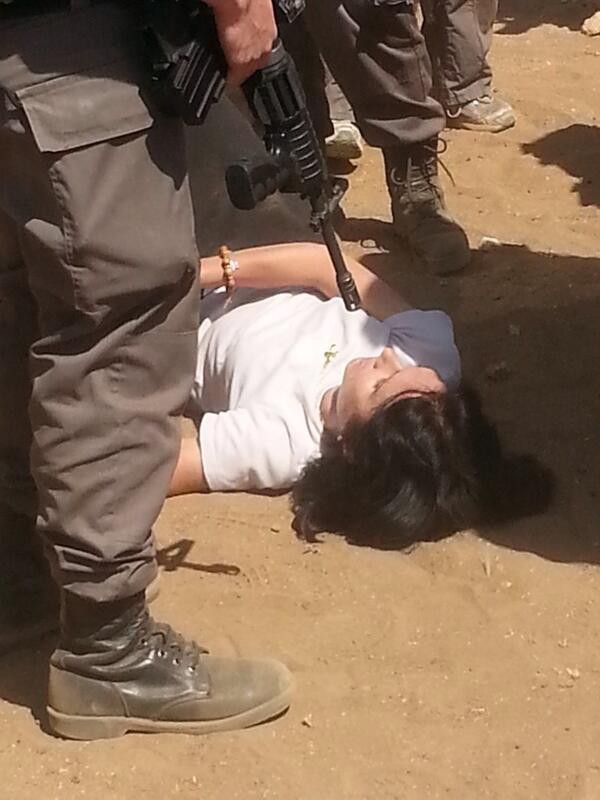 Israeli soldiers manhandled European diplomats on Friday and seized a truck full of tents and emergency aid they had been trying to deliver to Palestinians whose homes were demolished this week.
A Reuters reporter saw soldiers throw sound grenades at a group of diplomats, aid workers and locals in the occupied West Bank, and yank a French diplomat out of the truck before driving away with its contents.
“They dragged me out of the truck and forced me to the ground with no regard for my diplomatic immunity,” French diplomat Marion Castaing said.
“This is how international law is being respected here,” she said, covered with dust.
The Israeli army and police declined to comment.
Locals said Khirbet al-Makhul was home to about 120 people. The army demolished their houses, stables and a kindergarten on Monday after Israel’s high court ruled that they did not have proper building permits.
Despite losing their property, the inhabitants have refused to leave the land, where they say their families have lived for generations along with their flocks of sheep.
Israeli soldiers stopped the International Committee of the Red Cross (ICRC) delivering emergency aid on Tuesday and on Wednesday IRCS staff managed to put up some tents but the army forced them to take the shelters down.
Diplomats from France, Britain, Spain, Ireland, Australia and the European Union’s political office, turned up on Friday with more supplies. As soon as they arrived, about a dozen Israeli army jeeps converged on them, and soldiers told them not to unload their truck.
“It’s shocking and outrageous. We will report these actions to our governments,” said one EU diplomat, who declined to be named because he did not have authorization to talk to the media.
“(Our presence here) is a clear matter of international humanitarian law. By the Geneva Convention, an occupying power needs to see to the needs of people under occupation. These people aren’t being protected,” he said.
In scuffles between soldiers and locals, several villagers were detained and an elderly Palestinian man fainted and was taken for medical treatment.
The UN Office for the Coordination of Humanitarian Affairs (OCHA) said in a statement that Makhul was the third Bedouin community to be demolished by the Israelis in the West Bank and adjacent Jerusalem municipality since August.
Palestinians have accused the Israeli authorities of progressively taking their historical grazing lands, either earmarking it for military use or handing it over to the Israelis whose settlements dot the West Bank.
Israeli forces regularly demolish Palestinian homes, claiming they do not have the proper construction permits. However, the Israeli government regularly announces the expansion of settlements, which are considered illegal under international law.
Israelis and Palestinians resumed direct peace talks last month after a three-year hiatus. Palestinian officials have expressed serious doubts about the prospects of a breakthrough.
“What the Israelis are doing is not helpful to the negotiations. Under any circumstances, talks or not, they’re obligated to respect international law,” the unnamed EU diplomat said.
(Reuters, Al-Akhbar)
Palestinian teen ‘executed’ by Israeli forces in Jenin
By Saed Bannoura | IMEMC & Agencies | September 17, 2013
Palestinian medical sources have reported that a Palestinian youth was shot and killed by Israeli soldiers invading his home in the Jenin refugee camp, in the northern West Bank city of Jenin on Tuesday. Dozens of residents have been injured during ensuing clashes, and one was kidnapped.
The Maan News Agency has reported that a large Israeli military force invaded that camp, during late night hours, and that the soldiers broke into and violently searched dozens of homes.
The invasion led to clashes with local youths who hurled stones and empty bottles at the invading forces.
Medical sources said that resident Islam Husam Toubasy, 19, was shot by rounds of live ammunition fired at him by the invasion soldiers who broke into his home after detonating its door.
His family told Maan that, immediately after invading their property, the soldiers headed to the rooftop where Islam sleeps in his room, and shot him in the foot before dragging him onto the ground, taking him out of his home while he was heavily bleeding.
His brother, Kamal, stated that after the soldiers shot and injured Islam, and dragged him out of the home, undercover soldiers of the Israeli army shot him again, the Palestinian News & Info Agency (WAFA) has reported.
The army then moved him to the Al Khodeira hospital, inside the 1948 territories, where he died due to the massive bleeding he suffered as a result of his injury.
The family said that the soldiers forced them in one room, and that they saw Islam bleeding and unconscious before the soldiers took him away. The soldiers did not allow the family to help their son.
Army then withdrew from the camp, but re-invaded it, and the city of Jenin, in the morning, leading to clashes with dozens of local youths.
Eyewitnesses said that at least twenty armored Israeli military vehicles, and a military ambulance, invaded the area, leading to clashes with dozens of students heading to their school.
The soldiers fired more rounds of live ammunition, gas bombs and concussion grenades at the residents leading to several injuries.
One of the wounded, Nael Ghazzawy, 13, was shot by a live round in his leg while standing at the balcony of his home.
Soldiers also kidnapped a resident identified as Mohammad Bassam Al-Fayed, 21, and took him to an unknown destination.
It is worth mentioning that, in 2006, undercover soldiers of the Israeli army, shot and killed Ahmad, the brother of Islam, and demolished his home. Their brother Sa’id, is a political prisoner held by Israel after being sentenced to 32 years imprisonment by a military court.
Earlier on Tuesday, Israeli soldiers invaded various Palestinian communities in different parts of the occupied West Bank, and kidnapped at least nine Palestinians.
On Monday, Israeli soldiers kidnapped at least fifteen Palestinians, including a legislator, in different parts of the occupied West Bank.
The invasions are part of daily violations carried out by the army against the Palestinians and their property in different parts of occupied Palestine.
Related article
Yom Kippur – Illegal Israeli settlers attack Palestinian farmer attempting to harvest almonds
International Solidarity Movement | September 15, 2013
Kafr Qalil, Occupied West Bank – Late Friday night we received a call to accompany a farmer to harvest almonds early the following morning in Kafr Qalil, a village south of Nablus. This is a completely normal activity, harvesting crops when they are ripe and ready-to-pick; however, in Palestine, simply trying to tend to one’s land can be a life-risking event.
At times, international activists and observers accompany Palestinian farmers whose lands are close to settlements and who are at great risk for attack. For some settlers, though a limited minority, international presence can act as a deterrent against violence. For the settlement of Bracha, widely known for its unfettered brutality against Palestinians, there seems to be little that can influence the scope and scale of their attacks.

Photo of Bracha settlers taken after running for our lives (Photo by ISM)
As soon as we received the call, our team began to scramble a bit- rereading our fellow activists’ reports from a few weeks ago in which the same farmer and his family were violently assaulted by the settlers from Bracha, his almond harvest and donkey stolen. We discussed our plan should the settlers attack again and reassured ourselves that the majority would likely be in synagogue all day, as it was the holiday of Yom Kippur, the Jewish day of atonement.
The following morning we arrived to Kafr Qalil around 6:30 to meet the farmer and international observers from EAPPI. After a few quick rounds of tea, we set off for the almond and olive groves in the south of the village. The farmer’s young son led our convoy, riding a donkey and carrying the tools and bags necessary for the harvest. As we walked and chatted about the general situation in the area, the farmer kept close watch over his son, calling him back anytime he rode too far in advance.
We walked the long, windy hills until we reached the groves where we split into two groups, two of us taking the higher hill and four, including the farmer and his son, taking the lower. As my partner climbed the highest hill to look for trees ready to pick, I waited down below, inspecting those badly damaged by fires set two months before by the settlers. The leaves crumbled in my hands to dust.
No more than five minutes later, in a flash of white, the settlers attacked. Without warning, around 15 men and teenage boys began running through the trees, shouting abuses and hurling massive stones toward the farmer, his son and the members of EAPPI. As I called to my partner to warn him, the settlers also began charging toward me, also throwing stones and screaming. Needless to say, and not at all an overstatement, we all ran for our lives. From the corner of my eye, I managed to spot the farmer ahead of me, struggling to run quickly as he walks with a cane. His son and the donkey were even farther ahead. One of the EAPPI volunteers was hit in the back with a stone. The settlers continued chasing us through the trees until we reached an area closer to the village, out of breath, panicked and exhausted. Eventually, when they tired of shouting at us to leave, they settled under a tree, dashing any chance of returning to harvest.
Nearly 20 minutes after the assault, the farmer got in touch with the army commander of the area, who just happened to be sitting in a military jeep on the settler road below the olive grove. The commander insisted that we walk down the steep, rocky terrain to talk to him and explain the situation. After a brief discussion, one of the soldiers arrogantly declared that they “kicked the settlers’ asses back to the settlement,” (conveniently) well after the attack and botched harvest. They assured us that they would stay in the area so that the farmer would be able to work. The volunteer from EAPPI asked where she could make a complaint about the assault, an inquiry which was met by some laughter from the soldiers who told her she was welcome to make a complaint at the Ariel police department (a futile journey, indeed).

Settlers shouting across the olive and almonds groves (Photo by ISM)
Slowly, we marched back up the hill, listening to the farmers advice to stay quiet and keep our eyes on the horizon, should the settlers return. Unsurprisingly, the army remained quite far away, seemingly unconcerned about the potential for another assault. As we sat under the tree to make a new plan, the farmer told us about all the attacks before, the stolen equipment and donkeys, the many fires that had burned most of the trees that surrounded us. It was hard to understand how a man could remain so calm and kind after a mob of religious nationalist extremists attacked him and his family yet another time.
It felt like a failed day, as not even a single almond was picked. Only the farmer managed to keep a positive attitude. He said that the almonds that we would have harvested are not the most important thing. He came to show both the settlers and the army that this is his land, just as it belonged to his father and his grandfather before him. This is his land and he will continue to plant it and to harvest his crops. This is his land and no violence by the settlers, no violence supported by the army, will ever drive him away.
I feel really uncertain as to what would have happened if the settlers had managed to catch any of us, particularly the farmer and his son. I keep going over the event in my mind, trying to piece together an attack that happened so quickly, but was so extreme in its violence and intensity. In the end, I feel sure that if we ran a bit slower, if the farmer or his son had been caught, the day would have ended quite differently, with someone badly hurt or even killed. It is not uncommon here in Palestine, where farming one’s land must be considered a brave and courageous act.
Related articles
- Jewish settlers seize Palestinian lands in Bethlehem (alethonews.wordpress.com)
- Journal: The day of the stolen donkey (palsolidarity.org)
- Join ISM for the 2013 Olive Harvest Campaign (alethonews.wordpress.com)
Oslo Dead but Still Matters
By Ramzy Baroud | Palestine Chronicle | September 4, 2013
Suppose several armored vehicles belonging to a branch of the Palestinian Authority raided an Israeli border village at the eve of a new round of peace negotiations. One can picture PA President Mahmoud Abbas defending the killings, stating that the attack was made in the cause of protecting the security of the Palestinian public. Would the Israeli delegation return to the talks with handshakes and smiles?
The answer is an obvious no. Yet the Palestinian delegation did return to real recently renewed peace talks after Israeli forces’ raided a refugee camp in north Jerusalem on August 26, killing three. This was not the only lethal Israeli attack to take place during “peace talks”, and it will not likely be the last.
Granted, Palestine is an occupied nation, and its leadership possesses far fewer advantages than its Israeli counterpart; but if negotiations exist under such humiliating circumstances, can Abbas and his chief negotiator Saeb Erekat reasonably expect any fair outcome from these talks?
Of course not. Yet Abbas continues to offer more concessions that defy logic and the history of diplomacy. After volunteering last year to terminate claims to historic Palestine during an Israeli TV interview, which was rightly understood as a direct dismissal of Palestinians’ right of return to land occupied in 1947-48, he is still unrepentant.
“The Palestinians would abandon historic claims to land that is now in the state of Israel in the event of a far-reaching peace deal,” he told a group of Israeli parliamentarians, as reported by The Guardian newspaper on August 23.
Abbas, who serves no purpose aside from filling the US-entrusted role of the “moderate” Palestinian, has no vision of his own. Rather he is an assortment of confounded ideas about peace and justice and international law. He is willing to abandon the internationally enshrined rights of his people, yet expects a “just” agreement that would usher in “an end of the conflict”.
He doesn’t even seem to fully grasp the timetable set forth for the negotiations: “We wanted the meetings … to take place every day or every second day, and not once a week or every 10 days like the Israelis want. I don’t know why they don’t want to. We don’t have much time.”
Although his term as a president of the PA has expired, and his authority doesn’t enjoy a speck of democratic credentials, he makes concessions in the name of his people. “You have a commitment from the Palestinian people and also from the leadership, that if we are offered a just agreement, we will sign a peace deal that will put an end to the conflict and to future demands from the Palestinian side.”
Abbas’ statements have grown so increasingly strange that few political commentators – aside from those working in self-serving media outlets belonging to, partly funded by, or permitted to operate under the auspices of the PA in the West Bank – even bother to decipher his outlandish remarks.
The current peace process, styled on the 1993 Oslo I Accord, is long dead as far as its chances of achieving any peace, just or otherwise. Israel has made it crystal clear that no peace deal is present on its agenda.
In August alone, the Israeli government announced bids for 3,000 more housing units in illegal Jewish settlements. Abbas himself, although playing along for non-altruistic reasons, is aware of that. “I can’t say that I’m optimistic, but I hope we aren’t just wasting our time.”
That said, and although irrelevant as far as its declared reasons for finding a fair solution to the historic conflict, Oslo is not dead as a culture. That aspect of Oslo is very much alive. It continues to define Palestinian political bankruptcy and split Palestinian society.
As disheartening as it may sound, the accord’s legacy has plenty of supporters who are benefiting, to various degrees, from its perks and privileges. It has polarized Palestinians around factional and geographical lines. And unlike other attempts by Israel to weaken Palestinian resolve, this particular gambit has had unparalleled success.
History is laden with failed Israeli experiments aimed at destroying the Palestinian national project from within. In 1976, the Israeli government, then led by Yitzhak Rabin, conducted local elections in the West Bank and Gaza. It was a classic Rabin move aimed at stripping the Palestine Liberation Organization and nationalist leaders of any validity in the occupied territories.
Israel had by then made-up another group of Palestinian “leaders”, which consisted mostly of traditional heads of clans, a small, self-seeking oligarchy that historically accommodated whatever foreign power happened to be ruling over Palestinians at the time. Israel was almost certain that its allies were ready to sweep the local elections, but it miscalculated.
Israel’s miscalculation in 1976 was a rude awakening for both its military and political leaderships, whose plans had officially faltered when the results came out. National candidates won an overwhelming majority, sweeping 148 of the 191 mayoralties and councillorships. The attempt to create an early version of Abbas and his PA was a complete failure.
But Israel was never to give up trying to mold local Palestinian leaders as alternatives to elected Palestinians or internationally recognized representatives of the Palestinian struggle. In 1978, Israeli leader Menachem Begin established the Village Leagues, giving its members relatively wide powers, including approving or denying developmental projects in the occupied territories.
He armed them and also provided them with Israeli military protection. But that too was deemed to fail. “The league members [were] widely regarded as collaborators by their fellow townspeople and villagers (And by 1983) Israel had begun recognizing the artificial nature of the Village Leagues and acknowledged the failure of the efforts to create political institutions capable of mobilizing Palestinian support for the occupation,” wrote Ann Mosely Lesch and Mark Tessler in Israel, Egypt and the Palestinians: From Camp David to Intifada.
As a revamped version of the Village Leagues and their clan-like political apparatus, Abbas’ authority is working too well. Palestinians have to face up to the inescapable reality that their leadership has completely acquiesced and their continued silence is an affirmation of that defeat.
Related articles
Egypt and UAE plot to topple Hamas
MEMO | September 4, 2013
A retired Egyptian general has revealed details of an Egypt-UAE plot to impose a stranglehold on the Gaza Strip and overthrow the Hamas-led government. The plot, claims General Sami Hassan, is for the Egyptian army to act, with funding from the UAE government.
“The plan is led by General Abdel Fattah al-Sisi,” tweeted Hassan. “He aims to achieve political and military gains in the coming days.”
General Hassan said that the military will impose even more restrictions on the Palestinians in Gaza, cutting all essential supplies which currently pass through the tunnels. Fuel supplies in particular are being targeted. The Gaza Strip relies on Egypt for 80 per cent of its fuel.
According to Hassan, the process has already started with a media demonisation campaign against the Palestinians and Hamas. As soon as the army creates calm in the Sinai Peninsula, he asserted, it will stir up popular demonstrations.
Al-Sisi has already met with Shaikh Hazza bin Zayed, an adviser to the UAE National Security Authority, and ex-Fatah “strongman” Mohammed Dahlan, said General Hassan. “A sum of $750 million has been allocated for the plot,” he claims, “which will involve returning Gaza to Egyptian control or handing it over to the Palestinian Authority [in Ramallah].”
The decisive meeting, he noted, lasted one and a half hours in Al-Sisi’s office. The following objectives were agreed upon:
- Sinai will be “cleansed” of militant groups and nomadic tribes on the border with Gaza will be disarmed.
- A drone base will be established by Egypt in Sinai under international supervision. Air strikes will be launched against the “global jihadist movement”.
- All tunnels between Gaza and Egypt will be closed, and Egypt will cut off all essential supplies going to Gaza.
- Electricity supplies from Egypt to Gaza will be cut off altogether.
- An agreement between the Palestinian Authority, Egypt and Israel will be reactivated with the return of international observers to the Rafah Border Crossing.
- Hamas will be toppled and the Gaza Strip will be returned to President Mahmoud Abbas’s control.
- Power in Gaza will handed over to the PA or people in the UAE’s pay and control, such as Dahlan.
Related articles
- Egypt coup enters second phase: the overthrow of Hamas (alethonews.wordpress.com)
- Students campaign to expel Dahlan from UAE (alethonews.wordpress.com)
- Analyst: Mossad is behind Egyptian media’ incitement against Gaza (altahrir.wordpress.com)
- Egypt destroys Gaza tunnels, causes crisis (willyloman.wordpress.com)
- Egypt fires at Palestinian fishermen off Gaza: medics (willyloman.wordpress.com)
Federal investigation finds no merit in claims of ‘anti-Semitism’ at California universities
IMEMC Staff Report | September 2, 2013
After pro-Palestinian groups at several schools within the University of California system were accused of ‘anti-Semitism’, the U.S. Department of Education launched an investigation. This past week, they released the findings of their months-long investigation, announcing that the accusations of anti-Semitism were without merit, and that the accusations may have been attempts to stifle free speech on campus.
In response, the Center for Constitutional Rights issued the following statement:
Civil rights organizations this week welcomed news that the Department of Education’s (DOE) Office for Civil Rights (OCR) has closed three investigations against three University of California schools, at Berkeley, Santa Cruz, and Irvine, which falsely alleged that Palestinian rights activism created an anti-Semitic climate. The complaints underlying the investigation claimed that student protests and academic programing in support of Palestinian rights and critical of Israel “created a hostile environment for Jewish students.”
“The organized legal bullying campaigns have failed,” said attorney Nasrina Bargzie, of Advancing Justice-Asian Law Caucus (ALC), who alongside attorneys from Council on American-Islamic Relations (CAIR), the Center for Constitutional Rights (CCR) and the National Lawyers Guild (NLG) advocated for the students whose activism was scrutinized in the investigations.
“OCR’s decision in these cases confirms the obvious – that political activity advocating for Palestinian human rights does not violate the civil rights of Jewish students who find such criticism offensive, and that, to the contrary, colleges and universities have an obligation to create an environment that supports freedom of expression.” said Bargzie.
In its letter to UC Berkeley, OCR officials stated that student demonstrations in support of Palestinian rights “constituted expression on matters of public concern directed to the university community. In the university environment, exposure to such robust and discordant expressions, even when personally offensive and hurtful, is a circumstance that a reasonable student in higher education may experience. In this context, the events that the complainants described do not constitute actionable harassment.”
“We speak out on campus about matters of fundamental human rights. Students at institutions that are all about learning deserve to be part of robust discussion about one of the most pressing human rights issues of our time,” said Taliah Mirmalek, a student at UC Berkeley and a member of Students for Justice in Palestine.
The Berkeley complaint was filed in July 2012 by two attorneys who had previously filed an unsuccessful federal lawsuit on similar grounds. The Berkeley investigation was the latest of the three to be open; the Santa Cruz investigation was opened in March 2011, and the Irvine investigation in 2007.
A number of legal and advocacy groups, including Advancing Justice – ALC, CAIR, CCR, NLG, the American-Arab Anti-Discrimination Committee, American Muslims for Palestine, the Arab American Institute, and American Civil Liberties Union of Northern California have worked to challenge the misuse of civil rights law to intimidate students and dissuade them from advocating for Palestinian rights on campus.
“Students have faced a pervasive stigma that at times negatively impacted our ability to fundraise and hold events on campus, and even intimidated some of our peers into silence,” said Rebecca Pierce, a recent graduate of UC Santa Cruz and member of the Committee for Justice in Palestine. “However, we feel vindicated that the DOE has rejected this attack on our freedom of expression, and we will continue to advocate in accordance with our values regarding human rights and social justice.”
“The First Amendment unequivocally protects the activities that were targeted in these complaints – holding demonstrations, distributing flyers, street theatre – criticizing the governmental policy of the State of Israel and supporting Palestinian human rights. It is long past time that students engaging in First Amendment activities are able to do so without fear,” said Liz Jackson, Cooperating Counsel with CCR, who also worked with the targeted students. “While there continue to be threats of Title VI complaints against other universities, we are confident that OCR recognizes these claims as attempts to silence certain speech on Israel/Palestine, and do not present viable claims of discrimination against Jewish students,” said Jackson.
Four young boys arrested and beaten in Hebron
International Solidarity Movement | September 1, 2013
Hebron, Occupied Palestine – On Friday 30th August, Israeli soldiers arrested four Palestinian boys and held and abused them in a military base for around four hours.
Ashaq (15), Ali (15), Anwar (14) and Ahmed (10) were walking down the Shilal Street in the Old City of Hebron at around 6.30pm, when soldiers near Bab Al-Baladia violently grabbed them and accused them of throwing stones. Anwar’s shirt was torn by a soldier as they arrested him. They took the four boys through the yellow gate into Beit Romano military base. All four were blindfolded, and Ashaq was slapped in the face by a soldier. The soldiers also ate seeds in front of the boys and then spat the shells at them. The boys were held in the military base for nearly four hours. International activists who went to the military base to demand information on whether the boys were being held inside and why they had been arrested, were told by soldiers “we don’t know”, and were asked to leave. As they were waiting outside the military base, they were insulted and threatened by a settler. Subsequently the army forced them to leave Shuhada Street and threatened one international with arrest if she tried to return.
At around 10.15pm, Youth Against Settlements (YAS, a Palestinian activist group which seeks to end Israeli colonization and settlement activities in Palestine through non-violent popular struggle and civil disobedience) received a call by worried residents who had seen twelve soldiers taking the four blindfolded boys up into the cemetery opposite the military base. The youngest, Ahmed, had a bag put over his head. Members of YAS rushed to the scene, and when the soldiers saw them they seemed scared, released the boys and left quickly.
This incident stands out from other child arrests which are almost a daily occurrence in occupied Hebron due to the forced movement of the boys into the cemetery. This worrying act highlights the arbitrary nature of the occupation as well as the virtual impunity with which the soldiers are allowed to act.
Related articles
Palestinian schools in Jerusalem offered money to switch to Israeli curriculum

Al-Akhbar | August 28, 2013
Several Palestinian schools in Jerusalem will incorporate Israeli educational material in their curriculum after receiving financial incentives from Israeli officials, Ma’an news agency reported on Wednesday.
An education official told Ma’an that the Israeli municipality in Jerusalem had offered increased salaries for teachers and principals who implement Israeli course material in the classes, bringing an estimated $550 for each student enrolled in schools agreeing to the switch.
Some Palestinian and Israeli school principals and teachers met in Tel Aviv last week to discuss the change, the official added.
Jerusalem’s director of education Samir Jibril said at least five Palestinian schools in Jerusalem will switch from Palestinian Authority to Israeli education plans at certain grade levels.
“This step is very dangerous and touches the awareness of Palestinians in Jerusalem in an effort to brainwash them and control them, especially young generations,” a teacher identifying only as Jibril told Ma’an.
The Israeli curriculum purportedly includes maps marking the West Bank as part of Israel and identifying territories by their Jewish Biblical names.
The history material also identifies Jerusalem as the capital of Israel despite the fact that the United Nations and most states do not recognize Israel’s claim on the city.
The apartheid wall in the West Bank is also referred to as Israel’s security fence, and Israel is described as a bastion of human rights and democracy.
Another section depicts a conversation between Arab students who praise Israel’s development of Palestinian cities and decide to sing the Israeli national anthem.
(Al-Akhbar, Ma’an)
Featured Video

Why Hamas Really Attacked Israel on Oct. 7
or go to
Aletho News Archives – Video-Images
From the Archives
Confronting the Threat of Ethnic Bioweapons
By Tony Cartalucci – New Eastern Outlook – 29.11.2017
The United States Air Force’s 59th Medical Wing’s molecular biology branch recently was revealed to have been collecting specifically Russian RNA and synovial (connective) tissue samples, prompting fears in Russia of a possible US directed ethnic-specific bioweapons program. … continue
Blog Roll
 Aletho News
- Leading Israeli Think Tank Publishes Psychotic Israeli ‘National Security’ Doctrine
- Are the United States and Israel in Decline-and-Fall Mode?
- Why Hamas Really Attacked Israel on Oct. 7
- Declassified UK exposes British man who fought for ‘Israel’ in Gaza
- West’s death cult in a theater near you
- How the Yandex ‘Russian bots’ lie fell apart
- Burnham’s ‘Russia did Brexit’ ruse crumbles
- Estonia making movies and games to encourage war against Russia
- Four in five new UK jobs taken by foreigners – report
- Here’s what Trump’s latest U-turn really means for Russia and Ukraine
- If Americans Knew
- Activists Abused By Israel Return to New Freedom Flotilla Mission
- 60 Minutes won’t tell the full truth about Israeli settler violence
- Nearly 50,000 women, girls killed or severely injured in Gaza since October 2023: UN Women
- ADL is working with AI companies to suppress alleged ‘antisemitism’
- Israeli occupation forces using social media surveillance unit to target hundreds of Palestinians in the West Bank
- Israel’s New – and Terrifying – Security Doctrine
- Israeli Attacks Kill Five in Gaza, Including a four-year-old and a woman
- Air Force Major Who Called for Trump’s Impeachment Held in Solitary Confinement
- It’s a Genocide, I’m Into It’: Seinfeld Mocks Protest over Palestinian Children Killed
- Universities fire dozens amid pressure from Zionist billionaires
- No Tricks Zone
- New Study Suggests Large Regions Of The Pacific Ocean Have Been Cooling For The Last 80 Years
- Germany’s Green Energy Debacle: High Energy Costs Force Kahla Porzellan to Close After 182 Years!
- New Study: 50 Years Of The Most Aggressive ‘Net Zero’ Policies Can Only Affect The Global Climate By 0.03°C
- US September “Heat” Was No Record…Many Records Set Decades Ago
- Latest European Green Energy Debacle; Portugal’s Largest Flagship Solar Park Insolvent!
- Green Energy Debacle: German Expert Professor Fritz Vahrenholt Warns Of Severe Economic And Social Consequences
- Two More Paleo Reconstructions Affirm Meters-Higher Sea Levels Across Ireland, Brazil 7000-6000 Years Ago
- New Study: Earth And Venus Surface Warmth Largely Explained By Convection And Lapse Rate, Not CO2 Or Radiation
- 2025 Nature Paper Claiming Worsening Global Drought Gets RETRACTED …Heavily Flawed
- New Study: ‘Global Drought Shows No Detectable Recent Acceleration Under Climate Warming’

