Palestinian Nakba: The Young Will Never Forget
By Ramzy Baroud | Palestine Chronicle | May 15 2013

The Nakba must not be assigned to the shelves of history
Many Palestinians remember and reference al-Nakba, also known as the Catastrophe, on May 15 every year. The event marks the expulsion of nearly a million Palestinians, while their villages were destroyed. The destruction of Palestine in 1947-48 ushered in the birth of Israel. Older generations relay the harsh and oppressive memory of their collective experience to younger Palestinians, many of whom live their own Nakbas today.
In covering al-Nakba, sympathetic Arab and other media play sad music and show black and white footage of displaced, frightened refugees. They rightly emphasize the concept of Sumud, steadfastness, as they show Palestinian of all ages holding unto the rusty keys of their homes and insisting on their right of return. Other, less sympathetic media discuss al-Nakba, if at all, as a side note – a nuisance in the Israeli narrative of a nation’s supposedly miraculous birth and its progression to an idyllic oasis of democracy. What such reductionist representations often fail to show is that while al-Nakba started, it never truly finished.
Those who underwent the pain, harm and loss of al-Nakba are yet to receive the justice that was promised to them by the international community. UN Resolution 194 states that “the refugees wishing to return to their homes and live at peace with their neighbors should be permitted to do so at the earliest practicable date” (Article 11). Those who wrought this injustice are also yet to achieve their ultimate objectives in Palestine. After all, Israel doesn’t have defined boundaries by accident.
David Ben Gurion, first Prime Minister of Israel, once prophesized that “the old (refugees) will die and the young will forget.” He spoke with the harshness of a conqueror. Ben Gurion carried out his war plans to the furthest extent possible. Every region in Palestine that was meant to be taken was captured, its people were expelled or massacred in their homes and villages. Ben Guiron ‘cleansed’ the land, but he failed to cleanse Israel’s past. Memory persists.
Ben Gurion referenced my own family’s village – Beit Daras – which witnessed three battles and a massacre. In an entry in his diaries on May 12, 1948, he wrote: “Beit Daras was mortared. Fifty Arabs (were killed). The (villages of) Bashit and Sawafir were occupied. There is mass exodus from nearby areas (neighbors in Majdal). We sustained 5 dead and 15 wounded. ” (War Diaries, 1947-1949).
More than fifty people were killed in Beit Daras that day. An old Gaza woman, Um Mohammed – who I discussed in my last book, My Father was a Freedom Fighter – refers to what is likely the same event:
“The town was under bombardment, and it was surrounded from all directions. There was no way out. The armed men (the Beit Daras fighters) said they were going to check on the road to Isdud, to see if it was open. They moved forward and shot few shots to see if someone would return fire. No one did. But they (the Zionist forces) were hiding and waiting to ambush the people. The armed men returned and told the people to evacuate the women and children. The people went out (including) those who were gathered at my huge house, the family house. There were mostly children and kids in the house. The Jewish (soldiers) let the people get out, and then they whipped them with bombs and machine guns. More people fell than those who were able to run. My sister and I…started running through the fields; we’d fall and get up. My sister and I escaped together holding each other’s hands. The people who took the main road were either killed or injured. The firing was falling on the people like sand. The bombs from one side and the machine guns from the other.”
Ben Gurion would not necessarily doubt Um Mohammed’s account. He candidly stated: “Let us not ignore the truth among ourselves…politically we are the aggressors and they defend themselves…The country is theirs, because they inhabit it, whereas we want to come here and settle down, and in their view we want to take away from them their country” (as quoted in Chomsky’s Fateful Triangle, pp. 91-2).
It is precisely for this reason that neither the old nor the young have forgotten. Every day is another manifestation of the same protracted al-Nakba that has lasted 65 years now. Young people’s hardships today are inextricably linked to the violent and horrific uprooting decades ago.
Al-Nakba has also remained an ongoing project through generations of Israeli Zionists. When Ben Gurion died in 1973, current Israeli Prime Minister Benjamin Netanyahu was in his mid-twenties. He was then serving his last year in the Israeli army, and today he rules Israel with a coalition that includes almost three quarters of the Israeli parliament. Like most Israeli leaders, he continues to contribute to the very discourse by which Palestine was conquered. He speaks of peace, while his soldiers and armed settlers take over Palestinian homes and farms. He makes repeated offers to Palestinians for ‘unconditional’ talks, as he repeats his violent rejection of every Palestinian aspiration. His lobby in Washington is much stronger than ever before. He reigns supreme, as he continues to fulfill the ‘vision’ of early Zionists.
Old keys and deeds of stolen lands attest to the intergenerational experience that is Al-Nakba. Today Palestinians continue to be herded behind military checkpoints. They are denied the right to proper medical care, and their ancient olive trees are ruthlessly bulldozed. What Israel has not been able to control, however, is the resolve of Palestinians. The prison, the checkpoint and the gun reside in our collective memory in a way that cannot be held captive, controlled, or shot.
In fact, al-Nakba is not a specific date or an estimation of time, but the entirety of those 65 years and counting. The event must not be assigned to the shelves of history, not as long as refugees are still refugees and settlers continue to rob Palestinian land. As long as Netanyahu speaks the language of Ben Gurion, other ‘catastrophic’ episodes will follow. And as long as Palestinians hold on to their keys and deeds, the old may die but the young will never forget.
– RamzyBaroud (www.ramzybaroud.net) is an internationally-syndicated columnist and the editor of PalestineChronicle.com. His latest book is My Father Was a Freedom Fighter: Gaza’s Untold Story (Pluto Press, London).
Related articles
- A Hundred Deir Yassin and Counting: Beit Daras and the Buried History of Massacres (alethonews.wordpress.com)
- Palestinian child injured by Israeli metal bullet in the head in Beit Ummar confrontations (occupiedpalestine.wordpress.com)
Israel Agrees to Forego Use of White Phosphorus… Sorta
By Richard Silverstein | Tikun Olam | May 13, 2013

IDF rains white phosphorus indiscriminately on civilian targets
Yesh Din and other Israeli human rights NGOs sued the IDF over its use of white phosphorus during Operation Cast Lead and in similar conflicts. It is deemed by many as a chemical weapon, especially when used as the IDF does. It is not allowed to be used in or near civilian populations, which is precisely how Israel uses it. It also dropped the napalm-like substance directly on civilian targets causing grievous injuries. Scores of Gazans died or were maimed by the toxic, highly flammable material during the 2009 war. The only time it’s legal to use it in combat is to provide smokescreen cover for combat operations. While the IDF maintains that was what it did, the evidence in the form of civilian casualties refutes that.
Recently, facing a difficult hearing before what would likely have been a skeptical Supreme Court, the IDF announced it would stop using white phosphorus in populated areas. So far so good. But as in every matter concerning Israel’s army, the devil is in the details:
The IDF has decided “to avoid the use in built-up areas of artillery shells containing white phosphorus, with two narrow exceptions,” the state said in an announcement to the court.
Yuval Roitman, who represented the state in the petition, added: This “has been decided in the IDF as a matter of policy … even though this is not a commitment in a legal sense.” The state’s decision emphasizes that while this is current IDF policy it could change in the future.
The State wants to appear to have renounced use of white phosphorus while not really doing so. Note those “two narrow exceptions.” I’m trying to ascertain what they are. They have been conveniently omitted from any court filings or documents. But I’m guessing they may be wide enough to drive a Mack truck through. Also note the State affirms that the policy is only temporary and may be changed at the discretion of the army itself. Further, the army makes a big deal out of the fact that while this is a change of policy, it isn’t a legally binding agreement forced upon it. This is the equivalent of the defendant who cops a plea without an admission of guilt.
Buckling to Bigotry: The Newseum Dishonors Murdered Palestinian Journalists
By Nima Shirazi | Wide Asleep in America | May 13, 2013
Just two days before Palestinians commemorate the 65th anniversary of the Nakba, the names of two Palestinian cameramen targeted and killed by Israeli airstrikes in Gaza last November were dropped from a dedication ceremony held to honor “reporters, photographers and broadcasters who have died reporting the news” over the past year. The move followed an Israel lobby pressure campaign led by anti-Palestinian organizations such as the Anti-Defamation League, the Foundation for the Defense of Democracies and the American Jewish Committee, efforts that were openly supported by the Israeli government.
The Atlantic Wire’s J.K. Trotter summarizes:
Two days after Washington, D.C.’s Newseum announced its intent to honor Hussam Salama and Mahmoud al-Kumi, who were killed in November while working as cameramen for the Middle East-based Al-Aqsa TV, the well-known temple of journalism has decided — for now — not to recognize Salama and al-Kumi, citing their employer’s deep ties to Hamas, a Palestinian organization currently designated by the United States as a terrorist group.
The Newseum, which honored 82 journalists on May 13, 2013, stated that it had “decided to re-evaluate their inclusion as journalists on our memorial wall pending further investigation,” even though just last week, in response to the hysterical reaction to Salama’s and al-Kumi’s initial inclusion, the museum had affirmed and defended their decision, noting that “the Committee to Protect Journalists, Reporters Without Borders and The World Association of Newspapers and News Publishers all consider these men journalists killed in the line of duty.”
Indeed, as Joe Catron notes, Reporters Without Borders has pointed out, “Even if the targeted media support Hamas, this does not in any way legitimize the attacks,” while the Committee to Protect Journalists “found that the Israeli military’s official justifications for its attacks on journalists…’did not specifically address CPJ’s central question: how did Israel determine that those targeted did not deserve the civilian protections afforded to all journalists, no matter their perspective, under international law?'”
The World Association of Newspapers and News Publishers includes both Salama and al-Kumi on its list of “69 Media Employees Killed in 2012,” as does the International Federation of Journalists in tis report, “In the Grip of Violence: Journalists and Media staff Killed in 2012.”
Human Rights Watch, in its December 20, 2012 report on “Unlawful Israeli Attacks on Palestinian Media,” concluded,
Four Israeli attacks on journalists and media facilities in Gaza during the November 2012 fighting violated the laws of war by targeting civilians and civilian objects that were making no apparent contribution to Palestinian military operations.
The attacks killed two Palestinian cameramen, wounded at least 10 media workers, and badly damaged four media offices, as well as the offices of four private companies. One of the attacks killed a two-year-old boy who lived across the street from a targeted building.
The Israeli government asserted that each of the four attacks was on a legitimate military target but provided no specific information to support its claims. After examining the attack sites and interviewing witnesses, Human Rights Watch found no indications that these targets were valid military objectives.
“Just because Israel says a journalist was a fighter or a TV station was a command center does not make it so,” said Sarah Leah Whitson, Middle East director at Human Rights Watch. “Journalists who praise Hamas and TV stations that applaud attacks on Israel may be propagandists, but that does not make them legitimate targets under the laws of war.”
HRW added, “The two men’s families, interviewed separately, said the men were neither participating in the fighting nor members of any armed group. Human Rights Watch found no evidence, including during visits to the men’s homes, to contradict that claim. Hamas’s armed wing, al-Qassam Brigades, has not put either man on its official list of killed fighters – an unlikely omission if the men had been playing a military role.”
For the Newseum to be bullied into omitting Salama and al-Kumi from its rededication ceremony by avowedly Zionist groups and right-wing media outlets demonstrates that the institution itself is no less a propaganda outfit than Al-Aqsa TV. This shameful last minute decision effectively grants the U.S. and Israeli governments the ability to decide who is and who is not a journalist and who should and who should not be honored for their work.
But the decision also reeks of hypocrisy and Manichean double standards.
The Newseum is essentially suggesting that sycophantic journalists parroting government propaganda may be legitimate targets in military operations and should be labeled combatants, rather than civilians who enjoy press freedoms and are subject to protection.
Yet this only extends as far as the U.S. State Department says it does.
The ADL’s Abe Foxman called Salama and al-Kumi “members of a terrorist organization advancing their agenda through murderous violence” and “terrorist operatives” who “were working for a propaganda outlet, not a legitimate news organization.” The AJC’s David Harris echoed these sentiments, labeling Salama and al-Kumi as “brazen terrorists” and “two individuals who were integral to the propaganda machine of the Hamas terrorist organization,” that could not be considered “a legitimate media operation.”
Such terms as “terrorism” and “terrorist” are perhaps the most loaded, politicized, exploited and, consequently, meaningless words in our current lexicon, employed as a bludgeon against critical thinking in order to reinforce “us vs. them” narratives.
Apparently, the Newseum has determined that our propaganda deserves respect and admiration, while their propaganda (in this case, documenting on camera the effects Israeli bombs and missiles have on the human flesh of Palestinian people at Gaza’s al-Shifa Hospital) should be condemned, targeted and investigated.
By this measure, plenty of alleged propagandists grace the memorial wall of the Newseum already, with more added during today’s ceremony.
Mohamed Al-Massalma, a freelance reporter for Al Jazeera, was killed by a sniper while covering the Syrian civil war in Busra Al-Harir in late January 2013. The Syrian journalist, working under the pseudonym Mohamed Al-Horani, was “an activist in the revolt against President Bashar al-Assad,” before joining Al Jazeera.
In January 2012, Mukarram Khan Aatif was gunned down in the Pakistani town of Shabqadar by members of the Pakistani Taliban. Aatif was a journalist working for Deewa Radio, the U.S. government’s Voice of America Pasto-language service. He was among those honored by the Newseum this year.
The taxpayer-funded Voice of America (VOA) and its affiliated services have been legally banned from broadcasting or distribution here in the United States for the past 65 years because of a Congressional act prohibiting the government from propagandizing to its own citizens. Only last year was this law reversed; the ban will be officially lifted this coming July 2013. VOA is literally U.S. government propaganda, yet its reporters are accorded due protection from violence, as they should be.
Another VOA journalist, Mohammed Ali Nuxurkey, was killed in an al-Shabab bombing in Mogadishu, Somalia, this past March There is no doubt he will be added the Newseum’s wall next year.
If any distinctions are to be made among different categories of journalists caught in the line of fire or deliberately targeted for murder, international law does not, in fact, favor the Foxman’s and Harris’ of the world.
While war journalists who are not embedded with troops or themselves soldiers taking direct part in hostilities are legally protected by the law of armed conflict, embedded reporters are not necessarily similarly protected.
According to international law professor Sandesh Sivakumaran, writing for the Oxford University Press, embedded journalists, while civilians, may be “casualties of lawful attacks” as “[t]he law allows for the targeting of troops and that targeting may result in bystanders or embedded reporters becoming casualties.”
Still, embedded journalists who were killed while accompanying American occupation forces in Iraq and Afghanistan – a policy promoted by the U.S. military in order to ensure positive reporting on American actions (some might call that propaganda) – have also rightly been accorded a place in the Newseum’s memorial. Journalists like Spanish reporter Julio Anguita Parrado and German correspondent Christian Liebig, killed by Iraqi missiles in an April 7, 2003 attack on the U.S. Army’s 3rd Division headquarters in Baghdad, are honored by the Newseum as is NBC News soundman Jeremy Little, killed in Fallujah in July 2003 while embedded with the Army’s 3rd Infantry.
Sivakumaran also explains that “[j]ournalists who work for media outlets or information services of the armed forces” are legally considered “members of the armed forces,” and therefore “don’t benefit from the protections afforded to civilians and their deaths don’t constitute a violation of the law.”
As such, the Newseum’s glaring duplicity is all the more evident when considering the case of James P. Hunter. A staff sergeant, reporter and photographer with the 2nd Brigade Combat Team, 101st Airborne Division, Hunter was killed on June 18, 2010 by an IED while covering the massive U.S. offensive taking place in Kandahar, Afghanistan, for The Fort Campbell Courier, an Army newspaper in Kentucky. He was an active duty soldier and the first Army journalist to die in combat since 9/11. Still, the Newseum saw fit to honor Hunter on its memorial wall.
Yet in the case of Salama and al-Kumi, “Israeli officials sought to justify attacks on Palestinian media by saying the military had targeted individuals or facilities that ‘had relevance to’ or were ‘linked with’ a Palestinian armed group, or had ‘encouraged and lauded acts of terror against Israeli civilians,'” according to Human Rights Watch. “These justifications, suggesting that it is permissible to attack media because of their associations or opinions, however repugnant, rather than their direct participation in hostilities, violate the laws of war and place journalists at grave risk.”
If repellant statements, including the justification of and praise for acts of violence against civilians, are the benchmark of propaganda and thereby constitute legitimate targeting for death by those opposed to such statements, then countless American journalists and commentators from across the political spectrum would be subject to the same fate as Salama and al-Kumi.
Warmongering and incitement abound in the editorial pages of The Washington Post and Wall Street Journal. Liberal commentators like Joe Klein and former White House spokesman Robert Gibbs exhalt the extrajudicial executions by flying robot of countless civilians, including a 16-year-old American citizen in Yemen and hundreds of children in Pakistan. Right-wing pundits like Jennifer Rubin and her friends at Commentary and The Weekly Standard openly advocate for the murder of Iranian and Palestinian civilians, endlessly call for permanent war and occupation, support torture and indefinite detention, advocate for the assassination of whistleblowers, scientists and foreign officials, and justify the war crimes of their preferred military forces and governments.
Just days before the car in which Salama and al-Kumi were traveling, marked clearly as a press vehicle, was blown up by an Israeli bomb, Rubin published a post praising the IDF assault on Gaza. Hardly able to contain her glee, Rubin anonymously quoted “an old Middle East hand” declaring that, after weeks of sporadic Israeli airstrikes (“a form of messaging to Hamas”), “the Israelis escalated. But still they are avoiding infrastructure, hitting pinpoint high-level Hamas target.”
A recent B’Tselem report on Israel’s actions last November, however, “challenges the common perception in the Israeli public and media that the operation was ‘surgical’ and caused practically no fatalities among uninvolved Palestinian civilians,” noting that, “in some cases at least, the [Israeli] military violated IHL [international humanitarian law] and in other cases there are substantial reasons to believe IHL was violated.” Israeli airstrikes killed 167 Palestinians in Gaza, at least 87 of whom were noncombatants, including 31 minors.
Two days after cheering Israeli war crimes, Rubin set her sights on a bigger target. “Israel can keep swatting down Hamas, using air power or, if need be, going into Gaza on land,” she wrote. “It has a solemn obligation to defend itself against what was a deliberate escalation by Hamas in the number and quality of weapons launched against Israel’s civilian population. But even with the most robust U.S. support this is not a long-term solution. That will only come when Iran is dealt with, either militarily or via regime change.”
Anyone arguing that Rubin could be targeted with violence for writing her opinions would be labeled sociopathic and lambasted for incitement, and for good reason. And there is no doubt that if correspondents from Israeli Army Radio or employees of the state-run Israel Broadcasting Authority were killed, they would be honored by the Newseum, without so much as a whiff of dissent, let alone outrage.
It is evident that, as always, Palestinians are subject to unparalleled scrutiny and suspicion due to the tireless defamation and lobbying efforts of big-moneyed Zionist organizations and ideological zealots.
But is it surprising that the Newseum should jump on this bias bandwagon?
In the late 1940’s, Bugsy Siegel’s former publicist Hank Greenspun was recruited by Jewish militias in Palestine to help them fight against both the occupying British and indigenous Palestinians. He hijacked a yacht and laundered $1.3 million through Mexico in order to smuggle machine guns stolen from the U.S. Navy in Hawaii to the prolific terrorist group Irgun, which had blown up Jerusalem’s King David Hotel the year before and would massacre the residents of Deir Yassin a year later. Soon thereafter, Greenspun was apprehended by the FBI while attempting to illegally ship surplus combat airplane engines to Haganah.
In 1950, he was convicted of violating the U.S. Neutrality Act and fined $10,000 for his arms deals. The same year, he purchased the Las Vegas Review-Journal and renamed it the Las Vegas Sun, serving as publisher for the next four decades.
Upon his death in 1989, former Israeli Prime Minister Shimon Peres called Greenspun “a hero of our country and a fighter for freedom – a man of great spirit who fought with his mind and his soul; a man of great conviction and commitment.” In 1993, a one-acre plaza in the Jerusalem Botanical Garden of Hebrew University was dedicated to him.
In 2006, the Greenspun Family donated $7 million to the Newseum, which named a terrace in his honor. It overlooks Pennsylvania Avenue.
Related article
- Jewish groups slam ‘Newseum’ for honoring Palestinian journalists killed by Israelis (alethonews.wordpress.com)
Activists: Facebook blocks Nakba group page
Ma’an – 14/05/2013
BETHLEHEM – A Facebook page promoting Nakba commemoration events in Jaffa was temporarily blocked overnight, Palestinian activists said Monday.
Fatima Huleiwi, an activist with Jaffa Youth, told Ma’an that it was not the first time that Facebook had blocked the group’s user page.
“When we published material urging people to support hunger striking prisoners, our pages were blocked. Last night the invitation to an event commemorating the Nakba anniversary in Jaffa was also blocked on several accounts for hours,” she said.
Sometimes right-wing Israelis report violations on the group’s Facebook pages, Huleiwi says, and as a result Facebook temporarily blocks the site for several hours.
Jaffa Youth has to send a complaint to Facebook before they eventually unblock the page, she added.
Members of Jaffa Youth will commemorate the 65th Nakba anniversary in Jaffa’s Clock Square from 10 a.m. to 7 p.m.
The event will include artistic activities and public discussions about the Nakba, with Dr. Thabet Abu Ras from Adalah, and Eitan Bronstein from Zochrot, or ‘remembering,’ among the participants.
“We will continue to prepare for this event and will try to make it the most prestigious commemoration of the Nakba in the Palestinian territories occupied in 1948,” Mahmoud Abu Arisha, an activist from Jaffa Youth, told Ma’an.
More than 760,000 Palestinians — estimated today to number 4.8 million with their descendants — were pushed into exile or driven out of their homes in the conflict surrounding Israel’s creation in 1948.
Around 160,000 Palestinians, who remained in Israel after 1948, now number around 1.36 million people, or 20 percent of the country’s population.
Related articles
- UK pro-Palestine activists to hold Nakba Day demo (alethonews.wordpress.com)
- Nakba Day: Israeli troops attack Bethlehem rally (gazasolidarity.blogspot.com)
“Nothing forbidden for them, but nothing allowed for us”
International Solidarity Movement | May 14, 2013
Qaryut, Occupied Palestine – Settlers from the illegal colony of Shilo set fire to land belonging to the nearby village of Qaryut. Around 25 families own land in this area. The land contained wheat crops and olive trees and is next to land previously stolen by settlers, which they had been cultivating for themselves only two days before.
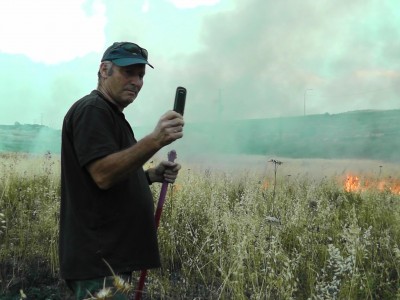
Illegal Shilo settler Moshka takes pictures of his handiwork, torching Palestinian land (Photo by Qaryut villagers)
Red Crescent paramedics went to the scene of the fires at around 6pm, where many villagers had already arrived hoping to put out the fires. However they were prevented from doing so by four settlers and half a dozen soldiers who had turned up to protect the settlers. Villagers were made to stand and watch their future harvest go up in flames. With the fires building up they had nothing to do but argue in vain with the soldiers about the gross immorality of the situation.
The settlers present also prevented the fire from spreading on to the annexed land they have been cultivating. It was clear to see the fires had been deliberately lit as there were many separate fires in a close range, rather than one large fire spreading on the overcast and wet day. Villagers witnessed Moshka, one of the settlers – (who is a regular problem causer; his son is a patrolman for the settlement too) – use a lighter to set fire to their land. The fire was only put out by the arrival of heavy and atypical rain from a thunderstorm an hour later.
Two days prior to this attack the settlers had started ploughing stolen land and cut down four trees. They have been expanding the settlement on the Palestinian side of the highway to Ramallah and Jerusalem. Fifteen dunams of land was torched. Meanwhile two dunums of wheatfields had been burnt in the South Hebron Hills earlier that day.
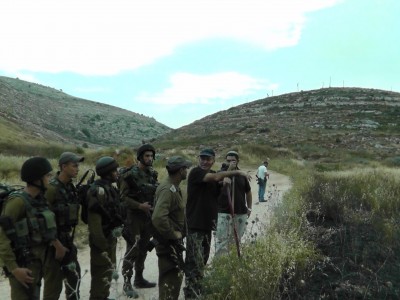
A familiar sight, soldiers and settlers working together (Photo by Qaryut villagers)
Related articles
- Tree planting met by tear gas and settlers’ death threats (palsolidarity.org)
- Witnesses: Settlers open fire at Palestinian homes in Hebron village (altahrir.wordpress.com)
- Settlers Attack Palestinian Property, Graves, Near Nablus (imemc.org)
A life of uncertainty under occupation
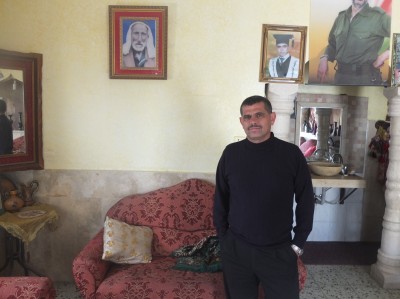
Nasri Sabarna
International Solidarity Movement | May 13, 2013
Beit Ummar, Occupied Palestine – At 3am on 13th May, Nasri Sabarna of Beit Ummar woke up to the sound of Israeli soldiers kicking down his front door. The sound of them shooting tear gas, rubber bullets and sound bombs at people passing his house on their way to the Mosque for morning prayer also woke up his 3 year old granddaughter, whose crying in turn woke up the rest of the Sabarna household.
The 6 jeeps full of soldiers had come to arrest his 21 year old son Achmed – for the fifth time. Achmed is a 21 year old student who has yet to be charged with any crime. As Achmed was not home at the time the soldiers invaded his home, the whole family were ordered to go to the police station in the illegal settlement of Gush Etzyon the following morning at 9am. It was here that Achmed was taken into interrogation. Despite not being guilty of committing any crime, his father does not expect to see him anytime soon. Achmed has already been forced to miss two years of university because of similar incidents, which have cost his family a lot of money – Achmed was arrested for the first time when he was 13 years old.
His father, Nasri is no stranger to the Israeli culture of injustice practiced against Palestinians. At the age of 13, he himself was arrested by Israeli soldiers without charge and imprisoned for 10 months. His whole life has been shaped by the occupation around him. He remembers seeing Israeli bulldozers demolish three historic homes in his village of Beit Ummar at the age of 10 – such events inspired him to become politically active. In 1978 he established the first student council in Palestine, going on later to become mayor of his home village of Beit Ummar. In Israel’s bid to crush any Palestinian political organisation, Nasri was imprisoned for 6 years between 1988 and 1994 for the sole reason of being a member of the political party Fatah.
Nasri’s main concern now is the effect that Israel’s systematic use of administrative detention, harrassment and abuse will have on the younger generations of Palestinians born under occupation. When he was mayor, 40 soldiers broke into his house and destroyed most of their belongings. They wore balaclavas as they did so and terrified his youngest son Abdullah.
Over the following weeks Abdullah’s teachers told his father that his mood had changed, he had become aggressive, argumentative and unusually violent. Nasri sought the help of psychologists from Medicenes Sans Frontiers who worked with Abdullah regularly. He told the psychologists of times where soldiers had lined him and his classmates up when walking home from school and made them jump over their guns before beating them.
The psychological treatment helped Abdullah, who is now ten, to deal with such issues and his behaviour is now back to normal. But Nasri worries for those hundreds of thousands of Palestinian children who are not so lucky to receive treatment. A combination of abuse and detentions coupled with the daily destruction of homes, land, resources and opportunities for young people in the West Bank diminishes any hope they may have for the future and ultimately leads them to seek out revenge through violence.
Nasri emphasised that this is not a struggle between religions, nor are different religious groups inherently incapable of coexisting in harmony. Colonialism and Zionism are the driving forces behind the brutality of the occupation and only granting Palestinians their freedom can bring around real peace. To summarise, Nasri said “No nation can just get rid of another nation.”
Related articles
- Israeli settlers’ attacks continue: Vineyards poisoned in Beit Ummar (occupiedpalestine.wordpress.com)
- Israel’s occupation forces targets medic and injures 17 in clashes in Beit Ummar (occupiedpalestine.wordpress.com)
Jerusalem Day: Marching Over History
Photo blog by Dylan Collins | Al-Akhbar | May 13, 2013
On Wednesday, 8 May 2013, Israel held its annual Jerusalem Day celebration, commemorating its annexation of East Jerusalem and the Old City during the 1967 Six-Day War.
Israeli settlers marched through East Jerusalem neighborhoods carrying Israeli flags and singing, celebrating and asserting their control of what is internationally recognized as the capital of any viable future Palestinian state.
Settlers marching in and out of the Damascus Gate, located directly alongside the largest Palestinian shopping center in the city, were met with a pro-Palestine counter-demonstration.
Hundreds of Israeli police were on the scene to put down the Palestinian counter-demonstration. Israeli police detained upwards of 18 individuals and beat dozens of others. Among the detainees were minors as well as several photographers.


(All photos by Dylan Collins)
UK pro-Palestine activists to hold Nakba Day demo

Press TV – May 11, 2013
Pro-Palestine campaigners from across Britain are to stage a protest in London later this week on Nakba Day, marking the 65th anniversary of evicting Palestinians from their homes by Israelis.
The demonstration is planned to be held at 1 p.m. across Downing Street on Wednesday May 15 in coordination with international rallies around the world.
The Ireland Palestine Solidarity Campaign (IPSC) will be also hosting a series of Nakba Week events between 11 and 17 May, including a speaking tour by Palestinian rights activist Mousa Abu Maria in Belfast, Cork, Limerick and Dublin.
Another protest rally dubbed “End the ongoing Nakba-Palestine’s catastrophe” and organized by Palestine Solidarity Campaign (PSC), will be held outside the British Parliament on May 18.
Palestinians refer to the May 15, 1948, occupation of Palestine as the “Nakba Day,” which means the Day of Catastrophe in Arabic, to mark the expulsion of more than 700,000 Palestinians from their homeland almost 65 years ago.
Israeli forces have wiped nearly 500 Palestinian villages and towns off the map, leaving an estimated total of 4.7 million Palestinian refugees hoping for an eventual return to their homeland more than six decades later.
On May 13 last year, Palestinians commemorated Nakba Day outside Downing Street in London, carrying placards reading, “free Palestine,” “end ethnic cleansing in Jerusalem,” and “end the siege on Gaza.”
Related articles
- Commemorate Nakba Day and Continue Work for Palestinian Rights (altahrir.wordpress.com)
- Despite threats, students to commemorate Nakba at Tel Aviv University (altahrir.wordpress.com)
Featured Video
Armando Mema: Finland Used as New Frontline Against Russia
or go to
Aletho News Archives – Video-Images
New Documentary
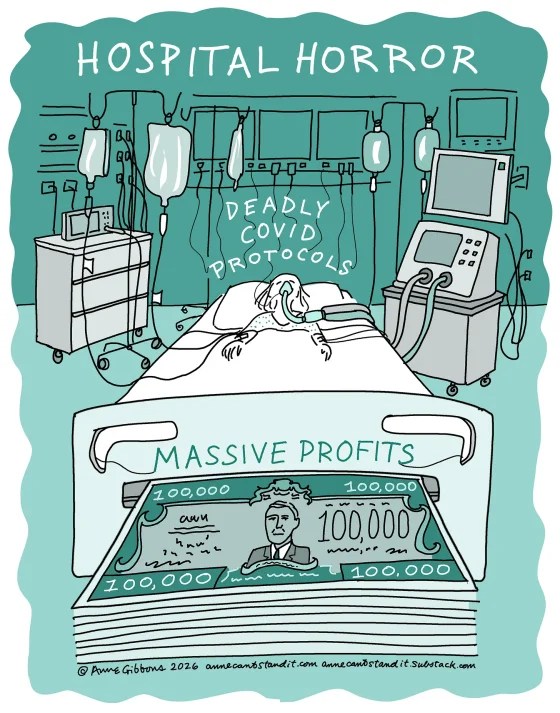
Hospital Horror
Documented in the film,“Bad Medicine”
Blog Roll
 Aletho News
- Armando Mema: Finland Used as New Frontline Against Russia
- Gestapo 2.0? Germany grants spy agencies sweeping new powers
- Franco-Palestinian group seeks court ban on Israeli real estate fair in Paris
- How British foreign policy is frozen in the ruins of empire
- EU risks investor exodus over Russian assets – Euroclear chief
- Moscow warns NATO over troop buildup
- EU leaders prolonging Ukraine conflict to stay in power – Swiss journalist
- Moscow car bombing injures former aide to Ukraine’s ex-PM Azarov
- Yemeni forces make major advances, complete Aden encirclement
- Trita Parsi: Trump’s Swiss Cheese Iran Plan & U.S. Break with Israel?
- If Americans Knew
- An error has occurred; the feed is probably down. Try again later.
- No Tricks Zone
- New Study: Barents Sea Temperatures Were Warmer And Sea Ice Less Extensive In The 1700s Than Today
- German Authorities Start Initiative To Evaluate Public Register For Climate “Disinformation” Spreaders!
- Zonal Asymmetry of Temperature Change in the Antarctic Circumpolar Current
- New Study: The Net Fossil Fuel Contribution To Rising Atmospheric CO2 Has Been Zero For 500 Years
- Germany’s Green Energy Transition Becoming Increasingly Expensive…Another 6 Trillion Euros!
- Sudden Stratospheric Warming, Powerful El Niño Combination May Lead To Extreme Europe Cold, Energy Crisis!
- Two New Studies Find Thwaites Glacier Melt Cannot Be Driven By Human Activity Or A Warming Ocean
- E-Cars Reduce CO2 Emissions By Only 41% Compared To Internal Combustion Engine Vehicles
- Predictions Made By Renowned Climate Professor Over Past Decades Have Been Proven To Be Poor
- New Study Suggests Large Regions Of The Pacific Ocean Have Been Cooling For The Last 80 Years

