Bethlehem – On Thursday, 21 March 2013, US President Barack Obama traveled from Jerusalem to the occupied West Bank town of Bethlehem. He entered the city through its northern entrance along the road Israelis call Route 300.
After all checkpoints had been opened and the roads were cleared of people, Obama’s trip took only a few minutes. However, the Palestinians do not enjoy such luxuries; this route is off-limits and access would necessitate a special permit from the occupation authorities.
If Obama wanted to arrive in Bethlehem via Ramallah, then his journey would not have taken him longer than 25 minutes, if not less. But what do Palestinians’ trips to Bethlehem from Ramallah look like?
Atef Louwais works in Ramallah and lives in Bethlehem. He told Al-Akhbar that he leaves his home every day at 6:30 am to catch a taxi to Ramallah, in the hope that he can get to work by 8 am.
After getting a taxi downtown, he makes his first mandatory stop at the Israeli “Container” military checkpoint at the southeastern entrance to the city.
If Israeli soldiers are in a good mood, they do not hold Louwais for very long, and let him continue his journey through the dangerous road known as Wadi al-Nar, which means valley of fire in Arabic. From there, he arrives at the town of Azarieh (Bethany) on the outskirts of occupied Jerusalem.
This takes him close to the Israeli settlement of Ma’ale Adumim, where Israeli border police vehicles often patrol the adjoining area. Louwais said that these patrols, which the Palestinians call “flying checkpoints,” are the real nightmare for commuters. The occupation soldiers habitually detain passengers, sometimes under the pretext of an ID or car registration check.
Next, according to Saed Abdallah, Atef’s commuting companion, “We head along the route known as the quarry road until we reach the Palestinian village of Hazma. We then take a bypass road around occupied Jerusalem. During that leg of the trip, we get to see the progression of the settlements devouring the lands in and around Jerusalem.”
“If we manage to cross the Jabba checkpoint, we walk a few minutes before reaching the Qalandiya crossing. But there, we will meet with another disaster: the massive traffic jam that comes with the arrival of thousands of commuters every morning and evening, all under the eyes of the occupation soldiers who enjoy torturing and humiliating the Palestinians.”
This is the arduous journey that Palestinian commuters must make every day. The return trip is even more difficult, and might take up to two hours, if not more. Perhaps Obama, who was met with red carpets and empty roads on his arrival, does not know these details. But even if he did, would he care?
March 22, 2013
Posted by aletho |
Ethnic Cleansing, Racism, Zionism, Illegal Occupation | Jerusalem, Palestine, West Bank, Zionism |
Leave a comment
‘Hi Papa .. Don’t worry about me too much, right now I am most concerned that we are not being effective. I still don’t feel particularly at risk. Rafah has seemed calmer lately,’ Rachel Corrie wrote to her father, Craig, from Rafah, a town located at the southern end of the Gaza Strip.
‘Rachel’s last email’ was not dated on the Rachel Corrie Foundation website. It must have been written soon after her last email to her mother, Cindy, on Feb 28. She was killed by an Israeli bulldozer on March 16, 2003.
Immediately after her painful death, crushed beneath an Israeli army bulldozer, Rafah embraced her legacy as another ‘martyr’ for Palestine. It was a befitting tribute to Rachel, who was born to a progressive family in the town of Olympia, itself a hub for anti-war and social justice activism. But Olympia is also the capital of Washington State. Politicians here can be as callous, morally flexible and pro-Israel as any other seats of government in the US, where sharply dressed men and women jockey for power and influence. Ten years after Rachel’s death, the US government is yet to hold Israel to account. Neither is justice expected anytime soon.
Bordering Egyptian and Israeli fences, and ringed by some of the poorest refugee camps anywhere, Rafah has never ceased being a news topic in years. The town’s gallantry of the First Palestinian Uprising (Intifada) in 1987 was the stuff of legends among other resisting towns, villages and refugee camps in Gaza and the rest of Palestine. The Israeli army used Rafah as a testing ground for a lesson to be taught to the rest of Palestinians. Thus, its list of ‘martyrs’ is one of the longest, and it is unlikely to stop growing anytime soon. Many of Rafah’s finest perished digging tunnels into Egypt to break the Israeli economic blockade that followed Palestine’s democratic elections in 2006. Buried under heaps of mud, drowning in Egyptian sewage water, or pulverized by Israeli missiles, some of Rafah’s men are yet to be located for proper burial.
Rafah agonized for many years, not least because it was partially encircled by a cluster of illegal Jewish settlements – Slav, Atzmona, Pe’at Sadeh, Gan Or and others. The residents of Rafah were deprived of security, freedom, and even for extended periods of time, access to the adjacent sea, so that the illegal colonies could enjoy security, freedom and private beaches. Even when the settlements were dismantled in 2005, Rafah became largely entrapped between the Israeli military border, incursions, Egyptian restrictions and an unforgiving siege. True to form, Rafah continues to resist.
Rachel and her International Solidarity Movement (ISM) friends must have appreciated the challenge at hand and the brutality by which the Israeli army conducted its business. Reporting for the British Independent newspaper from Rafah, Justin Huggler wrote on Dec. 23, 2003: “Stories of civilians being killed pour out of Rafah, turning up on the news wires in Jerusalem almost every week. The latest, an 11-year-old girl shot as she walked home from school on Saturday.” His article was entitled: “In Rafah, the children have grown so used to the sound of gunfire they can’t sleep without it.” He too “fell asleep to the sound of the guns.”
Rafah was affiliated with other ominous realities, one being house demolitions. In its report, Razing Rafah, published Oct 18, 2004, Human Rights Watch mentioned some very disturbing numbers. Of the 2,500 houses demolished by Israel in Gaza between 2000-04, “nearly two-thirds of these homes were in Rafah… Sixteen thousand people, more than ten percent of Rafah’s population, have lost their homes, most of them refugees, many of whom were dispossessed for a second or third time.” Much of the destruction occurred so that alleyways could be widened to secure Israeli army operations. Israel’s weapon of choice was the Caterpillar D9 bulldozer, which often arrived late at night.
Rachel Corrie was also crushed by the same type of US manufactured and supplied bulldozer that terrorized Rafah for years. It is no wonder that Rachel’s photos and various graffiti paintings adorn many walls of Rafah streets. Commemorating Rachel’s death anniversary for the tenth time, activists in Rafah gathered on March 16. They spoke passionately of the American girl who challenged an Israeli bulldozer so that a Rafah home could remain standing. A 12-year-old girl thanked Rachel for her courage and asked the US government to stop supplying Israel with weapons that are often used against civilians.
While Rafah carried much of the occupation brunt and the vengeance of the Israeli army, its story and that of Rachel’s was merely symbolic of the greater tragedy which has been unfolding in Palestine for many years. Here is a quick summary of the house demolition practice of recent years, according to the Israeli Committee against House Demolitions, also published in Al Jazeera August 2012:
The Israeli government destroyed 22 homes in East Jerusalem and 222 homes in West Bank in 2011, leaving nearly 1,200 people homeless. During the war on Gaza (Dec 2008 – Jan 2009), it destroyed 4,455 homes, leaving 20,000 Palestinians displaced and unable to rebuild due to the restrictions imposed by the siege. (Other reports give much higher estimates.) Since 1967, the Israeli government destroyed 25,000 homes in the occupied territories, rendered 160,000 Palestinians homeless. Numbers can be even grimmer if one is to take into account those who were killed and wounded during clashes linked to the destruction of these homes.
So, when Rachel Corrie stood with a megaphone and an orange high-visibility jacket trying to dissuade an Israeli bulldozer driver from demolishing yet another Palestinian home, the stakes were already high. And despite the inhumane caricaturing of her act by pro-Israeli US and other western media, and the expected Israeli court ruling last August, Rachel’s brave act and her subsequent murder stand at the heart of the Palestinian-Israeli conflict. It highlighted the ruthlessness of the Israeli army, put to shame Tel Aviv’s judicial system, confronted the international community with its utter failure to provide protection for Palestinian civilians and raised the bar even higher for the international solidarity movement.
The Israel court verdict last August was particularly sobering and should bring to an end any wishful thinking that Israel’s self-tailored judicial system is capable of achieving justice, neither for a Palestinian, nor an American. “I reached the conclusion that there was no negligence on the part of the bulldozer driver,” Judge Oded Gershon said as he read out his verdict in a Haifa District Court in northern Israel. Rachel’s parents had filed a law suit, requesting a symbolic $1 in damages and legal expenses. Gershon rejected the suit, delineated that Rachel was not a ‘reasonable person’ and, once more blamed the victim, as has been the case with thousands of Palestinians for many years. “Her death is the result of an accident she brought upon herself,” he said. It all sounded as though demolishing homes as a form of collective punishment was just another ‘reasonable’ act, deserving of legal protection. In fact, per Israeli occupation rules, it is.
Rachel’s legacy will survive even Gershon’s charade court proceeding and much more. Her sacrifice is now etched into a much larger landscape of Palestinian heroism and pain.
“I think freedom for Palestine could be an incredible source of hope to people struggling all over the world,” she wrote to her mother nearly two weeks before her death. “I think it could also be an incredible inspiration to Arab people in the Middle East, who are struggling under undemocratic regimes which the US supports.”
– Ramzy Baroud (www.ramzybaroud.net) is an internationally-syndicated columnist and the editor of PalestineChronicle.com. His latest book is: My Father was A Freedom Fighter: Gaza’s Untold Story (Pluto Press).
March 21, 2013
Posted by aletho |
Ethnic Cleansing, Racism, Zionism, Illegal Occupation, Solidarity and Activism, Subjugation - Torture, Timeless or most popular | Gaza, Human rights, International Solidarity Movement, Israel, Palestine, Rachel Corrie, Rafah, Zionism |
Leave a comment
Despite their ferocity, the March 9th 2013 clashes in the Noble Sanctuary of Al-Aqsa failed to make international headlines. The virtual news black-out was indicative of prevailing attitudes towards Jerusalem as a whole. Palestinian officials argue, and rightly so, that even the Arab media is complicit in this neglect. With every outrage committed in Al-Aqsa Mosque tensions rise to boiling point, evoking memories of September 2000 when Ariel Sharon ignited the second intifada with his provocative incursion into the Mosque compound.
Palestinians’ daily harassment at checkpoints, house demolitions and arbitrary arrests at the hands of Israelis are surely bad enough. However, the willful desecration of religious sites and Al-Aqsa Mosque in particular, is one indignity too many. In recent days Israel has taken its violations to new levels with a spate of incursions into the mosque, ending with the defiling of the Holy Qur’an.
Can things get worse? Many are expecting a dramatic turn of events. According to the Chief Imam of Al-Aqsa Mosque, Shaikh Ekrima Sabri, “The arrogance of the Israeli occupation and its on-going provocations will ignite the third uprising and no one will be able to stop it.”
For now, the Israelis are hoping that Mahmoud Abbas and his security forces will prevent this from happening. As a pre-emptive measure they have arrested scores of young men across the West Bank. Abbas vows that he will not allow another intifada. In this regard he is consistent, for he was staunchly opposed to the 2000 uprising. Besides, there is also the spectre of what happened to his predecessor, Yasser Arafat, who was blamed for instigating and encouraging the Aqsa Intifada.
There was, however, no justification for last week’s gratuitous violence. There were no attacks on Israelis or their property. The only Palestinian “crime” was that they protested against the defiling of the Qur’an by an Israeli soldier who was filmed kicking the Holy Book days earlier.
Friday’s attack on worshippers in Al-Aqsa Mosque left scores injured. Israeli soldiers and Special Forces fired tear gas and rubber-coated metal bullets at worshippers inside the mosque. The obvious conclusion from this is that Israel is determined to raise tensions in the run up to US President Barack Obama’s visit to the country.
The ugly scenes in Islam’s third most sacred mosque were preceded hours before by the desecration of the graves of revered Islamic scholars and sages in Ma’man Allah cemetery. Eighty-five per cent of the cemetery has been seized to build amusement parks, museums and even dog kennels. Two recent developments illustrated the shambolic approach of western politicians and governments to these manifestly criminal acts. The first was a threat from a gutless Canadian government to cut aid to the Palestinian Authority if it resorts to an international court to seek redress against the Israelis. Canada’s Foreign Minister [John Baird] made the announcement at the annual conference of the largest North American pro-Israel lobby group, AIPAC. In Britain, meanwhile, opposition leader Ed Miliband declared himself to be a Zionist and warned in a speech to the Board of Deputies of British Jews — the nearest thing to AIPAC on this side of the Atlantic that any thought of a boycott campaign against Israel is unacceptable. In both instances the message to the occupier was clear; carry on with more of the same illegal and unjust behaviour, we stand shoulder to shoulder with you.
UN Resolution 2787 called “upon all states dedicated to the ideals of freedom and peace to give all their political, moral and material assistance to peoples struggling for liberation, self-determination and independence against colonial and alien domination”; what happened to its lofty ideals? Countries like Canada and Britain appear to have abandoned them when the country being questioned is Israel.
On the ground, the coordination and division of roles between Israel’s army, Jewish settlers, the judiciary and the politicians continue unimpeded. The sacred Al-Aqsa Mosque compound has now, to all intents and purposes, been turned into an Israeli military outpost, contradicting the universal right to worship that all humanity is entitled to. Indeed, days after International Women’s Day, Palestinian women were prevented from attending classes in the mosques spread around Al-Aqsa’s courtyards. The silence of those critics of Islam who have a lot to say about Muslim women being oppressed is deafening in the face of the brutality of Israeli soldiers against Palestinian women.
In the absence of any meaningful political negotiations the politicians should tell us how to protect Palestinian rights. All they are doing at the moment is giving Israel time to realise its ambitions at the expense of Muslims.
These despicable acts of sacrilege will continue for as long as Israel enjoys the support of the US and its western allies. Every failure to act is an incentive which emboldens Israel to impose its administrative control over Al-Aqsa Mosque, to determine who enters the sacred site and when they can enter. These unjustified and deliberate attempts to insult and humiliate Muslims can only add to the dangerous climate of regional instability and move it inexorably towards the abyss of religious confrontation.
Dr. Daud Abdullah can be reached at: daud@memonitor.org.uk.
March 21, 2013
Posted by aletho |
Ethnic Cleansing, Racism, Zionism, Illegal Occupation, Subjugation - Torture, Timeless or most popular | Al-Aqsa Mosque, Board of Deputies of British Jews, Daud Abdullah, Human rights, Israel, Jerusalem, Mahmoud Abbas, Palestine, Zionism |
Leave a comment

BETHLEHEM – Israeli forces on Wednesday surrounded a new tent village erected by Palestinian activists in Eizariya east of Jerusalem.
An Israeli military spokeswoman said hundreds of Palestinians established “an illegal settlement” and that security forces were in the area “to maintain order.”
She said soldiers arrested the driver of a truck loaded with equipment including tents.
Mohammad Khatib, a spokesman for the activists, said soldiers handed protesters a document declaring the area a closed military zone.
“We are staying. We are Palestinians, and we will stay here. They will have to evacuate us. They will have to use their power to do it, but we will not do it by ourselves,” Khatib told Ma’an.
“We are staying here because this is Palestinian land. This is our land, and no one has a right to evacuate us.”
As US President Barack Obama arrived in Israel, activists set up 15 tents on a hillside near the site of the Bab al-Shams protest village that Israeli forces tore down in January.
They have named the new neighborhood Ahfad Younis, after the main character in the novel Bab al-Shams.
In a statement, the activists described the initiative as “first, to claim our right as Palestinians to return to our lands and villages, second, to claim our sovereignty over our lands without permission from anyone.”
The activists said it aimed to highlight their opposition to the Obama administration’s policies in the region, saying that it has been “complicit in Israeli occupation and colonialism.”
“An administration that used the veto 43 times … in support of Israel and against Palestinian rights, an administration that grants military aid to Israel of over three billion dollars annually, can’t have any positive contribution to achieve justice,” the statement said.
March 21, 2013
Posted by aletho |
Ethnic Cleansing, Racism, Zionism, Illegal Occupation, Progressive Hypocrite | Al-Eizariya, Bab Al-Shams, Israel, Jerusalem, Ma'an, Obama, Palestine, West Bank, Zionism |
Leave a comment
As American President Barack Obama hailed the ‘resounding success’ of Israel’s Is US-financed Iron Dome antimissile system on the first of his tour there, missile experts have newly unveiled that Iron Dome’s success rate during the regime’s November war on Gaza was as low as zero.
While Obama used his Wednesday’s tour of an Iron Dome installation, “celebrating a technological wonder built with the help of American dollars” and seeking to showcase US support of the Zionist regime, there was no mention about the “intensifying debate” on whether the promotion of the system’s success rate was “more illusory than real,” says a The New York Times article on Thursday.
Contrary to Israeli claims that Iron Dome’s success rate in destroying incoming Palestinian rockets during the regime’s massive military strikes against the blockaded Gaza strip was 90 percent, studies by weapons experts in the US and Israel suggest that the anti-missile system “destroyed no more than 40 percent” of the rockets “and perhaps far fewer,” the report emphasizes.
Many rockets, they argue, were “merely crippled or deflected” but not destroyed as claimed, allowing intact or dying rockets to fall on populated areas.
Following the wildly exaggerated claims by the Israeli regime about Iron Dome’s success rate, the US Congress also described the system as “very effective,” pledging an additional USD680 million for deployments through 2015.
According to the report, Richard Lloyd, a weapons expert who has written a critique of Iron Dome for engineers and weapons designers, and Theodore Postol, a physicist at Massachusetts Institute of Technology (MIT) who helped reveal major Patriot antimissile failures in 1991, analyzed new videos on the performance of the Israeli anti-missile system and found that Iron Dome “repeatedly failed to hit its targets head-on.”
“It’s very hard to see how it could be more than 5 or 10 percent,” the report quotes Dr. Postol as saying.
Moreover, the daily adds, Mordechai Shefer, an Israeli rocket scientist formerly with Rafael, Iron Dome’s maker, studied about two dozen videos and, in a study published last month, “concluded that the kill rate was zero.”
Meanwhile, the paper underlines, Iron Dome’s performance is the key to a potential Israeli decision whether to take military action against the Islamic Republic as it has repeatedly threatened, hinging on its estimate of possible retaliatory costs, “including damage inflicted by rockets fired from southern Lebanon and the Gaza Strip,” not to mention Iran’s own long-range ballistic missiles.
Amid the growing anxiety over any Iranian retaliatory strikes on Israel in case of an American or an Israeli attack against the country, as often threatened by officials of both allies as a ploy aimed at pressuring Tehran into abandoning its right to explore peaceful nuclear technology, “the Israeli public saw Iron dome’s (reported) early successes” against rocket fire from Gaza “as proof” that it can tolerate retaliatory strikes, the report adds, citing Israeli antimissile program’s founder, Uzi Rubin.
Following the Gaza cease-fire last year, the report notes, Lloyd began scrutinizing “hundreds of online videos of Iron Dome in action,” looking for “unambiguous signs of success: pairs of fireballs (at night) or smoke clouds (during the day) that formed as speeding fragments blew up a warhead.”
However, “he found very few,” the daily adds, citing Lloyd.
Lloyds method of video analysis won scientific backing during the 1991 US-led Persian Gulf war against Iraq, as the American military boasted that its Patriot interceptors, built to protect Israel against potential missile attacks by Iraqi dictator at the time Saddam Hussein, had succeeded 96 percent of the time.
MIT scientist, however, “analyzed broadcast videos and found only misses,” according to the Time’s report.
In Israel, meanwhile, Lloyd won support from Reuven Pedatzur, a military analyst and former fighter pilot “long skeptical of his country’s antimissile claims,” who found an Israeli police report saying that 109 rockets launched from Gaza – roughly twice the military’s figure – hit urban areas.
Pedatzur further discovered “evidence of wide destruction” inflicted by rockets fired by Palestinian Hamas militants. A Finance Ministry report registered 3,165 claims of property damage, “including to cars and buildings in cities like Ashdod and Beersheba, both protected by Iron Dome battalions.”
March 21, 2013
Posted by aletho |
Deception, Militarism | Israel, Palestine, United States |
Leave a comment
BETHLEHEM – Palestinians on Wednesday erected a new “village” encampment in Eizariya to stake their sovereignty and claims to return to their towns and villages.
Activists said they set up 15 tents on a hillside near the original “Bab al-Shams” village that Israeli forces tore down two months earlier.
In a statement, the activists described the initiative as “first, to claim our right as Palestinians to return to our lands and villages, second, to claim our sovereignty over our lands without permission from anyone.”
The action coincided with US President Barack Obama’s arrival at Ben Gurion International Airport.
The activists said it aimed to highlight their opposition to the Obama administration’s policies in the region, saying in the statement that it has been “complicit in Israeli occupation and colonialism.”
“An administration that used the veto 43 times … in support of Israel and against Palestinian rights, an administration that grants military aid to Israel of over three billion dollars annually, can’t have any positive contribution to achieve justice,” the statement said.
March 20, 2013
Posted by aletho |
Ethnic Cleansing, Racism, Zionism, Illegal Occupation, Progressive Hypocrite, Solidarity and Activism | Al-Eizariya, Bab Al-Shams, Israel, Obama, Palestine, Zionism |
Leave a comment
JERUSALEM – Last month, an international fact-finding mission on Israeli settlements in the Occupied Palestinian Territory (OPT) commissioned by the UN Human Rights Council found that settlements constituted a violation of international human rights and humanitarian law and called on Israel to stop all expansions immediately and withdraw from settlements.
A controversial Israeli plan, known as E-1, to build thousands of housing units and hotel rooms near the Ma’ale Adummim settlement, has garnered much attention in the media because it would sever Palestinian East Jerusalem from the rest of the West Bank. (See IRIN’s briefing on E-1 here.)
But at the same time, Israel has been moving forward with equally controversial settlement plans under less scrutiny and with unusual speed.
As US President Barack Obama prepares to visit the region this week, IRIN takes a look at some of the details that have been overlooked in the discussion.
What’s the Giv’at HaMatos plan?
According to Israeli NGO Ir Amim (“City of Nations”), which works to preserve Jerusalem as a home for both Jews and Palestinians, one settlement plan of “critical importance” is Giv’at HaMatos.
In a sense, Giv’at HaMatos does in the south what E-1 does in the east. The planned large housing and hotel complex at the southern perimeter of Jerusalem would further disrupt the contiguity of land between East Jerusalem and the rest of the West Bank required for a future Palestinian state, seriously impeding a two-state solution, research and rights groups say. It would also mark the first new settlement construction in Jerusalem since 1997.
“All construction is problematic but there are several plans that are, in our view, more dangerous if implemented,” Hagit Ofran, director of the Settlement Watch project at the Israeli NGO Peace Now, told IRIN. “Giv’at HaMatos is the most dangerous plan that is now approved.”
Part of the plan – to build 2,612 units – was approved by the Jerusalem Regional Planning Committee on 19 December.
Most of Giv’at HaMatos is currently uninhabited, but according to the International Crisis Group (ICG), which recently released a two-part report on the future of East Jerusalem, its build-up would cut off Arab neighbourhoods in southern Jerusalem, like Beit Safafa and Sharafat, rendering them “Palestinian enclaves”.
Giv’at HaMatos would connect the dots of several other planned or expanding settlements along southern Jerusalem – including Giv’at Yael in the southwest; and Har Homa and East Talpiyot in the southeast – forming “a long Jewish continuum severing Bethlehem’s urban continuum from Palestinian Jerusalem”, ICG said. Last year, the Israeli government also approved more than 2,000 new units in neighbouring Gilo.
This kind of attachment to Jewish expansions could make peace negotiations even harder.
“From an Israeli public opinion perspective, Giv’at HaMatos is in the municipal border of Jerusalem,” Ofran said. “It’s considered a legitimate part of Israel.”
Barak Cohen, the Jerusalem Municipality’s adviser for foreign affairs and media, told IRIN Giv’at HaMatos is part of Jerusalem’s “natural and much-needed growth”, allowing both Arab and Jewish landowners to develop their properties.
Indeed, part of the Giv’at HaMatos plan, approved on 18 December, allows for the building of 549 units for Palestinians – though Betty Herschman, director of international relations and advocacy at Ir Amim, points out much of it retroactively legalizes building that has already been completed. The figures, she added, amount to just over one-fifth of the Jewish expansion.
“For many Arab East Jerusalemites, the battle for their city is all but lost.”
Still, Cohen insisted, the development would benefit Jerusalem as a whole: “Not planning and developing Jerusalem neighbourhoods ultimately harms all residents and landowners – Arabs and Jews alike.”
Last year, Israel also issued tenders for the construction of 606 new housing units north of East Jerusalem, in the Ramot settlement, just north of the Green Line marking the border between Israel and the West Bank, and approved another 1,500 units in the neighbouring settlement of Ramot Shlomo, according to Ir Amim.
What other settlements are planned?
Beyond Jerusalem, there was movement on a number of other settlements projects in disputed areas, according to Settlement Watch.
In June 2012, the Israeli government announced it would build 851 new units in the West Bank, including more than 230 in the controversial settlements of Ariel and Efrat. Like Giv’at HaMatos, these two settlements make a contiguous Palestinian territory impossible, Settlement Watch says.
Overall, settlements expanded much faster than usual last year.
In 2012 the Israeli government approved the construction of 6,676 settler housing units in the West Bank, compared with 1,607 in 2011 and several hundred in 2010, according to Peace Now.
For plans that were already approved, it issued more than 3,000 tenders to construction contractors – more than any other year in the last decade, Peace Now said. Construction has actually begun on 1,747 homes.
Regardless of the settlements, Palestinians, especially in Area C, are under immense pressure. Recent weeks have seen a considerable upswing in demolitions of Palestinian structures. According to the Displacement Working Group, a grouping of aid agencies helping displaced families, Israeli forces destroyed 139 Palestinian structures, including 59 homes, in January – almost triple 2012’s monthly average. The demolitions occurred in East Jerusalem and the West Bank – with a majority taking place in Area C – and left 251 Palestinians, including over 150 children, displaced.
The office of the Coordinator of Government Activities in the (Palestinian) Territories (COGAT) told IRIN there was no connection between the removal of unauthorized buildings and the construction of Israeli settlements. “All construction in the West Bank is subject to building codes and planning laws and unauthorized constructions are dealt with accordingly,” the office said in an email.
What are the knock-on effects?
Settlements are often discussed through the lens of their illegality under international law or as obstacles to a peace agreement between Israel and the Palestinians. But everything associated with the settlements – including Israeli-only infrastructure, the separation barrier, military checkpoints, restrictions on Palestinian freedom of movement, suppression of freedom of expression and political life, and control of Palestinian natural resources – causes a ripple effect through Palestinian society, adversely impacting the people.
The UN estimates there are now 520,000 Israeli settlers in East Jerusalem and the West Bank, with 43 percent of the land there allocated to local and regional settlement councils. According to the UN Secretary-General, Israel has transferred roughly 8 percent of its citizens into OPT since the 1970s, altering the demographic composition of the territory and furthering the Palestinian people from their right to self-determination.
Baker, of the Israeli Prime Minister’s Office, said a future Palestinian state should include a Jewish minority. “The assumption behind this… is that Jews have no right to live in the West Bank, an assumption that we reject. In fact we see ourselves as the true indigenous people of this land.”
But Israeli settlements have violated Palestinian rights to equality under the law, to religious freedom and to freedom of movement, according to the UN fact-finding mission. They have also eroded Palestinian access to water and to agricultural assets, and the ability to develop economically, it said.
For example, Bedouins from the Palestinian village of Khan Al Ahmar, northeast of E-1, cannot sell their dairy products at their traditional Souq Al Ahmar market any more. Because of movement restrictions (they hold West Bank IDs and lack the proper permits to enter East Jerusalem), they cannot get there.
The UN secretary-general has said that Palestinians “have virtually no control” over the water resources in the West Bank, with 86 percent of the Jordan Valley and the Dead Sea under the de facto jurisdiction of the settlement regional councils.
There is a statistical correlation between Palestinians’ proximity to settlements and their rates of food insecurity, according to a UN and government survey, which found that one quarter of Palestinians who live in Area C, home to the largest number of settlements in the West Bank, are food insecure. In Areas A and B, the average rate of food insecurity is 17 percent.
In addition, “all spheres of Palestinian life are being significantly affected by a minority of settlers who are engaged in violence and intimidation with the aim of forcing Palestinians off their land,” the mission said.
Operation Dove, an international organization working in the Palestinian village of At-Tuwani and the South Hebron Hills, reported that Palestinian children have a very hard time going to school due to settler attacks.
The UN and rights groups say radical settlers use violence against Palestinians with impunity and their illegal outposts are often recognized and retroactively legalized by the government.
Since the occupation began, Israel has detained hundreds of thousands of Palestinians, some of them without charge, and some of them children. Most of the minors are arrested “at friction points, such as a village near a settlement or a road used by the army or settlers”, the fact-finding mission said.
Israel uses what they term “administrative detention” when it considers the detainee a threat to the security of the state.
Ir Amim’s Herschman says Israel is also attempting to create a “greater Jerusalem” through additional means, for example: the Israeli separation barrier, planned national parks, and the construction of highways dividing villages, dispossessing Palestinians of their land and making it harder for them to access services like schools and mosques.
In recent weeks, residents of the Palestinian village of Beit Safafa have been protesting against the planned extension of the Begin Highway that would divide their village in order to connect major Israeli settlement blocks outside the city to Jerusalem.
The planned root of the separation barrier, in addition to a potential national park around the perimeter of the barrier would also close off nearby Palestinian village al-Wallajeh.
The planned route of the barrier extends all the way around and far beyond Muale Adummim and in other areas south and north of Jerusalem. “These lines are a unilateral declaration of a much greater Jerusalem, a unilateral expanding of the boundaries, an exponential increase,” she told IRIN.
Or as the ICG put it, “for many Arab East Jerusalemites, the battle for their city is all but lost.”
March 19, 2013
Posted by aletho |
Ethnic Cleansing, Racism, Zionism, Illegal Occupation | East Jerusalem, Human rights, IRIN, Israel, Israeli settlement, Jerusalem, Palestine, United Nations Human Rights Council, West Bank, Zionism |
Leave a comment
Israel arrested the brother of former-Palestinian prisoner Ayman Sharawneh in the West Bank early Monday just hours after the long-term hunger striker was released from Israeli prison and deported to the Gaza Strip, Ma’an News Agency reported.
Israeli forces raided the home of Jihad Sharawneh, 24, at dawn Monday in Deir Samir, southwest of Hebron.
An Israeli military spokesman told Ma’an that Jihad Sharawneh was arrested and taken in for security questioning.
Amjad Najjar, head of the Hebron branch of the Palestinian Prisoners Society, denounced the arrest as an act of revenge to punish the Sharawneh family.
Ayman Sharawneh signed an agreement with Israeli authorities to be deported to Gaza for 10 years, bringing an end to his eight-month-long hunger strike, Qadura Fares, head of the Palestinian Prisoners Society, said in a statement.
He arrived at the Erez crossing Sunday night, where a Palestinian ambulance was waiting to take him into Gaza. Hundreds of people crowded at the Palestinian side of the checkpoint to greet him.
Fares said that Israel had previously proposed to deport Sharawneh outside of Palestine, but then offered to exile him to Gaza after he refused to leave his homeland.
Sharawneh agreed to be deported after months of hunger striking to protest his detention, and after numerous warnings by doctors regarding the severe deterioration in his health, Fares added.
The 36-year-old father of nine had previously demanded that authorities allow him to return to Hebron to be with his family.
The under secretary of the PA Ministry of Detainee Affairs, Ziad Abu Ein, told Ma’an that Sharawneh’s agreement was signed without notifying the ministry.
Earlier Sunday, the Minister of Detainee Affairs Issa Qaraqe said the Palestinian Authority rejected the deportation of prisoners as political blackmail.
Sharawneh was released in the October 2011 prisoner swap deal between Israel and Hamas but was rearrested in January 2012 and accused of violating the terms of his release.
Israeli authorities refused to reveal how Sharawneh violated his release terms, even to his lawyers, and he was jailed without charge or trial.
Israeli prosecutors sought to cancel Sharawneh’s amnesty and jail him for 28 years, the remainder of his previous sentence. He went on hunger strike to demand his release.
Abu Ein said Israeli authorities were pressuring Samer Issawi, who has been on hunger strike for 228 days, to make a similar deal.
(Ma’an, WAFA, Al-Akhbar)
March 18, 2013
Posted by aletho |
Civil Liberties, Ethnic Cleansing, Racism, Zionism, Illegal Occupation, Subjugation - Torture | Human rights, Israel, Palestine, Palestinian prisoners in Israel, West Bank, Zionism |
Leave a comment
As interim Venezuelan President, Nicolas Maduro’s first protocol act was to hold talks with a Chinese delegation, in order to reinforce economic ties with the People’s Republic. Following the meeting on March 8, Maduro declared that “China is the biggest economic driving force of the new world and a main political actor in world decisions.” The meeting was broadcast live on local Venezuelan media and on big screens around the military academy, where Chavistas were paying an emotional farewell to their leader Hugo Chavez.
The meeting concealed a double meaning: It served as a public political cover against anyone interested in destabilizing the Bolivarian revolution, as had occurred in 2002 with the failed coup against Chavez. Officials in Washington likely took note. The second implicit meaning was to reinforce the spirit of the Chavista revolution. It represents a continuity with Chavez’s foreign policy: the Bolivarian revolution which started 14 years ago will pursue Chavez’s main personal goal of creating a multipolar world grounded on strong anti-imperialism.
In his speech at the funeral ceremony, Maduro lightly opened up to the United States, who had dispatched two low-profile delegates to the ceremony, but clearly stated that his future duty would lie in “shap[ing] a world where there are no hegemonic powers, especially here in America.”
Under Hugo Chavez’s presidential mandates, Venezuela attempted to establish a multipolar world order in order to challenge US hegemony. Since 1999, Chavez increased Venezuela bilateral relations with countries such as China, Russia, Belarus, Iran, Syria and Libya. He personally built a bridge between leftist countries in Latin America and this multi-polar world.
Chavez’s international relations were indeed very much self-oriented and grounded in strong friendships. Most of these friendly countries assisted with high profile delegations at the funeral and considered Chavez’s death a personal loss more than the passing of a mere political ally.
Chavez’s Legacy and the Middle East
However, the main focus of Chavez’s foreign policy has been the Middle East and especially the Arab cause, which was considered a priority. Chavez found in the Middle East a common ground for his anti-imperialist policy and good allies not fearful to speak out against US hegemony. In the last decade, Venezuela signed several agreements with Middle Eastern countries, especially Syria, Libya and Iran, concerning natural resources, housing and trade, but mainly preparatory in order to reinforce the political alliance.
The future of these strong ties between Venezuela and Middle Eastern countries hostile to United States represents the main question after Chavez’s death.
Several delegations from the Middle East arrived in Venezuela to pay their condolences to the Venezuelan president. Syrian President Bashar al-Assad sent a telegram to Maduro and a delegation to assist with the funeral. Iranian President Mahmoud Ahmadinejad spent around 24 hours in Caracas and attracted much attention from Venezuelan media. During the ceremony, Ahmadinejad kissed several times the coffin and finally raised his fist in homage to his political ally and close friend.
Venezuelan media followed him around until his last steps on Venezuelan soil at the airport of Maiquetia. The relationship between Venezuela and Iran was solidified with Ahmadenijad’s rise to power in Iran in 2005, and with the consolidation of the Bolivarian political project in Latin America. Ahmadinejad traveled to Latin America on several occasions and received numerous visits from Latin American leaders.
On the other side, Chavez opened Latin America to Ahmadinejad as well, especially in terms of ideological and trade relations with other leftist governments in the region and especially with the members of the ALBA (Bolivarian Alliance for the Americas).
Facing international media speculations on the Venezuelan vacuum and about the end of bilateral relations between Iran and Venezuela after Chavez’s death, Ahmadinejad declared upon landing in Iran that “the Iranian nation has strong ties with revolutionary nations and we will help strengthening these ties. Thus, nobody should believe that our relations will be weaker because of the death of Chávez.”
The Iranian state PressTV also reported the declaration of Iran’s Vice-President for International Affairs Ali Saeedlou affirming that the death of Venezuelan leader Hugo Chavez would not undermine relations between Tehran and Caracas, and that it was wrong to consider ties with Venezuela as based merely on a personal relationship.
Beside the condolences from regional heads of states and the rush to discredit speculations, the main question remains after Chavez death: Will his successor be able to manage such a self-oriented foreign policy and stance toward the Middle East?
The Arab Spring and Venezuela Last Stances on the Middle East
In the last months, Hugo Chavez and Nicolas Maduro publicly supported China and Russia’s veto against UN Security Council resolutions to sanction Syria. In previous years, Chavez’s government expelled the Israeli ambassador as consequence of Operation Cast Lead in the Gaza Strip, and he vehemently criticized foreign intervention in Libya, supporting instead his close friend Muammar Gaddafi against what he considered another imperial aggression.
The Arab Spring destabilized Chavez’s relations with some Middle Eastern countries, and Libya was the first loss. But Adriana Boersner, director of the Venezuelan think tank Diploos, is skeptical that the Arab Spring represented any serious inconvenience for Venezuela: “the bilateral relations with Libya were merely related to an ideological component and they were very pragmatic in terms of trade, social, educational and cultural agreements. Of these 150 treaties, only 10 were being ratified by the assembly. Definitely the death of Gaddafi did not greatly affect Venezuela.”
Gaddafi’s death instead affected Hugo Chavez on a personal level. According to Reinaldo Bolivar, vice-minister of foreign affairs for Africa, “Venezuela lost contact with Libya but maintains good relations with other countries in the area.”
Indeed, Venezuela managed to maintain good relations with other countries from the region even if with different perspectives on the events in the Middle East – at least on an official level. That is the case especially with Qatar. The honeymoon between the emir and the comandante was mainly motivated by Chavez’s attempt to emulate the al-Jazeera model with his own creation, TeleSUR.
With the spreading of the Arab Spring to Syria, the agreements between the channels almost faded. But Venezuelan criticism toward al-Jazeera and Qatar’s role in Syria was left to low profile ministers and grassroots groups or individuals. The government publicly remained silent.
According to Reinaldo Bolivar, “in terms of Venezuelan politics toward the Middle East and North Africa, Maduro’s government will act in perfect continuity with Chavez’s mandate. Venezuelan foreign policy will be coherent with the Plan de la Patria of 2013-2019, which basically aims to create a multipolar world, express international solidarity with the oppressed people of the world, the defense of sovereignty and the complete rejection of foreign intervention.”
The Plan de La Patria is to be considered a road map for the coming years of the Bolivarian revolution and it was written a few months before Chavez’s death. It indicates that Venezuela’s prerogative in foreign policy is to shape a multipolar world which aims to preserve peace based on the principle of respect for all countries’ sovereignty.
Maduro, the Chavistas and the Middle East
Doubts persist if Maduro will be able to continue Chavez’s multipolar path and will be able to keep political alliances strongly based on friendship. Maduro was directly chosen by Chavez as his successor in his last public speech on December 8, before he traveled to Cuba for medical treatment against cancer.
Venezuelan analysts have different perspectives on the future of their country’s relations with the Middle East. Carlos Romero, professor at the Universidad Central de Venezuela, reminds us that “even if Chavez established very strong and personal relations with Middle East leaders, Maduro was his minister of foreign affairs for seven years before becoming vice president. He personally knows all these country’s leaders, and probably the relationship with the Middle East will be even deeper in the next years.”
Adriana Boersner instead maintains that after Chavez’s death “Venezuelan foreign policy will be deeply affected. During Chavez’s self-oriented mandates, the foreign ministry was reduced to a merely bureaucratic institution and it did not participate actively and autonomously in shaping international relations with other countries.”
Chavez’s self-oriented relationship with Middle Eastern countries is evident, too, from the limited awareness in terms of foreign policy at the grassroots level of the Bolivarian revolution.
Roso Grimau, delegate of the Venezuelan Communist Party and member of the Committee of International Solidarity in the Venezuelan Assembly considered that “Chavez personally accelerated Venezuela’s relations with the Middle East and Arab nations, because he considered it a right cause. Relations have never much been at the popular level, but now it is the duty of the Venezuelan people to engage and internationalize at its grass root’s basis, the Bolivarian revolution, by expanding ties with people who are facing imperialist aggressions, especially in the Middle East.”
That work needs to be done already. And beside this internationalist stance, Chavistas in the streets in the days of his funeral were sincerely unaware of who Mahmoud Ahmadinejad was when he was interviewed on local television. The basis of the Bolivarian revolution seems definitively uninterested in foreign policy and the Middle East, in particular at this stage.
The Future Bolivarian Roadmap to the Middle East
Maduro will probably win the next elections and act with greater pragmatism. It is not clear if other Latin American leftist leaders such as Evo Morales, Rafael Correa, Raul Castro or Daniel Ortega will follow in Chavez’s footsteps. Chavez’s path toward the Middle East was based on direct confrontation with the United States in the background, and not all these leaders seem interested or able to support that stance.
On the other side, the popular basis of the revolution neither appears ready nor interested in conducting and building solid relations with their counterparts in the Middle East.
The key lies in Maduro’s strength on the international scene. According to Carlos Romero, “Maduro will definitely continue on the path established by Chavez and he will maintain the basic axis of Venezuelan foreign policy for the Middle East, which is based on the support for a nuclear Iran, the rejection of foreign intervention in Syria and the condemnation of the occupation in Palestine.”
At least in the near future, the shadow of Hugo Chavez will guarantee the maintenance of strong relations between Venezuela and Middle East countries. Chavez was an extraordinary charismatic figure, but he shaped strong friendships that will be difficult to replace.
March 17, 2013
Posted by aletho |
Solidarity and Activism, Timeless or most popular | Chavez, Hugo Chávez, Latin America, Middle East, Nicolás Maduro, Palestine, United States, Venezuela |
Leave a comment

On 16 March 2013 the South Hebron Hills Popular Committee built a tent to protect school children from Tuba and Maghayir Al Abeed while they wait for their military escort. Hours after the ceremonious construction of the tent — attended by villagers, school children, internationals and various media outlets — was over, the Israeli military demolished the tent and arrested one of the internationals present.
The schoolchildren coming from Tuba and Maghayire Al Abeed walk between the Israeli settlement of Ma’on and the outpost of Havat Ma’on in order to get to school in At-Tuwani. Since 2001 settlers have repeatedly attacked the children along this route, preventing most of the children, who feared for their safety, from being able to attend school. In 2004 volunteers from Christian Peacemaker Teams (CPT) and Operation Dove began accompanying the children along the path, but the violent attacks continued. These attacks brought the matter to the attention of the Children Rights Committee of the Knesset, which established in November 2004 a military escort to protect the children.
Since November 2004, CPT and Operation Dove have constantly monitored the military escort, documenting the failures of the Israeli army as well as settler violence toward the children. During the school year 2011-2012, the volunteers of Operation Dove and CPT published a report, The Dangerous Road to Education, which found that in 35% of cases the military escort was late. In addition, in 48% of cases, the military escort arrived late after school, forcing the children to wait for a total time of about 21 hours. There is nothing to shelter the children, some as young as six years old, from the elements as they wait for their unpunctual military escort.
The Popular Committee wanted to give the children a tent to shelter them while they wait. The event had around one hundred in attendance. These included some of the children whom the tent was being made for, teachers and administrators from the school, CPT and other international organizations, Palestinians from At-Tuwani and surrounding villagers and the media. The crowd was immediately met by soldiers who filmed all the attendees and took down Palestinian flags that children had put up around the building area. The children played and chanted in front of the soldiers while settlers on the next hilltop yelled down at them, “Kill all the Arabs.” The tent was completed and christened “Michele’s tent” after the late daughter of the Italian woman who funded the project.
As the afternoon wore on the crowd started to leave. Two hours after the tent was build the Israeli military demolished it and arrested one of the international volunteers who had remained there. The volunteer was released, but must leave the West Bank for two weeks. The Popular Committee plans to rebuild the tent, but as for now the schoolchildren will have to wait out in the rain when they return to school on Sunday.
March 16, 2013
Posted by aletho |
Ethnic Cleansing, Racism, Zionism, Subjugation - Torture | Christian Peacemaker Teams, Israel, Israeli settlement, Ma'on Har Hebron, Operation Dove, Palestine, Tuwani, West Bank, Zionism |
Leave a comment
Rachel’s Legacy
“Parents can be awakened by their children”
–Cindy Corrie, 2003 Commencement address
Ten years have now passed since we received the terrible phone call telling us our young friend Rachel Corrie was dead. We had gone to see her off the drizzly winter day she left Olympia to work in Gaza with the International Solidarity Movement. We couldn’t know that we were seeing her for the last time, nor foresee the legacy she would leave as she said goodbye to her hometown, and stepped into history.
Rachel would be killed on March 16, 2003, crushed beneath an armored Israeli bulldozer as she tried to prevent the demolition of a Palestinian home in the Gazan border town of Rafah.
It seems likely that Rachel’s story would by now have faded from memory as just one more among the thousands of deaths in Gaza over the past decade, but for the efforts of her parents, Craig and Cindy. Having no prior involvement in the Israel-Palestine issue, they immersed themselves in a process of self-education and public activism so relentless and untiring that even now it leaves their friends slack-jawed in amazement.
Rachel’s family has witnessed an eventful decade—in the Middle East and at home. They’ve pursued legal struggles, led public campaigns, traveled the world, and kept Rachel’s story alive through books, plays, films and media outreach.
We sat down with them recently to talk about the changes they’ve seen.
Working Inside the System
As we detailed in an article five years ago, much of the Corries’ initial efforts focused on moving the three branches of the American government to deliver justice after Rachel’s killing. They pressed the Executive branch, through the State and Justice departments, for an investigation, they used the court system for a civil trial against the Caterpillar Corporation, and they sought a Congressional resolution calling for a U.S.-led investigation. As hardly needs saying, these efforts failed spectacularly in their primary goals. The Corries challenged—and for many newcomers, exposed–a powerful and deeply entrenched foreign policy apparatus that grants virtual impunity to Israel, even for the killing of an American peace activist.
But the Corries take a long view, and try to see the good. Cindy says, “Many people in government, particularly in the diplomatic corps, are there for good reasons– there are people with good hearts. I think their willingness to meet with us is partly because they know that Rachel’s story does have significance, around the world, and in the Arab world particularly. And certainly they know it has resonance in Gaza and with Palestinians.”
Craig and Cindy know that they carry an authority that few others can claim, and although it was unsought, they use it conscientiously.
“It’s been ten years for us now, and for our family,” added Craig. “That includes extended family like sisters and brother in laws, and it’s amazing how many people who are high up in government we’ve talked to. Either them or their assistants… all these people now have some understanding of the situation, and I think they have some respect, they can’t just write us off as crazy.”
“In the last attack on Gaza, in November, we were there. Israel started to drop bombs, and we woke up to a flash of light, then the concussion–it was that close to us. When we came back, we went to the State Dept. We spent about an hour talking to the head of the Israel-Palestine desk. They’ve never been to Gaza, none of these people knew anything about Gaza.” In a sense, the Corries have become civil society’s ambassadors to Gaza, a region abandoned by U.S. (and European) diplomatic isolation since the rise of the democratically elected Hamas government there.
Cindy said, “The State Department doesn’t have anybody in Gaza. I think many of them know that’s maybe not the most productive policy for them, it’s difficult when they don’t have people in places. We shared with them that we went to the funeral of a young boy killed playing soccer in front of his house in Khan Younis by the Israeli military. I went with his mother, and we talked to his friends who showed us where they had been playing soccer. You realize that for these children, that’s an experience they may carry with them forever. If you want to make progress, you have to stop these kinds of situations that have to fill people with so much hurt and rage. It shouldn’t happen.”
The Civil Trial in Israel
The Corries, at their own expense, have spent the last eight years pursuing a wrongful death lawsuit in Israeli courts, charging the State of Israel and its Defense Ministry with the intentional and unlawful killing of their daughter. If the effort to move the U.S. government was Herculean, the task of moving the Israeli government would prove Sisyphean. Personally attending all of the courtroom proceedings, the family logged some nine months in Israel for the trial. Seeking accountability, not money, they asked for $1 in symbolic damages.
Craig explained, “The courts are the way that we have agreed as a society to settle our disagreements nonviolently. That’s the official way to do it. And so I feel very strongly that you have to demand that they work. And so we did.”
They encountered double standards from the outset. Cindy told us,
”They didn’t want to hear anything about home demolitions. In some ways, Rachel’s lost in the trial. She’s just a dead person. And the reasons for why she was there, the home demolitions and all that was happening, oh they bristled so. When B’tselem gets brought up, the Israeli human rights organization that’s reporting what’s happening in the Occupied Territories, they just brush it away: ‘What’s B’tselem? We don’t trust their data!’ It’s so shocking because this is the Israeli state. That’s what we were seeing, the Israeli state, in the courtroom. And it’s very shocking, the lengths to which they will go to prevail.”
“They had a woman who testified as an ‘expert’ on the International Solidarity Movement—she had never done any research on ISM. She was the military spokesperson when Rachel was killed and so that made her an expert on ISM. She submitted to the court a 100-page report demonizing ISM, demonizing Rachel.”
Craig broke in: “She submitted that two weeks before she was coming to testify, so it’s all in Hebrew. We said, ‘How are we going to get this translated? ….What are we gonna do with it?’” (The Corries had to pay for the English translation of thousands of pages of documents). “Then we learn that she just picked it up off the internet. She has no expertise on this. And it all goes in, and it’s just made-up garbage. When we have witnesses, it can’t be about what Israel is doing in Gaza, but when they have witnesses, it can be about what the ISM is doing in Jenin. “
They were struck early on by the casual trial preparation by the military, signaling its confidence in a friendly judge’s courtroom. Craig recalled with exasperation the testimony of the former Gaza Division’s Southern Brigade Commander, Colonel Pinhas (Pinky) Zuaretz, who was in charge when Rachel died. The colonel had testified in a sworn affidavit that an injury he had received had occurred in the area Rachel where was working, known as the Philadelphi Corridor, which was untrue. “So our attorney says, ‘So you’re telling me, you’re injured near the Philadelphi Corridor?’ And he said ‘No, I never said that’. ‘Well, here, you want to read this (affidavit)? ‘Oh, well, it’s wrong.’ ‘Wrong? Why is it wrong?’ He said it’s wrong because of ‘inattention’!”
“Then he said his troops had been fired at with rockets from the Nasrallah’s home (the family Rachel was defending). They’re putting in a public document that anybody can read, that the family are terrorists. He then says, well it was after the family had been forced to move out. So it was when the house was controlled by the Israeli military! And it completely escapes them that they were safer with the family living in the house than when it was under their control. These are experienced, good attorneys turning out this sort of (Expletive Deleted), and it’s an important trial, but they know going in that they’ve got it won, and they don’t have to do any better than that. “
Last August the Corries finally received a verdict in the trial. While not unexpected, it was stunning in the scope of its implications.
The judge, Oded Gershon, ruled that the military was blameless in Rachel’s death. He said that the military’s own investigation (which had exonerated itself) had been “properly conducted.” Even the U.S. government rejects that finding; the Bush State Dept. told the Corries in writing that Israel had never conducted the “thorough, credible and transparent” investigation it promised in 2003.
But the judge didn’t stop there. He went on to condemn the Gandhian tactics of the ISM as “de facto violence,” and– in words indistinguishable from a military press release–said that ISM protected Palestinian families “involved in terrorism;” specialized in “disrupting operational activities of the IDF”; and shielded “terror activists wanted by the Israeli security forces.” The group also provided “financial, logistic and moral support to the Palestinians, including terrorists and their families,” and was involved in “disrupting the demolition or sealing of homes of terrorists who carried out suicide attacks that caused many casualties.”
The notion that home demolitions were defensive actions taken in response to suicide bombings is ludicrous on its face: over 1,600 homes were demolished in Rafah alone, between 2000 and 2004. This was a policy of mass collective punishment, and deliberate destruction of civilian infrastructure, a war crime. But more galling than this is the sheer hypocrisy. To Palestinians and their supporters accustomed to decades of Israeli demands that Palestinians use only non-violent tactics of resistance, Judge Gershon’s opinion could have come from the pen of Kafka.
Moreover, the real locus of “terrorism” had indeed been available from court testimony.
The Southern Brigade Commander, Colonel Zuaretz, had testified that the rules of engagement were to “shoot to kill any adult person on the [Philadelphi] route.” Another Israeli colonel had testified, “There are no civilians in a war zone.” Even the judge himself said, “She consciously put herself in harm’s way.”
As the Corries’ attorney Hussein Abu Hussein put it, “By accepting the testimony of Zuaretz and others, Judge Gershon essentially accepted that the ‘shoot to kill’ order was acceptable, which violates the fundamental tenets of international humanitarian law, mandating that soldiers distinguish between combatants and civilians.”
Indeed. And in addition, there is the unbounded irony of an Israeli judge dismissing the Fourth Geneva Convention. That convention, which mandates protection of civilians in wartime, was adopted by the U.N. in 1949 in response to the Nazi atrocities. In 1993, the Convention became a part of “Customary International Law,” binding even on non-signatory nations.
Following the verdict, former U.S. President Jimmy Carter of the Carter Center joined other distinguished critics in condemnation, saying that the “Court’s decision confirms a climate of impunity, which facilitates Israeli human rights violations against Palestinian civilians in the Occupied Territory.”
Changes over 10 years: Getting the story right
When Carter, a former U.S. president, can title a book Palestine: Peace or Apartheid, an undeniable shift has occurred in the public discourse on this issue. Countless activists working for decades have contributed to this slow change in perceptions. Palestinian civil society, religious activists, organizations such as ISM and the U.S. Campaign to end the Occupation, and prominent figures like Carter have all contributed.
Cindy particularly emphasizes “the Palestinian voices that have become so strong in this decade” and the importance of the Boycott, Divestment and Sanctions (BDS) movement: “It was courageous of those who first stepped out to support BDS, but now more and more people understand that BDS developed because other things have not worked, that there’s injustice to address, and this is a way that people are doing it.” She further highlights groups such as Jewish Voice for Peace and Young, Jewish & Proud who confront Israeli political figures and lobbyists and pointedly challenge the Occupation. She gives special note to “the remarkable courage of human rights organizations in Palestine and Israel” for helping to change public attitudes.
And, we believe, some of this shift can be attributed to Rachel’s inspiring stand for justice, the global impact of her story, and her family’s unrelenting work.
Ten years ago, Rachel was an early international witness to the mounting human catastrophe in Gaza that continues to this day. She wrote of Israel’s demolition of water wells, greenhouse cooperatives, and family homes, describing “the systematic destruction of people’s ability to survive.” Today her father contrasts this to the vast Israeli construction in the occupied West Bank, of settlements, roads, the Separation Wall. “You see the construction and you think ‘maybe this is better,’” as there is at least some employment. “But the people living there see the last parts of apartheid being set up–maybe it does matter if you have a little bit better standard of living under apartheid, but apartheid is what they are seeing there.”
In recent years, the mainstream media has come closer to getting the story right. The Corries pointed out the novelty of a major U.S. network reporting live from Gaza, during Israel’s November 2012 attack (a.k.a. “Operation Pillar of Defense”). Anderson Cooper’s coverage for CNN was “a huge sea change,” Cindy said. “It’s a bellweather…people may not know much about the issue, but they now know there’s something wrong with what Israel is doing there.” But, Craig added, “The part you don’t see in the paper is the siege of Gaza, which is always there—the basic injustice. “
Yet Israel’s attempt to isolate Gaza from the world, and the unprecedented destruction of its 2008 attack (“Operation Cast Lead”, which killed over 1400 Palestinians), has only brought more attention to Gaza’s plight. The Corries found themselves at the center of public response. In March 2009, they joined a Code Pink delegation, which included such public figures as Alice Walker and Medea Benjamin, to bear witness to Gaza’s destruction. Cindy also recounts how Rachel’s own congressman, Brian Baird, visited Gaza in the wake of Cast Lead, then “stood on the floor of Congress with a photo of three dead Palestinian children… and tried to speak to his colleagues about why there was something very wrong with all of this. I don’t know if this ever happened before. . .” Baird’s shift in position grew from his relationship with the Corries and his own eye-witness encounter with the sordid realities of daily life in Gaza. As Cindy explains, “When he first started talking to us, he started almost every sentence with ‘I’m supportive of Israel, but . . . ‘ and I said to him at one point, ‘I’m tired of hearing that. Can’t you just be pro-people?’”
The growing violence also spurred international activism to new levels of commitment. The Gaza Freedom Flotillas (2010-11) sought to break the siege of Gaza by delivering much-needed humanitarian supplies to the coastal strip, using unarmed civilian ships reaching Gaza from its Mediterranean coast. Israel’s military assault on the relief ship Mavi Marmara, killing eight Turkish activists and one Turkish American, drew widespread condemnation and further contributed to Israel’s pariah status. Another aid ship, christened MV Rachel Corrie, was intercepted in international waters by Israeli commandos in May, 2010. The Corries would tour the Mavi Marmara on a visit to Turkey in 2011, giving their condolences to the families who had lost loved ones in circumstances so similar to their own daughter’s.
Craig believes such actions have only backfired. He points out, “When you look at who voted for recognition of Palestine at the United Nations (last year), “it’s the U.S. that’s being isolated. You got the U.S., Canada, Israel and a couple of islands in the Pacific–and the rest of the world either voted Yes or abstained.”
Rachel’s Legacy
The award-winning play, My Name is Rachel Corrie (2006), produced by Alan Rickman and Kathryn Viner, has reached audiences in more than 20 countries and over a dozen languages—a fact that Craig thinks is “fairly astounding.” In addition, Rachel’s collected journal writings in Let Me Stand Alone (2008), published by WW Norton, convey Rachel’s gift as a young writer and poet, with an intense awareness and creatively quirky self-expression. Craig describes Rachel as a flawed, joyous, much more humorous person than the iconic figure of Rachel that has emerged, but he is glad that some of her humor comes through in both the play and the book. He explains, “When she went to Palestine, her voice changed and her writing changed dramatically.” Cindy, however, sees continuity in Rachel’s writing and her empathetic way of looking at the world: “She wrote a poem when she about 12 years old about lost souls. I think more than about anybody I know she made a conscious effort never to look away from somebody. And I think going to Gaza is a rational extension of that.”
Here in Olympia, the impact of Rachel’s story is manifest on the walls of our city and in the collective efforts that made the Olympia Food Coop the first grocery in the U.S. to successfully boycott Israeli products. In 2007 the Olympia City Council voted against official recognition of the Olympia-Rafah Sister City relationship initiated by Rachel, despite over 70% support in public testimony. Shortly thereafter, plans for the world’s largest Palestine solidarity mural emerged under the direction of Susan Greene, a Jewish American mural artist from San Francisco, whose work also appears on the Separation Wall in Palestine, as well as in the Palestinian refugee camps Sabra and Shatilla. Olympia’s mural, in the heart of downtown, can be viewed at (http://olympiarafahmural.org/).
Local BDS activists also won a significant victory when the Olympia Food Co-Op board passed a boycott in July 2010. They compounded that victory when they defeated a lawsuit brought by plaintiffs backed by the pro-Israel group Stand with Us. The lawsuit was struck down in February, 2012 as an illegal attempt to make it prohibitively expensive for the Co-Op to exercise its right to free speech. Under the provisions of a new Washington State law, the plaintiffs were ordered to pay attorneys’ fees plus $160,000 in damages to the Co-0p board members. This victory establishes a precedent for other groups to embrace the boycott strategy free from legal harassment.
In their travels across the country and around the world, Cindy and Craig encounter young people who have been inspired to act by Rachel’s story. “That happens over and over again,” Cindy said. “People say that her example resonates with them, and makes them feel they have to do something more with their lives.” She told us of a young man who approached them at a recent talk in Washington, D.C. and said that Rachel was the reason he had become politically involved. Craig recalled an actress who had done two long runs of the play in Australia, then went and volunteered in Africa. “And she told us, ‘I didn’t do that, Rachel did that, that’s not anything that was in me before I played Rachel.’”
Cindy spoke of being approached by Palestinians from the beginning. At first, she said, she didn’t understand why it was so important for Palestinians, young and old, to come meet them. Many would cry. “It took me awhile to understand it, and all that they were carrying, and have been carrying for over sixty years. I think it’s that there was this American kid–and as they struggled to get their message out and struggled to challenge what’s happened to them—she came, and she did that. I know, because they tell me how much that means, and it’s very personal.”
In the weeks approaching this 10th anniversary, the Rachel Corrie Foundation for Peace and Justice has been coordinating with activists in Australia, Scotland, Israel and Palestine, as well as in the U.S. In the past week alone, Craig and Cindy have traveled to Edmonton, Calgary, San Diego and Portland, and will be home in Olympia for a March 16 commemoration titled Rachel Corrie, 10 Years: The Person and the Continuing Struggle.
Cindy and Craig couldn’t throw out even a wild guess as to how many places they’ve traveled to in the past decade. “Continents,” Craig said. “I could tell you how many continents. All but Australia and Antarctica.” Recalling one event in Mobile, Alabama, Cindy said, “To me it’s heartening that no matter where you go, the smallest places, there are people—it may not be Palestine exactly—but they’re really a part of the movement, they know that it needs to be changed, and they’re finding a way to respond to that. It’s really inspiring, it keeps us going.”
Tom Wright directed the 1997 documentary, Checkpoint: The Palestinians After Oslo.
Therese Saliba is on the faculty of International Feminism and Middle East Studies at The Evergreen State College, Olympia. Mail can be sent to tomwright59@comcast.net.
March 15, 2013
Posted by aletho |
Solidarity and Activism, Subjugation - Torture, Timeless or most popular | Gaza, International Solidarity Movement, Israel, Palestine, Rachel Corrie, Zionism |
Leave a comment
Moshe Ya’alon, an ex-Israeli Chief of Staff and now Member of the Knesset, has been appointed Israel’s Minister of Defence in Netanyahu’s latest government coalition. Ya’alon replaces Ehud Barak.
Ya’alon was Chief of Staff of the IDF in July 2002 when Palestinian activist Salah Shehade was murdered in the Gaza Strip by a one tonne bomb dropped by an Israeli Air Force F-15 jet. Fourteen Palestinian civilians were also killed in the attack.
In 2005 a group of relatives of victims of the 1996 Israeli shelling of the Lebanese town of Qana, where some 106 civilians died, filed a suit demanding a jury trial against Ya’alon in Washington DC. Predictably, the case went no further. A year later in 2006 Ya’alon was visiting New Zealand on a fund-raising trip when an Auckland court issued a warrant for his arrest on charges relating to the Gaza Strip deaths. The warrant was over-ruled by New Zealand’s Attorney-General and Ya’alon was able to return to Israel. Then in October 2009 Ya’alon was forced to cancel a trip to the UK for fear of being arrested on war crime charges, again relating to the 2002 killings in the Gaza.
This man, who is pro-settlement, stridently anti-Iran, and fervently against the existence of any kind of Palestinian state, will be Israel’s next Defence Minister. This war criminal will probably be shaking President Obama’s hand when the President visits Israel next week.
No doubt more crimes will be planned when they meet.
March 15, 2013
Posted by aletho |
Ethnic Cleansing, Racism, Zionism, Progressive Hypocrite, War Crimes | Ehud Barak, Israel, Israeli Air Force, Moshe Ya'alon, Obama, Palestine, Salah Shehade, Zionism |
Leave a comment
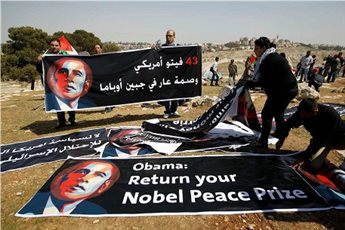
 Photo: OCHA – View larger version of map here


 Aletho News

