AIPAC aims to play ‘major strategic ally’ card to save aid for Israel from US cuts?
RT | March 03, 2013
US aid to Israel may be saved from sequestration and moved into Pentagon budget. That might be the result if the Israeli lobby in Washington gets its way and the American people aren’t paying attention, political analyst Robert Naiman told RT.
The annual conference of the American Israel Public Affairs Committee (AIPAC) is reportedly focused on the congressional designation of Israel as a “major strategic ally” of the US, a unique status that would be enjoyed only by the Jewish state. The move is seen as facilitating Israel’s military action against Iran’s alleged nuclear weapons program, which also appears on the conference agenda.
But according to the policy director at Just Foreign Policy Robert Naiman, the pro-Israel conference is focusing on Iran so as not to draw attention to the unresolved Israeli-Palestinian conflict – as well as protecting US funding of Israel from budget cuts.
RT: The US has been Israel’s faithful ally since the foundation of the state. Why does it need to become official, why the formalization?
RN: Well, according to lobbyists associated with the American Israel Public Affairs Committee, it has to do with the coming threat of budget cuts. Under this sequester… there’re supposed to be across-the-board cuts to the US budget. So that should mean that the US aid to Israel, which is substantial, billions of dollars a year, should also be cut – but the Israel lobby doesn’t want the aid to Israel to be cut. So their long game is that with this designation of ‘major strategic ally’ they would move things that are currently paid out of the US aid to Israel into the base Pentagon budget. They’ll argue, ‘well, this is about the national security needs…’
So their goal here is to exempt aid to Israel from the so-called across-the-board cuts. But of course they don’t want to announce that on the marquee, because Americans are going to be told: ‘oh, now we have to cut Head Start early childhood education because of the sequester cuts, but meanwhile aid to Israel is going to be protected.’ That’s going to make a lot of people in the United States very angry.
RT: It’s clear how Israel would benefit from this. But the US rubber-stamping the status of Israel as its ‘major strategic ally’ – how do they benefit from it?
RN: Well, they don’t – it has nothing to do with the benefit to the US. This is about what you can get away with if you’re lobbyist in Washington and the American people aren’t paying attention. If AIPAC and members of Congress are in a closed room, they’re going to agree on one thing. If the American people don’t find that out, it’s not reported in the press. This isn’t in the New York Times, it’s not in the Washington Post. It’s in the insider press that covers the stuff, Jewish telegraphic agency, for example, that covers AIPAC. So outside the people who follow such news, this is not in the mainstream American media yet.
RT: The conference will focus mainly on Iran, which is seen as the emerging threat. But the conflict with the Palestinians is very real and has been for decades. Why isn’t solving that on the agenda?
RN: Well, the American Israel Public Affairs Committee doesn’t want to solve the Israeli-Palestinian conflict, they’re completely content with the status quo. They want Israel to retain control of the West Bank, they want Israeli settlements in the West Bank to expand, so they’re completely happy with that. In fact, these are the people that do a lot to drive the focus on Iran, the American Israel Public Affairs Committee and the Israeli government, which are like two twin brothers. This focus now actually helps them change the channel from the Israeli-Palestinian conflict. They don’t want anybody to think about or talk about… three million Palestinians who don’t get to vote for the government that rules their lives, while their neighbors can stir in the Israeli Knesset.
Related article
- AIPAC To Hill: Don’t Touch Israel Aid (theuglytruth.wordpress.com)
Israel segregates West Bank bus line
Al-Akhbar | March 3, 2013
Israel on Monday will begin segregating certain buses in the occupied West Bank to appease Jewish settlers who say they are afraid of sharing a ride with Palestinians, Israeli media reported.
Buses operated by the Afikim bus company that transport passengers from the Eyal checkpoint into central Israel will now have separate lines for settlers and Palestinians.
Unnamed sources from Israel’s transportation ministry told Ynet that the project was developed to calm the nerves of settlers who say that Arabs pose a security threat.
But officially, the ministry has billed the controversial move as a plan to “improve services.”
“The new lines are not separate lines for Palestinians but rather two designated lines meant to improve the services offered to Palestinian workers who enter Israel through Eyal Crossing,” Ynet quoted a ministry statement as saying.
Related article
- Israel must remove all Jewish settlers from occupied West Bank – UN inquiry (alethonews.wordpress.com)
Jewish Voice for Weizmann
By Gilad Atzmon | March 3, 2013
I just came across a JVP press release (Jewish Voice for Peace) reporting a massive advertising campaign to counter the AIPAC Annual Conference in Washington. Apparently, from today 100 billboards will be stationed in DC Metro bearing a simple but important message.
“AIPAC Does Not Speak for Me”.
AIPAC is certainly a danger to world peace and yes, it is a positive development that a Jewish organization should confront its impact on American foreign policy.
But still, JVP’s tactics are problematic. If anything, they reveal the deep confusion inherent in Jewish politics in general, and Jewish progressive thinking in particular.
On the one hand, JVP’s campaign is simple and transparent: it states “AIPAC does not speak for me. Most Jewish Americans are pro-peace. AIPAC is not.” But on the other hand, JVP falls short in offering any universal or ethical solution to the conflict in the Middle East.
“According to a recent poll by pollster Jim Gerstein” reads the JVP’s press release, “82% of Jewish Americans support a two-state solution to the Israeli-Palestinian conflict.”
So, if I understand it correctly, 82% of Jewish Americans support a solution that dismisses the most essential and elementary Palestinian right to return to their land, in effect supporting the existence of a Jewish State in historic Palestine, at the expense of the Palestinians and their rights. In other words, the so-called ‘good peace-seeking Jews’ ,who are the vast majority of Jewish Americans (according to JVP), support an utterly non-ethical solution.
But the reference to Gerstein’s statistics is even more embarrassing. Are we interested in what the Dutch think about the solution of the conflict in Ireland? Do we care if Indians approve the Italian recent polls? No, we don’t but, for some reason, we are desperate to find out what ‘Jewish Americans’ think of the Israeli Palestinian conflict. The reason for this is obvious – Israel defines itself as the Jewish State and many Jewish Americans see Israel as their homeland and obviously, they care about their homeland and its politics. In that respect, Zionism should be seen as a success story – a trap into which JVP is foolish enough to fall. By referring to Gerstein’s statistics, JVP actually confirms that Jews are bonded spiritually and politically with their Jewish state and so are subject to an intense conflict of identity.
Chaim Weizmann, the legendary Zionist and the first Israeli President, somehow knew of all those JVPs to come. Already in the early days of Zionism, he observed the Jewish political inclination towards marginalism; he wrote “there are no English, French, German or American Jews, but only Jews living in England, France, Germany or America.” Whether Weizmann was correct or not is open to discussion, but clearly, JVP accepts Weizmann’s observation. JVP refers to the American Jews as ‘Jewish Americans’. It regards Jewishness as a primary political quality and it refers to Jews as a distinctive marginal ethno-centric group.
Interestingly, the ‘anti’ Zionist JVP is actually the embodiment of Weizmann’s Zionist wet dream. It may not agree with AIPAC on some side issues to do with settlements, occupation and Israeli policies, but it agrees on the fundamentals – “there are no American Jews, but only Jews living in America.” And as if this is not enough, JVP, like AIPAC supports the existence of a Jews only State in Palestine.
I guess that from Weizmann’s perspective JVP is Zionist to the bone. It openly promotes the two state solution because, like AIPAC, it is primarily concerned with Jewish tribal interests rather than human rights, ethics, or universal thinking.
JVP, like any other Jews-only ‘progressive’ organisation, may speak universal but it still thinks tribal.
British activists being detained in UK airports under anti-terrorism legislation on return home from Palestine
International Solidarity Movement, and Corporate Watch | February 28, 2013
 Two British peace activists have been detained in recent weeks after arriving home from the West Bank, occupied Palestine. They have been detained and taken in for questioning, over suspected links with the International Solidarity Movement.
“We are concerned about the British police using anti-terrorist legislation to target non-violent pro-Palestinian activists. We are a transparent group, trying to uphold the principles of international law; even inside Israel the International Solidarity Movement is not considered illegal. We would encourage the British Police to ask any questions they wish to do so, directly, and not by detaining affiliated activists at the airport”
The Schedule 7 of the Terrorism Act 2000, which the two activists have been held on, allows the police, under certain specified circumstances, to arrest individuals without a warrant who are reasonably suspected of being terrorists. These laws are draconian measures which give the British police powers to detain suspects for up to 28 days without charge.
Schedule 7 is clearly being used as a tool to find out more about activists involved in a wide variety of types of political dissent and to provide profiles of activists for the police to use in trying to undermine political movements. None of the questions about movements in the UK were designed to root out terrorism or uncover the preparation for terrorism. In fact, the movements concerned have never even been accused of terrorism (with the exception of completely false accusations made against the ISM, see here).
Britain abstained at the last vote at the United Nations deciding whether Palestine should be accepted as a non-member observer state. But in the last two weeks the double standards of the British government in relation to Palestine and Israel have again been laid bare; Saeed Amireh, has been refused a visa to visit the UK. Amireh is a peaceful campaigner against Israel’s occupation and the theft of Nilin’s land. He was told he hadn’t provided “enough supporting documents”, even though he had supplied everything that was asked for, including a letter of invitation and guarantee from the UK Palestine Solidarity Campaign of his costs being paid.
The use of these powers as a way to clamp down on non violent activists from Palestine and Britain is not acceptable, what is the British government afraid of? Maybe the fact the activists, returning home from Palestine, work with Corporate Watch and have helped reveal the continued supply of weaponry from Britain to the Israeli army has made them a target. This is despite the current British arms export policy stating it won’t deliver weapons to any countries breaking UN treaties. British companies are still complicit in Israeli war crimes in Gaza, as was proved in the EDO Decommisioners case of 2011.
Read more about the misuse of these powers and much more at corporateoccupation.org
Related articles
- Farming Injustice (alethonews.wordpress.com)
- Stop EU funding of Israeli military companies and illegal settlements (alethonews.wordpress.com)
- I find it sinister that the british firm securicor (“G4S”) is “providing services to israeli prisons and west bank checkpoints” (niqnaq.wordpress.com)
- Spies “monitoring” Palestine solidarity groups around world, says Israeli military correspondent (theuglytruth.wordpress.com)
Palestinian assailed by Israeli women, stripped of hijab
Al-Akhbar | February 27, 2013
 A Palestinian woman waiting at a light rail station in Jerusalem on Monday was attacked and stripped of her headscarf by religious Jewish women, Israeli newspaper Ma’ariv reported Tuesday.
According to bystanders, a young Jewish woman punched the Palestinian suddenly as she was passing by the station. A friend of the assailant began aiding her in beating the Palestinian, pushing her against the wall, and ultimately ripping off her headscarf.
The Palestinian was accompanied by an old man who tried to push the attackers away to no avail.
The event occurred at about three o’clock in the afternoon. It is unclear whether the incident involved only the two assailants mentioned in witness accounts, or a larger group shown in the photo.
“There were about 100 Orthodox and yeshiva students who disembarked the tramway and spotted an Arab woman accompanied by an older man,” a witness, who photographed the event, told Ma’ariv.
“It developed into arguing and yelling, and I don’t know what the content was that everyone jumped on her.”
According to the witness, an activist named Dorit Jordan Dotan, a municipality security officer passively watched the event and seemed to be smiling. Many residents also stood by.
“The entire time, the guard stood and smiled and did not even try to break up the fight,” a witness said.
Dotan confirmed that the incident took place at the station where a group of young people had just arrived from the train, but seemed to downplay the event by suggesting the attackers were intoxicated.
“Young people drink a lot of wine for Purim. Screams were heard everywhere. A woman tried to fight [the Jewish students] but they yelled at her not to dare touch the Jews and continued to beat [the Arab woman],” Dotan said.
Following publication in Ma’ariv, police launched an investigation into the case.
“It’s a shame that the Arab whore didn’t die”
On the day the report was published, Israeli police officer Ariel Shapiro re-posted the article on his Facebook page and issued a chilling endorsement: “Very good,” wrote Shpiro “It’s a shame that the Arab whore didn’t die.”

Screenshot of Shapiro’s Facebook page along with the offending status message
The message was publicized by Palestinian Member of Knesset Ahmad Tibi.
Israeli army and police officers have come under fire in recent weeks for showcasing dehumanizing images of and slogans about Palestinians. The most famous of these is an Instagram photo of Mor Ostrovski, 20, showing the crosshairs of a rifle being aimed at the head of a Palestinian boy.
Jordan: A Limited Strategic Shift
By Elie Chalhoub | Al-Akhbar | February 27, 2013
Jordanian King Abdullah II’s recent visit to Moscow crowned a series of steps that Amman has been taking over the past few months, signalling a shift away from its traditional allies like Washington and Israel.
Until recently, Jordan was in the warm embrace of oil-rich Gulf Arab countries that, prepared to admit the Hashemite kingdom into their Gulf Cooperation Council (GCC), would then shower it with billions in aid.
This is while Amman offered the services of its security and intelligence forces, coordinating closely with both Washington and Tel Aviv in a variety of areas, not least of which the unfolding crisis in Syria.
According to informed sources, last July 2012, Amman hosted a gathering of security officials from the US, Qatar, and Israel, who recommended setting up training camps for Syrian opposition fighters near the Jordanian city of Irbid.
US Secretary of Defense Leon Panetta admitted as much when he acknowledged in October 2012 that dozens of American soldiers were deployed along the Jordanian-Syrian border, explaining that “these units are tasked with establishing a base in Jordan and to assist the Syrian refugees and Jordanian armed forces to confront the dangers stemming from Syria’s chemical weapons.”
In the last few months Amman has begun to reassess its alliances in light of the Syrian crisis, perhaps embarking on a process of strategic realignment, moving closer to Iraq and Russia, at the expense of its traditional allies.
The prospective threat posed by the powerful Jordanian Muslim Brotherhood and the more radical Islamist currents prompted the army and intelligence to convince the palace not to go along with Washington’s plan.
Amman even went so far as to completely close its border with Syria, preventing fighters and weapons from crossing it.
This came at a high cost for Jordan, as Saudi Arabia and Qatar – who were mobilizing all the forces they could muster against the Bashar al-Assad regime – to halt their support for the kingdom, causing a serious economic crisis in the country.
Iraq quickly moved in to try to fill the void and revive its once close ties with Jordan. An official visit to Amman by Iraqi Prime Minister Nouri al-Maliki at the end of 2012 led to the signing of several lucrative deals that would see cheap Iraqi oil once again flowing to Jordan.
As for Jordan’s relationship with Iran, “that’s a tough one for us,” says a high-level Jordanian security official, pointing out that the realignment underway may go far, “but it has its limits, for there are lines that cannot be crossed, and Iran lies outside these boundaries.”
In light of all this, King Abdullah II’s visit to Moscow on Tuesday, February 19 cannot in any way be seen simply as a routine call.
For its part, Jordan is seeking a counterbalance to US influence, for fear that Washington is preparing to force Amman into accepting a confederation with the Palestinians as a solution to the Arab-Israeli conflict.
Russia, on the other hand, sees this as an opportunity to bring Amman into its orbit, particularly on the Syrian question, where Moscow is in the process of pushing for a settlement.
Jordan’s diplomatic support in the Arab arena and the valuable intelligence it can provide on the Syrian opposition make it a critical resource for the Russians.
EU report slams Israeli settlements, calls for economic sanctions
RT | February 27, 2013
An internal report by the European Union has come down hard on Israel’s decision to continue settlement construction in occupied East Jerusalem, threatening to end economic projects that involve the Jewish settlements.
The harshly worded 15-page report provides recommendations to the 27 member-states for responding to Israel’s activities in the occupied territories – which the document described as “systematic, deliberate and provocative” – and endorses a strategy that aims at “making it impossible for Jerusalem to become the capital of two states.”
Seven of the report’s 10 recommendations propose slapping tough economic sanctions on organizations directly involved in construction projects in the Jewish settlements, Israeli daily Haaretz reported. The report also called on the EU’s 27 member-states to “prevent, discourage and raise awareness” about doing business with companies that work in the disputed settlement zones.
It advised EU states to work to ensure that products exported from the settlements not receive an unfair advantage through “preferential tariffs,” and to give consumers an opportunity to make an “informed choice” through clear labeling of products’ origins.
The report advocated “closer supervision” of technological research and development programs between the EU and Israel. The measures would work to ensure that “no research grants, scholarships or other technological investments assist settlements, either directly or indirectly,” or be provided to agencies working in the settlements.
Haaretz, which obtained a copy of the report, called the sanctions “particularly severe” compared to earlier EU reports.
The annual report, compiled by EU consuls in Jerusalem and Ramallah, does not require member-states to implement the measures – the document’s recommendations serve as a guidepost for individual EU states in dealing with the ongoing Israeli-Palestinian conflict.
In December, several EU countries, including the UK, France and Sweden, summoned their Israeli ambassadors to voice disapproval of the ongoing construction projects.
The report expressed frustration with Israel for its late-November announcement of new settlement construction projects, shortly after the UN General Assembly voted to recognize Palestine as a non-member observer state – a move strongly condemned by Israel and the US.
The implementation of the Israeli government’s so-called E-1 project “would effectively divide the West Bank into separate northern and southern parts,” the report explained, adding that it would also “prevent Palestinians in East Jerusalem from further urban development and cut off East Jerusalem from the rest of the West Bank.”
Israel is “systematically undermining the Palestinian presence” in East Jerusalem through controversial strategies, including “restrictive zoning and planning, demolitions and evacuations, discriminatory access to religious sites, an inequitable education policy, difficult access to health care, the inadequate provision of resources,” the report said. … Full article
Al-Aqsa Brigades Fire Rocket on Occupied Territories in Response to Killing of Prisoner
Al-Manar | February 26, 2013
A rocket fired from the Gaza strip landed early Tuesday near Ashkelon in the south of the Palestinian occupied territories, as al-Aqsa Martyrs Brigades, the military wing of Fatah Movement, claimed responsibility for the rocket launch.
“The rocket fell early in the morning near Ashkelon and did some damage to a road, without hurting anyone,” an Israeli police spokesman Micky Rosenfeld.
In a statement, al-Aqsa Brigades, Groups of Martyr Luai Kane’, claimed responsibility on Tuesday for firing a Grad rocket on Ashkelon city.
The statement said that the rocket was “in response for assassinating the prisoner Arafat Jaradat” who was martyred on Sunday after being tortured in an Israeli prison.
“The Freedom won’t be achieved but through sacrifice… We have to resist our enemy in all available means,” al-Aqsa Martyrs added in the statement.
Jaradat’s martyrdom sparked protests across Palestine, with thousands of Palestinians thronging the West Bank village of Sair on Monday for the funeral of Jaradat, a 30-year-old father of two and member of the Al-Aqsa Martyrs Brigades.
Both the Palestinians and the United Nations special coordinator for the Middle East peace process, Robert Serry, have called for an independent inquiry into Jaradat’s death.
Tuesday’s rocket fire was the first such event since the end of an Israeli offensive against Gaza late November.
The two sides finally agreed to a truce on November 21 following the eight-day Israeli attack which cost the lives of dozens of Palestinian civilians. 177 Palestinians were martyred and six Zionists were killed, according to figures issued by the two sides.
Related article
Obama’s Israel Trip
Ignore the hype. It’s four more years of settlement growth
By Jonathan Cook | Dissident Voice | February 25th, 2013
NAZARETH — Israeli and Palestinian officials have been in Washington laying the ground for President Barack Obama’s visit to Israel and the West Bank, scheduled for next month and the first since he took office four years ago.
Topping the agenda, Israeli Prime Minister Benjamin Netanyahu has said, will be efforts to restart the long-stalled peace process. Last week Palestinian officials said they had urged the White House to arrive with a diplomatic plan.
The US president began his first term on a different footing, ignoring Israel and heading instead to Cairo where he made a speech committing the US to a new era in relations with the Arab world. Little came of the promise.
Now he apparently intends to start his second term — as Netanyahu resumes office too, following last month’s elections — with an effort to engage with Israel and the Palestinians that is almost as certain to prove an exercise in futility.
The prospect of reviving the peace track between Israel and the Palestinians is not one that is appetising for either Obama or Netanyahu. Both are bruised from locking horns over a settlement freeze — the key plank of the US president’s efforts — during his first term.
But equally, it seems, the price of continuing inaction is high too. The Palestinians have repeatedly embarrassed Obama at the United Nations, not least by isolating the US in November as it opposed an upgrade in the Palestinians’ observer status. Inertia also looks risky given the growing unrest in the West Bank over hunger-striking prisoners.
Ahead lie potentially even bigger headaches, including the doomsday scenario — from Israel and Washington’s perspective — that the Palestinians approach the International Criminal Court to demand Israel be investigated for war crimes.
The perennial optimists have been searching for signs that Obama is readier this time to get tough. Neither of the president’s recent major appointments — John Kerry as secretary of state and Chuck Hagel, nominated as defence secretary — has been welcomed in Israel.
US determination has been buoyed, it is argued, by what is seen as a tide change in Israeli public opinion, highlighted by the surprise electoral success of centrist Yair Lapid and relatively poor showing by Netanyahu’s Likud party.
Netanyahu’s officials sense similar motives, complaining that Obama’s visit so soon after the election is direct “interference” in coalition-building. The centrists, they fear, will be able to extract concessions from Netanyahu, who will not wish to greet the US president as head of an extremist government.
Israeli officials, meanwhile, look eager to mend fences: they have hopefully codenamed the visit “Unbreakable Alliance” and announced an intention to award Obama Israel’s highest honour, the presidential medal.
The more hopeful scenarios, however, overlook the obstacles to a diplomatic solution posed both by Israel’s domestic politics and by the Palestinians’ inability to withstand Israeli bullying.
Not least, they ignore the fact that Netanyahu’s Knesset faction is the most right-wing in Likud’s history. He cannot advance a peace formula — assuming he wanted to — without tearing apart his party.
Equally, there is nothing in Lapid’s record to indicate he is willing to push for meaningful compromises on Palestinian statehood. On this issue, he occupies the traditional ground of Likud, before it moved further right. A recent poll found half his supporters called themselves right-wing.
Last week Netanyahu signed a coalition pact with another supposed centrist, Tzipi Livni, a former Likud leader who now heads a small faction called Hatnuah. The goal, as one Likud official cynically put it, was to use Livni to “whitewash the Netanyahu government in the world’s eyes”.
In other words, Netanyahu hopes a Livni or a Lapid will buy him breathing space as he entrenches the settlements and pushes Palestinians out of large areas of the West Bank under cover of what the Israeli newspaper Haaretz termed a “booby-trapped diplomatic process”.
What of the Palestinians? Will they not be able to mount an effective challenge to Israeli intransigence, given an apparent renewed US interest in diplomacy?
Here is the rub. Netanyahu already has a stranglehold on the politics of his potential peace partners. He can easily manipulate the fortunes of the Palestinian leader Mahmoud Abbas on the two biggest tests he faces: the “peace process” overseen by the international community, and reconciliation talks with the rival Palestinian faction Hamas.
The latest talks between Hamas and Fatah broke down in Cairo this month, even though unity, in the view of most Palestinians, is a precondition of their seeking viable statehood. The talks’ failure followed the “arrest” by Israel of 25 Hamas leaders in the West Bank, seizures that Palestinian human rights groups and Hamas warned were intended to disrupt reconciliation.
Meanwhile, Israel has repeatedly undermined Abbas’s rule, and kept his PA close to collapse, by turning on and off one of its major sources of income — tax monies Israel regularly collects on behalf of the Palestinians and is supposed to pass on.
As a result, Abbas is trapped between various pressures impossible to reconcile: the need to keep Israel happy, to maintain legitimacy with his own people and to foster a shared political agenda with other Palestinian factions.
The sticks that Israel wields force Abbas to keep the door open to negotiations even as most Palestinians recognise their utter pointlessness. Likewise, his constant need to appease Israel and the US serves only to widen differences with Hamas.
The Palestinians are stuck in a political and diplomatic cul-de-sac, unable to move forward either with the development of their national struggle or with talks on viable statehood. Whatever Obama’s intentions, the reality is that this will be another four years of diplomatic failure.
Jonathan Cook is a writer and journalist based in Nazareth, Israel. He won this year’s Martha Gellhorn Special Prize for Journalism.
Israeli court extends remand of Issawi’s brother

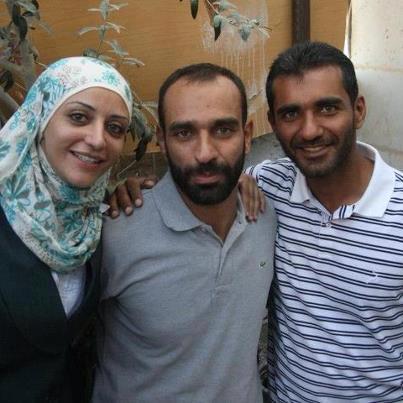
Shireen, Samer and Shadi Issawi
Palestine Information Center – 25/02/2013
RAMALLAH — The Israeli Magistrate Court in occupied Jerusalem extended on Sunday the remand of Shadi Issawi, the brother of hunger striker Samer Issawi, and did not allow him to see his lawyer.
Shireen Issawi, the sister of Shadi and a lawyer, said that the arrest of Shadi and extending his remand fell in line with pressures on Samer to end his seven months hunger strike.
She charged the Israeli occupation authorities (IOA) with targeting all members of Samer’s family, recalling that the IOA razed the home of her third brother Rafat at the start of the year and cut water supplies to her family home in addition to detaining her and her fourth brother Firas for a period of time.
Related articles
- Shireen Al-Issawi: PA did not take prisoners’ issue to the UN (alethonews.wordpress.com)
- Samer Issawi sentenced to 8 months in prison (alethonews.wordpress.com)
Minister: Autopsy shows torture killed Jaradat
Ma’an – 25/02/2013
BETHLEHEM – An autopsy has revealed that Arafat Jaradat died of extreme torture in Israeli custody and did not have a cardiac arrest, the PA Minister of Detainee Affairs said Sunday.
At a news conference in Ramallah, Issa Qaraqe said an autopsy conducted in Israel in the presence of Palestinian officials revealed that 30-year-old Jaradat had six broken bones in his neck, spine, arms and legs.
“The information we have received so far is shocking and painful. The evidence corroborates our suspicion that Mr. Jaradat died as a result of torture, especially since the autopsy clearly proved that the victim’s heart was healthy, which disproves the initial alleged account presented by occupation authorities that he died of a heart attack,” Qaraqe said.
A spokeswoman for Israel’s Prison Authority said Saturday that Jaradat had apparently died of cardiac arrest in Megiddo prison. An emergency service team had tried to resuscitate him but failed, she said.
Qaraqe described the claim as a fabrication and called for a committee to investigate those responsible for Jaradat’s death.
The minister said Jaradat had sustained injuries and severe bruising in the upper right back area and severe bruises of sharp circular shape in the right chest area.
The autopsy revealed evidence of severe torture and on the muscle of the upper left shoulder, parallel to the spine in the lower neck area, and evidence of severe torture under the skin and inside the muscle of the right side of the chest. His second and third ribs in the right side of the chest were broken, Qaraqe said, and he also had injuries in the middle of the muscle in the right hand.
Jaradat’s heart was in good condition and there were no signs of bruising or stroke, the minister added.
Israel’s Health Ministry said the injuries found in the autopsy could have been caused by the medical emergency team’s efforts to resuscitate Jaradat.
“These initial findings are not enough to determine the cause of death,” the Israeli ministry said, adding that further test results were not yet in. An Israeli police spokesman said the investigation into Jaradat’s death was still ongoing.
Qaraqe’s deputy, Ziyad Au Ain, urged any doctors, including Israeli doctors, who doubted that Jaradat was tortured to death to view his body in Al-Ahli Hospital in Hebron.
“Jaradat died due to torture and not a stroke or heart attack,” he said, adding that those responsible must be sued either through Interpol or the International Criminal Court.
Palestinian Prisoners Society president Qaddura Fares added that the autopsy revealed seven injuries to the inside of Jaradat’s lower lip, bruises on his face and blood on his nose.
After the autopsy, Jaradat’s body was transferred to the Palestinian Red Crescent at the Tarqumiya crossing west of Hebron, and taken to the Al-Ahli Hospital. He will be buried on Monday in his hometown Sair.
Jaradat’s lawyer Kameel Sabbagh said he was tortured by Israeli interrogators.
Sabbagh, who works for the prisoners ministry, was present at Jaradat’s last hearing on Thursday, which an Israeli judge postponed for 12 days.
“When I entered the courtroom I saw Jaradat sitting on a wooden chair in front of the judge. His back was hunched and he looked sick and fragile,” Sabbagh said in a statement Sunday.
“When I sat next to him he told me that he had serious pains in his back and other parts of his body because he was being beaten up and hanged for many long hours while he was being investigated
“When Jaradat heard that the judge postponed his hearing he seemed extremely afraid and asked me if he was going to spend the time left in the cell. I replied to him that he was still in the investigation period and this is possible and that as a lawyer I couldn’t do anything about his whereabouts at this time.”
Sabbagh said Jaradat’s psychological state was very serious and that he informed the judge his client had been tortured. The judge ordered that Jaradat should be examined by the prison doctor but “this didn’t happen,” the lawyer added.
On Sunday, thousands of Palestinians protested the death across the West Bank and Gaza, and at least two protesters were injured by live fire in clashes with Israeli forces, including the 13-year-old son of a Preventive Security officer.
Dozens more were injured by rubber-coated bullets.
An Israeli military spokeswoman said soldiers used riot dispersal means against Palestinians hurling rocks at security forces.
Featured Video

Why Hamas Really Attacked Israel on Oct. 7
or go to
Aletho News Archives – Video-Images
From the Archives
Confronting the Threat of Ethnic Bioweapons
By Tony Cartalucci – New Eastern Outlook – 29.11.2017
The United States Air Force’s 59th Medical Wing’s molecular biology branch recently was revealed to have been collecting specifically Russian RNA and synovial (connective) tissue samples, prompting fears in Russia of a possible US directed ethnic-specific bioweapons program. … continue
Blog Roll
 Aletho News
- Russia accuses France of ‘piracy’ over tanker seizure
- Why Yemen Is Bombing Saudi Arabia’s Airports: The War Behind the Headlines
- Sally Rooney’s books pulled from UK over support for Palestine Action
- Bombs for Tel Aviv, Promises for Riyadh
- Israeli ad agency conducted vast global espionage campaign using online ads: Report
- Oct. 7 Forever Marks The Big Reveal: ‘We See You, Israel, We Revile You, We Reject You!’
- Meet the US generals and admirals advancing Israeli policy
- Israel’s Straw Widow Protocol: The Kill Zones Where Civilians Were Labelled ‘Terrorists’
- Leading Israeli Think Tank Publishes Psychotic Israeli ‘National Security’ Doctrine
- Are the United States and Israel in Decline-and-Fall Mode?
- If Americans Knew
- Israeli firm used online ads to run vast spy operation, researchers say
- No, the world zionist movement is not an antisemitic conspiracy theory
- Hundreds of IDF investigations into killings still have no public outcome, BBC Verify finds
- After Ashley Moody Epstein Probe, Donors Linked to Him Poured Money Into her Senate Campaign
- Worried about Russian meddling in UK politics? Wait till you see what Israel is up to
- Israeli settlers attack West Bank center for disabled children, church leader calls for int’l action
- Pulling Out Teeth Just to Live: How Israel Has Devastated Dental Care in Gaza
- Gaza’s “ceasefire” death toll passes 1,500 – Daily Update
- Activists Abused By Israel Return to New Freedom Flotilla Mission
- 60 Minutes won’t tell the full truth about Israeli settler violence
- No Tricks Zone
- New Study Suggests Large Regions Of The Pacific Ocean Have Been Cooling For The Last 80 Years
- Germany’s Green Energy Debacle: High Energy Costs Force Kahla Porzellan to Close After 182 Years!
- New Study: 50 Years Of The Most Aggressive ‘Net Zero’ Policies Can Only Affect The Global Climate By 0.03°C
- US September “Heat” Was No Record…Many Records Set Decades Ago
- Latest European Green Energy Debacle; Portugal’s Largest Flagship Solar Park Insolvent!
- Green Energy Debacle: German Expert Professor Fritz Vahrenholt Warns Of Severe Economic And Social Consequences
- Two More Paleo Reconstructions Affirm Meters-Higher Sea Levels Across Ireland, Brazil 7000-6000 Years Ago
- New Study: Earth And Venus Surface Warmth Largely Explained By Convection And Lapse Rate, Not CO2 Or Radiation
- 2025 Nature Paper Claiming Worsening Global Drought Gets RETRACTED …Heavily Flawed
- New Study: ‘Global Drought Shows No Detectable Recent Acceleration Under Climate Warming’

