Popular Committee Offices Raided by Israeli Military Forces, Ramallah
PNN | May 8, 2012
At 1.30 a.m. on Tuesday morning, 8th May, ten armored jeeps of the Israeli Occupation Forces surrounded and raided the offices of Stop the Wall in Ramallah. Israeli military stole 2 laptops, 3 hard drives and 10 memory cards containing files and photos as well as archive material relating to the work that the organisation does in opposition to Israel’s apartheid wall and the attack on Palestinian human rights that the wall and the settlements represent. This is yet another attack upon Palestinian civil society and their struggle against the physical and psychological oppression, land confiscation and ethnic cleansing policies of Israel.
Stop the Wall is one of the most vibrant organizations of human rights defenders in Palestine, and has been promoting, for almost ten years, civil resistance and advocacy campaigns against the Wall and in defense of Palestinian rights to self determination. Human Rights Defenders are internationally recognized as an essential element in political processes and their repression further underlines Israeli unwillingness to achieve a just peace.
Jamal Juma’, coordinator of the Stop the Wall Campaign, comments:
“It is not surprising that the Israeli authorities have chosen this moment to escalate their repression against the Stop the Wall grassroots network of civil resistance against the Wall and the settlements, choosing to act on the same day that the Israeli High Court rejected the appeals of Palestinian hunger strikers Bilal Diab and Tha”ir Halahleh, imprisoned without charge and without trial, effectively condemning them to death.
The courageous steadfastness of the more than 2000 hunger strikers in Israeli jails is underlining once more the power of civil resistance as part of the Palestinian struggle. Almost daily people are out in the streets to protest in solidarity with the Palestinian political prisoners, and the discontent with the fruitless and completely stalled diplomatic processes is growing stronger. At the same time, the Israeli authorities announced in 2011 to UN agencies that throughout 2012 year they will systematically displace the Palestinian population in area C. While the displacement drive is underway in the Jordan Valley, home demolitions are rising and the settlement construction is accelerated, the people across the West Bank are always more constraint behind the cantons of the wall.
This raid on the Stop the Wall offices is a clear message that the Israeli authorities are fearing widespread nonviolent action will challenge their policies effectively. Israel is preparing for confrontation and more repression, clearly showing that it is not ready to relinquish any of the international sanctioned rights the Palestinian people are struggling for.”
This is not the first time Stop the Wall has been the target of Israeli repression. In September 2009 Stop the Wall youth coordinator was arrested and the Stop the Wall coordinator, Jamal Juma’, was arrested a few months later, in December 2009. The Israeli authorities were not able to formulate any accusations against either of them and after a sustained international campaign, that saw the active involvement of the diplomatic missions in Palestine and European foreign ministries as well as countless human rights organizations around the world, both had to be freed in January 2010. This attack was followed only a few months later by an extensive office raid by the Israeli military on February 8 2010 and mass arrests of grassroots human rights defenders in the villages most actively protesting against the Wall.
For photos see: http://www.flickr.com/photos/stopthewall/sets/72157629631856082/
Background:
Stop the Wall is one of the most vibrant organizations of human rights defenders in Palestine, and has been promoting, for almost ten years, civil resistance and advocacy campaigns against the Wall and in defense of Palestinian rights to self determination. Human Rights Defenders are internationally recognized as an essential element in political processes and their repression further underlines Israeli unwillingness to achieve a just peace.
This raid on the Stop the Wall offices is a clear message that the Israeli authorities are fearing widespread nonviolent action will challenge their policies effectively.
The courageous steadfastness of the more than 2000 hunger strikers in Israeli jails is underlining once more the power of civil resistance as part of the Palestinian struggle. Almost daily people are out in the streets to protest in solidarity with the Palestinian political prisoners, and the discontent with the fruitless and completely stalled diplomatic processes is growing stronger. At the same time, the Israeli authorities announced in 2011 to UN agencies that throughout 2012 year they will systematically displace the Palestinian population in area C. While the displacement drive is underway in the Jordan Valley, home demolitions are rising and the settlement construction is accelerated, the people across the West Bank are always more constraint behind the cantons of the wall. Israel is preparing for confrontation and more repression, clearly showing that it is not ready to relinquish any of the international sanctioned rights the Palestinian people are struggling for.
This is not the first time Stop the Wall has been the target of Israeli repression. In September 2009 Stop the Wall youth coordinator was arrested and the Stop the Wall coordinator, Jamal Juma’, was arrested a few months later, in December 2009. The Israeli authorities were not able to formulate any accusations against either of them and after a sustained international campaign, that saw the active involvement of the diplomatic missions in Palestine and European foreign ministries as well as countless human rights organizations around the world, both had to be freed in January 2010. This attack was followed only a few months later by an extensive office raid by the Israeli military on February 8 2010 and mass arrests of grassroots human rights defenders in the villages most actively protesting against the Wall.
Related articles
- Israeli military court sentences Palestinian journalist (alethonews.wordpress.com)
- Israeli forces raid anti-wall campaign office in Ramallah (maannews.net)
Israeli Hawkademia in Australian Universities
By Vacy Vlazna | Palestine Chronicle | May 2, 2012
The Israeli ‘defense’ industry is embedded in Israeli universities and in universities around the world including Australia. It plunders overseas intellectual property for Israel’s military research-and-development (R&D) programs while strategic bi-lateral research and exchange missions deliberately whitewash or ‘normalize’ the Zionist military occupation of Palestine and her people.
In Israel, Zionism and the military are undifferentiated. The IOF (Israeli Occupation Forces), the world’s fourth most powerful (nuclear) army, since the inception of the state of Israel, is duty bound to secure the fanatical Zionist goal of Eretz Yisrael or Greater Israel, which incorporates the whole of historic Palestine and beyond (from the Nile to the Euphrates).
The 1948 Nakba, the Catastrophe, which accounted for the destruction of 500 Palestinian villages and the forceful expulsion of over 700,000 Palestinians by Israeli terrorist militia (Irgun, Lehi, and Haganah) that metamorphosed into the Israeli army, has never ended with Israel’s relentless policies of ethnic cleansing through the expansion of its illegal colonies and the illegal Annexation Wall on stolen Palestinian land perforated moreover by hundreds of checkpoints and roadblocks manned by belligerent IOF.
Under international law, Israel’s military occupation of Palestine is illegal and yet it has impunity to defy UN Resolutions and to daily commit war crimes because of US, EU, Canadian and Australian support as well as the $3.1 billion in Israeli military assistance granted annually from the US State Department budget.
“Israeli defense sales in 2010 totaled 7.2 billion U.S. dollars, making the small nation the world’s fourth largest exporter…Most of the sales are from four leading companies: Elbit Systems, Israeli Aerospace Industries (IAI), Rafael, and Israel Military Industries ..Strong points of Israel’s arms industry include unmanned aerial vehicles, armoured vehicles, smart munitions, military and civilian aircraft avionics, weapons platforms and structural upgrades for foreign governments and private clients.”
It is Palestinian men, women, teenagers and children who are the guinea pigs of Israel’s ‘battle-tested’ weaponry.
Israeli defense companies as well as their joint venture US/UK defense partners have subsidiaries in Australia- Elbit Australia, Oracle Australia, Thales Australia, Raytheon Australia and have footholds in and associations with Australian universities.
In November 2011, Elbit Systems joined the Australian Defense Department’s Rapid Prototyping, Development and Evaluation Program. The University of Western Australia and Edith Cowan University also joined. “Elbit Systems and its subsidiaries contribute directly to two of the most insidious facets of the Israeli occupation of Palestinian territory: the indiscriminate assaults on civilian populations, through the provision of unmanned aerial vehicles (UAV’s or ‘drones’) and other military equipment to Occupation forces; and the ever-tightening ghettoization of the West Bank, through the provision of surveillance and electronics systems along the Apartheid Wall and settlements. During Israel’s 23-day assault in Gaza in 2008-09, missiles fired from drones were directly attributed to the killing of 78 Palestinians, including 29 children. Like all Israeli firms operating the military technology sector, endless war and occupation create valuable marketing opportunities. Elbit UAVs, for example, can be sold on the global market as ‘battle tested’ devices, significantly increasing their appeal and leading to their adoption by a number of militaries.”
The ZEN Entrepreneurs’ Challenge is a student business planning competition run by the Entrepreneurship, Commercialization and Innovation Centre at the University of Adelaide. ‘Participants work with dedicated mentors to cultivate their entrepreneurial plans including marketing thanks to Dr. Ben-Ari who joined Elbit Systems in 1978 and is, since 2001, Managing Director of Elbit Systems Singapore.
The Edith Cowan University’s Security Management program is offering academic credit to delegates on completion of the 2013 “Security Fundamentals Tour of Israel designed to provide a select group of security specialists and professionals with an insight into Israel’s critical infrastructure security and what continues to drive Israel to be one of the leading security technology providers.” The tour includes the euphemistically named ‘Separation’ Wall which is in fact an Apartheid/Annexation Wall deemed illegal by the International Court of Justice in 2004 and also includes the security, passenger screening and deterrence applications of Ben Gurion Airport which last month detained and deported volunteers invited to Palestine to help build a school for blind children. Last year, Australians Vivienne Porzsolt and Sylvia Hale were also arrested and detained at Ben Gurion for having the temerity of wanting to visit Marrickville’s sister city, Bethlehem.
In February, a guest speaker at Deakin University’s 7th Annual International Electromaterials Science Symposium was A/Prof. Yair Ein – Eli, He had been Director of Research and Battery Technology at Electric Fuel Ltd before joining the Department of Materials Engineering at the Technion. Electric Fuel Ltd is a subsidiary of the Arotech Corporation which has facilities in Israel and “operates through three major business divisions: High-level armoring for military and nonmilitary air and ground vehicles; interactive simulation for military, law enforcement and commercial markets, and batteries and charging systems for the military’.
Each Israeli university has societies worldwide that encourage and facilitate academic and scientific exchanges and collaboration. ‘Recent exchanges organized by The Technion Society of Australia have included Technion staff at Sydney University, University of NSW, University of Newcastle, Victoria University, University of Adelaide and Australian National University.’ On staff at the University of Western Sydney is a professor with Technion associations and experience in military and civilian R&D. Both Elbit and Rafael Advanced Systems (run by the Israeli Ministry for Defence)have long-standing partnerships with the hawkish Technion.
In May 2008 was the launch of the AICC s inaugural WA Innovation and Business Development Mission to Israel, supported by the WA State Governments Department of Industry and Resources and coordinated by the Australia Israel Chamber of Commerce (WA) Inc. (AICC). Among delegates were representatives from the University of Western Australia and Murdoch University. Mr R McCulloch representing Murdoch University’s interest in water research and renewable energy institutes praised Israel’s “immediate interest and openness to finding partners” though, of course this excludes Palestinians whose critical water resources are stolen, controlled and/or demolished by Israel.
The University of Johannesburg which had a joint water project with Ben Gurion University severed links in 2011 because it found “detailed, factual evidence and information regarding Ben Gurion’s direct and indirect role in further entrenching the violations of human rights and international law by the Israeli state”.
Innocuous academic interchange can promote normalization whereby Israeli oppression, racism and apartheid is accepted as the ‘normal’ status quo.
The Yachad Accelerated Learning Project designed to improve outcomes and address inequalities in Indigenous and Remote education was set up with the support of Melbourne and Monash Universities and The Hebrew University (Michael Federmann, the Chairman of Elbit Systems is a member of the Executive Committee of the Board of Governors of Hebrew University). In 2007 an Australian Yachad delegation enthusiastically visited the Bedouin village of Kseyfeh aware or unaware that the per capita spending per Bedouin student is less than half Israel’s average and that 40% of indigenous Bedouins are threatened by forced transfer policies and live in Unrecognized Villages systematically deprived of water, electricity, health care, education yet not deprived of incessant home demolitions.
The information presented here about the relationship between Australian universities and the Israeli occupation of Palestine is merely the tip of a very grubby iceberg. Australian universities by their degrading prostration to funding donors associated with Zionist Israel have lost their moral equilibrium and the purpose and ideals of academia. Dissenting academics are rare. Few emulate Professor Jake Lynch’s protest of the 2011 Israel Research Forum at the University of Sydney with guest experts from the The Weizmann Institute of Science, Technion – Israel Institute of Technology, and Tel Aviv University, all of which collaborate with the Israeli military industry.
Academics and students, concerned for the human rights of the people of Palestine, must investigate their university finances and demand divestment from and boycott of companies and Israeli universities that are implicated in the war crimes and crimes against humanity that Palestinians suffer daily.
– Dr. Vacy Vlazna is Coordinator of Justice for Palestine Matters. She was Human Rights Advisor to the GAM team in the second round of the Acheh peace talks, Helsinki, February 2005.
Related articles
- Lethal Hawkademia and BDS (alethonews.wordpress.com)
- Lebanese Society in California Normalizes with Israelis (alethonews.wordpress.com)
Illegal Settlements Bonanza: Israel Plots an Endgame
By Ramzy Baroud | Palestine Chronicle | May 2, 2012
Israel’s colonization policies are entering an alarming new phase, comparable in historic magnitude to the original plans to colonize Gaza, the West Bank and East Jerusalem following the war of 1967.
On April 24, an Israeli ministerial committee approved three settlement outposts – Bruchin and Rechelim in the northern part of the West Bank, and Sansana in the south. Although all settlement activities in the occupied West Bank and East Jerusalem are considered illegal by international law, Israeli law differentiates between sanctioned settlements and ‘illegal’ ones. This distinction has actually proved to be no more than a disingenuous attempt at conflating international law, which is applicable to occupied lands, and Israeli law, which is in no way relevant.
Since 1967, Israel placed occupied Palestinian land, privately owned or otherwise, into various categories. One of these categories is ‘state-owned’, as in obtained by virtue of military occupation. For many years, the ‘state-owned’ occupied land was allotted to various purposes. Since 1990, however, the Israeli government refrained from establishing settlements, at least formally. Now, according to the Israeli anti-settlement group, Peace Now, “instead of going to peace the government is announcing the establishment of three new settlements… this announcement is against the Israeli interest of achieving peace and a two states solution”
Although the group argues that the four-man committee did not have the authority to make such a decision, it actually matters little. Every physical space in the occupied territories – whether privately owned or ‘state owned’, ‘legally’ obtained or ‘illegally’ obtained – is free game. The extremist Jewish settlers, whose tentacles are reaching far and wide, chasing out Palestinians at every corner, haven’t received such empowering news since the heyday of Israeli Prime Minister Ariel Sharon.
The move regarding settlements is not an isolated one. The Israeli government is now challenging the very decisions made by the Israeli Supreme Court, which has been used as a legitimization platform for many illegal settlements that drove Palestinians from their land.
On April 27, the Israeli government reportedly asked the high court to delay the demolition of an ‘unauthorized’ West Bank outpost in the Beit El settlement which was scheduled to take place on May 1st. The land, even by Israeli legal standards, is considered private Palestinian land, and the Israeli government had committed to the court to take down the illegal outposts – again, per Israeli definition – on the specified date.
Now the rightwing Netanyahu government is having another change of heart. In its request to the court, the government argued: “The evacuation of the buildings could carry social, political and operational ramifications for construction in Beit El and other settlements.” Such an argument, if applied in the larger context of the occupied territories, could easily justify why no outposts should be taken down. It could eradicate, once and for all, such politically inconvenient terms such as ‘legal’ and ‘illegal’.
“Previous Israeli governments have pledged to demolish the unauthorized settler outposts in the West Bank, but only a handful have been removed,” according to CNN online. In fact, that ‘handful’ are likely to be rebuilt, amongst many more new outposts, now that the new legal precedence is underway.
Michael Sfard, an attorney with Yesh Din, which reportedly advocates Palestinian rights, described the request as “an announcement of war by the Israeli government against the rule of law.” More specifically, “they said clearly that they have reached a decision not to evacuate illegal construction on private Palestinian property.”
Some analysts suggested that Netanyahu was bowing down to the more rightwing elements in his cabinet – as if the man had, till now, been a peacemaker. The bottom line is that Israel has decided embark on a new and dangerous phase, one that violates not only international law, but Israel’s own self-tailored laws that were designed to colonize the occupied territories. It appears that even those precarious ‘laws’ are no longer capable of meeting the colonial appetite of Israeli settlers and the ruling class.
Israeli settlements have been contextualized through Israeli legal and political references, as opposed to references commonly accepted in international law. The emphasis on differences between Israeli governments, political parties and religious/ultra-nationalist settlement movements is distracting and misleading; colonizing the rest of historic Palestine has been and remains a national Israeli project.
An article in the rightwing Israeli Jerusalem Post agrees. “Support for settlement is not simply a program of right-of-center Likud. Its history has firm roots in Labor party activity during the periods of its governments, and activities by predecessors of the Labor party going back before the creation of the Israeli state” (April 27).
The only variable that might be worth examining is the purpose of the settlement, not the settlement itself. Following the war of 1967, the Allon plan sought to annex more than 30 percent of the West Bank and all of Gaza for security purposes. It stipulated the establishment of a “security corridor” along the Jordan River, as well outside the “Green Line”, a one-sided Israeli demarcation of its borders with the West Bank. Then, there was no Likud party to demonize, for that was the Labor party’s vision for the newly occupied territories.
While the Israeli settlement drive since then has swallowed much of the West Bank and East Jerusalem, populating them with over half a million Israelis, the international community’s response was as moot in 1967 as it is now in 2012. Responding to the latest sanctioning of illegal outposts, UN Secretary General Ban Ki-Moon declared that he was “deeply troubled” by the news. Meanwhile, Russia was ‘deeply concerned’ and so was the EU’s Catherine Ashton. As for the US, State Department spokeswoman Victoria Nuland insisted that the Israeli measure is not “helpful to the process.” What process?
While Israel has now showed all of its cards, and the international community declared its complacency or impotence, the Palestinian leadership in Ramallah continues to plan some kind of UN censure of the settlements. Even if a watered-down version of some UN draft managed to survive the US veto, what are the chances of Israel heeding the call of international community?
There is no doubt that Israel is plotting its version of the endgame in Palestine, which sees Palestinians continuing to subsist in physical fragmentation and permanent occupation. Unless a popular Palestinian uprising takes hold, no one is likely to challenge what is actually an Israeli declaration of war against the Palestinian people.
– Ramzy Baroud (www.ramzybaroud.net) is an internationally-syndicated columnist and the editor of PalestineChronicle.com. His latest book is My Father Was a Freedom Fighter: Gaza’s Untold Story (Pluto Press, London).
Related articles
- Knesset to discuss bill authorising settlers’ seizure of Palestinian land (alethonews.wordpress.com)
- Israeli government confirms plan for segregated settler train system (alethonews.wordpress.com)
- Study: Israeli ‘state land’ illegally taken from West Bank (alethonews.wordpress.com)
Revisiting the Palestine question: An interview with Ilan Pappe
By Paul Weinberg | Rabble | April 30, 2012

Israeli historian Ilan Pappe begins a speaking tour across Canada tonight in Montreal. The theme of his talk is “The False Paradigm of Peace: Revisiting the Palestine Question.”
Based currently at the University of Exeter in the UK, Pappe will be discussing the history of failed negotiations between Israelis and Palestinians. He is the author of nine books including The Ethnic Cleansing of Palestine, which is the definitive account of the expulsion of close to 800,000 Palestinians in 1948 upon the founding of the state of Israel.
Pappe’s tour is sponsored by the Canadians for Justice and Peace in the Middle East (CJPME). Freelance journalist Paul Weinberg interviewed Ilan Pappe for rabble.ca about some of the topics he will address on his tour. These questions and answers were conducted by email, just before Pappe boarded his flight to Canada.
Paul Weinberg: Do historians understand the entire story behind the events in 1948 involving the expulsion of the Palestinian residents from what now constitutes Israel? How open are the archives in Israel?
Ilan Pappe: Historians understand in different ways such a contested chapter in history. Much depends on their location of the ongoing conflict, because these events are part of our contemporary reality in Israel and Palestine. There were two basic conflicting understandings of the conflict: one Zionist and one Palestinian. What happened in the last 20 to 25 years is that most of the professional historians and with them large segments of the public tend to regard the Zionist understanding as a false attempt to cover for a crime committed against the Palestinians in 1948 when half of them were expelled by force from their homeland.
The most interesting development in this is the fact that quite a few Zionist historians, unlike their predecessors in the Zionist historiographical establishment, accept that half of Palestine’s native population was expelled, but they see this is a justified act of self defence. So the final stage in the historiographical attempt to understand, as you put it, is a moral debate of whether in the name of a perceived threat ethnic cleansing and massacres can be justified.
The archives in Israel used to be quite accessible. Material which is now considered as potentially damaging to the state’s image is now far more difficult to access. But there is still, for the time being, enough there to substantiate a better understanding of the 1948 situation and beyond.
PW: What are you working on now in your academic research?
IP: I’m working on several projects. One of them is called “the Idea of Israel”. This is a history of power and knowledge in Israel, and another is the early history of the 1967 occupation.
PW: Why are you living in the UK rather than Israel? Is it dangerous for you to live in Israel under the current political circumstances?
IP: I try and live both places in fact, but I have to work in the UK as I was ousted from the Israeli academia. I do not think the danger for people like me depends on where we are, but rather on how desperate the Israelis and their supporters inside and outside are and how far have they given up the charade of democracy.
PW: How do you envision a one-state solution? Is it possible for two hostile nations to live inside a single state? I speak of this as a Canadian living in a bi-national state that works by hook and crook.
IP: There is already a one-state solution in place – there is only one state and one regime controlling the land between the river Jordan and the Mediterranean. So the question is not getting hostile nations to live together but convincing oppressors to end the oppression. So one has to look for a combination of an outside pressure on the oppressor and an educational effort from within to change the power relations in the already existing one state.
PW: Norman Finklestein says that a two-state solution is still doable under international law even with the huge number of Jewish settlers on Palestinian land. He also suggests that the boycott and divestment campaign against Israel hasn’t really worked. What is your response?
IP: I think the two-states solutions are dead. Only someone who has not been for a while in the occupied territories can still think there is the ability to create a state of any kind there, even if the international will to impose this solution on Israel would have existed. If anything there is no such international will because the political elites are reluctant to do this. So the reality is of a one-state as I pointed out. The political elites in the west are also reluctant to stop the oppression on the ground, as they were in the heydays of apartheid in South Africa.
So you needed then, and you need now, a strong pressure from the civil society on the political elites to change course. And this is the essential role the BDS movement play and will play. The only real worry, and indeed the only remaining asset the Palestinians can still have vis-à-vis the Israelis is giving the presence of the Jews in Palestine moral and international legitimacy.
The BDS movement highlights that despite all its power, Israel will never receive legitimacy as long as the Palestinians do no grant it to them (this was understood very well by Netanyahu when he demanded that even the shamble of leadership of the PA would provide the state recognition as a Jewish State). Apart from the new efforts of Palestinian unity and re-arranging the issue of representation (resurrecting the PLO), the BDS is the most important development in Palestine in the last decade.
Paul Weinberg is a Toronto-based freelance writer and journalist. His website is www.paulweinberg.ca
Related articles
- Zionist group fails to disrupt Ilan Pappe’s tour at California state universities (alethonews.wordpress.com)
- In Israel, democracy sprays you (occupiedpalestine.wordpress.com)
Palestine…. A Moment of Reflection
To Save Palestine is to Save the World
By Nahida | Uprooted Palestinians | April 28, 2012
I often pondered as to why the name Holy Land was given to Palestine?
What is it about this land that justifies or legitimizes such a description when in fact that land, through myriad of foreign invasions has witnessed some of the cruelest, most barbaric, most unholy, most immoral human behaviour?
My latest visit to my Home-Land Palestine was a heartrending experience with shocking reality; a roller-coaster, a volcano of paradoxical emotions, an extraordinary visual and sensual intensive course, with daily, if not hourly, spiritual lessons.
While the visit itself did not last more than ten days, I however travelled through time, standing on the terrace of my grandparents, I saw what was, what is and what could be.
As I stood on that old terrace of my grandfather’s house, facing the remains of the village of Lifta on one side and the construction of the Jewish colony Givat Shaul with its hideous buildings and eerie cemetery on the other, what I saw was indescribable: a vivid screen shot of two extremes of human existence and endeavour, a visual manifestation of a bizarre reality of two paradoxical worlds narrating the tragedy of what had happened and is still happening to Palestine and the world:
In the horizon, there before my eyes, was written the truth in plain indisputable language.
With poignant Lifta on my left I saw the past: organic, natural, native, rooted, sustainable, gentle, green, alive, flowing, timeless, tender, harmonious, modest, and exquisitely beautiful.

With Givat Shaul on my right I saw the present, violently constructed on the ruins of Deir Yassin by the Jewish-Zionist occupiers; artificial, implanted, pompous, forced, disconnected, rootless, harsh, malignant, cancerous, dead, offensive, aggressive, predatory, foreign, ruthless, and hideous beyond words.
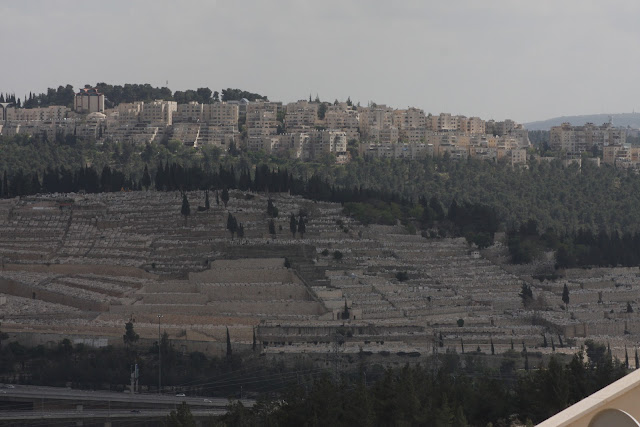
On the terrace of my grandfather’s I saw a Civilization that lived by fostering life VS a Devilization that can only exist by destroying life.
On the terrace of my grandfather I saw a culture of Life being momentarily oppressed by a culture of Death.
On the terrace of my grandfather I understood that for us Palestinians if we are to make it into the future, all we need to do is to vehemently reject the poisonous glitter of the occupiers with all its multifaceted deception: where slavery is sugar-coated with slogans as “modern banking systems”, “global trade”, “free loans”, “buy now pay later” and “economic growth”.
On the terrace of my grandfather I understood that whatever we do we must vehemently oppose any attempt that aims to lure us to “learn” from or mimic the occupier in any shape or form:
Not in the way they run their society, where the selfish concept of “I” and “my interest” are promoted and admired while the foundation of civil human interaction and the altruistic concepts of “we” and the “communal interest” are frowned upon, despised and discouraged as irrelevant backwardness;
Not in the way they conduct business by the use of usury enriching the rich few and impoverishing the masses of poor;
Not in the way they use aggressive agriculture, under the veil of “increasing productivity” they kill the land with chemicals and over-irrigation and destroy the future with GMO sterile seedless uncontrollable crops, they farm animals in the most cruel conditions. Under the veil of modernity they inject seeds of death and un-sustainability, bleeding the land dry of its richness and natural resources;
Not in the way they model their pyramidic hierarchical systems of which millions who languish at the bottom are crushed by a handful who climb to the top.
Not in the way they build colonies brutally carving out the heart of our beautiful landscape, savagely slicing through our precious hills and butchering our millennia-old meadows and mountains only to replace it with prison boxes and creepy tombstones.

On the terrace of my grandfather I saw that a culture of death by its very nature is not sustainable, and cannot possibly survive let alone give birth to life.

On the terrace of my grandfather I saw the manifestation of an exemplary, sustainable, organic, cohesive, open and hospitable civilization, a World Heritage that learned how to peacefully and lovingly coexist and thrive with its neighbours, surroundings and environment.
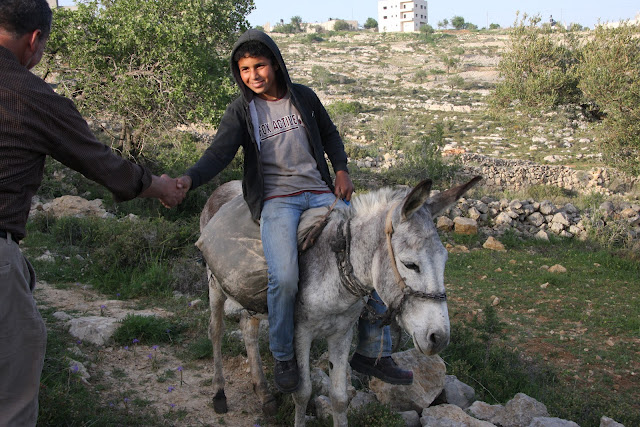
On the terrace of my grandfather, I understood why and how a land can become Holy and from where the sanctity of this cherished Land emerged.
On the terrace of my grandfather I saw the hands of thousands upon thousands of men women and children tenderly attending the land, lovingly removing the stones from its fields and pathways, where in return I saw the stones write poetry of love and thankfulness with its poppies, daisies and bluebells.

On the terrace of my grandfather, I saw the attentive hearts of my people singing melodies of affection and adoration as they tenderly depicted their poetic verses in sublime harmony with their environment. Their little hand-picked stones thoughtfully arranged, perfectly in tune with the landscape around. Sensitively, compassionately and to the best of human endeavour, mimicking in fine details the Divine-artwork, without causing injury or harm to whatever lays in the way. Out of stones, rocks, flowers and trees they have created a timeless panorama of breathtaking beauty.
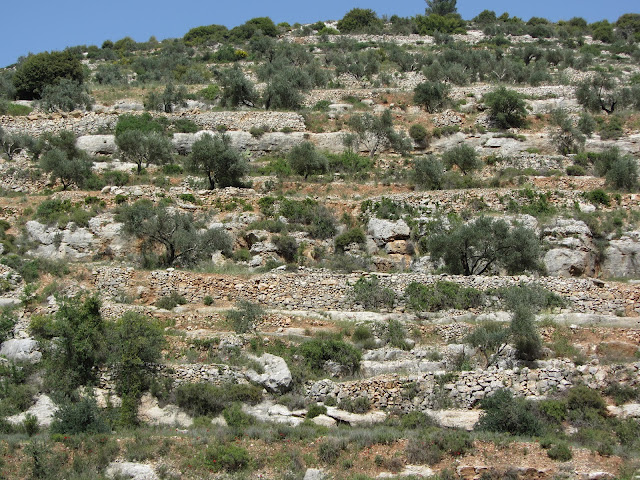
On the terrace of my grandfather, I saw the hands of generations of my ancestors patiently caressing its sleepy hills and artistically painting the landscape with the brush of pure love, swathing it with Holiness and Sacredness, preserving its Divine-given authenticity and protecting life that dwells on it.
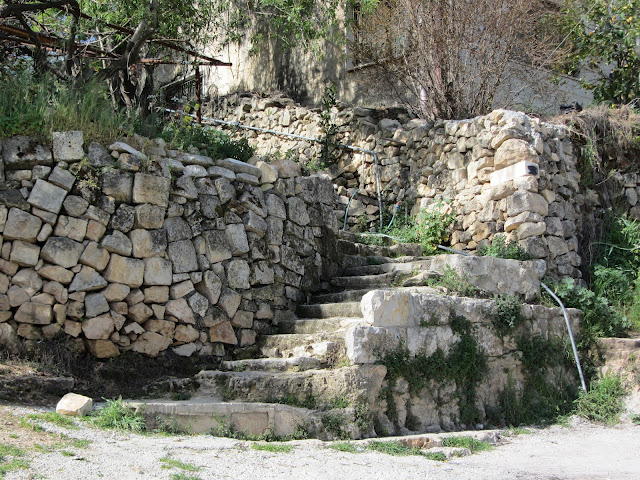
On the terrace of my grandfather I saw breathing homes with flowery grassy roofs, I saw homes with eyes, homes with hearts, homes that smile and weep, homes that rejoice meeting her loved ones and that mourn those whom have been lost.
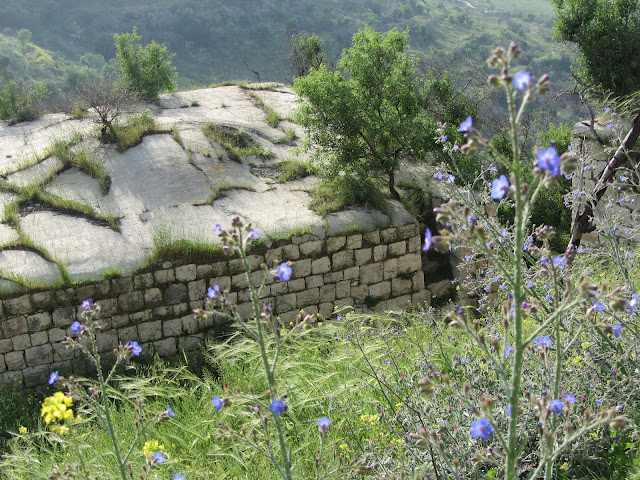
On the terrace of my grandfather I saw homes that welcome its dwellers with hugs and kisses and put its children to sleep by tales of love, magical bedtime stories and singing prophetic lullabies.

On the terrace of my grandfather, I finally understood the meaning of the name Holy Land, Blessed Land, Sacred Land and why that name was bestowed on our Palestine.

On the terrace of my grandfather, I saw Love of Life, Love of Land and Love of Humanity beautifully and supremely intertwined with spirituality, religiously protecting all that is around, thus creating a Holy Land, with excruciating beauty and dazzling glory, a Sacred Landscape, a Majestic Prayer and a Soul-Capturing Sanctuary with infinite charm and mesmerizing grace.

On the terrace of my grandfather, I saw how is it possible for humanity to be saved, to survive and thrive by saving and following the example of Palestine.

On the terrace of my grandfather I understood that the day of their demise is a stone throw away and the day of our Liberation is not far anymore.
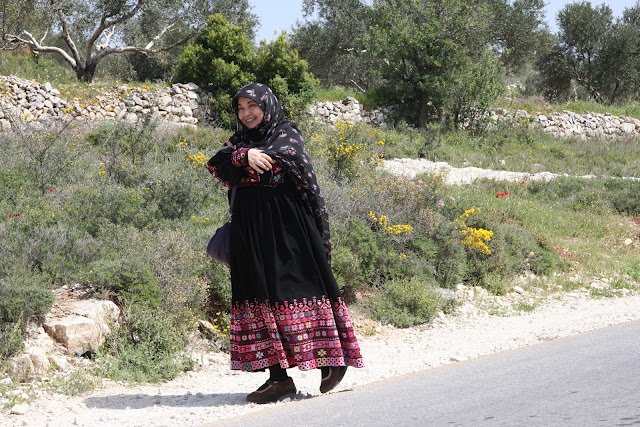
On the terrace of my grandfather I realised that stopping and reversing the destruction of this land, and its inevitable Full Liberation, is not only necessary and urgent from the standpoint of Justice. Palestine is far more.
Palestine and its ominously peaceful and sustainable model is NOT a mere nostalgic ideal, but the most perfect source of inspiration and blueprint to design a futuristic, yet solidly rooted and time tested society, in which human interaction, environmental intervention, timeless architecture, agriculture, ethical commercial exchange and spiritual quest are the peak of human achievement. They are not incompatible with contemporary technology and population growth, they are the safeguards and KEY to a sustainable, peaceful and brighter future.
Whether some like it or not, in order to rescue this Sacred World Heritage, it will need a difficult surgery: the removal of the invading death culture that has shown its colossal failure to integrate the Land and its People.
Beauty and Humanity shall prevail.
I warmly invite the world along with my fellow Palestinians to rediscover and embrace our Palestinian culture of Life following the flowering footsteps of the Prophets of this Holy Land, Palestine.

Related articles
- Palestinians: The Forgotten People (alethonews.wordpress.com)
- Deir Yassin: No passing over history (altahrir.wordpress.com)
Scottish TUC delegates join Palestine freedom struggle – unanimously!
Scottish PSC | April 25, 2012
 The delegates to the Annual Conference of the Scottish Trades Union Congress (STUC), the umbrella group for every trade union in Scotland, today voted unanimously and repeatedly against Israeli apartheid. The 450 delegates voted to:
- campaign to expose the role of the racist JNF (Jewish National Fund) in the Israeli apartheid system
- support the participants in the Welcome to Palestine initiative who tried to travel peacefully to Palestine via Tel Aviv Airport
- fully support the Palestinian-Brazilian call for the World Social Forum-Free Palestine in Brazil in November
- support the Palestinian hunger strikers and the work of Addameer, the Palestinian prisoner support organisation.
Congress delegates congratulated the students for their work organising Israeli Apartheid Week 2012 events, who initiated action in support of the Palestinian prisoners on hunger strike and called for support for the Scottish demonstration this Saturday 28th April in Edinburgh.
These decisions of the Scottish TUC in support of the Palestinian freedom struggle, by a union confederation representing half a million organised workers in every sector of the economy, will be widely seen as a continuation of the international solidarity the STUC also provided to the liberation struggle in South Africa. Glasgow, Scotland’s biggest city, named a city centre street after Mandela in 1986 while he was still on Robben Island. How long till there is a Palestine Square or Palestine Street in our major cities?
The full text of the resolutions – all passed unanimously – is given below.
The Jewish National Fund
That this Congress notes that the Jewish National Fund acquisition and control of land in Israel and the occupied territories actively discriminates against Palestinians.
Congress calls on the General Council to:
- endorse the international call for action against the Jewish National Fund;
- campaign to expose the role of the Jewish National Fund in the oppression of Palestinians; and
- campaign to have the charitable status of the Jewish National Fund revoked.
(Mover: Midlothian TUC)
Emergency Motion – Palestine
Congress:
- notes that despite prisoner releases, over 4,600 Palestinian political prisoners remain in detention, including 203 children.
- applauds the steadfastness of 1,200 Palestinian political prisoners who began an open-ended hunger strike on 17 April to protest against ‘administrative detention’, where detainees are held without charge or trial for up to six months and which can be renewed repeatedly.
- congratulates the student Palestine solidarity network for organising the biggest ever ‘Israeli Apartheid Week’ of educational and solidarity events and for their mobilisation across Scotland in support of Palestinian political prisoners.
- believes that the engagement of students, trade unionists and others with Palestinian civil society can only strengthen the current human-rights based approach to Palestinian self-determination and is essential to building a future of peace and democracy in the Middle East.
- therefore welcomes the January call by the Palestinian National Committee and the Brazilian National preparatory committee for the 2012 ‘World Social Forum: Free Palestine’ to be held at Porto Alegre, Brazil in November. Conference believes that this “Global Meeting of Solidarity with Palestine” will underline the strength and diversity of the support for the Palestinian call for justice.
- therefore instructs the General Council to:
- Support the work of Addameer, Prisoner Support and Human Rights Association, by distributing information and updates to affiliates and by supporting appeals for action where appropriate;
- Endorse the Scottish demonstration, called by students in support Palestinian political prisoners and the hunger strikers, taking place in Edinburgh on Saturday 28th April;
- Endorse the WSF Free Palestine as part of the internationalist activities promoted by the STUC and fully support the appeal from the Secretariat of the Palestinian National Committee for the World Social Forum “Free Palestine” to mobilise the Scottish trade union movement towards WSF Free Palestine.
(Mover: Dundee Trades Union Council)
Emergency Motion – ‘Welcome to Palestine 2012′
This Congress notes that there is no way into the Occupied Palestinian territories except through Israeli controlled airports or checkpoints.
Congress applauds the ‘Welcome to Palestine 2012′ initiative which highlighted Israel’s oppressive and abhorrent policy of restricting free and unopposed movement to, from and within the Occupied Palestinian Territories.
Congress condemns:
- the actions of the Israeli government in blacklisting activists from around the world and denying them access to the Palestinian territories.
- the detention of those activists who reached Tel Aviv wishing to visit Bethlehem at the invitation of the Mayor in order to attend the launch of an educational project to build new schools.
- Congress asks the General Council to call upon the Israeli government:
- to allow unrestricted passage to and from the Occupied Palestinian Territories for those wishing to visit.
- to end the continued, illegal siege by air, land and sea of the Palestinian Territories.
(Mover: Midlothian TUC)
Palestine
That this Congress applauds the successful delivery of humanitarian aid by the Scottish FBU to the Nablus Municipality Fire Department. Congress calls for continued trade union support for Palestinian projects, and for the exploration of a Scottish Trade Union Palestinian Support Group, and report back to Congress in 2013 any progress on this matter.
(Mover: Fire Brigades Union)
President’s Address to Congress (Mike Kirby, UNISON):
“There is a growing apartheid elsewhere, in Palestine. There have been many changes since my first official visit with Bill Speirs, Eddie Reilly and Malcolm Burns in 2001, during the Second Intifada. We were challenged by different militia, as we were escorted throughout the Occupied Lands by PGFTU, our hosts. On leaving, at the last stop at Jerusalem, we met members of the British Press Corps, who challenged us that we had only visited one place, met with one people. Eddie Reilly’s reply still pertains “We met many Israelis on our travels in Palestine. They were all armed and wearing uniforms.” Order may have been restored in many parts under the control of democratically elected representation of Fatah, democratically elected Hamas, and other political organisations. But that order is still enforced by a circle of unlawful Occupation, and the Apartheid Wall divides communities from their lands and work, and families are split apart.” Read full President’s address
Related articles
- Israel student society attacks peaceful Palestine protest with water bombs at London School of Economics (alethonews.wordpress.com)
- Apartheid is a crime, not an analogy (alethonews.wordpress.com)
- National Demonstration: March for the Hunger Strikers – March for Palestine (altahrir.wordpress.com)
- Ex-Palestinian prisoner: captivity in Israel, living in graves (alethonews.wordpress.com)
Palestinians: The Forgotten People
By William James Martin | Palestine Chronicle | April 24th, 2012
It is impossible to understand the present Palestinian/Israeli conflict without understanding the past, in particular, the 1948 ethnic cleansing of Palestine by Ashkenazi Jews from Eastern Europe, who are not Semitic people, but indigenous to Eastern Europe.
In 1900, there were no Ashkenazi Jews living in Palestine; essentially none, that is, but a few, small mostly temporary Russian Jewish settlers, not totally unusual for various cults in the Holy Land at that time. Theodore Herzl, frequently designated ‘The Father of Modern Zionism’, because of the publication of his book, The Jewish State, in 1996, and because of the founding of the World Zionist Congress a year later, stated in 1897:
[We shall] spirit the penniless population across the frontier by denying it employment. Both the process of expropriation and the removal of the poor must be carried out discreetly and circumspectly.
Thus the concept of ethnic cleansing of the Palestinians was introduced.
By the 1930s, the ‘transfer’ of Arabs was the unanimous opinion of the founders of Israel. So-called transfer committees, headed by Joseph Weitz, Director of Land Management for the Jewish Agency, were set up explicitly for the purpose of studying ways of transferring Arabs out of Palestine.
At the beginning of 1948, despite 50 years of land purchases, Jews only owned 6% of the land of Palestine. By the year’s end, the Israeli army controlled 78% of Palestine in a process of ethnic cleansing that saw the destruction of 531 Arab cities or villages and 11 Arab urban areas, with massacres at almost all of those towns or villages, the almost complete looting of Palestinian property and wealth, including looting of banks, confiscation of Palestinian homes and property, businesses, fields and orchards.
The Palestinian people lost everything. Those who survived the massacres lost their careers, their means of livelihood, only to find refuge in tent cities set up by the United Nations which were later to become squalid refugee camps of cinder block buildings dotted around the Middle East.
By just checking the time line, one quickly disposes of the 60 year old Israeli propaganda myth that the state of Israel was innocently minding its own business when it was attacked by five armies of surrounding Arab states.
The ethnic cleansing of Palestinians began on November 30, 1947 in Haifa when the Jewish army under David Ben Gurion, along with the Jewish terrorist group, the Irgun, under Manachem Begin, began shelling the Arab sections of that city. In March of 1948, David Ben Gurion finalized and distributed Plan D to his officers, which was a program for destroying and depopulating Arab villages and eliminating any resistance. The massacre at the Arab village of Deir Yassin, only one of many, but possibly the most famous, occurred on April 9, 1948. Israel declared itself a state on May 14, 1948, and it was the next day, May 15, that the first regular soldier of an Arab army set foot in Palestine. By then, about half of the 800,000 Palestinian refugees had been generated and all of Palestine’s urban centers and been depopulated of Arabs.
One cannot understand the natural anger and resentment of the Arab people, and particularly the Palestinian people, toward Israel, and also to the West, for supporting their oppressors and for being blind to their own suffering, without coming to a full understanding of the catastrophe, which they call the Nakbah, that befell the Palestinian people in 1948.
Nor can one understand the futility of the exalted ‘peace process’, ongoing now for the last 22 years, concurrent with the further erosion of Palestinian rights and freedom, and migration of new Jewish settlers into the West Bank and East Jerusalem, without understanding that Israel acquired its present status as a state, not by negotiation with Palestinians, but by brute force and very much against the will of the indigenous people.
For the Arab people, Israel is an alien implant, imposed by western powers, in the heart of the Arab world against the will of the Arab people.
The Palestinians living under occupation have been living in that situation for 40 years, deprived of natural human rights, abused and, more often than not, humiliated, suffering degradation and humiliation on a daily basis, as their land and property and resources are daily confiscated by the state of Israel, who also winks at settler violence and looks the other way as settlers, who have built their settlement so hilltops, dump their sewage onto Palestinian farmland, as they also cut down their olive trees, burn their fields and poison or otherwise kill their livestock, in order to make way for more settlers and settlements as well as to make life as miserable as possible for the Palestinians.
Zionism is a political program of clearing Palestine of Palestinian Arabs in order to create the space for an exclusive Jewish state. As such, its goal is to destroy the Palestinians as a people with an identity as a people and with an attachment to the land of their births and the births of their ancestry. Such a project meets the definition of genocide in international law. Genocide is a crime against humanity as well as against its immediate victims. Genocide is a crime in which all of humanity is degraded.
William James Martin teaches in the Department of Mathematics at the University of New Orleans. He can be reached at: wjm20@caa.columbia.edu.
Related articles
- Thomas Friedman Exposes Peace Process as a Fraud and Himself a Con Man (alethonews.wordpress.com)
- Knesset to discuss bill authorising settlers’ seizure of Palestinian land (alethonews.wordpress.com)
Khalil al-Wazir: Paving the Way of Armed Struggle

Abu Jihad coordinates with fedayeen (Palestinian guerrilla fighters) during the siege of Beirut in 1982. (Photo: Archive)
By Mohamad Bdeir | Al Akhbar | April 17, 2012
It took Israeli intelligence over two decades and many assassination attempts before they managed to hunt down the PLO’s military mastermind Khalil al-Wazir. On the 24th anniversary of his death, Al-Akhbar recounts his story.
When Khalil al-Wazir (Abu Jihad) began his endeavor in the early 1950s, Israeli intelligence had no idea he existed. At the time, he was the twenty-something leader of the Palestinian al-Haq Brigade in Gaza. His family had been displaced from Ramleh in 1948.
Back then, the security establishment in Israel did not believe that Palestinians were capable of organizing a resistance movement. Operations by the fedayeen (Palestinian guerrilla fighters) were believed to be entirely orchestrated in Egypt.
It took Tel Aviv about 10 years to begin to know al-Wazir, who would go on to play a major role in establishing the first and largest Palestinian national liberation movement. Moreover, he would coin the idea of “armed struggle” as the only path to liberate Palestine.
News of Abu Jihad first reached Israel in 1964 through a secret Mossad unit named “Ulysses” whose mission was to spy on Palestinian refugee communities in Arab countries. Operatives spoke about the creation of a Palestinian national liberation movement led by Yasser Arafat and al-Wazir and sounded the alarm in Israeli security agencies.
According to the Israeli newspaper Yediot Aharonot– which pieced together the story of the assassination of Abu Jihad based on public and private sources – the Mossad formed a secret unit in 1965. Its prime directive was to investigate methods of countering “Palestinian terrorism” and approve assassinations. It immediately suggested two primary targets: Abu Ammar (Arafat) and Abu Jihad.
The first assassination attempt was in Damascus when a planned car bomb operation was not executed properly. It was carried out by an agent of Unit 504 of the military intelligence, responsible for recruiting and running operatives.
Abu Jihad’s role in pushing for armed struggle against Israel became apparent, especially in the period following the naksah (the defeat of Arab armies in 1967). In 1970, Israeli prime minister Golda Meir retaliated by issuing him a “Red Card,” essentially a direct assassination order.
The Israeli secret service was adamant to settle scores with Abu Jihad and put an end to his dossier. In 1975, the Israeli air force raided a building in Beirut based on information of a Fatah movement meeting taking place there. In addition to Abu Jihad, Fatah leaders Arafat, Faruq Qaddumi, and Mahmoud Abbas were supposedly attending.
The Ben Hur operation missed the target and encouraged an escalation of attacks on Israel, coordinated by Abu Jihad, who was now the deputy chief commander of the Palestinian revolution.
On 11 March 1978, he planned the Kamal Adwan operation (named after a Fatah leader assassinated in Beirut in 1973), which was carried out by the Deir Yassin group led by Dalal Mughrabi.
The operation led to the death of 35 Israelis, with dozens more injured. It created a shock wave inside Israel especially following Abu Jihad’s announcement that the operation “demonstrated the ability of the revolution to reach Israel and carry out operations anywhere it wants.”
Following the Israeli invasion of Lebanon and the PLO’s relocation to Tunisia, Abu Jihad attempted to reverse the setback in armed struggle.
He visited various Arab countries, exposing himself to three assassination attempts, according to the Israeli account.
Abu Jihad, for his part, was planning an “unprecedented” operation that would strengthen the PLO’s position and impose new conditions on the struggle with the Israelis.
Twenty resistance fighters were supposed to reach Yafa by rubber dinghies, hijack a bus, drive it to the defense ministry in Tel Aviv, and attack the entrance known as Gate Victor. But the Israeli navy surprised their ship and sank it on 20 April 1985.
Abu Jihad did not hesitate and pressed on with plans for another major operation. In 1988, he picked Dimona, the location of Israel’s nuclear reactor.
On March 7, three Palestinian commandos captured a bus carrying workers from the nuclear facility. The fighters were consequently killed along with three of the workers in an exchange of fire with an Israeli army unit.
The Mossad concentrated its resources on the pursuit of Abu Jihad, by now the number one wanted person in Israel. Defense minister at the time, Yitzhak Rabin, ordered a direct operation that would not resort to remote targeting such as an air raid. He wanted to send a message to the Palestinian movement that Israel can reach its enemies in their homes.
The Mossad surveilled al-Wazir’s home in Tunis, 4km from the beach. It began planning an assassination attempt and sent a unit from Sayeret Matkal (General Staff Reconnaissance Unit) to the Tunisian shores.
It was to repeat the same scenario used successfully 15 years earlier against three Palestinian leaders in Beirut (know as the “Verdun Operation”).
On 13 April 1988, the quarter century chase after al-Wazir was almost over. Mossad agents carrying Lebanese passports arrived in Tunis and split into two groups.
The first group rented cars to transport the assassination unit from the beach to the targeted house, which was being closely watched by the second group.
In the meantime, Israeli navy vessels carrying the assassins were waiting at sea. In the evening, a unit of 26 Israeli commandos reached the beach and took the rented cars to al-Wazir’s home. After 23 years, they finally managed to assassinate him.
The next day, Israeli Prime Minister Yitzhak Shamir was asked about Israel’s involvement in the assassination. Scowling, he replied, “I just heard about it on the radio.”
From Ramleh to Yarmouk
Omar Nashabe
Khalil al-Wazir was born in 1935 in Ramleh and was expelled from Palestine along with his family in 1948. He studied in Alexandria University and then moved to Saudi Arabia.
Later, he went to Kuwait where he met with Yasser Arafat and joined him in creating the Fatah movement.
Leaving Kuwait in 1963, he founded the first Fatah office in Algeria, where he was allowed to establish the first Palestinian military camp.
He then moved on to Damascus in 1965 to establish the military command headquarters and coordinate with fedayeen cells inside Palestine.
During the 1967 war, he planned and executed operations in Upper Galilee, then became the head of the western sector of Fatah until 1982.
Abu Jihad strived to develop military capabilities throughout his struggle, playing a leading role in defending Beirut against the 1982 Israeli invasion.
In his meetings with the fedayeen, he would focus on tactics and also on ethics, telling them to save ammunition and explosives, not to be zealots, and not to steal.
One time, when he was ordering the fedayeen to avoid killing children, one of them replied, “Our children in Shatila and Sabra were the first to die… I lost 12 members of my family.”
Abu Jihad’s reply was clear, “In spite of this, we will not become like those fascists. We are not fascists. [The Prophet Muhammad’s second successor] Omar Bin Khattab commands us not to cut down trees or kill children.”
Memory of Resistance
Qassem Qassem
Those who knew Abu Jihad speak of his special relationship with Imad Mughniyeh. At the end of 1978, a 16-year-old Mughniyeh joined the Fatah cell in Chiyah.
Bassem Haidar, who was in charge of the cell between 1977 and 1979, says that the boy was always with another young man, Ali Khodor Salama (Abu Hassan), assassinated by Israel in 1999 in Abra, near Sidon.
The newcomer soon caught the attention of the higher command of the Palestinian revolution, specifically Abu Jihad, due to his skill in planning ambushes in the area between Tayouneh and Asaad al-Asaad street (south of Beirut).
He was none other than Mughniyeh, Hezbollah’s military commander who was assassinated in Damascus in 2008.
“Mughniyeh was the only person able to provide the cell with the weapons they needed. He would go to the Fakhani neighborhood (PLO headquarters in Beirut) and get it,” Haidar remembers.
“Once, we needed 3.5 inch anti-tank missiles, so he was sent to get them.” Haidar continues, “Had Mughniyeh’s relationship with Abu Jihad not been good, he would not have been able to get them, since they pass directly through the leadership.”
In 1978, Mughniyeh left the Chiyah cell after “he was summoned by the leadership in Fakhani and began clandestine work in a secret security unit. We never saw him again.”
Related articles
- Marwan Barghouti: A Decade of Defiance (alethonews.wordpress.com)
- What Marwan Barghouti Really Means to Palestinians (alethonews.wordpress.com)
Air France accused of racism after banning non-Jew from flight
Al Akhbar | April 17, 2012
French activists participating in the Welcome to Palestine campaign over the weekend accused Air France of racism on Tuesday after the airline asked passengers if they were Jewish as part of a strategy to prevent the activists from boarding.
“The racism of Israel and Air France was brought in plain light on Sunday…It was proven that one had to declare themselves Jewish or holder of an Israeli passport to have the right to travel,” the French contingent of Welcome to Palestine 2012 said in a press release on their website.
The activists noted the case of a passenger named as Horia, who had successfully boarded the plane, but was then asked by an air hostess whether she was Jewish before the flight had taken off.
An Air France employee signed Horia’s response on an official document (see below), and was then allegedly told by Air France personnel that she was prohibited to travel to Tel Aviv, according to activists.
Coordinator for the French chapter of Welcome to Palestine 2012, Maximilien Shahshahani, told Al-Akhbar that Air France was colluding with Israel’s secret service, Shin Bet, in determining which activists were not permitted to board Sunday’s flight to Tel Aviv.
“Shin Bit shared a blacklist of names with Air France, but told the airline to double check [others not blacklisted] with a series of questions,” he said.
The questions were also asked of other passengers, Shahshahani said, who were not participating in the Welcome to Palestine campaign.
“We saw another passenger, to which the same questions were asked. The response to the second question was that they were Jewish. The passenger was extremely shocked by the nature of the questions,” he said.
Air France in a statement issued on its website said Israeli authorities demanded that the airline question one of the passengers, without detailing what kind of questions were asked.
“The Israeli authorities requested that one of the passengers be questioned. The answers did not satisfy the Israeli authorities, the passenger had to disembark the flight at their demand,” Air France said.
Hundreds of activists, mostly from Europe, were due to fly into Tel Aviv international airport on Sunday as part of a global campaign to raise awareness of the restriction of movement and travel for Palestinians brought by Israel’s military occupation.
But, as in 2011, Israel threatened airlines that they faced sanctions if they did not prevent activists from boarding their flights, providing them with a list of names.
“You are ordered not to board them [activists] on your flights to Israel. Failure to comply with this directive will result in sanctions against the airlines,” a stern statement from Israel’s Ministry of Interior to airlines, obtained by activists, read.
Dozens still managed to board flights to Israel, with the official website for the French contingent of Welcome to Palestine saying that 40 French activists were detained upon arrival.
Preparations for legal proceedings against Air France are underway, Shahshahani said.
Welcome to Palestine has become an annual campaign, which is part of a growing international movement to highlight the continued suffering of Palestinians living under Israeli occupation and Israel’s apartheid policies.

An alleged Air France document showing questions asked of a passenger boarding a flight to Israel on Sunday 15 April 2012. (Photo: Handout – Welcome to Palestine 2012)
Related articles
- Israel and Air France racism overt (altahrir.wordpress.com)
- Europe’s airlines enforce Israeli travel ban on activists hoping to repair Palestinian schools (altahrir.wordpress.com)
- ‘Flytilla’ for Palestine hit by arrests as Israel clamps down (alethonews.wordpress.com)
Featured Video

Matt Bracken: US Plans Massive MOAB Strike on Iran?
or go to
Aletho News Archives – Video-Images
From the Archives
Confronting the Threat of Ethnic Bioweapons
By Tony Cartalucci – New Eastern Outlook – 29.11.2017
The United States Air Force’s 59th Medical Wing’s molecular biology branch recently was revealed to have been collecting specifically Russian RNA and synovial (connective) tissue samples, prompting fears in Russia of a possible US directed ethnic-specific bioweapons program. … continue
Blog Roll
 Aletho News
- Matt Bracken: US Plans Massive MOAB Strike on Iran?
- Russia accuses France of ‘piracy’ over tanker seizure
- Why Yemen Is Bombing Saudi Arabia’s Airports: The War Behind the Headlines
- Sally Rooney’s books pulled from UK over support for Palestine Action
- Bombs for Tel Aviv, Promises for Riyadh
- Israeli ad agency conducted vast global espionage campaign using online ads: Report
- Oct. 7 Forever Marks The Big Reveal: ‘We See You, Israel, We Revile You, We Reject You!’
- Meet the US generals and admirals advancing Israeli policy
- Israel’s Straw Widow Protocol: The Kill Zones Where Civilians Were Labelled ‘Terrorists’
- Leading Israeli Think Tank Publishes Psychotic Israeli ‘National Security’ Doctrine
- If Americans Knew
- Israeli firm used online ads to run vast spy operation, researchers say
- No, the world zionist movement is not an antisemitic conspiracy theory
- Hundreds of IDF investigations into killings still have no public outcome, BBC Verify finds
- After Ashley Moody Epstein Probe, Donors Linked to Him Poured Money Into her Senate Campaign
- Worried about Russian meddling in UK politics? Wait till you see what Israel is up to
- Israeli settlers attack West Bank center for disabled children, church leader calls for int’l action
- Pulling Out Teeth Just to Live: How Israel Has Devastated Dental Care in Gaza
- Gaza’s “ceasefire” death toll passes 1,500 – Daily Update
- Activists Abused By Israel Return to New Freedom Flotilla Mission
- 60 Minutes won’t tell the full truth about Israeli settler violence
- No Tricks Zone
- New Study Suggests Large Regions Of The Pacific Ocean Have Been Cooling For The Last 80 Years
- Germany’s Green Energy Debacle: High Energy Costs Force Kahla Porzellan to Close After 182 Years!
- New Study: 50 Years Of The Most Aggressive ‘Net Zero’ Policies Can Only Affect The Global Climate By 0.03°C
- US September “Heat” Was No Record…Many Records Set Decades Ago
- Latest European Green Energy Debacle; Portugal’s Largest Flagship Solar Park Insolvent!
- Green Energy Debacle: German Expert Professor Fritz Vahrenholt Warns Of Severe Economic And Social Consequences
- Two More Paleo Reconstructions Affirm Meters-Higher Sea Levels Across Ireland, Brazil 7000-6000 Years Ago
- New Study: Earth And Venus Surface Warmth Largely Explained By Convection And Lapse Rate, Not CO2 Or Radiation
- 2025 Nature Paper Claiming Worsening Global Drought Gets RETRACTED …Heavily Flawed
- New Study: ‘Global Drought Shows No Detectable Recent Acceleration Under Climate Warming’

